









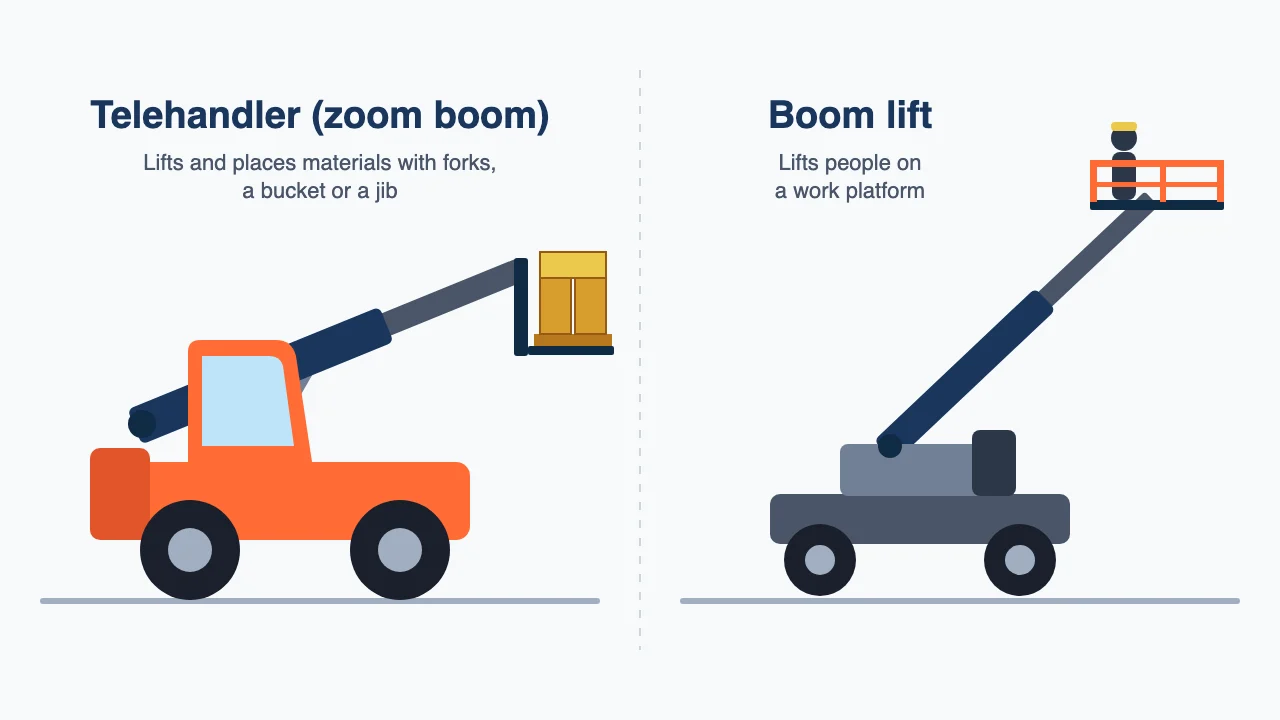
Yes. On North American job sites, “zoom boom” is a nickname for a telehandler. A telehandler uses its telescopic boom to lift and place materials with forks, a bucket or a jib. When a supplier uses the term “boom lift”, check the machine and working equipment on the quotation.
Names for site equipment are not standardised. The same machine may be called a telehandler, a telescopic handler, a reach forklift or a zoom boom, depending on the country and the job site. In some markets it is also called a boom loader.
Recognising a Telehandler and a Boom Lift
Both machines have a boom, which is why the names get mixed up. The difference is what the boom carries. A telehandler carries materials on its boom head. A boom lift carries people in a work platform. The diagram at the top of this page shows the two side by side.
| What to check | Zoom boom / telehandler | Boom lift |
|---|---|---|
| Main job | Lifts, moves and places materials | Lifts people to work at height |
| Equipment on the boom | Forks, a bucket, a jib or another attachment | A work platform for people |
| Typical loads | Pallets, building materials, bulk material and bales | Workers with their tools, within the platform rating |
| How capacity is stated | Rated load, with a load chart for each attachment and setup | Platform capacity and working height |
| Other names you may hear | Telescopic handler, reach forklift, boom loader | Aerial work platform, cherry picker |
If you are deciding between a telehandler and a warehouse forklift, see our guide on choosing a telehandler or forklift. For a full comparison of the two boom machines, read telehandler vs boom lift.
What the Machine Can Do
A telehandler is a material handler. The attachment on the boom head decides the job:
- Pallets with forks: lifting pallets of blocks or bagged material off a truck and placing them on a scaffold or an upper floor.
- Bulk material with a bucket: loading sand, gravel or feed and moving it around a yard.
- Bales with a bale clamp: stacking bales in a barn or loading them onto a trailer.
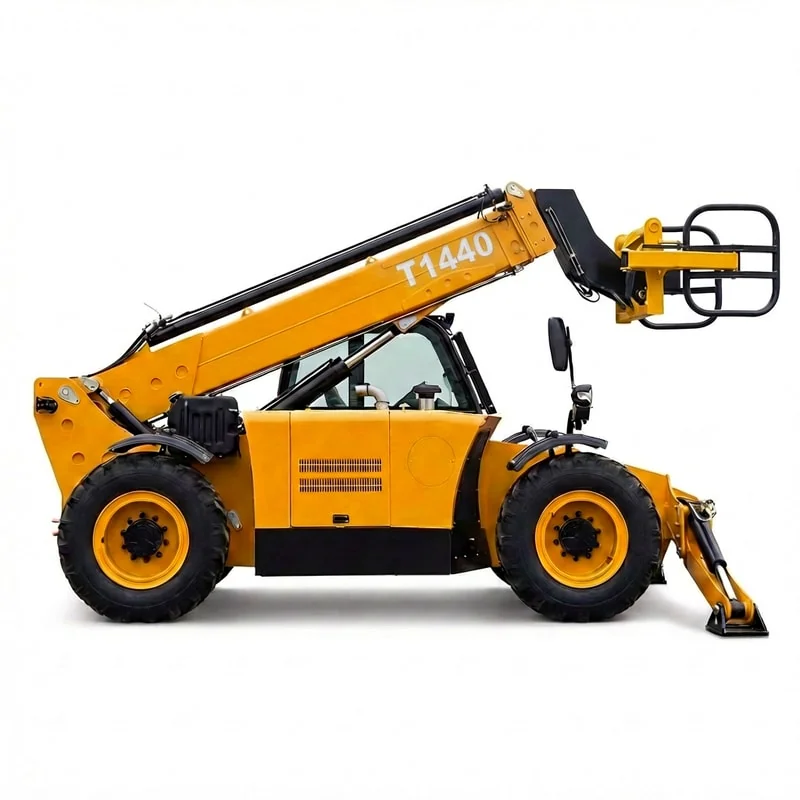
The rated load on a specification sheet is the maximum the machine can lift at a defined position. As the boom raises and extends forward, the safe load falls. The load chart for the model, attachment and setup shows the safe load at each lift point. Read more about telehandler lifting capacity and how to read a telehandler load chart.
Lifting people is a separate question. It depends on a suitable work platform for that machine and its documentation. See our guide on whether a telehandler can lift people.
Quick Answers
Which equipment name should I use when contacting a supplier?
Use “telehandler” or “telescopic handler” and describe the attachment and the work you need it to do.
What should I check if a supplier quotes a “zoom boom lift”?
Ask for the model, the working equipment and the intended use. Confirm whether the quotation covers a telehandler with the attachment you need or a boom lift with a work platform.
What details help a supplier check a lifting task?
Give the load, working height, forward reach and attachment. Ask for the load chart for that model and setup.
Where can I check a question about a personnel platform?
See our guidance on telehandlers and personnel platforms, and check the documentation for the specific machine and platform.
Related Guides and Machines
- What is a telehandler? How the machine works and where it is used.
- Telehandlers on a construction site: common site tasks and setup.
- Telehandlers for construction projects: machines and attachments for building work.
Two example machines: the T3507 telehandler – 3.5 t, 7 m for construction and yard work, and the T1440 telehandler – 4 t, 14 m for higher lifts.
References
- Wikipedia, “Telescopic handler”: lists telehandler, teleporter, reach forklift and zoom boom as names for the machine.
- Kevin Forestell, “The Zoom Boom: Features, Applications, and More”, DOZR, 2 October 2023: notes that telehandlers are also called telescopic handlers, reach forklifts and zoom booms.