










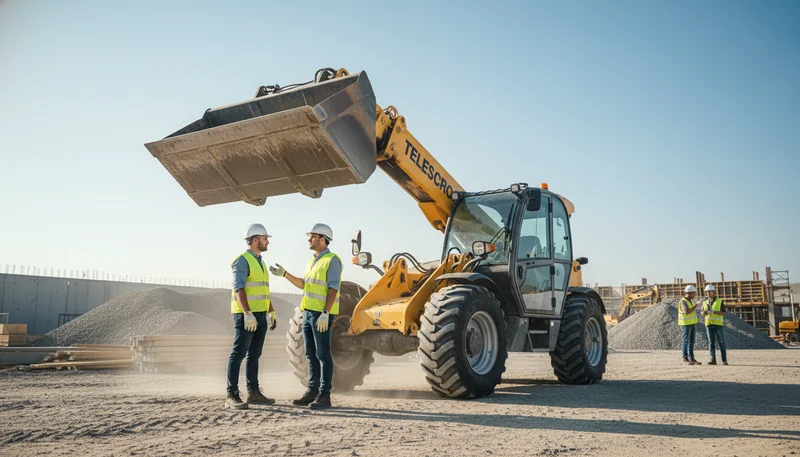
Just a couple of weeks ago, I was watching a crew outside Kraków, Poland, and they were completely stalled for half a day. Why? Their telehandler bucket was losing about 15% of the grain on every run because they had the wrong type of spill guard. It’s wild how often attachment mistakes—the small details people overlook until the jobsite turns into chaos—end up eating huge chunks of time and money.
After four years of running these machines and a background in mechanical automation from university, I can tell you that picking a telehandler bucket isn’t about guesswork; it requires a systematic review. You have to look at the material you’re moving, how often you’ll be moving it, and, critically, what your specific machine can actually handle safely.
Industry studies confirm what I see every day: a mismatched bucket size or type can absolutely slash productivity—we’re talking up to forty percent—and dramatically increase the risk of rollover. Professional practice demands that I map out the annual material handling patterns, verify the actual working capacities using the bucket-specific load charts, and then match the bucket’s width, mounting system, and hydraulic needs to the telehandler.
How Do I Match Bucket Type to Job?
Start by listing your top three annual bucket tasks. Identify main materials handled—such as grain, rubble, or manure—and categorize them by density and abrasiveness. Consider typical travel distances and underfoot conditions. Matching bucket specifications to your primary workload can boost productivity and reduce premature equipment failure.
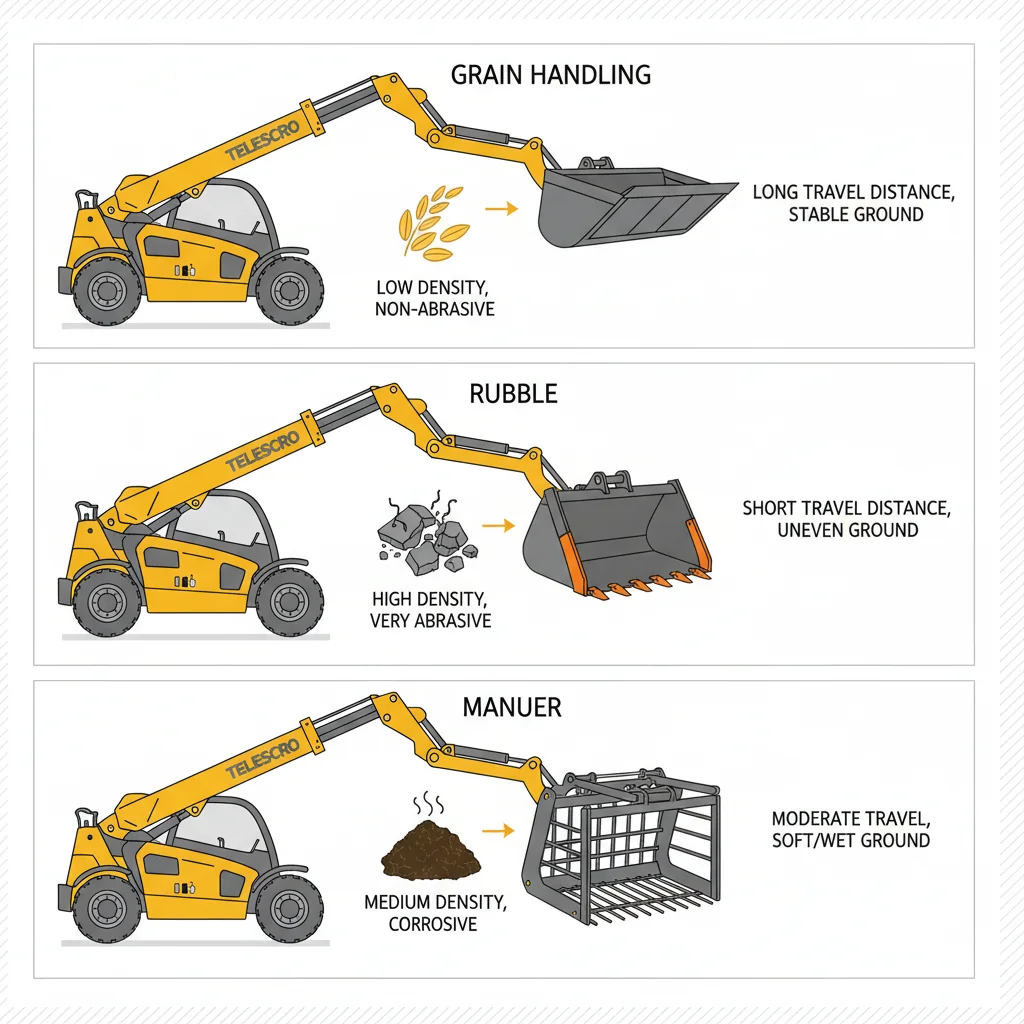
Most people don’t realize the real secret to choosing the right telehandler bucket: you need to plan around your three most common annual jobs—not just tomorrow’s project. I’ve worked with a massive dairy farm in Poland where 70% of their bucket use was for silage, 20% for manure, and only 10% for gravel. They picked a general-purpose bucket, thinking it would be “good enough” for all jobs. Within six months, abrasive gravel1 had chewed up the cutting edge, and the bucket was far too shallow to be efficient with the high-volume silage. Result—slow work and a costly early replacement.
Here’s what matters most: start with your main materials. List them out, and group them by density and abrasiveness. For example, light materials like grain or snow need big, high-side buckets (sometimes 2.5 m³ or more) because weight isn’t the issue, volume is. But if you’re dealing with dense, tough rubble, you need a reinforced bucket2—heavier steel and maybe a narrower build, usually 1–1.2 m³.
Cycle distance is next. If you’re traveling long distances on rough ground, capacity matters less than reinforcing the bucket and checking weld seams for fatigue. I remember a contractor in Dubai who lost three days because a light-duty bucket cracked right open under the stress of rocky demolition debris.
Here’s a simple table I use to help compare bucket options:
| Material Type | Bucket Shape | Best Capacity (m³) | Wear Protection | Typical Issue If Mismatched |
|---|---|---|---|---|
| Grain/Silage | High-side, wide | 2–3 | Minimal | Extra trips, wasted time |
| Gravel/Demolition | Reinforced, narrow | 1–1.2 | Bolt-on cutting edge | Early wear, cracks |
Choosing a bucket based on the proportion of annual tasks rather than a single job can extend cutting edge life by over 50%True
Selecting a bucket tailored to the majority of use cases, such as a deeper bucket for silage instead of a general-purpose shallow bucket, reduces excessive wear and improves efficiency, significantly prolonging cutting edge lifespan compared to a one-size-fits-all approach.
The general-purpose telehandler bucket is equally effective for abrasive materials like gravel as specialized gravel bucketsFalse
General-purpose buckets are typically shallower and use lighter cutting edges, which wear quickly when used with abrasive materials like gravel, whereas gravel-specific buckets have reinforced cutting edges and optimized depth to handle abrasive loads efficiently.
Key takeaway: Define your top three materials and tasks handled throughout the year—not just immediate needs—then select a telehandler bucket optimized for the majority of these uses. This approach can improve productivity by up to 40% while preventing excess wear, downtime, and costly mistakes.
How Does Bucket Size Impact Lift Capacity?
Bucket size alters your telehandler’s effective lift capacity due to increased distance from the center of gravity. An oversized bucket, especially with dense materials, can quickly reduce rated capacity, increasing rollover risk. Always use the correct bucket load chart3 and account for both bucket and material weight.
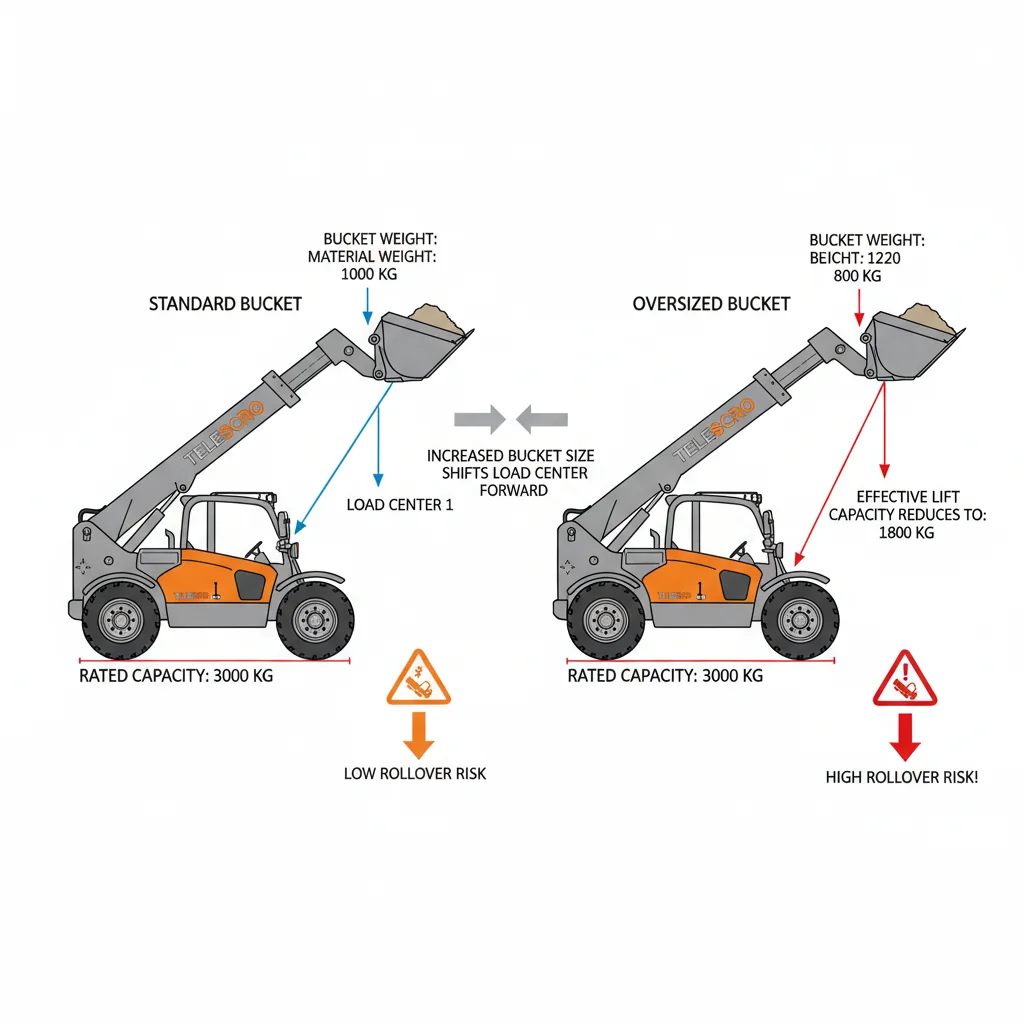
Let me share something critically important about bucket size—this topic causes more issues and close calls than most operators realize. I’ve seen jobsites from Dubai to Qingdao where teams swapped out a standard fork for the biggest bucket they could find, hoping to speed up loading. Here’s the fundamental problem: the moment you attach a large bucket, the load center moves forward, away from the telehandler’s base. That extra distance—sometimes 50 to 80 centimeters—has a colossal impact on stability and safe lifting. I’ve personally watched a 4-ton machine rated for 5,000 kg on forks drop to just 2,400 kg capacity with a full rock bucket. The load chart (usually stuck right on the cab window) makes this clear, but on busy sites, it’s dangerously easy to ignore.
From my experience, the risk jumps highest when operators don’t factor in both the bucket’s weight and the material density. Last year, a client in Brazil filled a 1.8 m³ bucket with wet sand—which is far denser than dry material. The total load was over 3,000 kg, exceeding the chart by almost 650 kg. Their telehandler’s front wheels nearly lifted off the ground, causing a terrifying moment of instability. That close call could have been a disaster.
If you’re handling stone, concrete rubble, or wet aggregates, I always suggest using a smaller, reinforced bucket—typically under 1.2 m³. For lighter materials like wood chips or grain, a larger bucket makes sense, but only with a careful look at the specific chart for that attachment. Never just go by the telehandler’s “headline” capacity. Keep a copy of each bucket’s load chart in the cab and make sure every operator knows how to check it before lifting. It’s a simple step that prevents expensive, career-ending mistakes.
Increasing the bucket size by 15 centimeters can shift the load center forward by up to 80 centimeters, significantly reducing the telehandler’s rated lift capacity due to stability lossTrue
The load center distance directly affects the moment arm on the telehandler’s chassis. Even small increases in bucket size disproportionately move the load center forward, decreasing stability and lifting capacity as per ASTM standards for telehandler ratings.
Using a larger bucket attachment increases the telehandler’s lift capacity because it allows for better weight distribution across the machineFalse
Larger buckets increase the load center distance, which actually decreases lift capacity and stability. Weight distribution shifts forward, causing higher tipping risk and reducing the telehandler’s rated safe lift, contrary to the claim.
Key takeaway: Oversized buckets significantly reduce your telehandler’s safe working capacity and are linked to 40% of industry rollovers. Always consult the bucket-specific load chart4, combine bucket and material weights, and size attachments for the material type to avoid dangerous overloading and machine instability.
Which Telehandler Bucket Fits My Materials?
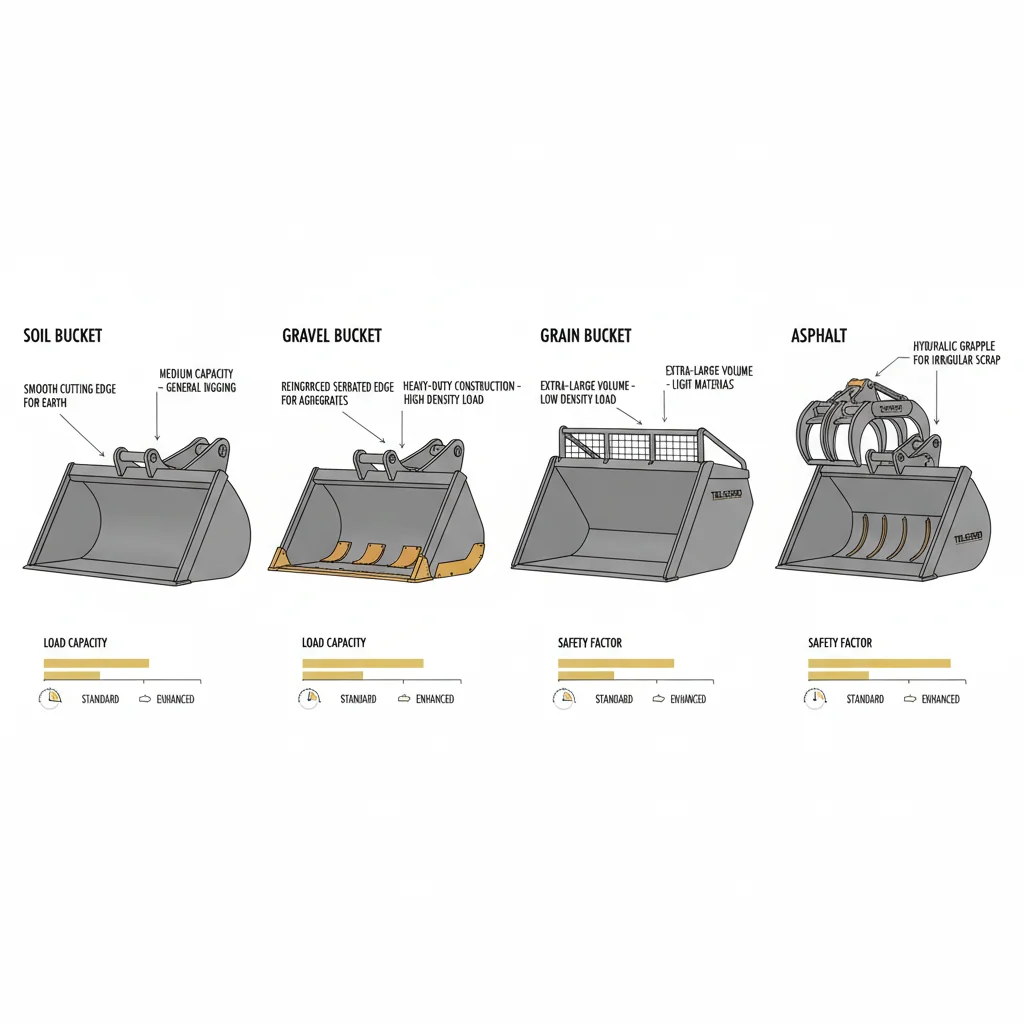
Selecting the right bucket means matching your primary material type—soil, gravel, grain, scrap, or asphalt—to the specialized bucket designed for it. Each telehandler bucket type optimizes handling, safety, and longevity if aligned with specific load densities and worksite needs.
Here’s what matters most when picking a telehandler bucket: match the bucket type to your actual material, not just what looks good in a brochure. I’ve seen this firsthand on a jobsite in Dubai, where a customer ordered a high-capacity bucket to move gravel—because it “fit the biggest load.” It turned out to be the wrong fit. The oversized bucket overloaded the machine’s hydraulics and cut productivity because every load had to be dumped halfway.
From my experience, most projects fall into five main material types. General purpose buckets handle dense, abrasive materials like soil, mulch, and mixed debris. In Kazakhstan last year, an agri business switched from a light-material bucket to a heavier-duty one for compost; it lasted nearly twice as long—saving significant downtime. Light-material buckets5 come into play for grain and silage, where volume matters but weight is lower so you don’t tip the telehandler or stress its structure.
If you deal with rock, demolition scrap, or asphalt, don’t risk standard buckets. Reinforced shells and bolt-on cutting edges6 take the beating and push structural life well past three years, even under heavy loads. Grapple buckets become invaluable if you move brush, pipe, or bale; the clamp keeps unpredictable loads secure, especially on uneven terrain. Hot box buckets are overkill unless you’re dedicated to asphalt—they’re costly and rarely justify the investment if you just need a general bucket for dirt.
Using a high-capacity bucket that exceeds your telehandler's maximum hydraulic flow rate can cause premature wear on the hydraulic pump and reduce overall machine lifespanTrue
Buckets that require hydraulic flow beyond the telehandler’s design limits force the pump to work harder, generating excess heat and stress on components, which accelerates wear and downtime. Matching bucket capacity to hydraulic specifications prevents this.
Telehandler buckets designed for granular materials like sand typically have a tapered back to enhance carrying capacity by up to 50%False
While tapered backs can improve material flow for some attachments, telehandler buckets for granular materials focus on optimized volume and tipping design rather than extreme tapering, which would actually reduce effective capacity and complicate loading.
Key takeaway: Identify your most common working materials first, then choose the simplest telehandler bucket purpose-built for that load. This ensures superior productivity, reduces equipment wear, and avoids over-investment in specialty attachments that aren’t suited to your daily operations.
How Do You Select Telehandler Bucket Width?
Choose a telehandler bucket width based on your machine’s size and the narrowest points in your working environment. Standard widths for ~3-ton telehandlers fall between 1.8–2.4 meters. Avoid exceeding your telehandler’s tire width7 to minimize the risk of striking obstacles or overloading components.
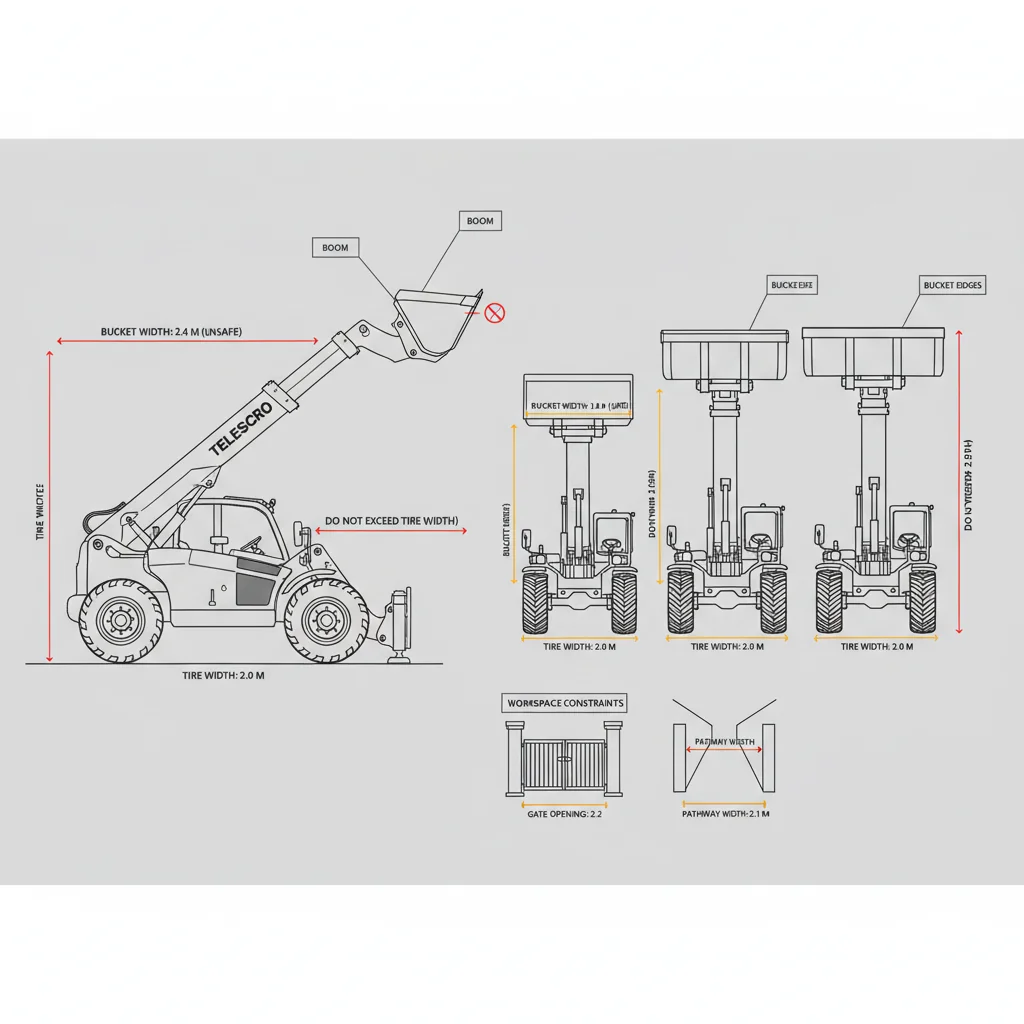
The biggest mistake I see is people spec’ing a bucket as wide as their telehandler can handle—on paper. In reality, the working site decides what actually fits. Not long ago, a customer in the UK called me upset because his new 2.5-ton unit with a 2.4-meter bucket couldn’t get through half the barn doors on his site. He’d measured only the main gates, not the narrow feed alleys and internal doors. That wide bucket looked efficient during the sales demo, but I watched the team losing at least an hour every day just repositioning or detaching the bucket to get through bottlenecks.
To be honest, the critical dimension isn’t just what your telehandler can lift, but the tightest gap you need to squeeze through—between tire racks, door frames, or even parked equipment. For most standard 3-ton machines, 1.8 to 2.2 meters hits the sweet spot, but always compare this to your machine’s outside tire width. If your bucket sticks out more than 10-15 cm on each side, you risk snagging posts or overloading the frame, especially in older yards or renovation sites with uneven pathways.
I’ve seen in Kazakhstan that for rocky sites or demolition debris, crews prefer slightly narrower and deeper buckets—maybe 1.8 meters—to improve digging force and reduce spill. Anyone moving wood chips or hay should also look at buckets with high backs or spill guards to avoid blowing material toward the cab. I suggest walking the full work route, tape measure in hand, before ordering. Give yourself 10 cm margin each side—even experienced operators need room for error. This detail saves hours of frustration and repair later.
Selecting a telehandler bucket width should be based primarily on the narrowest access point on the job site, such as feed alleys or barn doors, not just the maximum width the telehandler can handle on paperTrue
Even if a telehandler can technically handle a wide bucket, site constraints like narrow doorways and alleys dictate the bucket size to ensure operational efficiency and avoid daily delays caused by repositioning. Prioritizing site-specific measurements prevents costly inefficiencies.
Choosing the widest possible bucket for your telehandler will always maximize job site productivity because it increases material retention with each loadFalse
Although wider buckets carry more material, they can reduce productivity if they don’t fit through tight spaces on the job site. Oversized buckets cause frequent repositioning and maneuvering, leading to time loss that outweighs the benefit of extra material per scoop.
Key takeaway: Match your bucket width to both the telehandler’s physical dimensions and your site’s tightest clearances. Consider walk-through checks to measure critical passageways, and factor in spill guards for light materials. Avoid excess width to reduce accident risks and mechanical strain.
Which Telehandler Bucket Mounts and Hydraulics Fit?
Mechanical fit means matching your telehandler’s quick-attach system or pin-on mount (JLG, Genie, CAT, SkyTrak, etc.), while some brands use proprietary hitches. Hydraulically, confirm auxiliary lines, flow, and pressure ratings match any powered bucket needs to avoid performance or warranty issues.
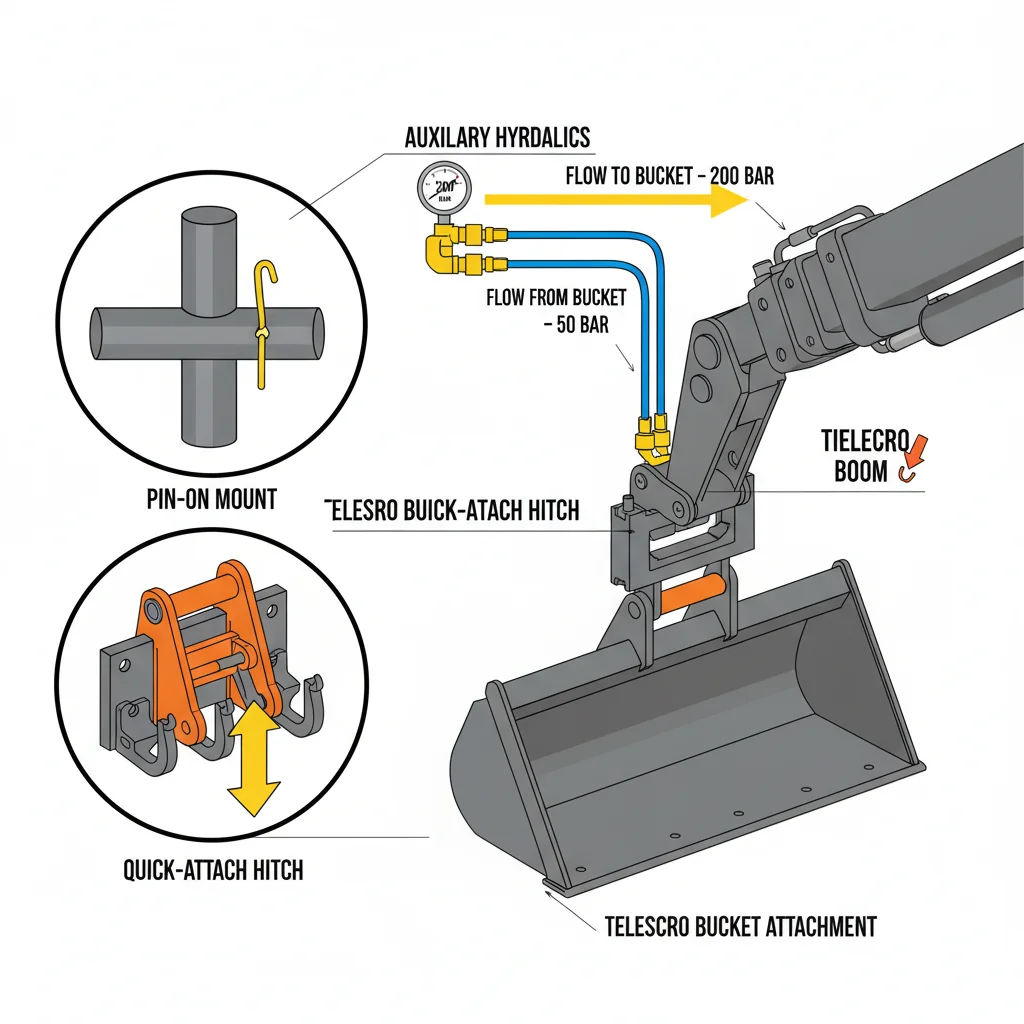
Last month, a client from Kazakhstan sent me photos of two new buckets—they looked perfect, but wouldn’t latch onto his 4-ton telehandler. The issue? He’d ordered a general “universal” quick-attach, but his machine actually took a specific CAT J-style pattern. This happens more than people think. The reality is, there’s no true universal fit. You need to match your telehandler’s carriage—whether it’s a horizontal pin-on, J-style quick-attach, or a proprietary hitch. If you’re running older pin-on mounts, I’ve found that switching to a quick-attach pattern with an adapter plate can save hours during attachments swaps and even boost resale value when it’s time to upgrade.
Mechanics aside, I often see teams forgetting about hydraulics. A customer in Dubai tried to run a powered grapple bucket on a 3,500 kg compact telehandler that had no auxiliary hydraulic lines8 installed. They lost half a week sourcing and installing retrofits. If your bucket needs powered clamps or a hydraulic opening, you must verify your machine’s auxiliary lines, hydraulic flow (in liters per minute), and pressure (typically 180-250 bar). Mismatched flow can cause sluggish or jerky operation or, worse, overheat your system—both risk safety and void warranties.
Here’s a simple table I use when reviewing telehandler and bucket compatibility:
| Feature | What To Check | Typical Range/Note |
|---|---|---|
| Carriage/Mount Pattern | Quick-attach or pin-on? | Confirm model-specific (adapter?) |
| Bucket Weight | Under rated tipping load? | 300–700 kg common bucket weights |
| Aux Hydraulics Needed | Yes/No + Flow/Pressure | 40–120 L/min; 180–250 bar |
| Electrical Connections | Power for switches/sensors? | Some clamps/grapples require this |
I suggest always confirming fit and hydraulics with your supplier in writing—avoid expensive surprises on site.
J-style quick-attach carriages often feature integrated hydraulic couplers that simplify bucket connection by automatically linking the hydraulic lines when the bucket latchesTrue
J-style quick-attach systems are designed to both mechanically secure the attachment and automatically connect hydraulic lines, reducing setup time and minimizing operator error during bucket changes. This integration is specific to the J-style pattern, unlike some pin-on mounts which require manual hydraulic hookups.
All telehandler buckets labeled as ‘universal’ use the same hydraulic pressure rating of 2500 psi, ensuring compatibility across all 4-ton telehandlersFalse
‘Universal’ buckets do not guarantee a standardized hydraulic pressure rating. Hydraulic systems vary by manufacturer and model, and buckets must be matched to the specific hydraulic flow and pressure capabilities to avoid damage or performance issues. The 2500 psi rating is not a universal standard and assuming so can lead to incompatible equipment and safety risks.
Key takeaway: Check both mechanical mounting (carriage, quick-attach, adapter plates) and hydraulic compatibility (lines, flow) before purchasing a telehandler bucket attachment. Mismatches can cause expensive returns, unsafe field modifications, or non-functional hydraulics. Always confirm with your supplier, in writing, that your exact machine and the bucket are fully compatible.
How Do Bucket Specs Affect Total Cost?
Bucket selection shouldn’t be based solely on price. Cheaper buckets often use thinner steel and weak welds, wearing out in 6–12 months. Quality aftermarket brands may outperform OEMs at 20–35% less cost. Reference full spec sheets and user feedback to ensure durability and value.
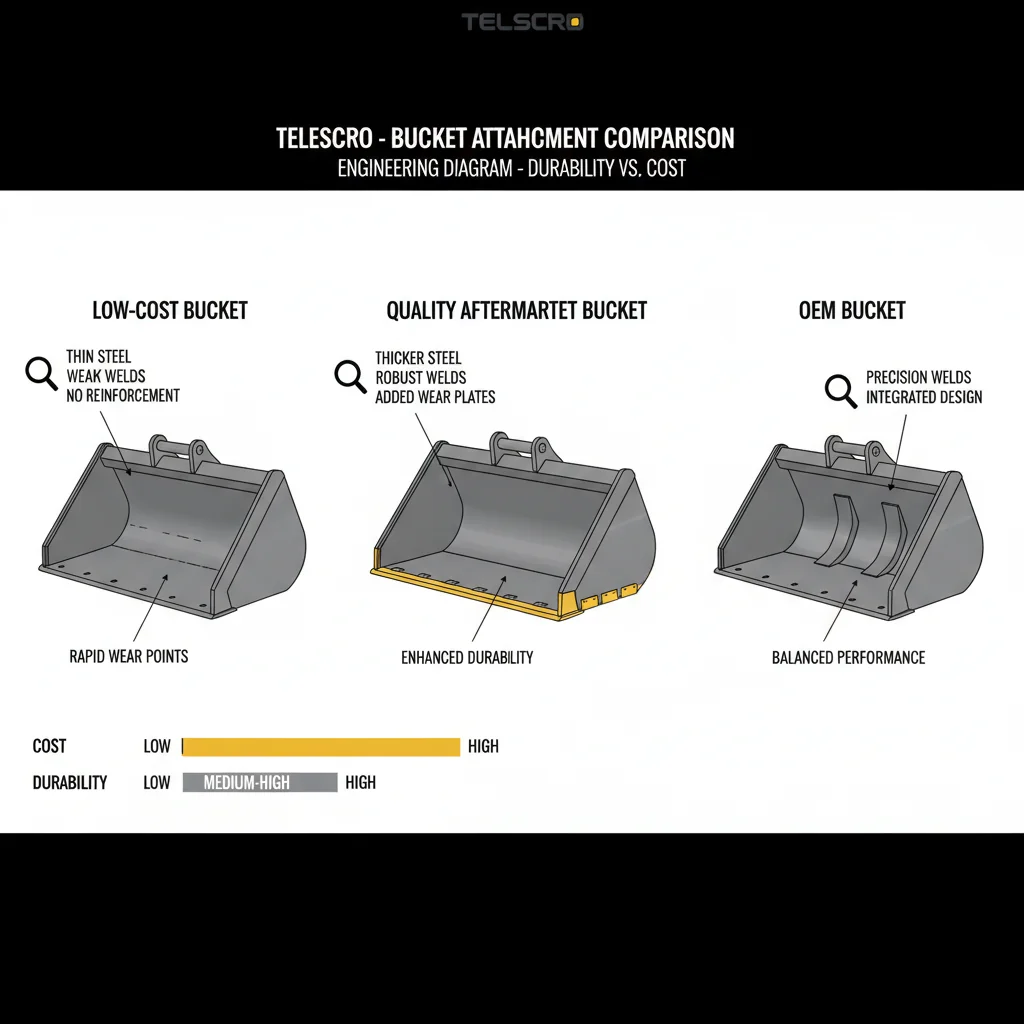
Last year, a contractor in Dubai called me after their telehandler buckets needed replacing just eight months into a new project. He had chosen a cheaper supplier, thinking he’d save money on the initial purchase. But every bucket showed cracked welds and worn-out cutting edges—far sooner than expected. When I asked for the spec sheet, the details were clear: shell thickness9 was under 5 mm, welds looked rushed, and the edge steel wasn’t rated for abrasive use. Their average downtime was two days every month just for repairs. By the end of year one, bucket replacements and lost labor cost them three times what a higher-spec option would’ve been.
To be honest, the specs that actually matter are steel grade, shell thickness, and overall weld quality. I always suggest comparing these details side by side. For example, a quality aftermarket bucket with 8 mm shell and a Hardox cutting edge10 can last up to four years in concrete or aggregate work. I’ve seen mine run nearly double the lifespan of an entry-level version, even at 20–30% lower price than OEM. In Kenya, one fleet manager told me their switch saved at least two full months’ downtime over three years just by investing in better steel.
Don’t forget, oversized buckets may require special shipping or risk overloading your hydraulic circuit. Ask the supplier for a detailed spec sheet, and check if local support—or even replacement cutting edges—are available nearby. For most sites, investing in durability up front means much lower cost per ton moved over time. I recommend making spec comparisons a non-negotiable step.
Telehandler bucket shell thickness below 5 mm significantly increases the risk of premature cracking under heavy-duty use due to insufficient structural reinforcementTrue
Buckets with shell thickness under 5 mm lack the necessary durability to withstand high stress and abrasive conditions, leading to cracked welds and faster wear, which raises maintenance cost and downtime.
Using a cheaper supplier for telehandler buckets generally reduces total project cost by at least 30% because the lower purchase price outweighs any potential durability issuesFalse
Although initial savings may occur, poor-quality buckets often result in frequent replacements and longer downtimes, ultimately increasing total costs rather than reducing them.
Key takeaway: Don’t base telehandler bucket choices on sticker price alone. Analyze steel grade, shell thickness, and weld quality up front. Durable buckets—premium or reputable aftermarket—lower long-term cost per hour or ton, thanks to reduced downtime and fewer replacements over several years.
What Safety Checks Apply to Telehandler Buckets?
Before using a telehandler bucket, verify that the bucket and load stay within the bucket-specific load chart, check compliance with local standards like CE or ANSI, ensure operator visibility remains clear, and confirm that all auxiliary circuits and components are protected for safe, legal jobsite use.
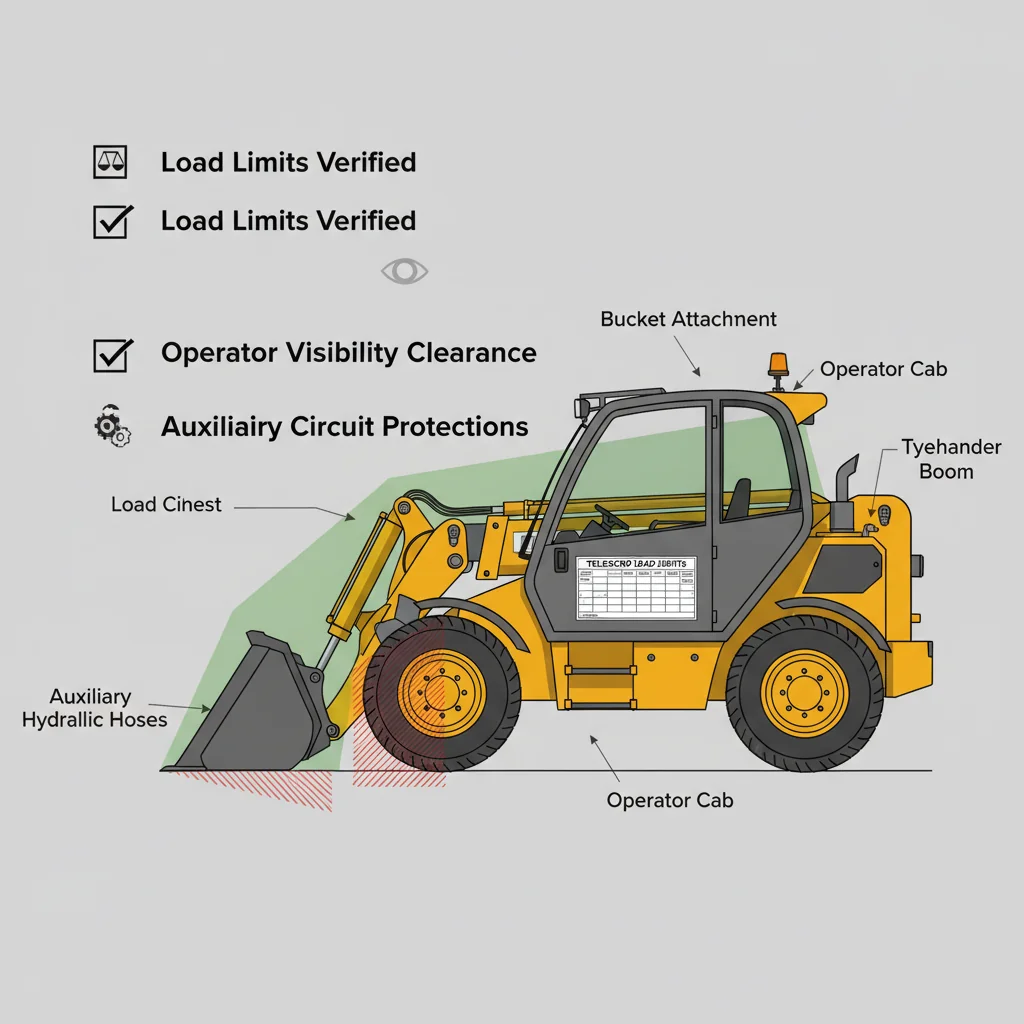
To be honest, the spec that actually matters is the bucket-specific load chart—most buyers just check the max capacity on the main spec sheet. That’s risky. I’ve seen sites in Brazil and Kenya where a 3,000 kg telehandler seemed perfect, but with the bucket extended, safe lift drops below 1,200 kg. Once, a team in Brazil overloaded by around 500 kg because they assumed the forklift numbers matched bucket numbers. Their rear wheels left the ground. It’s not just about capacity; reach and boom angle have a huge impact.
For compliance, always look for the proper markings: CE certification11 in Europe, ANSI in the US, or equivalent standards in your country. If the bucket has auxiliary hydraulics (like a grapple or clam shell design), make sure the circuit hoses are shielded and routed properly. I had a project in Dubai where exposed hoses got snagged by rebar, causing a small oil leak. Even minor mistakes here can lead to downtime or fines. Making operator safety checks routine—like verifying stabilizer deployment and seatbelt use—should be part of daily practice.
Operator visibility is another area that catches people off guard. Overfilled buckets create blind spots, especially when the bucket back is over 1 meter tall. I once walked a jobsite in Kazakhstan where a loader nearly struck a worker hidden by a gravel pile in the bucket. Keep the fill below the top, adjust mirrors or install cameras if needed.
A telehandler’s safe lifting capacity can decrease by over 60% when the bucket is fully extended compared to its retracted positionTrue
Extending the boom and bucket increases leverage and lowers stability, which significantly reduces the safe load capacity. This reduction can easily exceed 60%, as seen in cases where a 3,000 kg capacity drops below 1,200 kg when extended.
The maximum load capacity listed on a telehandler’s main specification sheet always applies when using any bucket attachmentFalse
The main spec sheet typically shows forklift or general lifting capacities, which don’t account for modifications in stability and reach caused by specific bucket attachments. Bucket-specific load charts must be consulted because capacities can differ drastically depending on the attachment and boom angle.
Key takeaway: Always use the telehandler’s bucket-specific load chart, confirm compliance with relevant standards, preserve clear operator sightlines, and deliver thorough operator training. Never improvise with buckets for tasks outside their intended use—proper safety and compliance practices are critical to prevent accidents and reduce liability.
How Do You Maintain Telehandler Buckets?
Routine maintenance for telehandler buckets means greasing all pins and pivot points weekly, inspecting welds for hairline cracks, and replacing bolt-on cutting edges or teeth at 50% wear. Rinse after handling corrosive materials and touch up paint as needed to maximize lifespan and protect your investment.
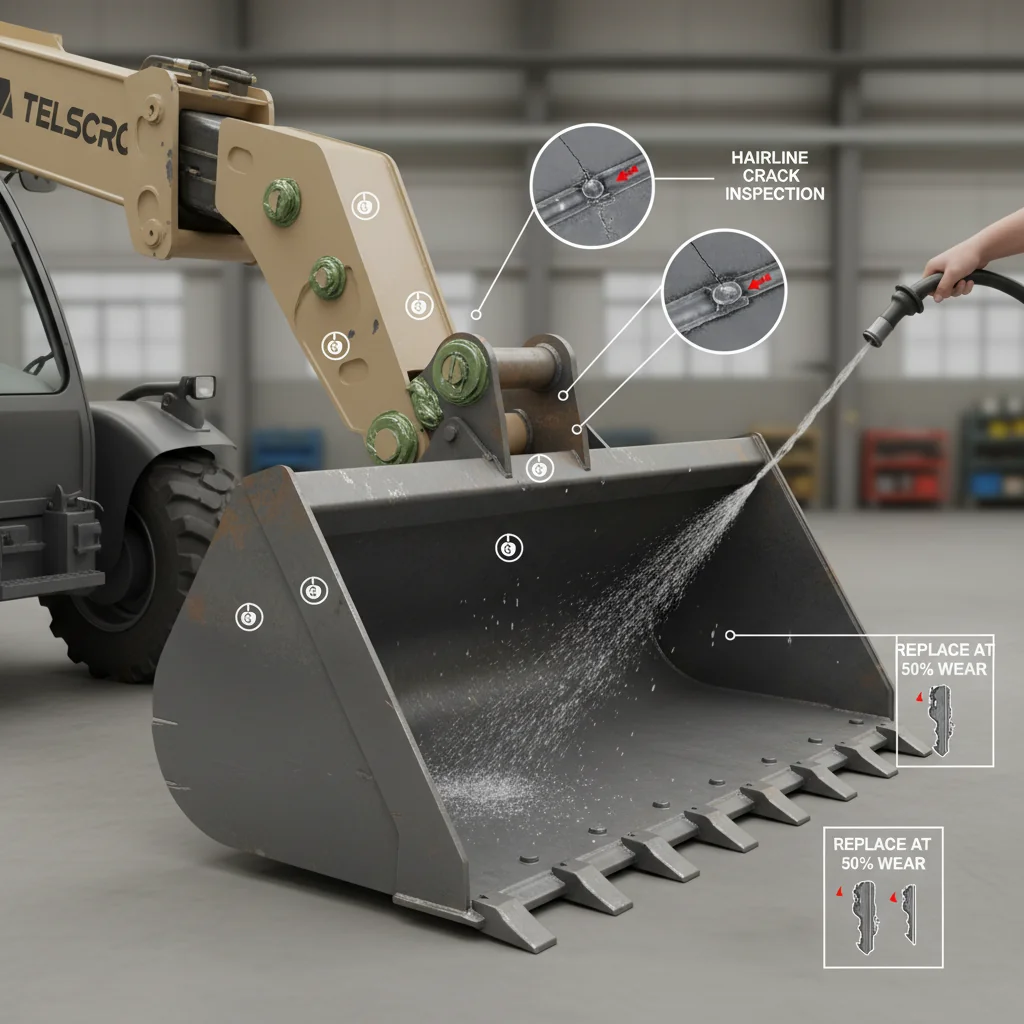
Last week, I got a call from a contractor in Brazil who lost two days on a sugar mill site because a telehandler bucket failed spectacularly. The culprit? Simple neglect—no grease on the pivot pins, and the cutting edge was so worn it started eating into the base plate. This happens more often than you’d think.
For maximum bucket lifespan, grease all pins and pivot points once a week, or even more often in dusty, gritty conditions. Dry pins wear fast and can seize, especially on grapple buckets with several moving parts—sometimes a single day without greasing makes a difference in the sugar or salt industry.
It’s especially important to inspect welds where stress is highest—corners, base-to-side joins, and the hitch area. I remember a jobsite in Kenya where a bucket cracked clean through at a corner weld after just eight months. They only noticed when it started leaking aggregate. Catching a hairline crack early takes a few minutes, but saves thousands on repairs or even a total replacement. If you see any crack, stop and repair it before it turns into a major job.
When it comes to bolt-on cutting edges or teeth, don’t wait until they’re paper-thin. I recommend swapping them at about 50% wear 12. In my experience, this simple habit can double the useful life of the whole bucket—especially on sites handling heavy stone or loading concrete debris.
Key takeaway: Regularly greasing, inspecting welds, and promptly replacing worn bolt-on edges can double your telehandler bucket’s service life. Cleaning and painting after corrosive use guards against rust. A well-maintained bucket often outlasts the telehandler, preventing costly failures and preserving equipment value.
Conclusion
We’ve talked through how picking the right telehandler bucket comes down to knowing your main materials and yearly tasks. In my experience, contractors who rush into decisions based on current needs often end up with attachments that become “showroom hero, jobsite zero”—they look great but don’t actually fit daily work demands.
Before you buy, take an honest look at your top three tasks and materials over the whole year. Then, double-check the manufacturer’s load chart for those conditions, not just the max specs. If you’d like advice for your specific jobsite or want to compare options, feel free to get in touch—I’m always happy to help crews find what actually works. Every site is different—choose what fits your real workflow.
References
-
Explains how abrasive materials like gravel cause wear and the importance of choosing the right bucket to prevent premature failure. ↩
-
Details advantages of reinforced buckets with heavier steel to handle tough rubble, improving durability and work efficiency. ↩
-
Details the critical role of load charts in preventing overload and instability, helping operators avoid costly accidents and downtime. ↩
-
Detailed insights on how bucket-specific load charts affect safe lifting capacities, preventing dangerous overloads and accidents on job sites. ↩
-
Detailed insights on selecting light-material buckets for grain and silage, optimizing volume without overloading telehandlers. ↩
-
Expert explanation on how reinforced shells and bolt-on edges enhance durability and lifespan for handling rock, scrap, and asphalt. ↩
-
Understand how matching bucket width to tire width prevents overloading and collisions, essential for safe telehandler operation. ↩
-
Detailed explanation on auxiliary hydraulic line requirements, flow rates, and pressure to avoid equipment malfunction and warranty issues. ↩
-
Explore how varying shell thickness impacts bucket lifespan, repair costs, and operational downtime with expert insights and case studies. ↩
-
Learn why Hardox cutting edges extend bucket life and reduce maintenance, supported by real-world examples from concrete and aggregate work. ↩
-
Expert explanation of CE certification requirements for telehandler buckets, ensuring compliance with strict European safety and quality standards. ↩
-
Details the timing and benefits of replacing bolt-on cutting edges to prevent base plate damage and maintain bucket efficiency. ↩