











Electric Telehandler: Current Models, Capacity Limits and Electric vs Diesel Fit
Current electric telehandlers are concentrated in the compact class, generally around 2,750-5,700 lb. This page compares the models available today, lays out where electric works well, and shows when diesel is still the better fit.

- Concentrated in the Compact Segment
All mainstream electric telehandlers currently fall within the compact class, with no full-size electric models in production.
- Available Capacity: 2,750-5,700 lb (1,250-2,600 kg)
The Faresin 6.26 Full Electric at 5,732 lb represents the current upper boundary of the electric market.
- Typical Lift Height: 13-20 ft (4.0-6.1 m)
JCB 505-20E reaches the highest at 20 ft. All models remain within compact-class height limits.
- Best Fit: Indoor, Low-Emission, Low-Noise Applications
Zero exhaust at point of use and reduced noise make electric ideal for enclosed spaces and emission-restricted zones.
What This Page Covers
Navigate to any section to compare electric telehandler models, applications, and decision criteria.
Electric Telehandlers Available Today
As of early 2026, the mainstream electric telehandler market includes five models from five manufacturers. All fall within the compact class.
| Model / Manufacturer | Rated Capacity | Max Lift Height | Battery System | Charge Time |
|---|---|---|---|---|
| TH412e / Wacker Neuson | 2,756 lb (1,250 kg) | 14.1 ft (4.3 m) | 18-28 kWh Li-ion (96V) | 3-5 hrs |
| E313 / JLG | 3,500 lb (1,588 kg) | 13.1 ft (4.0 m) | 18.6 kWh Li-ion (48V) | 2-3 hrs (220V) |
| 505-20E / JCB | 5,250 lb (2,381 kg) | 20 ft (6.1 m) | 24 kWh Li-ion | Varies by charger |
| MT 625e / Manitou | 5,512 lb (2,500 kg) | 19.2 ft (5.85 m) | 25/33 kWh Li-ion | ~2 hrs (9 kW charger) |
| 6.26 Full Electric / Faresin | 5,732 lb (2,600 kg) | 19.0 ft (5.79 m) | 24 kWh Li-ion (80V) | 2.5-13 hrs (charger-dependent) |
Specifications shown are manufacturer-published market references as of early 2026. Specs may vary by market and charger configuration.
Where Electric Telehandlers Make Sense
Electric telehandlers solve specific problems in specific environments. These five scenarios represent where electric currently makes the strongest case.
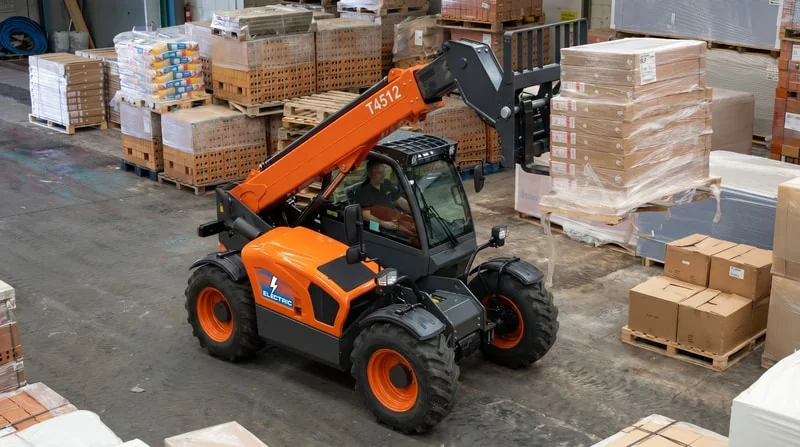
Indoor Warehousing and Renovation
Zero exhaust in enclosed spaces. No ventilation requirement, no operator exposure to engine fumes.

Low-Emission Urban Job Sites
LEZ-sensitive zones where diesel exhaust triggers compliance issues. Electric eliminates the point-of-use emission variable.

Night Construction and Residential Areas
Reduced noise helps meet stricter site rules. Electric telehandlers run significantly quieter than diesel equivalents.

Greenhouses and Enclosed Agricultural Use
Emission-sensitive environments where diesel exhaust can damage crops or trigger air quality thresholds.

Facilities Maintenance
Short duty cycles with predictable recharge windows. The machine returns to a charging point on a known schedule.
If your work fits these scenarios and stays within compact-class limits, electric may be worth evaluating. If not, the next sections help you pressure-test diesel.
Telescro does not manufacture electric telehandlers. Our product line is diesel-only (1,250-5,000 kg rated capacity). If electric does not cover your requirements, we can assess whether a diesel configuration fits your project.
Electric vs Diesel Telehandler: What Changes in Real Use
The differences go beyond the power source. Runtime pattern, capacity range, cold weather behavior, and site infrastructure all shift.
| Dimension | Electric | Diesel |
|---|---|---|
| Emissions at Point of Use | Zero | Engine exhaust (compliance-dependent) |
| Noise Level | Significantly reduced | Standard engine noise |
| Runtime Pattern | 4-8 hrs typical, recharge needed | Limited by fuel tank, refueled in minutes |
| Available Capacity | 2,750-5,700 lb (compact class) | Up to 20,000+ lb (full range) |
| Outdoor Heavy-Duty Suitability | Limited by battery and duty cycle | Better suited for long continuous field use |
| Cold Weather Sensitivity | Battery range may decrease | Minimal impact relative to battery systems |
| Maintenance Profile | Fewer moving parts, no oil changes | Standard engine service intervals |
| Site Infrastructure | Charging point required | Fuel logistics only |
If your project needs longer continuous outdoor runtime or higher capacity than the current compact electric market offers, diesel is still the practical path.
Is Electric Right for Your Project?
The answer depends on your working load, shift pattern, and site conditions, not on which power source sounds better on paper.
Electric May Be a Good Fit If:
- Loads stay within compact-class limits (generally under approximately 5,700 lb)
- Most work is indoor or in emission-restricted zones
- Shift pattern allows recharge windows
- Site has reliable power access for charging
Diesel Is Likely the Better Fit If:
- The application needs more than approximately 5,700 lb capacity
- The machine must run long outdoor shifts without recharge downtime
- Rough terrain productivity matters more than emission-free operation
- The job needs higher reach classes or more reserve at height
Not sure where your project falls?
What Happens Above the Current Electric Range?
Once your requirement exceeds the compact electric ceiling, diesel becomes the only mainstream option. This table maps the handoff points.
| Requirement Band | Electric Availability | Diesel Path | Action |
|---|---|---|---|
| Under 4,000 lb | Available from current compact electric models | Compact diesel also available | Compare electric vs compact diesel |
| 4,000-5,700 lb | Available from select OEM models (up to Faresin 6.26 at 5,732 lb) | Multiple diesel options also exist | Compare total cost and duty cycle |
| 6,000-8,000 lb | No mainstream electric options | Diesel class available | Review 6K diesel class |
| 10,000 lb Class | No mainstream electric options | Diesel class available | Review 10K diesel class |
| 12,000+ lb Class | No mainstream electric options | Large diesel class available | Review 12K diesel class |
Need capacity above approximately 5,700 lb? That means diesel for now. Tell us your project requirements and we will recommend the right diesel direction.
Key Buying Considerations Before Choosing Electric
Before committing to electric, confirm these seven variables. They determine whether electric is practical or whether diesel is the more realistic path.
Site Power Availability
Remote sites or temporary jobsites may lack the electrical capacity for consistent recharging. If this answer is "no," the electric path is closed before any other variable matters.
Shift Length and Recharge Windows
If the machine must run continuously, current battery runtime may not support your duty cycle.
Actual Working Load vs Rated Capacity
The brochure headline rating does not tell you what the machine can handle at your working height and reach. That working load is the decision point.
Outdoor Terrain and Weather Exposure
Battery performance decreases in cold weather. Rough terrain adds energy demand that shortens runtime.
Attachment Requirements
Confirm planned attachments are compatible with the electric models in your capacity range.
Battery Lifecycle and Replacement Planning
Battery replacement is a significant cost event. Factor projected battery life into total ownership cost.
Rental-First vs Purchase-First Decision
Renting first lets you test the electric fit before committing to higher upfront cost. If uncertain on any earlier variable, rental is the safer starting point.
If any of these variables are still open, the comparison should start from the application, not from the power source.
Electric Telehandler
Price Factors
Electric telehandlers typically carry higher upfront cost but lower routine operating cost due to fewer moving parts and no fuel expense. The total cost comparison depends on utilization, not just the sticker price.
Purchase Price vs Per-Hour Energy Cost
Higher acquisition cost offset by lower energy cost per operating hour.
Breakeven depends on annual utilization hours and local energy pricing.
Battery Capacity Option
Larger battery packs cost more upfront but extend runtime and reduce recharge frequency.
Match the battery size to your actual shift length and duty cycle requirements.
Charger Type and Charging Speed
Fast chargers reduce downtime but add infrastructure cost. Standard on-board chargers are slower but included.
Factor in site electrical capacity and installation cost for fast charging.
Limited Production Volume
Electric telehandlers are produced in smaller volumes, which can affect lead time and pricing flexibility.
Expect longer delivery timelines compared to established diesel models.
Rental as a Trial Path
Renting before purchasing lets you validate the fit without committing full acquisition cost.
Use rental data to confirm runtime, recharge pattern, and productivity before buying.
Need a Diesel Cost Comparison?
If the application ultimately requires a larger or longer-running machine, compare total project cost against diesel alternatives, not against the electric sticker price alone.
Why Telescro Can Help You
Navigate This Decision
We manufacture diesel telehandlers and understand the performance boundaries of both power sources. Our role is to match the right machine to your project, not to push one technology over another.
Factory-Direct Diesel Product Line
Telescro manufactures diesel telehandlers from 1,250 kg to 5,000 kg rated capacity. If the electric market does not cover your requirement, we can assess whether a diesel configuration fits.
Requirement Review Before Recommendation
We confirm whether electric is enough or whether diesel is the more practical fit before entering any price discussion. The goal is to match the machine to the job, not to push a sale.
Approved Configuration Credentials
Approved configurations available for different markets, including CE, ROPS/FOPS, EU Stage V, and EPA Tier 4 Final on TH1840 for North American requirements.
If current electric telehandlers look too limited for your load, height, shift length, or site conditions, send your project requirements. We will tell you whether compact electric is enough or whether a diesel configuration is the more practical fit.
Get a Configuration Recommendation for Your Project
If current electric telehandlers look too limited for your load, height, or shift pattern, send your project details. We will review whether compact electric is enough or whether a diesel configuration is the more practical fit.

Hi, I'm Sally.
Telescro Sales Manager
What to include in your request:
- Required lift capacity and load type
- Working lift height and forward reach
- Shift length and daily duty cycle
- Site power availability for charging
- Indoor/outdoor split and terrain conditions
- Destination market for shipping and registration
No commitment required. We typically respond within one business day with an honest assessment of whether electric works for your project or whether diesel is the more practical path.
Send Your Project Details
Include your load, height, and shift requirements for a faster recommendation.
Electric Telehandler FAQ
Answers to the most common questions about electric telehandler availability, capacity limits, runtime, and when diesel is the better choice.
Have a question not covered here? Send your specific project details for a direct answer.