










Telehandler vs Forklift: Expert Guide to Contractor Preferences & Pitfalls
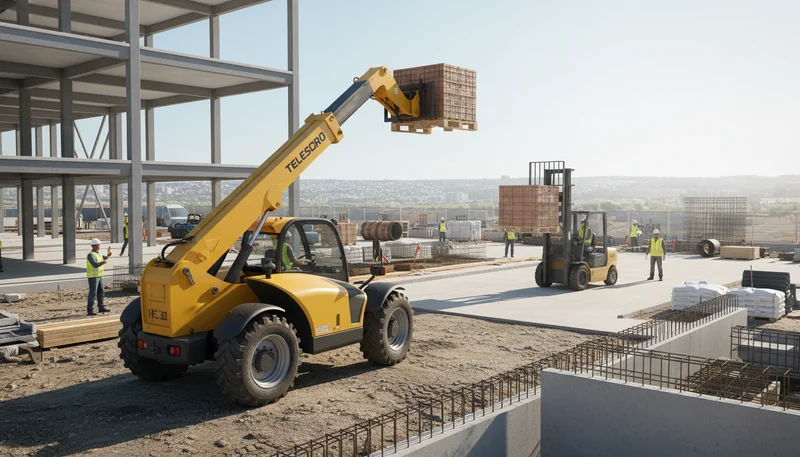
Not long ago, a customer in Australia sent me a photo of their site—telehandler perched confidently in the mud, dropping roof trusses onto a third-floor deck. He said, “My forklift would’ve sunk here, and I’d still be hauling with a crane.” That stuck with me.
Telehandlers incorporate telescopic booms that provide both vertical and horizontal reach, enabling precise placement of materials at significant heights and distances that conventional forklifts cannot access. Typical telehandlers lift between 7 and 18 meters and project loads several meters beyond the front axle, which is critical for feeding materials to upper floors and behind obstacles. Although capacity decreases at maximum outreach, telehandlers minimize intermediate handling, reduce the need for extra equipment likesmall cranes, and streamline overall jobsite logistics.
How does telehandler reach compare to forklifts?
Telehandlers utilize a telescopic boom1 instead of a vertical mast, providing both high vertical lift—typically 7–18 m (23–59 ft)—and significant forward outreach2. This enables direct placement of materials on upper floors, balconies, or behind obstacles, tasks beyond the reach of conventional construction forklifts.
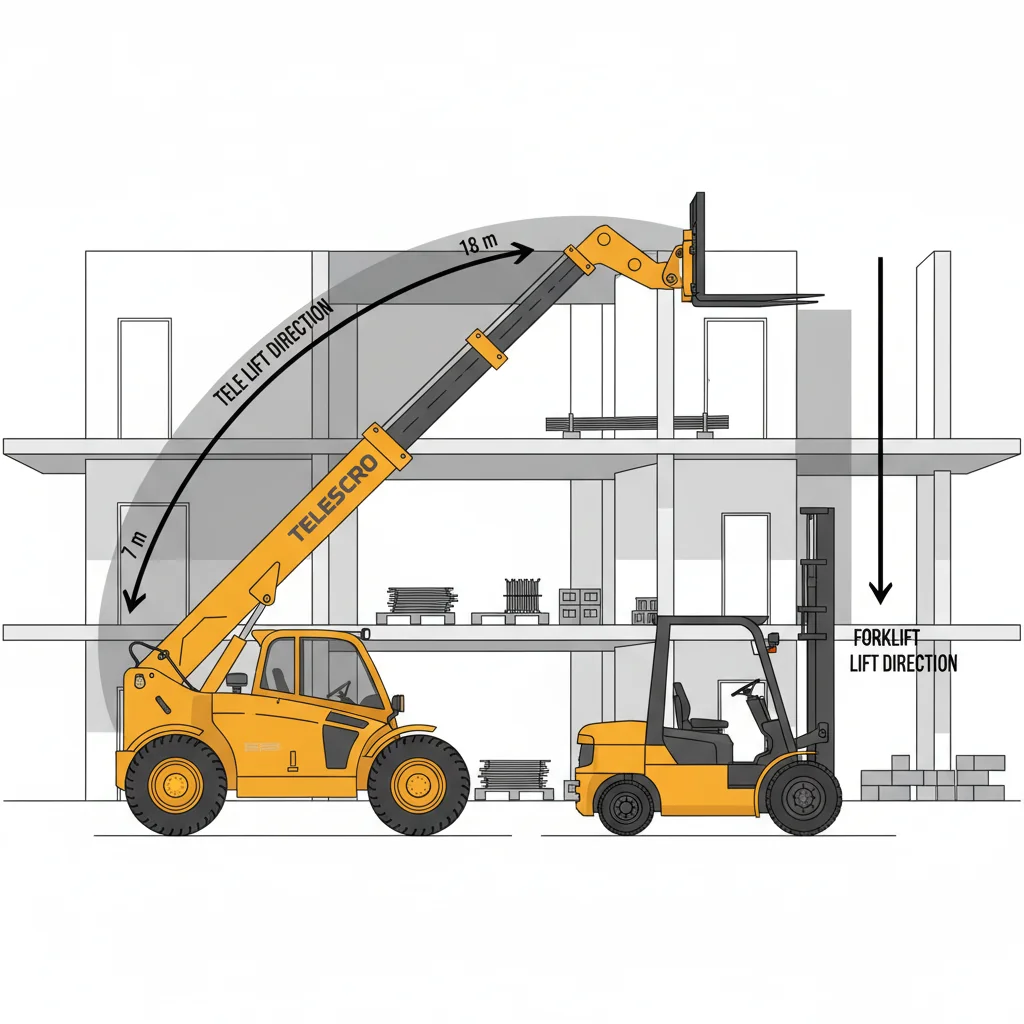
Most people don’t realize that when it comes to pure reach, there’s really no contest between a forklift and a telehandler. A regular construction forklift uses a vertical mast—great for moving stuff up and down, but that’s about it. Standard rough-terrain forklifts typically offer around 4–6 meters (13–20 feet) of vertical lift and have virtually no forward reach beyond the chassis. Telehandlers, though, use a telescopic boom. Typical construction units handle 7–18 meters (23–59 feet) vertically, but the big game changer is forward reach—up to around 13 meters or more on larger high-reach models. That means you can sit back from a building and still place materials straight onto an upper floor, over a wall, or behind rebar and formwork.
Last year, a customer in Dubai contacted me about a mid-rise project with tight site access. The team needed to deliver pallets of block to the fifth floor—nearly 16 meters up—and didn’t have space to position a forklift right next to the structure. A 4-ton telehandler with 17-meter boom solved the problem. They lifted loads over other obstacles and saved at least two site moves for each pallet. The operator just followed the load chart3, which clearly showed rated capacity4 dropped from 4 tons at the front axle to around 1.3 tons at maximum outreach. That’s normal—higher, farther picks mean less capacity. I always remind teams: check the boom extension and height together on the load chart, since ground-level capacity can be misleading.
Telehandlers with dual-stage booms can achieve horizontal reaches of over 13 meters (43 feet), allowing them to place loads two or more stories beyond the machine’s wheels.True
Dual- or multi-stage telescopic booms extend the forward reach of telehandlers well beyond fixed-mast forklifts, making them suitable for jobs like masonry, framing, and material placement in difficult locations where standard forklifts cannot operate.
Conventional forklifts equipped with side-shift attachments can attain the same horizontal reach as mid-size telehandlers.False
While side-shift attachments allow forklifts to move loads slightly left or right, their movement is typically under half a meter (less than 2 feet). This is vastly different from a telehandler’s telescopic forward reach, which can extend over 10 meters (33 feet) on mid-size models.
Key takeaway: Telehandlers surpass forklifts in reach and placement flexibility by combining vertical and horizontal movement via a telescopic boom. This allows direct material delivery to elevated or hard-to-access locations on-site, reducing the need for mobilizing small cranes or additional handling steps.
When Is a Telehandler Better Than a Forklift?
A telehandler is preferable over a forklift when the job requires extended forward reach5, elevated lifts above 25 feet, or operation on uneven, sloped, or soft ground6. Contractors favor telehandlers for early- and mid-phase construction—especially site prep, framing, roofing, or when placing loads over obstacles where forklifts cannot access.
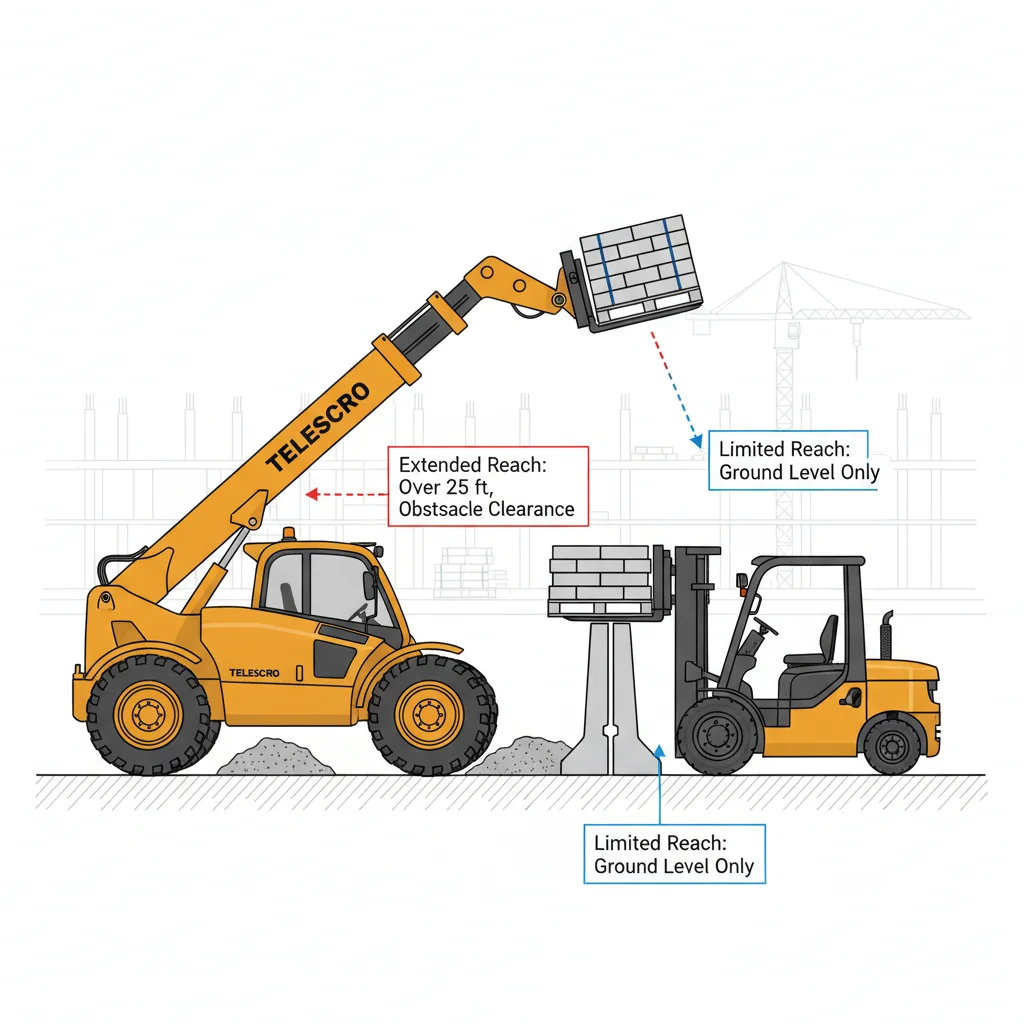
Let me share something important about when a telehandler truly outperforms a forklift. On jobsites where ground conditions are rough, there’s no finished slab, or you need to reach above 8 meters—this is where I see telehandlers deliver real value. For example, I worked with a framing crew in Kenya last year. Their project site was on a slope with soft soil, and they had to place roof trusses twelve meters above ground, reaching over a temporary scaffold. No forklift could safely handle that combination of height and distance. A 4-ton telehandler with a 14-meter boom managed the job without any drama.
Think about early-phase construction—site prep, masonry, or steelwork—when you’re often working on gravel, dirt, or mud. Standard forklifts just can’t keep traction or stability there. Telehandlers have robust 4WD, higher ground clearance7, and stabilizers that let you tackle these sites with confidence. I’ve seen projects in Dubai save at least two full working days during structural work just because a telehandler could lift pallets directly over deep foundations and into upper floors. Forklifts would need extra staging or cranes, costing more time and money.
Don’t forget the reach factor. The load chart really matters when you’re lifting out at full boom. Most rough-terrain forklifts are in the 5–6 meter lift range, while many construction telehandlers are designed for 13, 15, or even 18 meters of reach with controlled stability. For jobs needing over 25 feet of vertical or forward reach, a telehandler wins—simple as that. My advice: always match your machine selection to your ground conditions and lift height. It keeps your project safe and efficient.
Telehandlers with four-wheel drive, frame leveling, and crab steering are better suited than forklifts to operating on uneven or sloped ground, but they must still be leveled and derated according to the load chart rather than treated as having full capacity on a 10-degree slope.True
Telehandlers are engineered with features like four-wheel drive and advanced steering modes, which allow them to safely maintain stability and lift capacity on uneven terrain. In contrast, industrial forklifts are primarily designed for flat surfaces and can experience rapid derating of capacity and increased tip-over risk on even modest slopes.
Telehandlers are limited to lifting only palletized loads, making them unsuitable for handling oversized construction materials.False
Unlike forklifts, telehandlers are specifically designed to accommodate various attachments such as buckets, lifting hooks, and jib booms, allowing them to safely handle oversized and irregularly shaped construction materials, not just palletized loads.
Key takeaway: Telehandlers outperform forklifts in rough-terrain, high-reach, or obstacle-heavy sites, particularly during early and mid-construction when finished slabs are unavailable. Forklifts remain optimal for flat, hard surfaces and dense pallet handling. Matching machine to site conditions and lift reach ensures efficiency and safety.
How Do Telehandlers Reduce Project Costs?
Telehandlers often have a higher upfront and daily rental cost than rough-terrain forklifts, but contractors prefer them for versatility. On many projects, a single telehandler can cover the roles of multiple machines—rough-terrain forklift, small crane, loader, and even certain manlift tasks—reducing transport, rental, and idle equipment expenses. Cost efficiency increases when machine utilization8 stays high across diverse site tasks.
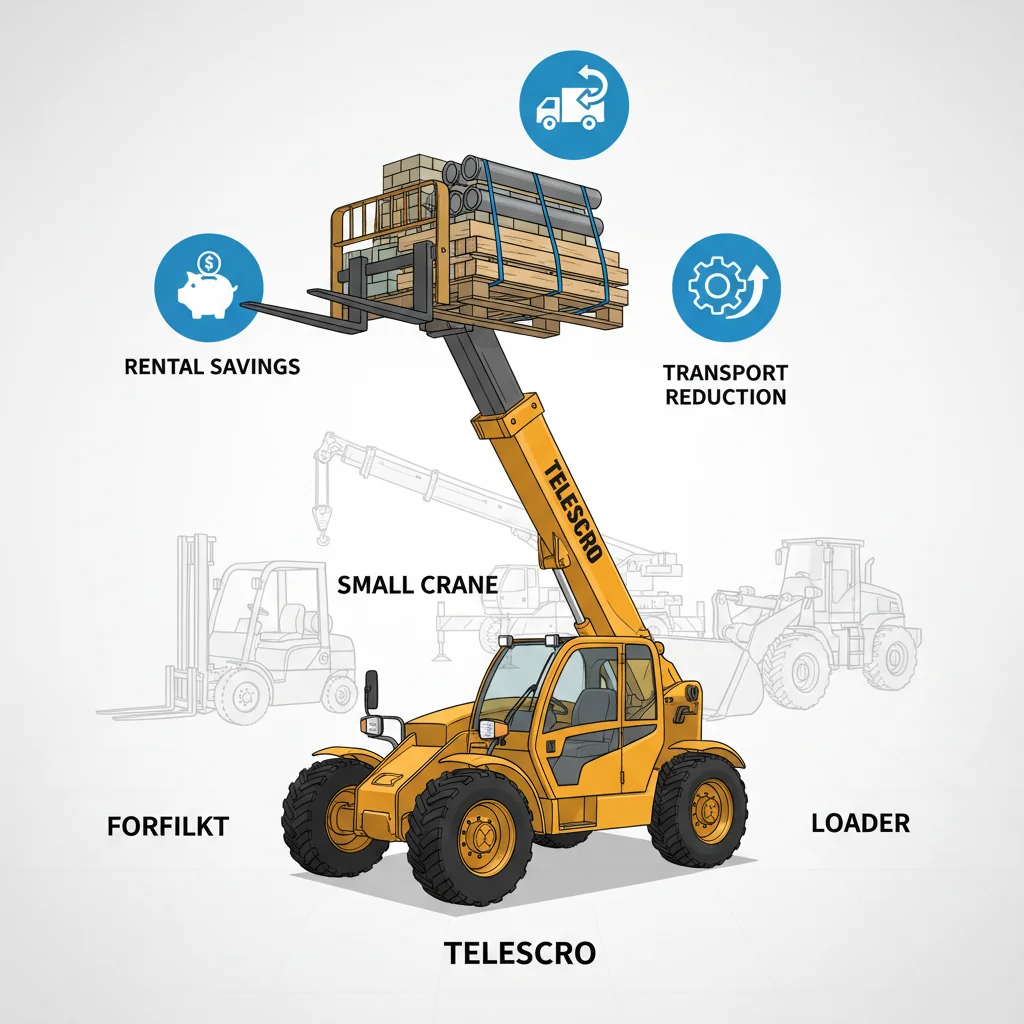
Here’s what matters most when you’re weighing project costs: how much can one machine actually do on your site, day in and day out? Many people see the price tag on a 4-ton, 13-meter telehandler and hesitate—it often costs over 50% more than a rough-terrain forklift, and the daily rental can be 25-40% higher. But that comparison misses the big picture. I’ve worked with builders in Dubai juggling concrete blocks, roof trusses, and site fencing, all with a single telehandler. That same machine easily replaced their old forklift and a small crane. Fewer machines meant lower transport fees, less site congestion, and nobody waiting on a lift—tasks kept moving.
One customer in Kazakhstan ran side-by-side trials with a loader, crane, and a 4,000 kg telehandler. Over a four-month project, they found the forklift and crane sat idle for days while crews waited for the next scheduled lift or delivery. Meanwhile, the telehandler worked almost every day—offloading materials, hoisting HVAC units, and even lifting workers in a certified work platform for maintenance at 10 meters up. The difference? They returned the extra machines early and cut their rental bill by nearly 30%.
The economics are simple. If you plan for high machine utilization and switch between attachments—a bucket for backfilling, forks for pallets, jib for trusses—the telehandler spreads out operating expenses over more productive hours. I suggest looking at your task schedule: if one machine handles 60–70% of your daily lifting, fueling, and moving, you’ll drive down the cost per hour on every job.
A standard 13-meter telehandler can lift materials to upper floors significantly faster than a conventional rough-terrain forklift when working with mixed loads and multiple levels.True
Telehandlers have a telescopic boom and 4-in-1 attachments that allow operators to rapidly place a variety of materials—such as pallets, buckets, or jibs—at height. In contrast, forklifts require time-consuming setup and cannot reach the same elevations, limiting their efficiency for multi-level projects.
Telehandlers are typically restricted from carrying suspended loads, making them less versatile than forklifts for material movement on construction sites.False
Many telehandlers can be equipped with manufacturer-approved hooks or jib attachments to handle suspended loads within clearly defined limits. However, this always depends on the OEM approval and local regulations, and operators must treat these lifts more like small-crane operations than standard pallet handling. In contrast, most forklifts are optimized for palletized loads, with suspended-load work limited to specific attachments and tightly controlled conditions.
Key takeaway: Telehandlers lower total project costs by consolidating multiple material handling and lifting roles into a single machine. When used intensively—serving tasks from unloading to roofing and seasonal maintenance—contractors spread operating expenses over many productive hours, making telehandlers more cost-effective than maintaining separate, specialized machines.
How do telehandlers reduce material handling time?
Telehandlers reduce jobsite material handling time by placing full pallets directly at elevated work locations—such as scaffolds, decks, or rooftops—eliminating the need for double handling by laborers. Their 4×4 capability and ground clearance maintain productivity on rough terrain, minimizing delays where conventional forklifts may become stuck or slowed by site conditions.
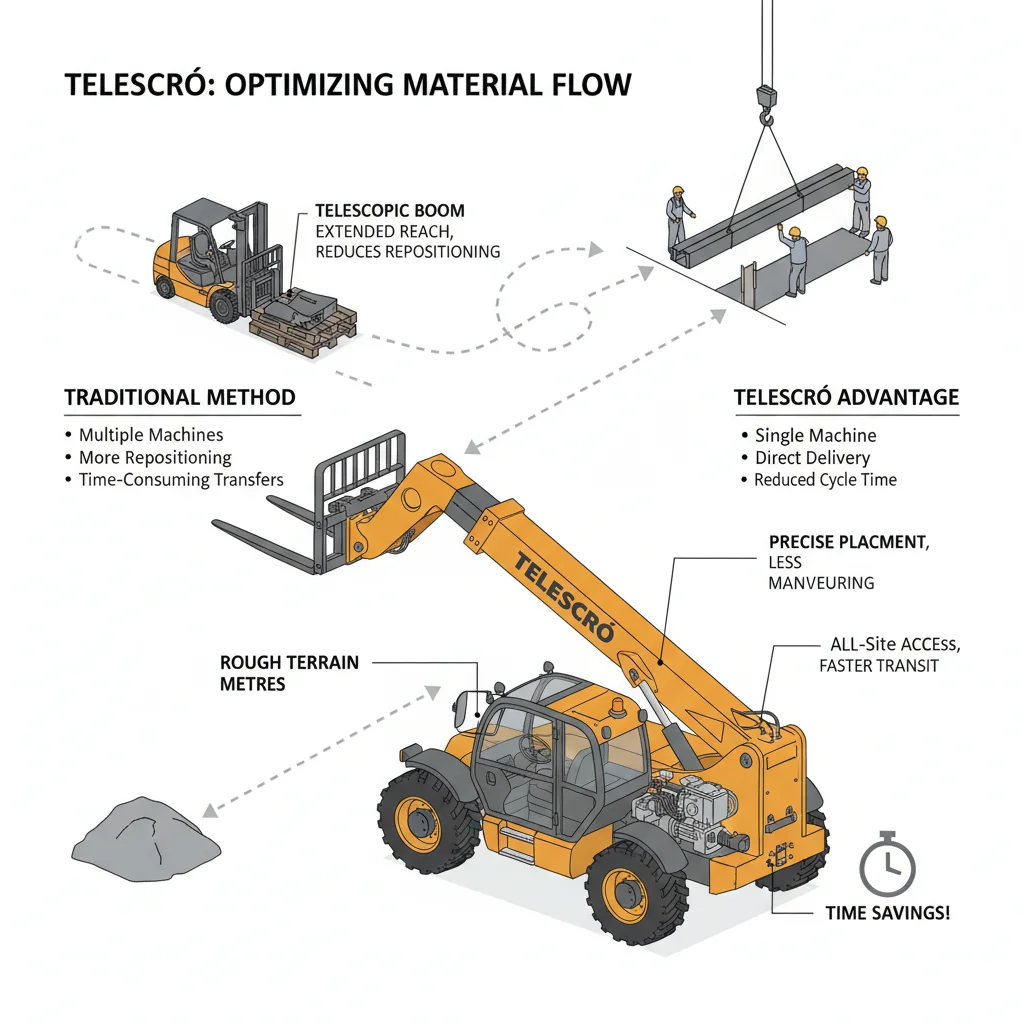
The biggest mistake I see is crews relying on basic forklifts or even hand-moving materials up floors. On real jobs, what slows everything down isn’t the lift itself—it’s that double handling. Picture this: I worked with a contractor in Dubai finishing a mid-rise project. They used a 4-ton telehandler with 17-meter reach to offload full pallets of drywall and lift them straight to the third floor deck—no staging on the ground, no laborers carrying sheets one by one up stairwells. Trades could unpack right where they worked. That’s hours saved every day. Instead of ten workers hauling materials, only two coordinated unloading and placement.
From my experience, even muddy or uneven sites don’t stop a telehandler. One site in Kazakhstan I visited had rutted access roads after heavy rain. Their conventional forklifts simply bogged down. But the telehandler—with its 4×4 drive and around 400 mm ground clearance—kept running loads up to scaffolding without delay. This kept masons and carpenters productive, and project sequencing flowed without constant interruptions waiting for materials to arrive.
The real efficiency comes from direct placement—full pallets of bricks to scaffold height, roofing packs to the top floor, or even structural steel to deck edges. You cut out the cycles of lifting, restacking, and hand-moving. For smaller contractors especially, telehandlers mean you can finish phases sooner or handle more work with the same crew size. I always suggest reviewing the load chart so you’re matching telehandler capacity to your most demanding placement point—saving time and labor on every project.
Telehandlers equipped with side-shift carriages can precisely position loads up to 100 mm left or right, reducing the need for manual repositioning and cutting handling time on congested sites.True
Side-shift capability allows operators to make fine lateral adjustments without driving the telehandler. This reduces the time and labor involved in aligning materials with tight access points or scaffolding, especially beneficial when delivering to upper floors.
Telehandlers require materials to be staged on every level before distributing them, similarly to truck-mounted cranes.False
Unlike cranes or forklifts that often necessitate multi-stage offloading, telehandlers can deliver full loads directly to the required floor or deck with a single move, eliminating the need for intermediate staging and minimizing material handling steps.
Key takeaway: Telehandlers streamline construction logistics by enabling direct placement of materials at point-of-use across challenging terrains. This minimizes manual double handling, reduces labor requirements for material movement, and accelerates work sequencing—allowing contractors, especially smaller crews, to complete more phases faster and improve overall jobsite efficiency.
What are telehandler safety risks and benefits?
Telehandlers offer safety benefits by placing materials directly where needed, minimizing manual handling, ladder use, and makeshift lifting. Modern features like stabilizers and load moment indicators improve stability and help operators stay within safe limits. However, the telescopic boom increases tip-over risk, especially at maximum extension or on uneven ground, requiring operator certification and strict adherence to load charts9.
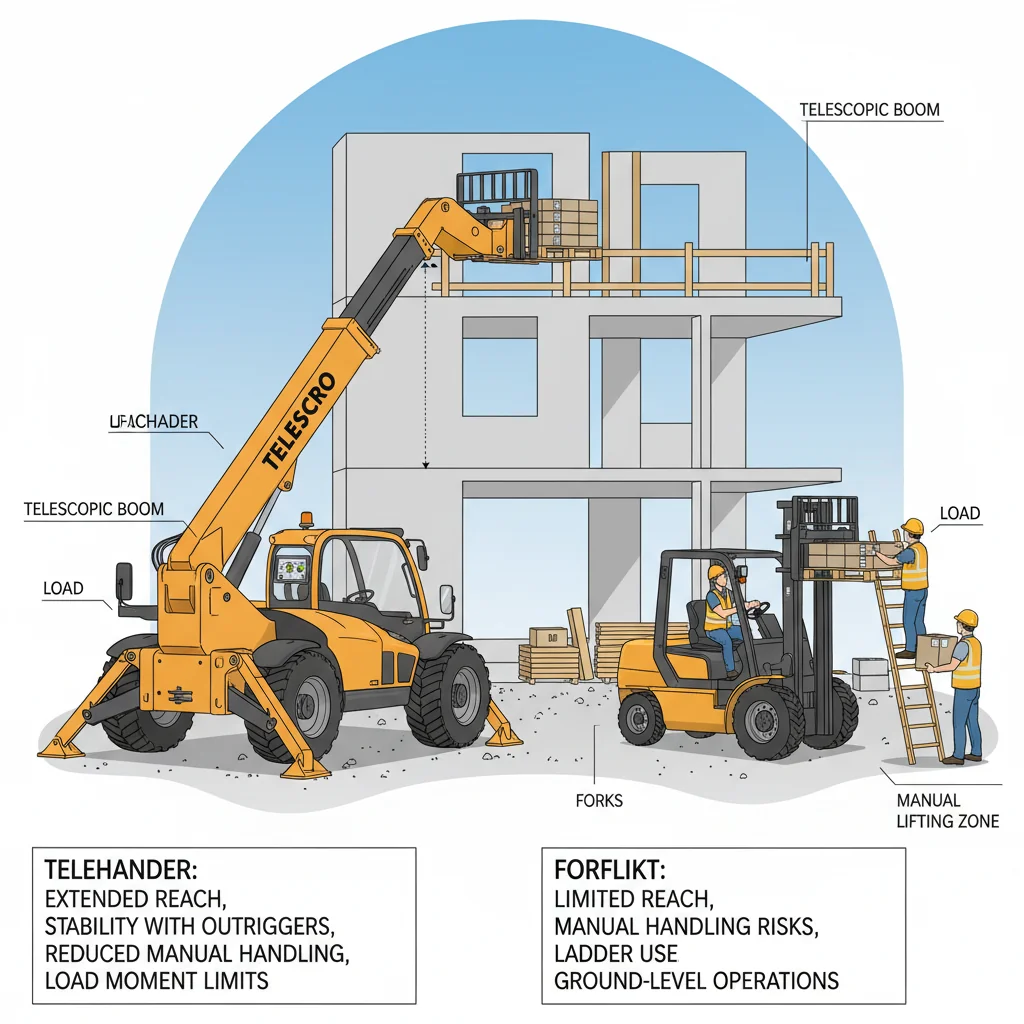
I’ve worked with crews in Dubai, Kenya, and Brazil who all found the same thing: telehandlers make jobs far safer when used right, but they can also create new risks. When you lift pallets or steel beams directly onto a safe work deck with the boom, you avoid a lot of manual carrying and ladder climbing—two top reasons for injuries onsite, wherever you work. Especially for jobs above ten meters, switching from a tower of scaffolding and manual hauling to a telehandler can cut incidents almost immediately. Still, I’ve seen teams underestimate the machine’s risk at full extension—thinking the rated capacity stays the same no matter where the boom is. It doesn’t.
The key safety features that matter most on modern telehandlers include:
- Load moment indicators (LMI): These systems alert the operator before exceeding the safe capacity at any boom angle or extension.
- Stabilizers: Some models let you deploy support legs for higher capacity, but you must always double-check the load chart for each setup.
- Work platforms: When correctly certified, these let the telehandler do double duty as a safer manlift—far better than makeshift cages or unapproved lifts.
- Detailed load charts: These show exactly how capacity drops with the boom extended and help prevent tip-overs on uneven ground.
Last year in Kazakhstan, I saw a crew tip a 3.5-ton telehandler forward after loading too much weight at 12 meters, ignoring the chart. I always tell managers: train every operator on your site, and budget for this upfront. The best machine is only as safe as the team using it.
Telehandlers with boom reach over 15 meters require stricter wind speed monitoring compared to standard forklifts, as boom extension significantly amplifies load sway risk in gusty conditions.True
High-reach telehandlers become more susceptible to instability from wind forces as the boom extends, especially above 15 meters, making weather monitoring crucial for safe operation. Forklifts, with low load heights, are much less affected by wind.
Unlike forklifts, telehandlers are designed so that their rated lift capacity remains constant regardless of boom extension or angle.False
A telehandler's rated capacity decreases as the boom extends or is raised; specific load charts must always be consulted. Assuming constant capacity is a dangerous misconception that increases accident risk.
Key takeaway: Telehandlers can significantly enhance onsite safety when used according to manufacturer guidelines, with proper training and certification. Their benefits hinge on correct use of stabilizers, close attention to load charts, and awareness of tip-over risks from boom extension and terrain slope.
How do telehandler attachments increase versatility?
Attachments transform a telehandler from a simple lifting machine into a multi-purpose asset. Quick couplers10 allow the use of pallet forks11, buckets, jibs, and work platforms, enabling roles as forklift, loader, mini-crane, or personnel lift—often within one day. Attachment weights and specific load charts define safe, effective use.
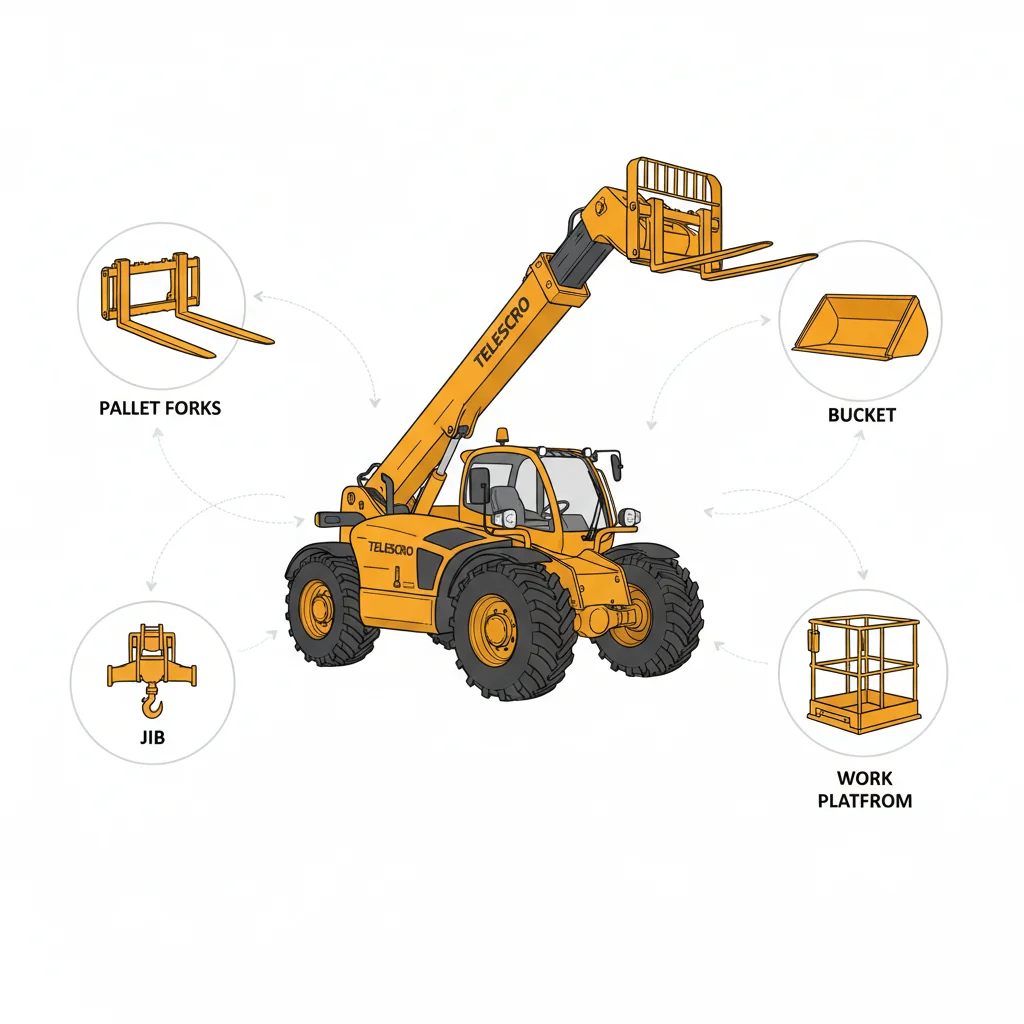
To be honest, the spec that actually matters isn’t just the boom length or how much the telehandler can lift—it’s how the right attachments let you do four jobs with one machine. I’ve seen this save time and money for contractors from Berlin to Nairobi. With a quick coupler, you can swap pallet forks for a 1.5 m³ bucket in under ten minutes. That means you unload materials at 8 a.m., clear debris before lunch, and lift ductwork to a third-floor platform the same afternoon—all with one operator. Here’s how attachments truly expand what a telehandler can do: – Pallet forks – Turn your telehandler into a heavy-duty forklift for moving bundled materials and pallets, especially over rough ground. – General-purpose buckets – Handle sand, gravel, and site debris, making your telehandler a loader when you need one most. – Jibs and lifting hooks – Safely rig and lift beams or piping, essentially acting as a compact mobile crane. – Approved work platforms – Support two workers plus tools for elevated repairs or facade jobs, offering safer access and reducing the need for dedicated boom lifts. – Side shifters or fork positioners – Precise placement of loads without moving the entire machine—great for tight spaces. One mistake I see is ignoring attachment weight. Every kilo of attachment comes straight off your rated capacity, and I’ve had customers in Malaysia surprised by how much this affects safe lifting at full reach.
A rotating telehandler equipped with a platform attachment can safely lift personnel to heights over 30 meters, which is typically beyond the maximum reach of standard rough-terrain forklifts.True
Rotating telehandlers (RTHs) offer both high lift heights and 360-degree rotation, making them suitable for work at elevation. Standard rough-terrain forklifts rarely reach beyond 6-7 meters, while many RTH models exceed 25-30 meters with personnel platforms, greatly expanding their utility on multi-story sites.
Telehandlers fitted with a side-shifting carriage can safely drive at full speed while carrying offset loads without risking stability, unlike standard fixed carriages.False
While a side-shifting carriage allows the operator to adjust the load position laterally for precise placement, traveling at speed with offset loads significantly increases the risk of tip-over due to a higher center of gravity and uneven weight distribution. All telehandlers, regardless of carriage type, must adhere to strict load balance and speed limitations to ensure safe operation.
Key takeaway: Attachments, when properly matched and derated by their specific load charts, unlock true multi-functionality in telehandler fleets. Standardizing quick-hitch types across machines and monitoring attachment weights enhances safety while controlling costs and maximizing the return on telehandler investment.
Which Telehandler Specs Outweigh Price?
For construction telehandlers, capacity at working height and reach is more critical than launch price or headline lift figures. Contractors prioritize load chart performance12 at 30–40 ft and extended reach, plus overall width, turning radius, boom cycle times, hydraulic flow, visibility, and standard ground clearance of 400–460 mm for jobsite fit and safety.
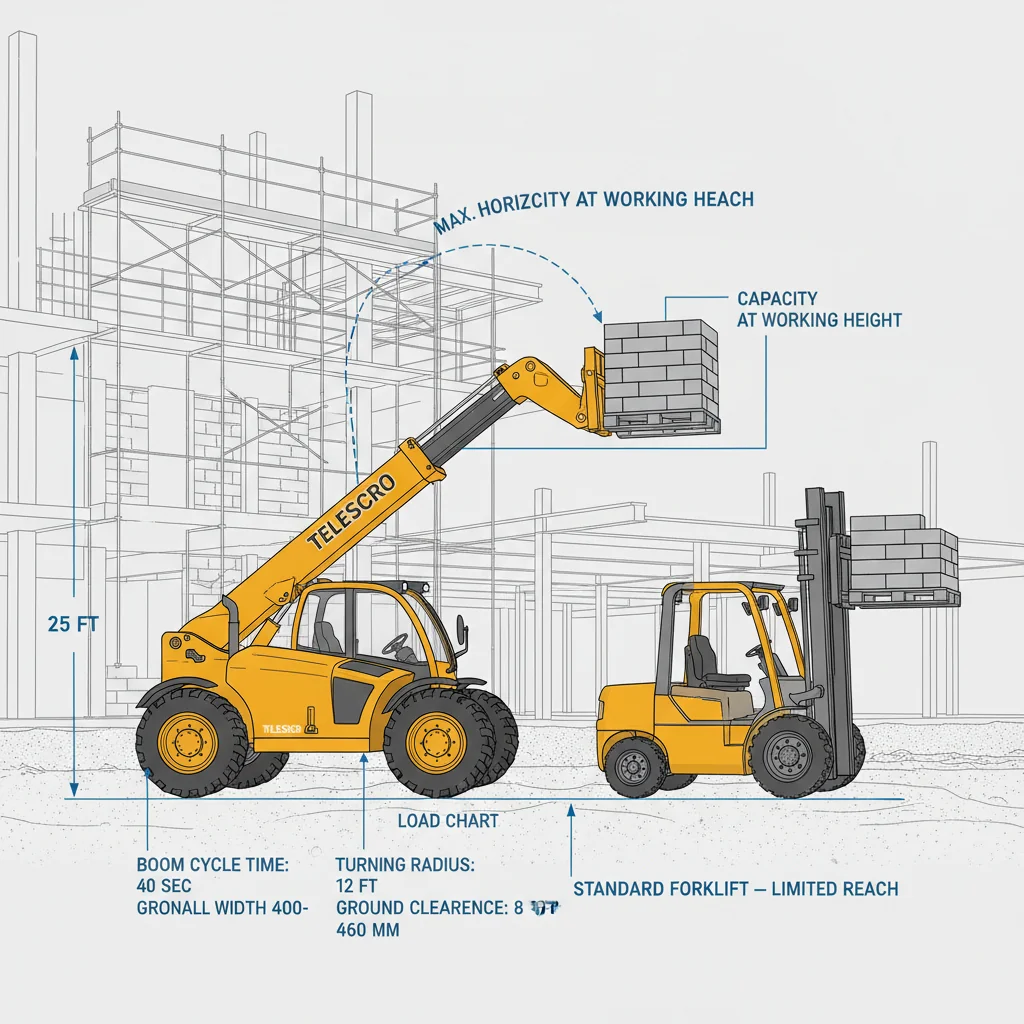
Last month, a contractor in Kazakhstan asked me why his new telehandler struggled with steel beams at 10 meters, even though the machine had a rated capacity of 4 tons. It’s a common problem—I’ve seen it in sites from Brazil to Nigeria. The headline figure is only at minimum reach. By the time you extend the boom out or lift up 10 meters, many models drop to just 1,100–1,400 kg on the load chart. That’s the critical number for real construction work. When you’re selecting a telehandler, it pays to focus on more than just price or the absolute max lift height. Tight jobsites often need width under 2.4 meters and a turning radius below 4.5 meters, or you’ll be blocked by rebar piles and scaffolding. I’ve worked on sites in Dubai where a difference of 100 mm in ground clearance—say, 410 mm vs. 520 mm—determined if forklifts got stuck or sailed through. Ground clearance around 400–460 mm fits most jobs, but rougher terrain might need more. Boom cycle times and hydraulic flow also matter if you run buckets or winches. Fast extension and strong hydraulic circuits keep crews moving, especially near foundation pits or in congested areas. Good visibility from the cab is critical—especially with foot traffic on city projects. I suggest reviewing the full load chart and measuring your narrowest jobsite entrance before you decide. You’ll usually get better value by matching the spec to your toughest, highest lift—not simply picking the cheapest machine.
A telehandler rated for 4 tons at minimum reach may only safely lift about 1,200 kg at a 10-meter forward reach due to leverage and stability limits.True
Telehandler load capacity is highest when the boom is retracted. As the boom is extended forward or upward, the maximum safe lift drops sharply—often to around 25-35% of the headline number—because of the increased tipping risk and structural limits. Load charts reflect this drop-off and are crucial for safe operation.
Forklifts with the same lift capacity as telehandlers can always lift heavier loads at higher reaches because of their compact counterweight design.False
Forklifts are usually designed for vertical lifts with limited forward reach and cannot safely extend heavy loads at height. Telehandlers have stabilizers, longer booms, and are purpose-built for reaching outwards and upwards, making them more capable for tasks at extended heights despite similar base capacities.
Key takeaway: Contractors should focus on actual load capacity at jobsite heights and reach, plus overall machine fit—width, turning radius, and ground clearance—rather than just rated lift height or price. Always review the load chart and key operator features to match real jobsite and safety needs.
What forklift habits risk telehandler safety?
Contractors switching from forklifts to telehandlers often overestimate rated capacity, failing to adjust for reduced load limits as the boom extends or raises. Ignoring the weight of attachments, traveling with the boom raised, and neglecting stabilizers are frequent errors. Formal telehandler-specific training and strict adherence to the load chart are essential to avoid incidents.
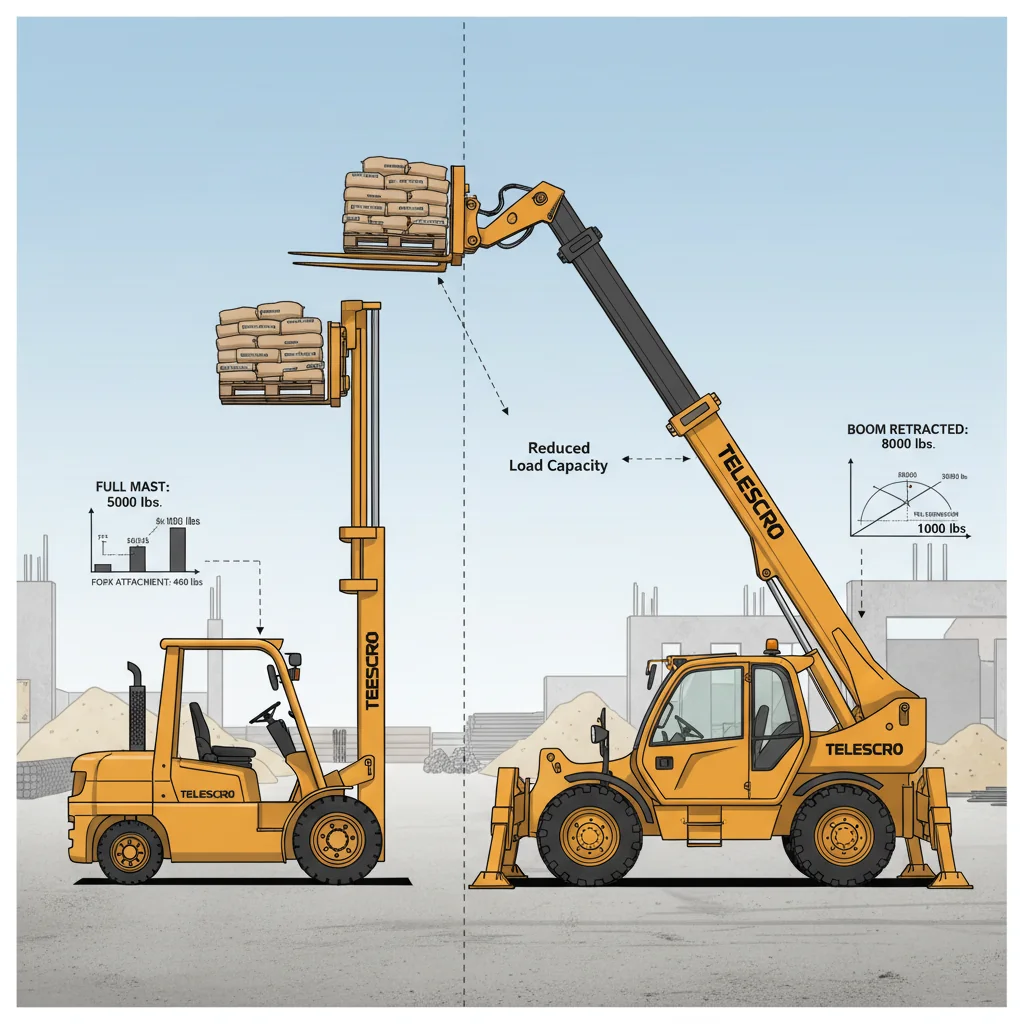
I’ve worked with customers who made this mistake after moving from forklifts to telehandlers—they treat the rated capacity printed on the side as constant, no matter where the boom is. Reality is totally different. Even if your telehandler is rated for 4,000 kg, that number only applies with the boom retracted and low. The moment you extend out, safe capacity drops sharply—sometimes to just 1,200–1,600 kg at full reach. In South Africa, I saw a crew try to lift palletized brick to a third-level platform (roughly 13 meters out). They thought they had plenty of margin based on the max rating. The machine’s load moment indicator set off alarms, and they had to abort the lift. It’s a costly lesson when you don’t check the load chart for real positions. Operators switching from mast-type forklifts also overlook attachment weight. Adding a 500 kg winch or heavy-duty bucket isn’t just “extra”; it has to be subtracted from your working load. I remember a jobsite in Dubai where a team loaded bulky pipe with a jib—no one bothered to account for the attachment. Suddenly, the telehandler struggled and stability suffered on a mild slope. It’s a classic recipe for tip-over, especially if you skip the calculation and just trust the sticker. Traveling with the boom raised is another habit that transfers over from forklifts—and it’s dangerous on uneven jobsite ground. I always tell new telehandler operators: keep the boom low, unloaded, and locked when you’re moving.
On a telehandler, rated capacity can drop by over 60% when the boom is fully extended at high angles compared to its retracted, lowest position.True
Telehandler load charts show significant capacity reductions as the boom extends and raises. For example, a machine rated at 4,000 kg with the boom retracted may only safely lift about 1,400–1,600 kg with the boom fully extended and high, due to leverage and stability factors.
Unlike forklifts, telehandler rated capacity remains unchanged regardless of boom angle or extension.False
This is a common misconception. Telehandler capacity varies dramatically depending on boom length and angle, as increased extension shifts the load further from the machine’s center, reducing both stability and lifting ability. Ignoring this can lead to dangerous overloading.
Key takeaway: Migrating forklift operators often carry unsafe habits to telehandler operation, especially by misapplying capacity limits and ignoring stabilizer use. Enforcing dedicated telehandler training and regular load chart review dramatically reduces tip-over risk and operational disruptions.
What Maintenance Do Telehandler Booms Require?
Telehandler booms demand frequent inspection and greasing of wear pads, pins, and high-pressure boom hoses. Unlike forklifts, telescopic booms have multiple moving sections that must be lubricated and adjusted. Lack of routine maintenance leads to excessive play, potential cracks at pivot points, and costly rebuilds.
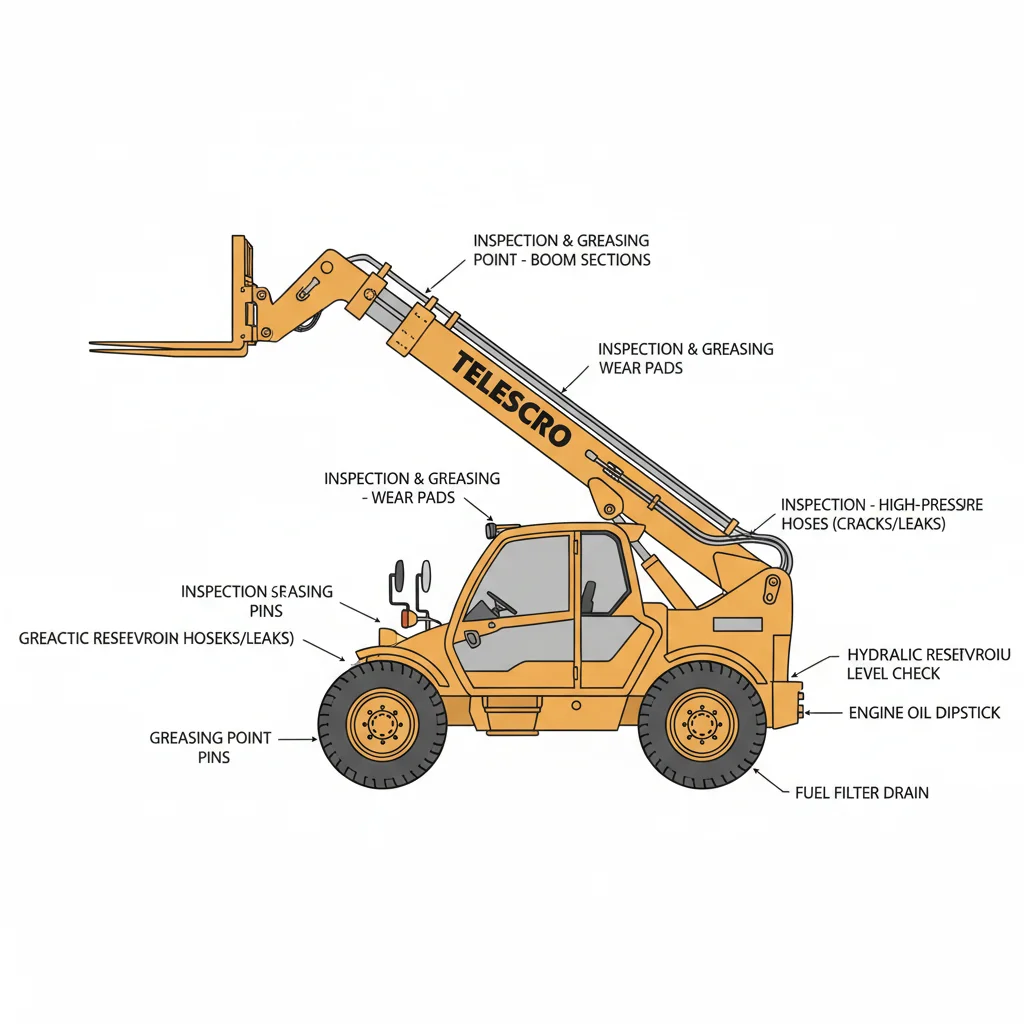
One thing I see all the time—crews forget that telehandler booms are far more complex than straight-mast forklifts. You’ve got multiple moving sections sliding inside each other, not just one solid frame. Each section rides on wear pads and is pinned together, which is why consistent greasing and pad inspections matter so much. If you neglect this, play develops at the joints, and I’ve seen pivot cracks start after just a year on rough sites in Vietnam. A cracked boom pivot isn’t just expensive—it can take your machine down for weeks.
Hydraulic hoses and cylinders do the real lifting. On a typical 4-ton, 14-meter telehandler, the hydraulic system cycles under full pressure every few minutes. If the oil turns dirty or you skip filter changes, expect sticking valves and leaking seals—especially if you work in mining or cement plants with lots of dust. I once supported a project in Kenya where bad hydraulic oil led to two cylinder replacements within eight months, at a cost that nearly matched the unit’s annual rental fee. Always check the OEM schedule: engine oil changes are usually every 500 hours, but hydraulic oil and filters can go 1,000 hours or longer—never assume they share the same intervals.
For small contractors, the real issue is manpower. It’s hard to keep six scattered machines properly serviced. That’s why I suggest either renting from a strong service provider or focusing your own maintenance team on a few well-used units. A disciplined daily walk-around—checking pin play, grease points, tires, and hoses—can easily prevent that “second-year surprise” nobody wants to deal with.
Telehandler booms typically require inspection of boom wear pads every 250 hours of operation to ensure uniform pad wear and prevent excessive play in the boom sections.True
Telehandlers are subject to high side and torsional loads which can accelerate wear at the wear pads supporting each telescoping segment. Most manufacturers specify a 250-hour inspection interval for these pads, as irregular wear can lead to structural play and eventual mechanical failure of the boom assembly.
Because of their robust frames, telehandler booms do not require regular lubrication of boom section contact points under normal use.False
Despite their strong frames, telehandler booms consist of multiple sliding sections and pins that must be properly lubricated to minimize friction and wear. Skipping lubrication leads to accelerated wear, corrosion, and even seizure of the moving parts, making regular greasing essential for safe and reliable operation.
Key takeaway: Telehandler booms require disciplined maintenance, including regular greasing, pad inspection, and hydraulic oil management. Neglecting these steps can cause accelerated wear, structural damage, and expensive repairs—especially under rough terrain conditions. Contractors should follow OEM schedules and perform daily walk-arounds to maximize service life and minimize unplanned downtime.
When Do Telehandlers Replace Small Cranes?
High-capacity telehandlers13 (10–12 ton class) increasingly replace small cranes for lifting steel beams, precast panels, and heavy formwork at height. With substantial forward reach and flexible handling, they excel on sites where crane mobilization is costly—provided operators follow load charts, plan for stabilizer use, and assess ground bearing limits.
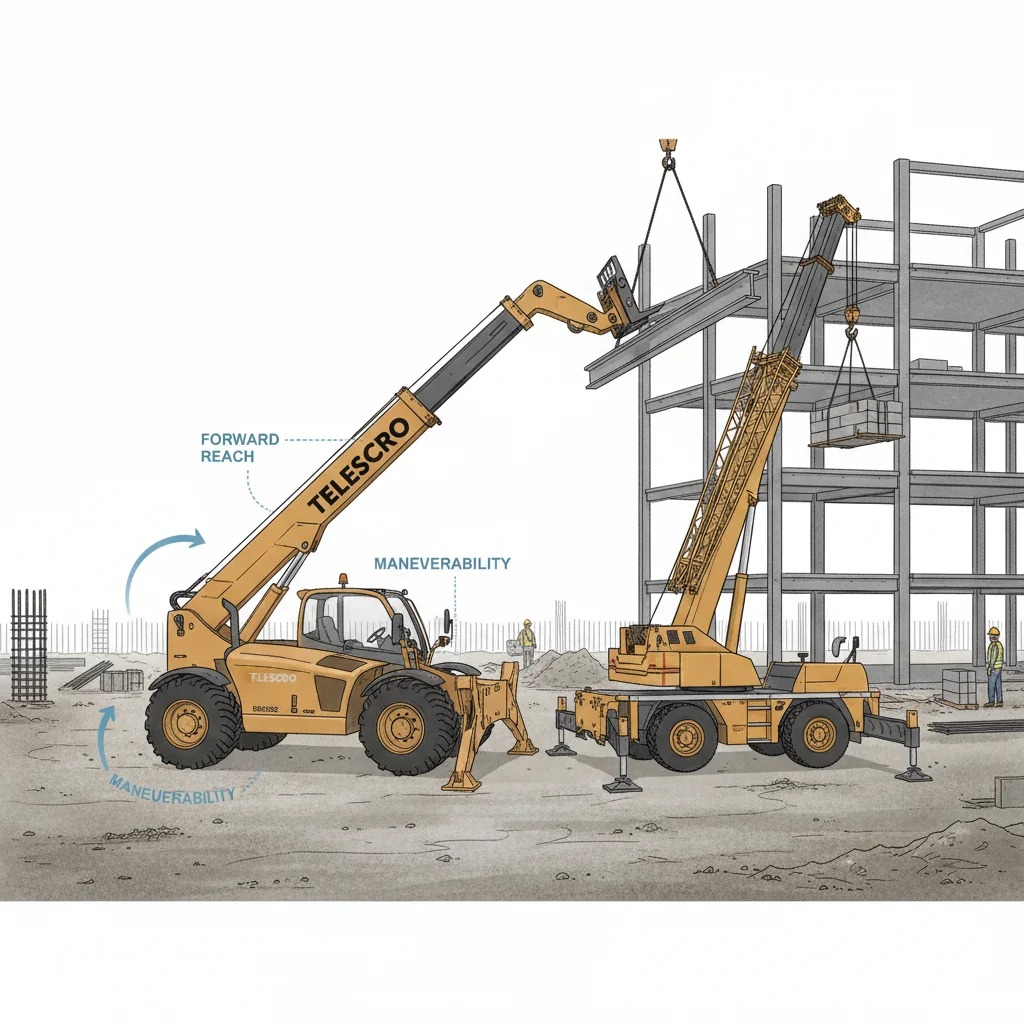
Last year, I worked with a project manager in Brazil who struggled with crane delays on a crowded high-rise site. Their team needed to lift steel beams weighing over 5 tons to the 8th floor, but mobilizing a small crane was both expensive and time-consuming—sometimes a full day just to move and set up for a new pick. They switched to a 12-ton telehandler with a reach of roughly 17 meters. Suddenly, multiple heavy lifts each day became possible from one location. The key? Staying within the rated load on the telehandler’s load chart and planning stabilizer use before each lift. The team saved several days per month just on reduced mobilization.
From my experience, these high-capacity telehandlers really shine when lifts are frequent but scattered—think urban sites where you need to get materials onto decks, set precast panels behind obstacles, or place heavy formwork quickly. If the ground is firm and you use the stabilizers (those hydraulic legs at the chassis corners), the machine stays stable even with the boom well extended. But you can’t ignore ground bearing pressure. I always recommend checking soil conditions and, if needed, using steel plates under the stabilizers—especially on reclaimed or soft ground.
One technical point: most crews overlook the moment indicator in the cab, which warns when you’re getting close to tipping limits. For near-capacity lifts, detailed load chart planning is critical. I’ve seen teams in the Middle East cut crane rentals by half just by sticking to this process. It’s not a universal crane replacement, but planned right, a big telehandler is a game-changer for crowded or remote sites with recurring heavy lifts.
Telehandlers equipped with boom-mounted winches can perform precision lifts similar to a small crane, but only if the load is within 70% of the machine's maximum rated capacity at full extension.True
Boom-mounted winches allow for vertical lifting tasks that closely resemble crane operations. However, most manufacturers derate the telehandler’s capacity when using these attachments, typically allowing safe operation only up to about 70% of the rated capacity at maximum boom extension to ensure stability and prevent tipping.
Telehandlers can safely operate at maximum rated capacity regardless of lift height, unlike small cranes which require load charts for every position.False
Telehandlers, like cranes, have load charts that specify maximum safe lifting capacities at various boom lengths and angles. Capacity decreases as the boom is extended or raised to higher elevations, and ignoring these limits can result in tipping or structural failure. No telehandler can safely lift its maximum rated load at all boom heights or extensions.
Key takeaway: On congested or remote construction sites with frequent moderate heavy lifts, high-capacity telehandlers can reduce crane hire frequency when engineered within their rated capacity and planned for stability. Careful attention to planning, operator training, and load chart use is essential for safe, efficient material handling.
Conclusion
We’ve looked at how telehandlers and forklifts each fit different site demands, especially with telehandlers offering more reach and placement options. From what I’ve seen on real jobsites, too many buyers get swept up in lifting height and forget to check what they can actually lift at working extension—the “3-meter blind spot” that causes headache later. Before choosing, I always suggest studying the load chart at the typical boom positions you’ll use and asking about local spare parts support. Need help figuring out what fits your next project or how attachments can improve productivity? I’ve worked with contractors in over 20 countries—feel free to reach out, I’m happy to share honest, practical advice. Every jobsite’s unique, so let’s find the match that works for yours.
References
-
Explore detailed mechanics and advantages of telescopic booms, enabling higher vertical lift and forward outreach in telehandlers. ↩
-
Learn the critical role of forward outreach in placing materials beyond forklift reach, solving complex site access challenges. ↩
-
Provides detailed guidance on reading load charts to avoid overloads and costly accidents at varying boom reaches. ↩
-
Explains why the rated capacity isn’t constant and how boom position impacts load limits for safe operation. ↩
-
Explore how extended forward reach enables telehandlers to place loads over obstacles forklifts cannot, improving site efficiency. ↩
-
Learn why telehandlers with 4WD and stabilizers outperform forklifts on rough terrain for safer, more stable lifting. ↩
-
Details the role of standard and increased ground clearance in navigating rough terrain and avoiding jobsite obstacles. ↩
-
Learn why maximizing machine utilization on site improves cost efficiency and keeps construction progress uninterrupted with fewer equipment idle periods. ↩
-
Understand the technical importance of load charts in maintaining safety and efficiency during heavy lifts with telehandlers. ↩
-
Detailed insights on how quick couplers enable fast attachment swaps, saving time and boosting telehandler productivity on job sites. ↩
-
Comprehensive understanding of pallet forks application for heavy-duty lifting on rough terrain, essential for material handling operations. ↩
-
Explores how load chart data affects telehandler capacity at height and reach, crucial for safe, effective construction lifting. ↩
-
Explore expert insights on how high-capacity telehandlers enhance lifting efficiency and reduce costly crane mobilization on crowded sites. ↩