











Why Telehandler Versatility Matters: Field-Tested Advantages Explained
Not long ago, I watched a team in Egypt unload roofing materials with a telehandler where a forklift simply couldn’t reach—over a fence, up two stories, and straight onto the scaffold. It’s moments like this that remind me: versatility isn’t just a feature, it’s a jobsite necessity.
Telehandler versatility comes from the combination of an extendable telescopic boom1 and a broad range of compatible hydraulic attachments. Unlike forklifts or loaders, a telehandler’s boom can lift and extend loads forward as well as upward, allowing materials to be placed at height or positioned beyond obstacles on construction and agricultural sites.
Advanced quick couplers2 and auxiliary hydraulic circuits allow attachments to be changed efficiently, enabling the same machine to handle palletized loads, bulk materials with buckets, bale handling, or approved work platforms when correctly specified and certified.
How Does a Telescopic Boom Increase Versatility?
A telescopic boom enables a telehandler to extend upward and forward, providing reach over obstacles and into upper floors—functions a traditional forklift or loader cannot perform. This design allows efficient placement of loads such as bricks, HVAC units, or bales, supporting tasks that otherwise require cranes or additional labor.
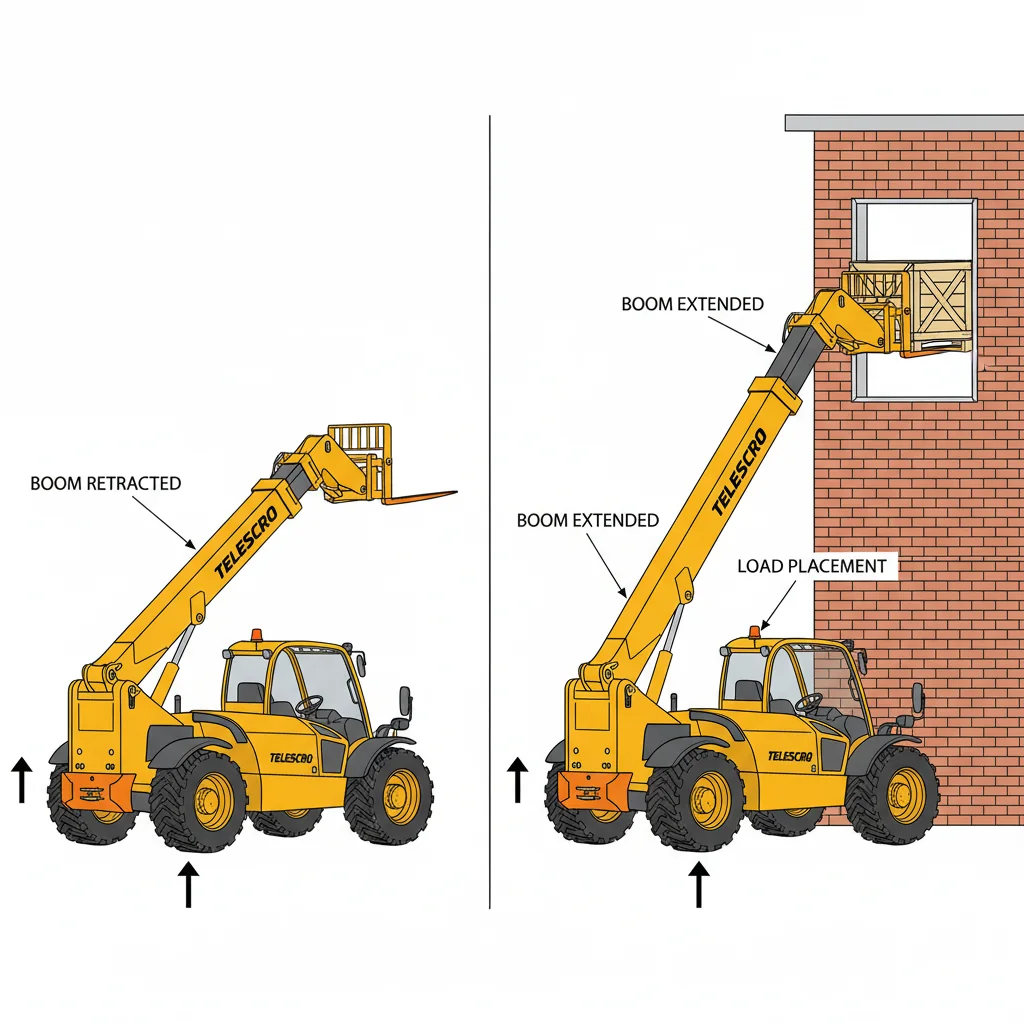
Most people focus on maximum lift height, but the real advantage is the telescopic boom’s ability to reach both upward and forward. On higher-reach models, that forward-and-up reach can extend into the high-teens in meters, which is exactly what solves placement problems around scaffolding, fences, and unfinished slabs.
I’ve seen this make a clear difference on sites in Kazakhstan, where contractors needed to place HVAC units onto a fifth-floor balcony with scaffolding and equipment blocking access. With a traditional forklift, they would have been forced to reposition constantly or bring in a crane for the day. The telescopic boom allowed the operator to reach past the obstruction and set the load accurately at the target point, with far fewer moves.
On large farms I’ve visited in Brazil, this same flexibility saves hours every week. Operators use a 4-ton telehandler with a 15-meter reach to stack hay bales deep into barns and fill grain bins—jobs that would take two machines or a lot more manual labor otherwise. With the boom extended, you don’t have to drive into tight corners. That not only saves time, but also reduces wear and risk of hitting structures. A customer told me it cut their bale-stacking time almost in half.
The load chart3 becomes essential here. As boom reach increases, allowable rated capacity4 decreases accordingly, which is why the chart—not the headline rating—must be checked for every lift.
At long reach, a machine may be limited to a much smaller fraction of its nominal capacity, depending on boom position, attachment, and setup. I always recommend comparing your highest and furthest placement tasks against what the boom can safely deliver at those exact positions. When the boom and capacity are correctly matched to site needs, fewer machines are required, labor is reduced, and lifts are completed more smoothly. Evaluate all high-reach tasks on your site before judging the machine purely by its price tag.
A telescopic boom allows operators to place loads at a variety of heights and distances without repositioning the entire machine, making it especially valuable in crowded or obstruction-filled job sites.True
Because a telescopic boom can extend outward and upward, operators can maneuver loads around obstacles or reach over structures, unlike forklifts or fixed booms that require repositioning to access different areas.
The forward reach capability of a telescopic boom is only useful for lifting light loads, as heavier materials can only be moved vertically.False
Telescopic booms are designed to handle substantial loads at varying outreach distances, and while load capacity does decrease with increased reach, properly rated telehandlers are engineered to safely handle heavy materials both vertically and horizontally within specified limits.
Key takeaway: The telescopic boom is central to telehandler versatility, enabling one machine to perform crane-like lifts, loader-style loading, and forklift pallet handling. This multi-functionality often offsets higher purchase costs by reducing the need for several specialized machines or additional labor for high-reach placement.
How Do Telehandler Attachments Add Versatility?
Attachments and quick couplers, such as JCB’s Q-fit, enable telehandlers to rapidly switch between forks, buckets, bale grabs, jibs, or man baskets5—often from the cab. This flexibility transforms a single machine to handle multiple site or farm tasks, maximizing operational efficiency and reducing the need for dedicated equipment.
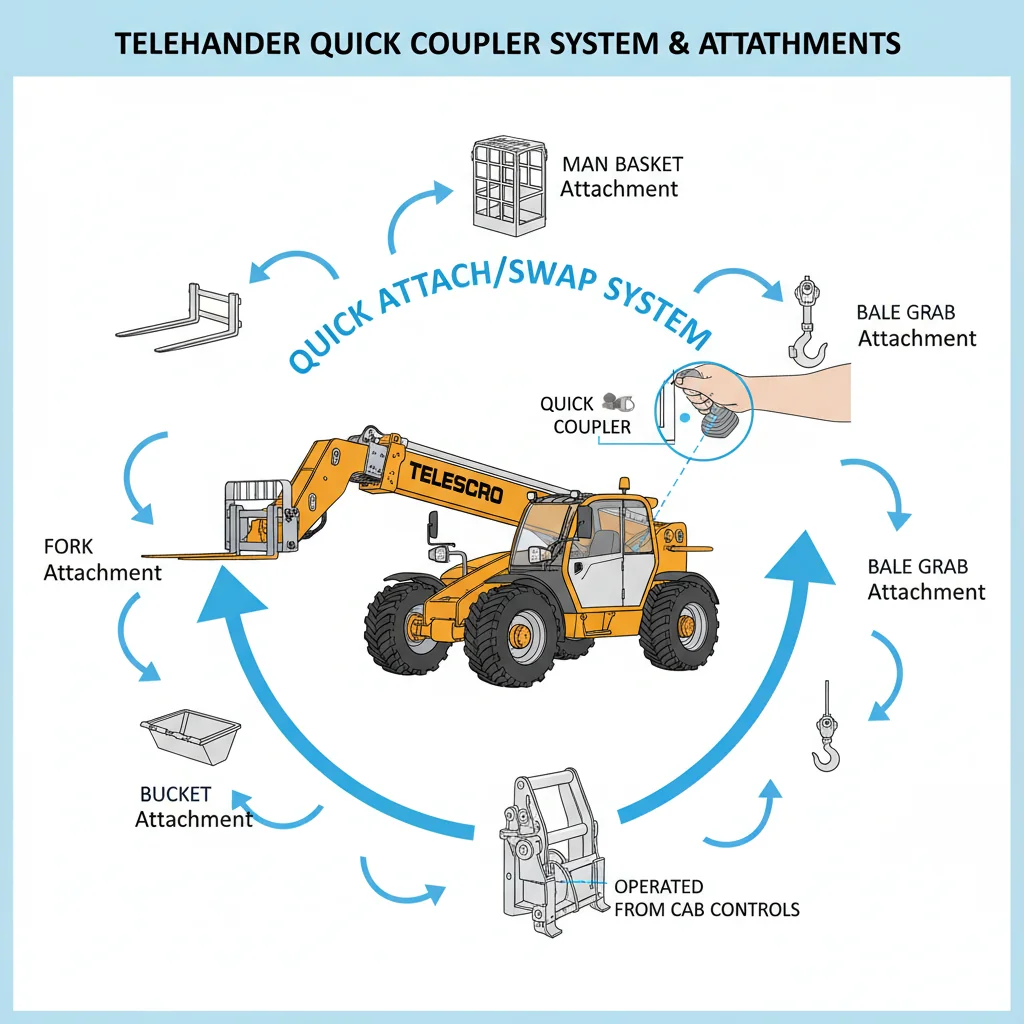
Let me share something important about telehandler versatility—attachments and quick couplers matter just as much as the base machine. You’re not buying a "tall forklift." The real value comes when operators can swap tools quickly to match changing jobsite demands. In Kazakhstan, I had a customer who started with basic forks but upgraded to a hydraulic bucket and a man basket the next season. Suddenly, that single machine handled pallet moving, material loading, and safe lift access for façade repairs—all because he spec’d a quick coupler6 and extra hydraulics from the start.
Here’s what really impacts your daily flexibility:
- Forks—standard for pallet work; most jobs need these daily.
- Buckets—convert your telehandler into a loader for sand or gravel; just check attachment weight against your load chart.
- Bale grabs/spikes—essential for farms; standard bale clamps usually handle bales from 250 to 800 kg, but silage weights vary with moisture.
- Jibs/winches—turns the boom into a mini crane for suspended loads.
- Man baskets—let crew work safely at height; always require machine-interlock and safety certification.
- Hydraulic/tilt rotators or side shifters—improve load handling without constant machine repositioning.
From my experience, the biggest regret is skipping necessary options—like enough auxiliary hydraulic circuits7 or an electric line for smart attachments. Without these, you can’t run powered clamps or advanced tools. And always specify a robust quick coupler system; if the pins seize up or don’t engage fully, swapping tools slows to a crawl. I suggest clarifying attachment requirements before purchase. It saves money and hassle down the road.
Some telehandler attachments can be shared across brands when the coupler interface and hydraulic requirements match, but compatibility must be verified against coupler standard, load rating, hydraulics, and local compliance rules.True
Some attachments can be cross-used if the coupler standard and hydraulic flow/return setup are compatible. However, buyers must verify mechanical interface, rated capacity, load chart applicability, hydraulic requirements, and any certification constraints before assuming interchangeability.
Telehandler attachments can only be used with the specific brand and model for which they were originally designed, so cross-compatibility is never possible.False
While some specialty attachments may have brand-specific mounting systems, industry-standard couplers and universal plates allow many attachments to be used across different brands and models, increasing overall flexibility.
Key takeaway: Specifying a robust quick coupler, adequate auxiliary hydraulic circuits, and an electrical line for smart attachments is essential. This ensures maximum versatility; otherwise, the telehandler functions only as a tall forklift with limited upgrade potential, missing the full benefits attachments provide.
How Can Telehandlers Replace Multiple Machines?
A properly specified telehandler can handle tasks typically managed by yard forklifts, small loaders, and light-duty crane operations. This versatility allows one telehandler to unload trucks, lift pallets to upper floors, and handle bulk materials, streamlining site logistics8 and reducing equipment, operator count, maintenance, and storage demands.
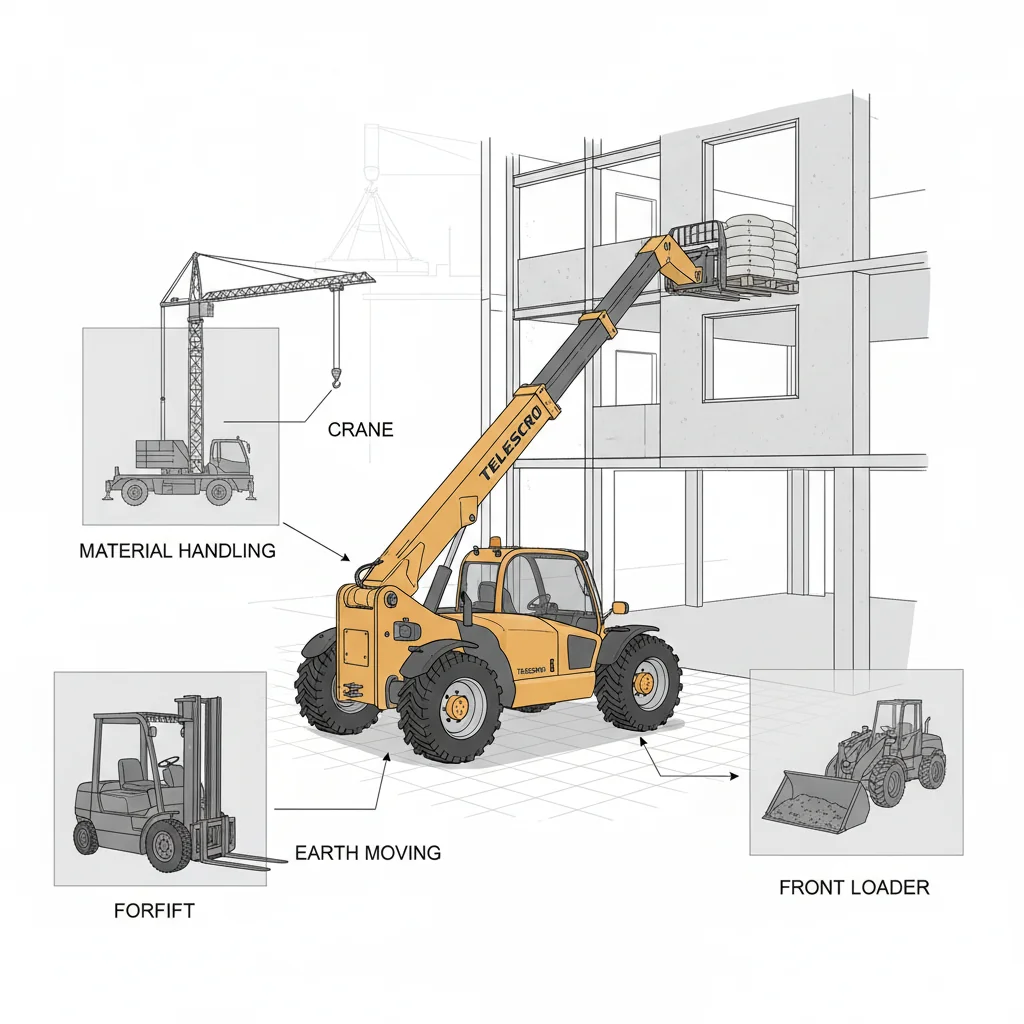
A common issue I see on jobsites—particularly in markets like Kazakhstan and Malaysia—is the use of multiple machines to cover tasks that could be handled by a single, properly specified telehandler. It’s not unusual to see a yard forklift, a skid steer, and a small truck-mounted crane all assigned to routine material handling and daily deliveries.
In one Dubai construction project last year, a contractor was operating exactly this mix. After reviewing their actual lift heights, reach requirements, and load weights, we specified a 13-meter telehandler with a 3.2-ton rated capacity. Once deployed, the machine took over truck unloading, pallet placement to upper floors, and debris handling into dumpers using a bucket attachment. As a result, fleet complexity was reduced, maintenance became more straightforward, and the number of operators required per shift dropped significantly.
From my experience, a lot of agricultural users don’t realize how dynamic one telehandler can be either. On a mid-size Australian farm, a 9-meter, 3-ton unit fitted with a grain bucket and bale grab replaced both a compact wheel loader and an old warehouse forklift. The operator swapped attachments in under five minutes for shifting bales, handling silage, or moving feed. Not only did this reduce idle machinery blocking capital, but fuel and service costs dropped sharply. One machine, multi-task duties—no more spare parts roulette with three brands in the shed.
Here’s what matters most when making the switch: always check your load chart and match the model to the heaviest, highest routine job. Oversizing does add cost, but being stuck with two underpowered machines is worse. I suggest walking your jobsite, listing major handling tasks, and mapping them to the telehandler’s rated capacity and reach. This step prevents disappointment and makes your investment count.
A telehandler equipped with the right attachments can perform as a rough terrain forklift, light-duty crane, and material handler, reducing the need for separate machines on site.True
Telehandlers are designed with a telescopic boom and can use a variety of attachments such as pallet forks, buckets, and lifting hooks. This allows them to take on the roles of forklifts, cranes, and loaders, offering unmatched versatility and multi-functionality in material handling tasks.
Telehandlers are limited to horizontal lifting and cannot safely place loads at height, unlike truck-mounted cranes.False
Telehandlers are specifically designed to both lift and precisely place loads at height using their telescopic boom. With proper stabilization and operator skill, telehandlers often outperform many traditional machines in vertical load placement for goods like pallets or construction materials.
Key takeaway: A single telehandler, matched to site and material requirements, can effectively reduce the need for 3–4 specialized machines across diverse environments. This consolidation delivers cost savings in equipment procurement, operator requirements, maintenance, and transport—without sacrificing capability for non-standard and multipurpose site tasks.
How Does Telehandler Versatility Impact ROI?
Telehandler versatility directly affects ROI because a single machine can often replace multiple units, such as forklifts or mobile cranes, reducing fleet size, rental reliance, operator demand, and overall operating costs. Newer telehandlers equipped with Stage V engines9 typically deliver improved fuel efficiency and lower emissions compared with earlier engine tiers, contributing to reduced lifetime operating costs. For accurate ROI evaluation, buyers should assess the complete working configuration—including attachments, auxiliary hydraulics, and electrical options—rather than comparing base machine prices alone, as system-level capability ultimately determines payback and utilization.
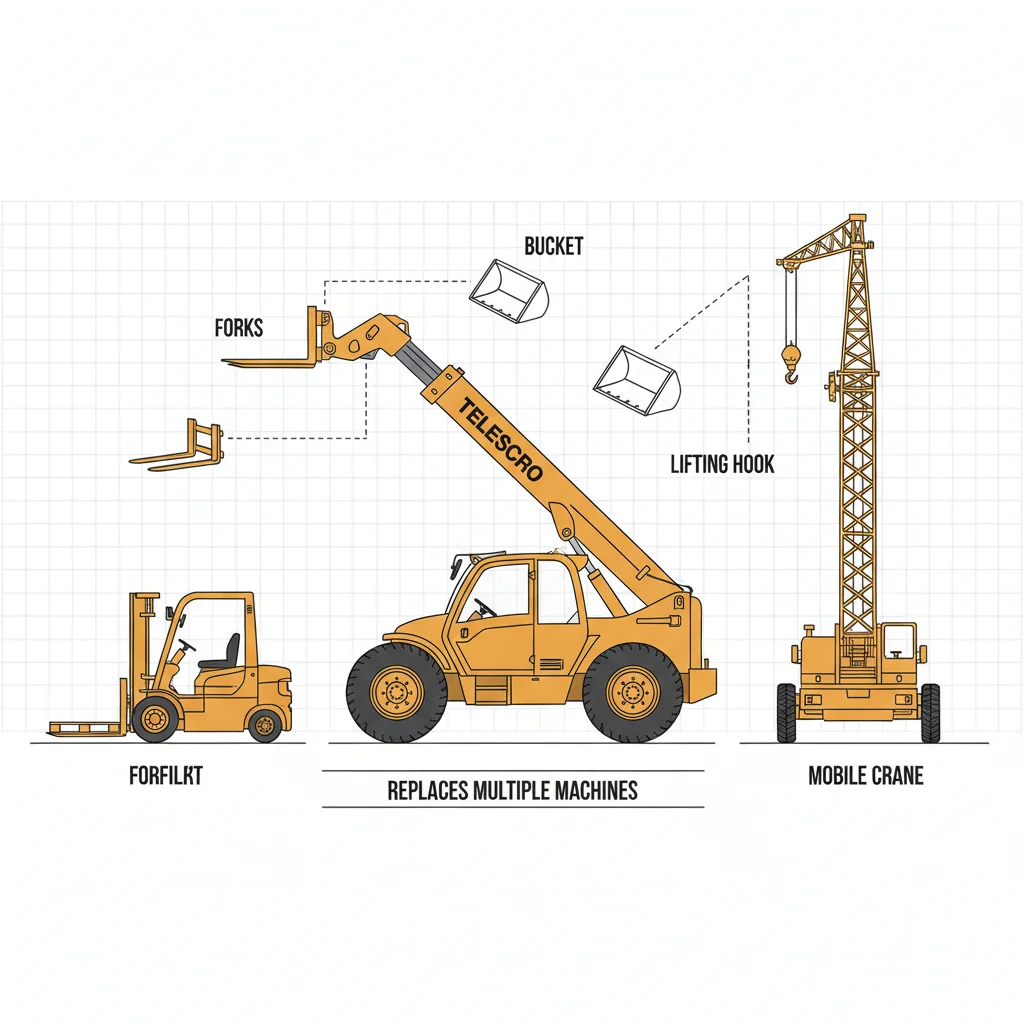
Here’s what matters most when you’re looking at telehandler ROI: focus on the full working package, not just the base machine price. Too many buyers compare a 3.5-ton, 12-meter telehandler to a basic forklift, thinking only about upfront cost. But a telehandler can often do the work of several machines—forklifts, light-duty cranes, even small loaders. I saw this firsthand with a contractor in Dubai last year. They were paying close to $900 per day for a mobile crane for roof material lifts. Once they switched to a higher-spec telehandler with a winch and fork carriage, crane rental days dropped by over half.
When I talk to rental fleets in Kenya or Kazakhstan, the operators always highlight machine utilization rates. If you’re running one versatile telehandler with core attachments—say, bucket, winch, jib—you can keep it working across multiple trades and shifts. That means higher utilization, fewer parked machines, and less dead capital. I’ve watched mixed fleets recoup the higher equipment investment in under three years, simply by reducing their overall fleet size and avoiding short-term rentals.
But there’s a caution here—attachments and the required hydraulic options add real cost. Each hydraulic tool, like a sweeper or material grab, might run $2,000 to $6,000. Advanced models with Stage V engines often deliver around 10–15% fuel savings, especially if they replace older, less efficient equipment. Always ask dealers for a full-system quote: base unit, three to five key attachments you’ll actually use, and the hydraulics or electronics needed. That’s the only way to get a clear picture of your real payback.
A telehandler's versatility allows it to perform multiple functions—such as lifting, loading, and material placement—which can reduce the need to rent or purchase separate machines for each task, leading to a more favorable ROI over the life of the equipment.True
This is true because telehandlers can use a wide variety of attachments, like buckets, jib booms, or winches, making them suitable for jobs typically assigned to forklifts, cranes, or loaders. This multi-functionality streamlines equipment fleets and increases utilization rates.
Telehandler versatility has little impact on ROI, because their specialized design restricts them to lifting tasks only.False
This is false; the core advantage of a telehandler is its adaptability. With the right attachments, a telehandler can handle far more than just lifting—such as loading, digging, or material placement—which is why its versatility is central to its ROI for many buyers.
Key takeaway: Evaluating telehandlers at a system level—including attachments, required hydraulics, and reduced rental needs—offers a more accurate ROI calculation than focusing solely on base price. Versatile units can pay for themselves in as little as 2–3 years through reduced fleet size, minimized crane rentals, and higher utilization.
How Does Telehandler Versatility Boost Efficiency?
Telehandler versatility streamlines site operations by reducing machine changes, minimizing idle time, and allowing seamless transitions between tasks such as truck unloading and precise rooftop placement. Fast boom and hydraulic cycles enable quicker handling versus separate cranes or forklifts, while adaptable attachments support diverse duties from maintenance access to oversized cargo handling.
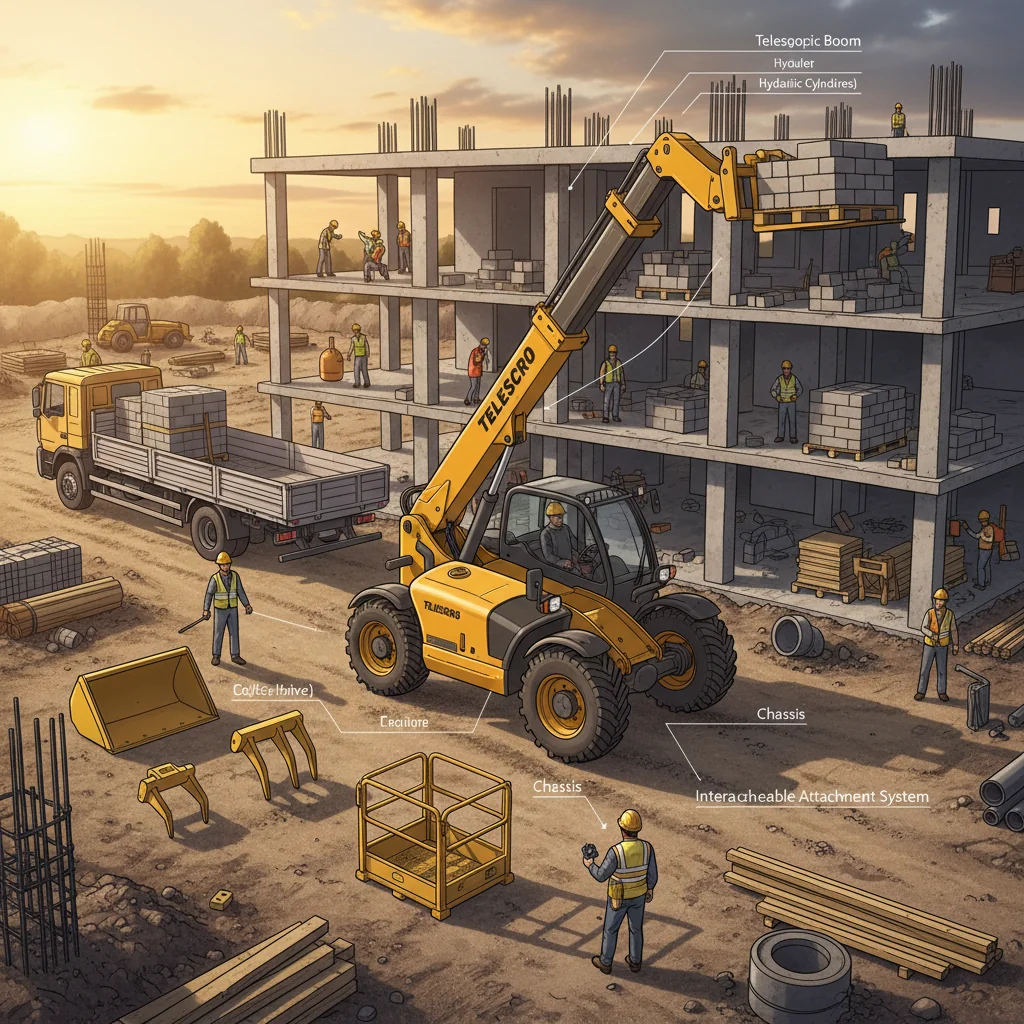
I’ve worked with customers in Dubai where project deadlines are tight and every minute of machine idle time adds to costs. On one recent site, the team used a 4-ton telehandler with a 14-meter boom. They switched from unloading steel pallets off trucks to lifting HVAC units onto a five-story roof—all without waiting for a separate crane or bringing in extra forklifts. That’s a real productivity boost. When the job called for quick lighting maintenance, the operator swapped on a man basket. No need to rent a separate work platform or delay the schedule.
Here’s what matters most when you want day-to-day efficiency: the fewer times your crew waits for the “right” machine, the faster the work flows. Telehandlers achieve that with fast boom cycles10—some models reach maximum extension in under 15 seconds. Hydraulic quick-couplers11 also make it easy to change attachments, which means you can shift from moving heavy palletized goods to placing irregular loads, like glass panels or long pipe sections, in minutes. In Kazakhstan, I watched a logistics customer use the same telehandler to unload oversized cable drums and then immediately handle pallets in a crowded storage yard. No wasted time shuffling equipment.
To be honest, flexible deployment changes how sites use staff. Since operators can handle more varied tasks without extensive retraining, you often reduce total operator hours across a shift. Modern cabs and load moment indicators help reduce mistakes—less downtime for troubleshooting or accident recovery. I always suggest tracking machine idle time on your busiest projects; most teams see a clear drop when switching to telehandler-based operations for multi-purpose jobs.
Telehandlers can switch quickly between attachments such as forks, buckets, and man baskets, allowing a single machine to perform multiple specialized tasks without long periods of downtime.True
Telehandlers are designed with quick-attach systems, enabling operators to swap attachments to suit the task at hand—like moving from pallet handling to personnel lifting—without requiring dedicated equipment for each job. This modularity reduces idle time and streamlines workflow on site.
Telehandlers require extensive modification and downtime whenever switching between lifting materials and elevating personnel, making them less efficient for multi-tasking on job sites.False
Modern telehandlers use quick-attach couplers and standardized controls, allowing for rapid changes between attachments and functions. This minimizes downtime and supports the machine’s versatility, rather than hindering it.
Key takeaway: Telehandler versatility enables fewer machine changes, faster material handling, and more flexible staffing. This translates into reduced operator downtime and improved daily efficiency across varied industrial, construction, and logistics applications—delivering measurable productivity gains without needing specialized equipment for each unique task.
When Is a Rotating Telehandler Worth It?
Rotating telehandlers provide 360° boom slewing and stabilizer-supported lifting, enabling precision load placement around structures and over obstacles without repositioning. While their higher price and operator skill requirements suit complex jobs, for mainly linear material handling, fixed-frame telehandlers12 remain better value for typical construction or agricultural tasks.
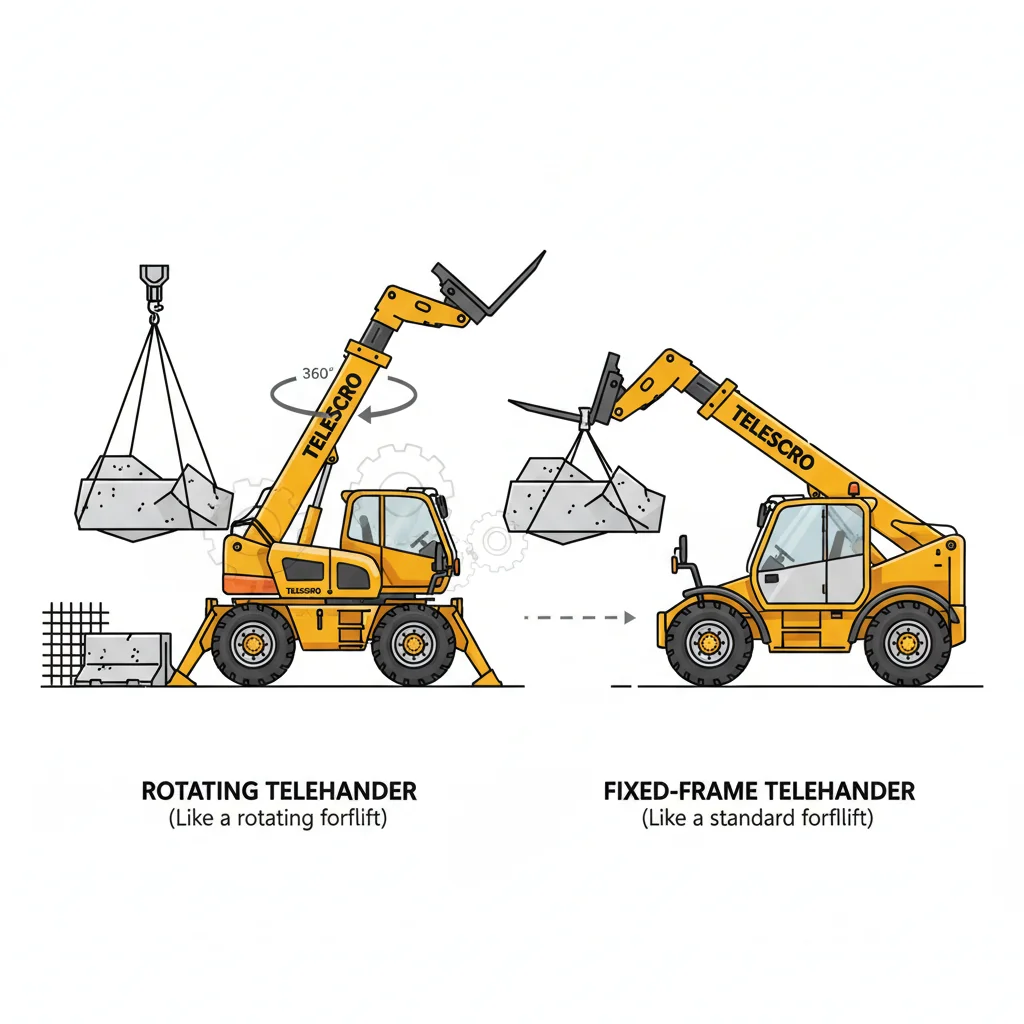
Most people don’t realize just how much a rotating telehandler (Roto) can change the way you handle complex jobsites. Unlike a fixed-frame model, a Roto gives you 360-degree boom slewing and hydraulic stabilizers that let you set up almost anywhere. I’ve seen this firsthand in Singapore, where a contractor was working on facade panels. They needed to lift glass units onto three different sides of a building—tight site, almost no room to reposition. With a 6-ton Roto model and the stabilizers fully out, they worked continuously for two days without moving the chassis once. That saved at least one full crane rental and days of scaffold assembly.
But here’s what matters most: if your daily work looks like loading pallets, shifting bales in a barn, or stacking materials along a single facade, the extra price—and the added operator training—just won’t pay off. In Kazakhstan, a steel yard manager told me that his team switched back to fixed-frame telehandlers after trialing a Roto. Nearly 90% of their lifting was in straight lines, so the rotating function barely got used, but fuel costs and transport weights were higher.
From my experience, the Roto’s biggest value comes when you need to regularly change your lift angle—like roofing work, man-basket jobs on irregular buildings, or steel erection inside tight city sites. The load chart matters even more with a Roto. Stabilizers boost lifting performance, but you still need a skilled operator who can read moment indicators and keep within limits. I always suggest reviewing your last six months of crane and man-basket use—if those bills add up, a Roto might start making real financial sense.
A rotating telehandler can position its load to multiple sides of a structure without needing to be physically moved on the ground, due to its 360-degree turret rotation and deployable outriggers.True
The key advantage of a rotating telehandler is true omnidirectional boom positioning, which eliminates the need for constant repositioning on congested or confined jobsites. Its stabilizers keep the unit steady, allowing safe lifting from one spot.
Rotating telehandlers are less stable than fixed-frame telehandlers when lifting loads at maximum outreach because their turntable mechanism increases structural flex.False
Rotating telehandlers actually deploy hydraulic outriggers or stabilizers before lifting, which often results in greater stability compared to regular fixed-frame telehandlers, especially at long reaches or unconventional angles. The design purpose of the rotation system is not to compromise rigidity but to enhance versatility and safe lift setup.
Key takeaway: Rotating telehandlers justify their premium when frequent multi-angle lifting, building façade access, or man-basket jobs reduce crane rental needs. For straightforward loading and pallet handling, fixed-frame models deliver greater value. Always consider work type, site layout, and operating skill requirements before investing in a rotating telehandler.
What Telehandler Specs Limit True Versatility?
Common configuration errors—such as ordering only pallet forks without a quick coupler, omitting auxiliary hydraulic circuits, or skipping electrical lines—restrict a telehandler’s versatility. These oversights can prevent use with grabs, mixers, or smart attachments, forcing costly retrofits. Attachment weight and incompatible coupler standards may further reduce rated capacity and limit options.
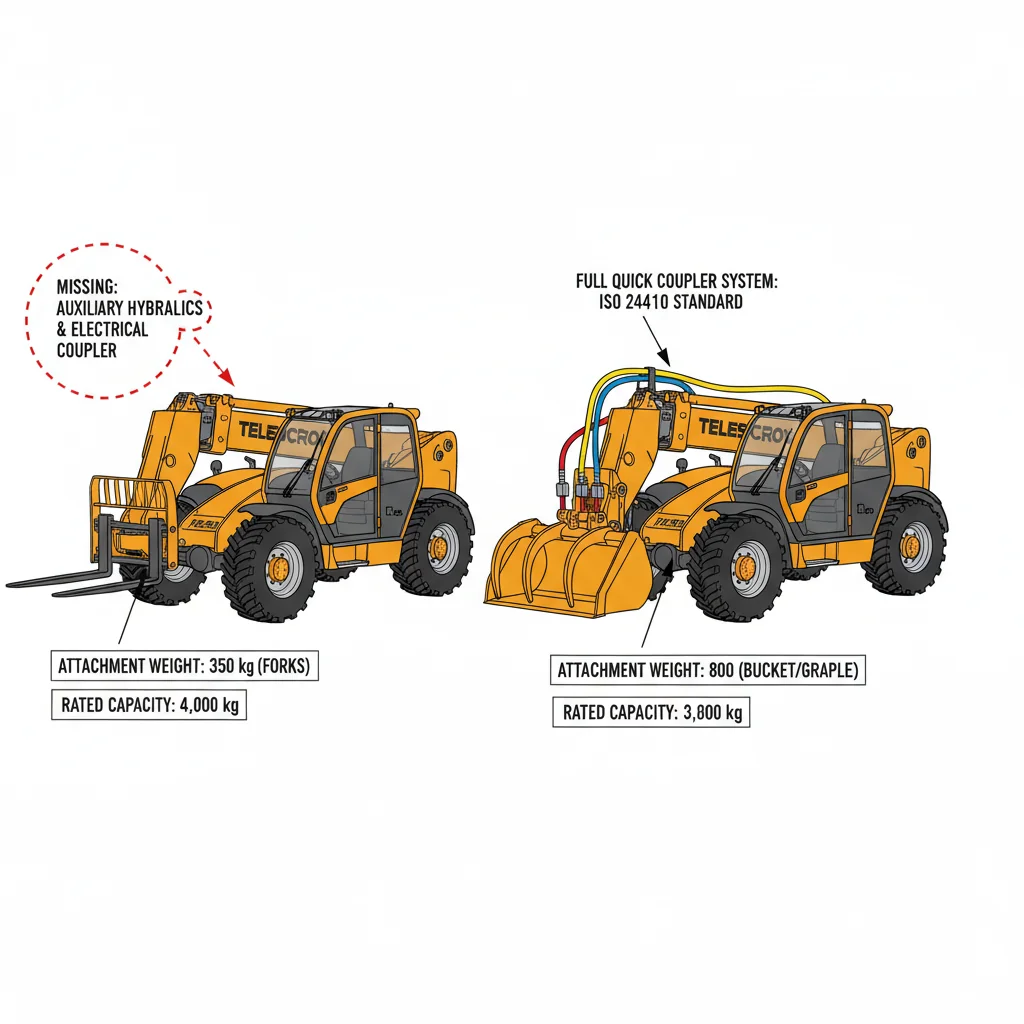
The biggest mistake I see is customers treating telehandler specs like a shopping checklist—ticking off things like lift height or engine power, but missing configuration details that decide versatility on site. Last summer, I worked with a contractor in Kazakhstan who ordered six machines for a mixed-use project. They came spec’d with only standard pallet forks and no quick coupler—so any future switch to grabs or mixers meant hours lost on manual attachment swaps. He assumed “forks included” was enough. In reality, the lack of a coupler locked him into basic load handling, and retrofitting the system weeks later cost his team both time and serious money. I’ve also seen projects grind to a halt because buyers skipped auxiliary hydraulic circuits on the boom—maybe to save a few thousand dollars up front. The trouble is, if you can’t run a bucket with a hydraulic ram or a rotating man basket, your “versatile” telehandler becomes a tall forklift and nothing more. I always recommend mapping out which attachments you’ll actually use over the next three to five years—grabs, augers, mixers, sweepers, or anything requiring flow and return lines—and making sure the right number of circuits, hoses, and even electrical lines are installed from day one. Missing this means you’re boxed in, costly to upgrade later, and sometimes outright impossible if the factory’s wiring isn’t in place. Attachment weight and coupler compatibility trip up a lot of buyers too.
A telehandler without a quick coupler significantly limits its versatility, as operators must manually swap attachments, increasing downtime and reducing the machine’s flexibility on diverse tasks.True
Quick couplers allow rapid changes between attachments like buckets, forks, and jibs without manual intervention. Without them, machines are tied to a single attachment or require time-consuming manual swaps, restricting on-site adaptability and efficiency.
The engine’s horsepower rating alone determines how many different types of attachments a telehandler can effectively use on site.False
While engine power is important, the ability to use various attachments depends more on the machine’s hydraulic system, auxiliary lines, and coupler compatibility—not just horsepower. A high-powered engine does not compensate for a lack of hydraulic capacity or attachment interface limitations.
Key takeaway: Telehandler versatility is often limited by initial specification errors—especially missing quick couplers, hydraulic and electrical lines, or ignoring attachment weights and coupler compatibility. Confirm core attachments, hydraulic and electrical requirements, and local coupler standards before ordering. Upfront investment in the right spec saves retrofit costs and operational frustration.
How Does Telehandler Versatility Impact Safety?
Telehandler versatility introduces additional safety requirements. Because each attachment—such as forks, buckets, jibs, or man baskets—changes the machine’s rated capacity and approved operating envelope, operators must reference the specific load chart for the exact attachment and configuration in use. Personnel work platforms typically require OEM approval and site-/region-specific compliance measures. Misuse, or ignoring stabilizer setup and load chart limits, increases tip-over and structural risk. Operator training and documented site rules are essential for safe operation.
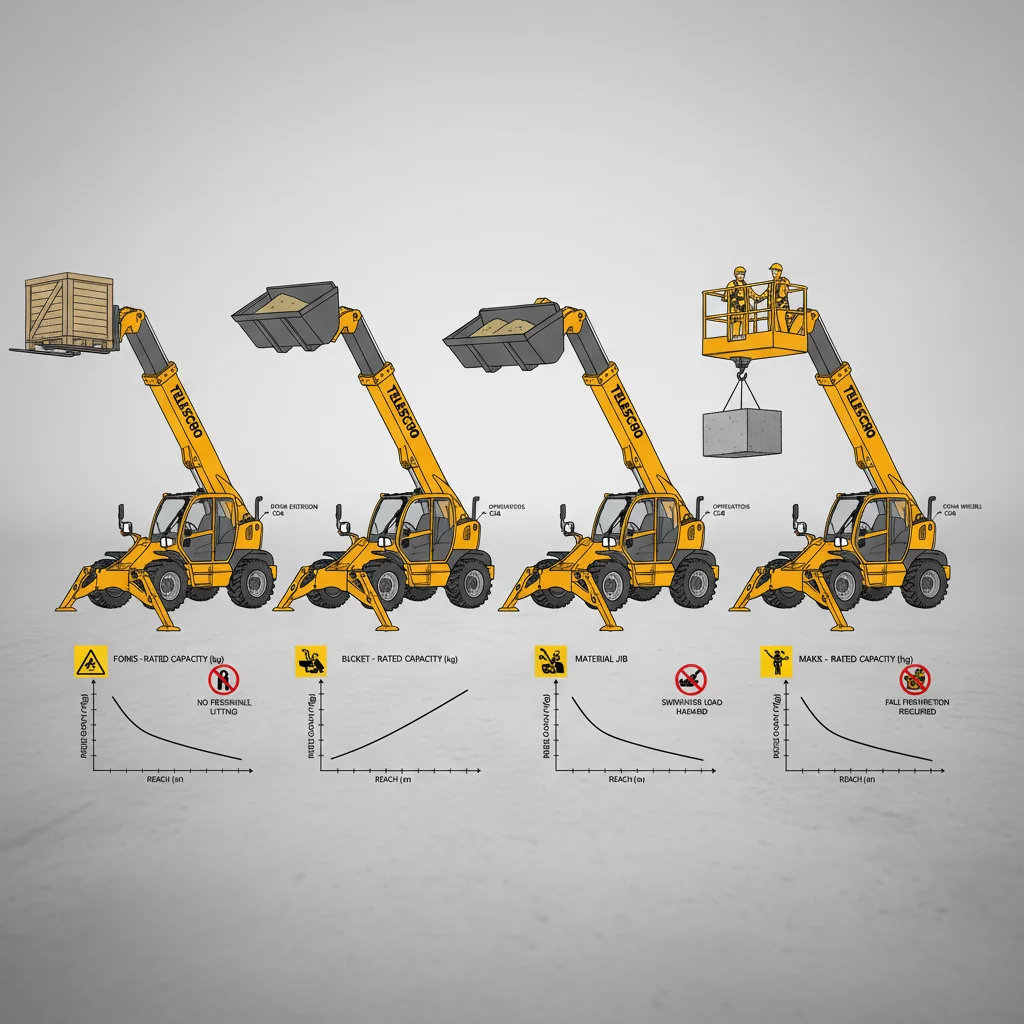
Telehandler versatility is a major advantage, but it also increases safety management requirements. These machines can cover multiple handling tasks, and the risk profile changes with every attachment and configuration. Each time you switch from forks to a man basket or a bucket, the applicable load chart changes. I’ve visited jobsites in Malaysia and found operators using a jib without the proper chart in the cab. They assumed the fork-rated numbers still applied, not realizing that allowable capacity at long reach can be substantially lower. That kind of mismatch can lead to overload, tip-over risk, or component damage.
One customer in Kazakhstan needed to lift workers using an approved platform. Local inspectors required not just the correct man basket and documentation, but also confirmation that the machine and platform were approved for that use, along with the required safety provisions and operator authorization specified by the site and local rules. If anything was missing—the document set, identification labels, or the correct load chart—the telehandler was not permitted to operate.
I always tell clients to double-check the setup shown on the load chart for that specific attachment: on tires vs. on stabilizers (if equipped), and any limits tied to stabilizer position. If you skip this—especially on rotating models—you can easily assume a capacity that the approved configuration does not allow.
The safest crews I see follow a simple rule: no attachment goes on the boom unless its matching load chart is in the cab—no exceptions. Combined with regular training on reading load charts, correct stabilizer use, and awareness of site and local compliance requirements, that habit removes guesswork and reduces incident risk. I’d suggest making that your baseline.
Telehandler versatility requires operators to reference different load charts for each attachment, since the safe lifting capacity can change drastically between forks, buckets, and jibs.True
Each attachment changes the load center, boom geometry, and the approved operating envelope, which alters allowable capacity at different reaches and heights. Switching attachments without consulting the correct, configuration-specific load chart increases the risk of overload, tip-over, or structural damage.
Once certified on one telehandler attachment, an operator is automatically qualified to use all other attachments safely, as the basic controls remain the same.False
While basic machine controls may be consistent, each attachment changes the machine’s stability and handling. Safe operation requires training and familiarity with how each tool affects load capacity and balance, as well as how to interpret different load charts.
Key takeaway: Telehandler versatility requires strict attention to model-specific load charts, attachment ratings, and site/region compliance requirements. Operator training must cover all approved attachments and configurations. Implement a rule that no attachment is used without the matching load chart available in the cab to minimize risk.
How Does Maintenance Impact Telehandler Versatility?
Neglecting key maintenance areas—such as coupler pins13, quick-connects, and boom hoses14—can gradually erode a telehandler’s multi-role versatility. Dirt in hydraulic connectors leads to leaks and unreliable functions, while boom and sensor wear can reduce usable capacity or trigger erratic safety cut-outs over time. Regular inspections and timely part replacement preserve long-term performance.
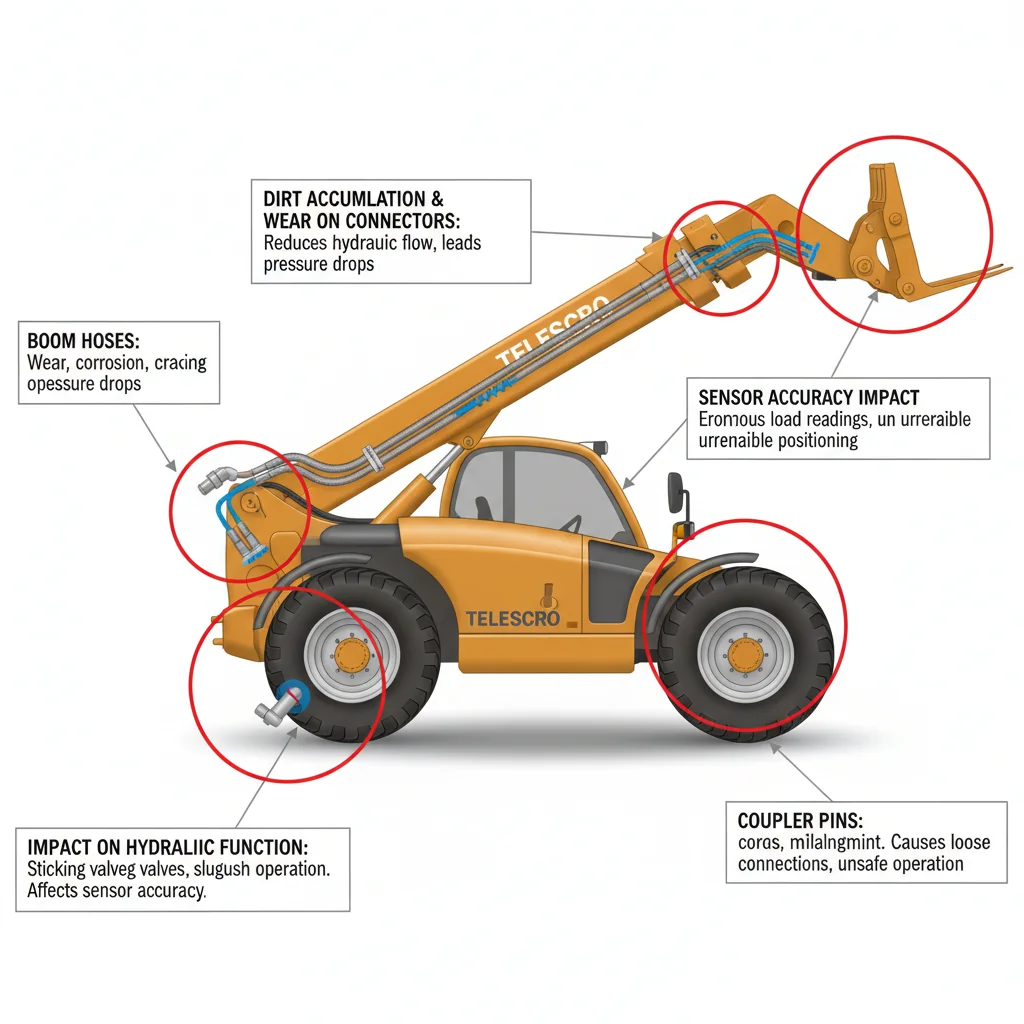
To be honest, a telehandler’s true versatility can disappear faster than people think when daily maintenance slips. I saw this last winter in Kazakhstan, where a mining contractor had three 4-ton telehandlers swapping out buckets, forks, and grabs every week. After six months, two machines started leaking hydraulic oil at the coupler. Dirty quick-connects caused pressure drops and unreliable grab movement—suddenly, their “multi-role” machines were limited to forklifting only. That wasn’t just downtime—it cost them extra equipment rentals and delayed their core job.
Regular checks on coupler pins, hoses, and wiring aren’t just a chore in the service schedule. I’ve worked with customers in Brazil who skipped greasing the locking pins because “we hardly change attachments”—but after a year of cement dust, the pins seized up. One telehandler lost its man basket certification for three weeks. It’s the same with boom hoses: neglect the dust caps and lose track of which attachment carried contamination, and you’re asking for recurring sensor errors down the line.
Here’s a tip I always share: keep a log of every attachment swapped on each machine. That way, if you notice hydraulic contamination or a cylinder acting up, you can trace it back, instead of guessing. Also, load sensors and electronic safety systems need calibration at least once a year, especially on units used for suspended loads. If those start drifting, you’ll either trip frustrating safety cut-outs or—worse—face unsafe lifting without warning. Proactive, specific maintenance protects your machine’s flexibility and your team’s confidence on every job.
Neglecting proper cleaning and lubrication of telehandler quick couplers can result in attachment hydraulic functions losing responsiveness or failing altogether, which directly reduces the machine’s versatility.True
Dirty or poorly maintained hydraulic quick couplers can introduce contamination and restrict fluid flow, leading to pressure loss. This impairs the performance or functionality of attachments such as grabs or buckets that rely on hydraulics, meaning multi-functional capabilities are lost until maintenance is performed.
The versatility of a telehandler remains unaffected by poor maintenance since attachments can always be changed regardless of the machine’s condition.False
Attachment interchangeability heavily depends on the condition of couplers, hydraulics, and auxiliary systems. When these components are neglected, some attachments may not function properly, thus limiting the spectrum of tasks the telehandler can perform.
Key takeaway: Consistent maintenance of couplers, hydraulic connectors, sensors, and hoses is essential to retain a telehandler’s full range of capabilities throughout its service life. Accurate inspection records and scheduled calibration prevent avoidable issues that compromise safety, machine flexibility, and long-term value.
How Should Telehandler Versatility Be Planned?
The most effective way to plan telehandler versatility is to start from a facility’s top three recurring tasks and size boom reach15 and rated capacity for those needs. Attachment selection should cover at least 80% of annual jobs before considering optional features such as rotation or weighing systems.
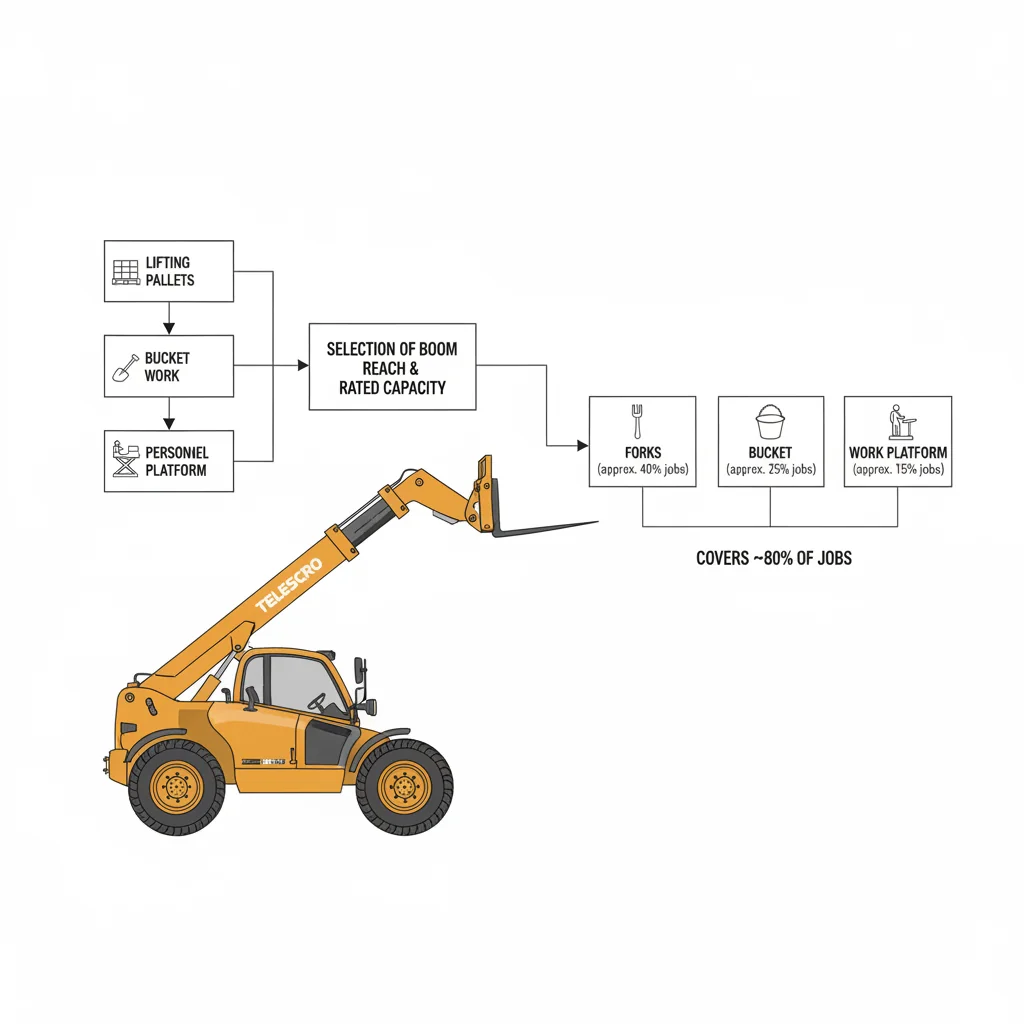
Here’s what I see most often on real jobsites: versatility gets planned around the wrong priorities. Instead of starting with what actually happens day after day, buyers get distracted by max specs—like a 17-meter boom or features they rarely use. But based on my calls with customers in Brazil, Dubai, and South Africa, the right approach always starts with listing your top three regular tasks. For example, in construction: it’s typically unloading deliveries, placing bricks or MEP units on upper levels (around 10-14 meters), and shifting site debris. On farms, I see lifting seed or feed, handling round bales (often 500–900 kg each), and loading grain. Sizing your telehandler’s boom reach and rated capacity for these jobs first—using the load chart, not just max numbers—avoids oversized and underused machines.
I remember a contractor in Kazakhstan who wanted a rotating telehandler with every attachment, expecting it would “do everything.” We broke down their last six projects. Over 80% of the work needed just forks and a bucket, with most lifts under 2.5 tons and below 12 meters. They skipped the rotation feature in the end, saving close to $20,000 up front and cutting maintenance hassles later. That’s real versatility—matching specs to the high-frequency jobs.
Before jumping to man baskets or weighing systems, I always suggest checking—will your chosen attachments and hydraulic circuit handle 80% of your workload? Walk through a few past projects and ask, “Could this setup have replaced our old forklift, crane, or loader for that task?” The more “yes” answers, the more your telehandler will truly pay off.
Key takeaway: Prioritize telehandler boom size and attachments around real-world, high-frequency tasks instead of seldom-used features. This approach maximizes productivity, avoids overspending, and ensures essential hydraulic and operational requirements are met across the most common job requirements in construction, agriculture, and industrial settings.
Conclusion
We’ve looked at how the telescopic boom makes telehandlers flexible enough to handle lifting, loading, and pallet work on a single machine. That versatility can replace extra equipment and cut down on labor for high-reach tasks.
From my experience, smart buyers look past just the maximum reach and check the load chart at mid-extension—often where most jobs actually happen. Don’t let impressive showroom specs turn into a "showroom hero, jobsite zero" situation.
If you’re weighing options, or not sure what fits your crew’s real work, I’m happy to share what I’ve seen work on jobsites worldwide. Feel free to reach out anytime for advice. Every jobsite is unique, so choose what fits your daily workflow best.
References
-
Explores how a telescopic boom extends reach and access, enabling tasks cranes or forklifts cannot, improving efficiency and reducing labor. ↩
-
Explore how quick couplers enable rapid tool changes on telehandlers, maximizing efficiency and reducing equipment downtime. ↩
-
Details the importance of load charts in safe lifting and rated capacity, helping operators optimize telehandler performance without overloading. ↩
-
Understand how rated capacity impacts telehandler efficiency and safety by aligning machine capabilities with jobsite lifting requirements. ↩
-
Learn about safety certifications and interlocks for man baskets to ensure safe elevated work from telehandlers. ↩
-
Explore how quick couplers enable fast attachment changes, boosting telehandler productivity and reducing costly retrofits. ↩
-
Learn why auxiliary hydraulic circuits are essential for running attachments like buckets or rotating man baskets on telehandlers. ↩
-
Detailed analysis on how telehandlers streamline site logistics, cutting maintenance and operator count for more efficient workflows. ↩
-
Learn about Stage V engines’ fuel savings and emissions improvements that lower operating costs and comply with latest environmental standards. ↩
-
Details how rapid boom extension speeds up material handling, improving site workflow and cutting idle machine time significantly. ↩
-
Explains the technology behind quick attachment changes, boosting telehandler versatility and reducing downtime on construction sites. ↩
-
Learn why fixed-frame telehandlers offer better value for linear material handling and typical construction or agricultural jobs. ↩
-
Explains how maintaining coupler pins prevents leaks and downtime, crucial for telehandler versatility and safe multi-attachment use. ↩
-
Details the impact of boom hose wear on safety cut-outs and usable capacity, highlighting why regular checks prevent costly failures. ↩
-
Explore expert guidance on sizing boom reach based on recurring telehandler tasks to optimize performance and prevent oversized equipment. ↩