










Why Does Telehandler Lifting Capacity Drop When the Boom Extends? A Field Guide to Common Missteps
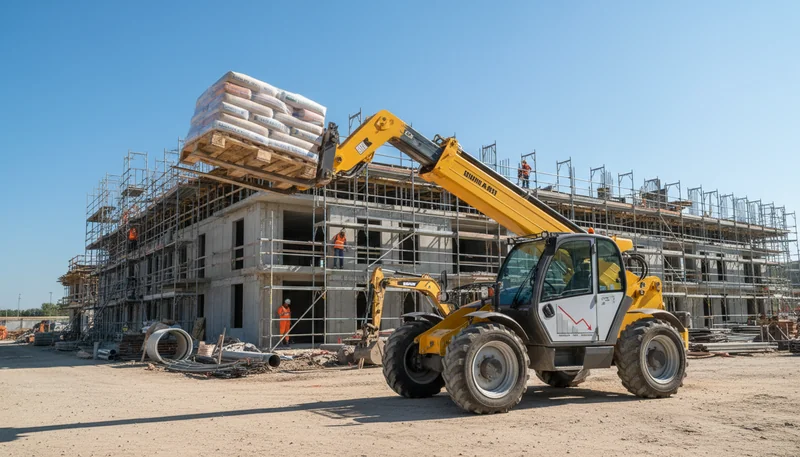
Not long ago, a project manager in Brazil called me, frustrated that his 3-ton telehandler couldn’t handle a 2-ton pallet once the boom was stretched out. I hear versions of this story from Europe to Southeast Asia—telehandler lifting limits almost always catch people off guard, especially on tight jobsites.
Lifting capacity on a telehandler decreases as the boom extends due to leverage and stability. As reach increases, the load’s horizontal distance from the machine’s forward stability reference (often associated with the front axle/front tires) increases, raising the overturning moment. To prevent forward tip-over, manufacturers derate allowable capacity as reach increases.
Why Does Telehandler Capacity Drop at Reach?
Telehandler rated capacity1 declines sharply as the boom extends because the load acts further from the front axle, increasing the tipping moment2. The machine’s weight and wheelbase remain unchanged, so manufacturers limit permissible loads to prevent forward tipping. Always check the load chart3 for capacity at any given reach or height.
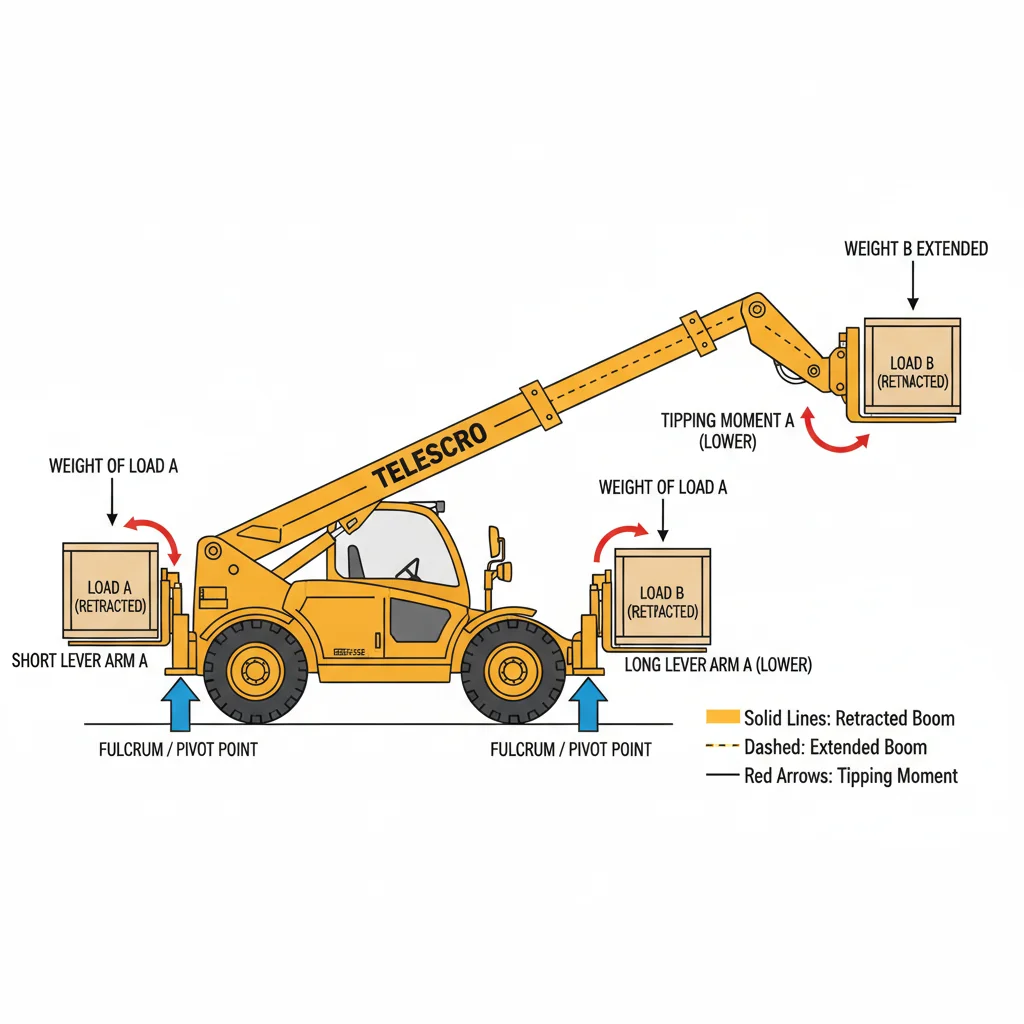
Most people don’t realize a telehandler behaves like a massive lever. As reach increases, the horizontal distance from the front tires/axle line to the load center increases, which raises the overturning moment and reduces stability margin.
When you keep the boom retracted, the load sits close to the chassis. That means the machine’s own weight does a great job counterbalancing the load. But as soon as you start extending the boom, everything changes fast. The load moves several meters further away from the axle, multiplying the “tipping moment” (which is basically the force trying to tip the machine forward). The telehandler’s weight and its wheelbase stay exactly the same, so you get less and less margin for stability as the reach increases.
A contractor in Saudi Arabia asked me why his 4-ton model could only pick up 1,000 kg out at 13 meters, even though it claims a 4,000 kg rated capacity. This catches buyers off guard all the time. The reality is, that “4-ton” rating is defined at minimum reach (typically with the boom retracted) under firm, level conditions with the specified load center and standard attachment. As you extend the boom, allowable capacity drops sharply per the load chart. I’ve seen some 17-meter units that handle close to 4 tons at ground level, but barely 600–700 kg at full reach.
Here’s what matters most: always check the load chart in the cab. It shows the safe capacity for each height and reach, not just the headline number in the brochure. Never assume ground-level rated capacity is available at 10 meters or up high. I suggest training every operator to read that chart before each lift. That’s the only way to prevent tipping on real jobsites.
As the telehandler boom extends, the center of gravity shifts forward and increases the tipping moment, which significantly reduces the machine’s safe lifting capacity.True
The further the load is from the front axle, the more leverage it has to tip the machine forward. The machine's own counterweight becomes less effective as the boom extends, causing a natural reduction in rated capacity to prevent tipping.
Raising the boom while keeping it retracted does not affect the telehandler’s lifting capacity, no matter how high the load is lifted.False
Even with the boom retracted, elevating a heavy load to significant heights can shift the center of gravity and impact stability, especially on uneven ground or slopes. Safe operating guidelines always consider both reach and height when determining capacity.
Key takeaway: Rated capacity only applies with the telehandler boom fully retracted and on level ground. As the boom extends, the tipping moment increases, so capacity decreases. Managers and operators must always reference the load chart for safe, legal lifting at any height or reach.
Why Does Telehandler Capacity Drop When Extending?
Telehandler rated capacity decreases as the boom extends because stability depends on a three-way relationship: boom length, boom angle, and load weight. At lower boom angles with maximum extension, the load is furthest from the front axle, increasing overturn risk and reducing allowable lifting capacity, as clearly indicated by OEM load charts4.
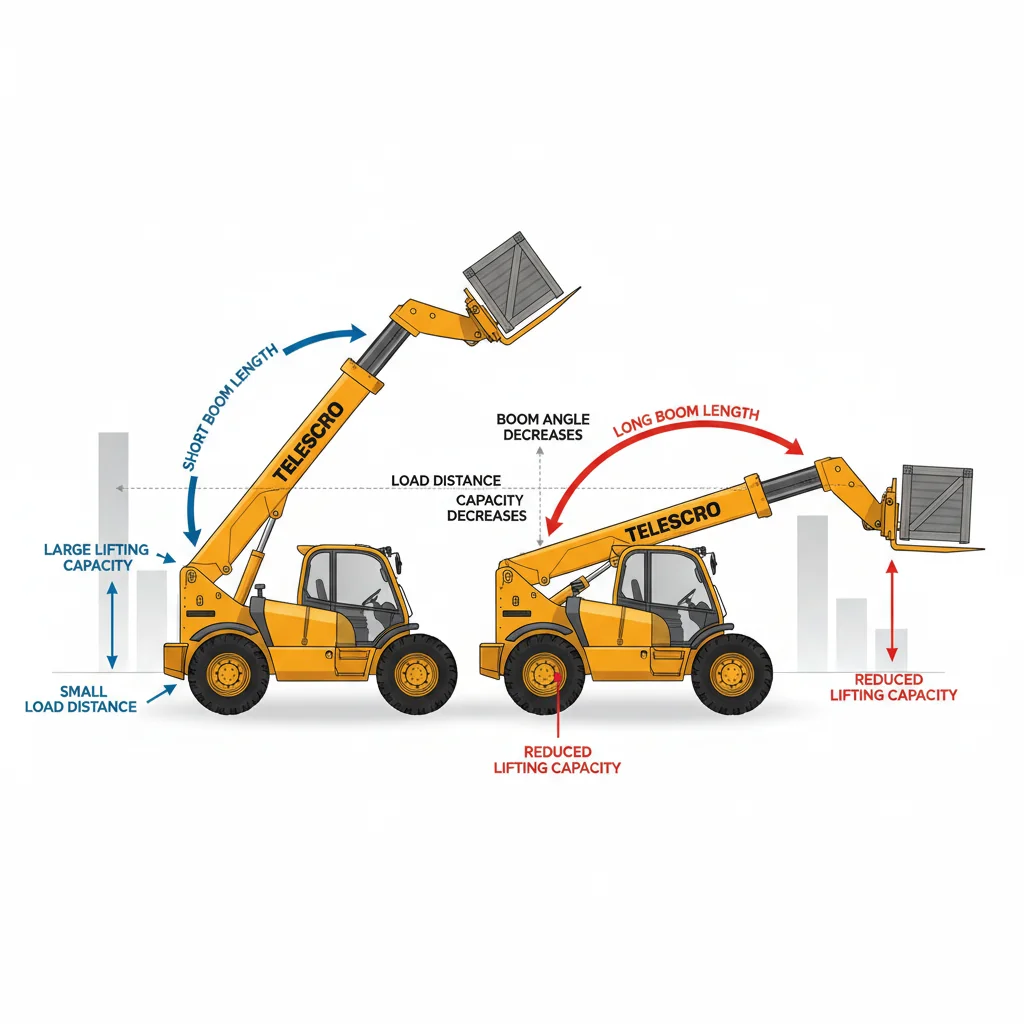
Let me share something important about how telehandler capacity really works as the boom extends. It’s not just about picking a bigger machine—stability is all about the balance between boom extension, angle, and load weight. As you extend the boom further out, the load sits farther from the front axle, so the risks jump quickly. Picture a telehandler at a busy site in Kazakhstan reaching over a trench: the operator had a 4-ton unit rated for nearly 18 meters, but once he extended to 14 meters at a low boom angle, the safe working load dropped to just over 1,100 kg. That’s a huge cut from the “headline” number, and it’s exactly what the load chart will warn you about.
From my experience, the most common surprise for new operators comes during slab pours or unloading brick pallets at low heights. With the boom stretched out and nearly parallel to the ground, I’ve seen loads become unstable well before you hit the machine’s maximum reach. The load’s leverage creates a big tipping moment—think of a long wrench versus a short one. Even a 3-ton rated model might only manage 800 to 900 kg at that lowest boom angle and full extension.
The practical advice? Always read the load chart for the exact boom angle and extension you plan to use—not just the numbers on the spec sheet. If you’re lifting material to a second floor or unloading trucks, keep the boom as steep as possible and extend only as much as you need. That simple habit protects both your crew and your machine.
A telehandler's lifting capacity decreases as the boom extends because the load's increased distance from the front axle amplifies the tipping moment, reducing overall stability.True
When the load moves farther from the machine's pivot point, the leverage or tipping force around the front axle grows. This shift in the center of gravity reduces the capacity the telehandler can safely handle, independent of the boom’s maximum strength.
A telehandler maintains its maximum lifting capacity at any boom extension as long as the load is evenly distributed on the forks.False
Proper load distribution is important, but the dominant factor in capacity reduction as the boom extends is the increased tipping moment caused by the greater horizontal distance between the load and the machine’s base, not just how the load is placed on the forks.
Key takeaway: Telehandler load capacity is highest with a steep boom angle and minimal extension. As the boom extends or is positioned low, the load’s leverage increases, dramatically reducing rated capacity. Always consult the load chart for actual limits at each height and reach combination.
Why Does Telehandler Capacity Drop When Extending (Continued)?
Telehandler rated capacity drops as the boom extends due to a shift from structural to stability limits5. At short reach, steel and hydraulics set the limit, but as reach increases, the risk of overturning dominates. Stability—not structure—defines the steep drop seen on most telehandler load charts6.
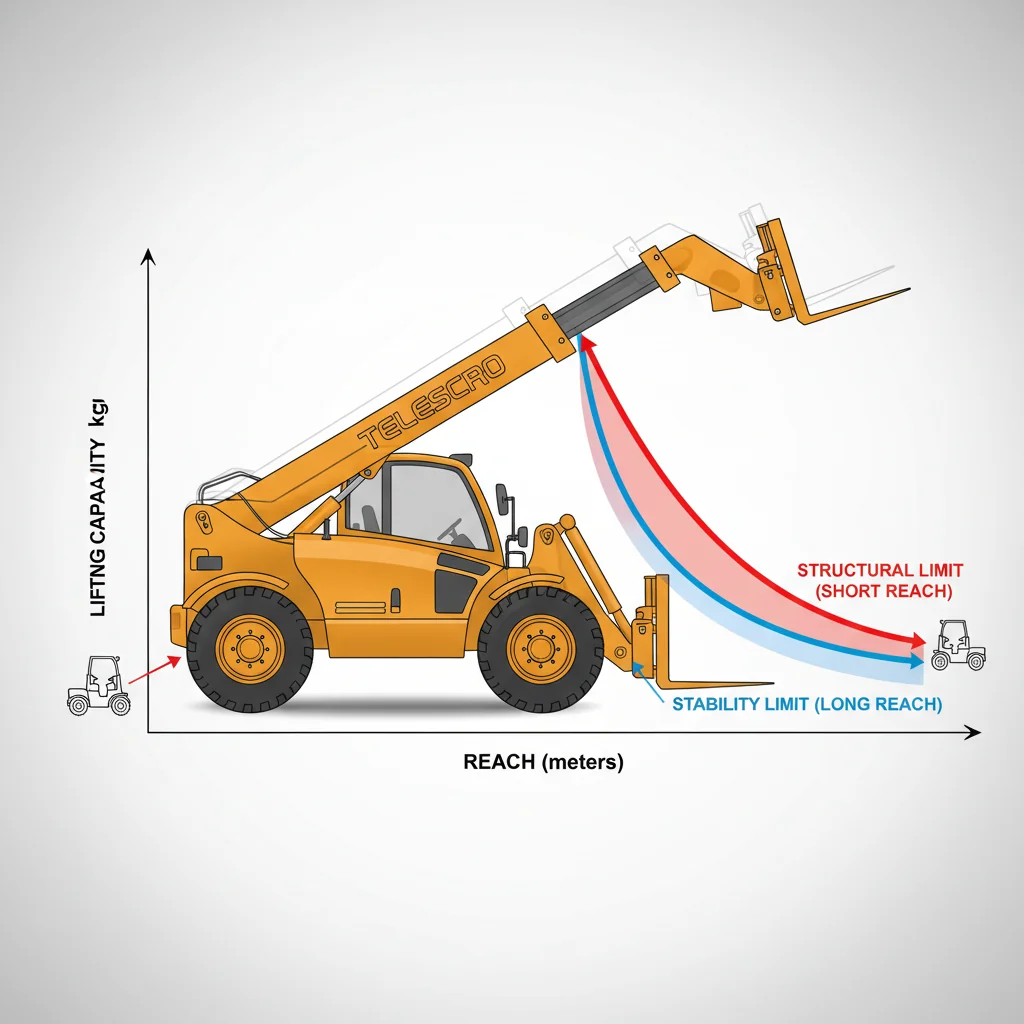
Here’s what matters most when looking at telehandler capacity during boom extension: the real-world limit can switch from structure to stability in a heartbeat. At close range, the steel boom, carriage, and hydraulic system set the ceiling—basically, you can’t overload the metal or the hydraulic circuit without risking damage. But as you reach out further, the biggest risk isn’t breaking something. It’s tipping. I see this most with 4-ton, 17-meter units—a popular size in Dubai. Their load charts show a flat 4,000 kg lift at 3–4 meters, but once you extend past 10 meters, that safe capacity can dive below 1,200 kg.
Last year, a site manager in Kazakhstan called me after struggling with heavy panels at full extension. His team tried to shift a 1,500 kg load at 14 meters, thinking they were in the safe zone since the machine was “nowhere near the limit” at short reach. But they forgot how stability dominates at long reach—the machine started to teeter even though the structure was fine. That’s always a hair-raising moment on site.
It’s tempting to focus on the maximum number the brochure shows. But I always recommend finding where the load chart starts to drop sharply—that’s the point where stability, not steel, governs your safe working limit. And remember: stabilizers or counterweights can buy you a bit more margin in the stability zone, but you still can’t exceed the structural rating at short reach. For any critical lift, keep a generous buffer from both limits. That’s the difference between safe planning and a close call.
When a telehandler's boom extends, the lifting capacity is more often limited by the machine's stability (risk of tipping) rather than the strength of the boom or hydraulics.True
As the load moves farther from the telehandler, leverage increases dramatically, creating a much greater risk of overturning even if the structural components could handle the weight. Manufacturers' load charts account for this by showing steeply declining limits at greater extensions.
Telehandler capacity remains mostly unchanged during boom extension, as the strength of the boom structure is the critical factor at all lengths.False
While boom strength does play a role at shorter reaches, stability becomes the dominant limiting factor at greater extensions. The risk of tipping increases with distance, causing capacity to decrease substantially even if the boom itself is capable of bearing more weight.
Key takeaway: Telehandler lifting limits depend on both structure and stability. Capacity falls sharply at long reach due to stability—not structural—constraints. Capacity planning must ensure critical lifts are well inside both the structural and stability zones for safe operation.
How Should Telehandler Load Charts Be Read?
Telehandler load charts serve as stability maps, not marketing figures. Each cell defines the tested rated capacity at specific boom angles and reaches, assuming level ground and standard load position. Site managers must identify the furthest/highest required point on the chart and treat capacities as absolute limits, not targets or general capacities.

The biggest mistake I see is managers trusting the headline “4-ton” or “5-ton” rating without opening the load chart. That headline figure refers to capacity at minimum reach under ideal conditions—typically with the machine on firm, level ground, the frame level, and the specified load center and standard attachment in use.
Once you start lifting at height or extending the boom forward, allowable capacity can drop sharply. For example, at around 14 meters of height or long forward reach, a load chart may show capacity falling from 4,000 kg at short reach to well under 1,000 kg, depending on the model and boom position. I’ve seen this catch site teams off guard from Brazil to Kazakhstan, especially when rushing to unload trucks at maximum horizontal outreach.
Last year, a contractor in Dubai called me after their 4-ton telehandler overloaded at 85% boom extension. The digital load moment indicator cut all boom functions because the actual allowed capacity was only about 1,100 kg at that position. They had assumed the machine would lift 4,000 kg anywhere within its range. That load chart grid—each cell showing boom angle and reach—shows the absolute tested limits, not average working weights. If your load exceeds the cell value, stability is not guaranteed.
Always start by locating the furthest or highest pick point you’ll need, then find that exact spot on the chart for your attachment. Never “estimate” or use the capacity from just one side of the graph. If your machine is on a slope or the ground is soft, rated capacities don’t apply—reduce your load and reset. I always tell customers: the safest lift starts with the load chart, not the brochure.
A telehandler's rated capacity can drop significantly at maximum boom extension due to increased leverage and reduced stability, even though the machine's headline rating remains unchanged.True
As the boom extends, the load moves farther from the machine's center of gravity, increasing leverage and risk of tipping. Load charts account for this by reducing allowed capacity to maintain safety, meaning the actual lift limit at height can be much less than the maximum rating.
If the telehandler is equipped with outriggers, you can always use the full headline capacity at any boom extension or height.False
Outriggers improve stability but do not override the load chart limits. The structural and tipping risks associated with boom extension and angle still apply, so the capacity at full reach is always less than the maximum, regardless of outrigger use.
Key takeaway: Always use the telehandler load chart to determine rated capacity for each position before lifting—especially at maximum reach or height. Rated capacities only apply on firm, level ground, with standard load centers, and must never be estimated based on headline machine rating alone.
How Do Attachments Affect Telehandler Capacity?
Attachments and changes to load center7 reduce a telehandler’s rated capacity by adding weight and moving the load farther forward. Standard fork load charts assume a specified load center (commonly 500 mm under EN 1459, or 24 in / 610 mm under ANSI/ITSDF—depending on market and model). Any larger load center or bulky attachment requires using the correct attachment-specific chart and derated values.
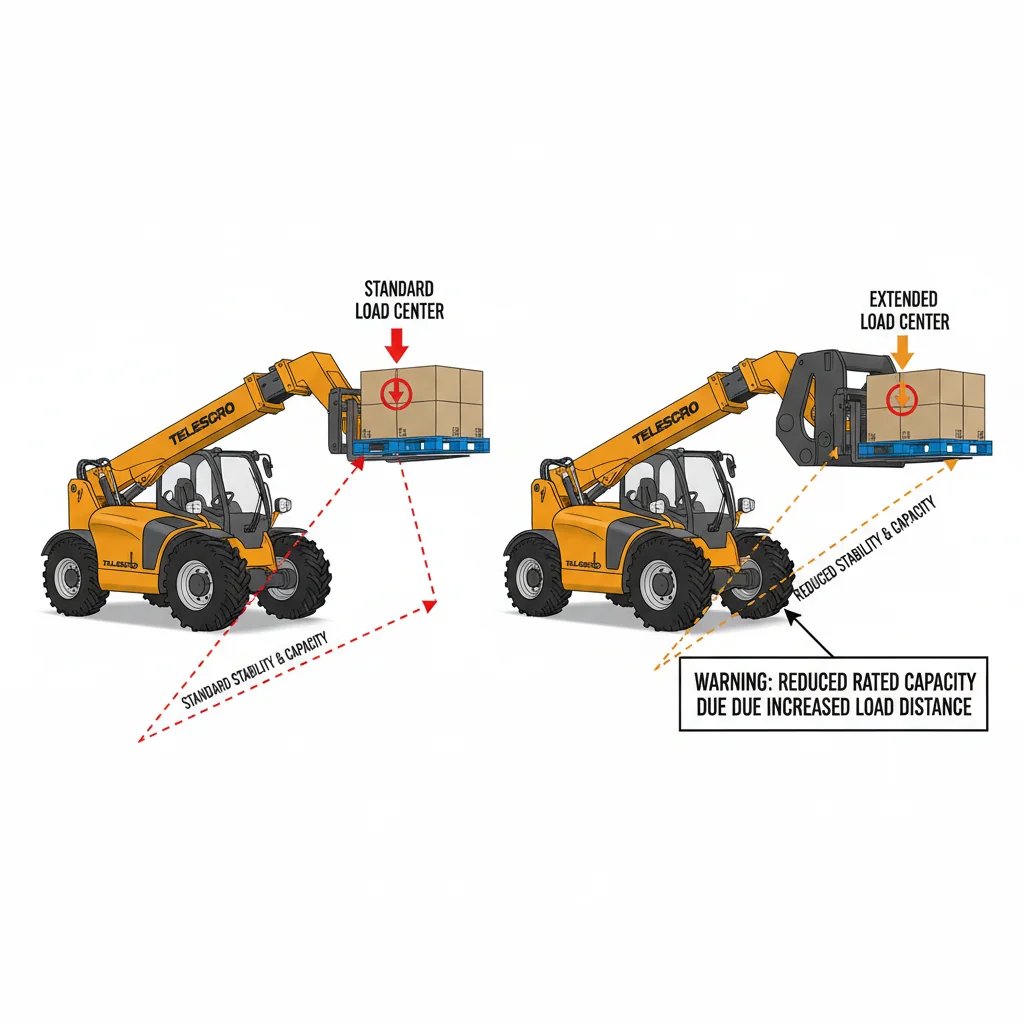
I’ve worked with customers who made this mistake—ignoring how attachments or bulky loads change the game for telehandler capacity. Many buyers assume the load chart applies no matter what, as long as the load is under the machine’s rated number. But that’s not how it works. Once you add a jib, a bucket, or even handle a long truss, everything shifts. The load moves farther from the carriage, increasing leverage and making the telehandler much less stable at the same boom position.
Let me break down the main ways attachments reduce your lifting power:
- Attachments add “dead weight”—for example, a common truss boom can weigh over 180 kg, eating into your rated load instantly
- They shift the load center forward—anything sticking past standard forks means the load’s “pivot point” moves out, so lifting limits drop
- Bulky or long materials—handling a 5-meter steel beam? Your center of gravity can double or triple compared to pallets, slashing safe capacity
- Specialty tools like rotating carriages or man baskets—these not only add weight but change the force angles, which often requires dedicated, lower-rated load charts
Last month, I helped a roofing crew in Dubai who nearly tipped their 4-ton, 14-meter telehandler while using a man basket at maximum outreach. Their rated chart no longer applied—the real safe limit with that setup was just under 800 kg. My advice? Always specify your planned attachment and “real” load dimensions up front. Ask for derated charts for each configuration. If you routinely handle long or awkward loads, consider stepping up to a bigger machine class—it’s much safer in the long run.
Installing a jib or truss boom attachment on a telehandler reduces the rated lifting capacity at full boom extension, even if the weight is within the machine's top rating.True
Attachments like jibs or truss booms move the load farther from the carriage, increasing leverage on the boom. This amplifies the tipping force and reduces safe lifting capacity at any given degree of extension. The official load chart only applies to standard forks; using other attachments requires consulting the corresponding, often lower, rated capacities.
Telehandler lifting capacity remains the same, whether using forks or a bucket, as long as the total weight is under the stated maximum.False
Lifting capacity changes with attachment type because attachments, especially buckets or jibs, shift the load's center of gravity further from the machine, adding leverage and reducing stability. Load charts for forks cannot be used for other attachments; each has its own, typically lower, rated capacities.
Key takeaway: Always specify the actual load’s weight, length, and attachment when planning lifts. Using attachments or handling oversized materials shifts the center of gravity forward, requiring use of derated load charts. Ignoring these adjustments is a top cause of overload and instability in telehandler operations.
Why Does Capacity Drop as Boom Extends?
Telehandler rated capacity declines rapidly as the boom extends, with the steepest loss occurring near maximum reach and height. This reduction is not linear; loads manageable at short reach may become unsafe at full extension. Always consult the manufacturer’s load chart for each reach and height combination to confirm safe operation.
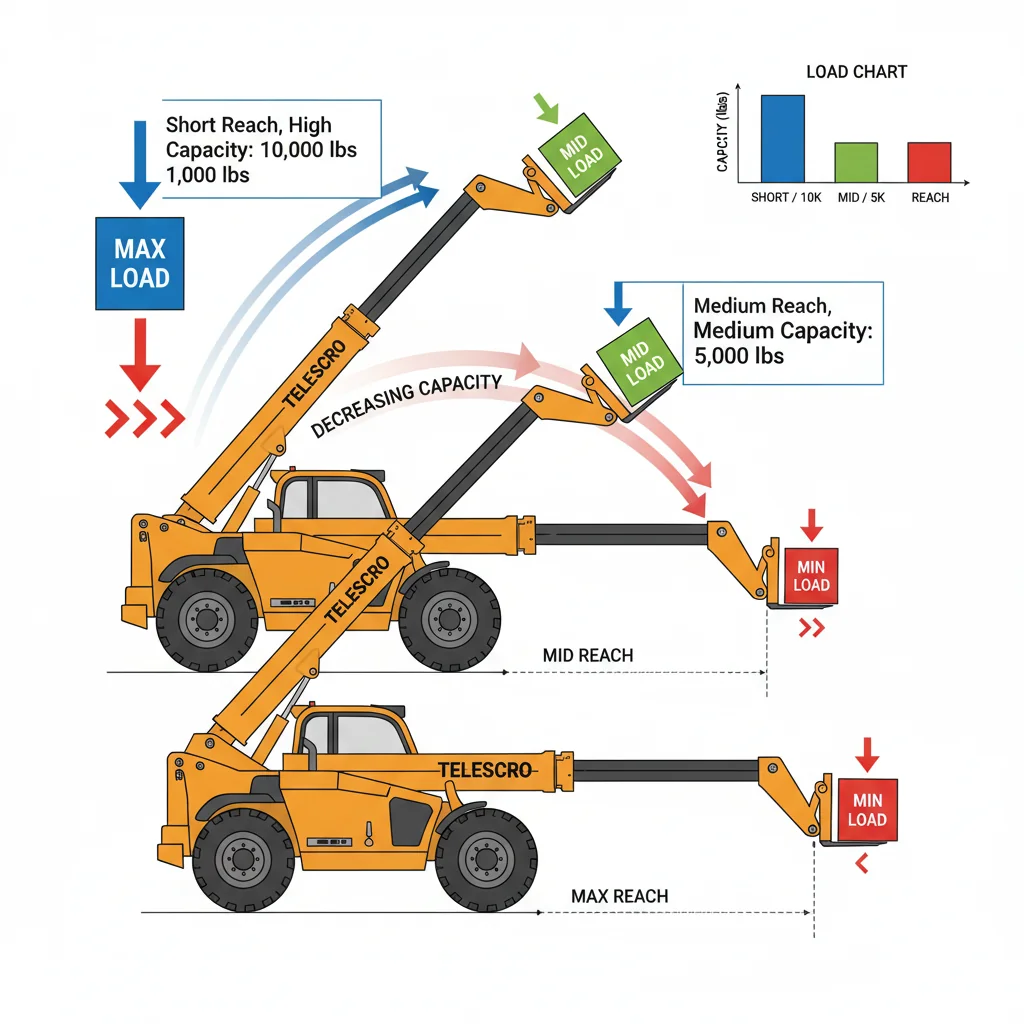
Let me share something important about telehandler performance that catches even experienced operators off guard. A telehandler doesn’t lose lifting strength steadily as the boom extends—it drops off fast, especially at the far end. For example, a 4-ton machine might handle close to that number when the boom is fully retracted and staying low. But reach out to 14 or 16 meters, and the same unit might only safely lift 1,200 kg—or sometimes less, depending on the exact height and position. The physics behind this is simple: as the load gets farther from the main body, the tipping moment increases much faster than most people expect.
I’ve seen customers get caught out in places like Dubai, where they pick a telehandler by its rated capacity, confident it can move heavy steel bundles. The real surprise comes on site—at full extension, what felt like a “safe” load suddenly exceeds the chart limit, and the stability alarm goes off. That’s why I always push teams to check the load chart for every specific reach and height, not just the best-case rating. Most jobs are won or lost at the limits, not in the spec sheet’s bold numbers.
The key question to ask is: what’s my heaviest load, and where does it need to go? Look up that exact scenario in the load chart. If you’re pushing the limits at full extension, leave a margin—at least 20%. Conditions rarely match the brochure. I suggest double-checking the numbers before every big lift, especially higher up or farther out.
Telehandler lifting capacity drops rapidly as the boom extends due to increased leverage, which multiplies the load effect on the machine’s pivot and stability systems.True
As the boom extends, the distance between the load and the telehandler’s center of gravity increases, creating greater leverage (moment). This reduces the machine’s ability to safely support heavy weights because the tipping force multiplies faster than many operators realize.
The telehandler’s rated lifting capacity remains nearly the same at maximum boom extension as it does when fully retracted, as long as the base machine is heavy enough.False
In reality, regardless of how heavy the base machine is, boom extension always causes a sharp reduction in rated capacity due to the principles of leverage and stability. Simply increasing base weight cannot counteract the significant tipping risk caused by an extended boom.
Key takeaway: Telehandler capacity drops sharply, not gradually, as boom extension increases—especially near maximum reach. Loads safe with a retracted boom may significantly exceed allowable capacity when extended. Always refer to precise load chart data for every reach/height and maintain a safety margin for real-world conditions.
How Should Telehandler Size Be Selected?
Telehandler selection should prioritize actual reach and height requirements over headline rated capacity at ground level. A unit labeled “10,000 lb” may only support 2,000–2,500 lb at full forward reach or high elevations. Match worst-case pallet placement scenarios to load charts, upsizing for stability, efficiency, and compliance.
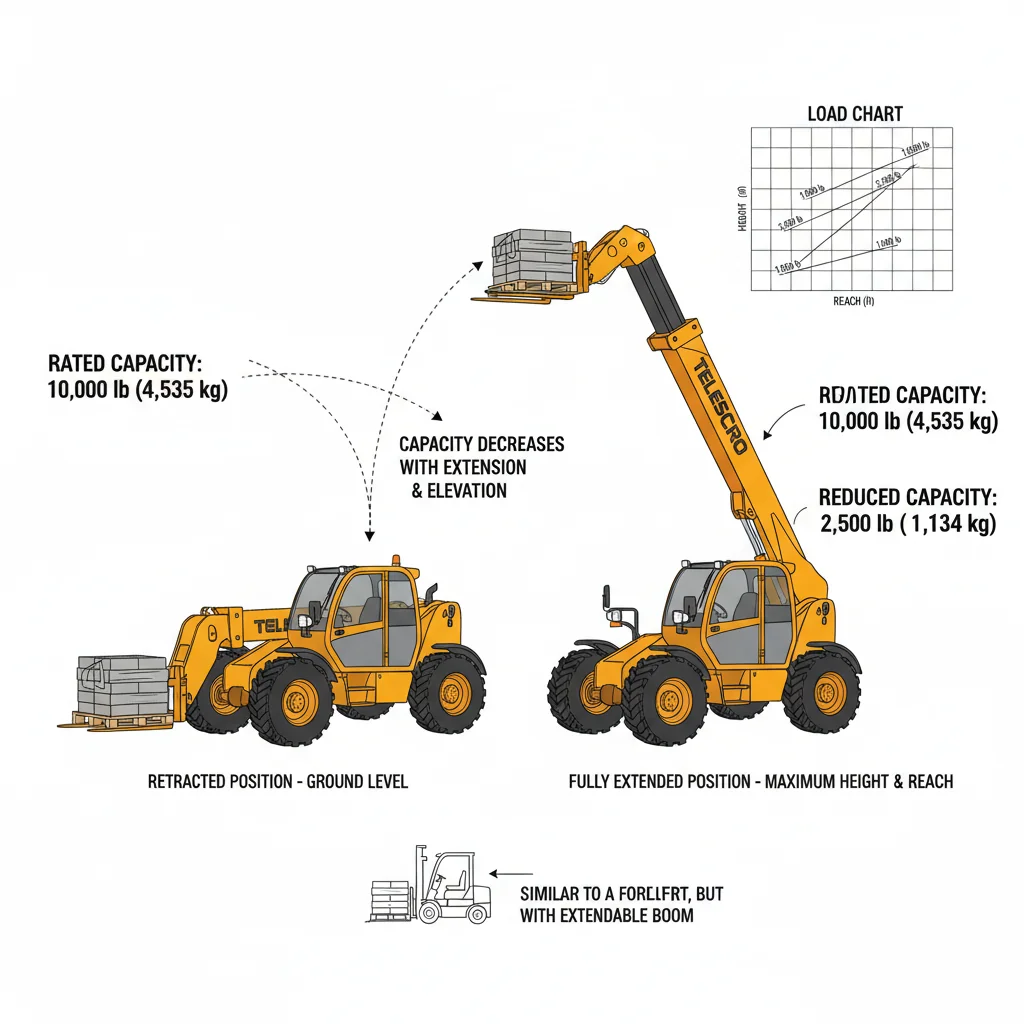
To be honest, the spec that actually matters is load capacity at your real working positions8—not the “headline” rated capacity at ground level. I’ve seen way too many buyers in places like Dubai pick a 4.5-ton telehandler, thinking it will handle 4,500 kg even at full reach near maximum height. But if you check the load chart (the table showing what’s safely liftable at each boom position), it might only manage 2,000–2,500 kg at a 12-meter height with the boom extended. The further you reach, especially above 7–12 meters—which covers most modern construction jobs—the capacity drops rapidly.
A customer in Kazakhstan once called me mid-project, frustrated after discovering his 10,000 lb machine could barely move 1,200 kg pallets out to the fifth floor. The site plan called for regular placements at 12 meters up and 9 meters out. He’d relied on the brochure spec—now his teams lost hours waiting for a backup crane. I always tell buyers: start with your worst-case lift, usually the farthest and highest point you’ll need, like setting brick pallets at full stretch.
The real trick is to match that specific scenario to the load chart, not just the overall capacity sticker on the side. If you’re anywhere near the chart’s border—or relying on “luck”—that creates a safety risk and slows your workflow. For repeat projects, upsizing to the next model class pays off: not only are operators less tempted to “push the margin,” but the machine remains stable, efficient, and much less likely to need outside help. I suggest double-checking load capacity for your most difficult reach before you commit. That’s where mistakes cost the most.
A telehandler's maximum lifting capacity at full boom extension is significantly lower than its rated capacity at ground level due to increased leverage and decreased stability.True
As the boom extends, the load moves farther from the machine's chassis, increasing the overturning moment and reducing the weight the telehandler can safely handle without tipping.
Telehandler lifting capacity remains nearly constant regardless of boom extension or height, provided the load stays within the machine's rated maximum.False
The lifting capacity decreases as the boom extends or elevates because the load's distance from the telehandler's fulcrum increases, making the machine more prone to tipping and requiring reduced lifting weight for stability.
Key takeaway: Always select telehandlers by cross-referencing worst-case reach and height needs against detailed load charts—not just ground-level rated capacity. Upsizing often improves site safety and operational efficiency, reducing reliance on questionable margin lifts or supplemental cranes. Prioritize stable, comfortably over-capable machines for repeat jobsite performance.
Why Does Telehandler Capacity Drop When Extended?
Telehandler rated capacity decreases as the boom extends due to changes in leverage and stability. Best practice is to minimize boom extension under load, approach with steeper angles, and always follow the load chart. Driving with a heavily extended boom, especially on uneven terrain, drastically reduces safety margins.
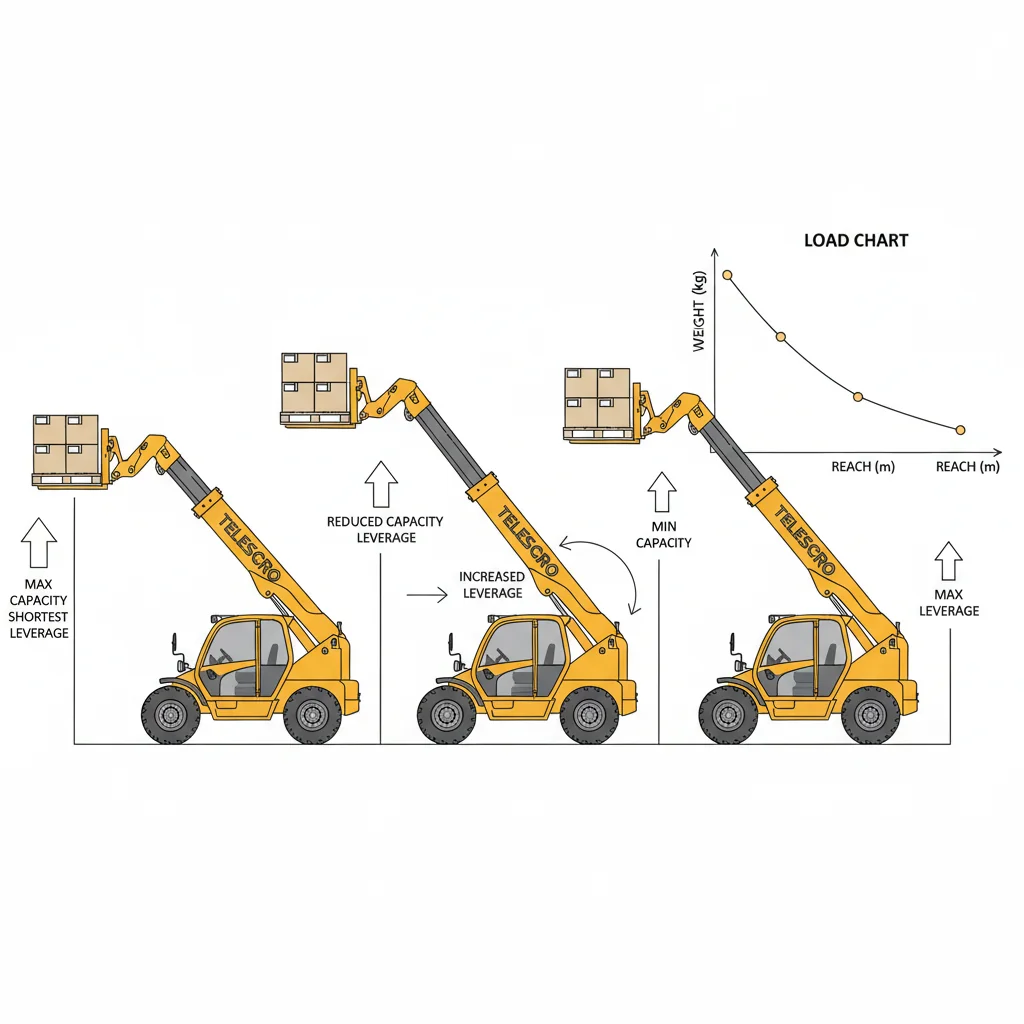
From my experience with sites in the Middle East and Africa, the same question comes up again and again—why can’t a telehandler lift its full rated load once the boom is extended? The answer is straightforward: every additional meter of boom extension shifts the machine’s center of gravity forward. This increases leverage on the front axle and reduces the available stability margin very quickly.
The load chart—the sticker most people ignore—shows this clearly. A typical 4-ton telehandler may handle close to its rated capacity at minimum reach, but at long reach or near maximum extension, allowable capacity can drop dramatically. Depending on the model and boom position, safe capacity at long reach may fall to around a quarter of the headline rating.
I’ve seen what happens when operators try to push their luck on uneven ground. In Kazakhstan, a crew was working on a sloped yard with the boom extended low and forward, assuming the load chart still applied. The machine felt stable—until one side suddenly started to lift. They were fortunate no one was injured.
The issue was simple: rated capacities shown on load charts assume firm, level ground with the frame level and the machine set up according to the manufacturer’s conditions. Once those assumptions are violated—such as working on slopes or uneven surfaces—the real safe capacity drops sharply and unpredictably.
My advice is practical and consistent. Lift and place with the boom as short and as steep as possible. Approach the drop point straight on, raise the load first, and extend only as much as necessary. Avoid traveling with the boom extended or low under load, especially on rough or sloped ground. Plan work paths so lifting is done with favorable boom angles, and never “test” stability by inching the boom outward until alarms activate.
When the boom of a telehandler is fully extended, the leverage effect increases the risk of forward tipping, making the hydraulic and counterweight systems less effective at stabilizing the machine.True
As the boom extends, the load's center of gravity moves further away from the machine's base. This amplifies the overturning moment on the telehandler and diminishes the stabilizing effect of both the machine’s counterweights and its chassis design. The hydraulic system can control the boom's motion, but it cannot counteract the basic laws of physics related to leverage and tipping.
A telehandler’s lifting capacity remains constant at all boom lengths as long as the machine is on level ground.False
A telehandler’s lifting capacity decreases as the boom extends because of the increasing leverage and shifting center of gravity, regardless of ground level. The distance from the wheels to the load is the critical factor affecting stability, not merely whether the ground is level.
Key takeaway: Telehandler stability depends on boom angle and extension. Capacity at maximum reach is much lower than at minimum reach. Operators should lift and place loads with the shortest feasible boom extension and strictly observe load charts, especially on rough or sloped terrain.
How Do Ground Conditions Impact Telehandler Capacity?
Telehandler rated capacity is defined assuming firm, level ground and a stationary machine set up according to manufacturer conditions. On sloped, soft, or uneven surfaces, stability is quickly compromised—especially at longer boom reach or lower boom angles. Any deviation from level ground can significantly reduce the available safety margin. Dynamic factors such as machine travel, braking, load swing, or wind further reduce stability and require additional derating beyond what is shown on the load chart.
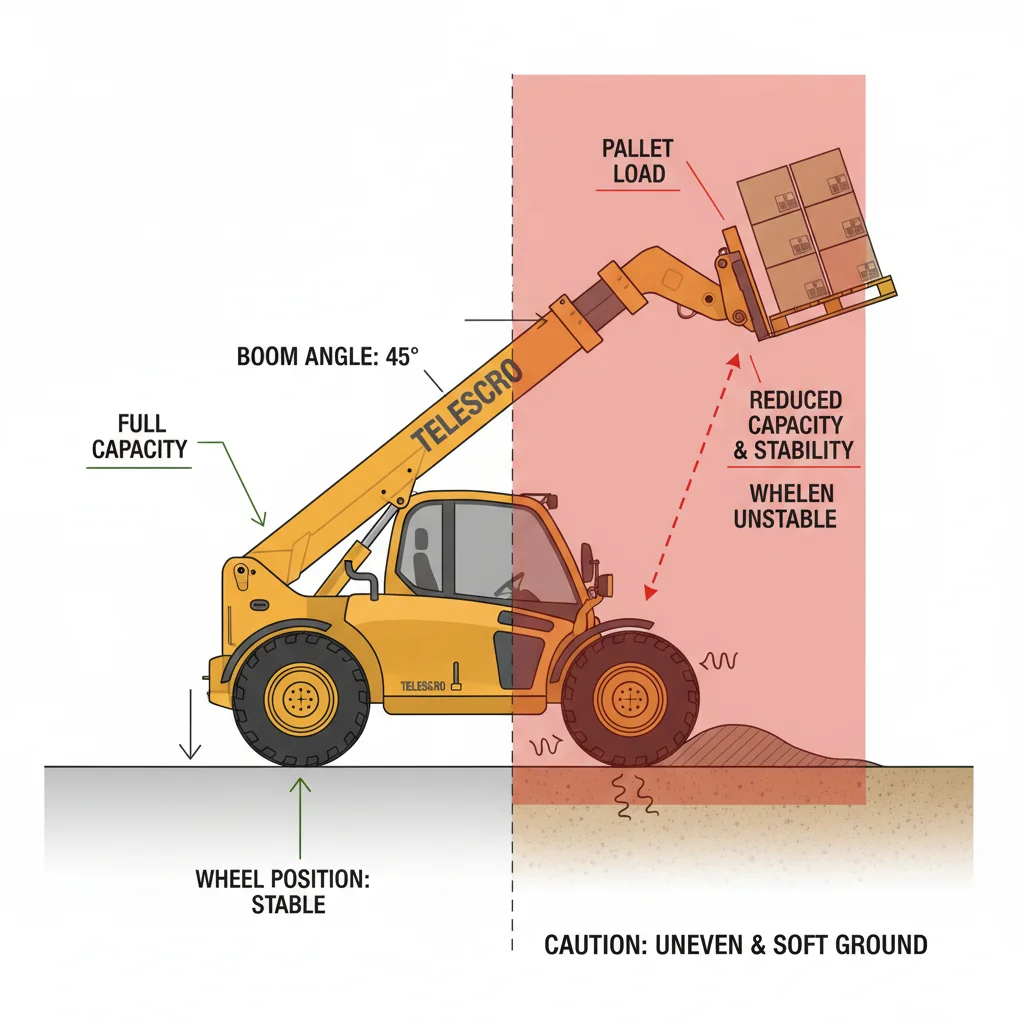
Last year, a site manager in Dubai called me after his crew struggled with repeated tip alarms on a new 4-ton telehandler. The machine was operating on a compacted gravel yard, and although the surface looked acceptable, the stability system began restricting hydraulic movement once the boom was extended.
What caught him off guard was a basic assumption behind the load chart: rated capacities are defined for firm, level ground with the machine properly set up. Once the telehandler was working on a sloped or uneven surface—especially with the boom extended—the available stability margin dropped much faster than expected.
With the boom extended beyond mid-range, the crew found they could only lift a little over half of the headline rated capacity before the limiter intervened. Nothing was wrong with the machine—the load chart assumptions simply no longer matched the site conditions.
Soft or uneven surfaces bring their own issues. I’ve seen this in Kazakhstan, where spring thaw softens jobsite ground. One side of the machine would sink a few centimeters, unknowingly shifting the center of gravity. Even if everything felt stable, the effective wheelbase shrunk, making the machine more likely to rock or tip sideways. Operators told me loads felt “wobbly”—which is a warning sign the rated performance doesn’t apply. And if you add motion—braking, sharp turning, or bouncing over ruts—it only gets riskier.
Jobsite conditions are rarely ideal, so lifting plans need to be adjusted accordingly. When working on sloped, soft, or uneven ground, allowable lifting capacity should be reduced to maintain a safe stability margin, especially at longer boom reach.
Avoid traveling with the boom extended or carried low under load, particularly when handling bulky or wind-sensitive materials such as cladding panels. If the telehandler is equipped with stabilizers, use them in accordance with the load chart and manufacturer guidance. Where possible, relevel the machine or reposition before lifting.
Taking a few extra minutes to set up correctly—rather than relying on nominal chart values—can prevent loss of stability and significantly reduce the risk of a serious incident.
Telehandler rated capacity on the load chart assumes operation on hard, level ground, so any deviation—like a 3° slope or soft surface—can drastically reduce safe lifting limits, especially at greater boom extensions.True
Load charts are calculated under ideal conditions; real-world factors like uneven or unstable ground can significantly impact stability and reduce maximum allowable load, particularly when the boom is extended far from the chassis.
Extending the boom on a telehandler actually increases its lifting capacity on sloped ground, since the weight is distributed further from the chassis.False
Boom extension reduces lifting capacity because it shifts the load's center of gravity away from the machine, increasing the risk of tip-over, especially on sloped or unstable surfaces. Distributing the weight further from the chassis does not improve, but rather decreases, the safe lifting capacity.
Key takeaway: Telehandler rated capacities are defined assuming firm, level ground and proper machine setup. When working on slopes, soft or uneven surfaces, or handling large or wind-sensitive loads, the available safety margin is significantly reduced. Operators should adjust working loads accordingly, minimize boom extension under load, and avoid traveling with an extended boom to maintain stability and safe operation.
How Do Telehandler Safety Systems Limit Capacity?
Modern telehandlers use load moment indicators9 (LMIs) with boom angle and extension sensors10 to estimate the overturning moment at the front axle. As limits approach, these systems issue warnings or restrict boom functions. These protections rely on accurate load estimation, calibration, and level ground, but are not foolproof.

You’d be surprised how many new operators trust the “rated capacity” sticker without looking at what’s actually happening inside the safety systems. Modern telehandlers use load moment indicators, or LMIs, working alongside boom angle and extension sensors. These sensors estimate the tipping risk—or overturning moment—based on where the boom is and how far it’s extended. When the calculated risk nears the machine’s tested limit, the system either gives a warning (lights or alarms) or begins to restrict what the operator can do—like cutting off further boom extension or lift. I’ve seen this firsthand on sites in the UAE, where crews tried to move heavy concrete blocks with the boom nearly horizontal; the machine refused to lift any higher, forcing the team to retract and reposition.
But these safety features aren’t magic. They depend on the telehandler being correctly calibrated and set up on level ground—usually within 3 degrees of tilt. I recall one project in Malaysia where operators trusted the LMI readout, but the ground sloped nearly 6 degrees sideways. The system still showed “safe,” but in reality, the true capacity was far lower than shown on screen. The risk shot up just because the site grading wasn’t finished yet.
Here’s the thing: LMIs and electronic cutoffs are there to help, but don’t treat them like foolproof shields. Always specify machines with clear, easy-to-understand capacity indicators—both in the cab and on the boom. And make sure every operator knows never to override or ignore those warnings. I always tell crews: safe lifting starts with the load chart and a level machine, not just trusting electronics.
Telehandler safety systems can automatically restrict hydraulic functions, such as boom extension or lowering, if the load moment indicator detects that the machine is approaching its stability limit.True
Modern telehandlers use sensors to monitor the boom angle and extension along with the load, and will actively intervene to prevent movements that could lead to overturning, not just trigger warnings.
The lifting capacity of a telehandler remains the same regardless of how far the boom is extended because the hydraulic system compensates for different positions.False
In reality, as the boom extends, the risk of tipping increases because the load is farther from the fulcrum, decreasing stability. Hydraulic systems cannot counteract the fundamental laws of physics and leverage; therefore, capacity must decrease as the boom extends.
Key takeaway: LMIs and electronic safety systems help prevent overloads as boom extension increases overturning risk. However, they depend on correct setup and level ground. Always specify models with clear indicators and ensure operators receive proper safety training—never bypass these critical safeguards.
How Does Maintenance Impact Telehandler Lifting Capacity?
Telehandler rated capacity is based on load charts assuming a machine in optimal condition. Poor maintenance—such as worn boom pads11, bent forks, low hydraulic pressure12, or improper tire inflation—can significantly reduce real-world lifting capacity, even if the load chart decal remains unchanged. Regular inspections aligned with OEM standards are essential for reliable performance.
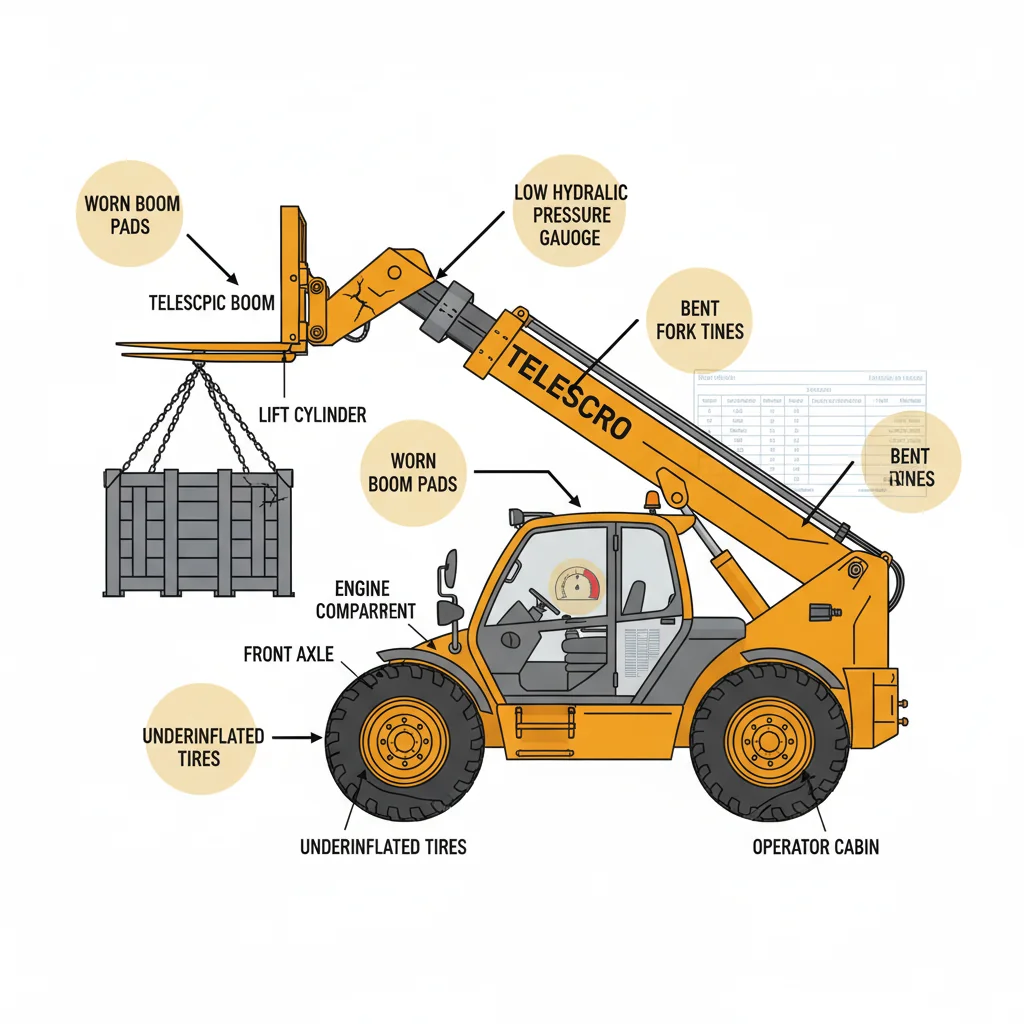
I see a lot of customers focus on the load chart decal and take those numbers as guaranteed, but the reality on sites often looks very different. A load chart assumes the telehandler is in perfect shape—like it was the day it left the factory. But jobsites are tough on machines. I’ve seen cases in Brazil and Eastern Europe where teams were surprised their 4-ton telehandler couldn’t pick even 3,000 kg at full boom. Turned out, worn boom pads and loose pins caused extra play, which adds stress every time the machine moves or brakes suddenly. That sort of wear doesn’t show up on the chart, but it directly eats away at your real lifting margin.
Here’s a practical example. One customer in Kazakhstan noticed degrading performance—they struggled to lift materials up to 12 meters. After checking, we found the hydraulic circuit was delivering much lower pressure than spec. Often this comes from worn seals or old fluid, not always a big leak. Low pressure means the machine can’t safely reach those chart numbers, especially at reach. I also caught a crew running mismatched tires on a muddy site near Nairobi last year—ride height and stance were off, and the operator felt the telehandler tip sooner than expected. Correct tire pressure and right spec actually matter for stability, not just comfort.
That’s why I always advise to make regular checks a core part of your routine. Measure fork heel thickness and boom clearances during every PM; check hydraulic pressures and make sure tires match OEM specs. Staying on top of these items keeps your telehandler lifting like it should—and protects your team.
Worn or unlubricated boom pads can increase internal friction, which in turn restricts smooth boom extension and may cause the telehandler’s actual lifting capacity at maximum reach to fall below the values shown on the load chart.True
Load charts assume ideal equipment condition and friction-free operation. Excessive internal friction from neglected maintenance causes extra resistance, resulting in unexpected capacity loss, especially at extended boom positions.
If a telehandler’s hydraulic oil is past its service interval, the only issue that arises is slower boom movement; lifting capacity remains unchanged as long as the load chart isn’t exceeded.False
Old or contaminated hydraulic oil can cause pressure loss and less effective cylinder performance. This leads to both sluggish operation and reduced maximum lifting ability, not just slower boom action.
Key takeaway: Telehandler lifting capacity assumes equipment is in prime condition. Maintenance issues like worn boom components, hydraulic faults, or incorrect tires quietly erode lifting safety margins. Proactive checks—fork wear, boom clearances, hydraulic pressure, tire specs—should be built into every PM schedule for safe, OEM-compliant operation.
Conclusion
We’ve looked at how a telehandler’s rated lifting capacity only applies when the boom is fully retracted, and why the load chart is your real guide to safe operation. From my time on jobsites, I can’t stress enough: always double-check the load chart at your actual working height and reach. It’s tempting to get caught up in showroom specs, but that’s the “showroom hero, jobsite zero” trap—numbers on paper rarely tell the whole story. If you’ve got questions about charts, attachments, or want tips from jobsites in different countries, I’m happy to help—just reach out anytime. The right telehandler really depends on how and where you’ll use it.
References
-
Detailed explanation on how reaching the boom affects rated capacity and machine stability, crucial for safe telehandler operation. ↩
-
Clear insights into tipping moment mechanics and its impact on telehandler load limits, helping operators understand safety margins. ↩
-
Learn how load charts guide operators to use telehandlers safely at different boom extensions and avoid tipping hazards. ↩
-
Learn detailed guidance on interpreting OEM load charts that ensure safe telehandler operation under different boom positions. ↩
-
Details how stability—not structure—controls telehandler load charts, preventing overturning during boom extension. ↩
-
Detailed insights into interpreting telehandler load charts to avoid overload and ensure site safety with real-world examples. ↩
-
Detailed explanation of how shifting load centers influence stability and reduce telehandler safe lifting limits, essential for operators. ↩
-
Explains why operators must prioritize actual lift conditions over headline specs to ensure safety and efficiency on site. ↩
-
Explore how LMIs use sensors to estimate tipping risk and limit boom functions, reducing accidents and enhancing telehandler operational safety. ↩
-
Learn how these sensors work with LMIs to calculate overturning moments, ensuring accurate load limits and preventing telehandler tipping incidents. ↩
-
Detailed explanation on how worn boom pads cause lift capacity loss and increase machine stress, essential for maintenance planning. ↩
-
Insightful analysis on how hydraulic pressure impacts lifting capacity and tips to identify and fix pressure issues in telehandlers. ↩