










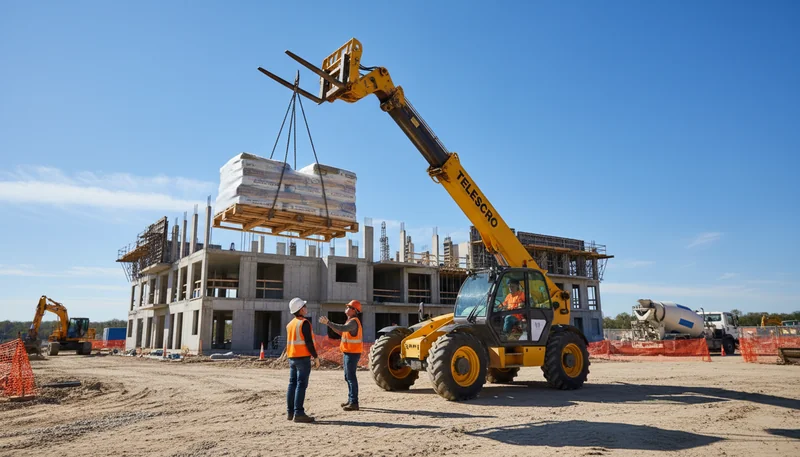
Why Do Telehandler Specs Assume Level Ground? What Buyers Overlook
Not long ago, a site manager in Brazil was convinced his telehandler could safely lift full loads on a sloping farm track—“it barely looked off-level.” An hour later, they were calling for a recovery crane when a wheel dropped into a soft patch. Cases like this are more common than most think.
Telehandler rated load charts are standardized using firm, level ground and the OEM-specified configuration (tyres, attachment, and setup) to keep capacity ratings repeatable and comparable. In common industry guidance, “level ground” is often described as around a 0±2% gradient, which supports certification frameworks such as EN 1459 and ISO 108961. In the field, slopes, soft soil, and surface variability can quickly shift the centre of gravity relative to the stability triangle2, reducing the available tipping margin well below charted values.
Why Are Telehandler Load Charts Level-Based?
Telehandler load charts are derived from standardized stability tests performed on firm, level ground using the OEM-specified tyres, attachments, and machine configuration. In practice, “level ground” is commonly interpreted as a near-horizontal surface (often cited around a 0–2% gradient) to support compliance with standards such as EN 1459 and ISO 10896. This methodology ensures that every OEM’s rated capacity3 is repeatable, comparable, and certifiable—but it also means the published values represent ideal test conditions, not typical jobsite realities.
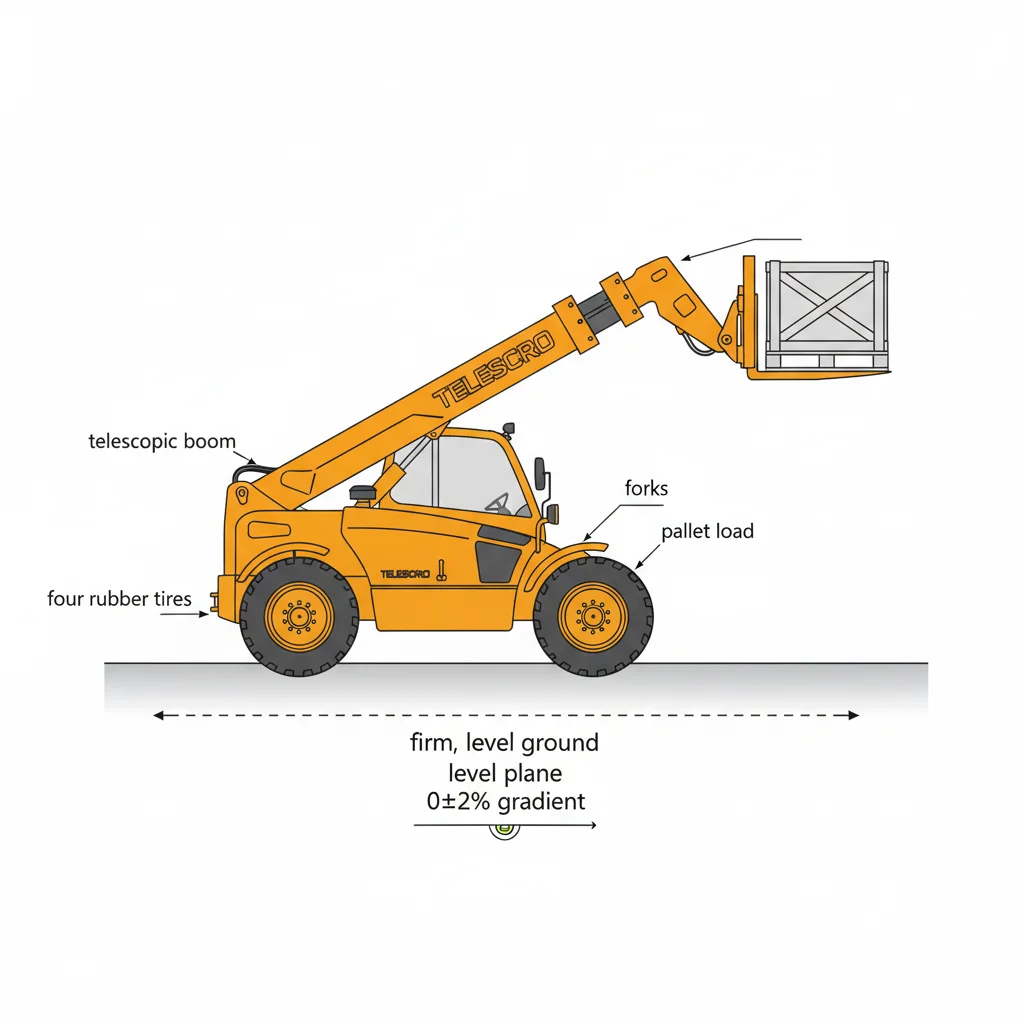
Most operators I meet think the load chart tells them exactly what their telehandler can pick up, no matter where they park. That’s a risky assumption. The numbers you see on a telehandler load chart come from tests on firm, flat concrete—usually a 0–2% slope, with the right tires specified, and standard boom configuration. European sites often insist on these standards, but honestly, every manufacturer worldwide follows similar rules. The idea is simple: you get a rating that’s repeatable, safe, and fair to compare across different machines.
I remember a contractor in Dubai who tried lifting 2,000 kg pallets on a jobsite with soft sand and a slight cross-slope—he used a 3.5-ton telehandler, expecting no problem. As soon as the boom reached out eight meters, the machine started rocking dangerously. The problem wasn’t the load or the machine—it was the ground and the gradient. The factory load chart just didn’t apply anymore. Once you leave level ground, the real tipping margin disappears incredibly fast, especially if you’re on tires, not stabilizers.
This is why standards like EN 1459 and ISO 10896 exist. They specify that stability must be checked on tilt platforms to the verge of tipping—then the safe “rated capacity” is set well below that point, but still assumes perfect conditions. If you operate on a slope, adjust your expectation immediately. Before using the chart, check your actual ground—hard, flat, minimal tilt. If that’s not possible, reduce your working load. I always tell customers: the printed chart is your best-case scenario, never a guarantee in rough site conditions.
Telehandler load charts are level-based because even modest ground slopes can significantly reduce lifting capacity and stability, leading to dangerous misinterpretations if site conditions differ from test conditions.True
Load charts are formulated under controlled, level conditions to ensure consistent and predictable ratings. Operating on uneven ground changes the center of gravity and can cause instability, making any chart-based lift limits inaccurate and potentially unsafe. This is a critical but often overlooked reason why level surfaces are always assumed in official specs.
Manufacturers account for common jobsite slopes in their official load charts by automatically derating capacities for uneven ground.False
Official load charts do not include allowances for sloped or unstable ground; they reflect capacities only for level surfaces under ideal conditions. Any derating for uneven terrain must be done manually by the operator or through additional manufacturer guidance, not the original published load chart.
Key takeaway: Telehandler rated capacities are calculated under controlled, level-ground conditions for certification and comparability. Any deviation—such as operating on slopes, ruts, softer ground, or with unapproved attachments—invalidates the printed load chart rating and rapidly reduces actual safety margin. Always assess site conditions before relying on stated capacities.
How Do Slopes Affect Telehandler Capacity?
Telehandler rated capacity4 is defined for operation on firm, level ground, where the combined center of gravity remains within the machine’s stability triangle. On a side slope, the center of gravity shifts toward the downhill side, reducing the available stability margin. Even relatively small, often unnoticed tilts can lead to a substantial reduction in usable lifting capacity compared with the manufacturer’s load chart values.
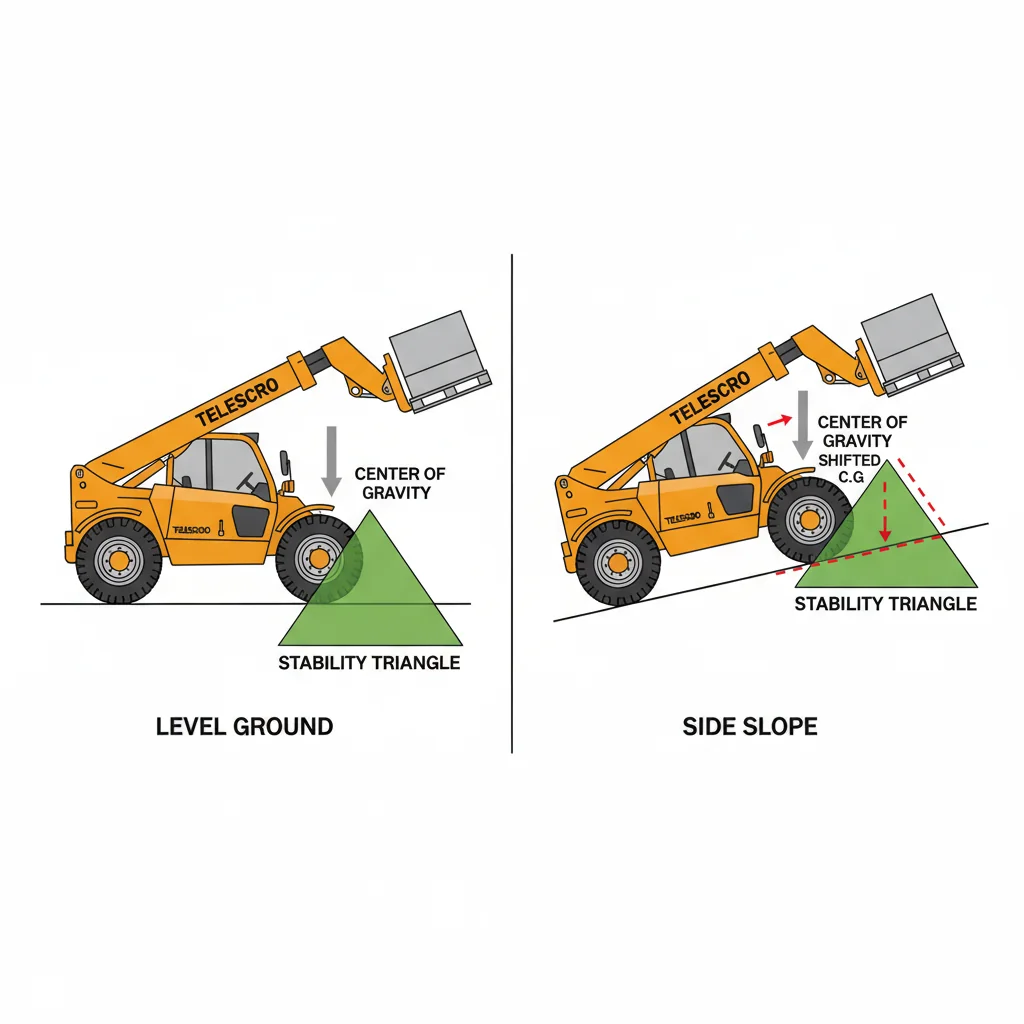
Here’s what matters most when evaluating telehandler capacity: every load chart assumes the machine is standing on firm, level ground, typically within about 3° of level in any direction. A rated figure—say 4,000 kg at minimum reach—is only valid under those conditions. On real jobsites, that assumption is rarely met.
I saw this clearly on a steel erection project in Kazakhstan. At first glance, the work area looked flat enough. But when we checked it properly with a spirit level, the foundation line showed a consistent side slope of around 5°. The operator loaded two pallets of roofing panels, confident the 3.5-ton telehandler was well within its charted limits. As soon as he began to raise the boom, the machine started to feel light on one side—the stability margin was far smaller than the load chart implied.
The reason is straightforward. A telehandler’s center of gravity (CG) must remain inside the stability triangle formed by the ground contact points—typically the two front wheels and the rear axle. On level ground with a centered load, that condition is satisfied. On a side slope, however, the entire stability triangle effectively tilts, and the CG shifts toward the downhill wheel. When you then raise or extend the boom, the usable stability margin shrinks rapidly, especially with wide, stacked, or uneven loads.
Based on controlled stability testing and OEM data I’ve reviewed over the years, many telehandlers approach their lateral tipping limit at relatively modest cross-slopes, often far below what operators intuitively expect. I regularly hear people assume that 15–20° “should be fine”, which is simply unsafe thinking for a loaded machine on tyres.
My advice is consistent on every site: treat any uneven or sloped ground as an immediate reduction in usable capacity. If the surface isn’t clearly level and firm, assume the load chart no longer applies at face value and plan your lift accordingly.
Even a modest cross-slope can significantly reduce a telehandler’s rated lifting capacity, because the uneven ground alters the center of gravity and increases the risk of tip-over.True
Telehandler load charts assume the machine is on level ground, as sloping terrain causes uneven weight distribution and can quickly compromise stability beyond the listed capacity, even if the angle seems minor.
Telehandler capacity charts compensate for sloped surfaces, so the listed capacity remains the same whether the machine is level or on a slope.False
Capacity charts are based on ideal, level ground and do not account for reductions caused by operating on a slope. In real conditions, operating on a slope requires a manual reduction in load for safety since the charts do not provide adjusted values.
Key takeaway: Telehandler rated capacities only apply on level ground—usually within a ±3° tolerance. Side slopes, even as little as 3–7°, greatly reduce stability and effective lifting capacity. Operators should never rely on load chart values unless the machine is confirmed level and all conditions match chart prerequisites.
What Is Firm, Non-Yielding Ground in Telehandler Specs?
“Firm, non-yielding ground” in telehandler specifications refers to surfaces that can sustain concentrated wheel or stabilizer loads without compressing, crumbling, or collapsing. Rated capacity assumes the machine is level on such solid ground—typically asphalt or compacted rock—within strict ground bearing pressure5 limits specified by standards and OEMs.
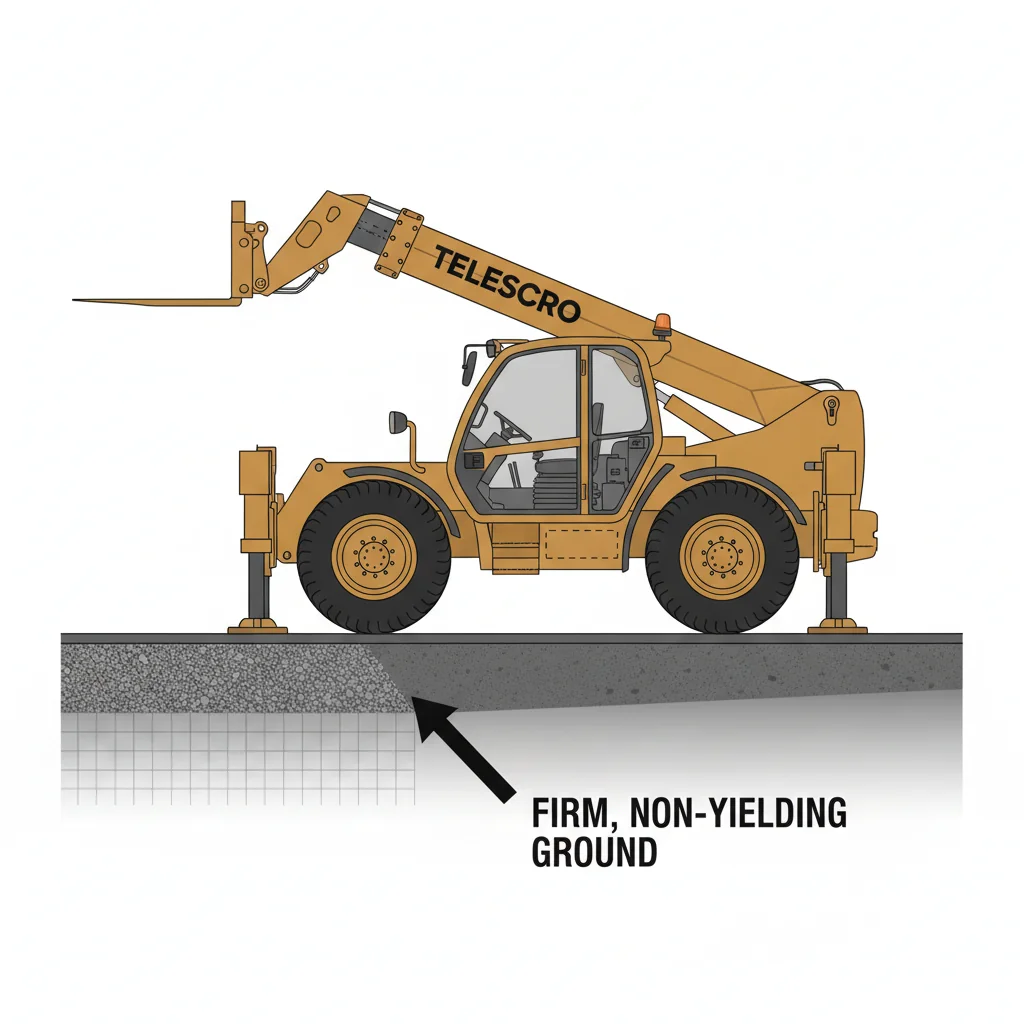
Let me share something important about "firm, non-yielding ground" that specs often skip over. The truth is, a surface can look solid but collapse under a concentrated telehandler load. I’ve seen it firsthand. In Kazakhstan, one customer set a 4-ton telehandler with stabilizers on backfilled gravel, thinking it was compacted enough. As soon as the boom went up with a 2,000 kg pallet—one stabilizer punched straight through. The machine tipped at a scary angle before the operator could stop. That ground probably held trucks all week, but a telehandler’s feet and tires put intense pressure in small spots, often above 20,000 kg per square meter.
Let me clarify something that specifications often gloss over when they mention “firm, non-yielding ground.” A surface can look solid and still fail under a telehandler’s concentrated loads. I’ve seen this firsthand.
On a site in Kazakhstan, a customer positioned a 4-ton telehandler with stabilizers on backfilled gravel. The area had been compacted and had no visible movement, so the crew assumed it was adequate. As soon as the boom was raised with a 2,000 kg pallet, one stabilizer began to sink rapidly and punched through the surface. The machine leaned sharply before the operator could react.
What caught them out was load concentration, not overall ground appearance. That same surface had supported delivery trucks for days, but a telehandler applies much higher point loads through its stabilizers and tyres, over a much smaller contact area. Even well-compacted fill can lose bearing capacity when subjected to these localized stresses, especially if moisture content or sub-base conditions are uneven.
Rated capacity on the load chart assumes the telehandler is level and sitting on ground that won’t give way. For most models, this means hard asphalt, a reinforced concrete pad, or rock. A surface like loose fill, grass, or a silage face might look dry but won’t meet the bearing pressure needed. Once one wheel or stabilizer sinks just 5–10 centimeters, the whole machine attitude changes—the moment indicator will warn you, but physics takes over fast.
Before lifting heavy, I always tell operators to walk the work zone. Check for patches of soft ground, recent trench work, or manhole covers—those are classic weak points. If the sub-base is unknown, lay down thick mats or cribbing to spread the load. One operator in Dubai avoided a costly incident using 0.5 m² pads under the stabilizers; that simple step kept a 5,000 kg load within safe limits. When in doubt, pause and get an engineer’s input. It only takes one corner to drop for the whole lift plan to go wrong.
Telehandler load charts and specs assume the machine is used on firm, non-yielding, and level surfaces, but do not account for weakly compacted or backfilled soil that may still appear solid.True
Manufacturers' published specifications are based on controlled, ideal conditions—typically a level, stable surface like concrete or thoroughly compacted ground. Weakly compacted or recently backfilled soils may look stable but can fail under the high point loads applied by a telehandler, especially under its stabilizers or wheels. This is why field testing or ground assessment is necessary before deploying a telehandler.
If the ground surface is visually dry and shows no movement when walked on, it will always be firm and non-yielding enough to support a telehandler according to its rated specs.False
Appearance and a person’s weight are not reliable indicators of ground bearing capacity. A telehandler applies much higher, concentrated loads through its wheels or stabilizers compared to a human. Compaction, soil type, moisture content, and ground history all affect bearing strength. Even ground that appears stable can give way under heavy equipment, resulting in instability or tipping.
Key takeaway: Telehandler rated capacities require level, firm, and non-yielding ground—defined by specific bearing pressure limits. Seemingly solid surfaces like backfilled trenches or silage faces may appear stable but can suddenly yield under concentrated loads, causing loss of stability. Confirm ground conditions and use mats or cribbing when uncertain.
How Should Telehandler Specs Be Derated on Slopes?
Telehandler load charts assume firm, level ground, meaning rated capacity does not directly apply on slopes or uneven surfaces. In practice, many contractors adopt conservative internal derating rules when operating off-level, often planning lifts well below charted values unless the machine is fully leveled in accordance with the operator’s manual. Additional reduction is commonly applied for wind, yielding ground, or high-profile loads that further reduce stability.
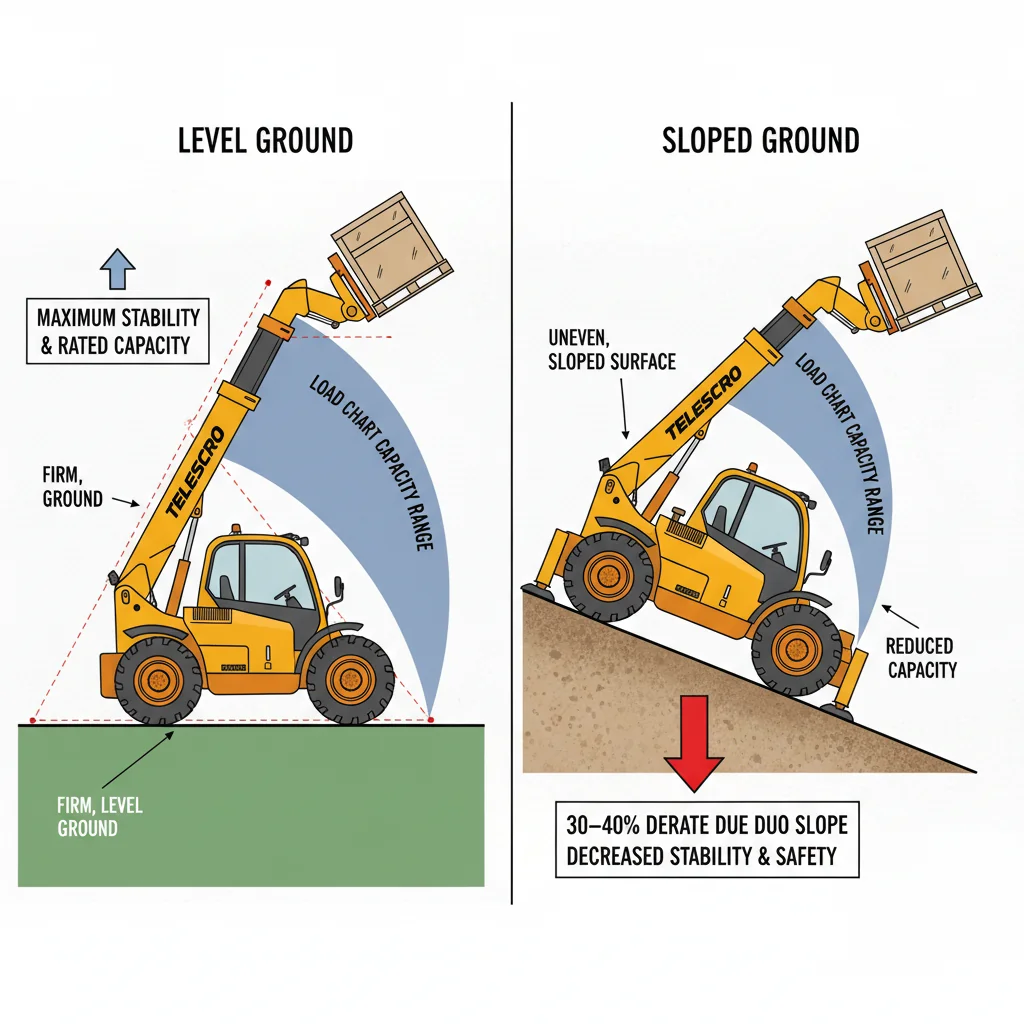
The biggest mistake I see is operators trusting the load chart without considering the ground they’re on. Rated capacity only applies when the telehandler is leveled—usually within 3°—and on solid, flat ground. If you’re working on slopes, rough terrain, or a surface that’s not fully compacted, that chart reading of 3,500 kg at 7 meters is just theory. In real-world jobs, especially on construction sites in places like Dubai or Indonesia, I never advise lifting more than 70% of rated capacity unless the machine is perfectly leveled using built-in frame leveling or parked on engineered pads. So, a 4-ton telehandler? Plan for 2,400 to 2,800 kg on less-than-ideal ground.
Last year in Kazakhstan, I watched a team try to set concrete panels on a slight cross-slope—just 4 degrees. Their moment indicator started showing warnings at loads well below the charted maximum. After we recalculated and dropped working loads by 35%, operations went smoothly and safely. Wind adds another layer: a high-profile load acts like a sail, so if there’s any wind or unstable ground, I tell customers to derate even further, sometimes to 50% of chart. The risk of tipping increases sharply on even mild slopes, because the tipping axis—defined by the front axle line—shifts and reduces your safety margin.
If you’re ever unsure, remember this: lifting to 90% of chart value on a slope is never “safe.” I always recommend keeping boom extensions shorter and loads lower where possible. It’s better to take two trips than risk a tip-over or structural damage.
Telehandler rated capacities listed on the load chart are only valid when the machine is on level ground, typically within 3° of horizontal, and must be derated for operation on slopes or uneven terrain.True
Manufacturers design load charts based on ideal, flat conditions; operating on sloped or unstable surfaces alters the machine’s stability and center of gravity, requiring a reduction in working load to maintain safety.
Telehandler load charts automatically account for the effects of typical jobsite slopes, so operators do not need to adjust for uneven ground when using them.False
Load charts are created under controlled, level conditions and do not factor in real-world variances like slope or loose ground; operators must manually derate capacities when working off-level to prevent accidents.
Key takeaway: Telehandler rated capacities are valid only for level, firm ground within specified tolerances. On slopes or rough terrain, treat load chart values as hard ceilings and apply conservative derating—typically use only 60–70% of rated capacity, and consider further reductions for challenging loads or wind.
Why Must Telehandlers Be Level Before Lifting?
Telehandler rated capacity and load charts assume the machine is parked on level ground, typically within ±3° tilt. For any lift above 1.2 m (4 ft), the chassis must be leveled before raising the boom, using the frame-leveling system or stabilizers if fitted, to preserve stability and prevent tipping accidents.
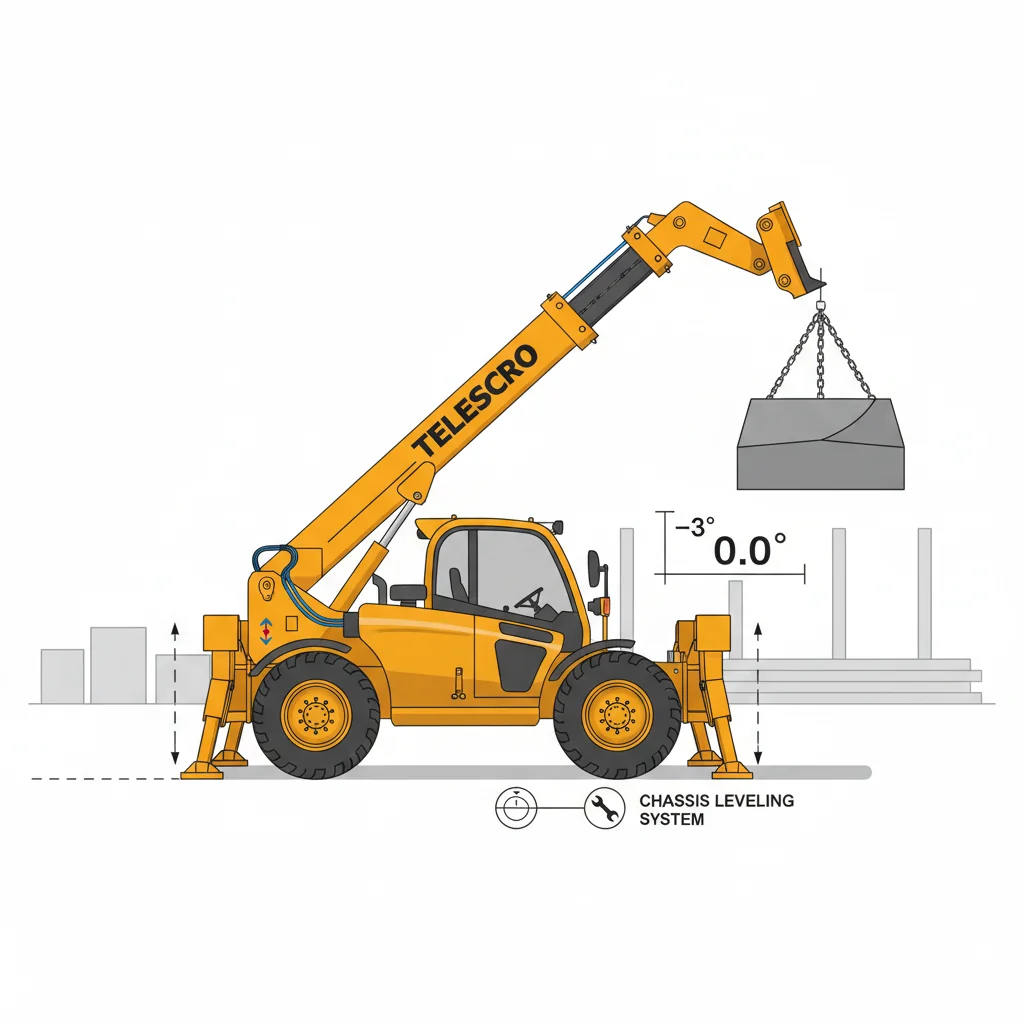
I’ve worked with customers who made this mistake more than once: assuming a telehandler can safely handle its rated capacity even when parked on a lumpy slab or a shallow slope. That “4-ton” specification only applies when the chassis is properly leveled—typically within about 3 degrees—because the load chart itself is based on level ground and defined test conditions.
Problems start when operators try to correct chassis tilt after the boom is already raised. Once the load is up—especially above about 1.2 meters—lowering stabilizers or adjusting the frame can shift the center of gravity outside the stability envelope. I’ve seen this nearly end in a tip-over on a site in Dubai, where an operator assumed the frame leveling system would “fix” the slope after placing a pallet at height. The machine rocked, the sensors alarmed, and they were lucky not to lose the load.
At higher boom angles or longer reaches, the stability triangle—defined by the machine’s ground contact points—is already very tight. Any additional tilt, even a small one, quickly eats into the safety margin. The true tipping axis is along the front axle line, which is the pivot point the machine will rotate around if stability is lost.
Soft ground makes this even worse. A tire settling into the soil or a missing cribbing block under a stabilizer can turn a “level” setup into an off-level one in seconds. That’s why I always tell operators the same thing: park on the flattest spot available, engage the park brake, and check the frame bubble before every lift—not after the load is already in the air.
A telehandler's load chart capacities are only accurate when the machine is leveled to within a few degrees, because even a small tilt can drastically shift the center of gravity and reduce stability.True
Telehandlers rely on a precise center of gravity calculation to ensure safe lifting. If the chassis isn’t nearly level, the load can tip the machine more easily because the forces don’t act directly downward through the stabilizing points. That’s why official load ratings and charts assume level ground.
Raising the boom before leveling the chassis can help stabilize a telehandler on sloped ground, as the added weight acts like a counterbalance.False
Lifting the boom before leveling actually increases the risk of tipping, because elevating the load raises the center of gravity and shifts weight away from the machine’s base of support. This makes instability worse instead of providing any counterbalance.
Key takeaway: Telehandler rated capacity is valid only when the machine is leveled before lifting, as specified by OEM standards. Leveling after the boom is raised can create hazardous instability. Daily tire-pressure checks and proper site selection are essential to maintain true chassis level and safe lifting performance.
How should telehandlers operate on slopes?
On slopes, telehandler stability6 is critical—machines should always travel straight up or down with the boom lowered and load close to the ground. Avoid driving across inclines or operating on side slopes beyond 5°. Never adjust the boom significantly while moving on a slope; sudden shifts can cause rollovers.
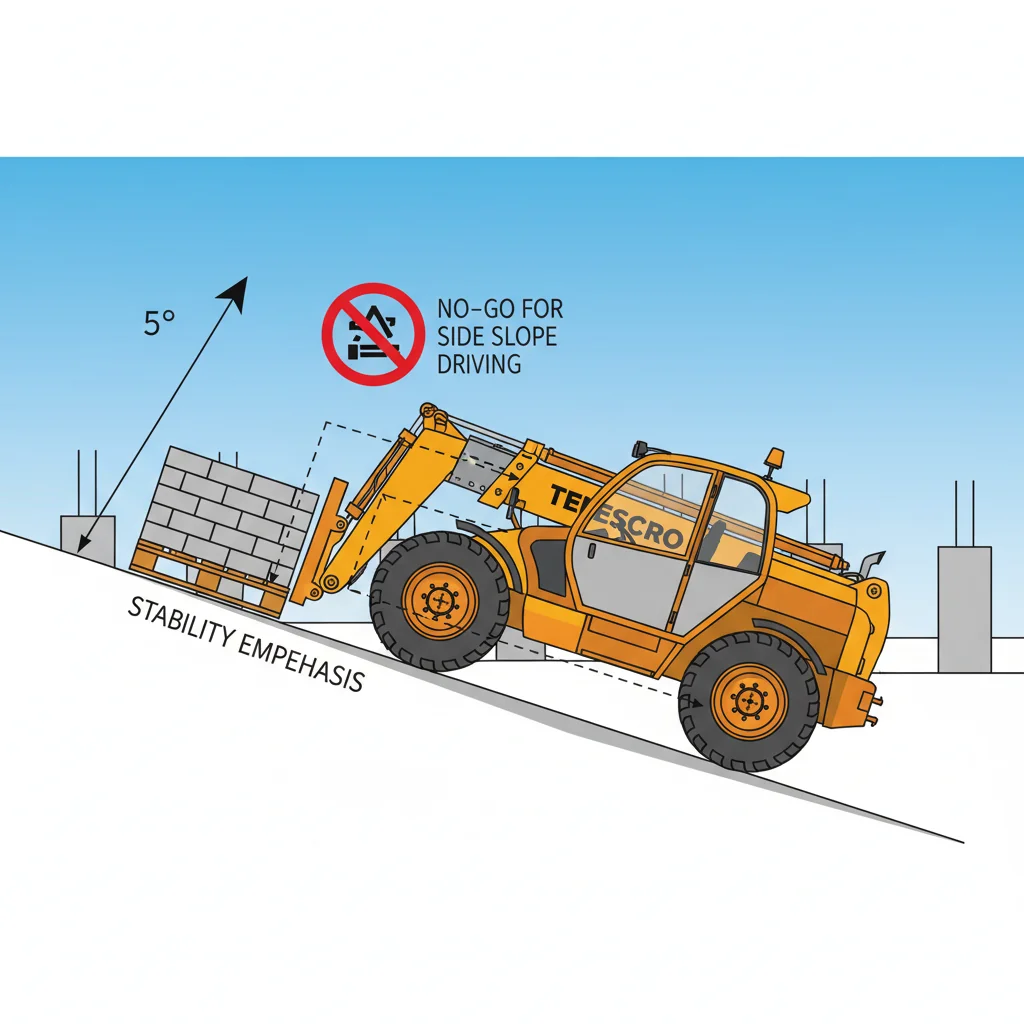
Here’s what matters most when you’re running a telehandler on a slope: stability always comes first, speed comes last. On jobsites in Dubai and Western Australia, I’ve seen what happens when operators get impatient and try to take shortcuts across inclines—and it rarely ends well.
The safest practice is always to travel straight up or down a slope, with the boom fully lowered and the load kept as close to the ground as possible. Driving across the face of a slope—especially anything over about 5 degrees—is asking for trouble. At that angle, even a 4-ton machine can tip with just a small, sudden shift in the center of gravity.
It doesn’t matter if the job looks “safe enough.” A telehandler does not forgive side-to-side movement when it’s carrying a load on a slope. I saw this firsthand with a customer in Brazil using a 12-meter reach unit. They tried to carry bricks diagonally across a rough incline, keeping the load high for visibility. The rear tire lifted off the ground, and they had to rush a service call before the machine went over.
From my experience, if you lose traction or sight while descending, lowering the boom and backing down is the smart move. What you should never do is adjust the boom out or up while climbing or descending. Even a one-meter change in boom position can double the tipping risk, especially on uneven or muddy terrain.
If side slopes are unavoidable, stop and rethink the plan. Use mats to level the working area if possible, or reposition the machine entirely. A few extra minutes spent setting up properly is far cheaper than a recovery operation—or worse, an injury.
Telehandler stability ratings in manufacturer specifications are typically based on operation over level ground and may not account for side slope forces.True
Manufacturer ratings and load charts assume the telehandler is on level ground because side slopes introduce lateral forces that can cause tipping, which aren't accounted for in standard stability calculations.
It is safe to operate a telehandler with its boom raised while driving across a slope if the load is light.False
Raising the boom on a slope, regardless of load weight, significantly increases the risk of tipping due to a higher center of gravity. The safest position is always with the boom lowered and the load close to the ground.
Key takeaway: Safe telehandler operations on inclines require prioritizing stability over speed. Always keep the load low, avoid side slopes greater than 5°, and follow the manufacturer’s guidelines. Sudden boom movements or improper travel on rough terrain dramatically increase rollover risk. When in doubt, lower the boom and choose a safer route.
Why Do Telehandler Load Charts Require Level Ground?
Telehandler rated capacity and load charts are based on stability tests conducted on level platforms, as mandated by standards like EN 1459 and ISO 10896. These charts are only valid if the machine is level, equipped with original tyres, specified counterweights, and approved attachments. Non-level ground or non-approved attachments invalidate published capacities.
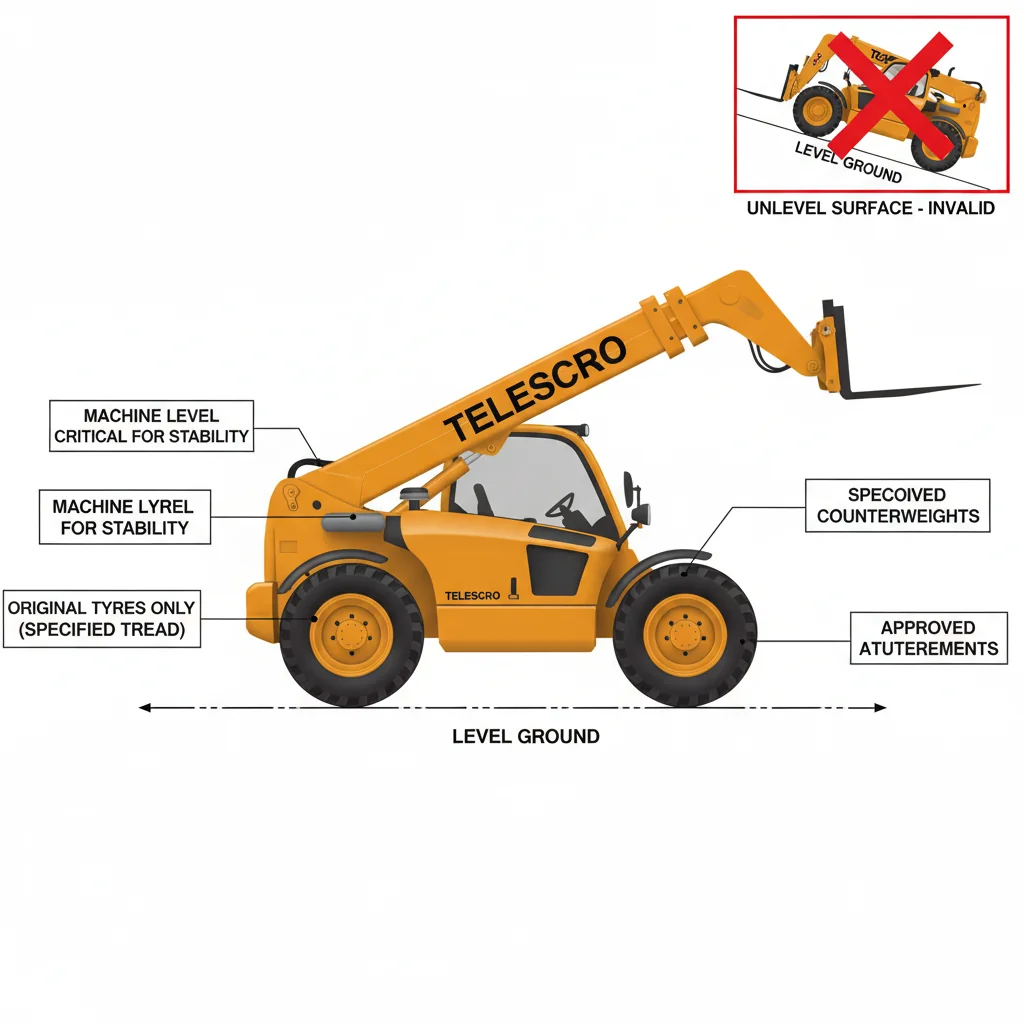
Let me share something about telehandler rated capacity that many operators overlook.
The figures you see on a load chart—such as 4,000 kg at 6 meters or 1,200 kg at 15 meters—are only valid when the machine is on level ground, typically within about 3 degrees of tilt. Those numbers assume factory test conditions: original tyres, approved forks or bucket, a standard load center, and—if the machine is equipped—stabilizers deployed exactly as specified.
I’ve seen what happens when people forget this. In Dubai, one crew tried lifting full-rated loads on a site that sloped gently toward a drainage channel. At first, the telehandler felt stable. But as the boom extended, they hit the tipping limit well before the charted value. Nothing was “wrong” with the machine—the ground conditions simply no longer matched the assumptions behind the load chart.
There’s a reason the rules are this strict. International standards such as EN 1459 and ISO 10896 require stability testing to be done on a level test platform. During certification, manufacturers push the machine close to the forward tip-over point—often with the boom extended beyond 80% of its maximum reach—and then apply safety margins based on that controlled setup. All rated capacities come from those tests.
Once you operate on a slope—even a 5° side slope—the stability triangle shifts sideways. Your usable capacity drops rapidly, but the load chart gives you no adjusted numbers for that condition. At that point, you’re working outside the rated envelope.
The same applies if you use a non-approved jib, larger bucket, or unlisted attachment. You’re effectively off the chart entirely.
Modern telehandlers do help—warning lights, alarms, and sometimes hydraulic cut-offs will activate. But from my experience, when those systems start beeping or locking out, you’re already very close to a real stability problem. They’re a last line of defense, not permission to keep pushing.
A telehandler’s load chart capacities are calculated assuming the machine is on level ground so that the center of gravity remains within a safe range and prevents unexpected tip-over risks.True
When a telehandler is tilted or on uneven ground, the shift in center of gravity causes the machine to become unstable at lower loads and reaches its tipping point much faster than on a flat surface. This is why tested capacities are based on level conditions as a safety standard.
As long as the telehandler’s stabilizers are deployed, the rated load capacities from the chart apply equally, regardless of whether the ground is level or sloped.False
Deploying stabilizers does help with machine stability, but capacities can only be trusted if the ground is level. On sloped surfaces, the stabilizers do not compensate for the change in center of gravity, so load chart figures are no longer valid or safe.
Key takeaway: Telehandler load charts and rated capacities are only valid for level ground with manufacturer-approved configurations. Any slope, uneven surface, or substitution of attachments immediately requires derating and specific risk assessment. Always confirm machine leveling and correct attachment setup before relying on published load chart figures.
How Do Slopes Affect Telehandler Capacity (Continued)?
Telehandler load charts and rated capacities assume level ground, not sloped sites. On uneven terrain, effective lifting capacity drops significantly. Buyers overlooking this may overspec costly larger models. Instead, selecting telehandlers based on site slope, chassis-levelling range7, and published derating guidelines ensures safe, efficient lifting with an optimal machine size.
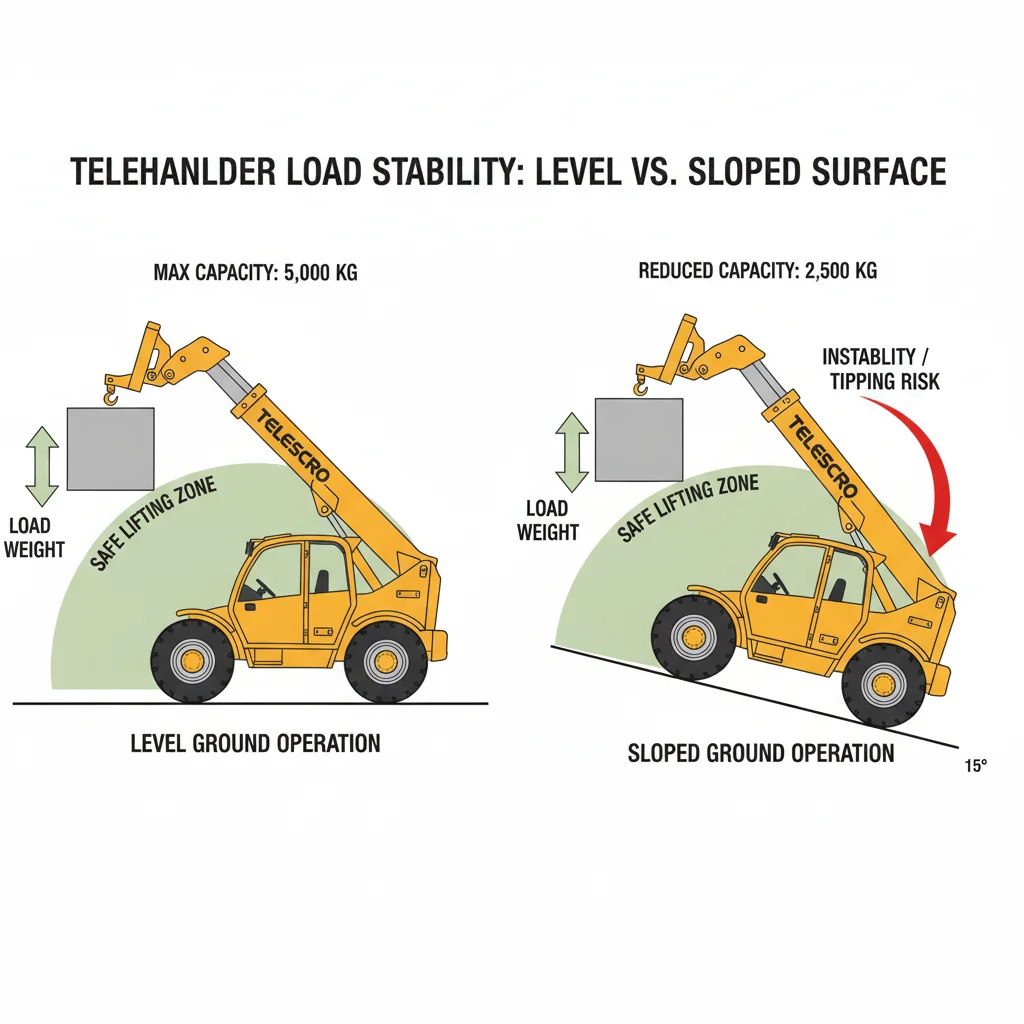
Most people don’t realize that telehandler rated capacity is only valid on level, firm ground—usually within 3° of tilt. I’ve seen this catch buyers off guard on sites where you’re always working on a slope or uneven yard. For example, a contractor in Kazakhstan called after his 3-ton telehandler struggled to lift 2.2 tons on a sloped farm lot. He assumed the spec sheet number would hold anywhere. But once you get even 5° off-level, you lose a big chunk of usable capacity. The load chart you see in manuals is based on perfect conditions—tilted machines move the tipping axis and worsen stability immediately.
On uneven ground, the machine’s frame leveling system becomes critical. Most standard models can level within ±8 degrees, but anything beyond that is outside safe working scope. If you’re routinely running across cross-slopes, you need to ask about stability limits and whether “on tyres” or “on stabilizers” is how you’ll mostly work. Some high-reach units only support stabilizers at the front, not all four corners (true four-point stabilization mainly appears on rotating models or extreme heavy-duty units). OEMs also publish derating guidelines—tables that show a steep drop in capacity the second you’re out of level. Don’t guess; look for those numbers.
I always recommend planning a flat, compacted approach zone before placing your biggest lifts—this often lets a properly equipped 3-ton machine handle the task, rather than wasting budget jumping up to a 5-ton class. Bring your terrain and real jobsite challenges to the table when talking to suppliers. That’s how you get a machine that’s stable, safe, and not oversized for the real working world.
Telehandler rated capacities are calculated assuming the machine is on level ground, typically within a 3-degree incline from true horizontal.True
This is an industry-standard practice because tilt beyond 3 degrees can significantly shift the center of gravity, risking stability and safe lifting ability. Manufacturers design and test telehandlers for optimal capacity under these controlled, level conditions.
As long as you stay within the total maximum lifting capacity listed on the telehandler spec sheet, it doesn't matter if the machine is on a slope or uneven surface.False
This is false because actual lifting capacity decreases when a telehandler is not level. Slope or uneven ground changes the machine's center of gravity, which can reduce stability and create a risk of tipping, even when lifting loads within the stated maximum capacity for level conditions.
Key takeaway: Rated telehandler capacity on spec sheets applies only to level ground. On sloped or uneven sites, consult chassis-levelling range, stability systems, and OEM derating guidelines for real working capacity. Specifying for actual ground conditions helps avoid overpaying for oversized machines and improves safety.
What Daily Checks Prevent Telehandler Tip-Overs?
Most telehandler tip-overs show advance warning signs, not sudden failure. Essential daily checks include verifying tyre pressure8, examining tyres and rims for damage, checking axle locks9 and stabilizers, and confirming the chassis is level. Operators should compare machine bubble levels with the load chart before near-limit lifts and assess ground firmness visually every shift.
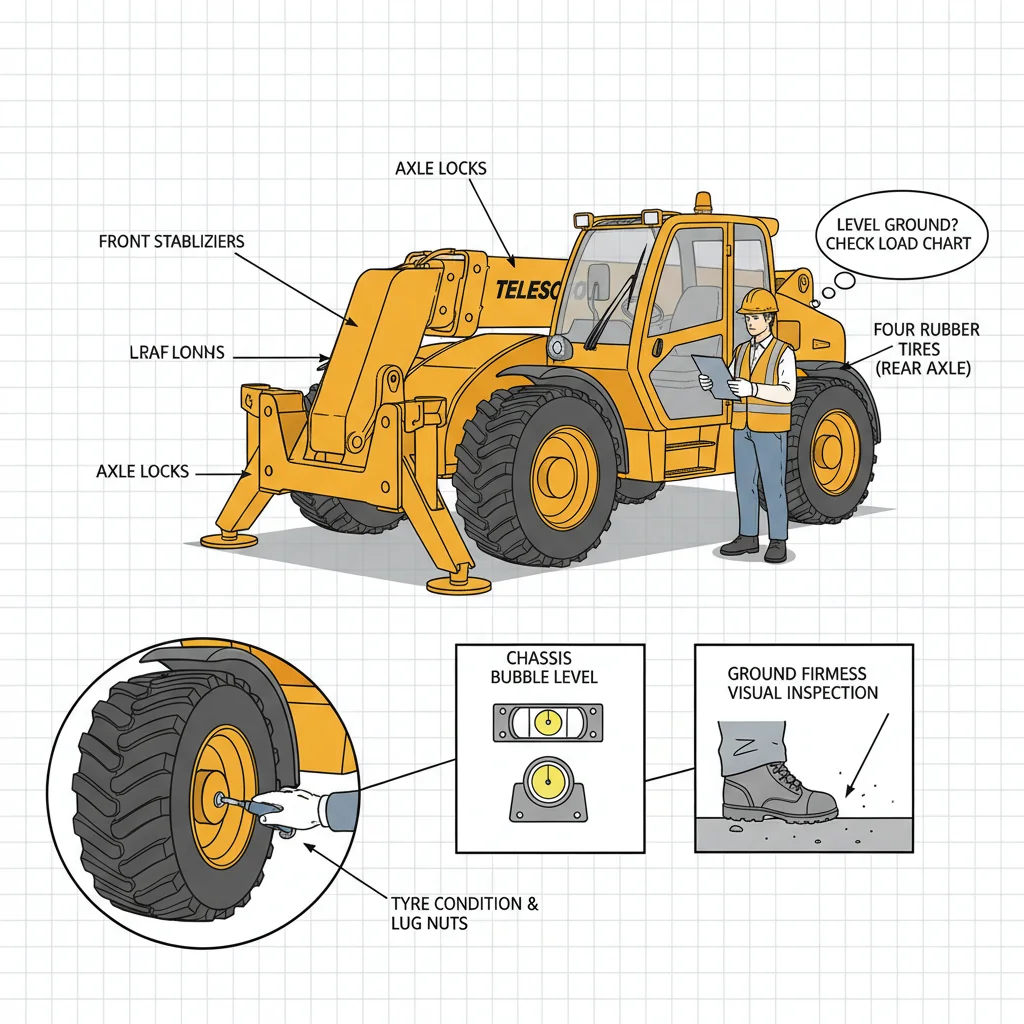
The biggest mistake I see is operators rushing into lifts without a full walk-around. Most tip-overs don’t happen out of nowhere—there’s almost always a clue. Take tyres, for example. I once visited a jobsite in Dubai where a 4-ton telehandler was parked for concrete block lifts. A quick check showed the left rear tyre sitting deeper in soft ground, and the rim had a dent from a past impact. Those might seem minor, but that tyre was underinflated by at least 40 kPa compared to the others. When the operator extended the boom, the whole machine started to lean just before reaching its working limit. Luckily, we spotted it and reset before anything tipped.
I always suggest starting each day by checking all tyre pressures, side-to-side. It only takes five minutes, but uneven or low pressure throws off stability in real-world conditions—especially with full loads at mid-height. Look closely at the treads and rims for damage. Worn or cracked tyres are a hidden risk, and even a slight rim distortion can weaken support under a side load. I also check that axle locks engage fully and, for rotating models, that stabilizers are deployed according to the load chart—not just by feel or habit.
Another simple habit is stepping back 3–5 meters and lining up the chassis against nearby verticals, like fence posts or scaffolding. Is the machine tilting even slightly? If yes, reduce your load by half or reposition. On muddy or uneven ground, pack down a strip with the telehandler before lifting high. These steps take minutes but turn that “assume level ground” line in the specs into real, daily safety.
Telehandler stability tables and rated capacities are calculated based on operation on level, firm ground; even a small slope or soft spot can invalidate those ratings and dramatically increase tip-over risk.True
Manufacturers test and certify telehandler capacities on standard, level surfaces because uneven terrain changes load distribution and center of gravity, which can easily lead to instability. This is why daily inspections must include checking for both ground firmness and levelness under each tyre.
It is safe to rely on the telehandler’s load chart for lifting limits, regardless of minor differences in ground condition or tyre inflation.False
The load chart assumes optimal, level, and uniformly firm ground with tyres inflated to specification. Variations in ground support or tyre pressure can shift the center of gravity, making published limits unreliable and increasing the chance of tip-over accidents.
Key takeaway: Implementing a routine of visual and functional checks—tyre pressure, rim condition, axle lock engagement, chassis level, and ground stability—transforms the abstract ‘level ground’ assumption in telehandler specs into practical, on-site safety. Early intervention based on these checks is critical for preventing sudden tip-overs.
Conclusion
Most telehandler specs are based on perfect, level ground—something we rarely see outside the manual. It’s easy to miss how quickly real site conditions change what those charts actually mean for daily work.
From my experience, the safest jobs—and the least headaches—come from spending a few extra minutes assessing ground conditions and not assuming the full rated capacity applies everywhere. I’ve seen good operators caught out by "showroom hero, jobsite zero" situations, especially on uneven or soft surfaces.
If you’re unsure about working with slopes, attachments, or want a more realistic capacity check for your site, feel free to reach out. I’m happy to share what works for crews in the field, not just on paper. Every jobsite has its own quirks—choose what keeps your people and project safe.
References
-
Learn expert insights into EN 1459 and ISO 10896 standards that enforce safety and consistency in telehandler load capacity testing. ↩
-
Understand the stability triangle concept and how ground contact points impact telehandler tipping risks at high boom angles. ↩
-
Explore detailed insights on how rated capacity depends on ground conditions to ensure safe telehandler operation and prevent tipping risks. ↩
-
Explore the critical impact of operating telehandlers on level ground and how it affects rated load capacities and safety compliance. ↩
-
Understand the technical limits of ground bearing pressure and its influence on telehandler load support for safe lifts on construction sites. ↩
-
Provides expert insights on preventing rollovers and ensuring safety by maintaining stability when operating telehandlers on inclines. ↩
-
Details the importance of chassis levelling systems for safe telehandler operation on uneven terrain and slope variation. ↩
-
Provides detailed guidance on how tyre pressure affects telehandler stability and helps avoid costly accidents on site. ↩
-
Explores the role of axle locks in maintaining machine stability and preventing tip-overs, based on expert inspection tips. ↩