










Why Do Telehandler Load Charts Assume Static Lifting? A Field Safety Guide
I still remember a warehouse job in Hungary where a solid, experienced operator loaded a telehandler right up to the limits of the chart—and then tipped forward in slow motion while easing the machine down a slight slope. He did everything “by the book,” but the chart didn’t save him.
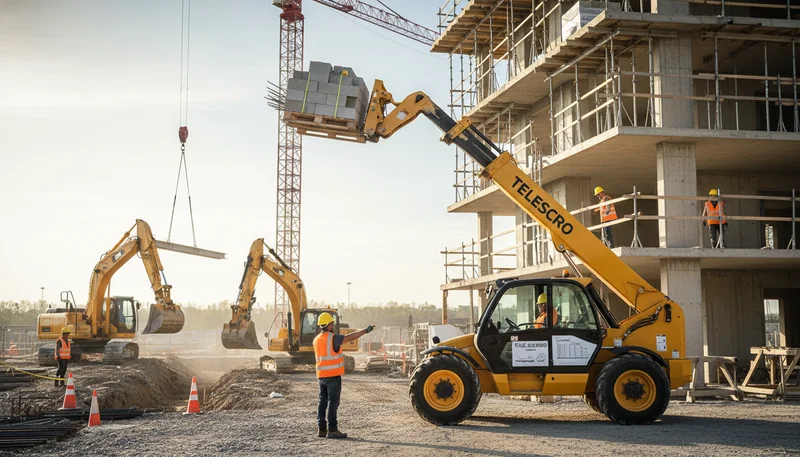
Telehandler load charts are established from controlled, stationary test conditions and are intended to be applied only under the setup assumptions stated by the OEM (commonly firm, level ground, frame level, and correctly inflated tires). Standard ratings are typically based on unit loads handled on forks and do not represent dynamic effects such as travel, slopes, wind, ground settlement, or suspended/swinging loads.
Why Are Telehandler Load Charts Static?
Telehandler load charts display lifting capacities under strictly static, controlled conditions: flat, level ground, standardized tire pressures, and stationary loads. These charts result from manufacturers’ stability tests, not dynamic scenarios. Thus, load charts certify best-case performance, excluding factors like travel, uneven surfaces, or wind. Capacity during real-world use may be significantly lower.

Most people don’t realize that telehandler load charts are based on static, controlled test conditions. In practice, manufacturers establish rated capacities with the machine stationary and set up according to the chart’s stated assumptions—typically on firm, level ground, with the frame level, and with tires inflated to the specified pressures. The test load is handled as a standardized “unit load” on forks at the load center stated on the chart (often around 24 in / 600 mm, depending on the market and chart format). With the machine stopped, boom position is changed methodically to determine the allowable load at each reach-and-height point within the published envelope.
Here’s what matters most: these charts show what’s achievable only when those setup assumptions are met. Real jobs rarely match that perfect scenario. For example, I worked with a developer in Dubai running a 4-ton class telehandler on a site with mild slopes and frequent gusts between structures. When the operator tried to work near the chart’s long-reach boundary, the load management system warned early and limited movement. Nothing was “wrong” with the machine—the chart simply wasn’t written for that combination of slope, ground variation, and load movement. Under those conditions, the usable capacity was materially lower than the static chart value at the same reach.
So don’t treat the load chart as a promise for every lift. Treat it as a baseline envelope for ideal setup conditions, and build in margin whenever the site introduces variables like soft ground, uneven terrain, wind, travel, or any suspended/swinging load behavior. Checking the load chart is the start—understanding its assumptions and limits is what keeps your operation safe.
Telehandler load charts are based on static, stationary tests under the setup conditions stated by the OEM (typically firm, level ground, frame level, and specified tire pressures), so even small deviations in ground condition or machine attitude can reduce the usable safe capacity.True
Load charts are established under controlled conditions to provide a consistent baseline. Changes in ground firmness, slope, tire pressure, or chassis attitude shift stability margin and can lower safe capacity relative to the charted values.
Because load charts are static, manufacturers usually include allowances in the chart for factors like wind speed and soft ground when specifying lifting capacities.False
Static load charts are published for stated setup assumptions and do not generally include explicit allowances for wind, uneven terrain, travel, or swinging loads. These real-world factors must be managed through planning, site controls, and appropriate operating margins.
Key takeaway: Telehandler load charts reflect static capacity under stated setup assumptions with the machine stationary. They do not account for dynamic effects from movement, uneven terrain, wind, or load swing—so lift planning must include margin and site-condition controls to prevent incidents.
Why Ignore Dynamics in Telehandler Load Charts?
Telehandler load charts assume static lifting, excluding dynamic forces1 such as braking, turning, ground shocks, wind, and swinging loads. These real-world variables can shift the center of gravity2 and spike load moments well beyond chart values, making rated capacity an upper safety ceiling—not a guaranteed limit under moving or unstable conditions.
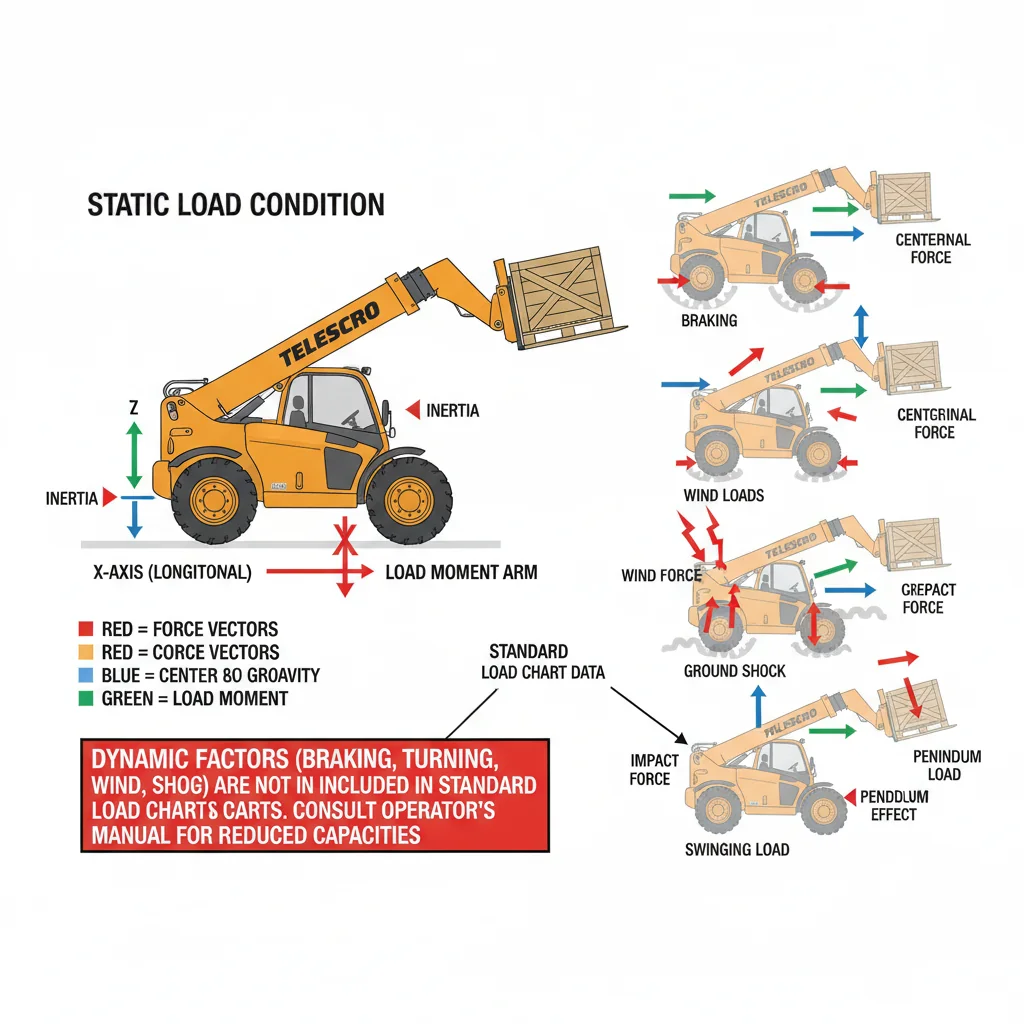
Let me share something important about telehandler load charts that often gets missed—especially by first-time buyers. Those charts look very precise, with clean lines for every boom angle and reach. But they are all based on static, level conditions. The moment you brake sharply, swing the boom, or roll over uneven ground, you introduce dynamic forces that the load chart does not account for.
I’ve seen even experienced operators get caught out by this in Latin America. Last year, I worked with a contractor in Chile who believed they were operating safely while moving a load that sat just under the chart limit at a long forward reach. During a routine reposition, the operator had to brake suddenly to avoid site traffic. The load management system reacted immediately, and the rear wheels became noticeably light. Nothing had changed on the chart—but the real-world forces had changed everything.
Here’s why that happens. Braking shifts the combined center of gravity forward. Turning pulls it sideways. A rut or uneven patch of ground can momentarily unload one tire and overload another, sharply reducing stability margin. Add wind—especially when handling large panels or formwork—and the problem escalates. I saw a similar issue on a coastal project in Peru, where gusty conditions caused a suspended load to start swinging. Even a small swing arc increased the effective load moment far beyond what the static chart assumes.
This is exactly why manufacturers treat rated capacity as an upper safety ceiling, not a guaranteed working limit under all conditions. Load charts define what is possible only when the machine is stationary, properly set up, and free from external disturbances. In the field, I always advise operators to view the chart as the maximum for still, controlled situations, and to reduce expectations whenever movement, uneven ground, wind, or suspended loads are involved.
Telehandler load charts do not account for the increased tipping risk caused by sudden acceleration or uneven ground because they assume lifting occurs on a perfectly level and stable surface.True
Load charts are created under controlled laboratory conditions, reflecting only static, stationary lifts. Dynamic movements such as driving, braking, or operating on slopes introduce momentary forces that can exceed chart limits, but these are not represented in the published load chart.
Manufacturers include dynamic safety margins in telehandler load charts to ensure operators are protected during real-world movement and abrupt stops.False
Load charts are generally based on static, stationary tests and do not include added safety factors for dynamic conditions. It is the responsibility of the operator to understand that actual working conditions can reduce safe lifting capacity below the values shown.
Key takeaway: Telehandler load charts only address static, level conditions and deliberately exclude dynamic forces encountered during actual operation. Operators must treat load chart values as absolute ceilings and include safety margins for motion, variable ground, and environmental factors to avoid exceeding stability limits.
Are telehandler load charts valid on slopes?
Telehandler load charts are defined for use with the machine stationary and set up on firm, level ground, as reflected in industry standards such as EN 1459 and ANSI/ITSDF B56.63 and corresponding OEM test procedures. Operations on slopes, uneven surfaces, or while traveling with the boom raised fall outside these tested assumptions, meaning the published rated capacities no longer apply without additional derating or site-specific controls.
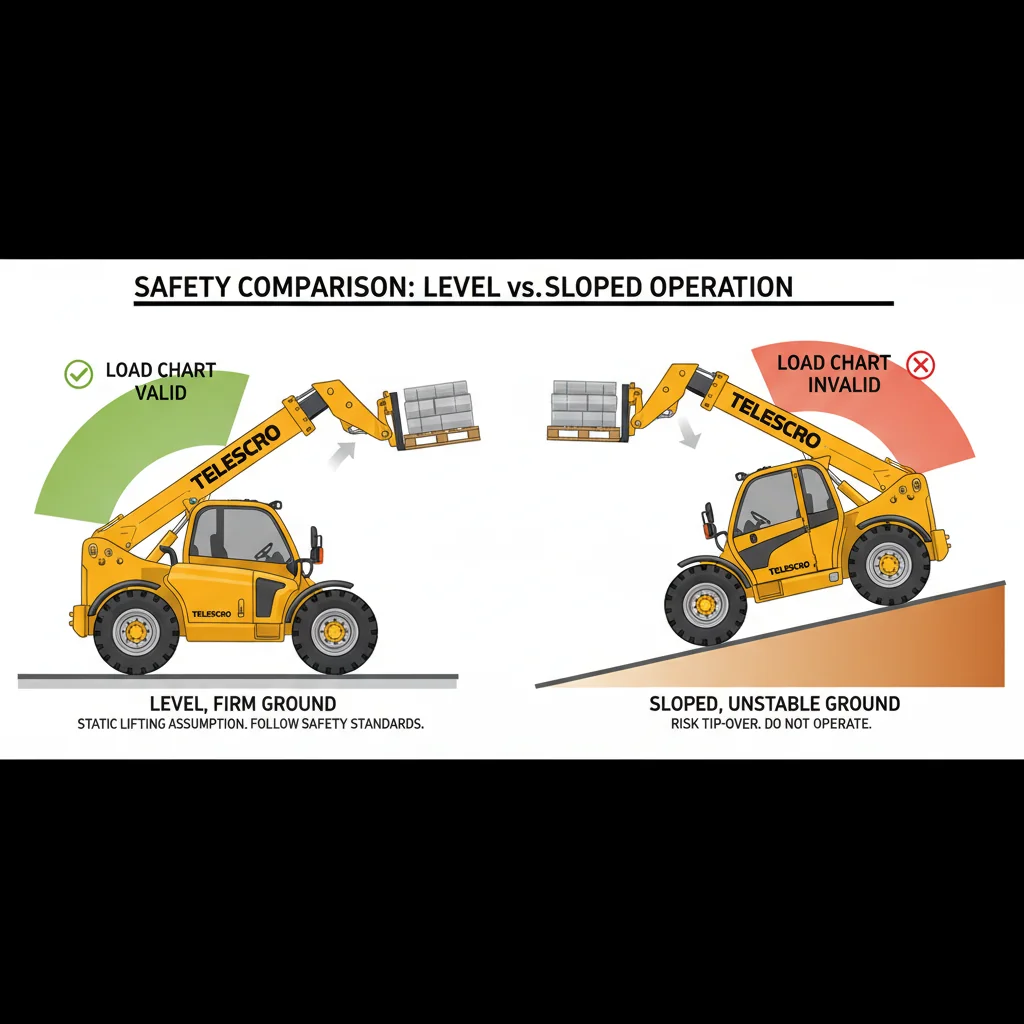
The biggest mistake I see is assuming the load chart covers any ground your tires touch. It just doesn’t. The rated capacity printed on the load chart is only accurate when your telehandler is parked, boom down, on firm and level ground—usually within about a 3-degree tilt. This is true whether you’re running a 3-ton compact model or a 5-ton high-reach unit. I’ve seen crews on sites in Dubai and Brazil load up to charted capacity, then try to drive with the boom raised across a mild slope or construction fill. The operators were shocked when the machine became unstable, even though on paper, they were “within limits.” The problem? The chart never applied to those real ground conditions.
Here’s what matters most when reading any telehandler load chart: every number shown assumes level ground, usually on tires and at a specific load center distance from the front tire edge to the fork or attachment center. As soon as you have a soft spot, a rut, or even a 4-degree side slope, those numbers mean nothing—the geometry and weight balance change fast. Industry standards like EN 1459 and ANSI/ITSDF B56.6 are clear: all capacity tests happen on flat, hard surfaces with the machine stationary. Once you start turning, moving, or let a wheel drop into a dip, stability can disappear well before the warning alarm sounds.
I always advise customers in countries with rough sites—like Kenya or Kazakhstan—to set stricter rules: never travel with the boom up, and always double-check ground under the wheels before lifting. That way, you treat load charts as a guideline, not a promise.
Telehandler load charts are accurate only when the machine is set up on firm, level ground and stationary, as assumed in manufacturer testing and standards.True
Load charts are developed under static, level setup conditions. Any slope or uneven ground shifts the center of gravity and reduces stability, meaning the published rated capacity may no longer be valid under those conditions.
Telehandler load charts automatically compensate for ground slope when stabilizers or outriggers are deployed.False
While some telehandlers provide separate load charts for stabilizers deployed versus retracted, these charts still assume firm, level ground unless the manufacturer explicitly states otherwise. Stabilizers do not automatically compensate for operating on slopes or uneven terrain.
Key takeaway: Telehandler load charts state rated capacity for firm, level ground with the machine stationary. Any slope, soft ground, or moving with a raised boom means the charted capacity no longer applies. As a best practice, prohibit travel with a raised boom and derate or reassess operations on non-level or unstable terrain.
How Do Load Charts Handle Attachments?
Telehandler load charts are typically based on handling a rigid, evenly distributed unit load on forks, such as palletized materials. When suspended loads, hooks, jibs, work platforms, or other attachments are used, separate OEM-approved load charts or derating instructions are required. These configurations can reduce allowable capacity significantly at the same reach and height, depending on attachment weight, load center, and stabilizer setup. Always ensure the attachment, load chart, and stabilizer configuration match the actual operating condition.

Last year, I worked with a client in Dubai who assumed their 4-ton telehandler could safely lift 3,000 kg at maximum reach using a hook attachment—just like with forks. The reality was very different. The moment a suspended load or jib comes into play, the capacity curve changes sharply. That’s because standard load charts are built around rigid, evenly distributed pallets on forks, not swinging or offset loads. The operator was surprised to see that, with the hook, his rated capacity at 14 meters dropped to barely 1,600 kg—and the machine’s built-in moment indicator started warning much earlier than expected.
Here’s what matters most when working with attachments:
- Each attachment (forks, hook, jib, man basket, bucket) requires a matching OEM load chart.
- Capacity drops 30–50% for most suspended or platform loads at the same reach.
- Stabilizer configuration (deployed or up) changes the valid chart—never mix conditions.
- If no attachment-specific chart is provided, do not guess—request it from your equipment supplier.
I’ve seen supervisors in Kenya unknowingly use fork-based charts for man baskets. That’s a serious site risk. Suspended loads swing and change the load center. Work platforms have their own mass, plus people moving on them. The load chart for forks becomes invalid as soon as the attachment changes.
To be honest, I always suggest locking “homemade” hooks or baskets away unless you have the exact OEM chart for that setup. The only safe path is to match your telehandler, attachment, and stabilizer mode to the correct chart every time. That one step prevents costly mistakes and keeps your team safe.
Telehandler load charts assume the load is static and uniformly distributed because dynamic or suspended loads, like those on a hook or jib, introduce unpredictable forces that can cause rapid capacity reduction.True
Standard load charts are based on stable, balanced pallet loads resting securely on forks. Suspended or swinging loads add variables such as shifting centers of gravity and dynamic movement, which increase tipping risk and invalidate standard capacity figures.
Load charts automatically factor in any attachment you use, so the rated capacities shown always apply regardless of forks, hooks, or jibs.False
Most manufacturer load charts are based on the machine equipped with standard forks; they do not account for the varying effects of specialized attachments. Attachments like hooks or jibs often reduce stability and alter load geometry, requiring a separate chart or manual de-rating calculation.
Key takeaway: Telehandler load charts are specific to both the attachment and the machine configuration. Fork-based charts do not apply to suspended loads or specialized accessories. Always obtain and follow the OEM-provided, attachment-specific load chart or instructions to maintain rated capacity, stability, and site safety.
Why Do Load Charts Assume Static Lifting?
Telehandler load charts assume static lifting because they are based on slow, controlled boom movements, not accounting for inertia caused by rapid or abrupt operator inputs. When operators move the boom quickly or snatch loads, dynamic forces increase the effective load moment, posing risks well beyond charted values.

I’ve worked with operators in Dubai, Kenya, and Brazil who often ask why a telehandler with a “3-ton rated capacity” can’t always lift 3 tons at full speed. The answer comes down to how load charts are created. Load charts are tested with the boom moving very slowly and smoothly—deliberate, controlled motions. The moment you snap the boom out or lower it too quickly, you create extra force from inertia. That means the real load on the machine’s structure and stability is much higher than the static weight you see on the scale.
I saw this firsthand with a client in South Africa. Their team needed to place pipes at nearly full reach—about 13 meters out—with a 2.5-ton machine. The operator got impatient, boomed out fast, and the load started to swing. For a split second, the machine’s stability margin was completely gone. The load chart only covered the calm, controlled scenario. Once dynamic forces from abrupt movement kicked in, the risk of tip-over shot up. Luckily, no damage that time—but it was close.
From my experience, operators get comfortable and forget how much inertia can work against them. Modern machines use load moment indicators and hydraulic cut-outs, but these are backups. The real solution is clear training and strict site rules: always pause movement before lifting or extending, never snatch loads, and keep boom movements steady—especially at max reach. I suggest including these controls in every telehandler induction. The smoother the operation, the safer you stay—right in line with what that load chart actually guarantees.
Telehandler load charts are based on static lifts because dynamic movements, like rapid boom extension or lowering, generate additional inertial forces that significantly increase stress on the machine’s frame and stability system.True
Dynamic motions introduce forces beyond just the weight of the load, including inertia and shock loads, making the actual stress much higher than during slow, controlled static lifts. Load charts are calculated using slow and steady motions to establish a consistent baseline for safety.
Manufacturers design telehandler load charts to model both static and rapid, real-world lifting scenarios, so the rated capacity always accounts for sudden boom movements and braking.False
Load charts are specifically based on idealized static lifting conditions with smooth, slow operation. They do not account for dynamic factors like quick movements or sudden stops, which can significantly reduce actual lifting capacity in real-world use.
Key takeaway: Static load charts presume calm, deliberate boom operation. Fast or abrupt movements introduce dynamic forces that can exceed rated capacities, increasing risk of tip-over or structural stress. Safety training must emphasize smooth boom control to keep real-world conditions aligned with chart assumptions.
Why Derate Telehandler Load Charts for Motion?
Telehandler load charts assume static lifting on firm, level ground as a baseline. In real field operations, experienced supervisors typically apply additional derating whenever the machine is moving, the ground is imperfect, or the load is flexible or suspended. This practical derating helps absorb dynamic risks4 such as braking, uneven terrain, load swing, and operator input—factors that are not represented in static load charts but can significantly reduce real-world stability margins.
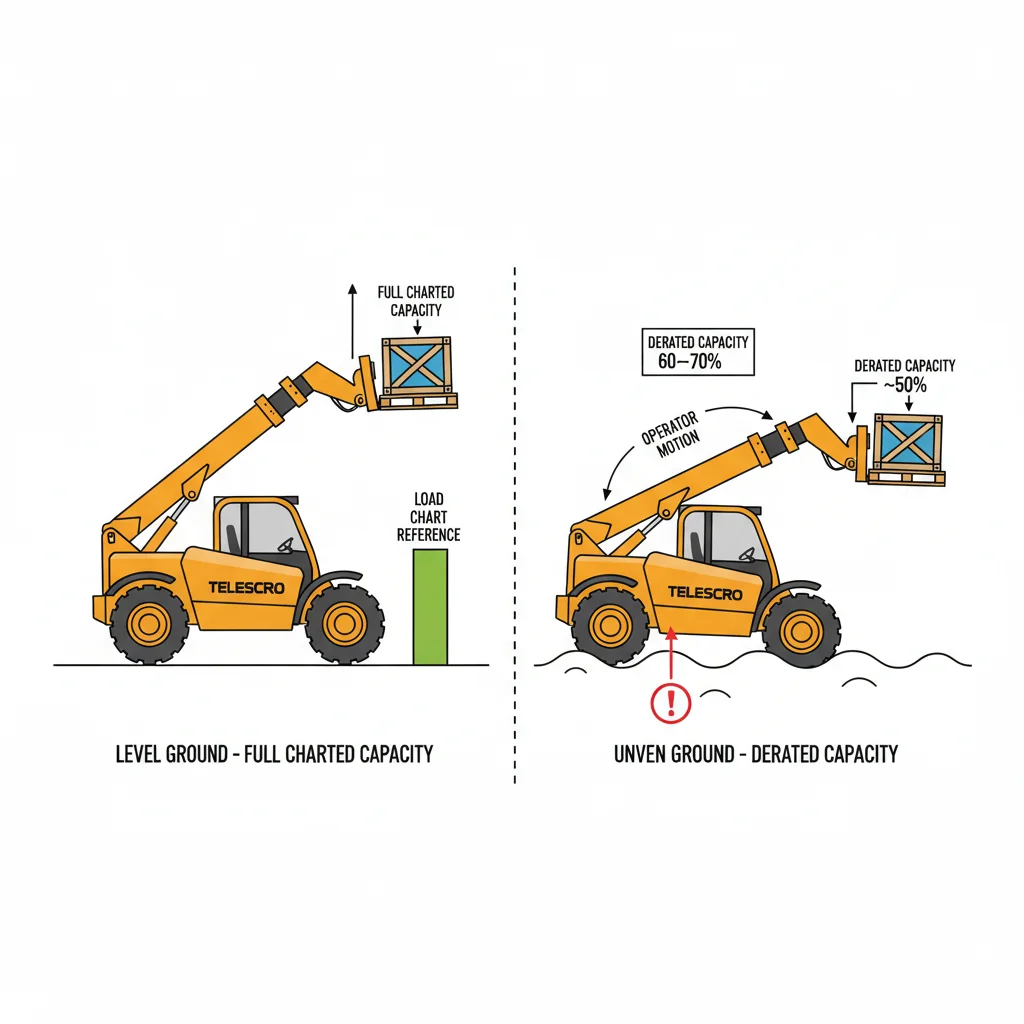
To be honest, the spec that actually matters is how much capacity you use during lifts that involve movement or less-than-perfect ground. Load charts look clear on paper, but real jobsites never match those flat, stable test pads. I’ve watched operators in Kazakhstan attempt to shift 2,000 kg pallets across fresh fill—listed as "within chart range" at minimum reach, but as the telehandler moved, tire settlement and a slight slope turned the boom into a lever. Suddenly, the machine felt light over the front axle—dangerous. That’s why experienced supervisors never use full charted capacity when traveling with a load.
On the sites I’ve supported in Malaysia and South Africa, contractors plan most moving lifts at only 60–70% of what the chart claims is safe—sometimes less. For example, one client near Kuala Lumpur handled steel pipes on partly compacted gravel with a 3.5-ton class telehandler. He set his fleet’s moving load limit to just 2,000 kg, even though the machine was rated well above that for stationary work. Travel distance was under 30 meters, but slight undulations in the terrain made even this buffer feel wise. The reason is simple: any machine movement or ground imperfection amplifies load swing and risk.
This kind of derating isn’t a formal rule in the manuals—it’s just good judgment. Jobsite slopes, small ground settlements, or a shifting suspended load can push a telehandler into its tipping zone faster than most new operators expect. I always recommend that safety managers formalize reduced working loads for different risk levels, so the team treats the factory chart as a ceiling, not a target.
Telehandler load charts are developed with the assumption that the machine is on a firm, level surface and stationary, because dynamic forces from motion or uneven terrain can reduce stability and overload the structure.True
Static load charts exclude the extra forces caused by movement or uneven ground, such as momentum, shifting loads, and uneven tire compression, which can lead to instability or tipping even when within the listed capacities.
Manufacturers intentionally overstate telehandler load chart capacities to compensate for operator error during dynamic lifts.False
Manufacturers do not inflate load chart capacities as a safeguard; instead, they base them on controlled testing to ensure safety on static, level conditions. Operator safety depends on derating for real-world scenarios, not built-in overstatement.
Key takeaway: Telehandler load charts reflect ideal, static conditions. For actual moving lifts or on imperfect ground, prudent fleets set their own internal limits—often using only 50–70% of charted capacity—providing an essential safety margin for dynamic loads5, minor slopes, ground settlement, and human error.
How Should Telehandlers Be Sized for Dynamic Loads?
Sourcing equipment based solely on static load chart ratings6 can lead to under-specification when dynamic site conditions are involved. For applications that require frequent travel, rough-ground operation, or handling flexible loads, selecting a telehandler with additional rated capacity at the required reach provides a wider operational margin and helps reduce the likelihood of instability or overload.
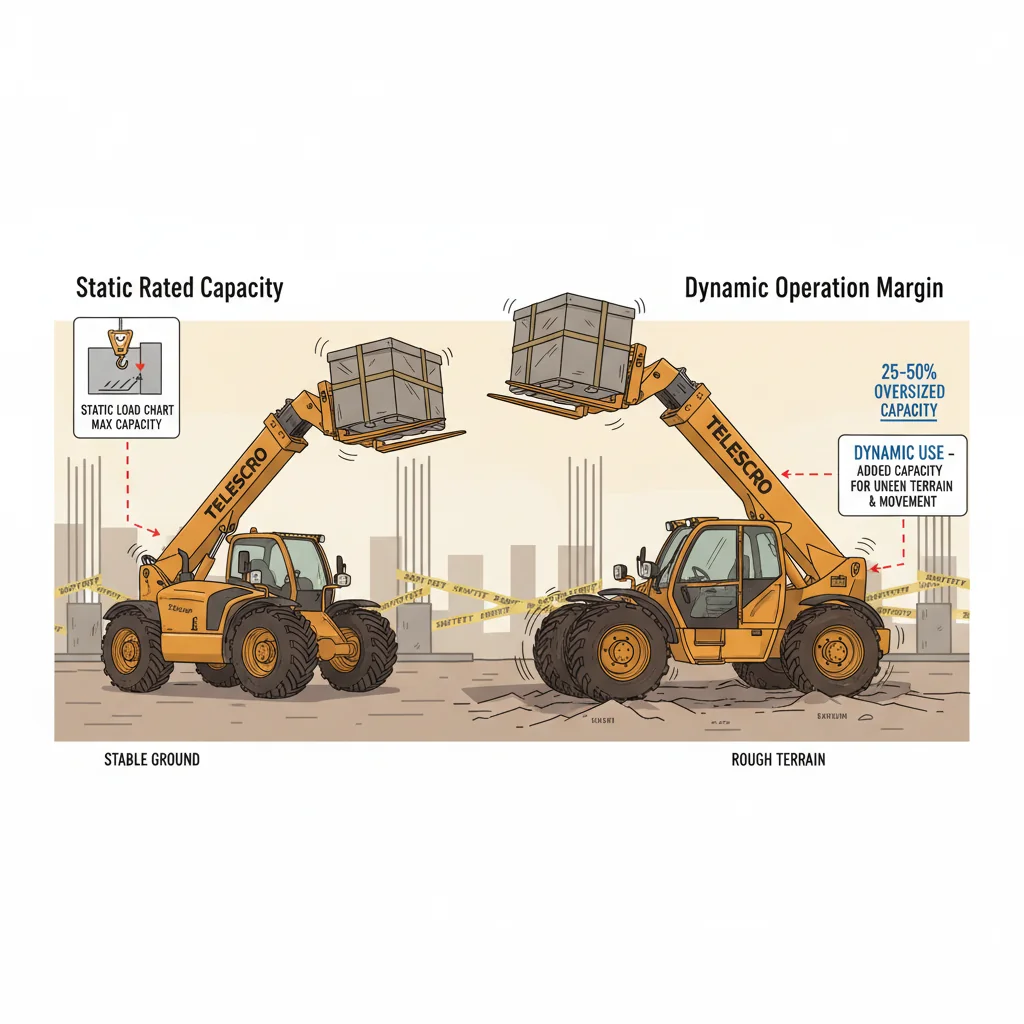
Here’s what I’ve learned from site work: the static load chart is only the starting point. Rated capacity is determined on firm, level ground with a stationary machine and a specific attachment. Once the telehandler is required to travel, operate on uneven ground, or handle loads that can shift, the effective safe capacity is reduced—sometimes significantly.
I saw this clearly with a contractor in Chile working on a precast project. They were lifting concrete panels weighing about 2,000 kg at an 8-meter reach using a telehandler rated for that load on the static chart. The site had compacted gravel and mild cross-slopes, and the machine had to travel short distances with the load. Within the first week, stability warnings were frequent, productivity slowed, and operators reported that the machine always felt close to its limit.
The solution was not changing operators—it was changing the machine selection. We moved to a model that offered greater rated capacity at the same reach, which restored operating margin. The alarms stopped triggering constantly, travel felt more stable, and the crew could work without fighting the limits of the machine.
This approach becomes even more important when suspended loads are involved or when ground conditions vary throughout the site. Features like stabilizers, boom suspension, and appropriate tire selection help, but they do not replace adequate capacity margin. My rule is simple: confirm the static load chart first, then select a machine that still has comfortable margin once movement, surface condition, and load behavior are considered.
Telehandler load charts assume static lifting because dynamic forces, such as traveling over uneven ground or moving while lifting, can introduce load moments beyond tested limits.True
Load charts are developed under controlled, stationary conditions. Dynamic actions like movement, braking, or surface irregularities can momentarily increase load moments beyond what is shown on the chart, requiring additional operational margin.
Telehandler load charts are calculated to fully account for dynamic effects such as rough terrain travel and boom movement.False
Published load charts are based on static testing on level ground with the machine stationary. Dynamic effects are not included and must be managed through conservative machine selection and operating practices.
Key takeaway: Selecting a telehandler strictly to match static load chart values leaves little tolerance for movement, uneven ground, or shifting loads. Choosing a machine with additional capacity at the required reach provides necessary margin for dynamic site conditions and supports safer, more productive operation.
How Do LMIs Enhance Telehandler Safety?
Load Moment Indicators (LMIs) and zone control systems monitor parameters such as boom angle, extension, and hydraulic pressure to estimate load moment in real time. These systems provide warnings or movement cutouts as the machine approaches static stability limits, helping prevent gross overloads and reinforcing compliance with the load chart—particularly in rental or multi-operator fleets.

On jobsites I’ve supported in Mexico and Colombia, LMIs have proven essential—especially where multiple operators rotate through the same machine. These systems continuously calculate load moment based on boom geometry and give clear warnings as limits are approached. I’ve personally seen LMIs prevent operators from attempting placements that were well beyond the safe range for the machine.
However, it’s critical to understand what LMIs do not do. They are calibrated around the same assumptions as the load chart: firm, level ground and a stationary load. They cannot fully account for potholes, sudden braking, swinging suspended loads, or incorrect tire pressure.
I was reminded of this on a site in Peru, where a crew relied heavily on the LMI while traveling with a suspended bundle of rebar. The display showed normal operating status, but a sudden stop caused a rapid shift in load moment and triggered a tilt alarm that came too late to feel comfortable. The system reacted, but it could not predict the dynamic shock created by movement.
That’s why I always advise fleet managers and buyers to treat LMIs as a safeguard—not a substitute for planning. Proper machine sizing, conservative load planning, and disciplined operating practices remain essential. LMIs are extremely effective at preventing obvious overload errors, but stability still depends on the operator respecting the limits assumed by the load chart.
Telehandler load charts assume static lifting conditions, and LMIs are designed to enforce those static limits rather than predict dynamic events.True
LMIs calculate load moment based on static geometry and sensor inputs. Dynamic factors such as sudden stops or ground irregularities can exceed these assumptions even when the display appears within limits.
LMIs allow operators to safely exceed the manufacturer’s rated capacity as long as no alarm is active.False
LMIs do not authorize operation beyond rated capacity. They provide warnings and cutouts to help prevent overloads but do not change the underlying limits defined by the load chart and manufacturer testing.
Key takeaway: LMIs are a critical safety tool for enforcing static load chart limits, but they operate within the same assumptions as those charts. Safe telehandler operation still depends on correct machine selection, conservative planning, and disciplined operator behavior—especially when movement or uneven ground is involved.
How Does Dynamic Loading Impact Telehandler Wear?
Dynamic loading accelerates wear on telehandler boom sections, pins, axle pivots, and tires, increasing the risk of structural issues such as boom play7, elongated pin holes, and cracked welds. Over time, component degradation means the telehandler’s stability and performance may fall below what static load charts assume, reducing real-world safety margins.
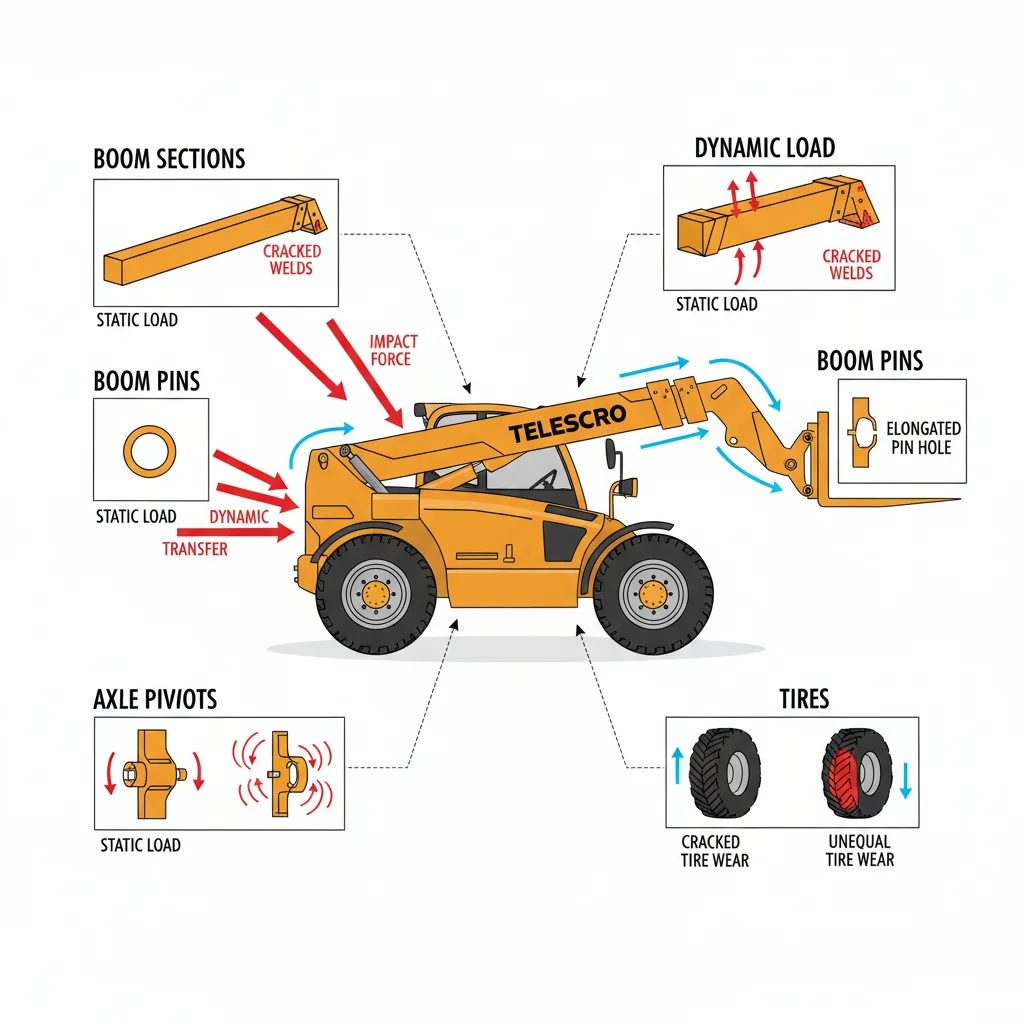
I’ve worked with customers in Kazakhstan who are often surprised by how quickly their telehandlers start to show extra play in the boom or noisy pins—especially after fast driving with heavy loads or emergency stops on uneven ground. They called me out to inspect a 13-meter telehandler that had developed noticeable boom movement after just 14 months, even though the load chart said they weren’t overloading. When we checked, the pin holes at the main boom section were already oblong, and there were hairline cracks near some welds. The machine had been running over rough, unfinished roads and making quick turns with loads raised. That’s classic dynamic loading damage.
The reality is, dynamic forces on a telehandler don’t just test limits in the moment—they build up hidden wear. Every hard brake or bounce transfers shock loads into the boom sections and axle pivots. Tires flex and settle, sometimes sagging under repeated stress. I’ve seen 4-ton compact units end up with underinflated tires after operators ignore slow leaks. That reduces true stability compared to static test conditions—even before you consider any boom play.
What I always tell fleet managers is this: static rated capacity assumes perfect conditions—level ground, standard attachment, correct tire pressure. But with dynamic loading, minor wear multiplies quickly. Chronic alarms from your load moment indicator, or visible bouncing under load, are never “just operator issues.” I suggest making boom clearance checks and pin inspections a routine part of your monthly schedule. If you spot early signs of wear, get a technician involved before small issues become structural risks.
Telehandler load charts are based on static load conditions and do not account for dynamic forces caused by sudden movements or driving on uneven ground.True
Load charts are designed using controlled, stationary scenarios, focusing on the machine's lifting capacity with a stationary load. Dynamic effects, such as shock loads from driving or abrupt stops, can generate forces far exceeding the static-rated capacity, leading to accelerated wear on pins, bushings, and boom structures—even when the operator is technically within load chart limits.
Dynamic loading has no significant impact on the wear and longevity of telehandler boom components if operators adhere to the stated load chart limits.False
Even when the load chart is followed, dynamic events like abrupt stops or traveling over rough terrain create additional forces that the static load chart does not consider. These forces can rapidly increase wear on critical components, causing issues like oblong pin holes and increased boom play much sooner than would occur under purely static lifting.
Key takeaway: Repeated dynamic loading—such as hard braking and sharp turns with raised booms—damages critical telehandler components and drifts machine performance away from static test conditions. Regularly inspect boom clearances, pin connections, and tires to maintain safety, and treat abnormal alarms or bouncing as triggers for immediate checks.
How Can Telehandler Operators Minimize Dynamic Risks?
Operators can reduce dynamic risks by keeping telehandlers as level as possible using slope indicators, avoiding boom movements while traveling, and only raising or extending with the machine stopped. Where the load chart allows higher capacity with stabilizers, they should be fully deployed before lifting. These habits help align actual site safety with static load chart conditions.
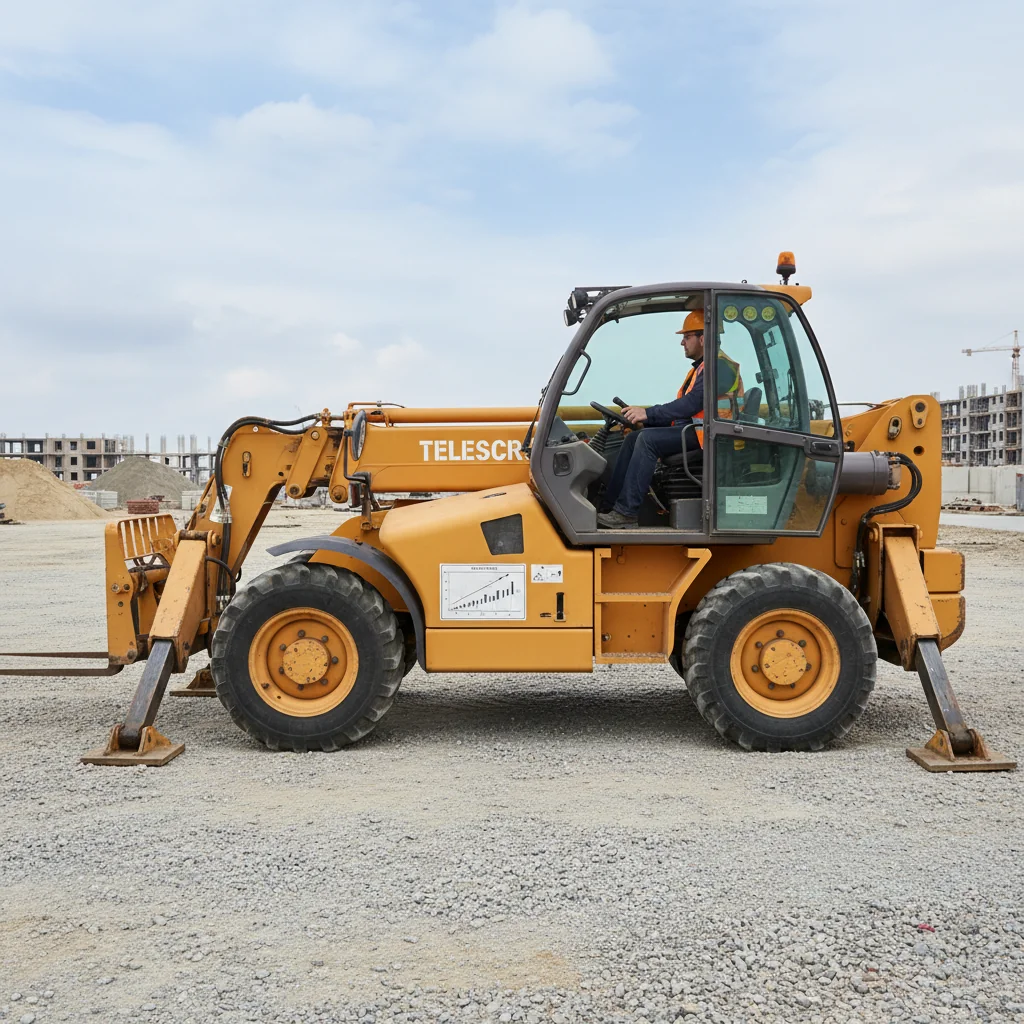
One thing I notice a lot—especially when I visit sites in places like Malaysia or Chile—is how quickly operators start moving with the boom raised or partially extended. That single habit introduces way more dynamic risk than most realize. When the machine is rolling, even small bumps or gentle turns amplify the forces acting on a partially raised load. I’ve seen a 3.5-ton telehandler nearly lose a 1,200-kg load on uneven concrete simply because the operator extended the boom halfway while driving. The solution is straightforward: always complete boom adjustments from a full stop, with the machine as level as you can manage. Use the built-in slope indicator8—if you’re working with more than 2 or 3 degrees of tilt, that’s already beyond what the load chart assumes for rated stability. On larger jobsites in the UAE and Australia, I’ve watched crews get into the habit of traveling with loads at low speed. It’s not always practical to be perfectly static. So, when you have to move a load, keep the boom retracted and as low as possible, go slow, and avoid sudden stops or sharp turns. The difference in tipping risk between “boom low and retracted” versus “boom halfway up” is bigger than most manuals can put into numbers. And remember—manufacturer load charts show capacity for static conditions, with the machine stopped. Don’t estimate. Always treat those numbers as a hard limit. When your model has stabilizers, use them to your advantage.
Telehandler load charts assume the machine is stationary with the boom retracted or only slightly extended, because any movement or boom extension significantly increases the potential for instability due to shifting forces and momentum.True
Load charts are developed under controlled, static conditions to provide safe lifting limits, as dynamic movements introduce additional lateral and longitudinal forces that can't be accounted for in standard load ratings. These factors can quickly tip a telehandler beyond its safe limits, especially when turning or traversing uneven ground.
Telehandler load charts account for all potential movements and dynamic stresses, so operators can drive with a partially raised load up to the listed capacity without additional risk.False
Load charts are based strictly on static lifting conditions; they do not include allowances for dynamic forces such as those introduced by movement, turning, or driving on slopes. Operating beyond static conditions increases the risk of tip-over or loss of load, making it unsafe to rely on listed capacities while the machine is moving.
Key takeaway: By consistently applying load chart-based decisions, deploying stabilizers where permitted, restricting dynamic maneuvers, and embedding these habits in operator training, telehandler operations can stay much closer to manufacturer-rated static capacities. Always use the manufacturer’s load chart as the sole reference for safe lifting limits and stability, never generic formulas.
Conclusion
We looked at how telehandler load charts are based on level, static conditions—not the realities of a busy, unpredictable jobsite. From my own projects, I see many crews relying too much on these charts and forgetting the risks once the machine starts moving, or when the ground gets soft. I always remind people to treat load charts as starting points, not guarantees, especially when ground or weather isn’t perfect. If you’re unsure how your site conditions affect lift capacity, or want to walk through load charts for real tasks, I’m happy to help—no pressure. Feel free to reach out with questions. The safest results always come from careful planning, not just trusting the paper specs.
References
-
Explore how braking, turning, and ground shocks affect telehandler stability beyond static load charts to improve operational safety. ↩
-
Understand how shifts in the center of gravity impact load moments and machine safety for safer lifting under real-world conditions. ↩
-
Offers authoritative insights on telehandler testing and operational safety standards, essential for compliance and equipment reliability. ↩
-
Detailed explanation of dynamic risks during telehandler boom movements and best practices to enhance site safety. ↩
-
Provides expert advice on selecting telehandlers with increased rated capacity to safely handle dynamic loads on rough terrain. ↩
-
Explains the limitations of static load charts and why a higher safety margin is critical for real job site conditions. ↩
-
Understand the causes of boom play from dynamic forces and learn maintenance tips to maintain telehandler stability and performance. ↩
-
Explore the technical role of slope indicators in maintaining telehandler stability and preventing accidents on tilted surfaces. ↩