











Why Are Telehandlers Important in Material Handling? Field Lessons for Buyers
A site manager from Chile once sent me a photo of six workers waiting around while their forklift got stuck in a muddy access road—again. Meanwhile, their telehandler sailed past, dropping off steel beams right where they were needed. It was a perfect snapshot of why so many projects rethink their equipment mix.
Telehandlers have emerged as central machines in modern material handling by combining vertical lift, horizontal reach, and all-terrain mobility within a single platform. Unlike forklifts, telehandlers deploy telescopic booms to deliver payloads precisely at height and distance, while traversing rough jobsite conditions that immobilize conventional lift trucks. Their ability to reduce double-handling, minimize manual re-handling, and support various attachments offers significant improvements in workflow efficiency and operational productivity across construction, industrial, and agricultural sites.
How Do Telehandlers Outperform Forklifts and Cranes?
Telehandlers outperform forklifts and cranes by combining lifting, reaching, and rough-terrain travel1 in a single machine. With a telescopic boom2, they can unload trucks, traverse uneven sites, and precisely place loads at height or depth—tasks typically requiring multiple machines and more steps with conventional equipment.
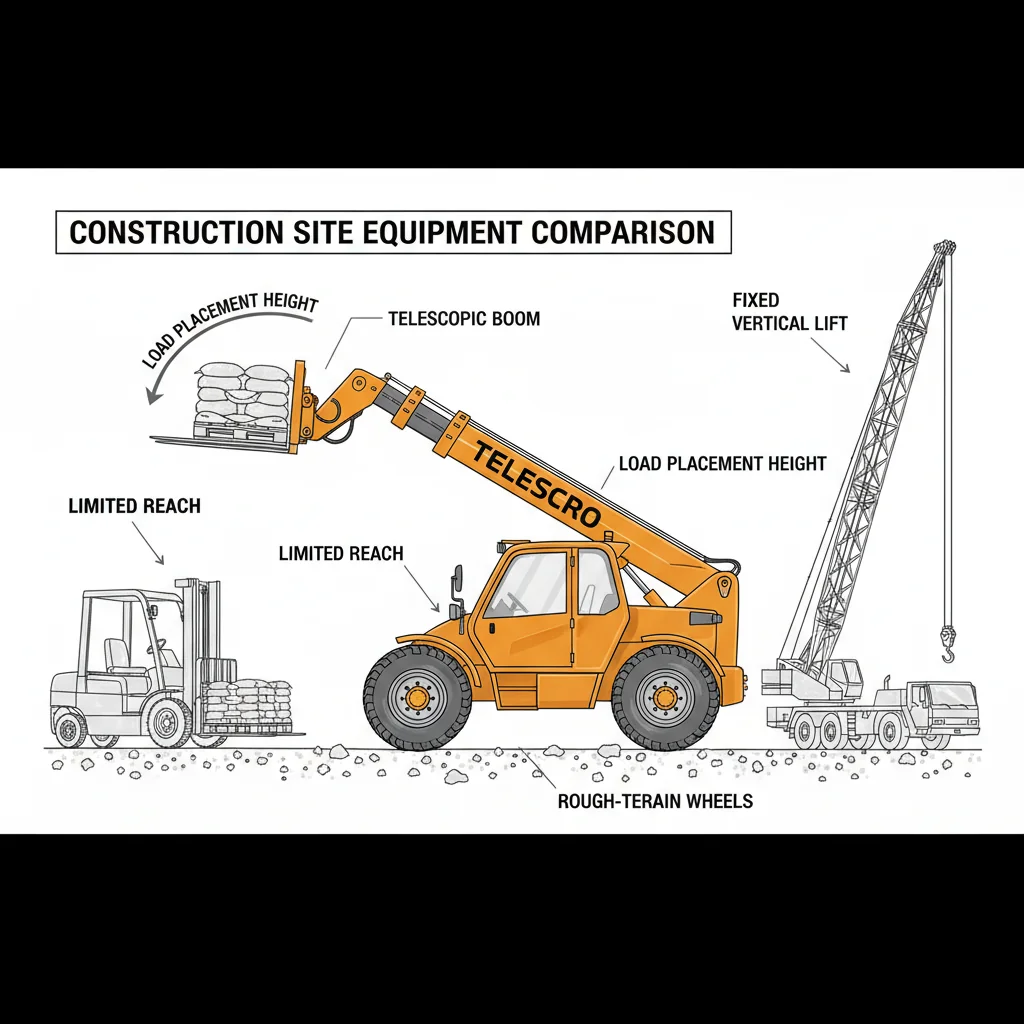
Most people don’t realize that telehandlers actually simplify jobs where you’d need both a forklift and a crane. I saw this firsthand last year in Dubai. A contractor was moving steel pipes—some up to 5 meters in length—across rough, uneven ground. Their forklift kept getting stuck and couldn’t get close to the drop zone, while the crane took up too much space and needed extra crew just for rigging. With a 4-ton telehandler that had an 18-meter telescopic boom, they unloaded materials from the delivery truck, navigated right through the sand, and placed each pipe directly onto a second-story platform. All in one run.
Here’s what sets telehandlers apart: the telescopic boom. You get forklift forks for pallet work, but you’re not stuck with ground-level lifting. Extend the boom and you’re working above fences, reaching into buildings, or dropping bundles deep into excavations. On a site in Kenya, I watched a team use a 3.5-ton machine with a 14-meter reach. Instead of double-handling blocks—forklift to ground, then labor up scaffolds—they picked directly to the second floor in one cycle. That change alone saved them at least two full working days over the month.
The real benefit is the lack of setup. Cranes need outrigger legs and a clear pad. Forklifts stop when the ground gets soft. Telehandlers roll right through mud, gravel, or steep ramps. For a fleet manager, that means one operator, less site congestion, and faster material flow. I always suggest checking if your jobsite has a “double-handling” problem—if so, a telehandler can likely solve it.
A telehandler with an 18-meter boom can safely place materials on rooftops or elevated floors that would normally require a mobile crane, all while maneuvering on soft or uneven surfaces where cranes cannot operate.True
Telehandlers' long reach and all-wheel-drive or crab steering allow them to access tight or rough-terrain sites, making them ideal for jobs that would typically need both a forklift's mobility and a crane's vertical lift, especially in construction environments.
Telehandlers universally have higher maximum lift capacities than rough-terrain forklifts of the same size class.False
While telehandlers generally offer greater versatility and reach, their maximum lift capacity is often lower than that of specialized rough-terrain forklifts in the same weight class, due to the added leverage and structural stresses from extending booms.
Key takeaway: Telehandlers’ unique combination of forklift, crane, and loader functions enables efficient single-cycle material handling. This reduces the need for multiple machines, minimizes double-handling, and streamlines workflows, especially in construction and industrial environments where load placement flexibility and site mobility are critical.
When Do Telehandlers Boost Productivity Most?
Telehandlers significantly increase efficiency when sites require frequent movement of materials both vertically and horizontally. Their reach and rated capacity minimize trips versus standard forklifts and enable direct delivery to upper floors, façades, or tight yard spaces—reducing manual handling, crew waiting, and optimizing site space utilization.
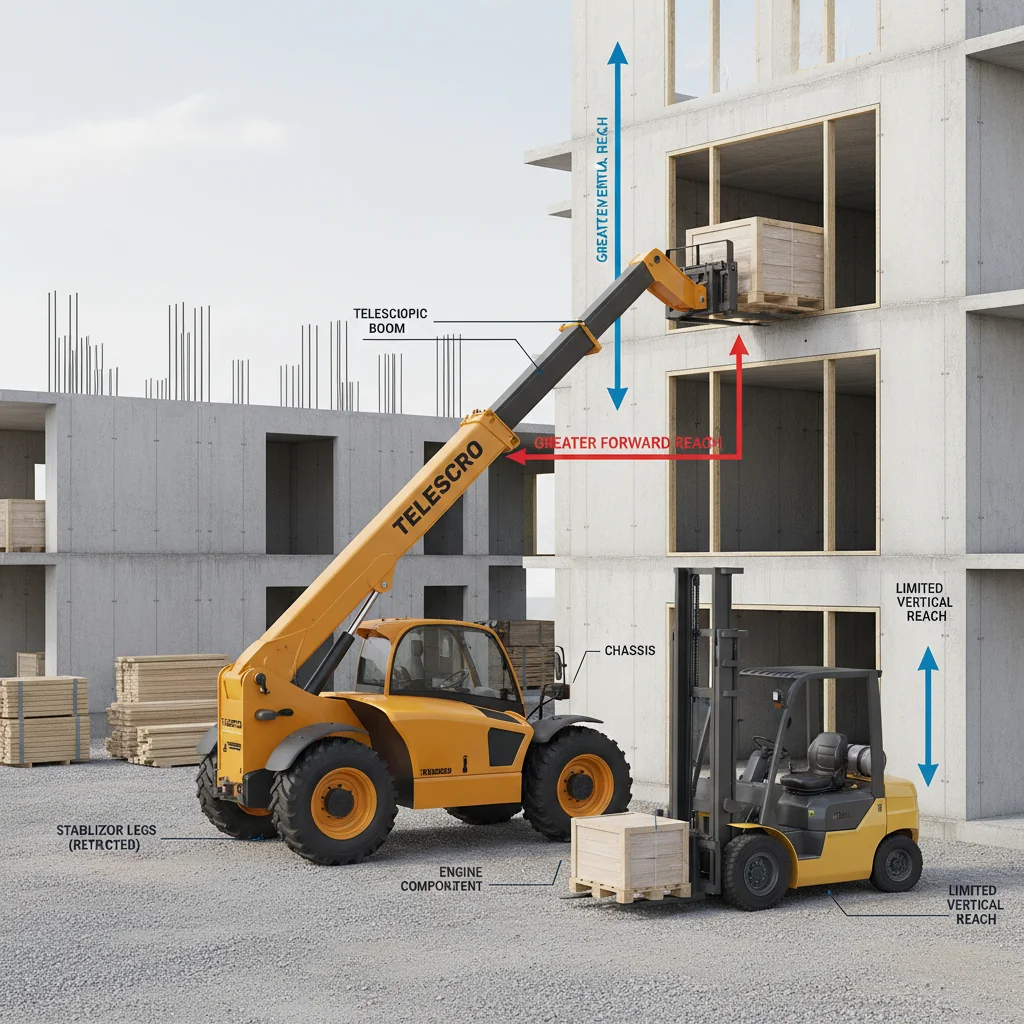
Let me share something important about when telehandlers truly deliver productivity gains. It’s not just about lifting heavy loads, but how efficiently you move those materials both up and across the site. Think about a renovation project I supported in Dubai. The crew regularly had to get drywall and HVAC units to the fifth floor—over 14 meters up—with no tower crane and limited ground access. Manual lifting would have taken a small army, and a standard forklift couldn’t reach. With a 3.5-ton telehandler rated for 15 meters, they parked at a single gate and supplied materials directly to multiple floors and two building façades. This move cut their crew waiting time3 noticeably—by roughly a third in their own tracking—and cycle times dropped enough that the general contractor noticed a clear difference by the end of the first week.
I’ve also seen similar results in tight industrial yards in Europe, where space is always at a premium. Telehandlers allow higher stacking of pallets, loading semi-trucks from just one side, or even sliding heavy panels into deep storage rows—tasks that would take double the time (and more labor) with conventional forklifts. It’s not just about raw lifting power; the real advantage is how flexibly you can position materials exactly where they’re needed, using the boom and hydraulics. Mapping the site’s “hot zones”—like laydown areas, congested gates, or spots where a tower crane can’t reach—lets site managers use telehandlers as efficiency multipliers.
I always suggest tracking task cycle times before and after bringing in a telehandler. That’s how you make the benefits visible and adjust work patterns for even more savings.
Telehandlers equipped with boom reach over 14 meters can significantly reduce reliance on temporary scaffolding in many multi-story material placement tasks.True
Advanced telehandlers can access upper floors directly, reducing the time and labor spent on erecting and dismantling scaffolding, which is particularly beneficial on sites with height constraints or restricted ground access.
Telehandlers are most productive on sites where all materials can be accessed and delivered from a single fixed location.False
Telehandlers are designed for versatility and mobility. They are most productive when materials must be transported to multiple, hard-to-reach locations across a dynamic site, rather than operating from a single spot like a stationary crane.
Key takeaway: Telehandlers add the most value in material handling scenarios with complex reach requirements, enabling efficient vertical and horizontal movement. Strategic stationing at chokepoints and mapping task frequencies allow buyers to maximize productivity gains and objectively validate improvements by tracking site cycle times before and after telehandler deployment.
Where Do Telehandlers Outperform Forklifts Off-Road?
Rough-terrain telehandlers4 feature large tires, higher ground clearance, and oscillating axles5, allowing them to operate effectively on mud, gravel, or unfinished surfaces where conventional forklifts become liabilities. Advanced steering options, such as four-wheel and crab steering, enable precise placement in confined spaces near scaffolds or between materials, delivering superior off-road versatility.
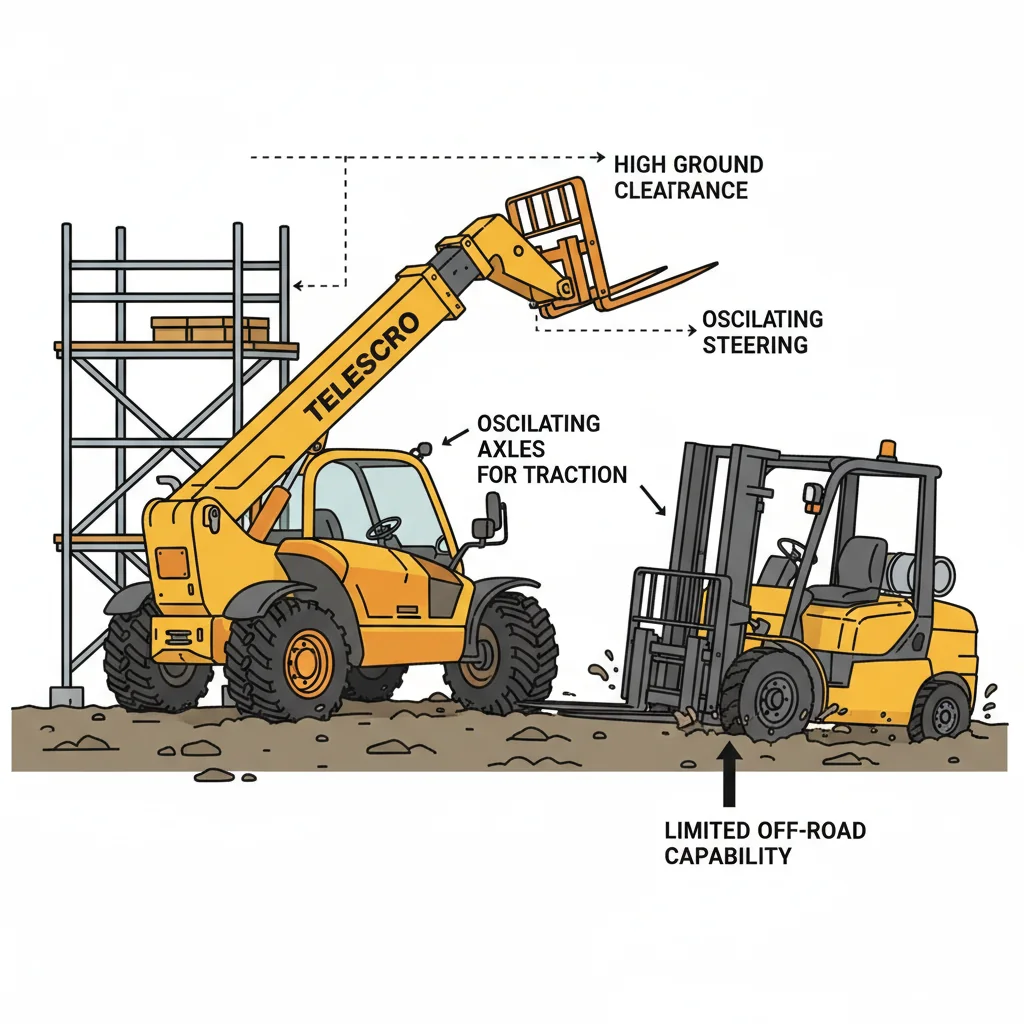
Here’s what matters most when you leave paved surfaces behind—traditional forklifts just aren’t designed for real jobsite conditions. I’ve seen this on dozens of construction sites in Indonesia and Eastern Europe. Regular forklifts struggle as soon as you have mud, wet gravel, or even just compacted rebar mesh on the ground. One contractor in Kazakhstan tried using a 5-ton forklift to offload roofing sheets, only to sink axle-deep after the morning rain. They lost nearly half a shift pulling the machine out—while the telehandler kept working.
Telehandlers are purposely built for these unpredictable surfaces. Large, agricultural-style tires and higher ground clearance (usually 350–420 mm) let them roll over potholes and soft ground where forklifts get stuck. Oscillating axles allow the wheels to adjust independently, so all tires stay in contact with uneven terrain. From my experience, a standard 3.5-ton rough-terrain telehandler can handle jobsite ruts and subgrades that put a 4-ton industrial forklift out of action completely.
Another key advantage is steering. Most telehandlers have three steering modes including four-wheel and crab steering, making tight turns in congested areas effortless. I’ve watched a team in Dubai use a rotating telehandler (RTO) to place heavy glass panels on a high-rise—working right beside scaffolding, reaching behind obstacles, and saving at least two full days compared to repositioning a forklift over and over.
If you’re dealing with unfinished surfaces or tight logistics, I suggest walking your site and looking for worn tracks or access bottlenecks. That’s often where a telehandler pays for itself quickly—by keeping your project moving, not spinning its wheels.
Telehandlers with three-mode steering can maneuver loads through confined or uneven terrain much more quickly than standard forklifts, thanks to superior agility and tighter turning capability.True
Three-mode steering (front, four-wheel, and crab) gives telehandlers far superior agility on unpredictable ground, allowing material delivery and placement operations to proceed more efficiently in off-road environments where forklifts struggle or become immobilized.
Telehandlers equipped with pneumatic tires provide no traction advantage over forklifts when working on wet, loose soil.False
Telehandlers typically use large, deeply treaded pneumatic tires that significantly improve flotation and traction on loose or muddy surfaces, unlike forklifts, which often use smooth, solid tires that sink or slip easily in such conditions.
Key takeaway: Telehandlers are specifically engineered for challenging off-road environments, handling uneven ground and tight construction sites far better than standard forklifts. Their terrain-adapted design and advanced maneuverability often eliminate the need for extensive road preparation or site grading, streamlining operations and reducing surface damage.
How Do Telehandlers Support Crane Operations?
Telehandlers complement cranes by efficiently handling everyday material movements and staging, bridging the gap between manual handling and crane lifts. Their mobility allows direct workface delivery, quick stabilization, and routine distribution, while cranes focus on heavy, complex, or high lifts. Joint planning maximizes productivity and reduces idle crane rental time6.
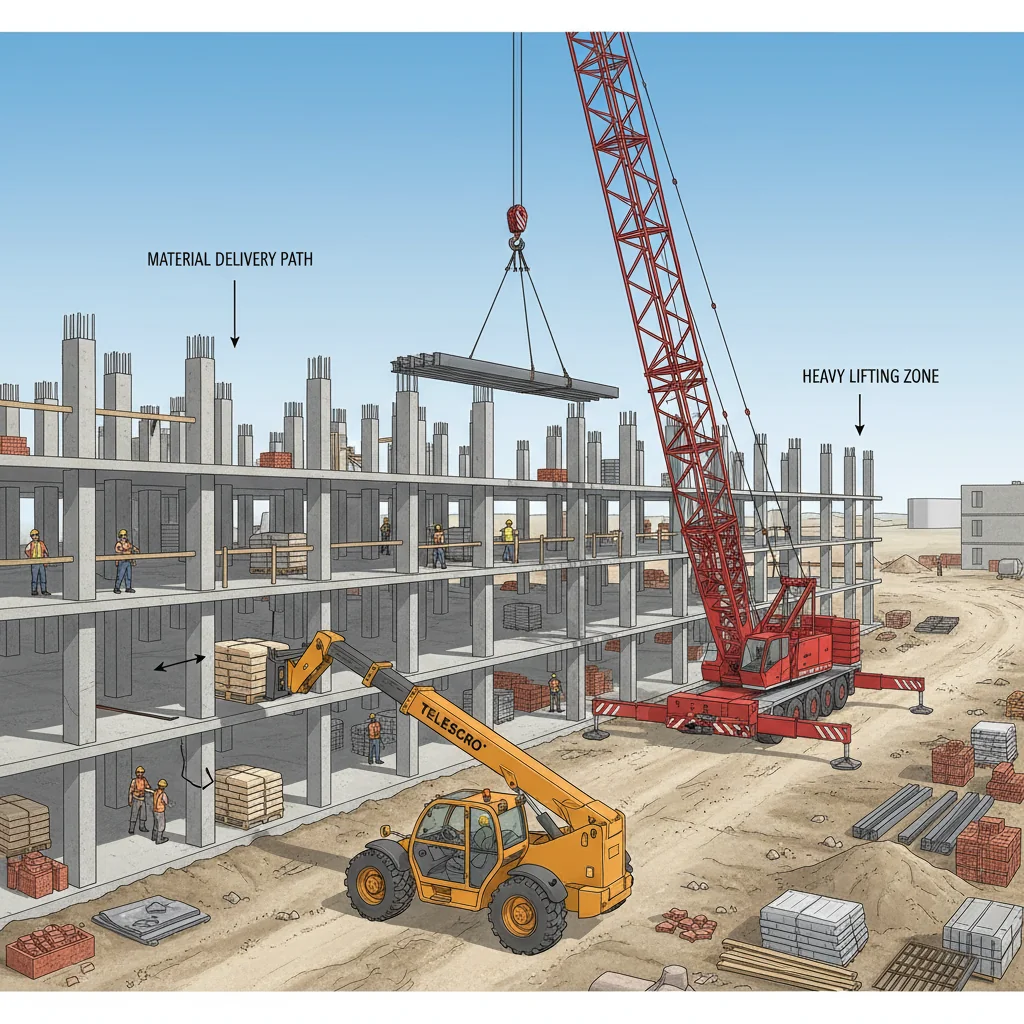
The biggest mistake I see is assuming telehandlers can replace a crane altogether. They can’t—but they absolutely make crane work faster and less expensive when you use both together. For example, on a project in Dubai last year, the crew had limited laydown space and paid high crane rental rates by the hour. The site manager pre-staged loads of rebar and drywall with a 4-ton telehandler, placing pallets right at each floor opening. That meant when the crane came online, it focused only on those big, critical picks—heavy HVAC units and steel trusses that a telehandler can’t safely lift.
From my experience, keeping a crane crew waiting for materials is where projects lose real money. In Kazakhstan, I watched a job lose at least two full working days because materials weren’t staged. The crane operator just sat idle. A telehandler with 17-meter reach could have kept the flow moving, shuttling materials up to 3,500 kg from the main laydown straight to the installers all day, without constant rigging changes. When you integrate both, you shorten crane hire by a week or more—which really adds up fast at international day rates.
On dense urban sites, rotating telehandlers are a secret weapon. I saw them on a plant shutdown in Singapore: tight site, no room for added tower cranes, but a rotary telehandler parked in the middle distributed loads across a full arc, saving dozens of crane repositionings. My advice? Plan material flow with both machines from the start. Use the telehandler for routine shifts and staging—then let the crane tackle only what nothing else can. It’s efficient and cost-smart.
"TelehandlersFalse
"Hydraulic
Telehandlers are routinely used to lift suspended loads exceeding their stated maximum capacity when assisting cranes on construction sites.False
Exceeding a telehandler's rated lift capacity can cause structural failure or tip-overs. Manufacturers and safety regulations strictly prohibit lifting loads above these limits, even during crane-assisted tasks.
Key takeaway: Telehandlers do not replace cranes but enhance overall material handling efficiency by supporting routine lifts, pre-staging materials, and reducing unnecessary crane picks. Coordinated use shortens crane rental durations and minimizes costly downtime, especially on space-constrained or fast-paced projects requiring flexible material flows.
Why do telehandler attachments matter most?
Attachments define a telehandler’s versatility, enabling a single machine to perform multiple roles—such as lifting pallets, handling bulk materials, light crane tasks, and personnel elevation—by swapping forks, buckets8, jibs, or platforms. The right attachments, specified and managed strategically, maximize fleet utilization while minimizing the need for additional single‑purpose equipment.
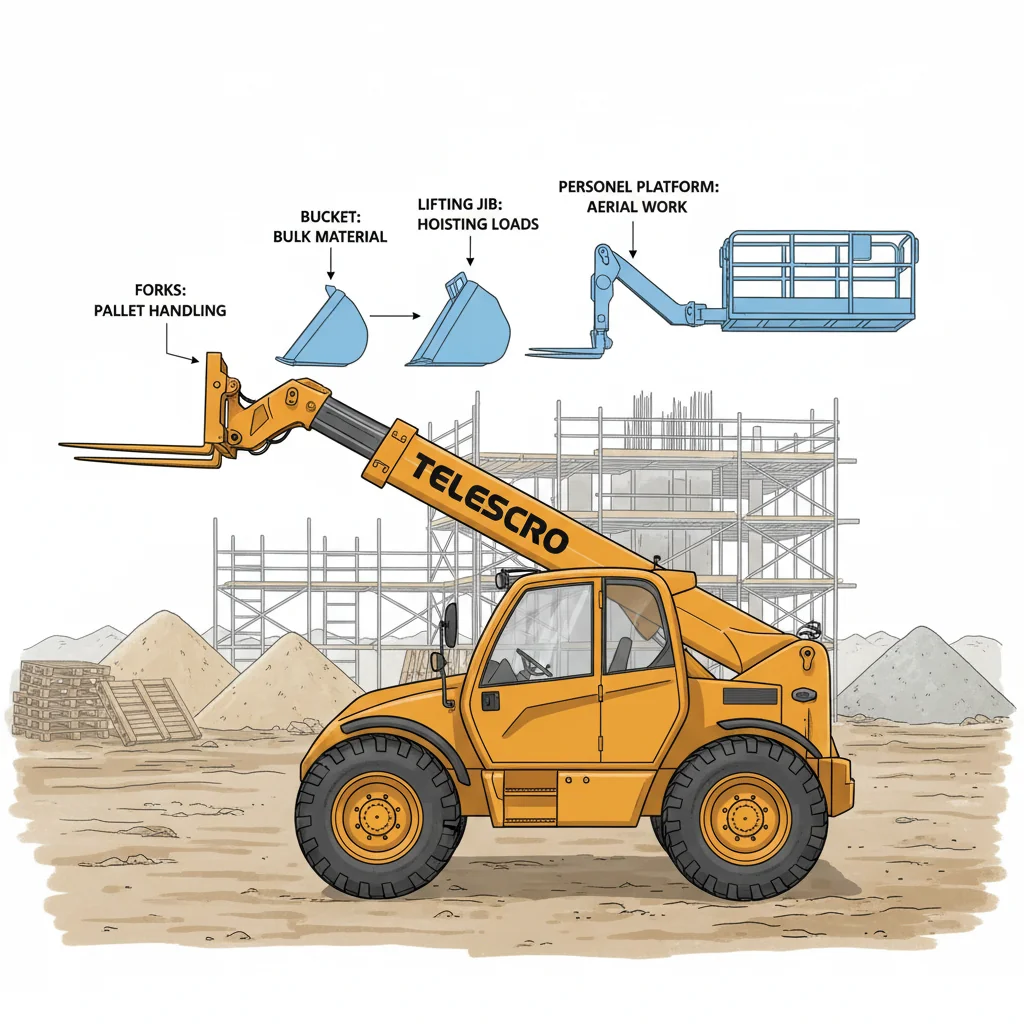
I’ve worked with customers who made the mistake of treating attachments as a minor detail—usually after they run short on jobsite flexibility. In Saudi Arabia, a contractor relied on a 4-ton telehandler but only had pallet forks on-hand. When a sudden need for sand backfilling came up, they lost half a day waiting for a suitable bucket from another site. That delay cost more than the price difference of buying the right bucket up front.
It’s not just about having a machine—it’s what the machine can do, day to day. The right attachments turn a telehandler into a fleet of tools. Here’s how attachments make the difference:
- Pallet forks – move materials on pallets, from bricks to bundled steel, within the rated capacity shown on your load chart.
- Buckets – handle loose bulk like gravel or sand, but always check the attachment’s weight. A loaded bucket often means usable capacity drops by several hundred kilograms.
- Jibs or winches – allow for light crane tasks and hoisting suspended loads in confined spots, often up to 1,500 kg on a standard machine.
- Work platforms – provide safe access for personnel elevation (always verify compliance with local safety codes before lifting people).
- Pipe grabs, bale clamps or rotating heads – these enable specialty tasks without adding extra machines to the site.
Using a telehandler with a dedicated grapple attachment can significantly improve loading efficiency for irregular-shaped materials compared to pallet forks.True
Grapple attachments are specifically engineered to securely grab uneven or loose materials like debris or pipes, substantially reducing handling time and improving safety versus standard forks, which may allow such loads to slip or require multiple attempts.
Telehandler attachment compatibility is universal across all brands as long as the lift capacity is matched.False
Attachment mounting systems and hydraulic connections vary significantly between manufacturers; even with the same rated lift capacity, many attachments will only fit machines with the same quick coupler design and compatible controls, requiring adapters or retrofits otherwise.
Key takeaway: The full value of a telehandler comes from strategic selection and management of attachments. Proper specification, compatibility, and inventory control ensure that telehandlers deliver on their multi-purpose promise, optimizing utilization and reducing operational costs compared to owning several specialized machines.
How Should Telehandlers Be Properly Sized?
Telehandlers should be sized based on recurring job requirements, not just brochure figures. Rated capacity significantly decreases at maximum boom height and reach. Selection must reference load charts9 for real-world lift points, account for machine access constraints, and include a 10–20% safety margin10 to ensure optimal safety and cost-effectiveness.

A few years back, I got a call from a project manager in Dubai who was puzzled why his new 4-ton telehandler struggled to lift 1,200 kg roof trusses at full extension. On paper, the machine looked perfect—4,000 kg sounded more than enough. But what really mattered was the load chart, not the headline figure. When the boom reached out to 16 meters, the safe lifting capacity dropped to around 1,100–1,300 kg. The issue? They matched the machine to maximum rated capacity, without considering how fast that number falls at height and reach.
From my experience, the best approach is mapping out your most frequent tasks. List each job—like lifting 1-ton pallets to 13 meters, or moving smaller loads over a fence from 5 meters away. Go line by line through the load chart for every crucial working point. Most of your real work happens at 70–90% of max extension, not at the base. I always encourage customers to allow a 10–20% safety margin too, in case of unlevel ground, wind, or load misplacement. Remember, rated capacity is only valid with the machine leveled within about 3 degrees—anything steeper, and it drops sharply.
Another common pitfall I see is choosing a larger, “safer” model that looks good on paper but causes headaches. Oversized machines can’t always fit through site gates or turn easily in tight yards, especially in city projects like those in Singapore. Extra size means more fuel, more maintenance, and higher transport costs. I suggest picking the smallest telehandler that covers 90% of jobs, with a solid margin. The right size makes your work safer, cheaper, and far more efficient.
A telehandler's maximum rated capacity is typically only achievable with the boom fully retracted and low to the ground, while capacity can decrease by over 70% at maximum reach.True
Telehandler load charts show that as the boom extends and rises, stability and leverage decrease, drastically reducing safe load limits at maximum extension. Many operators mistakenly select machines based only on headline capacity, not chart performance at working heights and reaches.
If a telehandler is rated for 4,000 kg, it can safely lift that amount regardless of boom length or angle.False
The rated capacity only applies under optimal conditions, with the boom retracted and low. As the boom extends or raises, the leverage on the machine increases and capacity drops significantly. Ignoring this can cause instability or tipping.
Key takeaway: Right-sizing telehandlers means matching machine selection to actual load, height, and reach requirements—never just headline capacities. Reference load charts for specific tasks and real site constraints to select the smallest model that meets 90% of frequent needs with a built-in safety margin.
How Do Telehandlers Improve ROI in Fleets?
Telehandlers boost ROI by combining the functions of rough-terrain forklifts, small cranes, and loaders into a single, highly utilized machine. This consolidation reduces total equipment needs, operator requirements, and mobilization costs. However, buyers should factor in transport, tire wear, and downtime risks when comparing telehandlers to specialized lifting equipment.
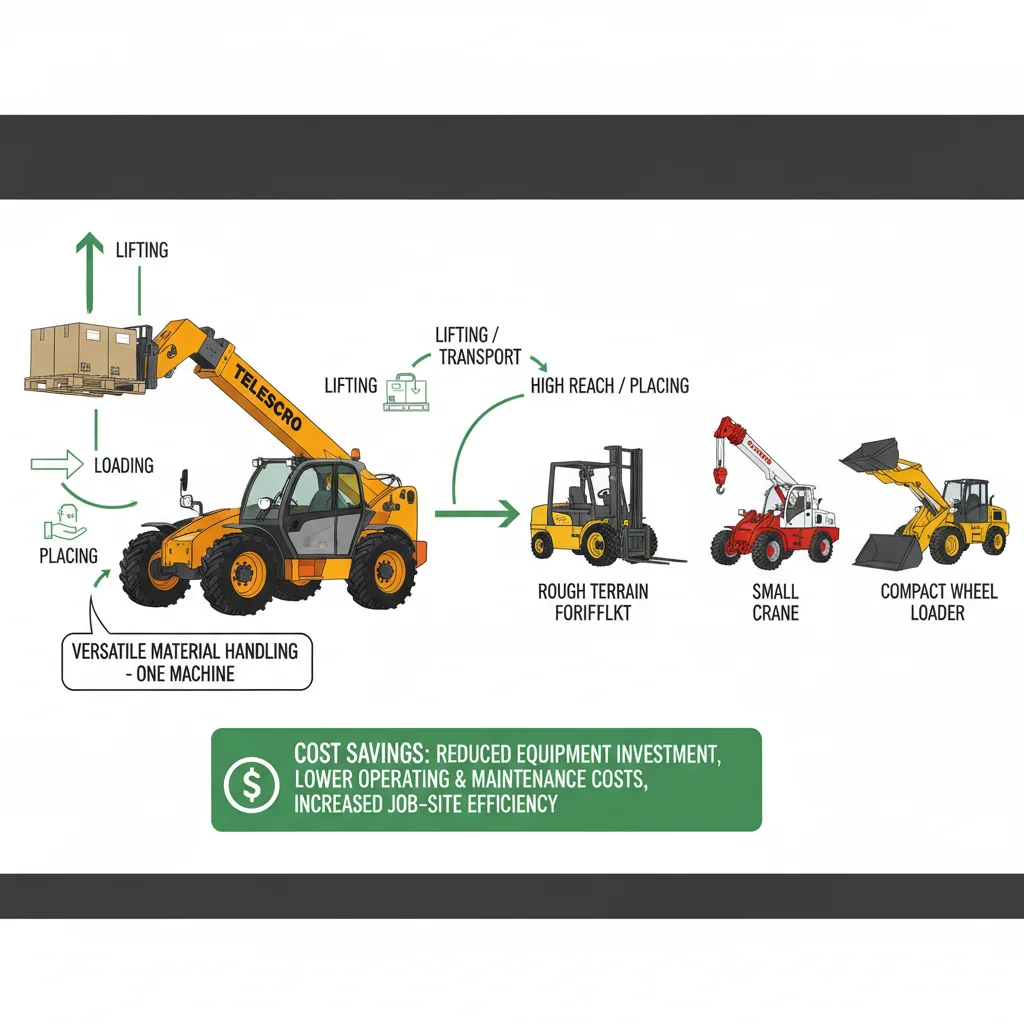
Let me share something important about ROI with telehandlers: the real advantage comes from multi-tasking, not just raw specs. One unit can handle site deliveries like a rough-terrain forklift, lift beams like a small crane, and load rubble into trucks. I’ve watched contractors in Kazakhstan do all that with a single, 4-ton model rated for 17-meter reach. That used to require three different machines and operators. Cutting your fleet by even one machine—plus one operator—over a year saves serious cash on insurance, maintenance, and payroll.
But the reality is, you’ll only see these savings if your telehandler stays busy across departments. In Dubai, a precast factory uses their machines for yard stacking, trailer loading, and site placement. It runs almost every month, not sitting idle like a crane waiting for a big lift. When you log 1,200 to 1,800 hours a year on one machine—compared to 600 or less for a crane—the hourly operating cost11 drops fast, even if your purchase price was higher up front.
Of course, there are hidden traps. Large telehandlers need low-bed trailers and sometimes local permits to move. On paved sites, rough-terrain tires wear down fast—one customer in Brazil replaced all four tires after six months, and that bill stung. And when your “all-in-one” machine fails, everything stops. I always recommend standardizing models, planning a backup (either rental or spare), and counting full lifecycle costs—fuel, tires, transport, and inevitable downtime—before deciding which machines to retire from your fleet.
In the right applications, replacing both a crane and a forklift with a single telehandler can substantially reduce annual fleet operating costs by cutting maintenance, insurance, and staffing expenses.True
Telehandlers' versatility means they can perform tasks typically requiring multiple machines and operators. This consolidation significantly cuts recurring costs like insurance for extra machines, salaries for additional operators, and routine maintenance for redundant equipment.
Telehandlers with a 17-meter reach are designed to safely transport suspended loads while driving at maximum travel speed.False
While telehandlers can lift and move suspended loads, manufacturers and safety standards restrict travel speed when carrying such loads to maintain stability and prevent accidents. Driving at maximum speed with suspended loads is unsafe and not permitted by operational guidelines.
Key takeaway: Telehandlers deliver strong ROI through versatile, year-round utilization across multiple site tasks, making them more cost-effective by reducing fleet size and operator needs. To protect that investment, buyers must calculate all lifecycle costs—including transport and downtime—to avoid budget overruns from hidden expenses.
How Do Telehandlers Enhance Lifting Safety?
Telehandlers improve lifting safety by replacing manual or improvised methods with engineered controls like load moment indicators, load charts, boom angle sensors, stabilizers, and robust frames. These features help prevent tipping and overloading. Safe operation depends on understanding the specific machine’s load chart and ensuring comprehensive operator training.

To be honest, safety features are what separate a well-designed telehandler from risky lifting on site. With manual or improvised lifting, you’re guessing capacity and risking serious accidents. Modern telehandlers use engineered systems like load moment indicators (LMI), boom angle sensors, and hydraulic limiters to watch the actual load and boom position in real time. For example, I worked with a team in Dubai handling 2,000 kg HVAC units to the 10th floor of an office build. Their 4-ton telehandler had sensors that gave an in-cab warning if the boom got too flat or the load approached chart limits—far better than watching for “signs” of instability.
Last year in Brazil, a customer asked me if they could skip using stabilizers to save time. That’s a mistake I hear often. Not all telehandlers have stabilizers, but when they do, you must follow what’s on the manufacturer’s load chart—never any shortcut formula. The load chart shows “on tyres” and “on stabilizers” limits for every extension and angle. I’ve seen lifts where partial stabilizer deployment (allowed as “short-jacking” in the load chart) made the difference between a safe pick and a near-miss. The risk of tipping climbs fast as you extend the boom, especially over soft ground or a side slope.
Proper operator training adds a final layer of safety. Too many sites only train for forklifts and overlook the telehandler’s risks—like boom swing and capacity drops at long reach. I always recommend thorough training for every operator. Safe lifting isn’t about luck; it’s about using every engineered safeguard, reading the chart, and matching the approach to real jobsite conditions.
Telehandlers equipped with load moment indicators (LMI) can automatically lock out boom extension functions when the load approaches 95% of rated capacity.True
LMI systems actively monitor both the load and boom position, and will restrict further unsafe movements as limits are approached to prevent tip-over incidents, providing a critical safeguard beyond operator judgment alone.
Telehandlers with stabilizers can safely lift loads that exceed the manufacturer’s maximum rated lifting capacity by up to 20%.False
Stabilizers improve stability on uneven ground but never increase the maximum rated capacity set by the manufacturer; exceeding rated loads can cause structural failure or tip-overs regardless of stabilizer use.
Key takeaway: Telehandlers provide engineered solutions and critical safety systems that minimize the risk of tip‑overs and overloading, but effectiveness depends on reading the load chart, using machine features correctly, and delivering proper operator training—never generic shortcuts or formulas.
When Are High‑Capacity Telehandlers Justified?
High-capacity telehandlers (10–30+ tons) are justified when material handling requires frequent lifting and transporting of heavy components, such as in precast, mining, or industrial maintenance. Their unique advantage is site mobility with extreme loads, sometimes replacing multiple machines. Quantifying repeated heavy tasks determines if ownership is cost-effective versus renting or using cranes.
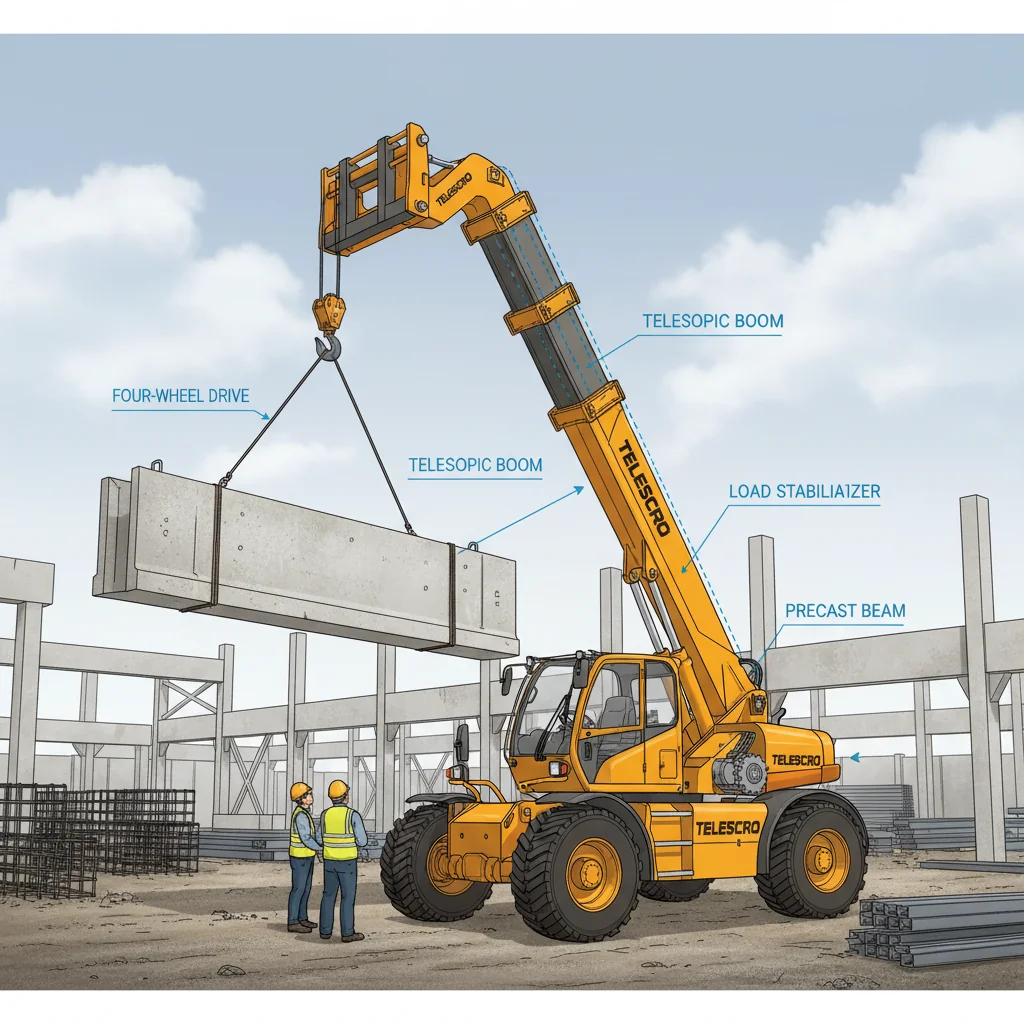
To be honest, the spec that actually matters is how often you’re really pushing the limits of heavy lifting on site. I’ve had large contractors in Dubai call about high-capacity telehandlers—machines rated for 10 to 25 tons—asking if ownership is worth it. The answer comes down to whether your daily work involves repeated moves of massive components. For example, in a precast concrete yard, operators might shift 12-ton wall panels from laydown to install zones every hour. In this scenario, a high-capacity telehandler moves faster across rough ground than a crane, and one machine might replace two or three standard units.
Last year, I worked with a mining firm in Kazakhstan facing daily transport of crusher housings, each weighing close to 15 tons. They measured the average distance—about 100 meters between storage and the processing line—plus the frequency of moves, which could hit 40 times per week. After factoring in crane rental costs, extra labor for rigging, and site congestion, it made sense to invest in a dedicated 15-ton telehandler. In six months, the savings in time and operator hours covered most of the purchase price. But if you’re only handling extreme weights once a month, that same machine can become a headache—higher upfront cost, special transport permits, more parking space needed.
I always recommend tracking your actual heavy lift cycles: list load weights, typical travel paths, and how often big moves really happen. If these intense jobs are daily or weekly, ownership gives you control and speed. If not, stick with rentals or a crane—it’ll keep your capital working smarter.
A high-capacity telehandler rated for 15 tons or more often features multi-stage boom designs that provide greater outreach at full rated load compared to standard models.True
High-capacity telehandlers are engineered with heavier-duty, multi-section booms and robust counterweights, enabling them to extend heavy loads farther without tipping, which is essential for lifting bulky materials like precast panels or structural steel beams.
High-capacity telehandlers are typically more fuel efficient than their lower-capacity counterparts due to larger engine displacement.False
In reality, high-capacity telehandlers generally consume more fuel because their larger engines and hydraulic systems are designed for heavier workloads, not for efficiency. Larger displacement increases power but does not inherently improve fuel economy.
Key takeaway: High-capacity telehandlers are best justified when daily operations demand moving very heavy loads across a site. Carefully quantify load weights, travel distances, and frequency to assess cost-effectiveness. Occasional heavy moves may be better served by rentals or cranes to avoid unnecessary capital outlay.
How do telehandlers boost storage efficiency?
Telehandlers optimize yard and storage utilization by reaching vertical and hard-to-access spaces12 that conventional forklifts cannot safely handle. Their telescopic boom enables stacking pallets or irregular loads higher and deeper, maximizing storage within the same footprint and improving efficiency in tight or congested industrial environments.

Last month, a contractor in Dubai asked me how they could handle bulky steel pipe racks stacking up in a crowded yard. Their old forklift maxed out at a 3-meter lift, but their storage needed to go vertical—fast. A 4-ton telehandler with a 14-meter boom made all the difference. The operator started stacking loads nearly three times higher right next to the perimeter fence, opening up working lanes and freeing valuable space. Being able to reach over other stored materials meant they didn’t need to reorganize the entire yard each week. That’s efficiency you feel on day one.
From my experience, the real advantage is how telehandlers exploit those hard-to-reach spots—tucking pallets deep into racks or placing irregular-sized equipment into otherwise wasted tight corners. In Kazakhstan, I watched a mining supplier use a telehandler to load pallets of spare parts five rows deep against a wall. No conventional forklift could reach those positions without extra wide aisles. The result? They delayed plans for a new warehouse by two years just by improving their storage method.
But here’s what matters most: don’t just chase the highest stacking number on the brochure. Telehandler rated capacity drops fast as you extend the boom. Check the load chart at full outreach and set safe stacking heights that match the real working weight. I always suggest marking approach lanes and aisle widths—clear visual guides make it easier for the operator to place loads accurately without bumping other materials or getting off balance. Careful planning unlocks every square meter and keeps both people and goods safe.
Telehandlers equipped with side-shift carriages can precisely reposition heavy loads up to 150 mm without moving the base machine, allowing denser and safer material stacking in tight storage areas.True
Side-shift carriages let operators make lateral adjustments to the load position even at height, reducing the need to reposition the entire telehandler. This enables more accurate placement of bulky material (like pipe racks or pallets) in confined spaces, improving yard density and reducing the risk of material damage.
Telehandlers are limited to stacking materials only at ground level due to their stability requirements.False
Telehandlers are specifically designed to elevate and stack materials at significant heights—often over 10 meters—thanks to their telescopic boom and stabilizer features. Modern telehandlers are engineered for stability when lifting and placing loads high, making them ideal for vertical storage, unlike conventional forklifts.
Key takeaway: Telehandlers enable buyers to maximize site storage by stacking materials higher and deeper using telescopic reach. Proper planning—such as defining safe stack heights and marking approach aisles—is critical to harnessing their full benefits while maintaining safety and material integrity.
How Do Maintenance and Sustainability Affect Telehandlers?
Consistent telehandler maintenance13—including timely greasing, regular fluid checks, and thorough inspection of boom sections and hydraulic components—is essential for maximizing service life, often allowing well-maintained machines to operate well beyond 8,000 hours in suitable applications. Sustainability advances such as electric and hybrid models14 also help reduce onsite emissions and noise, which is increasingly important for regulated environments and urban projects.
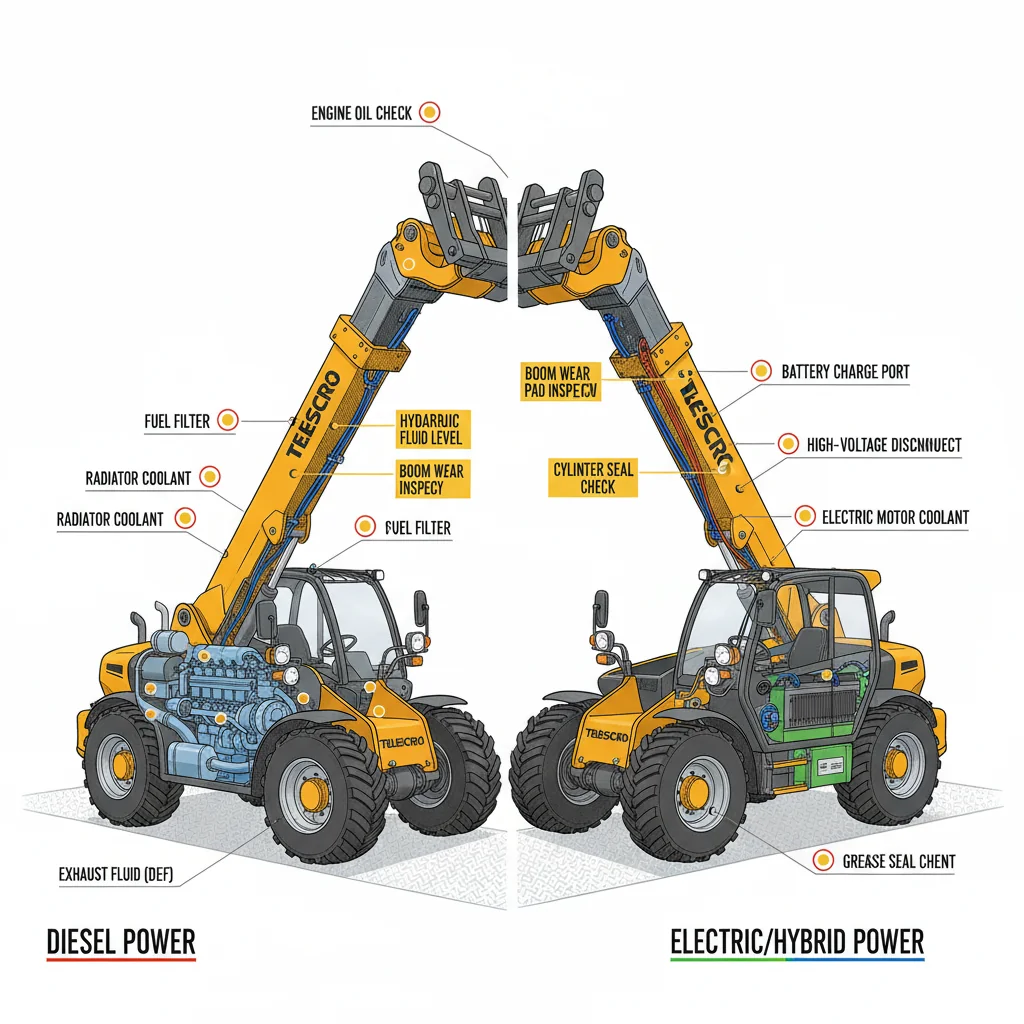
From my experience, the single most important factor for keeping a telehandler productive over ten years isn’t the brand—it’s consistent, detailed maintenance. I’ve seen customers in Kazakhstan run 4-ton, 13-meter units to nearly 12,000 hours because they didn’t just skip over greasing boom sections or inspecting boom pads. They followed their OEM schedules—engine oil around every 500 hours, hydraulic oil and filters typically at 1,000 or more, and regular checks on wear pads, chains, and hydraulic hoses.
If someone ignores pivot pin greasing or waits too long to change axle oil, I can almost guarantee early bushing wear or tire issues. And those problems don’t just cost time—they can shorten total service life and push operating costs noticeably higher over the machine’s life.
I remember a site in Brazil where poorly kept steering joints led to tire replacements twice within one season. That crew also missed early warning signs in their hydraulic circuit—sluggish lift, higher oil temps—just because daily checks were skipped. Small steps add up: keeping boom chains tensioned, staying on top of fluid schedules, and using telematics data as a guide (not a substitute for hands-on inspection) really pays off in uptime.
The shift toward sustainability is changing fleet planning, especially in urban or indoor projects across Europe. Electric and hybrid telehandlers can cut onsite noise and emissions significantly, making them the only practical option for night work or jobs inside warehouses. But I always tell buyers—think about your duty cycles.
Telehandlers with neglected boom pad maintenance can experience significantly faster boom wear compared to units maintained per OEM scheduleTrue
Boom pads reduce friction and absorb lateral forces as the boom is extended and retracted. Without regular inspection and replacement, worn pads allow increased clearance and potential metal-on-metal contact, accelerating structural wear and affecting lift precision.
Switching telehandlers from mineral to synthetic hydraulic oil always doubles hydraulic system service intervals regardless of manufacturer recommendationsFalse
While synthetic hydraulic oils may offer improved resistance to breakdown at high temperatures, service intervals should always follow the manufacturer's directions. Factors like seal compatibility and system design prevent universal doubling of service intervals.
Key takeaway: Effective maintenance—aligned with OEM schedules—directly impacts telehandler longevity, cost of ownership, and operational uptime. Sustainability upgrades, like electric or hybrid drivetrains, not only reduce emissions and noise but also meet increasing regulatory demands on construction sites and indoor or urban material handling operations.
Conclusion
We’ve talked about how telehandlers combine the best of forklifts, cranes, and loaders to make material handling more efficient. Their value really shows on sites where flexibility and quick placement matter.
From what I’ve seen, smart buyers look beyond just the lift height or price tag. I always tell customers to double-check the load chart at real working positions and ask about parts availability. Otherwise, you risk falling into “parts roulette” down the road—a headache I’ve seen too many times.
If you want a practical comparison for your own jobsite, or have questions about the right specs and attachments, feel free to reach out. I’m happy to share what’s actually worked for crews in the field. The right telehandler choice depends on the realities of your site.
References
-
Understand the benefits of rough-terrain travel capability for navigating complex job sites without equipment downtime. ↩
-
Explore how telescopic booms enhance reach and load placement versatility, crucial for efficient construction handling. ↩
-
Understand the impact of lowering crew waiting time on project efficiency and how telehandlers contribute to faster cycle times. ↩
-
Learn why rough-terrain telehandlers outperform forklifts on mud and gravel with features like large tires and high ground clearance. ↩
-
Explore how oscillating axles help maintain tire contact on uneven terrain, enhancing telehandler stability and traction in rough conditions. ↩
-
Explore expert insights on optimizing crane rental costs by integrating telehandlers for efficient material staging and faster lifts. ↩
-
Explore how pallet forks enhance material handling efficiency on jobsites and optimize telehandler load capacity management. ↩
-
Understand how bucket weight impacts usable telehandler load capacity and how to choose the right bucket for bulk materials. ↩
-
Explore how load charts determine safe lifting capacities at different boom heights and why they are critical for equipment sizing. ↩
-
Understand the necessity of a 10-20% safety margin to accommodate uneven ground, wind, and load misplacement for safer operations. ↩
-
Understand how high utilization reduces hourly operating costs, with data on telehandler usage vs cranes, helping optimize fleet expenses. ↩
-
Details telehandlers’ advantages in reaching difficult areas forklifts cannot, improving yard utilization and reducing reorganization needs. ↩
-
Explore detailed maintenance schedules and their impact on telehandler longevity and cost savings with real-world case studies. ↩
-
Understand how electric and hybrid telehandlers reduce emissions and noise, crucial for urban projects and regulated worksites. ↩