










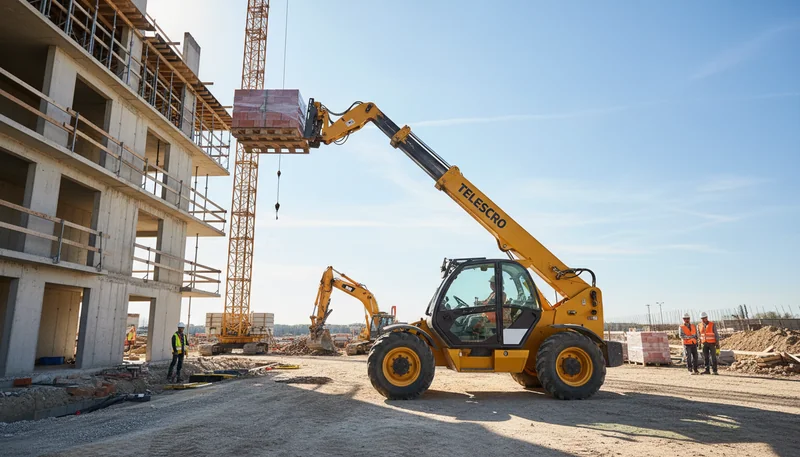
When Does Telehandler Rated Capacity Actually Apply? Field-Tested Insights
Last month, a client in Australia nearly overloaded his “4-ton” telehandler while unloading steel beams at full reach—despite trusting the brochure rating. Situations like this happen every week, usually when real-world conditions don’t match the lab-perfect scenarios manufacturers use for their test results.
A telehandler’s headline rated capacity (nameplate/brochure) is valid only within the OEM load-chart assumptions—typically with the boom retracted, an approved attachment, a specified load center, and the machine on firm, level ground in serviceable condition. As reach/height increases, or when attachments, ground conditions, or machine condition vary, allowable capacity can drop sharply—often to ~25–50% at full reach, depending on model and configuration.
When Does Telehandler Rated Capacity Apply?
Telehandler rated capacity is valid only within the assumptions stated by the manufacturer and shown on the OEM load chart—typically with the boom fully retracted, an approved attachment at a specified load center (commonly 500–600 mm or 24 in), and the machine positioned on firm, level ground in serviceable condition. Any deviation—such as increased reach or height, attachment changes, or uneven/soft ground—reduces the allowable lifting capacity.
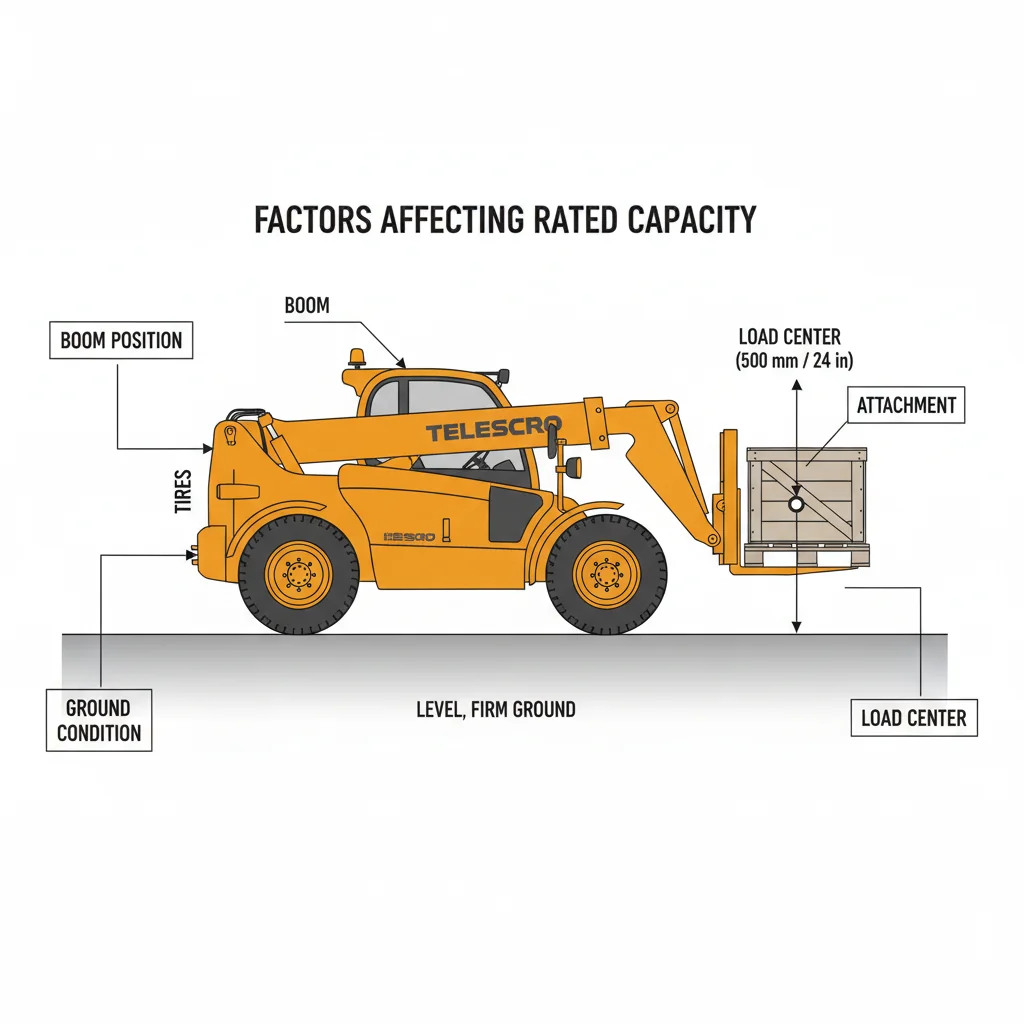
Most people don’t realize that the rated capacity shown on a telehandler’s nameplate reflects a best-case configuration, not a universal lifting limit. Manufacturers determine this headline rating under defined conditions—typically with the boom fully retracted, an approved standard attachment, and a specified load center as stated on the load chart.
I’ve seen jobsite crews in Dubai get into trouble by assuming a 4,000 kg machine could handle that weight at any boom position. Once you actually run the numbers on the load chart, the picture changes quickly. As forward reach increases toward the machine’s maximum working envelope—often around the 12 m class depending on model—the allowable load can fall well below the nameplate rating. On many machines, that means capacities closer to 1,500 kg, and sometimes less, particularly when ground conditions are less than ideal.
Here’s what matters most. As soon as you raise the boom, extend it forward, swap for a heavier attachment, or operate on a slope, your actual safe capacity drops—sometimes to less than half the nameplate. In Kazakhstan, a client called after an incident where their 3.5-ton telehandler tipped moving a pallet of bricks on a 5° incline. The operator never checked the load chart1, which—according to EN 1459 standards—assumes a level machine. The machine was simply outside its safe limits.
Load chart details are the real answer. That chart shows how much you can safely lift at each reach and height. From my experience, never trust the sticker on the boom alone. Check the load chart for your exact attachment and working conditions. If your site isn’t flat or you’re using a bucket instead of forks, I suggest derating your expectation and treating the nameplate as just a starting point.
Telehandler rated capacity is only valid when the boom is fully retracted, at its lowest angle, and with a standard attachment, such as forks, set to the manufacturer's specified load center.True
The rated capacity on a telehandler’s nameplate is determined under controlled conditions where the boom is fully retracted and low to the ground, using a standard attachment and load center—any deviation, such as extending the boom or changing attachments, reduces the safe capacity.
A telehandler can safely lift its nameplate rated capacity at any boom extension and elevation angle, regardless of attachment type.False
The rated capacity only applies in specific conditions; extending the boom, raising it to higher angles, or using non-standard attachments dramatically reduces the machine's safe lifting capacity and stability.
Key takeaway: Telehandler rated capacity is valid only under tightly controlled, ‘best-case’ conditions as specified in standards like EN 1459 or ANSI/ITSDF B56.6. Real-world operating variables—such as boom position, attachment changes, machine wear, and ground slope—mean actual safe working capacity is almost always less. Always consult the machine’s load chart.
How Do Telehandler Load Charts Define Capacity?
Telehandler load charts define rated capacity across different height and reach combinations, not as a single fixed figure. The chart grids or zones show maximum allowable loads for each boom position, with reach measured from the front tire edge to the load center. Load chart accuracy requires referencing boom angle, reach, height, and specific attachment.

Let me share something important about telehandler load charts—they’re not just a “capacity sticker” on the machine. The chart is a full grid, translating that single rated capacity number into a range of safe loads at every boom height2 and forward reach.
I’ve seen new buyers in Dubai assume that a 4-ton telehandler can handle 4,000 kg anywhere. In practice, once you move toward maximum forward reach—often around the 12–13 m class depending on the model—the allowable load can drop to a fraction of the headline rating. On some machines, that means little more than 1,000–1,500 kg. You only see that gap by studying the actual load chart, not the brochure headline.
Each load chart is laid out as a grid. The vertical axis shows lift height, while the horizontal axis shows forward reach, typically measured from the front tire to the load center of the forks or attachment (as defined in the chart legend). In use, you identify your intended working point—height and reach—then read the corresponding box to find the maximum permitted load for that position.
Most load charts divide the operating envelope into defined zones (often labeled A, B, C, and D), each with its own maximum permitted load. On machines equipped with stabilizers or outriggers, manufacturers typically provide separate load charts for different configurations—such as “on tyres” and “on stabilizers”—with capacity limits that vary according to the selected setup.
Here’s what really matters when using these charts: the values are based on the OEM’s stated assumptions—an approved attachment, a defined load center (commonly 500–600 mm in many EN/CE charts or 24 in in North American charts), and the machine positioned on firm, level ground. Change any of those factors—extend the boom further, raise the load higher, switch attachments, increase the load center, or work on uneven or soft ground—and the allowable capacity drops accordingly.
The rated capacity shown on a telehandler’s data plate is valid only within the configuration and assumptions defined by the manufacturer and shown on the OEM load chart—typically with the boom fully retracted, an approved attachment, a specified load center, and the machine positioned on firm, level ground.True
Telehandler rated capacity represents the most favorable stability condition defined by the OEM. Load charts assume a specific configuration—such as boom retracted, approved attachment and load center, and level ground. Where stabilizers or outriggers are fitted, separate load charts apply depending on whether the machine is set up on tyres or on stabilizers. Any change in configuration reduces allowable capacity.
Telehandlers can safely lift their rated maximum capacity at any boom extension or angle as long as the engine is running and the load is well balanced.False
Boom extension and angle drastically affect lifting stability—extending the boom increases leverage and reduces the maximum safe load, regardless of engine status or balance. Safe capacity is greatly decreased as reach increases, which is always indicated on the load chart.
Key takeaway: Telehandler rated capacity only applies when interpreting the OEM load chart3 for specific boom position, reach, load center, and attachment. The highest capacity is at minimum reach; exceeding rated grid zones—even with lighter loads—risks overload or tip-over. Always reference the exact load chart, not just brochure numbers.
When Does Rated Capacity Actually Apply?
Telehandler rated capacity only applies at minimum reach and specified load center, with the machine on level ground. As boom reach or load center increases, actual capacity drops sharply due to increased tipping risk. Always use the OEM load chart to check capacity at real-world reach and load center.
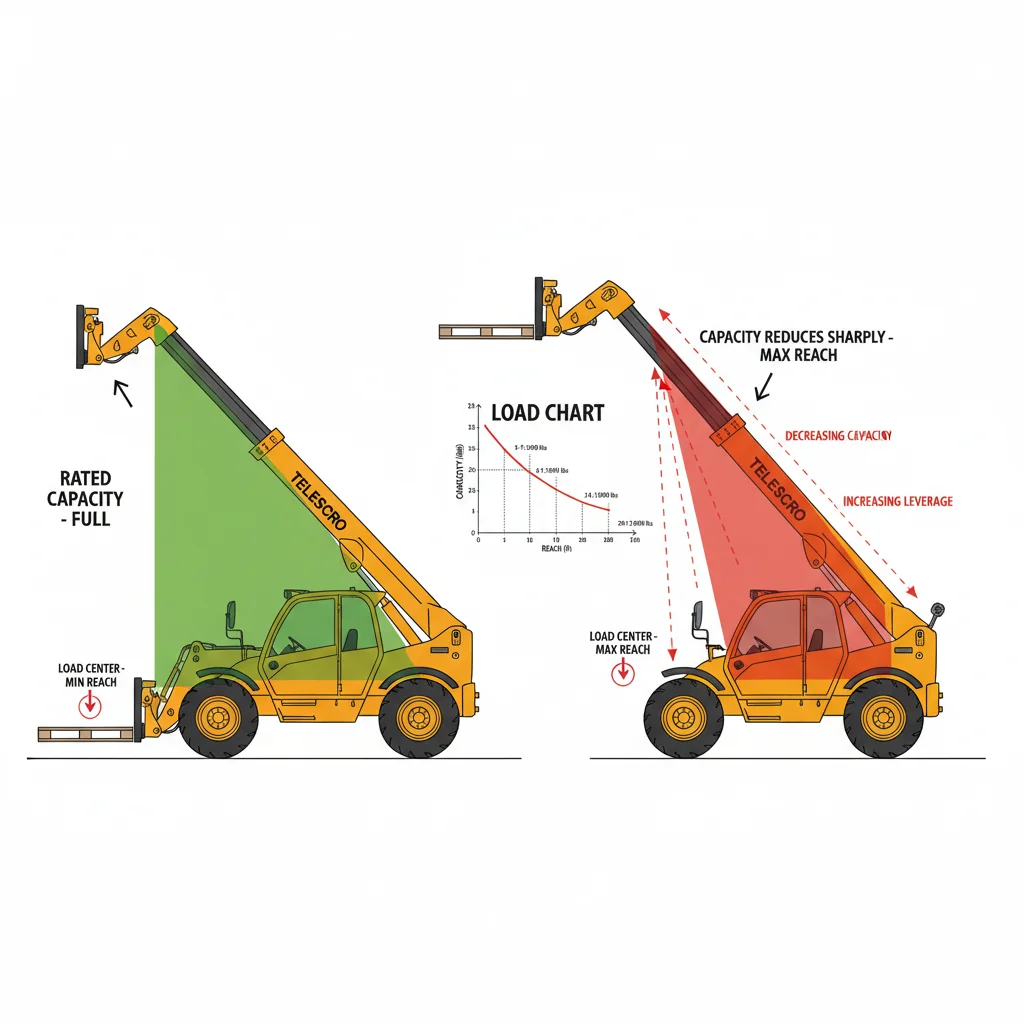
The biggest mistake I see is contractors assuming that rated capacity always means safe lifting at any boom position. That’s not how it works. The headline rated capacity is valid only within the configuration defined by the manufacturer and shown on the OEM load chart—typically with the boom fully retracted, an approved attachment, a specified load center (often around 500–600 mm from the fork face), and the machine positioned on firm, level ground.
Once you extend the boom or move the load further forward, the usable capacity drops quickly. I had a client in Brazil who bought a 4-ton-class telehandler to place 3-ton brick pallets on a multi-storey project. They assumed the machine would lift those loads “all the way up” without checking the load chart. In reality, at around 11 meters of forward reach, the chart only permitted roughly 1,800–2,000 kg—well short of their 3-ton requirement. The machine itself wasn’t the problem; the assumption was.
Here’s what matters most when deciding whether a lift is safe: always start with the OEM load chart. It shows, for every combination of reach and height, what the machine is actually allowed to handle. There are no shortcuts—headline tonnage in a brochure doesn’t tell you what happens at working reach.
The reason is simple physics. As the boom extends, the load moves farther away from the front axle, increasing leverage and reducing stability. The effect is amplified when the load center grows. I saw this again with an agricultural contractor in Argentina handling large bales with an effective load center of around 800 mm on a machine rated at 3,000 kg with a 500 mm load center. They called me after the stability indicator started warning at what looked like “half capacity” on paper—but according to the load chart, the machine was already close to its limit.
Rated capacity only applies when the boom is fully retracted, the load is at the specified load center, and the machine is level within a small tolerance.True
Telehandler rated capacities are established under laboratory conditions: boom fully retracted, specific load center (commonly 500–600 mm from the fork face), and level ground—any deviation from these factors reduces the safe lifting capacity.
A telehandler's rated capacity can be used as a safe maximum at any boom extension, as long as the load is properly secured.False
Once the boom is extended or a load is moved further out, the machine's lifting capacity decreases rapidly due to increased leverage and instability, regardless of how securely the load is attached.
Key takeaway: Rated capacity refers to a telehandler’s maximum load at minimum reach, standard load center, and level ground. Extended reach or larger load centers greatly reduce allowable capacity. Contractors must consult the specific load chart for each operation—never rely on headline tonnage ratings alone.
How Do Attachments Affect Rated Capacity?
Telehandler rated capacity assumes standard pallet forks. Any attachment, such as buckets, jibs, or extensions, increases weight and load center distance4, reducing usable capacity and potentially altering stability category. Manufacturers provide attachment-specific load charts, making it essential to verify actual capacity for each attachment—not rely on the base machine rating.
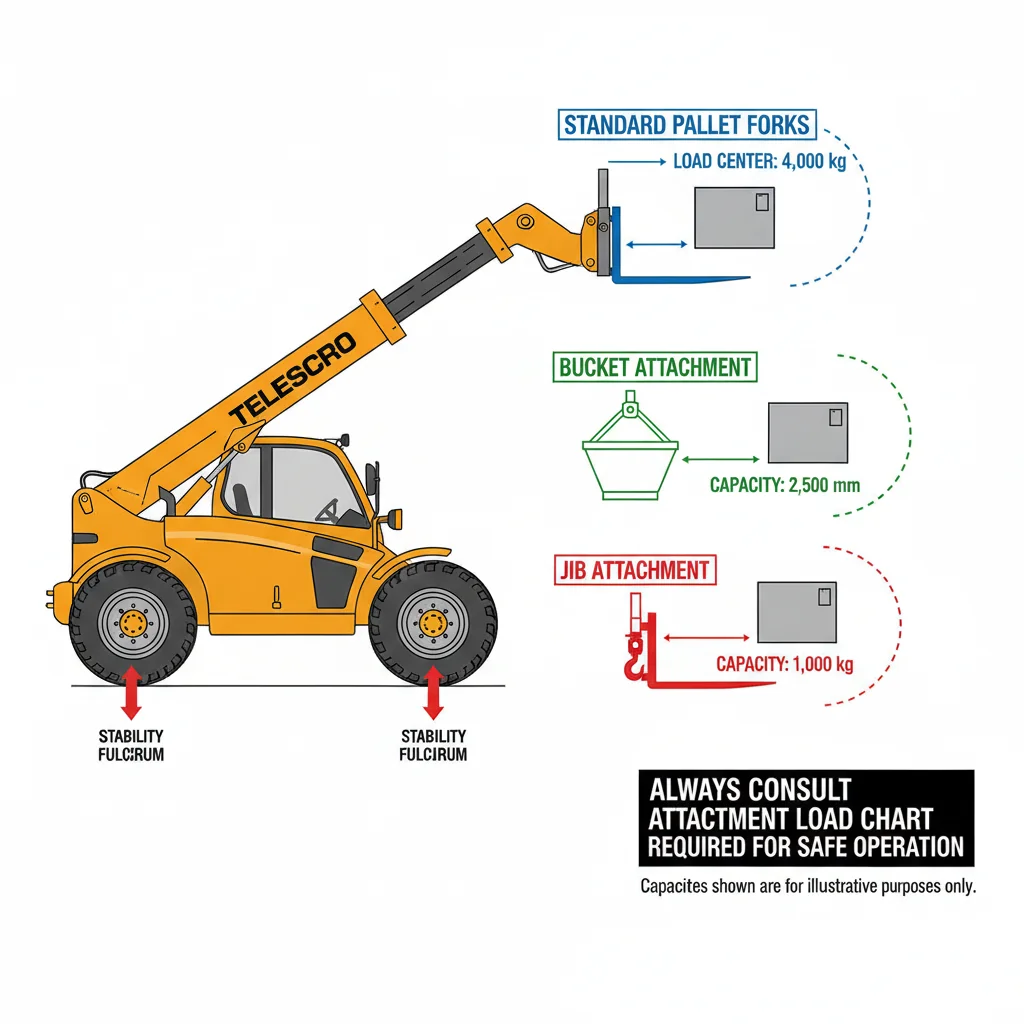
To be honest, the spec that actually matters is the rated capacity with the exact attachment you’ll be using—not just what’s printed on the machine’s nameplate. The base rated capacity always assumes standard pallet forks, which are light and keep the load close to the carriage. The moment you fit a bucket, jib, or fork extension, you add extra weight and push the load center further out. That’s when capacity drops—and sometimes by a lot.
Let me break this down. I’ve seen a 4-ton telehandler in Dubai drop to just over 2.5 tons capacity at the same boom position with a crane jib attached. Last year, a customer in Poland tried a 2-meter fork extension. The load center increased so much that the safe lift went down almost 40%. The machine didn’t feel overloaded, but the moment indicator showed reduced stability—one wrong move could tip the whole unit.
Common attachments that impact rated capacity include:
- Material buckets – heavier and move load further out
- Crane jibs and hooks – shift loads to a longer radius
- Work platforms (man baskets) – change both weight and permitted use
- Fork extensions and brick grabs – stretch the load center beyond standard
Manufacturers publish separate load charts for each approved attachment. Always check the chart specific to your configuration—never just assume the base rating. Using non-OEM-approved or improvised attachments can invalidate the applicable load chart assumptions and may create compliance and insurance issues. Always obtain the correct attachment-approved load chart and documentation.
The rated capacity listed on a telehandler's nameplate only applies when using the standard pallet forks, not other attachments.True
This is true because manufacturers calculate the base rated capacity assuming the standard forks, which are lightweight and hold loads close to the machine, whereas other attachments alter the load center and add weight, reducing rated capacity.
All telehandler attachments, regardless of type or size, have no significant effect on the rated capacity of the machine.False
This is false because attachments like buckets, jibs, or long extensions add weight and change the load center, which significantly reduces the maximum safe lifting capacity compared to standard forks.
Key takeaway: Telehandler rated capacity varies significantly with attachments. Always consult the manufacturer’s load charts for each specific attachment to avoid overloading, ensure legal compliance, and maintain site safety. The nameplate capacity only applies with standard forks—other attachments frequently reduce usable lifting capacity.
When Does Rated Capacity Actually Apply (Continued)?
Telehandler rated capacity applies only when all OEM-specified conditions are met: level, firm ground (typically ≤3° tilt), correct attachment, and defined load center. Soft or sloping surfaces, inadequate stabilizer pads, or excessive wind require significant capacity reductions. Load chart values5 represent best-case scenarios and must not be used on uneven terrain without adjustment.
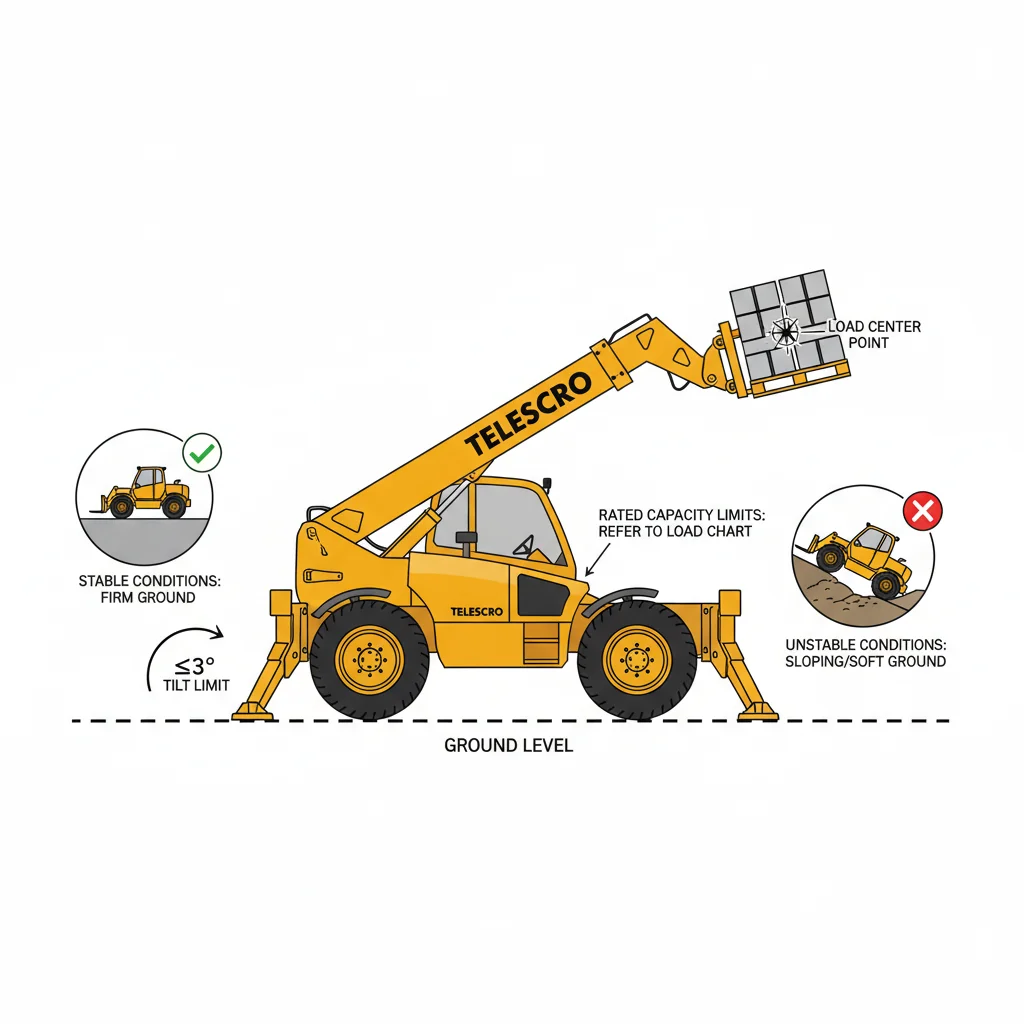
I’ve worked with customers who made this mistake—assuming rated capacity always applies, no matter where the telehandler sits. One example stands out: a project in Kazakhstan using a 4-ton, 13-meter unit to unload steel bundles near a foundation. The ground looked flat, but mud and small slope put the machine at over 4° tilt. The operator tried lifting 3,800 kg, thinking he was under the capacity. The machine’s sensors cut off boom movement part way up—that’s the electronic safety stepping in. But not all models can detect risk early, especially older units. If they’d ignored the warning, they easily could have tipped or sunk a wheel.
Here’s what matters most when you’re planning lifting operations: load chart values are built around perfect, level, compacted ground and the exact attachment listed—like standard forks with a defined load center, usually noted in the chart as “500 mm” or “600 mm.” On soft subsoil or gravel, ground pressure6 under each wheel really matters. If you have a wheel supporting 5,000 kg, but your pad area is too small, you’ll exceed 20,000 kg/m² and risk sinking—capacity means nothing if the machine isn’t stable.
I always suggest using only 60–70% of the load chart values in rough conditions or wind. A slight 5° side slope can reduce tipping margin dramatically. That’s why most manufacturers say “rated capacity = level (≤3° tilt)” and show higher values “on stabilizers,” but only if you’re on solid, well-supported ground. Never trust showroom specs in real-world mud or incline. Always check the load chart for your actual setup—then adjust down for risk.
Telehandler rated capacity only applies when the machine is on firm, level ground within manufacturer-specified tolerances.True
Rated capacity is calculated assuming ideal conditions. Any deviation—like sloped or unstable ground—reduces the safe lifting ability, even if the load weight appears within limits.
If a telehandler stays under its rated load, it can operate at full performance regardless of ground conditions.False
Ground conditions such as uneven surfaces or slopes impact machine stability and load chart validity, meaning rated capacity does not always apply—even below the maximum listed weight.
Key takeaway: Telehandler rated capacity is based on ideal, level ground conditions with specified attachments and load centers. Any deviation—such as sloping, uneven, or soft ground—requires significant capacity reduction. For safety, always consult the load chart and apply OEM-recommended adjustments in marginal field conditions.
When Must Telehandler Rated Capacity Systems Be Checked?
Electronic load monitoring systems, such as Rated Capacity Indicators (RCI) and Load Moment Indicators (LMI), rely on boom position, angle, and hydraulic sensing to assess stability. Their accuracy depends on proper maintenance and periodic verification in line with OEM requirements, as sensor drift7 or mechanical wear can otherwise compromise rated-capacity indications.

Here’s what matters most when keeping your telehandler rated capacity system safe: regular checks and calibration, not just box-ticking on service sheets. The rated capacity indicators (RCI) and load moment indicators (LMI) depend on boom angle, length, and hydraulic pressure sensors. If any of those go out of calibration, the readout can become meaningless—or worse, give you false confidence. I’ve seen a jobsite in Dubai where sensor drift meant the LMI was off by almost 500 kg after a year. The operator thought he was under capacity, but the machine was actually right on the stability limit. That’s a serious safety blind spot.
Manufacturers and industry standards both call for annual LMI/RCI system checks. This isn’t just a rule on paper—real machines experience sensor drift, wear in boom pads, and hydraulic leaks as the months add up. One contractor in Kazakhstan skipped their calibration for nearly two years on a 4-ton telehandler. When they finally tested, readings at maximum extension were off by over 10%. On a boom stretched out to 16 meters, that difference could be the line between a safe lift and a near tip-over. I always recommend checking load monitoring systems at least once per year, but after a hard season, do it even sooner.
Regular electronic checks must go hand in hand with structural inspections. If your boom pads are worn, the carriage bolts are loose, or tires are underinflated, your load chart isn’t valid—even if the display says you’re safe. My advice: treat annual LMI/RCI verification and a full machine inspection as non-negotiable, especially if you’re lifting anything close to chart limits.
Telehandler rated capacity systems must be checked and recalibrated whenever hydraulic components are replaced or adjusted, since sensor readings can be affected by changes in hydraulic pressure or component performance.True
Hydraulic pressure sensors play a major role in telehandler load monitoring systems. Any modification, repair, or replacement of hydraulic components may shift system pressures and render previous calibrations inaccurate, so recalibration is necessary to maintain accurate rated capacity readings.
Once a telehandler’s rated capacity system is calibrated at the factory, it does not require further checks unless there is a clear malfunction.False
In reality, regular checks and recalibrations are essential because sensors can drift over time or due to everyday usage. Environmental factors and gradual wear can cause rated capacity readouts to become inaccurate even without obvious signs of malfunction.
Key takeaway: Telehandler rated capacity and load monitoring electronics must be regularly calibrated and the machine maintained to specification. Failures in calibration, sensor accuracy, or structural integrity can invalidate the rated capacity, leading to unsafe lifts or false security. Annual electronic and structural checks are essential.
When Does Telehandler Rated Capacity Apply (Continued)?
Telehandler rated capacity only applies under manufacturer-specified test conditions: level ground (typically ≤3°), defined load center, specified attachment, and as shown on the machine’s exact load chart. Real-world sizing must account for maximum required reach, load dimensions, and ground conditions, as actual usable capacity may be significantly less than the rated value.
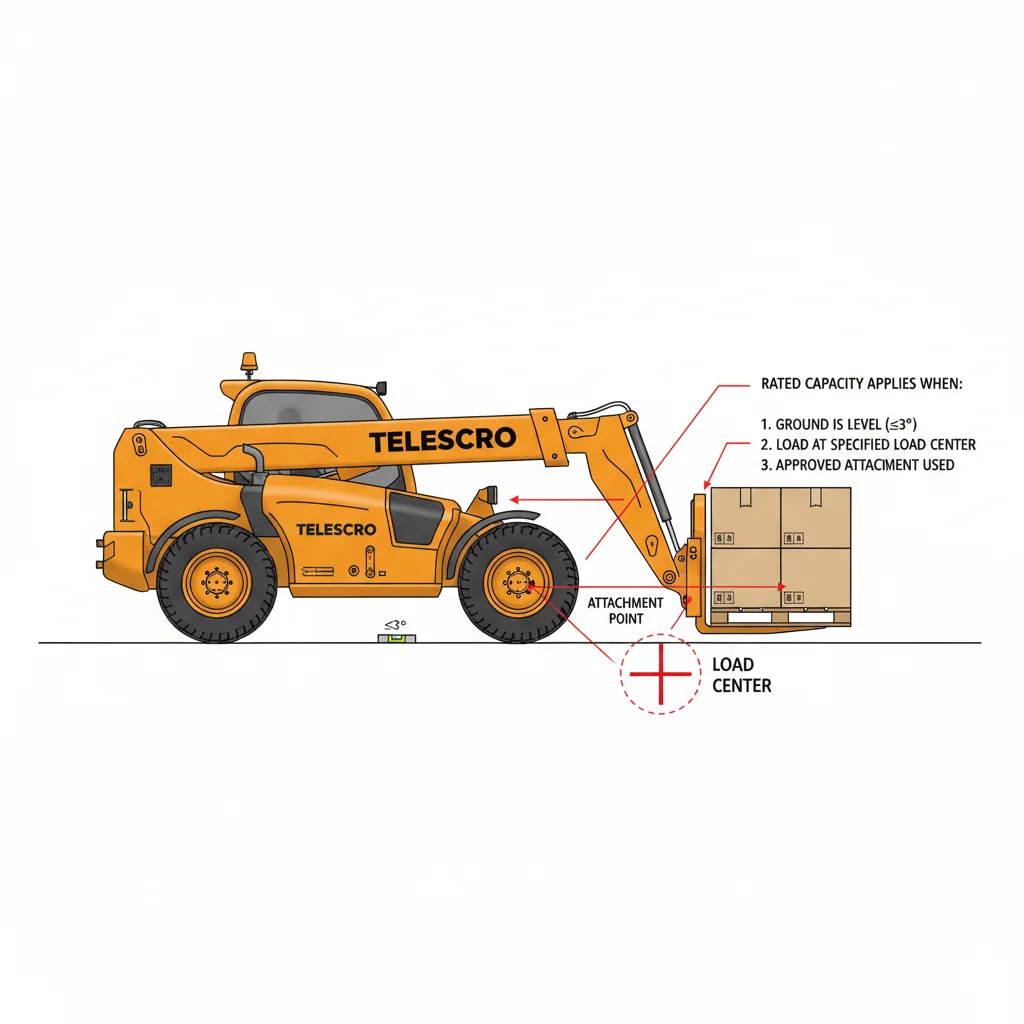
Last month, a contractor in Dubai asked me why their 4-ton telehandler couldn’t safely place a 2,200 kg pallet at maximum reach. Their site was tight, the ground slightly sloped, and the task needed the full boom extension. The answer is simple: the rated capacity is only valid under strict, level conditions—usually less than 3 degrees of tilt, using the standard fork, and set at a specific load center called out on the load chart. At full outreach, that same “4-ton” machine might only handle 1,200 kg safely, and any slope shrinks that further.
From my experience, buyers often fixate on the spec sheet or the model’s nameplate, but that number can be misleading. The only way to size a telehandler reliably is to take your most challenging lift—the farthest reach, largest load center, trickiest ground—and see where that point lands on the actual load chart. If your load is even close to the chart’s edge, that’s a warning sign. Most fleet managers I know plan for working at 80–85% of the load chart to build in a real safety margin. On uneven job sites, it’s smarter to aim lower.
I’ve seen projects in Kenya stall because planners believed a 3-ton class unit would do the job, only to split pallets or scramble for another machine halfway through. Undersizing creates double handling or costly delays. It’s usually better to go up just one size class, even if that means higher purchase or rental cost. The extra margin often pays for itself in saved labor and fewer headaches.
Telehandler rated capacity assumes the machine is on level ground with less than 3 degrees of tilt, using standard forks and a specific load center as shown on the load chart.True
Manufacturers determine rated capacity under controlled, level conditions to ensure safety and predictability. Any deviation, such as using different attachments, operating on a slope, or changing the load center, can drastically affect the actual capacity and stability.
A telehandler’s rated capacity remains the same regardless of how far the boom is extended or the slope of the terrain.False
The rated capacity decreases significantly as the boom is extended or when operating on a slope. Both increased boom extension and uneven ground shift the center of gravity, reducing the machine’s safe lifting ability and increasing the risk of tipping.
Key takeaway: Telehandler rated capacity is not a universal number—it reflects ideal lab conditions and strict configuration requirements per the load chart. Field operators must validate lifting needs based on the toughest task, model-specific charts, and actual worksite conditions to avoid under- or oversizing.
When Does Telehandler Rated Capacity Apply (Part 3)?
Telehandler rated capacity only applies under manufacturer-specified conditions: level ground, defined attachment, stated load center, and precise reach. Actual usable capacity can differ sharply on site due to load size, reach, slope, and attachment choices. Always confirm suitability by mapping real tasks onto the official load chart before procurement.
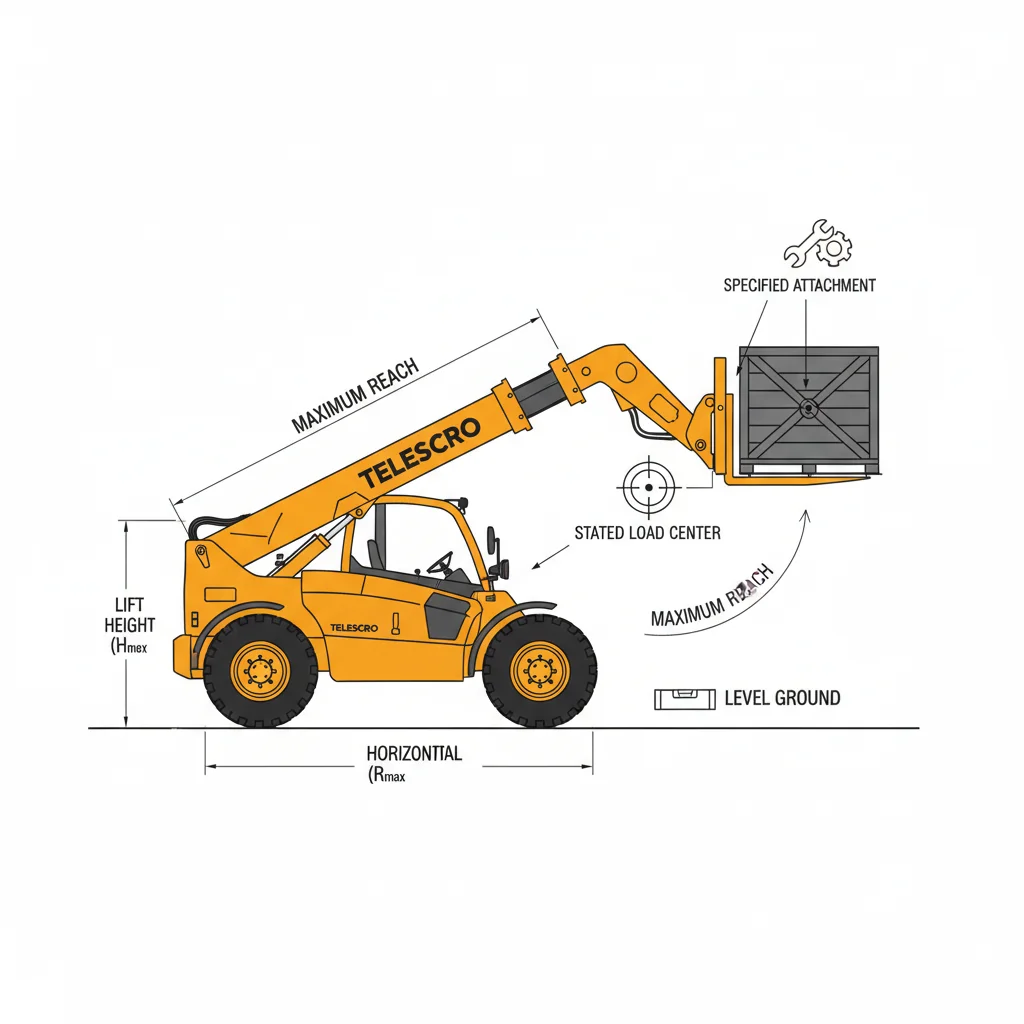
One question I get all the time: “Can this 4-ton telehandler actually lift 4 tons at my jobsite?” The reality is, rated capacity only counts when the machine is sitting level—usually no more than 3° of tilt—on solid ground, with the precise attachment and load center the OEM uses for testing. I’ve seen customers in Australia run into trouble because their 4-ton unit could only legally lift about 2,000 kg once they extended the boom 10 meters out across the slab. The spec sheet didn’t warn them—only the load chart told the real story.
Real jobsite loads aren’t perfect cubes. Pallet size, attachment type, even a slightly longer load center can cut your usable capacity fast. For example, I worked with a team in Morocco lifting packed insulation with a wide bucket attachment. Load width increased the center of gravity—suddenly, at the same boom extension, capacity dropped by almost 30% compared to the basic forks. Slope is another killer. Even a mild 6° slope—barely noticeable—takes you outside the rated envelope. The load chart applies only if you level the machine first, either with frame leveling or, if available, stabilizers.
Before you rent or buy, I suggest building a simple “lift matrix” for your key tasks. Write down each needed load, the weight, dimensions, attachment, reach, and ground condition. Ask your dealer to trace these points on the official load chart. This step takes 20 minutes, but it instantly shows if that machine can handle your real loads—or just showroom numbers. It’s the best way to avoid nasty surprises when you start work.
Telehandler rated capacity is only valid when the machine is on level ground, typically within 3 degrees of tilt, and using the manufacturer-specified attachment and load center.True
Manufacturers test rated capacity under controlled conditions—level ground, specific attachments, and precise load placement—so in real jobsite scenarios with uneven ground or different attachments, actual lift capacity can be significantly less.
As long as you do not exceed the telehandler’s published maximum capacity, you can safely lift that weight at any boom extension or angle.False
Telehandler rated capacities decrease as the boom extends or changes angle. The maximum published capacity only applies with the boom fully retracted and at minimal height. Trying to lift the maximum capacity with the boom extended can overload the machine and is not safe.
Key takeaway: Rated capacity figures are valid only when the telehandler is in a level, stable configuration with the exact attachment, load center, and reach defined by the OEM. Always use a detailed lift matrix and load chart review to verify safe operational margins for real-world jobs.
When Is Telehandler Rated Capacity Valid?
Telehandler rated capacity applies only for manufacturer-specified configurations, such as pallet handling with approved forks on level ground. When using work platforms or man baskets, separate load charts and ratings must be used. Improvised platforms (like cages or pallets on forks) are not recognized, making rated capacity invalid for safety and liability.
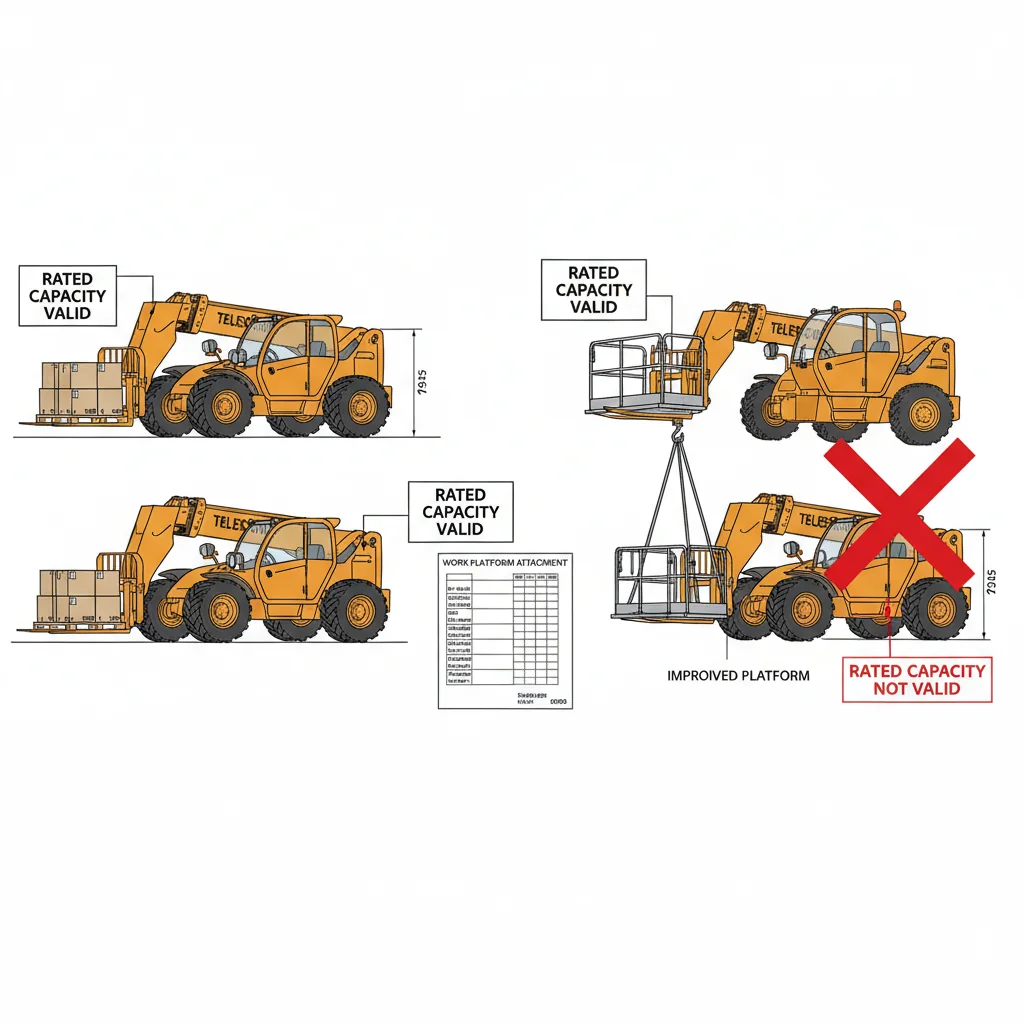
A lot of customers assume the telehandler’s rated capacity covers every situation, but this can lead to serious issues on real jobsites. I had a construction firm in Kazakhstan call me after an inspection — they’d lifted people with a pallet on forks, thinking the machine’s 3,000 kg rating would protect them if anything went wrong. The inspector didn’t see it that way. Once you swap out forks for a platform or man basket, the standard rated capacity isn’t valid anymore. Each approved work platform8 has its own load chart, factoring in the weight of the platform, people, tools, and materials—usually dropping the safe working load far below what the machine would handle for pallets.
Here’s why this difference matters. OEMs test telehandlers for stability only under very specific conditions—level ground, approved forks, standard load center. If you change the attachment or operate on a slope greater than about 3°, you leave that controlled envelope. Rated capacity assumes the machine is perfectly level and the boom is loaded as specified. In some places, like Australia, using a man basket triggers extra requirements: registered attachments, special EWP training, and much stricter wind limits. I’ve seen projects stop abruptly because someone improvised with a cage “to save time”—but insurance and the law don’t care about convenience.
So, what’s my advice? Stick to manufacturer-approved platforms with their matching charts, and treat personnel lifting as a separate plan, never an add-on. If you use anything unapproved, your rated capacity becomes invalid, and you accept all the liability. For most contractors, that’s simply not worth the risk.
A telehandler's rated capacity is only valid when using the original forks and with the boom fully retracted, as most load charts are based on this configuration.True
The rated capacity is determined under specific test conditions with the standard attachment (usually forks) and the boom retracted. Using different attachments or extending the boom changes the machine’s center of gravity and leverage, requiring new load ratings.
As long as you stay under the machine’s rated capacity, you can safely lift any type of load, regardless of the attachment or boom position.False
Telehandler capacity ratings are not universal for all configurations. Attachments like work platforms or extending the boom can drastically decrease capacity, and using the standard rating in these scenarios can cause dangerous overloading.
Key takeaway: Telehandler rated capacity is valid only under manufacturer-approved conditions—usually with forks and on level ground. For personnel lifting, always use platforms with OEM ratings and load charts. Unapproved attachments or improvised platforms void rated capacity, increase risk, and leave the operator fully liable.
Conclusion
We’ve looked at how telehandler rated capacity is really just a starting point—the actual safe lifting limits depend on real jobsite factors, not just the sticker specs. From my experience, the folks who run into trouble are the ones who trust showroom numbers without checking the load chart for their real working positions. I always suggest looking at the chart at your typical boom angles and factoring in attachments or worn pins. Want a detailed comparison or have questions about your specific setup? I’ve helped customers across 20 countries solve these same headaches, so feel free to reach out—no pressure. Every site is different—focus on what truly fits your workflow.
References
-
Learn how to interpret telehandler load charts to determine safe load limits based on reach, ground conditions, and attachment used. ↩
-
Learn how checking safe loads by boom height prevents overloads and accidents, ensuring safer telehandler use on construction sites. ↩
-
Details how to read OEM load charts for real-world lifts, ensuring safety by accurately assessing capacity at varying boom reaches and angles. ↩
-
Explains how increasing load center distance with attachments changes stability and lowers the telehandler’s usable lifting capacity. ↩
-
Detailed explanation of load chart values in telehandlers helps operators understand safe lifting limits based on conditions and attachments. ↩
-
Explores how ground pressure influences stability and sinking risk when lifting heavy loads on subsoil or gravel ground conditions. ↩
-
Learn about the risks of sensor drift in telehandlers and why regular calibration is crucial for accurate load readings and safe operation. ↩
-
Clarifies the safety requirements and manufacturer guidelines for using approved work platforms with telehandlers. ↩