










When Does Hydraulic Wear Reduce Telehandler Performance? Field Warning Signs
Not long ago, a site manager in Brazil told me his telehandler was starting to “lag” on big lifts, even though it had just crossed 3,000 hours. His frustration was obvious—the machine still moved, but crews were losing valuable time waiting on a “lazy” boom. That single complaint is often the sign hydraulic wear is beginning to bite.
Hydraulic wear in telehandlers develops as internal leakage and friction increase within pumps, valves, and lift cylinders, causing a gradual loss of volumetric efficiency1. As internal leakage rises with wear, more hydraulic oil bypasses inside components instead of producing useful cylinder movement, leading to slower boom response and reduced cycle speed under load—especially when performance begins to deviate measurably from the model’s OEM specifications.
When Does Hydraulic Wear Impact Telehandlers?
Hydraulic wear begins to affect telehandler performance as internal leakage and friction increase in pumps, valves, or cylinders. As volumetric efficiency declines, operators may notice sluggish boom response, weaker crowd force, and higher throttle demand to achieve the same functions. In heavy-duty or high-cycle applications, these warning signs can emerge relatively early, depending on duty cycle, maintenance quality, and operating conditions.

Most people don’t realize hydraulic wear sneaks up on telehandlers long before there’s a breakdown. I’ve seen this on jobsites in Dubai and Germany—machines with 3,000 hours on the clock still “working,” but operators start to complain. The first signs aren’t leaks on the ground or flashing warning lights. Instead, the boom becomes noticeably slower. Operators might have to push the throttle much higher for the same crowd function, or it takes a few extra seconds to fully extend.
In one case last year, a rental company in Brazil ran a fleet of 4-ton telehandlers at concrete sites. By around 2,500 hours, their crews noticed a 20% drop in cycle speed. We checked the pump’s volumetric efficiency—down to about 82%. At that point, the machine still lifted to rated height, but actual productivity suffered. It’s not just an operator comfort thing. A slow boom or weak crowd can mean missing a tight lift schedule or risking safety if loads start to drift.
Here’s what matters most: hydraulic wear doesn’t wait for total failure. Even relatively small increases in internal leakage—often described as “invisible oil bypass”—can materially reduce available actuator force and slow boom functions at long reach. I always suggest tracking average cycle time as machines accumulate hours, especially when they operate daily in demanding conditions. Waiting until someone says, “This machine feels lazy,” is already late. Simple checks using a flow meter or pressure gauge can help identify early-stage wear, preventing costly downtime and maintaining operator confidence.
Hydraulic wear can cause telehandlers to show degraded boom speed and sluggish crowd functions well before there are any visible leaks or dashboard warnings.True
This is true because internal hydraulic component wear, such as pump and cylinder seal degradation, initially leads to slower or less responsive operations even without external leakage or system alarms. Operators will notice performance changes first, making early detection difficult.
Hydraulic wear only impacts telehandler performance after the machine displays obvious fluid leakage beneath the unit.False
This is false because hydraulic systems often experience internal wear—such as increased clearances or worn seals—that reduce efficiency and speed before any external leak is visible. Operators typically notice performance issues, like slow boom movement, before discovering external leaks.
Key takeaway: Declining hydraulic efficiency reduces telehandler productivity and operator confidence well before total failure. Monitoring cycle times and responsiveness around the 2,000–3,000 hour mark in heavy-duty environments can prevent unplanned downtime and preserve working performance.
How Can Hydraulic Wear Be Confirmed?
Hydraulic wear in telehandlers is confirmed through three key checks: boom cycle time2, system pressure3, and oil temperature. Reliable diagnosis uses these objective measurements, comparing results to the model’s OEM specifications. Significant deviation from expected values signifies underperformance, internal leakage, and lost productivity—requiring prompt investigation and possible maintenance.

Let me share something important about confirming hydraulic wear—guesswork isn’t enough. Objective checks are the only reliable way to identify developing issues before they impact productivity. Too often, operators rely on “feel” or assume it’s an operator problem, but measured performance tells the real story. One of the first checks I recommend is timing the boom’s full extend and retract cycles, both empty and with a known load, and comparing the results to the specific model’s OEM specifications under the stated test conditions. If measured cycle times are materially slower than the manufacturer’s benchmarks, it is a strong indicator of internal leakage, pump wear, or control valve inefficiency.
A customer in Peru contacted me about slow boom response on a three-year-old telehandler. We measured the boom cycle time under load and recorded nearly 20 seconds, which was clearly outside normal expectations for that machine. We then checked system pressure at the test port: maximum pressure reached 205 bar, compared to the model’s specified 230 bar. Operating materially below the specified pressure under load indicates hydraulic underperformance and typically warrants further investigation for causes such as internal leakage, pump wear, or main control valve losses.
Oil temperature is the third clue I check. After about an hour of mixed work, the hydraulic tank reached 87°C with ambient temperature around 32°C. That elevated temperature suggested the system was generating excess heat under load, which can be consistent with increased internal leakage and inefficiency. I suggest recording these three measurements on a regular schedule and performing a documented pre-purchase functional test (cycle time, pressure, and temperature checks) before buying a used unit. This approach turns hidden wear into clear evidence—protecting both uptime and resale value.
Measuring the time it takes for a telehandler boom to fully extend and retract under load can help objectively detect internal hydraulic component wear.True
Hydraulic wear, such as deteriorating seals or pump inefficiency, will cause slower or inconsistent boom cycling times. Monitoring these cycle times under controlled conditions allows comparison to manufacturer benchmarks and reveals hidden system degradation.
Visual inspection of hydraulic hoses is sufficient to confirm hydraulic wear affecting telehandler performance.False
Hydraulic wear often occurs internally in cylinders, pumps, and valves; these problems cannot be detected simply by looking at hoses, as external hose condition does not reveal internal fluid bypass or pressure losses that impact performance.
Key takeaway: Objective checks—cycle time, pressure, and oil temperature—are essential to identify and confirm hydraulic wear in telehandlers. Relying on actual measurements, compared to OEM specs, delivers clear evidence of performance loss and helps guide timely maintenance decisions, protecting both uptime and resale value.
What Are Early Signs of Hydraulic Wear?
Early hydraulic wear in telehandlers appears before severe failures. Key signs include slower boom operation under load4, jerky or uneven movements, audible banging or knocking from cylinders, increased fuel consumption, inconsistent steering, and noticeable boom or attachment creep when parked. Logging these issues by hour meter aids proactive maintenance and avoids costly hydraulic rebuilds.

Here’s what matters most when operators start noticing small changes in hydraulic performance: don’t ignore them. Subtle issues—like a boom that’s slower to extend under load, or steering that feels a bit stiff—often show up hundreds of hours before a major breakdown. I worked with a jobsite in Dubai last year where a 4-ton, 15-meter reach telehandler started showing a slight delay in boom lift, especially when moving bundles at full extension. The team thought it was just a busy day, but after two weeks, the problem got worse and site productivity dropped by nearly 20%. By the time they called for help, the pump clearances were badly worn and repairs cost them three days of downtime.
Another clear sign—jerky, uneven cylinder movements—usually means internal wear in valves or growing leakage. I saw this in Brazil with a rental fleet: one operator reported the boom would “jump” instead of smoothly lowering loads. We checked the hour meter—just past 2,100 hours. Early diagnosis let us swap out a leaking load-holding valve5 in a few hours, not deal with a full system overhaul.
Don’t forget the quiet warnings like increased fuel use or the boom drifting (creeping down) when parked with the engine off. That’s classic internal leakage—usually in the cylinder seals or valves. I always suggest operators keep a simple log by hour meter when any of these symptoms appear. Even if it feels minor, tracking these details gives your maintenance team a head start. It’s the best way to avoid full hydraulic rebuilds and keep your telehandler working where it matters—on site, not in the shop.
A subtle increase in steering resistance can be one of the first operational symptoms of hydraulic system wear in telehandlers, often detectable before any visible hydraulic fluid leaks appear.True
Early-stage hydraulic wear may increase internal friction and reduce efficiency in steering circuits, making the steering feel stiffer before external signs such as leaks develop.
Hydraulic wear will never affect telehandler performance until the system loses a significant amount of fluid.False
Performance issues often begin with internal wear, such as pump inefficiency or small internal leaks, well before there is an observable loss of hydraulic fluid.
Key takeaway: Operators should treat subtle changes—like sluggish boom movement, unusual noises, or unexpected fuel use—as early hydraulic wear warnings, not just complaints. Timely reporting and tracking by hour meter empowers maintenance teams to schedule repairs, preventing unplanned downtime and more expensive system overhauls.
How Does Dirty Oil Impact Hydraulic Wear?
Contaminated hydraulic oil accelerates abrasive, adhesive, and fatigue wear in telehandler pumps, valves, and cylinder surfaces. Elevated particle contamination increases internal leakage and heat generation, creating a self-reinforcing wear cycle that shortens component service life. Maintaining hydraulic oil cleanliness within the OEM-recommended ISO 4406 targets is critical to preserving hydraulic efficiency and reliability.

The biggest mistake I see is operators assuming a hydraulic oil change can be delayed just because the telehandler “still drives fine.” In reality, oil contamination is often invisible at first but extremely destructive. Even a small jump above ISO 17/15/12 cleanliness can turn the inside of your hydraulic circuit into a high-speed sanding machine. Abrasive particles scrape pump gears, valve spools, and cylinder rods every time the system cycles. From my experience supporting fleets in Dubai, pump lifespans drop shockingly fast when sites use poor filtration—sometimes failing before 3,000 hours. Clean oil? Those same pumps can run well past 8,000 hours with minimal issues.
I recall a project in Kazakhstan where a rental fleet struggled with constant cylinder leaks and sticking valves on their 4-ton high-reach units. Oil analysis showed fine silicates from windblown dust—something you spot only under a microscope, not with a dipstick. Once they started swapping filters every 300 hours and installed proper tank breathers, their downtime dropped sharply. Adhesive and fatigue wear slowed because the oil actually protected the system, instead of damaging it. Trust me, the extra 30 minutes for regular oil checks paid for itself in avoided repair bills.
Here’s the thing—if you skip routine filter changes or run with a basic, unfiltered tank vent, you might as well budget for a full hydraulic overhaul6 every few thousand hours. Internal leakage climbs, system temperatures rise, and wear accelerates in a vicious loop that’s expensive to stop. I always suggest checking oil cleanliness weekly. Even on clean-looking jobsites, jobs in dusty regions can turn a telehandler’s hydraulic circuit into a wear zone faster than you think.
Microscopic abrasive particles in dirty hydraulic oil can accelerate the wear of telehandler pump gears and spool valves even when performance loss is not immediately noticeable.True
Hydraulic components are engineered with tight tolerances, so even slight contamination can cause ongoing internal abrasion long before external symptoms become evident.
Hydraulic wear from dirty oil will only affect telehandler performance if the oil becomes visibly discolored.False
Most harmful hydraulic contamination is too small to be seen by the naked eye, and destructive wear can begin while the oil still appears clean, so relying on visual inspection alone is inaccurate.
Key takeaway: Maintaining hydraulic oil cleanliness7 is critical for telehandler reliability. Dirty oil dramatically shortens pump and valve life, driving up maintenance costs. Strict filtration, timely filter changes, and regular oil inspection are essential; otherwise, fleets should budget for accelerated component repairs and reduced service life.
How Does Heat Affect Hydraulic Wear?
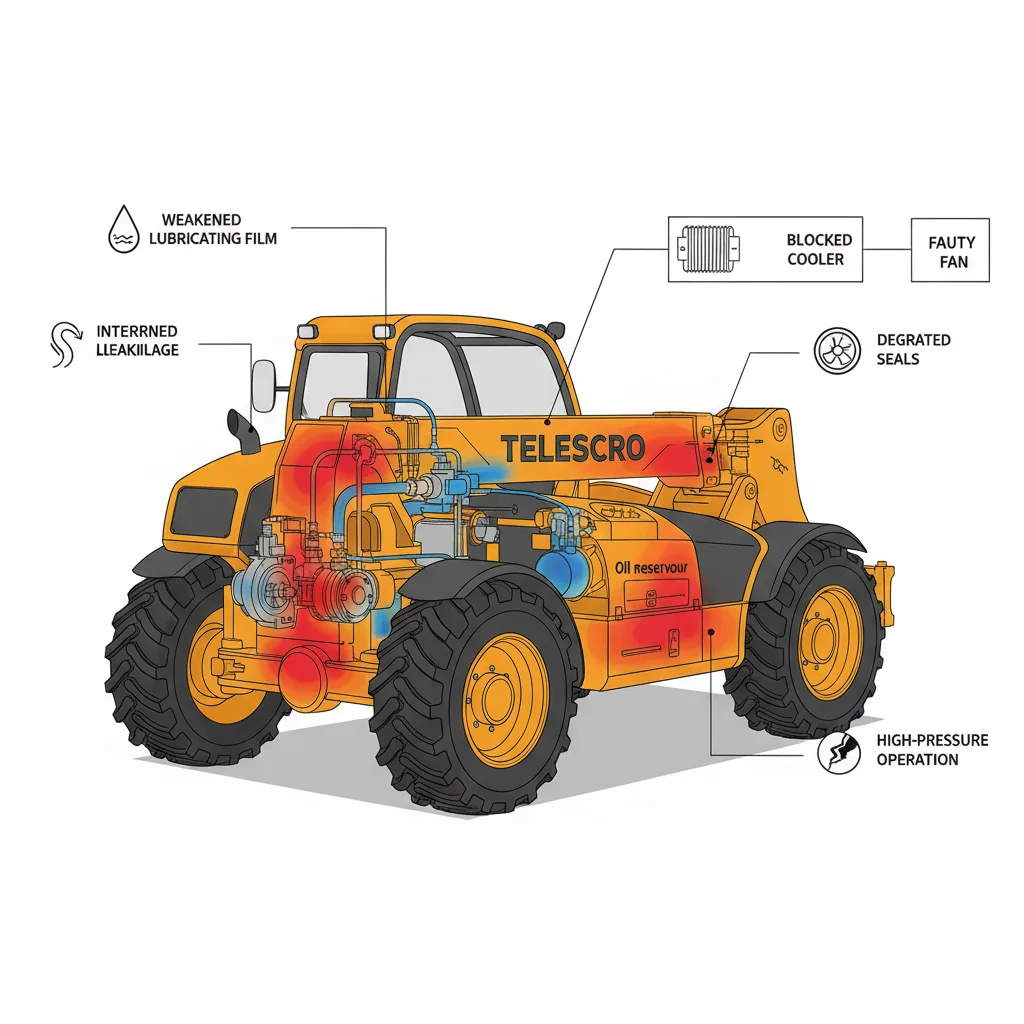
Excess heat is both a cause and a symptom of hydraulic wear in telehandlers. Sustained high oil temperatures weaken the lubricating film, accelerate seal degradation, and increase internal leakage, leading to gradual performance loss. Blocked coolers, faulty fans, and prolonged high-pressure operation accelerate this process, allowing heat and wear to reinforce each other and progressively reduce hydraulic efficiency.
Last summer, I got a call from a site manager in Dubai—his 4-ton, 17-meter telehandler was losing lifting power by midday. The main complaint? Slow boom movement and hydraulic oil that felt nearly too hot to touch. On inspection, we measured oil temperatures above 90°C in the tank, way past the safe range for most telehandlers. What happens at this point is pretty clear: hot oil becomes thin, so it leaks past internal clearances, especially in older cylinders and pumps. Instead of building pressure to do work, that energy turns straight into even more heat—a vicious circle I’ve seen completely ruin productivity on desert sites.
I’ve also seen jobsites in Brazil where dust and concrete debris clogged almost every fin in the hydraulic oil cooler after just two months. When airflow is blocked, the cooling fan can’t bring oil temps down. You start seeing early seal failure—rubber goes hard or cracks, then leaks appear both inside and outside components. Once seals wear, more oil escapes, and the problem gets worse. With some models, you can lose up to a quarter of machine efficiency before anyone notices—a massive cost if you’re working long shifts or running attachments with high flow requirements.
Here’s my honest advice: check your hydraulic temperature every day in tough weather or heavy use. A basic infrared gun works fine. Plan to clean out the cooler and radiator at least every 500 hours, and far more often on dusty urban or mining sites. It beats paying for a new pump or chasing down stubborn internal leaks later.
Excessive hydraulic oil temperature accelerates the breakdown of oil additives, which leads to increased internal wear in telehandler hydraulic components even before any noticeable drop in performance.True
Hydraulic oil is formulated with additives that help prevent wear and corrosion. High temperatures cause these additives to degrade faster, leaving components vulnerable to wear and damage inside pumps, valves, and cylinders before obvious performance issues, such as slower lifting or leaks, appear.
Hydraulic systems in telehandlers are largely unaffected by ambient temperature because the oil temperature is solely regulated by the machine’s internal cooling system.False
Ambient temperature directly influences the hydraulic oil’s temperature, as the cooling system can only dissipate so much heat, especially in very hot climates. Inadequate cooling or high outside temperatures can result in the oil exceeding safe operating limits, which increases wear and reduces hydraulic efficiency.
Key takeaway: Persistent hydraulic overheating in telehandlers accelerates internal leakage, seal failure, and component wear, causing notable efficiency losses. Daily temperature checks and cleaning coolers every 500 hours—more often in dusty sites—are critical for preventing expensive repairs and performance decline.
When Do Hydraulic Seals Need Replacing?
Hydraulic seals, cylinders, and rods in telehandlers require inspection or overhaul when symptoms such as external leaks, slow boom drift8, or unstable boom control are observed. These signs indicate internal leakage or seal degradation that can lead to pressure loss, oil contamination, and declining efficiency. Service timing varies widely with duty cycle, environment, and maintenance quality, so action should be based on observed performance changes rather than a fixed calendar interval.

Last month, a contractor in Dubai called me after noticing the boom on his 4-ton telehandler kept creeping down, even with the engine off. At first, his team thought it was no big deal—just a minor oil streak on the cylinder rod. But that small leak told me right away the hydraulic seals were starting to fail. When a loaded boom drifts by more than a few centimeters over ten minutes, especially with a rated load, that’s not just a nuisance—it’s a safety issue. Drifting means pressure is leaking past the piston seals inside the cylinder, and your pump is working overtime to compensate.
I’ve seen cases in South Africa where ignoring these early signs led to major power loss halfway through a project. The crews would notice the boom moving jerky or refusing to hold position during a lift. That happens because oil bypasses worn seals, causing pressure loss and—worse—letting contaminants in. On average, most telehandlers working regular construction shifts need their external seals checked or replaced about every 2–3 years. If you’re working in a sandy or corrosive environment, upgrades like chrome-plated or nitrided rods can make those seals last at least 50% longer, especially with daily rod inspections and proper wiper seals.
I always suggest monitoring for signs like unstable boom control, slow or uneven movement, or even small drips around the rod. As soon as loss of control or drift affects the job, it’s time for seal and cylinder maintenance—not when the system finally fails. Acting early keeps jobsites safer and your rated performance where it should be.
Hydraulic seals in a telehandler should be inspected or replaced whenever the boom drifts noticeably under load with the engine off, as this often indicates internal leakage that can compromise both safety and load-holding capacity.True
Boom drift with the engine off reveals that the hydraulic circuit is unable to maintain pressure due to seal leakage, which reduces the telehandler’s ability to safely support and position loads. This is a crucial indicator of wear and a prompt for seal replacement.
Hydraulic seals can be left unchanged as long as they do not cause a total loss of hydraulic function, since minor leaks are a normal part of telehandler operation.False
Even minor hydraulic leaks indicate seal deterioration, leading to pressure loss, uncontrolled movement, and potential safety hazards. Ignoring early signs of seal wear can result in equipment failure and unsafe working conditions.
Key takeaway: Address hydraulic leaks, boom drift, or unstable boom control in telehandlers as soon as they are detected. Rather than relying on a fixed time interval, maintenance decisions should be guided by observed symptoms and OEM service criteria. Early intervention preserves load control, prevents pressure loss and oil contamination, and helps maintain safe, predictable performance—especially in harsh or high-duty applications.
When Is Hydraulic Overhaul Cost-Effective?
A hydraulic overhaul on a telehandler is financially justified when boom or lift cycle times slow by 25–30% from specification, test flow at rated pressure9 drops 15–20%, or operating pressure cannot reach 90–95% of relief levels under load, even after maintenance. Hidden productivity losses often outweigh overhaul costs.

I’ve worked with customers who made this exact mistake—waiting too long for a hydraulic overhaul because the upfront cost looks high. A few months ago, I was contacted by a contractor in Kazakhstan who was frustrated with his 4-ton, 17-meter telehandler. The boom took nearly 12 seconds longer to fully extend compared to when the machine was new. On paper, that’s not dramatic. But when the project depended on fast cycles, that lost time quickly added up to serious overtime costs and missed deadlines.
From my experience, by the time lift or boom cycles slow more than 25% from the original spec, or the hydraulic system can’t hit 90% of the relief pressure under load—even after a fresh filter and oil—you’re already leaving serious money on the table. I’ve seen jobs in Brazil where operators “tough it out” with slow cycles, hoping to push overhaul costs into next year’s budget. But letting a $3,000 service slip for another six months typically costs double in lost productivity.
Here’s the thing: when test flow at full pressure drops off by about 15–20%, it’s not just about slowness. The system starts generating more heat, valves get sticky, and you risk contamination that can force a full hydraulic circuit rebuild—I’ve seen it happen after a cylinder seal fails and debris travels through the pump. For fleets running hard—5,000 to 7,000 hours, and even sooner for rental units—a scheduled overhaul pays back fast. I suggest tracking your cycle times monthly and acting early; it saves the system and the budget.
A delayed hydraulic overhaul can lead to slower boom extension times, which may not seem significant in isolation but can cause substantial overtime costs on cycle-dependent projects.True
Hydraulic wear often manifests as slower operations, which can accumulate into lost productivity and increased overtime costs, particularly when project timelines depend on rapid machine cycles.
Hydraulic wear affecting boom performance can always be resolved with minor fluid top-ups and does not require a full overhaul until total system failure.False
Minor fluid maintenance does not address internal wear, such as deteriorated seals or scored cylinders, which can critically reduce telehandler performance well before total system failure occurs.
Key takeaway: Hydraulic overhauls are cost-effective when consistent wear causes performance losses, such as slower cycles or decreased system pressure. Delaying maintenance leads to hidden productivity losses that can far exceed overhaul expenses, especially in demanding applications or high-hour fleets. Early intervention also reduces risk of system-wide damage.
How Does Usage Affect Hydraulic Wear?
The rate of hydraulic wear in telehandlers varies dramatically with duty cycle10 and attachment usage. Light agricultural tasks may not show substantial performance loss until 5,000–6,000 hours. In contrast, high-demand duties, frequent boom cycling, and continuous-use hydraulic attachments11 can cause significant “weakness” as early as 2,000–3,000 hours.

To be honest, the spec that actually matters is how the telehandler gets used on your site—not just what’s printed in the brochure. I’ve seen two identical 4-ton machines in different jobs age at completely different rates. In Kazakhstan, a rental fleet operator ran his units on nonstop high-rise construction, cycling the boom fully every five minutes and lifting close to rated capacity at least half the day. By 2,500 hours, his main pump started losing pressure, and hydraulic “feel” became sluggish—especially noticeable when feathering loads or running the telescopic boom out at high reach.
Now compare that to a dairy farmer I worked with in New Zealand. His telehandler’s main job was stacking hay bales and loading feed once or twice per day. Moderate loads, light boom movement, rarely at max extension. After 5,500 hours, hydraulic performance still felt solid—no obvious loss of power and no oil leaks except a minor hose drip every few months. The difference comes down to duty cycle and how attachments affect overall system stress.
Hydraulic attachments—like sweepers, rotators, or bale squeezers—put extra demand on the system. If more than half your tasks involve continuous hydraulic flow at moderate to high pressure, oil heats up faster, valve bodies cycle nonstop, and seals wear quicker. I usually tell customers using heavy attachments to halve their oil and filter intervals—changing at 1,000 hours instead of 2,000. And don’t wait for obvious symptoms—schedule pump and cylinder checks earlier for these high-demand machines. That’s how you actually avoid costly downtime.
Frequent operation near maximum rated boom extension and load capacity can accelerate internal hydraulic component wear, leading to earlier performance degradation.True
Hydraulic systems experience greater stress and heat buildup under heavy or repeated high-load cycles, which increases friction and wear on pumps, valves, and cylinders. Consistent operation near these limits can shorten the effective lifespan of the system compared to lighter-duty use.
Hydraulic wear is determined solely by total operating hours, regardless of the type and intensity of the telehandler’s tasks.False
The rate of hydraulic wear depends heavily on how the machine is used; frequent heavy loads and rapid cycling accelerate wear much more than light or intermittent usage. Two machines with identical hours but different operating profiles can have vastly different hydraulic system conditions.
Key takeaway: Telehandler hydraulic performance depends heavily on workload and attachment usage. Machines in heavy-duty or attachment-intensive roles typically require earlier maintenance than those in light-duty farm work. Fleet managers should adjust maintenance intervals and pump checks to match actual usage severity and application profile.
How Can Hydraulic Wear Be Delayed?
Consistent, light-touch maintenance habits—such as keeping hydraulic fluid within recommended cleanliness levels, using high-quality filters, performing regular hose and seal checks, maintaining cooling systems, and inspecting mechanical interfaces—substantially delay hydraulic wear. These practices preserve telehandler performance and shift repairs from emergencies to planned overhauls, extending the lifespan of critical hydraulic components.

Let me share something important about hydraulic maintenance—operators often underestimate how much small habits matter. Hydraulic wear doesn’t punch you in the face; it builds up quietly, then suddenly you’re hit with jerky steering or weak boom movements at the worst time. A few years back, I was on a jobsite in Kazakhstan where a team ran a 4-ton, 14-meter telehandler for almost 1,500 hours without changing filters on schedule. By the time they called me, every cylinder had scoring, and the pump was already noisy. Skipping simple maintenance turned into a week of downtime and a big bill. The reality is, fluid cleanliness makes or breaks hydraulic life. I always recommend using OEM filters (or proven equivalents) and changing them every 250–500 hours, as the manual says. Never mix oil types—one customer in the UAE tried that, and it caused seal swelling on a compact 2.5-ton unit. Topping up only with the right grade keeps contamination down. Honestly, a $20 filter can save thousands in cylinder and pump rebuilds. Jobsite conditions matter, too. On dusty projects, blow out the cooler daily and watch for radiator blockages—overheating shortens oil and seal life fast. Walk around the machine weekly: check hoses for sweating or wet dust, inspect cylinder rods for any nicks, and look for signs of side load or misalignment, especially where the boom extends. On one site in Brazil, simply lubricating the boom chains and aligning them properly fixed what looked like a “hydraulic” problem—no expensive parts needed.
Changing hydraulic filters at intervals recommended by the manufacturer can significantly delay wear on cylinders and pumps by preventing abrasive particles from circulating.True
Hydraulic systems rely on clean fluid; contaminated oil accelerates wear by allowing abrasive materials to damage internal surfaces, so sticking to filter change intervals maintains fluid cleanliness and reduces wear.
Topping off hydraulic fluid alone is usually sufficient to prevent most causes of hydraulic wear in a telehandler.False
Simply adding fluid does not address contamination or filter clogging; if dirty fluid remains in the system or filters are neglected, wear will continue despite the fluid level being adequate.
Key takeaway: Proactive maintenance—including fluid cleanliness, correct filter use, regular inspections, cooling system care, and pressure testing—can delay detectable hydraulic wear and help telehandlers operate closer to new condition. This approach reduces emergency breakdowns and allows hydraulic work to be scheduled during planned overhauls.
Which Features Extend Telehandler Hydraulic Life?
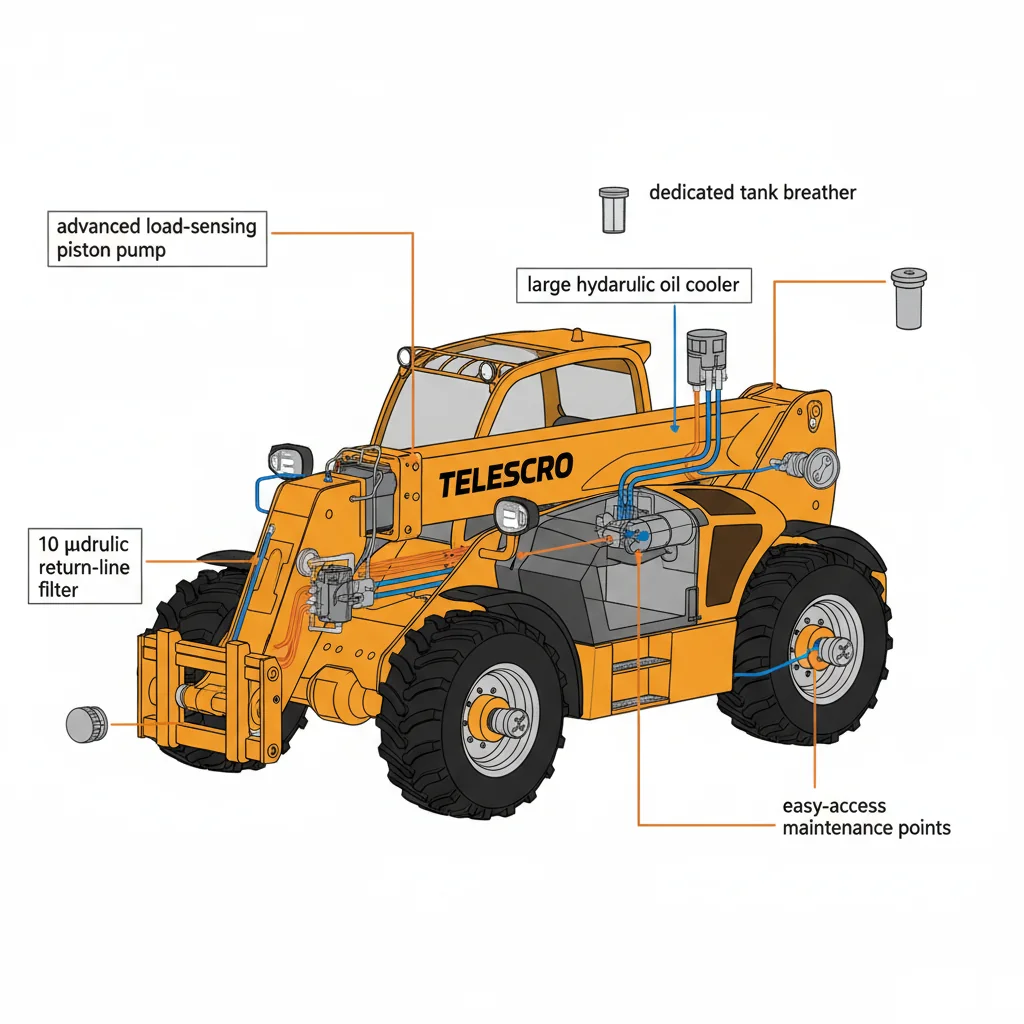
Telehandler hydraulic longevity depends on key design features: advanced load-sensing piston pumps maintain efficiency longer under heavy duty, superior 10 μm return-line filtration12 and dedicated tank breathers reduce internal wear, and ample cooling capacity prevents oil overheating. Easy access to maintenance points increases preventive service compliance, ultimately preserving performance and minimizing unplanned downtime.
On a project in Kazakhstan, a customer asked why his fleet of 4-ton telehandlers was experiencing noticeable hydraulic performance loss after relatively moderate service hours. Investigation showed a combination of basic gear pumps, limited filtration, and insufficient cooling capacity—a common combination that accelerates hydraulic wear in high-utilization fleets.
This pattern appears frequently where lower upfront specifications are selected to reduce purchase cost, but higher maintenance frequency and earlier hydraulic rebuilds offset those savings over time. Based on field experience, several design features consistently help extend the effective service life of telehandler hydraulic systems:
| Feature | Effect on Hydraulic Life | Why It Matters on the Jobsite |
|---|---|---|
| Load-sensing piston pump | Maintains hydraulic efficiency longer under variable load | Lower heat generation and more consistent performance during heavy cycles |
| 10 μm return-line filtration | Reduces internal contamination and abrasive wear | Fewer premature pump and valve failures |
| High-capacity cooling | Limits oil temperature rise under sustained load | Stable pressure and predictable response during long shifts |
| Dedicated tank breather filter | Prevents dust ingress into hydraulic oil | Improved reliability in dusty or dirty environments |
| Easy maintenance access | Encourages regular inspection and servicing | Faster maintenance and reduced unplanned downtime |
In a controlled comparison on a China test site, I evaluated two machines side by side: a standard 3-ton unit equipped with a fixed-displacement gear pump, and another configured with load-sensing hydraulics, finer filtration, and increased cooling capacity. Under comparable duty cycles, the higher-spec machine maintained stable hydraulic performance for a significantly longer period before requiring major hydraulic service. Over an 18-month operating window, this translated into substantially less downtime and smoother daily operation.
It is often tempting to prioritize minimum upfront price, but hydraulic specification choices directly influence long-term reliability, maintenance cost, and fleet productivity—especially in high-hour or rental applications.
Telehandlers equipped with high-efficiency filtration systems and variable displacement piston pumps experience significantly less hydraulic wear compared to those with basic gear pumps and minimal filtration.True
High-efficiency filters remove more contaminants, while variable displacement piston pumps reduce unnecessary pressure and flow, lowering internal stress on hydraulic components and extending system life.
Increasing hydraulic line pressure beyond recommended levels is an effective way to extend telehandler hydraulic component lifespan.False
Operating at higher-than-recommended hydraulic pressures accelerates wear on seals, hoses, and pump internals, leading to premature failures rather than increased component life.
Key takeaway: Load-sensing piston pumps, high-grade 10 μm filtration systems, effective hydraulic cooling, and accessible maintenance areas significantly extend telehandler hydraulic performance. These features reduce wear, prolong operational efficiency, and minimize costly downtime or overhauls—especially valuable in high-utilization fleets where hydraulic failures most impact productivity.
Conclusion
Hydraulic wear rarely happens overnight—small changes in cycle speed or hesitations are signs worth noticing before they grow into bigger headaches. From what I’ve seen on real job sites, keeping an eye on telehandler responsiveness around that 2,000–3,000 hour mark can save a lot of trouble later. I’ve also seen crews run into "parts roulette" when they wait too long, which leads to unexpected downtime and stress. If you have questions about diagnosing early wear, or if you’re unsure which maintenance steps make the most difference for your fleet, feel free to reach out. I’m always happy to share what’s worked for different environments and crews. Every site is different—look after your machine and it’ll look after your project.
References
-
Detailed analysis of volumetric efficiency’s role in hydraulic performance and early wear detection to maximize telehandler productivity. ↩
-
Explore how timing boom full extend and retract cycles can reveal internal leakage or pump wear with precise examples. ↩
-
Learn how comparing system pressure to OEM specs identifies internal bypass and component wear for timely maintenance. ↩
-
Explore the key mechanical and hydraulic issues that reduce boom speed, helping operators prevent costly downtime with early maintenance. ↩
-
Understand the crucial role of load-holding valves in stabilizing boom movements and how leaks cause jerky operation requiring prompt repair. ↩
-
Explore expert insights on timing hydraulic overhauls to avoid costly productivity losses and extend telehandler lifespan effectively. ↩
-
Detailed insights on how oil cleanliness levels impact hydraulic component lifespan and system reliability with supporting field data. ↩
-
Explains causes of boom drift like pressure loss and seal wear, plus solutions to maintain boom stability and enhance safety. ↩
-
Understand how reduced test flow impacts telehandler lift speeds and system efficiency, with practical thresholds to guide maintenance decisions. ↩
-
Explore how varying duty cycles impact hydraulic component lifespan and performance, backed by real-world usage scenarios and expert insights. ↩
-
Understand how different hydraulic attachments increase system stress and contribute to faster wear, with examples from construction and agriculture. ↩
-
Explains how fine filtration slows internal wear and lowers downtime, helping fleets avoid costly hydraulic failures. ↩