










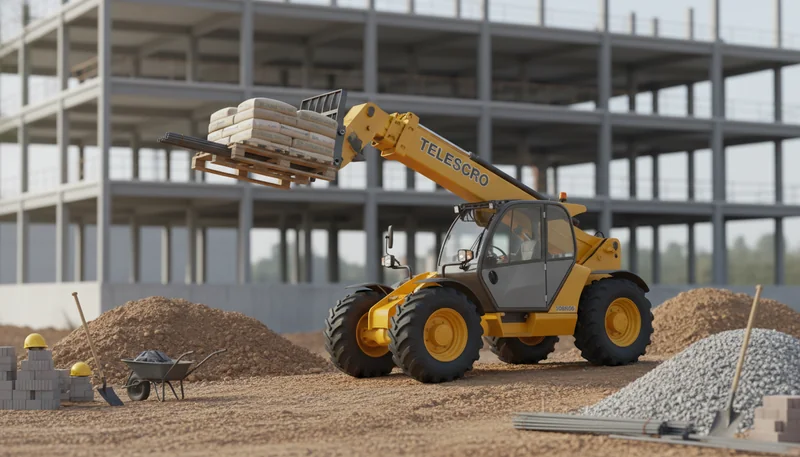
What Makes a Telehandler Suitable for Uneven Terrain? Field Engineer’s Checklist
Not long ago, an Italian project manager sent me photos of his “all-terrain” telehandler stuck with its belly on a rut—crew standing around, wheels off the ground, progress completely stopped. He assumed all 4×4 telehandlers could handle rough ground, but reality on site was very different.
A telehandler designed for uneven terrain must integrate multiple systems to ensure safe travel, stabilization, and lifting while under load on variable ground conditions. Key features include high ground clearance1 (often in the 350–450 mm class, depending on model and measurement point), heavy-duty oscillating axles, robust frame leveling2 systems (commonly ±8–10°), off-road tire selection, and carefully calibrated load charts specifying safe operation on slopes and with stabilizers3.
What Makes a Telehandler Uneven-Terrain Ready?
A true uneven-terrain telehandler combines strong chassis clearance, aggressive off-road tires, axles with oscillation, and hydraulic frame leveling (commonly ±8–10°). These systems work together to maintain safe travel, stability, and lifting—on ruts, soft ground, slopes, and loose surfaces—while adhering to manufacturer load chart specifications.
Field verification tip (for buyers):
Always confirm minimum ground clearance at the lowest point (center belly vs. axle can differ) and the exact frame-leveling angle on the OEM specification sheet—not just marketing brochures.
For reference, the Genie GTH-844 lists approximately 0.38 m (center) and 0.43 m (axle) clearance (official spec), while the Manitou MT1840 lists 0.42 m ground clearance (technical data). These examples show why the measurement location matters when evaluating uneven-terrain capability.

Most people look for "all-terrain" stickers on telehandlers, but that’s only part of the story. Uneven-terrain readiness starts with solid basics—ground clearance, axle design, and frame leveling. I once worked with a team in Kazakhstan who bought a yard-spec telehandler because the dealer called it "off-road capable." The first week onsite, they sank into soft ground. Why? Their machine had just 320 mm clearance and no axle oscillation4. For a true rough-terrain unit, you want at least 400 mm ground clearance. Construction-grade models usually offer 400–450 mm; specialty agricultural units push a bit higher, up to 480 mm for field work.
But ground clearance alone isn’t enough. Heavy-duty axles with rear-axle oscillation allow the wheels to maintain contact on uneven ground, which is critical for climbing ruts or traversing sloped sites safely—especially with a load on the forks. The actual oscillation range varies by model and design, so buyers should confirm the OEM-specified axle articulation rather than relying on tire size alone. I’ve seen operators in Brazil try to solve traction issues with bigger tires, but without proper axle oscillation, the machine simply bounces and loses stability.
Frame leveling is another key stability feature. Many construction-grade telehandlers offer side-to-side frame leveling in the ±8–10° range, allowing operators to compensate for cross-slopes and keep the boom level before lifting. As with axle design, the exact leveling capability should be verified on the manufacturer’s specification sheet, since rated capacities assume the machine is properly leveled.
Another key factor is the load chart—don’t skip this. Many telehandlers publish rated capacities assuming firm, level ground, and those numbers can change significantly once cross-slopes, soft surfaces, or stabilizer configurations are involved. Real uneven-terrain work requires checking the correct load chart for the actual operating condition (on tyres vs. on stabilizers, levelled vs. unlevelled), not just the headline capacity.
I’ve seen cases where a machine rated at 3,500 kg on level ground became severely limited once the site conditions changed—simply because the operator or buyer had not reviewed how slope, setup, and leveling affect the usable capacity.
My advice? Always verify ground clearance, axle design, frame-leveling capability, and the applicable load charts before buying. If a supplier cannot clearly document these values on the OEM specification sheet or operator manual, that’s a red flag.
Telehandlers equipped with axle oscillation are much better at maintaining stability on uneven terrain compared to rigid axle machines.True
Axle oscillation allows each wheel to move independently over rough surfaces, keeping more tire contact with the ground and improving stability in off-road conditions. Rigid axle machines can lose grip or become unbalanced more easily on bumpy sites.
As long as a telehandler has four-wheel drive, it is fully equipped to handle any uneven terrain.False
Four-wheel drive helps traction but does not ensure uneven-terrain readiness. Critical factors also include sufficient ground clearance, axle design (such as oscillation), and frame leveling systems, which together determine real off-road capability.
Key takeaway: Not all telehandlers marketed as ‘all-terrain’ offer true rough-terrain capability. Critical features include ground clearance, axle oscillation, frame leveling, and slope-referenced load charts. Always verify these specs to ensure safe and effective operations on uneven ground with a load on.
Is Four-Wheel Drive Enough for Rough Terrain?
Four-wheel drive is essential for telehandlers on uneven terrain, but by itself, it does not guarantee off-road stability or lifting safety. Key factors include axle oscillation, frame leveling capacity, tire type, and chassis clearance. Permanent 4WD improves traction, but additional stability systems are crucial for safe, effective field operation.

The biggest mistake I see is buyers assuming four-wheel drive alone means their telehandler is ready for any rough site. Last year, a team in Kazakhstan bought a 4-ton, 13-meter reach model for a remote solar project. It handled mud and gravel fine—with all four wheels pulling, traction wasn’t a problem. But as soon as they tried lifting when the ground sloped or rutted, they struggled. Without axle oscillation or frame leveling, the machine felt unstable, especially with the boom extended. The operator told me, “It just rocked and tipped—like the wheels weren’t touching evenly.”
From my experience, specifying permanent four-wheel drive is just the starting point. I always advise asking about axle oscillation range—ideally ±10° on the rear. That helps keep all tires in contact with the ground, even over stones or ruts. You also want at least 7–10° of frame leveling. In Dubai, I visited a site where a contractor switched to a model with hydraulic frame leveling after nearly toppling a scaffold load at a 5° incline. That single feature made the operator’s job much safer and faster.
Tire choice matters too. Some models offer “all-terrain” but ship with basic transport tread. In wet fields, that’s a recipe for getting stuck. Aggressive R4 tires, combined with at least 380 mm chassis clearance, made all the difference for a palm plantation client in Brazil—they stopped losing hours winching machines out of bogs.
I suggest always asking for axle and frame-leveling specs in writing. Let 4WD narrow the list, then dig into the real stability package.
A telehandler equipped with four-wheel drive but lacking axle oscillation can still lose stability when lifting loads on uneven or sloped ground.True
Four-wheel drive improves traction but does not automatically compensate for ground irregularities when the telehandler is loaded; axle oscillation is needed to keep all wheels in contact for better stability.
If a telehandler has four-wheel drive, it can always safely operate at maximum boom extension on rough terrain without additional features.False
Four-wheel drive ensures traction but does not guarantee stability, especially at full extension. Features like frame leveling and axle oscillation are essential for safe operation on uneven ground.
Key takeaway: Four-wheel drive is the basic requirement for telehandler operation on rough ground, but not the only factor. Buyers should demand details on axle oscillation, frame leveling, and tire selection to ensure safe and stable lifting—4WD alone does not guarantee true off-road suitability.
How Do Telehandlers Handle Uneven Terrain?
Ground clearance and chassis geometry are critical for telehandlers operating on uneven terrain. Minimum ground clearance should be 350 mm, with 400+ mm ideal for rough sites. Approach and departure angles5 over 20° prevent underbody strikes, reducing risk to steps, belly guards, and hydraulic lines. These specifications protect machine uptime.

Let me share something important about telehandlers on rough ground—ground clearance and chassis geometry aren’t just numbers for the brochure. I watched a project outside Nairobi lose two days because their machine, with 320 mm clearance, hung up on buried debris. The technician had to fix a cracked hydraulic line under the chassis—not an easy repair on a muddy hillside. A model with 410 mm clearance on another site in the same region rolled right over limestone chunks and uneven ruts. No stoppages, no damage.
What really protects your uptime isn’t the highest spec sheet lift height, but whether the undercarriage survives everyday abuse. Approach and departure angles—over 20°—mean you won’t slam steps or bash underguards cresting a pile or dropping into a rut. I’ve seen too many machines with long rear overhangs drag their counterweights, especially when accessing basements or ramps in places like the UAE. Lower clearance or shallow angles usually mean workshop visits, lost productivity, and risk to critical parts like the hydraulic filter or hoses tucked under the belly.
When comparing models, I always suggest you make the seller show you three things: actual ground clearance under the lowest point (look at the center, not just under the axle), approach angle at the front, and departure angle at the rear. Forget what’s painted on the side—ask for real numbers. It’s easy to be tempted by that “off-road capable” label, but if you’re expecting stony terrain or deep tracks, those extra 50 or 60 mm under the chassis can save days of downtime.
A telehandler with higher ground clearance reduces the risk of undercarriage damage from obstacles like debris and uneven ground, making it more reliable on rough terrain.True
Higher ground clearance allows vital components such as hydraulic lines and the chassis to pass over rocks, ruts, and construction debris, minimizing the chances of getting stuck or sustaining damage, which enhances uptime and safety on uneven job sites.
The length of a telehandler’s boom is the primary factor determining how well it operates on rough, uneven surfaces.False
Boom length primarily affects lifting reach and capacity at height, not ground-handling capability. When dealing with uneven terrain, features like ground clearance, axle oscillation, and tire type are much more critical to safe and effective machine movement.
Key takeaway: For uneven or rocky worksites, prioritize telehandler models with at least 350 mm ground clearance—400 mm or more is preferred—and approach/departure angles above 20°. These parameters minimize underbody damage and machine downtime, making them more important than small advantages in lift height for rough terrain applications.
What Tires Make a Telehandler Off-Road Ready?
Telehandler performance on uneven terrain relies heavily on tire selection. Larger tire diameter and section width increase the contact footprint and can contribute to additional chassis clearance, while deep, open-lug tread patterns6—often described as R4-style or true rough-terrain profiles—improve traction by shedding mud and maintaining grip on loose surfaces. High-ply construction helps resist cuts and punctures, and purpose-built rough-terrain tires7 are typically engineered for longer service life and higher damage resistance than light-duty or transport-oriented options, with actual durability depending on surface conditions and operating practices.

Here’s what matters most when a telehandler needs to tackle rough terrain—your tire choice will decide if the machine delivers or gets stuck before lunch. In my experience, focusing on tire size and construction makes a bigger difference than most people expect. A customer in Kazakhstan once upgraded from standard 16-inch tires to 20-inch rough-terrain models with wider section width. The change delivered better flotation, about 30 mm extra ground clearance, and reduced rutting in soft clay. Suddenly, daily progress doubled, simply because their telehandler could access every part of the site, even after heavy rain.
The tread pattern isn’t just cosmetic, either. Deep, open-lug treads—like what you see on true R4 or off-road profiles—shed mud and grip uneven surfaces far better than road-biased patterns. I’ve seen machines in Kenya with shallow tread get stuck with only one axle in soft ground, while those with deep industrial tread managed to keep moving after a downpour. A good off-road pattern also wears more evenly, which helps rental fleets stretch tire life beyond 1,500 hours instead of swapping out worn sets at the 900-hour mark.
Construction is your other line of defense. Higher ply ratings, commonly seen on construction and rough-terrain telehandler tires, help resist cuts and punctures from sharp gravel, scrap metal, or jobsite debris—an issue I’ve seen frequently on residential projects where nails and rebar offcuts are common. Actual ply ratings and constructions vary by tire size and manufacturer, so buyers should confirm the OEM-approved tire specification for their application.
If tire damage is a recurring problem, foam-filling can be considered, but it comes with trade-offs: added weight, a much stiffer ride, and reduced flotation on soft ground. For that reason, it’s best treated as a site-specific solution, not a default upgrade.
My advice? Always match your tire type to the dominant surface conditions—mud, gravel, or mixed terrain. Get that choice right, and the telehandler will deliver consistent traction, lower downtime, and longer component life.
Radial construction tires generally provide better ground contact and ride comfort on uneven terrain compared to bias-ply tires.True
Radial tires flex more and maintain a broader, flatter contact patch, which improves traction, stability, and comfort when traversing rough ground. This difference is especially apparent in off-road applications where terrain can be unpredictable and uneven.
Narrow-profile tires are ideal for off-road telehandler use because they cut through soft soil and prevent sinking.False
Narrow tires often sink deeper into soft ground, reducing flotation and increasing the risk of getting stuck. Wider tires disperse the telehandler's weight over a larger surface area, providing better flotation and traction on soft or loose terrain.
Key takeaway: Matching tire size, tread, and construction to site conditions significantly improves telehandler safety and productivity on rough ground. Quality rough-terrain tires enhance traction, resist damage, and last longer—providing real-world advantages over standard or road-biased options, especially where mud or debris are constant challenges.
How Do Frame Leveling and Stabilizers Enhance Safety?
Frame leveling enables side-to-side chassis adjustment, typically within ±8–10°, ensuring the telehandler is level before lifting. Stabilizers, especially on rough-terrain models, widen the support base and transfer weight off the axles. Both features are critical for maintaining rated capacity and safety, since load charts assume level ground conditions.

To be honest, the spec that actually matters is whether your telehandler can stay level before you lift. I’ve seen too many crews ignore this, especially when working on slopes in places like central Turkey or the outskirts of Sydney. On paper, rated capacity sounds straightforward—just check the load chart. But here’s the thing: every single chart assumes the chassis is level, usually within 3 degrees, sometimes up to 5 if you’re lucky. If you try to lift “on the lean,” that capacity drops off a cliff, and the risk of tipping skyrockets.
I remember a landscaping job in southern Brazil. The customer called after a near-miss when their 3.5-ton telehandler started to sway while lifting logs on a riverbank. The problem? They relied on “feeling stable,” not on proper frame leveling and stabilizer deployment. Once we reviewed their site, it turned out the ground sloped close to 6 degrees—well outside safe limits for operation on tires. With stabilizers fully extended and mats laid down under each pad, their usable capacity bounced back up to almost manufacturer spec, and the operator felt the difference right away.
Capacity improvements aren’t just numbers. On rough-graded sites in Kenya and northern China, I’ve seen frame leveling turn a risky 2,200 kg lift at 9 meters into a much safer operation, as long as the machine was re-leveled before every pick. The key takeaway is simple: double-check your level and stabilizer positions every single time. I always tell customers—it’s not about gut feel; it’s about what the load chart truly guarantees when the machine is set up right.
Frame leveling systems on telehandlers allow operators to maintain a level chassis on uneven ground, ensuring that the machine’s rated lift capacity remains valid and stable during operations.True
Frame leveling compensates for lateral inclines by adjusting the chassis, so the telehandler's lift performance matches what's listed in the load chart, which assumes a level base. This reduces the risk of tip-over events when lifting on uneven terrain.
Stabilizers on a telehandler make it possible to safely exceed the machine’s rated capacity when working on slopes, provided they are fully deployed.False
Stabilizers are designed to improve machine stability and reduce tipping risk but do not permit operators to exceed the manufacturer’s rated lift capacity. Rated capacities are determined with the assumption that the chassis is level and stabilizers are in use; exceeding these limits is unsafe regardless of stabilizer deployment.
Key takeaway: Proper use of frame leveling and fully deployed stabilizers is essential on uneven terrain to ensure telehandlers operate within rated capacity and manufacturer safety limits. Always verify ground slope, reference the correct load chart (‘on tyres’ or ‘on stabilizers’), and never lift unless the machine is properly leveled.
How Do Telehandler Steering Modes Aid on Rough?
Telehandler steering modes—two-wheel, four-wheel, and crab steer8—enhance maneuverability on uneven or confined jobsites. Four-wheel steering9 dramatically reduces turning radius and tire scrubbing, improving traction and minimizing tire wear when navigating loose gravel, mud, or cluttered spaces. Effective steering geometry is critical for productivity and tire life on rough terrain.

Most people don’t realize that steering modes on a telehandler can make—or break—your jobsite efficiency on rough terrain. I’ve seen this firsthand while consulting for a construction site in Kazakhstan, where winter mud and deep ruts are the norm. With only two-wheel steering, the team struggled every morning to turn around piles of rebar. They wore out front tires twice as fast, and sometimes got stuck pivoting with a loaded pallet.
Switching to four-wheel steer mode changed everything. Suddenly, the turning radius dropped to under 4.5 meters. The operator could cut a U-turn between scaffolds without dragging tires sideways or squashing fresh gravel. Four-wheel steering let both front and rear wheels track naturally in arcs—this means no more scraping tires across loose stone, which not only reduces stress on the axles, but also protects expensive rubber. The difference was so clear that the project manager told me they saved at least three hours a week just on material handling.
Crab steer is another trick that comes in handy when space gets tight. I’ve seen this on poultry farm jobs in Brazil, where you need to move bales right next to a barn wall or follow along a trench. With all wheels pointing in the same direction, the machine moves sideways—allowing operators to stay lined up without constant reversing. It’s a real time-saver.
I always suggest testing each steering mode with a full load on uneven ground before deciding. If the machine drags, hops, or squeals tires, it’ll cost you in the long run. It’s smart to invest in good steering geometry—that pays off in both safety and tire life.
Four-wheel steer mode on a telehandler allows all wheels to turn in unison, greatly improving maneuverability and reducing tire wear on uneven terrain.True
By enabling both front and rear wheels to steer, four-wheel steer mode drastically decreases turning radius and spreads the turning load across all tires, which is especially beneficial on jobsites with mud, ruts, or tight spaces.
Crab steer mode is never used for rough terrain because it destabilizes the telehandler during movement across uneven ground.False
While crab steer mode is not the primary choice for navigating obstacles, it is frequently used to move diagonally along rough or sloped terrain, helping to avoid obstacles without needing to reposition the telehandler, and if used properly, does not inherently destabilize the machine.
Key takeaway: Multiple steering modes, especially four-wheel steer, are essential for telehandlers operating on uneven or congested sites. They enhance maneuverability, protect tires from excessive wear, and support smoother tracking with a load—improving both safety and efficiency in field operations.
When Are Compact Telehandlers Best for Uneven Ground?
Compact rough-terrain telehandlers10 are preferred on uneven terrain where maneuverability and real off-road capability are essential, but space is limited. Their key advantages include 4WD drivetrains, rough-terrain tires, and shorter wheelbases, allowing them to work efficiently in confined or obstructed sites where larger machines struggle.
While lift height varies widely by model and manufacturer, compact designs prioritize access and control over maximum reach, with higher-reach machines typically belonging to the broader telehandler lineup rather than the compact class itself.

I’ve worked with customers who made the mistake of bringing standard telehandlers onto sites with tight access and rough ground—they ended up stuck or wasting hours just trying to maneuver. One clear example comes to mind: a roofing contractor in northern Italy was juggling jobs between old barns and new-build homes. On those sites, access roads measured under 2.5 meters wide, ground was rutted from tractors, and bigger machines simply couldn’t get through. After switching to a compact rough‑terrain model with just under a 4.5-meter turning radius and 400 mm of ground clearance, they could lift shingles to 11 meters without blocking neighboring driveways or having to lay extra gravel. That kind of efficiency isn’t possible with a forklift or a full-size telehandler.
Here’s what matters most when choosing a compact telehandler for uneven ground: maneuverability and stability must go hand in hand. Four-wheel drive and rugged tires let you keep traction even in mud or over loose stones, but the real gain is in the shorter wheelbase and narrower chassis. I’ve seen compact units in Kazakhstan work between scaffold frames with barely 30 mm of clearance on each side—something a high-reach model can’t manage. At the same time, lift heights in the 35–55 ft range mean you’re not sacrificing vertical reach for compactness.
I suggest always comparing three specs together: turning radius, overall width/height, and ground clearance. A machine might look compact, but if the chassis is too wide, it still won’t fit down a vineyard row. Get these details right—your machine will work every day, not just on perfect surfaces.
Compact telehandlers with all-wheel steering and improved ground clearance are better suited for uneven terrain than standard models, as they offer enhanced maneuverability and can maintain traction on rutted or sloped surfaces.True
All-wheel steering allows compact telehandlers to navigate tight, irregular sites more effectively, while increased ground clearance helps prevent grounding on bumps and ruts, making them ideal for rough conditions.
Compact telehandlers are less effective on uneven ground than larger telehandlers because their shorter wheelbase leads to greater instability on slopes.False
In reality, the design of compact telehandlers often results in a lower center of gravity and improved weight distribution, which can enhance stability on uneven terrain when compared to larger, less agile machines.
Key takeaway: Compact rough-terrain telehandlers excel in environments with narrow access and unstable surfaces, providing essential lift and stability where larger machines or forklifts fail. Comparing turning radius, width, height, and ground clearance is critical to confirming fit and performance for specific uneven sites.
What Telehandler Specs Ensure Uneven Terrain Performance?
Engine torque11 and gradeability12 are critical for telehandler performance on uneven terrain. Adequate gradeability—commonly quoted in the 30–45% range depending on model and test condition—and strong low-rpm torque help machines travel and handle loads on slopes, soft ground, or muddy access roads without stalling or excessive thermal stress. Buyers should always confirm whether gradeability figures are stated with load or unladen, and prioritize usable low-speed torque and drivetrain capability over peak horsepower when specifying machines for demanding terrain.

Most people don’t realize that a telehandler’s performance on flat concrete doesn’t always translate to a muddy, sloped jobsite. Engine torque is your real friend out there—it’s what keeps you moving when traction drops and the boom is loaded up. Peak horsepower looks great for brochures, but in practice, it’s strong torque at low rpm that pulls a 10,000 lb load up a 20° incline. I’ve seen operators in Kazakhstan forced to “take a run” at sandy ramps with underpowered machines; not only does this wear out transmissions and tires, but it’s a real safety risk if the load shifts.
Gradeability is another spec that gets ignored. Take a closer look: many telehandlers advertise 40% or even 45% gradeability, but that’s sometimes the unloaded figure. The only one that matters is with the rated load on the forks. I always suggest asking your dealer for the load chart and checking gradeability at full capacity. On a project in Dubai, a customer needed to shuttle pallets up a long, soft construction ramp—his first unit struggled in the middle of the climb, overheating after twenty minutes of work. We switched him to a model with stronger torque and higher rated gradeability, and the problem disappeared.
My advice: if you face slopes, muddy conditions, or long climbs, prioritize low-end engine torque and gradeability with full load over speed or top gear ratios. And whenever possible, test the machine on a real incline—not just in the flat yard. That difference could save you from hours of downtime and expensive repairs.
Telehandlers with locking front and rear differentials are significantly better suited for maintaining traction on uneven or loose terrain.True
Locking differentials allow both wheels on an axle to rotate at the same speed, which prevents a single spinning wheel from losing all the drive torque in slippery or uneven conditions. This feature is especially valuable on mud, sand, and inclines where one wheel may lose contact or grip.
A telehandler’s maximum lift height is the primary spec for determining its performance on rough and uneven ground.False
Maximum lift height reflects a machine’s reach but does not correlate with stability or drivability on difficult terrain. Uneven ground performance depends more on features like chassis leveling, axle articulation, and drivetrain torque, not just lift height.
Key takeaway: For reliable telehandler operation on uneven terrain, prioritize high engine torque and gradeability ratings with the full rated load. Machines with insufficient torque or gradeability may struggle on slopes, increasing wear and safety risks. Always verify specifications for real-world site conditions, not just flat surfaces.
How Do Telehandler Suspensions Aid Uneven Terrain?
Telehandler suspension systems—such as axle, chassis, or cab suspension—along with boom suspension13 and boom float features, are designed to absorb shocks from uneven terrain. These technologies stabilize both the operator and the load, minimize tipping risk, and reduce operator fatigue, especially when transporting heavy materials on rough ground.

Last month in Kazakhstan, I watched a 4-ton telehandler haul bundles of rebar across a rough site filled with potholes and compacted dirt. Without proper suspension, that load bounced dangerously every time the front axle dipped—one sharp jolt can be enough to tip things over or damage the boom. The operator told me he’d felt every bump in the seat before, which left him exhausted after long shifts. Once they activated the boom float feature14, the difference was immediate—the rebar rode smoother, and the operator kept much better control.
Here’s what matters most when tackling uneven ground: not all suspension systems work the same way. Axle suspension takes some shock off the wheels, but you also need boom suspension—or "ride control" as some call it—for moving material with the boom raised. This circuit allows the hydraulic oil to cushion the boom, absorbing most vertical jolts before they can shake the load loose. From my experience, if you’re carrying anything over 5,000 pounds, a machine without active boom suspension is a risk you just don’t need to take.
Don’t forget about wear pads inside the boom. These pads are critical for keeping the boom snug and reducing side-to-side play—if they get loose, it sounds like a hammer inside the steel, especially if you’re driving on washboard surfaces. I always suggest asking during demos: how do you check or adjust the pads, and is boom suspension auto-engaged or manual? Testing these systems with a real load at speed will show you the real difference—before you find out the hard way.
Active telehandler suspension systems help keep all four tires in better contact with uneven ground, reducing load instability and minimizing frame stress.True
Suspension systems, such as oscillating axles and boom float features, allow wheels to maintain consistent ground contact over rough terrain. This stability reduces shock loads transmitted to the frame and the boom, helping prevent tipping and structural strain, especially when hauling heavy or fragile materials.
Telehandler suspension systems are designed primarily to increase travel speed rather than to protect the load or operator over rough terrain.False
While some improvements in travel comfort can allow for moderate speed increases, the main goal of telehandler suspension is to maintain stability and protect both the load and operator on uneven surfaces, not to enable faster driving on rough sites.
Key takeaway: Advanced telehandler suspension and boom float features help maintain load stability over uneven surfaces by absorbing vibrations and shocks. Proper adjustment and regular checks—such as testing boom suspension with a real load—are essential to ensure both safety and machine longevity during rough-terrain operations.
What Extra Maintenance Do Rough-Terrain Telehandlers Need?
Rough-terrain telehandlers require more frequent maintenance, especially for articulation points, tires, and boom components. Daily greasing of axle oscillation pins15 and close monitoring of frame-leveling cylinders16, sidewalls, and boom wear pads are essential. These extra steps help offset accelerated wear caused by uneven ground conditions.

Last spring, I worked with a contractor in Brazil who kept having issues with telehandler downtime. Their machines spent most of the week on soft, uneven jobsite roads. After just four months, they already had excessive play in the axle oscillation pins—worn bushings and a slight lean when lifting over 2,000 kg near max reach. In rough-terrain conditions like that, I always tell customers to step up greasing of every articulation point, especially the axle pins. Once you feel movement, you’re already losing precision and stability.
Daily checks for hydraulic leaks at the frame-leveling cylinders and cylinder pins are non-negotiable. I’ve seen side play develop quickly if seals or retaining bolts start to give out—especially on machines working slopes or constantly adjusting boom angle. One client in Kenya had a 4-ton unit with premature wear at the leveling system; the result was tilting loads and a cracked weld, which took a week to repair. Proactive inspection every shift can catch this before it grows expensive.
Tires are another hidden pain point. Most operators glance at the tread but forget the inner sidewalls, where sharp stones and debris slice into the tire from under the chassis. I’ve seen whole fleets sidelined just from ignoring this spot—so always run your hand along that area in walk-arounds. And if you start feeling “clunk” in the boom or notice loose movement, don’t wait for a scheduled service. Adjust or replace the boom wear pads right away. I always document these issues for my fleet customers. Better records mean fewer urgent phone calls later.
Greasing the axle oscillation pins more frequently is critical for rough-terrain telehandlers, because uneven surfaces cause accelerated wear on these articulation points compared to smooth-ground applications.True
Rough and uneven terrain increases the amount of movement and stress on axle oscillation pins and bushings. This constant articulation leads to faster wear, which can result in excessive play, compromised stability, or misalignment if not maintained with regular greasing.
Rough-terrain telehandlers require less frequent hydraulic filter changes than standard telehandlers because dirt and debris are less likely to penetrate the hydraulic system on outdoor jobsites.False
In reality, working in dirty, uneven terrain increases the risk of dust and debris entering the hydraulic system, especially due to exposed components and aggressive cycles. This makes regular hydraulic filter checks and changes even more important, not less.
Key takeaway: Telehandlers working on uneven terrain are subject to faster wear at critical joints and components. A tighter maintenance schedule targeting axle pins, leveling cylinders, tire inner sidewalls, and boom wear pads is necessary. Proactive inspection and documentation help prevent breakdowns and ensure ongoing productivity.
How to Compare Telehandlers for Uneven Terrain?
Evaluating telehandler performance on uneven terrain requires practical field tests beyond brochure claims. Key assessments include the oscillation test using a 150–200 mm block, slope and frame leveling with test load, and maneuverability on loose gravel. These controlled demonstrations reveal true stability, frame response, and traction under real-world site conditions.

From my experience, spec sheets only tell you half the story when it comes to rough terrain. In the field, it’s the basics—like frame stability or real traction—that separate a solid pick from a headache on the job. Last year in Dubai, I watched two teams trial 4-ton telehandlers across a sandy lot. Both units handled 15-meter lifts, but only one kept its chassis stable going over a 180 mm timber block, while the other rocked so much the operator lost confidence. I always suggest starting with a controlled oscillation test. Place a 150–200 mm block diagonally under a wheel and drive slowly. Watch how each machine’s front and rear axle handle the lift—excessive rocking means the oscillation lock or hydraulic damping isn’t doing its job. Then, try a frame leveling check: put one side of the machine on a 5° concrete wedge, use frame levelling, and extend the boom halfway with a 1,000 kg pallet. Machines with a strong moment indicator and smooth frame shift feel much safer here. Don’t forget turning and traction—loose gravel will expose weak hydraulic circuits or poor tire spec instantly. I remember a customer in Kenya realizing too late that his compact 2.5-ton model scrubbed hard during four-wheel steering, leaving deep ruts. You want smooth turning at full lock, not wheel hop or push.
Telehandlers with a rigid chassis and automatic leveling systems are substantially better at maintaining stability on uneven terrain compared to those relying solely on manual compensation.True
A rigid chassis combined with automatic leveling enables the machine to adjust for sloped or irregular ground without relying on the operator’s skill alone, greatly reducing the chance of unwanted rocking or load destabilization.
Two telehandlers with identical rated lift capacities will both maintain the same stability and control on rough terrain, regardless of differences in chassis design.False
Lift capacity ratings do not account for differences in chassis configuration or suspension systems; even with equal capacities, variations in design can lead to very different real-world handling and stability on uneven ground.
Key takeaway: Controlled field checks, such as oscillation, slope leveling, and traction tests, expose critical differences in telehandler performance on uneven ground. Relying solely on brochures or flat-surface tests can mask real stability and handling issues, leading to suboptimal or unsafe machine choices for rough-terrain sites.
Conclusion
We’ve looked at the real features that actually make a telehandler perform safely on uneven terrain—ground clearance, axle oscillation, frame leveling, and using the right load charts. From working with crews across 20 countries, I can say the buyers who succeed pay close attention to load charts and parts support, not just whatever looks good on the spec sheet. Before choosing, I suggest checking how the machine handles at mid-boom extension and asking how fast you can get replacement parts. Need help figuring out which model fits your jobsite? I’m happy to share what’s worked for real projects—just reach out. The right telehandler choice really does depend on your site’s day-to-day demands.
References
-
Explains how optimal ground clearance enhances stability and prevents sinking on rough construction sites, avoiding costly downtime. ↩
-
Learn how hydraulic frame leveling stabilizes telehandlers on uneven ground, preventing tipping and ensuring safer lifts. ↩
-
Detailing how stabilizers widen the support base and transfer weight off axles to maintain load capacity and reduce tipping risks on uneven ground. ↩
-
Provides insight on how heavy-duty axle oscillation maintains wheel contact on rough ground for safer lifting and better traction. ↩
-
Explore how angles over 20° prevent underbody strikes and protect key components, reducing maintenance downtime on uneven ground. ↩
-
Explains the traction benefits and mud-shedding capabilities of deep, open-lug treads, crucial for telehandlers on uneven terrain. ↩
-
Detailed insights on how rough-terrain tires enhance traction, flotation, and durability for off-road telehandler operations. ↩
-
Explore the benefits and technical application of crab steer mode to maximize telehandler flexibility in confined or cluttered environments. ↩
-
Detailed insights on how four-wheel steering reduces turning radius, tire wear, and enhances traction in challenging jobsite conditions. ↩
-
Explore how compact rough-terrain telehandlers improve maneuverability and lift efficiency on challenging, tight construction sites with uneven terrain. ↩
-
Detailed explanation of why low-rpm engine torque is crucial for telehandlers handling slopes and rough sites safely and efficiently. ↩
-
Expert insights on why checking gradeability at full rated load matters more than unloaded figures for safe, reliable telehandler operation. ↩
-
Explore how boom suspension cushions vertical jolts, enhancing load stability and operator control on rough construction sites. ↩
-
Understand how the boom float feature smooths load transport, reduces operator fatigue, and minimizes tipping risks on rough terrain. ↩
-
Explains maintenance criticality of axle pins to prevent wear, maintain stability, and avoid costly downtime in harsh terrain. ↩
-
Details how proactive monitoring of hydraulic leaks and wear in leveling cylinders prevents load tilting and expensive repairs. ↩