










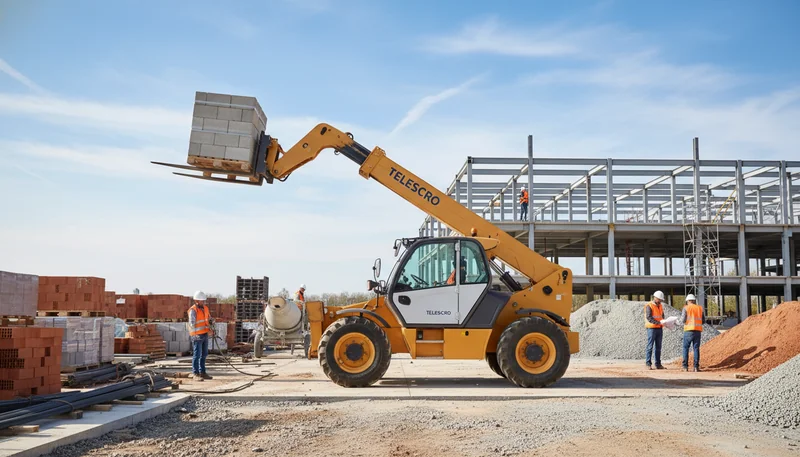
What is the Typical Weight of a Telehandler? Field Guide to Avoiding Costly Mistakes
Not long ago, a site manager in Poland called me in a panic—his telehandler was stuck behind the delivery gate, simply because the transport permit was wrong. It turned out he’d guessed at the machine’s weight, and that “minor detail” nearly cost him a day’s work.
The operating weight of a telehandler varies widely depending on its size and intended application. Most standard models used in construction and rental fleets weigh between 20,000 and 28,000 pounds (approximately 9,000–12,500 kilograms), balancing lift capacity and ease of transport. Compact units can weigh as little as 9,500 pounds, while high-capacity or large-reach models may exceed 35,000 pounds (about 16,000 kilograms). Machine weight affects transport requirements, lifting performance, and ground impact.
What Is the Typical Weight of a Telehandler?
Standard telehandlers used on construction and industrial sites typically weigh between 20,000 and 28,000 pounds (9,000–12,500 kg), aligning with common 6,000–10,000 lb lift capacities. Compact models range from 9,500–12,000 lb, while high-capacity or long-reach units can exceed 30,000 lb, depending on application and specification.
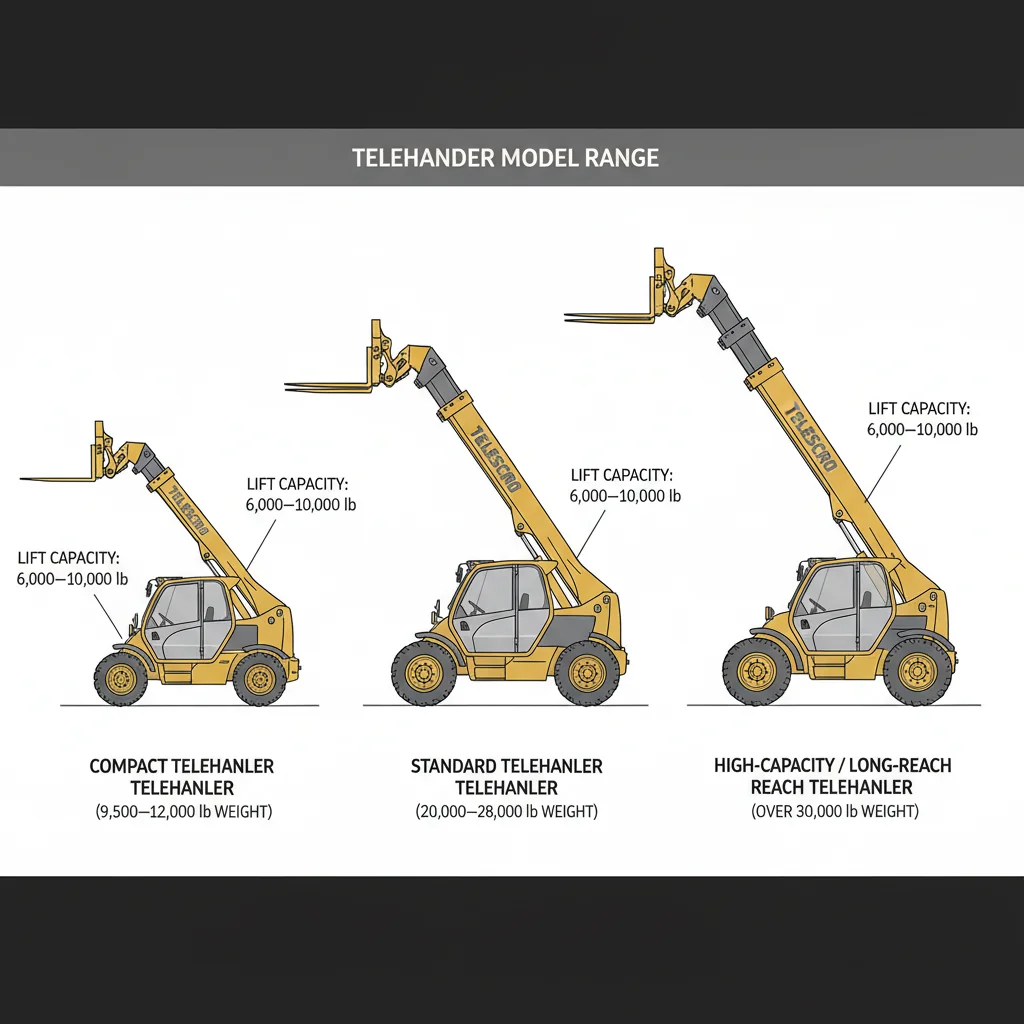
Most people don’t realize how much telehandler weight can affect jobsite logistics. Last month, a rental company in Dubai contacted me about moving a pair of 10,000 lb capacity telehandlers to a tower build. They assumed each machine weighed under 20,000 lb—close, but not quite. The actual operating weight hit 24,000 lb per unit, thanks to bigger counterweights and sturdier boom sections for stability. That 4,000 lb difference meant their chosen truck trailers were suddenly under-rated for transport. Plan for the real numbers, not what “seems right” based on lift capacity.
At the smaller end, I’ve seen compact telehandlers—those with under 3-ton capacity and under 10-meter boom length—used on urban jobs in Singapore and tight sites in Poland. These typically weigh around 10,000 to 12,000 lb. The lighter weight is a real advantage for multi-story projects with limited crane access, or when ground bearing pressure matters. But keep in mind, if you choose a compact machine, you trade off some lift performance for that easy handling.
For heavy work, high-capacity machines can easily top 32,000 lb. One client in Kazakhstan’s oil fields needed a heavy-duty 7-ton telehandler with nearly 18 meters of reach—the operating weight was just over 36,000 lb. That’s in a different league. Heavy units demand careful ground prep, reinforced jobsite ramps, and proper transport routing.
I always suggest verifying the exact operating weight from the manufacturer’s spec sheet before booking transport or setting up the site. Precision here saves time, money, and headaches down the line.
Telehandlers with a 10,000 lb capacity typically weigh around 22,000 to 24,000 lb due to the additional counterweights and reinforced boom sections needed for stability.True
To safely lift heavy loads, telehandlers include substantial counterweights and robust boom designs, which increase their operating weight beyond just the lift capacity rating, often adding 50-60% more weight than the rated load capacity.
A telehandler's operating weight is usually less than double its rated lift capacity, making it easy to transport on any standard flatbed trailer.False
Operating weight often exceeds twice the rated capacity due to heavy counterweights and structural reinforcements, meaning transportation requires trailers rated well above the telehandler’s capacity to accommodate the full machine weight safely.
Key takeaway: Telehandler operating weight varies widely by model, with most standard units falling between 20,000–28,000 lb. Always use the manufacturer’s listed operating weight for planning, transport, and safety calculations—never rely on class labels or assumptions, as this figure drives equipment suitability and logistics decisions.
How Does Weight Impact Telehandler Lift Capacity?
Telehandler weight directly influences lift capacity through counterbalance1, frame strength, and axle robustness. Heavier units offer greater rated capacities and enhanced stability at reach. However, capacity is not constant—load charts2 reveal significant reductions at full boom extension. Factors like design, wheelbase, and boom geometry interact with weight to determine performance at specific heights and reaches.
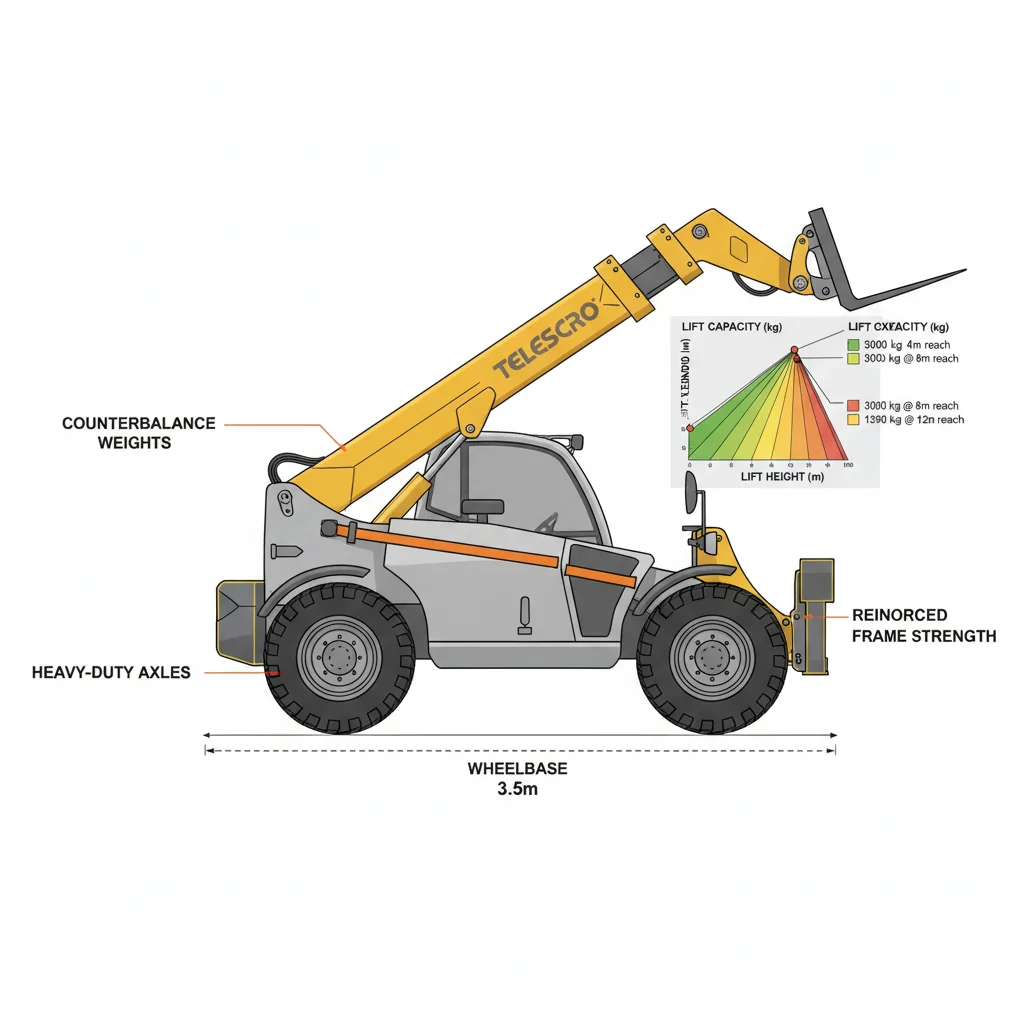
Here’s what matters most when talking about telehandler weight and lift capacity: people often assume a heavier unit will always lift more, no questions asked. But on real jobsites, it’s not that simple. I worked with a project in Dubai last year. They needed to lift 3,000 kg steel beams to the fifth floor—at nearly 15 meters reach. Their crew picked a 12-ton telehandler, thinking the heavy chassis would make lifting at maximum extension safe. The reality? According to the load chart, that unit could handle only around 2,400 kg at that height and reach. They learned the hard way that actual lift capacity drops sharply as you extend the boom.
From my experience, counterweight and the machine’s structure set the absolute upper limit—but factors like axle strength, boom design, and wheelbase play just as big a role. Bigger counterweights can help, but without a robust frame and proper hydraulics, a heavy telehandler isn’t enough. For example, a high-reach model with 4,000 kg rated capacity usually weighs at least 10 to 12 tons. But at maximum outreach, you’re looking at less than half that capacity—often just 1,800 to 2,000 kg.
Load charts (the diagrams showing safe lift at different positions) are your best friend here. I suggest always checking the chart for your specific job—especially when you’re working at height or need full outreach. Don’t rely on the machine’s total weight or the biggest number on the spec sheet. I’ve seen too many teams in places like Kazakhstan end up renting a second unit because they skipped this crucial step.
A telehandler weighing around 12 tons typically has a maximum lift capacity close to 4,000 kg at mid-range boom extension, but this capacity drastically decreases at full reach due to stability limitsTrue
Telehandler lift capacity charts show that heavier units may handle heavier loads at shorter reaches, but stability and boom angle significantly reduce capacity at extended reach, regardless of overall machine weight. This is why a 12-ton telehandler cannot safely lift 3,000 kg at 15 meters reach without counterbalancing or support.
Increasing the overall weight of a telehandler by adding ballast always increases its maximum lift capacity at any boom extensionFalse
While adding ballast can improve stability and increase lift capacity in some configurations, it does not universally increase maximum lift capacity at every boom extension. Lift charts are based on complex factors including boom angle, reach, and center of gravity, and excessive weight can also reduce mobility and increase structural stress.
Key takeaway: Telehandler weight serves as a useful initial indicator of lifting performance, but actual capacity varies with boom extension and height. Always consult the manufacturer’s load chart for the precise safe lifting capacity at the required working position—never rely solely on machine weight or rated maximum performance.
How Does Telehandler Weight Impact Transport?
Telehandler weight dictates transport method and legal requirements. Machines under 30,000 lbs typically travel on standard tandem- or tri-axle trailers, staying within most regional weight limits. Heavier telehandlers, especially above 35,000 lbs, may require lowboys, extra axles, and oversize or overweight permits3, increasing costs, limiting routes, and affecting scheduling logistics.
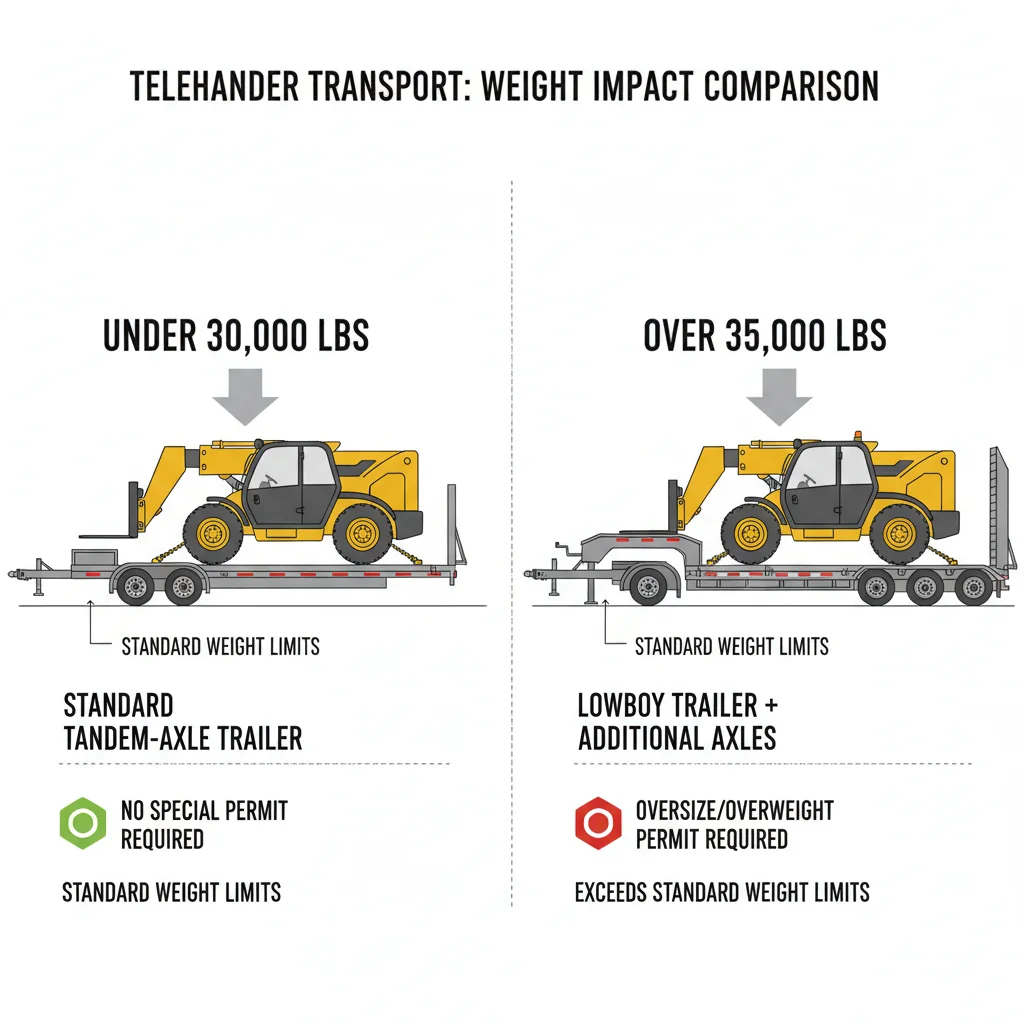
Let me share something important about telehandler weight and transport—especially if your jobs are spread out across different regions. In China, I’ve seen contractors assume a 27,000 lb machine can go on any standard tandem-axle trailer. It’s not always that simple. I worked with a customer in Dubai last year who needed to move a heavy-lift 16-ton telehandler between city projects. On paper, their trailer was rated for 35,000 lbs, but local axle weight limits forced them to upgrade to a tri-axle just to avoid hefty fines. The result? Mobilization costs nearly doubled, and city regulations limited travel to night hours only.
Once you’re dealing with machines above about 35,000 lbs, things get more complicated. Extra axles or lowboy trailers4 become mandatory—sometimes with drop-deck designs for added ground clearance. In Kazakhstan, one client needed special permits for a 20-meter rotating unit that pushed their combination over 45,000 lbs. This meant route restrictions: certain bridges were off-limits, and delivery got delayed by at least two full days while paperwork cleared.
It’s not just the gross weight—axle loading and access roads matter too. Even a 12-ton standard telehandler can push a loaded tractor-trailer past bridge limits on older rural infrastructure. I always suggest verifying every leg of your planned route, including plant gates, site access roads, and even the last-mile approach.
My takeaway? Don’t let a spec sheet or trailer rating be your only guide. Check real route constraints, verify local transport laws, and factor in those hidden costs before you buy.
Telehandlers with a rated lifting capacity around 16 tons typically weigh between 30,000 to 40,000 lbs, which often exceeds the payload limits of standard tandem-axle trailersTrue
Heavy-duty telehandlers designed for lifting around 16 tons are constructed with robust frames and counterweights, resulting in machine weights that commonly surpass 30,000 lbs, necessitating trailers with higher axle counts and weight ratings for safe transport.
Most telehandlers weighing over 25,000 lbs can be legally transported on any standard tandem-axle trailer without modifications or permitsFalse
Transporting telehandlers above 25,000 lbs typically requires special trailers or permits since tandem-axle trailers have strict weight limits per axle; exceeding these limits can violate local transport regulations and compromise safety.
Key takeaway: Telehandler weight directly affects transport method, necessary permits, and logistics cost. Exceeding regional weight or axle limits on certain trailers or bridges can bring added fees and schedule restrictions. Always verify trailer ratings, DOT requirements, and access constraints before committing to a specific telehandler model.
How Does Telehandler Weight Affect Ground Conditions?
Heavier telehandlers increase ground pressure, posing risks such as soil compaction5, rutting, or overstressing on soft, landscaped, or sensitive surfaces. Lighter telehandlers, typically under 7,000 kg for agriculture, minimize soil disturbance. Conversely, additional weight improves stability and traction on rough, sloped terrain, but raises fuel usage and wear. Site-specific ground bearing capacity6 should always be evaluated before equipment selection.
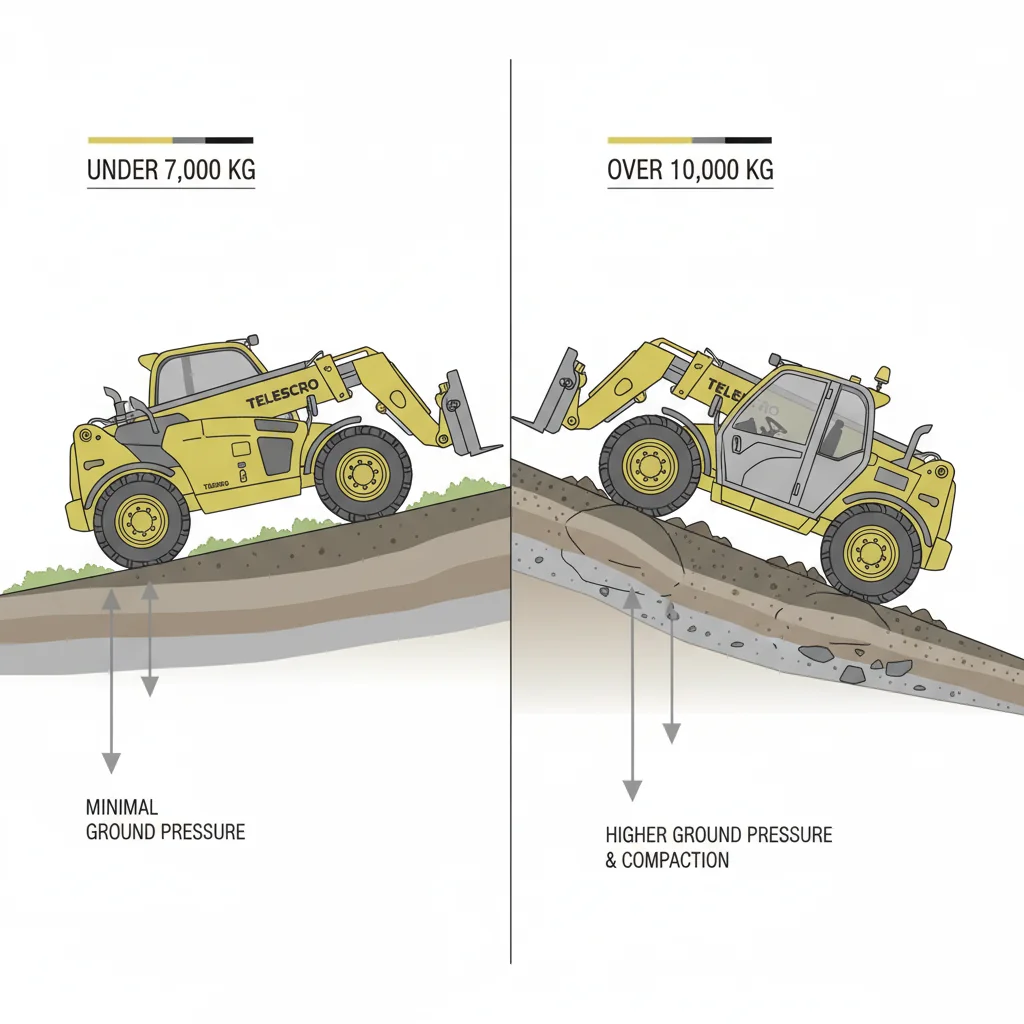
The biggest mistake I see is underestimating how much a telehandler’s weight can impact a jobsite, especially on non-paved ground. In Kazakhstan, one agriculture customer chose a compact telehandler just under 7,000 kg for harvesting—smart move. Their fields stay productive because the lighter machine keeps soil compaction low, even during wet seasons. When I see projects using heavy, 12,000 kg units on soft terrain, they often end up with deep ruts or even stuck machines. And those repair costs? They add up fast—sometimes more than $5,000 just for basic landscape restoration.
But there’s another side. If you’re working on rough or sloped ground, like a site I visited in Brazil with steep embankments, extra weight can actually help. Heavier telehandlers—think over 10,000 kg, often with reinforced frames and extra counterweights—offer valuable stability and traction. That extra mass, especially combined with wide, aggressive-tread tires, stops the machine from sliding or tipping on uneven grades. However, you’ll burn through more fuel and see tire wear climb. One customer in the UAE told me their fuel bills jumped nearly 15% after swapping from a compact to a heavy-duty model for desert work.
Here’s what I always recommend: review your site’s ground bearing capacity. Geotechnical reports or site engineers can give you numbers—often 50 kPa for soft soil, up to 250 kPa for compacted gravel. Match telehandler weight and tire choice to those figures. On sensitive finishes, lay down steel plates or mats, or pick a lighter unit. It usually saves headache—and money—in the long run.
Telehandlers weighing around 7,000 kg typically exert ground pressure close to 50 kPa on soft soils, significantly reducing soil compaction compared to heavier machinesTrue
The ground pressure exerted by a telehandler depends on its weight and tire contact area; lighter machines spread their weight more effectively, lowering soil compaction which is critical in agriculture and soft terrain applications.
Most telehandlers heavier than 10,000 kg use steel tracks instead of tires to minimize ground disturbance on soft surfacesFalse
While steel tracks can reduce ground pressure, most heavy telehandlers still use pneumatic tires because they offer greater versatility and cost-effectiveness; steel tracks are uncommon in telehandlers and more typical in other tracked machinery.
Key takeaway: Telehandler weight directly influences stability and ground impacts on jobsites. Heavy units excel in rough terrain but risk soil damage on sensitive ground, while lighter models reduce surface harm. Always match telehandler weight and tire type to the ground conditions and consult site engineers or reports to avoid costly site repairs.
Which Telehandler Weight Class Is Best?
Selecting the correct telehandler weight class depends on matching jobsite access constraints and lift requirements. Compact units (9,500–15,000 lb) excel in restricted areas but offer lower lift heights. Standard fleet units (20,000–28,000 lb) deliver balanced capacity and reach. Heavy-duty models (30,000+ lb) are reserved for the highest loads where ground and transport logistics are suitable.
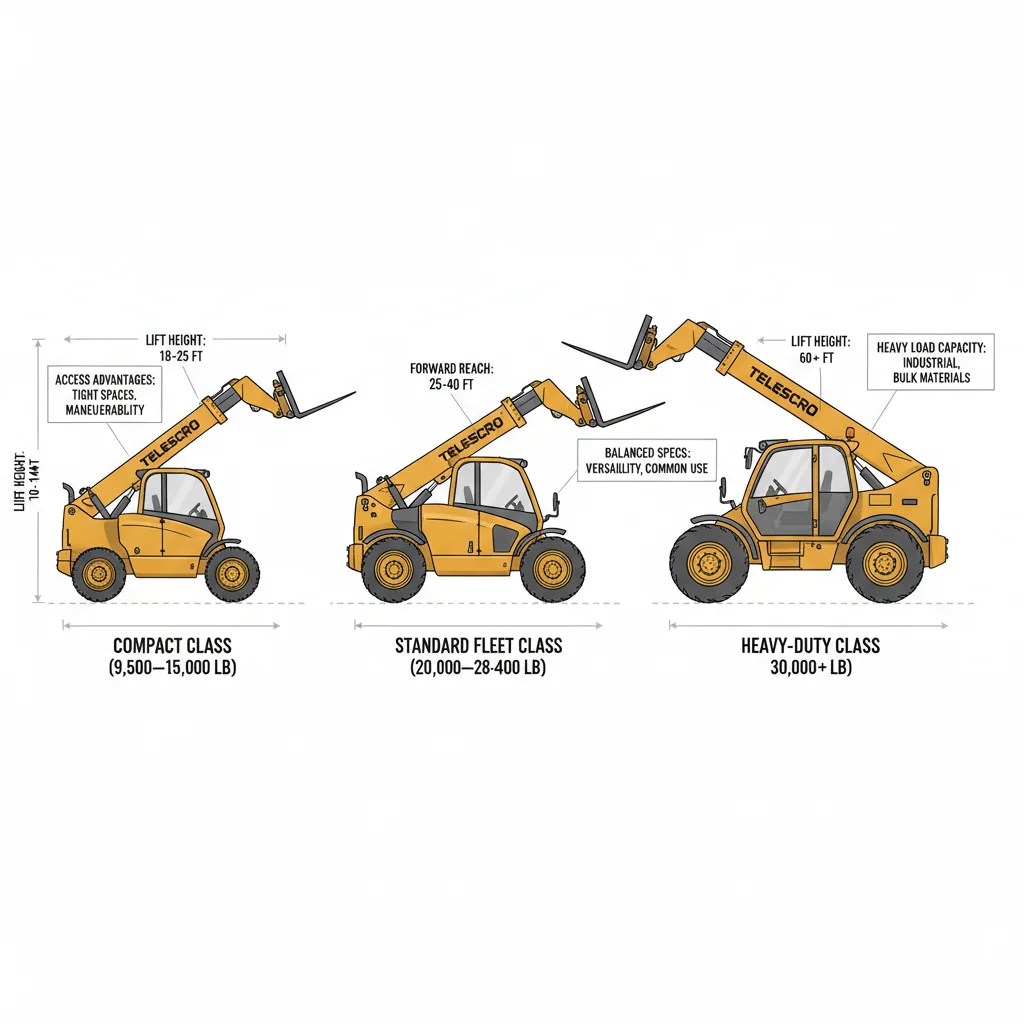
I’ve worked with customers from Dubai to Brazil who’ve learned—sometimes the hard way—that picking “the biggest” telehandler isn’t always the smart move. Space constraints, access roads, and even local weight limits often matter more than headline specs. For example, a client in central Dubai tried to use a 33,000 lb heavy-duty machine for glass panels inside a tight courtyard. The result? Constant delays moving materials because the machine could barely turn—a classic case of over-sizing.
Compare the main telehandler weight classes below:
| Weight Class | Best For | Capacity | Max Lift Height | Turning Radius |
|---|---|---|---|---|
| Compact (9,500–15,000 lb) | Urban, indoor, farms | 2,500–3,500 kg | 6–10 m (20–33 ft) | <4 m (13 ft) |
| Standard (20,000–28,000 lb) | New builds, framing, staging | 4,000–5,000 kg | 12–17 m (39–56 ft) | 4–5 m (13–16 ft) |
| Heavy-duty (30,000+ lb) | Precast, steel, bulk material | 6,000+ kg | 15 m+ (49 ft+) | >5 m (16 ft) |
From my experience, compact units shine on jobs with tight access or frequent transport between sites. They’re easier on narrow roads and cheaper to move. Standard fleet telehandlers—what I see most often in rental yards—are reliably versatile. They handle 4-ton lifts to 12 meters day after day. On a big industrial job in Kazakhstan, heavy-duty units made sense, but the ground was reinforced and delivery cost double that of a standard unit.
Most telehandlers typically weigh between 10,000 and 30,000 pounds, balancing maneuverability with lifting capacity to suit a wide range of job sitesTrue
Telehandlers in this weight range are common because they provide sufficient lift and reach capabilities while remaining compact enough for varied terrain and access constraints, which is critical for diverse construction applications.
Telehandlers weighing over 50,000 pounds are standard for most indoor construction projects due to their superior agility and compact sizeFalse
Telehandlers over 50,000 pounds are considered heavy-duty and are generally too large and unwieldy for indoor projects, where space and maneuverability are limited; lighter, more compact machines are preferred indoors.
Key takeaway: The right telehandler weight class is not about maximum size but aligning machine capacity and maneuverability with actual project needs and site limitations. Over-specifying adds unnecessary expense, while undersizing risks job efficiency and safety—always match machine to site and materials for optimal value.
How Does Telehandler Weight Affect Costs?
Telehandler weight significantly impacts direct and indirect costs. Heavier units consume more fuel hourly due to larger engines and increased mass, raising operating expenses during extended use. Transport costs also rise as heavier machines often require specialized carriers or permits, influencing both rental rates and total cost of ownership for multi-site or fleet operators.
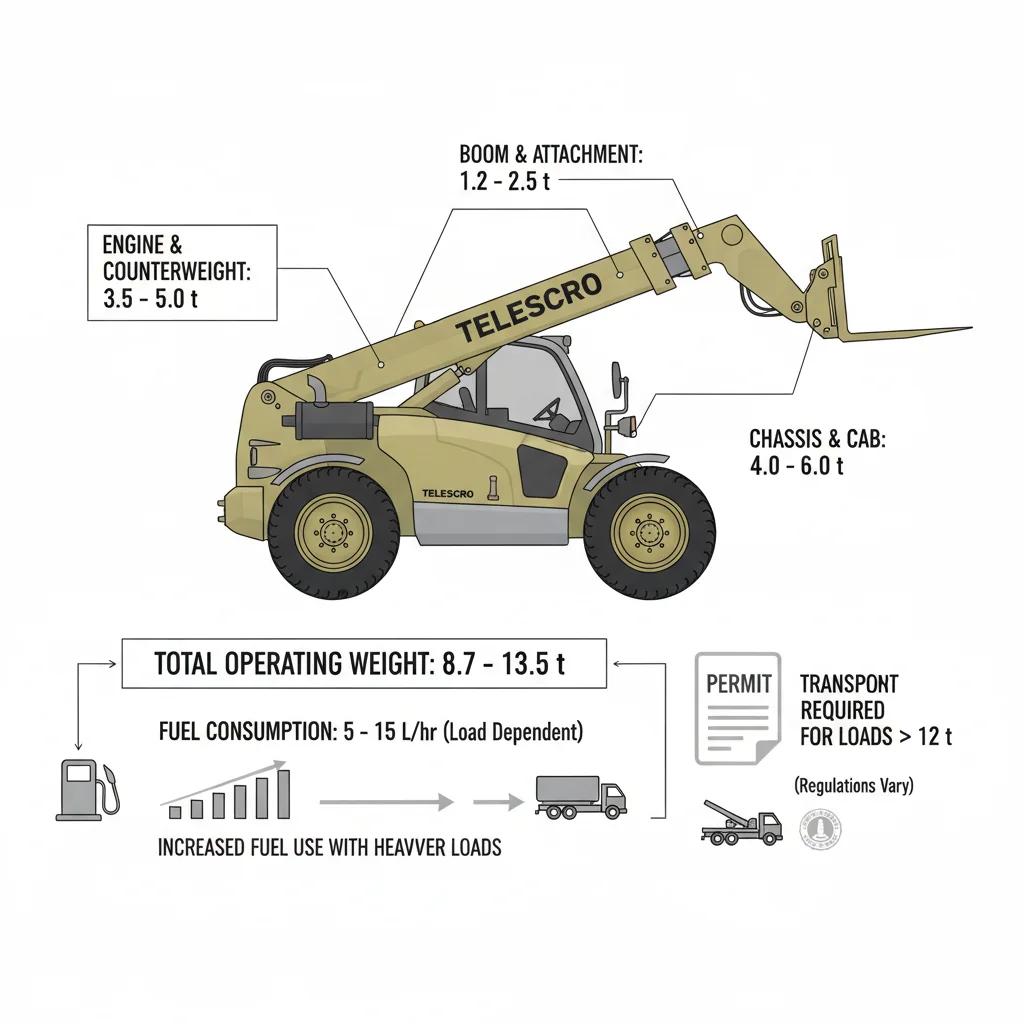
To be honest, telehandler weight is a hidden factor that can quickly eat into your budget if you don’t track it closely. I’ve worked with a contractor in Kazakhstan who ordered a 32,000 lb unit for lifting HVAC systems on a new hospital site. The performance was solid, but after three months, they were shocked by their fuel spend—over 25% higher than their previous 24,000 lb model—simply because a bigger engine and added mass meant every working hour cost more in diesel. When you run eight hours a day, week after week, that difference turns into thousands of dollars.
Let’s talk about transport. Heavier machines need bigger trucks, and sometimes special permits. A 20,000 lb telehandler can usually ride on a standard flatbed in most countries. Jump up to 35,000 lbs and you’re looking at step-deck trailers, more paperwork, and sometimes limited road access. Last year, a client in Brazil moved five heavy units between two sites, just 120 km apart, but paid double what lighter machines would have cost. This also affected their rental rates. Operators know heavier means pricier moves—so rates go up to cover the risk.
From my experience, picking the heaviest machine “just in case” isn’t usually the smart move. I always suggest starting with your real lift requirements—look at your heaviest loads, max working height, and usual outreach. The lightest model that genuinely fits the job will almost always save money, whether you own one or run a fleet. Don’t forget to factor in those unseen costs before you sign any deal.
Telehandlers weighing over 30,000 lbs typically require engines rated above 75 horsepower to maintain efficient lifting and maneuvering performance on construction sitesTrue
Heavier telehandlers demand more power to operate hydraulic systems and drive the machine effectively. Engines above 75 HP provide the necessary torque and flow rate for smooth function, which is why units above 30,000 lbs often come with larger engines.
Telehandler weight has minimal impact on fuel consumption since diesel engines are optimized to consume fuel at a constant rate regardless of loadFalse
Fuel consumption in diesel engines varies with load because heavier machines require more engine power to move and operate hydraulic systems. Therefore, increasing telehandler weight directly raises fuel usage, disproving the idea of constant fuel consumption.
Key takeaway: Telehandler weight influences both operating and logistics costs. Heavier machines increase fuel consumption and transport expenses, often resulting in higher rental rates and overall ownership costs. Selecting the lightest machine suitable for project requirements can optimize lifecycle ROI, especially for fleet and multi-site deployments.
Why Are Heavy-Duty Telehandlers So Heavy?
Heavy-duty and rotating telehandlers are significantly heavier due to reinforced chassis7, larger counterweights, robust boom sections, and heavy-duty slew rings8 engineered to manage higher loads and complex load movements. These machines often exceed 35,000 lb—and sometimes 40,000 lb—enabling safe placement of large materials over greater distances and 360° rotation on job sites.
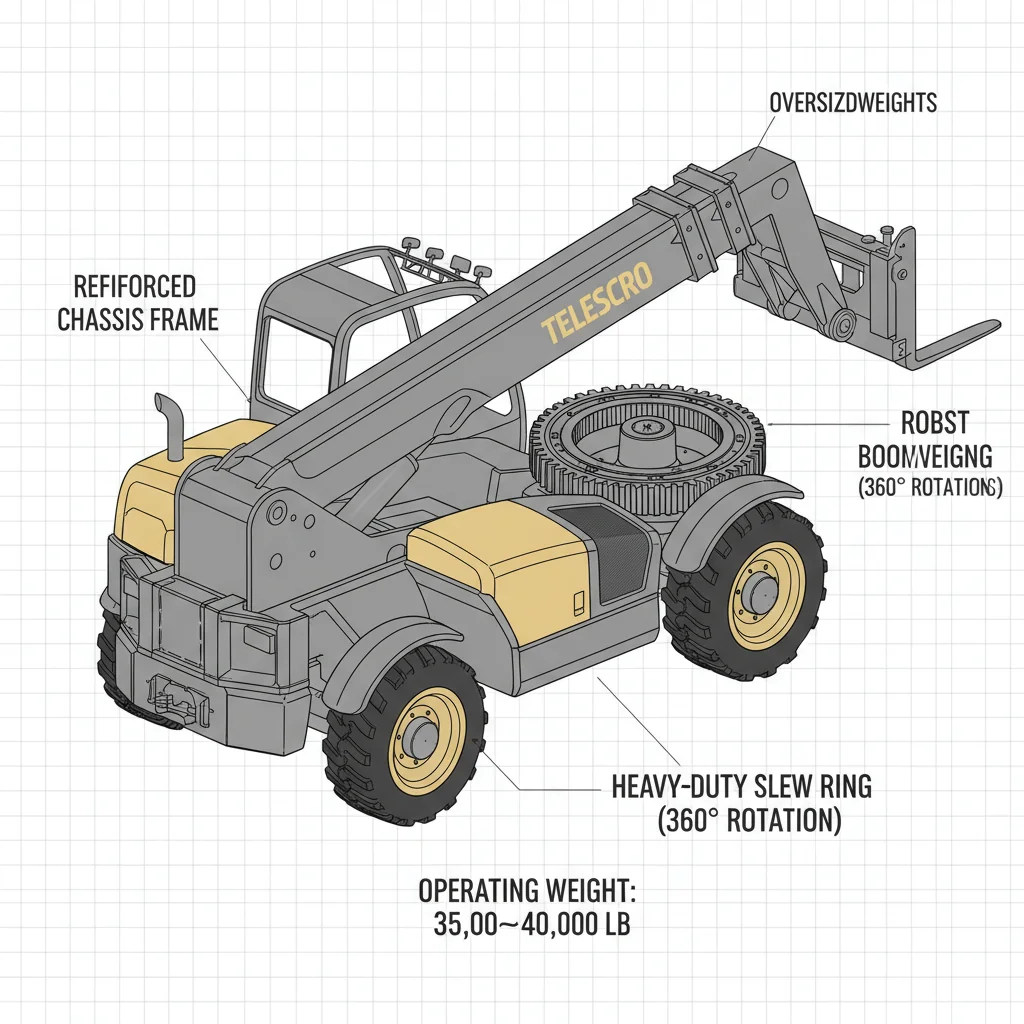
Last month, a project manager from Kazakhstan called about their new rotating telehandler—he couldn’t believe it tipped the scales at over 40,000 pounds. I get this question a lot: why are these machines so much heavier than standard models? The answer comes down to pure engineering. When you want to safely lift bundles of steel over 10,000 pounds—and swing them a full 360 degrees—you need much more than extra horsepower.
Manufacturers reinforce every major structural point. For example, the boom on a rotating telehandler is often twice as thick as one on a regular unit. The frame uses higher-grade steel plates, and the counterweight alone can weigh several tons. I’ve seen this firsthand at a port site in Dubai. Their team needed to set 15-ton precast panels nearly 20 meters away from the machine—something only a true heavy-lift telehandler can manage. But the machine’s bulk becomes a new challenge. Moving it meant special transport permits, prepping a compacted gravel pad, and running ground pressure checks.
Don’t overlook the slew ring size, either. To rotate such heavy loads smoothly, these units rely on massive slew rings—sometimes weighing as much as a compact car. Add heavier outriggers, thicker hydraulic cylinders, and a robust load moment indicator, and you’ve got a telehandler that’s closer to a mobile crane than a forklift.
From my experience, I always suggest treating these units as crane-class equipment. Check ground bearing capacity, plan for delivery routes, and bring in engineering support early. It’s the best way to keep your job running safely and on schedule.
Heavy-duty rotating telehandlers that can lift over 10,000 pounds 360 degrees often weigh more than 40,000 pounds due to the need for reinforced boom structures, counterweights, and robust chassis designs to ensure stability and safety under extreme loads.True
The significant increase in weight comes from engineered reinforcements and counterbalance systems necessary to prevent tipping or structural failure when lifting heavy loads in any direction, especially with rotating capabilities.
The primary reason heavy-duty telehandlers weigh over 40,000 pounds is because they use larger diesel engines exceeding 1,000 horsepower to generate the required lifting power.False
While powerful engines are necessary, the engine size typically ranges between 150-300 horsepower; the weight increase mainly results from structural reinforcements and counterweights rather than extremely large engines.
Key takeaway: The extra weight of high-capacity and rotating telehandlers ensures safe operation with extremely heavy or dynamically positioned loads, but it brings stricter transportation, jobsite preparation, and permitting requirements. Treat these units as crane-class assets and coordinate engineering support and logistics planning early in the project.
How Is Telehandler Operating Weight Determined?
Telehandler operating weight is the total mass of the machine fully equipped for use, including all filled fluids, standard attachments such as forks or buckets, and installed cab protection. This value differs from shipping weight, which often excludes essential components and fluids. Always reference the official CE/ID plate or technical manual for the confirmed operating weight.
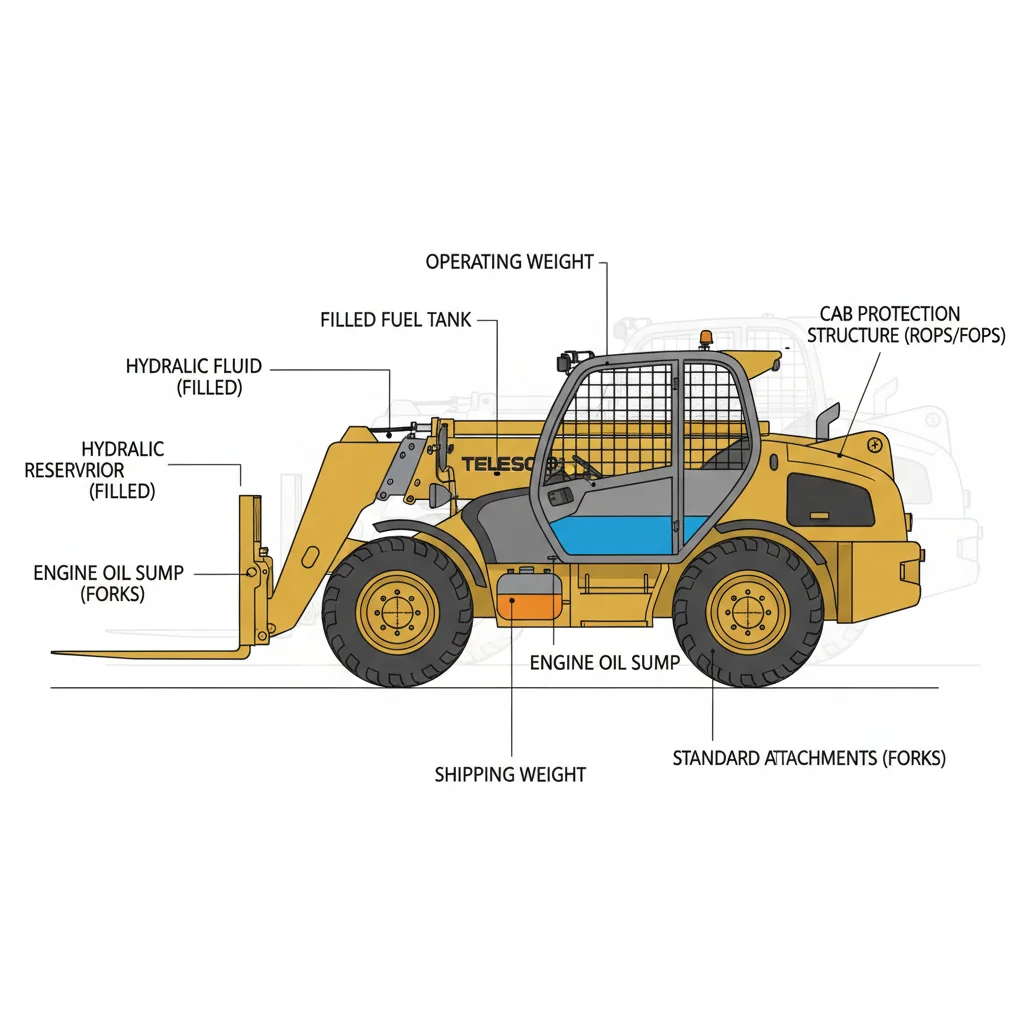
Last year, a site manager in Malaysia called me after their telehandler failed a bridge weight check en route to a new housing project. The problem? They planned logistics based on a shipping weight listed in a brochure—missing nearly 700 kg of hydraulic oil, fuel, and the standard bucket. That made their transport permit wrong and delayed the job by almost a full day. It’s a common trap, and it can get costly fast.
From my experience, manufacturers often publish three or four weight numbers: “shipping weight,” “base weight,” “operating weight,” sometimes even “gross machine mass.” Only operating weight reflects the machine as it actually works—fluids full, forks or bucket mounted, cab protection fitted. That’s the weight inspectors, transport authorities, and jobsite engineers care about. I always check the operating weight on the machine’s ID plate (usually on the frame near the cab) or in the technical manual, not the glossy brochure.
Be aware—tire choices, outrigger options, and even the type of attachment can swing the weight by several hundred kilograms. I saw a customer in Brazil choose flotation tires for soft ground. That added about 250 kg per wheel, pushing their unit into a higher permit category for road transport.
Always ask your dealer for the full operating weight—with the exact setup you’ll use—before arranging transport or jobsite crane lifts. It’s not just about safety; it’s about avoiding project delays and extra costs. I suggest double-checking every time you change attachments or options. It’s a detail that pays for itself in peace of mind.
The typical operating weight of a mid-sized telehandler includes not only the machine's chassis but also about 300 to 700 kilograms of hydraulic fluid, fuel, and a standard attachment, which manufacturers often exclude from the basic curb weight listed in brochuresTrue
Manufacturers usually report a base curb or shipping weight excluding fluids and attachments; however, the actual operating weight factors in full hydraulic oil, fuel tank capacity, and the standard bucket or forks, significantly increasing the total weight relevant for transport and site safety considerations.
The operating weight of a telehandler is primarily determined by the weight of its engine and tires, accounting for over 80% of the total machine weightFalse
While the engine and tires contribute significantly, a telehandler's weight is more evenly distributed among its boom structure, counterweights, chassis, hydraulic system, and attachments. Focusing solely on engine and tires ignores other critical components that can account for nearly half of the total operating weight.
Key takeaway: Always confirm the true operating weight of a telehandler by checking the official plate or manual, not just brochure figures. Relying on shipping weights or incomplete data can lead to costly errors in transport, site planning, and compliance with safety or legal weight limits.
Why Study the Telehandler Load Chart?
Studying the telehandler load chart is essential because rated lift capacities vary greatly depending on boom length, angle, and reach. While a model may be advertised with a “10,000 lb capacity,” actual limits can drop to 5,000 lb at maximum height or just 3,000 lb at full forward reach.
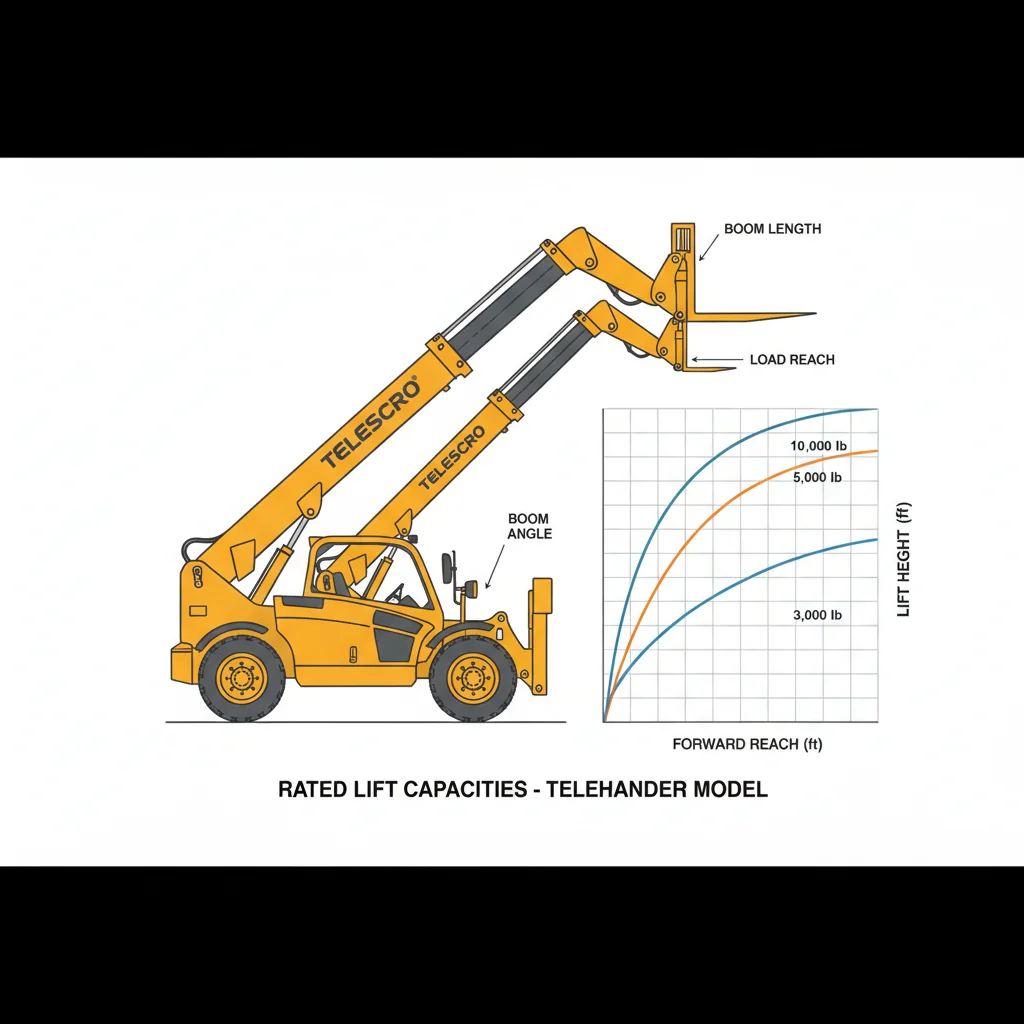
Too many fleet managers assume the big capacity number on the spec sheet is all that matters. But telehandler lifting isn’t that simple. Real lifting capacity changes9 at every position—boom up, boom out, forks tilted. I’ve seen this surprise people on jobsites in the UAE and Singapore. For example, a 4.5-ton machine rated for 10,000 lbs will confidently lift a full load close to the wheels, boom down. Raise that same boom to its max height, and you’re usually limited to about 5,000 lbs. Stretch the boom out forward for an 11-meter reach? Now you might be down to just 3,000 lbs safely—less than one-third of the headline number.
One customer in Kenya learned this the hard way. Their carpenters needed to lift 3,600 kg of roofing sheets to 13 meters. The machine was rated at 4,000 kg, so they thought they were covered. But when I checked the load chart, it could only handle 2,500 kg at that distance. They nearly overloaded the telehandler, risking a tip-over and bent boom. It was a close call, and the operator told me he’ll never skip the chart again.
I always remind teams: the load chart is your truth. It’s a grid, showing exactly how weight, height, and horizontal reach affect safe lifting. No operator should ever guess or trust the gut feeling, especially at top reach. Before you choose a model, map your real jobsite lifts—then compare against the chart. I suggest every operator get comfortable reading these charts before starting the first lift on site.
A typical 4.5-ton telehandler weighs between 12,000 and 14,000 pounds due to structural components, counterweights, and hydraulic systemsTrue
Telehandlers need substantial weight for stability and lifting capacity; the machine's own weight is often 2.5 to 3 times the rated lift capacity to ensure safe handling under dynamic loads and elevated boom positions.
The weight of a telehandler is usually less than its rated lifting capacity to maintain maneuverability on construction sitesFalse
Telehandlers are generally heavier than their lift capacity because a heavier base and counterweights are essential for balance and safety, making the machine weight exceed the rated load capacity, not less.
Key takeaway: Never rely on a telehandler’s nameplate rating alone. Always consult the manufacturer’s load chart to compare actual lift requirements—including weight, lift height, and reach—against true capacity, preventing costly tip-overs, equipment damage, and site accidents.
Conclusion
We’ve covered why telehandler weight matters and how model differences can seriously affect your planning and safety. From what I’ve seen on real jobsites, relying on general class labels or assumptions is asking for trouble—always double-check the manufacturer’s weight data before arranging transport or figuring ground pressure. If you only look at surface specs, that’s the “3-meter blind spot” I see catch even experienced crews now and then.
Need help sorting through specs or understanding how load and weight figures will impact your actual workflow? I’ve worked with customers in all kinds of conditions and am happy to share practical, pressure-free advice. Every site is different—choose what really fits your operation.
References
-
Explains how counterbalance impacts telehandler stability and lift limits, with technical depth and practical jobsite examples. ↩
-
Detailed insights on interpreting telehandler load charts to ensure safe lifting and prevent overload at various boom extensions. ↩
-
Detailed insights on legal requirements and cost implications of permits for transporting heavy telehandlers over regional limits. ↩
-
Expert explanation of lowboy trailer designs and their advantages for moving large telehandlers while meeting height and clearance restrictions. ↩
-
Explore the impact of telehandler weight on soil health, with expert insights on minimizing soil damage and preserving ground conditions. ↩
-
Understand how to assess ground bearing capacity to prevent site damage and optimize telehandler performance on various terrains. ↩
-
Explores how reinforced chassis improve telehandler strength and durability to safely handle heavier loads on construction sites. ↩
-
Details the engineering behind slew rings that allow safe full rotation under heavy loads, crucial for telehandler performance. ↩
-
Explains the impact of boom height and extension on safe lifting capacity, helping operators avoid overloads and improve jobsite safety. ↩