










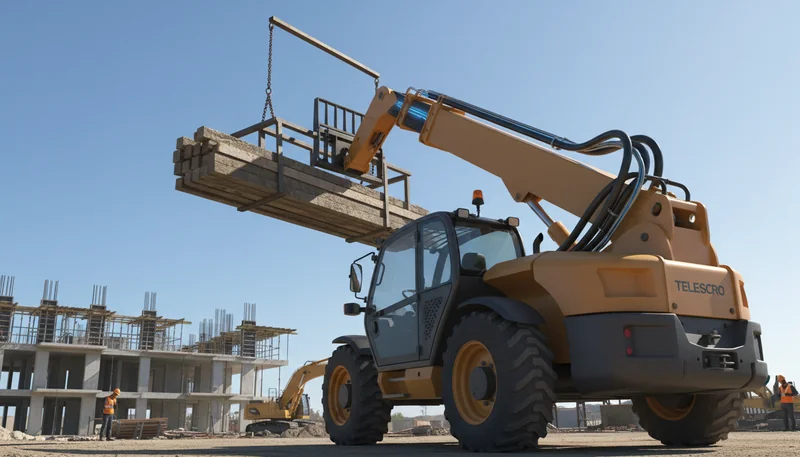
What is Telehandler Hydraulic Flow? Field Guide to System Speed & Mistakes
Just last month, I was on a video call with a crew in Germany puzzled by why two telehandlers with “identical horsepower” operated at wildly different speeds on site. Turns out, the answer had nothing to do with the engines—and everything to do with hydraulic flow.
Telehandler hydraulic flow is the volume of hydraulic oil the pump delivers per minute, typically measured in litres per minute (L/min) or gallons per minute (gpm). Flow is the main factor that sets the speed of boom lift, boom extension, and auxiliary attachment functions (and, depending on the hydraulic layout, steering response). Hydraulic pressure, measured in bar or psi, primarily determines available force—but real-world cycle speed is also influenced by load, engine rpm, and how the system shares flow between functions.
What Is Telehandler Hydraulic Flow?
Telehandler hydraulic flow refers to the volume of hydraulic oil a pump delivers per minute, measured in litres or gallons. Flow rate directly impacts how quickly telehandler functions—such as lifting, extending, or steering—operate. It represents system speed, while hydraulic pressure dictates lifting capacity and force.

Most people don’t realize that telehandler hydraulic flow is all about speed—how quickly you can lift, extend, or move the boom. It’s not about how much you can pick up. Hydraulic flow is measured in litres or gallons per minute, and it’s set by the pump inside your machine. On site in Dubai, I worked with a team handling precast panels at height. Their telehandler claimed “160 L/min flow” on the spec sheet. They assumed this meant extra lifting muscle, but when they checked the load chart, the safe capacity at full height hadn’t changed. The difference? The boom moved faster, which helped with cycle times—but didn’t let them handle heavier loads.
Here’s the thing: hydraulic pressure (measured in bar or psi) is what delivers the force for lifting. Flow just determines how quickly the oil gets to the cylinders. You can have two telehandlers with identical pressure, but the one with higher flow will lift the boom in less time. I’ve seen compact 3-ton units in Kenya offering about 110–130 L/min, while larger 4-ton models provide flows over 150 L/min. That extra speed is great when you’re doing repetitive loading or using attachments like buckets. Just be careful—not every site needs maximum flow, and higher flow can also heat up your oil faster if you’re not working continuously.
I always suggest customers check both the rated hydraulic flow and system pressure for their specific model. OEM data sheets matter here. If you really care about how much weight you can lift, focus on the load chart, not just the flow numbers.
Hydraulic flow in a telehandler determines how quickly hydraulic functions like boom extension or lift can be performed, but not the maximum weight the machine can lift.True
Hydraulic flow, measured in litres or gallons per minute, controls the speed of movement for hydraulic cylinders and motors. Actual lifting capacity is determined by hydraulic pressure and the machine’s structural design, not flow rate.
"AFalse
"Hydraulic
Key takeaway: Telehandler hydraulic flow determines the speed of machine functions, not lifting strength. Buyers often confuse flow with hydraulic power, but actual capacity depends on system pressure and rated load chart. Always consult model-specific data for flow and pressure details before comparing telehandler performance.
How Does Hydraulic Flow Affect Cycle Time?
Hydraulic flow is a key factor influencing telehandler cycle times, as it controls the speed of boom lift and telescoping functions. Higher pump flow rates supply a greater volume of oil to hydraulic cylinders per unit time, allowing lift and retraction movements to occur more quickly. In practical applications, increased flow can noticeably shorten cycle durations, enabling higher hourly throughput—provided the valves, hoses, cylinders, and cooling system are correctly sized to handle the flow.

Let me share something important about hydraulic flow and how it impacts your jobsite speed. Cycle time—the total seconds it takes to lift, extend, dump, and return for the next load—is driven mainly by the flow rate your hydraulic pump delivers. I’ve seen cases where two telehandlers with the same rated capacity feel totally different in the field. For example, last year in Kazakhstan, a customer swapped their old 3-ton handler for a new model with a higher pump flow (almost 30% more, based on the specs). Suddenly, their teams moved at least two more pallet loads per hour—without increasing lift height or capacity.
The reason is simple: greater oil flow means cylinders (especially for the boom lift and telescope) move much faster. If the main pump delivers, say, 130 liters per minute instead of 100, you get a noticeable difference. Manufacturers’ data suggests boom lift cycles could be 20%–25% quicker. On a busy site—like grain handling in Brazil or block stacking in Dubai—that adds up fast over a 10-hour shift. But, there’s a catch: The whole hydraulic circuit matters, not just the pump. If hoses or valves aren’t sized for higher flow, the machine might slow down, overheat, or even cause leaks.
Here’s my honest advice: Always check the hydraulic flow rating, not just lift specs, especially if jobsite speed matters to you. Ask for the technical data sheet—not just marketing brochures. If you’re comparing models, match the pump flow with cylinder sizes and ensure all components are properly rated. Otherwise, the best numbers on paper won’t turn into real productivity.
Increasing the hydraulic flow rate in a telehandler can noticeably reduce the cycle time for lifting and material placement without changing the machine's rated lift capacity.True
Hydraulic flow rate determines how quickly actuators (booms, buckets) can move, directly impacting how fast each function completes a cycle. However, it does not affect the maximum weight the telehandler can safely lift, since that is dictated by hydraulic pressure and structural limits.
A higher hydraulic flow rate always means the telehandler will exert greater lifting force, allowing it to handle heavier loads.False
Lifting force and load capacity are governed by hydraulic pressure and the mechanical design, not the flow rate. Flow rate only affects the speed of movement, not the force applied by the hydraulics.
Key takeaway: Hydraulic flow is the main factor driving system speed in telehandlers. Machines with higher usable flow can complete lift and loading cycles significantly faster. Always assess hydraulic flow ratings—not just lift capacity—when comparing models for productivity. Verify that valves, hoses, and coolers are sized for increased flow.
How Is Telehandler Hydraulic Flow Controlled?
Telehandler hydraulic flow control relies on operator inputs via joysticks or levers, which actuate proportional valves. These valves regulate oil flow to multiple functions, such as boom lift, telescope, stabilizers, and steering. Advanced systems use load-sensing, pressure-compensated valves2 for smoother, combined movements, while flow regulators prioritize critical operations like steering and boom safety.

Here’s what matters most when evaluating telehandler hydraulic flow: real-world controllability is just as important as raw pump output. Many buyers focus on engine horsepower or maximum flow rates, but those figures don’t help if the operator can’t feather the controls precisely on the jobsite. The engine spins a hydraulic pump, but it’s the proportional valves—linked to the joysticks and levers in the cab—that actually decide how much oil reaches each function. This means a skilled operator has direct control over boom lift, telescoping, steering, stabilizers, and any auxiliary lines—just by how far they move a lever.
I’ve worked with contractors in Kazakhstan and South Africa who run heavy concrete panels—often right on the limit of rated capacity. They tell me the difference between a smooth valve and a jerky one can mean minutes lost on every cycle, or worse, damaged product. Older telehandlers with basic valves tend to “jump” if you try to do fine placement, especially when combining actions like lifting and extending at the same time. Modern models now use load‑sensing, pressure‑compensated valves that adjust flow instantly, even under changing demand. This lets operators perform multiple movements smoothly—like lifting the boom while extending and steering around an obstacle—without sacrificing accuracy.
Don’t just check flow specs on paper; test the actual machine. I always suggest trying combined movements and very slow feathering when demoing a telehandler. That’s how you’ll spot the differences in fine control, especially if you work with fragile loads or tight spaces. And remember, system pressure and tank capacity are model-specific—always check the technical data sheet before making a decision.
Telehandler hydraulic flow can be finely controlled by proportional valves, which adjust oil supply to each function in response to operator input, allowing for precise movements regardless of maximum pump output.True
Proportional valves translate the operator's joystick or lever inputs into varying hydraulic flow rates, enabling tasks that require delicate handling or slow, controlled motions—even if the system is capable of higher flow rates. This is crucial for safety and efficiency on the jobsite.
Increasing the engine horsepower of a telehandler will always result in better control over hydraulic function speeds and precision.False
While higher engine horsepower can enable greater maximum hydraulic pump output, it does not directly translate to improved controllability of hydraulic functions. Actual control and precision depend on the hydraulic circuit design and valve technology, not just engine power.
Key takeaway: Telehandler performance depends on both pump output and precise hydraulic flow management. Operators influence system speed and accuracy through proportional valve control, while modern load-sensing valves deliver reliable, smooth movements—especially during combined actions. Always evaluate slow, fine feathering and combined controls during machine selection.
How Much Hydraulic Flow Do Telehandlers Provide?
Mid-size telehandlers typically provide hydraulic pump flows in the range of 120–150 L/min (approximately 32–40 gpm) at rated engine speed, with system working pressures commonly around 220–250 bar. Actual delivered flow and pressure vary by model, hydraulic configuration, and optional packages. Many modern machines use load-sensing axial-piston pumps3, which automatically adjust output based on demand to improve efficiency, controllability, and responsiveness during real jobsite operation.

To be honest, the spec that actually matters is how much hydraulic flow the telehandler can deliver where you actually use it—not just the maximum number stamped on the brochure. Mid-size telehandlers, especially in the 3-4 ton range, usually claim between 120 and 150 liters per minute at full engine speed. But on real jobsites, I see machines rarely run flat out all day. You often work just above idle—say, 1,600 to 1,900 rpm—which means your real world hydraulic flow is a bit less. That drop can affect your boom speed or how responsive the controls feel when shifting between tasks.
A contractor I worked with in Dubai hit this issue during concrete deck work. Their team used a telehandler with a rated 140 L/min pump, thinking it would easily handle a bucket and a rotating fork side-by-side. In practice, at the rpm they liked to run to save fuel, usable flow hovered closer to 110 L/min. Boom operation was slower than expected, especially with two functions moving. I explained that not all 140 L/min pumps feel the same—load-sensing systems make a big difference. These pumps automatically adjust flow to what you need, ramping up for multiple functions, then dropping output (and fuel burn) when you pause.
I always suggest asking dealers for the hydraulic flow curve—or at least the usable L/min at your typical working rpm. Don’t shop by maximum brochure specs alone. For frequent multi-function work, telehandlers equipped with load-sensing axial-piston pumps are usually a better choice. These systems adjust output to real demand, improving controllability and, in many duty cycles, reducing unnecessary fuel consumption compared with traditional fixed-displacement gear-pump systems. Over a year of operation, this efficiency difference can translate into meaningful operating cost savings.
Actual hydraulic flow available from a telehandler decreases at lower engine speeds because the hydraulic pump output is directly tied to engine rpm.True
Hydraulic pumps on telehandlers are typically engine-driven, so as rpm drops (such as when idling or running at partial throttle), the available flow rate drops accordingly, meaning operators often experience less flow than the brochure maximum.
A telehandler will deliver its maximum rated hydraulic flow regardless of what engine speed it is running at.False
Maximum hydraulic flow is only possible at or near rated engine speed because the hydraulic pump output depends on engine rpm; at lower speeds, the flow delivered is noticeably less.
Key takeaway: Telehandler hydraulic flow depends on model size, pump type, and operating rpm. Maximum pump flow is less important than usable flow at practical engine speed for field productivity. Always consult OEM data or flow curves, and prioritize models with load-sensing pumps for fuel efficiency and control.
How to Match Hydraulic Flow to Attachments?
Matching hydraulic flow to attachments ensures tools operate within specified parameters for speed and reliability. Each attachment lists a required flow range, such as 80–110 L/min at 180–230 bar. Always verify the telehandler’s auxiliary flow at the quick couplers4 meets these requirements to prevent underperformance or equipment stress.
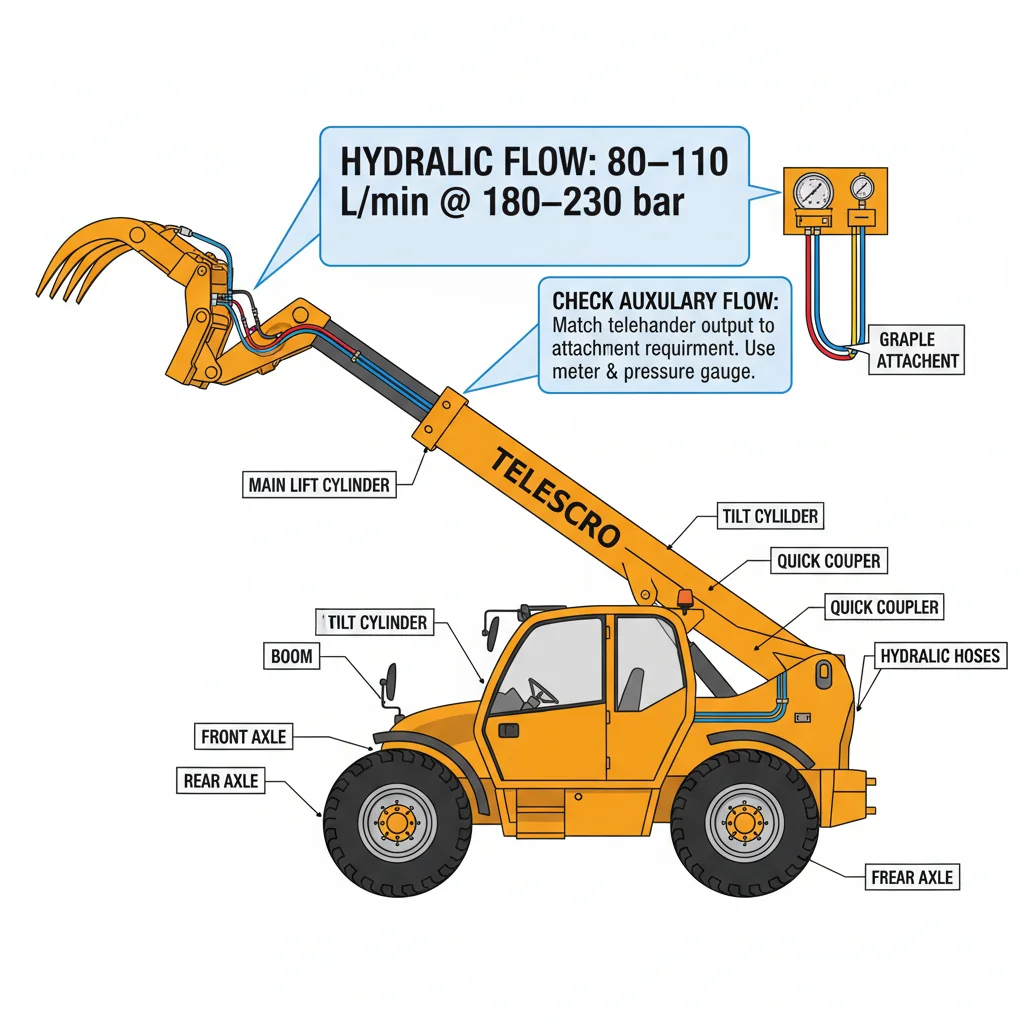
The biggest mistake I see is operators assuming the main hydraulic pump flow5 is the same as what reaches their attachment at the quick couplers. That’s rarely true—especially on machines with longer booms or extra hydraulic functions. For example, I had a customer in Kazakhstan who wanted to power a heavy-duty mulcher. His telehandler’s pump was rated at 140 L/min, but only about 105 L/min made it to the boom head. The attachment needed at least 120 L/min to work well. Result? The mulcher barely spun, overheated, and they lost two days fixing blown seals.
That’s why you should always match the auxiliary flow at the couplers to the attachment spec. Here’s what I check before recommending any hydraulic tool:
- Look at the attachment spec sheet: Every hydraulic tool lists a required flow (for example, “80–110 L/min @ 200–230 bar”). Make sure you have both flow and pressure.
- Check the telehandler’s aux flow “at the head”: This is usually found in the technical data, not the big marketing brochure. Often, it’s 20–30% less than pump output.
- Compare actual flow to tool needs: If your tool asks for 90–110 L/min and your machine provides only 70 L/min at the coupler, you’ll see slow, weak operation.
- Consider control settings: Some telehandlers let you adjust max flow from the cab. Set it to suit the attachment—too much flow causes heat, too little means lost productivity.
I suggest contacting your dealer for actual “at the coupler” data before buying any hydraulic attachment. This one detail keeps jobs running smoothly—and saves you serious repair costs.
Hydraulic flow losses between the main pump and the attachment can be substantial on telehandlers with longer booms or multiple auxiliary circuits.True
The hydraulic fluid must travel through hoses, valves, and connectors to reach the attachment, and longer distances or more complex routing increase resistance and internal leakage, reducing the flow available at the tool.
If the main hydraulic pump is rated for a specific flow, every attachment at the coupler will always receive close to that same flow regardless of configuration.False
The actual flow at the quick coupler is typically lower due to internal restrictions, hose length, and additional circuit losses in the hydraulic system.
Key takeaway: Always consult both the attachment flow requirements and the actual auxiliary flow available at the telehandler’s quick couplers—not just the pump’s rated output—before purchasing or operating hydraulic tools. Failure to match flow leads to slow operation, excessive heat, or potential equipment damage.
Is High-Flow Hydraulic Worth It?
High-flow hydraulic packages on telehandlers deliver up to 120–150 L/min, supporting high-demand attachments like mulchers and large brooms. However, for users mainly lifting pallets or handling bales, standard auxiliary flow6 (80–100 L/min) typically provides sufficient system speed without added cost, fuel draw, or unnecessary system complexity.
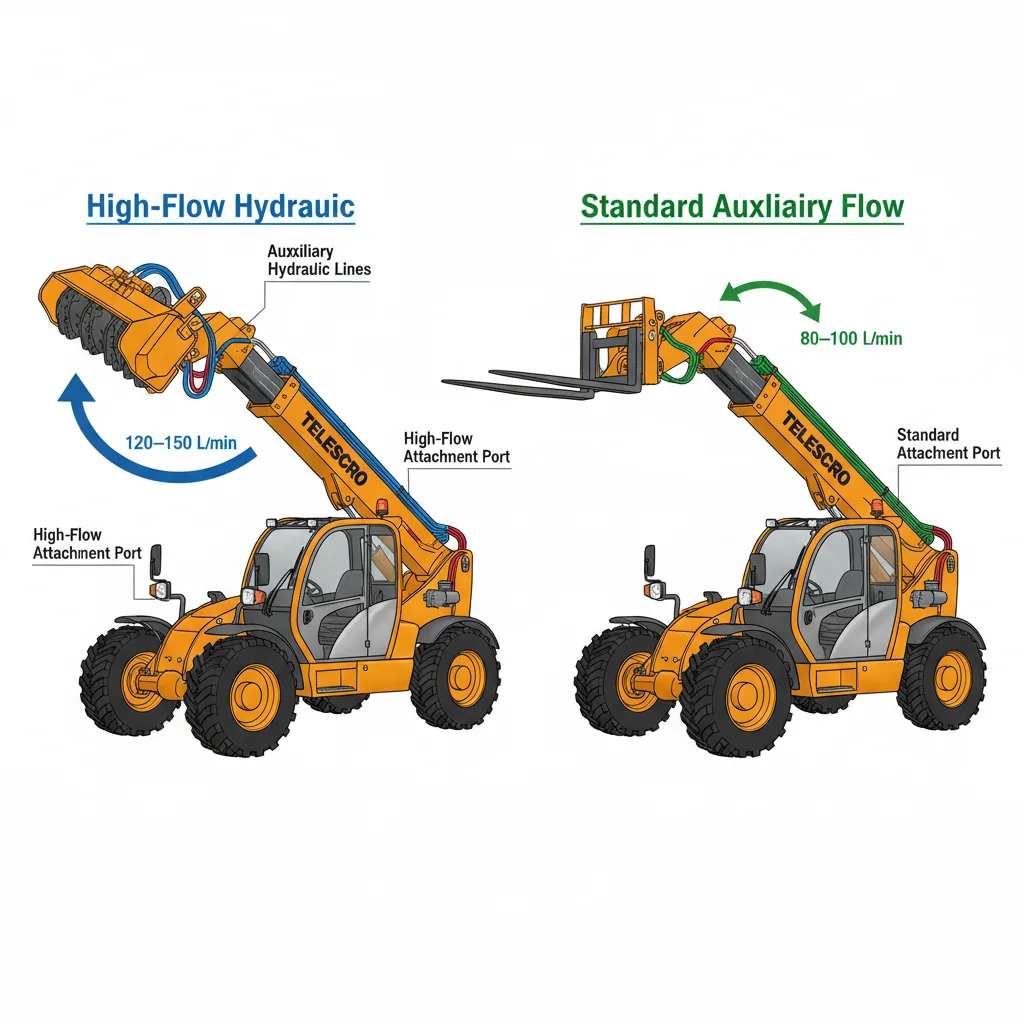
The biggest mistake I see is operators choosing high-flow hydraulics just because it sounds impressive, not because their work actually demands it. On paper, seeing “120 or 150 liters per minute” feels like a big upgrade over standard auxiliary flow—but unless you’re pushing mulchers through thick brush or running wide brooms all day, that extra flow often goes unused. Last year, I worked with a crew in Kazakhstan who invested in high-flow for their 4-ton, 13-meter telehandlers. After six months, over 85% of their hours were spent moving concrete blocks and handling pallets. When we reviewed their fuel records, their machines used noticeably more diesel, but their average cycle speed didn’t change much. They could have saved real money sticking to standard flow.
Think about what you’re attaching to your boom. High-flow is designed to run large attachments—mulchers that shred trees, big snow blowers, or brooms sweeping runways. If these make up at least 30% of your annual work hours, the extra cost and complexity may pay off—faster attachment speed can mean finishing big jobs a day or two sooner. But for mostly forks, bales, or moderate bucket work, standard flow—usually in the 80–100 L/min range—is more than enough. You’ll still lift rated loads safely and keep your hydraulic oil cooler, with less wear on pumps and hoses.
I always suggest tracking your real attachment hours. Before you choose the high-flow option, ask yourself: how often is my telehandler actually driving a high-demand tool? If that number is low, standard flow keeps things efficient and simple—without paying for flow you rarely use.
High-flow hydraulics on a telehandler are essential only if you regularly use high-demand attachments like forestry mulchers or large cold planers.True
High-flow hydraulic circuits are specifically designed to supply extra oil flow required by power-hungry attachments. Most standard-duty attachments function perfectly well on standard auxiliary flow, making the high-flow option unnecessary for many users.
Upgrading to high-flow hydraulics will automatically increase the lifting capacity of your telehandler.False
Lifting capacity is determined by the telehandler’s structural design and stability, not by hydraulic flow rates. High-flow hydraulics primarily increase attachment performance, not the machine’s ability to lift heavier loads.
Key takeaway: High-flow hydraulic options are valuable only if a significant portion of telehandler use involves demanding attachments. For predominantly pallet or light material handling, standard flow minimizes fuel consumption and system wear. Always base upgrade decisions on actual attachment hours, not just advertised flow rates.
How to Read Telehandler Hydraulic Flow Specs?
Telehandler hydraulic flow specs should be read with care. Auxiliary flow at the boom head, not pump flow, determines attachment performance. Flow rates are also impacted by actual engine rpm, often lower than brochure figures. Always request measured auxiliary flow at the quick couplers, specifying rpm and pressure, for a valid performance comparison.
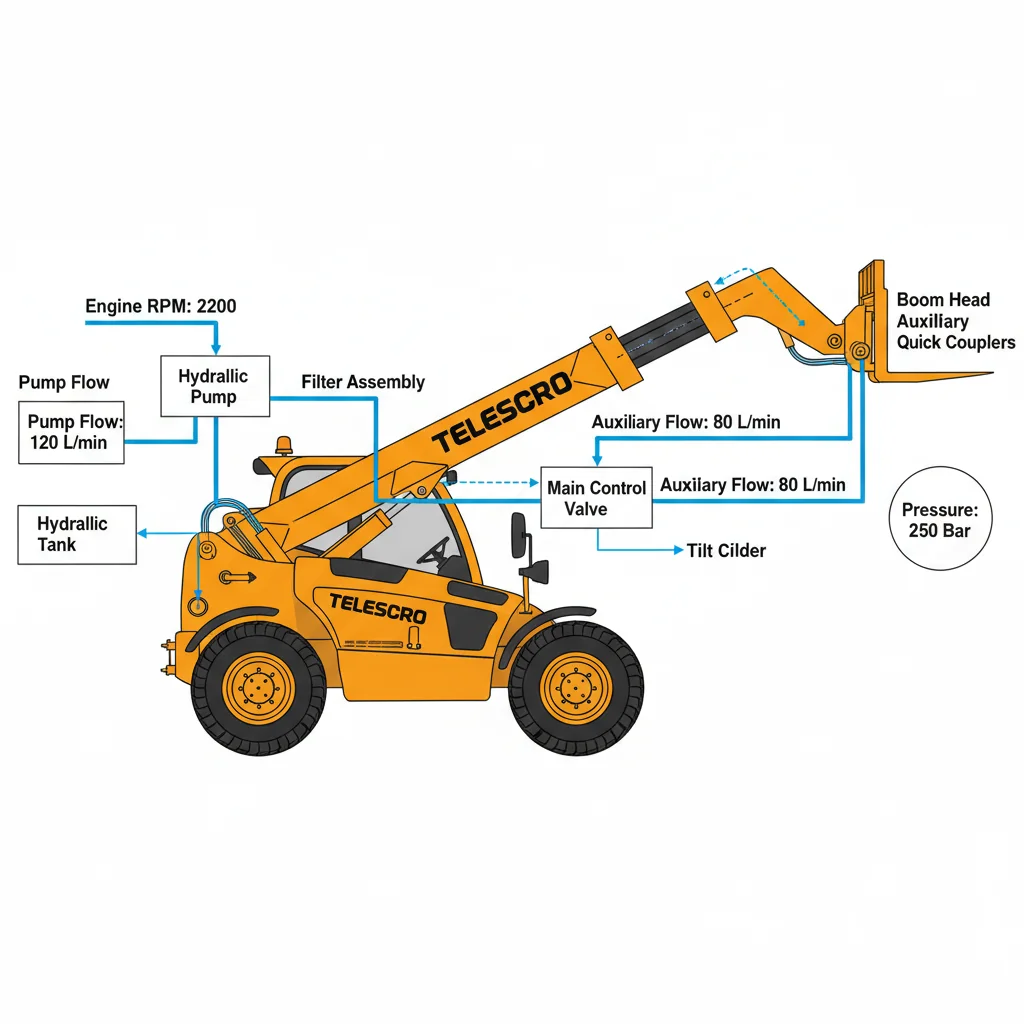
Last month, I spoke with a contractor in Dubai who struggled with a new hydraulic broom attachment. The telehandler’s brochure listed a 140 L/min hydraulic pump, but the broom didn’t spin at full speed. The issue? That spec was just pump flow at maximum rpm—not actual auxiliary flow at the tool. At the quick couplers, he was only getting around 100 L/min at the typical working rpm of 1700, which wasn’t enough for that attachment. I see this problem a lot, especially with jobsites running attachments like concrete mixers or large augers that require a steady flow.
One thing I always point out is the difference between pump flow and what your tool really receives. Restrictions like valve size, hose routing through the boom, and even connector sizes can shave off 20% or more from what’s on paper. Also, many spec sheets show flow rates at engine speeds most operators never hit during normal work. For example, in Brazil, a customer believed their high-pressure washer would run fine because the system claimed 130 L/min—but that was at 2200 rpm. On their typical site, engines rarely go above 1800 rpm, so measured flow at the attachment was closer to 95 L/min.
I recommend you request actual measured auxiliary flow at the quick couplers, taken at a specific engine rpm and pressure, before deciding if an attachment will work. That’s the number that matters in real jobs. Every telehandler model is different, so double-check those figures—don’t rely on brochure promises. It will save a lot of onsite headaches later.
The hydraulic flow spec listed in a telehandler's brochure often represents the maximum pump output at high engine rpm, not the actual auxiliary flow available at the attachment couplers during typical operation.True
Brochure specs usually show the theoretical max pump capacity, but real-world auxiliary flow is reduced by factors like engine rpm, hydraulic circuit losses, and prioritization of other machine functions. Operators must check actual flow at the quick couplers for attachment compatibility.
Any attachment that matches the maximum hydraulic flow listed in the telehandler specs will always operate at full efficiency on the machine.False
Maximum flow specs don't guarantee real delivered flow at attachments, as actual output can be significantly lower during normal operation due to engine speed, system diversion, and losses. Relying solely on brochure figures can lead to underpowered or slow-running attachments.
Key takeaway: Hydraulic flow specs on telehandler brochures can be misleading. Focus on auxiliary flow at the quick couplers and ensure measurements are at realistic engine rpm. Always request precise data from the manufacturer to ensure attachment compatibility and accurate field performance evaluation.
What Risks Come With Higher Hydraulic Flow?
Higher hydraulic flow in telehandlers results in faster boom and attachment movements, which can increase productivity but also raise the risk of sudden load shifts, overshooting, and destabilization. High flow can overload smaller or older attachments, potentially causing overheating or hose failures, especially on rough terrain or with inexperienced operators.
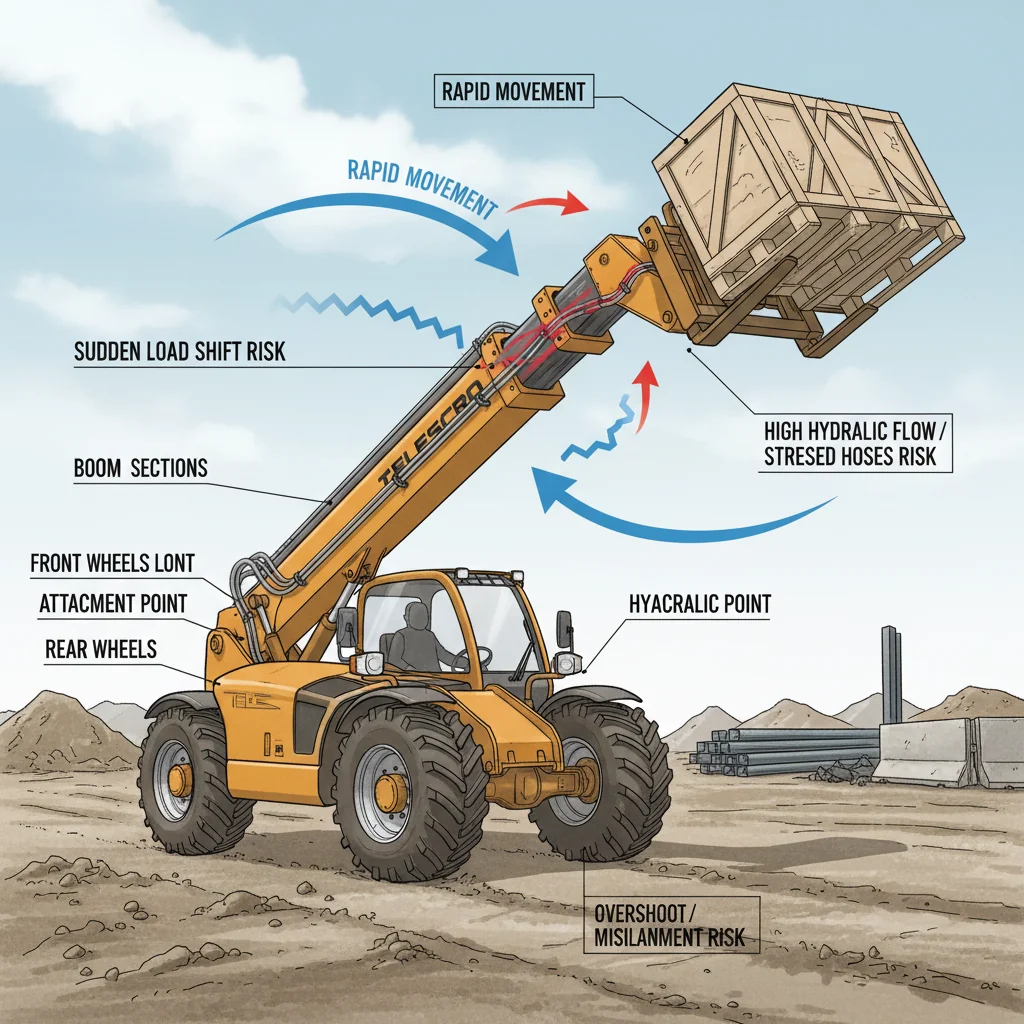
One thing I always ask customers: “Who’s actually running your machine, and how much rush is the job in?” Faster hydraulic flow sounds attractive, but it’s not always a direct upgrade—especially on busy, uneven worksites. More flow means the boom and attachments move quicker, but that can also make handling less forgiving. In Dubai, I worked with a crew using a 4-ton telehandler with a 140 L/min hydraulic system. They nearly lost a load of bricks when an inexperienced operator overshot the pallet position. Fast reaction can catch even a skilled operator off guard, especially if the ground is rough. The machine felt “nervous,” always wanting to jump ahead. That boosts productivity if you’re careful, but it’s a real risk for teams still learning the controls.
High flow creates another big issue: older or lighter attachments aren’t always rated for the extra oil and speed. I’ve seen cases in Brazil where a quick-coupler bucket got so hot from overpressure, the hose seals failed halfway through a shift. When hoses burst or parts overheat, you not only face downtime—the repair bills add up quickly. Always check the attachment’s maximum flow rating against your telehandler’s spec sheet. If the numbers don’t line up, you risk both equipment and safety.
I suggest looking for machines with good proportional joystick controls, so operators can “feather” movements. Features like max auxiliary flow adjustment and boom suspension make a big difference. On jobsites with mixed experience levels, I always recommend capping the hydraulic flow in the settings and focusing on practical operator training. It’s not just about speed—it’s about control.
Higher hydraulic flow in a telehandler can lead to more abrupt and less controllable movements of the boom, especially if the operator lacks experience.True
Faster hydraulic flow increases the speed of the boom and attachments, which can make fine control more challenging, particularly on uneven ground or for less skilled operators.
Increasing hydraulic flow always improves lifting capacity because the system can move heavier loads more quickly.False
Hydraulic flow mainly affects the speed of movement, not the maximum lifting capacity, which is determined by system pressure, structural limits, and load charts.
Key takeaway: While higher hydraulic flow boosts telehandler speed and productivity, it introduces significant safety risks such as unstable movements and mechanical failures. Operators must consider machine controls, attachment ratings, and train staff on safe practices. Always match hydraulic flow settings with operator skill and jobsite conditions.
How Does Hydraulic Flow Affect Telehandler Longevity?
Hydraulic flow directly determines power draw, fuel consumption, and heat generation within a telehandler. Increased flow at typical working pressures causes higher engine loading, additional fuel use, and greater heat input into hydraulic oil. Sustained high-flow operation accelerates oil degradation7, shortens hose and seal life, and can lead to performance loss unless cooling and service are adequate.
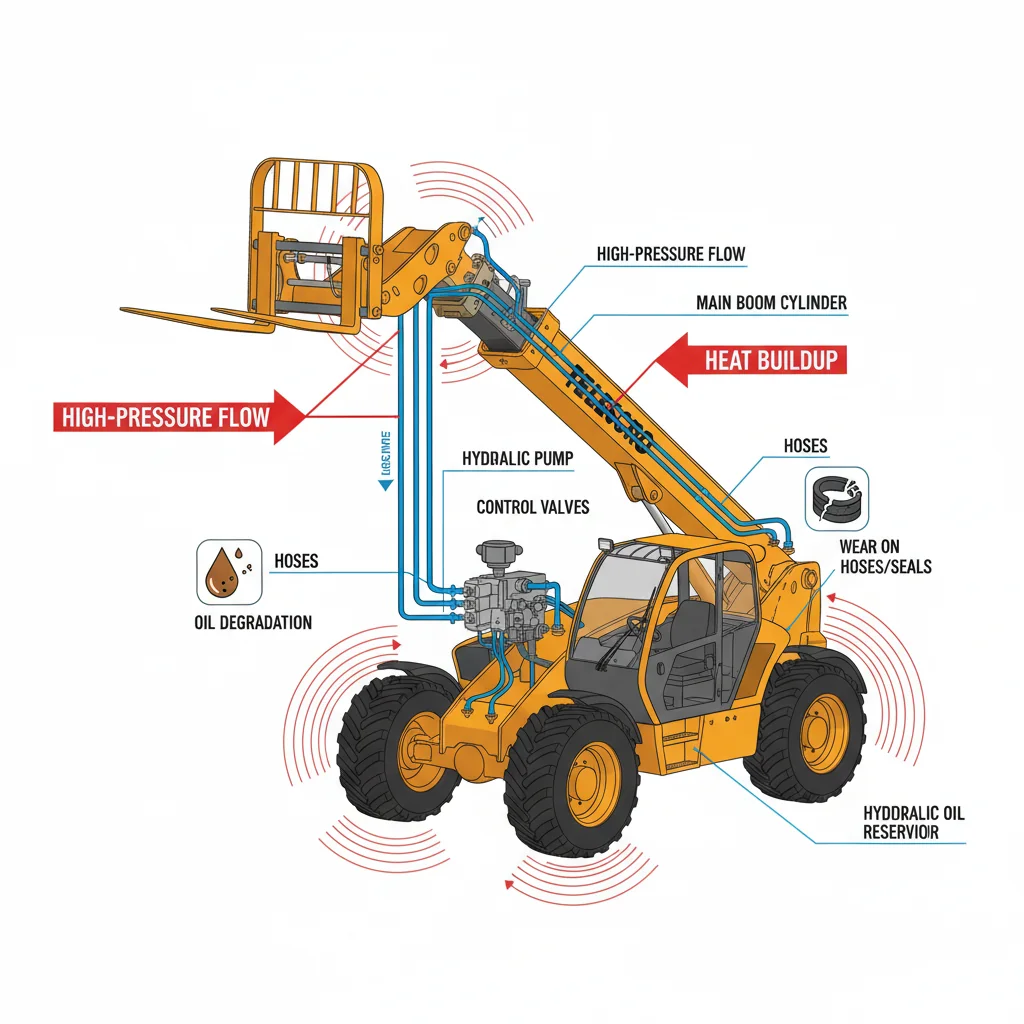
The biggest mistake I see is operators running high-flow hydraulic attachments—like mulchers or saws—without paying close attention to cooling and maintenance. Last year, I supported a road crew in eastern Kazakhstan. They used a mid-sized telehandler with a mulcher head for six hours straight, day after day. The oil temperature ended up climbing at least 15 °C above the recommended range. Within three months, they noticed soft hoses, sticky valves, and hydraulic oil that smelled burnt. The machine’s lift speed dropped and the attachment power faded during long jobs.
Hydraulic flow isn’t just about faster boom movement—it also increases fuel demand and heat generation as more oil is forced through the circuit at working pressure. For example, operating around 120 L/min at roughly 230 bar represents a substantial power draw on the engine, on the order of several tens of kilowatts. When high-demand attachments push flow and pressure higher, thermal effects can build quickly.
Elevated oil temperatures reduce viscosity, which increases internal leakage and accelerates wear. Over time, sustained high-temperature operation shortens the service life of hoses, seals, and valve components. In hot climates such as the Middle East, I’ve seen hydraulic hose aging accelerate noticeably—sometimes requiring replacement far earlier than expected when oil coolers and radiator fins aren’t kept clean.
If you plan continuous high-flow work, be honest about your needs right at the purchase stage. Make sure the oil cooler is sized for the job, not just the spec sheet. I always suggest using HVLP 46 oil unless you’re in a region where winter brings serious freezing. Most important—keep up on hydraulic filter changes, clean those cooler fins weekly, and sample your oil each season. It’s a small investment that can double your machine’s reliable working life.
Consistently running a telehandler at excessive hydraulic flow rates without proper cooling can accelerate degradation of seals and hoses, resulting in early hydraulic system failure.True
Hydraulic components like seals and hoses are sensitive to heat generated by high flow rates. If the hydraulic fluid overheats due to inadequate cooling, it causes materials to soften, wear prematurely, or degrade, ultimately shortening component lifespan.
Hydraulic flow rate has no significant impact on telehandler longevity as long as the system pressure remains within recommended limits.False
Even if operating pressure is acceptable, excessive flow generates more heat and turbulence in the system. Over time, this can damage hydraulic components regardless of system pressure, making flow control critical for longevity.
Key takeaway: Hydraulic flow in telehandlers must be managed carefully to prevent excess heat, increased fuel burn, and premature wear of vital components. For demanding, continuous high-flow tasks, prioritizing cooling capacity, correct oil grade, and proactive maintenance is critical to maintain efficiency and extend machine life.
How to Diagnose Slow Hydraulic Flow?
Slow or weak telehandler hydraulics usually indicate loss of hydraulic flow, not insufficient engine power. Causes include worn pumps, blocked suction strainers, sticky valves, or internal leakage. Accurate diagnosis requires a hydraulic flow test with a flow meter and load valve, comparing actual pump output at set pressure to OEM benchmarks.
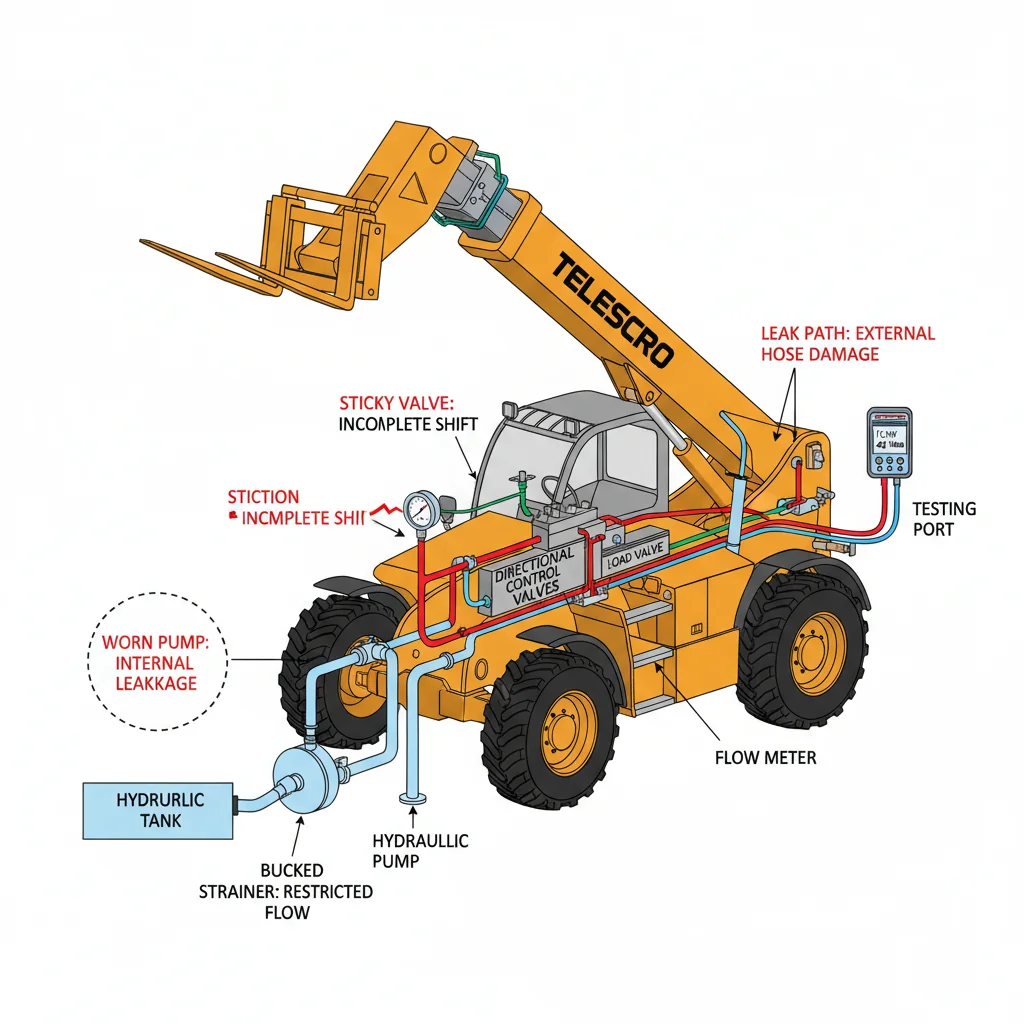
The biggest mistake I see is jumping to conclusions about engine power when a telehandler starts running slow or feeling weak on the controls. It’s actually much more common to lose hydraulic flow—especially after a few years of heavy use. I’ve worked with teams in Dubai and South Africa who spent weeks swapping filters, cleaning radiators, and even considering an engine overhaul, only to discover a worn hydraulic pump8 was quietly robbing them of flow. That’s why I always start with a flow test. With the right meter and load valve, you check exactly how many liters per minute the pump can deliver under real pressure—like 200 bar at normal operating rpm.
Last year in Brazil, a concrete contractor called me about his 4-ton telehandler. The boom moved sluggishly, even after a fresh oil change and new filters. We set up a flow meter and at 210 bar, the pump only pushed 85 L/min instead of the normal 120. The root cause? Internal wear and a partially clogged suction strainer. Fixing the pump and cleaning the strainer brought the hydraulics back to life in a single afternoon—far less downtime than a wild-goose chase through the engine or valves.
The key is to always measure and compare against your specific machine’s OEM flow spec—not a generic number. I suggest recording a baseline flow test when you get a new or newly serviced telehandler. Repeat that same test every few years, especially for high-hour machines. It’s the smartest way to track performance and prevent surprises on your jobsite.
Performing a hydraulic flow test is more effective at diagnosing a slow telehandler than simply checking the hydraulic pressure.True
Hydraulic flow directly relates to the speed and responsiveness of telehandler functions. Pressure testing alone can miss problems like internal pump wear that reduce flow while pressure remains within specification.
A partially clogged radiator is the most common cause of slow hydraulic movement in aging telehandlers.False
While cooling issues from clogged radiators can contribute to occasional overheating and performance loss, the most frequent root cause of slow hydraulic movement is internal wear in the hydraulic pump, which reduces flow over time.
Key takeaway: Diagnosing slow telehandler hydraulics starts with a flow test, not guesswork. Comparing actual flow against new-machine baselines identifies flow loss sources early, avoiding unnecessary engine or pump replacements and reducing costly downtime. Always reference model-specific OEM specifications for accurate system evaluation.
What extra hydraulic checks for imports?
Import telehandlers, particularly some Chinese models, may list only optimistic hydraulic pump figures. Before purchase, request tested auxiliary hydraulic flow9 at the boom head, hose and coupler sizes, and a factory test report or video. Actual attachment performance depends on measured flow at the auxiliary quick couplers10, not just datasheet numbers.

I’ve worked with customers in Kazakhstan and South Africa who ran into big problems with import telehandlers that looked great on paper—but couldn’t power attachments like mulchers or hydraulic sweepers as expected. The issue? The sales brochure listed “maximum system flow” from the hydraulic pump, but the actual flow at the auxiliary quick couplers—right at the boom head—ended up much lower. In some cases, skinny hoses or undersized quick couplers dropped real flow by at least 15%. That’s enough to make a high-flow broom stall or a mulcher spin weak, even though the pump itself met the spec.
Here’s what matters most: make the supplier prove the actual auxiliary hydraulic flow at the coupler, measured at a steady rpm and working pressure. Ask for a simple test report or short video showing the real liters per minute delivered to the boom head. One team I worked with in Dubai caught a problem early—they requested a coupler flow test for a 3.5-ton telehandler (rated at 100 L/min on paper). The result at the boom head came out closer to 78 L/min. That’s a huge drop on demanding attachments. Thanks to that check, they avoided a costly mismatch.
Don’t forget hose and quick coupler size—go for at least 1/2" hoses on anything needing over 80 L/min. For import or lower-cost units, never rely on pump specs alone. I always suggest putting proven auxiliary flow at the couplers high on your checklist, especially if your job involves demanding hydraulic tools. It will save you stress—and money—down the line.
The hydraulic flow available at the telehandler's auxiliary quick couplers can be significantly lower than the pump's rated maximum flow due to restrictions in hoses, fittings, or undersized couplers.True
This is true because the overall hydraulic system must deliver flow from the pump to the end of the boom, and bottlenecks like narrow hoses or small couplers increase resistance and reduce the flow that reaches attachments.
If the sales brochure lists a telehandler's maximum system flow, you can assume that same flow will always be available at the auxiliary quick couplers for any attachment.False
This is false because the flow at the attachment-side auxiliary couplers is often less than the system maximum due to friction and restrictions along the hydraulic path, which must be checked separately to ensure adequate tool performance.
Key takeaway: Proven auxiliary flow at the couplers is critical for attachment-heavy telehandler work. For import or low-cost units, always verify flow at the boom head—not just brochure specs—to prevent underperformance with demanding tools like mulchers, brooms, or blowers.
Conclusion
We’ve gone through what hydraulic flow means for telehandlers and why it matters for machine speed, not just lifting strength. From what I’ve seen on real jobsites, the difference between a smooth workday and unexpected delays usually comes down to understanding both the flow and pressure numbers—not just comparing them on spec sheets. That’s the “3-meter blind spot” many buyers miss by focusing only on top-line specs.
If you’re unsure about interpreting load charts or want to double-check parts support in your market, feel free to reach out. I’ve worked with crews in all sorts of conditions and I’m always happy to share what works in the field. Every site runs differently—let’s find what fits yours best.
References
-
Understand how hydraulic flow rate affects boom speed and control responsiveness, critical for optimizing telehandler performance onsite. ↩
-
Explores advanced valve technology that balances flow for combined movements, improving safety and operator control on telehandlers. ↩
-
Explore how load-sensing axial-piston pumps enhance efficiency and responsiveness in telehandler hydraulics with real-world examples. ↩
-
Learn expert methods to accurately measure auxiliary flow at couplers, ensuring hydraulic attachments perform efficiently without damage. ↩
-
Explains differences between rated pump flow and real-world flow at attachments, highlighting common issues and testing methods. ↩
-
Compares standard auxiliary flow benefits and limitations, helping operators decide the most fuel-efficient and cost-effective hydraulic option. ↩
-
Learn the effects of heat and sustained flow on oil degradation, signs of damage, and maintenance tips to extend hydraulic system life. ↩
-
Explains the impact of a worn hydraulic pump on flow loss and sluggish hydraulic controls, helping troubleshoot common telehandler problems. ↩
-
Explains why testing actual auxiliary hydraulic flow at the boom head prevents underperformance with attachments on imported telehandlers. ↩
-
Details how hose size and quick coupler specifications impact hydraulic flow and the efficiency of telehandler attachments. ↩