










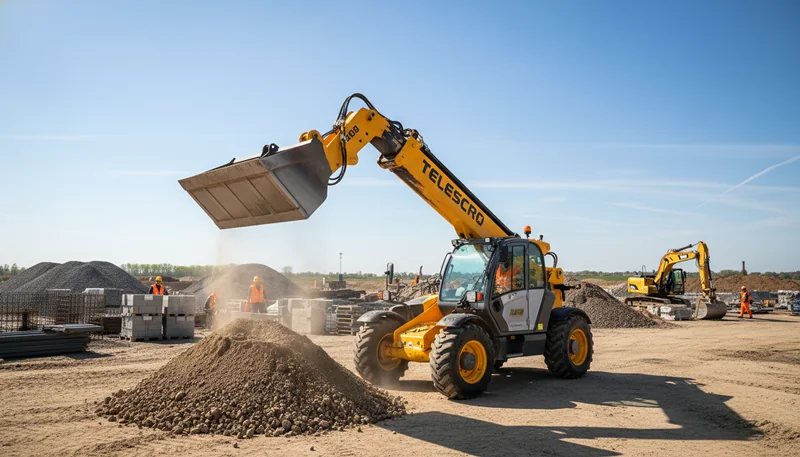
What is Telehandler Bucket Breakout Force? Field Guide for Buyers
Not long ago, I got a video call from a French jobsite where a crew was trying to break into a mound of packed gravel with a brand-new telehandler and bucket. The operator was frustrated—not because the machine couldn’t lift, but because the bucket just wouldn’t dig in. Moments like that really highlight how easily “breakout force” gets misunderstood.
Bucket breakout force on a telehandler refers to the maximum force applied at the bucket’s cutting edge when the bucket is crowded back with the boom fully retracted and close to ground level. This value describes the machine’s effective digging or penetration capability during loading, measured under controlled test conditions defined by the manufacturer rather than its lifting capacity.
What Is Telehandler Bucket Breakout Force?
Bucket breakout force is the maximum force applied at a telehandler’s bucket cutting edge when the bucket is crowded back with the boom fully retracted near ground level. It describes the machine’s ability to penetrate and load dense material, not its vertical lifting capacity. For typical 3–4 t telehandlers, breakout force commonly falls in the 60–80 kN range.
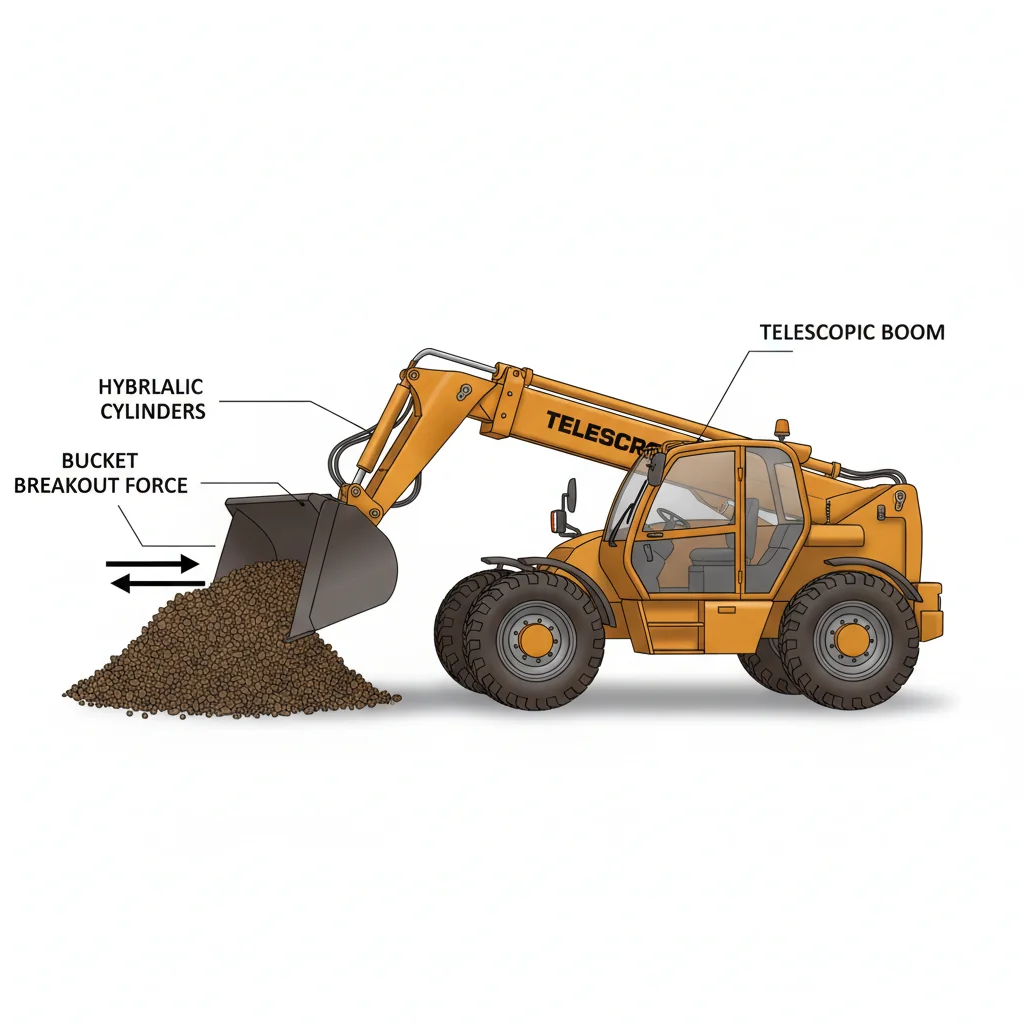
Most people don’t realize that bucket breakout force is unrelated to how much a telehandler can safely lift. Instead, it describes how much force the machine can apply at the bucket cutting edge when curling the bucket back with the boom lowered and fully retracted. On typical 3–4-ton telehandlers, breakout force commonly falls in the 60–80 kN range. This level of force indicates how effectively the machine can penetrate dense materials such as compacted gravel, wet clay, or frozen soil under ground-level loading conditions.
Let me share something important about how this actually plays out on site. I had a customer in Brazil moving packed manure from concrete pits. They tried a compact telehandler with only 55 kN breakout and found it struggled to fill the bucket—especially as the pile got denser down low. Upgrading to a 75 kN model made loading much faster, and their operator said the hydraulic circuit felt much less stressed. But here’s the thing: even with big power at the bucket, the telehandler’s safe lifting capacity hasn’t changed at all. That’s still governed by the load chart, which shows what you can safely handle at each height and reach.
Breakout force matters most if you’re loading heavy piles or tough materials—not stacking pallets or lifting at maximum extension. I always suggest buyers compare this spec for bucket work but never assume it makes the whole machine stronger. For any lifting or placement tasks, check the actual load chart before deciding.
A telehandler’s bucket breakout force is typically highest when the boom is fully retracted and lowered, because this position maximizes the hydraulic leverage available for curling the bucket.True
The geometry and hydraulic setup of telehandlers mean that with the boom retracted and down, the bucket linkage has optimal leverage, which translates to the greatest possible curling force at the edge of the bucket.
Bucket breakout force on a telehandler directly indicates how much material the machine can lift to full boom extension.False
Breakout force measures the initial curling power of the bucket against resistance, not the maximum lifting capacity of the machine. Lifting capacity is determined by the telehandler’s overall design and counterweight, especially at boom extension.
Key takeaway: Bucket breakout force measures a telehandler’s digging power at the bucket edge, not its lifting ability. This value is vital for buyers comparing machines for material loading, but always consult the load chart for safe lifting capacities at various boom positions.
How Is Telehandler Bucket Breakout Force Measured?
Telehandler bucket breakout force is measured with the boom low and fully retracted, maximizing leverage at the crowd linkage1. A load cell2 or chain scale records the peak force as the bucket is crowded until lift-off or hydraulic relief. Results vary depending on measurement point, conditions, and adherence to standards like ISO 14397.

Let me clarify something important about telehandler bucket breakout force: the large numbers shown in brochures usually represent a best-case scenario that rarely reflects real jobsite conditions.
Manufacturers typically measure breakout force with the boom fully retracted and positioned low or nearly horizontal. In this configuration, the hydraulic cylinders and crowd linkage provide maximum mechanical advantage. However, this test setup does not represent how the machine is commonly used when the boom is raised or extended during actual work.
The measurement itself is usually taken using a load cell or heavy-duty chain scale attached near the bucket cutting edge. The bucket is then curled back until either hydraulic relief pressure is reached or forward stability becomes the limiting factor. The highest recorded value under these controlled conditions is published as the breakout force.
In practice, measurement location matters significantly. Breakout force recorded at the bucket pivot pin can be 20–30% higher than force measured at the cutting edge, where material penetration actually occurs. Relying only on pivot-pin values can therefore give an inflated impression of real digging capability.
This gap becomes obvious on site. I’ve seen contractors in Dubai select mid-range telehandlers based purely on brochure figures. Once they changed bucket types and extended the boom to clear debris at height, effective breakout force dropped sharply—often by nearly half compared to the published value—leading to frustration and slower cycle times.
For an accurate comparison, always ask which test standard was used (ISO 14397 is common), where the force was measured (cutting edge versus pivot pin), and under what hydraulic settings and boom positions the test was performed.
Telehandler bucket breakout force is typically measured with the boom fully retracted and at a low angle to maximize hydraulic leverage.True
This is true because manufacturers want to display the highest possible breakout force, and keeping the boom retracted with a low angle provides the strongest geometry for the hydraulic rams to generate force at the bucket edge.
Breakout force on a telehandler bucket increases as the boom is extended and raised higher.False
This is false because extending and raising the boom reduces the mechanical advantage of the hydraulic system, resulting in much lower breakout force compared to when the boom is retracted and kept low.
Key takeaway: Breakout force numbers in brochures represent best-case, ground-level measurements and may differ by up to 30% depending on where and how they’re measured. Buyers should check manufacturer methods, standards followed, and test conditions to ensure accurate application for field use.
What Factors Affect Telehandler Bucket Breakout Force?
Bucket breakout force in telehandlers is chiefly determined by hydraulic pressure3, crowd cylinder size4, and the geometry of the linkage connecting the bucket to the boom. Boom position is also critical—raising or extending the boom significantly reduces available force at ground level, regardless of rated capacity.

Here’s what matters most when you want real breakout force for tough bucket jobs: the hydraulic system and linkage design do most of the heavy lifting, not just the machine’s rated capacity. I’ve seen buyers in Kazakhstan focus on the biggest lift numbers, only to struggle with compacted soil or gravel. What really makes the difference is hydraulic pressure—most telehandlers run between 220 and 270 bar—and the size of the crowd (tilt) cylinder. For example, a 4-ton telehandler with bigger crowd cylinders will outperform a 5-ton unit with smaller cylinders when prying out heavy clay. Those crowd cylinders, combined with the right bore diameter, give you the muscle at the bucket.
The geometry of the linkage matters just as much. Shorter distances between the tilt cylinder pin and the bucket hinge mean more force at low angles—ideal for breaking out from a pile. But there’s always a trade-off: you get more force but less total roll-back. Some machines target loader work and really optimize for bucket power; others focus on pallet handling and lose strength down low. I’ve worked with customers in Dubai who realized too late that their telehandler’s linkage was built for fork use, not digging, and watched their productivity drop.
One more critical factor is boom position. The moment you lift or extend the boom, you lose significant force—often 30% to 40% less breakout at max height versus at ground level. I always suggest looking beyond the rated numbers. Ask your dealer for actual cylinder specs and check the breakout curve at your typical boom angle before buying. That detail can save you a world of headaches on site.
The size of the crowd (tilt) cylinder has a direct impact on telehandler bucket breakout force, sometimes making a compact machine outperform a higher-capacity model in heavy digging.True
Breakout force depends greatly on the hydraulic system and cylinder dimensions, not just overall lift capacity. Larger crowd cylinders generate more force at the bucket edge, allowing some telehandlers with lower rated capacities to excel in breakout performance under tough conditions.
A telehandler’s maximum rated lift capacity is the main factor that determines its bucket breakout force.False
Rated lift capacity reflects what the telehandler can safely lift, not how much force it can exert to break material free with the bucket. Breakout force relies more on hydraulic pressure, cylinder size, and linkage geometry than on lift capacity alone.
Key takeaway: Buyers comparing telehandlers for heavy bucket work should focus on hydraulic pressure, tilt cylinder size, and whether the linkage geometry is suited to loader applications—not just rated lift capacity. Boom position can reduce breakout force by up to 40% from ground-level values.
How Do Buckets Affect Breakout Force?
Telehandler breakout force is directly influenced by bucket size, design, and connection setup. Deeper or higher-capacity buckets shift the load further from the pins, reducing leverage and effective force at the cutting edge. Quick couplers5, adapters, or worn components can further diminish breakout performance, especially in dense or challenging materials.
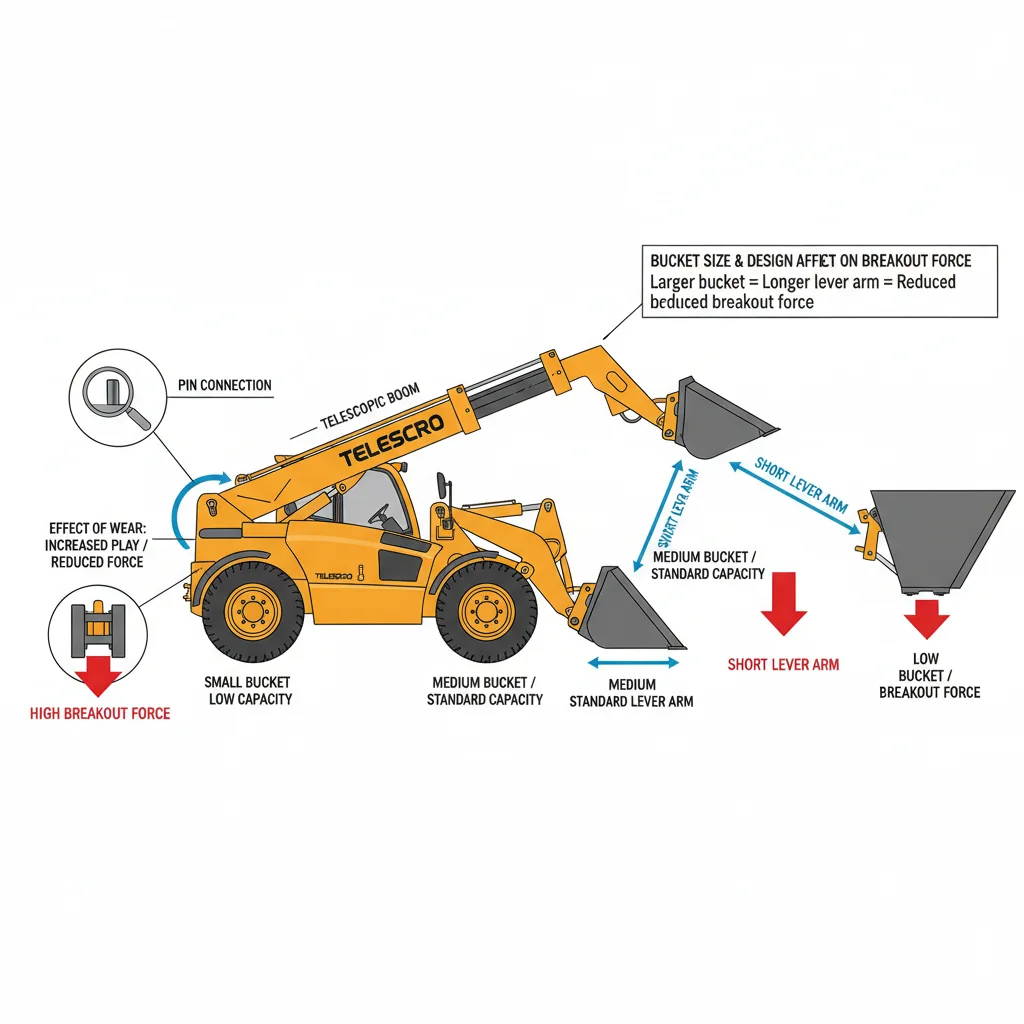
The biggest mistake I see is assuming any bucket will let your telehandler perform at its peak. In reality, the bucket’s size and shape directly affect how much digging power you can actually put to the ground. If you fit a high-capacity or extra-deep bucket, you shift the load’s center of gravity further out from the boom pins. That extra distance means the hydraulics and frame have less leverage—so your breakout force drops. I worked with a client in Kazakhstan last year who actually lost nearly 40% of expected breakout just by switching to a long-floor, 1.3-cubic-meter bucket on a 3-ton telehandler. The machine felt much weaker in compacted gravel. The rated breakout force always assumes a general-purpose bucket, with moderate volume right at the pin. But it’s not only about bucket size. The connection setup plays a huge role. Quick couplers and adapters add distance between the boom and the bucket pins. Even an extra 120 mm can translate to a big drop at the cutting edge. I’ve seen jobs in Dubai where loose or worn coupler systems made things worse, especially trying to dig into dense clay fill. The bucket “gave” before the ground did—the operator felt like he was fighting the machine, not the material. If you need features like bolt-on teeth or side-cutters, remember they help with penetration but can increase resistance. The engine and hydraulics won’t know the difference on paper, but in rocky spoil or frozen dirt, the bucket will stall sooner.
A larger or deeper bucket on a telehandler reduces breakout force because the added distance from the boom pivot decreases leverage.True
Breakout force depends on mechanical leverage. A bucket that extends farther from the boom pin increases the load's moment arm, meaning the hydraulic system must work harder with less mechanical advantage, resulting in reduced digging power.
Using a smaller bucket on a telehandler always results in significantly decreased breakout force compared to standard-sized buckets.False
A smaller bucket, being closer to the boom pivot and generally lighter, actually tends to increase available breakout force, as it improves leverage and reduces the load on the hydraulic system.
Key takeaway: Bucket size and attachment design significantly impact telehandler breakout force. Choosing oversized or deep buckets and adding couplers or adapters can reduce effective breakout, compromising digging performance. Always match bucket type to material density and maintain tight, compact coupler connections to maximize breakout strength.
How to Match Telehandler Breakout Force?
Telehandler bucket breakout force must be matched to material density and compaction. Light, loose materials require around 40–50 kN of breakout force, while dense or compacted loads like wet sand or debris need 60 kN or higher with a reinforced bucket. Prioritize penetration and select bucket size accordingly to avoid stalling.
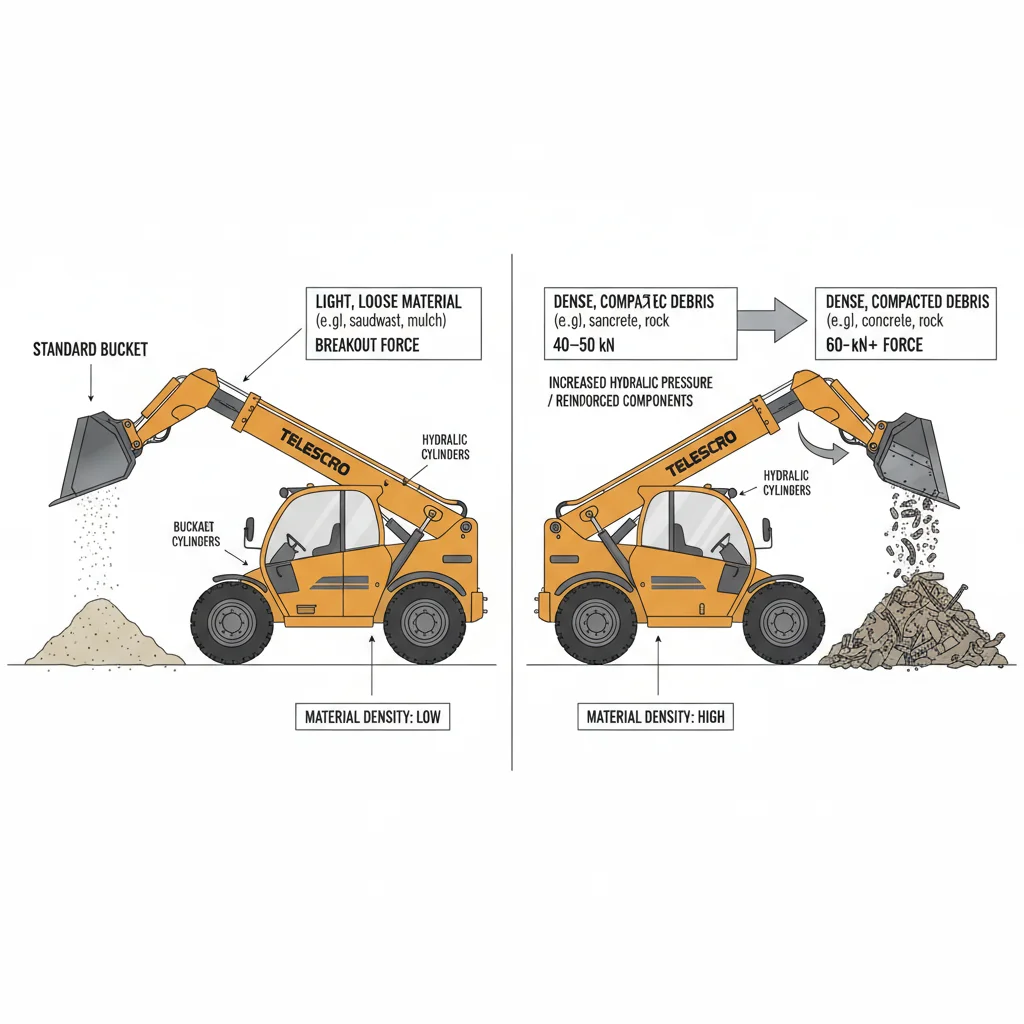
To be honest, the spec that actually matters is the breakout force at the bucket edge—not just the number in a brochure, but what it delivers on real jobsites. I’ve seen buyers in Kazakhstan try to load wet, compacted sand with a light-duty 45 kN machine. The operator spent half the shift fighting the pile. The bucket simply rode up on the surface or stalled out the hydraulic circuit. All because the machine wasn’t matched to the material or bucket type.
Dense materials—wet gravel, demolition debris, frozen soil—need a lot more force at the cutting edge. In Dubai, one of my repeat customers switched to reinforced, teeth-equipped buckets and a heavier model rated at 65 kN. The difference was obvious. He could break out packed rubble with half the passes and didn’t risk overheating the hydraulic pump. Yes, he lost some volume per scoop, but overall job speed improved because the machine actually penetrated the pile.
From my experience, it’s better to scale down bucket size and focus on penetration if you’re dealing with tough or sticky loads. A wider, shallow bucket can’t bite into compacted materials—the pressure simply spreads out, and the telehandler works too hard. For light materials like grain or compost, you can get away with a 2 cubic meter bucket and around 40 kN force, but don’t try that with wet earth. I always suggest looking honestly at your main materials, then matching breakout and bucket spec. If real digging is constant, consider a wheel loader instead.
Breakout force at the bucket edge can be significantly different depending on the type of bucket or attachment mounted on a telehandler.True
The geometry and leverage of different buckets or attachments change how the hydraulic and mechanical forces are transmitted, meaning breakout force at the edge may vary from published specs depending on what is installed.
Breakout force ratings published in telehandler brochures always reflect real-world performance, regardless of jobsite conditions or material type.False
Brochure values are measured under controlled conditions and do not account for actual jobsite variables like material density, compaction, or operator technique, so real-world performance may differ substantially.
Key takeaway: Always select telehandler breakout force and bucket specification based on the actual material type—loose, lightweight materials need less force, while digging into compacted, dense or frozen material requires higher breakout and a digging-type bucket. For true excavation, a wheel loader may be more suitable.
Why Don’t Telehandlers Dig Like Loaders?
Telehandlers prioritize reach and placement over aggressive digging, with booms and linkage optimized for vertical and horizontal load handling rather than high breakout force. Even at similar operating weights, telehandlers generate lower effective digging force at ground level than wheel loaders. As the boom is raised or extended, available breakout force decreases rapidly, which limits their suitability for sustained digging applications.

I’ve worked with customers who made this mistake—expecting a telehandler to dig like a loader simply because the operating weight or bucket size looks similar. I remember a jobsite in Kazakhstan last winter. The site manager had a 4-ton high-reach telehandler, thinking it would handle compacted earth just like their old loader. The first week, the machine struggled even to skim the frozen gravel pile. Why? Because telehandlers focus on reach, not breakout force. Their hydraulic circuit and crowd linkage aren’t designed to drive the bucket hard into the ground. When the boom is fully retracted, your breakout might look acceptable on paper—maybe around 5,000 kg of force for a 4-ton class machine. But try to extend just a few meters, and that drops sharply. From my experience, even a mid-size wheel loader with a similar operating weight will outperform a telehandler in bucket work. That’s due to a completely different linkage design. Loaders use a Z-bar or parallel arm for “crowd” force—pushing the bucket deep into material. You simply don’t get that with most telehandlers. I’ve seen it frustrate teams in Brazil and the UAE who assumed a bucket attachment would make their telehandler a full replacement for a loader. It won’t. The hydraulic circuit and frame design just can’t transfer enough torque at the bucket edge, especially when you’re dealing with dense or sticky material. If heavy digging is a daily job, I always suggest pairing a dedicated loader with your telehandler.
A telehandler’s bucket breakout force is typically much lower than that of a comparably sized wheel loader because telehandlers are engineered primarily for lift height and outreach, not earthmoving tasks.True
Telehandlers have a different hydraulic geometry and loader arm design compared to loaders. Their crowd and lift cylinders are optimized to support extended reach and high lifting positions, which limits how much force they can apply to the bucket for digging into compacted materials.
Telehandlers can achieve the same bucket penetration and digging efficiency as loaders by simply using a reinforced digging bucket.False
Even with a specially reinforced bucket, a telehandler's hydraulic and structural design still limits its breakout force. The machine's geometry, lift arm leverage, and cylinder size determine digging ability, so accessory improvements cannot compensate for the fundamental design differences.
Key takeaway: Telehandlers are engineered primarily for lifting and placing loads at a distance, not for heavy digging tasks. Buyers expecting loader-like digging will find telehandler breakout force insufficient in tough ground conditions. Treat bucket work as supplementary; match equipment type to the primary operational need.
How to Compare Telehandler Bucket Breakout Force?
Telehandler bucket breakout force should be treated as a comparative indicator rather than an absolute promise. Always verify where force is measured (edge vs. pivot pin), under what conditions, and request breakout force curves6 for a full picture. Insist on standardized test positions and documentation when comparing brands.

Last month, a contractor in Kazakhstan asked me why two 4-ton telehandlers, with similar boom lengths, had bucket breakout force specs that differed by more than 30%. I explained that many brands inflate these numbers by measuring force at the bucket pivot pin instead of the actual cutting edge. The cutting edge is where the real work happens—digging into gravel or loading rock. From my experience, pivot pin values usually look 20–30% higher on paper, but you won’t feel that power at the jobsite. Here’s where the confusion comes in: every manufacturer has a different test setup. Some use a fully retracted boom, others extend it halfway. Pressure can vary, and one company’s “standard bucket” might be wider or lighter than another’s. In Dubai, I saw two bids with breakout force differences of over 1,500 kg, but the local team discovered one had quoted only a theoretical hydraulic max—not a tested value. Always ask for the full breakout curve, not just one peak number. This curve shows how the force drops as you lift higher or extend farther.
To help you compare, here’s a simple table I use with clients:
| Factor | Brand A (Typical) | Brand B (Typical) | What to Insist On |
|---|---|---|---|
| Force location | Pivot pin (looks higher on paper) | Cutting edge (more realistic) | Cutting-edge force stated (or both, clearly labeled) |
| Bucket type | Large/light bucket (can inflate numbers) | Standard GP bucket | “Standard GP bucket” definition: width, heaped volume, weight |
| Boom position | Half-extended | Fully retracted | Boom position stated (retracted / mid / extended) + angle |
| System pressure | Quoted at theoretical relief max | Tested at rated working pressure | Test pressure stated + relief setting + oil temp range |
| Measurement basis | Single peak number only | Average/working figure | Full breakout curve (force vs boom angle/reach/height) |
| Test method | In-house / not clearly documented | Standardized or documented procedure | Written test procedure + whether measured or calculated |
| Value type | Theoretical hydraulic maximum | Measured (instrumented) value | “Measured vs calculated” explicitly stated |
| Reporting units | Mixed / unclear conversion | Clear kN or kgf at stated lever arm | Units + lever arm reference + conversion assumptions |
| Conditions/variables | Not stated (tire pressure, ballast, etc.) | Stated (machine config documented) | Machine configuration sheet (counterweight, tires, bucket pins, hydraulic circuit) |
Measuring breakout force at the bucket pivot pin typically results in higher advertised numbers compared to measuring at the bucket’s cutting edge.True
This is because the farther from the lift cylinder you measure, the greater the mechanical advantage; measuring at the pivot pin does not account for losses due to the bucket linkage, so real-world performance is overstated if referenced at the pin.
Two telehandlers with identical rated lift capacities and boom lengths will always have the same bucket breakout force.False
Bucket breakout force also depends on factors like hydraulic cylinder bore size, linkage design, and hydraulic system pressure, so similar capacities and booms do not guarantee identical breakout force.
Key takeaway: Breakout force specs vary by measurement method and test conditions. For accurate telehandler comparison, always standardize assumptions: cutting edge measurement, boom fully retracted, standard bucket, and rated system pressure. Demand supporting test data and ignore marketing numbers derived only from theoretical hydraulic calculations.
What safety limits affect bucket breakout force?
Breakout force indicates a telehandler’s hydraulic and structural push at the bucket, not a safe working load. Safety limits are governed by stability, boom stress, and machine configuration. Always consult the load chart, keep the boom low for prying, and avoid using curl for demolition tasks.

I’ve worked with operators in Dubai who thought breakout force was a green light for heavy demolition. One client tried prying out a stubborn concrete block with the bucket curled up and the boom raised halfway. The telehandler had a listed breakout force of 70 kilonewtons, but after the job, their crowd cylinders were visibly bent, and there was a hairline crack near the boom nose. That’s a painful reminder—breakout force is hydraulic muscle, not a license to push or pry with the boom anywhere you want.
What actually limits you? Stability, first of all. The telehandler’s load chart shows how capacity drops as the boom extends or raises—the tipping axis is always your forward limit, not just what the hydraulics can push. Even if your machine can generate enough force to move a buried rock, the risk of tipping or stressing the boom rises sharply the further you reach. Structure is the next barrier. The quick coupler, tilt links, and the entire boom nose take a huge load during aggressive prying; I’ve seen pin bores "egg out" in less than a month on harsh sites in Kazakhstan.
If you need to use the bucket for prying, I recommend keeping the boom fully retracted and as low as possible. Always check the load chart—even for "simple" ground work. And never use bucket curl to break up big slabs or dig out stumps. I suggest training every operator on proper prying technique and structural limits. Machines survive longer—and operators stay safer—when everyone respects these boundaries.
Operating a telehandler bucket at a high boom angle can reduce the effective breakout force available at the attachment due to leverage and geometry limitations.True
Breakout force is highest with the boom low and retracted, as hydraulic force is transferred more directly to the bucket. As the boom angle rises, the mechanical advantage changes, reducing the force the bucket can apply at the ground.
Exceeding the listed breakout force on a telehandler only risks bucket damage, not structural harm to the boom or cylinders.False
Forcing the bucket beyond its breakout limit can transmit excessive loads through the boom and hydraulic system, potentially causing severe damage to cylinders, weld joints, or even the boom structure, not just the bucket.
Key takeaway: Breakout force is not a lift or prying capacity—load chart limits, machine stability, and structural factors determine what is safe. Misusing breakout force risks bent cylinders or damaged booms. Always reference the load chart and use proper operating techniques for safety and equipment integrity.
How Does Wear Impact Bucket Breakout Force?
Wear and improper setup can significantly reduce a telehandler’s effective bucket breakout force over time. Common contributors include pin and bushing wear, hydraulic pressure falling below specification (often by 10–20 bar), and excessive play in quick couplers. Each of these factors degrades linkage geometry or available hydraulic force, resulting in a noticeably softer bucket response and a clear loss of breakout performance during normal operation.

I hear this question from jobsite managers all the time: “Why does my telehandler’s bucket seem weak after a few years?” The reality is, breakout force drops off more quickly than many expect—especially on machines that see daily bucket work. Just last year, I worked with a team in South Africa running two 4-ton units, mostly handling gravel and concrete debris. They noticed it took noticeably more effort to break into a pile after only two seasons.
The main culprit? Pin and bushing wear7. Even 1–2 millimeters of play in the boom-head or tilt linkage can subtly change the geometry. Instead of a crisp response, the bucket feels “soft” as the linkage absorbs some of the force. I’ve measured machines where this wear alone knocked off over 5% of their original breakout strength. The effect multiplies with each worn joint—an issue I once saw with a rental fleet in Brazil, where operators were struggling to fill a standard 1-cubic-meter bucket.
Hydraulic pressure is the next sneaky cause. If your main pump or relief valve sits just 15–20 bar under spec, you’re losing another 5–10% right away. I always suggest checking system pressure with a gauge once a year—low pressure often goes unnoticed until the machine feels “lazy.” And don’t ignore the quick-coupler. Worn couplers add extra play and actually move the bucket further out, reducing leverage and practical breakout.
My advice: keep linkages greased daily, check for joint play every 500 hours, and confirm hydraulic settings at least once a season. Small fixes here can recover a surprising amount of lost power.
Wear between the bucket pins and bushings increases the amount of play at the pivot points, causing the telehandler’s breakout force to drop noticeably even if the hydraulic system is still performing at full pressure.True
Breakout force depends both on hydraulic power and the mechanical integrity of the linkage. Excessive play from worn pins and bushings means some motion is lost to movement at the joints instead of being transferred to the bucket for digging, noticeably reducing effective breakout force.
As long as the telehandler’s hydraulic pump is working correctly, bucket breakout force will remain the same regardless of how worn the linkage pins and bushings become.False
Even with good hydraulics, wear in linkage components introduces slack and reduces the amount of force that actually reaches the bucket tip. This mechanical inefficiency causes the true breakout force at the bucket to decrease as wear accumulates.
Key takeaway: The real-world breakout force of a telehandler’s bucket is often lower than the brochure value after years of operation due to wear in pins, bushings, and couplers, or low hydraulic pressure. Regular inspections and preventive maintenance can restore lost performance and extend productive life.
When Is High Bucket Breakout Force Worth It?
Higher telehandler bucket breakout force justifies extra cost when loading dense or compacted materials8, as it enables faster bucket fill in a single cycle—cutting engine hours and diesel use over time. For routine tasks with light material or pallet handling, moderate breakout force is generally sufficient and more cost-effective.

Operators often think the highest breakout force means “better telehandler,” but that’s not always true—or worth the extra money. High breakout force comes from stronger hydraulic cylinders and heavier-duty linkages, which add both weight and cost to the machine. The question is: when does that investment actually pay off? In my experience, it’s a game changer on sites handling dense or compacted materials—gravel, crushed concrete, sticky clay—where bucket teeth sometimes barely bite in. If you’re digging into that kind of pile all day, higher breakout can let you fill the bucket in one clean pass instead of two or three, saving engine hours and reducing diesel use across the whole season.
One example stands out—a quarry project in Kenya. They needed to load compacted aggregate into trucks, and their previous telehandler struggled, sometimes taking nearly twice as many passes per load. Upgrading to a 4-ton model with a higher breakout rating cut each loading cycle by about 30%. Less idling, fewer cycles, and noticeably better fuel efficiency. Over months, that saved not just operating hours but also reduced wear on pins and cylinder seals in the hydraulic circuit.
But if most of your jobs involve lighter materials—mulch, fertilizer, grain—or mostly pallet work, chasing the biggest breakout number just adds cost and machine weight you rarely use. For those tasks, a telehandler with moderate breakout force and the right bucket or forks is plenty. I always suggest checking your load chart for typical cycle loads, then matching the machine to real jobsite demands—not just the marketing brochure. That detail is where efficiency starts.
A telehandler with high bucket breakout force is especially valuable when working with compacted fill or demolition debris, as it allows the bucket to penetrate and lift these tough materials more effectively than standard models.True
Breakout force directly affects the bucket’s ability to cut into and lift dense materials. In applications like compacted soil, demolition rubble, or dense construction fill, standard breakout force may not be sufficient, so higher capability becomes crucial for productivity and machine versatility.
High breakout force on a telehandler bucket will always result in an increase to the maximum lift height of the machine.False
Breakout force and maximum lift height are determined by different design factors; breakout force relates to the hydraulic capacity and linkage geometry affecting how much force the bucket can exert, while lift height depends on boom length and structure. High breakout force does not increase the machine's reach or maximum lifting height.
Key takeaway: High breakout force is a targeted investment for telehandlers frequently digging into dense or compacted materials, improving efficiency and fuel savings. For lighter loading or palletized work, moderate breakout with suitable attachments meets operational needs without excess cost or machine weight.
Conclusion
We’ve looked at what bucket breakout force really means for telehandlers and why it matters when you’re moving bulk materials—not just lifting loads. From my experience, the buyers who save themselves headaches take time to check the load chart at different boom positions, not just the spec sheet figures. Digging power is important, but lifting safely and keeping your crew working matter most on a real jobsite. Need help comparing models, load charts, or attachments? I’ve worked with contractors in over 20 countries and I’m happy to share practical advice from the field. Reach out anytime—I’m here to help you make the right choice for your site. Every project has its own challenges, and the best machine is the one that fits your real workflow.
References
-
Details the role of crowd linkage like Z-bar in providing high breakout force, highlighting why telehandlers lack digging power. ↩
-
Learn how load cells accurately capture peak breakout forces in telehandlers, crucial for reliable on-site performance assessment. ↩
-
Explores how hydraulic pressure influences bucket breakout force with data and examples to optimize telehandler performance in tough soil conditions. ↩
-
Details how crowd cylinder size impacts breakout power, showing why larger cylinders can outperform bigger rated machines in heavy material handling. ↩
-
Understand the technical reasons quick couplers affect breakout force, including distance effects and connection wear, supported by field cases. ↩
-
Details how breakout force curves provide a full picture of force variation over range of motion, helping contractors choose reliable telehandler models. ↩
-
Explores how slight joint wear alters linkage geometry and reduces breakout force, critical for telehandler maintenance decisions. ↩
-
Understand the challenges of handling compacted materials and how telehandler specs impact load cycles and machine wear. ↩