










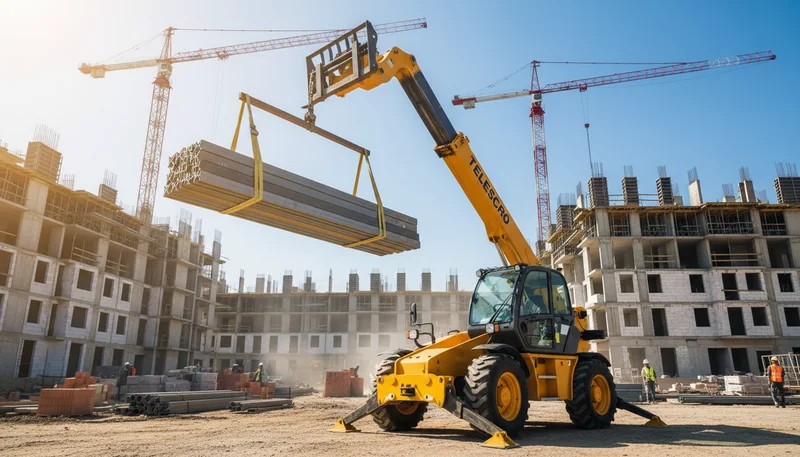
What is a Heavy-Duty Telehandler? A Field Engineer’s Breakdown
Not long ago, I watched a steel yard team in Brazil struggle with overloaded pallets and a standard telehandler. The operator kept creeping up to his limit—and then beyond it—which is a recipe for disaster in these environments. It made me realize just how often people underestimate what “heavy-duty” really means.
A heavy-duty telehandler is defined by its ability to lift exceptionally large, repetitive loads—typically between 10,000–40,000 lb—across rough, demanding jobsite conditions. Unlike standard models, heavy-duty telehandlers utilize reinforced chassis1, enhanced axles, thicker booms, and substantial counterweights, creating a distinct equipment class designed for industrial-strength lifting cycles and stability. This category prioritizes weight handling capacity over height, with many models reaching operating weights above 33,000 lb, making them well suited for applications in steel yards, precast plants, ports, mining support, and other heavy industrial sites.
What Defines a Heavy-Duty Telehandler?
A heavy-duty telehandler is a robust, all-terrain lifting machine with a telescopic boom, engineered to handle loads typically starting at 10,000–12,000 lb and exceeding 40,000 lb. Key features include reinforced chassis, heavy-duty axles, larger counterweights, and increased operating weights for safe, repetitive lifting in demanding industrial environments.

Most people don’t realize that “heavy-duty” isn’t just a label—it means a telehandler built for serious, repeated lifting in tough conditions. When I talk to customers in places like Dubai or South Africa, the first thing I check is their typical load. If they’re handling steel pipes, concrete blocks, or heavy industrial machinery, an ordinary 5,000 kg model won’t cut it. You need a telehandler with a rated capacity2 starting at 10,000–12,000 lb, and some jobs demand models handling up to 40,000 lb. That extra capacity isn’t just about the boom or forks. It’s the reinforced chassis—think thick steel sections—plus axles, heavy-duty tires, and counterweights easily over 4,500 kg.
I’ve seen operators in Kazakhstan use these machines to move large grain hoppers across uneven ground. Standard telehandlers struggled; the heavy-duty units stayed stable even with 15,000 lb loads at half boom reach. Their operating weights often exceed 33,000 lb, which helps keep everything planted. But what defines these machines goes beyond single lifts—it’s about doing the job all day, every day, without overloading or risking safety.
Here’s what matters most: heavy-duty telehandlers combine the features of a forklift, mobile crane, and rough-terrain machine. You get robust booms with extra hydraulic power for precise, repetitive work. Many models include moment indicators—a warning system if you get close to tipping. I always suggest checking the load chart at your intended boom extension, not just the max figure. That small detail avoids costly mistakes on site.
Heavy-duty telehandlers typically feature reinforced boom structures and heavy-duty axles to maintain stability and durability when lifting loads above 10,000 lbTrue
Telehandlers designed for heavy-duty applications incorporate structural enhancements like reinforced booms and robust axles to handle the stresses of repeated lifting of heavy loads, ensuring safety and longevity under tough operating conditions.
Heavy-duty telehandlers usually sacrifice operator visibility as a trade-off for increased lifting capacity, making them less safe on construction sitesFalse
Although heavy-duty telehandlers handle larger loads, manufacturers implement advanced design features such as elevated cabs, panoramic windows, and sensor systems to maintain or improve operator visibility and safety, rather than sacrificing it.
Key takeaway: Heavy-duty telehandlers are specialized machines built for extremely heavy, repetitive lifting in tough environments. Their structural reinforcements and high load capacities distinguish them from standard telehandlers, making them essential for material handling where frequent loads above 10,000 lb and harsh site conditions are routine.
How Do Heavy-Duty Telehandlers Differ?
Heavy-duty telehandlers feature reinforced frames, axles, and booms, enabling them to handle 10,000–26,000+ lb capacities—far exceeding the 6,000–9,000 lb range of standard models. Components such as drivetrains, brakes, and steering are built for continuous heavy lifting, focusing on safe, stable handling of precast concrete, steel bundles, and heavy industrial loads.

Here’s what matters most when comparing heavy-duty telehandlers to standard models: it’s not just about lifting capacity, but how every component is built for punishment. In Kazakhstan, I worked with a contractor moving precast concrete panels—some pieces weighed nearly 10,000 kg. Their standard 4-ton telehandler couldn’t handle the load, so the boom flexed dangerously and stability was a real concern. They upgraded to a heavy-duty 12-ton unit with a reinforced boom and frame3. Problem solved—especially since the hydraulic circuit4 and axles were built for continuous strain, not just short lifts.
Standard machines, usually rated for 2,700–4,000 kg and around 12–17 meters of reach, target versatility and easy handling. Think bricks, timber, drywall. Their booms and axles are lighter, and the electronic control systems—like the moment indicator (that warns you if you’re close to tipping)—are calibrated for moderate weights and duty cycles. If you ask these machines to lift precast slabs or steel bundles day after day, it’s not just the structure at risk. Expect faster hydraulic leaks, drivetrain wear, overheating brakes, and even possible frame fatigue.
To be honest, the biggest mistake I see is skipping the load chart when deciding if a standard telehandler is “good enough.” In Dubai, a logistics site manager told me they used a regular 9,000 lb unit to lift heavy generator skids, and within months, steering and brake service costs doubled. My advice: any time your routine lift is over 4,000 kg, check the heavy-duty models and review the load chart at your actual working height. That’s the safest choice for both people and equipment life.
Heavy-duty telehandlers often feature booms constructed from higher-grade steel alloys with additional reinforcements, enabling them to handle loads exceeding 10,000 kg without significant flexing or stability lossTrue
The use of higher-grade steel and reinforced structural design increases the boom’s rigidity and strength, which is essential when handling extremely heavy precast concrete panels, as in the Kazakhstan example. This structural upgrade is what distinguishes heavy-duty telehandlers from standard models beyond just a higher load rating.
Heavy-duty telehandlers achieve higher lifting capacities mainly by installing larger tires and more powerful engines, while keeping the same frame and boom design as standard telehandlersFalse
Although larger tires and stronger engines contribute to performance, heavy-duty telehandlers rely heavily on reinforced frames and booms engineered to withstand increased stress. Simply upgrading tires and engines without structural enhancements would lead to dangerous flexing and instability under heavy loads.
Key takeaway: Heavy-duty telehandlers are engineered for continuous lifting of significantly heavier loads than standard models, with robust components and enhanced stability. Using a standard telehandler in heavy-duty applications can cause unsafe conditions and equipment damage—always confirm requirements using load charts5 for optimal jobsite safety and equipment longevity.
How Do Heavy-Duty and High-Reach Telehandlers Differ?
Heavy-duty telehandlers are engineered to lift much heavier loads—typically 15,000 to 26,000+ pounds—over moderate heights (up to 40–50 ft). High-reach telehandlers, however, prioritize height, reaching 70–75 ft with lighter load capacities (8,000–12,000 lb). Choosing the correct type is critical for safety and operational efficiency.

Let me share something important about heavy-duty versus high-reach telehandlers: these two categories don’t just differ on paper—they solve very different real-world site problems. High-reach telehandlers are built for vertical access. Think of a jobsite in Dubai where a contractor needed to lift insulation panels up to the seventh floor, around 21 meters. Their high-reach machine could extend nearly 75 feet, but the max load at full boom was only 10,000 pounds. That’s typical. The load chart (which shows what you can safely lift at each height) drops off fast as you reach higher. In these jobs, getting height beats brute force.
Heavy-duty telehandlers flip the priorities. In a steel yard in Brazil, I saw a team using a 26,000-pound capacity unit with a maximum reach just under 50 feet. They rarely needed more than 35 feet of lift, but every load—pipes, coils, heavy machinery—was dense and seriously heavy. With reinforced frames, larger hydraulic cylinders, and heavier counterweights, heavy-duty models deliver stable lifting at mid-level heights, even on rough, uneven ground.
From my experience, the biggest mistake is assuming one type can do both jobs well. I’ve worked with customers in Kazakhstan who thought a high-reach would handle massive precast elements, only to hit load limits halfway up the boom. That mistake costs time and rental fees. For jobs where weight trumps height, stick with heavy-duty. When you need to lift lighter loads to maximum vertical points, go high-reach instead. I always recommend checking the load chart alongside your site’s real working heights before making a final choice.
Heavy-duty telehandlers typically have a maximum lifting capacity exceeding 12,000 pounds but a maximum reach of under 40 feet, prioritizing load over heightTrue
Heavy-duty telehandlers are engineered to handle heavier loads at shorter reaches, focusing on maximum lifting power rather than extended boom length, which distinguishes them from high-reach models designed for height.
High-reach telehandlers are always equipped with counterweights twice the size of those on heavy-duty models to maintain stability at full extensionFalse
While counterweights vary between models, high-reach telehandlers do not universally have counterweights twice as large as heavy-duty machines; counterweight size is optimized based on total machine balance and manufacturer design, not a fixed multiplier.
Key takeaway: Heavy-duty telehandlers are optimized for lifting substantial weight at moderate heights in tough environments, while high-reach models are best for accessing significant vertical heights with lighter loads. Accurate selection based on job requirements prevents costly mistakes and ensures on-site safety and efficiency.
Where Are Heavy-Duty Telehandlers Essential?
Heavy-duty telehandlers are essential in environments where repeated lifting of heavy loads and harsh site conditions are the norm. Typical applications include steel yards, precast concrete facilities, mining, large-scale agriculture, ports, and industrial construction projects. Their increased weight, robust tires, and higher capacity let them outperform standard machines in rutted or uneven terrain, where durability and strength matter most.

Last month, a contractor in Dubai contacted me about moving steel beams—each one weighing nearly 3,000 kg—across a muddy construction site. A standard 3-ton telehandler just couldn’t manage with the soft ground and constant loading. Most jobs like this, especially in steel yards or precast plants, push machines hard for hours at a time. In these environments, heavy-duty telehandlers with rated capacities over 5,000 kg and oversized tires6 handle the punishment day after day.
From my experience, the demands in large ports or mining sites go even further. I’ve helped customers in Kazakhstan unload machinery where each pallet tips 4,500 kg, on uneven, gravel yards. Here, it’s not about reaching higher than 18 meters—it’s about surviving rough terrain and repetitive, heavy lifts without breakdowns. The hydraulic system comes under real strain, so checking for reinforced boom sections and a robust moment indicator is crucial before choosing a machine.
A client in Brazil once tried to cut costs with a lighter model for moving concrete bridge segments. It worked for a few weeks, but a bent boom and burnt-out hydraulic pump quickly cost more in downtime than the initial savings. That’s the reality—when you hit these weight classes and tough surfaces, heavy-duty specs aren’t a luxury.
If your projects involve lighter pallets or tight urban jobsites, a compact 2.5-ton telehandler is faster and far more maneuverable. But once your daily loads start tipping over 4,000 kg or you’re working on unpaved ground, it’s time to look at heavy-duty models. I always suggest starting with your real load chart needs, not just the maximum lift height.
Heavy-duty telehandlers with capacities over 5,000 kg typically feature reinforced boom structures and upgraded cooling systems to sustain continuous operation under heavy loads without overheatingTrue
Heavy-duty telehandlers endure long hours handling loads near or above 5,000 kg, which generates significant heat in hydraulic and engine components. Reinforced booms prevent structural fatigue while enhanced cooling systems maintain optimal operating temperatures, ensuring reliability in demanding environments like steel yards.
Heavy-duty telehandlers designed for muddy sites usually use narrower tires to increase ground pressure for better penetration and traction on soft soilsFalse
Narrower tires increase ground pressure and risk sinking in soft or muddy conditions. Instead, heavy-duty telehandlers use oversized, wide tires that distribute weight over a larger area, improving flotation and traction on soft ground typical in construction or precast plant environments.
Key takeaway: Heavy-duty telehandlers are ideal for industrial sites handling heavy, repetitive loads—such as steel, concrete, mining, ports, or wind energy projects—where durability, large tires, and high lifting capacity are required. For lighter-duty or space-restricted jobs, standard or compact telehandlers are usually more efficient.
How Do Telehandler Capacity and Weight Interact?
Heavy-duty telehandler capacity varies with boom extension and angle; a 12,000 kg model may lift only 4,000 kg at full reach. Stability depends on high operating weight, wide stance, and counterweights, but this added mass requires stronger ground conditions and careful site assessment to avoid safety risks and infrastructure damage.

The biggest mistake I see is relying on the headline capacity—let’s say 12,000 kg—without looking closely at the load chart. That number only applies with the boom fully retracted and low to the ground. Once you extend the boom or raise it past mid-angle, the physics change. For example, a heavy-duty 12,000 kg telehandler I supplied to a logistics yard in South Africa could only lift about 4,000 kg at its maximum outreach. The operator was surprised—he thought the rated capacity covered every scenario. It doesn’t. The load chart (the table showing safe lift at each height and reach) matters far more during real jobsite work.
Extra mass makes the machine more stable, but from my experience, the trade-offs are real. A 15-ton operating weight means you need solid ground—concrete, thick asphalt, or well-compacted gravel. In Brazil, a customer ran into trouble lifting precast panels near a drainage channel: the ground couldn’t handle the telehandler’s 33,000-pound weight, even though the load itself was under 4,000 kg. The result? The telehandler sank, causing costly delays.
Here’s what matters most—never spec a telehandler by headline numbers alone. Check the load chart at your max reach and boom angle, especially on a slope. Then verify that your ground can support both the machine and the load. I always suggest reviewing ground conditions before delivery, especially with slab floors or buried utilities. It saves time, money, and trouble down the line. If you’re unsure, I recommend consulting a site engineer or the manufacturer’s ground pressure data before you commit.
A heavy-duty telehandler’s rated capacity drastically decreases—sometimes to one-third—when the boom is fully extended and raised beyond mid-angle due to leverage effects and stability limitsTrue
Rated capacities are determined with the boom retracted and low, where stability is optimal; extending and elevating the boom shifts the center of gravity forward and reduces the maximum safe lift load, often by as much as 66%, requiring operators to consult detailed load charts.
Heavy-duty telehandlers maintain their full rated capacity regardless of boom extension or angle due to advanced counterweight systemsFalse
Although counterweights improve stability, physics still dictate that extending and raising the boom increases leverage and reduces the machine’s safe lifting capacity; no telehandler can maintain full rated capacity at maximum outreach without risking tipping or structural failure.
Key takeaway: Always consult the manufacturer’s load chart for actual capacity at required reach and boom angle, not just the headline figure. Confirm site ground conditions can support the telehandler’s operating weight to ensure safety and prevent costly damage or operational delays.
Which Stability Systems Protect Heavy Telehandlers?
Heavy-duty telehandler stability relies on a low center of gravity, wide wheelbase, heavy counterweights, and robust axles or stabilizers. Electronic safety systems—such as load moment indicators, boom angle sensors, load-limiting valves, and chassis level sensors—are integrated to alert operators or prevent unsafe boom and load movements, minimizing tip-over risk during lifting and carrying operations.

To be honest, stability is the core reason some telehandlers perform safely year after year—while others face scary near-misses on site. Mechanical design is the first defense: I often see heavy-duty models with a wide wheelbase, heavy counterweight, and solid axle construction. These features keep the center of gravity low and resist tipping, especially when you’re moving concrete blocks or steel beams.
For example, in Kazakhstan, I helped a mining contractor select a 6-ton telehandler specifically because its longer wheelbase outperformed a shorter unit when fully loaded with steel pipe—no flex or bounce, even on uneven gravel. But mechanical strength alone isn’t enough for modern jobsites. Electronic and hydraulic stability systems take the guesswork out of risky lifts. Most models above 4 tons now include load moment indicators (these alert you if you approach tipping limits), boom angle sensors, and load-limiting valves that automatically cut hydraulics to the boom if a dangerous position is detected.
In Dubai, one team avoided a major accident when the load moment indicator halted their lift with only 200 kg headroom—otherwise the machine would’ve overloaded by mistake. Some heavy telehandlers feature front stabilizers, but many big pick-and-carry units are purposely designed to work fully loaded on their tires. Outriggers are rare unless you’re dealing with 17-meter or higher lift models or rotating telehandlers. Still, always check the spec sheet.
Heavy-duty telehandlers often employ a wide wheelbase greater than 2.5 meters combined with a counterweight exceeding 1,500 kg to maintain a low center of gravity and prevent tipping during heavy lifts.True
A wider wheelbase and significant counterweight lower the center of gravity, improving lateral stability when handling heavy loads at height, which is critical for telehandlers operating in demanding environments like construction and mining.
Heavy-duty telehandlers primarily rely on electronic gyroscopic stabilizers instead of mechanical design features like wheelbase width and counterweights for stability on uneven terrains.False
While electronic aids can supplement stability, mechanical elements such as wide wheelbase and heavy counterweights are fundamental for safe operation, especially on uneven or rough terrain where electronics alone cannot physically prevent tipping.
Key takeaway: Both mechanical design features and advanced electronic or hydraulic safety systems are fundamental for heavy-duty telehandler stability. Operators and buyers should always verify safety system standards, regulatory compliance, and ensure that operators are fully trained for the specific model’s unique handling characteristics.
What Specs Matter When Choosing a Telehandler?
Critical telehandler buying criteria include rated capacity at actual working heights and radii, structural features like axle load ratings and boom thickness7, and drivetrain type. Load charts must be referenced for lifting at intended reaches. Tire selection and pick-and-carry ratings are also essential considerations for matching machine performance to demanding field applications.

From my experience, buyers often get distracted by impressive numbers like maximum lift or engine power. I once helped a team in Kazakhstan that ordered a 4-ton telehandler with 17-meter reach, thinking the headline capacity would handle everything. On site, they needed to lift concrete blocks weighing 2,200 kg onto a platform at 14 meters reach. The load chart showed only 1,650 kg safe at that extension—so they fell short and had to rent a larger unit. This situation happens more often than you’d think. The real capacity at your most-used reach and height matters much more than the max figure in the brochure.
Another critical area is structural durability—especially if the machine will face rough terrain or daily heavy-duty cycles. I always advise checking the boom section thickness and axle load ratings. For example, in South Africa, a customer’s project saw cracks developing on a light-duty unit’s boom after eight months of hauling stone pallets. They switched to a model with reinforced boom welds and heavier axles—the difference in maintenance downtime was significant. When you see a robust chassis and strong boom, you know the telehandler can stand up to abuse.
Drivetrain type also affects daily comfort and operating costs. Hydrostatic transmissions give you very smooth, controlled movement—best for tight yards or crane-like jobs. But if you need to tow or drive long distances, a powershift gearbox performs better at higher speeds. Don’t overlook tires either. Pneumatic types ride smoothly, but in Malaysia’s scrap yards, I’ve seen foam-filled or solid options prevent expensive downtime from punctures. I suggest confirming pick-and-carry ratings before you decide—actual site tasks may require moving loads, not just static lifts.
A telehandler's maximum lift capacity must always be checked against the load chart at the specific boom extension and angle, as capacity can reduce by over 40% at maximum reachTrue
Telehandler load charts reflect how lifting capacity decreases with boom extension and angle due to leverage and stability factors; for example, a machine rated for 4 tons at minimal reach may safely lift only 1.6 tons at full 17-meter outreach. Ignoring this leads to unsafe overloading and operational failures.
Heavy-duty telehandlers are defined primarily by having at least 250 horsepower engines, regardless of their lifting capacity or boom reachFalse
While engine power contributes to overall machine performance, heavy-duty telehandlers are classified based on their lifting capacity, boom reach, and duty cycle rather than just engine horsepower; smaller engines can still power telehandlers with high lifting specs effectively.
Key takeaway: Comparing telehandler specs beyond headline capacity is essential. Evaluating lifting ability across working heights, structural durability, suitable drivetrain, tire configuration, and pick-and-carry ratings ensures the selected model delivers on job requirements and long-term reliability in heavy-duty applications.
What Drives Total Cost for Heavy-Duty Telehandlers?
Heavy-duty telehandlers involve higher upfront costs, often exceeding $100,000, but deliver significant value by reducing breakdowns and downtime compared to undersized equipment. Key cost factors include fuel consumption8 (10–13 liters/hour under load), maintenance intervals9, parts and service access, uptime, and resale value. Utilization rates strongly influence cost-effectiveness over the machine’s lifecycle.

I’ve seen how easy it is for buyers to get hung up on the initial price tag—especially when a heavy-duty telehandler costs north of $100,000. But I always remind customers in places like Kazakhstan and Nigeria that spending less upfront can backfire fast if they’re pushing a smaller machine past its real limits. One project in Kazakhstan stands out: a 14-ton telehandler replaced two overloaded 7-ton units. Breakdown calls dropped by half, and the crew finished weeks ahead of schedule—mainly because downtime from constant repairs just disappeared.
Fuel is another big piece. Most people ask me about hourly consumption. In real terms, a 15-ton telehandler running near max load usually burns 10–13 liters per hour. Multiply that by hundreds of hours each year and it adds up. But here’s the catch: bigger machines aren’t always less efficient. If you’re overworking a smaller telehandler, it can actually use more fuel per ton lifted, thanks to strained hydraulics and longer cycle times.
Maintenance and service intervals make a difference too. In Brazil, I’ve seen customers lose days waiting on parts for less common models—what I call "parts roulette." Machines from major brands with strong local support will usually get you back up and running in a day. For a busy site, that uptime is money saved.
If your telehandler cycles across multiple projects, utilization goes up and your cost per productive hour drops. I suggest building a lifetime cost model—with financing, fuel, maintenance, and resale—before you rule out heavy-duty units. The totals often surprise people.
Heavy-duty telehandlers designed for capacities above 12 tons typically feature reinforced boom structures with thicker steel plates and additional gusseting to handle increased bending stressesTrue
Telehandlers with higher lifting capacities experience greater mechanical stress, especially on the boom. Manufacturers reinforce critical components using thicker steel and gussets to prevent fatigue and extend machine life under heavy loads.
Choosing a smaller, less expensive telehandler and running it continually at its maximum rated capacity will extend the machine's operational lifespan due to consistent workloadFalse
Operating a telehandler continuously at or near its maximum rated capacity causes excessive wear, leading to more frequent breakdowns and reduced lifespan. Properly matching machine capacity to job requirements reduces stress and maintenance costs.
Key takeaway: Evaluating lifetime value—not just purchase price—is critical for heavy-duty telehandlers. Factoring in fuel costs, maintenance, uptime, and resale, these machines often deliver lower total costs when properly matched to high-utilization projects, compared to the risks and recurring expenses of overusing smaller, less capable telehandlers.
How Should Telehandler Maintenance Be Planned?
Heavy-duty telehandlers require disciplined preventative maintenance10 to maximize uptime. Daily inspections should include fluid levels, hydraulic leaks, tires, and boom wear pads. Monthly greasing11 and torque checks on critical fasteners prevent structural failures. Following manufacturer schedules for hydraulic filter and oil changes is crucial. Simple, hydraulics-focused models improve reliability in areas with limited dealer support.

Planning telehandler maintenance starts long before the first day onsite. Many owners think they can wait for a warning light or strange sound. That’s risky—especially if your machine is lifting over 3 tons fifteen meters in the air. I’ve worked with a contractor in Kazakhstan who ran two 4-ton telehandlers for concrete panel jobs all winter. Their uptime was over 95%. Why? They stuck to a strict daily checklist: check hydraulic oil, inspect hoses for leaks, test tire pressures, and wipe any dust from boom wear pads. Quick checks take less than 10 minutes, but they spot issues before they can cause delays. Monthly, I always recommend a routine greasing of all pivot points and hinge pins—especially on sites with a lot of dust or mud.
On one quarry project in South Africa, skipped greasing led to a seized boom section and a week of lost productivity. Torque checks on critical fasteners, like those connecting the boom to the chassis, catch any signs of vibration loosening. Missing just one can set off a chain reaction of repairs later. Sticking to the manufacturer’s intervals for hydraulic filter and oil changes is also non-negotiable. I’ve seen too many cases where operators waited until the hydraulic pump sounded loud—by then, metal filings were already circulating. In remote regions without strong dealer support, simpler models with conventional hydraulic circuits make life easier for local technicians. No diagnostic laptop? No problem. Finally, adapt your maintenance plan to the site.
A heavy-duty telehandler designed for lifting loads over 3 tons typically has reinforced boom structures made from high-tensile steel alloys to ensure durability and safety at extended reach heightsTrue
To safely handle heavy loads at heights reaching 15 meters or more, manufacturers use advanced materials like high-tensile steel in the boom construction, which provides the necessary strength and resistance to bending stresses during operation.
Heavy-duty telehandlers do not require daily maintenance checks if they are equipped with electronic self-diagnostic systems that detect all potential failures in real-timeFalse
Even with advanced electronic diagnostics, daily maintenance checks such as inspecting hydraulic oil levels, hose conditions, and tire pressures remain essential to identify issues that sensors may not detect and to prevent unexpected breakdowns.
Key takeaway: Strict preventative maintenance, daily inspections, and adherence to manufacturer service intervals are essential for heavy-duty telehandler reliability. In regions lacking strong dealer support, selecting models with conventional hydraulic systems can minimize downtime and simplify onsite repairs. Site-specific options, such as climate kits and enhanced filtration, further support uptime and equipment longevity.
Conclusion
We’ve looked at what sets heavy-duty telehandlers apart and why they’re a must on truly demanding jobsites. From my experience, the biggest difference isn’t just in size—it’s the machine’s ability to keep working reliably where regular models struggle. I’ve seen contractors run into trouble by picking based on headline specs, only to run into what I call “parts roulette” down the road. Before choosing, I always suggest double-checking the load chart at real working heights and making sure replacement parts are available locally. If you need help sorting out which telehandler fits your job, I’m happy to share what’s worked for crews I know. Feel free to reach out with questions. Every site is different—choose what actually works for your workflow.
References
-
Explore how reinforced chassis design enhances durability and safety in heavy-duty telehandlers for tough industrial tasks. ↩
-
Understand the significance of rated capacity in telehandlers and how it impacts lifting performance and job suitability. ↩
-
Explore the engineering behind reinforced booms and frames that enable telehandlers to safely handle extreme loads and improve durability. ↩
-
Gain expert insights on hydraulic circuit design that supports continuous strain and heavy lifting in telehandlers, preventing leaks and failures. ↩
-
Explains how load charts ensure safe lifting by matching rated capacity with actual working heights and reaches, preventing costly mistakes. ↩
-
Learn how oversized tires help telehandlers maintain stability and durability on uneven, muddy, or gravel construction sites. ↩
-
Details how boom thickness influences structural strength and reduces maintenance downtime in demanding construction environments. ↩
-
Explore detailed insights on how fuel efficiency affects operating costs and long-term savings for telehandler users worldwide. ↩
-
Learn expert advice on maintenance scheduling to reduce downtime and extend telehandler service life, backed by real-world examples. ↩
-
Explore expert insights on how disciplined preventative maintenance maximizes telehandler uptime and prevents costly breakdowns with practical tips. ↩
-
Understand why routine monthly greasing of pivot points and hinge pins is critical for preventing failures and maintaining telehandler productivity. ↩