










What is Forward Reach on a Telehandler? Field Engineer’s Guide
Last month, a project supervisor from Australia showed me his blueprints and asked, “Will this telehandler reach three meters inside the new warehouse from the outside curb?” That simple question gets overlooked more often than you’d think—and it can make or break the workflow on a tight jobsite.
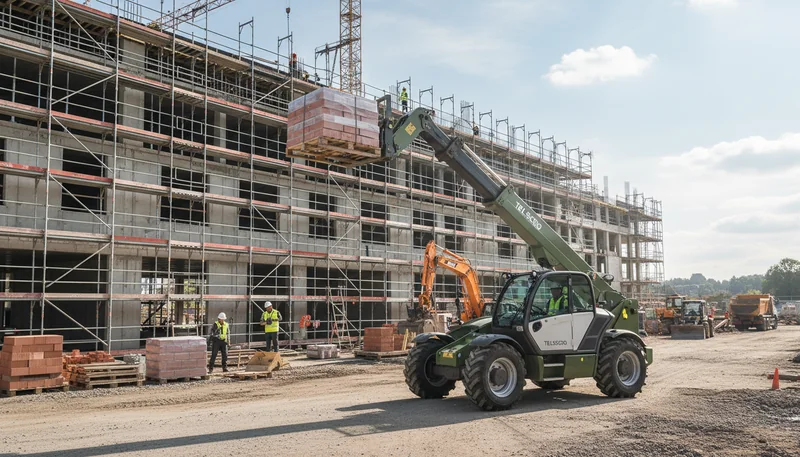
Forward reach on a telehandler refers to the horizontal distance shown on the load chart—typically measured from the front face of the front tire (or the manufacturer’s stated reference point) to the attachment’s load center1. It is distinct from lift height, because forward reach determines how far a load can be placed or picked in front of the chassis at a given boom configuration.
What Is Forward Reach on a Telehandler?
Forward reach on a telehandler is the maximum horizontal distance, per the load chart, from the manufacturer’s reference point (commonly the front face of the front tire) to the specified load center for the attachment in use. Forward reach is critical for effective onsite material placement.

Most people don’t realize that forward reach is more than just “how long is the boom”—it’s about how far out you can actually set a load from the machine’s wheels or chassis and still stay safe. On a busy site in Dubai last year, I watched a team struggle with a 14-meter telehandler because their material pallet needed to land behind deep scaffold, almost 8 meters out. The operator checked the spec sheet, but what mattered was where that distance started. Some manufacturers define reach from the front axle, but many load charts reference reach from the front face of the front tire. On machines equipped with stabilizers, the load chart may provide separate ratings for operation on tires versus on stabilizers—so the chart’s stated reference and configuration matter when comparing models. That 1-meter difference changed whether he could reach—or had to reposition the whole telehandler.
Let me share something important from real jobsites: forward reach almost always limits you before the rated lift height2 does. Many buyers check that a machine can lift 3,000 kg and reach 13 meters vertically, but they don’t look at the load chart3 for horizontal extension. At longer forward reach, many telehandlers are limited to a much smaller fraction of their rated capacity. The exact allowable load depends on the model, attachment/load center, and the specific load chart zone at that height and reach. I’ve seen jobs stall in Kazakhstan when teams assumed capacity stayed high at full reach. If you overlook this, you end up double-handling loads or, worse, risking a tip-over.
The practical takeaway? Always check the forward reach in the machine’s load chart—look for capacity at your most common extension, not just max numbers in bold print. I suggest asking dealers to clarify their reference points when comparing specs. That one detail can mean the difference between smooth material placement and costly downtime.
Forward reach on a telehandler is typically referenced from the front face of the front tire (or the manufacturer’s stated reference point), not from the boom tip itself.True
This is true because forward reach is defined on the load chart as a horizontal distance from a fixed machine reference to the specified load center for the attachment, which is essential for consistent planning and safe operation.
A telehandler’s maximum forward reach can always be used safely at its maximum lifting capacity, regardless of the extension.False
This is false because as the boom extends further out, the maximum safe load decreases due to leverage and stability limits; exceeding these can cause tip-over accidents.
Key takeaway: Forward reach defines how far a telehandler can extend loads horizontally from its base, directly impacting productivity and safety. Always verify the manufacturer’s reference points when comparing specifications to ensure accurate, jobsite-relevant performance comparisons—forward reach often matters as much as lift height in field operations.
How is forward reach different from lift height?
Forward reach is the horizontal distance the boom can project a load in front of the machine, while lift height is the maximum vertical placement height. Telehandlers marketed as “17 m” typically refer to lift height; maximum forward reach is substantially less and varies by model and load-chart configuration.

I’ve worked with customers who made this mistake—assuming a “17-meter” telehandler would reach 17 meters both up and out. That’s not how it works. Let me break it down with a quick comparison. Lift height is the straight-up vertical distance: how high above the ground you can set your load. Forward reach is all about distance out in front of the tires—horizontal extension, often over obstacles or into a building.
Here’s a simple table to compare both specs:
| Specification | Lift Height | Forward Reach |
|---|---|---|
| Direction | Vertical (up) | Horizontal (forward) |
| Typical Range | 6–18 m | 9–13 m (for 17–18 m models) |
| Usage Example | Placing rafters on a high roof | Loading trucks, reaching inside structures |
| Capacity Impact | Highest at lowest boom angle | Drops as reach increases |
One recent call stands out—a contractor in Dubai needed to place HVAC units 8 meters inside a structure while clearing a 2-meter wall. Their 17-meter telehandler reached only about 12 meters forward with the load, nowhere near the full height spec—and at that forward reach, the safe capacity dropped to around 900 kg. That’s the reality most buyers discover later.
You rarely get max height and max forward reach at once—there’s always a trade-off. If you mainly unload trucks or feed materials into a slab, I suggest looking at the maximum forward reach on the load chart. “Max height” sounds good in the showroom, but on site, forward reach is what gets the job done. Always verify both specs for your real-world tasks.
On most telehandlers, the maximum forward reach is substantially less than the maximum lift height because stability and leverage decrease rapidly as the boom extends horizontally.True
As a telehandler extends its boom outward, the center of gravity shifts and the machine's stability is reduced, limiting how far it can reach before risking tip-over. This is why forward reach specs are always much less than lift height, even on high-reach models.
If a telehandler’s maximum lift height is 17 meters, its maximum forward reach is also 17 meters.False
Forward reach is limited by factors like machine balance and boom geometry. Even for telehandlers with high lift heights, the forward reach is significantly less, typically less than half the vertical height, because extending the boom outward reduces safe load handling capacity.
Key takeaway: Forward reach is a critical but often overlooked specification, representing the horizontal extension of a telehandler. Buyers should not assume maximum lift height equals forward reach, as actual horizontal reach is typically much less. Verify both specs to match application needs.
How Does Forward Reach Affect Capacity?
As forward reach increases on a telehandler, safe lifting capacity drops sharply. This is because loads further from the front axle create more leverage, increasing tip risk. The rated capacity depends not only on hydraulic strength but also on the machine’s stability, as shown clearly on every load chart.

Let me share something important about telehandler capacity that too many jobsite managers overlook. It’s not the hydraulic power, or even the maximum lifting spec, that dictates what you can actually pick up at distance—it’s the physics of stability. As soon as you extend the boom forward, the load moves further from the front axle, and that leverage creates a tipping force. Even a powerful hydraulic circuit can’t change this fundamental limit. Every load chart, no matter if it’s for a 3.5-ton or a 4-ton model, makes this drop in capacity obvious: what looks strong at 2 meters might struggle with half the weight at 7 or 8 meters.
Last spring, I worked with a site in Dubai where the operator assumed his 3,500 kg telehandler could handle heavy HVAC units all the way out to 8 meters. In reality, when we looked at his load chart, the rated capacity dropped to just under 1,000 kg at full extension. That’s less than a third of what he expected. I’ve seen similar scenarios in Brazil and Uzbekistan—it’s almost universal. Most tip-overs, in my experience, happen when someone adds “just one more meter” on a routine lift, thinking the margin will hold.
Here’s the thing: always pair your required reach with the actual load at that distance. Don’t guess. Check the load chart for each specific boom extension and lift height. I always suggest choosing a machine where your real jobs—especially critical lifts—stay well inside the chart’s grey zone, not right on the limit line. It’s the only way to keep both the project and your crew safe.
Forward reach on a telehandler refers to how far the load can be extended horizontally from the front axle, not just how high it can be lifted.True
This is true because the primary challenge in telehandler operation is the tipping force created as the load is projected outward. Forward reach is measured from the front axle (the machine’s tipping point), and knowing this distance is essential to understanding the machine’s stability for any load at a given extension.
A telehandler’s maximum lifting capacity remains the same regardless of how far the boom is extended forward.False
This is false because extending the boom increases the distance (leverage) from the front axle, reducing the machine’s stability and allowable load significantly. Every telehandler load chart shows a decrease in rated capacity as forward reach increases, reflecting these physical limitations.
Key takeaway: Safe lifting capacity falls quickly as forward reach extends, due to increased leverage and stability limits—not just hydraulic constraints. Always check the load chart for capacity at required reach distances, and choose machines with comfortable margins for critical applications.
How Do Telehandler Load Charts Show Reach?
Telehandler load charts display forward reach on the horizontal axis, measured from the front tires or chassis to the load center, with lift height on the vertical axis. Each chart zone or curve indicates the maximum safe load for specific height and reach combinations, ensuring correct rated capacity at every point.

Here’s what matters most when using a telehandler load chart: understand exactly how forward reach is measured and why it changes your safe lifting limit. The horizontal axis always shows reach—usually measured from the front tires or chassis to the load’s center of gravity. If your pallet sits four meters inside a floor slab, you need to add any gap between your machine’s wheels and the edge. Let’s say you have to stand half a meter back from the slab, so your real reach is 4.5 meters. That’s the number you’ll walk along the bottom of the chart—not just the “max reach” from the brochure.
A contractor in Dubai made this mistake last year—he thought his 4-ton machine could handle 2,500 kg anywhere within 12 meters of boom extension. The reality was, at 10 meters reach, the load chart only permitted about 950 kg at that height. He called me after the pallet nearly tipped the machine. I ran him through the load chart step by step: start at your real reach, move up to your working height, and only trust the figure shown in that exact box or zone. It can be surprising how fast rated capacity drops as you extend further out.
From my experience, even seasoned operators sometimes overlook this. They see a headline figure and assume it holds at full stretch or while lifted high above ground. My advice? Always use the specific scenario you’ll face, not brochure maximums. Spend two minutes with the OEM load chart before buying, renting, or planning a lift—this habit prevents costly errors and keeps your project safe.
On a telehandler load chart, forward reach is measured horizontally from the front tires or chassis to the load's center of gravity, not simply to the edge of the forks.True
Manufacturers specify reach measurements from a fixed reference point on the machine—typically the front tires or chassis—to the center of gravity of the load. This ensures lifting limits are calculated as safely and consistently as possible.
The safe lifting capacity on the load chart remains the same regardless of how far you extend the boom forward.False
As you extend the boom, the forward reach increases, which causes the machine's leverage to change and reduces the safe lifting capacity. That's why load charts show different limits at different reaches.
Key takeaway: Reading the full OEM telehandler load chart is essential. Maximum rated capacity drops as forward reach and lift height increase, so always cross-reference your lift scenario on the chart—not just headline specs—to verify safe operation and avoid unstable or unsafe lifts.
How to Size Telehandler Forward Reach?
Telehandler forward reach should be sized by measuring the actual horizontal distance from the machine’s working position (front tires) to the load pick or drop point, the required lift height at that location, and the heaviest load handled. Reference the load chart and apply a 20–30% capacity margin4 for safety.

The biggest mistake I see is relying on brochure specs or “max reach” numbers in catalogs. Those figures look impressive, but real jobs are about what you can actually lift, not just how far the boom goes. To size forward reach correctly, grab a tape measure and walk your site. Start from where the front tires will be parked—then stretch to the center of your pick or drop point. Are you lifting over a truck, reaching inside a building, or going past obstacles? Measure that horizontal distance.
Let me give you a real example. A customer in Dubai needed to unload steel pipes from flatbed trucks and place them 6 meters beyond the truck edge, with a lift height around 2.5 meters. He first considered a 4-ton machine advertised with 13-meter reach. But when we checked the load chart together, at 6 meters reach and 2.5 meters height, rated capacity dropped to 2,200 kg—well below his 3-ton pipe load. That’s why I always say: load charts are your roadmap, not promo brochures.
For safety, never plan to use a machine right at its rated limit. I suggest picking a telehandler that handles at least 20–30% more than your heaviest load at the needed reach and height. This “80% rule” covers mistakes, uneven ground, and operator differences. And always remember: rated capacities assume the machine is fully level—usually within 3 degrees. If your site isn’t flat, you’ll lose capacity fast. I recommend checking these numbers before you sign any purchase order.
Forward reach on a telehandler refers to the horizontal distance measured from the front tires to the center of the load's landing point, not just the distance from the boom pivot.True
This distinction matters because real-world lifting scenarios are based on where the telehandler itself is positioned, and catalog specs typically omit factors like machine footprint and boom angle, which impact functional reach.
The actual lifting capacity of a telehandler stays the same regardless of how far you extend the boom forward.False
As the boom extends, the telehandler's lifting capacity decreases due to leverage and stability limits. Relying only on maximum rated lift risks unsafe operations, as the load chart shows capacity drops significantly at full forward reach.
Key takeaway: Always measure real on-site distances and lift heights rather than relying on brochure figures. Confirm the telehandler’s capability at the exact forward reach and height using the load chart, and select a model that can handle at least 20–30% beyond the maximum expected load for added safety.
What Are Typical Forward Reach Ranges?
Telehandler forward reach varies by model: compact types offer 3–4 m (10–13 ft) for tight sites; standard construction or agricultural models typically provide 6–9 m (20–30 ft); high-reach machines extend to 10–17 m (33–56 ft). Longer reach increases size and reduces agility, suiting specialized material placement.

To be honest, the forward reach spec actually matters more than most buyers think. It can make or break your efficiency onsite. For example, compact telehandlers5 usually top out at 3–4 meters of forward reach.
I worked with a landscaping crew in Singapore who picked a compact 2.5-ton unit for its tight turning radius and small footprint. It maxed out at just under 4 meters—which was fine for loading pallets onto small trucks or stacking in narrow yards, but they struggled whenever they needed to place materials deeper past a fence line.
Standard construction or agricultural telehandlers offer more flexibility, with forward reach typically in the 6–9 meter range. I see these models handling 80–90% of jobs on mixed-use sites in Kazakhstan and South Africa. With around 3,000–4,000 kg rated capacity, they’re reliable for truck loading, feeding scaffolds, and placing batches of block or bagged cement into mid-sized buildings.
Anything longer often means a bigger, heavier machine with a wheelbase over 3 meters and more limited maneuverability. That’s where it starts to feel less nimble in busy yards.
Jobs that demand deep placement—like reaching 12–15 meters into a building shell or placing steel on the far side of a large excavation—are reserved for high-reach telehandlers. These can reach 10–17 meters forward, but there’s a trade-off: load capacity drops sharply at max extension.
Earlier this year, a customer in Dubai asked about lifting 1,800 kg deep inside a shopping mall build-out. Once we checked the load chart, it was clear that a standard mid-range telehandler could not maintain that load at the required forward reach, and a higher-reach, heavier chassis model was necessary to complete the lift safely.
Forward reach is typically less than maximum lift height on a telehandler, since increasing forward outreach reduces lifting capacity due to stability limits.True
As a telehandler boom extends outward, the center of gravity shifts, and the machine becomes less stable, meaning manufacturers limit forward reach for safety even if the boom can extend higher vertically.
Most compact telehandlers are designed to handle their full rated load capacity at maximum forward reach.False
A telehandler’s lifting capacity decreases as the boom is extended forward. The rated load is only valid at minimal extension; at maximum forward reach, the safe lifting capacity is substantially lower.
Key takeaway: Compact telehandlers suit maneuverable tasks with 3–4 m forward reach, while standard models offer 6–9 m for broader site needs. High-reach telehandlers (up to 17 m) are reserved for specialized or deep placement jobs. Selecting the shortest-reach model covering most tasks maximizes efficiency and cost-effectiveness.
Why is forward reach critical for telehandlers?
Forward reach allows a telehandler’s boom to extend loads horizontally—often between 6–15 meters—enabling placement over obstacles and precise positioning where forklifts cannot operate. This capability is key for loading trucks from one side, setting materials over barriers, and accessing locations without direct drive-up access.

From my experience, the main difference between a telehandler and a rough-terrain forklift isn’t just how high you can lift—it’s what you can reach over. Forward reach lets you position loads where a traditional forklift simply can’t get to. Take a site in Dubai I worked with last year: the contractor needed to lift steel beams over a 2.5-meter retaining wall and set them on the other side. A standard forklift couldn’t get close enough, even with a tall mast. But their 12-meter telehandler, with a rated capacity of 3,800 kg and forward reach of over 8 meters, handled the job without the team having to rearrange barricades or lose time repositioning.
This horizontal boom extension really shines when you’re dealing with truck loading on congested sites. I’ve seen clients in South Africa save hours by using the forward reach to load flatbeds from just one side, not bothering to clear both sides of the vehicle. The same applies inside buildings—sometimes you need to place pallets or HVAC units deep onto new concrete slabs. Driving a heavy machine onto fresh concrete isn’t an option, but extending a telehandler’s boom lets you do the job safely from the edge.
The technical side matters here too. Always check the load chart for your machine—rated capacity drops as reach increases. For example, a 4-ton model might handle 1,500 kg safely at 12 meters, depending on the working angle. I suggest verifying your real working needs before choosing a machine. That way, you get the right balance of flexibility, safety, and cost for your job.
Forward reach allows telehandlers to place loads behind obstacles or into spaces inaccessible to vertical-mast forklifts, such as over walls or onto upper floors set back from an edge.True
Unlike forklifts that lift straight up, telehandlers use telescopic booms that can extend forward horizontally—this makes it possible to deposit materials in locations over physical barriers or reach recessed positions, which is essential on many construction sites.
Forward reach on a telehandler is only beneficial for increasing vertical lift height, not for positioning loads horizontally.False
Forward reach refers specifically to the horizontal extension capability of a telehandler’s boom, which allows it to move loads outward from the machine's base—this is crucial for reaching over obstacles or into limited-access locations, not just for raising loads upward.
Key takeaway: Forward reach is the primary advantage that separates telehandlers from conventional forklifts and loaders. It enables safe, efficient load placement in areas with restricted access, justifying the added complexity and cost for jobs that demand reach, flexibility, and fewer machine movements.
How Do Attachments Affect Forward Reach?
Attachments such as buckets, bale clamps, or man baskets shift the load center farther forward compared to standard forks. This increases the moment arm on the telehandler, effectively reducing the safe rated capacity at any given forward reach, even though the machine’s maximum reach distance remains unchanged. Always consult attachment-specific load charts6.

Let me share something important about telehandler attachments—I’ve seen operators in Kazakhstan struggle with forward reach, thinking their equipment was still “in spec” after swapping out forks for a large bucket. The reality? Just switching from standard forks to a 1.5-cubic-meter bucket can move the load center forward by 400–800 mm. That changes everything. Even though the brochure shows a maximum forward reach, the operator’s actual safe working capacity at that position dropped by up to half.
This isn’t just about buckets. Most attachments—whether it’s bale clamps, man baskets, or material-handling grabs—shift the load center farther away from the front axle. That means the telehandler’s moment arm increases, which limits what you can safely lift at any reach. I’ve seen a jobsite in Dubai come to a standstill because workers overloaded a man basket based on the standard fork chart, not the attachment-specific one. The machine’s stability warning alarm saved them, but the lost time was avoidable.
Here’s what I always recommend when you’re planning for real jobsite work:
- Request the load chart for every attachment, not just the basic forks.
- Verify forward reach capacity with your actual attachment—not just the machine spec sheet.
- Account for added attachment weight; it eats into your rated capacity immediately.
- Remember that shifting the load center forward reduces lifting power at height.
- Plan sizing based on your heaviest, most awkward load—not ideal test conditions.
If your daily work involves buckets, bale clamps, or personnel platforms, ask up front for the attachment-specific limits. Otherwise, you risk ending up with “showroom hero, jobsite zero”—great on paper, underpowered where it matters.
Switching to a larger or differently shaped attachment, like a bucket instead of forks, can significantly shift the load center forward and reduce the telehandler’s maximum safe forward reach.True
Attachments with more mass or volume placed further from the carriage alter the machine's weight distribution, making it less stable at extended reaches, and requiring derating of lifting capacity at those ranges.
Because forward reach specifications are published in the manufacturer brochure, operators do not need to adjust their practices after changing attachments.False
Published specifications are usually based on standard forks; using larger or longer attachments affects the load chart and can reduce safe working limits, meaning operators must always recalculate or verify the capacity and reach after changing attachments.
Key takeaway: Telehandler forward reach and safe working capacity are both reduced in real conditions when using attachments that shift the load center farther forward. Always refer to specific load charts for each attachment to avoid undersizing and ensure safe operation for actual jobs—brochure specs only apply to standard forks.
What costs increase with longer telehandler reach?
Longer forward reach on a telehandler requires a heavier, more robust boom and chassis, leading to a higher purchase price, increased fuel consumption, greater tire wear7, and more expensive transport. Maximum reach use also accelerates wear on boom sections, wear pads, extension cylinders, and chains, raising ongoing maintenance demands.

Last month, a contractor in Kazakhstan called me about switching from a 7-meter to an 11-meter telehandler. On the surface, the longer reach looked ideal for their new warehouse build. But once we ran the numbers, it was clear the jump wasn’t just about height. The 11-meter model weighed nearly 2,500 kg more and required a reinforced chassis8 and thicker boom sections. That difference added at least 20% to the purchase price and pushed monthly fuel bills up by a similar amount. Just moving the larger machine to their site meant upgrading to a bigger transporter truck—and those costs stack up quickly.
I’ve seen it on jobs in Dubai as well, where longer machines wear out tires far faster, especially working on rough ground. The heavier the telehandler, the more pressure you put on tires—sometimes cutting tire lifespan by a third compared to shorter models. When you regularly operate at max reach, there’s extra stress on boom sections, extension cylinders, wear pads, and even the chains running inside the boom. Maintenance managers tell me their 10–12 meter machines need replacement pads and shimming twice as often as compact units. That’s not just downtime—it’s real money.
Here’s what matters most: If your typical lifts are well within the mid-range of your telehandler’s load chart, you avoid most of these extra costs. I always recommend picking a model where day-to-day jobs fall in the 50-70% range of max reach and capacity. It means less stress, smoother operations, and noticeably lower upkeep over the machine’s lifespan.
A longer forward reach on a telehandler typically increases not only the initial purchase price, but also ongoing transport costs due to heavier chassis requirements.True
Telehandlers with greater reach need a heavier-duty frame and components, raising both up-front cost and the shipping or transport expenses, since heavier machines may require special handling.
Increasing forward reach on a telehandler does not impact fuel consumption because the engine size remains the same.False
Longer reach models are heavier and often require more robust hydraulics, both of which can raise fuel consumption even if the engine size is similar.
Key takeaway: Moving to a longer-reach telehandler raises upfront and operating costs due to heavier components, higher fuel use, and more frequent maintenance on booms and moving parts. Choosing a machine for typical, not extreme, work minimizes maintenance, running costs, and downtime over the equipment’s lifespan.
Conclusion
We’ve looked at what forward reach means for a telehandler and why it’s just as important as maximum lift height on real jobsites. From my experience, buyers often focus on the headline specs and miss the “3-meter blind spot”—the real working range and stability at extension. I always recommend checking the load chart at your common forward reach, not just the max numbers, and making sure parts and support are close by. If you have questions about load charts, tricky placements, or need advice for your site, I’m happy to share what’s worked for crews in more than 20 countries. Feel free to reach out—getting the right fit saves headaches later. Every jobsite has its own challenges; choose what helps your team work safely and efficiently.
References
-
Detailed insights into how load center shifts impact telehandler load limits and operational safety on construction sites. ↩
-
Explores how maximum vertical lift relates to load capacity and why horizontal reach often limits jobsite productivity. ↩
-
Comprehensive insights into understanding load charts to prevent tip-overs and maximize safe lifting capacity in telehandlers. ↩
-
Learn why adding a 20–30% capacity margin ensures safety and reliability for telehandler lifting operations on construction sites. ↩
-
Explore how compact telehandlers improve efficiency in confined spaces with tight turning radius and small footprint, ideal for landscapers and urban jobs. ↩
-
Explains the critical role of attachment-specific load charts in preventing overload incidents and ensuring safe telehandler use. ↩
-
Details the impact of heavier telehandlers and maximum reach use on tire degradation and maintenance costs in rough terrain. ↩
-
Explains the engineering behind telehandler chassis reinforcement necessary for handling increased boom weight and operational stress. ↩