










What is a Telehandler “Working Envelope”? A Field Guide to Safe Operation
I’ll never forget watching a telehandler operator in the UK scratch his head at a "4,000 kg" machine that refused to lift more than a pallet of bricks at full reach. That moment summed up a common confusion—even among seasoned crews—about what these machines can actually do, and where.
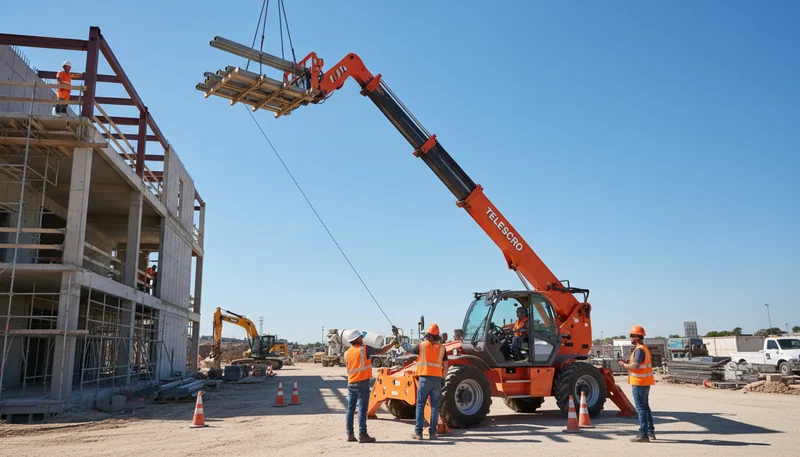
A telehandler’s working envelope is the three-dimensional range in which a load can be placed safely for a given configuration—defined by lift height, forward reach, and allowable capacity as shown on the OEM load chart. The envelope is attachment- and load-center-dependent, so operators must match the intended lift point to the correct chart and zone before lifting.
What Is a Telehandler Working Envelope?
A telehandler’s working envelope is the three-dimensional space defined by the boom’s maximum height, forward reach, and rated capacity1, as shown in the manufacturer’s load chart. This “bubble” marks all safe load placement positions, while areas outside it are considered unsafe or ‘dead zones.’

The biggest mistake I see is assuming a telehandler’s “max” numbers tell the whole story. The real question is always, “Can this machine put my load exactly where I want it—safely?” That’s what the working envelope is about. On actual jobsites—from the high-rise projects in Dubai to rural Kenya—operators don’t just lift straight up and down. They need reach: over scaffolding, into a third-story window, past parked trucks. The working envelope is the full three-dimensional boundary where your telehandler can safely place a load, considering both height and forward reach, not just one or the other.
I worked with a contractor in Kazakhstan who purchased a 4-ton class telehandler expecting it to lift close to its rated capacity at long reach. When we reviewed the load chart—the manufacturer-provided reference for all safe lifting positions—the allowable load at around 12 meters of outreach was far lower than expected.
The reason is straightforward: as the boom extends, forward stability decreases because the load moment about the front axle (the primary tipping axis) increases rapidly. Manufacturers calculate each point within the working envelope under defined conditions—such as proper machine setup, firm supporting surface, the specified attachment, and a defined load center2—and the load chart reflects those limits. Relying on the headline rating instead of the chart is where many jobsite surprises begin.
A good OEM load chart typically shows lift height on the vertical axis and reach on the horizontal axis, with reach measured from the front face of the front tire to the load center for the attachment being used. Allowable capacity is then indicated by curves, tables, or shaded zones. Any position outside the charted envelope is outside the manufacturer-approved operating range—even if the boom can physically reach it. Before any lift, verify your actual load weight, planned height, reach, and attachment against the correct load chart rather than relying on headline “max” specifications.
A telehandler’s working envelope can change dramatically depending on the stability provided by outriggers, terrain angle, and boom extension—even if the lift capacity stays the same on paper.True
The working envelope is a three-dimensional boundary and depends on operating conditions like outrigger deployment and ground slope, which affect where and how safely the telehandler can place loads, regardless of its maximum rated capacity.
The working envelope of a telehandler simply refers to its maximum lifting height and nothing else.False
The working envelope describes the total spatial range—both reach and height—where the telehandler can safely position a load, not just the vertical lifting height. It encompasses forward reach and angles, factoring in obstructions and stability, not only maximum height.
Key takeaway: Understanding a telehandler’s working envelope—represented in model-specific load charts—is essential for ensuring safe load placement at any given height and reach. Always reference the envelope to verify that both intended position and load weight are within manufacturer-approved stability limits.
How Do Telehandler Load Charts Define Capacity?
Telehandler load charts illustrate the true working envelope by mapping rated capacity at each lift height and reach. Capacity drops sharply as the boom extends and height increases due to the shifting load center. Each attachment has its own chart. Operating outside these specified limits risks instability and must be avoided.

Let me share something important about reading telehandler load charts—these charts are not just for operators; they’re the real key to whether your job runs safely or not. Too often, I’ve seen buyers focus on a machine’s "4-ton" rating and stop there, without realizing that number is only true in the best-case setup—boom retracted, level ground, and the specified attachment. The minute you raise the boom or stretch it forward, capacity drops, sometimes by half or more. The load chart draws this out in black and white: height on the side, forward reach along the bottom, allowed capacity marked at every intersection.
Last month, a jobsite in Kazakhstan ran into trouble expecting their 3.5-ton telehandler to lift 2,500 kg up to a balcony at nearly full reach. According to the load chart, capacity at that position maxed out at just over 1,200 kg—and that’s if the ground is level. They had to bring in a second smaller machine to finish, eating up valuable time and budget. That’s the kind of scenario the load chart is meant to prevent.
Each attachment also comes with its own chart, because swapping forks for a bucket or work platform changes the whole balance and load center. Never assume the same limits apply just because the telehandler class is the same. I always recommend picking your working position—both height and reach—on the chart, then checking your actual load. If you’re even a little over, change your plan before you risk a tip-over or damaged equipment. Your real capacity is only what the chart tells you.
A telehandler's working envelope, as shown on the load chart, illustrates how lifting capacity decreases as both the boom extends and the lift height increases.True
The working envelope defines the combination of boom angles, lengths, and positions where the machine can safely handle a load. Extending the boom outward or raising it higher changes the leverage on the machine, reducing capacity compared to the base rating at full retraction and low height.
If the telehandler’s wheels remain on the ground, the rated capacity shown on the load chart stays the same at every boom position.False
The rated capacity shown on the load chart varies depending on boom length and lift height, even if the telehandler remains stationary and its wheels stay planted. Changes in boom extension and angle shift the center of gravity and reduce lifting capacity, regardless of wheel contact.
Key takeaway: Load charts precisely define a telehandler’s safe working envelope by showing rated capacity at every height and reach combination. Staying within these charted limits—verified for each attachment—prevents overloading and minimizes tipping risk. Never assume fixed-rated capacity applies throughout the entire reach or at every boom angle.
Why Don’t Max Height and Capacity Align?
Telehandler brochures often highlight maximum lift height3 and rated capacity, but these specifications rarely apply at the same time. Rated capacity is typically measured with the boom retracted and low, while maximum lift height is achieved with the boom extended and lightly loaded. As reach and height increase, allowable lifting capacity decreases significantly, which is why actual limits must always be verified on the manufacturer’s load chart.

Here’s what matters most when comparing telehandler specs: maximum lift height and rated capacity almost never go hand-in-hand. You’ll see brochures advertising “17 meters height” and “4,000 kg capacity”—but if you dig into the load chart, you’ll quickly realize that lifting 4,000 kg is only possible when the boom is down low and fully retracted. As soon as you start extending the boom upwards or outwards, rated capacity drops off rapidly. In most cases, at full extension and maximum height, usable capacity can drop below 25% of the headline figure.
I’ve worked with contractors in Dubai and Brazil who ran into this problem. One team bought a 14-meter, 4-ton telehandler hoping it could lift steel beams to a roof at 13 meters. The on-paper numbers looked perfect—until they actually checked the load chart. At 13 meters and a typical reach position, that machine could handle just 900 kg. They needed to rethink their lifting plan entirely and ended up using cranes for the heaviest loads. These types of surprises are common if you rely on the “big numbers” in marketing materials.
The reality is, two telehandlers in the same class can have very different working envelopes. One 4-ton model might lift 1,200 kg at 12 meters, while another can barely manage 800 kg at the same point—even if both are rated for 4 tons at minimum reach. I always suggest matching your actual lift point to the load chart before making a final selection. That’s how you avoid expensive jobsite headaches.
A telehandler's maximum rated capacity is typically only achievable when the boom is fully retracted and at its lowest lift point, not at maximum height or reach.True
This is true because as the boom extends or elevates, leverage increases and the machine's stability decreases, requiring lower load ratings to maintain safe operation.
At maximum lift height, a telehandler can always handle its maximum rated capacity safely.False
This is false because structural and stability limits mean the safe lifting capacity at maximum height is usually significantly less than the machine's maximum rated load; exceeding safe limits risks tip-over or equipment failure.
Key takeaway: Maximum height and rated capacity in telehandler specifications are never achieved together. Actual lifting ability at working height and reach depends on the model’s specific working envelope, making load chart consultation essential for safe, effective equipment selection and job planning.
How to Define a Telehandler Working Envelope?
A telehandler working envelope is defined by specific reach and height points, based on load weight, lift height, and forward reach from the front tire edge to the attachment load center. Operators must list key site tasks, then use load charts to confirm safe, stable operation at each working point.

Let me share something important about defining your telehandler working envelope—it’s not just about picking a machine with a big spec sheet. You need to translate your actual jobsite tasks into specific numbers before you start looking at models. I’ve seen buyers in Kazakhstan guess at “max reach” or “max capacity,” but when I ask for real site examples, they get stuck. That’s where I always recommend starting with your three most critical lifts—what’s the heaviest thing, how high, and how far from the machine base do you actually need to go?
Say you’re in Dubai lifting 1,800 kg concrete blocks onto a floor slab 12 meters up, set back 3 meters from the edge. If the telehandler must stay 2 meters from the scaffolding for safety, your working envelope is about 12 meters high and 5 meters reach (measured from the front tire edge to your load center). Open the load chart and check: does a 4-ton class, 18-meter reach telehandler actually handle that at full extension? Sometimes, due to stability design or chassis limits, the capacity drops way below what you expect—maybe to just 1,200 kg at that position.
From my experience, the biggest time-waster is comparing machines on paper without this jobsite envelope. One contractor in Brazil bought a 3.5-ton telehandler, then found it couldn’t safely place roofing sheets at full height and reach. They ended up renting a larger unit halfway through the project. I always suggest mapping each site task to the load chart before talking to dealers—it saves money, avoids under-spec mistakes, and keeps your site running smoothly.
A telehandler's working envelope should always consider both vertical lift (height) and horizontal reach (outreach) together, rather than as separate maximums, for every lift scenario.True
Manufacturers publish load charts that show lifting capacity at specific heights and reaches, as these factors interact. Only analyzing max vertical or horizontal figures separately can create unrealistic expectations about what the machine can safely handle in typical site tasks.
The maximum capacity listed on a telehandler’s spec sheet is the weight the machine can lift at any point within its working envelope.False
The maximum capacity is only achievable at a limited range of boom positions, usually with the boom retracted and low to the ground. As outreach or lift height increases, the lifting capacity decreases significantly for stability and structural reasons.
Key takeaway: Defining a telehandler’s working envelope means translating real site tasks into clear load, height, and reach requirements. By mapping these points against load charts before engaging dealers or rental providers, operators can eliminate unsuitable models and prevent both under-spec and over-spec equipment selection.
How Do Attachments Affect Working Envelope?
Every telehandler attachment alters the working envelope by changing both weight and load center, typically reducing usable capacity. Heavy or long attachments, such as jibs or platforms, increase leverage on the boom, leading to lower rated capacities at given heights and reaches. Always consult attachment-specific load charts—never rely on base machine data for safe operation.

Most people don’t realize how much the working envelope can shrink when forks are replaced with attachments such as a jib or a man basket. I see this frequently on jobsites. On a project in Dubai last year, a team planned to lift HVAC units using a jib and assumed the telehandler’s standard fork load chart still applied at their required reach.
Once the attachment-specific load chart was reviewed, the allowable load at that same working position was far lower than expected. The reduction came from two factors: the additional weight of the jib itself and the longer load center created by positioning the load farther out from the boom. Together, these changes significantly reduced the usable working envelope compared to fork operation.
The extra distance and weight from attachments reduce stability and lifting power fast—some operators don’t realize how quickly things change until the alarm on the moment indicator starts beeping. I’ve seen people try to “just make one lift” outside those limits, and a few minutes later, the rear wheels leave the ground. That’s a common cause of tip-overs and bent booms, and it always ends up costing more in downtime and repair.
Here are the main ways attachments affect the working envelope:
- Heavier attachments eat into rated capacity—every kg on the quick-coupler subtracts from your max load.
- Long attachments shift the load center forward, reducing safe reach and height.
- Each attachment needs its own load chart—never use the base machine data.
- Improvised solutions (like people on forks) fall completely outside the tested envelope and are responsible for many serious accidents.
I always suggest requesting the exact load chart for any attachment before work starts. That’s your map for safe operation.
Attaching a jib or man basket to a telehandler can significantly reduce its maximum safe lifting capacity at full reach due to added weight and increased load center.True
Attachments like jibs and man baskets shift the load farther from the machine's pivot point and add their own weight, both of which decrease the telehandler's stability and lifting capability at extended reaches.
Switching from forks to a jib on a telehandler does not require any adjustments to the load chart because the working envelope remains unchanged.False
Every attachment alters the forces and load centers acting on the machine, which requires using a dedicated load chart for that attachment. Ignoring this can cause operators to unintentionally overload the telehandler and compromise safety.
Key takeaway: Attachments significantly impact telehandler capacity and stability by shifting weight and load center. Always use the dedicated load chart for each attachment—never assume the main machine’s rated envelope still applies. Improper improvisation or exceeding attachment-specific limits is a frequent cause of serious incidents.
What Keeps a Telehandler Inside Its Envelope?
Modern telehandlers use a combination of electronic and hydraulic safety systems—including load moment indicators (LMIs), boom angle sensors4, and boom extension measurement—to monitor proximity to the working envelope limits defined by the load chart. When those limits are approached, these systems warn the operator and, depending on the model, may restrict movements that would further increase load moment. Proper function depends on regular inspection, maintenance, and manufacturer-specified calibration.

Let me share something important about how telehandlers actually stay within their designed working envelope. Electronic and hydraulic safety systems play a critical role in supporting safe operation, particularly at height and reach, but they do not replace proper load chart verification or correct machine setup.
At the core of these systems are load moment indicators (LMIs), which assess stability risk based on inputs from boom angle sensors and boom extension measurement. These sensors track how high the boom is raised and how far it is extended, allowing the system to compare the current working position against the limits defined in the load chart. As those limits are approached, the machine typically warns the operator through audible or visual alerts.
On a project in Malaysia last year, a contractor ignored repeated LMI warnings while attempting to complete a lift at long reach. On that particular machine, further boom extension was eventually restricted to prevent an increase in load moment. While frustrating at the time, the operator later acknowledged that the system likely prevented a rollover.
These safety systems are only effective when properly maintained. During inspections in regions such as Nigeria and Eastern Europe, I have frequently found contaminated sensors or degraded wiring connections. In such conditions, the system may respond too conservatively—or, more dangerously, fail to intervene before the working envelope is exceeded. Regular inspection, testing, and manufacturer-specified calibration are essential, and safety interlocks should never be bypassed to save time.
A telehandler's load moment indicator (LMI) uses input from both boom angle sensors and boom extension encoders to prevent the machine from exceeding its working envelope.True
The LMI integrates data from multiple sensors to track boom position and extension in real time. This allows electronic safety systems to calculate the stability margin and restrict unsafe operations, helping operators stay within the machine's safe working limits.
Hydraulic safety systems alone are sufficient to keep modern telehandlers within their working envelope, without the need for electronic monitoring.False
While hydraulic systems provide some basic overload protection, they cannot measure or respond to changing boom angles and load positions as accurately as electronic systems with sensors. Modern telehandlers rely on a combination of electronic and hydraulic systems to ensure safe operation within the designated envelope.
Key takeaway: Electronic and hydraulic safety systems—like LMIs, boom sensors, and encoders—actively prevent telehandlers from breaching their safe working envelope. However, these protections depend on proper maintenance: damaged or miscalibrated parts can compromise safety. Never bypass safety systems, and always follow a documented inspection and calibration program.
What Defines a Telehandler Working Envelope?
A telehandler’s working envelope is a hard limit defined by the manufacturer’s load chart and operating procedures. Exceeding charted limits can lead to tip-over risk, structural damage, or dropped loads—and can expose employers and operators to regulatory non-compliance and liability. Treat the load chart as the controlling document for every lift.
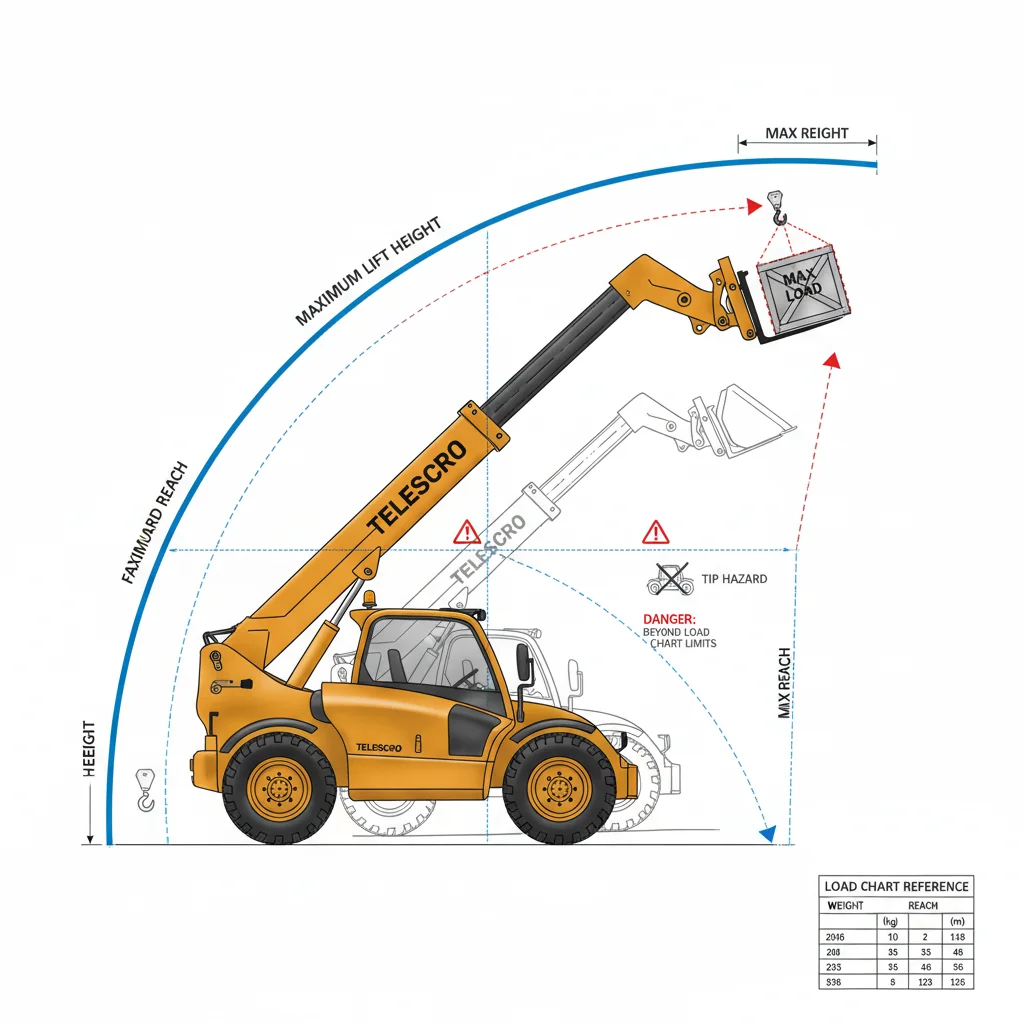
Last month, a contractor in Saudi Arabia sent me a photo of a 4-ton class telehandler working on loose gravel with the boom extended close to its working limit. According to the load chart, the planned lift appeared to fall within the allowable range for that reach. However, the chart assumes defined setup conditions, and the soft ground significantly reduced the machine’s real stability margin. As soon as a heavy HVAC unit was picked, the telehandler began to tip, highlighting how quickly ground conditions can shrink the practical working envelope. Fortunately, no one was injured.
I still see many jobsites treating the working envelope as a guideline rather than a hard limit defined by the manufacturer. In reality, load charts and operating instructions establish the approved operating range for the machine. Deviating from these limits—whether through overloading, improper ground support, or unapproved work platforms—greatly increases the risk of incidents and shifts responsibility toward the user. In Europe, standards such as EN 1459 define the conditions under which telehandlers are designed and tested, while in the United States, OSHA enforcement typically focuses on whether equipment is used in accordance with the manufacturer’s instructions.
What matters most is understanding where the working envelope comes from: real engineering constraints such as hydraulic capacity, structural strength, and stability margins. These limits cannot be bypassed by adding counterweights or “reaching just a little farther.” When stabilizers or outriggers are provided, they must be fully deployed and properly supported, especially on soft or uneven ground. And whenever people are lifted, only manufacturer-approved platforms and trained operators should be used. The working envelope should be treated like a physical barrier with an alarm—not a flexible boundary to be tested.
A telehandler's working envelope is limited not only by boom reach and load capacity, but also by ground conditions, which can significantly reduce stability even when the load chart allows the lift.True
Load charts are calculated for ideal, level, and firm ground. When the ground is soft or uneven, the machine's center of gravity shifts, and tipping risk increases, meaning the practical working envelope shrinks.
The working envelope of a telehandler is determined solely by the maximum boom extension and rated load at each angle, regardless of where the machine is positioned.False
The working envelope is also affected by external factors such as ground stability, tire pressure, and machine leveling. Relying only on boom extension and rated load ignores these real-world factors that impact actual safe operation.
Key takeaway: The working envelope is a legally defined boundary set by the manufacturer’s load chart, not a flexible guideline. Overstepping it—due to unstable ground, improper stabilizer use, or unapproved platforms—creates serious legal liability and endangers site safety. Always operate strictly within charted limits.
How Does Working Envelope Impact Costs?
A telehandler with a stronger, better-shaped working envelope may carry a higher purchase or rental price, but reduces jobsite costs5 by minimizing repositioning, marshalling time, and reliance on additional lifting equipment. Cost per usable working envelope, not just maximum reach or tonnage, best predicts actual productivity and economics.
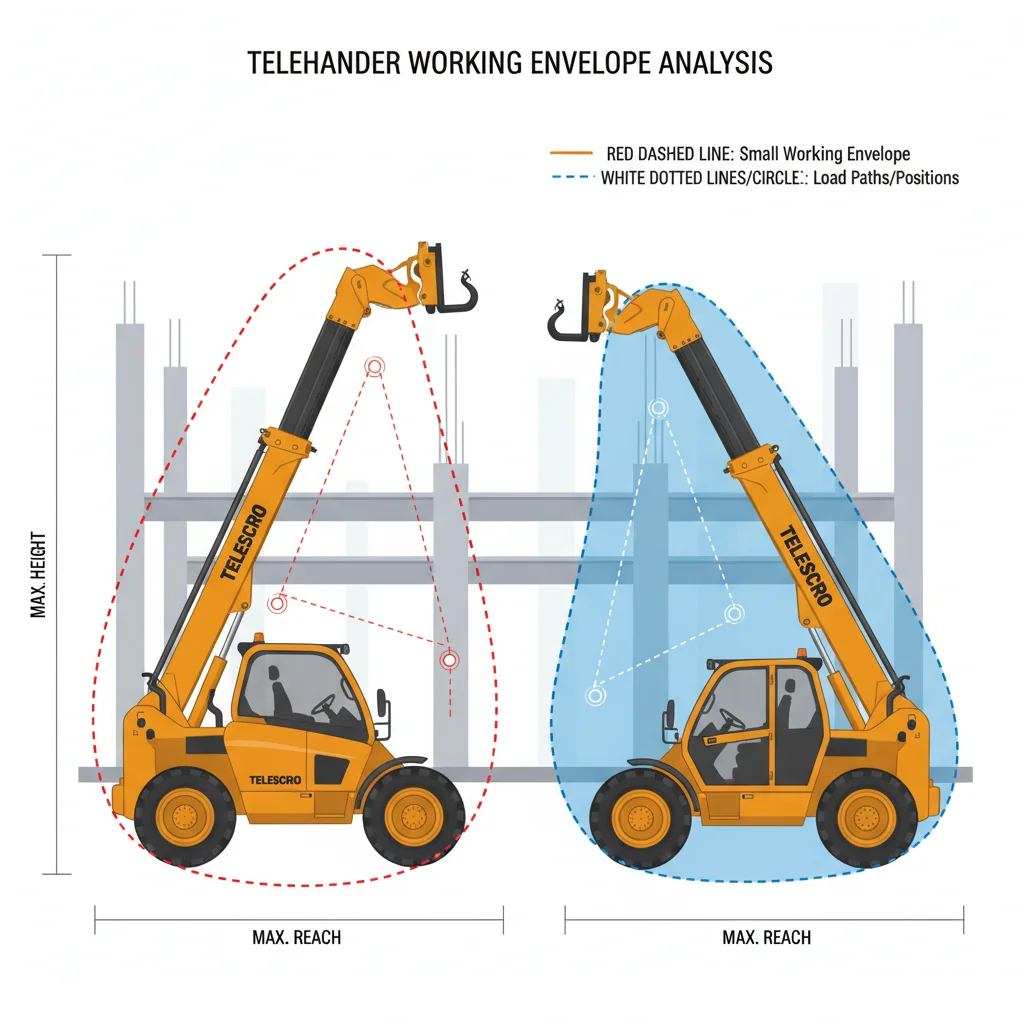
To be honest, the cost-savings from a better-shaped working envelope are underestimated by most buyers. I’ve seen customers choose a cheaper telehandler, only to double handling time because the boom couldn’t reach key spots without constant repositioning. For example, one project in Dubai used a 4-ton telehandler with an 18-meter reach, but the load chart showed it could only handle about 1,200 kg at full horizontal extension. The crew needed to lift HVAC units to a second-floor slab—at 13 meters out. They lost almost four hours a day shifting the machine and clearing space just to finish each lift.
Here’s what matters most when you compare real running costs: a machine with a stronger working envelope covers more targets from one position. That means less marshalling, less site disruption, and much safer placements when operating at height. On a recent jobsite in Brazil, a customer told me their high-reach 20-meter telehandler could place 1.3-ton loads on the third story—avoiding at least two monthly crane rentals. The extra spend on rental rate quickly paid off within the first two phases.
From my experience, focusing only on maximum reach or “rated capacity” doesn’t show the full picture. Rated capacity applies at minimum reach, on level ground, with the OEM-specified attachment. What you actually want is cost per usable working envelope—a way to judge how efficiently the machine supports your real material handling tasks. I suggest always checking the load chart at your common working heights and reaches before deciding. That’s where the real jobsite costs—good or bad—come from.
Choosing a telehandler with a well-matched working envelope can reduce site costs by minimizing machine repositioning, which helps shorten project timelines and reduces labor use.True
An optimized working envelope allows operators to reach more work areas from a single setup, reducing idle time, material double-handling, and the frequency of moving the machine. This leads to smoother workflows and fewer labor hours, which translates to lower direct and indirect site costs.
A telehandler’s working envelope has no significant effect on project costs as long as the lift capacity is sufficient for the job.False
Lift capacity alone does not determine efficiency. If the working envelope cannot reach critical locations without constant repositioning, handling time and associated labor and equipment costs increase, even if the telehandler can technically lift the required weight.
Key takeaway: Choosing a telehandler with an optimized working envelope often results in significant cost and productivity benefits. Fewer relocations, safer load placements at height, and reduced need for auxiliary lifting equipment can quickly offset higher upfront costs, improving both schedule and overall project economics.
Conclusion
We’ve talked through what a telehandler’s working envelope really means and why those load charts are so important for safe operation. From what I’ve seen on sites, safe lifts come down to knowing your machine—especially at different heights and reaches—not just trusting the overall max capacity. Double-check where your actual load and boom position fall within the chart, even if it seems obvious. Have questions about reading load charts or matching telehandlers to specific jobsite needs? I’m happy to share what’s worked for real crews—just reach out any time. The right telehandler choice depends on your site’s realities, not just the spec sheet.
References
-
Understand the technical basis of rated capacity and its practical limitations based on boom position and load charts for safer operations. ↩
-
Explains the impact of shifting load center on lifting capacity and stability, essential knowledge for operators managing diverse attachments. ↩
-
Explore detailed explanations on how lift height affects telehandler capacity and why specs don’t align to aid better equipment planning. ↩
-
Details how boom angle sensors monitor position to keep telehandlers within safe operational limits and prevent dangerous movements. ↩
-
Analyzes how telehandler specs and usage affect costs such as marshalling time, crane rentals, and site disruption, backed by real project examples. ↩