










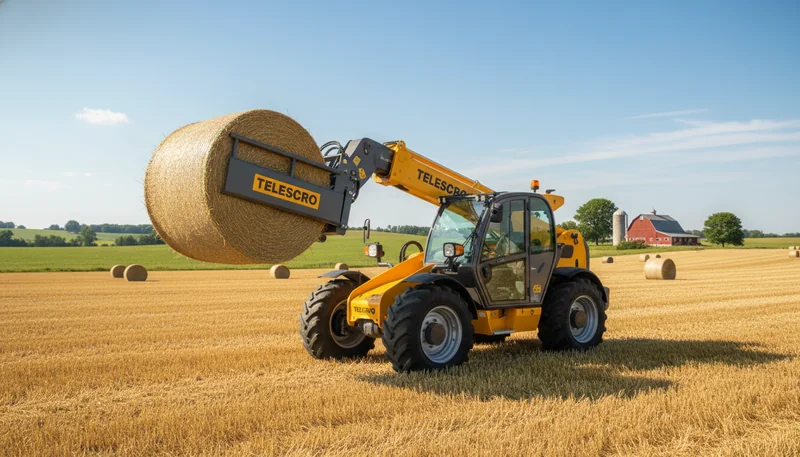
What is a Telehandler Bale Grab Attachment Used For? Field Uses & Buyer Tips
Last month, I watched a crew in Sweden struggle to unload silage bales with pallet forks—plastic torn, bales rolling everywhere, feed value dropping by the minute. It’s a scene I’ve seen in fields from Brazil to Ireland, and every time, there’s a smarter way: a proper bale grab.
A telehandler bale grab attachment is a hydraulically actuated tool engineered for handling wrapped and unwrapped bales while minimizing damage to their exterior. Curved, smooth arms clamp securely around round or square bales—most commonly in the 1.2–1.5 m diameter range and, on higher-capacity models, up to around 1,500 kg. By avoiding spikes and spreading pressure evenly, the grab helps prevent plastic film punctures on silage bales, preserving fermentation quality and reducing spoilage.
What Is a Telehandler Bale Grab For?
A telehandler bale grab is a hydraulically operated attachment designed for securely lifting, transporting, and stacking wrapped or unwrapped bales on livestock and hay operations. Its curved arms clamp around bales—rather than piercing—preserving bale integrity. This tool streamlines typically in the 400–900 kg range, with some high-density silage bales approaching 1,200–1,500 kg on suitable grabs and machines.
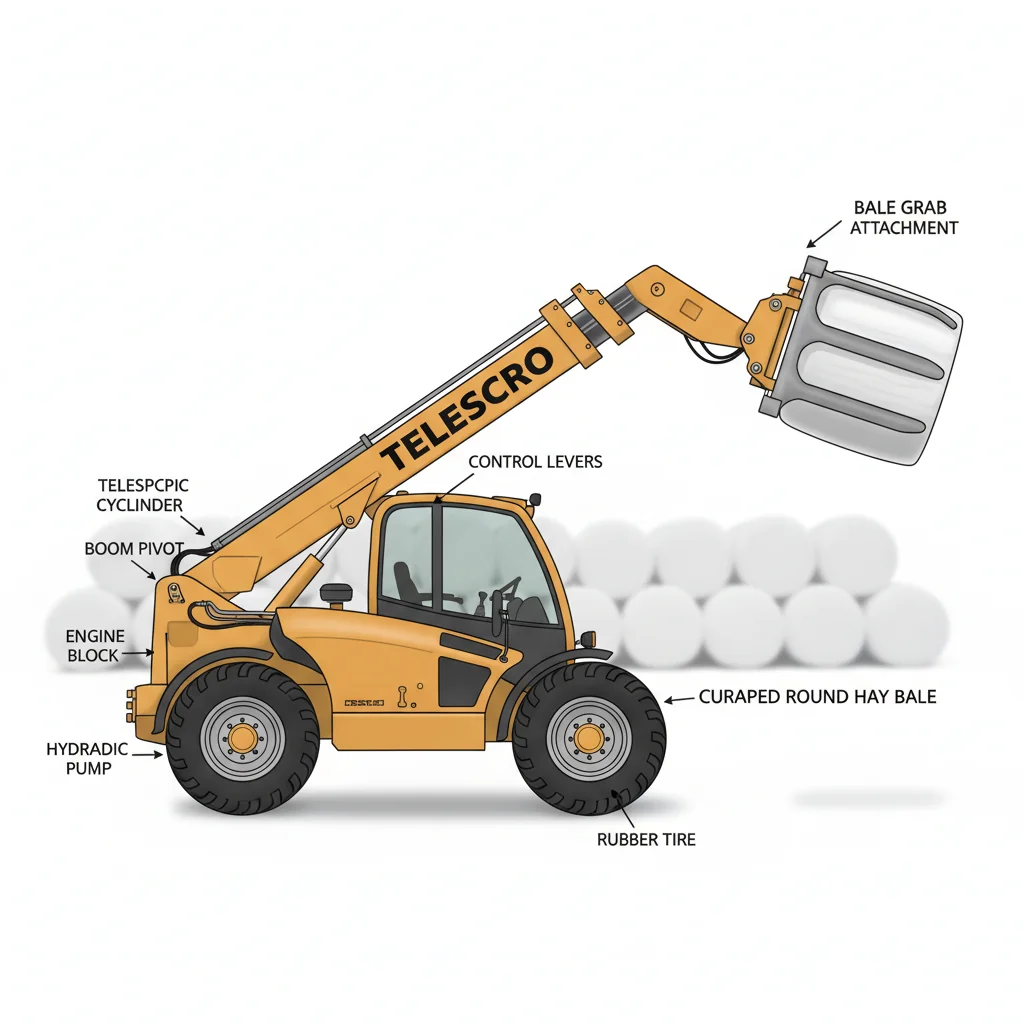
Most people don’t realize how much damage a standard fork or spike can do to wrapped bales—especially when you’re dealing with silage. The main job of a telehandler bale grab is to clamp around the bale, not puncture it. This makes a huge difference for farms in places like Ireland or New Zealand, where preserving the plastic wrap means no mold or spoilage. You simply connect the bale grab to the quick-hitch, plug in the hydraulic hoses, and you’re ready to move bales weighing anywhere from 500 up to 1,500 kg without breaking the seal.
Last year, I worked with a livestock operation in Kazakhstan dealing with over 200 round bales daily. Switching to a bale grab on their 3.5-ton telehandler cut their bale handling time by half. They could stack three layers high in the yard and unload trucks quickly from just one side, thanks to the telehandler’s reach. The setup used a standard double-acting hydraulic circuit1—no complex modifications, so maintenance stayed simple. Quick-attach locking pins kept everything safely locked, but I always remind operators to check for wear, because loose pins can let the grab wobble (not something you want with a 1,000 kg bale two meters up).
A telehandler bale grab isn’t just about speed—it protects expensive feed and saves you switching machines mid-task. Whether you’re moving dry straw, dense haylage, or slippery plastic-wrapped silage2, a grab avoids the risk of punctures, so quality stays high. I suggest looking at your bale sizes and daily volume—choose a grab that’s a good match for both and always check the load chart for any derating with the attachment mounted.
A telehandler bale grab is specifically designed to move wrapped bales without piercing the plastic, significantly reducing the risk of spoilage compared to using standard forks or spikes.True
The clamp action of a bale grab applies even pressure around the bale, ensuring that the protective plastic wrap stays intact. This is crucial for silage, as any holes in the plastic allow air to enter, causing spoilage due to mold or fermentation losses.
Telehandler bale grabs are suitable for efficiently transporting loose silage, as the clamps can secure unwrapped forage just as effectively as wrapped bales.False
Bale grabs are engineered to move intact, wrapped bales by clamping their shape; they are not designed for handling loose or unwrapped material, which can slip through the arms or be difficult to control. Specialized buckets or forks are preferred for loose silage.
Key takeaway: A telehandler bale grab allows safe, efficient, and non-damaging movement of hay, straw, and silage bales. It preserves bale quality, fits most telehandlers via quick-hitch, and is essential for stacking and loading tasks throughout livestock and agricultural operations.
How Do Bale Grabs Protect Bale Quality?
Telehandler bale grab attachments use smooth, rounded arms—often called “soft hands3”—to handle wrapped silage and haylage bales without piercing or damaging the plastic wrap. This design preserves bale integrity, minimizing air ingress, mold risk, and feed spoilage. Leading manufacturers emphasize polished, burr-free contact surfaces to maintain merchantable wrap quality during bale handling and transport.
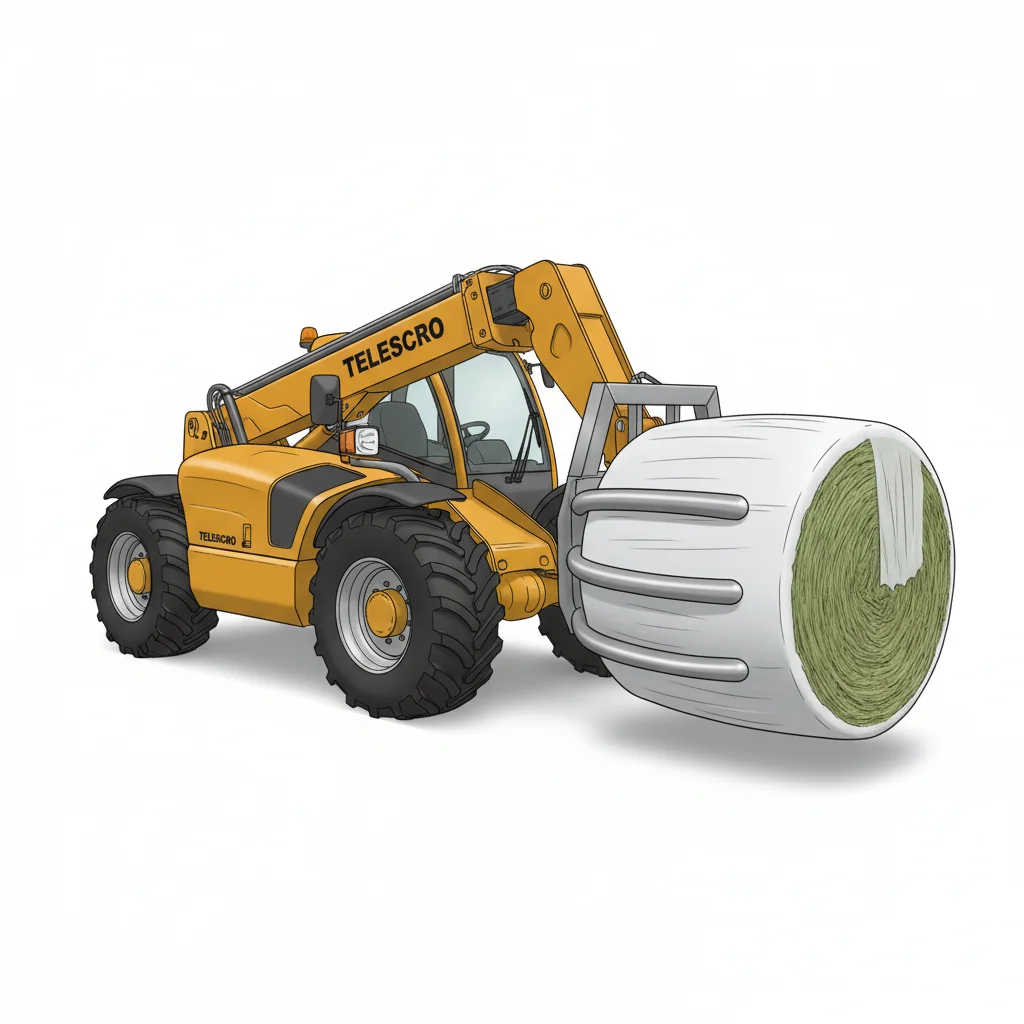
Here’s what matters most when you want to keep your silage and haylage bales in top condition: damage-free handling. I’ve seen too many operations lose feed value just from using the wrong attachment. Standard pallet forks can puncture the wrap or squeeze bales unevenly. Once the plastic is damaged—even a small nick—oxygen gets in. That’s when mold and spoilage take off fast, sometimes wrecking an entire batch.
A few years back, a customer in Kazakhstan called me after losing at least fifteen wrapped bales during transit. The issue? Their team was using a spike-style attachment meant for dry straw, not wrapped silage. The sharp tines made just enough holes to ruin the airtight seal. After switching to a bale grab with smooth, properly rounded arms, they lost almost zero bales the next season—just one, from accidental contact with a fence post.
Here’s the technical side: quality bale grabs use thick, polished arms—often called “soft hands.” These curve gently to maximize contact area and prevent scuffing or slicing through the wrap. Telehandler-rated units can handle heavy, high-density bales, with some models rated up to 1,500–1,600 kg, although such weights represent the upper end of silage bale densities rather than everyday bales. I always look for arms with a painted or powder-coated surface to eliminate burrs or rough welds. When operating, clamp firmly but avoid over-tightening, since excess pressure can deform the bale and cause seepage.
My suggestion—inspect the contact tubes yourself before choosing an attachment. If there’s any sharp edge, keep looking. That attention to detail keeps your bales merchantable and feed value intact.
Telehandler bale grab attachments use curved, wide arms to distribute pressure evenly over the bale’s surface, preventing punctures to the wrap.True
The design of bale grabs intentionally avoids sharp points or concentrated force, which helps maintain the integrity of plastic-wrapped bales and reduce the risk of spoilage from oxygen exposure.
Bale grabs are primarily designed to lift only square bales, as round bales require a different type of attachment.False
Most telehandler bale grabs are actually engineered to handle both round and square bales by adjusting grip or arm spacing, making them versatile for different bale types.
Key takeaway: Bale grabs are purpose-built to protect silage and haylage bales by eliminating punctures or abrasions during handling. Selection of models with smooth, rounded arms and careful operation prevents spoilage, preserving feed value, storage life, and saleable appearance—critical benefits for both producers and commercial bale sellers.
When Is a Bale Grab Attachment Preferred?
A telehandler bale grab attachment is preferred when handling wrapped silage or haylage bales that must remain sealed and undamaged. Unlike spikes, which puncture and compromise plastic wrap—causing spoilage and feed loss—a bale grab clamps securely from the sides, preserving bale integrity and appearance, especially for merchantable bales.
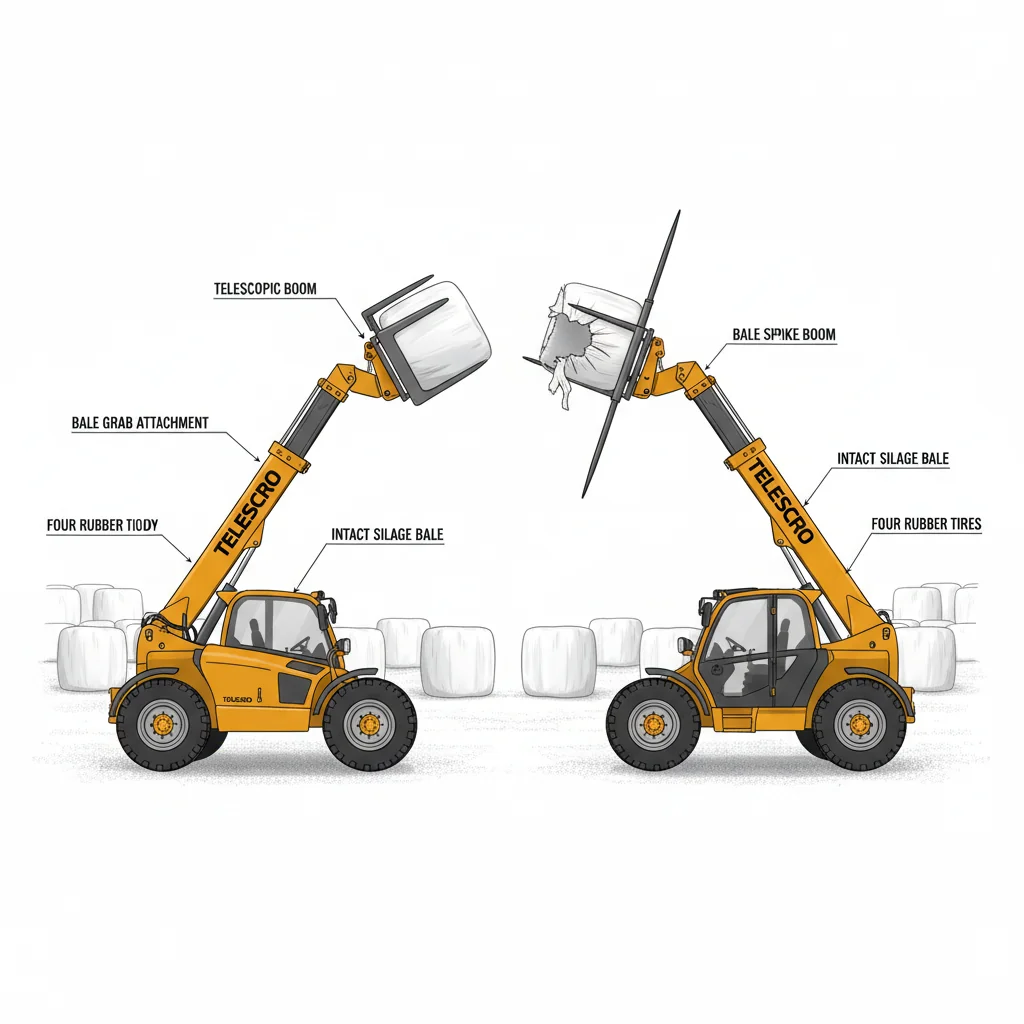
Let me share something important about bale grabs that gets overlooked on real jobsites. I’ve seen too many farmers and contractors switch to spikes just because they’re easier to source or a bit cheaper up front. But it always comes back to bite them—especially when dealing with wrapped silage or haylage bales. Last year, a customer in New Zealand lost nearly 8% of his stored feed because of small punctures, which started as “no big deal” until mold set in. Patch repairs soaked up extra labor and nobody wants to sell bales with obvious holes.
So, when do I recommend a bale grab over spikes? Here are the key scenarios:
- Handling wrapped silage or haylage – Side clamping preserves the airtight seal, preventing spoilage and nutrient loss.
- Moving bales for sale – Buyers expect undamaged film. Spiked bales lose value and buyers may just walk away.
- Feeding high-moisture or premium forage – Maintaining bale density means better storage and easier stacking.
- Tight barns or sloped fields – A clamp grab holds bales firmly, so you aren’t chasing them downhill or repositioning all day.
I’ve seen this in Kazakhstan, where a 3-ton telehandler with a proper grab saved at least two working days each harvest season. Spikes make sense for dry, unwrapped bales—old straw or bedding material—but using them on wrapped product almost always leads to hidden losses and extra rework.
My advice? If preserving wrap integrity and bale shape matter at all, make the bale grab your default attachment. You’ll save more feed—and time—than you realize.
A bale grab attachment is preferred over bale spikes when handling wrapped silage bales because it distributes pressure evenly, preventing punctures that encourage spoilage.True
Bale grabs use curved arms to envelop and lift bales without piercing the wrap, which is essential for maintaining the integrity of plastic coverings on silage or haylage and avoiding contamination.
Bale grab attachments are less effective than bale spikes for stacking round bales in tight storage spaces because they cannot grip bales securely.False
In reality, bale grabs provide a secure and controlled grip, allowing for precise placement and stacking of round bales, especially in compact storage environments, making them highly effective in such situations.
Key takeaway: Use a telehandler bale grab attachment wherever maintaining bale wrap integrity is critical—such as with silage, haylage, or bales intended for sale. Bale spikes remain suitable for dry, unwrapped bales, but risk spoilage and labor costs if used on wrapped feedstock.
How Does a Bale Grab Improve Productivity?
A telehandler bale grab attachment increases productivity by providing secure side-clamp control of bales, enabling faster transport over uneven ground with less risk of load loss. Operators can stack three to five layers high and, with dual-bale capacity4, load trailers efficiently, reducing machine movements, fuel use, and manual labor during peak bale handling seasons.

The biggest mistake I see is operators switching between spikes and pallet forks for bale work, thinking it’s just a matter of what’s available. On a real jobsite—especially in peak season—you end up wasting time with constant attachment changes and double-handling bales. What a bale grab does differently is clamp each bale from the side. This means operators can move faster, even across bumpy ground or sloped yards, because the risk of dropping a bale is almost zero. In my experience, a side-clamp grab gives you much more control on uneven terrain than forks or spikes.
Last autumn, a farm in Kazakhstan needed to clear 2,000 round bales from a stubble field in under three days. With a standard fork setup, they only managed about 450 bales per day—the driver had to slow down to avoid dropping bales on every rough patch. Once they switched to a dual-bale grab on their 3.5-ton telehandler, throughput went up by at least 30%. They could lift two bales at once and stack them four layers high in the shed, all without extra staff. That’s about 600 bales moved in a single shift with just one machine.
I always remind buyers: the real savings show up when you count machine movements and fuel. Fewer trips to the trailer, tighter stacking, and no need to pause for lost loads. The result is a safer yard and lower labor costs—especially critical when you’re handling thousands of bales per season. I suggest checking your telehandler’s load chart at typical working heights before ordering a grab. That’s where the real productivity gains come in.
A telehandler bale grab allows operators to safely transport wrapped silage bales without puncturing the plastic, which prevents spoilage and preserves feed quality.True
Unlike spike or fork attachments, a bale grab clamps the bale from the sides rather than piercing it. This avoids damaging the protective wrap on silage bales, which is critical for keeping out air and moisture and maintaining feed quality.
Switching from pallet forks to a bale grab attachment provides no improvement in bale handling speed or security when working on uneven terrain.False
A bale grab is specifically designed to clamp bales securely from the sides, reducing the risk of dropping them even on bumpy ground or slopes. In contrast, pallet forks can allow round bales to roll or slip, slowing operations and increasing the chance of accidents.
Key takeaway: Using a telehandler fitted with a bale grab allows for safer, higher stacking and faster bale movement, especially when handling volumes of hundreds or thousands per season. This attachment streamlines workflows, boosts throughput, and directly cuts fuel and labor costs in high-demand agricultural environments.
Which Bale Grab Best Fits My Bales?
Choosing the right telehandler bale grab depends on bale type. Curved ‘soft hands’ grabs5 protect wrapped round bales, while adjustable wide-frame grabs suit big square bales. Combination ‘clap-hands’ grabs offer versatility for mixed bale sizes, but ensure the grab’s arm shape and clamping range match typical bale dimensions for secure, gentle handling.
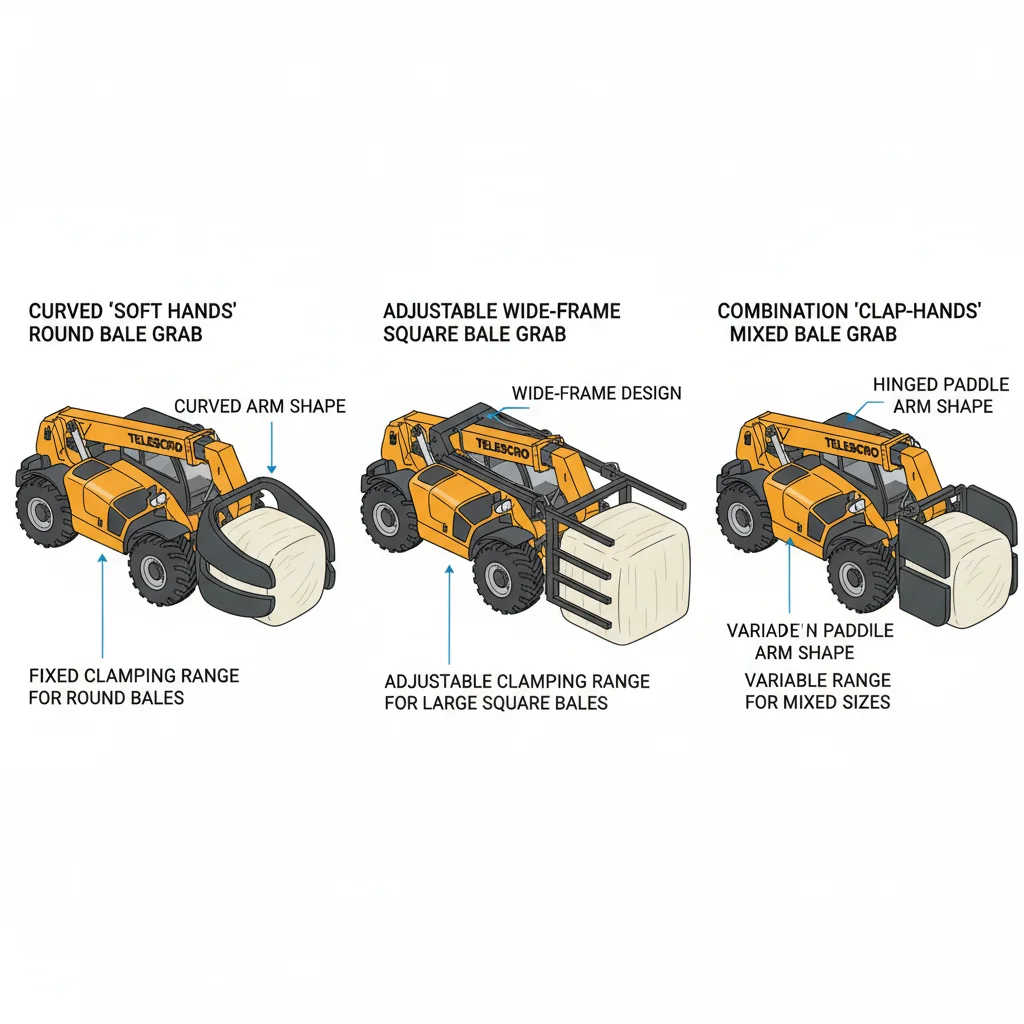
Choosing the right bale grab really comes down to the jobsite and bale type. I’ve seen operations in Kazakhstan lose dozens of wrapped silage bales just from using a square grab on round bales—the edges cut into the plastic, and they started fermenting wrong after only a week. For most wrapped round silage bales, you want a curved “soft hands” style—the big, smooth arms cradle the plastic without pinching. Most of these are rated around 700–1,200 kg, which easily covers standard 1.2–1.5 m diameter bales. If you mainly stack large square bales—especially dense straw or hay—I always suggest a wide-frame clamping grab. These range from 1.8 up to about 2.4 meters wide and feature arms that can move in and out. If your typical bale is 1.2 x 0.9 x 2.5 meters and around 400–500 kg, make sure the arms cover that footprint and the grab opens far enough so you’re not fighting each load. Look for bottom supports with these, since that keeps heavier bales from sagging or losing shape mid-lift. Many mixed-crop farms ask me about combination “clap-hands” grabs. I’ve worked with a project in Brazil where the same telehandler needed to swap between round and square bales daily—the solution was a combination grab with a clamping range from about 0.7 up to 2.0 meters. It handled both types without causing slippage, as long as the arms were adjusted to match the regular bale size.
A curved 'soft hands' telehandler bale grab is specifically designed to handle wrapped round silage bales without damaging the plastic, reducing spoilage risk compared to grabs with sharp edges.True
Curved 'soft hands' grabs distribute pressure evenly and avoid puncturing the plastic wrap, which is essential for preserving the anaerobic environment necessary for silage fermentation. Using square or sharp-edged grabs can compromise the wrap, leading to spoilage.
A standard manure fork attachment can be used interchangeably with a bale grab for transporting wrapped silage bales without increased risk of bale damage.False
Manure forks have tines that can easily puncture or tear silage wrap, especially on round bales. Proper bale grabs are designed to handle the bales gently, preserving the integrity of the plastic and preventing spoilage, whereas forks are not intended for this purpose.
Key takeaway: Selecting the correct bale grab for a telehandler depends on bale shape and protection needs. Always match the grab’s arm design and clamping range to regular bale sizes to prevent slippage or damage. Flexible designs exist for mixed bale operations, offering practical versatility across straw, hay, or wrapped silage bales.
How to Size Bale Grabs for Telehandlers?
Correctly sizing a telehandler bale grab attachment is essential for safety and efficiency. Operators must consider the grab’s own weight (typically 250–450 kg), its rated working load (at least 30% above the heaviest bale), and clamping range. The total combined load must stay within the machine’s load chart at intended reach.
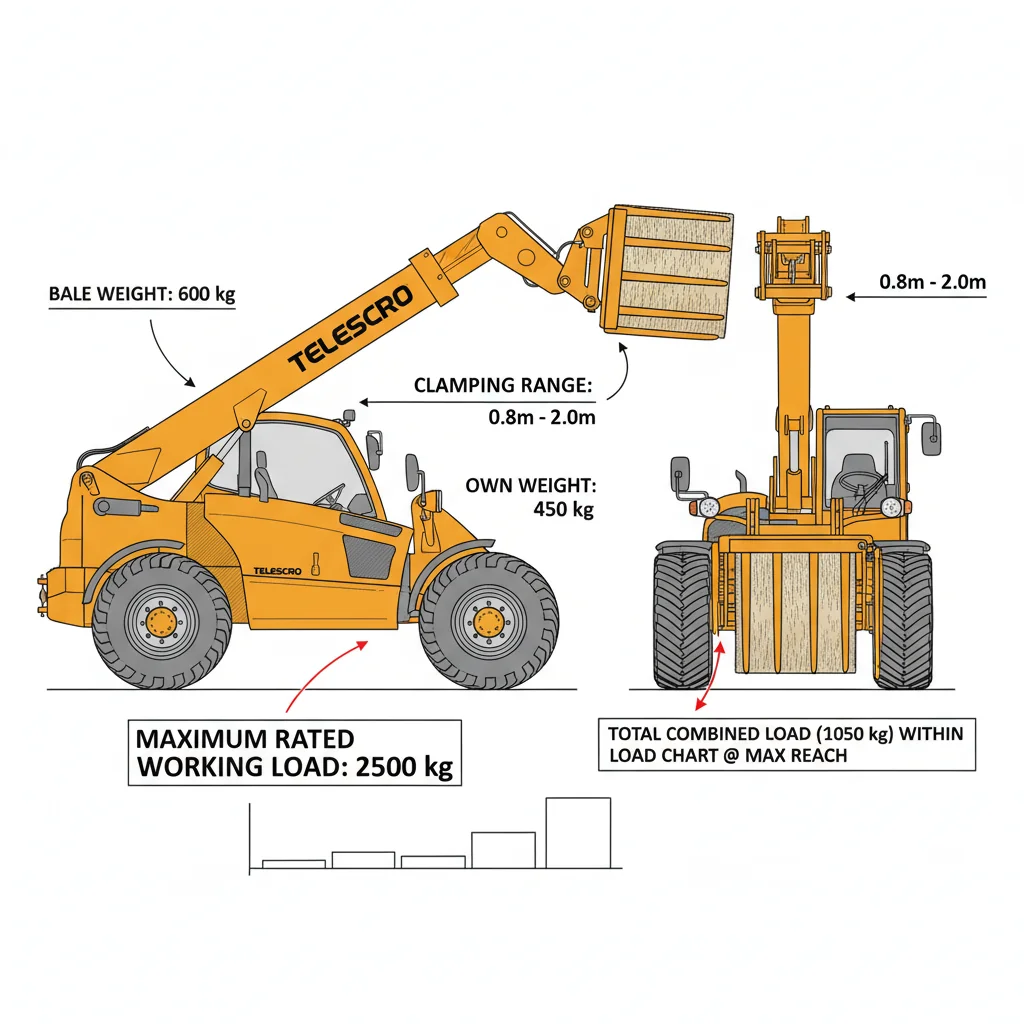
Last month, a contractor in Kazakhstan called me after his team struggled with overloaded telehandlers during wet straw season. They’d chosen their bale grabs based only on average bale weights, not realizing that the grab itself adds 300 to 450 kg before a single bale is lifted. The heaviest silage bales on site sometimes topped 950 kg when wet. With a 350 kg grab, that’s already 1,300 kg on the forks—well past the rated safe working load at any boom extension over 7 meters on their 3-ton machine. The real danger showed up when the operator raised the boom to stack at just over 8 meters. Their moment indicator alarmed, forcing a mid-lift drop. No one got hurt, but it was a close call and wasted a whole afternoon.
To be honest, most buyers forget to check how much capacity they lose as the boom extends. Every telehandler has a detailed load chart—check it for the exact reach and height you’ll use most. Never rely on the rated capacity at minimum boom. I always suggest choosing a bale grab rated at least 30% higher than your biggest bale, so the hydraulics don’t struggle and the clamp always holds firm.
Make sure the grab’s clamping range fits your bale dimensions. I’ve seen customers in Brazil buy wide grabs for small round bales, only to end up with loose, unsafe loads. Lastly, always verify hydraulic pressure and quick coupler compatibility—matching specs at the start can save serious downtime on site. Safe sizing keeps both your team and your machine out of trouble.
When sizing bale grabs for telehandlers, it is essential to factor in the combined weight of both the grab attachment and the bale, as this total often significantly reduces the machine's effective lifting capacity, especially when the boom is extended.True
The weight of the grab attachment adds to the total load the telehandler must lift, and as boom extension increases, the machine’s lifting capacity decreases, making it critical to account for both weights when choosing equipment.
Telehandler operators can ignore the weight of the bale grab attachment because only the bale weight affects the safe working load chart.False
Safe working load calculations require consideration of all weight placed on the boom, including attachments; disregarding grab attachment weight can lead to dangerous overloading.
Key takeaway: Correct bale grab sizing ensures safe, efficient telehandler operation. Always account for the combined weight of the grab and bale, ensure the grab’s rated load exceeds bale mass by a wide margin, check clamping fit, and verify hydraulic compatibility to avoid unsafe overloading or operational issues.
What Mistakes Happen Buying Bale Grab Attachments?
Common telehandler bale grab buying mistakes include using spike attachments instead of grabs, leading to feed loss and wrap damage. Frequent errors are arms too narrow or sharp for soft bales, mismatched mounting brackets6, and ordering light-duty models for heavy use. Always verify steel thickness, pin size, and exact mounting compatibility.
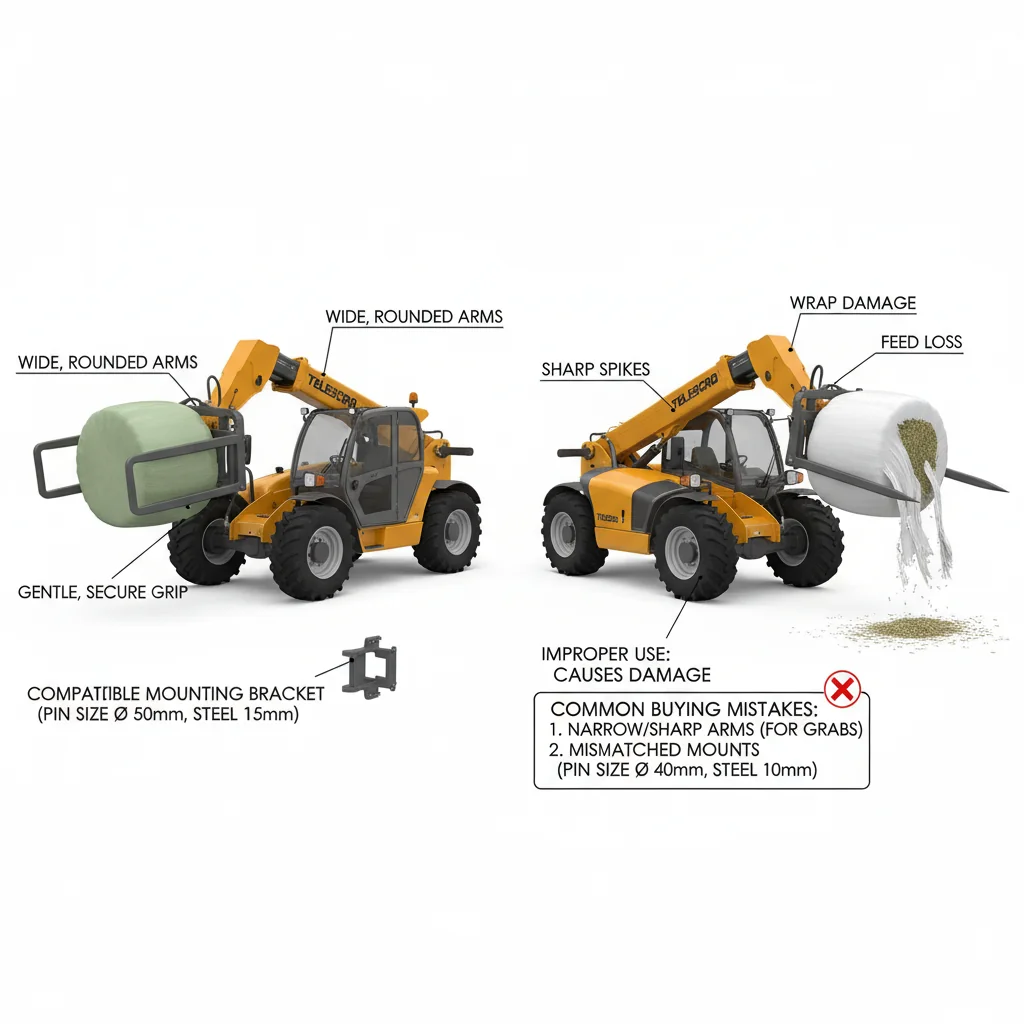
I’ve worked with customers who made these mistakes more than once, especially when bales are wrapped or handled on sloped ground. In Australia last year, a dairy farm lost over 5% of its feed during silage season. The reason? They used spike forks instead of proper bale grabs—those spikes tore plastic wraps, and every torn bale lost quality fast. I always suggest checking if you’re seeing tiny holes after unloading; that’s a red flag you’re using the wrong attachment. Bale grab buyers often overlook critical specs. Narrow or sharp arms—usually designed for harder straw bales—will pinch, dent, or even slip off softer haylage or silage bales.
I’ve seen this mistake in Denmark, where wet bales started sliding off on a muddy ramp because the grab’s arms only opened to 1.3 meters, not the 1.6 meters needed for their larger, 900-kg bales. Mismatched mounting brackets create even bigger headaches. Confusing between Euro-style hooks and quick-attach pin mounts can delay work by a whole week while waiting for an adaptor or modifications.
Here are the errors I see again and again:
- Using spike forks instead of grabs7 – Causes wrap tears and hidden feed loss, especially in silage.
- Arms too narrow/sharp – Crushes soft bales or lets them slip.
- Wrong mounting bracket – Machine and grab don’t fit, forcing unsafe adaptors or on-site welding.
- Light-duty models for heavy use – Thin steel, small pins or undersized cylinders can’t handle 2,000+ heavy bales/year.
A telehandler bale grab attachment is designed to handle wrapped silage bales without puncturing the plastic, which helps preserve bale quality during transport and stacking.True
Bale grab attachments use clamping arms instead of spikes, distributing pressure evenly around the bale and avoiding damage to plastic wraps, which is essential for maintaining feed quality.
Telehandler bale grab attachments are only suitable for use on flat, hard ground and cannot safely handle bales on sloped or uneven terrain.False
When properly matched to machine capacity and used with caution, bale grab attachments can be operated on sloped or uneven ground. Operators must be vigilant, but these attachments are designed to secure bales in a variety of terrain conditions.
Key takeaway: Selecting the wrong telehandler bale grab can cause bale damage, loss of feed quality, unsafe mounting, and premature wear. Prioritize robust construction, correct bracket compatibility, and proper arm design. Always specify technical details and request evidence of grab suitability before purchasing.
How Does a Bale Grab Improve Safety?
A telehandler bale grab attachment enhances operator safety by securely gripping bales with side-clamping arms8, minimizing the risk of loads rolling off during travel, turns, or boom extension. This reduces potential for property damage and serious injury, especially with heavy silage bales, compared to using improvised forks, pallets, or chains.
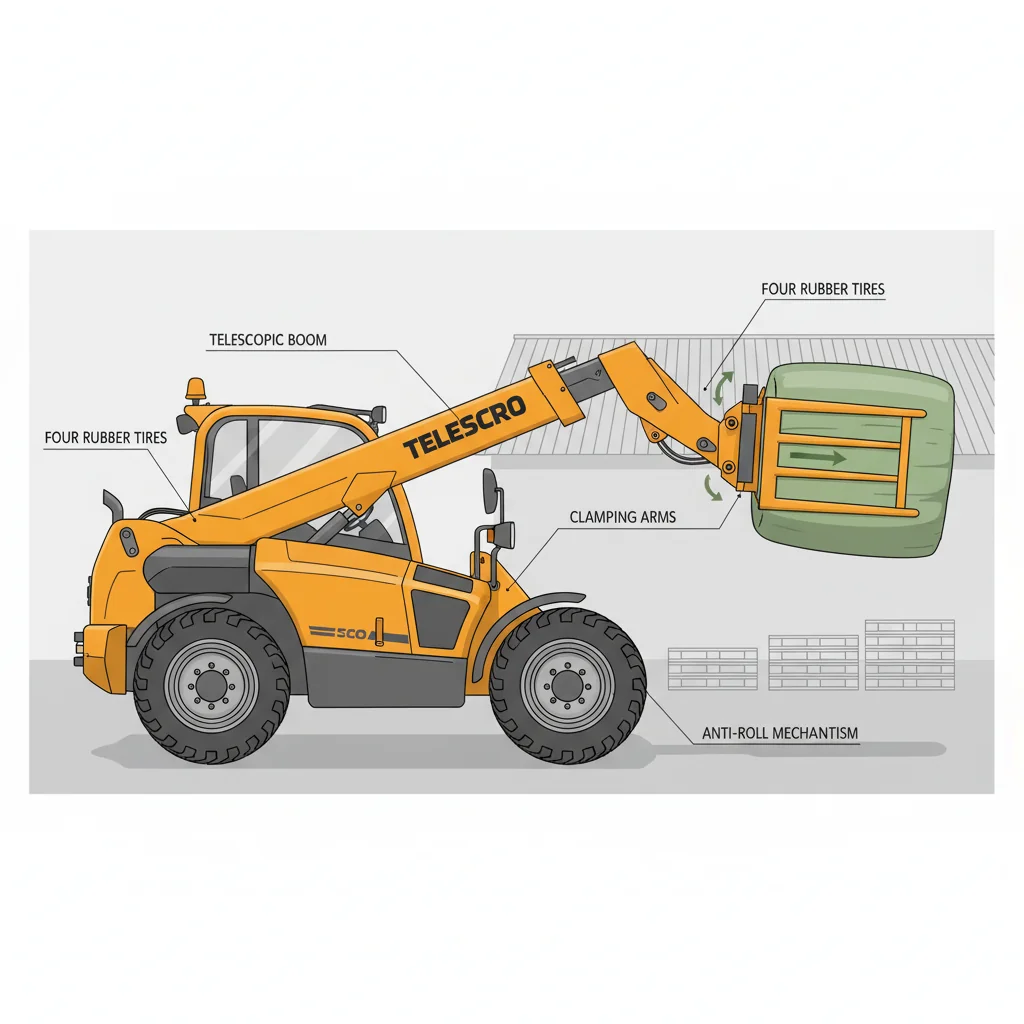
To be honest, the spec that actually matters is how securely the bale is held—not just how much weight your machine is rated for. With a proper bale grab, the side-clamping arms wrap around the bale firmly, which is a huge upgrade from balancing round bales on regular forks or pallets. I’ve seen too many situations, especially on wet, uneven ground, where a silage bale weighing over 850 kg rolled right off a pallet and nearly hit a worker. That’s not just scary—it’s preventable.
Last year in Poland, a dairy operator told me they’d had two damaged fence lines in one week using improvised chains and forks. Their old method struggled with heavy, high-density bales—especially on slopes or when traveling with the boom even half-extended. After switching to a grab designed for their 2.5-ton telehandler, the incidents stopped. It wasn’t just luck. The bale grab’s hydraulic circuit provided steady, even pressure, clamping the load so tightly that bouncing over ruts or turning gently on a side-slope didn’t make the bale budge.
But even with that extra security, safe technique still matters. I always advise keeping bales low to the ground while moving and using the load chart to verify you’re within limits at your boom angle and reach. Wet bales can easily weigh 20% more than dry ones—don’t guess at the load. Never use the grab for tasks it wasn’t designed for, like dragging stuck equipment or lifting people. If you’re stacking, work on flat ground and avoid reaching too far at full boom extension. That’s how you protect both people and property.
A bale grab attachment reduces the risk of bales rolling or dropping unexpectedly by gripping the bale from the sides, rather than relying on the balance achieved with forks or pallets.True
Side clamping arms distribute pressure evenly and stabilize the bale throughout lifting and transport, minimizing the chance of sudden shifts or releases that can occur with regular forks.
A bale grab attachment is mainly designed to increase lifting capacity, not to enhance load stability or worker safety.False
Bale grabs are specifically engineered to improve the safe handling of bales by securing them better, not to increase the machine's lifting limits, which are set by the telehandler's overall design.
Key takeaway: Using a dedicated bale grab attachment is far safer than improvised handling, as it clamps bales securely, significantly reducing the chance of accidental drops—particularly with heavy, high-density bales. Always follow the telehandler’s load chart and operate in accordance with best safety practices.
Is a premium bale grab attachment worth it?
Investing in a quality telehandler bale grab attachment protects silage bales from costly spoilage and reduces labour losses. On farms handling around 1,000 bales a year, even a small percentage of wrap damage can add up to several thousand dollars in lost feed and extra handling. Heavy-duty grabs generally outlast lighter models and can recover their higher purchase cost within a few seasons through reduced spoilage and lower downtime.

From my experience, buyers often underestimate just how much a premium bale grab impacts their bottom line, especially on large farms or busy silage projects. Handling 1,000 bales a year sounds normal for many of my customers in Europe and Australia. But the numbers are brutal—a single torn wrap can turn a $60 bale into waste.
Last season, I spoke with a dairy contractor in New Zealand who said his old light-duty grab damaged about 7% of silage bales, losing at least $4,000 in spoilage and extra labour. Upgrading wasn’t just a matter of preference—it quickly became a smart business move.
Let’s break down exactly where heavy-duty bale grabs earn their keep:
- Reduced wrap damage – Stronger, smoother arms grip without tearing, so you lose far fewer bales to spoilage.
- Longer service life – Models with 10–12 mm side plates and 40–50 mm pins shrug off daily use, even on 2,000+ bales per year.
- Lower downtime risk – Fewer repairs means your machine stays productive; I’ve seen light-duty frames twist or pins shear after one busy season.
- Better resale value – Heavy-duty grabs tend to retain solid resale value, often holding a noticeably higher percentage of their original price than lighter-duty models, especially when well-maintained and from reputable manufacturers.
I always ask operators to check the actual arm thickness and pin diameter, not just the maximum opening specification. In China and Brazil, contractors who chose the heavier-spec models told me failures dropped to nearly zero—saving both the cost of replacement grabs and peak-season headaches.
A premium telehandler bale grab attachment is specifically engineered to minimize punctures and tears in bale wraps during handling, helping prevent feed spoilage and financial loss.True
Premium bale grab designs often use rounded clamping arms and smooth contours, which distribute pressure more evenly across the bale and reduce the chance of damaging the plastic wrap. This design difference is critical for maintaining bale integrity, especially when handling high volumes.
Telehandler bale grab attachments are only suitable for handling straw bales and cannot be used for silage or hay bales.False
Bale grabs are designed to handle various types of wrapped and unwrapped bales, including silage, hay, and straw. The difference is typically in the grip style and surface shape, not in a restriction to a single crop, making them versatile tools on farms.
Key takeaway: High-quality telehandler bale grabs reduce spoilage, labour, and downtime risks—often saving thousands of dollars annually for large operations. Although heavy-duty models cost more upfront, their durability, lower failure rates, and superior bale protection make them a financially sound investment for high-volume users.
How to Maintain a Bale Grab Attachment?
Basic daily maintenance extends the life of a bale grab attachment and preserves bale wrap integrity. Grease all pivot pins every 8–10 hours during peak use, check for excessive play in pins and bushes, and inspect hydraulic hoses at full extension. Keep arm surfaces clean, free from burrs, and store the grab under cover.

Let me share something important about bale grab maintenance—a lot of operators think a quick visual check is enough, but real longevity comes from a few targeted steps every single day. During silage season in northern France, I saw a team running two 3-ton telehandlers with bale grabs. The unit they greased daily went two full seasons with almost zero downtime. The other needed bushing and pin replacements before harvest ended—costing them days and around $900 in spare parts and labor. That’s not rare. Small habits can make a big difference in the field.
To break it down, here’s the daily routine I always recommend:
- Grease all pivot pins every 8–10 hours: Dry pins quickly develop play and chew through bushings, especially during peak use.
- Check for play in pins and bushes: If you notice more than about 2-3 mm at the tip of the grab’s arms, it’s time to plan a replacement. Too much slack leads to misalignment and uneven clamping, risking bale wrap cuts.
- Inspect hydraulic hoses at maximum extension: Pay extra attention with the boom fully out and at full tilt—most leaks I see start where hoses flex most.
- Keep all arm surfaces smooth and clean: Remove burrs, old weld spatter, and touch up any paint damage. Small sharp spots can slice silage plastic again and again.
Regularly greasing the pivot points and checking hydraulic hoses on a bale grab attachment prevents premature wear and unexpected hydraulic leaks.True
Hydraulic hoses and pivot points are common failure points on bale grabs. Dirt, moisture, and friction can degrade seals and bushings if not maintained, leading to leaks and mechanical play. Proper lubrication and inspection significantly reduce downtime and extend the lifespan of these components.
Bale grab attachments are designed to handle a variety of materials, including loose soil and gravel, making them versatile for general construction loading tasks.False
Bale grabs are specifically engineered to handle cylindrical or square bales with minimal deformation and slippage. Their gripping arms do not scoop or hold loose bulk materials like soil or gravel. Using them for such tasks can damage the bale grab and compromise operational safety.
Key takeaway: Consistent, targeted maintenance—greasing pivots, monitoring wear in pins and bushes, inspecting hydraulic hoses, and keeping surfaces smooth—greatly extends the service life of telehandler bale grabs while protecting bale wrap and ensuring reliable clamping performance.
Where Do Telehandler Bale Grabs Belong?
On agricultural telehandlers, bale grab attachments form part of a modular attachment system, positioned alongside manure forks, silage grabs, pallet forks, and buckets. Bale grabs are preferred whenever efficient, damage-free handling of forage bales is required, preventing costly damage and preserving feed quality during farm, yard, or field operations.

I’ve seen firsthand how telehandler bale grabs fit into the daily rhythm of modern farms. Unlike standard forks or buckets, bale grabs have one job—moving wrapped or soft bales without tearing the film. The problem? Even a small puncture on a silage bale can spoil feed worth hundreds of dollars. In one case on a dairy operation near Harbin, the crew switched from standard pin-type clamps to proper bale grabs for their 1,200-kg wrapped bales. They saw feed losses drop almost overnight.
Think about the line-up of attachments you find on most agricultural telehandlers: manure forks for mucking out, buckets for grain and sand, pallet forks for feed or seed bags, and silage grabs for bulk silage. The bale grab sits right in that modular system, ready whenever high-value haylage needs gentle treatment. Its smooth, curved arms wrap around the bale. The hydraulic circuit controls clamp pressure9—so you get a firm hold but no crushing or tearing, even moving at full boom extension. You can’t trust a generic fork to do that on a delicate, high-moisture bale.
Last season, a customer in Ireland ran three different attachments side by side: a basic fork, a grapple bucket, and a dedicated smooth-arm grab on a 3.5-ton telehandler. Only the grab kept film wrap intact on more than 95% of bales. For jobs where feed quality is everything, I’d always recommend a purpose-built bale grab. For loose material or manure, pick your bucket or fork. But when every bale counts, go for the precision tool. I suggest checking your actual bale size and weight before choosing the right grab—it saves both feed and downtime in the real world.
Telehandler bale grab attachments are designed to exert uniform pressure around the circumference of a bale, minimizing the risk of puncturing plastic-wrapped silage compared to traditional bucket or fork attachments.True
This is true because bale grabs use curved or padded arms that distribute pressure evenly, preventing sharp points of contact that could tear or puncture the protective film on wrapped bales. This design addresses the specific need to preserve the integrity of silage wrapping, which is crucial to maintaining feed quality.
Telehandler bale grab attachments can safely transport stacks of loose hay without any risk of dropping or losing material, regardless of bale condition.False
This is false because bale grabs are optimized for wrapped or densely-formed round and square bales. Loose hay is not held securely by the clamping arms, making it easy for material to fall out during lifting or transport, especially if the bale is not compact or is deteriorating.
Key takeaway: Telehandler bale grabs are specialized precision tools for handling and stacking wrapped or delicate forage bales without piercing or damaging the film. They are essential attachments for high-value haylage and silage handling, complementing other tools for tasks involving muck, pallets, or loose material.
Conclusion
We’ve looked at how a telehandler bale grab keeps bales secure and undamaged, making daily work in agriculture safer and easier. In my experience, the best results come from choosing attachments based on real bale sizes and stacking heights, not just what looks versatile on paper. I’ve seen some buyers get caught by the “parts roulette”—attachments are only as useful as your local ability to service them. If you’re wondering which grab style or capacity fits your operation, or need honest advice about what works on tough jobsites, feel free to get in touch. I’m always happy to help with practical experience, not just catalog specs. Remember—every site is different, so it’s worth taking a closer look before you decide.
References
-
In-depth explanation of double-acting hydraulic circuits in telehandler attachments highlights ease of maintenance and operational efficiency. ↩
-
Learn why handling wrapped silage with proper bale grabs prevents oxygen ingress, mold, and feed spoilage, preserving feed quality. ↩
-
Explore how soft hands use smooth, rounded arms to protect bale wrap integrity and minimize damage during handling and transport. ↩
-
Details the efficiency gains and reduced machine movements achieved by dual-bale capacity attachments in telehandlers on construction and farm sites. ↩
-
Explore how curved ‘soft hands’ grabs protect plastic on wrapped bales, preventing damage and spoilage for effective silage handling. ↩
-
Details the common mounting bracket errors that delay work and cause costly modifications, critical for proper telehandler attachment fit. ↩
-
Explains how using spike forks can cause wrap damage and feed loss, with real-world dairy farm examples highlighting the risks. ↩
-
Learn why side-clamping arms provide steady, even pressure that prevents heavy bales from rolling off during transport or turns. ↩
-
Understand the role of hydraulic circuits in precisely controlling clamp pressure to handle delicate bales without crushing or tearing. ↩