











What is a Telehandler? A Field Engineer’s Breakdown
From my experience working with customers in over 20 countries, the biggest mistake I see is folks confusing telehandlers with regular forklifts or cranes. I’ve watched contractors lose hours—and sometimes whole workdays—because they didn’t understand what a telehandler is really built to do on-site.
I’m going to break down the real-world functions of a telehandler, from its core capabilities to the safety steps you absolutely can’t skip.
Whether you’re running a construction firm or managing a mixed fleet, I’ll explain how telehandlers boost productivity, which specs matter most, and what you need to consider before investing in one.
I’ve spent the last 4 years troubleshooting telehandler issues and training operators on jobsites from Dubai to Peru, so trust me when I say I know what works—and what doesn’t.
What Are Telehandler Core Functions?
A telehandler, or telescopic handler, is a machine built around a robust chassis with a powerful telescopic boom1. That boom is the magic piece; it allows the machine to lift, reach, and load in various directions—something a standard forklift just can’t touch. Equipped with the right attachments, like forks or buckets, it’s the ultimate jobsite utility player, handling material movement, precise placement, and elevated work across construction and agriculture.
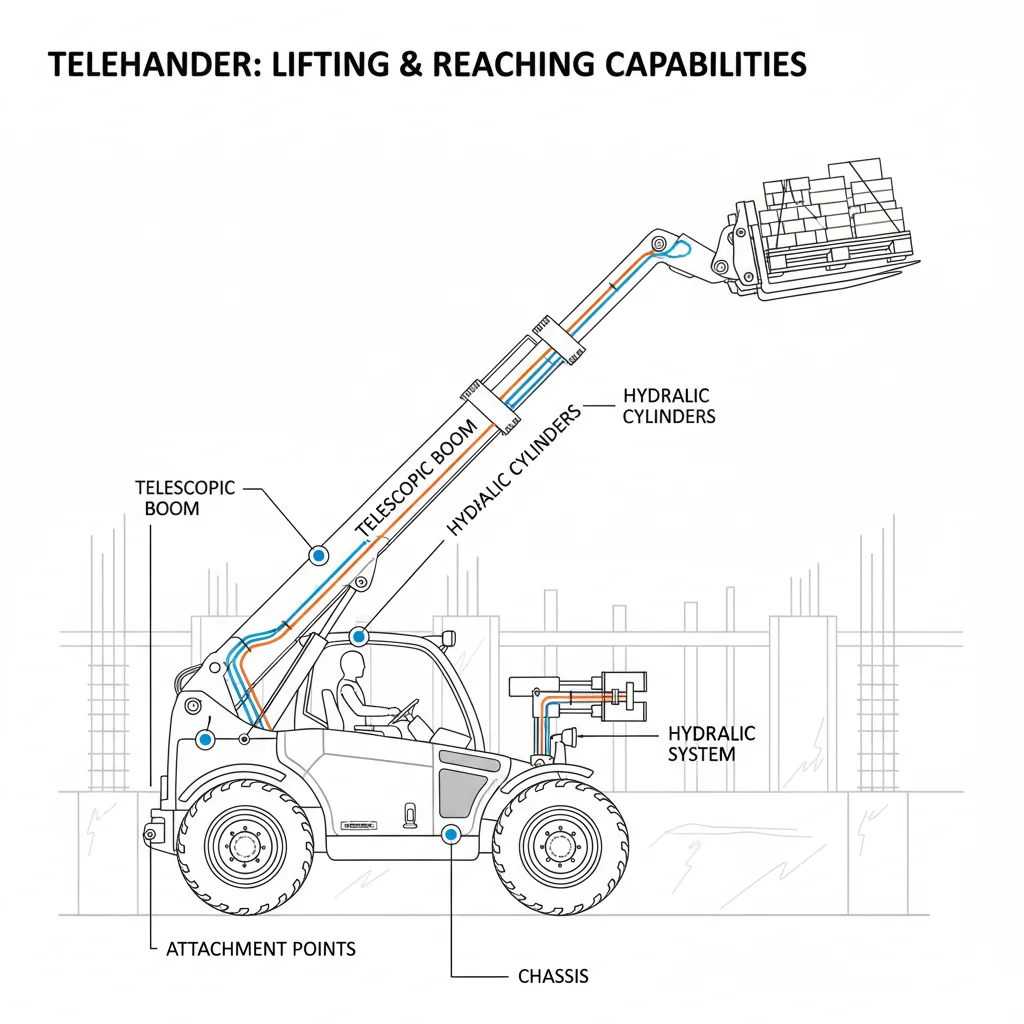
I’ve seen plenty of sites where the telehandler became the single most important piece of equipment—especially when projects run on tight schedules. I remember a specific project in Kazakhstan. A customer of mine used a 4-ton unit with a 17-meter boom to move steel rebar, lift pallets to upper floors, and clear debris—all within one tight courtyard. They avoided bringing in a crane or extra forklifts, cutting both costs and downtime. That’s the kind of flexibility telehandlers offer, and it’s why I recommend them so often.
Let’s break down the core functions that really matter on site:
- Lifting and Placing Loads: The telescopic boom reaches up and outward, letting you lift materials as high as 18 meters or more on some models. This is perfect for putting pallets, bricks, or panels where a standard forklift simply can’t reach.
- Material Handling with Attachments: Quick-change attachments2—like buckets for loose gravel, forks for pallets, or jibs for suspended loads—make the machine adapt fast to different jobs. I tell my operators to think of it as a multi-tool on wheels.
- Elevated Work Platforms: Slap on a work platform, and the telehandler becomes an aerial lift for people and tools. I’ve watched crews in Dubai finish cladding work up to 15 meters without renting a scissor lift or boom lift. It’s a huge cost saver.
- Maneuverability on Rough Terrain: Four-wheel steering3, solid ground clearance (I usually see around 410 mm on mid-sized units), and powerful hydraulics allow telehandlers to navigate muddy, uneven sites better than any standard forklift.
To be honest, understanding these core functions is the key to bridging the gap between nice specs and real jobsite performance. I always suggest evaluating what attachments you’ll use most and checking the machine’s rated load at your typical working height. That’s where the actual value shows up.
Telehandlers with a 17-meter boom can typically lift loads up to around 4 tons, allowing them to handle heavy materials like steel rebar and pallets on multi-story construction sites without additional cranesTrue
A telehandler’s boom extension and load capacity are designed to balance reach and weight, enabling it to operate efficiently in confined urban environments by lifting heavy materials to upper floors while eliminating the need for multiple machines.
Telehandlers are designed primarily for indoor warehouse work and are not suitable for outdoor use on rugged construction sitesFalse
Telehandlers are specifically engineered for versatile outdoor use, featuring robust tires and suspension systems that allow them to navigate uneven, rough terrain commonly found on construction sites, unlike traditional indoor forklifts.
Telehandlers are essential for job sites requiring versatile material handling. Their telescopic booms and attachments replace multiple machines, boosting efficiency and reducing cost. Understanding their core functions helps contractors and managers select the right machinery for complex lifting, loading, and reaching tasks.
How Do Telehandlers Improve Efficiency?
In my experience, telehandlers enhance job site efficiency by allowing operators to use quick couplers4 to switch attachments rapidly, which minimizes downtime. Their multifunctional design reduces the need for multiple machines while allowing operators to handle diverse tasks such as lifting, loading, and accessing heights, even in tough terrain.
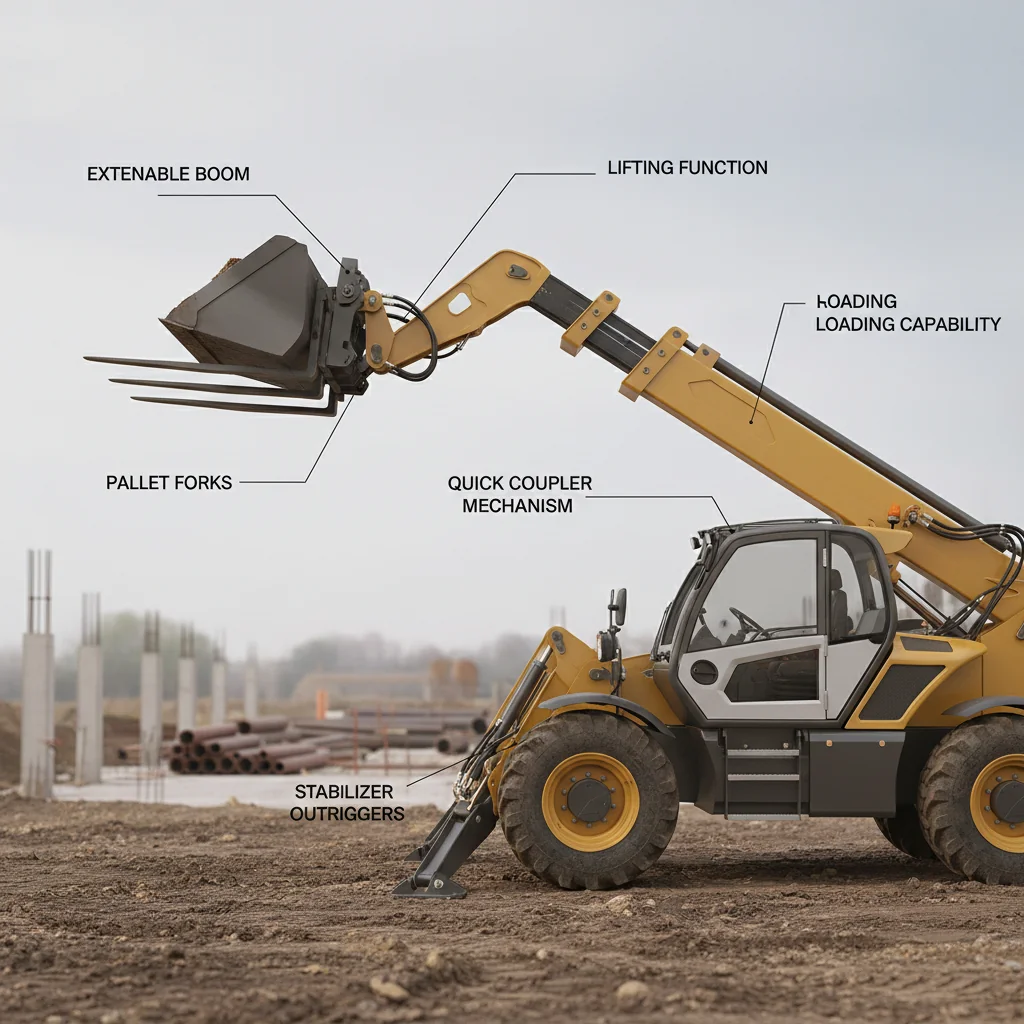
Here’s what matters most when we talk about telehandler efficiency: versatility on rough jobsites and minimizing wasted time. Take a project I supported in Dubai last year. That contractor used a 4-ton telehandler with an 18-meter reach. Instead of hauling in separate equipment—one forklift, one crane, and another with a work platform—they managed all three jobs with one machine. The quick coupler meant operators swapped from pallet forks to a bucket in under three minutes. That saved at least two full working days over an eight-week project, just from reduced attachment changeover time.
I often see crews in Brazil run telehandlers over mixed surfaces—mud, gravel, even uneven concrete. The large tires and four-wheel steering let them keep working when traditional forklifts can’t move an inch. Moving materials to upper floors, stacking bricks, handling loose sand, or even lifting light steel frames—all done with one unit. Operators tell me the hydraulic circuit is especially forgiving, so repeated cycles don’t overheat the system, and the moment indicator5 adds a crucial safety layer when stretching the boom out at maximum extension.
From my experience, most buyers underestimate how much downtime eats into their budget. When you only need one skilled operator and one multi-purpose machine—rather than three separate crews and machines—you cut labor costs fast. Plus, you reduce transport headaches. I suggest always matching your choice to two factors: max reach with rated load at extension. That’s the real efficiency driver—more work, less waiting, lower costs.
The quick coupler system on modern telehandlers allows attachment changes in under three minutes, significantly reducing downtime compared to manual bolt-on methodsTrue
Quick couplers use hydraulic or mechanical locking mechanisms that enable operators to switch between forks, buckets, or other attachments rapidly, which minimizes idle time and maximizes operational efficiency on site.
Telehandlers with an 18-meter reach can lift the same weight at full extension as at minimum reach due to hydraulic load compensationFalse
While hydraulics aid in stability and control, the maximum lift capacity of telehandlers decreases as reach extends because of reduced leverage and increased tipping risk, requiring operators to observe load charts to avoid overloads.
Telehandlers streamline operations by combining the functions of several machines into one adaptable unit. Quick attachment changes and terrain versatility mean less downtime and lower equipment costs, making them an effective investment for both productivity and budget-conscious contractors or fleet managers.
What Are Telehandler Safety Protocols?
Essential telehandler safety protocols, in my book, include rigorous operator training6, mandatory certification, and thorough pre-operation inspections focused on brakes, tires, and hydraulics. Supervisors must ensure machine-specific knowledge, monitor load charts religiously, and utilize onboard technology like load-sensing systems7, minimizing tip-overs and overload risks during high-reach or heavy-lift operations.

I’ve worked with customers from Dubai to South Africa who seriously underestimated how strict telehandler safety really needs to be. Let me share a recent example: a team in Kazakhstan called me after a minor tip-over shook their jobsite. Nobody was hurt, but digging in, I found their pre-operation checks were rushed. They’d skipped a hydraulic circuit inspection and missed a slow pressure leak—turns out, the boom lost lift mid-way, causing the load to slip. That’s why the checklist isn’t optional.
Operator training is the absolute bedrock of safe telehandler use. I always insist on hands-on onboarding, not just theory. In China, I’ve seen crews switch between a 4,000 kg standard telehandler and a 2,500 kg compact unit in a single day. Without machine-specific training, mistakes happen—especially with variable controls and different load charts. The key detail is simple: never assume one-size-fits-all when it comes to capacity or reach.
Supervisors play a critical role overseeing daily checks. On a large project in Brazil, a site manager had operators verify brake response, tire condition, and check hydraulic fluid before every shift. One morning, their routine caught a worn tire about to blow—a small fix that probably prevented a serious accident at a 12-meter lift. That’s the value of consistency.
Modern telehandlers offer extra help. Load monitoring systems and moment indicators on current models alert the operator before overload or excessive reach. Still, nothing replaces active supervision and constant awareness. I suggest making safety talks and load chart reviews part of every project kickoff. It doesn’t slow things down much, and in my experience, it keeps everyone going home safe.
A comprehensive telehandler pre-operation checklist includes testing hydraulic circuit pressure for leaks to prevent boom lift failure during operationTrue
Hydraulic circuit pressure tests can identify slow leaks that may cause loss of boom lift capacity, preventing tip-overs and load slippage by ensuring all systems maintain proper pressure under load.
Modern telehandlers are designed to automatically stop boom movement if an operator skips pre-operation safety checksFalse
While telehandlers include safety interlocks and sensors, they cannot autonomously detect if pre-operation safety checks were performed; operator compliance remains essential for safe machine operation.
Adhering to strict safety protocols—such as comprehensive operator training, machine inspections, and leveraging modern load-monitoring technology—not only prevents accidents and tip-overs but also ensures reliable telehandler operation. Supervisors must enforce these protocols on every site to maintain a controlled and injury-free work environment.
How Do Telehandlers Aid Multiple Sectors?
Telehandlers deliver versatility and capability across construction, agriculture, forestry, and logistics. With robust designs, all-terrain mobility, and interchangeable attachments, they efficiently move heavy loads, elevate materials to hard-to-reach areas, and boost operational efficiency where standard machinery simply cannot perform as effectively.
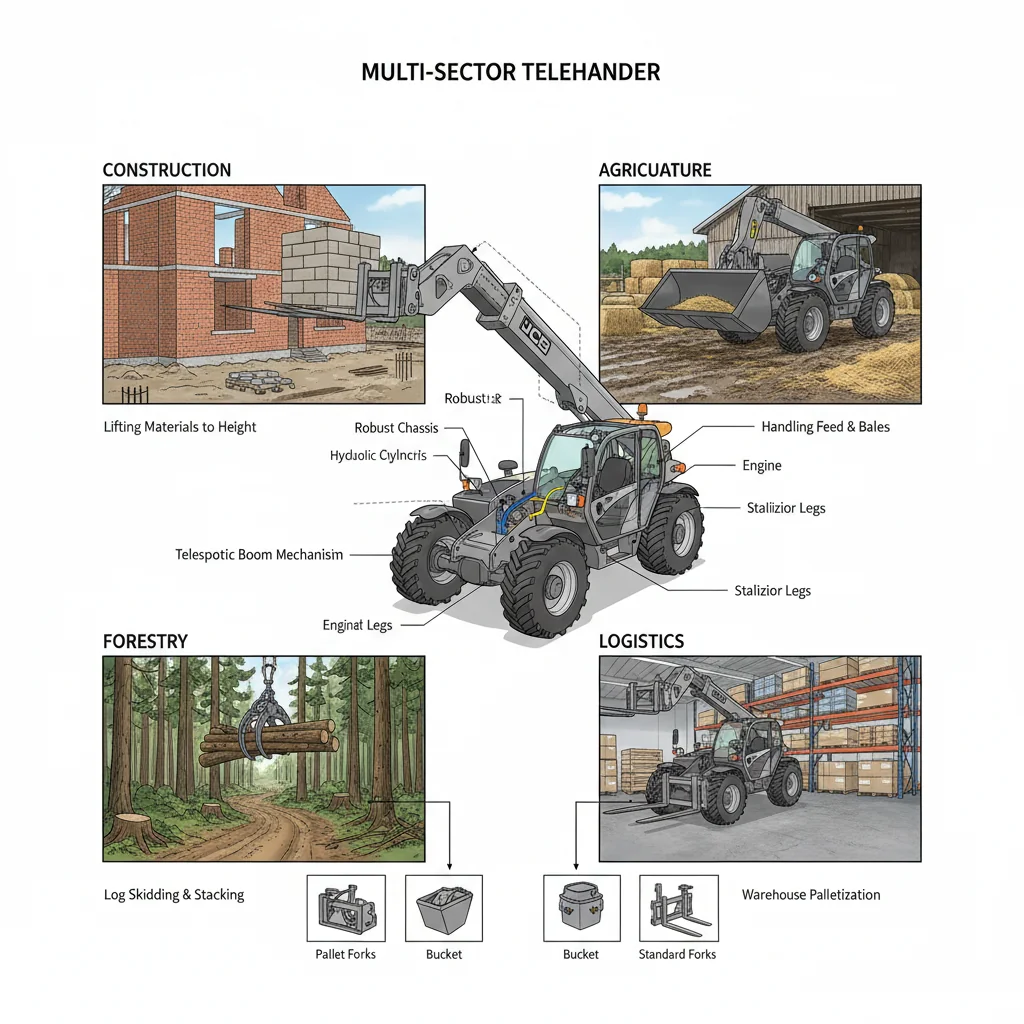
Last month, a contractor in Kazakhstan called me stuck—his team needed to install facade panels at 16 meters on uneven ground. Standard forklifts were out of the question. A 4-ton telehandler with a 17-meter boom handled both the height and the bumpy terrain, thanks to its four-wheel drive and high ground clearance (around 410 mm). To get the job done safely, the operator relied on the moment indicator to keep loads stable at full reach. That’s the sort of real-world flexibility you just can’t get from fixed-mast machines.
In agriculture, telehandlers make moving silage and feed look almost easy. I’ve seen dairy farmers in Brazil save at least two hours per day by switching from tractors to a 3-ton compact telehandler with a bucket and bale grab. Swapping attachments was simple—less than five minutes with the hydraulic quick coupler8. That freed farm workers for other jobs, boosting efficiency across the board.
The biggest mistake I see is buyers overlooking all-terrain performance. In forestry jobs here in China, soft ground and steep slopes can stop conventional loaders right away. But I watched a mid-sized telehandler (12-meter reach, 3.5-ton rated capacity) carry bundled logs through muddy access roads without drama. The right tires and all-wheel steering made a huge difference. Operators also liked the side-shift function for precise placement under tight canopy.
If you’re choosing for mixed work—construction, farming, or logistics—I suggest mapping out your typical site conditions. Attachment versatility isn’t just a feature; it multiplies your investment. Check compatibility, not just max specs.
A telehandler’s moment indicator uses real-time load and boom angle data to prevent tipping by alerting operators before the machine reaches its stability limitTrue
Moment indicators continuously calculate the tipping moment based on sensor data, enabling operators to maintain safe load handling even at maximum boom extension and on uneven terrain.
Telehandlers can safely lift their maximum rated load regardless of boom extension length due to hydraulic compensation systemsFalse
A telehandler's lifting capacity decreases as the boom extends because leverage forces increase; hydraulic systems assist but cannot fully compensate for the reduced stability at longer reaches.
Telehandlers are uniquely valuable due to their adaptability across different industries. By handling tasks from lifting construction materials to distributing agricultural feed, their all-terrain features and attachment versatility make them a strategic investment for anyone aiming to maximize equipment utility and onsite productivity.
How to Choose the Right Telehandler?
Selecting the right telehandler requires evaluating lift height, load capacity, attachment compatibility, and terrain capability. For example, a 5,000 kg capacity and 15-meter lift suit residential projects, while all-wheel drive models excel on rough sites. Matching specifications ensures efficiency and cost-effectiveness.

Most people don’t realize that matching telehandler specs to your exact site conditions saves headaches later. I’ve helped a team in Kenya who picked a 5,000 kg, 15-meter telehandler thinking it would do everything for their mid-rise project. On site, rain turned the ground rough and muddy. They struggled with traction and stability because the model had only rear-wheel drive. Upgrading to all-wheel drive wasn’t cheap, but it kept them moving through the entire rainy season. It’s a mistake I’ve seen in several countries—buying for maximum height and capacity but ignoring ground conditions and drive type.
Let me share something a lot of folks miss: the real limits are usually in the load chart, not just the sticker specs. For example, that same 5,000 kg telehandler often lifts only around 2,000 kg at full 15-meter reach. That’s due to the moment indicator (the safety system that prevents tipping). If you work in tight spaces, watch the turning radius—models under 4.5 meters handle urban jobs much better. Attachments also matter. A rotating fork carriage or a hydraulic bucket can turn one machine into a multi-tool, replacing a crane or loader.
From my experience, thinking ahead about what attachments you’ll need is worth your time—especially if you want to cut equipment costs. I always suggest checking the load chart, terrain suitability, and hydraulic options before buying or renting. Take an honest look at what you’ll lift, how far you’ll reach, and what ground you’ll cross. That’s what makes a telehandler efficient, not just impressive on paper.
Telehandlers with rear-wheel drive alone typically have less traction and stability on muddy or uneven terrain compared to all-wheel drive modelsTrue
Rear-wheel drive telehandlers rely solely on the rear tires to provide traction, which can cause slipping and instability on soft or uneven ground; upgrading to all-wheel drive powers all tires, improving grip and machine control in challenging conditions.
A 15-meter reach telehandler can operate safely on any site regardless of ground condition as long as the load capacity is under 5,000 kgFalse
Reach and load capacity alone do not guarantee safety; ground conditions such as mud or rough terrain greatly affect stability and traction, and an inappropriate drive system or ground preparation can lead to tipping or losing control despite the machine’s rated specs.
Assessing maximum lift, load capacity, and operational environment allows you to select a telehandler that meets your project’s exact needs. Well-matched equipment can enhance productivity, reduce overall equipment costs, and often serve as a multifunctional tool, replacing other machines on site.
Conclusion
We’ve gone through what telehandlers do best and why they’re such a good fit for jobsites needing flexible material handling. From my own time in the field, I suggest not getting caught up just on specs like max lift height—take a careful look at the load chart at real working ranges and always ask how quickly you can source critical parts locally. That’s how you avoid what I call "parts roulette," where a minor repair leads to weeks of downtime. If you have questions about attachments, applications, or comparing brands for your site, feel free to reach out—I’m happy to share what I’ve seen actually work across different countries. Every project has its own needs—choose what fits your real workflow.
References
-
Detailed insights into telescopic boom mechanics and benefits, showing how it improves reach and lifting capacity on construction sites. ↩
-
Comprehensive overview of quick-change attachments, enabling fast adaptation of telehandlers to varied materials and tasks, boosting efficiency. ↩
-
Understand how four-wheel steering improves telehandler maneuverability on uneven terrain, enhancing safety and operational efficiency. ↩
-
Explore how quick couplers enable fast attachment changes, reducing downtime and boosting productivity on construction sites. ↩
-
Explore detailed explanations of moment indicators and their critical role in telehandler safety and tipping prevention, backed by expert insights. ↩
-
Explains how hands-on training reduces operational errors and improves safe handling of variable load capacities and controls. ↩
-
Details how onboard load-sensing technology minimizes risk by monitoring loads and preventing overload or instability during lifts. ↩
-
Details the mechanism and benefits of hydraulic quick couplers, showing how they reduce attachment change time and boost productivity. ↩