










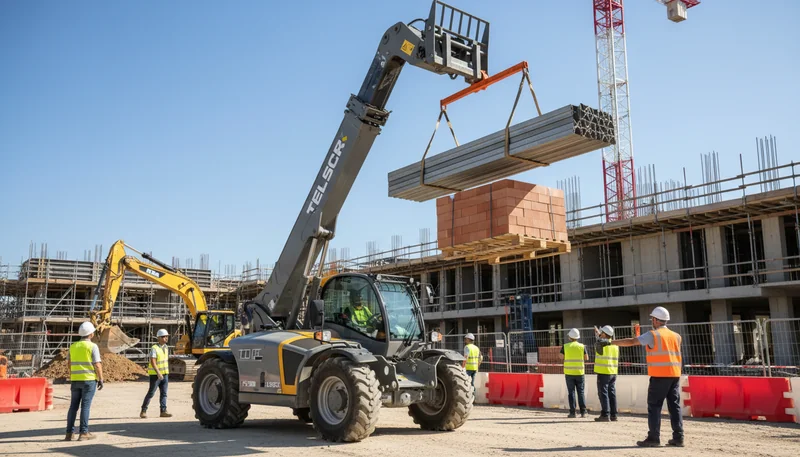
What is a Rotating Telehandler? A Field Engineer’s Breakdown
Not long ago, I watched a team in Singapore struggle for hours to squeeze a standard telehandler into a tight courtyard, only to realize a rotating machine would have cut their setup time in half. Every jobsite with cramped access raises the same big question: what makes a “ROTO” so different?
A rotating telehandler features a split structural design, separating the lower chassis from a fully rotatable upper frame housing the cab, telescopic boom, and turret. This allows the upper section to rotate 360° on a slew ring1 while the chassis remains stationary. Compared to conventional telehandlers, rotating units deliver substantial productivity gains by eliminating the need for repeated repositioning to access multiple zones.
What Structurally Defines a Rotating Telehandler?
A rotating telehandler features a split design: the lower chassis contains the engine, axles, tanks, and steering, while the upper structure—comprising the cab, boom, and turret—sits on a slew ring and rotates independently. Unlike standard telehandlers, many modern rotating telehandlers offer 360° continuous rotation2, while some models use 400–500° limited rotation ranges.
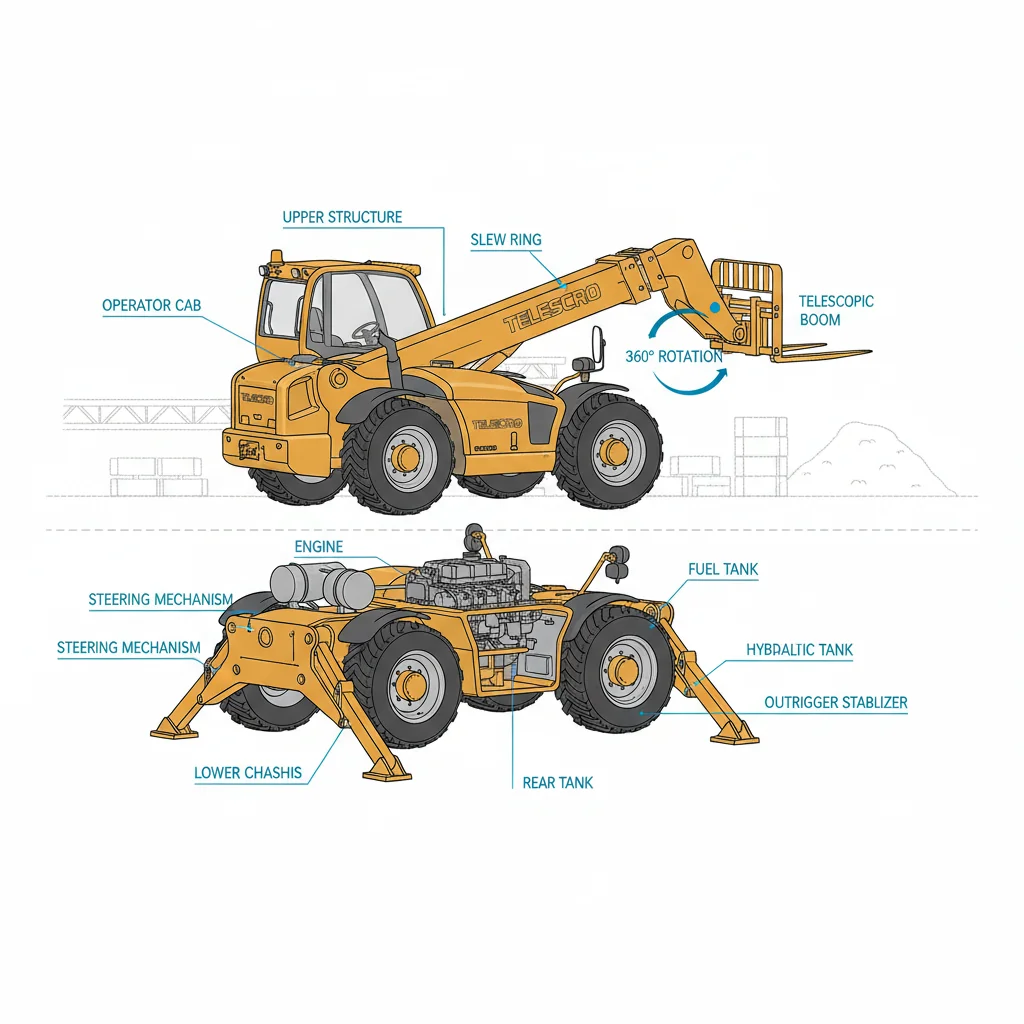
Most people don’t realize how different a rotating telehandler’s structure is until they get one onsite. Instead of a fixed boom mounted directly on a chassis, you get two separate frameworks—almost like a crane. The lower frame, or undercarriage, holds the engine, axles, hydraulic tanks, and steers just like a standard telehandler. But on top, the operator’s cab, telescopic boom, and whole turret sit on a large slew ring bearing. This upper structure rotates a full 360°, completely independent from the chassis.
I remember a project in Dubai where the contractor had barely five meters between buildings. Moving a standard telehandler back and forth was impossible. A rotating model with 4-ton capacity and 20-meter reach solved the issue—they set stabilizers, lifted loads, and rotated in place the whole day. The chassis never moved. That’s the structural advantage: you get stationary operation, even in tight or blocked sites.
However, all this comes with extra weight and mechanical complexity. For example, that slew ring is a major wear point. I’ve seen customers in Kazakhstan replace theirs after about 2,000 hours because dust and improper greasing accelerated the damage. Also, ROTO machines generally weigh significantly more than fixed-boom models of similar capacity due to the slew ring, turret structure, and stabilizer systems. Electronics play a big part, too. Moment indicators, hydraulic rotation locks, and stability sensors are all tied into the design. These increase jobsite flexibility, but also raise maintenance and training needs.
My advice? Always factor in upkeep and operator skill when you’re considering a rotating telehandler for confined sites. That’s where the investment truly pays off.
Key takeaway: Rotating telehandlers are structurally distinct thanks to a split chassis and upper rotating frame, delivering 360° rotation without moving the base. This structural advantage allows field engineers to operate efficiently on restricted sites while considering additional wear, weight, and complexity factors not present in standard telehandlers.
How Does 360° Telehandler Rotation Aid Productivity?
A rotating telehandler features 360-degree upper structure rotation3, allowing operators to access multiple work zones without repositioning the machine. This reduces cycle times, fuel consumption, and tire wear, while lowering collision risks. On confined or urban sites, operators can unload, lift, and place materials across facades or roofs from a single, stabilized position.

Let me share something important about 360° rotating telehandlers that gets overlooked on most spec sheets. I’ve seen the difference firsthand on a dense warehouse site in Dubai. There, a 4-ton rotating telehandler with a reach of 18 meters let the crew unload rebar and HVAC units from trucks parked at the front entrance—then swing the boom, still stabilized, to place them on two building façades and the roof, all without moving the base. That single feature cut their material handling time by at least 40% compared to a fixed-frame unit, and the operator told me he used about one-third less fuel that week.
From my experience, constant repositioning is a hidden time-killer, especially when you’re squeezed between a scaffold, a live road, and other trades. I worked with a team in Poland last year who were losing nearly an hour per shift just maneuvering a standard telehandler around a crowded residential site. After they upgraded to a rotating model—with stabilizers extended for maximum safety—they finished lifts to every side of the building from a single compact spot. Tire wear dropped, and their accident risk from blind spots fell sharply, since machine movement was minimized.
For decision-makers facing tight access or strict site rules, the math is simple. The operator sets up on stabilizers, references the load chart at each swing angle, and completes more lifts, faster and safer. I always suggest tracking how much time your team spends on repositioning each day; rotation often pays for itself just in reduced labor and downtime.
A 360° rotating telehandler can reduce material handling time by up to 30% on congested sites by eliminating the need to reposition the base unit when accessing multiple work frontsTrue
Because the boom can rotate fully around the chassis, operators can unload and place materials across a wide area without moving the telehandler, streamlining workflow and cutting downtime associated with frequent machine repositioning.
360° rotating telehandlers use a separate hydraulic system for rotation that operates independently from the boom lift and extension hydraulicsFalse
Many models integrate rotation into the main hydraulic architecture, though some high-capacity units use dedicated slew-drive circuits; a completely separate system would add complexity, weight, and cost without operational advantage.
Key takeaway: Rotating telehandlers reduce repositioning, fuel use, and operational risk by enabling work on all sides from a compact stabilized setup. This delivers significant productivity gains and site safety, especially where access is restricted or regulatory traffic control is required.
How do attachments enhance rotating telehandlers?
Attachments transform rotating telehandlers into versatile multi-tools, functioning as telehandlers, small cranes, and mobile elevating work platforms (MEWPs). With forks, winches, or platforms, these machines handle material handling, lifting, and access tasks. Quick-coupler systems4 allow rapid changes, while smart features auto-detect attachments for accurate capacity charts, streamlining jobsite equipment and reducing extra machine hires.

Here’s what matters most when talking about attachments on rotating telehandlers: they turn one machine into a real multi-tool, not just theory. I’ve seen this firsthand—last spring, a contractor in Dubai replaced three separate pieces of equipment with just one rotating telehandler and a set of attachments. They didn’t just save space on their cramped site. They cut equipment rental costs by almost 25% for that project.
The secret wasn’t just in the machine, but in how they planned and used attachments. Attachments expand what a ROTO can do, but each one serves a specific purpose. Common options I see on jobsites include: – Pallet forks – Classic for moving blocks, bricks, and pallets up to 4,000 kg; works like a standard telehandler.
- Winches or jibs – Let the machine lift and precisely place loads like steel beams or HVAC units, acting as a small crane.
- Work platforms (man baskets) – Turn the telehandler into a powered access lift, perfect for facade or glazing jobs at heights up to 25 meters.
- Concrete buckets – Useful for pouring concrete in places where a mixer truck can’t reach.
- Bucket attachments – Handle loose materials like gravel or aggregate, adding genuine versatility for roadwork.
Quick-coupler systems are another big advantage. With hydraulic connects, even a less-experienced operator can swap attachments in under five minutes. Many modern machines auto-detect the new attachment and display a revised load chart on the screen—no guessing, just verified safe limits.
Rotating telehandlers equipped with quick-attach couplers can switch between attachments in under 90 seconds, significantly minimizing downtime on complex job sitesTrue
Quick-attach couplers allow operators to rapidly change between forks, buckets, and lifting jibs without leaving the cab or using additional tools, enhancing efficiency and flexibility on multi-task projects.
Attachments for rotating telehandlers typically double the machine’s maximum lifting capacity by utilizing hydraulic load amplificationFalse
Attachments do not increase the fundamental lifting capacity of a rotating telehandler; they allow different functions or load types, but the machine’s rated capacity remains limited by its chassis, boom, and hydraulic specifications.
Key takeaway: Rotating telehandlers with specialized attachments can replace multiple machines on site, dramatically increasing versatility, reducing fleet size, and improving jobsite efficiency. Always verify load capacity for each attachment and ensure teams leverage the equipment’s full multi-tool potential for maximum return on investment.
When Do Rotating Telehandlers Add Most Value?
Rotating telehandlers add significant value on projects needing crane-like reach, multi-sided access, and flexibility in restricted spaces. They excel in façade installation5, roofing, steel erection, industrial maintenance, shipyards, and event builds. Their ability to rotate and reach 25–30 meters streamlines tasks that standard telehandlers or small cranes would complicate.
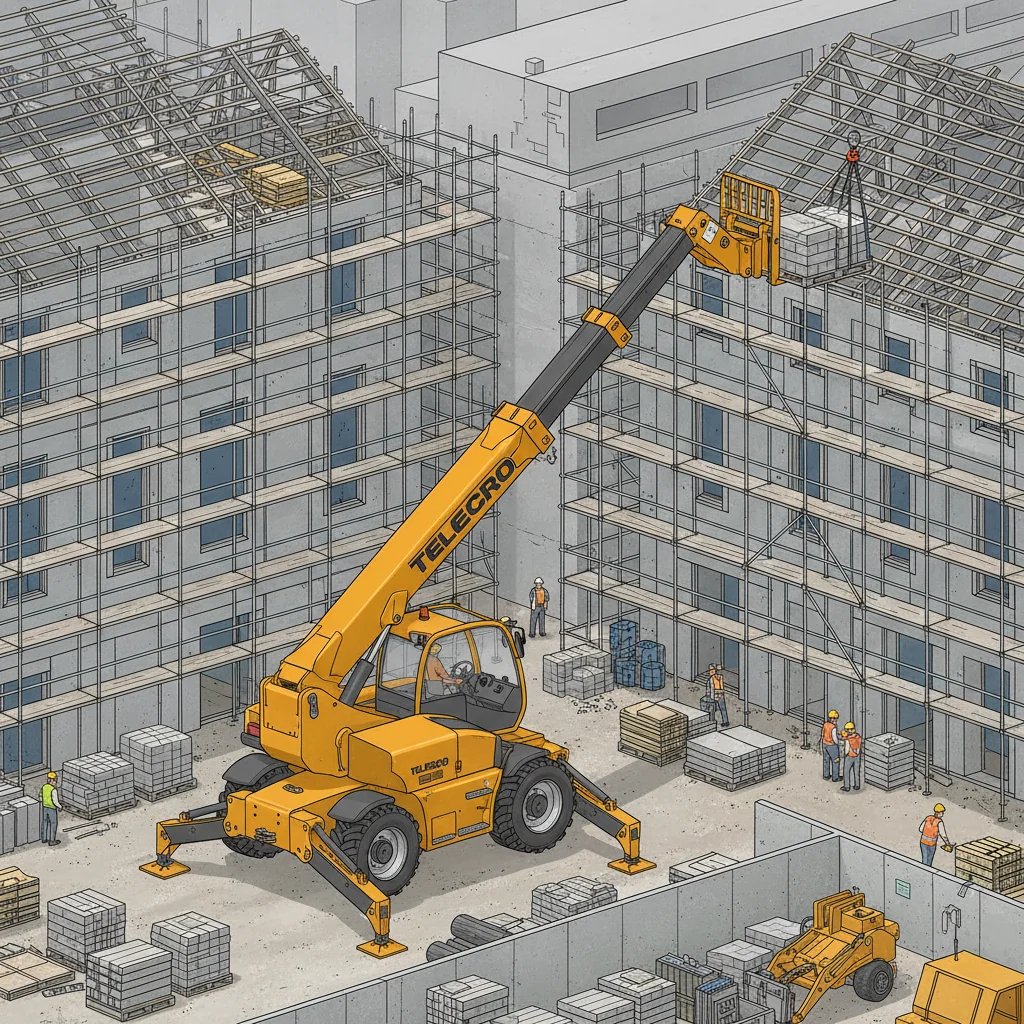
The biggest mistake I see is buyers treating rotating telehandlers like just another high-reach forklift. They’re not. Rotators add real value when the jobsite is cramped, and you need to handle loads from multiple sides without moving the machine every hour. In Dubai, I worked with a contractor doing a façade installation on a new office tower. The street was narrow, and ground space was tight. They parked a 6-ton rotator in one corner, extended the stabilizers, and serviced all four elevations—just by rotating the turret. Compared to bringing in a crane or re-parking a standard telehandler every few hours, they finished cladding three days sooner and avoided traffic permit headaches.
On projects like steel erection or roofing where you have to reach 25–30 meters up—and sometimes shift loads horizontally—rotating telehandlers feel like a compact crane. I’ve seen a model in Kazakhstan lift steel beams up to 7 tons to the fifth story, then swing 180° to feed a crew working on the opposite side, all without leaving its spot. The load chart is your friend here: most rotators safely handle 2,500–7,000 kg, but capacity tapers down as you extend and rotate. Always check the rated capacity at max reach with stabilizers deployed.
For industrial maintenance, especially in shipyards or tight plants, rotating telehandlers shine again. One client in Brazil moved heavy machinery modules around corners where a small crane couldn’t fit. If most of your work is ground-level or simple lifts, though, a standard telehandler makes more sense—less cost, less complexity.
Rotating telehandlers typically have stabilizers that must be fully extended to safely rotate with loads up to 6 tons, allowing operation in confined spaces without repositioning the machineTrue
The use of fully extended stabilizers stabilizes the rotating base, enabling the telehandler to handle loads safely from multiple angles within tight jobsite constraints, which is a key advantage over fixed-frame high-reach forklifts.
Rotating telehandlers are designed to lift heavier loads than standard fixed-frame telehandlers of the same size because the rotation mechanism adds structural strengthFalse
Rotating mechanisms add complexity and weight to the machine but do not inherently increase lifting capacity; in fact, rotating telehandlers often have similar or slightly lower rated capacities compared to fixed-frame models of the same size due to stability considerations.
Key takeaway: Rotating telehandlers are best utilized where projects demand high reach, side-to-side maneuverability, and operation in tight spaces, making them ideal for construction, cladding, roofing, and industrial upkeep. For ground-level, straightforward tasks, standard telehandlers are simpler and more cost-effective.
What Ensures Rotating Telehandler Stability?
Modern rotating telehandlers feature advanced stability and load-control systems6 that monitor boom angle, extension, chassis tilt, and stabilizer position. Automatic interlocks restrict unsafe movements, recognizing attachment type and applying the correct load chart. Full stabilizer deployment7 is required for maximum performance, and adherence to regulatory standards like EN 1459-2 ensures machine safety and operational compliance.
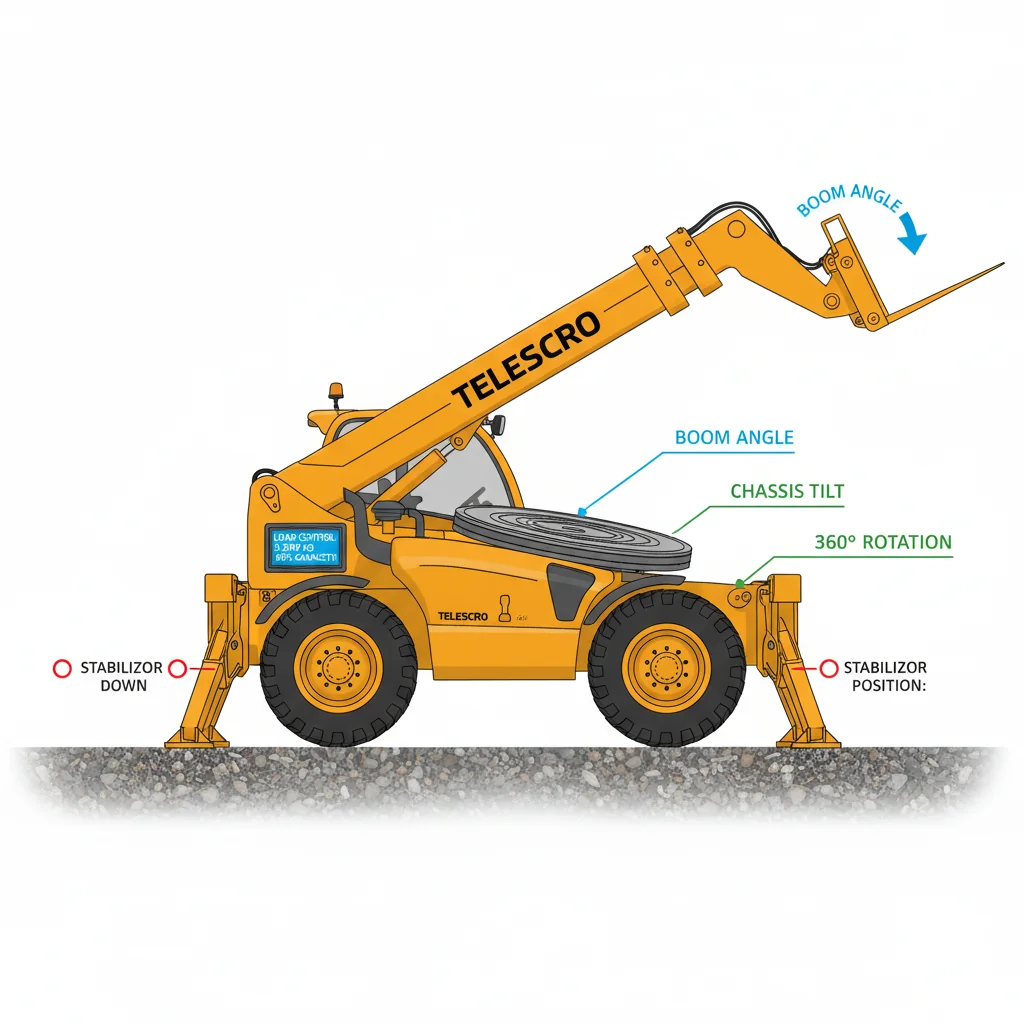
To be honest, the spec that actually matters is how a rotating telehandler manages real-time stability—not just its rated capacity on paper. In Italy last year, I worked with a team installing curtain wall panels on a seven-story office. They used a 5.5-ton rotator with a 25-meter boom. The only way they could safely reach over 22 meters was with all four stabilizers fully deployed and locked. The machine’s onboard system tracked boom angle, extension, and even which glass suction attachment they installed, automatically switching to the right load chart. That detail made all the difference—one wrong chart and those glass panels could have ended up shattered on the pavement.
From my experience, many operators face the temptation to “just extend one side” of the stabilizers (short-jacking), especially when working in tight Dubai sites. But anytime you don’t fully deploy per the chart, you’re risking an overturn. Modern machines have load control modules that will block boom movement once you’re near the rated tipping moment. You’ll hear a loud alarm, and the hydraulics will even cut off or restrict extension. This level of automation saves lives—but only if you respect it.
Machines compliant with EN 1459-2 standards require full stabilizer deployment before you can rotate or lift near maximum capacity, making partial stabilizing a non-starter. I suggest always comparing both the on-tire and on-stabilizer sections of your load chart. The difference isn’t small—at full extension, lifting capacity on stabilizers can be double what you’ll get on tires alone. That’s how you prevent call-backs and downtime.
Rotating telehandlers use real-time stability control systems that monitor boom angle, extension, and load to adjust hydraulic pressure dynamically, preventing tip-over risks during complex liftsTrue
These onboard stability systems continuously assess the machine's configuration and load distribution, enabling automatic adjustments to hydraulic support and alerting operators when stability thresholds are approached, ensuring safer operation at extended reaches.
Rotating telehandlers can achieve full rated capacity lifting at any boom extension without deploying stabilizers if equipped with advanced counterweight systemsFalse
Despite counterweights improving stability, stabilizers are essential for safe operation at long boom extensions and heavy loads; without deploying them, the risk of tipping significantly increases, especially when lifting near or beyond 20 meters.
Key takeaway: Advanced electronic monitoring and full stabilizer deployment are crucial for rotating telehandler safety. Automatic systems limit unsafe movements based on real-time data, but strict operator discipline and regulatory compliance (such as EN 1459-2) remain essential to prevent overturn incidents, especially when lifting on stabilizers versus tires.
Which Rotating Telehandler Specs Matter Most?
When comparing rotating telehandlers, critical specifications include maximum lift height8 (commonly 15–35 meters), maximum capacity (usually 4–7 tons), and the rate of capacity decrease with boom extension. Essential factors also include rotation type, stabilizer footprint, automatic leveling features9, attachment compatibility, and the machine’s overall dimensions, particularly for tight worksites.
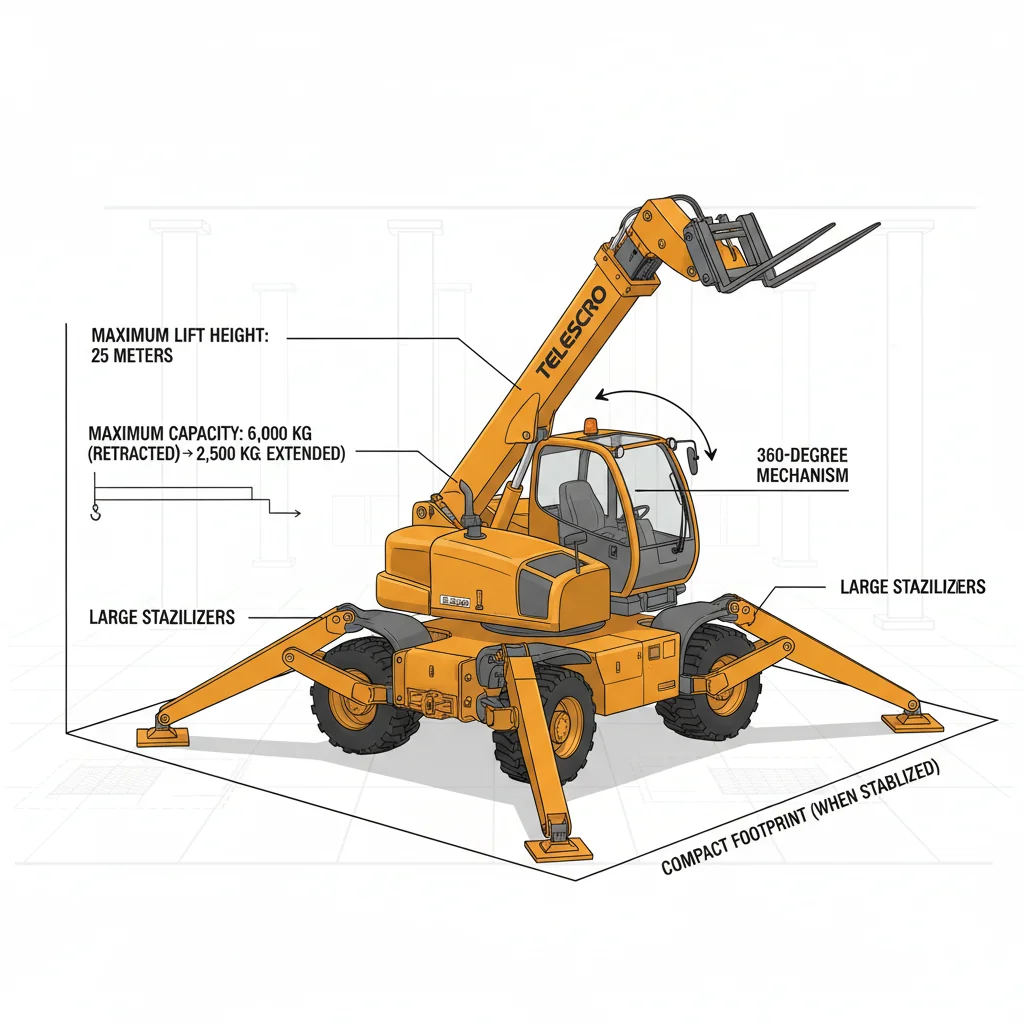
Last month, a contractor in Dubai asked me why their new rotator wasn’t performing as expected. They focused on maximum lift height—32 meters—when choosing the machine, but on-site, almost all their pallet lifts were happening at a 20-meter forward reach. Here’s the catch: at that reach, their 6-ton telehandler could only handle around 1,600 kg, not the headline 6,000 kg. That’s why I stress analyzing the load chart closely. Look at rated capacity at real boom positions you’ll actually use on the job.
Technical details make all the difference. For example, compare rotation mechanisms—continuous (360°) versus limited (typically 400°–500°). Continuous rotation is vital for jobs where obstacles force you to reposition often. Also, check stabilizer size and placement. A wide stabilizer footprint means greater working stability, especially on soft or uneven ground. Automatic leveling simplifies setup on sloped sites and reduces time aligning the machine before each lift.
Here’s a quick comparison table based on what I see requested in Asia and Europe:
| Spec Feature | Why It Matters | Common Range | Key Jobsite Impact |
|---|---|---|---|
| Max Lift Height | Vertical reach | 15–35 m | Reaching upper floors |
| Rated Capacity | Max weight at min reach | 4–7 tons | Handles heavier materials |
| Capacity @ Max Reach | Real-world lifting ability | 1.2–2.2 tons (20 m) | Lifting at distance |
| Rotation Type | Continuous vs limited | 360° / 400–500° | Jobsite maneuverability |
| Stabilizer Footprint | Setup stability | 3–5 m spread | Determines working envelope |
The rated capacity of a rotating telehandler at maximum boom extension can be less than 30% of its maximum rated load at zero reachTrue
Telehandler load charts demonstrate significant derating as the boom extends forward; for example, a 6-ton machine might only safely lift around 1,600 kg at a 20-meter forward reach, which is less than 30% of its 6,000 kg maximum rated load at minimal reach. This reflects the mechanical constraints and stability requirements at extended positions.
Rotating telehandlers maintain their maximum rated load capacity regardless of boom extension or boom angle due to their rotating turret designFalse
Despite the rotating turret allowing 360-degree movement, the telehandler's load capacity decreases as the boom extends or moves forward because of stability limits and mechanical leverage, which cannot be compensated by rotation alone.
Key takeaway: When evaluating rotating telehandlers, look beyond headline numbers. Analyzing detailed lift charts, rotation mechanisms, stabilizer effectiveness, attachment versatility, and dealer support ensures the chosen model aligns with real-world lifting tasks and jobsite constraints, supporting both safety and operational productivity.
When is a rotating telehandler worth buying?
A rotating telehandler is worth buying when high utilization is expected for multi-directional work10—such as multi-face construction, crane-like lifts, and elevated site access. With upfront costs 25–40% higher than fixed-boom models, ownership is justified only if rotation is required for more than 30% of operating hours and the machine’s versatility is fully leveraged across projects.
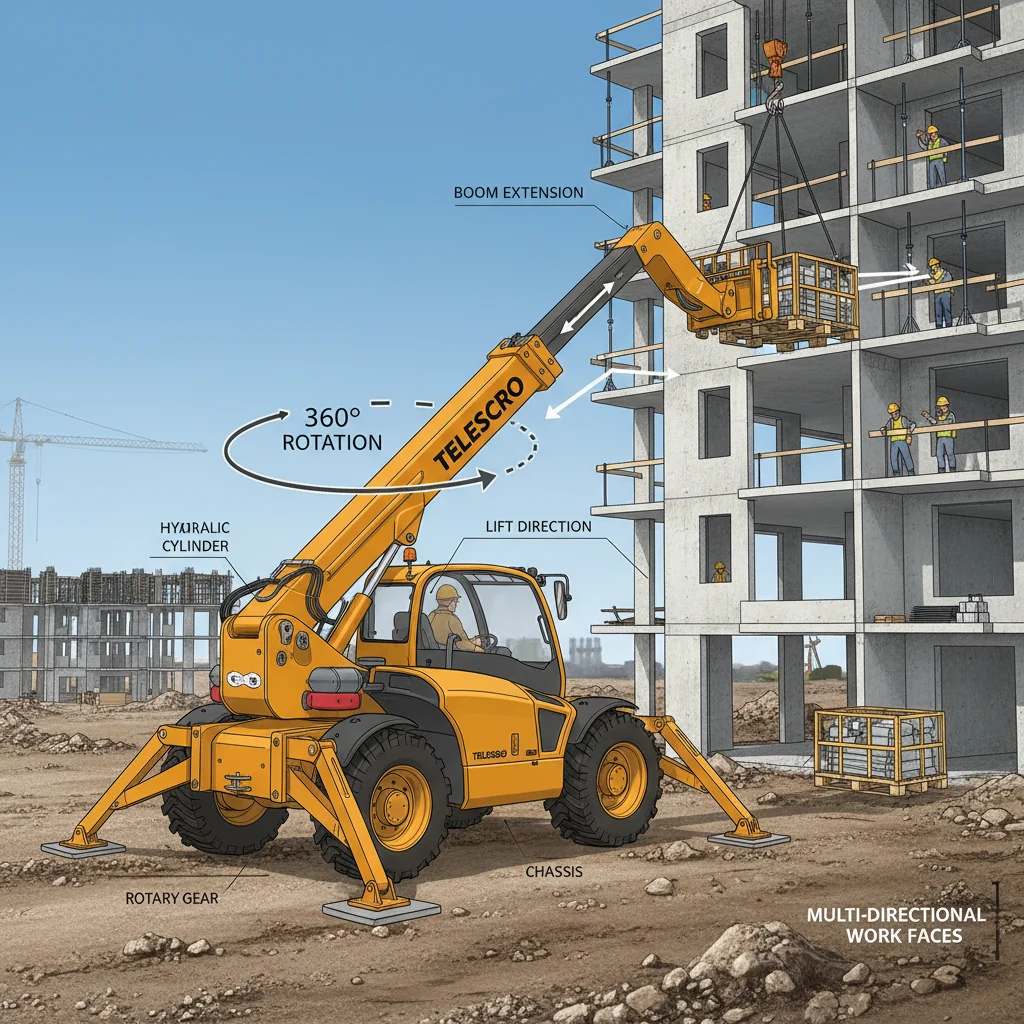
Let me share something important about rotating telehandlers—they’re not for every job, or every fleet. I see many buyers get tempted by the 360° boom and the promise of “one machine does it all.” But unless you really need that rotation for a big chunk of your work, the numbers just don’t add up. Think about it: upfront, you’ll pay 25–40% more than you would for a similar fixed-boom machine. In Malaysia, I worked with a contractor who ran high-rise steel jobs in dense city sites. Rotation was essential. They used their rotator on three projects in a row—multi-face lifts, suspended loads, and platform work. Within 18 months, they saved the cost of at least four monthly crane rentals and reduced site congestion.
But I’ve also seen customers in Kazakhstan buy a rotating telehandler “just in case.” Six months later, the machine sat idle because most lifts never needed rotation. Fixed-boom units handled 70% of their work without the extra training or hydraulic repairs. The “Swiss army knife” advantage only works if you’re scheduling it across different projects and really stretching what it can do—using work platforms for facade repairs, winches for lifts, and rotating the boom for tight access. Make sure your operators are comfortable with the added controls and the moment indicator system. If rotation is under 30% of your planned operating hours, I suggest renting a unit for special jobs instead. Crunch the numbers on your avoided crane and MEWP costs before committing to ownership.
Rotating telehandlers typically cost 25-40% more upfront than fixed-boom models due to the complexity of their 360° slew systems and reinforced structural componentsTrue
The engineering required to allow continuous 360° rotation involves specialized slewing rings, additional hydraulic circuits, and enhanced chassis design, which significantly increases manufacturing costs compared to fixed-boom telehandlers.
Rotating telehandlers are generally lighter than fixed-boom telehandlers because the rotating mechanism replaces heavy counterweightsFalse
Rotating telehandlers often weigh more because the rotation mechanism, including slewing rings and additional hydraulic systems, adds weight rather than reducing it. Heavy counterweights are still needed to maintain stability during rotation.
Key takeaway: Purchasing a rotating telehandler delivers value only for companies needing frequent rotation for specialized lifting and access tasks. Buyers should quantify cost savings over cranes and MEWPs, ensure high machine utilization, and be confident in both scheduling and operator training before committing to ownership.
What Extra Maintenance Do Rotating Telehandlers Need?
Rotating telehandlers require rigorous maintenance of the slew ring and rotation drive, with regular lubrication and inspection vital due to high replacement costs—often $4,000–$10,000 for parts. Corrosive or dusty sites accelerate wear, and advanced electronic stability and attachment-recognition systems demand periodic diagnostic checks, making planned preventive maintenance and specialist dealer support essential.

I’ve worked with customers in Kazakhstan and the UAE who underestimated what it takes to keep a rotating telehandler running smoothly. With standard models, you’re mostly focused on boom and hydraulic checks. But as soon as you add the rotation system—a slew ring and rotation drive—the maintenance level jumps. These parts take all the side loads and vibration. If you miss regular greasing or skip inspections, wear accelerates fast. I’ve seen a customer face a $9,000 repair bill just for a replacement slew ring—parts alone, not counting downtime or labor. In dusty environments—think North Africa or western China—grit attacks the turret area and causes premature wear, so daily cleaning and following manufacturer greasing intervals is absolutely critical.
On a recent project in coastal Brazil, salt and moisture caused early corrosion on the rotation system. We caught it thanks to a 600-hour detailed inspection. That’s another point—rotating machines need more frequent, in-depth checks than fixed telehandlers. I always suggest budgeting for professional preventive maintenance every 500–600 hours, especially for the rotation mechanism and stabilizers. It’s not just mechanical either. Advanced electronic systems—like stability monitors and attachment recognition—require specialist diagnostic tools and periodic calibrations.
If you’re managing a fleet, routine tasks like filter changes are just the beginning. Diagnostic checks for sensor faults, controller updates, and even small wiring repairs can add real labor hours. When considering a new rotator, check if your dealer has technicians certified specifically for rotating telehandlers and a solid track record with spare parts. This planning minimizes costly surprises in year two or three—what I call the “second-year surprise.”
Rotating telehandlers require a regular greasing interval of at least every 50 operating hours on the slew ring and rotation drive to prevent accelerated wear under side loads and vibration.True
The slew ring and rotation drive components on rotating telehandlers endure constant side loads and vibrations, making frequent lubrication critical. Operating without greasing every 50 hours can cause the bearings and gears to deteriorate quickly, leading to expensive repairs.
Rotating telehandlers do not require additional hydraulic maintenance compared to standard models because the rotation system uses independent electric motors.False
The rotation system in most rotating telehandlers relies on hydraulic slew drives integrated into the main hydraulic circuit, increasing the load on hydraulic components and requiring more frequent fluid and hose inspections compared to standard telehandlers.
Key takeaway: Rotating telehandlers introduce higher long-term maintenance demands, particularly for the slew ring, rotation drive, and electronics. Budgeting for preventive maintenance, access to trained technicians, and dealer support is crucial for minimizing downtime and costly repairs, especially in harsh site conditions.
How Do Telehandler Controls Affect Precision?
Rotating telehandler operator controls—typically hydrostatic transmissions11 and proportional hydraulics12 with dual joysticks—enable millimetre-level placement and smooth boom rotation. Enhanced visibility through expansive cabs and cameras supports safer, more accurate slewing. Wireless remote controls allow operators to position themselves optimally, further improving accuracy and reducing reliance on hand signals, especially during complex façade or glazing work.
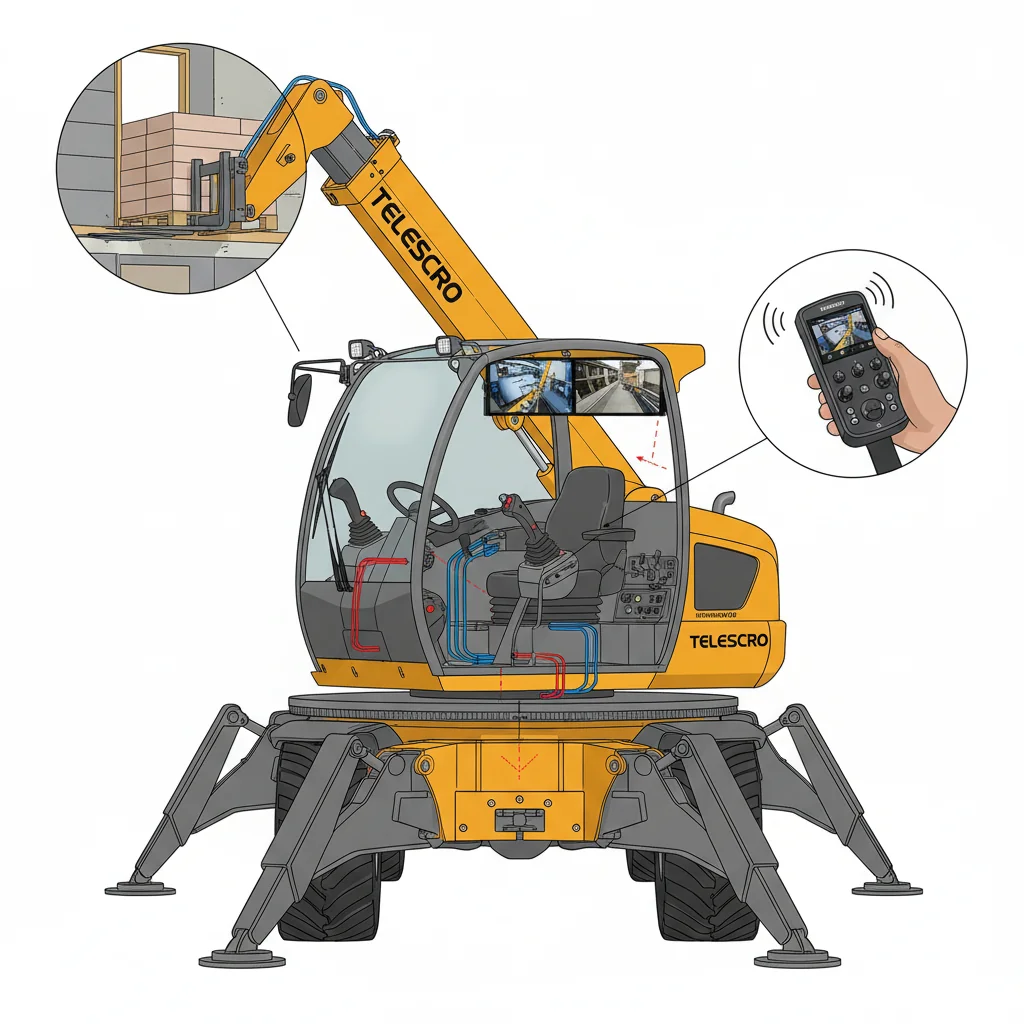
When it comes to jobsite accuracy, intuitive telehandler controls make all the difference. I remember a project in Singapore where the crew needed to set glass panels along a curved façade—each piece had to line up exactly, and the contractor only had a 40 mm gap to work with. With a rotating telehandler using dual proportional joysticks and hydrostatic drive, the operator dialed in minor corrections with just a fingertip. Millimetre-level adjustments weren’t just possible—they became routine. If that same operator had clunky, on-off hydraulic controls, the result would have been broken panels and costly delays.
For operators, clear visibility is just as important as smooth hydraulics. Large glazed cabs and overhead sightlines help a lot, but I’ve seen the biggest difference when operators use units with both rear and boom-tip cameras. Last winter in Poland, a customer told me the camera system let his crew place insulation packs two stories high, tight against scaffolding, with no need for spotters shouting hand signals. Their boom tip visibility removed almost all guesswork, and their site incident rate dropped.
Wireless remote controls are another upgrade that changes how crews work. Being able to leave the cab and operate from the best vantage point—especially for complex glazing or façade jobs—means fewer errors and less reliance on radios or hand signs. I suggest choosing models that allow for remote operation if your projects demand extremely precise placements. And don’t skip proper operator training; even experienced telehandler drivers need time to master extra rotation and safety features on these advanced machines.
Rotating telehandlers use a 360-degree rotating turret mechanism allowing the boom and cab to swivel independently from the chassis, enabling precise positioning in tight or complex jobsite layouts.True
Unlike standard telescopic handlers, rotating telehandlers have a turret that rotates fully around the chassis, allowing operators to place loads with greater accuracy without repositioning the entire machine, which is especially valuable in confined spaces or jobs requiring frequent directional changes.
Rotating telehandlers achieve precise load placement primarily through a fixed boom design that eliminates any lateral movement during rotation.False
Rotating telehandlers do not rely on a fixed boom; instead, their telescopic booms extend and retract, and the turret rotation provides the lateral movement. The precision comes from the combination of boom control and turret rotation, not a fixed boom design.
Key takeaway: Intuitive controls, optimal cab visibility, and remote operation dramatically increase a rotating telehandler’s placement precision. Selecting units with user-friendly layouts and training operators in advanced control functions ensures both safer operations and higher productivity, particularly for demanding jobs requiring exact load positioning and minimal error margins.
Conclusion
We’ve looked at what sets rotating telehandlers apart—their split chassis, ability to rotate 360°, and where that helps most on tight jobsites. Honestly, from my experience, the contractors who get the best results with rotators spend extra time on the load chart and parts support, not just the lifting height. I’ve seen a few get caught up in specs and end up with a “showroom hero, jobsite zero.” If you’re weighing your options or unsure what matches your site, feel free to reach out. I’m happy to share what’s worked (and what hasn’t) for real crews in twenty different countries. Every project is different, and the right fit goes beyond what looks good on paper.
References
-
Explore the critical role of the slew ring in enabling 360° rotation and its maintenance challenges in rotating telehandlers. ↩
-
Understand how 360° rotation allows stationary operation in tight worksites, enhancing telehandler productivity and safety. ↩
-
Explains how full rotation reduces cycle times and fuel use, enhancing productivity on confined construction sites. ↩
-
Explore how quick-coupler systems enable fast attachment swaps, boosting jobsite productivity and reducing downtime for construction projects. ↩
-
Discover expert insights on how rotating telehandlers streamline facade installation by handling loads from multiple sides without frequent repositioning. ↩
-
Explore how load-control systems monitor boom angle and chassis tilt to prevent tipping and ensure safe telehandler operation. ↩
-
Understand the role of full stabilizer deployment in maximizing telehandler stability and preventing overturn accidents on construction sites. ↩
-
Provide a detailed analysis of how maximum lift height influences the performance of rotating telehandlers, helping users select equipment that matches their real-world job requirements. ↩
-
Offer an in-depth explanation of how automatic leveling functions simplify machine setup and enhance safety and efficiency when operating on slopes. ↩
-
Understand how multi-directional capabilities enhance project flexibility and reduce equipment rentals with rotating telehandlers. ↩
-
Explore the role of hydrostatic transmissions in enabling smooth, precise telehandler movements with fingertip control for delicate construction tasks. ↩
-
Discover how proportional hydraulics allow fine, incremental adjustments in telehandlers, reducing operator errors and preventing costly damage on-site. ↩