










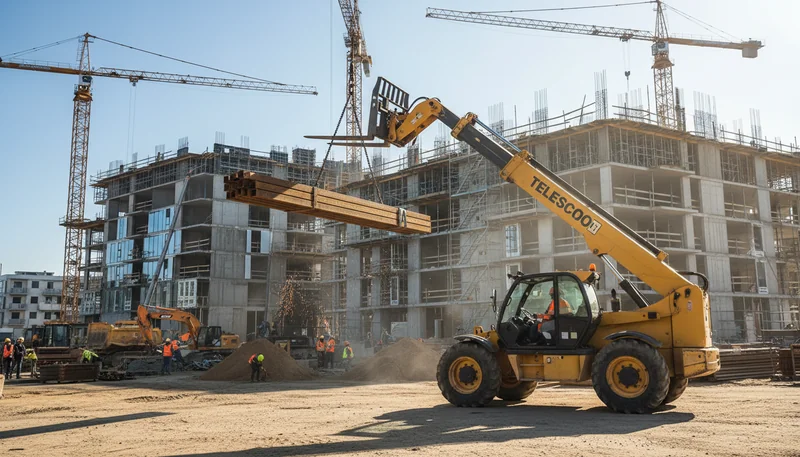
What is a High-Lift Telehandler? Field Insights for Buyers and Operators
When I visited a jobsite in Brazil last month, I watched a crew trying to land roofing bundles on a fifth-floor slab. Their standard telehandler just couldn’t clear the parapet, and every attempt meant wasted time. That’s the kind of situation where a high-lift telehandler really proves its worth.
A high-lift telehandler is a heavy-duty telescopic handler engineered specifically for lifting and placing loads at elevated heights and extended outreach, often well beyond the reach of conventional or mid-range telehandlers. Typical models offer 40–60 feet (12–18 meters) of vertical reach, with leading units approaching 70–75 feet (21–23 meters). The critical specifications are not only maximum lift height1, but safe lifting capacity at height and reach, which is governed by the machine’s load chart, stability limits, boom extension geometry, and counterweight configuration.
What Defines a High-Lift Telehandler?
A high-lift telehandler is an off-road telescopic handler designed for extended vertical and forward reach, typically achieving 40–60 ft (12–18 m) of lift, with some models reaching up to 75 ft (23 m). These machines use multi-section booms2 and reinforced chassis for stability when placing loads at significant heights and distances.

Most people don’t realize that a high-lift telehandler isn’t just about lifting more weight—it’s about reaching much higher and further, safely. Standard machines top out at around 15 meters, but once your project involves placing loads at 12, 15, or even 20 meters—think fourth or fifth floor—you’re firmly in high-lift territory. I recently advised a customer in Dubai working on a mall extension. They needed to place HVAC units over a tall parapet, with a reach of at least 16 meters and a load of 2,000 kg. Their old 7-meter telehandler just couldn’t do it.
What makes these machines special is the boom. Most use at least three telescopic sections, sometimes four, giving balanced vertical and forward reach. The reinforced chassis and large counterweights make a real difference for stability, especially at maximum extension. I’ve seen models with leveling frames and extendable stabilizers3—those hydraulic “feet” that add lateral support—deployed on uneven ground in Brazil, where foundations were far from finished. Without these features, the risk of tipping increases dramatically.
One detail many buyers overlook is the load chart. The safe working capacity drops as the boom extends—sometimes by half or more. For example, a 4,000 kg capacity at ground level might shrink to 1,500 kg at 18 meters forward reach. This matters most when loading roofs or placing materials where overshooting is impossible.
I suggest always asking for the full load chart and checking real-world lifts at your planned working heights. That’s the best way to avoid unpleasant surprises during peak jobsite pressure.
High-lift telehandlers often feature extended boom designs that allow them to safely reach heights of up to 20 meters while maintaining stability, distinguishing them from standard models capped at around 15 meters.True
High-lift telehandlers incorporate specialized boom structures and often enhanced counterweights to safely achieve greater vertical and horizontal reach, enabling operations on building floors four and five or higher, which standard telehandlers cannot reliably handle.
"AFalse
"High-lift
Key takeaway: High-lift telehandlers are specialized for projects demanding vertical placement at multi-story heights, not just higher load capacity. Their advanced boom structure and stability features address complex site challenges, making them essential for tasks like roof loading or reaching over tall obstacles in construction and industrial applications.
When Is a High-Lift Telehandler Needed?
A high-lift telehandler is required when material placement height and outreach are critical, such as lifting loads to upper floors, over obstacles, or deep into structures. Commonly used in multi-story construction and agriculture, high-lift models minimize crane dependence and accelerate jobsite cycles by safely reaching areas inaccessible to standard handlers.

Let me share something important about high-lift telehandlers—height specs alone don’t tell the full story. Last summer, a contractor in Dubai asked me if their 14-meter unit could handle exterior glazing panels on a new six-story hotel. The challenge wasn’t just getting up to 18 meters. They needed to reach over a concrete canopy and set panels two meters back from the edge, while keeping loads stable and operators safe. That’s exactly where a high-lift model shines. Standard handlers max out at 10–12 meters with usable outreach, but high-lift units extend boom reach to 17 meters or more, typically holding 1,500–2,500 kg at those ranges—enough for heavy materials like masonry, HVAC modules, or cladding.
From my experience, high-rise projects in Brazil, Kazakhstan, and Kenya all face tight sites where cranes create scheduling headaches and extra costs. One site in São Paulo saved at least a week because their high-lift handler managed every pallet of brick and steel deck straight to the fifth floor—no waiting for crane windows or blocking other trades below. In agriculture, it’s a similar story. Tall storage sheds in France or deep silage clamps in Australia often require stacking bales four or five layers high. Compact or standard telehandlers simply can’t reach safely, even with their max extension.
I suggest always double-checking the load chart at your max boom angle and outreach—especially above 14 meters. The real value comes when you spend less time moving materials multiple times and more time building.
High-lift telehandlers typically incorporate extended reach stabilizers that enable them to position loads safely up to 6 meters beyond the machine’s wheelbase, a feature essential when working over obstacles like canopiesTrue
The extended reach stabilizers increase lateral stability allowing operators to set loads further from the base without tipping, which standard telehandlers usually cannot do, making high-lift models crucial for tasks requiring reach beyond just vertical height.
High-lift telehandlers achieve greater height primarily by using telescopic booms made from lightweight aluminum alloys, which reduce overall machine weight and allow for higher liftsFalse
Telehandlers generally use steel or high-strength steel alloys for their booms to maintain structural integrity and load capacity; lightweight aluminum is not commonly used for booms due to insufficient strength and durability for heavy lifting tasks.
Key takeaway: High-lift telehandlers are essential for projects demanding precision placement at significant heights or distances. They improve efficiency and flexibility by reducing crane reliance, making them indispensable for multi-story construction, façade work, and agricultural storage where standard handlers cannot safely or efficiently reach required elevations.
How Does Height Affect Telehandler Capacity?
High-lift telehandler capacity decreases as boom height and outreach increase. The further a load moves from the machine, the greater the tipping moment, sharply reducing safe lift limits—sometimes to just 25–30% of rated capacity at maximum reach. Manufacturers provide precise load charts5 listing allowable weights by boom angle and extension for safe operation.

The biggest mistake I see is buyers focusing only on a telehandler’s maximum rated capacity, without asking what it can really lift at height. On the jobsite, those headline numbers only tell part of the story. Let me give you a real example: A client in Dubai needed to lift HVAC units—each weighing about 1,200 kg—to the seventh floor of a new build, roughly 20 meters up with 10 meters of outreach. Their 4-ton, 18-meter telehandler looked perfect on paper. But consulting the load chart, we saw the safe working load at that reach and height dropped to just over 1,300 kg. One unexpected wind gust or uneven ground, and they’d be right at the edge. We switched to a higher-capacity model—avoiding delays and extra rental costs.
Here’s what matters most when you look at telehandlers for high lifts: the further you extend the boom, the less you can safely pick up. The long boom acts as a lever, increasing the tipping moment as the load moves out from the chassis. I’ve seen machines rated for 4,000 kg handle only around 1,000–1,200 kg at maximum height and full forward reach. Add soft ground or an incline, and the picture gets riskier. Outriggers can help some models, but they never override the load chart.
I always suggest checking the load chart for your real working scenario—not just the brochure numbers. That simple habit keeps crews safe and your project on schedule. Don’t let the “showroom hero” spec blind you to the real limits on your site.
A telehandler’s rated lifting capacity can decrease by up to 50% when fully extended to its maximum outreach at high elevationTrue
Telehandlers experience significant load capacity reductions as boom height and outreach increase, due to leverage and stability limits defined in load charts. This can halve the rated capacity when the boom is fully extended overhead, impacting safe lift planning.
High-lift telehandlers maintain their maximum rated capacity regardless of boom height or outreachFalse
High-lift telehandlers do not maintain maximum capacity at all heights; load charts show reduced capacity at greater heights and outreach due to stability constraints and increased leverage forces against the chassis.
Key takeaway: Always size a high-lift telehandler based on the actual weight to be lifted at the required height and outreach, not just the machine’s headline maximum capacity. This approach ensures operator safety and prevents costly operational setbacks like mid-project equipment changes or overload incidents.
Which Telehandler Specs Matter Most?
Three non-negotiable telehandler specs when selecting high-lift models are maximum lift height, maximum forward reach, and capacity at the working point6—where height meets outreach. High-reach telehandlers maximize boom length and vertical work, while high-capacity units handle heavier loads at lower heights. Application dictates whether reach, capacity, or both should drive purchasing decisions.

Here’s what matters most when sorting through high-lift telehandler specs: not every “high” model on the chart can do serious work at the far end of its reach. I’ve watched contractors in Dubai and Brazil both bring in a 17-meter machine, thinking they could lift 2,500 kg to full height—until they checked the load chart on site. At maximum height and outreach, that same machine usually manages less than 900 kg safely.
This gap between “headline” specs and usable capacity can stall your project or, worse, create serious safety risks. Let’s break down the critical specs. Maximum lift height tells you the absolute top of the boom, but that number alone is misleading without knowing what it can handle up there. Forward reach matters just as much—especially when stacking blocks three rows deep or navigating scaffolding. But the real game-changer is working-point capacity: how much weight the telehandler can actually place at your highest and furthest point.
Here’s a quick comparison to highlight the practical differences:
| Model Type | Max Height | Max Forward Reach | Capacity at Max Height | Best Use Case |
|---|---|---|---|---|
| High-Reach | 17–18 m | 13–15 m | 700–950 kg | Multi-story façade work, light materials |
| High-Capacity | 10–12 m | 6–8 m | 4,000–5,000 kg | Heavy steel, low-rise construction |
| Balanced Utility | 14–15 m | 9–10 m | 2,000–2,500 kg | General building, mixed site needs |
A high-lift telehandler’s maximum rated load decreases significantly as the boom extends horizontally, often dropping to less than 40% of its capacity at full heightTrue
Load charts typically show that telehandlers must reduce their rated capacity at higher outreach to maintain stability and prevent tipping. This reduction can be drastic, with a 2,500 kg machine occasionally limited to under 1,000 kg at maximum reach due to leverage and stability constraints.
High-lift telehandlers maintain their full rated capacity regardless of boom height or extension due to advanced counterweight systemsFalse
Even with advanced counterweights, physics limits apply. The rated capacity must be reduced at extended reaches to prevent tipping and structural overload; no telehandler can lift its maximum rated load at full boom extension without risking equipment failure or accidents.
Key takeaway: Always prioritize maximum lift height, maximum forward reach, and working-point capacity based on the heaviest expected load at required heights. Distinguish clearly between high-reach and high-capacity models to avoid mismatched performance on site. Proper spec selection impacts safety, productivity, and regulatory compliance.
How Do High-Lift Telehandlers Compare On Site?
High-lift telehandlers differ from forklifts and cranes by combining off-road mobility7, four-wheel drive, and telescopic boom reach. Forklifts are limited to flat, level surfaces, while telehandlers manage rough terrain and distance placement. Unlike small cranes, telehandlers provide faster repositioning, direct pallet handling, and can replace multiple machines on medium-rise job sites.

Last month, a contractor in Dubai called me to settle a debate: should he get a high-lift telehandler, or stick with separate forklifts and a light crane for his medium-rise project? His main concern? Speed and jobsite access. Their team needed to place HVAC units on a third-floor platform—12 meters up, over a pit, with no stable roads nearby. Standard forklifts couldn’t manage the sandy, uneven ground. The light-duty crane would have worked, but only with expensive rigging and more labor. I’ve seen this same scenario in Brazil and Kenya—different sites, but the same issue.
Here’s a quick table showing how high-lift telehandlers compare onsite:
| Machine Type | Terrain Capability | Max Reach | Load Handling | Site Speed | Pallet Handling |
|---|---|---|---|---|---|
| Standard Forklift | Flat, paved only | 3-6 m | Vertical lift only | Slow—reposition often | Yes |
| Small Crane | Firm/leveled ground | 12-20 m | Best for suspended/lift loads | Slow—set up needed | No |
| High-Lift Telehandler | Rough/uneven, all weather | 12-18 m | Forward reach, height or depth | Fast—can drive under load | Yes |
From my experience, one well-sized high-lift telehandler can do both: it reaches over obstacles and handles pallets directly. Let’s say you use a 4-ton model with an 18-meter boom; you get enough capacity for heavy blocks at height, and you save at least two days on site movement. Another advantage is mobility—these machines turn in under 5 meters and can reposition in tight spots. I suggest always matching the rated load at maximum outreach to your heaviest material. That’s what keeps the jobsite moving and cuts down on bottlenecks.
High-lift telehandlers typically feature boom extensions that allow them to reach heights of 12 meters or more while maintaining compact stability suitable for uneven and unstable jobsite terrain.True
Unlike conventional forklifts or cranes that require stable ground or additional rigging, high-lift telehandlers combine telescoping booms with four-wheel drive and stabilizers, enabling them to operate efficiently on uneven surfaces and reach medium-rise heights with less setup.
High-lift telehandlers can generally replace all crane functions on a jobsite, including lifting loads above 30 meters and performing precision heavy lifting without additional support equipment.False
While telehandlers excel in lifting on uneven terrain and moderate heights (typically up to about 15 meters), they are not designed for very high lifts or the precise heavy lifting tasks that specialized cranes perform, which require counterweights, slewing capabilities, and higher safe working load capacities.
Key takeaway: High-lift telehandlers offer a unique advantage by handling uneven terrain, extending load placement at height or depth, and improving job site logistics compared to forklifts and small cranes. Properly sized, one high-lift telehandler can often replace both a rough-terrain forklift and a light-duty crane.
What Are Typical High-Lift Telehandler Heights?
High-lift telehandlers in construction commonly offer maximum lift heights in distinct classes: 40–55 ft (12–17 m) for standard three- to four-story jobs, 70–75 ft (21–23 m) for high-reach demands like five-story buildings, and 30–40 ft (9–12 m) for mid-range applications8 exceeding yard forklift capabilities.

To be honest, the spec that actually matters is matching telehandler height to your real jobsite needs—not just chasing the biggest numbers in the brochure. I’ve seen buyers in Kazakhstan invest in a 21-meter high-reach model, thinking “more is better.” But their average project was only three stories, under 15 meters. They ended up with higher transport costs, more weight to maneuver around tight sites, and a hydraulic system they rarely pushed to its designed limit. That’s wasted budget and effort.
Most construction jobs I support fall into the 40–55 ft (12–17 m) high-lift class. This range covers roof trusses, brick loads, and equipment up to four stories—sometimes even with a setback from the building line. If you’re working on shopping malls, warehouses, or standard office towers, that’s the sweet spot. I’ve helped a customer in Brazil handle heavy HVAC units onto a fourth-floor rooftop. Their model, rated for about 4 tons and 16 meters, lifted every load without strain. Going larger would have meant extra permit fees and difficult parking in São Paulo’s dense city sites.
If your typical projects are just two stories, don’t overlook the practicality of mid-range 30–40 ft (9–12 m) machines. These still outclass any standard yard forklift and are easier to transport. You’ll also save on fuel and maintenance—the smaller hydraulic circuits and lighter frames reduce stress on wear parts.
I always suggest mapping your core job heights, roof lines, and distance from access roads first. This way, your telehandler class matches your operational reality—no hidden costs, just the right machine for the work.
High-lift telehandlers designed with boom lengths over 18 meters typically require counterweights that increase the machine's overall transport weight by at least 20% compared to standard modelsTrue
Longer booms generate greater lifting moments, so manufacturers add heavier counterweights to maintain stability, which increases the telehandler's curb weight and transportation challenges. This affects logistics costs and site maneuverability.
Telehandlers with high-reach booms generally achieve greater lift heights by using double hydraulic cylinders in series, doubling the effective stroke length without increasing boom lengthFalse
Lift height is primarily increased by extending boom length or adding telescoping sections, not by connecting hydraulic cylinders in series; this method wouldn't effectively double stroke and would complicate hydraulic system design unnecessarily.
Key takeaway: Selecting a high-lift telehandler should be guided by the height and access needs of recurring projects. Overspecifying lift height adds unnecessary cost and complexity, so matching machine class to typical building stories and required outreach ensures optimal utilization and operational efficiency.
How Do Attachments Enhance High-Lift Telehandlers?
Attachments transform high-lift telehandlers into versatile, multi-purpose tools beyond conventional forklift use. Standard pallet forks accommodate masonry and lumber, buckets handle bulk material, while jibs, winches, and man platforms enable crane operations and elevated work. Many powered attachments require adequate auxiliary hydraulics9 (80–120 l/min), making early compatibility checks essential for safe and efficient operation.

I’ve worked with customers in at least twenty countries who were shocked by how much attachments expanded their machine’s role. Last autumn, a builder in Kazakhstan called after buying a 17-meter high-lift telehandler for moving pallets. Within weeks, they realized the right set of attachments could replace a mobile crane, loader, and even a manlift for façade work—all in one. That’s when the planning starts to pay off.
The versatility really comes down to matching attachments to on-site needs. Here’s how the most popular options transform a standard high-lift telehandler:
- Pallet forks – For everyday lifting of bricks, blocks, and timber up to full boom extension.
- Bulk buckets – Scoop and move loose material or debris, especially during demolition or site cleanup.
- Lifting jibs10 and hooks – Handle truss, rebar, or HVAC installation at height without bringing in a crane.
- Winches and hydraulic clamps – For precise placement or handling of awkward loads where control matters.
- Man platforms – Turn the telehandler into a mobile access platform—perfect for upper-level maintenance, glass fitting, or roof repairs.
From my experience, the biggest technical issue is hydraulic flow. Many powered attachments—like hydraulic swing carriages or rotators—need at least 80 liters per minute, sometimes more. I’ve seen more than one customer in Brazil order a rotating fork, only to find their machine’s auxiliary circuit couldn’t power it efficiently.
My suggestion: focus on your jobsite’s real tasks, then spec attachments with the machine—not after. Check flow and return lines before purchasing. That way, you’ll get one high-lift unit earning its keep season after season.
High-lift telehandlers with attachments like fork positioners can handle loads up to 20% heavier than their base rated capacity by optimizing load distributionTrue
Attachments such as fork positioners allow operators to adjust the fork width precisely, improving load stability and enabling safer handling of heavier palletized loads within the machine’s rated capacity, effectively increasing operational load efficiency.
Using a high-lift telehandler with a manlift attachment eliminates the need for OSHA-mandated fall protection equipment on construction sitesFalse
Even when a telehandler is equipped with a manlift attachment, OSHA regulations require fall protection to ensure worker safety at heights. The attachment facilitates access but does not exempt operators from standard safety equipment requirements.
Key takeaway: Selecting the right attachments enables a single high-lift telehandler to handle diverse site tasks—lifting, material handling, craning, or work platforms—boosting productivity and ROI. Always confirm hydraulic requirements and compatibility when configuring machines for multi-purpose roles in construction or agriculture.
What Drives High‑Lift Telehandler ROI?
Cost and ROI for high-lift telehandlers hinge on their 15–30% price premium, heavier frames, and greater transport, insurance, and training expenses. However, consistent multi-story project use can offset these through reduced crane rentals and fewer manual lifts. ROI modeling should factor utilization, maintenance, fuel, and resale value over two to five years.

Here’s what matters most when weighing ROI on high-lift telehandlers: it’s not just the purchase price that hits your budget. The initial outlay is typically 15–30% higher compared to mid-range models. That extra cost covers longer booms, heavier frames, and stabilization systems. But there’s more—these machines often weigh over 12 tons, which means special trailers and permits for transport. I’ve seen clients in Kazakhstan run into delays because their regular flatbeds couldn’t handle the extra weight. Insurance premiums also increase once you exceed 16-meter reach, and local safety rules may demand advanced operator training.
From my experience, the real ROI shows up over two to five years—especially if you’re using the high-lift model on most projects. In Brazil, one customer switched from crane rentals to an 18-meter, 4-ton telehandler. He was skeptical at first, but within six months he’d cut his crane costs by nearly half. Lifting roof trusses and heavy pallets directly to fourth-floor slabs saved at least three working days on each project. Fewer manual lifts also meant lower injury risks and less double-handling of materials.
Still, if you rarely need more than 12 meters or only tackle high-reach jobs twice a year, rentals often make more sense. Real costs include not only maintenance and fuel but resale value. I always recommend modeling payback over two to five years, factoring in your actual utilization rate. Check the load chart at max height, calculate your crane or labor savings, then decide what fits your project pipeline.
High-lift telehandlers often require specialized transport permits because their gross vehicle weight regularly exceeds 12 tons, complicating logistics compared to mid-range modelsTrue
The substantial weight of high-lift telehandlers, driven by reinforced frames and longer booms, typically surpasses legal limits for standard flatbed transport, necessitating permits and specialized trailers that increase operational costs and planning complexity.
High-lift telehandlers usually have a purchase price 50% higher than mid-range models due to advanced electronic stabilization systemsFalse
While high-lift telehandlers are more expensive than mid-range versions, the price premium typically ranges from 15–30%, not as high as 50%. The cost increase is due to structural and hydraulic enhancements rather than solely electronic stabilization systems.
Key takeaway: Buyers should weigh higher upfront and operating costs against recurring crane rental savings and reduced manual handling. Consistent use on high-reach projects often justifies ownership, while infrequent use is better served by rentals. Detailed two- to five-year ROI projections guide optimal fleet decisions.
What Maintenance Do High-Lift Booms Require?
High-lift telehandlers’ extended booms endure greater stress, making preventive maintenance crucial. Key components demanding attention include hydraulic cylinders, extension chains or cables, and boom pads or rails, especially at full extension. Most manufacturers advise lubrication and inspection every 250 operating hours, with more frequent intervals for intensive use. Neglecting these areas rapidly increases repair costs and downtime.

Most people focus on regular engine and tire checks, but high-lift booms demand far more attention—especially if you’re running jobs above 14 meters on a daily basis. I’ve seen too many operators in Kazakhstan ignore boom lubrication and end up with seized extension pads halfway through a critical concrete pour. Once, a 17-meter unit lost hydraulic pressure under full load because the extension chains hadn’t been adjusted or inspected. That downtime lasted nearly three days and cost the site over $2,000 in lost productivity and emergency repairs.
From my experience, the parts that fail first on high-reach machines are usually right where the boom extends and retracts. Hydraulic cylinders on these larger units work under higher pressure—over 250 bar in some cases. At full stretch, those forces go straight into the extension pads and rails. Even a small amount of pad wear or chain slack gets amplified. I always inspect for early signs like “slop” in the boom, unusual grinding or squeaking noises, or visible debris on the boom rails. If operators power-wash without drying, moisture sneaks into chain housings or cylinder seals. That’s a silent killer—it might take six months before you notice a leak or loss of precision.
For customers running rental fleets in Brazil, I recommend documenting boom inspections at least every 250 hours—sometimes sooner for high-frequency jobs. Quick walk-arounds catch misalignment or leaking cylinders before they turn into major rebuilds. Protect your investment with scheduled checks, and you’ll avoid the pain of heavy repairs when it matters most.
High-lift telehandler booms operating regularly above 14 meters require boom extension chain inspection and adjustment at least every 200 operational hours to prevent hydraulic pressure loss.True
Frequent inspection and adjustment of extension chains ensure proper tension and hydraulic integrity, preventing failures like pressure loss under load that can cause costly downtime, especially at heights above 14 meters. This interval is recommended by several manufacturers for high-lift models.
Lubricating the high-lift boom is unnecessary if the telehandler is equipped with sealed extension pads designed for outdoor daytime use only.False
Sealed extension pads reduce contamination but still require regular lubrication to minimize friction and wear. Ignoring lubrication can result in seized pads and operational failure regardless of pad design.
Key takeaway: Diligent, scheduled maintenance of boom sections and hydraulic systems is essential for high-lift telehandlers. Early detection of wear or structural issues prevents costly repairs and ensures machine safety, reliability, and uptime—factors critical for fleet managers and operators handling demanding, high-reach applications.
Conclusion
We’ve looked at how high-lift telehandlers are built for tasks that need vertical reach—like setting materials on rooftops or working over tall obstacles—not just for extra lifting capacity. From what I’ve seen on jobsites, the best results come when buyers pay close attention to load charts at real working heights, not just those eye-catching max numbers. It’s also wise to consider how quickly you can get critical parts, so you don’t fall into the “parts roulette” trap later.
If you’re weighing options or have questions about fit for your job, feel free to reach out. I’m always happy to share what’s worked—and what hasn’t—for real crews in the field. Every project’s different, so the right telehandler is the one that fits how you actually work.
References
-
Explains how maximum lift height impacts telehandler performance and project safety, with practical examples from real job sites. ↩
-
Explore how multi-section booms provide balanced vertical and forward reach with improved stability, essential for high-lift telehandlers. ↩
-
Learn how extendable stabilizers add lateral support on uneven ground, reducing tipping risks during heavy lifts at height. ↩
-
Understand how extended boom reach enhances telehandler capabilities for heavy lifting, especially in challenging placements beyond standard equipment limits. ↩
-
Understand the importance of load charts for safe telehandler operation, including how to interpret weight limits by boom angle and extension. ↩
-
Details the crucial role of working point capacity in safely lifting loads at max reach and height, preventing risks and project delays. ↩
-
Understand the technical benefits of off-road mobility in telehandlers, enabling efficient handling on uneven and sandy job sites worldwide. ↩
-
Understand the practical use of mid-range telehandlers beyond yard forklifts, including typical height classes and suitable job types. ↩
-
Detailed insights on auxiliary hydraulics flow rates and compatibility for powering various telehandler attachments safely and efficiently. ↩
-
Expert explanation on how lifting jibs enable crane-like operations with telehandlers, reducing the need for additional cranes on construction sites. ↩