










What is a Compact Telehandler? Field Engineer’s Working Guide
The first time I saw a compact telehandler squeeze through a narrow loading bay in Shanghai, I realized just how much these machines can change small-space material handling. It wasn’t about flashy features—it was pure problem-solving, built for sites where traditional forklifts and loaders just can’t fit.
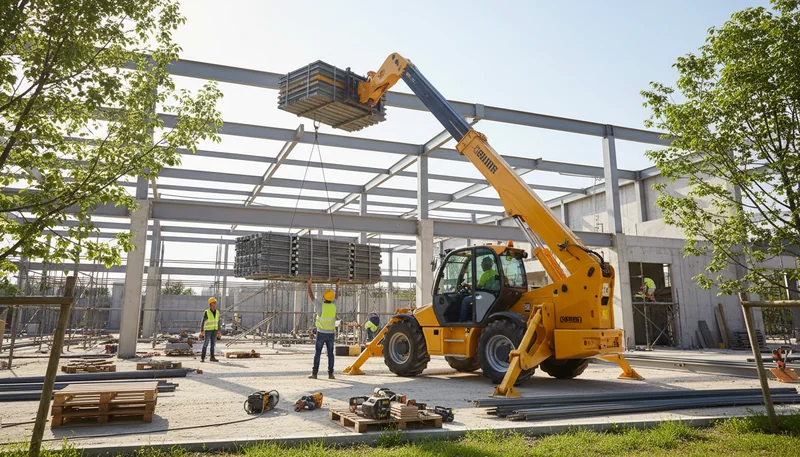
A compact telehandler is a downsized telescopic handler engineered for tight spaces, offering core telehandler capabilities—such as boom reach, off-road performance1, and versatile attachment compatibility—in a significantly smaller package. Key specifications typically include an overall width under 2 meters, lift heights between 4 and 7 meters, and rated capacities ranging from approximately 1,200 to 2,500 kilograms.
What is a compact telehandler used for?
A compact telehandler is a smaller, highly maneuverable variant of the standard telescopic handler, designed for accessing tight spaces such as narrow doorways, low ceilings, and congested yards. Featuring a telescopic boom2 and lifting capacities from 1,200–2,500 kg, compact models provide full telehandler functionality with a reduced footprint ideal for confined or indoor job sites.
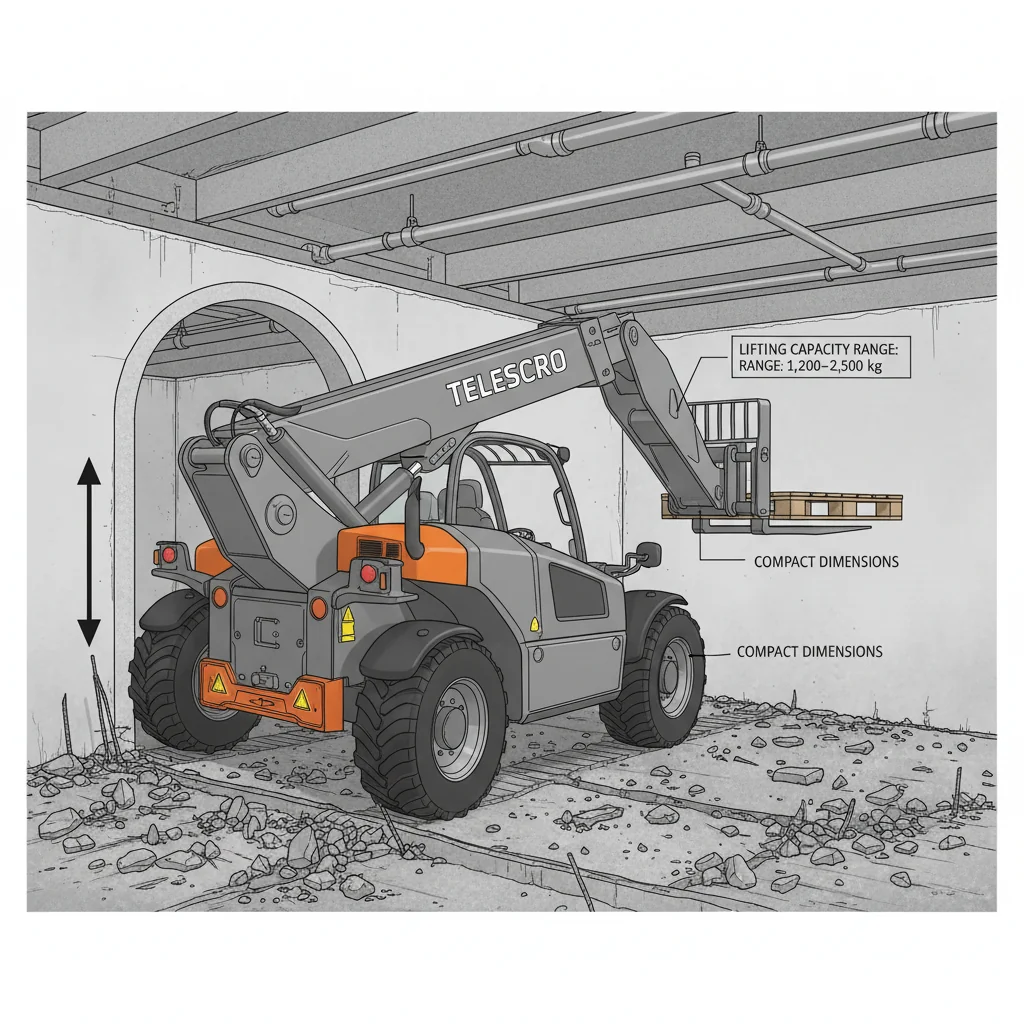
Last month, I was on a call with a contractor in Dubai who found his jobsite squeezed between two towers—barely enough space for an SUV, let alone heavy equipment. Standard telehandlers were out of the question. In these situations, compact telehandlers really prove their worth. At just under 2 meters in width and height, some ultra-compact models can steer through single doorways and low underground parking structures with ease. Most people don’t realize these machines offer true telehandler performance—including a telescopic boom, off-road wheels, and hydraulic circuits for multiple attachments—in a much smaller package.
Here’s what I see most often for compact telehandler uses:
- Indoor material handling3—moving pallets of tile or drywall inside warehouses and shopping centers
- Urban construction—working in city streets or between buildings where space and turning radius4 matter most
- Agricultural jobs—maneuvering in livestock barns or greenhouses, where a full-size loader is simply too big
- Landscaping and groundskeeping—lifting soil, plants, or tools in gardens or golf courses with minimal ground impact
- Industrial maintenance—raising technicians or equipment under low ceilings, such as inside factories
One customer in Poland switched from forklift trucks to a 2.5-ton compact telehandler for renovating a historic site. The difference? He saved at least two full working days on each floor because he could reach directly into window openings and handle materials overhead, all with a single machine. To be honest, I always suggest checking your door and ceiling heights before picking any model. If your space is tight, compact telehandlers are simply the right tool for the job.
Some ultra-compact telehandlers measure under 2 meters in both width and height, enabling them to pass through standard single doorways and low-clearance underground parking spacesTrue
The design constraints of ultra-compact telehandlers typically keep their maximum dimensions below 2 meters wide and tall, allowing operation in confined urban or indoor environments where traditional machines cannot fit. This enhances jobsite accessibility without compromising lifting capacity.
Compact telehandlers commonly utilize tracks instead of wheels to navigate restricted jobsite areas more effectivelyFalse
Most compact telehandlers use wheeled chassis, not tracks, as wheeled models provide superior maneuverability and speed on varied terrain. Tracked versions are rare in telehandlers and are more typical in crawler cranes or excavators.
Key takeaway: Compact telehandlers deliver essential telehandler capabilities—such as telescopic reach and attachment versatility—in a smaller format. They’re purpose-built for environments where larger machines are impractical, making them a smart choice for indoor work and jobs with limited access or height restrictions.
How Do Compact Telehandlers Differ From Forklifts?
Compact telehandlers provide greater vertical reach, off-road performance, and forward reach using a telescopic boom, distinguishing them from warehouse forklifts. Compared to skid-steers or compact loaders, they lift higher and farther forward. Unlike full-size telehandlers or cranes, compact models trade maximum capacity for superior access and maneuverability in tight spaces.
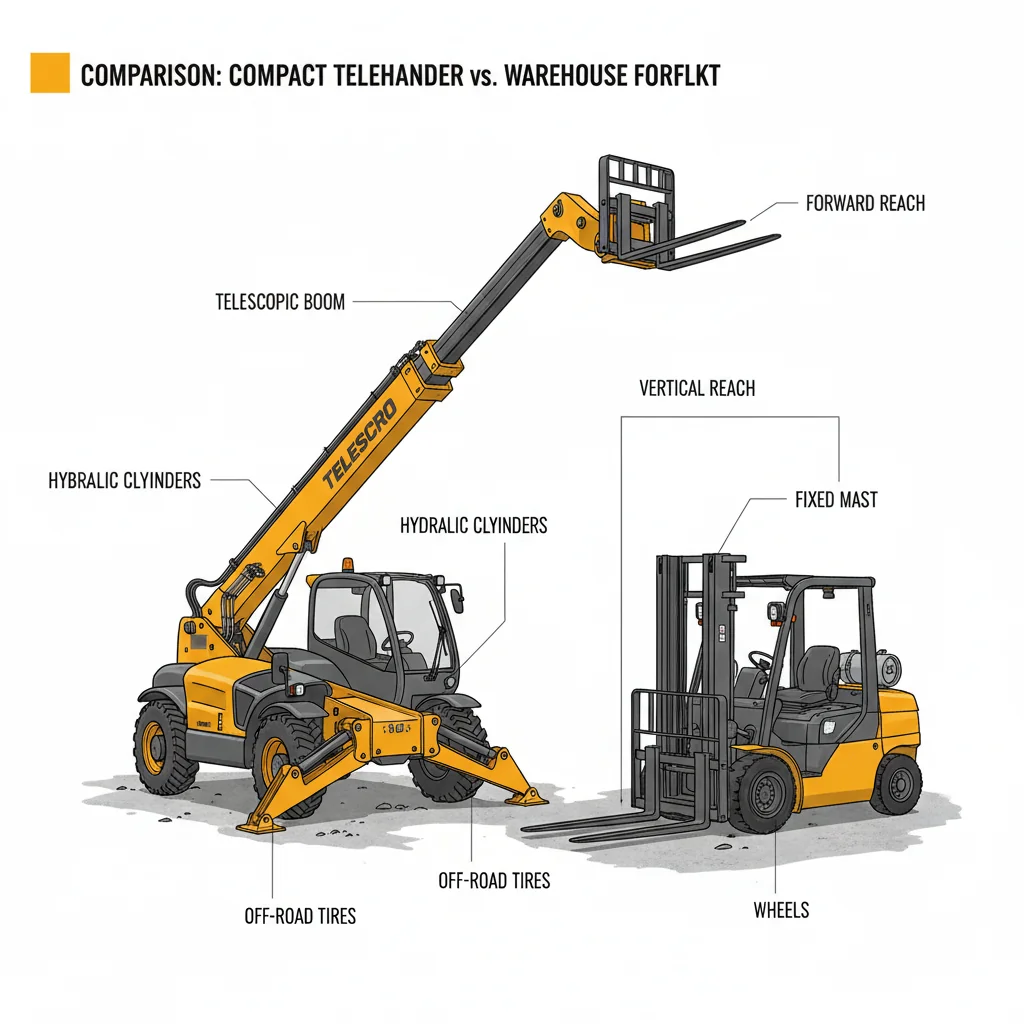
Here’s what matters most when comparing compact telehandlers and forklifts: the worksite itself. In my experience, customers often focus on maximum lift capacity or engine size, but overlook how these machines handle rough or uneven ground. For example, a warehouse forklift may handle 2.5 tons, but it struggles the moment you leave paved floors. Last spring, a small builder in Kazakhstan tried using a standard forklift on gravel. They lost hours every week, constantly getting stuck and unable to unload trucks parked off the pavement.
A compact telehandler, even with similar rated capacity—say around 2,500 kg—adds value through its telescopic boom. I’ve seen these units place pallets onto second-floor slabs or over walls up to 6-7 meters high. That’s simply not possible for a mast forklift, since it can only lift vertically. Plus, compact telehandlers usually have ground clearance over 350 mm, all-wheel drive, and a turning radius under 4 meters. This gives them far better access on messy jobsites.
Compared to skid-steers or small loaders, compact telehandlers still lead on reach. On a dairy farm in Brazil, a customer needed to load silage into tall feed bins—almost 5 meters high. Their loader managed the lower bins, but only the telehandler could reach up and out, clearing obstacles with ease.
If your site is tight but demands flexibility, I suggest checking real working heights and outreach, not just spec sheet numbers. Look at the load chart5—especially at maximum extension—before making a decision. It’ll save you frustration down the road.
Compact telehandlers typically feature four-wheel drive with oscillating axles, allowing them to maintain traction and stability on uneven or soft terrain unlike most standard forkliftsTrue
The oscillating axle design enables compact telehandlers to adapt to ground contours by allowing one wheel to move independently, maintaining traction and machine balance on rough surfaces, which forklifts generally lack due to fixed axle configurations.
Compact telehandlers have a higher maximum lift capacity than all heavy-duty forklifts because of their extended arm reach and advanced hydraulic systemsFalse
While compact telehandlers offer extended reach due to their boom design, their maximum lift capacity is generally lower than heavy-duty forklifts designed specifically for high load lifting. Reach does not directly translate to higher lifting capacity, as stability and chassis design limit telehandler capacities.
Key takeaway: Compact telehandlers offer unique advantages over forklifts, skid-steers, and full-size telehandlers by providing more reach and versatility in compact or restrictive environments. They are ideally suited for applications requiring moderate lift power with excellent mobility, making them valuable tools for small contractors or agricultural operations.
How Does Maneuverability Affect Telehandler Performance?
Compact telehandlers are designed with superior maneuverability, featuring widths around 1.8–2.0 meters and tight turning radii under 3.2 meters. Their three steering modes—two-wheel, four-wheel, and crab steer6—allow operation in confined environments, reducing labor time and enabling productivity in spaces too restrictive for larger machines. Operator-friendly steering controls further enhance efficiency in challenging sites.
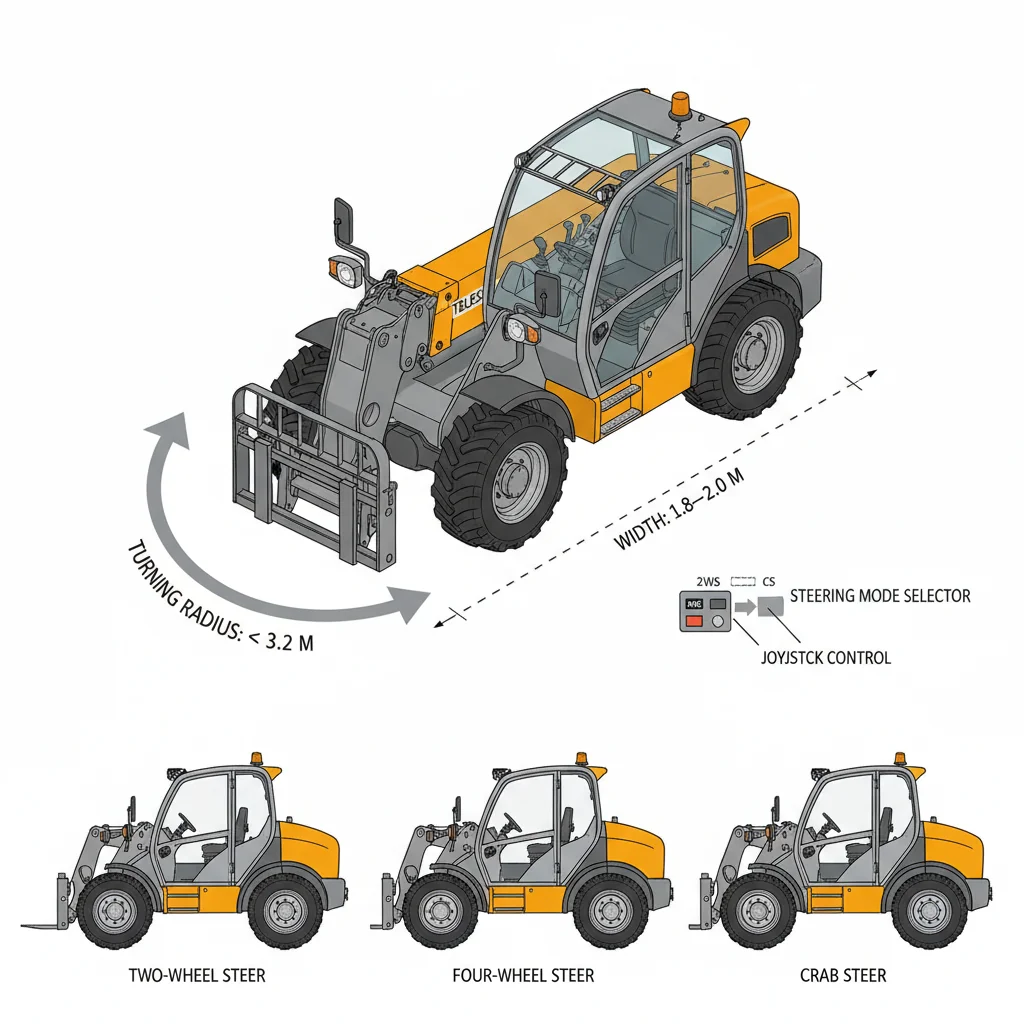
Most people don’t realize that maneuverability isn’t just a nice extra—it’s often the whole reason crews choose a compact telehandler. I’ve seen this play out on tight warehouse jobs in Singapore and dense housing sites in the UK. When your machine is under 2 meters wide with a turning radius below 3.2 meters, you can slip between columns or spin around obstacles in ways a standard loader can’t manage. Three steering modes really make a difference: two-wheel steer for road moves, four-wheel for those jobsite U-turns, and crab steer to get right alongside a wall or rack. Crab mode, in particular, helped a customer in Dubai line up to unload pallets just 30 centimeters from fire-suppression piping—a job that bigger units simply couldn’t touch.
From my experience, I always suggest customers inspect not just width and turning specs but also the cab’s steering controls. On some models, operators can switch instantly between modes with a simple lever or button—no fiddling or delays. That’s key when you need to reposition constantly in crowded environments. I once watched a crew in Brazil save at least two full days on a warehouse build, just because they didn’t need to stop and readjust equipment every time their path narrowed.
Look at the whole package—overall width, turning radius, wheelbase, and how easily an operator can handle the switch between steering modes. Those small differences show up as real gains in labor time and efficiency by the end of a project. If you’re working anywhere space is tight, I strongly suggest putting maneuverability at the top of your checklist.
Compact telehandlers typically have a maximum width of under 2 meters and can feature turning radii as tight as 3.2 meters, enabling operation in confined spaces where standard loaders cannot fitTrue
Most compact telehandlers are designed with narrow widths and small turning radii to maneuver through tight work environments like warehouses or dense construction sites, significantly improving accessibility and productivity.
Compact telehandlers usually omit four-wheel steering to reduce mechanical complexity, relying solely on two-wheel steering for maneuverabilityFalse
Contrary to this claim, many compact telehandlers are equipped with multiple steering modes, including four-wheel and crab steering, to maximize maneuverability in restricted areas, which enhances rather than reduces complexity.
Key takeaway: Compact telehandlers excel in environments with limited space, thanks to their narrow dimensions and agile multi-mode steering. Field engineers should prioritize width, turning radius, and steering mode flexibility when selecting models, as these factors critically influence productivity and reduce dependence on larger, less efficient equipment in tight areas.
How Much Can Compact Telehandlers Lift?
Compact telehandlers typically offer lift heights of 4–7 meters (13–20+ feet) and maximum rated capacities between 1,200–2,500 kg (2,700–5,500 lb). Ultra-compact models cluster near the lower end, while larger compacts approach 6–7 meters and up to 2,500 kg. True lifting performance depends on the manufacturer’s load chart, especially at maximum reach.
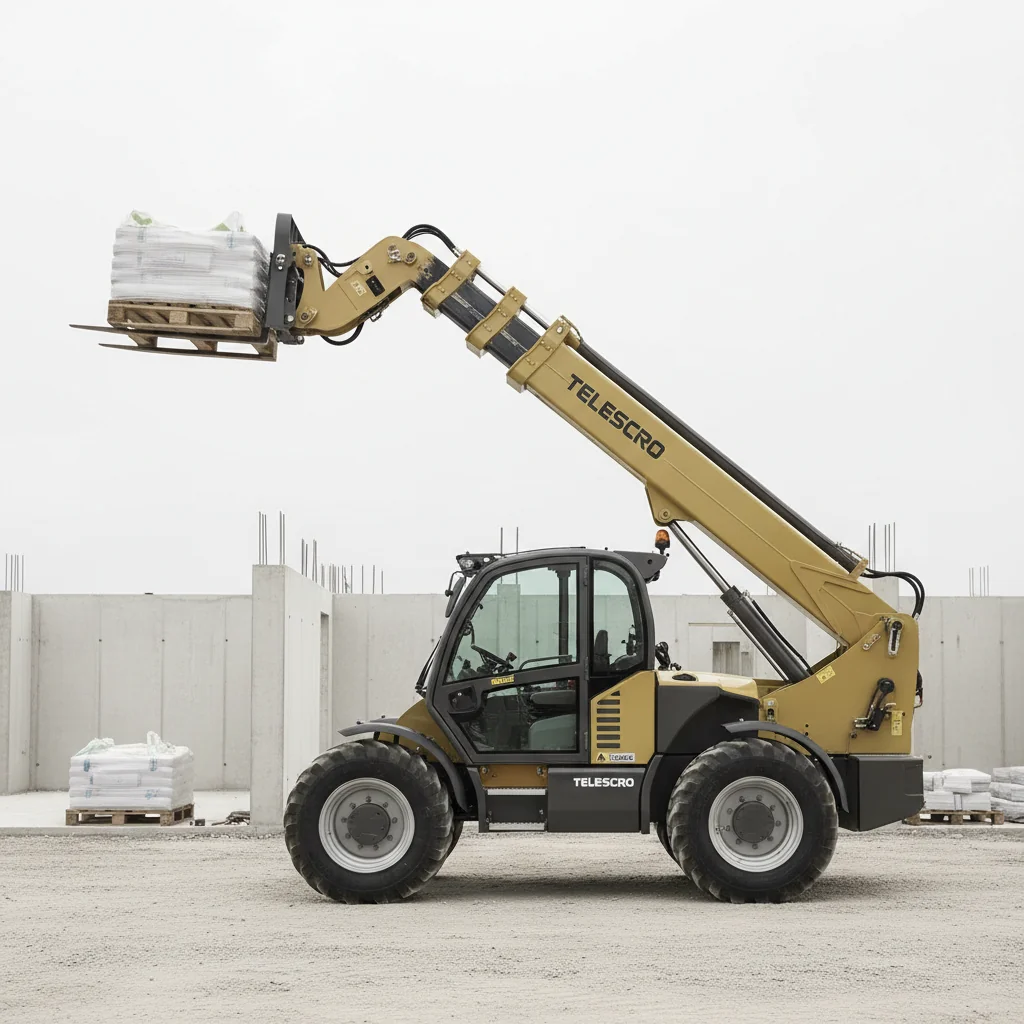
Let me share something important about compact telehandler specs—especially if you’re comparing lift capacity. The headline numbers, like “2,500 kg max lift,” only tell half the story. In real jobsites, I’ve seen that the actual load you can safely handle at full boom extension drops sharply. For example, a compact model rated for 2,000 kg might only lift about 900 kg out at maximum forward reach. I remember one project in Dubai where the customer needed to place pallets of blocks up and over a retaining wall. On paper, their 2.2-ton model seemed perfect. But once we checked the load chart (that’s the diagram showing capacity at each reach and height), their safe pick limit was just 1,100 kg at that exact position—less than half the headline rating.
From my experience, most buyers focus on max height and forget the load curve. I always suggest starting with your heaviest lift at the furthest reach you’ll actually need. Then, match that scenario exactly against the manufacturer’s load chart—not just the brochure. For work like bagged materials, hay bales, or construction supplies, compact telehandlers work very well, especially in tight urban spaces or lower buildings. But if you’re hoping to handle big precast pieces, steel beams, or anything awkward and heavy, you need to check if those weights are still within safe limits at full extension.
I recommend asking for the load chart during your selection process. That one page can prevent costly mistakes and ensure smooth jobsite operation. Simple step, big difference.
A compact telehandler rated for 2,500 kg maximum lift capacity will typically only be able to lift around 900-1,200 kg at its maximum forward boom extension due to stability and hydraulic limitsTrue
The rated maximum lift capacity is measured at the shortest reach and lowest boom angle where the machine is most stable. As the boom extends forward, leverage increases, reducing the maximum safe load significantly to prevent tipping and structural stress.
Compact telehandlers generally maintain their full rated lift capacity regardless of boom extension due to advanced counterweight systemsFalse
Despite counterweights, stability decreases as the boom extends, and the rated capacity must be reduced to ensure safety. No telehandler can safely lift its maximum capacity at full extension without risking tipping or equipment damage.
Key takeaway: Always verify the manufacturer’s load chart for actual lifting capacity at specific heights and reaches, as maximum rated load dramatically decreases at full extension. Brochure headlines are only a starting point—critical decision-making relies on accurate, model-specific load curves to prevent undersizing or unsafe operation.
How Do Attachments Make Telehandlers Versatile?
Attachments transform compact telehandlers into multi-purpose tool carriers. High-flow auxiliary hydraulics, typically 18–32 gpm, and various quick coupler7 systems enable the use of buckets, bale spears, grapples, sweepers, and augers. This flexibility allows one compact telehandler to perform tasks usually requiring both a forklift and a skid steer.
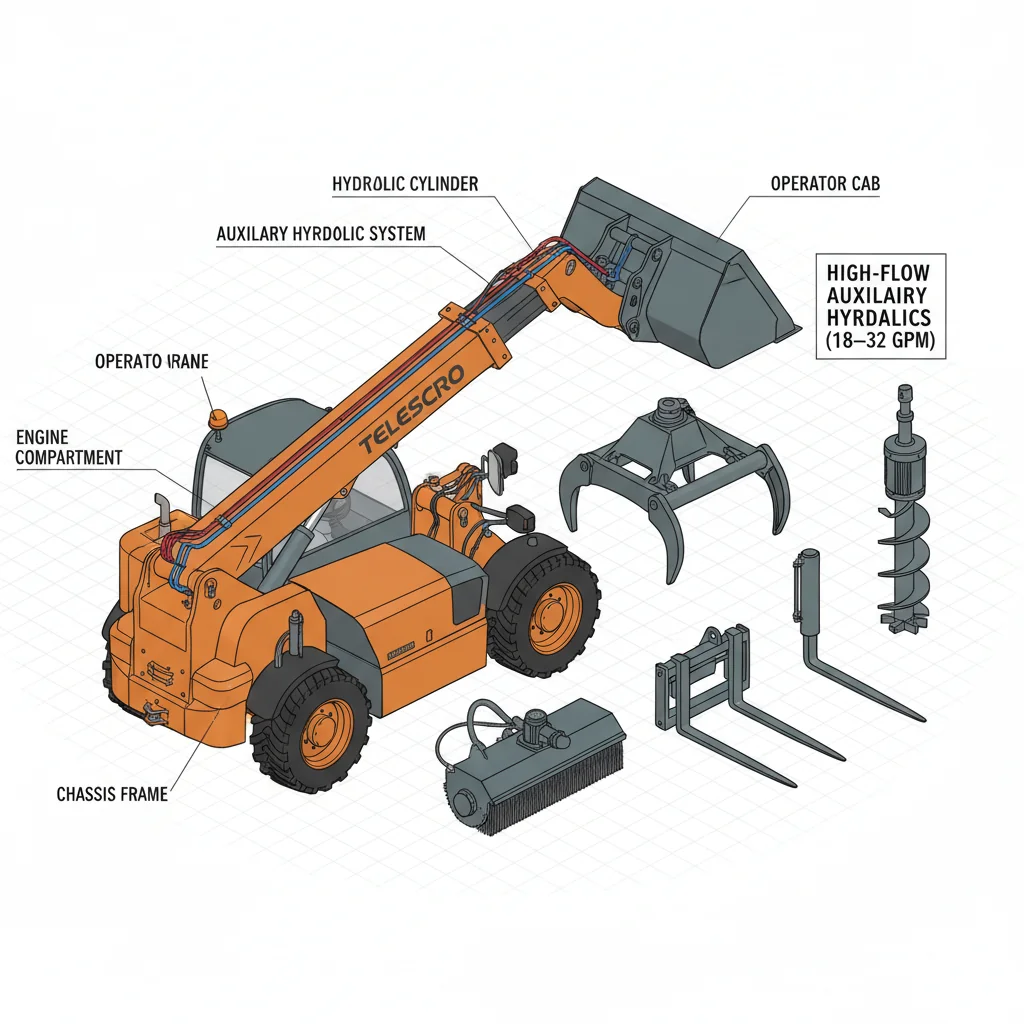
The biggest mistake I see is assuming a compact telehandler is just a small forklift with a boom. Actually, attachments are what unlock real value. In Brazil last year, I worked with a citrus farm that started with only pallet forks. After adding a bale spear and a 0.7-cubic meter bucket, their machine went from stacking crates to hauling manure and clearing brush—without needing a separate loader. That versatility came from the machine’s 28-gpm auxiliary hydraulic circuit and a universal quick coupler, which let them swap tools in under five minutes.
Let’s look at the most common attachments that turn a compact telehandler into a true multipurpose workhorse:
- General-purpose buckets – For moving sand, soil, gravel, or waste.
- Pallet forks – Basic material handling and unloading trucks.
- Bale spears – Transporting hay or silage, especially valuable on farms.
- Hydraulic grapples – Handling scrap, timber, or demolition debris.
- Sweepers – Cleaning roads and jobsite surfaces quickly.
- Augers – Drilling holes for fencing or planting.
From my experience, you need to check your machine’s rated hydraulic flow. Some augers or powered sweepers demand at least 28 gpm—otherwise, they’ll run too slow or overheat the pump. I’ve seen this problem on Kenyan construction sites, where a mismatched attachment cut productivity nearly in half. Always check the load chart (the safe working limits at each extension and angle) before adding heavier attachments.
To sum up, specifying the main attachments before buying or renting avoids disappointment and keeps your team safe. I suggest verifying both hydraulic specs and maximum rated load for each tool you plan to use.
A compact telehandler's universal quick attach system allows it to connect to a variety of attachments that operate using the machine’s 28-gpm auxiliary hydraulic circuit, enabling functions like digging, lifting, and moving materials without additional equipment.True
The 28-gpm hydraulic flow provides enough power to run different hydraulically operated attachments, and the universal quick attach system ensures compatibility with forks, buckets, and specialized tools, making compact telehandlers highly versatile beyond just lifting pallets.
Compact telehandlers universally feature a fixed 15-gpm auxiliary hydraulic circuit, limiting their ability to operate attachments like buckets or bale spears effectively.False
Compact telehandlers typically have higher flow auxiliary hydraulic circuits, often around 25-30 gpm, to support a wide range of attachments. A fixed 15-gpm system would restrict attachment functionality and reduce versatility, which is contrary to industry design standards.
Key takeaway: Compact telehandlers equipped with the right hydraulic capacity and quick coupler systems can safely perform a wide range of tasks—reducing fleet size and improving jobsite efficiency. Specifying compatible attachments during procurement ensures optimal performance and prevents machine overload or unsafe operation.
Which Compact Telehandler Size Suits the Job?
Compact telehandlers include two main size bands: ultra-compact models offer 4–5 m (13–16 ft) lift heights and 1,200–1,600 kg (2,700–3,500 lb) capacity, ideal for indoor or space-limited environments. Larger compacts deliver 5.5–7 m (18–20+ ft) reach and up to 2,500 kg (5,500 lb) capacity for outdoor, higher-reach applications.
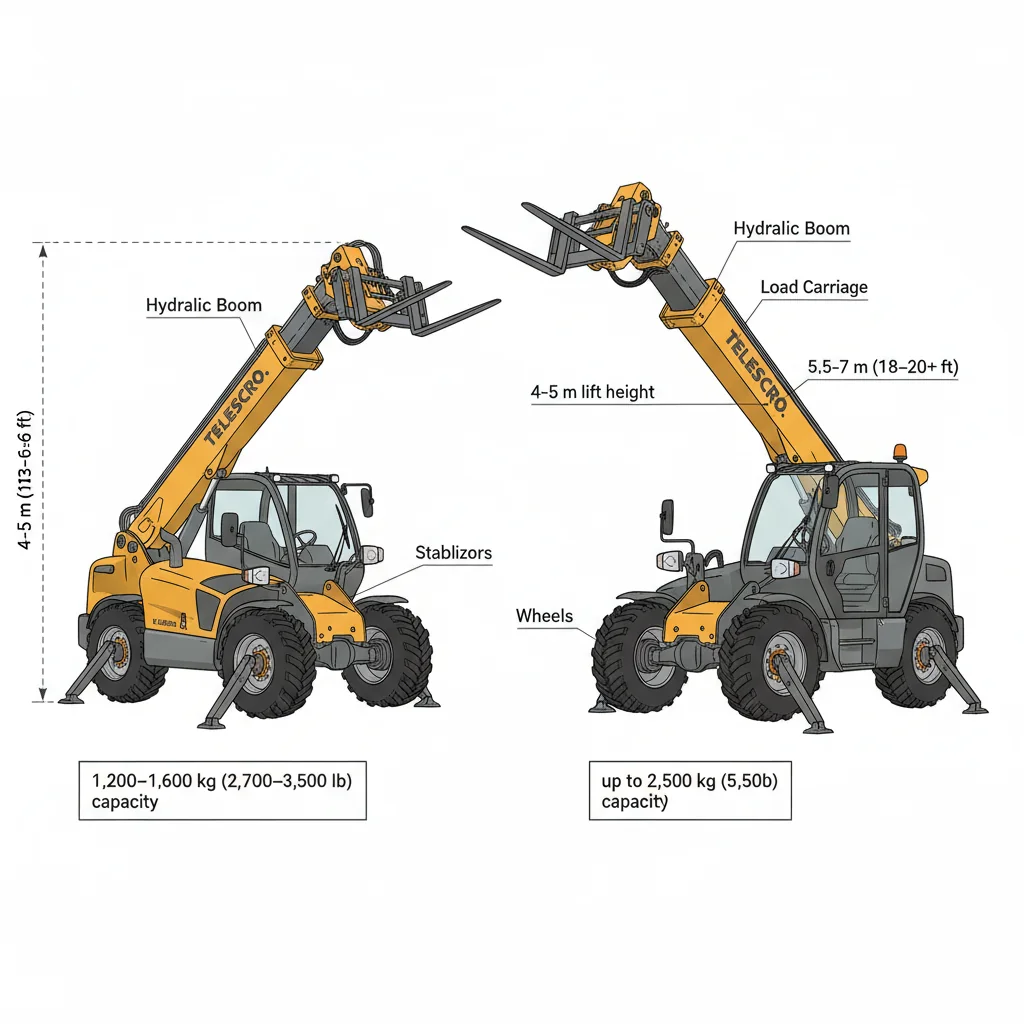
Last year in Singapore, a client contacted me about a renovation project inside a large shopping mall. Their concern? Tight corridors, low ceiling beams, and strict weight limits on transport. They needed to lift pallets of tiles up to the mezzanine, around 4.2 meters high. I suggested an ultra-compact telehandler8 with a lift height just over 4 meters and a capacity of 1,500 kg—plenty for their needs but with an overall weight under 2,700 kg. That meant they could load it onto a standard trailer and meet local transport rules. The machine zigzagged through building entries where a larger model simply wouldn’t fit.
That project highlights the real split in compact telehandler sizing9. From my experience, if your main work is indoors—finished buildings, warehouses, even greenhouses—ultra-compact units make life easier. They’re light, often below 2,800 kg total, and some feature a turning radius under 3.5 meters. However, if your tasks require stacking materials on second-story scaffolds or loading dump trucks, you need the taller, heavier side of the compact range.
Here’s a quick comparison:
| Size Band | Best For | Capacity | Lift Height | Typical Weight | Transport |
|---|---|---|---|---|---|
| Ultra-Compact | Indoors, tight sites | 1,200–1,600 kg | 4–5 m | 2,500–2,800 kg | Standard trailer |
| Larger Compact | Outdoor/higher stacking | Up to 2,500 kg | 5.5–7 m | 3,500–5,000 kg | Flatbed truck |
I always suggest checking your main access points and actual lifting needs before deciding. If you switch between small sites and bigger outdoor jobs, some “mid-size” compacts strike a balance, but transport weight can quickly sneak up on you.
Ultra-compact telehandlers under 2,700 kg often feature reduced boom lengths and tighter turning radii to navigate confined indoor environments like shopping mallsTrue
To operate safely in confined spaces with low ceiling heights and narrow corridors, ultra-compact telehandlers are designed with shorter booms and compact chassis dimensions, allowing tighter maneuverability without sacrificing enough lift capacity for lighter loads like pallets of tiles.
Telehandlers with lift heights just over 4 meters typically weigh more than 5,000 kg, making them unsuitable for standard trailer transportFalse
Many compact telehandlers designed for urban or indoor use can lift around 4 meters while remaining under 3,000 kg, enabling easy transport on standard trailers; heavier models with higher lift heights generally exceed 5,000 kg, but these are not the only option.
Key takeaway: Selecting the right compact telehandler size depends on primary workplace constraints. Ultra-compact models excel in tight or indoor spaces, while larger compacts are preferable for demanding outdoor or elevated tasks. Choose based on required lift height, load capacity, dominant environment, and transport limitations.
What Site Constraints Limit Compact Telehandlers?
Compact telehandlers must be matched to jobsite constraints beyond just lift capacity. Key factors include doorway heights10, gate and aisle widths, ceiling clearance, ramp gradients, and turning radii. Measure the tightest access points first, then compare with machine specifications, including overall dimensions and attachments, to ensure seamless entry and maneuverability.
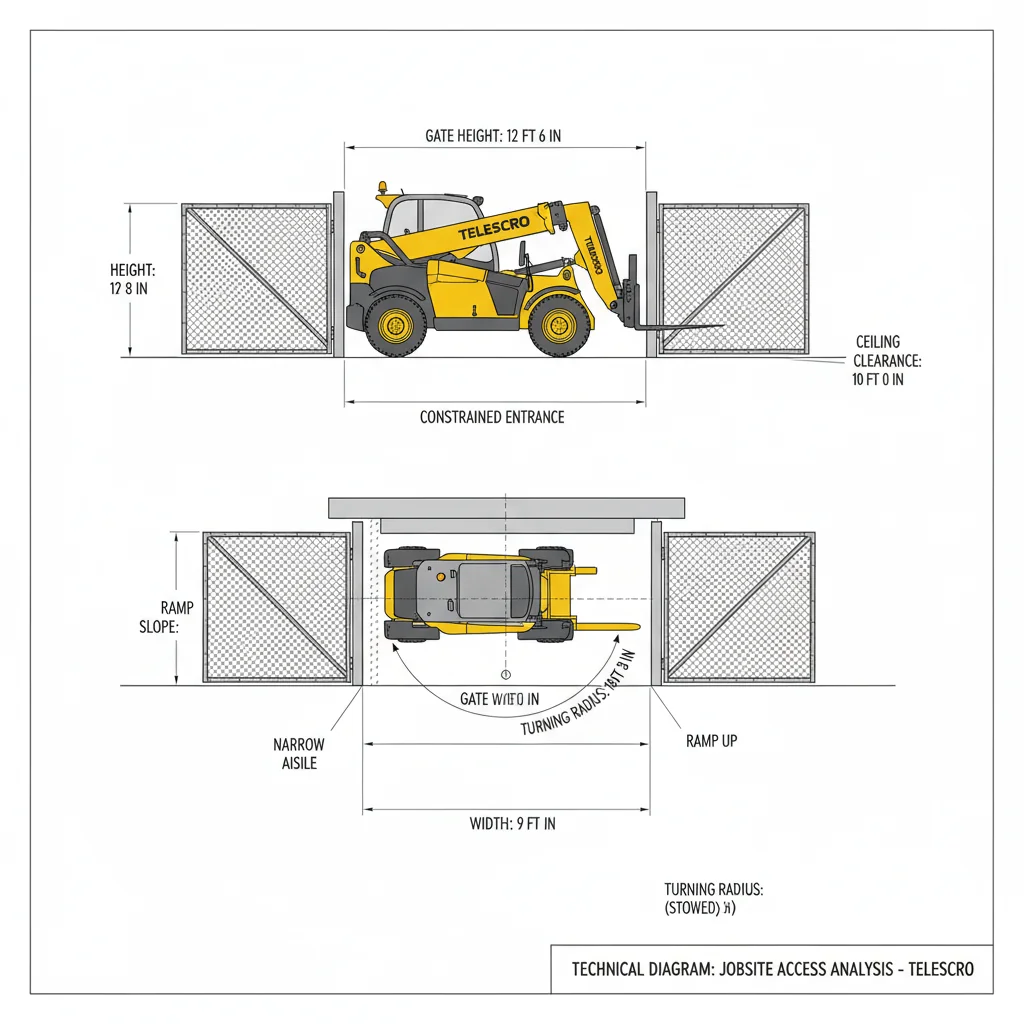
I’ve worked with customers who made this mistake more than once—choosing a compact telehandler based on lifting specs, only to realize it can’t physically reach the work zone. In Kazakhstan last spring, a client ordered a 2,500 kg telehandler for a factory renovation. On delivery day, they found their main access gate was about 2 meters wide, but the machine’s overall width including wider tires was just under that—1.95 meters. In theory, it should have fit, but the mirrors and rear counterweight left no margin. It took them half a day to remove obstacles and squeeze it inside. That kind of delay is expensive and frustrating.
Beyond just machine width, doorway heights are a frequent issue. Factories in Europe sometimes have old rolling shutters under 2.1 meters high. Some compact cab designs with work lights easily reach 2.2 meters. I always advise checking every low point—read the spec sheet carefully, but also factor in attachments. For example, a side-mounted hydraulic boom can add 10-15 cm in width and change the turning radius.
Ceiling clearance and aisle width are equally limiting indoors. An ultra-compact model might have a turning radius under 3.5 meters, while a standard unit sits closer to 4.5 meters. Ramps matter too—if the gradient is steep, ground clearance and approach angle become bottlenecks. On recurring projects, I suggest clients keep digital notes on all tight points so future rentals fit without hassle.
Matching the machine to the narrowest passage—rather than the tallest lift—removes surprises and boosts jobsite flow every time.
Compact telehandlers often have a narrower tire width that can make their total operating width nearly 10-15% wider than the chassis measurements, due to tire tread and sidewall expansion under loadTrue
Although compact telehandlers advertise narrow chassis widths, the tires—especially wider, heavy-duty ones—expand the effective machine width, which can create clearance issues at tight site entrances like gates or narrow pathways. Operators must measure including tires and attachments, not just the frame.
Compact telehandlers are designed so that their total width including mirrors and counterweights is always less than 1.5 meters to ensure easy access in confined sitesFalse
Compact telehandlers do not have a mandated maximum total width of 1.5 meters. In fact, many have overall widths closer to 1.8-2.0 meters once mirrors and counterweights are considered, which can limit access through very narrow gates or tight corridors. This varies by model and manufacturer specifications.
Key takeaway: Always document and compare the tightest jobsite access dimensions—such as widths, heights, and turning space—against all key telehandler measurements before purchase or rental. This practice avoids on-site access issues and optimizes productivity by ensuring proper fit, often having a bigger impact than maximum lift height.
What Are Compact Telehandler Costs and Power Options?
Compact telehandlers typically cost 20–30% less than full-size models and are more fuel-efficient, consuming about 5–7 liters per hour. While rental rates are similar, lower machine weights reduce transport expenses. Buyers can choose between diesel and electric power, with electric units offering zero onsite emissions but higher upfront prices and different operating considerations.
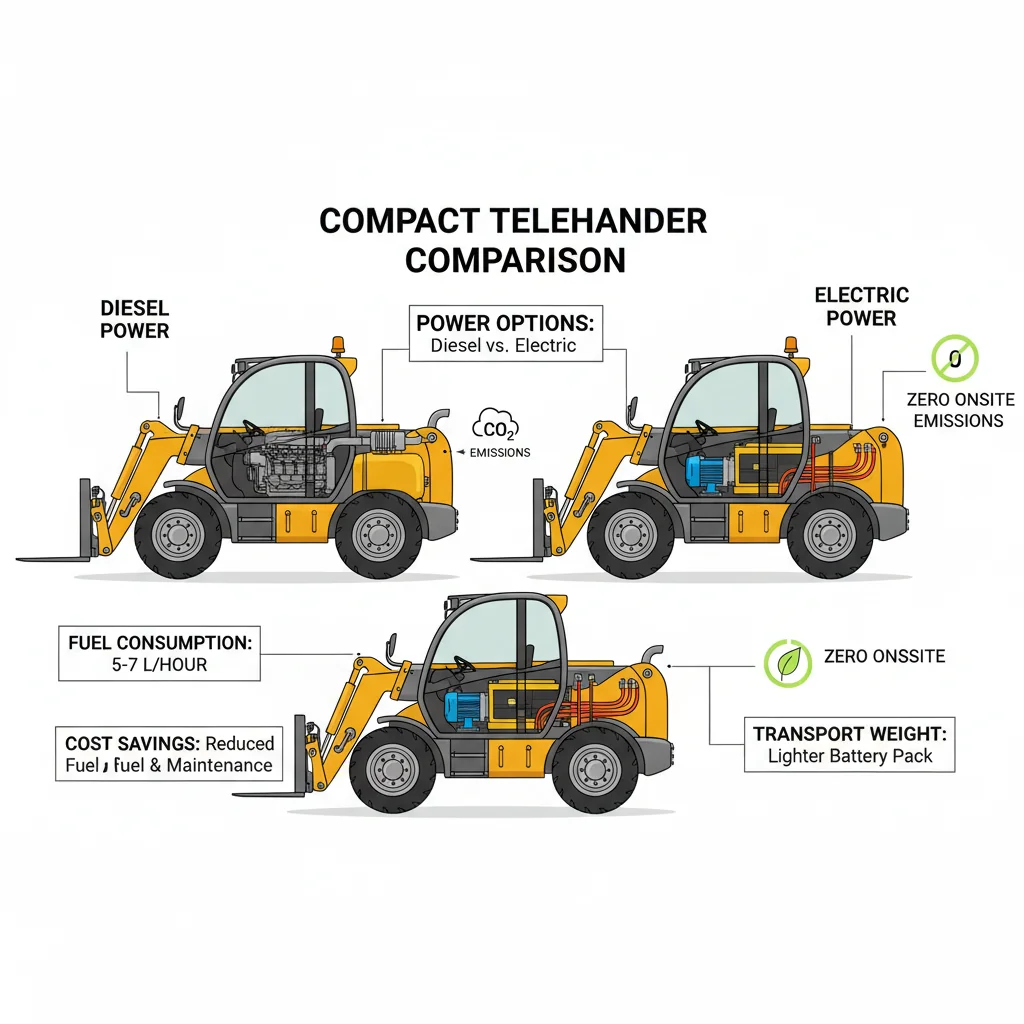
Most people don’t realize that compact telehandlers often cost much less to own, but the rental rates can catch you off guard. For example, last spring in Dubai, a customer expected huge rental savings with a 2.5-ton compact unit. In reality, the daily rental was nearly the same as larger machines. Where they actually saved was on fuel—just under 6 liters per hour during typical work cycles, which adds up quickly. Lower operating weight—usually around 6,000 to 11,000 pounds—also meant cheaper transport on a standard flatbed, and no special truck licenses were needed.
Here’s a breakdown to help compare cost and power options at a glance:
| Option | Upfront Cost | Fuel/Charge Use | Onsite Emissions | Typical Uses |
|---|---|---|---|---|
| Diesel (compact) | Lower (20-30%↓) | 5–7 L/hr diesel | Yes | Outdoor, all-weather, remote |
| Electric (compact) | Higher (up to 35%↑) | ~3-4 kWh/hr | Zero | Indoors, urban, low-noise |
To be honest, the spec that actually matters is matching your choice to the site’s real needs. If you sometimes run double shifts or use attachments with high hydraulic flow—like in a warehouse in Brazil—it pays to map out your charging windows and workload first. Electric machines have fewer moving parts, so I’ve seen customers save on maintenance by year two, but reliable access to charging is key. For both power types, factor in the right attachment size. Oversized buckets have caused premature wear or even overloading in more than one project I’ve seen. I suggest verifying trailer specs and checking your typical lift cycles before deciding.
Compact telehandlers typically operate with engine powers ranging from 50 to 100 horsepower, which balances fuel efficiency and sufficient lifting capacity for most job sitesTrue
Most compact telehandlers are equipped with engines in the 50-100 HP range, providing enough power for lifting and maneuvering while keeping fuel consumption and wear lower compared to larger machines. This range is optimal for their lighter operational weight and typical job demands.
Compact telehandlers usually have comparable rental rates to larger units because they require the same amount of fuel per hour during operationFalse
Although compact telehandlers may have similar rental rates to larger units, they consume significantly less fuel—about 6 liters per hour versus larger machines—which is one of the key savings they provide, disproving the idea that their fuel consumption is the same.
Key takeaway: Compact telehandlers offer significant cost and fuel savings over standard models, but similar rental rates make utilization tracking crucial. Decision-makers must weigh diesel against electric options, factoring in application, charging infrastructure, and the operational advantages of zero-emissions. Proper attachment sizing and transport logistics can further optimize overall ownership or rental costs.
What Safety Steps Are Essential for Compact Telehandlers?
Compact telehandlers require operators to be certified under regional regulations such as OSHA or CE standards. Site-specific permits may restrict model use based on height and application. For optimal safety, clear visibility via mirrors and cameras, adherence to the load chart, and use of stabilizers or outriggers when specified are essential measures.
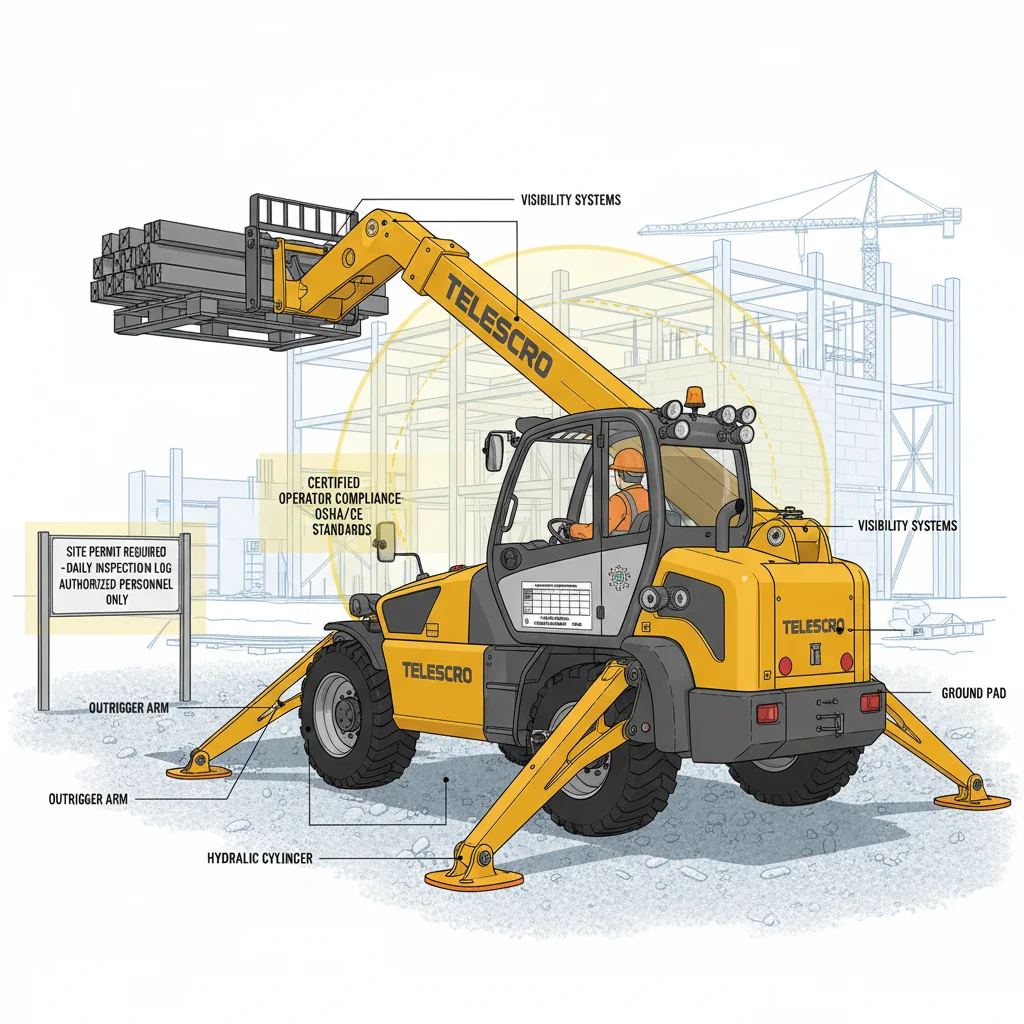
To be honest, most safety problems I see with compact telehandlers start well before anyone touches the controls. Operators need current certification under local rules—think OSHA cards in the U.S. or CE proof in Europe. I’ve seen jobsites in Germany refuse access to a compact 3-ton model simply because the operator didn’t have the right permit for that exact lifting height. Even small telehandlers count as complicated lifting equipment—inspectors don’t care about size, only compliance.
But paperwork isn’t enough. When you get on a busy urban site, mirrors and rear-view cameras become your lifeline. I worked with a team in Singapore last year where scaffolding, rebar racks, and parked excavators made blind spots everywhere. They avoided several close calls only because their compact telehandler had a full camera kit and kept the cab windows spotless.
Here’s a safety routine I always recommend before each shift:
- Check certifications and site permits—confirm you’re allowed to run that model and height on today’s job.
- Walk around for visibility—clean all mirrors and windows, test cameras, and adjust seat position.
- Review the load chart—know safe limits at max reach and angle. Exceeding rated load, even by a bit, risks tip-over.
- Inspect stabilizers or outriggers—if fitted, deploy them as specified in the manual and double-check the ground is level.
- Daily hydraulic and tire check—look for leaks under the boom and make sure tires are at correct pressure for safe handling.
If you want consistent uptime, make simple safety habits automatic. A five-minute daily check can prevent an accident that shuts down your whole project.
Compact telehandlers under 4,000 kg often have lower stability requirements but still require dynamic stability controls to prevent rollovers during liftsTrue
Despite their smaller size, compact telehandlers must have stability control systems, such as tilt alarms and automatic engine torque reduction, to compensate for their higher center of gravity and reduced footprint, preventing tip-overs during handling.
Operators of compact telehandlers do not need to renew their lifting certification if the machine’s maximum lift height is below 3 metersFalse
Certification renewal requirements are based on local regulations and operator skill maintenance, not solely on the machine’s lift height; even low-height compact telehandlers require up-to-date certification to ensure safe operation.
Key takeaway: Proper certification, adherence to safety protocols, and attention to visibility are critical for safe compact telehandler operation. Operators must consider both regulatory compliance and equipment-specific features, including load charts and stabilizing systems, to minimize risks and ensure efficient, compliant jobsite performance.
Conclusion
We’ve explored what makes compact telehandlers useful when space is tight or access is limited. These smaller machines still offer the core capabilities you’d expect—just in a more maneuverable size. From my experience, the contractors who get the most value don’t just look at lifting specs. They focus on reliable parts supply and real-world work cycles to avoid “parts roulette” on the job. If you’re weighing options or want to discuss which model would actually fit your site, feel free to reach out. I’m happy to share what I’ve learned working with a range of crews around the world. Every site is different—choose what actually works for your workflow.
References
-
Details how off-road capabilities improve jobsite efficiency and accessibility, critical for construction equipment in uneven ground conditions. ↩
-
Explains the mechanics and advantages of telescopic booms in telehandlers, improving reach and flexibility on rough terrain. ↩
-
Learn how compact telehandlers enhance indoor material handling efficiency in warehouses by navigating narrow doorways and low ceilings. ↩
-
Offers expert insights on how turning radius influences telehandler maneuverability in confined spaces, critical to site productivity and safety. ↩
-
Covers how adherence to load charts ensures safe lifting capacities and prevents equipment overload and accidents on construction sites. ↩
-
Explains the technical benefits and operational scenarios where crab steer enhances precision and access in confined environments. ↩
-
Expert explanation of quick coupler mechanisms improving fast tool swaps, boosting telehandler efficiency and reducing downtime on job sites. ↩
-
Detailed insights into ultra-compact telehandlers’ sizes, lifting capacities, and ideal indoor applications for confined spaces. ↩
-
Explores differences in compact telehandler sizes and capacities, helping choose the right machine for indoor or outdoor tasks. ↩
-
Explains how measuring doorway heights impacts equipment choice, avoiding costly access delays during construction and renovation projects. ↩