










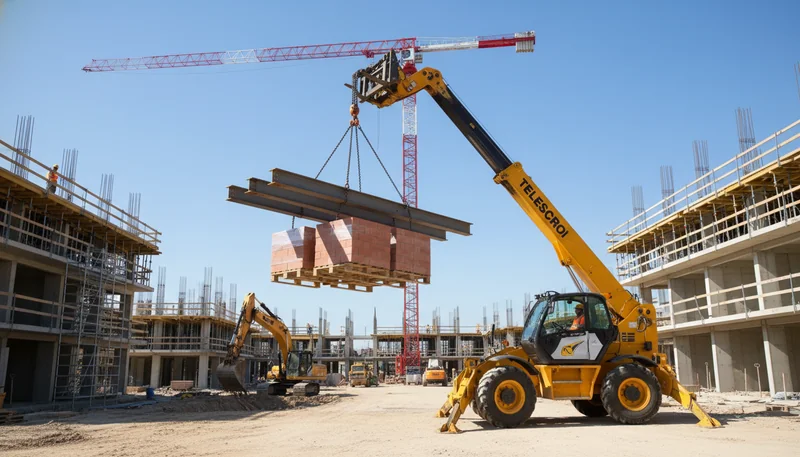
What does Telehandler lifting capacity mean? Avoid Common Site Mistakes
Not long ago, I watched a crew in Malaysia try to lift a heavy pallet onto a second-story slab—everyone was confident the telehandler could manage, “because it’s rated 3,500 kilos.” The boom barely got halfway before the limiter cut in. That confusion happens everywhere, from Dubai to Sydney.
Telehandler lifting capacity indicates the maximum weight a machine can safely manage at a specific boom height and reach, typically measuredat minimum reach (boom largely retracted) on level ground. The headline figure on brochures—often 3,000 kg or 6,000 lb—rarely reflects performance at full outreach or elevated positions. Load charts define true capacity in real-world use, showing exactly how maximum allowable loads decrease as the boom is raised or extended.
What Does Telehandler Lifting Capacity Mean?
Telehandler lifting capacity indicates the maximum safe load at a specific boom height and reach, tested on level ground with standard forks. The rated capacity1 is specified at minimum reach (typically with the boom retracted), under ideal, level conditions—actual safe capacity decreases as the boom is extended or raised. Always reference the manufacturer’s load chart2 for accurate, site-specific limits.

Most people don’t realize that the “rated capacity” printed on a telehandler’s spec sheet is only true under ideal conditions. That headline figure—maybe 4,000 kg or 6,000 lbs—is measured at minimum reach (typically with the boom retracted), on level ground, and with standard forks installed. But once you start raising the boom or reaching out, the safe load drops noticeably. I’ve seen sites in Kazakhstan where the team was surprised their 3.5-ton telehandler barely managed 1,200 kg at 12 meters outreach. It wasn’t a fault—the load chart made it clear. The further from the chassis you work, the less weight you can safely lift.
The biggest mistake I see, especially with new buyers in places like Kenya and Brazil, is treating the rated capacity as a guarantee at any height or position. In reality, as soon as you extend that boom—even halfway—capacity falls fast. This isn’t just about weight. It’s about the center of gravity and the risk of tipping. The load chart (that folded sheet in the cab nobody loves to read) tells you the exact safe capacity at each height and reach combination. Miss that detail and you could overload your machine without realizing it.
To be honest, the ground itself matters, too. Rated capacity is determined assuming the machine is perfectly level—usually within three degrees. If you’re working on a slope or loose fill, real capacity is even lower. I always tell customers: check the load chart for your actual working conditions before committing to a lift. It’s a step that keeps jobsites—and people—safe.
A telehandler’s rated lifting capacity is defined at minimum reach, typically with the boom retracted and under ideal, level conditions; extending or raising the boom reduces the machine’s safe load limit.True
This is true because the leverage effect increases as the boom is raised or extended, increasing the risk of tipping and reducing effective capacity. Manufacturers define rated capacity at minimum reach under optimal, stable conditions, which rarely reflect real-world jobsite configurations.
The lifting capacity listed on a telehandler's spec sheet can be safely applied regardless of boom angle or extension, as long as the machine is not overloaded by weight.False
This is false because telehandler capacity decreases as the boom is raised or extended, due to changing load geometry and stability. Relying on the rated capacity at all positions is dangerous and ignores key safety limits set by the machine’s load chart.
Key takeaway: The rated lifting capacity shown on telehandler brochures is a best-case value measured near the machine and on level ground. Actual capacity drops as the boom extends or raises. Always consult the specific load chart to match site conditions and avoid dangerous overloading.
What Does Telehandler Lifting Capacity Mean (Continued)?
Telehandler lifting capacity is defined by the load chart, which specifies maximum allowable weight at each combination of lift height and forward reach. Capacity decreases as height and outreach increase. Operators must always reference the load chart for real limits, not just the rated capacity or brochure figures.

Let me share something important about telehandler lifting capacity that I see cause problems on real jobsites. The load chart isn’t just paperwork—it decides what you can safely pick up at every combination of lift height and forward reach. I’ve worked with crews in the UAE who relied on the rated capacity figure, thinking they could handle 4,000 kg all the way up. But when they tried that load at 10 meters up and 5 meters out, the actual limit was barely 1,500 kg. The machine’s hydraulics and stability systems just don’t allow anything more at full stretch.
If you take a close look at any telehandler’s load chart, you’ll see a grid or table. On one side: lift height (meters up), and across the top: forward reach (meters out from the front wheels). Each box gives the real maximum load for that position. For example, a 3,500 kg telehandler often carries 3,500 kg only at nearly minimum reach and low heights. By the time you extend the boom close to its maximum—let’s say around 11 meters out—you might be limited to as little as 700 kg, or nothing at all, depending on the model.
The reality is, no manufacturer will guarantee rated capacity unless the machine is on level ground—usually less than 3° tilt, measured side-to-side or front-to-back. I always recommend asking your dealer for the actual PDF load chart before you decide on a model. If your lifting scenario lands between two values, use the lower number to stay safe. That’s the real secret to both safety and compliance on any site.
A telehandler’s maximum rated lifting capacity is generally achieved at minimum reach, typically with the boom largely retracted under ideal, level conditions.True
Telehandler load charts show that rated capacity decreases as the boom is extended or raised. Maximum rated capacity is defined at minimum reach, where the machine has the greatest stability and lowest tipping moment, which is why capacity reduces at greater heights or outreach.
The lifting capacity shown on a telehandler’s load chart remains constant regardless of the angle or extension of the boom.False
The lifting capacity decreases as the boom is raised or extended, because these positions reduce the machine’s stability and increase the risk of tipping. The load chart provides different limits for each boom angle and extension.
Key takeaway: Telehandler capacity isn’t a single fixed number—actual limits change with lift height and reach, as defined only by the load chart. Always use the chart for each task, and if in doubt, stay under the lower value to ensure safety and compliance.
Why Does Telehandler Capacity Drop With Height?
Telehandler lifting capacity is primarily governed by stability, not just hydraulic power. As boom height and reach increase, the load’s distance from the center of gravity grows, raising the tipping moment3. To prevent tip-over, allowable capacity must decrease as height and reach extend. Always consult the load chart for accurate limits.
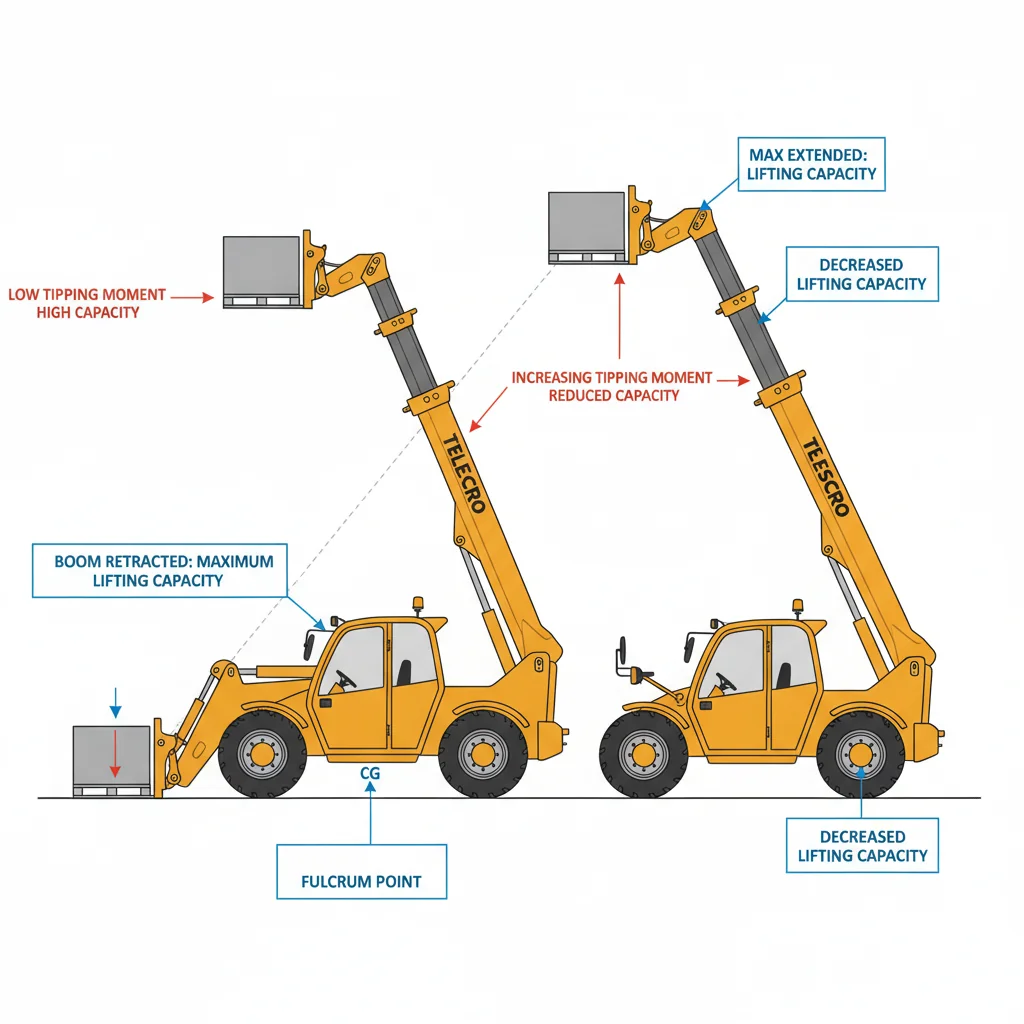
Here’s what matters most when looking at telehandler capacity at different heights: stability always comes before hydraulic strength. Many buyers think as long as the hydraulic system can lift a load, it’s safe—this isn’t true. The real limit is tipping. I’ve seen it on job sites in Turkey and Malaysia—crews plan lifts using the “rated capacity,” but once they extend the boom out to 14 meters or raise it above a second floor, safe capacity drops sharply. For example, a compact telehandler rated for 2.5 tons right up against the front wheels will only handle around 800 kg at maximum outreach. The difference can catch anyone off guard if they’re not familiar with load charts.
A load chart (usually mounted in the cab) spells out exactly how much you can lift at each boom extension and height. It’s not about how “strong” the machine is—it’s physics. As the boom moves out, the load shifts further away from the chassis. That increases the tipping moment (think of it as force trying to tip the telehandler forward). The machine’s center of gravity and base width set a hard limit. I’ve worked with clients in Dubai who tried to lift full-weight steel beams at 17 meters with a 4-ton unit. They were surprised to find the maximum safe load dropped to around 1,200 kg.
My advice? Always assume your usable capacity will be much less the higher or farther you go. Before every lift, check your boom angle and outreach on the load chart—never guess. Taking a minute to confirm the safe number can save a major headache, or worse, a dangerous tip-over.
Telehandler lifting capacity is primarily limited by the risk of tipping over at higher boom angles or extensions, rather than by the strength of the hydraulic lifting system.True
As a telehandler’s boom extends or rises, the center of gravity shifts away from the machine’s base. This increases the risk of tipping, so manufacturers reduce the rated capacity to maintain stability, even though the hydraulics might be capable of lifting more weight.
As long as the hydraulic system is powerful enough, a telehandler can safely lift its maximum rated load at any boom height or extension.False
This is incorrect because stability, not hydraulic force, becomes the limiting factor as the boom height or reach increases. Ignoring stability would risk tipping the machine, which is why actual safe lifting capacity decreases at greater extensions and elevations.
Key takeaway: Telehandler rated capacity sharply decreases as boom height and outreach increase due to stability limits, not power. Always refer to the load chart for each configuration—never assume maximum load applies at full height or reach. Confirm site conditions and stay within safe operating limits.
How does telehandler weight affect capacity?
A telehandler’s lifting capacity is determined by its weight, chassis design, and counterbalance systems4. Heavier, robust models can support higher rated capacities at shorter reach but are less maneuverable. Lighter, compact machines offer easier transport and handling, but their usable capacity at extended reach is significantly lower. Always reference the load chart for actual lifting limits.
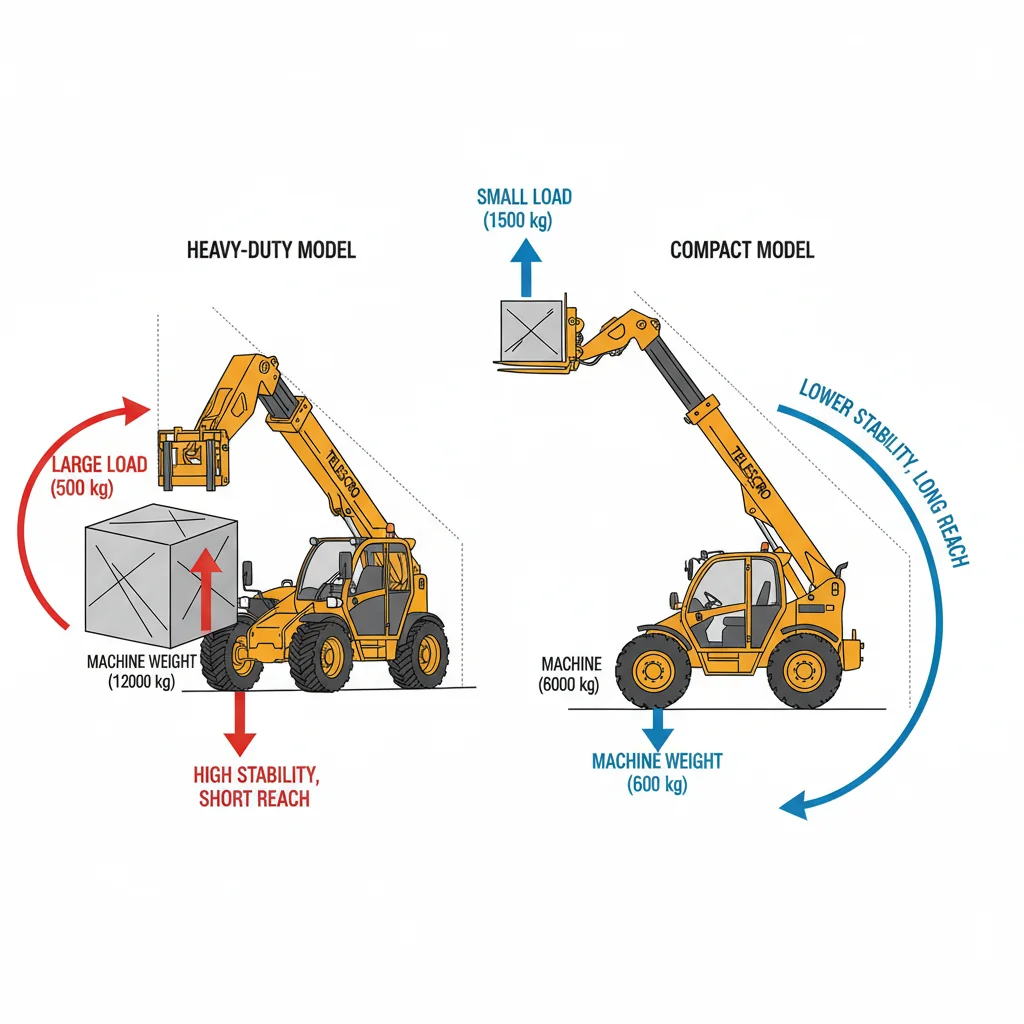
The biggest mistake I see is when buyers assume that two telehandlers with “4,000 kg” rated capacity handle the same loads at full extension. That’s almost never true. For example, last year I worked with a team in Dubai—they needed to get heavy insulation panels up to the eighth floor. Their compact telehandler was rated for 4,000 kg, but at 12 meters reach, it dropped to just over 1,100 kg. The operator was shocked. On the same job, a heavier 11-ton chassis model kept lifting over 2,000 kg at that reach with no stability alarm. This difference has everything to do with the telehandler’s own weight, frame strength, and the counterweight system, not just numbers on the data sheet.
Here’s what matters most: heavier, robust telehandlers can counterbalance higher loads, thanks to reinforced boom sections, longer wheelbases, and larger counterweights. These units often weigh 15,000 kg or more. That heavy mass lets them support more material at short radii and maintain better usable capacity as the boom moves out. But there’s always a trade-off. Larger machines don’t squeeze through tight sites as easily and can be tougher to transport—especially across city roads in Europe or site-to-site in Southeast Asia.
If your main job is unloading standard pallets at 7-8 meters, a lighter, compact model is enough. But once you’re lifting heavy bricks or steel at upper floors, those high-capacity chassis earn their price. I always suggest studying the load chart for the actual working points—not just trusting the “headline” rated capacity. That’s how you avoid dangerous overloads or costly site delays.
A telehandler with a heavier chassis often maintains a higher lifting capacity at full extension compared to a lighter machine with the same rated maximum capacity.True
A heavier chassis provides better counterbalance and stability, allowing the machine to safely lift heavier loads farther out on the boom without tipping. This is why larger, heavier telehandlers tend to outperform lighter models in real-world reach and capacity, even if both are rated for the same maximum load at minimum reach.
If two telehandlers are rated for the same maximum capacity, they will always be able to lift identical loads at full boom extension regardless of their own weight.False
Lifting capacity at maximum extension depends not just on the rating but also on the machine's stability, which is affected by its own weight and design. Lighter telehandlers typically have a much lower safe lifting capacity at long reach than heavier units, even if their maximum rated capacities are equal.
Key takeaway: Telehandler rated capacity depends on machine weight, design, and counterbalance—not just reach or height. Compact models are convenient but have lower usable capacity at reach than heavier machines. Always check load charts at working points to avoid overload and site errors.
What Does Telehandler Rated Capacity Mean?
Telehandler rated capacity is the maximum load specified at minimum reach (typically with the boom retracted and the load close to the front axle), on level ground—often much higher than what is safe at full reach or lift height. Operators must consult the load chart to determine actual capacity at different boom positions.
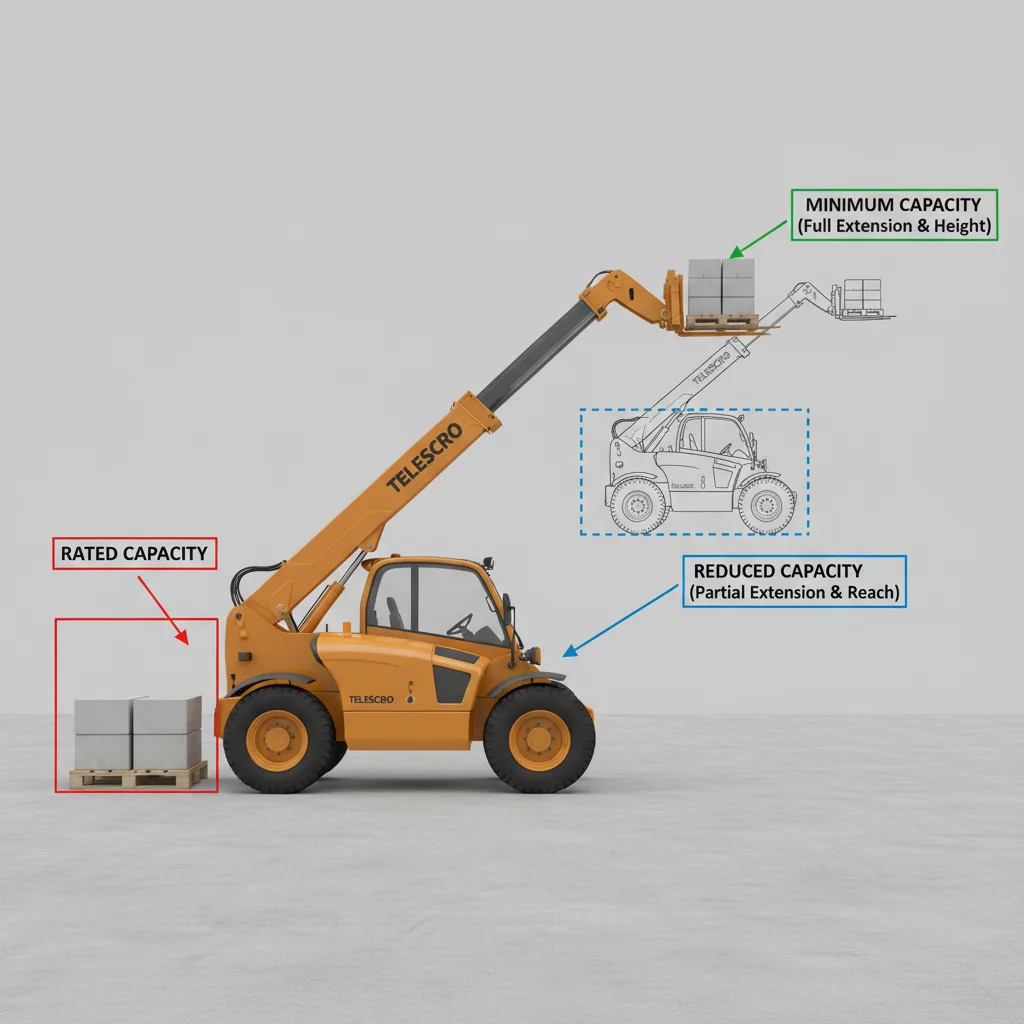
I’ve worked with contractors in Dubai who saw “5,000 kg rated capacity” on a brochure and assumed the telehandler would lift that much to any height, anywhere on site. The reality? That’s only for the absolute best-case setup: boom fully retracted, load tucked in close, and everything perfectly level. Once you extend the boom—even halfway—safe lifting limits drop fast. I remember one job where a 5-ton machine struggled to pick up 1,500 kg at 12 meters reach. The operator thought something was wrong with the hydraulics. But the machine was doing its job—the safety system just prevented a dangerous overload.
Why does this happen? It comes down to basic physics and machine stability. The load chart (usually displayed in the cab) defines the safe working limits for each combination of lift height and forward reach—far more important than the single “headline” number on a sales brochure. At extended reach, many standard construction telehandlers are limited to only a fraction of their rated capacity, and in some high-reach configurations, usable capacity can be significantly lower. If the machine is not operating on firm, level ground, the rated capacity assumptions no longer apply, further reducing safe lifting limits. I’ve seen this lead to major delays on sites in Brazil and Kazakhstan, particularly when operators attempt heavy lifts on sloped or uneven surfaces.
My advice? Before you trust any max capacity figure, check the load chart for your real working position—height, reach, attachment, and ground slope. If you’re planning heavy picks out front, make sure the numbers match reality. I suggest confirming safe capacity at your typical boom extension, not just at ground level. That’s where the mistakes—and accidents—happen.
A telehandler’s rated capacity refers to the maximum load it can safely lift only when the boom is fully retracted and the machine is on level ground.True
Manufacturers determine rated capacity under ideal conditions—boom retracted, load close to the machine, and level ground. Any deviation from this setup, such as extending the boom or being on a slope, will reduce the safe lifting capacity.
If the telehandler’s brochure lists a 5,000 kg rated capacity, it means the machine can always lift that weight, regardless of boom extension or terrain.False
Rated capacity is based on optimal conditions. Extending the boom or working on uneven ground significantly reduces safe lifting capability due to changes in leverage and stability.
Key takeaway: The rated capacity shown in telehandler brochures represents the best-case scenario—boom retracted, load near the front axle, and machine perfectly level. Relying on this figure alone is risky; always reference the specific load chart for each work position to avoid critical lifting errors.
How Do Attachments Affect Telehandler Capacity?
Attachments and load geometry can significantly reduce a telehandler’s effective lifting capacity. Every attachment—such as fork carriages, sideshift devices, buckets, or personnel baskets—adds weight and changes the load center5, increasing tipping risk. Manufacturers provide separate load charts for each attachment; always consult these charts, as base rated capacity does not reflect real on-site limits.

Last month, a contractor in Kazakhstan called me about a 4-ton telehandler struggling with heavy brick pallets. His team swapped from forks to a large bucket—hoping to speed up loading. But after checking the load chart, he found the real safe payload dropped under 2,600 kg at the same reach. Why? That bucket alone weighed almost 650 kg, and it pushed the load center farther out, making the telehandler less stable. This isn’t uncommon. I always remind customers: swapping attachments might be practical, but every extra kilogram—and every centimeter forward—comes straight off your safe lifting number.
Attachments affect rated capacity much more than most people expect. Here’s what changes when you add different tools:
- Fork carriages: Usually add 250–350 kg, but heavy-duty types can weigh even more.
- Buckets: Often 600–900 kg, plus they shift the center of gravity forward, which worsens tipping risk.
- Sideshift carriages: Allow side movement but weigh up to 500–800 kg.
- Personnel baskets: Bring strict capacity rules—many 3,500 kg machines are limited to just 400–600 kg total, basket plus workers plus tools.
- Crane jibs or winches: Reduce base capacity and may have extra restrictions on height and boom angle.
Manufacturers publish a separate load chart for each attachment—and each chart assumes a specific load center (usually 500 mm for Euro pallets). If you change the pallet size, attachment, or load shape, the chart changes too. I suggest telling your supplier exactly what, where, and how you plan to lift—including the attachment and pallet details—so you get the right load chart. Never risk jobsite safety by guessing.
Switching from forks to a heavier attachment such as a large bucket can significantly decrease a telehandler’s safe lifting capacity at the same reach, because the added weight and extended load center reduce machine stability.True
A bucket is usually heavier than standard forks and increases the distance from the load to the machine’s pivot point. Both of these factors lower the maximum safe working load as indicated on the telehandler’s load chart.
The lifting capacity labeled on a telehandler remains unchanged regardless of which attachment is used, as long as you do not exceed the machine’s rated limit.False
The stated lifting capacity assumes standard forks and a specified load center. Heavier or longer attachments both add weight and shift the load center forward, which can substantially reduce the machine's actual safe capacity.
Key takeaway: Telehandler attachments and load details directly reduce effective rated capacity due to added weight and altered load centers. Always use the specific load chart for the selected attachment and exact load geometry. Never rely solely on the base machine’s rated capacity for non-standard loads or configurations.
How to size telehandler lifting capacity?
Sizing telehandler lifting capacity starts with the heaviest anticipated load and the most challenging working position, such as maximum required height and reach. Consult the manufacturer’s load chart6 for capacity at this specific point, then add a 20–30% safety margin to cover variable weights, ground conditions, and operator error.
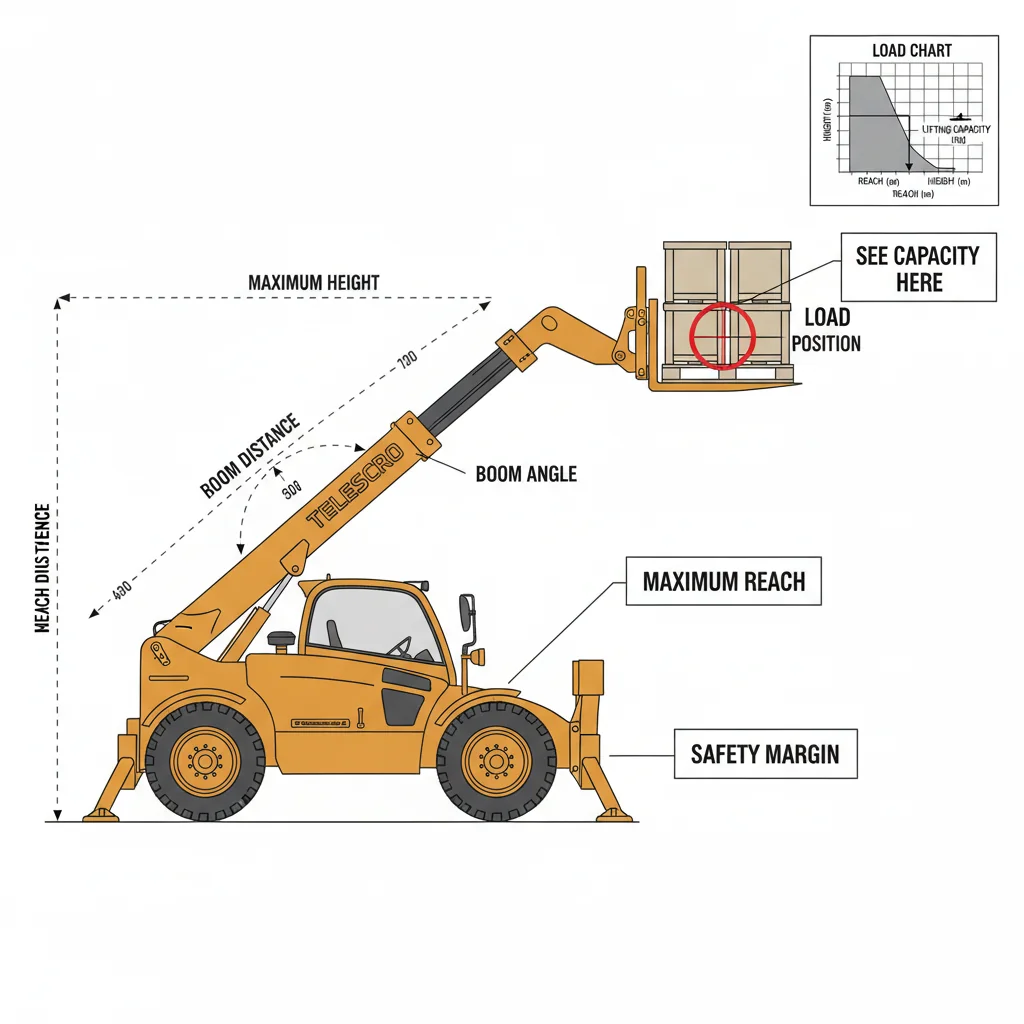
Let me share something important about telehandler sizing that too many buyers overlook: it’s never about “maximum capacity” at ground level. The real question is, what’s the heaviest load you’ll need to lift at your most challenging position—meaning the highest boom elevation and farthest outreach on your site? Every telehandler’s rated capacity drops as you extend the boom. If your project involves lifting masonry pallets (usually 1,800 to 2,200 kg) to the third floor, you need to check the load chart—not just the sales brochure numbers.
Last year, I worked with a team in Brazil pouring slab concrete over a half-finished foundation. They needed to reach 5 meters horizontally, across formwork and rebar, and carry 1,700 kg at full stretch. Their “4-ton” telehandler could only handle 1,400 kg at that position. In that case, the machine simply stalled, and the operator got a warning from the moment indicator. They lost two days waiting for a larger rental.
Here’s the thing: always start by mapping your actual site layout. List your heaviest load, your real max height, and how far you need to reach. Grab the manufacturer’s load chart—find the row and column for your working height and outreach. Compare actual capacity at that point against your requirement, then add at least a 20–30% safety margin for pallet weight differences, uneven ground, or simple operator error. If you’re close to the limit, step up a size. Most contractors I support choose coverage for 90–95% of jobs and just rent bigger only for rare heavy lifts.
A telehandler's lifting capacity at maximum boom extension is usually much lower than its rated maximum capacity at ground level.True
This is true because as the boom extends and elevates, the leverage on the machine increases, reducing its ability to safely lift heavy loads. Load charts provided by manufacturers clearly show decreasing capacities with increased reach and height.
The rated lifting capacity printed on a telehandler always applies, regardless of boom angle or extension.False
This is false because the rated capacity is typically measured at the shortest boom and lowest elevation. As you increase boom extension and height, the machine's safe lifting capacity drops to prevent tipping or structural overload. Load charts must be referenced to determine safe capacities at various positions.
Key takeaway: Proper telehandler sizing requires calculating the maximum expected load at the worst-case height and reach, then confirming capacity with the manufacturer’s load chart—adding a 20–30% margin for operational safety. This avoids common site mistakes and ensures reliable, compliant lifting performance.
How Do Ground Slopes Affect Telehandler Capacity?
Telehandler rated lifting capacities7 are based on operation over firm, level ground with properly inflated, matching tires. Slopes, ruts, or soft surfaces reduce true stability and safe lifting limits. Any tilt or wheel sinkage can lower real capacity, making tip-over more likely—even if the load chart is followed.

I’ve worked with customers who made this mistake in the field: they trust the load chart, set up on a gentle slope, and try lifting near rated capacity. It looks close enough to level, but the telehandler’s stability changes quickly. Even a 4° tilt—barely visible to the eye—means the forward tipping point arrives sooner than the chart suggests. I had a project in southern Brazil where a team tried to lift a 2,000 kg pallet on an 8-meter reach with the machine sitting on packed dirt that sloped toward a drainage ditch. As soon as they raised the boom, one front tire compressed slightly, shifting more weight forward. They felt the rear wheels go light, backed off, and called me for advice.
Here’s what matters most when you’re working on jobsite slopes or soft ground: rated capacity only applies when the machine is almost perfectly level—typically within 3°. Load charts assume this in every calculation. If one side of the telehandler is lower, or if a tire sinks even 3–4 centimeters, the leverage of the load increases and the safe lifting limit drops sharply. Stability isn’t just about the machine—it’s also about the ground you park on.
I always suggest finding the flattest, hardest spot available before any big lift. If your telehandler has stabilizers, use them per the load chart and manufacturer guidelines. Never trust “gut feel” when the rear wheels feel light—that’s a red flag you’re at risk of tip-over. For anything near max capacity, level the machine first and double-check your setup. That’s how you avoid real trouble.
A telehandler's rated lifting capacity, as shown on its load chart, only applies when the machine is positioned on firm, level ground.True
Load charts are calculated based on the assumption that the machine is level. Any tilt or slope alters the telehandler's center of gravity, reducing stability and lifting capacity.
As long as a telehandler's tires remain in contact with the ground on a slope, you can safely lift loads up to the rated capacity shown on the load chart.False
Even if all tires are touching the ground, a sloped surface shifts the center of gravity toward the tipping axis. This decreases stability before reaching the charted capacity, making lifts unsafe even if the machine appears stable.
Key takeaway: Telehandler load charts apply only when the machine is nearly level (≤3° tilt) on firm, stable ground. Operating on slopes or soft surfaces reduces actual safe capacity, so always level the machine and use stabilizers if permitted before attempting lifts near the rated capacity.
How do telehandler safety limiters work?
Modern telehandlers use load moment indicators (LMI) and rated capacity limiters that monitor boom position, extension, and load in real time. If limits are approached or exceeded, these systems trigger alarms or block further boom movement to prevent tip-overs. Overriding such systems is dangerous and invalidates compliance.

The biggest mistake I see is operators trying to “outsmart” the safety limiters when the boom suddenly stops or won’t extend further with a heavy load. I get calls about this every month. The reality? The load moment indicator (LMI) and rated capacity limiter8 are doing exactly what they should—stopping movement before you risk a tip-over. These systems track the boom angle, extension, and actual load using sensors wired into the hydraulic circuit. If the load at that position is near or over the charted limit, you’ll get a flashing light, loud alarm, or even a hard cutoff—no more extension, lift, or tilt until you retract or unload.
I had a team in Turkey running a 4-ton telehandler with an 18-meter boom, frustrated that “the machine was refusing to work” on a rooftop block job. When I checked the load chart and limiter logs, it turned out they tried to lift 1,800 kg at almost max extension. The limiter froze them out because stability at that reach drops under 2,000 kg, especially on tyres only. If they had rigged a bypass (and yes, some operators try), any accident would have voided insurance, breached CE/OSHA rules, and put their crew at risk.
To be honest, if your limiter is triggering often during routine lifts, that’s a sign your telehandler is undersized or you’re using the wrong attachment. I always tell customers: treat that alarm as your friend, not an obstacle. When it activates, lower the load or retract the boom. Never override. I suggest verifying your job’s real lift needs using the manufacturer’s load chart before you even choose a machine.
Telehandler safety limiters use real-time sensor data to compare the actual load and boom position with the rated capacity chart programmed into the machine’s control system.True
This is true because limiters must continuously monitor both the load weight and the boom's geometry to ensure movements only stay within the safe working limits; otherwise, there is an increased risk of tip-over.
The lifting capacity displayed on a telehandler is always the maximum amount you can safely lift at any boom angle or extension.False
This is false because the safe lifting capacity decreases as the boom extends or raises. Capacity charts specify different limits for various positions, and exceeding these at any given geometry can be dangerous.
Key takeaway: Telehandler safety limiters and load moment indicators are critical safeguards that monitor load, boom angle, and extension. If warning alarms sound or movement is blocked, operators should retract the boom or lower the load—never attempt to override the system, as this compromises both safety and regulatory compliance.
How does maintenance impact telehandler lifting capacity?
The rated lifting capacity of a telehandler remains the same on paper, but poor maintenance reduces actual stability and safety. Worn boom pads, loose pins9, cracked welds, bent forks, or improper tires increase tipping and failure risks, even when loads stay within chart limits. Regular inspections10 are essential to maintain real-world lifting performance.

One point about telehandler lifting capacity is often overlooked, especially by new fleet owners. On paper, a telehandler may be rated at “4,000 kg” or “3.5 tons,” but that figure assumes the machine is in proper mechanical condition—tight pins, sound hydraulics, and boom pads with minimal play.
Wear can develop quickly, even on relatively young machines. I’ve inspected three-year-old units with loose kingpins or boom pads worn close to metal. When this happens, additional movement appears in the boom. It may only be a few millimeters, but when lifting 3 tons at 12 meters of reach, that movement is magnified, causing load shift and a noticeable loss of stability.
Last spring, a contractor in Brazil contacted me after a near-miss. They were lifting steel bundles where the load chart indicated a safe limit of 2,400 kg at 14 meters. However, one fork was slightly bent, and the front tires were mismatched—the left side was running about 200 kPa lower than the right. During slewing, the operator noticed increased lean, and the load shifted dangerously. Fortunately, the machine did not tip, but under those conditions, the rated lifting capacity was no longer meaningful.
The takeaway is straightforward: usable lifting performance depends on a machine remaining mechanically tight and properly set up. Before any heavy or high-reach lift, a full inspection is essential—boom pads, pins, tires (including pressure and matching), major welds, and attachment locking mechanisms. Periodic load testing should also be part of routine fleet maintenance, especially for machines operating near their capacity limits.
Worn boom pads and loose kingpins can significantly decrease a telehandler’s actual safe lifting capacity, even if the machine’s rated capacity plate hasn’t changed.True
Over time, mechanical wear in critical components like boom pads and kingpins introduces excess movement and instability in the boom structure. This can cause the machine to lose the precise load handling it was rated for, increasing the risk of tip-over or structural failure well before reaching the listed lifting capacity. Regular inspection and maintenance are essential to preserve both safety and real-world lifting performance.
As long as a telehandler’s hydraulic system has adequate pressure, wear on pins and bushings will not reduce the machine’s lifting capacity.False
While hydraulic pressure is critical for lifting functions, structural wear in pins and bushings leads to instability and excess movement, directly impacting the telehandler’s ability to carry rated loads safely. Even with proper hydraulic performance, mechanical wear undermines load stability and increases the risk of failure, so lifting capacity is not maintained without addressing such wear.
Key takeaway: Telehandler lifting capacity assumes mechanical components and systems are in optimal condition. Inadequate maintenance introduces play, instability, or mechanical weaknesses, reducing stability and increasing site risk. Consistent inspections, servicing, and required load testing ensure the stated capacity matches real-world performance and jobsite safety.
Conclusion
We’ve gone over what telehandler lifting capacity really means and why it’s not just about the number you see in a brochure. From my experience, buyers who look beyond max capacity specs and take the actual load chart into account avoid the “showroom hero, jobsite zero” problem. Check how much you can safely lift at your typical boom angles and make sure parts are available locally—these details save a lot of headaches down the line. If you have questions about specific load charts, attachments, or want to hear what’s worked on real jobsites, feel free to reach out. Every jobsite is different, and I’m happy to help you find what really works for yours.
References
-
Insight into how rated capacity is calculated under ideal conditions and how it decreases with boom extension and outreach. ↩
-
Learn how load charts define safe lifting limits at various boom lengths and heights to prevent tip-over accidents. ↩
-
Explore how tipping moment impacts telehandler stability and lifting limits with physics-based insights and safety guidelines. ↩
-
Explore how counterbalance design improves telehandler stability and lifting power, vital for safe heavy load handling and operation efficiency. ↩
-
Explore how shifting the load center impacts telehandler tipping risk and lifting capacity with real-world examples and expert guidance. ↩
-
Detailed guide on interpreting load charts to ensure safe telehandler operation under varying reach and lift conditions. ↩
-
Explore how rated lifting capacities are determined and why adhering to them is critical for safe telehandler operations on various grounds. ↩
-
Expert explanation on rated capacity limiters that safeguard machines by restricting boom movement beyond safe load limits. ↩
-
Detailed insights on how loose pins compromise telehandler stability and safety, increasing risks of tipping and equipment failure. ↩
-
Explains the crucial role of regular inspections in maintaining real-world lifting capacity and preventing accidents in telehandler operations. ↩