











What Does Stability Margin Mean on a Telehandler? Field Engineer’s Guide to Safer Operation
A project manager from Saudi Arabia once sent me a photo of his brand-new telehandler—front wheels barely touching the ground after a big panel lift. He thought the machine was still within the safe range because the load chart1 said so. But the hidden culprit? A dangerously thin stability margin.
Stability margin on a telehandler refers to the remaining stability reserve before the machine reaches a tipping condition. In simple terms, it describes how close the combined center of gravity2 (machine plus load) is to the stability limit—often explained using the stability triangle concept. Many telehandlers indicate proximity to this limit through an OEM load/stability indication system (e.g., LMI/LSI), typically using color zones and, on some models, a percentage display.
What Is Stability Margin on a Telehandler?
Stability margin on a telehandler indicates the remaining reserve before tipping occurs, measured by the center of gravity’s position within the stability triangle formed by the front wheels and rear axle. As long as this center remains inside the triangle, the telehandler stays upright and within safe operational limits.
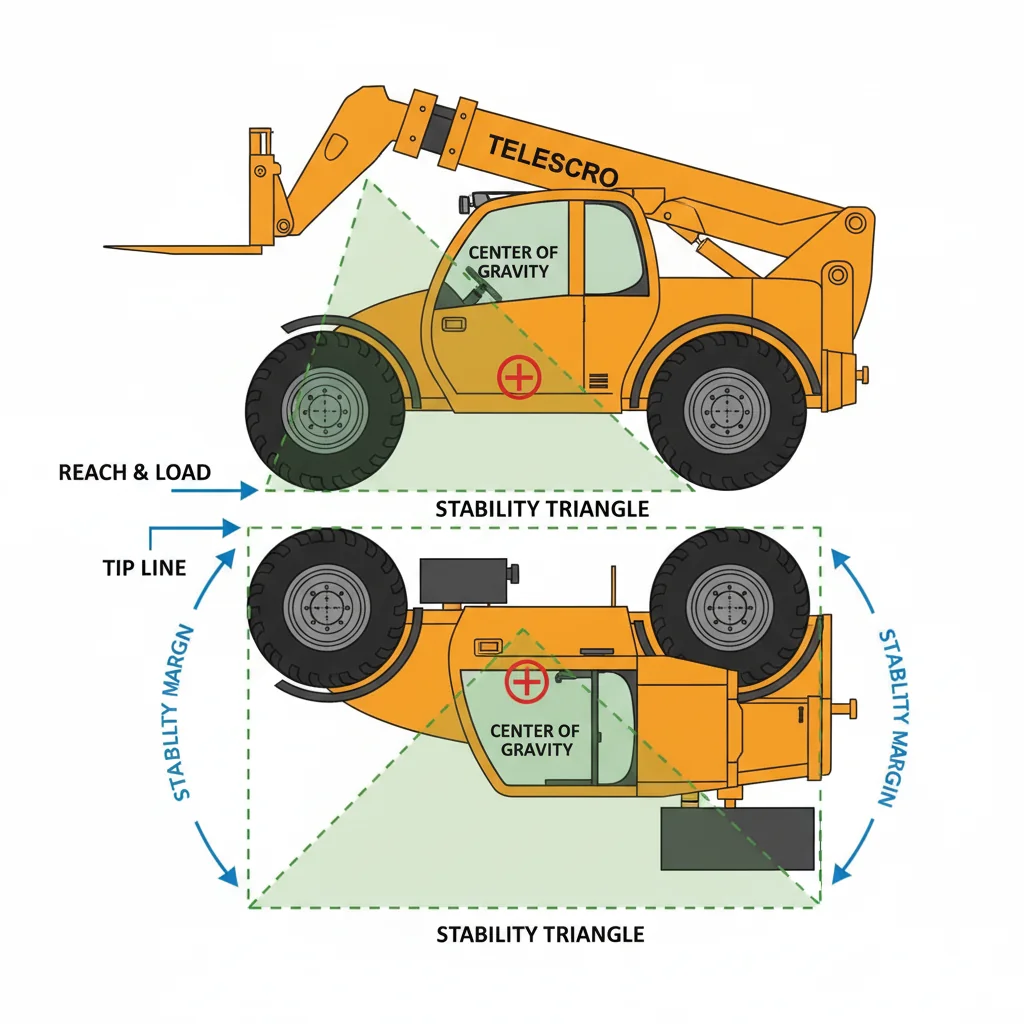
Many operators underestimate how quickly a telehandler’s stability margin can shrink under real jobsite conditions. I’ve worked with crews in Dubai who were lifting full pallets comfortably at mid-reach—until the boom was extended slightly further and the load moment indicator3 moved into the red zone. Stability margin is governed by physics, not operator confidence. As the combined center of gravity of the machine and load shifts forward toward the front axle line, the available stability reserve reduces rapidly. The front axle contact line represents the primary forward tipping axis; once the center of gravity approaches or crosses this boundary, the telehandler becomes critically unstable and a tip-over risk increases sharply.
On sites in Brazil, I’ve seen operators assume the “green zone” on the load moment indicator means they have spare lifting capacity. That’s a dangerous misread. The margin shown isn’t for more load; it’s the buffer keeping you stable. For example, with a 4-ton telehandler at maximum reach, the actual safe load can drop to 800–900 kg—and only if the ground is level within 3 degrees. Bumpy surfaces, uneven tires, or marginal extra reach will eat up that stability reserve fast. Frame leveling and stabilizer use help only if you set up properly at the start.
I always suggest planning your lifts so you operate well inside the green, never near the transition to yellow or red. Staying “comfortably inside” your stability margin cuts stress for operators and managers—and dramatically reduces the chance of a costly accident. Let the load chart, not guesswork, guide your decisions.
The stability margin on a telehandler significantly decreases as the boom extends outward, even if the load weight remains unchanged.True
Extending the boom shifts the center of gravity forward, moving it closer to the tipping axis. This reduces the available margin for stability regardless of whether the load is heavier or lighter, making it more likely for the telehandler to become unstable.
A telehandler’s stability margin is determined solely by the weight of the load, regardless of boom position or ground conditions.False
Stability margin is influenced by multiple factors, including load weight, boom extension, boom angle, and the condition or slope of the ground. Focusing only on load weight overlooks critical elements that affect how close the telehandler is to tipping.
Key takeaway: Stability margin represents a telehandler’s remaining stability reserve—not spare lifting capacity. Operating with a healthy margin reduces tip-over risk and operator stress. Always reference the load moment indicator or capacity display, and plan work to stay well within the green zone for safety.
How Do Boom Height and Reach Affect Stability?
As the telehandler boom is raised and extended, the stability margin shrinks considerably. Keeping the boom low and retracted maintains a wide support triangle and low center of gravity. At maximum height and reach, even minor disturbances can cause tipping, so rated capacity at these positions is significantly reduced.

Let me share something important about telehandler stability—most buyers look at the maximum lift height and reach on the spec sheet, but the real challenge starts as soon as you lift the boom. The higher and farther out you extend, the more the center of gravity shifts forward and up. That “support triangle” you have with all four tires on the ground is wide when the boom’s low and retracted. But once that boom is fully extended, the usable area shrinks dramatically—and so does your margin for error.
Last month, I worked with a customer in Saudi Arabia moving HVAC units to a roof, about 15 meters up and 10 meters out. Their 4-ton telehandler could handle almost 4,000 kg at minimum reach, but at maximum outreach the safe load dropped to just 950 kg—less than a quarter of the ground-level capacity. The wind picked up during the lift. Even a slight gust made the load sway. If the boom’s angle or the machine’s levelness shifts even a few degrees at max height, the tipping axis (which runs under the front tires) comes into play fast. That’s how rollovers happen.
From my experience, the load chart is your best friend—not just a paperwork formality. Always check the rated capacity at your planned working position, especially at height or long outreach. If you’re operating on anything but perfectly level ground, reduce your working load further. I always suggest planning with an extra safety buffer when you’re approaching those limits—don’t treat max height numbers as everyday specs.
When a telehandler’s boom is fully extended, the counterweight and rear tires contribute less to overall stability because the load’s leverage increases dramatically.True
As the boom extends, the load's center of gravity moves further away from the telehandler's base, reducing the effectiveness of the counterweight and decreasing the rear axle's stabilizing effect. This shift significantly limits the stability margin and makes tipping more likely.
A telehandler’s stability margin remains constant regardless of how high or far the boom is raised, as long as the total weight does not exceed rated capacity.False
Stability margin is directly affected by boom height and reach. Even if the weight stays within limits, extending the boom shifts the center of gravity, reducing the stable area and increasing the risk of tipping. The rated capacity actually decreases as the boom goes higher and farther to maintain a safe stability margin.
Key takeaway: Raising and extending a telehandler boom dramatically reduces stability margin, making the machine far more sensitive to level, wind, and load shifts. Always consult the load chart for capacity limits at height and reach, and apply extra caution in these working positions.
How Is Stability Margin Defined on Telehandlers?
Stability margin on a telehandler is established by manufacturers through controlled stability testing, in which the machine is progressively loaded and positioned until it approaches a forward tipping condition. The resulting limits are incorporated into the load chart in accordance with standards such as EN 1459, providing a defined safety reserve above the rated operating load under ideal conditions, including firm, level ground and approved attachments.

What matters most is that the values shown on a telehandler load chart are not arbitrary. They are derived from controlled factory tests carried out with standard forks, a specified load center, and the machine set on level, solid ground. During these tests, load and boom position are increased step by step until the machine reaches a critical forward stability condition at the front axle line. The rated capacity shown to the operator is then reduced from this limit to include a safety margin required by standards such as EN 1459.
I’ve worked with contractors in Dubai and Kenya who misunderstood this principle. One crew in Nairobi assumed they could briefly exceed the charted 4-ton rating for a “quick lift” because the machine did not immediately feel unstable. In reality, once conditions deviate from the test assumptions—such as operating on a slight slope, soft ground, or uneven tyres—the available stability margin can reduce rapidly. Additional factors like wind, braking, or sudden boom movements can consume this reserve without obvious warning.
For this reason, the stability margin should never be treated as spare lifting capacity. It is a safety buffer intended to account for real-world variability. For critical lifts, especially on unfamiliar terrain or with irregular loads, operating comfortably below the charted limits is the safest practice. Reviewing the load chart and operating assumptions with the crew before major lifts helps ensure long-term machine reliability and site safety.
The stability margin on a telehandler is determined under factory test conditions with the boom extended and the machine loaded until it is just about to tip forward over the front axle.True
Manufacturers establish the stability margin using controlled tests on level, solid ground, incrementally increasing the load or boom extension until the front tipping point is reached. This ensures a precise definition of the operational limit.
Stability margin for telehandlers is calculated based on simulated loads without performing physical tests, relying solely on computer models.False
While design simulations are an important step, regulatory and industry standards require physical factory tests to determine the actual stability margin, ensuring reliable real-world performance data.
Key takeaway: Telehandler load charts already incorporate a built-in stability margin, based on testing and regulatory standards. Operators should not use this reserve as extra capacity—real-world factors like slopes and soft ground quickly consume it. Stay well below rated chart limits for critical lifts and prioritize operator training on stability principles.
What Is Stability Margin on a Telehandler (Continued)?
Stability margin on a telehandler refers to the remaining distance between the machine’s center of gravity and the tipping axis (front axle line) before instability occurs. Hydraulics may lift loads even as the stability margin nears zero, which is why operators must use load chart values4 for safe operation.

The biggest mistake I see is operators trusting the feeling of hydraulic power over what the load chart actually says. Hydraulics can feel strong right up to the moment you tip—I’ve seen this firsthand on a jobsite in Dubai, where a supervisor insisted his 3-ton telehandler could handle a 1,500 kg pallet at more than 12 meters out. The boom lifted the load easily, but the machine’s center of gravity shifted dangerously close to the front axle. One sharp brake or a bump in the surface, and they would have gone over.
Here’s the thing: hydraulic circuits are usually built with more lifting power than the telehandler can safely balance. A cylinder might lift a load with no problem, but stability margin is shrinking as that boom goes out. Once you get close to the edge of the stability triangle, you’re relying on a buffer that can disappear in seconds if conditions change—wind, uneven ground, even an unexpected movement from the operator.
I’ve worked with a contractor in Nigeria who thought his new 4-ton, 17-meter machine would keep full capacity at every extension. The reality? At maximum reach, his safe load dropped to around 750 kg. This is exactly why I always urge customers to read the load chart—not just for max lift, but for each working position. The load moment indicator—if your machine has one—is a great backup, but it isn’t a substitute for understanding your stability margin. For your own safety, check that margin at every setup, not just at the start of the day.
A telehandler’s stability margin decreases significantly as the boom extends further out and the load moves away from the machine’s center of gravity.True
When the boom extends, the load acts as a greater lever arm, shifting the center of gravity closer to the stability limits of the telehandler, which greatly reduces the margin before tipping occurs.
As long as the load weight is below the telehandler’s maximum rated capacity, it can be safely lifted at any boom extension.False
The safe lifting capacity of a telehandler decreases as the boom extends due to lever action and stability factors. Load charts specify lower limits at greater heights and reaches to prevent tipping, regardless of the overall maximum machine capacity.
Key takeaway: Stability margin is the safety buffer keeping a telehandler balanced as loads and boom positions change. Hydraulic power often exceeds safe stability limits, so operators should always reference load chart values for their specific reach and height, not just rely on headline rated capacity.
How Do Slopes and Tyres Affect Stability?
Telehandler stability margins5 depend on level, firm ground and properly inflated tyres. Side slopes, soft soil, or deflected tyres quickly shift the centre of gravity6 toward the tipping edge, reducing lateral stability. Even small angles or ground settlement can shrink safety margins. Always verify level surfaces, firm compaction, and correct tyre pressure before high-reach or heavy lifts.

To be honest, the spec that actually matters is how well your telehandler sits on the ground before you lift anything heavy. The rated capacity and the impressive numbers on the load chart? They’re all based on having level, hard-packed ground and tires at the manufacturer’s pressure. When even a small slope or a soft spot creeps in, stability drops much faster than most people expect. I’ve seen a team in Malaysia try to lift two tons with the boom fully extended—on what looked like just a gentle 5° side slope. Less than a minute later, one tire started to sink, shifting the center of gravity past the tipping line. They stopped just in time, but it was a close call.
Here’s what’s happening: the stability triangle on your machine doesn’t move, but gravity always pulls straight down. On site, if the ground tilts—even by a few degrees—the plumb line from the center of gravity swings sideways, getting dangerously close to the edge of that triangle. If one tire sits on soft soil or is underinflated, the chassis will lean, shrinking your margin on that side. It doesn’t take much; even ground settlement of a couple centimeters can make a big difference, especially with the boom high.
I always suggest walking the lift path first. Check for leveling and use a pressure gauge on all tires—don’t just “eyeball” them. If you must work on a slope or uncertain ground, reduce your load well below the charted rating and consider using cribbing or mats. For rough terrain projects, investing in wider or more aggressive tires isn’t just about traction; it’s about keeping your stability margin safe.
Even a slight deviation from level ground can drastically reduce a telehandler's stability margin, making lifts unsafe well before the rated capacity is reached.True
Telehandler load charts assume the machine is on level, solid ground with properly inflated tires. Any slope or soft surface alters the center of gravity, quickly reducing the effective stability margin and safe lifting capacity.
As long as the telehandler's load is under the rated capacity, it remains stable even if parked on a moderate slope.False
Rated capacities are only valid on level, firm ground. A slope can shift the machine's center of gravity outside the stable base, making it dangerously unstable even with loads well under the rated maximum.
Key takeaway: Stability charts assume level ground and correct tyres; real-world slopes, soft soil, or incorrect tyre pressure can sharply reduce the stability margin. Always confirm surfaces are level and firm and tyres are properly inflated before performing high or heavy lifts, and derate capacity on non-ideal terrain.
Which Features Improve Telehandler Stability Margin?
A telehandler’s stability margin is enhanced by design features such as a wider, longer, and heavier chassis; a low centre of gravity (with boom and major components mounted low); and systems like stabilizers7 and frame leveling. These elements expand the stability triangle, increasing resistance to tipping, especially under load at maximum reach.
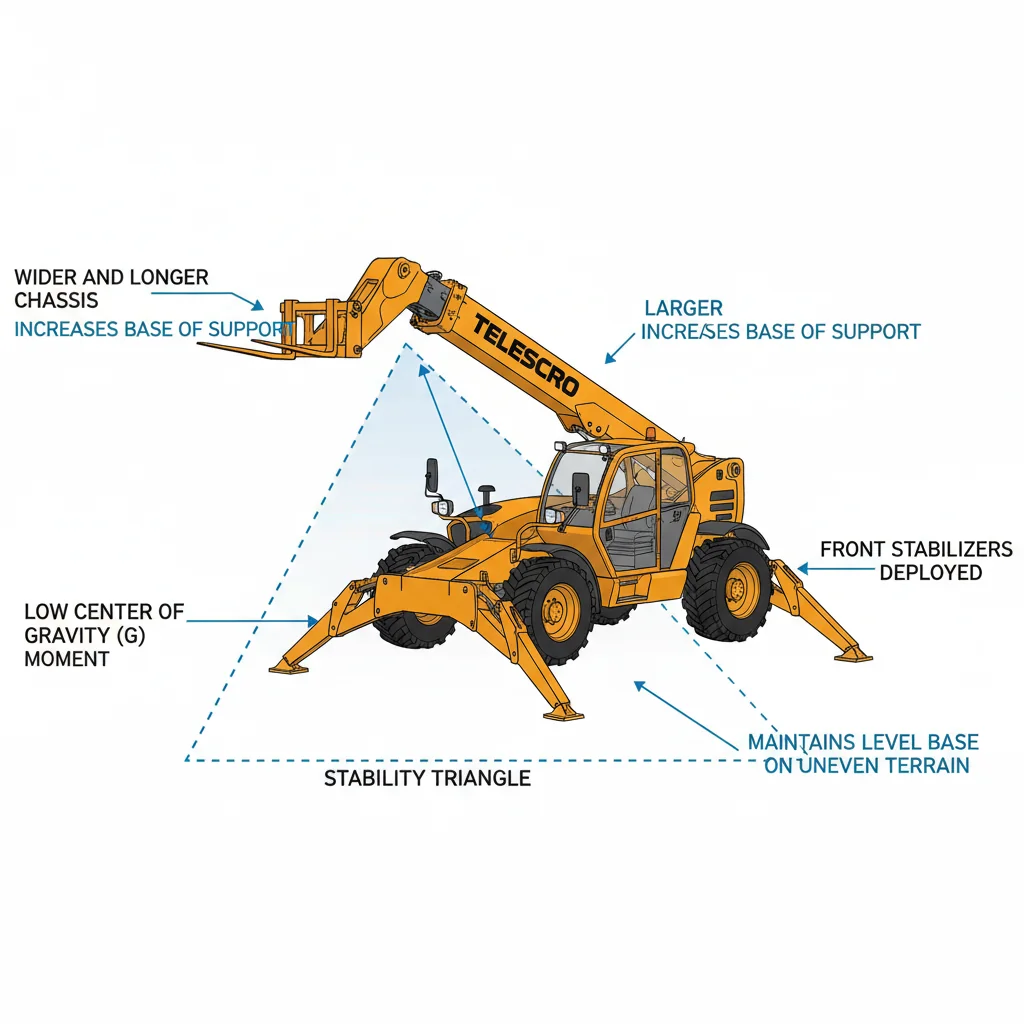
From my experience, too many buyers chase maximum lifting height or tonnage—but overlook stability features that actually keep jobsites safe. True stability margin is all about what stands between you and a tipping incident when working at full reach or on rough surfaces. When a telehandler has a wider, longer, and heavier chassis, you get a larger “stability triangle”—that’s the base keeping your center of gravity away from the tipping line at the front axle. Some models with 4-ton capacities at 17 meters can feel far more stable than “similar” competitors because of deeper counterweights and wider wheelbases. Last month, one of my customers in Kazakhstan was comparing two 3.5-ton telehandlers. Both had a similar rated capacity, but the one with the 2.8-meter width and a low-slung boom felt noticeably steadier on uneven ground. The other machine, with a higher boom mount and narrow chassis, felt “floaty” even well below its rated load. Stabilizers make a substantial difference, especially at maximum forward reach. Most high-reach models only have front stabilizers—rear units are rare except on rotating types.
Here’s a simple table showing how design features impact stability margin in real world conditions:
| Feature | Impact on Stability Margin | Typical Scenario |
|---|---|---|
| Wide, heavy chassis | Increases resistance to side and forward tipping | Rough or sloped ground |
| Low center of gravity | Keeps load center inside stability triangle | Lifting at or near max reach |
| Front stabilizers | Raises allowable capacity at full extension | Roofing, high-reach placement |
A telehandler with a longer wheelbase and wider chassis will generally offer a greater stability margin, reducing the risk of tipping at maximum outreach.True
A larger stability triangle from a wider and longer chassis means the center of gravity stays further from the tipping point, which is especially crucial when handling loads at full extension or on uneven ground.
Increasing the maximum lifting height of a telehandler will automatically improve its overall stability margin.False
Lifting height by itself does not enhance stability; in fact, raising loads higher can shift the center of gravity closer to the tipping line, which can reduce the stability margin unless other features (like a heavier or wider chassis) are improved.
Key takeaway: Telehandler stability margin is primarily determined by chassis dimensions, weight distribution, and active stability systems. When comparing models, prioritize width, wheelbase, low-mounted components, and stabilizer options over just lift height or tonnage, as these features offer greater tipping resistance in real-world operation.
How Do LMIs Protect Telehandler Stability?
Load Moment Indicators (LMIs) and advanced stability control8 systems continuously monitor load, boom angle, extension, and sometimes side slope or attachment type. These systems display proximity to the tipping limit using color-coded gauges and alarms. They intervene automatically by blocking or slowing unsafe functions to maintain a safe stability margin, preventing operation near the critical threshold.
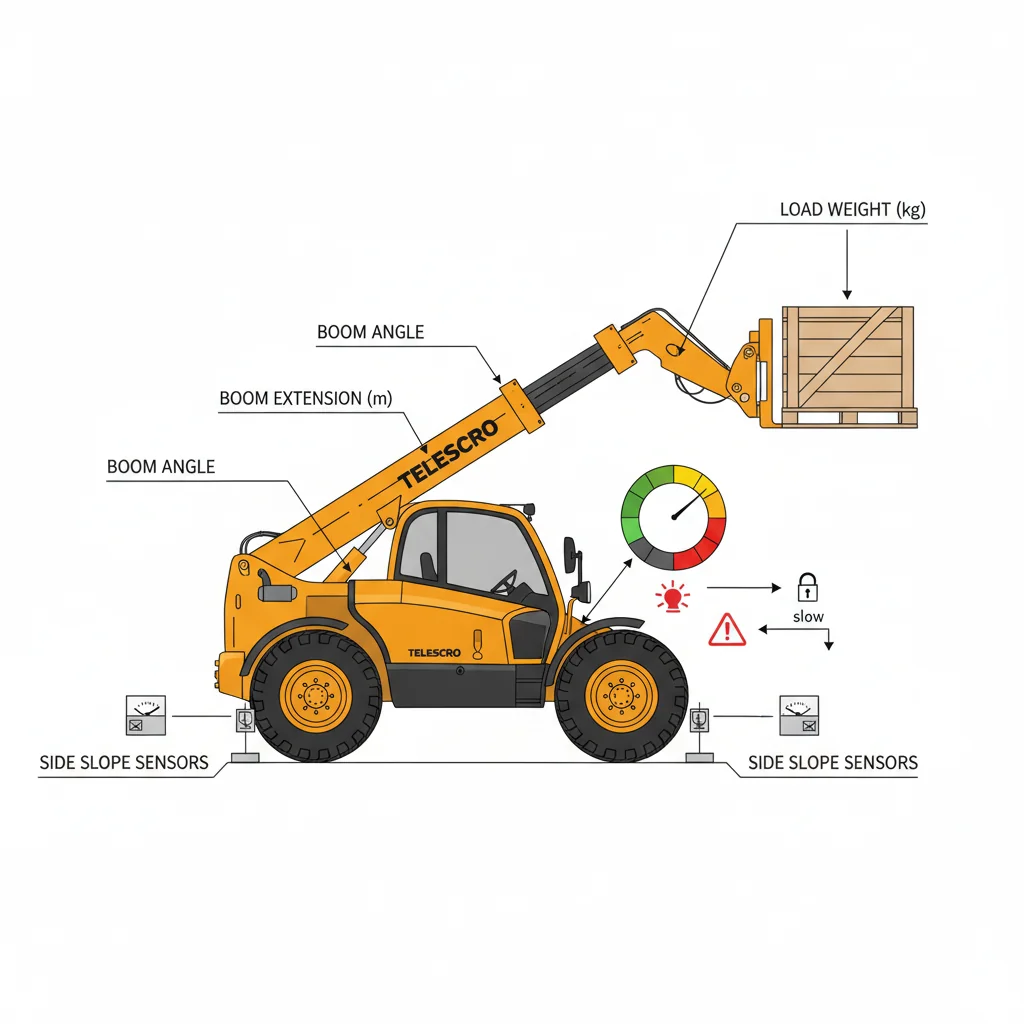
If you’ve ever operated a modern telehandler, you know the color-coded gauges and alarms aren’t just for show—they are the backbone of safe lifting. I remember a project in Dubai where the operator ignored the early yellow warning zone on a 4-ton, 17-meter telehandler and pushed the boom out another meter. The LMI immediately shifted to red. Within seconds, the system slowed all boom functions and finally blocked further extension. That built-in intervention prevented a real risk—he was already less than 15% away from the theoretical tipping line, which runs along the front tires. Without that automatic cut-out, he could have put an overloaded pallet right at the point where only a slight ground shift or gust would have tipped the machine. Real-time feedback from an LMI isn’t just about avoiding an alarm. On site, most jobs rarely go exactly as planned: uneven ground, side slope, different forks, unexpected pallet weight. Advanced stability control takes those realities into account. I’ve seen units in Kazakhstan that factor in side slope and the attachment in use—if the frame slopes past 3°, the display flashes and boom motion is blocked well before you hit the red. If you swap to a winch or jib, the indicator recalculates capacity on the spot, based on the manufacturer’s load chart and reduction factors. If you’re buying, ask how soon the safety system acts—some intervene with 20–25% margin left, others wait until you’re nearly at the edge. My advice?
A telehandler’s LMI maintains a stability margin by factoring in both boom angle and load distance, not just the weight being lifted.True
The stability margin is calculated using several parameters, including boom extension (distance), boom angle, and gross load, because all of these affect the machine's tipping point and stability envelope.
A telehandler’s LMI will allow operators to continue working within the red zone as long as they reduce the lifting speed.False
Once the LMI detects the machine is beyond its safe stability margin (the red zone), it automatically overrides operator controls to prevent further hazardous movement, regardless of speed; no reduction in speed can compensate for unsafe geometry or load positions.
Key takeaway: Modern telehandler stability relies on real-time monitoring by LMIs and stability control systems. These technologies provide clear feedback and intervene early to prevent exceeding safe limits. Operators should plan lifts to remain in the green/yellow safety range, consulting the manufacturer’s load chart for every variable.
How Do Attachments Affect Stability Margin?
Attachments directly alter a telehandler’s stability margin by changing both the weight at the boom and the load center distance9. Heavy tools or man baskets increase the load center and impose stricter rating limits. Always use attachment-specific load charts and ensure the LMI matches the installed attachment to maintain safe operations.
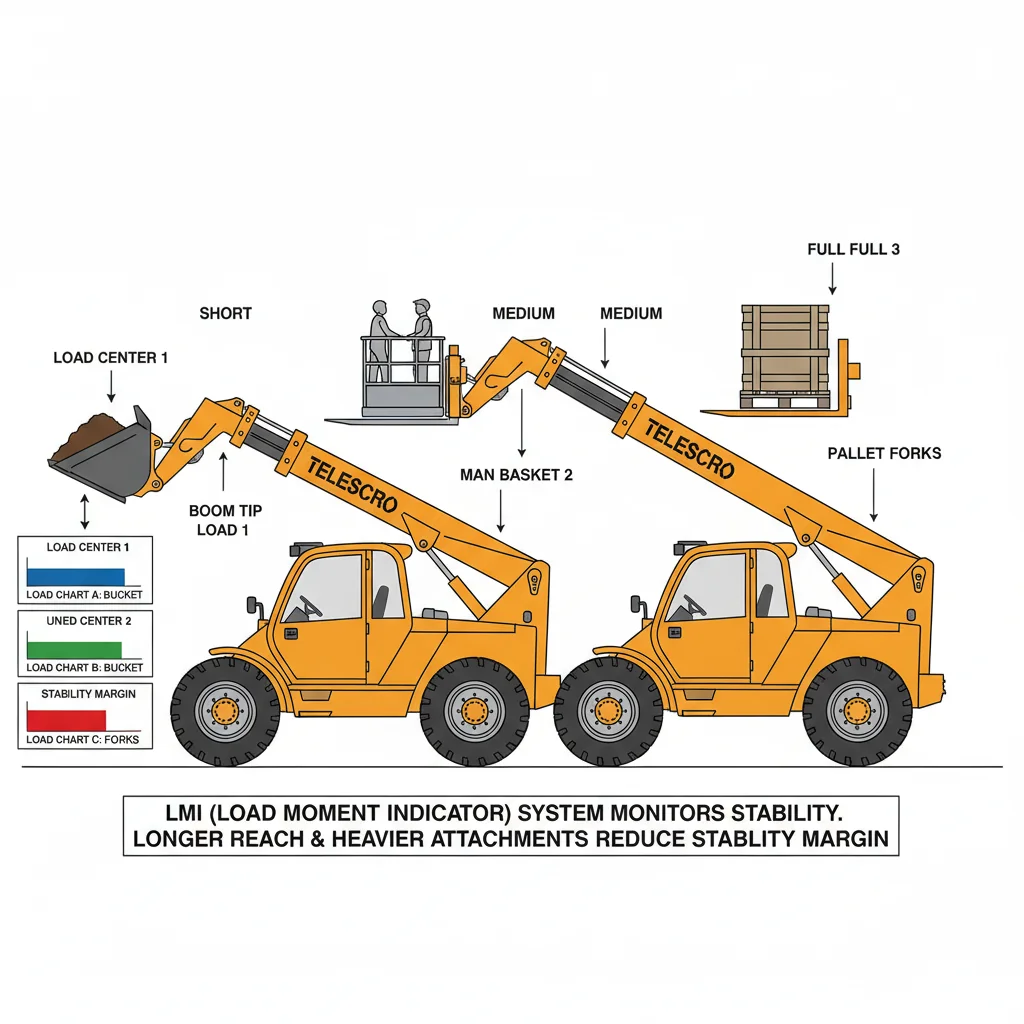
I’ve worked with customers in Dubai and Vietnam who underestimated how much attachments impact stability margin. The reality is, every attachment you swap on a telehandler changes both the weight right at the boom tip and the distance from the tipping axis (that’s the front axle). Sometimes it’s only a light material bucket, but when you bolt on a heavy hydraulic block clamp or a large man basket, you’re shifting the load center out by half a meter or more and often adding 300–400 kg of extra weight up front. That can cut your rated payload by 30–50% at full extension—sometimes more.
To break it down, here’s what actually changes with attachments:
- Attachment self-weight – A light fork adds almost nothing, but a man platform or rotating clamp might weigh over 500 kg.
- Effective load center – The longer and bulkier the attachment, the farther out your main load sits from the boom foot.
- Load chart derating – Each attachment triggers its own load chart, often with stricter limits than standard forks.
- LMI configuration – If the load moment indicator (on newer machines) isn’t set to the correct attachment, you risk totally misreading your safe envelope.
Last year, a contractor in Kazakhstan set up a man basket but forgot to switch the LMI mode. Their crew found out the hard way when the warning alarm didn’t trigger at a dangerous outreach—they nearly lost the basket.
Installing a heavier attachment on a telehandler will typically move the combined load center further forward from the front axle, which reduces the stability margin even if the load weight remains unchanged.True
The load center is determined by both the weight and the horizontal position of everything mounted on the boom tip. Heavier or bulkier attachments shift the overall center of gravity forward, increasing the overturning moment and reducing how much extra load the telehandler can safely handle before risking a tip, even when you're lifting the same payload.
The stability margin of a telehandler is only affected by the weight of the attachment and not by its distance from the tipping axis.False
Both the mass of the attachment and its position relative to the front axle (the tipping axis) determine the overturning moment. If an attachment is mounted further away from the tipping axis—even if it is not heavy—it increases leverage and can still significantly reduce the stability margin.
Key takeaway: Telehandler stability margin is highly sensitive to attachment type and load center shifts. Always reference OEM attachment-specific load charts and configure the LMI correctly for each tool—never use generic capacity data or make on-site estimations, as this can severely compromise safe working limits.
How Do Operator Actions Affect Stability Margin?
Operator actions such as boom extension, sudden braking, or frame leveling with the load raised above 1.2 m make the telehandler’s stability margin extremely sensitive. Even minor movements can shift the center of gravity outside the stability triangle, creating a significant risk of tipping, especially at maximum height or outreach.
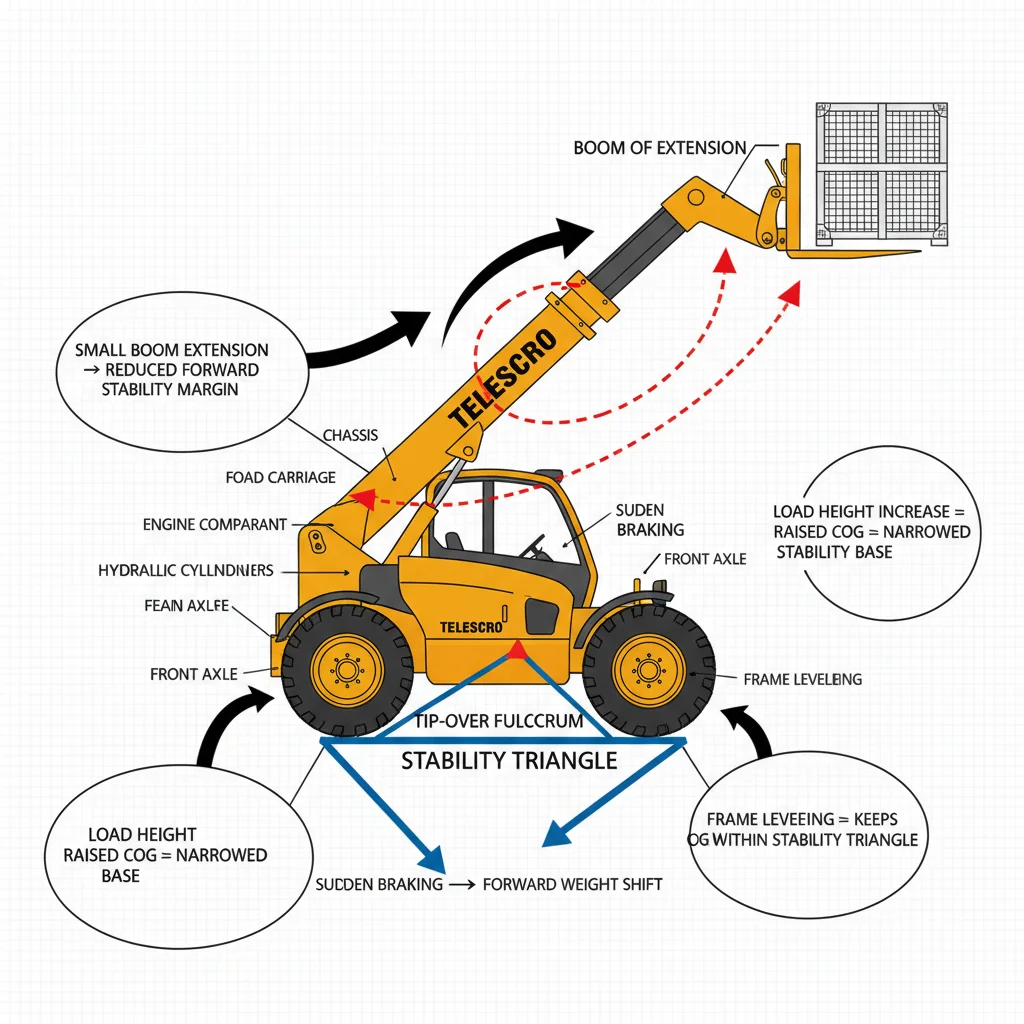
Let me give you a real-world scenario—just last year, a client in Kazakhstan asked me why their telehandler tipped during a job, even though they were far from the maximum rated capacity. They had the boom out, load about five meters in front, lifted nearly to full height. The problem? An operator bumped the frame-leveling control while the load was more than 1.2 meters off the ground. That tiny adjustment was enough to push the center of gravity outside the stability triangle. In these situations, just a few degrees of tilt, or a quick correction, can create instability in seconds.
At extension and height, the margin for error shrinks sharply. Even light lateral movements, sudden braking, or rotating with a raised load can create unexpected forces. The load moment indicator (the instrument that warns when you approach tipping limits) only reacts to static conditions—a dynamic shock can push you over the edge before the system even alerts you. On sites in the Middle East, I’ve seen units handle 2,500 kg safely at low elevation. But raise that same load above six meters and travel over rough terrain—the effective margin almost disappears. Operators sometimes underestimate how a small bump in the ground multiplies risk when you’re fully extended.
Strict procedures make a real difference here. Never travel with heavy loads above 1.2 meters unless absolutely necessary, and then only at creep speed on level, smooth surfaces.
Operating the frame-leveling function while the telehandler's boom is extended with a raised load can significantly reduce the stability margin by shifting the center of gravity outside the stability triangle.True
Even minor adjustments in the frame-leveling system with a raised, extended load can laterally shift the machine’s center of gravity. If this occurs while the load is off the ground, it can push the center of gravity beyond the stability triangle, increasing the risk of tipping.
A telehandler’s stability margin is not affected by sudden operator movements if the load is below maximum rated capacity.False
Stability margin is influenced by the position of the boom, the height and reach of the load, and any operator inputs, regardless of whether the load is below maximum rated capacity. Sudden or improper movements can shift the center of gravity abruptly and compromise stability even with lighter loads.
Key takeaway: With the boom raised and load elevated, stability margin sharply decreases. Small or sudden movements—including lateral corrections or frame adjustments—can critically shift the centre of gravity, quickly leading to instability. Strict procedures are essential: avoid travel or adjustments with elevated loads, and always limit motion at height.
How Does Wear Affect Telehandler Stability Margin?
Telehandler stability margins shown in load charts assume a new, properly maintained machine. Over time, wear in boom pads, bushings, chains, pivots, tires, and axle locks reduces the real stability margin. These mechanical issues can go undetected by the LMI, making regular inspection and component maintenance essential for safe operation.
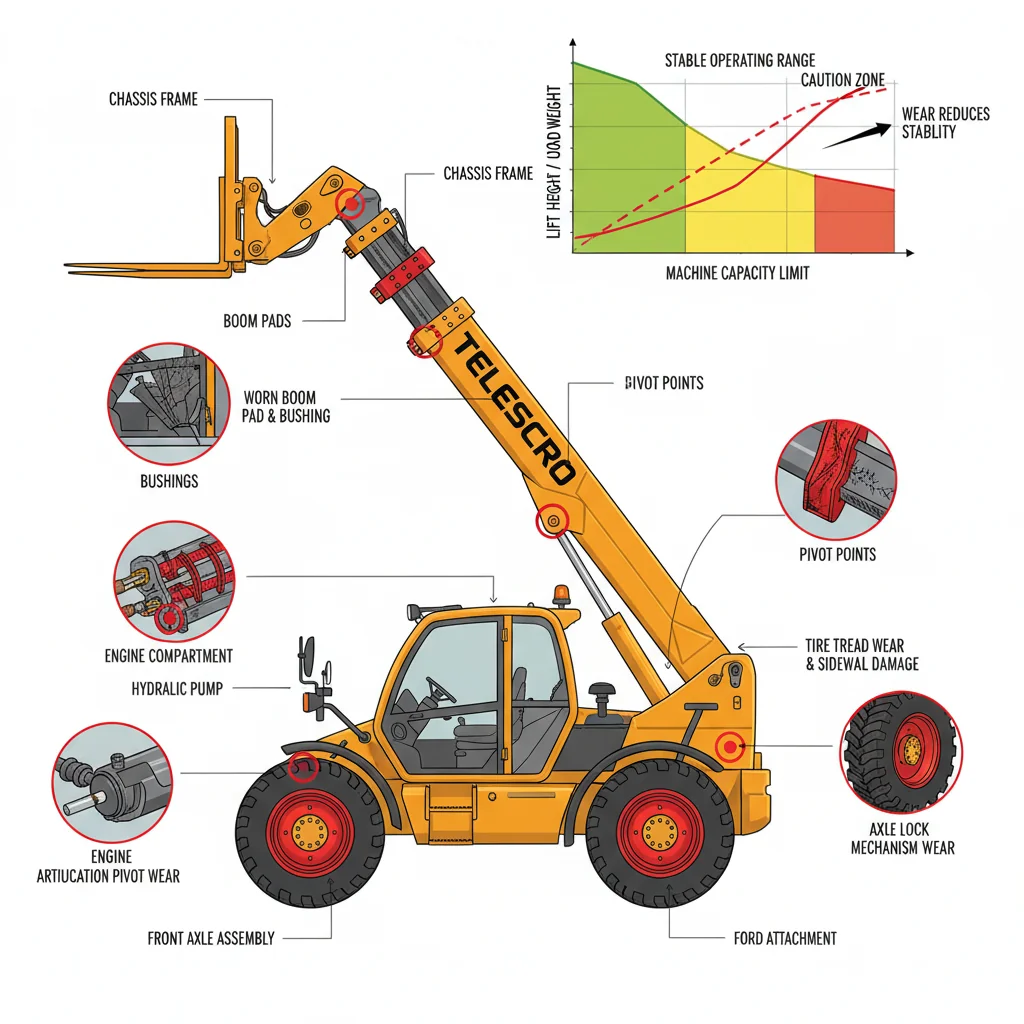
A lot of operators trust the load moment indicator (LMI) to warn them of tip risks, but here’s the reality: the LMI only measures hydraulic forces and boom extension, not wear in your machine’s linkage or tires. I’ve seen cases in Kazakhstan where a 4,000 kg telehandler handled loads that “looked” safe on paper, but subtle boom side play from worn pads left the actual margin razor-thin. The machine didn’t trigger any alarms, yet it felt unstable when turning with a suspended load—classic signs that wear is eating into your real stability margin.
I’ve worked with several rental fleets in Brazil, and worn axle oscillation locks often catch people out. If the rear axle isn’t properly locked during a lift, especially at full boom reach, the effective tipping axis shifts. That means the whole chassis can pivot more than the load chart allows for. Even a small amount of extra movement—just a few millimeters at the boom pivot—can translate to dozens of centimeters of sway at full extension. That’s why suspensions and pivot points must be tight and within factory tolerance.
Uneven or over-worn tires create another hidden risk. One contractor in Kenya replaced only one front tire, so the base width was off by several centimeters. With a loaded pallet at 10 meters, the telehandler rocked side-to-side unexpectedly. No warning from the indicator, but the true stability margin was cut in half. I always suggest keeping inspection records on boom pads, pins, axle locks, and tire pressure. Out-of-spec here means you’re closer to that tipping line than you think—don’t treat it as just “cosmetic.”
Wear in a telehandler’s boom pads and articulation points can reduce the stability margin without triggering a warning from the load moment indicator.True
The LMI senses hydraulic load and boom position but does not compensate for mechanical wear, which can introduce extra movement or looseness in the structure, leading to unpredictable shifts in weight distribution and reduced stability.
Telehandler tire wear has no effect on the machine's stability margin during lifting operations.False
Worn tires can alter the contact area and height of the machine, potentially causing uneven support or a lower stance on one side. This can reduce overall stability, especially when handling loads at extension or on uneven ground.
Key takeaway: Telehandler stability margins erode with wear and poor maintenance, even if the load moment indicator shows normal values. Structural, suspension, and tire components are critical to maintain as their degradation directly reduces true tipping resistance. Treat out-of-spec parts as stability risks, not just cosmetic issues.
When Should a Telehandler Be Upsized for Stability?
A telehandler should be upsized when routine operations frequently push the load moment indicator (LMI) close to or into the yellow/red zone, indicating a chronically thin stability margin. Chronic operation near stability limits increases tip-over risk and component wear, justifying the transition to a higher-capacity or stabilizer-equipped model for safer, more reliable performance.
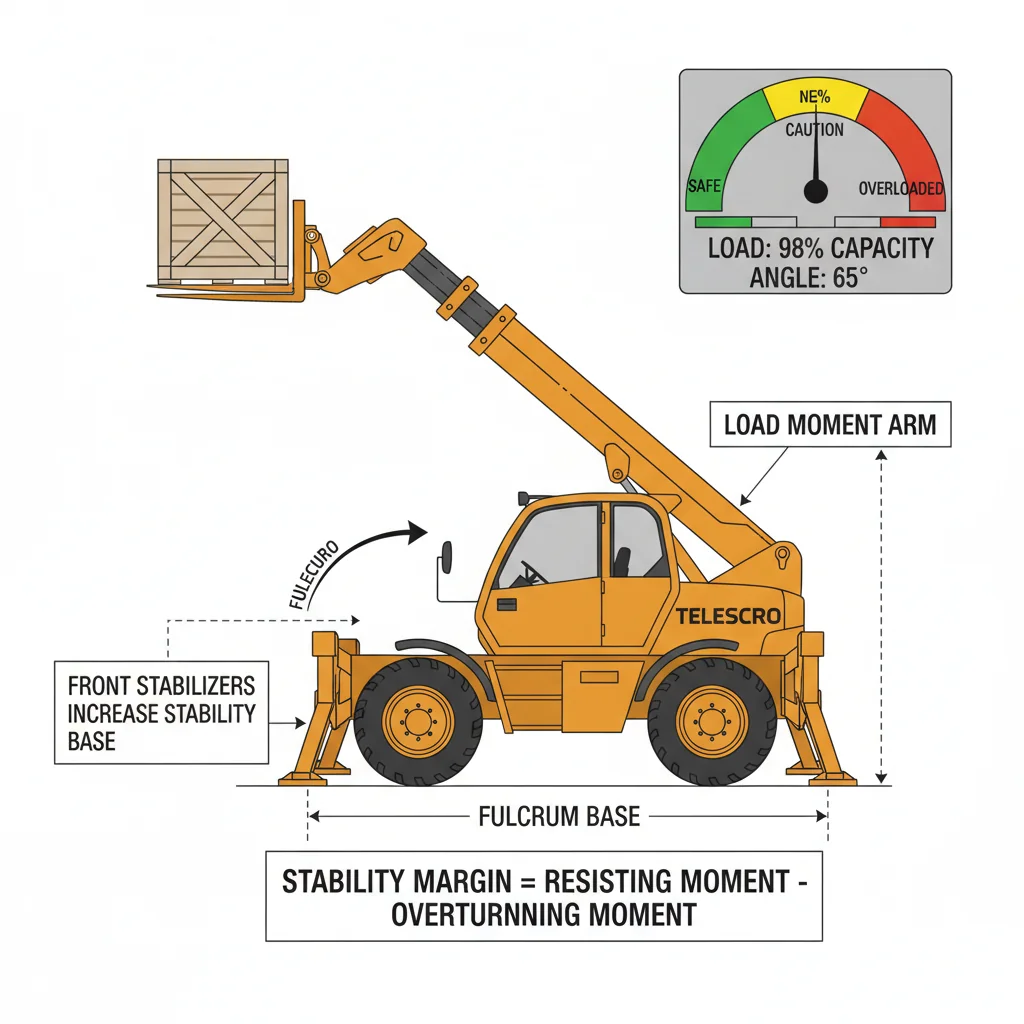
One question I often get from site managers is, “How close is too close to the limit?" My answer: If your operators are seeing the load moment indicator (LMI) flash yellow or red on a regular basis, you’re already beyond safe practice. In one case, a client in Kazakhstan used a 3.5-ton telehandler to move concrete blocks for a high-rise project, thinking the rated capacity covered them. But almost every lift at full extension was within 200 kg of that max—LMI alarms nearly every hour. That’s a classic sign your stability margin is just too thin, especially when the jobsite is rarely perfectly level or when the wind picks up.
The risk of tipping goes way up, and every near-limit lift adds stress to the boom sections and axles. From my experience, running near the capacity limit isn’t just a safety issue—it hits maintenance costs. I’ve seen teams in Brazil rack up thousands of dollars in repairs after six months because their 4-ton machines spent too much time maxed out at long reach. Booms grow loose, the hydraulic system runs hot, and even tires wear out faster.
If you need to rely on perfect ground or no wind just to avoid an overload, you’re really running out of margin. That’s not sustainable for most operations. I always suggest watching for chronic yellow-zone LMI readings. If routine tasks leave less than 50–60% stability margin in most positions, it’s time to look at a higher-capacity model or something with stabilizers.
A telehandler’s stability margin refers to the buffer between the safe working load and the point where the machine could tip, so frequent activation of the load moment indicator is a clear sign that your machine is operating with insufficient stability margin.True
Stability margin on a telehandler is the engineered safety buffer to prevent tip events. The LMI is designed to alert the operator as that buffer is consumed; regular LMI alarms mean the telehandler is too close to its stability limit, signaling the need for a larger machine.
If loads are within the rated capacity on paper, there’s no need to upsize a telehandler for stability, regardless of how close the operator is to the maximum extension or capacity.False
Rated capacity assumes ideal conditions. Actual stability can be compromised by frequent operation near limits, load dynamics, or uneven ground. Working consistently near max capacity reduces stability margin, increasing risk and showing that upsizing may be necessary.
Key takeaway: Operating a telehandler near its stability limits raises both safety and maintenance risks. If routine work leaves less than a 50–60% stability margin except in perfect conditions, fleet managers should consider upsizing or reconfiguring operations to ensure a safer and more durable solution.
Conclusion
We’ve looked at what stability margin means for telehandler safety and how it’s not just about lifting more—it’s about keeping your crew and jobsite secure. From my experience, the safest and least stressed operators keep an eye on the actual margin shown on the machine, not just the advertised max capacities. I suggest checking the load chart at real working heights and making sure parts are easy to get—“parts roulette” can be a real headache on remote sites. If you’d like advice on matching a telehandler to your job or help reading those capacity charts, just reach out. I’m happy to share what’s worked for crews in all sorts of conditions. The best results always come from choosing for your actual workflow.
References
-
Understand how using the load chart helps operators prevent overload and tipping by respecting rated capacities at various boom positions. ↩
-
Explore the critical impact of center of gravity shifts on telehandler tipping risks and how to manage stability during boom operations. ↩
-
Insight into how the load moment indicator signals safe operational zones to prevent overloads and tipping accidents. ↩
-
Explains why relying on load charts is vital for safety, preventing accidents despite powerful hydraulic lifts in telehandlers. ↩
-
Provide a detailed explanation of how stability margins affect safe telehandler operation, including the impact of center-of-gravity shifts and terrain conditions on machine stability, helping to reduce accident risk. ↩
-
Offer an in-depth analysis of the critical role of the center of gravity in equipment stability, incorporating the effects of side slopes and soft ground to help users understand how to maintain safe operating conditions. ↩
-
In-depth insights on how stabilizers increase resistance to tipping, especially at maximum forward reach, improving operational stability. ↩
-
Learn how advanced stability control integrates side slope and attachment factors to maintain telehandler stability under varied site conditions. ↩
-
Explore how varying load center distances impact telehandler stability and safe operation limits with expert data and charts. ↩