










Popular Telehandler Attachments: Field Guide to Must-Have Tools
From my experience working with customers from Shanghai to South Africa, the biggest mistake I see is buyers treating the telehandler like a giant forklift. They miss just how much the right attachments can transform a single machine into five.
In this article, I’ll break down the most popular telehandler attachments—why pallet forks dominate, when buckets or jibs earn their keep, and what to look for in a work platform.
If you’re mapping out which add-ons make sense for your jobsites, this field guide is for you. To be honest, understanding attachments is where I see operators and fleet managers save—or drain—a lot of budget over time. I’ll walk through the real reasons these tools matter, when
Which Telehandler Attachments Boost Versatility?
Telehandler attachments such as pallet forks, buckets, lifting jibs, work platforms, and bale spears allow one machine to handle 80–90% of construction, logistics, or farming jobs. Swapping attachments converts a telehandler into a forklift, loader, crane, aerial lift, or bale handler quickly.

To be honest, most people underestimate just how much you can get out of a basic set of telehandler attachments. I’ve visited jobsites in South Africa where a single 4-ton, 14-meter machine handled everything from unloading rebar to lifting workers onto roofs—and it was all about choosing the right attachments. When you look at the core tools, five types do almost all the heavy lifting:
- ง่ามยกพาเลท: Go-to for palletized loads (bricks, blocks), rated for up to 4,000 kg.
- ถังอเนกประสงค์: Ideal for loose material (sand, gravel); typically 1-1.5 cubic meters per scoop.
- Lifting jibs/truss booms: Attach these for swinging loads or placing trusses—critical for roof jobs or air-conditioning installs.
- แท่นทำงาน: Turn your telehandler into an aerial lift for safe access up to 17 meters high. I’ve seen these save a full week on maintenance projects in Brazil.
- Bale spears/grapple buckets1: Crucial for anyone in farming—move round or square bales fast and avoid double-handling.
Here’s a quick comparison of the most common attachments:
| ประเภทของไฟล์แนบ | การใช้งานทั่วไป | Load Capacity (approx.) | Reach Impact | Common Task Example |
|---|---|---|---|---|
| ง่ามยกพาเลท | Pallet handling | Up to 4,000 kg | Full | Block/brick delivery |
| GP Bucket | Loose materials | 1,000–1,500 kg | Slight loss | Sand/gravel movement |
| Lifting Jib2 / Truss | Suspended loads | 1,000–2,500 kg | Reduced | Roof truss placement |
| แพลตฟอร์มการทำงาน | Personnel access | 200–350 kg (2–3 people) | ความสูงสูงสุด | Elevated maintenance |
Using a work platform attachment equipped with automatic fall arrest anchorage points on telehandlers improves worker safety and compliance with international standardsจริง
Work platforms designed for telehandlers often include integrated fall arrest anchorage, which provides secure attachment for safety harnesses, reducing fall risk and meeting OSHA and EN standard requirements for elevated worker safety. This enables safe lifting of personnel in construction applications.
General-purpose buckets on telehandlers typically have a load capacity twice that of pallet forks rated at similar weight limitsเท็จ
General-purpose buckets are designed for volume rather than heavy loads; while pallet forks can carry concentrated heavy loads up to their rating (e.g., 4,000 kg), buckets generally handle lighter, bulk materials and do not double the load capacity compared to forks of the same rated capacity.
ประเด็นสำคัญ: Choosing essential attachments—pallet forks, buckets, jibs, work platforms, and bale tools—maximizes telehandler productivity across varied tasks. Starting with core tools matched to your primary jobs delivers maximum ROI, while specialty attachments should be added only when they measurably improve workflow or safety.
Why Are Pallet Forks So Popular?
Pallet forks dominate telehandler attachment use, handling over 60% of typical site tasks. Their popularity stems from low cost, simplicity, and ability to move pallets, lumber, and bricks. Adjustable widths and broad compatibility make them the industry standard for construction, rental, and industrial applications.

I’ve worked with customers in Dubai, Brazil, and Vietnam who all say the same thing—pallet forks are the first tool they ask for with any telehandler. Why? It’s simple. Forks let crews move everything from concrete blocks to lumber packs, straight off a delivery truck or out of storage, without stopping for extra setups. On most sites, over 60% of all lifting jobs are just getting palletized materials from one spot to another. The low cost compared to buckets or specialized clamps means even rental companies include forks as a default attachment.
Last year, I helped a contractor in Qatar spec out a fleet of 4-ton telehandlers for a new logistics yard. Their main concern? Can the forks safely handle 1,500 kg pallets at maximum boom extension—about 13 meters out? We checked the load chart together. Rated ground capacity3 was over 4,000 kg, but at full reach, it dropped to just under 1,600 kg. That detail saved them from some risky lifts. It’s a reminder that rated capacity changes with boom position, and the load chart (that graph next to the operator seat) really matters.
For anyone planning mixed-material jobs, I always suggest adjustable carriage widths and fork-mounted hook adapters. I’ve seen situations in Kazakhstan where a single forklift with a hook adapter moved both pipe bundles and heavy formwork safely in the same morning. Always check for solid locking pins and clearly stamped load ratings on the forks. I suggest confirming capacity at full extension, not ground level, before you sign off on a purchase or rental. That’s what keeps your lifting operations efficient—and safe.
Pallet forks increase telehandler productivity by eliminating the need for repositioning pallets during unloading, reducing material handling time by up to 30%จริง
By directly engaging palletized loads and allowing quick load transfers without rearranging pallets, forks streamline workflow and significantly cut down material handling cycles on most construction sites.
Pallet forks typically cost more than specialized clamps because they require advanced hydraulic controls and attachmentsเท็จ
Pallet forks are generally less expensive than specialized clamps or buckets because they are simpler mechanical tools that do not require additional hydraulic circuits or complex controls, making them a cost-effective choice for common lifting tasks.
ประเด็นสำคัญ: Pallet forks are industry-standard telehandler attachments due to versatility, ease of use, and broad fitment across major brands. Confirm capacity at maximum lift/reach, opt for adjustable carriages, and consider hook adapters for dual-use scenarios to ensure safety and efficiency on-site.
When Use Telehandler Material Buckets?
Material handling buckets transform your telehandler into a loader, ideal for moving bulk materials like sand, gravel, and demolition debris. Compared to forks, buckets speed up loose material handling, excel at cleanup, and are invaluable during site prep, landscaping, and demolition—especially with reinforced edges for heavy-duty work.

Let me share something important about material handling buckets—many buyers overlook just how much faster these attachments move bulk materials compared to forks. Last year, I worked with a site supervisor in Kazakhstan who was clearing torn-up landscaping and old bricks. Swapping to a 1.2-cubic meter bucket on his 3.5-ton telehandler cut his site cleanup time by at least two full working days. That’s a serious cost saver on projects with tight deadlines.
Here’s when I recommend using material buckets instead of forks:
- Site Cleanup: Buckets let you scoop and carry loose debris—much quicker than stacking with forks.
- Loading Trucks with Aggregates: Sand, gravel, or soil loads go much faster with a proper bucket.
- Backfilling Trenches: Efficiently spread and level fill without dragging out manual labor.
- Landscaping and Grading: Move topsoil or compost across large areas in less time.
- Demolition Waste: Clean up broken concrete or brick rubble—especially with reinforced bucket edges4.
From my experience, the trick is sizing your bucket for your machine’s rated capacity at typical extension. If you carry wet sand, a full 1-cubic meter bucket can weigh over 1,800 kg—so check the load chart (which shows safe weight at different boom positions). For especially abrasive materials, I suggest buckets with wear-resistant edges and extra reinforcement. In farm work, general-purpose or clamshell-style buckets let you handle feed, manure, and even silage efficiently.
If you plan to upgrade, confirm your telehandler’s hydraulic circuit matches any special bucket (like 4-in-1 or grapple). I always recommend checking with your supplier for compatible attachments before making a purchase.
Using a 1.2-cubic meter material bucket on a 3.5-ton telehandler can improve site cleanup efficiency by reducing cycle times by up to 30% compared to standard forksจริง
Material buckets allow for bulk loading and transporting loose materials in fewer cycles than forks, which require individual handling of items, thus significantly speeding up tasks like site cleanup.
Telehandler material buckets always increase fuel consumption by more than 50% due to added hydraulic demandเท็จ
While material buckets require hydraulic power to operate, the increase in fuel consumption is generally moderate and often offset by the efficiency gains in material handling, not exceeding a 50% increase under typical conditions.
ประเด็นสำคัญ: Material handling buckets are a top choice when moving or loading loose materials on construction or agricultural sites. Select a bucket that matches your telehandler’s rated capacity and consider wear-resistant edges for abrasive materials. Purpose-built buckets can greatly boost efficiency versus pallet forks for site cleanup and prep.
When to Use Truss or Jib?
Truss booms and lifting jibs excel at safely placing suspended loads—like roof trusses, steel, or HVAC units—where telehandler forks lack reach or control. Best for framing and roofing tasks, they extend reach and minimize repositioning. Always review lift charts and attachment safety features.

Here’s what matters most when deciding between a truss boom5 and a lifting jib: it comes down to the type of load, required reach, and site conditions. Some jobs simply can’t be done safely or efficiently with forks alone. Last year, I worked with a framing crew in Indonesia—they were placing wooden roof trusses nearly 10 meters across on a two-story house. With a standard telehandler and forks, they couldn’t clear the scaffolding. Switching to a 4-meter truss boom let them lift and set each truss from outside the structure, which cut manual handling and kept the crew off ladders.
In my experience, truss and jib booms are most valuable when you need precise overhead placement—especially with items like:
- Roof trusses and rafters – Framing jobs where you must reach over walls or obstacles
- Structural steel beams or joists – Steelwork on warehouses or multi-story frames
- HVAC units and ductwork – Placing equipment onto rooftops or mezzanines
- Precast concrete panels – Panel handling for mid-rise buildings
The key is understanding capacity changes. Adding a 12-foot jib or truss can lower your rated capacity by half or more at full extension. I’ve seen a 4-ton telehandler limited to just 1,000 kg at 15 meters with a lifting jib installed. Always check the attachment’s load chart—mounted at the boom head—for real numbers, not just theory. Also, look for anti-drop valves and certified lifting points for safety. I recommend confirming your jobsite’s lifting plan before selecting an attachment. It saves time, protects your crew, and keeps inspectors happy.
Truss booms on telehandlers typically allow for a higher vertical reach compared to standard forks, enabling lifts over obstacles like scaffolding by extending up to 4 meters beyond the boom tipจริง
The truss boom's design creates a longer, more stable lifting arm that can extend vertically and horizontally past the machine's cab, making it ideal for placing large loads such as roof trusses over obstructions where forks alone cannot reach.
Jib attachments are primarily used to increase the machine's load capacity rather than extend its reach or versatility in lifting anglesเท็จ
Jib attachments are designed to increase reach and provide more lifting angle versatility, not load capacity; using a jib generally reduces the maximum rated load due to leverage and stability constraints.
ประเด็นสำคัญ: Truss and jib booms are essential for jobs requiring precise overhead placement, such as roofing or steelwork. They extend a telehandler’s reach, replacing cranes in many cases, but come with strict capacity limits. Always verify compatibility, safety features, and capacity reductions before use.
How Do Telehandler Work Platforms Improve?
Telehandler work platforms, such as fork-mounted man baskets6, provide secure elevated access for inspection, maintenance, and installations. Purpose-built platforms are safer than ladders or makeshift scaffolds, offering certified features like anchor points and self-closing gates. Always confirm your telehandler and platform meet safety standards and regulatory compliance.
The biggest mistake I see on jobsites is workers using ladders or makeshift cages instead of proper telehandler work platforms. Just last year, I had a site manager in Dubai ask me if they could weld a basic cage and mount it on their 3.5-ton telehandler for quick fixture repairs at 10 meters. My answer was simple: there’s a reason purpose-built baskets exist. Certified work platforms7 offer features like toe boards, anti-slip floors, and self-closing gates—things a homemade solution simply can’t provide.
I’ve watched crews in South Africa save at least two days of work time every month by switching from scaffold towers to fork-mounted man baskets. With a certified platform, two workers plus tools can operate safely up to 12 meters. Quick-coupler carriages let you swap the basket and forks in just a few minutes. That means you keep your telehandler busy, not parked and waiting. But there’s a catch: the platform and telehandler must both meet local safety standards, whether that’s CE in Europe or ANSI in North America. And not every telehandler is rated for personnel lifting—some require extra controls, like overload sensors or auxiliary hydraulic circuits, for man-basket approval.
From my experience, always check the load chart for platform use. The rated capacity drops when you extend the boom, especially at higher lifts. For example, a 4-ton machine might only allow 450 kg at full 14-meter outreach when carrying people. I suggest verifying these limits before you buy any attachment. Safety and compliance aren’t optional—they keep your team and your business running.
Certified telehandler work platforms are designed to meet EN 280 standards, which require features like guardrails at a minimum height of 1100 mm and platform load ratings specified for two workers plus toolsจริง
EN 280 standards set strict safety and performance criteria for work platforms including guardrail height, structural load capacity, and platform stability, ensuring these platforms can safely support workers and equipment at height. Homemade cages rarely meet such precise and tested specifications.
Telehandler work platforms typically eliminate the need for outriggers because the built-in stabilizers on all telehandlers are sufficient to counterbalance the load when lifting personnelเท็จ
Most telehandler work platforms require outriggers or stabilizers to be fully deployed during use to ensure stability and prevent tipping, especially when elevated at height. Relying solely on the telehandler’s built-in stabilizers is unsafe and not compliant with most industry safety regulations.
ประเด็นสำคัญ: Certified telehandler work platforms offer a safer, more efficient way to access heights compared to ladders and homemade solutions. Ensure all equipment is CE/ANSI-certified, purpose-built for personnel, and compatible with your telehandler to remain compliant while maximizing safety and uptime.
Which Telehandler Attachments for Farming?
Grapple buckets and bale handlers are top telehandler attachments for farming and land-clearing. Grapple buckets secure loose or irregular materials with hydraulic clamps, while bale spears and grabs are designed for stacking and moving round or square bales efficiently and safely, maximizing lift height and productivity.

Most people don’t realize how much choosing the right telehandler attachment can change your daily workflow on a farm. The difference between a regular bucket and a proper grapple bucket is huge—especially when you’re working with things like silage, brush, or logs. I worked with a customer in Kazakhstan last season who switched from a standard material bucket to a hydraulically-clamped grapple. Suddenly, loose material stayed put, cleanup times dropped, and there was a lot less wasted motion.
If you’re handling anything irregular, go for the grapple with a wide opening and robust hydraulic cylinders. Just make sure your telehandler’s auxiliary circuit delivers enough pressure, or you risk slow operation. When it comes to bales, the choice is between bale spears and bale grabs. Bale spears are best for round bales—one main spear, two stabilizers, and you’re stacking safely up to 1,200 kg per bale if your machine supports it. Bale grabs work well for square bales or wrapping, since their padded arms avoid damaging the surface. I saw a mixed grain and cattle farm in Brazil improve stacking height by over 1.5 meters just by switching to a high-lift model plus longer spears. It’s easy to overlook how much reach and boom angle matter until you’re actually building stacks three levels high.
ประเด็นสำคัญ: Grapple buckets and bale handling attachments transform telehandlers into versatile tools for agriculture and land management. Choose grapple width and tine length to match your materials and bale sizes, and ensure your telehandler’s hydraulics can handle the attachment demands for safe, efficient operation.
Which Specialty Telehandler Attachments Matter?
Specialty telehandler attachments like sheet material handlers, pipe handlers8, cable drum handlers, fork-mounted trash hoppers, and grapple buckets enable a single machine to perform highly specific tasks—such as handling drywall, piping, or debris—without investing in dedicated equipment for every phase of construction or utility work.

Specialty telehandler attachments like sheet material handlers, pipe handlers, cable drum handlers, fork-mounted trash hoppers, and grapple buckets enable a single machine to perform highly specific tasks—such as handling drywall, piping, or debris—without investing in dedicated equipment for every phase of construction or utility work.
Specialty telehandler attachments allow contractors and rental fleets to tackle niche tasks efficiently using one base machine. Before purchasing, evaluate expected usage; frequently used tools may justify ownership, while truly specialized attachments are best acquired through short-term rental to optimize project flexibility and cost.
Pipe handlers typically increase telehandler load capacity by redistributing load forces, allowing safe handling of long, heavy sections without exceeding the machine's rated lift capacityจริง
Specialty pipe handler attachments are engineered to shift the center of gravity and spread the load, enabling operators to lift long pipes securely; this design prevents overloading and maintains stability within the telehandler's rated capacity.
Fork-mounted trash hoppers double the telehandler's maximum lift height due to their lightweight design and aerodynamic shapeเท็จ
While fork-mounted trash hoppers are designed for convenience in debris handling, they do not affect the telehandler's maximum lift height; the lift height is determined by the boom design and hydraulic reach, unaffected by attachment aerodynamics or weight.
ประเด็นสำคัญ: Specialty telehandler attachments allow contractors and rental fleets to tackle niche tasks efficiently using one base machine. Before purchasing, evaluate expected usage; frequently used tools may justify ownership, while truly specialized attachments are best acquired through short-term rental to optimize project flexibility and cost.
How Do You Match Telehandler Attachments?
Always verify three key factors: mount type, hydraulic flow and pressure9 compatibility, and safety certifications. Mismatched mounts or specs can damage equipment, compromise safety, and void warranties. Confirm attachment fit through manufacturer compatibility charts and by inspecting load ratings, anti-drop valves, and locking mechanisms before purchase or rental.

Most people don’t realize that matching telehandler attachments is more than just picking something off a catalog. It’s a technical process that can save you hours—or cost you thousands—depending on what you miss. Take the case of a project in Poland last year: a client tried using a rotating concrete bucket from another brand on their 3-ton, 14-meter telehandler. The problem? The mount didn’t align, and the hydraulic coupler leaked under load—slowing work, risking damage, and voiding their warranty.
To avoid issues like this, I always suggest checking these four essentials before buying or renting any attachment:
- Mount type compatibility10: Carriage interfaces vary across manufacturers and models. Just because it looks similar doesn’t mean it will lock in safely.
- Hydraulic flow and pressure: Every attachment with a hydraulic cylinder—think clamshell buckets, winches, or rotating platforms—must match your telehandler’s circuit flow (usually measured in liters per minute) and maximum pressure. Undersized circuits give weak performance; overspec pressure can cause failures.
- Load ratings and certification: Attachments should display clear rated load capacity that matches your telehandler’s chart. Look for CE or ANSI markings as proof the equipment meets safety standards.
- Safety features: For lifting tools, always check for anti-drop valves, locked pins, and solid stops. On one site in Kenya, missing locking pins led to a fork shifting under load—luckily no one was hurt, but it was a close call.
I recommend verifying all specs directly with your OEM documents or a reputable supplier. It’s a simple step, but it keeps your site running safely and avoids costly downtime.
Using telehandler attachments requires matching the coupler type and hydraulic pressure specifications precisely, as mismatched mounts or incorrect pressure ratings can cause leaks and mechanical failures.จริง
Telehandler attachments must be compatible with specific mount systems (e.g., Euro, Manitou, JCB) and hydraulic pressure ratings to ensure secure fitting and proper function of hydraulic components, avoiding leaks and potential warranty voids.
"Mostเท็จ
ประเด็นสำคัญ: Matching telehandler attachments requires careful attention to mount compatibility, hydraulic specifications, and verified safety certifications. Bypassing these steps risks equipment failure and safety incidents. Always consult OEM documentation or trusted suppliers to ensure all components are properly paired and fully certified for intended use.
What Criteria Guide Attachment Selection?
Select telehandler attachments by matching your main tasks to attachment type: heavy lifting needs certified jibs12, bulk work requires high-capacity buckets, and pallet handling benefits from adjustable forks. Always assess material size, job frequency, site conditions, machine capacity at height, and attachment compatibility before deciding.

Select telehandler attachments by matching your main tasks to attachment type: heavy lifting needs certified jibs, bulk work requires high-capacity buckets, and pallet handling benefits from adjustable forks. Always assess material size, job frequency, site conditions, machine capacity at height, and attachment compatibility before deciding.
Define your primary jobs and material types, check site constraints, and ensure boom capacity at height matches attachment weight. Favor quick-attach and cross-compatible designs for flexibility. Never size attachments solely by maximum lift; prioritize safety and optimal performance tailored to real operating conditions.
Certified lifting jibs for telehandlers must be specifically rated for the machine's maximum boom height and load chart to maintain stability and safety during heavy liftingจริง
Lifting jibs are designed with load ratings that correspond to the telehandler's capacity at various boom extensions. Using a jib without matching these specifications risks overloading the machine and causing tipping or structural failure. This ensures safe operation when handling heavy or awkward loads at height.
Adjustable forks on telehandlers are universally compatible with all pallet types regardless of size or weight due to their hydraulic adjustment featureเท็จ
While adjustable forks increase versatility, they are not universally compatible with every pallet type. Pallet size, weight distribution, and fork capacity must be matched carefully to avoid load instability or damage. Some pallets require specialized forks or attachments beyond simple width adjustment.
ประเด็นสำคัญ: Define your primary jobs and material types, check site constraints, and ensure boom capacity at height matches attachment weight. Favor quick-attach and cross-compatible designs for flexibility. Never size attachments solely by maximum lift; prioritize safety and optimal performance tailored to real operating conditions.
Buy, Rent, or Go Aftermarket Attachments?
For high-use attachments like forks and buckets, purchasing yields the best ROI, especially with certified brands. Seasonal or niche tools—such as snow plows and tree shears—are better rented. Aftermarket cross-brand options13 cut costs but require checks for compatibility and safety certifications.
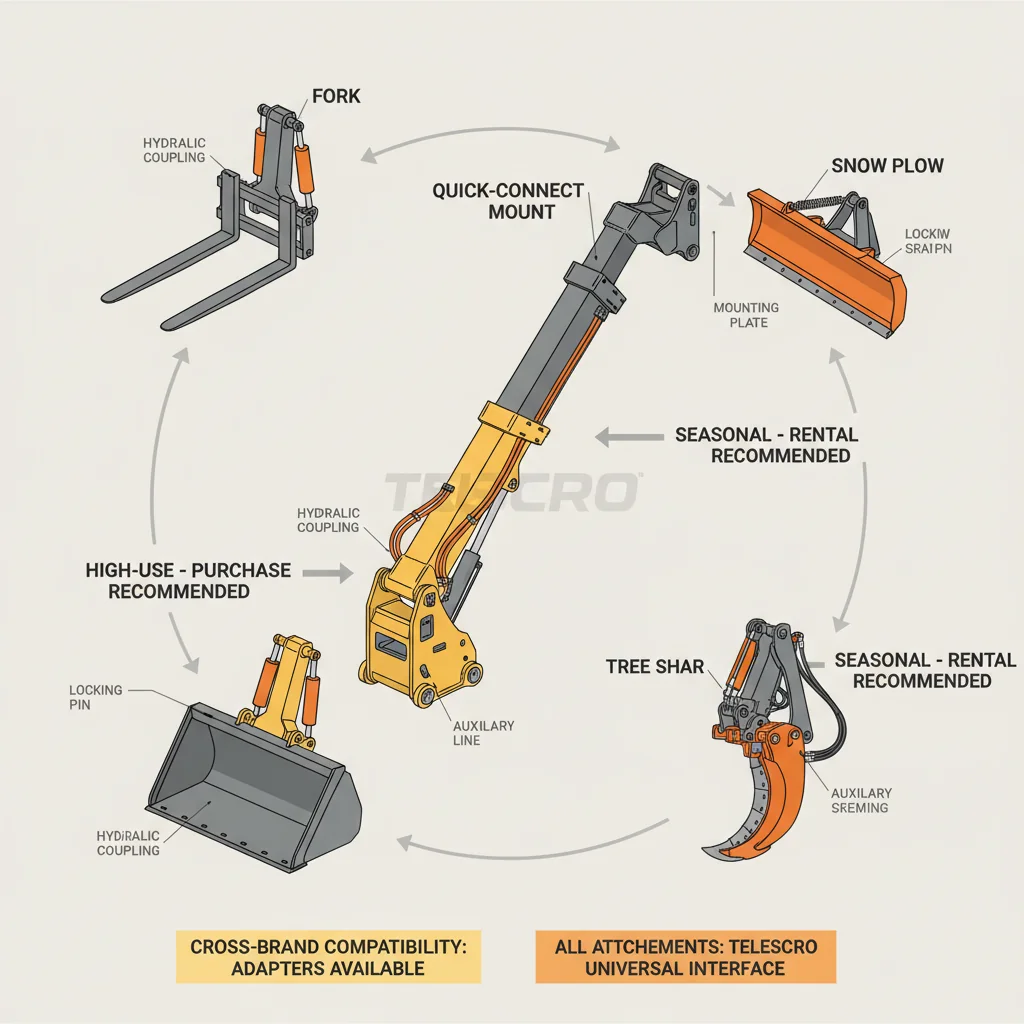
Most people don’t realize that attachment strategy has just as much impact on your budget as choosing the main machine. In my experience, the right decision can save thousands over a project’s lifetime. For example, a contractor I worked with in Kazakhstan ran a mixed fleet of 4-ton and 3-ton telehandlers. They bought high-use forks and general buckets outright—these were used almost every day. Those attachments paid themselves off in less than a year, and kept strong resale value. But for snow plows and tree shears, they rented during winter and spring. This let them avoid spending an extra $8,000 on niche gear that would sit idle eight months a year.
Here’s what I recommend when weighing your options:
- Buy the basics if you use them daily: forks, buckets, and any attachment central to your work.
- Rent seasonal or niche tools—like snow plows, sheet handlers, or cable drums—if you only need them a few weeks each year.
- Review rental records. If an attachment’s rental cost is close to its purchase price within a year or two, it’s time to buy.
- Aftermarket cross-brand options can save money and simplify mixed fleets, but check mount type, hydraulic hookups, and always ask for safety certification. I’ve seen operators in Dubai struggle with hydraulic leaks on non-certified gear, slowing down the whole site.
- Consider total cost—not just purchase price, but maintenance and resale.
I suggest talking to your dealer about compatibility, especially if your units come from different brands. In my view, planning your attachment purchases carefully makes every machine—and every project—much more efficient.
High-use telehandler attachments like forks and general buckets typically retain over 70% of their original value when resold within two yearsจริง
Attachments used daily often maintain their condition and market demand, which supports strong resale values close to 70-80%, making them a worthwhile upfront investment.
Telehandler attachments designed for snow removal, such as snow plows and blowers, generally have a longer operational lifespan than general-purpose bucketsเท็จ
Snow removal attachments often face harsher conditions like corrosion from salt and abrasive ice, which typically reduces their lifespan compared to more robust, general-purpose buckets used in less corrosive environments.
ประเด็นสำคัญ: Invest in frequently used core attachments to maximize ROI and potential resale value. Rent specialty or seasonal tools to conserve capital and increase flexibility. When considering aftermarket suppliers, always verify compatibility and certifications to ensure safety and integrate seamlessly across mixed-brand telehandler fleets.
How Do You Maintain Attachments?
To maximize telehandler attachment life, inspect pivot points14, pins, and bushings regularly, ensuring they’re greased per manufacturer guidelines. Check hydraulic hoses and seals for leaks and wear; clean attachments after use, store them protected from moisture, and maintain safety decals and load charts for optimal performance.

I’ve worked with customers in Brazil who thought they’d ruined a set of forks just from heavy use, but the real issue was simple—no one kept up with daily lubrication. The biggest risk to your attachments isn’t always your telehandler’s power; it’s skipping small steps in care. Whether you’re running buckets in South Africa’s abrasive sand or rotating jibs on busy Dubai sites, consistent checks matter far more than most realize. Attachments are the front line—they handle impacts, dirt, and hydraulic pressure, and I’ve seen $1,000 in early repairs turn into $8,000 replacement bills within two years just from neglected pivots and seals.
To keep attachments in top shape, I suggest a routine that covers the basics:
- Inspect all pivot points, pins, and bushings—look for wear, cracks, or missing grease.
- Grease contact points as recommended (usually every 8-16 hours of use)—poor lubrication is the most common cause of breakdowns.
- Check hydraulic hoses, couplers, and cylinders for leaks, wear, or cracked seals, especially on grapples and platforms.
- Clean buckets, couplers, and quick-attach plates after use, especially following corrosive or sticky materials—sand and cement can pit steel fast.
- Store attachments under cover or indoors to prevent rain and moisture from causing rust or seizing pins.
- Maintain clear load charts and safety decals—faded stickers can be a safety risk, especially for new operators.
I’ve seen this checklist extend attachment life by five years on busy jobs in Kazakhstan. For most fleets, a simple five-minute inspection before every shift is enough to catch problems early and keep jobs running smoothly.
Hydraulic quick-attach couplers on telehandler attachments typically require lubrication every 50 operating hours to prevent premature wear and ensure leak-free connectionsจริง
Regular lubrication of quick-attach couplers is critical because these components endure high pressures and frequent coupling cycles; insufficient maintenance can lead to seal failure and hydraulic leaks, reducing attachment reliability.
Telehandler attachments such as jibs and buckets universally require full disassembly every 1000 operating hours for effective maintenanceเท็จ
Unlike complex engine or transmission components, most telehandler attachments do not need full disassembly at fixed intervals; routine maintenance focuses on lubrication, inspection, and minor repairs, with disassembly only needed for specific damage or wear conditions.
ประเด็นสำคัญ: Routine inspection, lubrication, and proper storage of telehandler attachments are critical to preventing corrosion, breakdowns, and unnecessary downtime. Following a maintenance checklist preserves safety features, performance, and resale value, ensuring that essential attachments remain dependable tools on every job site.
สรุป
We’ve covered which attachments—like forks, buckets, jibs, work platforms, and bale tools—make the biggest difference for telehandler productivity on most sites. From what I’ve seen, the smart buyers start with the core tools that solve 80% of their tasks and only add specialty attachments when there’s a clear need. Don’t let impressive specs create a "showroom hero, jobsite zero" situation—focus on what actually improves your workflow and safety. If you have questions about fit, load charts, or which tools give the best value for your jobs, feel free to reach out. I’m happy to help you find what truly works for your team and site needs. Every jobsite is different—choose what makes yours run smoother.
เอกสารอ้างอิง
-
Detailed insights into grapple buckets’ hydraulic clamps that secure irregular materials, enhancing efficiency and reducing cleanup times on farms. ↩
-
Discover expert advice on lifting jib attachments, capacity impacts, and best practices for maximizing safety and reach on site. ↩
-
Understand how rated ground capacity varies with boom position to avoid risky lifts and ensure telehandler safety on site. ↩
-
Discover the technical benefits of reinforced bucket edges for heavy-duty tasks, improving durability and performance during demolition cleanup. ↩
-
Explore technical guides and case studies on truss boom use for safer, precise overhead load placement in construction sites. ↩
-
Explore certified safety features and operational benefits of fork-mounted man baskets for safe elevated access in construction. ↩
-
Learn about compliance requirements, safety standards, and design features that protect workers using certified telehandler platforms. ↩
-
Learn how pipe handlers redistribute load forces to safely lift long pipes without exceeding telehandler lift limits. ↩
-
Learn how matching hydraulic flow and pressure prevents equipment failure and ensures optimal performance in attachment use. ↩
-
Explore detailed compatibility standards and mounting system differences vital for safe, damage-free telehandler attachment use. ↩
-
Covers how to match attachment size and weight with machine capacity for safe and efficient telehandler performance on-site. ↩
-
Explains safety standards and load ratings for certified jibs to prevent overloading and ensure stable heavy lifting operations. ↩
-
Explore expert insights on saving costs with aftermarket cross-brand attachments while ensuring compatibility and safety certifications. ↩
-
Detailed guidance on inspecting and lubricating pivot points to prevent early wear and costly repairs on telehandler attachments. ↩