










Telehandler Working Envelope vs Height: What Buyers Overlook in Real Jobs
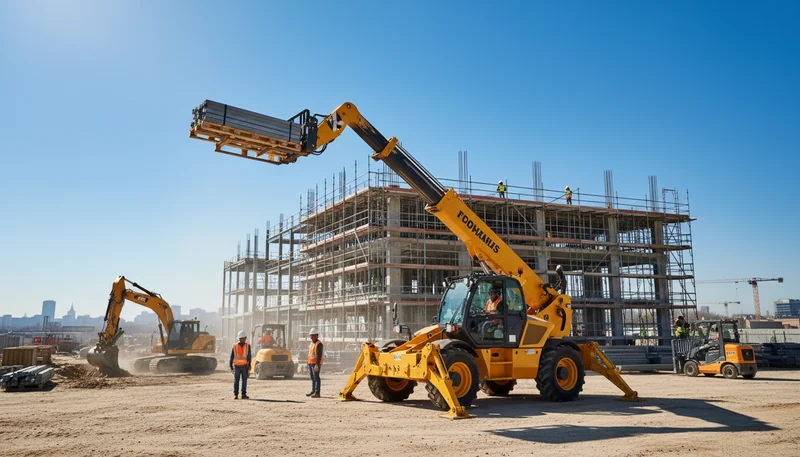
When I visited a high-rise project in the UAE last month, the site manager was frustrated. His brand-new 17-meter telehandler couldn’t place engine parts over a balcony, even though the specs seemed “more than enough.” I hear this kind of story everywhere—because height alone rarely tells the real story.
A telehandler’s working envelope defines the zone within which rated loads can be safely handled, combining lift height with forward reach1 as defined on the OEM load chart (often referenced from the front face of the front tire to the load center). While manufacturers often highlight maximum height and headline capacity figures, the practical limit on most jobsites is the allowable capacity at the actual working point—which can be far lower once outreach, load center, attachment configuration, and stability requirements are applied.
Why Is the Working Envelope Critical?
The telehandler working envelope defines the full area—combining lift height, forward reach from the front tires, and load center—where safe load handling is possible. Maximum height alone is just a single point. Real tasks almost always occur somewhere inside the envelope, making it the critical capacity reference—not just the top height.
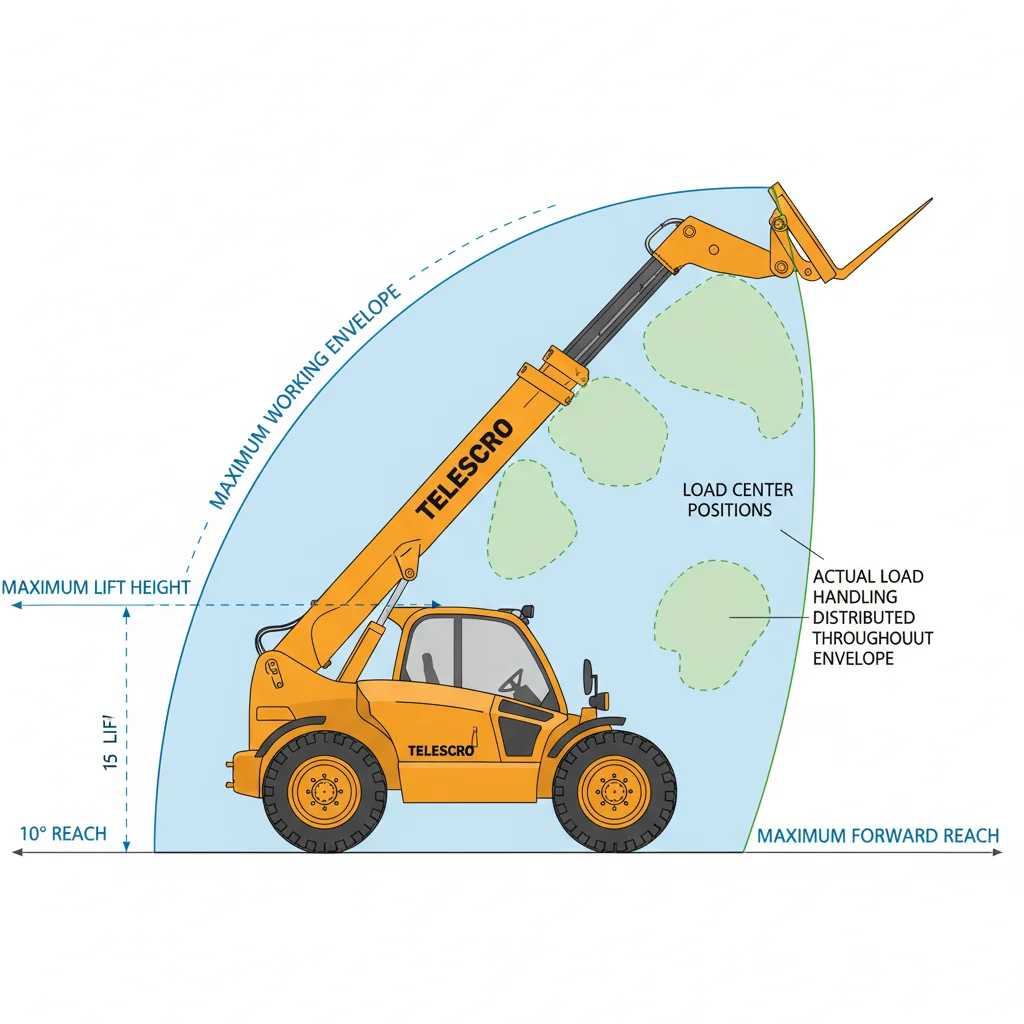
Most people don’t realize that maximum lift height is just one figure on a telehandler spec sheet—it says very little about real jobsite capability. The real question is whether the machine can safely place the load at the position you actually need. That’s where the working envelope matters. It represents the usable range combining lift height and forward reach, as defined on the OEM load chart (commonly measured from the front face of the front tire to the attachment’s load center), within which safe operation is permitted. I see many projects in Dubai and Kazakhstan overestimate performance by assuming a “4,000 kg, 17 m” telehandler can handle full tonnage at long reach. The load chart2 quickly shows that allowable capacity at high reach and height can be substantially lower than the headline rating, depending on model design, attachment configuration, load center, and ground conditions.
Here’s what matters most: real work happens inside the envelope, not just at the top. Placing pallets on a third-floor scaffold, threading bundles of rebar overhead, or dropping pipes into a form—all of these jobs require specific combinations of height and forward reach. Last month, a client in Brazil called me frustrated because their newly rented telehandler couldn’t safely reach a hopper positioned eight meters out from the slab edge. We checked the load chart together. The safe capacity at that reach was under 1,000 kg, nowhere near their two-ton requirement.
I always suggest reviewing the load chart for your exact reach and height, not just trusting the headline numbers. Look for the safe working envelope—you’ll prevent costly misjudgments and avoid dangerous surprises once the machine is on site. If in doubt, ask for a load chart overlay on your site plan before ordering.
A telehandler’s working envelope determines not just how high, but how far forward it can safely place loads without risking stability or overloading.True
The working envelope accounts for both height and reach, as measured from the front tires to the load's center, which defines the actual safe operational space for placing loads. This is critical for jobsite planning and avoiding unsafe situations, especially when obstacles or building layouts require long reaches.
As long as a telehandler can reach the maximum specified height, it can safely operate at any point within that height range, regardless of reach distance.False
Maximum lift height does not guarantee safe operation at all outreach distances. The further the boom extends forward, the more limited the lifting capacity becomes due to stability and load chart restrictions. The working envelope ensures the operator understands these safe limits, which change as reach increases.
Key takeaway: Buyers should prioritize the working envelope over advertised maximum height, as most real-world placements occur within this area. Understanding the envelope ensures that rated capacity3 aligns with actual reach and height requirements, preventing dangerous or costly misjudgments during telehandler selection for specific applications.
How does telehandler working envelope affect stability?
The telehandler’s working envelope defines the safe combinations of lift height and forward reach, which directly influence machine stability. As the boom is raised or extended, the combined center of gravity moves forward, reducing the available stability margin. Load charts specify allowable capacity at each reach-and-height position based on stability requirements and structural limits, not just headline or nominal capacity figures.
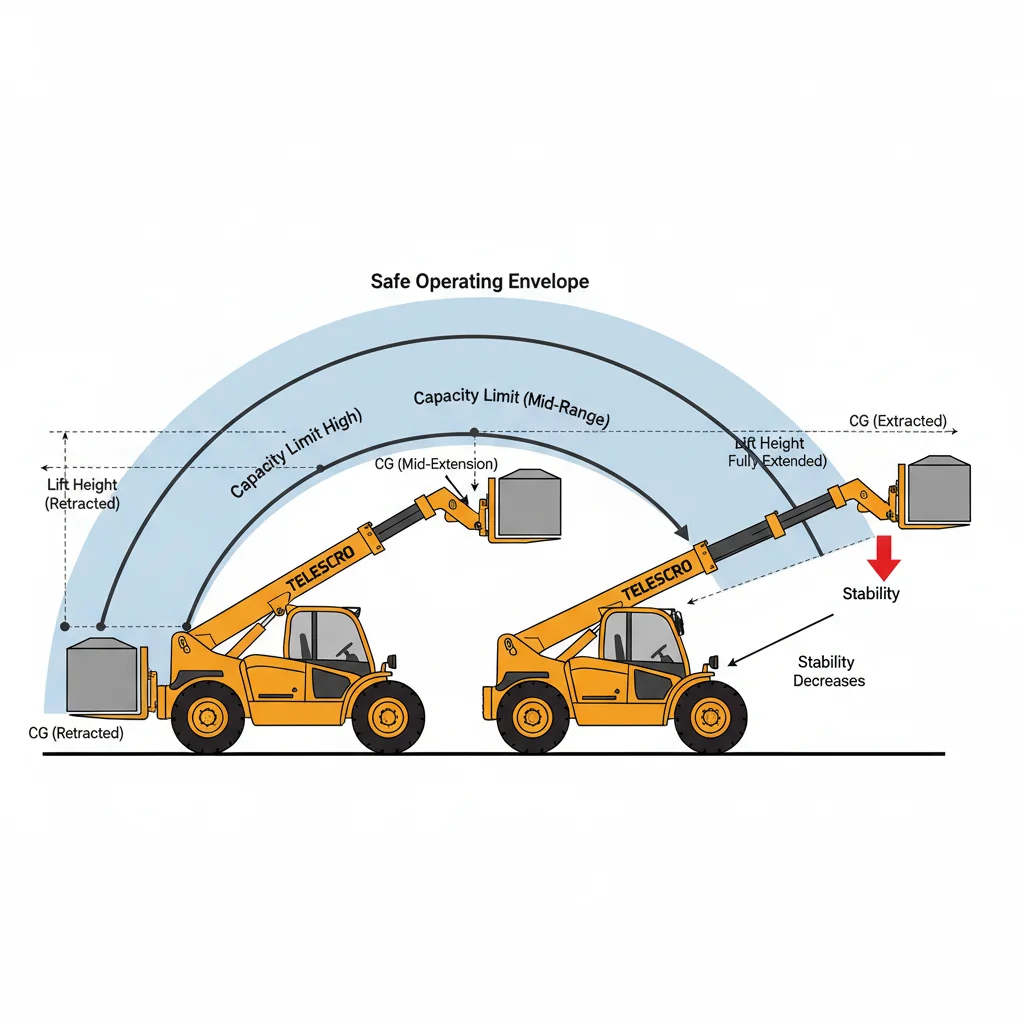
Let me share something important about the telehandler working envelope—many people see the big lift height and rated capacity in the brochure but skip the details hidden in the load chart. The working envelope is not just a suggestion, it’s a map showing exactly what’s safe at every combination of boom extension and height. The moment you extend the boom or raise the load, the center of gravity shifts forward. Stability drops fast, even if you’re nowhere near the machine’s nominal rating.
I once worked with a contractor in Kazakhstan who ordered a 4-ton telehandler expecting it to place concrete blocks at long forward reach. On site, the allowable capacity at that outreach was far lower than the brochure rating, well below what the task required. The reason is straightforward: as the boom extends, the load’s leverage increases and the combined center of gravity moves toward the forward tipping line defined by the stability triangle, reducing the available stability margin.
The load chart—which defines reach relative to the reference point specified by the OEM (commonly from the front face of the front tire to the load center)—sets capacity limits for each position based on stability requirements and structural constraints, assuming firm, level ground and correct setup. When these envelope boundaries are ignored, stability can be lost quickly, especially on soft ground or even slight slopes.
From field experience, many tip-over incidents are not caused by exceeding the headline rated load, but by operating outside the approved load-chart envelope—often when an operator tries to reach slightly farther to clear an obstacle or place a load just beyond the planned position. These small reach increases can rapidly reduce stability, even with relatively light loads. As a practical rule of thumb, I generally advise selecting a telehandler with working capacity margin for the actual reach-and-height range used on site, rather than planning lifts right at the edge of the chart. Respecting the working envelope is about maintaining safety and consistency in daily operation, not limiting productivity.
A telehandler can tip over even when lifting well below its maximum rated capacity if the boom is extended beyond the stable working envelope.True
The rated capacity only applies within specific combinations of boom angle and extension. Outside of these parameters, the center of gravity can shift enough to cause instability and tip-over, even with lighter loads.
As long as the load is under the telehandler’s maximum capacity, its stability is not affected by boom extension or angle.False
Stability is heavily influenced by boom position because extending or raising the boom moves the load farther from the machine’s center of gravity, reducing stability regardless of the weight being below the maximum rating.
Key takeaway: The working envelope is a critical safety boundary—capacity drops sharply at maximum reach and height, regardless of the telehandler’s nominal rating. Always treat envelope limits as strict safety rules. Select a telehandler offering comfortable margin for the specific work zone to prevent tip-over risks.
Why isn’t lift height enough for telehandlers?
Selecting a telehandler by maximum lift height alone often misleads. Rated capacity sharply declines as reach and boom height increase, especially near the maximum extension. The working envelope—defined by the load chart—shows how much weight can be safely placed at specific heights and reaches, not just the headline numbers.

The biggest mistake I see is contractors picking a telehandler just because it “reaches high enough.” I’ve worked with customers in Dubai who ordered a 17-meter model, thinking it would easily place 1,800 kg pallets onto rooftops. On site, they were shocked—the load chart showed only 750 kg capacity at full extension and reach. The rest of the weight had to be manually re-handled, which wasted hours every day and forced them to rent a crane as backup.
Here’s what matters most when planning lifts: the load chart, not just the specs. That chart maps out the true working envelope—the combination of height and reach where your telehandler actually handles the weight you need. Most 4,000 kg machines can only do that rating at minimum boom extension, maybe 6-8 meters out. Push to 14 or 17 meters and usable capacity drops sharply. It’s a safety risk if the operator guesses based on just the max lift height. I’ve seen near-misses in Kazakhstan because a team tried to place bundles of rebar at max height, only to trip the moment indicator and nearly tip the machine.
To be honest, I always suggest starting with your real task: What weight, at what height, and how far out? Print out the load chart and mark your target spot. It takes ten minutes but can save thousands in last-minute changes. If you only look at brochure numbers, you’ll pay 20% more for height you don’t use—or end up with a “showroom hero, jobsite zero.”
A telehandler’s maximum lift height does not guarantee it can safely place heavy loads to that height, as capacity typically decreases significantly at full extension and reach.True
Telehandler load charts show that as the boom extends, both vertically and horizontally, the rated safe lifting capacity drops due to leverage and stability limits, making it essential to consider the working envelope rather than just height.
If a telehandler can physically reach a height, it will always be able to lift its maximum rated load to that point.False
A telehandler’s maximum capacity is only available within a limited part of its envelope, usually at minimum boom extension and close-in reach; as the boom is raised or extended, safe lifting capacities decrease substantially due to tipping and structural limits.
Key takeaway: Maximum lift height does not guarantee usable capacity at full extension. Evaluating the load chart and the true working envelope, rather than headline specifications, prevents costly on-site surprises, last-minute equipment changes, and unsafe lifting attempts. Always confirm required capacity at specific heights and reaches.
How Should Telehandler Load Charts Be Read?
Telehandler load charts use the forward reach (measured from the front tire edge to attachment load center) and lift height axes to define the safe working envelope. Capacity zones are based on a specified load center, typically 600 mm or 24 in. Always plot actual job requirements on the full load chart4, not just by headline capacity.

Last month, a project manager from Dubai called me in a panic—he had a 4-ton telehandler that couldn’t safely lift 1,800 kg pallets to the edge of a fourth-story slab, even though the brochure said “4,000 kg capacity.” The truth is, those headline numbers only apply at minimum reach, close to the wheels, and with a specific load center (usually 600 mm or 24 inches). On the load chart, capacity drops sharply as you extend the boom forward or lift higher. I pulled up the machine’s full load chart with him on video call. At 10 meters of height and 7 meters of forward reach, the safe working limit was just under 1,200 kg—not enough for his application.
Here’s what matters most when reading a telehandler load chart: always reference both axes—the horizontal axis is forward reach (measured from the front edge of the tires to the load’s center), while the vertical shows lift height. The colored areas or lines across the chart mark capacity zones. Plot your actual job requirements—don’t just assume “it should work” based on tonnage class. Telehandlers in the same tonnage can differ a lot in what they can handle out at full stretch because of differences in chassis weight, boom design, or tire configuration.
To be honest, I never recommend working right at the edge of the chart—leave a working margin for uneven ground, wind, or small miscalculations. I’ve seen jobs in Kenya go sideways when operators pushed to 100% of rated load at height. Check your requirements at each point and choose your machine based on those plotted positions, not just the spec sheet headline.
A telehandler’s load chart shows significantly reduced lifting capacity at maximum forward reach compared to when the boom is retracted.True
This is true because as the boom extends, the load's leverage over the telehandler’s front axle increases, requiring the rated capacity to be reduced to maintain machine stability.
If the rated capacity is advertised as 4,000 kg, the telehandler can safely lift this weight to its maximum height and reach without consulting the load chart.False
This is false because the rated capacity is only valid at a minimal boom extension and with the load close to the front wheels; at greater heights or reaches, the safe lifting capacity decreases substantially, making the load chart essential for safe operation.
Key takeaway: Relying on a telehandler’s rated or maximum capacity without referencing the full load chart can result in unsafe or unsuitable choices. Actual job needs—by reach and height—must be plotted on the chart, with working margin built in. Tonnage class or headline numbers do not guarantee safe performance.
How do attachments affect telehandler capacity?
Every telehandler attachment—such as forks, side-shift carriages, buckets, jibs, and work platforms—changes the load center and working envelope. This shift often reduces allowable capacity at a given height or reach. Load charts are attachment-specific; buyers should always reference charts for both actual attachments and load types used on site.

Here’s what matters most when it comes to telehandler capacity: every attachment you add changes how much you can safely lift. It’s easy to look at the base machine’s rated capacity—let’s say 3,000 kg at 7 meters—and assume that covers every job. That’s a mistake I see across jobsites, from Korea to Brazil. The moment you swap out standard forks for a bucket, work platform, or jib, both the attachment weight and the new load center start eating into your allowed capacity.
For example, last winter a customer in Kazakhstan fitted a material bucket to their 4-ton telehandler, expecting close to full lift at 10 meters. But, the bucket’s extra weight plus the load’s distance from the boom meant their real capacity dropped to just over 1,000 kg at full extension. That meant double the trips—and much longer unloading times. To avoid surprises like this, always have the right load chart for the exact attachment and material you’ll use.
Here’s how different attachments can impact your working envelope and safe capacity:
- Forks – rated for the machine’s published load at 600 mm load center
- Buckets – shift load farther forward, reducing allowable capacity
- Side-shift carriages – add extra weight, slightly decreasing rated load, but improving placement accuracy
- Jibs or truss booms – extend load center dramatically; expect major capacity reduction
- Work platforms – lowest capacities, strict rules for operator plus platform weight
I always advise sizing your telehandler for the most limiting attachment and load type—not just the nameplate rating. Double-check the manufacturer’s load chart every time your task or attachment changes. That’s real-world safety.
Using a jib attachment on a telehandler not only adds its own weight to the load but also shifts the load center further forward, significantly reducing the machine's maximum safe lifting capacity compared to standard forks.True
The further the load is positioned from the telehandler's front wheels, the greater the leverage exerted on the machine. Jib attachments increase the distance to the load center, so the rated capacity must be reduced to prevent tipping and structural overload.
Once a telehandler's rated capacity is established with forks, switching to any manufacturer-approved attachment will not require further capacity adjustments.False
Even with manufacturer-approved attachments, every additional attachment alters both the weight and the load center characteristics. Operators must always recalculate the allowable capacity based on the specific attachment and its influence on balance and stability.
Key takeaway: Selecting a telehandler by rated capacity alone is risky. Always review manufacturer load charts for the specific attachments and load types required. The most limiting combination—not the base machine—defines real-world working envelope and safe capacity on site.
How do site layout and ground affect reach?
Telehandler working envelope is often reduced on real sites due to ground conditions and obstacles. Fencing, traffic, trenches, or nearby structures mean machines rarely park at the building line. These setbacks push the boom deeper into the forward-reach zone, where rated capacity is significantly lower than on paper. Site-specific planning is essential for safe, effective operation.
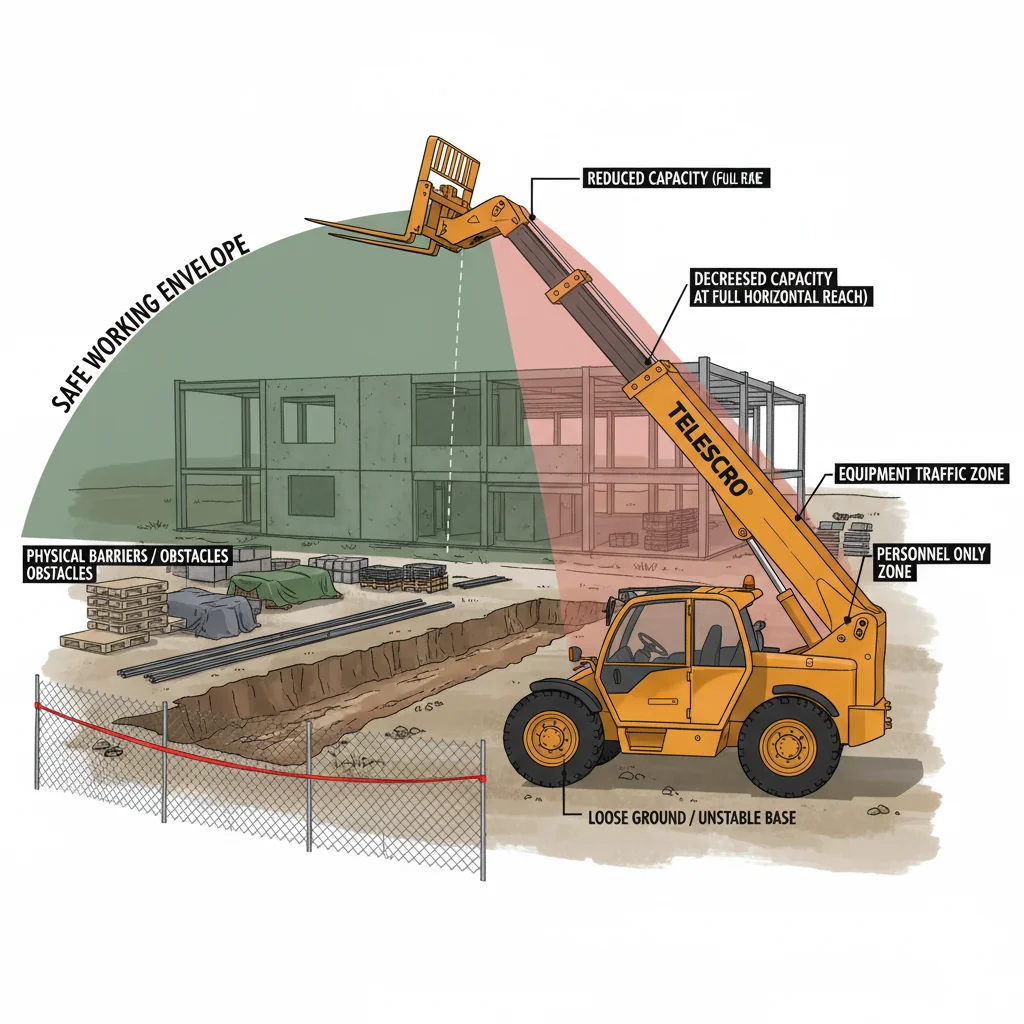
Last month, a contractor in Kazakhstan shared photos of a site where their telehandler was forced to park well back from the building line. Uneven ground, open trenches, and temporary fencing blocked direct access, preventing the machine from working at minimum reach close to the structure.
Instead of lifting in the most stable zone—where load charts show the highest allowable capacities—the operator had to boom out significantly farther to reach over these obstacles. As a result, the usable capacity at the required reach and height was far lower than the machine’s headline rating, even though the telehandler itself was operating normally.
This situation is more common than many buyers expect. The working envelope shown on load charts is defined using the reference point specified by the OEM (commonly the distance from the front face of the front tire to the load center) and assumes firm, level ground. Real job sites rarely match these ideal conditions. Scaffolding, traffic lanes, backfilled pits, stored materials, or exclusion zones often force machines to stand farther back than planned.
Every additional meter of setback pushes the boom deeper into the forward-reach zone, rapidly reducing allowable capacity. Even when a site appears flat, soft ground or minor slopes can further reduce stability and invalidate load-chart assumptions. While leveling systems can help manage chassis attitude, they do not change the underlying physics. My approach is simple: sketch the site layout, mark all setbacks and obstacles, and measure the true horizontal distance to every critical placement point before finalizing telehandler selection.
A telehandler's rated lifting capacity can decrease substantially when boomed out to reach over site obstacles, even if the maximum height is not being used.True
Telehandler capacity charts rate lifting at minimal reach, but real-world site conditions like trenches and fences often force operators to extend the boom. The farther the load is from the tires, the greater the tipping risk, so capacity drops significantly even at lower heights.
If a telehandler is positioned farther from a building due to site layout, its load capacity at maximum boom extension remains the same as when positioned close to the structure.False
Lifting capacity decreases as the boom is extended farther out, regardless of positioning relative to obstacles. The increased distance increases leverage on the machine, reducing stability and safe carrying weight.
Key takeaway: The theoretical working envelope shown in telehandler load charts5 is often much larger than what is physically usable on real job sites. Site layout, ground quality, setback distances, and obstacles force operators to use the boom at longer reaches, which greatly reduces lifting capacity and limits usable height.
When is a compact telehandler superior?
For most construction and agriculture tasks, a compact or mid-size telehandler with a wide working envelope at 6–12 meters often outperforms taller 17–18 m models. These machines deliver higher rated capacity at moderate heights, offer better manoeuvrability, lower purchase cost, and increased productivity in confined, real-world job sites.

To be honest, I see many buyers drawn to the tallest telehandler in the lineup, thinking bigger is always better. But in most construction and agricultural settings, that’s not the case. Maximum lift height looks impressive in a brochure, but most real tasks—whether it’s loading sand into a truck bed or stacking feed bales in a barn—need strong capacity within 6 to 12 meters. That’s where a compact or mid-size telehandler leaves the tall models behind.
One project in the Philippines stands out. The contractor thought they needed a high-reach 18-meter telehandler for a tight city jobsite. But after reviewing their actual daily lifts, we switched them to a compact 3-ton model rated for 9 meters with a wide working envelope. The result? Faster cycle times, safer operation between the rebar and scaffolding, and no worries about losing lifting power as the boom extended. On many machines, rated capacity drops sharply near maximum reach, but compact models keep higher capacity through most of the boom range.
I’ve seen similar patterns on mid-size farms in Eastern Europe. A 2.5-ton compact telehandler with a turning radius under 4.5 meters easily navigates sheds and orchard rows, while a larger unit struggles with site access and costs much more to maintain. The reality is, unless your main task is placing loads on a five-story building, a “fat” working envelope at moderate height does the actual job better.
I suggest mapping your key lifting points, then comparing load charts at those heights—don’t let brochure numbers blind you to what actually works on your jobsite.
A compact telehandler often offers a tighter working envelope, allowing operators to maneuver efficiently in confined sites where a full-size telehandler would struggle to access or reposition.True
A compact telehandler’s smaller chassis and reduced boom overhang make it easier to navigate tight indoor areas or densely built job sites, which are common in urban construction and farm settings. This improves productivity and reduces risk of site damage compared to larger, high-reach models.
The highest-reaching telehandler is always the best choice for any job site, since more lift height universally means more versatility.False
Higher reach often comes at the cost of maneuverability and suitability for restricted spaces. In real-world scenarios, most tasks don’t require maximum height; instead, a properly matched working envelope for the site’s dimensions and load placement needs leads to better overall performance and safety.
Key takeaway: Choosing a compact or mid-size telehandler with ample capacity at moderate heights frequently delivers better results than focusing only on maximum lift height. This approach improves efficiency, site access, and load handling for most actual tasks in construction and agriculture while minimizing unnecessary cost and complexity.
Does Working Envelope Impact Telehandler Wear?
Operating a telehandler near the limits of its working envelope increases stress on boom sections, pads, pins, and extension chains6. Frequent use at maximum reach accelerates component wear, raising maintenance needs. A telehandler with a generous working envelope for typical tasks maintains smoother operation, minimizing overload events and extending component life.

I get a lot of questions about whether running a telehandler at the edge of its working envelope really makes a difference in wear. The reality? It absolutely does. Think about a site in South Africa where a customer was hoisting concrete blocks to nearly the full 14-meter reach, shift after shift. They started seeing pad and pin wear in less than six months—about half the time I’d expect if most lifts were kept at 60–70% of boom extension. That sort of stress, especially near max forward reach, doesn’t just affect the boom sections; it impacts extension chains and those sliding wear pads inside the boom, too.
What happens is simple physics. When you’re constantly close to chart limits, every movement puts higher forces through the entire structure. The hydraulic circuit has to work harder, you get more moment indicator alarms, and the smallest miscalculation puts the machine at risk of stability warnings or even downtime. For comparison, another customer in Brazil switched to a model with 11-meter maximum reach but almost never used more than 8 meters for their prefab wall panels. Their telehandler needed less frequent pin adjustments, and boom retraction was always smoother—less grinding, less noise, and a noticeably steadier chassis.
So I always suggest: match the machine’s envelope to your real site tasks, not just the biggest one-off lift you might ever need. Give yourself a margin—operating well inside the load chart means longer life for your wear components and fewer surprise repairs down the road.
Operating a telehandler frequently near the maximum reach of its working envelope accelerates pin and pad wear due to increased leverage forces on the boom and chassis joints.True
At full or near-full extension, the forces acting on the telehandler's structure multiply, increasing stress on booms and articulation points. This leads to faster mechanical wear than at moderate extensions.
The working envelope of a telehandler only affects its ability to lift loads safely and has no impact on equipment wear rates.False
Operating at the limits of a telehandler's working envelope increases mechanical stress, which directly contributes to faster component wear, especially in areas like boom pins and pads.
Key takeaway: Selecting a telehandler with a working envelope suited to routine site tasks—rather than operating at chart limits—prolongs boom life, reduces adjustment and replacement frequency, and keeps overall maintenance costs lower. Always match model specifications to real-world reach and height requirements for maximum reliability.
How to Check Telehandler Working Envelope?
To verify whether a telehandler’s working envelope truly fits the job, always request the full OEM load chart and any available reach-and-height envelope diagrams for the specific model and attachment configuration. Where possible, use CAD or DXF data to overlay the machine’s working envelope onto the actual site layout. Plot critical delivery points—including required heights, horizontal setbacks, and obstacles—against these references to confirm that both reach and allowable capacity are sufficient and safe under real site conditions.

Let me share something important about verifying a telehandler’s real working envelope: marketing specs like “17-meter reach” rarely match jobsite reality. I’ve seen this play out in Turkey, where a customer picked a machine for roofing panels purely based on brochure stats. When we did a true fit check, the boom would only reach their setback point at 14 meters, not 17. Even worse, the rated capacity at that outreach dropped by almost half—about 1,100 kg, not the 2-ton figure in bold on the first page. That was a costly lesson they didn’t forget.
The smartest way to check fit is to ask for three things: the model’s full load chart, a 2D working envelope diagram, and—if you want to be certain—a CAD or DXF file to overlay on your actual building plan. Mark your key delivery points and obstacles right on the diagram. For example, in a project I helped in Kenya, their material needed to be lifted 10 meters high, but the real challenge was a 4-meter setback behind scaffolding. Once we overlaid the envelope, it was clear only a 15-meter class model with at least 2-ton capacity at that reach could do the job safely. A cheaper 12-meter model wouldn’t make it.
Don’t forget to request load charts for the exact attachment you’ll use, since a bucket or jib can change the capacity numbers. I always remind customers in Europe and Southeast Asia: a telehandler’s “envelope” is defined by what’s safe, not what looks good on paper. My advice—turn the manufacturer’s data into a clear site overlay before you commit. This small extra step saves major headache and cost every time.
The actual reachable distance and lifting capacity of a telehandler can be substantially less on-site than what is stated in manufacturer brochures, due to real-world factors like boom angle, load weight, and obstructions.True
Manufacturer specifications are often recorded under ideal conditions. On real jobsites, uneven ground, actual load centers, and physical barriers restrict the machine’s working envelope, reducing both reach and safe lifting capacities.
If a telehandler’s brochure lists a maximum reach height, you can always rely on achieving the same performance on any construction site regardless of the machine’s surrounding environment.False
Site-specific variables such as setbacks, obstacles, load weight, and necessary boom angles often limit a telehandler’s real working envelope, making brochure figures unreliable benchmarks for actual jobsite performance.
Key takeaway: Reliance on marketing claims for telehandler reach or height often leads to under- or over-specification. A data-driven fit check—using OEM-provided load charts, 2D envelope diagrams, and site CAD overlays—ensures the working envelope truly matches project needs and avoids costly selection errors.
Conclusion
We looked at why the real working envelope matters more than the telehandler’s max height spec—especially for most everyday placements. From my jobsite visits, I’ve seen too many buyers focus on the big number and end up with a machine that’s a “showroom hero, jobsite zero.” The details on the load chart and usable reach often get missed, but they make all the difference once work starts. If you want practical advice or need a hand comparing working envelopes for your tasks, feel free to reach out. I’m happy to share what’s worked on real jobsites across different countries. Every site has its quirks—let’s find what truly fits your workflow.
References
-
Understand how forward reach affects telehandler lifting capacity and job planning to prevent overloading and accidents. ↩
-
Details how load charts reveal true capacity at various heights and reach distances, preventing overestimation and unsafe lifting on construction sites. ↩
-
Learn about the importance of rated capacity and how compact models maintain lifting power throughout most of the boom range for safer operation. ↩
-
Detailed guidance on interpreting telehandler load charts ensures safe lifting limits and prevents costly accidents on site. ↩
-
Explore detailed guidance on interpreting telehandler load charts to enhance safety and optimize material handling on construction sites. ↩
-
Understand the impact of stress on extension chains during maximum reach operations and methods to prolong their life. ↩