










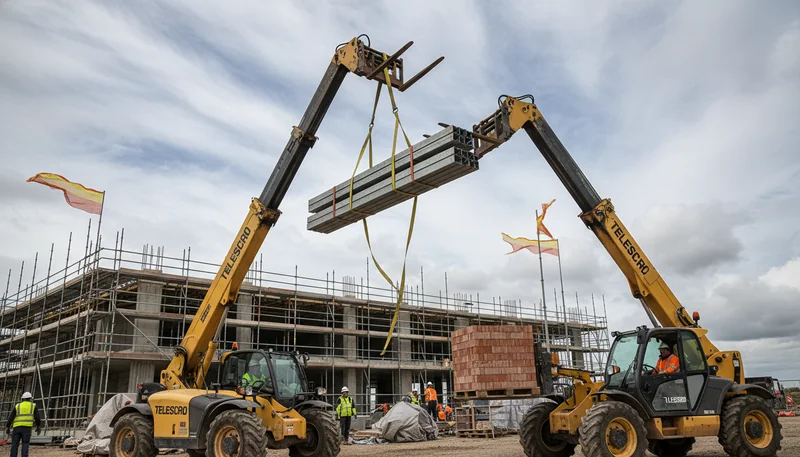
Telehandler Wind Limits: When Lifting Specs Stop Applying (Field Guide)
Earlier this spring, a team in Denmark called after a near-miss with a loaded jib—gusts came up, and suddenly the telehandler rocked harder than they’d ever felt. It wasn’t the weight that almost toppled them, but something far less obvious: wind speeds that crept over the machine’s rating.
Manufacturer-issued telehandler load charts remain valid only when the OEM’s stated operating conditions are met—most critically the maximum allowable wind speed1 for the specific telehandler and approved attachment. If wind exceeds that limit, the published rating no longer applies because lateral wind forces add overturning moment on the boom and load. Large “sail area” loads, suspended loads, and work platforms typically require stricter limits, so always follow the lowest wind rating stated for the machine, attachment, and lift plan.
When Do Telehandler Load Charts Fail?
Telehandler load charts fail whenever site conditions exceed the manufacturer’s stated limits—especially the maximum permitted wind speed for the specific machine and attachment. Once wind is above that stated limit, published rated capacities no longer apply and the lift must be stopped or postponed; do not “self-derate” and continue above the limit. Always use the most restrictive wind limit from the telehandler, the attachment, and the site lifting procedure.
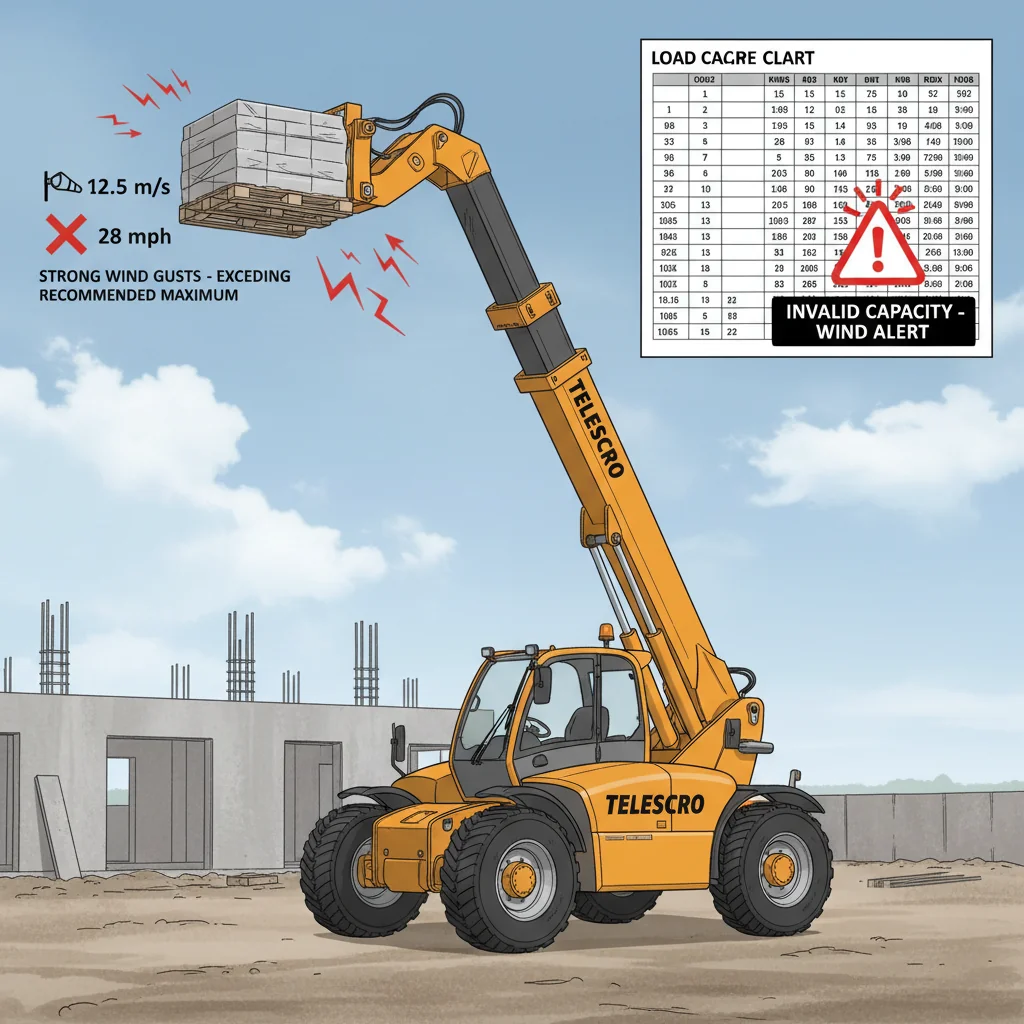
Most people don’t realize just how quickly a telehandler’s rated capacity can become meaningless if wind speeds pick up. Last summer, I was working with a site manager in Dubai. He called me in a panic because his team had started a lift with a 4-ton, 17-meter telehandler using a work platform. Suddenly, the wind jumped above 12 m/s. At that point, the operator’s instinct was to “just take it a bit slower,” but I had to make it clear: once wind exceeds the manufacturer’s limit—usually 9–12.5 m/s, depending on the machine and attachment—the published load chart is invalid. No amount of caution or ‘going easy’ can override that.
The reality is, load charts are engineered on strict prerequisites: level ground, specified attachment, known load center, and—most critically—maximum permitted wind speed. If any of those factors change, even by a small margin, the safe working envelope shrinks or disappears. I’ve seen crews in Kazakhstan try to “build in their own derating” when weather turns. But telehandler stability doesn’t allow for guessing. There’s no formula like “just lift 70% of charted weight above the wind limit.”
Here’s what I tell all my customers: always verify the wind rating for your exact telehandler and attachment combination. Treat that maximum speed as a hard ceiling, not a guide. On exposed sites or high-rise jobs, many contractors choose to stop work a few meters per second below the manufacturer’s limit to account for gusts and measurement uncertainty. That margin is what helps keep crews—and machines—out of trouble when wind conditions change quickly or readings aren’t perfectly accurate.
A telehandler’s load chart becomes unreliable if wind speeds exceed the manufacturer’s specified maximum, even if the machine is lifting less than the rated capacity.True
Wind forces acting on the load can dramatically increase tipping risk, overriding the safe limits indicated on the static load chart regardless of actual weight being lifted.
Using a work platform on a telehandler with a load below its maximum capacity is always safe, regardless of wind conditions.False
Work platforms increase wind-exposed surface area, making the operation much more susceptible to wind forces—exceeding the manufacturer's wind speed limits makes even light loads unsafe.
Key takeaway: Load charts are no longer valid above the maximum wind speed specified by the manufacturer for each machine–attachment combination, commonly 9–12.5 m/s. Always treat this as an absolute ceiling, building in a margin to account for gusts and potential measurement error.
How does wind impact telehandler stability?
Wind applies a significant sideways force to a telehandler’s boom and load, generating an overturning moment2 around the front axle tipping axis. Stability risk rises sharply with long boom extensions, high lift heights, lighter chassis, and crosswinds3. Even within rated capacity, moderate to strong winds can push telehandlers close to tipping, especially on rough or sloped ground.
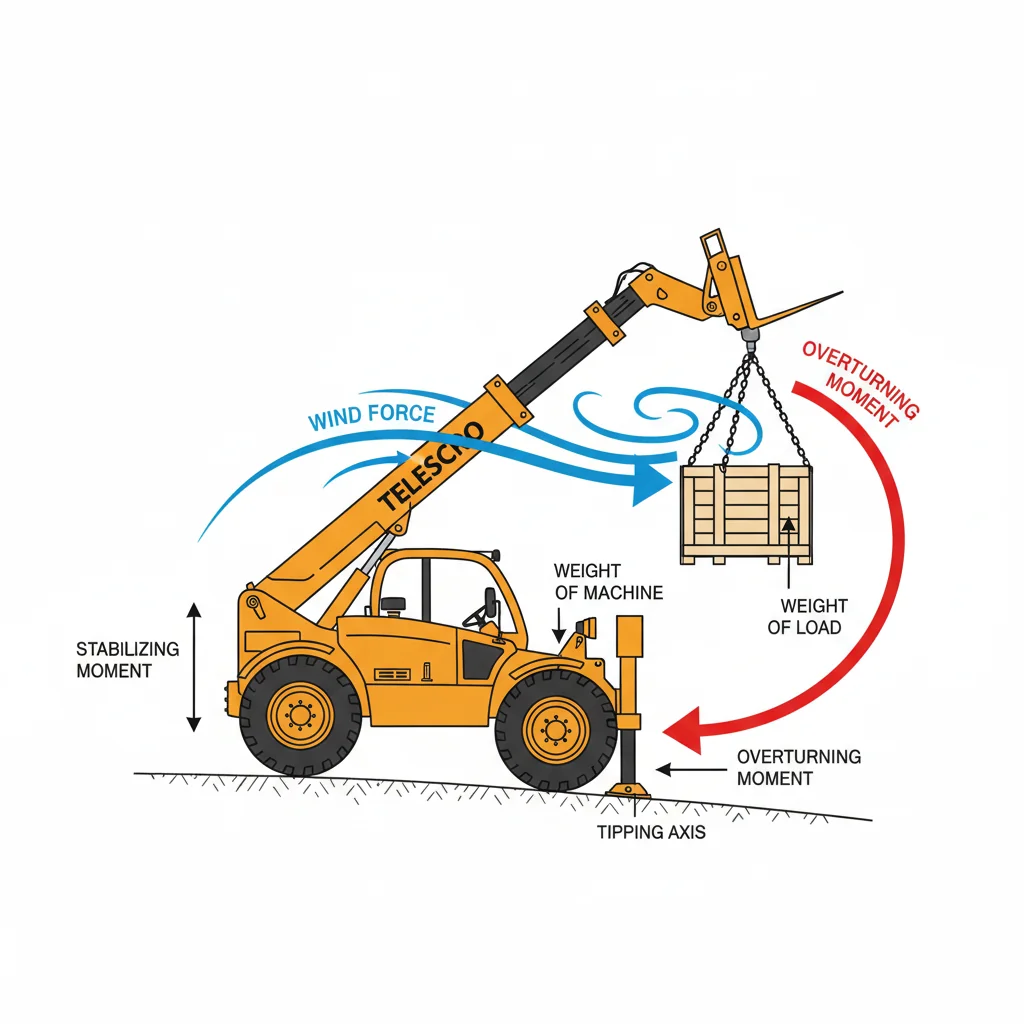
Let me share something important about wind and telehandler stability—this is a topic that gets missed in the showroom but hits hard on site. Wind acts like a massive invisible hand, pushing sideways on the boom and load. That force creates an overturning moment around the front axle line, which is the tipping axis for stability. I’ve seen even 4-ton telehandlers with the boom fully extended—say, reaching 17 meters—get worryingly light on the rear tires with a stiff crosswind.
A real example: last year in Kazakhstan, one of my customers needed to lift insulation panels to the fifth floor, about 14 meters up. The load itself was within rated capacity, but strong afternoon winds—gusting over 35 km/h—made the telehandler rock dangerously on rough, uneven ground. Even though everything looked fine on paper, that side force pushed the machine close to its tipping point. Stabilizers might help in some cases, but most high-lift telehandlers only have front stabilizers or rely on their tires. The risk climbs fast with long booms, tall lifts, and lighter chassis.
Here’s the reality: load charts are built on calm, level test conditions—usually less than 3° tilt, almost no wind. Once you add wind, especially at full extension, the safe working load is absolutely lower than what the chart says. I always suggest if wind is expected, either use a larger-capacity machine, keep the boom retracted, or delay the lift. Field safety beats pushing a spec to its technical edge every time.
Strong lateral wind can require operators to derate the telehandler’s maximum lift capacity, even if the ground is level and the load chart is observed.True
Wind pressure on a fully extended boom increases the risk of overturning, so manufacturers and safety guidelines may advise reducing the rated load limit under high wind conditions, regardless of other factors.
Wind has minimal impact on telehandler stability as long as stabilizers are deployed and the load chart is followed.False
Stabilizers and load charts are designed for static conditions; wind introduces dynamic forces that can exceed stability expectations, so ignoring wind effects even with stabilizers is a misconception and increases accident risk.
Key takeaway: Telehandler rated capacity assumes low or specified wind levels on level ground. As wind increases, especially at long reach, safe working capacity is less than the load chart value. Always provide extra safety margin—use larger machines, reduce boom extension, or postpone lifts in high winds.
Why do bulky loads derate in wind?
Bulky, lightweight loads derate in wind because telehandler stability is governed by the load’s exposed “sail area4,” not just its weight. Industry guidance uses exposed area-to-mass criteria to classify wind-sensitive loads and shows that permissible wind speeds must be reduced significantly compared with compact, dense loads, sharply increasing overturning risk.
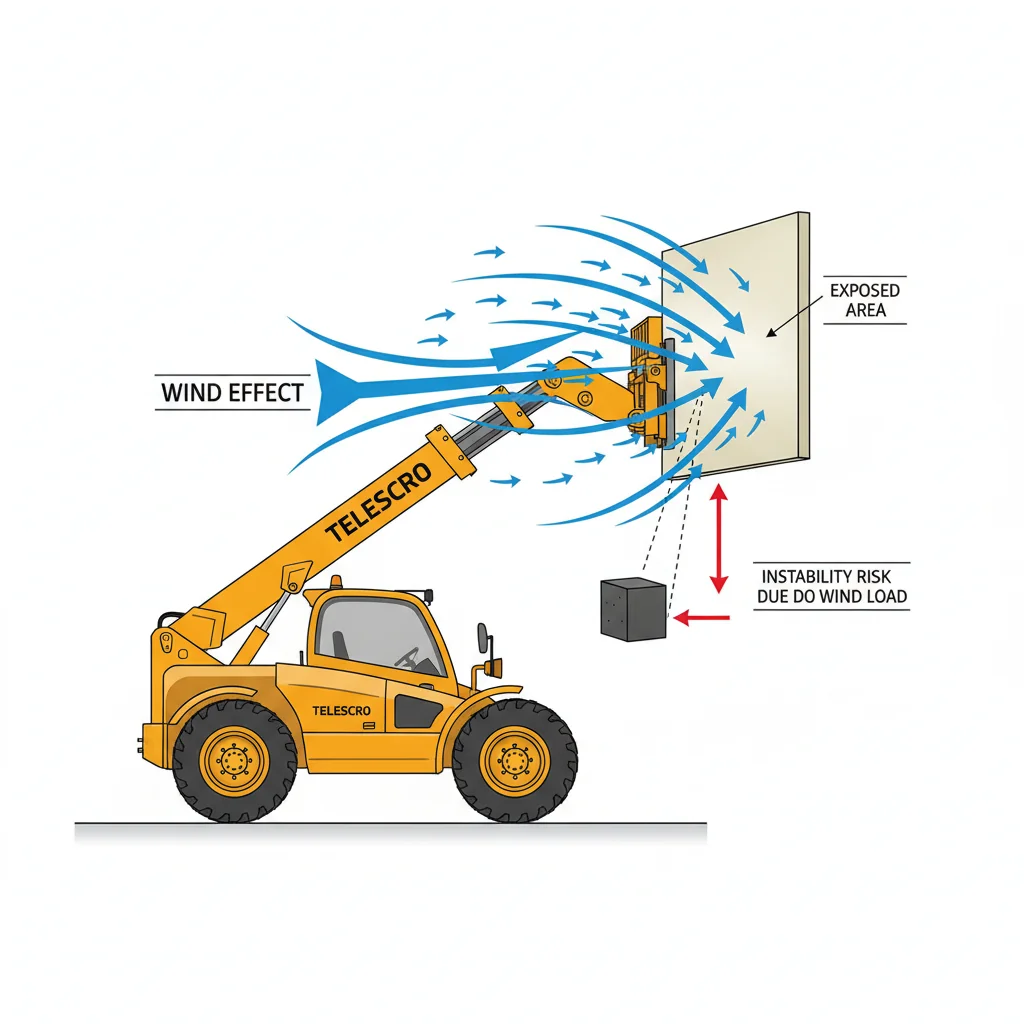
Here’s what matters most when you’re handling big, flat, or lightweight materials with a telehandler—don’t let the load’s weight fool you. On windy days, the real danger isn’t just the load’s mass. It’s how much area the wind can push against—engineers call this “sail area.” I’ve seen companies in Dubai try to lift 12-meter-long roof panels, weighing only a ton, on scaffolding jobs. Wind barely above 10 m/s was enough to set the whole machine rocking, even though the load chart showed they were under rated capacity for that height.
The biggest mistake I see is relying on load charts as if all one-ton loads behave the same. That’s not true once you lift something with lots of exposed surface—like cladding sheets or insulation panels. The wind turns these items into giant sails, generating massive sideways force. Industry guidance, including in the CPA rules I reference for export customers in the UK and South Africa, shows that when you double the exposed area per tonne, your allowable wind speed might drop by 60–80%. So, what’s totally safe with a tight pallet of bricks often becomes dangerous with big, flat panels.
From my experience, every machine operator who’s been caught by a sudden gust with a large sail-area load remembers it. You get a huge increase in overturning moment—the tipping risk jumps even when the load weight doesn’t change. Treat sail area as a critical spec. If you’re moving something big and flat, consider using a larger telehandler, keep the load closer, and be ready to postpone. I always suggest checking sail-area guidance before you trust what the load chart alone tells you.
Telehandler load charts often do not factor in wind speed for bulky or flat loads, meaning operators must make manual derating decisions based on wind conditions and sail area.True
Most telehandler load charts assume compact, dense materials and calm conditions. Bulky loads like roof panels create large 'sail areas' that catch wind, increasing the risk of tipping or loss of control. Wind effects must be judged by the operator or qualified supervisor, as standard charts don't capture these variables.
A telehandler’s lifting capacity in wind is determined solely by the weight and shape of the load, and not by its position or boom extension.False
The capacity is also highly dependent on where the load is positioned relative to the machine, especially as the boom extends. The moment (a combination of weight and distance from the chassis) and the increased leverage at longer boom extensions make wind effects much riskier, even with lightweight or flat materials.
Key takeaway: Wind derating for telehandlers is driven by the load’s exposed area, not just mass. Large, light, or flat items (e.g., panels, insulation) create much higher wind forces at modest speeds, so always treat sail area as a critical parameter when applying lifting specs and operational decisions.
When Are Telehandler Suspended Loads Unsafe in Wind?
Suspended loads and man baskets on telehandlers are far more wind-sensitive than pallet fork operations. For suspended loads, manufacturers and attachment manuals typically specify much lower allowable wind limits or require additional controls, reflecting the increased swing and side-load risk. For man baskets, personnel lifting is only permitted within the wind limits stated by the basket or OEM—often significantly lower than fork operations—and must cease once those limits are reached, regardless of how stable the machine appears.
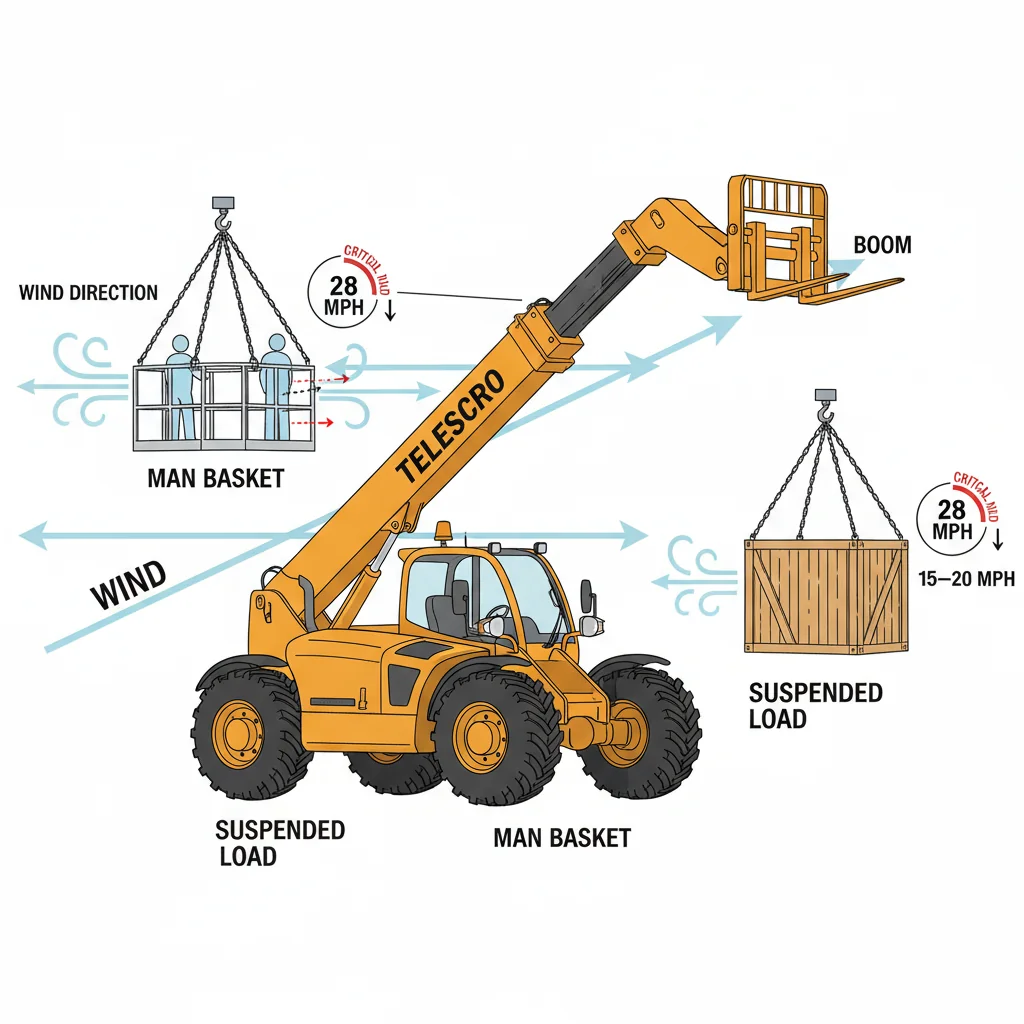
The biggest mistake I see is assuming that if your telehandler is stable with pallet forks, you’ll be fine lifting with a hook or man basket—even when the wind picks up. That’s a dangerous shortcut. Suspended loads—whether it’s a bundle of rebar on chains or a spreader beam—are much more sensitive. The wind catches them, starts a swing, and even a small gust can build momentum. I had a customer in Morocco trying to place HVAC units with a 4-ton telehandler rated at 17 meters. When wind hit about 10 m/s, the load began to sway, putting side loads on the boom that weren’t on the original load chart. He stopped just in time, and admitted the pallet work would’ve felt safe—but the suspended lift was a different story.
Here’s the thing—most manufacturers set strict wind limits for suspended loads, usually capping it at 7–9 m/s (about 15–20 mph), which is much lower than most people expect. With man baskets, industry standards and most OEMs draw the red line at 12.5 m/s (28 mph). I’ve had experienced crews in Dubai push their luck because the machine ‘felt stable’ with two people in the basket. But the rules are hard lines—even if the telehandler sits flat, you can’t risk it.
So, always check your specific telehandler’s load chart and attachment manual. The lowest wind limit applies, whether it’s from the machine or the basket. If winds are near the threshold, I suggest stopping suspended and personnel lifts first—even if you can keep working with forks a bit longer. It’s not just about feeling safe, but being safe.
Wind speeds that are safe for pallet fork operations can become unsafe for suspended loads due to increased surface area and swing potential, even if the load weight remains within rated limits.True
Suspended loads act like pendulums and have more surface area exposed to wind, making them less stable; telehandler stability charts for forks do not account for this dynamic risk.
As long as the rated capacity is not exceeded, a telehandler can lift suspended loads safely in any wind conditions permitted for pallet fork use.False
Suspended loads behave differently from rigid fork loads because wind can cause them to swing or drift unpredictably; following only the static rated capacity overlooks these dynamic forces, which can easily lead to tipping or loss of control.
Key takeaway: Telehandler wind limits for suspended loads and man baskets are stricter than for forks. Always follow the lowest applicable limit based on the OEM’s load chart or attachment rating. Cease lifting people or suspended loads early in marginal wind conditions, even if basic pallet work could continue.
How to measure wind at telehandler boom tip?
Wind conditions at a telehandler’s boom tip can be significantly stronger and more gust-prone than ground-level forecasts due to height and site exposure. Ground-based weather apps often underestimate this risk. Best practice is to measure wind as close as practical to the boom tip using an anemometer5, and to base stop decisions on measured peak gusts6 rather than average wind speed.
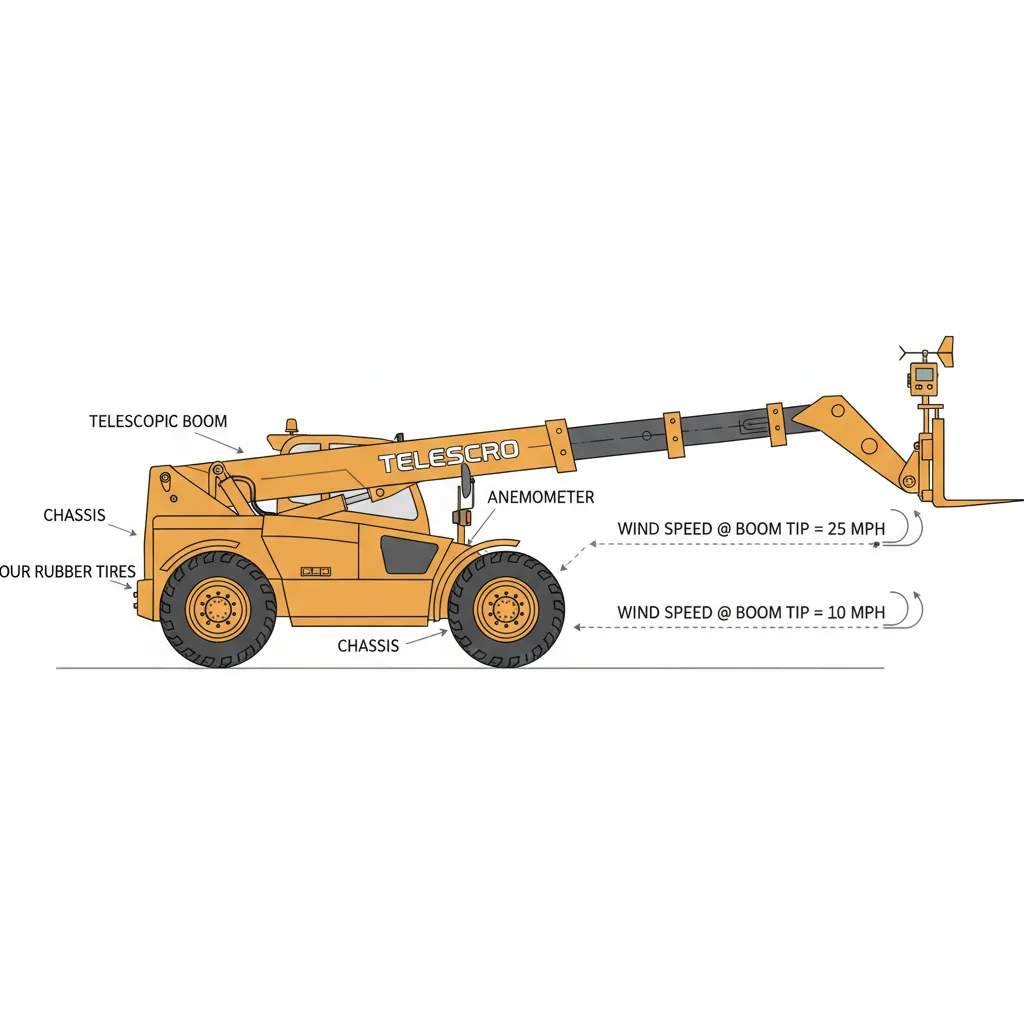
I’ve worked with customers who made this mistake—trusting the wind readings from a phone or a ground-level weather station. Last year, a team in Dubai called frustrated: their 17-meter telehandler started rocking at height, even though their weather app said the wind was under 9 m/s. The reality on the boom tip? Their small hand-held anemometer later showed gusts shooting up past 13 m/s. It’s not just a Dubai problem. I’ve seen similar issues on sites near the sea in southern China and at exposed projects in Turkey. Wind stacks up with height, and if your boom tip is sticking out above the roofline, site geometry can funnel gusts even higher.
Best practice is to mount a compact anemometer right on the boom tip, using a steel clamp or even strong tape if there’s no bracket. If that’s not possible, the highest scaffold or the jib end of a nearby crane works as a decent alternative, but always double-check conditions match your work zone. Be sure you’re watching for peak gusts—not just the average. On our projects in Kazakhstan, the measured gusts were sometimes 30% higher than the 10-minute average on the ground.
To be honest, I always suggest stopping work 2–3 m/s before you hit the limit shown in the telehandler’s manual. This gives you a buffer for those sudden spikes and the slight lag between real gusts and what your meter displays. No instrument? Use visual cues like large tree branches bending, and play it safe—better a short delay than a serious accident.
Wind speed at the telehandler boom tip is often significantly higher than at ground level due to less shielding and increased exposure at elevation.True
Wind speed typically increases with height above ground because there are fewer barriers and surface friction is reduced. This means wind measurements taken at ground level can underestimate conditions at the boom tip, leading to unsafe lifting situations if not properly accounted for.
Relying on ground-level weather app wind readings is sufficient to determine if telehandler lifting operations can proceed safely at full boom extension.False
Weather app readings or ground-level wind measurements do not account for localized gusts and increased wind speeds that can occur at the boom tip's height. Safe lifting requires wind measurement directly at the working height, as conditions aloft can differ markedly from those at ground level.
Key takeaway: Wind at telehandler boom height can far exceed ground measurements, leading to underappreciated risk. Always measure wind with an anemometer at or near boom tip and set operational wind stop rules 2–3 m/s below OEM maximums to account for gusts and measurement lag.
What Are Safe Wind Limits for Telehandler Lifting?
Telehandler wind speed limits are set by the specific manufacturer, but many OEMs reference a maximum around 12–12.5 m/s (28 mph) for lifting. However, contractors often enforce lower operational thresholds—typically halting sensitive, high-reach, or large area lifts at 7–10 m/s—and always observe the OEM’s published maximum as an absolute limit.
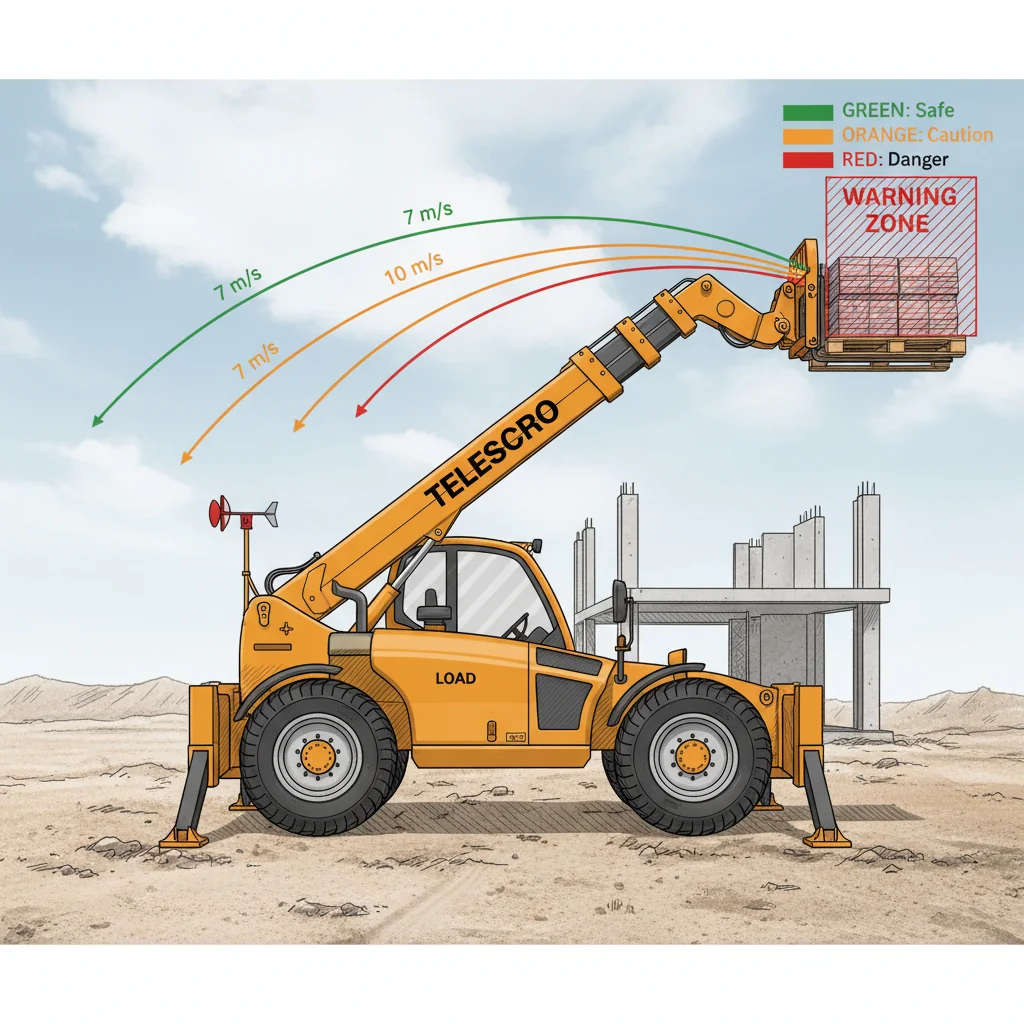
To be honest, the spec that actually matters is the wind speed limit set by your telehandler’s manufacturer—not some number copied from MEWP manuals. There’s no universal value. I’ve seen manuals for a 4-ton, 18-meter machine allowing lifts up to around 12 m/s (about 28 mph), but that’s always the absolute maximum. In real jobsites, especially in places like coastal Vietnam or Northern Europe where gusts can pick up fast, no site manager wants to flirt with that threshold. The risk for overturning or losing a long panel to a sudden gust just isn’t worth it.
Last month, a contractor in Dubai called after a high-reach lift got postponed for wind. Their operation manual allowed 12.5 m/s, but the site safety manager stopped all lifts at 9 m/s. Why? Because they were handling large cladding panels—basically giant sails in the wind. For these types of loads, I always suggest getting more conservative, pausing at around 7–9 m/s for suspended, high-reach, or “sail area” lifts. If you’re moving compact pallets at low boom angles, maybe you can run up close to the OEM limit. But every “special” lift—glass, formwork, anything with surface area—deserves stricter site rules.
Remember: gusts, not steady wind, cause most accidents. One project in Kazakhstan used an anemometer on the boom head and actually tracked wind every 10 minutes. Their log showed gusts 4 m/s above the average. That’s the danger zone. My advice? Always have clear wind rules in your lifting plan—who checks, what thresholds, and when to stop. Treat the OEM maximum as a hard ceiling, never a target.
Wind gusts that are sudden and unpredictable can make lifting operations with a telehandler unsafe even if average wind speeds remain below the manufacturer’s specified maximum.True
Manufacturers set wind limits assuming generally steady conditions, but unexpected gusts can destabilize loads and lead to accidents even when average wind is within limits. Operators must monitor for gusts, not just sustained wind speed.
It is safe to use the same wind speed limits for telehandlers and mobile elevating work platforms (MEWPs) because their stability characteristics are similar.False
Telehandlers and MEWPs have different designs, load dynamics, and stability characteristics. Applying MEWP wind limits to telehandlers can be unsafe, as telehandlers often handle heavier, more awkward loads further from the center of gravity. Always follow equipment-specific wind guidelines.
Key takeaway: Always consult the telehandler manufacturer’s load chart and manual for wind limits. Site rules should set more conservative operational thresholds below the OEM’s absolute limit. Lifting must stop before the published maximum, especially for suspended, high-reach, or large panel loads, to avoid incident risk from wind gusts.
When justify upsizing telehandler for wind?
Heavier, higher-capacity telehandlers offer greater stability and tolerate wind loads7 more effectively at a given reach, reducing weather-driven stoppages on windy or coastal sites. However, upsizing increases ground pressure8, which can compromise safety on soft or unstable ground. Always consult machine-specific load and wind charts before deciding.

Wind isn’t just uncomfortable—it can make or break your job schedule. I’ve worked with contractors on Scotland’s coastal sites, where gusts regularly hit 40 km/h. For one project, we upsized from a standard 3-ton telehandler to a 4-ton high-reach model with a heavier chassis. The difference? They stayed operational an extra two days each month instead of stopping work every time wind speeds increased. That extra margin in chassis weight and capacity made the boom steadier at 9 meters, even with half-ton loads—less swaying, fewer weather delays.
But choosing a bigger telehandler isn’t always the answer. On a muddy site near Almaty, a client wanted to bring in a heavier machine for wind stability. We measured ground pressure: their 4-ton model with 600 mm wide tires created over 60 kPa at each wheel. The risk? Deep rutting and uneven settling, especially after rain, which could compromise the level base required for safe operation. More weight doesn’t always mean more safety—sometimes it’s the opposite on poor ground.
Here’s what matters most: before deciding, I always review both the machine’s load chart and site-specific conditions. The load chart—always measured from the front tire edge to the load center—shows exactly how much you can lift at every height and reach, under “level, firm ground” conditions. For windy sites, favor models with stabilizers or frame leveling systems for extra safety margin. But balance this with ground conditions. If the surface won’t reliably support the heavier unit, you may gain wind tolerance but lose overall jobsite stability.
Upsizing to a telehandler with a heavier chassis can improve stability during high winds, allowing operations to continue safely when lighter models would be sidelined.True
A heavier chassis increases overall stability and reduces the risk of tip-over in gusty conditions, which helps maintain productivity even when wind speeds challenge lighter machines.
High-reach telehandlers always have better wind resistance regardless of their chassis weight.False
Wind resistance depends on both reach and the machine's overall mass and design. A high-reach telehandler with a light chassis can still be vulnerable to instability in windy conditions compared to a heavier, appropriately rated machine.
Key takeaway: Stepping up to a heavier or higher-capacity telehandler can provide essential wind stability and reduce downtime on exposed sites, but only after site-specific ground conditions and load charts are reviewed. Never rely on tonnage class alone—verify model-specific performance and ground bearing requirements.
How do attachments affect telehandler wind limits?
Attachments fundamentally alter telehandler wind limits. Each attachment type—such as forks, buckets, platforms, panel handlers, jibs, or cages—has its own rated wind speed and load capacity. OEMs provide separate load and wind charts for each configuration, and safe wind limits often decrease with larger or wind-sensitive attachments, especially without stabilizers deployed.
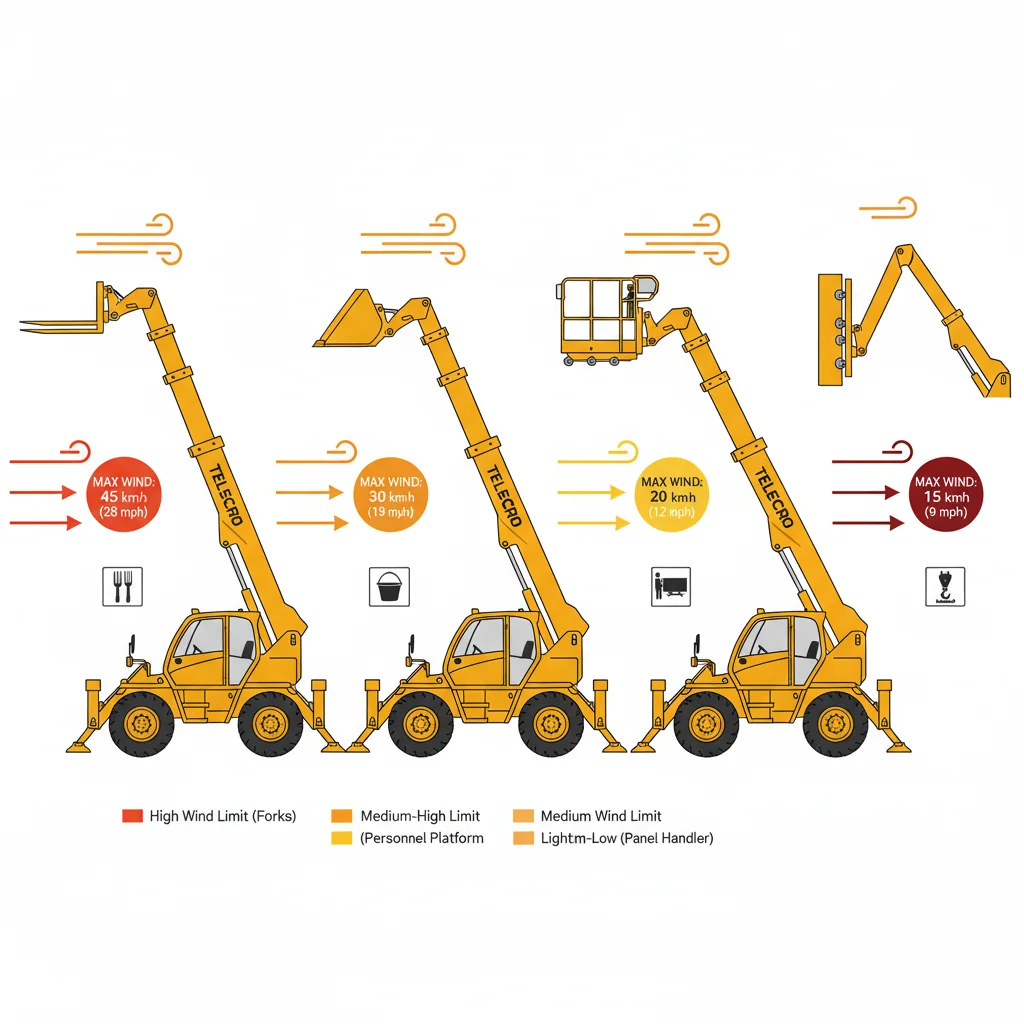
Last month, a site supervisor in Dubai called me about a lift plan that looked fine on paper—but the telehandler was fitted with a panel handler. The problem? The wind forecast climbed to 14 meters per second. Even though their 4-ton telehandler could normally work safely up to 12.5 m/s with forks, the panel handler cut the limit to 9 m/s. That job had to pause until the wind died down. It’s a perfect example: attachment choice can cut your wind speed allowance by as much as a third.
Attachments influence wind limits more than most buyers expect. Here’s why each type demands a separate check:
- Standard forks (compact load) – Least affected by wind, sometimes rated up to 12–13 m/s.
- Buckets or platforms – Larger surface area, often reducing wind limit to 9–11 m/s even on the same machine.
- Panel handlers, jibs, cages – Can drop safe wind speed well below 10 m/s, especially at max boom extension.
- Man baskets/work cages – Typically have the strictest ratings; some sites won’t allow use above 7–9 m/s for safety.
From my experience on sites in Kazakhstan, I’ve seen that leaving stabilizers up also shrinks your wind margin. If the machine’s load chart says “stabilizers required” for a given reach, treat that as non-negotiable—particularly in strong crosswinds.
I always tell supervisors: never guess wind limits based on the basic machine. Check the specific load and wind charts for every attachment and stabilizer setup, and plan your lift to the tightest limit you find. It only takes one missed detail for trouble.
Using a telehandler attachment with a large surface area, such as a panel handler or bucket, can significantly reduce the manufacturer’s maximum wind speed rating compared to standard forks.True
Attachments with larger surface areas catch more wind, increasing the risk of tipping or loss of load control. Manufacturers often publish separate wind limits for attachments because their aerodynamic profile can amplify wind forces and stability concerns.
Telehandler wind limits remain the same regardless of the attachment used, as the base machine’s rating accounts for all possible configurations.False
Wind limits are not universal across all attachments. The base machine’s rating is typically specified for forks or minimal attachments. Broader or bulkier attachments may require the operator to follow reduced wind limits to maintain safety.
Key takeaway: Telehandler wind limits depend on both the attachment and stabilizer configuration. Always confirm attachment approval and reference the specific OEM load and wind charts for every setup. Never assume the standard machine-rated wind limit applies—use the most restrictive guideline between machine, attachment, and site policy.
How Do Area-to-Weight Ratios Affect Wind Limits?
Industry guidance states that the permissible wind speed for lifting loads with telehandlers is directly affected by the exposed area-to-weight ratio9 and the load’s shape. Loads exceeding 1.2 m² per tonne are classed as wind-sensitive, and their safe working wind limits decrease sharply according to standards like CPA lifting rules.
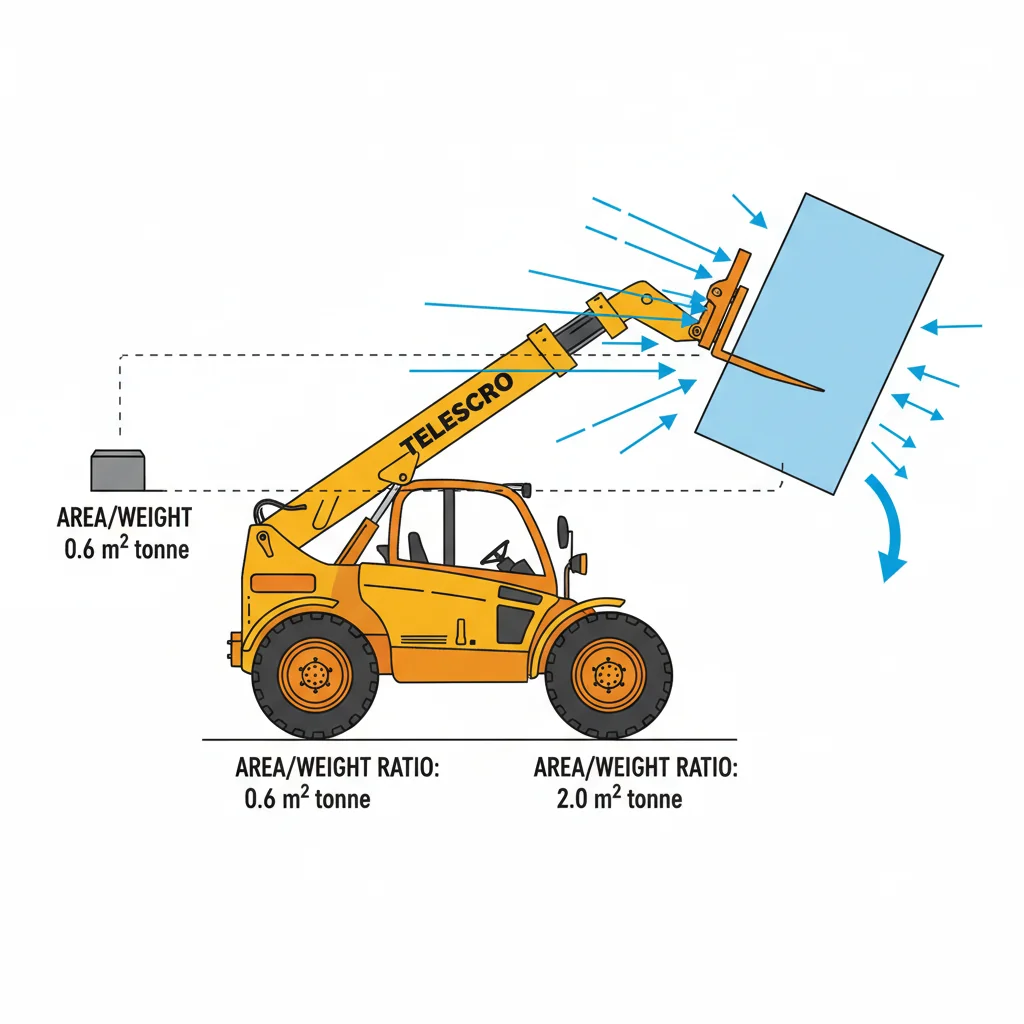
Here’s what matters most when you’re handling loads in wind: the shape and exposed area matter just as much as weight. Loads like large facade panels or pre-fab walls with a big, flat face can act almost like sails. From my experience on jobsites in the UK and Vietnam, the exposed area-to-weight ratio is what engineers and safety officers watch closely. If your load has more than about 1.2 square meters of area per tonne, it’s officially wind-sensitive according to most lifting standards. The safe wind speed drops fast—sometimes from 12 m/s down to 7 m/s or less, even with a mid-size 3.5-ton telehandler.
I’ve seen contractors in high-wind regions like Kazakhstan cut corners, thinking, “It’s a heavy load, so we’re fine.” But when you lift something like a five-meter cladding panel that weighs less than 500 kg, a gust can cause it to swing or even tip the machine. The moment indicator—if your telehandler has one—won’t warn you about side loads from wind. That’s why I always suggest asking for site wind limits and checking the load’s area before you start. If you’re unsure, treat any lightweight, big-area load as wind-sensitive by default.
Sometimes, the solution is to schedule the lift early in the morning when winds are calm, or to use a machine with greater capacity to give yourself extra margin. For critical facade lifts or glass panels above the third floor, involve a qualified lift planner. It’s much safer—and it could save you expensive damage or costly stoppages down the line.
A telehandler lifting a lightweight but large-area load, such as a facade panel, often faces stricter wind speed limits than when lifting a much heavier, compact object.True
This is because larger surface areas catch more wind, increasing the risk of instability or loss of control, regardless of the load's weight. Wind pressure acts on exposed area, so area-to-weight ratio directly influences safe lifting limits.
As long as a telehandler's load is under its weight limit, wind speed does not significantly affect lifting safety—even with large or flat loads.False
This is false because wind can exert substantial force on large, flat surfaces even if those loads are lightweight. Ignoring exposed area greatly increases the risk of tip-over or loss of control, making it essential to consider both weight and area-to-weight ratio when determining wind safety limits.
Key takeaway: Loads with a high exposed area-to-weight ratio or a bluff, drag-prone shape should be considered wind-sensitive, regardless of their mass. In windy conditions or with critical loads, specialized planning or engineering support is recommended to ensure lifting operations remain within safe wind limits.
Why does telehandler condition affect wind safety?
Telehandler stability in windy conditions is highly dependent on machine condition. Worn components—such as excessive boom side play10, underinflated tyres11, faulty stabilizers, or misadjusted wear pads—reduce stability margins. These faults amplify unpredictable movements during gusts, increasing dynamic load and risk, especially when operators attempt to compensate with sudden joystick actions.

I’ve seen firsthand how small issues in a telehandler’s condition can become major risks when the wind picks up. Earlier this year, a contractor in coastal Vietnam called after a close call—his team was lifting steel beams with an older 4-ton telehandler. The machine had noticeable side play in the boom and two tyres below recommended pressure. When a strong gust hit, the load swayed more than expected, and his operator tried to correct it quickly with the joystick. The result? The telehandler rocked dangerously, and the boom flexed much more than it should have. In that moment, the worn components made the machine feel unpredictable, which is exactly what you don’t want above 10 meters with wind blowing. Worn boom pads, sloppy frame-levelling, or hydraulic leaks in the stabilizer circuit are things I always flag in pre-use inspections. If the boom can move side-to-side at full reach, wind gusts will multiply that movement. Underinflated or mismatched tyres also shift the center of gravity faster than you think. When I worked with a crew in South Africa building a hospital, we swapped a 3-year-old telehandler with loose steering for a newer unit in better shape—instantly, the operators felt safer and had fewer problems stabilizing long HVAC units. The newer machine’s load moment indicator was also more reliable, which really helped when judging gust risks. So here’s my suggestion: on any site where wind is a factor, walk through a stability checklist before you lift.
Worn boom components in a telehandler can amplify load sway in windy conditions, making it harder for operators to safely control suspended materials.True
Side play or looseness in the boom increases the pivoting and movement of the load, especially when wind adds lateral force, reducing the operator's ability to maintain stability and precision.
Underinflated tyres on a telehandler have no impact on wind safety during lifting operations, as they do not affect machine stability.False
Tyre pressure is critical to telehandler stability; underinflated tyres can allow the chassis to shift or tilt more in strong winds, increasing the risk of tipping or uncontrolled load movement.
Key takeaway: Telehandlers with worn, poorly maintained components have significantly reduced stability margins in wind. Always prioritize the best-conditioned units for wind-exposed and high-risk lifting tasks. Rigorous, stability-focused pre-use inspections are essential before any operation where gusts can affect loads or handling behavior.
What Wind Performance Details Should Suppliers Provide?
Telehandler buyers should request maximum allowed wind speeds12 for forks, large-area, suspended, and man basket loads; seek derating charts13 for high sail-area materials; confirm anemometer options and mounting locations; and inquire about special wind or altitude instructions. Clarifying wind-related specifications ensures safe and consistent operation when wind is a frequent site challenge.
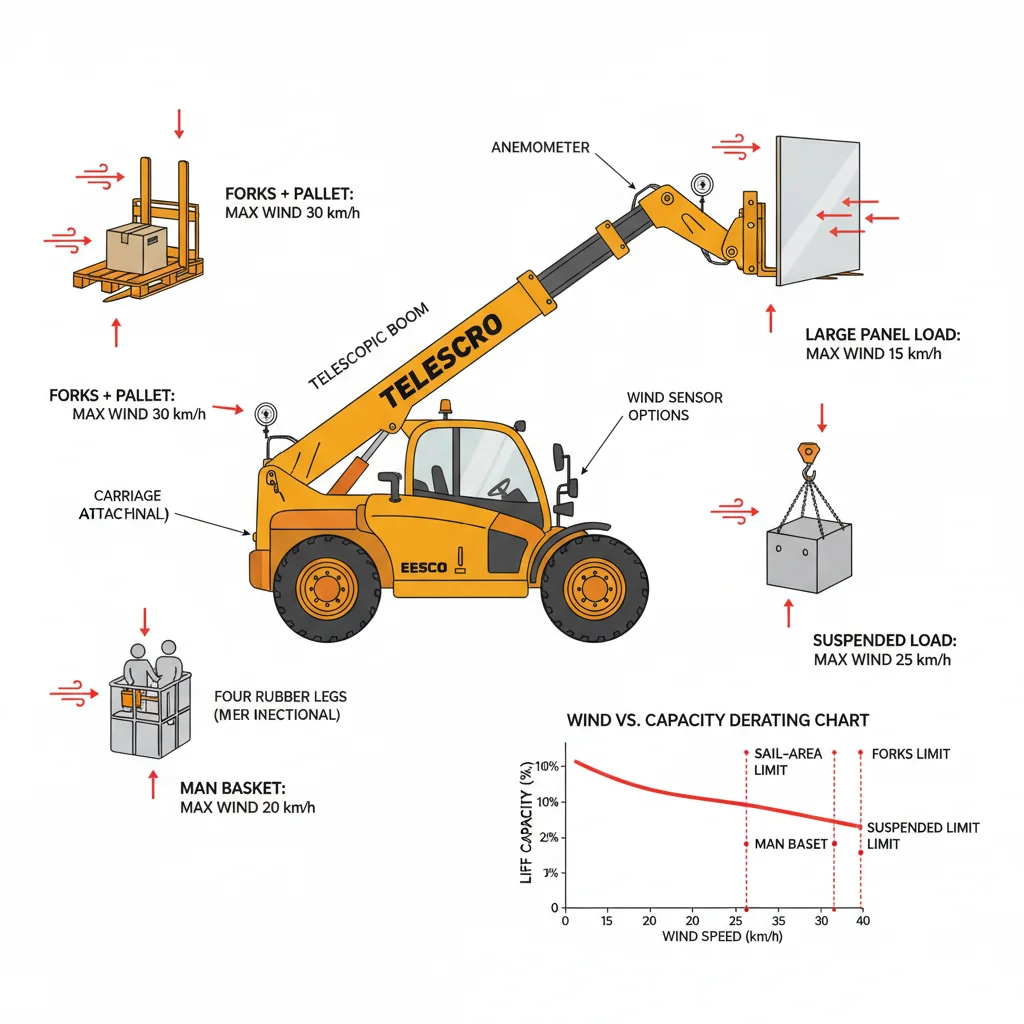
I get a lot of wind-related safety questions from customers working in exposed environments. A project manager from coastal Namibia called last year, worried about panel lifting in strong gusts near the Atlantic. The reality is that not every telehandler will carry the same maximum wind rating for every task. For example, the safe wind speed with forks and compact loads might reach 12-14 m/s on a typical 4-ton, 17-meter machine. But switch to a man basket or lift a large cladding panel, and the safe wind limit often drops to 7-9 m/s—sometimes lower, depending on sail area.
Too often, buyers only see the “maximum capacity” stamped in the manual. But that rarely covers the actual jobsite risks when wind is a factor. I always suggest asking for derating charts or tables that show safe working capacity versus wind speed—especially if you handle big façade panels, pre-cast stairs, or anything that acts like a sail. For suspended loads or truss lifts, limits can get even stricter, with the chart based on total area or even shape. Working without these charts leads to confusion and, honestly, unnecessary stops.
Another detail many suppliers don’t mention: anemometers. Some jobsites in Kazakhstan actually require them by law, mounted right beside the cab window. It’s smart to check if factory options, aftermarket kits, or even a mounting bracket are available. Finally, tell your supplier if you work at high altitude or in wind-prone regions. They may have special instructions or alternative capacity charts. Taking these steps reduces downtime and keeps your crew safer on tough, windy days.
Wind speed limits for telehandler lifting are generally lower when using attachments with a large surface area, such as man baskets or cladding panel grabs, compared to forks with compact loads.True
Large-surface attachments catch more wind, increasing the risk of instability or tipping. This is why manufacturers and suppliers provide lower maximum allowable wind speeds for these tasks to maintain safe operation.
Once a telehandler's maximum wind speed rating is established for one type of load, this same rating can be safely applied to all load types and attachments used with that machine.False
Wind ratings are not universal across different attachments or load types; larger or more aerodynamic loads significantly change how wind affects stability and safe operation. Each configuration requires its own assessment, and applying a single wind rating to all situations is unsafe.
Key takeaway: Engaging telehandler suppliers with specific questions about wind performance—such as load-specific wind speed limits, derating resources, anemometer integration, and region-specific guidance—ensures that equipment choices reflect real site risks. This proactive approach boosts both safety and productivity in consistently windy environments.
Conclusion
We looked at when wind limits mean your telehandler’s load chart no longer applies, and why those numbers are absolute—not suggestions. From my experience, the crews that stay safe always treat the manufacturer’s wind speed as a hard stop, not something to “just watch” on gusty days. There’s no shortcut around this—once you’re above the limit, specs become meaningless. If you’re unsure about where your real-world work puts you, or you want to check safe configuration for a tricky lift, feel free to reach out. I’ve worked with many teams sorting out these same challenges, and I’m always happy to help. Every site is different—choose what actually works for your workflow.
References
-
Insight into how bulky load characteristics reduce permissible wind speeds by 60-80%, helping prevent dangerous overturns. ↩
-
Detailed explanation of how sideways forces generate tipping moments in telehandlers, crucial for safe operation in windy conditions. ↩
-
Insight into the risks posed by crosswinds to telehandler stability especially with extended booms and uneven ground conditions. ↩
-
Detailed explanation of how exposed sail area impacts wind forces and telehandler overturn risk, crucial for safe load handling. ↩
-
Detailed insights into using anemometers for accurate wind speed detection at height, aiding safer telehandler operations under gusty conditions. ↩
-
Explains the importance of monitoring peak gusts over averages to prevent telehandler accidents caused by sudden high winds. ↩
-
Detailed insights on how wind loads impact telehandler stability and work continuity in windy or coastal site conditions. ↩
-
Comprehensive explanation of ground pressure risks when upsizing telehandlers and its impact on safety over unstable ground. ↩
-
Explore how area-to-weight ratio impacts wind limits and safety in telehandler load lifting with expert industry guidelines. ↩
-
Explains how excessive boom side play increases instability and dynamic loads during wind gusts, risking operator safety. ↩
-
Details the risks of underinflated tyres shifting center of gravity and reducing stability under wind loads. ↩
-
Learn the critical wind speed limits for different telehandler tasks to ensure safety and prevent accidents in exposed work environments. ↩
-
Explore how derating charts provide essential guidance on safe lifting capacities under varying wind speeds and sail-area loads. ↩