










Telehandler Weight: Why Heavier Units Aren’t Always Safer – A Field Guide
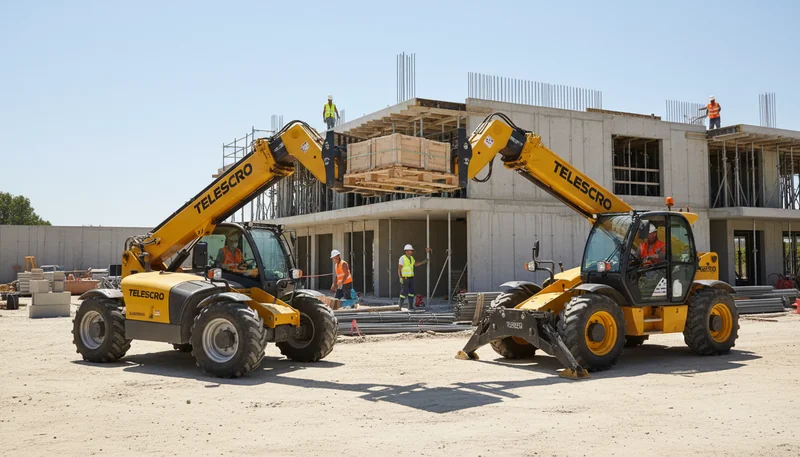
A few months ago, an Italian site manager proudly showed off his new 13-ton telehandler, convinced nothing could go wrong with "more iron." But by week two, his crew had bogged it down in soft ground—and nearly overturned it lifting just 2 tons at full reach. It’s a story I hear more than you’d think.
Heavier telehandlers are often assumed to be safer, but weight alone doesn’t guarantee stability. Safe working limits come from the machine’s geometry and centre of gravity, the model-specific load chart, and applicable standards (e.g., EN 1459)—not “more iron.” Boom extension, axle behaviour, tyre footprint, and counterweight placement all affect stability at specific heights and reaches.
Does telehandler weight equal more stability?
Telehandler weight does not guarantee greater stability or lifting safety. Two units of similar gross weight may have sharply different rated capacities at the same reach and height. Stability depends on chassis design, counterweight location, boom structure, and axle-oscillation locking, all documented in the model-specific load chart.
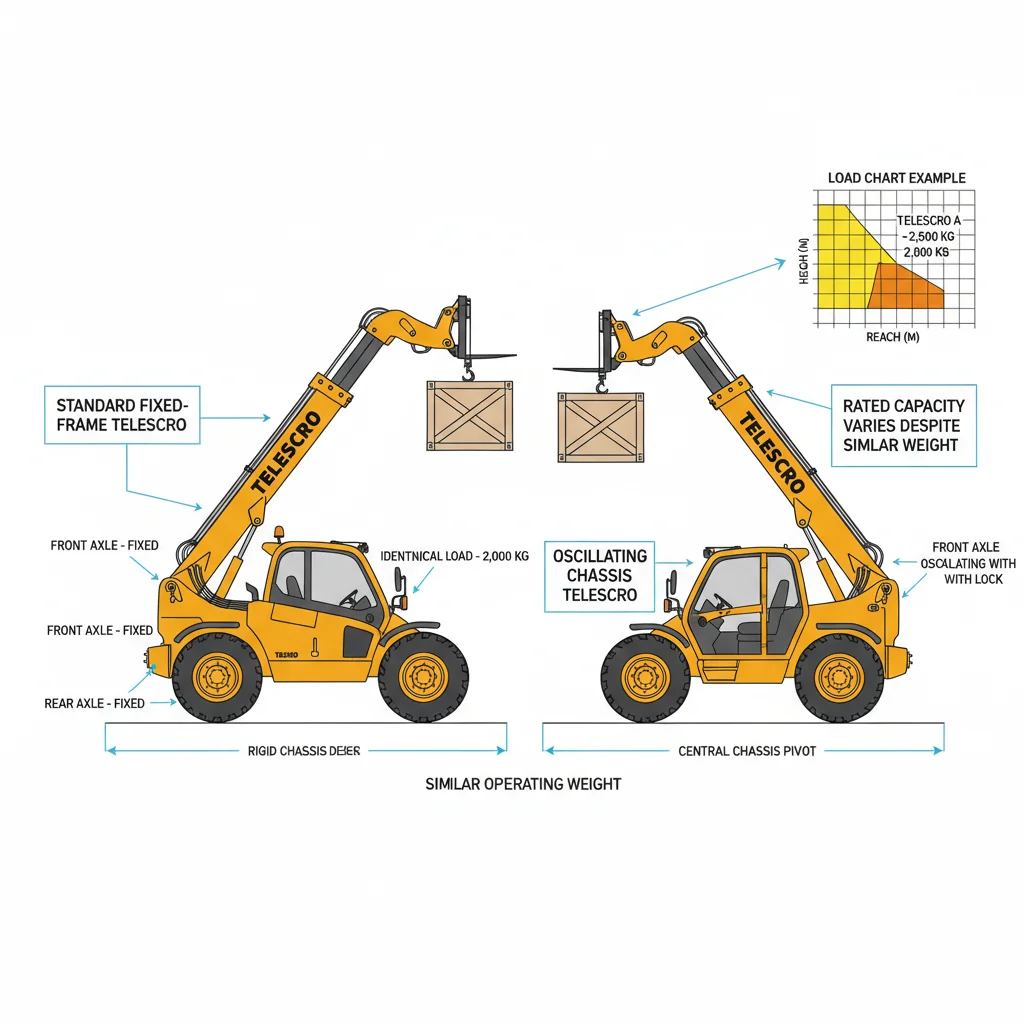
Most people think a heavier telehandler means a safer, more stable machine. But the reality is, gross weight on its own tells you very little about actual working stability or what you can safely lift at full reach. I’ve worked with teams in Dubai who bought 13-ton units expecting to lift heavier loads twelve meters out—only to find their 9-ton unit could actually handle more at certain heights. The difference? Chassis layout, counterweight position, boom structure, and most importantly, the load chart for each machine.
Let me share something important I’ve learned after seeing hundreds of job sites: Two telehandlers—both weighing around 10 tons—can perform completely differently. One may safely lift 2,500 kg at 7 meters, while the other maxes out at 2,000 kg, even though their weights are almost identical. The reason is in the engineering: Longer wheelbase, better counterweight location, and a firmer boom design push the stability envelope wider. Systems like axle-oscillation locking also matter a lot, especially on uneven ground. Remember, rated capacity1 always depends on level ground, standard attachment, and load center—all defined in the load chart, not the brochure specs.
The biggest mistake I see is buyers using “heavier feels safer” as a shortcut. In reality, the safer choice comes from matching the machine to the work. Start with your actual lift requirements: What do the pallets really weigh, including forks and attachments? At what reach and height will you operate most of the time? Then pull out the load chart and check the capacity at those exact points.
From field experience and OEM guidance, I recommend planning a working margin of roughly 20–30%, increasing it further if wind, uneven ground, or frequent attachment changes are involved. This approach leads to a machine that works comfortably within its stability envelope—rather than simply choosing the heaviest telehandler in the yard and hoping mass will compensate for geometry.
A telehandler's stability at full reach depends more on its counterweight position and boom design than on the machine's overall weight.True
Stability is influenced by how weight is distributed and supported as the boom extends. Counterweight placement and the structural engineering of the boom help prevent tipping, regardless of the telehandler's total mass.
Purchasing a heavier telehandler automatically increases the safe lifting capacity at maximum extension.False
Gross weight alone does not guarantee better lifting performance at full reach; factors like load chart, chassis design, and weight distribution are more critical for determining how safely and effectively a telehandler can lift at its limits.
Key takeaway: Heavier telehandlers are not necessarily safer or more capable. Always evaluate lifting needs using the actual load chart for each model and configuration, not gross machine weight. Consider pallet weight and working height/reach, and maintain a significant safety margin based on application requirements.
Does Heavier Telehandler Weight Boost Stability?
Extra telehandler chassis weight does not guarantee improved forward stability2 at maximum reach. Physics dictates that as the boom extends, the load’s distance from the front axle increases, sharply raising overturning risk. Load chart capacity3 drops steeply with reach, especially under non-ideal site conditions, making added chassis weight insufficient for safety.
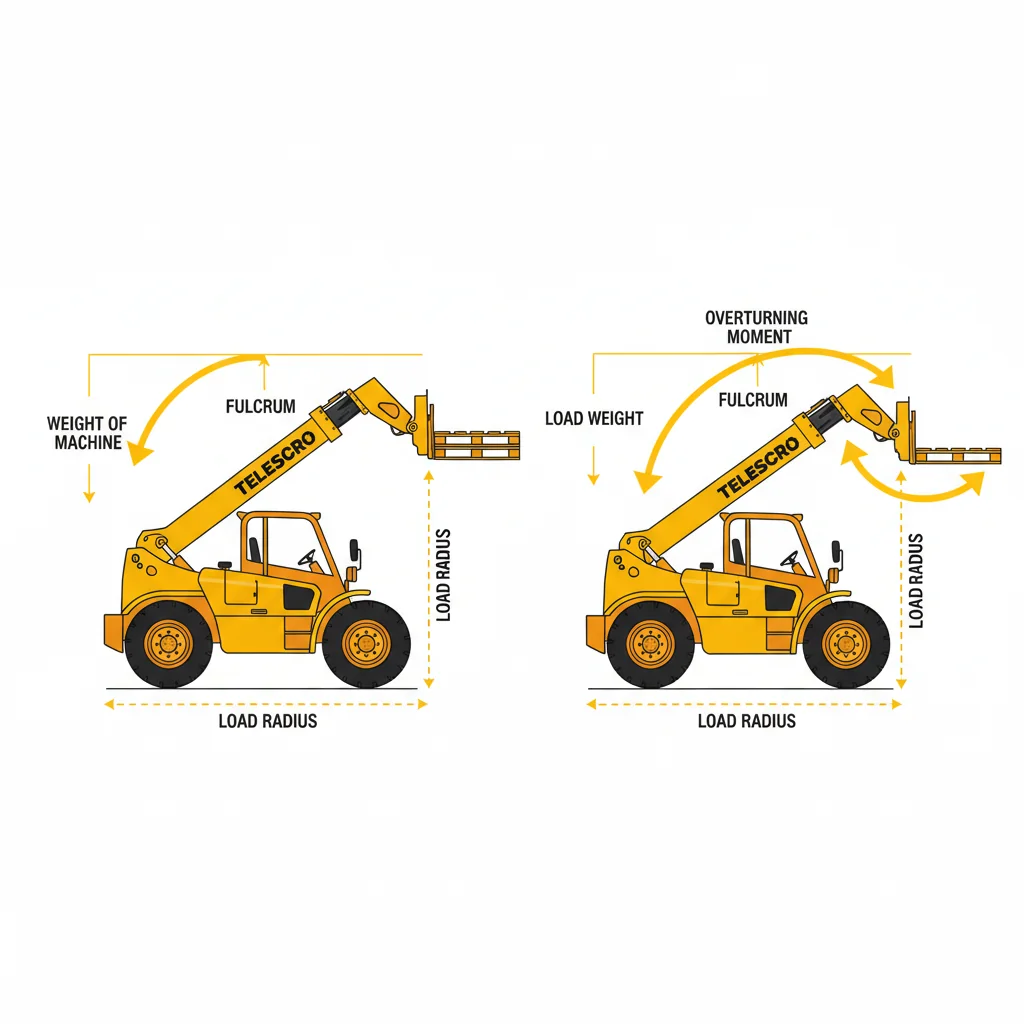
Let me share something important about telehandler stability—it’s not just about having a heavier chassis. I’ve seen contractors in Dubai buy 10-ton machines, thinking extra weight would let them push the limits on tight tower crane sites. Truth is, the moment you extend the boom, the load’s distance from the front axle creates a much bigger tipping force. Physics wins every time. I remember a site where a 4-ton unit with an 18-meter reach could only safely handle about 1,200 kg at full stretch, no matter how heavy the base was.
Many buyers forget that the tipping axis runs right through the front wheels. That’s the actual pivot point for forward stability calculations. Even if your machine weighs four more tons, once the reach puts your load three or four meters out front, rated capacity drops sharply—sometimes down to one-third of what’s possible at minimum reach. I’ve worked jobs in Kazakhstan where poor ground conditions and uneven surfaces cut usable lifting power in half. Wind gusts or sudden braking makes it even riskier.
From my experience, real jobs rarely match the “level ground, no wind, perfect load” scenario behind OEM test charts. Load charts always assume the best conditions—clear ground, firm surface, fresh tires, the right pressures. Even a few degrees of side slope or a heavier-than-expected pallet can throw calculated safety margins out the window. I always recommend that contractors build in generous margin and never plan jobs at chart limits. It’s safer—and usually ends up saving time and headaches later.
A heavier telehandler does not guarantee higher stability when the boom is fully extended, because the tipping force is primarily determined by the load's distance from the front axle rather than the weight of the chassis.True
When a telehandler's boom is extended, the load acts as a lever arm, greatly increasing the tipping moment. The chassis weight provides a counterbalance but cannot fully offset the lever effect as the distance increases, making boom extension the dominating factor for stability.
The total weight of a telehandler ensures it can safely handle heavy loads at maximum boom extension regardless of load position.False
This is incorrect because maximum safe lifting capacity is dictated by load chart limits, which account for both boom angle and extension, not just overall machine weight. Stability at full reach depends much more on geometry and balance than on chassis mass.
Key takeaway: Telehandler rated capacities decrease significantly with boom extension, regardless of chassis weight. Contractors should never plan to operate near chart limits, especially at full reach. Always allow for safety margins and adjust for site conditions, as heavier machines cannot override the principles of stability physics.
Is a heavier telehandler safer on soft ground?
Heavier telehandlers are not inherently safer on soft or unstable ground. Increased machine mass raises ground pressure4—for example, a 13-ton telehandler on standard tyres can exceed ~80 kPa depending on tyre size and inflation. Higher ground pressure accelerates rutting, sinking, and traction loss. As surfaces soften or become uneven—especially on slopes or backfill—the risk of instability and tip-over increases rather than decreases.

The biggest mistake I see is believing a heavier telehandler automatically means safer ground handling—especially on soft sites. I can’t count how many times I’ve seen large machines get stuck while a lighter one finishes the job with no drama. Two years ago in Kazakhstan, a customer insisted on a 13-ton high-capacity unit for stacked brickwork on a backfilled access road. As soon as rain softened the surface, that telehandler exerted ground pressure over 80 kPa and quickly started to sink. They lost half a day waiting for recovery—while a neighbor’s 9-ton machine managed without issue, just because it floated better on similar tyres.
Here’s what matters most when ground isn’t solid: it isn’t just about machine weight, but how that weight spreads over the tyre contact area. A telehandler’s ground pressure (weight divided by total tyre contact area) makes all the difference. On anything unstable—backfill, drainage channels, muddy farmyards—higher pressure causes rutting, sinking and instability. Once a big unit sits unevenly, its high center of gravity and long boom multiply your risk. Tip-over moments can climb fast if wheels lose even partial contact. I’ve had Italian project managers call in a panic after a 33,000-pound telehandler slid sideways on a simple 5° side slope—no warning, just trouble.
I always suggest checking both soil condition and access before choosing a machine. In borderline ground, a lighter telehandler with oversized tyres, or with front stabilizers for support, is almost always the safer bet. Don’t just chase the biggest specs—a balanced approach wins on unstable sites.
A heavier telehandler can exert much higher ground pressure on soft soil, increasing the risk of sinking or losing traction even if its tires are large.True
Ground pressure is determined by the machine's weight relative to its tire contact area; heavier telehandlers often have more weight without a proportional increase in tire size, making them less suitable for soft surfaces.
Using a heavier telehandler always ensures better stability and safer handling on construction sites with soft or uneven ground.False
Heavier telehandlers may become unstable or stuck in soft or unstable conditions, as their higher ground pressure can cause the machine to sink, reducing both traction and safety.
Key takeaway: Heavier telehandlers do not guarantee safety on soft or backfilled ground. Higher ground pressure increases the risk of rutting, sinking, and tip-over. On fill, farmyards, or muddy sites, a lighter telehandler with larger tyres or front stabilizers may provide better stability and safer operation.
Can heavier telehandlers damage industrial floors?
Heavier telehandlers can damage warehouse slabs and mezzanine floors. Most industrial floors are designed for distributed loads of roughly 25–40 kN/m², not for the high concentrated wheel loads5 imposed by a 12-t telehandler plus payload. Excessive wheel loads—especially near joints, edges, or mezzanine supports—can lead to cracking, localized punching, or long-term structural damage if slab capacity is exceeded.

I’ve worked with customers who made this mistake, especially on warehouse projects in Dubai and Singapore. A contractor in Dubai tried using a 12-ton telehandler indoors—rated capacity was enough for the load, but nobody checked the wheel loads against the slab specs. The result? The machine’s front wheels created concentrated pressure that exceeded the floor’s design, leaving cracks along expansion joints and near column bases. Repairs delayed their finishing crew by almost a week, and the customer spent thousands on slab reinforcement.
Most industrial floors are engineered for distributed loads—typically around 25–40 kN per square meter. But a heavy telehandler, especially with a full pallet, puts concentrated loads under each tyre. With four narrow tyres and a boom extended out, local pressure can spike well above what the concrete was designed to handle. This risk is even greater near slab edges, mezzanines, or over trenches, where the structural margin is lower.
Here’s what matters most when choosing a telehandler for slab or mezzanine work: always ask for the floor load data6 first. Then estimate the wheel loads in each position—including with a raised boom and cargo. Sometimes, a compact 2.5-ton or 4-ton model with wider tyres spreads the load better and avoids costly damage. In Kazakhstan, I saw a team switch to a lightweight material hoist in a high-rise renovation to avoid damaging expensive epoxy flooring. That small adjustment saved them both time and headaches.
I suggest treating every slab as a potential weak point, not just for heavy lifts but even for routine material movement. When in doubt, verify before you drive.
Heavier telehandlers can concentrate wheel loads that exceed typical industrial floor slab load ratings, even if the telehandler’s overall weight is within site limits.True
The key risk is not just total machine weight, but the high, localized pressure where the wheels contact the slab, which can stress the concrete beyond its designed load-bearing capacity, especially near joints or less-reinforced areas.
Using a telehandler with a higher rated capacity always ensures less risk of floor damage compared to using a lighter machine.False
A higher rated capacity does not correlate with safer floor loading. In fact, larger telehandlers often have higher wheel loads, increasing the risk of floor damage, particularly when used indoors on slabs not designed for concentrated point loads.
Key takeaway: Always verify floor load data and calculate telehandler wheel loads before operating on slabs or mezzanines. Using oversized machines indoors can lead to slab damage or structural failure; consider compact models or alternative equipment for sensitive flooring conditions.
Does telehandler weight increase site safety?
Heavier telehandlers do not automatically improve safety. Oversized models can hinder access on restricted sites, leading operators to work at greater reach or awkward angles—precisely where stability margins are lowest. Proper sizing for typical loads and heights, with an adequate margin, promotes safer, more controlled machine operation in real field conditions.

Here’s what matters most when you’re choosing a telehandler for your site: weight alone does not guarantee extra safety. Heavier machines often look “safer” on spec sheets, but real jobsite conditions tell a different story. I’ve worked with crews in Germany who thought a 4-ton, 17-meter telehandler would cover every task. On most days, their loads were around 1 to 1.5 tons, lifted no higher than 8 meters. But that oversized unit made tight access nearly impossible—narrow farm lanes, soft ground, and low bridges limited their options. More than once, operators ended up stretching the boom to reach over obstacles instead of positioning the machine closer. That’s exactly where a telehandler’s stability is at its lowest and the risk is highest.
From my experience, using a bigger telehandler just for peace of mind can actually lead to more dangerous habits. Some operators feel confident handling shrinking loads at awkward angles, thinking the bigger counterweight will “save” them from tipping or instability. It’s a false sense of security—the load chart is the only real safety guarantee, and even the heaviest machine has serious limits the further you extend or lower the boom.
A better approach is to size your main telehandler for the loads and heights you handle every day, with a sensible safety margin. For rare heavy lifts or high placements, rent a larger machine temporarily. Your daily driver will be lighter, easier to position, and less likely to force awkward operations. I always suggest checking site conditions and typical load distances before making a final choice—real safety starts with smart sizing, not just more steel or bigger numbers.
A heavier telehandler can increase the risk of ground instability on soft surfaces, potentially compromising site safety.True
Heavier telehandlers exert greater ground pressure, especially on soft or uneven terrain, making them more susceptible to sinking, tipping, or becoming stuck. This risk can outweigh the perceived stability benefits of additional weight, especially where soil conditions are poor.
Heavier telehandlers are always safer for all load sizes and lift heights, no matter the site conditions.False
Heavier machines can present maneuverability challenges, limit access in tight or unstable areas, and do not automatically increase safety for lighter loads at modest heights. Proper size matching, site conditions, and operational requirements are essential for safety, not just machine weight.
Key takeaway: Selecting a telehandler heavier or larger than daily requirements can actually compromise site safety by encouraging overreach and awkward positioning. The safest approach is to match telehandler size to typical loads and heights, reserving larger rentals only for rare, exceptional lifts.
Do heavier telehandlers stop more safely?
Heavier telehandlers do not stop more safely; increased chassis weight means greater inertia, resulting in longer stopping distances if brakes and tyres are comparable. At travel speed, a 12–13 t unit carries more kinetic energy7 than an 8–9 t machine, raising risk in crowded or confined site conditions.

Last month, a farm manager in Kazakhstan called me after a close call with a 12-ton telehandler on a muddy feedlot. He assumed the extra weight would make stopping smoother compared to his older 8-ton machine. But at just under 10 km/h, it took almost double the distance to stop—he was lucky there were no cattle in the way. The bigger chassis didn’t equal safer braking. It actually created a bigger risk, especially with tight turns and limited visibility.
The physics are simple. Heavier telehandlers hold more momentum—more mass moving at speed takes more force to stop. If the brakes and tyres are the same size as what you’d find on a lighter machine, the extra weight can overwhelm them. On many crowded job sites in the Middle East, I’ve watched operators get caught off guard by this. Even disciplined drivers sometimes forget how quickly conditions can change. When a 13-ton machine is loaded up and the boom’s raised, sudden stops or turns send all that mass forward—it’s a tipping hazard, not a safety feature.
I always tell operators that speed control is non-negotiable—especially when the boom is raised or a load is carried. Most OEM operating manuals require very low travel speeds with an elevated load and clearly state that machines must be slowed to walking pace when maneuvering or braking under load. Safety in travel comes from well-maintained brakes, correct tyre condition and pressure, and disciplined operator habits—not from extra machine weight.
Heavier steel doesn’t shorten stopping distance. In fact, added mass increases inertia, making sudden stops and direction changes harder to control. With suspended or delicate loads, even small speed changes can turn into large load sway. When stopping distance becomes a concern on site, I always advise checking operator speed discipline, brake condition, and tyre grip first, rather than assuming a heavier machine will solve the problem.
Heavier telehandlers often require significantly longer stopping distances than lighter models, even at the same speed.True
A heavier machine possesses greater momentum for any given speed. On loose or slippery surfaces like mud, the tires may lose grip more easily, causing the telehandler to skid and travel a longer distance before coming to a complete stop. Extra weight does not increase braking force if the tires or surface limit traction.
A larger, heavier telehandler always stops more safely than a smaller one because its mass provides more stability during braking.False
Heavier telehandlers may feel stable when moving slowly, but during braking, their increased momentum can overwhelm tire grip and extend stopping distance, especially on compromised surfaces. Mass alone does not guarantee safer stopping if traction or visibility is reduced.
Key takeaway: Heavier telehandlers require longer distances to stop safely due to increased inertia, especially with raised loads. This can significantly increase risks on busy construction sites, farms, or feedlots. Strict speed limits, meticulous brake and tyre maintenance, and operator discipline are essential for travel safety—machine weight is not a substitute for risk control.
Why Count Every Kilogram on Telehandlers?
Telehandler rated capacity is based on the total load at the carriage, including pallet, forks, rigging, work platforms, and attachments—not just the cargo. Attachment changes, like longer forks or side-shift carriages, alter the load’s center of gravity8, impacting stability and potentially exceeding charted capacity even when cargo weight appears safe.

Last quarter, a site manager in Dubai asked me why his new 4,000 kg telehandler kept tripping its overload sensor while moving concrete blocks—each pallet weighed just under 3,400 kg. It turned out that when we checked the total load, the long forks alone added about 250 kg, and the side-shift carriage, plus rigging, topped another 150 kg. That’s 3,800 kg at the carriage, not counting the pallet weight. On paper, he was “within capacity,” but in real life, he was right on the edge—or just beyond it.
Every kilogram at the carriage counts toward rated capacity—not just the payload itself. Forks, pallets, rigging, carriages, and any attachment changes are all part of the lifted mass. When you switch from standard forks to longer forks, or add a work platform, you’re doing more than adding weight—you’re moving the load center forward. That increases the tipping moment even if the display or load weight “looks” acceptable.
Rated capacity is calculated for a very specific configuration: level ground, a defined load center, and the exact attachment shown on the load chart. Change any one of those, and the chart no longer represents your real stability margin. If you don’t account for the full package at the carriage, the machine can reach its limit suddenly—often without warning. From my experience in the field, these overlooked extras are a common root cause behind unexpected instability and bent boom structures.
I always recommend two things: check the exact boom height and reach you’ll use, and run the numbers for every attachment and load component—down to the smallest rigging. If you’re working anywhere near the rated chart limit, leave some margin. Upsizing the machine for a safer buffer often prevents costly downtime and keeps everyone on site safe.
Accessory attachments like carriage and fork extensions can significantly reduce a telehandler's effective safe lifting capacity without operators realizing it.True
The weight of attachments is added to the load at the carriage, which can push the total load over the machine’s rated capacity, even when the main load itself seems within spec. This factor is often overlooked, leading to overload situations.
A heavier telehandler will always be able to lift heavier loads at full reach than a lighter model with the same rated capacity.False
The actual lifting ability at full reach depends not just on the base machine's weight, but more importantly on stability, counterweight configuration, and load chart limitations. A heavier telehandler does not guarantee better performance at maximum extension if other design factors limit capacity.
Key takeaway: Always calculate the total load at the telehandler carriage, accounting for all attachments and rigging—not just the cargo—to avoid instability and overloading. Rely on the OEM load chart for exact boom height and reach, and avoid working at the absolute rated limit.
What extra costs do heavier telehandlers add?
Heavier telehandlers bring significant hidden costs beyond their price tag. Crossing key weight thresholds often requires higher-capacity trailers, more powerful trucks, and special transport permits9, with logistics costs potentially adding hundreds per move. Increased machine weight also accelerates tyre and component wear, shortening service life and raising maintenance expenditures over a typical ownership period.

Most people don’t realize that heavier telehandlers can quietly turn into a major budget drain—well beyond the purchase price. The first hidden cost usually shows up with transportation. Once you get above about 12 or 13 tons, standard low-bed trailers often aren’t enough. Last year, a customer in Kenya tried moving a 14-ton high-reach machine using his regular trailer and mid-size truck. He ended up delayed by two days because the transport company insisted on a bigger tractor unit and an oversize permit. That single move cost him nearly $400 more than moving his old 10-ton unit. Multiply that by six or more moves per year and it adds up fast, especially on scattered jobsites.
Then there’s wear and tear. Heavier models put more strain on tyres, axles, and boom pivots—even when you’re just doing standard pallet work. I’ve seen customers in Brazil replace heavy-duty tyres after just 1,200 hours, compared to almost 1,700 hours on smaller machines under the same conditions. In tight yards, that extra weight means more tyre scrubbing during turns, which accelerates wear and heats up the rubber. Service intervals for boom pins, steering joints, and brakes also shorten because all components are under higher baseline load.
To be honest, I always suggest looking past the maximum capacity spec. Ask yourself how often you’ll truly need the extra lifting power versus paying for transport headaches and higher maintenance every year. If you’re moving between sites or running long hours, double-check tyre costs and real-world logistics fees. That’s how you know if the heavier machine pays its way.
Heavier telehandlers often require special permits for road transport due to exceeding weight limits, which can involve extra fees and logistical delays.True
Transportation regulations generally impose stricter requirements as equipment weight climbs. Heavier machines can surpass standard trailer and axle load limits, making special permits and sometimes even police escorts necessary, which adds time and cost.
A heavier telehandler will always provide a proportional increase in safety compared to lighter models, making job sites safer by default.False
While heavier telehandlers may have increased stability when stationary, greater weight can also lead to higher ground pressure, more complex handling, and longer stopping distances. These factors can actually reduce maneuverability and safety under certain site conditions.
Key takeaway: Heavier telehandlers increase ownership and operating costs by demanding costlier transportation, faster tyre wear10, and higher maintenance outlays—even if extra lifting capacity is rarely used. Buyers should calculate real lifecycle costs, not just headline specifications, to determine the most cost-effective machine for routine jobs.
Does telehandler weight improve site safety?
Heavier telehandlers do not reduce operator training needs or guarantee greater safety. Increased mass amplifies risks if stability is lost—such as during tip-over or collision events. Manufacturer’s load charts, rigorous training, and site-specific hazard assessment are essential for all telehandler sizes, as larger machines require even stricter operational discipline.

Too many buyers assume a 12-ton telehandler with a massive frame gives them a safety cushion. But on real jobsites, that extra weight cuts both ways. If a heavy machine loses stability—say, on a muddy slope or when a load swings out unexpectedly—the tipping force is much greater. I’ve seen this firsthand on a site in Brazil, where an operator thought his large 13-ton telehandler was “unflippable” on a gentle bank. One bad wheel rut, and the machine went over so fast nobody could respond. The result? Major structure damage and weeks of lost work.
Heavier units also demand stricter discipline. Load chart values aren’t just numbers you glance at—they’re the only safe reference. And those charts are calculated for ideal conditions: flat, solid ground, no wind, no debris. Most contractors I work with in South Africa or the UAE have sites with gradients, rubble, and soft spots—exactly where margins evaporate. That’s why I always insist operators get job-specific training before climbing into a bigger rig. Overconfidence is the real danger, especially with high-rated capacity models. A well-trained person on a 3.5-ton telehandler usually has fewer incidents than an under-trained hand in a 12-ton machine.
So, does more weight make you safer? Actually, the risks are amplified if you cut corners. Stick to the manufacturer’s load chart, check every slope and surface, and never assume your machine “won’t tip.” I suggest updating your site’s assessment every time ground conditions shift—it’s a habit that can prevent accidents and save money in the long run.
A heavier telehandler can become more dangerous on uneven ground because its higher mass increases the force and severity of a tip-over event.True
When a heavy telehandler starts to become unstable, its greater momentum and mass make it harder to recover and amplify the destructive impact if it rolls, especially on slopes or soft ground.
A telehandler's extra weight guarantees that it will maintain traction and stability on all terrain types found on a construction site.False
A machine’s overall weight does not guarantee stability or traction; adverse slope angles, soil conditions, and sudden load shifts can still cause even the heaviest telehandler to lose grip and potentially tip over.
Key takeaway: Relying on machine weight for safety is misleading. Proper operator training, adherence to manufacturer load charts, and thorough on-site hazard checks are critical, regardless of telehandler size. Complacency with heavier machines increases risk; disciplined operation and certified oversight are essential for preventing severe incidents.
Conclusion
We’ve looked at why a telehandler’s weight isn’t the real measure of safety or usefulness on the jobsite. Instead, actual capacity at your typical working height and reach makes all the difference in safe, efficient lifts. From my experience, focusing on load charts and how much you’ll truly lift at real boom angles always delivers better results than chasing heavier machines. I’ve seen “showroom hero, jobsite zero” play out too many times when spec sheets outshine practicality. If you want help sorting out load charts, attachments, or even just a second opinion for your project, feel free to reach out. Every site has its own demands—make sure your telehandler fits how you actually work.
References
-
Detailed explanation of telehandler rated capacity, its calculation, and impact on safety and stability during lifting operations. ↩
-
Explore expert insights on forward stability mechanics and how load position impacts telehandler safety and tipping risks. ↩
-
Understand how telehandler load chart capacity varies with boom extension, ground conditions, and site safety measures. ↩
-
Explore how ground pressure impacts telehandler performance on soft ground, including effects on sinking, rutting, and tip-over risks. ↩
-
Detailed explanation of how concentrated wheel loads from heavy telehandlers impact floor durability and cause structural damage. ↩
-
Explores the crucial role of floor load data in preventing slab damage and ensuring telehandler compatibility with floor specifications. ↩
-
Understand how kinetic energy varies with telehandler weight and speed, affecting braking performance and operational hazards. ↩
-
Expert insights on how changing the load’s center of gravity influences machine tipping risk and safe operating limits. ↩
-
Explore detailed regulations and costs of transport permits for heavy machinery, essential for budgeting and compliance in construction logistics. ↩
-
Learn expert analysis of how heavier telehandlers accelerate tyre wear, with real-world data on tyre lifespan and maintenance impact. ↩