











Telehandler Warehouse Applications: Field-Tested Uses & Buyer Tips
Not long ago, I visited a warehouse outside Kuala Lumpur where the manager was struggling to move HVAC modules onto a second-story mezzanine. His forklifts could handle pallets on ground level all day, but anything bigger or higher had his team stumped—until they rolled in a compact telehandler.
Telehandlers are engineered for tasks where traditional forklifts reach their limit, especially in warehouse environments requiring vertical access and load placement flexibility. These machines utilize telescopic booms1 with interchangeable attachments, making them adept at lifting pallets to rack levels exceeding 6 meters, maneuvering awkward loads, and bridging outdoor yard work with high-bay storage. Compact and mid-sized models optimize turning radius2 and capacity for semi-dense layouts, while attachments such as forks, buckets, and work platforms extend one machine across handling, cleanup, and maintenance tasks.
How Do Telehandlers Assist Forklifts in Warehouses?
Telehandlers complement forklifts by using telescopic booms and versatile attachments to handle loads at heights and positions standard forklifts cannot reach. Common warehouse uses include high-rack pallet handling3, accessing mezzanines, and maneuvering long or bulky materials. Their ability to work on uneven surfaces and over obstacles enhances operational flexibility in logistics environments.

Most people assume forklifts can handle every lifting job inside a warehouse. The reality? Standard forklifts typically hit their practical limits once you need to move loads higher than about 5–6 meters or place materials over barriers. Telehandlers step in where forklifts stop. For example, I supported a project in Dubai where the customer needed to place HVAC units—over 2,000 kg each—onto a mezzanine 9 meters high. Their standard forklift couldn’t reach or safely lift at that angle, but a 4-ton telehandler with a 13-meter boom handled it in less than half a day.
Here’s how telehandlers make a real difference in warehouses:
- High-rack pallet handling – Reach 8-18 meters for pallet storage or removal well above forklift range
- Mezzanine and rooftop access – Place heavy equipment or supplies on elevated platforms
- Long or awkward loads – Move pipes, conveyors, or steel sections where maneuvering space is tight
- Overcoming obstacles – Work over trucks, racking, or uneven outdoor surfaces, where forklifts struggle
- Truck unloading in yards – Offload containers or bulky goods directly from ground level, even on rough terrain
To be honest, the flexibility can reduce your equipment count. In Kazakhstan, a distributor told me that switching to a shared telehandler for high-reach, yard, and facility maintenance cut his need for three separate machines. One practical tip: always check the load chart4 before lifting at full extension. Rated capacity drops significantly as you reach further—don’t rely on the max figure printed on the side. Telehandlers fill that essential high-reach niche and keep operations moving when forklifts can’t.
"TelehandlersFalse
"Unlike
Standard forklifts are always preferred over telehandlers for warehouse operations because telehandlers cannot operate effectively in narrow aisle spacesFalse
While forklifts are generally more compact, telehandlers come with various boom configurations and attachments designed to maneuver in tighter spaces. With proper planning and model selection, telehandlers can be adapted for use in warehouses where forklifts have limitations, especially when height and load reach are critical factors.
Key takeaway: Telehandlers fill critical high-reach and high-flexibility roles in warehouses, complementing rather than replacing forklifts. Deploying telehandlers for specialized lifting reduces the need for additional machinery and enables safe, efficient handling of non-routine, elevated, or oversized loads in warehouse and logistics applications.
When Are Telehandlers Best for High-Bay Storage?
Telehandlers excel in high-bay warehouse storage where vertical reach and flexible placement are priorities. They efficiently lift pallets or bulk bins to upper rack levels—typically between 6 and 15 meters—bypassing fixed dock heights and streamlining yard-to-storage transfer. Telehandlers are ideal for short-distance, high-elevation storage applications but are slower than dedicated reach trucks in narrow aisles.
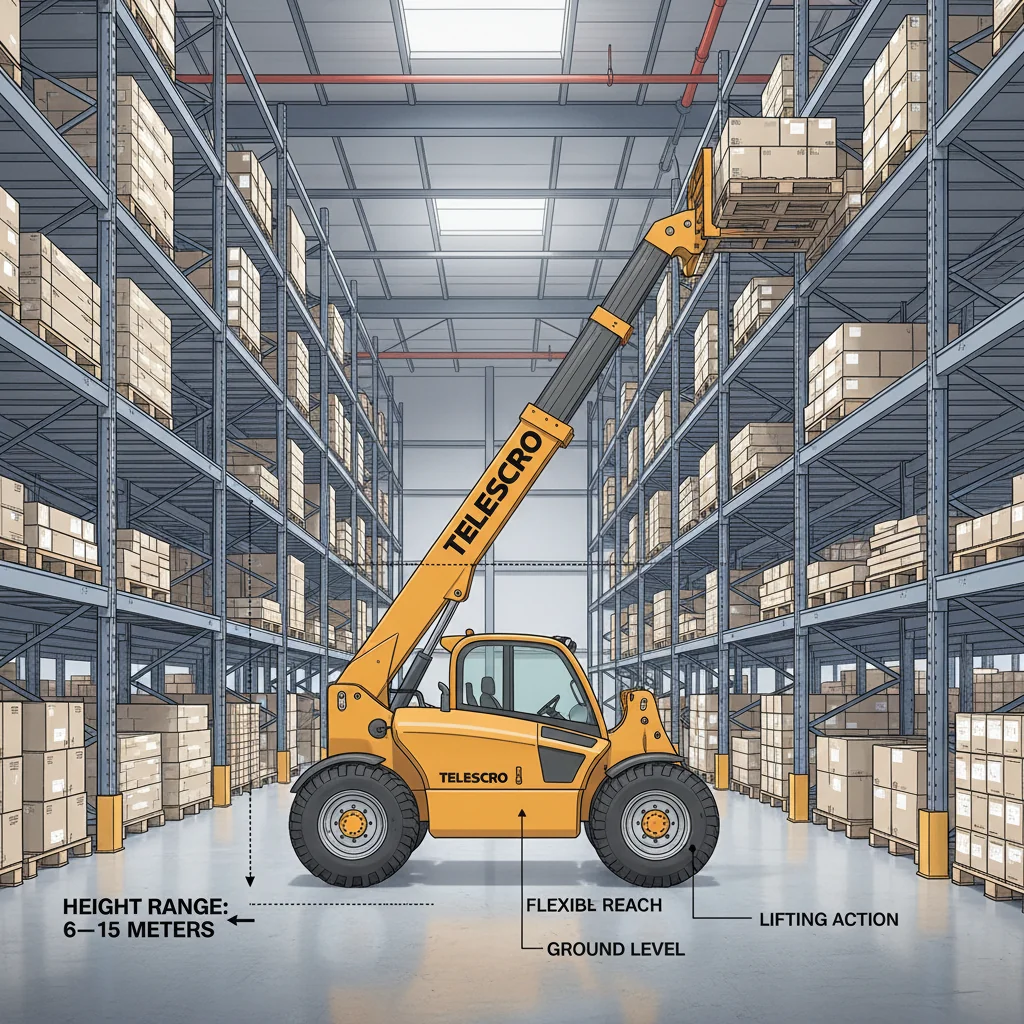
Let me share something important about using telehandlers in high-bay storage—especially if you’re dealing with multi-level racks or temporary overflow zones. I’ve worked with logistics clients in Dubai who needed to move heavy pallets—up to 2,800 kg—into storage racks more than 13 meters high. A telehandler made that job easy. Their operation had no fixed loading dock, so they couldn’t use standard forklifts without extra steps. With a 14-meter reach model, their team offloaded incoming trucks in the open yard, lifted directly to the top storage positions, and cut out a full transfer cycle. That saved at least a day’s work each week.
What makes telehandlers truly valuable in these scenarios isn’t just the vertical reach. It’s the flexibility to operate across rough ground, quick setup using stabilizers, and the ability to switch between forks, buckets, or winches for different loads. I always suggest reviewing the load chart for every rack height you’ll use. You might see a model rated for 3,500 kg, but that’s at minimum boom extension—at full 13–15 meters, real capacity often drops to just 1,000–1,400 kg.
I’ve noticed telehandlers work best when yard-to-rack distance is short—usually under 100 meters. They’re not designed for rapid aisle work like a reach truck. If your layout has wide aisles and frequent outdoor transfers, a compact telehandler is your best “bridge” tool. For narrow-aisle, high-frequency stacking, I suggest considering a dedicated reach truck for maximum speed. Always match your machine to your real workflow, not just headline specs.
Telehandlers with a boom reach of over 13 meters can efficiently place pallets in multi-level racks without the need for elevated operator platformsTrue
The boom design of telehandlers allows operators to position heavy loads at heights exceeding 13 meters, eliminating extra equipment such as elevated platforms and enabling direct placement in high-bay racks, especially in areas lacking fixed loading docks.
Telehandlers equipped with fixed forks cannot handle pallets heavier than 1,500 kg when accessing high-bay storage above 10 metersFalse
Many telehandlers have hydraulic lifting capacities well above 1,500 kg and variable reach configurations that allow them to handle up to 2,800 kg or more at heights above 10 meters; restrictions depend more on model specifications and stability than fork type alone.
Key takeaway: Telehandlers offer unique value in high-bay warehouse storage by reaching rack heights of 6–15 meters and acting as a flexible link between outdoor unloading and upper-level storage. They are best used where vertical access and versatility matter more than speed in narrow aisles.
What Telehandler Size Suits Warehouse Operations?
For warehouse applications, compact and mid-range telehandlers6 in roughly the 3–10 ton class, with lift heights under about 50 feet (15 m), tend to offer a strong productivity-to-cost balance when correctly matched to the site. Their maneuverability suits semi-dense layouts, but turning radius remains critical—always compare aisle and door measurements against telehandler specifications before purchasing.
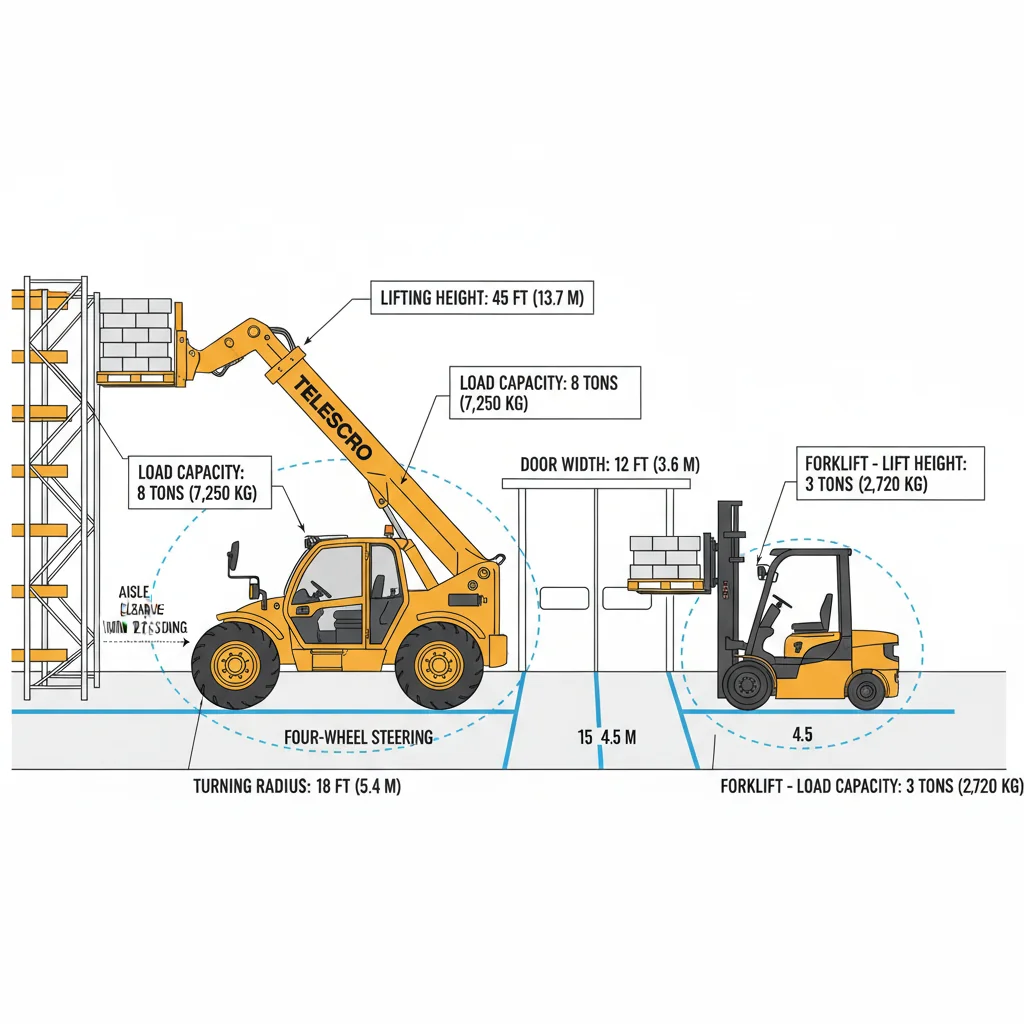
Here’s what matters most when choosing telehandler size for warehouse operations: it’s all about finding the right balance between capacity and maneuverability. Many buyers obsess over maximum lift height, but in most warehouses, you rarely need more than 10–12 meters reach. I’ve worked with a client in Dubai who bought a mid-range 7-ton telehandler. The lift height fit their racking systems perfectly, but the turning radius—over 4 meters—became a bottleneck in their narrower aisles. It’s a classic story: the machine fit through the doors but couldn’t work efficiently between pallet racks.
From my experience, compact or mid-size telehandlers—between 3 and 10 tons and with lift heights under 15 meters—can cover the majority of occasional high-reach and yard-to-rack tasks in most warehouses. Check the load chart, since rated capacity drops as you extend the boom. I always recommend comparing your warehouse’s narrowest aisle and door sizes directly with spec sheets. Some jobsites get creative, but if your aisles are under 3 meters wide, even a compact telehandler might struggle.
Here’s a checklist to guide your selection:
- Chassis width and length – Confirm it fits your aisle and door dimensions.
- Turning radius – Most models need 3–4 meters; double-check for your tightest turns.
- Lift height – Only as much as your top rack, with some margin.
- Rated capacity at typical boom extension – Not just max capacity.
- Optional: 360° rotating (slewing) boom – Adds versatility, but costs more and needs clear space.
I suggest creating a simple layout drawing before you buy. It’s easy to miss a “3-meter blind spot” in a crowded warehouse.
In warehouse telehandlers, a turning radius exceeding 4 meters can significantly hinder operations in aisles narrower than 3.5 meters, making maneuverability as critical a factor as lift capacityTrue
Telehandlers with large turning radii struggle to navigate tight aisles common in warehouses; this limitation often causes operational bottlenecks despite adequate lift height, highlighting the importance of balancing capacity and maneuverability.
Telehandlers used in warehouse operations typically require lift heights of at least 20 meters to efficiently access most rack systemsFalse
Most warehouse racking systems require lift heights between 10 and 12 meters; specifying 20 meters exceeds typical warehouse needs and results in unnecessarily large equipment that compromises maneuverability and increases costs.
Key takeaway: Choosing the right telehandler size for warehouses depends on balancing capacity and maneuverability. Compact and mid-range machines are most efficient, but always verify that turning radius, chassis size, and lift height match site-specific aisle, door, and racking dimensions before purchasing.
How Do Attachments Expand Telehandler Use?
Attachments transform telehandlers into multi-functional warehouse machines. Standard forks handle pallets, while couplers enable switching to buckets, jibs, or platforms for diverse tasks like loose material handling, equipment lifting, or facility maintenance. Always verify attachment compatibility, consider proprietary vs. universal interfaces, and evaluate changeover times to maximize operational efficiency in dynamic warehouse environments.
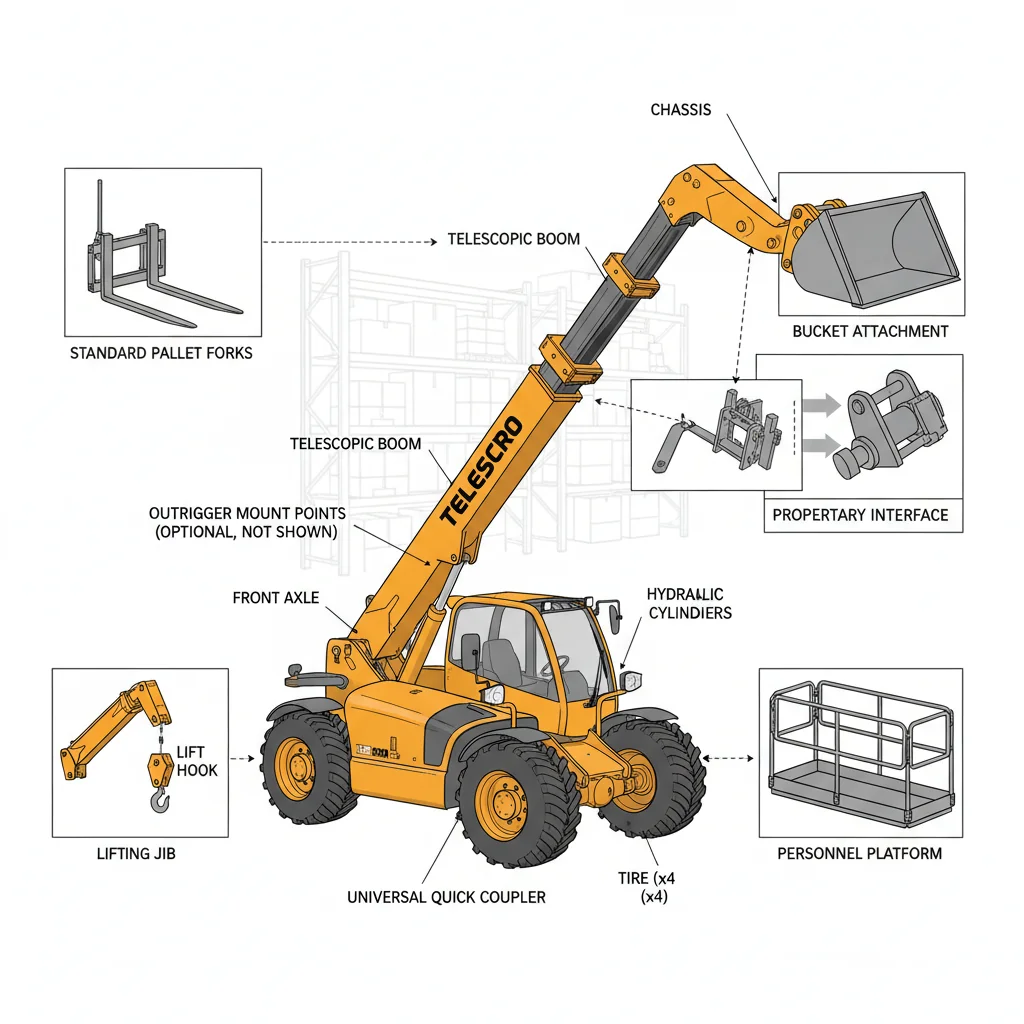
The biggest mistake I see is buyers picking a telehandler for pallets, then later realizing it can do so much more—if they planned ahead with attachments. In Thailand, a warehouse operator once called me because they suddenly needed to move loose aggregates for a small retrofit. Their standard forks were useless for the task. After we switched them to a quick-coupler system7 and added a bucket, one machine covered pallets, sand, and even small equipment lifts—saving them from renting two extra units.
Attachments I see most in warehouses include:
- Pallet forks8 – for daily palletized goods movement, usually rated for 2–4 tons
- Buckets – handle loose material like gravel, waste, or spilled grain
- Jib booms or lifting hooks – for machinery installation or irregular loads
- Work platforms – reach lighting fixtures, HVAC, or racking up to 12 meters
- Side shifters/fork positioners – adjust fork spacing or alignment without moving the machine
Here’s what matters: Not all telehandlers accept every attachment. Some models only fit proprietary accessories, forcing you to buy from a single supplier and limiting future add-ons. Universal quick-couplers let you switch tools in two to five minutes, depending on hydraulic setup. Always check the machine’s load chart with each attachment—especially buckets or platforms—because rated capacity usually drops due to extra weight and moved load center.
I always suggest mapping your attachment needs based on future upgrades, not just present work. Picking a flexible attachment package now keeps your warehouse one step ahead and avoids unexpected costs down the road.
Using a quick-coupler system on telehandlers allows operators to change attachments in under two minutes, significantly increasing job site productivityTrue
Quick-coupler systems are designed to enable fast and safe attachment swaps, often within 90 to 120 seconds, which reduces downtime and allows a single telehandler to perform multiple tasks efficiently.
Pallet forks on telehandlers are fully compatible with all types of pallet sizes and weights without the need for adjustment or additional stabilizationFalse
Pallet forks must be correctly sized and positioned for different pallet types and weights to ensure stability and safety. Improper adjustment can lead to load instability and accidents, so forks often require repositioning or additional supports for varying pallet dimensions and loads.
Key takeaway: Choosing a telehandler with a versatile quick-coupler and a broad range of approved attachments maximizes warehouse productivity and future-proofs material handling operations. Always align attachment options with current and anticipated facility needs while confirming supplier compatibility to avoid costly limitations later.
How Do Telehandler Powertrains Affect TCO?
Telehandlers often cost around 30–50% more upfront than comparable rough-terrain forklifts in the same capacity range, depending on brand, market and specification. In medium- to high-utilization fleets (roughly 1,000 operating hours per year), maintenance and fuel over a five-year period typically add up to around 20–30% of the original purchase price, while lighter-duty warehouse applications may sit below this range. Battery-electric telehandlers9 can cut on-site emissions, noise and ventilation demand, but remain a niche option in many markets and require investment in charging infrastructure and electrical capacity. When a telehandler is genuinely used as a multi-purpose machine—covering high-reach work, yard handling and occasional lifting tasks—it can spread these higher capital and running costs over more productive hours than a fleet of single-purpose forklifts.
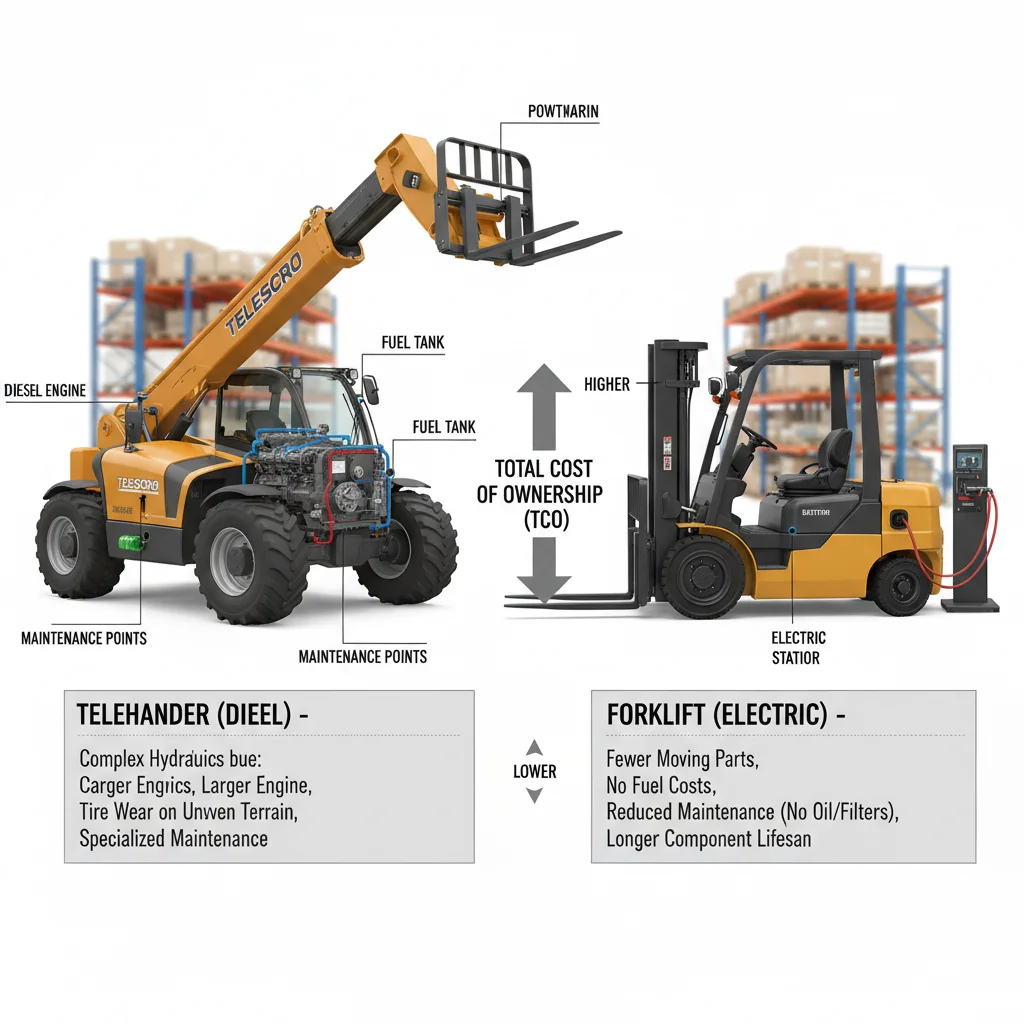
Most people don’t realize just how much the powertrain impacts long-term running costs for a telehandler—especially when compared to forklifts. Let me put it in perspective with an example from one of my clients in Dubai. They were replacing a diesel telehandler (lift capacity: 5 tons, reach: 9 meters) with a battery-electric unit for warehouse work. The upfront cost for the new electric telehandler was about 35% higher than a comparable diesel forklift, but they saved significantly on ventilation and fuel. In their operation, fuel and exhaust treatment ran over $6,000 per year per machine. With electric power, that dropped to less than $1,000 for charging—plus maintenance was simpler since there’s no engine oil, fuel filters, or exhaust aftertreatment to worry about.
To be honest, the real question is how much you can utilize a telehandler across multiple roles. In Kazakhstan, a contractor used two telehandlers for both pallet handling and light lifting jobs typically done by small cranes. Over five years, their maintenance bills averaged about 25% of the machine’s original cost—mainly for hydraulics and wear on the boom, not the transmission. They spread those costs over more projects because the telehandlers did double duty.
No powertrain is perfect. Diesel still wins for heavy, all-day outdoor work or where charging is difficult, but electric pays off fast indoors or on green-certified sites. I always recommend modeling both acquisition and running costs across your application mix. If you can run one telehandler where you’d normally need a forklift and a boom lift, your total ownership cost starts to make sense.
Battery-electric telehandlers used indoors can reduce ventilation costs by up to 70% compared to diesel models due to zero tailpipe emissionsTrue
Electric telehandlers produce no exhaust fumes, dramatically cutting ventilation and air quality control expenses in enclosed spaces, which can account for a large portion of operating costs in warehouse environments.
Diesel telehandlers typically have lower maintenance costs than electric units because their engines are simpler with fewer componentsFalse
Electric telehandlers generally have fewer moving parts and require less routine maintenance than diesel engines, which need regular oil changes, fuel system maintenance, and emission controls, often leading to lower maintenance expenses over the machine's life.
Key takeaway: Telehandlers have higher initial and maintenance costs than similar forklifts, but electric models offer operational savings in warehouse environments. When a telehandler’s multi-functionality is maximized for tasks usually handled by forklifts or small cranes, total cost of ownership can be optimized over a 5–7 year span.
What Indoor Safety Risks Do Telehandlers Pose?
Indoor telehandler operations present unique safety challenges: stability decreases as the boom extends, and working close to the upper end of the boom’s reach range—even with moderate loads—can sharply increase tip-over risk. Load charts10 must be strictly followed. Additional hazards include limited sightlines around racking, pedestrian traffic, floor load capacity, and the slewing radius of rotating models. Enhanced visibility aids, camera systems, clear zoning and exclusion areas, and floor-strength verification are all essential risk controls.

I’ve worked with customers in Dubai who underestimated just how different indoor telehandler work is compared to outdoor lifting. Indoors, the main issue is stability—especially as you start extending the boom over racking or aisles. Once you reach beyond about 80% of the rated maximum reach, even a moderate load can cause the machine to feel “light” on the back wheels. One customer tried to move 1,800 kg of pipe to a 12-meter rack in a logistics warehouse. The load chart (which shows how much you can safely lift at each boom angle and extension) only allowed about 1,400 kg at that position. They almost tipped the machine—luckily, the moment indicator alarmed before anything happened.
Honestly, indoor hazards stack up quickly. Limited sightlines due to racks, unpredictable foot traffic, narrow aisles, and uneven floor slabs all play a role. In older South African warehouses, I’ve seen floor concrete less than 160 mm thick—nowhere near enough for a heavier 4-ton telehandler with a full load. I always suggest getting the building plans or using a floor load tester before running high-capacity units indoors.
For rotating models, you need even stricter zoning. I saw a project in Kazakhstan pause for half a day after a rotating unit slewed too close to a staircase—no one had marked an exclusion zone, and a pedestrian nearly got clipped. Indoor jobs demand more than PPE and mirrors; invest in camera systems, proximity sensors, and clear operating corridors. Simple measures—like marking safe pedestrian lanes and enforcing standardized hand signals—cut incident rates dramatically in my experience.
Extending the boom beyond 80% of a telehandler’s rated maximum reach indoors significantly reduces rear wheel traction, increasing the risk of tipping even with moderate loadsTrue
As the boom extends, the center of gravity shifts forward, lifting weight off the rear wheels and reducing stability. Indoors, confined spaces and uneven floors exacerbate this effect, making the 80% reach threshold critical for safe operation.
Telehandlers used indoors can operate safely at their full rated lifting capacity at any boom extension length as long as the floor is levelFalse
Load charts for telehandlers show that maximum lifting capacity decreases as the boom extends; even on level floors, exceeding the reduced capacity at extended reaches risks instability and potential tipping.
Key takeaway: Telehandlers in warehouses face stability and floor load challenges, especially during indoor use at high reaches. Strict enforcement of load charts, improved visibility, pedestrian segregation, and robust zoning for rotating models are essential safety measures that significantly reduce operational incidents and satisfy regulatory and insurance requirements.
How Critical Is Telehandler Operator Training?
Operator training for telehandlers is essential due to the need for managing boom extension, load charts, and machine stability. Inadequate training can result in tip-overs and product damage. Facilities that adopt structured, manufacturer-led programs often report noticeably fewer rack/product strikes and, in some cases, up to around 15–20% faster multi-level cycles.
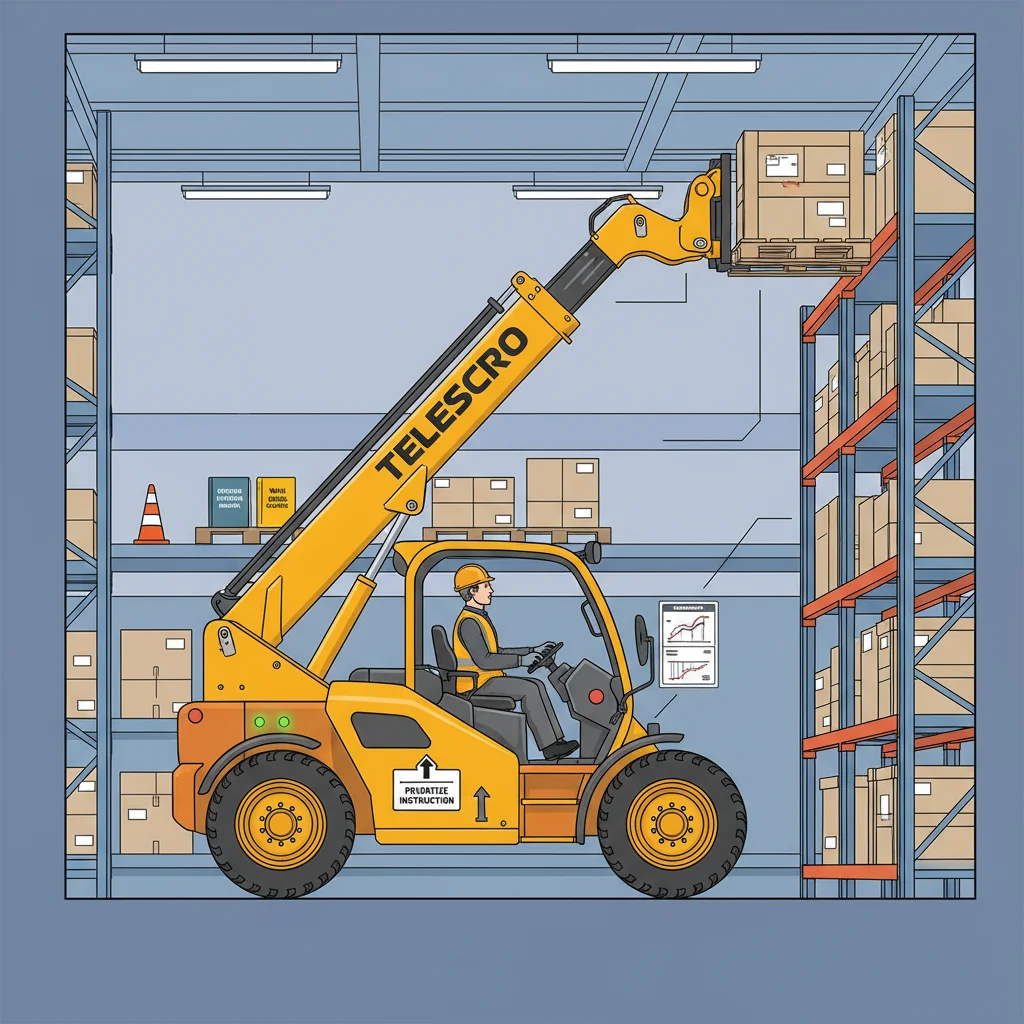
To be honest, the spec that actually matters is how an operator reads the load chart, not how quickly they can drive across a site. Telehandlers aren’t just big forklifts—they demand more critical thinking. I’ve worked with a crew in Kazakhstan who thought they were saving time skipping official training. Within weeks, their new 4-ton, 14-meter telehandler ended up with a bent boom and two near tip-overs just because operators relied on “feel” instead of the charts. Their productivity dropped, and so did morale. After switching to a manufacturer-led training session, they reached multi-level racks about 20% faster, and product damage almost disappeared.
What’s often missed is the impact of proper instruction on daily operations. Operators must interpret the load chart for every task. That means knowing when the rated capacity drops—especially at full boom extension or low boom angle. For units with stabilizers, the manuals clearly separate “on tyres” and “on stabilizers” capacities. Relying on old habits or shortcuts isn’t just risky; it creates liability. I always suggest tracking near-misses and rack strikes before and after training—improvements usually show up fast.
In my experience, rotating telehandlers or models with remote control absolutely demand a specialized certification. Regular refreshers and pre-use checklists make a measurable difference. I’ve seen sites in Dubai cut incident reports in half just by reviewing recent operator errors during monthly toolbox meetings. Treat the telehandler like a crane: only signed-off operators, load chart in hand, and every move documented. That mindset protects people, product, and profits.
Telehandlers used in warehouse operations rarely require training on load charts since most loads are standardized and predictableFalse
Even in warehouse environments with standardized loads, variations in boom extension, elevation, and load placement affect load stability; ignoring load charts can risk overloading and tip-overs, making operator training essential.
Key takeaway: Comprehensive, manufacturer-led operator training is vital for telehandler safety and efficiency. Training in load chart interpretation, boom management, and site-specific risks results in fewer incidents and up to 20% faster task completion. Always require qualified operators—treat telehandlers as cranes, not just oversized forklifts.
How is telehandler maintenance optimized with telematics?
Telehandler maintenance in warehouses should include regular—often monthly—inspections of hydraulic cylinders, hoses, and seals, especially where boom cycling is heavy. Telematics modules11 help track utilization, detect fault codes, and monitor indicators of hydraulic wear. Integrated platforms support condition-based servicing and faster access to spare parts, reducing downtime and helping fleet managers plan preventive maintenance or replace high-wear components at the right time.
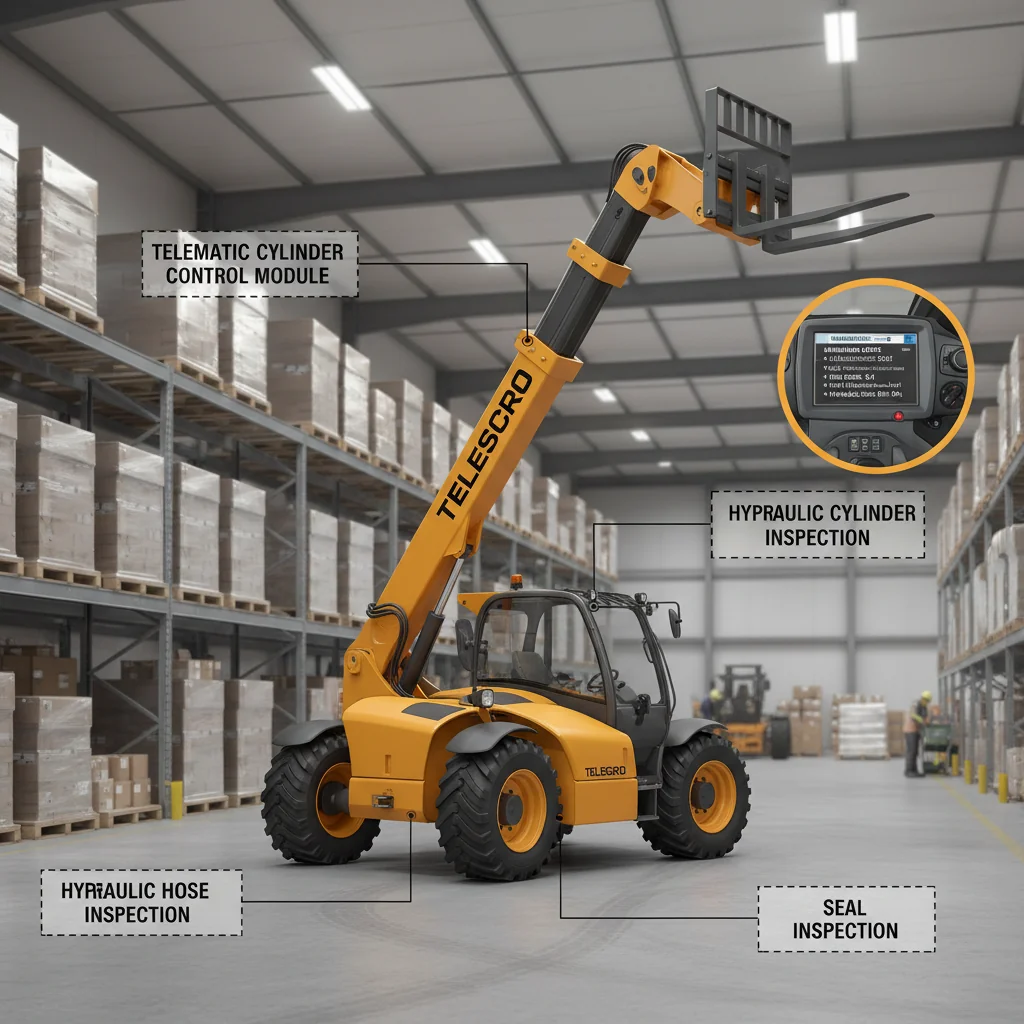
Last month, a warehouse manager in Poland asked me how to cut down on telehandler downtime, especially during peak shipping season. Their 4-ton unit was cycling its boom over 500 times a week—meaning hydraulic hoses and seals were under constant stress. In those environments, waiting for a fixed 250-hour inspection isn’t enough. Most issues I see actually start with minor leaks or slow-boom operation, caused by worn cylinder seals or debris around the telescopic sections. That’s where telematics makes a real difference.
Telematics modules track every boom movement, operating hour, and even hydraulic pressure anomalies. For example, I worked with a customer in Vietnam who connected their telehandler fleet to a digital maintenance platform. Once, the system flagged increased cycle counts and a slight drop in hydraulic pressure on their heaviest-used unit—a warning sign for seal wear. They scheduled a service before any fluid loss happened, swapped out seals, and were back to full operation in less than half a day. If they’d waited? Easily two or three days lost, plus a much bigger repair bill.
Here’s what matters for warehouse fleets: integrate telehandler telematics data with whatever system you use to manage your equipment or jobsites. That way, you see live reminders for monthly inspections, hose greasing, and cylinder checks—plus real data for planning. I always suggest tracking which units are hitting high hour counts or frequent boom cycles. That’s how you avoid “parts roulette” when peak season hits—by servicing based on real wear, not just a calendar.
Telematics systems can detect early-stage hydraulic leaks by monitoring subtle changes in boom extension speed and pressure fluctuations, enabling maintenance before visible damage occursTrue
By analyzing real-time data such as boom cycle rates and hydraulic pressure patterns, telematics can identify irregularities linked to worn seals or contamination, allowing proactive repairs that prevent downtime during critical operations.
Telematics automatically adjusts the telehandler’s boom movement speed to reduce hydraulic stress without operator inputFalse
While telematics provides valuable diagnostic data and maintenance alerts, it does not directly control or modify hydraulic system operation; boom speed adjustments remain manual or controlled by the telehandler’s onboard control systems.
Key takeaway: Effective telehandler maintenance in warehouse environments relies on routine hydraulic checks and leveraging telematics for real-time condition monitoring. This combination reduces downtime, optimizes service intervals, and supports smarter ownership or rental decisions by identifying high-usage units within mixed fleets.
Where Do Remote Telehandlers Add Value?
Autonomous and remote-operated telehandlers excel in repetitive, point-to-point warehouse tasks like pallet transfers between docks and staging lanes or feeding production lines. These units, guided by warehouse management systems, increase operational predictability, minimize operator exposure in hazardous or hard-to-reach areas, and perform well in environments with poor visibility or extreme conditions. Current adoption remains niche due to high specialization and cost.
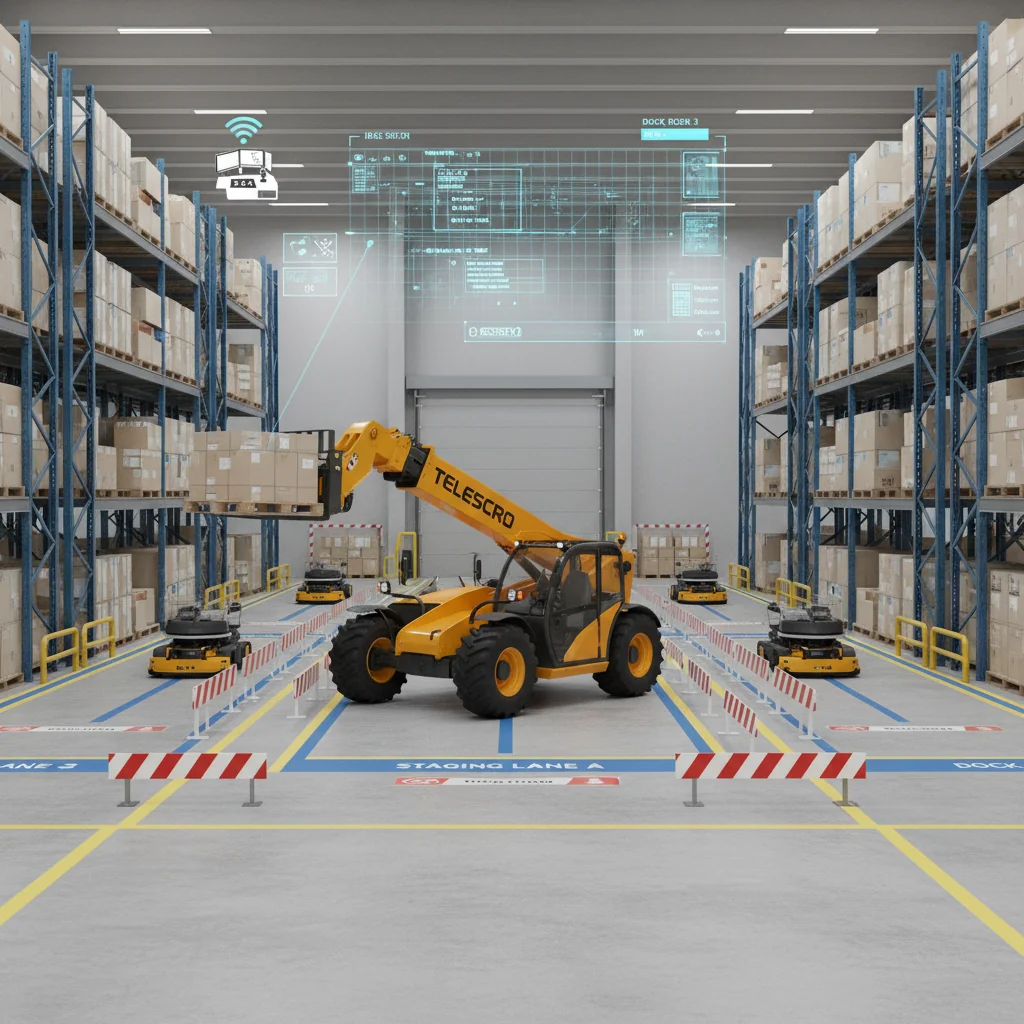
From what I’ve seen, remote and autonomous telehandlers really shine in environments where risk is high, repetition is constant, or human access is a genuine challenge. Take a logistics center I supported in South Korea last year—they set up two remote-operated units for pallet transfers between their inbound docks and a freezing cold storage area. The temperature inside hovered just above -20°C, which made it tough for operators to spend more than 10 minutes at a stretch. With remote operation linked directly to their warehouse management system, those telehandlers moved at least 30 pallets an hour with steady pace—even when visibility dropped due to ice mist. Their team was thrilled; no more rotating operators out for warmth or worrying about slip hazards near the dock doors.
Here’s what matters most when considering these machines: the real value comes in highly repetitive, tightly-controlled tasks. Feeding a production line, staging heavy cargo in racked storage, or keeping operators out of areas with dust, fumes, or low light—these are jobs where remote telehandlers outperform skilled humans. But I’ll be honest, this technology isn’t a one-size-fits-all solution. The systems are complex, and the upfront cost can easily run to two or more times that of a standard 3.5-ton model—even before you consider integration with your safety interlocks and WMS.
For most customers, I always suggest piloting remote or autonomous units in the riskiest or most repetitive workflow, then retaining trained operators for irregular loads or troubleshooting. Ensure the handover process between manual and autonomous modes is rock-solid—because on a real jobsite, conditions change fast.
Remote telehandlers in warehouse cold storage environments can improve operator productivity by allowing continuous operation beyond 10 minutes without exposure to sub-zero temperaturesTrue
Operators working in freezing environments like -20°C struggle with limited exposure times due to safety concerns and discomfort, but remote operation removes this limitation, enabling sustained material handling and improving throughput.
Telehandlers used in warehouse operations must always be equipped with GPS-based autonomous navigation systems to operate safely in confined indoor environmentsFalse
Indoor warehouse environments typically lack GPS signals and rely on other sensor systems like LIDAR or vision-based navigation; GPS is not feasible for precise telehandler operation inside buildings.
Key takeaway: Autonomous and remote-operated telehandlers offer strong benefits for specific, high-risk, or repetitive workflows—especially where safety, visibility, or environmental hazards are concerns. However, high costs and limited versatility mean most fleets should selectively pilot these solutions while retaining skilled operators for variable, complex warehouse tasks.
When Is Renting Telehandlers More Cost-Effective?
Renting telehandlers is most cost-effective for warehouses with infrequent or fluctuating high-reach requirements. Typical rental scenarios include peak storage, temporary outdoor use, facility upgrades, or racking changes. Rental agreements often provide the latest models, bundled maintenance, and telematics, minimizing capital outlay and idle equipment storage compared to outright ownership for low annual utilization.
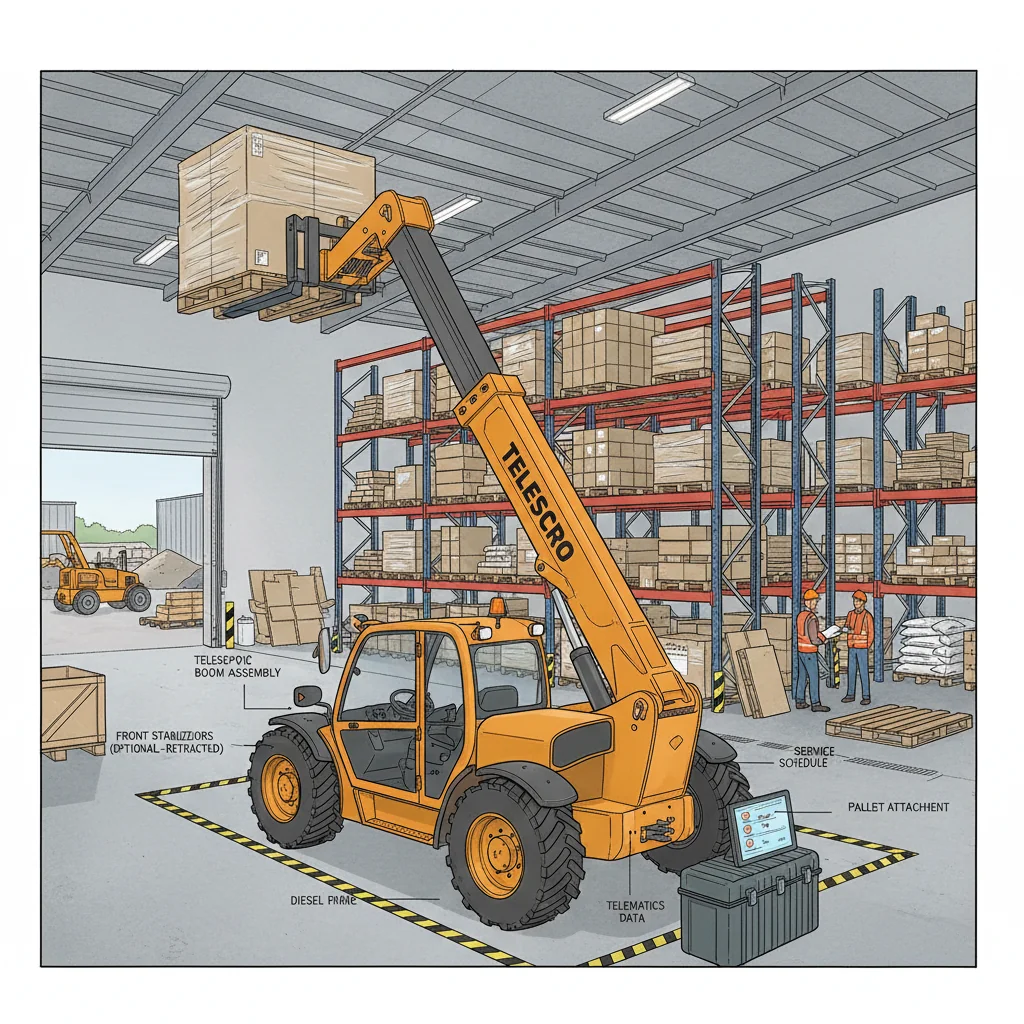
Most people don’t realize that telehandler rentals12 can actually save money—even for large warehouses—if your lifting needs are inconsistent. Take last summer in Kazakhstan: one of my customers manages a cold storage facility that only needs high-reach lifts during two seasonal inventory rotations. For the rest of the year, their telehandler sits idle, tying up capital and taking up valuable indoor space. Renting a 4-ton, 14-meter model for those peak months cost them about 40% less per year compared to owning and maintaining their own unit.
I’ve seen a similar pattern in Brazil, where a logistics operator used rental contracts to handle a major racking upgrade. Instead of investing over $70,000 in a new machine they would rarely use, they signed a six-month rental that included full maintenance and real-time telematics—no surprise service costs or downtime panic. The operator told me the subscription-style package also let them swap to a compact, battery-powered machine for indoor work halfway through the project.
From my experience, it’s the “lumpy” or unpredictable jobs—like setting up temporary mezzanines, expanding outdoor yards, or changing out conveyor systems—where rental makes the most sense. If you only run 300–400 hours per year, consider the costs beyond rental versus purchase: storage for idle equipment, insurance, annual inspections, and operator training all add up. I suggest tracking your actual lift hours with telematics, then comparing a three-year total cost using real service quotes. For most seasonal workloads, renting offers flexibility and sharp cost control—without a big upfront cash drain.
Renting telehandlers for seasonal peak usage can save up to 40% on annual costs compared to owning a machine that remains idle most of the yearTrue
Telehandler ownership involves fixed costs like depreciation, maintenance, and storage that accrue year-round, while renting only incurs costs during the high-demand periods, significantly reducing total annual expenses when usage is infrequent.
Telehandlers used in warehouse operations typically require specialized cold-weather engines that are not available in rental modelsFalse
While cold-weather packages are available for telehandlers, most rental fleets include models suitable for cold storage environments; there is no exclusive engine type needed that rental units cannot provide.
Key takeaway: For warehouses with intermittent or seasonal telehandler needs, renting often outperforms buying. Consider historical usage, projected hours, and total ownership costs—including service and downtime—when choosing between rental and purchase, especially as rental contracts increasingly cover long-term telematics, service needs, and minimize capital investment.
Conclusion
We looked at how telehandlers handle unique warehouse challenges—from high-reach lifting to moving awkward loads that standard forklifts just can’t manage. The trick is knowing when a telehandler genuinely adds value, not just chasing the biggest lifting specs. I’ve seen too many buyers get caught by what I call "parts roulette"—the frustration of downtime when a simple part takes weeks to arrive. Before you decide, always check how easy it is to get spares in your area and see how your most common loads fit on the real-world load chart. If you want to talk through your site’s needs or compare machines for your workflow, feel free to reach out—I’m always happy to share practical tips. Every warehouse is different; the right telehandler should fit your daily reality.
References
-
Learn the technical benefits of telescopic booms including extended reach, versatility, and improved load placement capabilities in logistics. ↩
-
Understand the critical role of turning radius in maneuvering telehandlers within narrow aisles and its impact on operational efficiency. ↩
-
Explore expert insights on how high-rack pallet handling expands storage capacity and optimizes material flow in warehouses. ↩
-
Detailed insights on interpreting telehandler load charts ensure safe operation and optimize lifting capacity at various boom extensions. ↩
-
Explore how vertical reach enhances telehandler efficiency in lifting pallets to upper rack levels and improves warehouse productivity. ↩
-
Explore how compact and mid-range telehandlers balance capacity and maneuverability to optimize warehouse productivity and cost-efficiency. ↩
-
Explains how quick-coupler systems enable fast attachment changes, boosting telehandler versatility and warehouse operational efficiency. ↩
-
Details how pallet forks handle daily palletized goods and the importance of selecting the right forks rated for tonnage in warehouse tasks. ↩
-
Explore how battery-electric telehandlers cut fuel expenses, lower maintenance needs, and reduce emissions for sustainable construction operations. ↩
-
Comprehensive explanation of using load charts to determine safe lifting capacities, crucial for preventing accidents with telehandlers indoors. ↩
-
Detailed insights on how telematics tracks utilization and hydraulic wear, enabling condition-based servicing to reduce telehandler downtime. ↩
-
Explore how telehandler rentals reduce capital and maintenance costs for low-use scenarios with expert cost-saving examples. ↩