










Telehandler vs Backhoe: Key Differences Every Buyer Should Know
From my experience working with contractors and fleet managers across four continents over the past four years, the biggest mistake I see buyers make is treating telehandlers and backhoes like interchangeable tools. I came into this industry with a mechanical automation background, and I can tell you, mechanically and operationally, they are worlds apart. On site, this confusion leads to costly delays and frustrated crews—especially when you realize the machine you bought can’t actually reach the height or dig the trench you need.
I’ll cover how each machine is truly designed, what tasks they’re best at, and what you need to watch out for—whether your team is lifting heavy pallets to 15 meters or digging precision utility trenches in tight city spaces. To be honest, understanding these key differences can save you a ton of money and headaches down the road. Trust me on this.
How Do Telehandlers Differ from Backhoes?
Telehandlers specialize in lifting and placing; they feature telescopic booms that can reach over 18 meters and support a huge variety of attachments for material placement and high-reach tasks. Backhoes, on the other hand, combine a powerful digging arm (the backhoe) and a front loader bucket, excelling at excavation, trenching, and general demolition work.
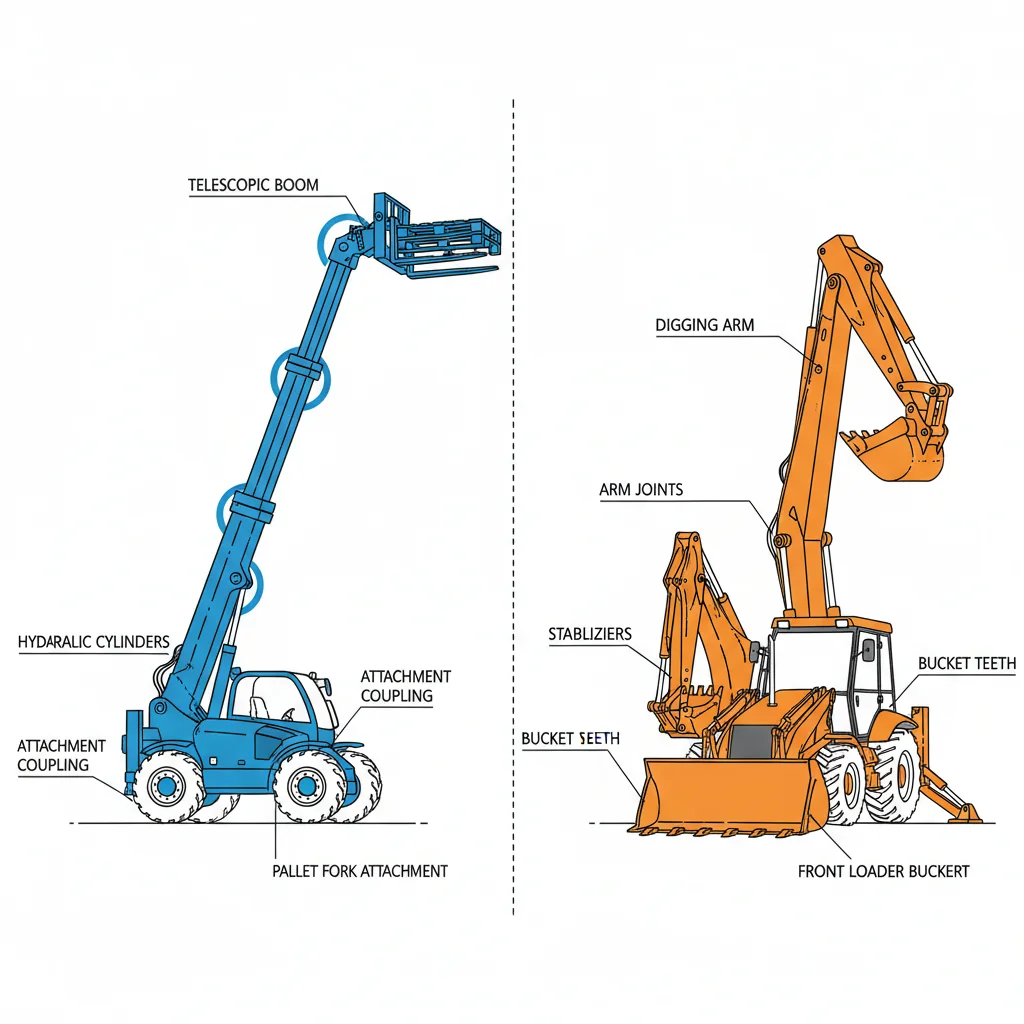
Most people don’t realize that the way telehandlers and backhoes work is completely different on actual jobsites. I’ve seen this confusion firsthand in places like Kenya, where a customer needed to lift palletized bricks up to an 8-meter scaffold. They tried using a backhoe because they already owned one, but it simply couldn’t reach—the digging arm is designed for downward and near-ground work, not vertical lifting. The backhoe’s hydraulic circuit is optimized for force, not reach. In the end, they brought in a 3.5-ton telehandler with a boom reaching over 12 meters, solving the problem in a single morning. That’s the difference between the right tool and the wrong tool.
Let me share something important about control and visibility. Telehandlers use a telescopic boom1 that extends forward and upward, with sophisticated moment indicators2 constantly monitoring stability and safe lifting angles. This is absolutely critical when placing loads high above ground, especially on tight sites where space is limited. A typical model can reach 10-18 meters and safely handle 2,500 to 4,000 kg, but you have to respect the load chart. In contrast, backhoes focus on earthmoving—digging trenches up to 5 meters deep, breaking concrete, and carrying material with the front bucket. They are rarely designed to lift anything above cab height.
To be honest, trying to use a backhoe for high-reach placements is not only inefficient, it’s dangerous. The hydraulic circuit and counterweight on a backhoe are optimized for digging force, not stability at extension. I always tell operators to check the load chart for any telehandler—the rated load drops dramatically as the boom extends, and knowing these limits prevents accidents. For any project involving vertical lifts, the right choice is clear: pick a telehandler equipped for the height and weight you actually need.
Telehandlers typically use a telescopic boom that can extend vertically and horizontally up to 12 meters or more, allowing them to lift loads to higher elevations than backhoesTrue
Unlike backhoes, which have a fixed pivot arm designed primarily for digging near ground level, telehandlers feature an extendable boom that provides greater reach and versatility for lifting materials to significant heights on the jobsite.
Backhoes are generally preferred over telehandlers for tasks requiring vertical lifting at heights above 10 meters due to their superior boom extension capabilitiesFalse
Backhoes are not designed for high vertical lifting; their digging arm has limited reach and is optimized for ground-level excavation, making telehandlers the better choice when lifting loads vertically beyond typical reach, such as above 8 to 10 meters.
Telehandlers are ideal for lifting and placing materials at height, thanks to their telescopic booms and attachments. In contrast, backhoes are designed for digging and earthmoving. Choosing the right machine maximizes efficiency, enhances safety, and prevents costly equipment misuse on the jobsite.
Which Is Better: Telehandler or Backhoe?
Telehandlers excel at high-reach lifting, handling 2.5–5 tons up to 18 meters with versatile attachments. Backhoes are superior for digging and trenching, especially in tight spaces. The choice depends entirely on whether your primary tasks favor lifting height and reach or precise earthmoving performance.
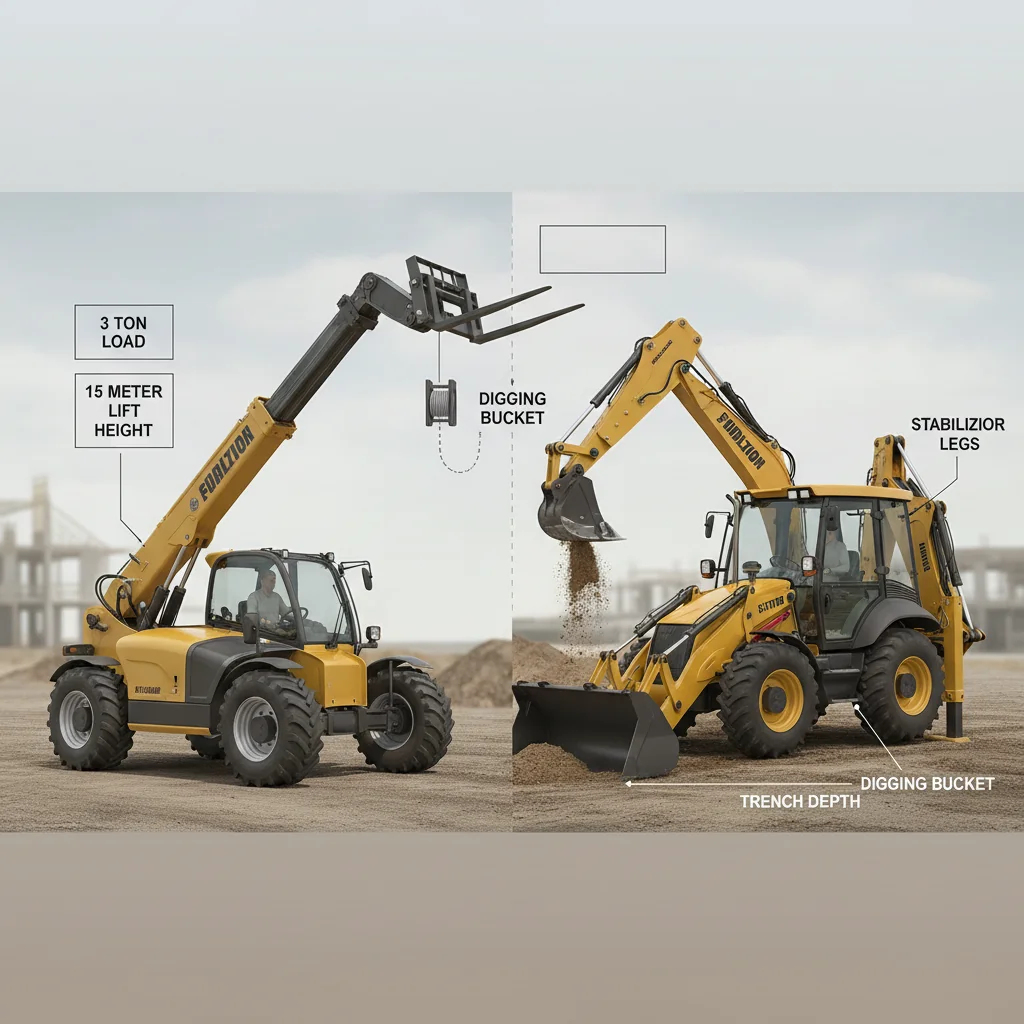
Let me share something important about choosing between telehandlers and backhoes—most contractors think it’s all about the lifting capacity or digging force. But, I’ve seen on so many jobsites that if you pick the wrong one for your core tasks, things get slow and expensive fast. Last year, one of my clients in Kazakhstan needed to move palletized bricks to a fourth-floor slab—roughly 14 meters up—but their site also had tight corners. They tried using a standard backhoe with a loader bucket. The machine was strong, but couldn’t safely reach above 6 meters. It took them extra days, and they finally had to rent a 4-ton telehandler, which finished the job in less than a day. That’s real money lost.
Here’s a simple comparison to help you quickly spot the best choice:
| Machine | Best For | Lifting Capacity | Max Reach/Depth | Maneuverability |
|---|---|---|---|---|
| Telehandler | High lifts, stacking | 2.5-5 tons | 10-18 m (vertical) | Moderate (Excellent with 4WS) |
| Backhoe | Digging, trenching | ~1 ton (loader) | 4-6 m (dig depth) | Excellent (tight) |
For lifting materials to elevated places—roof tiles, rebar, big formwork panels—I always suggest a telehandler. You get superior reach and can easily swap between forks, buckets, or work platforms thanks to the quick-attach coupler. If most of your tasks involve trench work, pipe laying, or utility repairs, a backhoe outperforms in tight city alleys or rural groundwork. One detail I recommend: check your site’s turning radius and operating surface. A telehandler’s stability depends heavily on ground conditions and the hydraulic circuit’s setup. That’s often overlooked, but makes a huge difference for safety and efficiency.
Telehandlers typically have higher maximum lift heights than backhoes, often reaching up to 20 meters, making them more suitable for vertical material handling on multi-story construction sites.True
Telehandlers are designed with extendable booms that can reach significant heights, commonly between 12 to 20 meters, whereas backhoes have limited lift height due to their fixed loader arms, usually under 5 meters. This makes telehandlers preferable for tasks like placing pallets on upper floors.
Backhoes can generally maneuver more easily in tight jobsite spaces than telehandlers due to their smaller turning radius and compact boom design.False
Telehandlers often have better maneuverability in confined spaces because many models feature four-wheel steering and smaller turning radii compared to backhoes, which have a rear dipper arm that can restrict turning and movement in tight corners.
Select telehandlers when your project requires heavy lifting and extended reach, leveraging their adaptability for different material handling jobs. Choose backhoes for frequent digging or trenching tasks, especially in confined areas. Carefully matching equipment to your core needs ensures job site efficiency and safety.
What Are Telehandler vs Backhoe Costs?
Telehandlers typically have higher upfront costs due to advanced lifting features but deliver strong ROI for high-reach tasks and often have lower maintenance expenses. Backhoes offer dual-functionality at a slightly lower purchase price, but their complex hydraulics and constant earthmoving duties can drive up long-term servicing and operating costs.
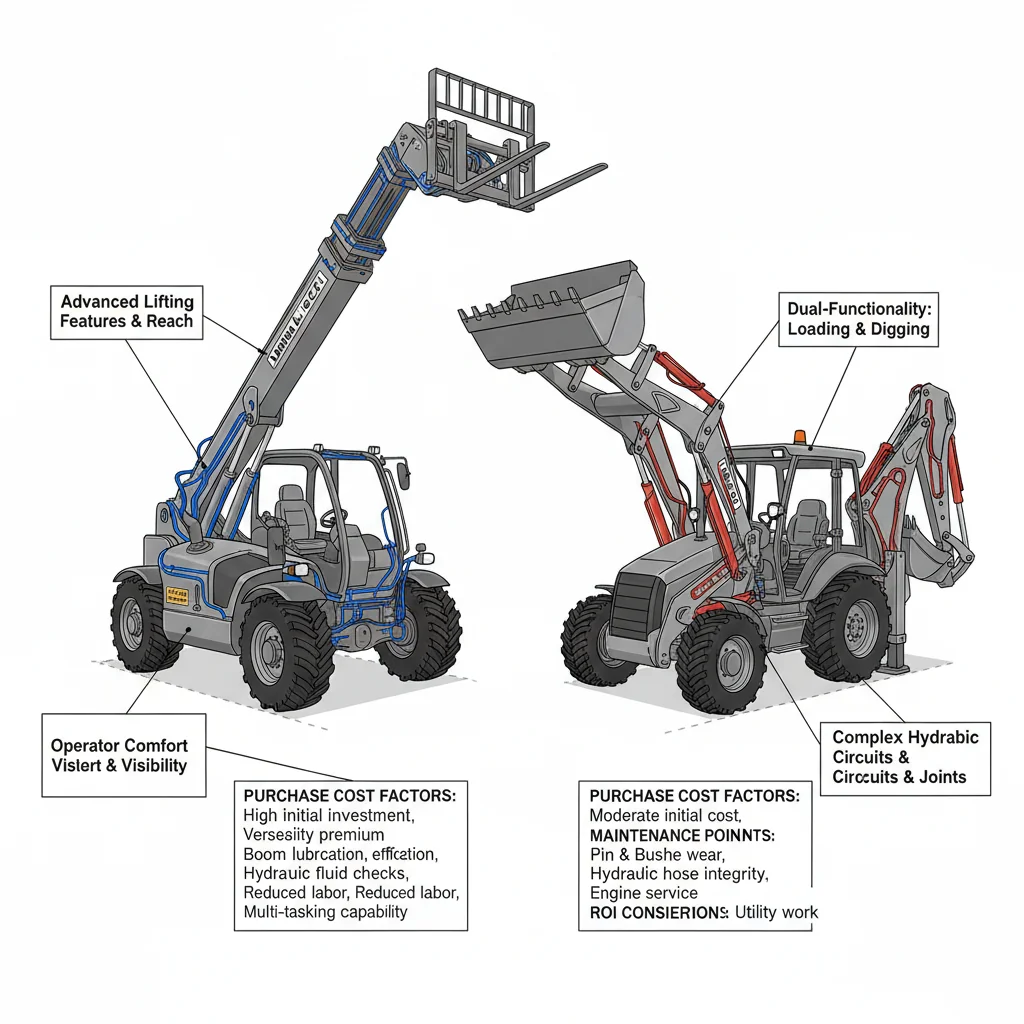
Here’s what matters most when comparing telehandler and backhoe costs: it’s not just about the sticker price you see up front. I’ve worked with contractors in developing markets who focused entirely on initial purchase cost, only to discover much bigger differences in maintenance and long-term expense later. For example, a typical 3.5-ton telehandler with a 13-meter reach might cost around $65,000 new, while a similarly sized backhoe loader usually starts closer to $55,000. That $10,000 gap looks significant—but it’s only the start.
Let’s break down the real numbers I see in the field:
| Machine Type | Upfront Cost (USD) | Key Strength | Maintenance Frequency | Common Service Issues | Project ROI Focus |
|---|---|---|---|---|---|
| Telehandler | $60,000–$80,000 | High-lift, precise | Annual/Biannual | Hydraulic leaks (rare), tires | Lifting & placing materials |
| Backhoe Loader | $50,000–$70,000 | Dig & load combo | Quarterly/Monthly | Hydraulic pumps, swing frame | Earthmoving & trenching |
From my experience (and my mechanical background confirms this), telehandlers run with much simpler, closed hydraulic circuits focused on extension. Over three years, an owner in Kazakhstan reported only minor hydraulic seal replacements—maybe $500 a year. By contrast, one customer in Dubai told me their backhoe needed a full hydraulic pump rebuild after just 18 months due to the demanding, high-cycle digging work, costing over $3,000 plus significant downtime. Fuel consumption also differs; telehandlers are often 10–20% more efficient when used mainly for static lifting tasks.
I suggest thinking hard about your jobsite needs. If you mostly shift pallets up several stories, the telehandler pays off quickly through efficiency and lower maintenance. But for diverse digging and loading, the backhoe’s versatility can justify the higher servicing demands. Always check both load charts and maintenance intervals before signing anything—that’s where real long-term costs hide.
Telehandlers typically have higher long-term maintenance costs than backhoe loaders due to more complex boom hydraulics and telescoping mechanisms requiring frequent inspections and seals replacementTrue
The telescoping boom of telehandlers involves multiple hydraulic cylinders and sliding components exposed to dirt and wear, increasing maintenance frequency and cost compared to the simpler backhoe loader arm design.
Backhoe loaders generally cost 20% more upfront than telehandlers of similar size because their additional bucket and excavator attachments require more advanced hydraulic systemsFalse
Backhoe loaders usually have a lower or similar purchase price compared to telehandlers; they don’t cost significantly more upfront despite having multiple attachments because their hydraulic systems are less complex than the telescopic boom hydraulics found on telehandlers.
When comparing telehandlers and backhoes, weigh both initial cost and long-term expenses. Telehandlers excel in maintenance efficiency and project ROI for lifting jobs, while backhoes suit diverse earthmoving needs despite higher servicing demands. Assess your typical project requirements to make the most cost-effective investment.
What Are Telehandler and Backhoe Safety?
Telehandlers require specialized training in load management and stability at height, while backhoe operators must focus on cautious digging and avoiding underground utilities. Both machines demand rigorous, regular safety checks and strict compliance with regulations. Following these practices greatly reduces accident risks and protects your operators.
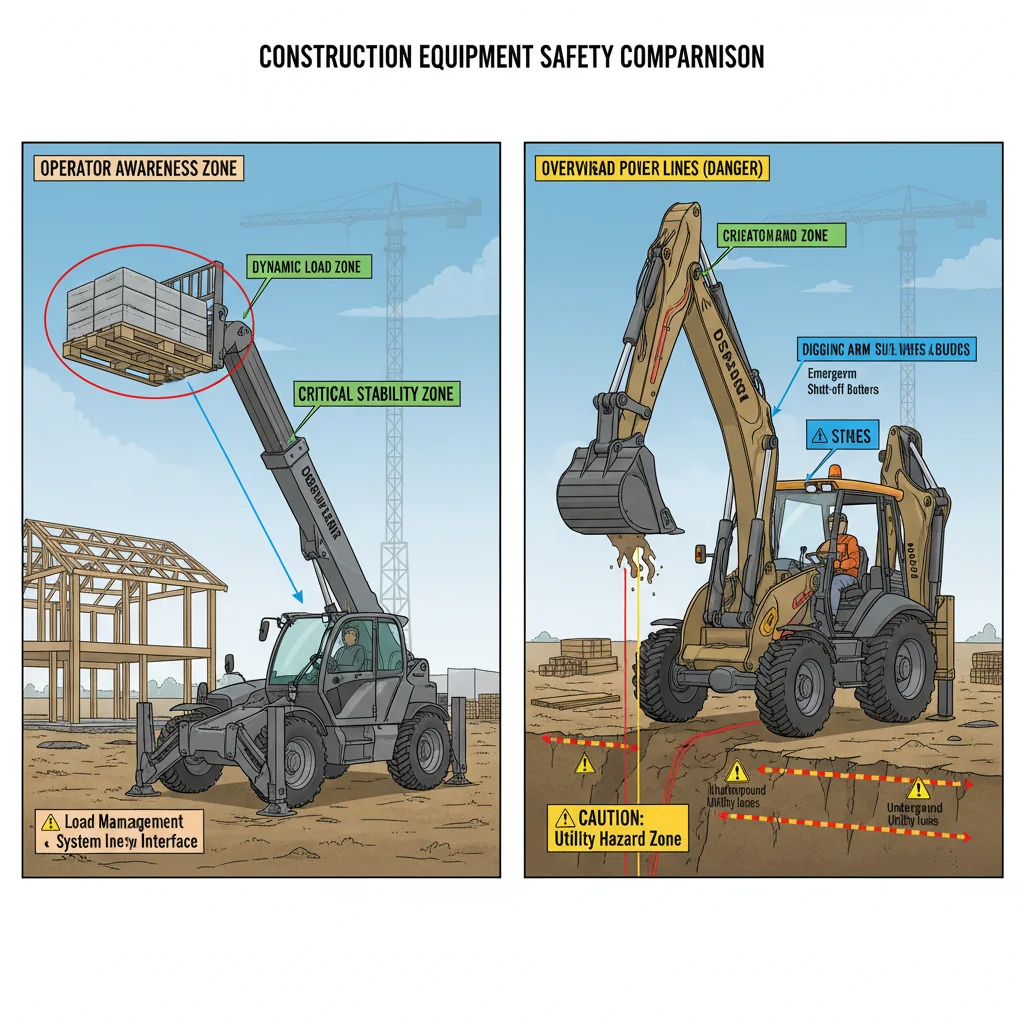
The biggest mistake I see is assuming that lifting with a telehandler or digging with a backhoe is just about muscle and horsepower. It’s not. Both machines pose unique safety challenges—ones I’ve seen firsthand working jobsites globally. For telehandlers, load management at height is critical. A 4-ton telehandler may handle bricks confidently at ground level, but extend that boom to 16 meters and suddenly your safe capacity drops, sometimes by half or more. I once saw a crew in Brazil try to lift a pallet of tiles to the fifth floor without checking the load chart. The rear wheels lifted clean off the ground—serious risk of tipping. I always tell operators to trust the machine and check the load moment indicator3, which warns you immediately if you’re exceeding capacity at any height or extension.
For backhoes, careful digging isn’t just about technique—it’s survival. In Kazakhstan, a local contractor cut through a major power line because they skipped a basic utility survey4. That mistake shut down the site for three days and nearly caused severe injury. Digging near infrastructure means knowing where every cable and pipe runs, using markers and sometimes even ground radar. It’s not just theory—one small oversight can be catastrophic.
Regular safety checks matter just as much as skill. I suggest inspecting hydraulic circuits daily, looking for leaks or damaged hoses. Test every control, every stabilizer, and every backup alarm before starting work. Even top-quality machines lose reliability without this discipline. If you follow local safety standards while investing in real, machine-specific operator training, accident risks drop sharply. That’s how you protect both people and expensive assets.
Telehandler load charts must account for boom extension angles because at 16 meters height, lifting capacity can decrease by over 50% compared to the rated capacity at ground levelTrue
As the boom extends and elevates, leverage increases and stability decreases, requiring operators to follow detailed load charts that drastically reduce allowable loads to prevent tipping or structural failure. This is especially critical beyond 10 meters of boom extension.
Backhoes are designed with telescopic booms similar to telehandlers, allowing them to lift loads at significant heights with comparable capacityFalse
Backhoes have fixed boom arms primarily designed for digging, with limited vertical reach and no telescoping ability; their lifting capacity at height is minimal compared to telehandlers, which use extendable booms specifically for lifting and placing loads.
Prioritizing proper operator training, routine safety inspections, and strict adherence to local safety regulations significantly minimizes risks for both telehandlers and backhoes. This structured approach protects equipment, ensures operator well-being, and helps maintain overall on-site safety during heavy machinery operations.
How Does Maintenance Extend Equipment Life?
Regular maintenance of telehandlers and backhoes, including hydraulic system checks, boom inspections, and monitoring bucket and loader wear, reduces the risk of catastrophic breakdowns. Timely oil and filter changes plus inspection of all moving parts prevent major failures, resulting in fewer costly repairs and a much longer machine lifespan.
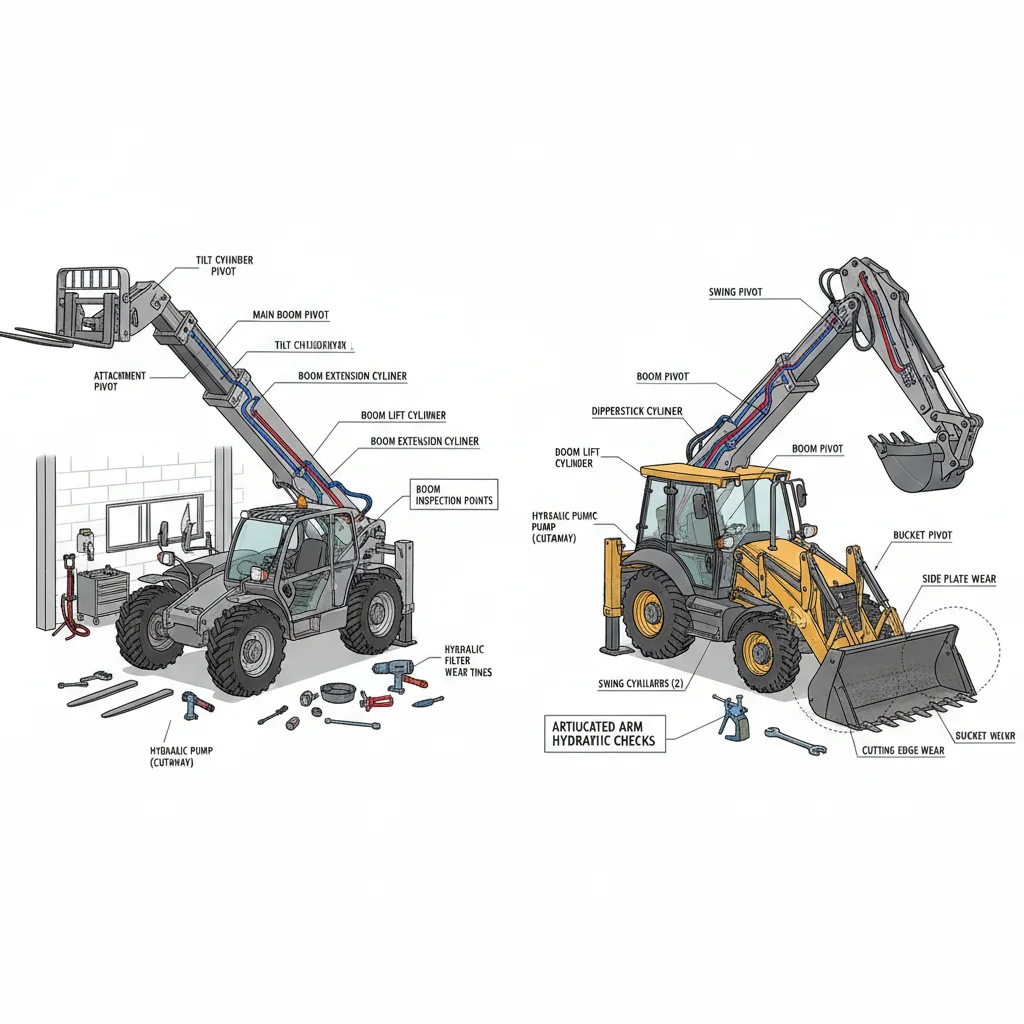
Last month, a contractor in Kazakhstan contacted me after their 3.5-ton telehandler suddenly lost hydraulic pressure mid-shift. Turns out, the main hydraulic filter hadn’t been replaced for over 800 hours—far beyond the recommended 500-hour interval. That small oversight led to a blocked circuit, forcing them to stop work for nearly a week while waiting for replacement parts. Their downtime cost at least $4,500, not counting delays for the building schedule. This isn’t unusual. In my experience, regular filter and oil changes are low-cost tasks that protect the entire hydraulic system—pumps, cylinders, and hoses—from premature wear.
Boom inspections are just as critical. I worked with a team in Dubai using a high-reach 17-meter telehandler for steel assembly. They found a hairline crack on a weld joint during a routine inspection. If they’d missed it, the entire boom could have failed under load. Instead, a one-day repair prevented a major structural failure. For backhoes, contractors often notice bucket teeth or loader arms wearing down fast after months of heavy digging. Replacing these parts on schedule keeps the main joints and cylinders working smoothly. Even small items, like pins and bushings, matter—they take massive force with every cycle.
To be honest, ignoring daily and weekly maintenance will almost always cost you more in the long run. I suggest scheduling routine checks—especially before peak work seasons. Keeping an eye on hydraulic fluid levels, greasing all pivot points, and checking safety devices like moment indicators really does pay off. You’ll see fewer sudden repairs, and your equipment stays reliable for years.
Telehandlers typically have a higher forward reach capacity, extending boom lengths up to 7 meters or more, while backhoes generally have limited reach around 4 to 5 meters due to their compact designTrue
Telehandlers are designed with longer reach to place loads at height or distance, often equipped with telescopic booms extending beyond 7 meters. Backhoes prioritize excavation and digging, featuring shorter, hinged arms better suited for close-range material handling, usually limited to 4-5 meters reach.
Backhoes are generally capable of lifting heavier loads at maximum reach than telehandlers because of their dedicated boom arm designFalse
Although backhoes have powerful digging arms, their lifting capacity at maximum reach is lower than telehandlers. Telehandlers are engineered primarily for lifting and placing heavy loads at distance and height, often supporting capacities of 3 to 7 tons at full extension, while backhoes trade off reach and height for digging power.
Routine, targeted maintenance—such as inspecting hydraulics, booms, joints, and performing timely oil and filter changes—greatly increases the longevity and reliability of both telehandlers and backhoes. Proactive care minimizes costly breakdowns, supports machine uptime, and lowers overall operating costs for contractors.
Conclusion
We’ve explored how telehandlers and backhoes serve very different roles—one for high-reach material handling, the other for digging and earthmoving. Understanding those core differences prevents a lot of headaches down the line. I know, because I’ve been the guy troubleshooting the machine that was never meant for the job.
From my experience, buyers who skip past the "showroom hero" specs and really look at load charts, maintenance schedules, and local support are the ones who avoid trouble. It’s all too common to see a machine chosen for its catalog numbers—but falling short where it counts on the jobsite.
If you have questions about how either machine would fit your specific workflow, or want advice based on real jobsite conditions, feel free to reach out. I’m happy to share practical tips so your equipment works where and when it matters. Every site is different—choose what actually works for your workflow.
References
-
Detailed insights into telescopic boom mechanics, extensions, and safety features vital for efficient high-reach material handling. ↩
-
Explains the technical function of moment indicators in monitoring load and stability, reducing risks during vertical lifting tasks. ↩
-
Detailed explanation of load moment indicators preventing tipping risks by monitoring load capacity changes at height, essential for operator safety. ↩
-
Explores the importance of utility surveys in preventing damage to underground cables and pipes, with real case studies highlighting safety measures. ↩