










Telehandler Uses in Road & Bridge Projects: Field-Tested Applications and Safety Tips
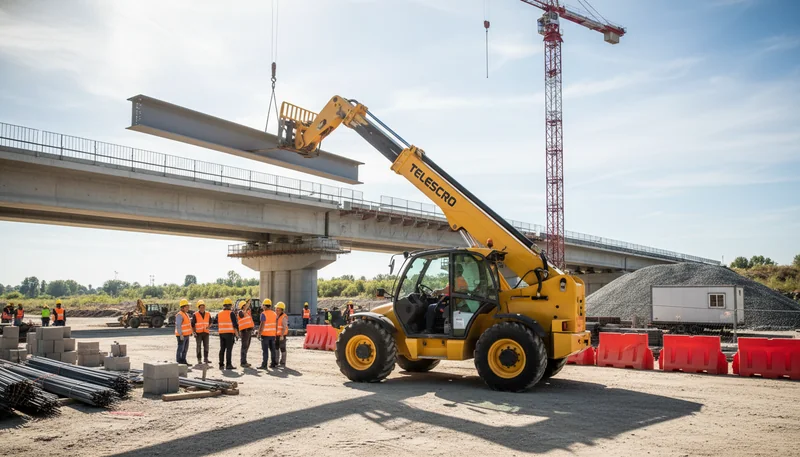
Earlier this year, a bridge contractor in Malaysia sent me photos of his crew squeezing a 12-meter telehandler along a muddy detour, lifting rebar over concrete barriers with just centimeters to spare. It’s moments like that when the true versatility of telehandlers becomes crystal clear—especially on tight and unpredictable road projects.
Telehandlers deliver critical value in road and bridge construction by combining the extended reach of a crane with the maneuverability of a loader and the material handling of a forklift. Telescopic booms on modern units allow operators to place heavy materials such as rebar, precast segments, and formwork over obstacles, minimizing the need for larger, costlier cranes. Compact designs, rough-terrain capability, and an array of quick-change attachments enable efficient quick-change attachments enable efficient material handling, lifting, and access support across dynamic road and bridge jobsites.
How Do Telehandlers Improve Bridge Project Efficiency?
Telehandlers enhance road and bridge project efficiency by combining crane, forklift, and loader functions in one machine. Their telescopic booms—typically offering 6–17 m of reach with 2.5–6 t rated capacities, and special heavy-duty models reaching 10–12 t at shorter radii—handle rebar, formwork, precast barriers, and steel beams where cranes are impractical. Rough-terrain chassis and compact footprints allow access to undeveloped subgrade and tight workspaces, maximizing material placement versatility.

Let me share something important I learned working with contractors on bridge jobs in Dubai and northern China. Most people don’t realize how much downtime comes from waiting for the right lifting equipment to arrive. On bridge projects, space is tight and surfaces are rarely finished. Traditional cranes can’t always position close to the work, and standard forklifts get stuck on ungraded approaches. This is where telehandlers really shine.
A 12-meter telehandler rated for around 4,000 kg can unload rebar pallets one moment, then lift formwork or place precast barriers the next—even over guardrails. On a project in Kazakhstan last year, the crew used a single compact 3-ton telehandler to handle everything from steel beams to site fencing. Its 4WD and rough-terrain chassis let them maneuver along temporary detours and shoulders, even with muddy ground. They saved at least two full working days compared to renting separate cranes and loaders. The cost savings added up, especially for a medium project running three months.
Another thing I notice—many buyers overlook the load chart. Just because a telehandler is rated for 5 tons doesn’t mean you can lift 5 tons at maximum extension. Always check the rated capacity at your required reach. For most bridge work, that’s somewhere between 8–12 meters horizontally. The moment indicator and hydraulic circuit performance are key for safe and stable lifts.
In short, I suggest considering telehandlers as your site’s utility player. One well-chosen unit can handle a surprising range of jobs, cut mobilization costs, and solve those access headaches cranes or forklifts can’t touch.
Telehandlers with 12-meter reach and 4,000 kg capacity can maneuver over ungraded or uneven surfaces on bridge sites where traditional forklifts typically failTrue
Telehandlers are designed with all-terrain tires and adjustable stabilizers, allowing them to operate on rough or unfinished surfaces common in bridge construction, whereas forklifts generally require smooth, graded ground for stability and traction.
Telehandlers eliminate the need for any crane support on bridge projects because they can lift and place all types of heavy structural componentsFalse
While telehandlers are versatile and can handle many lifting tasks, they have lifting capacity and reach limits that prevent them from fully replacing cranes, especially when handling very heavy or large structural elements on bridge sites.
Key takeaway: Telehandlers’ multi-functionality, telescopic reach, and all-terrain mobility reduce the need for multiple specialized machines on road and bridge projects. This versatility lowers mobilization and fleet costs while enabling efficient material handling in areas inaccessible to cranes or standard forklifts.
How to Select the Right Telehandler Type?
Matching telehandler type to road and bridge projects involves evaluating maximum load, reach (vertical and forward), and ground conditions. High‑reach models with outriggers1 suit elevated installations, while high-capacity pick-and-carry units handle heavy transport. Compact or rotating telehandlers provide optimal maneuverability in confined spaces. Always consult load charts2, map component weights, access constraints, and assess ground bearing capacity before selecting equipment.

Here’s what matters most when matching a telehandler to a road or bridge project: real jobsite demands. I’ve worked with clients in Dubai and Sao Paulo who assumed any “big” telehandler would work—until tight medians or soft soil forced a rental swap in week two. The first step is always mapping out your heaviest component, real-world reach over barriers, and width of your access path. A headline 20-meter boom or 8-ton “rated capacity” sounds great, but if your load chart only allows 2,500 kg at maximum reach, it’s a “showroom hero, jobsite zero.”
Let’s break down the main telehandler types and their practical fit:
| Type | Best For | Typical Rated Capacity | Max Reach | Turning Radius |
|---|---|---|---|---|
| Compact | Confined/tight sites, bridge decks | 2,500–3,500 kg | 8–12 m | <4 m |
| High-Reach (with stabilizers) | Sound walls, tall abutments | 3,500–6,000 kg | 18–25 m | 5–6 m |
| High-Capacity Pick-and-Carry | Heavy highway, barrier moves | 6,000–12,000 kg | 12–18 m | 6–7 m |
| Rotating (RTH) | Tunnels, urban, over obstacles | 3,500–5,000 kg | 15–25 m | ~5 m |
Last month, a bridge contractor in Vietnam needed to lift steel forms—each over 4,000 kg—across a soft riverbank. A high-capacity pick-and-carry telehandler worked, but only after we double-checked ground pressure and planned turning radii under 7 meters. I always suggest reviewing the moment indicator or load chart for each critical lift—don’t skip this step. The right match means safe, efficient progress and no costly replacements mid-project.
Telehandlers with longer booms often have reduced rated capacity at maximum reach, requiring careful load chart review to avoid overloading when lifting heavy components over obstacles in road and bridge projectsTrue
As boom length increases, telehandlers experience greater leverage effects, reducing their rated capacities at extended reach positions. This makes it critical to consult load charts to ensure safe operation especially when lifting heavy loads over barriers.
Selecting a telehandler based solely on its maximum rated capacity guarantees efficient performance regardless of jobsite constraints like access width or soil typeFalse
Maximum rated capacity alone does not account for real site conditions such as narrow access paths or weak soil that may restrict machine size or outriggers, making other factors like width, ground pressure, and stability essential for proper telehandler selection.
Key takeaway: Choosing the correct telehandler requires a thorough assessment of load requirements, reach needs, site access, and ground stability. Consulting load charts and considering machine type—high-reach, pick-and-carry, or rotating—ensures safe, effective handling of materials in diverse road and bridge construction scenarios.
What Safety Risks Affect Telehandler Stability?
Overloading and instability are major risks in telehandler use on road and bridge projects. Load capacity3 decreases with boom extension, height, and attachments like jibs. Exceeding rated capacity can cause tip-over or damage. Site-specific lift plans4, proper operator training, exclusion zones, and compliance with standards like EN15000 or ANSI B56.6 reduce incidents. Modern machines use load moment indicators and automatic cut-outs.
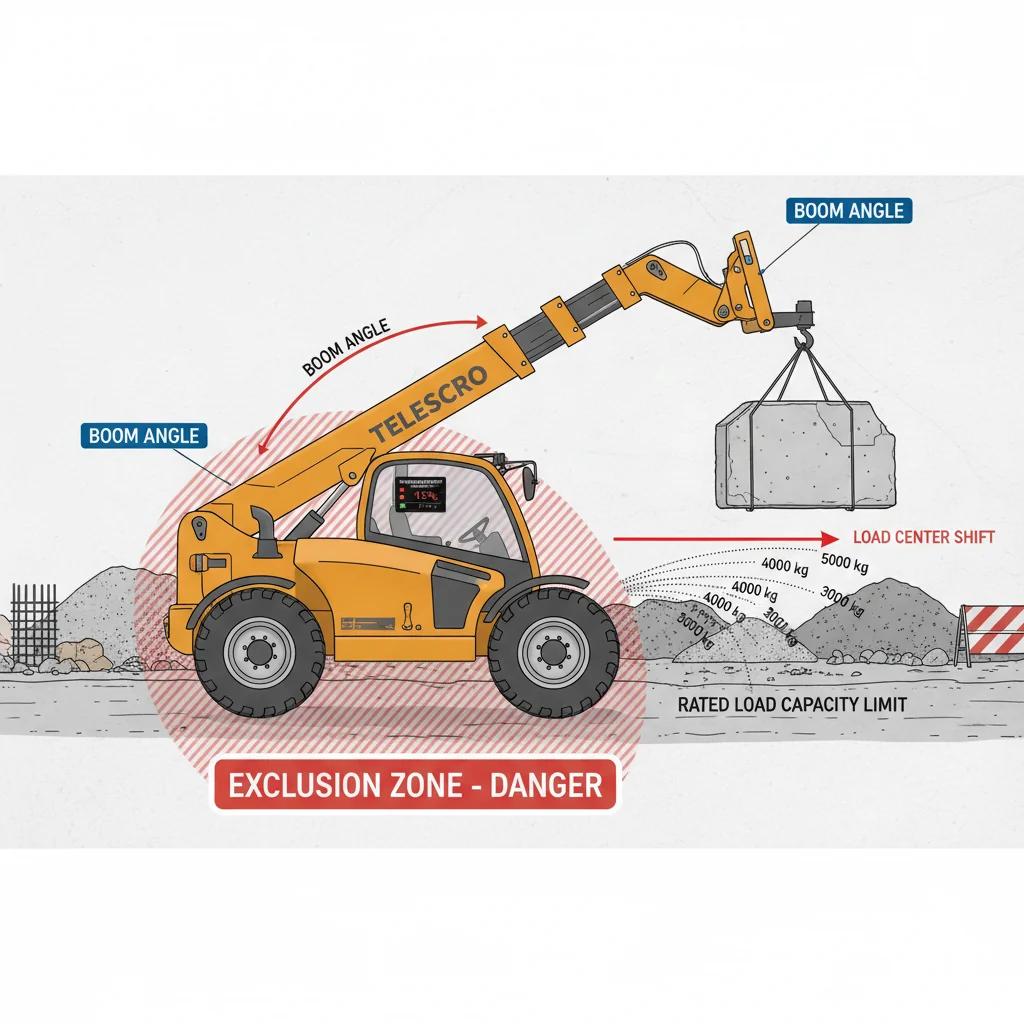
The biggest mistake I see is clients ignoring how quickly rated capacity drops as the boom extends. I’ve worked with contractors in the UAE who assumed their 4-ton telehandler could always lift that full weight—until the boom reached 14 meters with a platform, and suddenly safe capacity sank to just over 800 kg. That’s where instability creeps in. If anyone tries to “just stretch it a bit” past the load chart, the risk of tip-over or even structural damage skyrockets. On road and bridge projects, you’re often lifting at awkward angles, over guardrails or embankments, and sometimes even above open traffic lanes. Wind gusts make things trickier, especially with long rebar bundles or formwork panels—just a moderate wind can push a suspended load off balance.
I always stress site-specific lift planning, not generic charts. Recently in Brazil, a customer needed frequent lifts near a highway edge. We walked the site and found that the ground looked stable, but the top 200 mm was loose fill. Without ground verification and proper stabilizer use, the risk of the telehandler sinking or tilting was real. For rotating machines, EN 1459-2 says you only get full chart performance with full stabilizer deployment—short-jacking is allowed, but the restricted load chart applies. Modern telehandlers help with load moment indicators and automatic cut-outs, but nothing replaces trained, attentive operators. I suggest reviewing lift plans for every shift, especially if conditions change after rain or if you’re swapping attachments. Always set and clearly mark exclusion zones around suspended loads—on a crowded site, that one step prevents countless incidents.
Key takeaway: Managing telehandler safety on road and bridge projects requires strict control of load limits, use of site-specific lift plans, proper training, ground verification, and adherence to industry safety standards. Automatic safety systems and exclusion zones are critical in preventing tip-over and instability incidents during complex lifts.
How Do Telehandler Attachments Boost Productivity?
Telehandler attachments maximize versatility and efficiency by enabling one machine to perform multiple specialized tasks—such as pallet handling, earthmoving, lifting, and inspections—without switching equipment. Quick-coupler systems5 facilitate rapid swaps between forks, buckets, jibs, and man baskets, supporting noticeably higher daily productivity, particularly on sites where one machine must handle multiple tasks.

Most people don’t realize that telehandler attachments are what transform one basic machine into a “tool carrier” for all sorts of demanding site work. When I visited a road project in Kazakhstan last year, the crew used a standard 4-ton telehandler with quick coupler attachments. Their job included unloading rebar bundles, feeding cement mixers, clearing debris, and lifting workers for bridge inspections—all with a single machine. That versatility saved them the cost (and headache) of renting multiple pieces of equipment.
Common telehandler attachments that drive this productivity boost include:
- Pallet forks6 – for transporting palletized materials, bagged cement, and steel bundles up to the rated machine capacity
- Material buckets – moving gravel, sand, and loose fill; I’ve seen site cleanups completed significantly faster compared to manual haulage, based on contractor feedback.
- Lifting jibs or winches – for precisely placing small beams, ductwork, or utility poles at height
- Certified man baskets – raising two or three workers to 14 meters for bridge inspections or lighting work
- Side shifters or fork positioners – saving time by adjusting fork spacing hydraulically, no need to manually re-rig
Quick-coupler systems make a real difference here. I saw a team in Dubai change from forks to a man basket in under three minutes—no special tools, just a hydraulic release and the correct lock pin. That’s how they managed concrete, debris, and site inspections in one shift.
To be honest, always verify that your attachments are compatible, certified, and that your operators understand their impact on the load chart. It keeps your team safe—and keeps productivity gains real.
Quick coupler attachments on telehandlers can reduce tool change times by up to 70%, significantly enhancing workflow efficiency on complex road and bridge projectsTrue
Quick couplers allow operators to switch between different attachments, such as forks, buckets, and personnel lifting cages, rapidly without leaving the cab, minimizing downtime and improving productivity on multifaceted jobsites.
Using telehandlers to lift workers for bridge inspections is generally discouraged because telehandlers lack the stability and certified fall protection systems required for personnel liftsFalse
Modern telehandlers equipped with proper personnel lifting attachments and safety features meet industry standards for safely lifting workers, making them practical and widely accepted tools for tasks like bridge inspections when used correctly.
Key takeaway: Selecting the right mix of certified attachments and utilizing quick-coupler systems transforms telehandlers into multi-role machines, cutting equipment needs and boosting daily productivity by up to 15%. Always verify attachment compatibility and load chart impacts to ensure operator safety and regulatory compliance.
How Are Telehandlers Used for Bridge Access?
Telehandlers serve as agile crane substitutes on bridge projects, handling light-to-medium lifts such as formwork panels, precast barriers, and deck elements. Their ability to reach restricted areas, especially with rotating models, facilitates component placement and elevated work where large cranes or boom lifts are impractical. Adherence to equipment specifications and site conditions remains critical for safe operations.
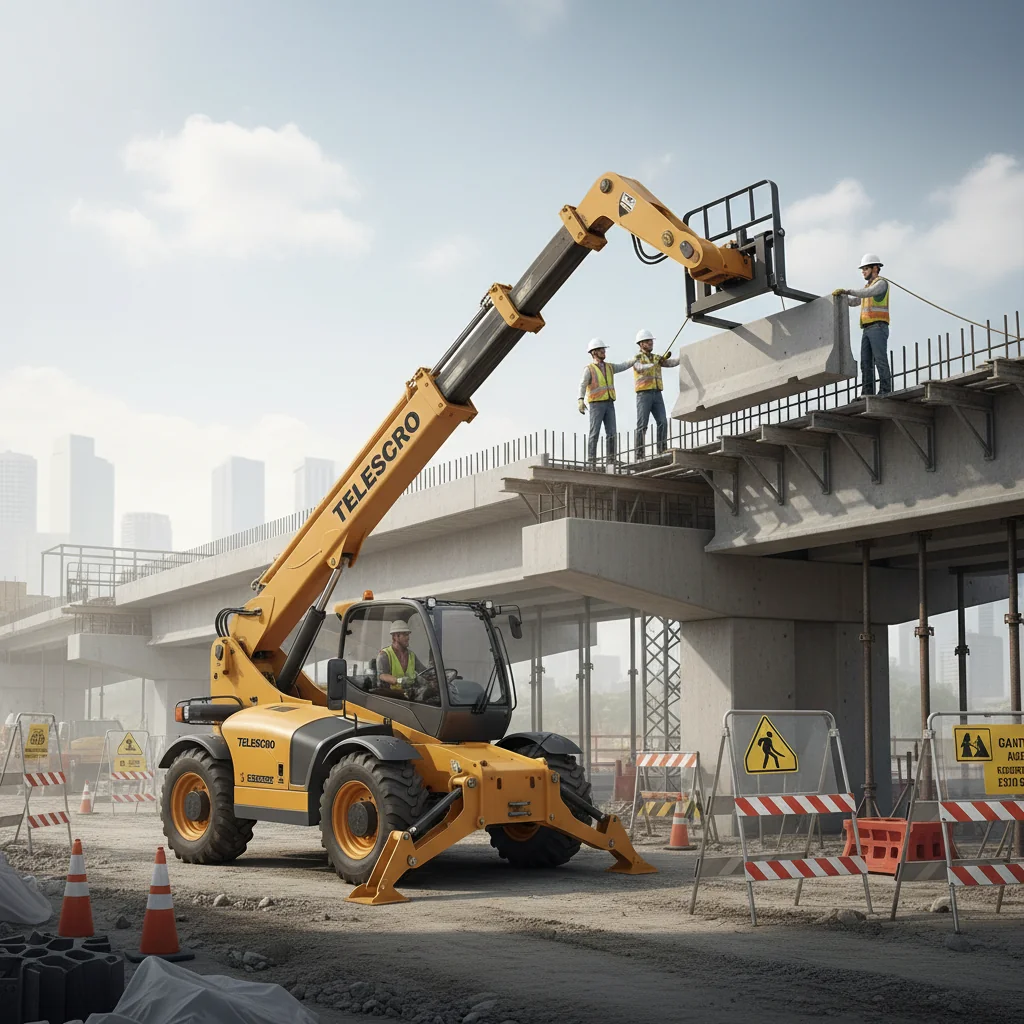
Last month, a contractor in Kazakhstan called me about a bridge deck replacement. Their team couldn’t justify bringing in a 100-ton crane just to set formwork and handrails on a narrow, elevated span. Instead, they used a 4-ton rotating telehandler7 with an 18-meter reach. It positioned heavy panels right onto the deck from a single spot, saving at least two full working days and cutting crane rental costs8 by more than half. On jobs like this, I see telehandlers acting as small mobile cranes—fast to move, easy to reposition, and much more flexible.
Here’s how telehandlers are commonly used for bridge access:
- Formwork and barrier placement9: Transporting and setting panels, precast barriers, and edge protection directly on bridge decks or piers.
- Elevated access for work crews: With work platforms, lifting teams safely to parapets for installation, form stripping, and cable work.
- Component handling and alignment: Placing lighter girders, deck components, or bearings—especially in spots where cranes or boom lifts can’t reach due to water, traffic, or tight access.
- 360° reach in tight spaces: Rotating models handle material placement across a wide area without moving the machine, which matters most on staged or single-lane projects.
From my experience, the most critical factor is checking the load chart—not just the rated capacity. You have to know what the machine can safely handle at full or partial extension, especially over the side. I always suggest reviewing ground conditions closely—soft soil or uneven surfaces can push a telehandler past safe limits. For many bridge projects, a properly chosen telehandler truly closes the gap between small crane and access lift, without the cost or logistics headaches.
Using rotating telehandlers with reaches over 15 meters allows placement of heavy bridge components from a single fixed position, reducing the need for repositioning and minimizing site disruptionsTrue
Rotating telehandlers can maneuver heavy loads precisely at height and distance, enabling contractors to set formwork and handrails efficiently without moving the machine multiple times, which saves labor and time especially on narrow, elevated bridge decks.
Telehandlers can replace 100-ton cranes in all bridge construction tasks because they have equivalent lifting capacities and reachFalse
While telehandlers are versatile for certain loads and reach, their lifting capacity typically maxes out well below 100 tons, making them unsuitable for all heavy lifting tasks on bridges; large cranes remain necessary for very heavy or awkward loads.
Key takeaway: Telehandlers, especially high-reach and rotating models, can cost-effectively replace or complement smaller cranes for bridge access and material handling. Proper selection based on lift charts and site conditions is crucial, maximizing efficiency while maintaining safety—particularly on sites with limited access or challenging terrain.
How Do Telehandlers Minimize Lane Closures?
Telehandlers minimize lane closures by operating from medians, shoulders, or work pads, allowing them to reach over active lanes without occupying multiple traffic lanes. Their compact setup and quick relocation enable rapid placement of materials, barriers, and signage, reducing closure windows, traffic disruption, and associated user-delay costs, especially during night shifts where time savings are critical.

Most people don’t realize that telehandlers can eliminate full-lane closures by working from tight spots—like the shoulder or median—while still delivering materials exactly where the crew needs them. For example, I helped a highway contractor in Dubai last year who was struggling with traffic disruption. Before switching to a 4-ton telehandler with a 16-meter reach, they had to block two lanes just to unload crash barriers with a small crane. With the telehandler operating from a compact work pad, the team only closed half a lane, and they finished nightly barrier placement about two hours faster per shift. Those savings add up—especially with lane-closure costs running into the thousands per hour in busy cities.
From my experience, rapid repositioning10 is what sets telehandlers apart. Unlike fixed cranes, you can drive them between locations in under ten minutes. For a bridge upgrade in southern Brazil, a crew used a telehandler equipped with both fork and lifting hook attachments. This meant they could unload steel beams, then instantly switch to placing signage—all without needing extra equipment or shuffling machines around. Their project manager told me they cut their nightly work window from eight hours down to five, just by minimizing lane downtime.
To be honest, if you’re planning night work, don’t overlook lighting and visibility features. Powerful LED work lights and all-around mirrors are must-haves for crew safety. I always suggest checking the rated capacity on the load chart at every outreach—especially if you’re using partial stabilizer extension ("short-jacking"), as allowed by EN 1459-2. That way, you get real productivity and avoid costly delays.
Using telehandlers with a reach of 16 meters allows operators to place materials directly over traffic barriers from the shoulder, reducing the need to close multiple lanes for unloadingTrue
The extended reach of telehandlers enables precise placement of heavy materials from confined spaces like shoulders, minimizing traffic disruption by avoiding full-lane closures typically required when cranes must operate within the travel lanes.
Telehandlers require full lane closures during material delivery on highway projects because their boom cannot extend beyond the truck bed widthFalse
Telehandlers have extendable booms designed to place materials at considerable distances from the machine, allowing them to work alongside travel lanes without obstructing traffic, thus often eliminating the need for full lane closures.
Key takeaway: Telehandlers’ ability to operate off to the side and handle diverse materials quickly allows road and bridge projects to limit lane-closure duration, decrease disruption, and save significant costs. Strategic equipment selection should prioritize reach, maneuverability, and lighting for safer, more efficient nighttime operations.
How Do Telehandlers Aid Roadbed Repairs?
Telehandlers equipped with buckets or specialty tools handle site prep and roadbed repairs by clearing demolition debris, loading spoil, and distributing aggregates for backfilling and grading. Their rough-terrain capability allows safe placement of geotextiles, gabions, and modular retaining wall blocks, especially in confined construction environments with changing traffic or limited space.
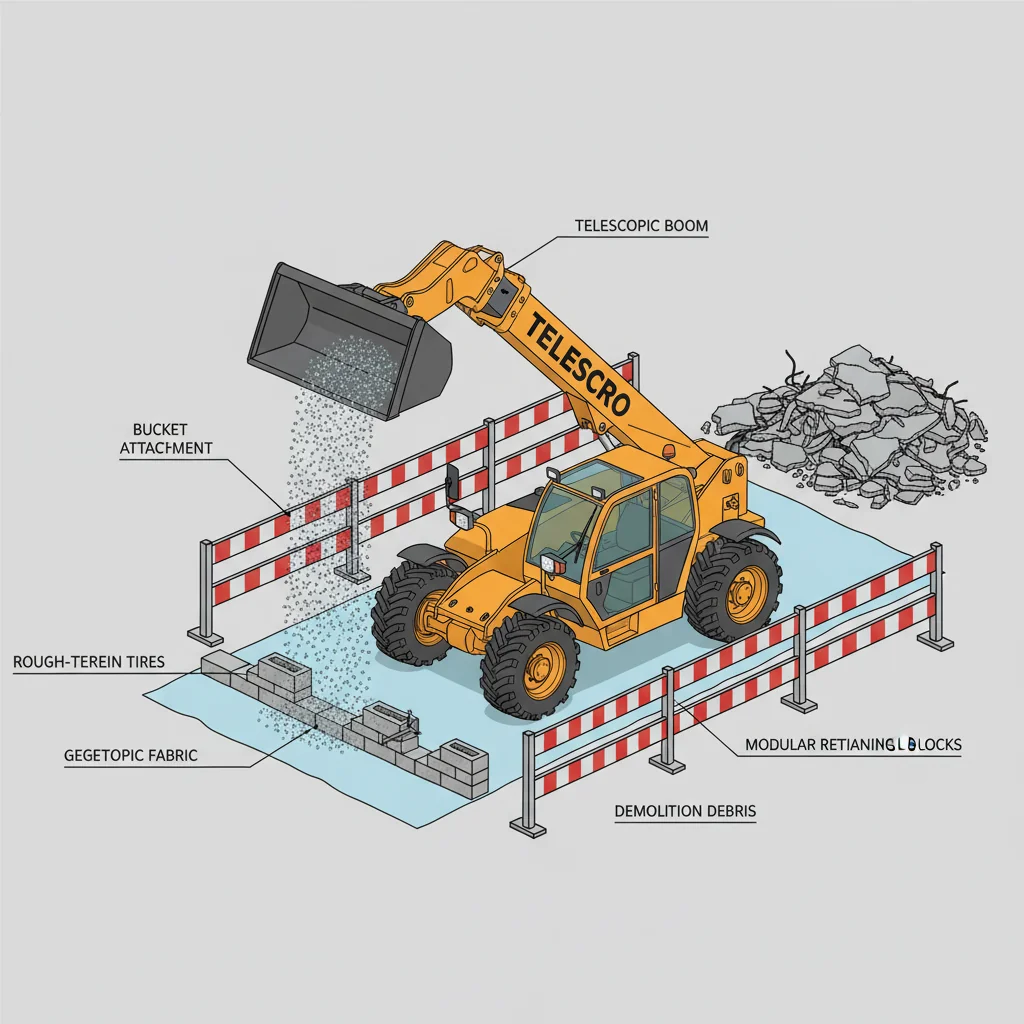
To be honest, the spec that actually matters in roadbed work isn’t just rated capacity or max height—it’s how well your telehandler adapts to changing ground conditions. Roadbed repair sites are rarely perfect. I’ve seen projects in southern Brazil where deep ruts and uneven slopes stalled typical wheel loaders, but a rough-terrain 4-ton telehandler handled aggregate delivery and spoil removal without getting bogged down. The wide tires and ground clearance—often around 410 mm—make a difference, especially during rainy season work on rural highways.
Here’s what matters most when planning site prep: attachments. With a heavy-duty bucket installed, a telehandler can shift concrete chunks or old asphalt, load dump trucks, then switch in under 15 minutes to forks for geotextile rolls or modular wall blocks. One crew I worked with in Dubai managed all their material handling, backfilling, and even some light grading along a 2-kilometer stretch—using just a single 3.5-ton model rated for a 13-meter reach. That eliminated the hassle of bringing in both a loader and a crane, which saved transport costs and cut down on traffic disruption.
I always suggest reviewing the load chart before assigning lifting jobs along embankments or confined city streets. It’s common to underestimate how quickly capacity drops at full reach. In tight spaces, the turning radius—often under 4.5 meters—lets you position close to the work zone, even with barriers and live traffic. For roadbase repairs and shoulder reconstructions, that versatility gives your team true flexibility. Consider one telehandler with the right attachments as your multipurpose “toolbox” for roadbed jobs.
Telehandlers with ground clearance around 410 mm and wide tires outperform traditional wheel loaders in navigating deep ruts and uneven slopes during roadbed repairsTrue
High ground clearance and wide tires help telehandlers maintain traction and mobility on irregular and soft surfaces often found in roadbed repair sites, reducing the risk of getting stuck compared to typical wheel loaders with lower clearance and narrower tires.
The primary spec influencing telehandler performance on roadbed repair sites is the maximum lifting height, which should exceed 10 meters for efficient aggregate deliveryFalse
While lifting height is important, the adaptability to uneven terrain via ground clearance and tire configuration is more critical in roadbed repairs. Most aggregate delivery operations happen at lower heights, making max height less relevant than mobility features.
Key takeaway: Versatile telehandlers with the right attachments efficiently manage both lifting and earthmoving duties in road and bridge projects. They streamline site prep, debris removal, and roadbed repairs, particularly in tight urban or rural settings, reducing the need for multiple specialized machines and improving fleet utilization.
Should Telehandlers Be Rented or Owned?
Choosing between renting or owning telehandlers involves analyzing project duration, usage frequency, and total cost of ownership. Rental is usually more economical for single or short-term projects, especially under 9 months, while ownership benefits multi-year highway or bridge programs by maximizing asset use, reducing overall fleet size, and leveraging attachment versatility for improved productivity.
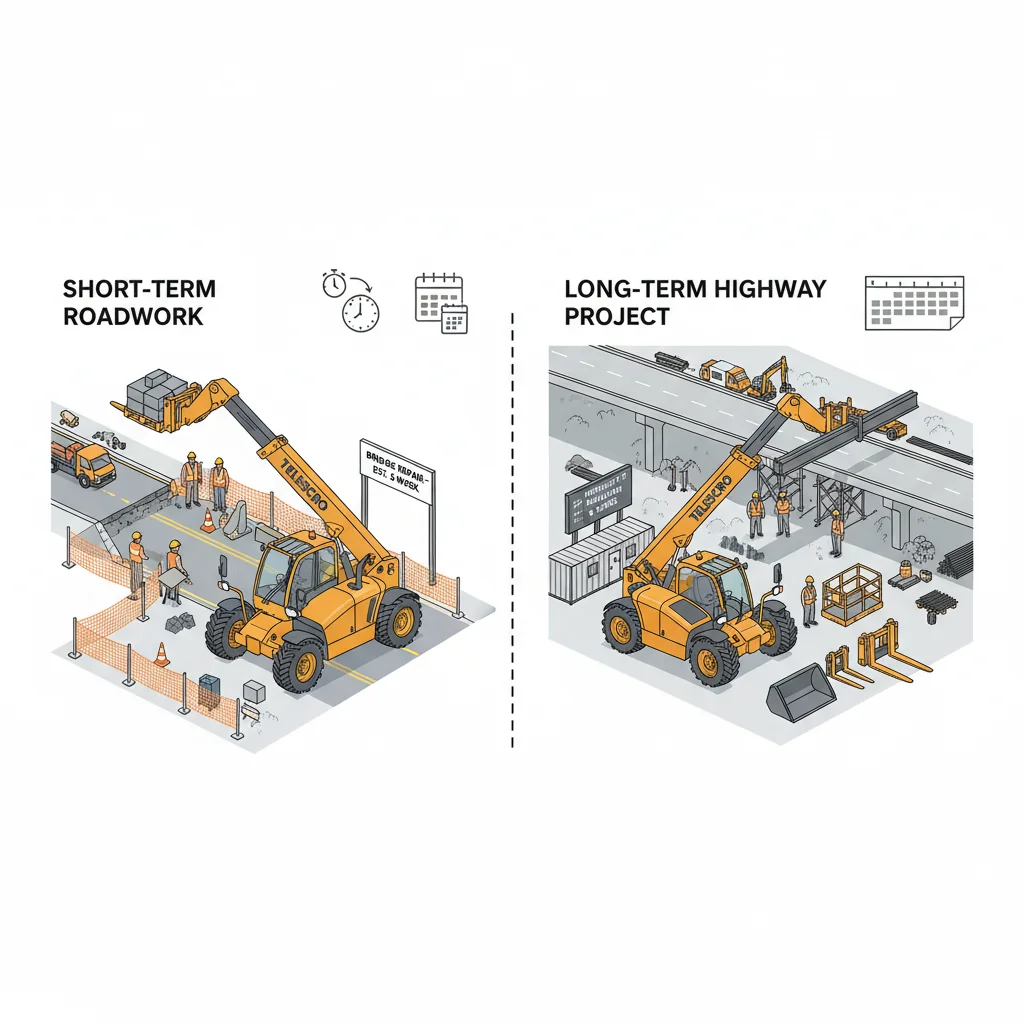
I’ve worked with customers who made this decision purely on price per month—then got caught out later. For example, a contractor in Brazil rented a 4-ton telehandler with 17-meter reach for a bridge job expected to last 6 months. Rain delays and design changes stretched that project past a year. On that particular project, by month nine the contractor found that cumulative rental costs had reached nearly 60% of the purchase price of a comparable new unit. They told me they wished they’d modeled real project duration upfront.
From my experience, the right call depends on how often you’ll use the telehandler, and for how long. If it’s just for a short or unpredictable job—something under 9 months, or a few weeks at a time on multiple sites—rental usually keeps costs predictable and off your balance sheet. That’s especially true if you need high-reach or specialty rotating units, since those carry higher purchase prices and often require special transport permits, which add hidden logistics costs. I’ve seen teams in Kenya rent compact 2.5-ton units just for a few weeks during peak material unloading, then return them before routine maintenance is due.
For multi-year highway or complex bridge projects, ownership starts to make sense—particularly if you invest in attachments like buckets, jibs, or work platforms. One versatile machine equipped this way may handle 80% of heavy lifting, reducing your total fleet size. But don’t ignore operating costs. Over 2–3 years, expect fuel, tires, and routine hydraulics to add up to 25% above the original purchase. I suggest running detailed cost models before you decide—factoring in expected hours, attachment ROI, and even transport costs between jobsites.
Renting telehandlers for projects expected to last longer than 9 months can result in rental costs that exceed 60% of the purchase price of a new machine, making ownership more cost-effectiveTrue
Extended rental periods increase cumulative costs, and administrative delays such as paperwork for extensions add hidden expenses, thus ownership often becomes more economical for long-term projects.
Telehandlers with a 17-meter reach are rarely used in road and bridge projects because their long reach significantly reduces lifting capacity, making them impractical for most tasksFalse
While longer reach can affect lifting capacity, telehandlers with 17-meter reaches are commonly utilized in bridge construction for placing materials at height or over obstacles where versatility and reach are critical.
Key takeaway: Rental is generally optimal for short-term or intermittent telehandler use, particularly for specialized applications. For multi-year road or bridge projects, ownership may be more cost-effective when utilization is high and attachment versatility reduces the need for additional equipment, improving productivity and fleet efficiency.
Why Is Telehandler Maintenance Vital On-Site?
Routine telehandler maintenance is essential in road and bridge projects due to exposure to dust, debris, and uneven terrain. Proactive measures such as frequent air filter changes11, visual hydraulic checks12, and tire inspections can substantially reduce unplanned work stoppages, especially in dusty or high-shift environments. Consistent maintenance minimizes breakdowns, preserves project timelines, and supports safe, continuous lifting operations in demanding environments.

Most people don’t realize that project delays often start with something as simple as a clogged air filter or a slow hydraulic leak. On a highway bridge job in Kenya last year, a customer called me after three unplanned telehandler stoppages. Their site ran 14-hour shifts with constant dust from aggregate trucks and steel fabrication. I asked about their maintenance checks—they were only changing air filters every week. In these conditions, that’s too infrequent. Dust quickly chokes filters, starving the engine and triggering shutdowns. Once we set up a system to inspect and swap air filters every two to three days, breakdowns dropped noticeably. Their project started hitting schedule targets again.
Here’s what matters most when planning maintenance for road and bridge sites: You’re working on rough ground, surrounded by rebar, concrete debris, and loose stone. That environment tears up sidewalls and punctures tires. Hydraulic hoses take a beating where rubble piles up. I always remind operators to do a quick walkaround before every shift—look for cuts on tires, check for any wet spots around hydraulic fittings, and listen for unusual hissing sounds that could signal trapped air. Don’t wait. Early signs like weeping hydraulic oil often mean a hose is close to failure.
Manufacturers and field data both show well-maintained telehandlers have 20–30% fewer work stoppages. That makes a big difference if you’re using a 4-ton, 18-meter unit to lift rebar bundles for overnight bridge deck pours. I suggest building maintenance into your job schedule from the start—stocking filters, hoses, and tires, and writing everything down. In road and bridge work, a reliable telehandler is as important as a precise load chart.
On highway bridge projects with high dust levels, In extremely dusty environments, air filters may need inspection or replacement every 1–2 days to prevent engine power loss and unexpected shutdowns, which indirectly lead to more frequent work interruptions.True
In dusty environments like aggregate and steel fabrication sites, contaminants accumulate rapidly, causing air filters to clog within days. This restriction reduces engine efficiency and can lead to hydraulic leaks, so checking or replacing filters every 48 hours minimizes downtime and equipment damage.
Telehandlers used in bridge construction do not require more frequent hydraulic oil changes even when operating in dusty and high-shift environmentsFalse
High dust and extended shifts increase hydraulic system contamination and oil degradation, necessitating more frequent oil changes than typical schedules to ensure optimal performance and avoid hydraulic failures. Ignoring this accelerates wear and unplanned stoppages.
Key takeaway: Preventive maintenance routinely reduces breakdowns and delays by 20–30% for telehandlers in road and bridge construction. Regular air filter cleaning, hydraulic and tire checks, and a structured scheduling approach keep machines safely operating, protecting critical project timelines and minimizing costly interruptions.
Conclusion
We’ve discussed where telehandlers fit on road and bridge projects, and how their flexibility can simplify work that would otherwise need multiple machines. From my experience, focusing on load handling at real heights and double-checking local parts supply matters more than just comparing specs. I’ve seen too many “showroom hero, jobsite zero” choices end up stuck waiting for parts mid-project. If you want to talk through load charts, attachments, or what’s actually practical for your site, I’m happy to share what’s worked for contractors in different countries. Feel free to reach out—every site has its own needs, and I’m here to help you find the right fit.
References
-
Comprehensive explanation of outriggers’ role in stabilizing telehandlers during elevated installations improves safety and operational efficiency. ↩
-
Detailed insights on interpreting load charts ensure safe telehandler operation by matching load weights and reach capabilities accurately. ↩
-
Explore detailed effects of boom length and attachments on telehandler load capacity to prevent tip-over incidents safely. ↩
-
Learn how tailored lift plans and ground verification reduce risks in complex environments like road and bridge projects. ↩
-
Explore how quick-coupler systems enable rapid attachment swaps, boosting efficiency by 10–15% on site with practical examples. ↩
-
Learn how pallet forks enhance material handling by transporting heavy bundles efficiently, improving site workflow and reducing equipment needs. ↩
-
Explores the technical benefits of rotating telehandlers in tight spaces, showcasing cost savings and enhanced maneuverability on bridge projects. ↩
-
Explains the financial impact of rental vs ownership, highlighting risks like delays and cost overruns in telehandler projects. ↩
-
Details how telehandlers assist in precise placement of formwork panels and barriers on bridges, improving safety and reducing crane dependency. ↩
-
Understand the benefits of quick telehandler relocation for speeding up material placement and reducing downtime on complex infrastructure projects. ↩
-
Explains how timely air filter replacements prevent engine shutdowns and reduce telehandler downtime in dusty construction sites. ↩
-
Details the impact of hydraulic inspections on preventing leaks and equipment failures, ensuring safer and continuous lifting operations. ↩