










Telehandler Uses in Farming: Field-Tested Tips for Mistake-Free Operation
Last autumn, a dairy farm in Denmark sent me a picture of their team loading five layers of straw bales—using just one mid-size telehandler, not the usual tractor-loader combo. That’s when I realized many farmers still underestimate how versatile these machines have become.
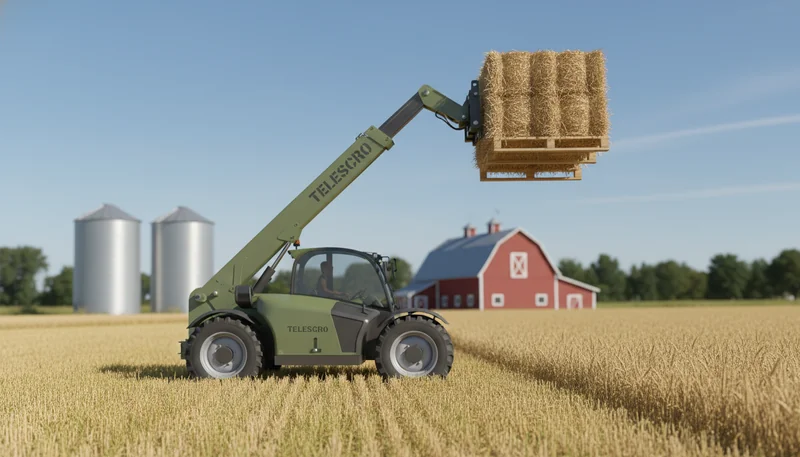
Telehandlers in agricultural settings function as high-capacity material handlers, leveraging telescopic booms and quick-attach systems1 to move hay bales, bulk feed, fertilizer, grain, and seed pallets with greater efficiency than conventional farm loaders. Typical agricultural telehandlers offer 2–4 ton lift capacity2 and 6–9 meter maximum reach, allowing effective stacking, trailer loading, and barn servicing without redundant equipment. Their maneuverability, stability, and range of attachments streamline core tasks including bale stacking, feed mixing, bedding, waste handling, and harvest logistics.
How Do Telehandlers Move Farm Materials?
Telehandlers use a telescopic boom3 for lifting and stacking heavy farm materials like hay bales, silage, bulk feed, seed bags, fertilizer, and grain. Agricultural telehandler models4 typically support loads of 2–4 tons with a reach of 6–9 meters, outclassing tractor loaders in height, reach, and operational efficiency.

Let me share something important about how telehandlers actually move farm materials on a daily basis. On most jobsites I’ve visited—from Poland to South Africa—the main task is handling heavy, awkward loads like big square bales, silage, or stacked bags of feed. The telescopic boom is a game-changer here because it combines the lift height of a small crane with the versatility of a forklift. Typical ag telehandlers manage at least 2 tons up to 4 tons safely, and you’ll see models with a boom reach from 6 up to 9 meters. That’s enough to load taller grain trailers or stack hay three layers high inside a modern barn—no ramps or scaffolding needed.
Last spring, a client in rural Brazil switched from using a tractor loader to a 3-ton telehandler with an 8.5-meter reach. He told me his crew finished afternoon feedouts faster, with less damage to the barn posts. The key thing he noticed? Much more precision when placing big feed bags onto narrow platforms. Tractor loaders often don’t have the same forward reach or side visibility, so stacking gets risky or slow.
It’s easy to get distracted by maximum specs printed in brochures. To be honest, the real limits come from the load chart—this shows rated capacity at different boom positions, not just the tip. Before buying, measure your barn and trailer heights. I always suggest matching the telehandler’s rated capacity and boom reach to your actual loads—not just what looks good on paper. That’s how you avoid expensive surprises and keep your operation flowing safely.
Most agricultural telehandlers use a closed-center load-sensing hydraulic system to precisely control boom movement and optimize fuel efficiency during repetitive farm material handlingTrue
Closed-center load-sensing hydraulics adjust flow and pressure based on the boom's demand, reducing energy waste and improving control when moving heavy, uneven loads like bales or feed bags on farms. This technology is common in modern ag telehandlers to enhance performance and efficiency.
Telehandlers on farms typically use an electric motor to drive their telescopic boom, allowing for smoother and quieter operation compared to traditional diesel-hydraulic systemsFalse
While electric drive systems are appearing in some equipment categories, most farm telehandlers still rely on diesel engines powering hydraulic pumps. The boom movement is hydraulically actuated, not electric, to deliver the high force and reliability needed for heavy material handling.
Key takeaway: Telehandlers offer superior reach, height, and load capacity for handling core farm materials when compared to tractor loaders. Selecting the right model depends on accurately measuring typical loads and worksite clearances—not just relying on maximum brochure specs.
How Do Telehandlers Simplify Livestock Feeding?
Telehandlers streamline livestock feeding by enabling efficient bucket, grab, and bale spike attachment changes for unloading feed, moving silage, and distributing bedding. Their extended reach allows over-barrier feeding and efficient stacking in tight sheds. Key specifications for farm use include compact maneuverability5, operator visibility, and rapid quick-attach systems, supporting diverse daily tasks and enhancing productivity on dairy, beef, or poultry farms.
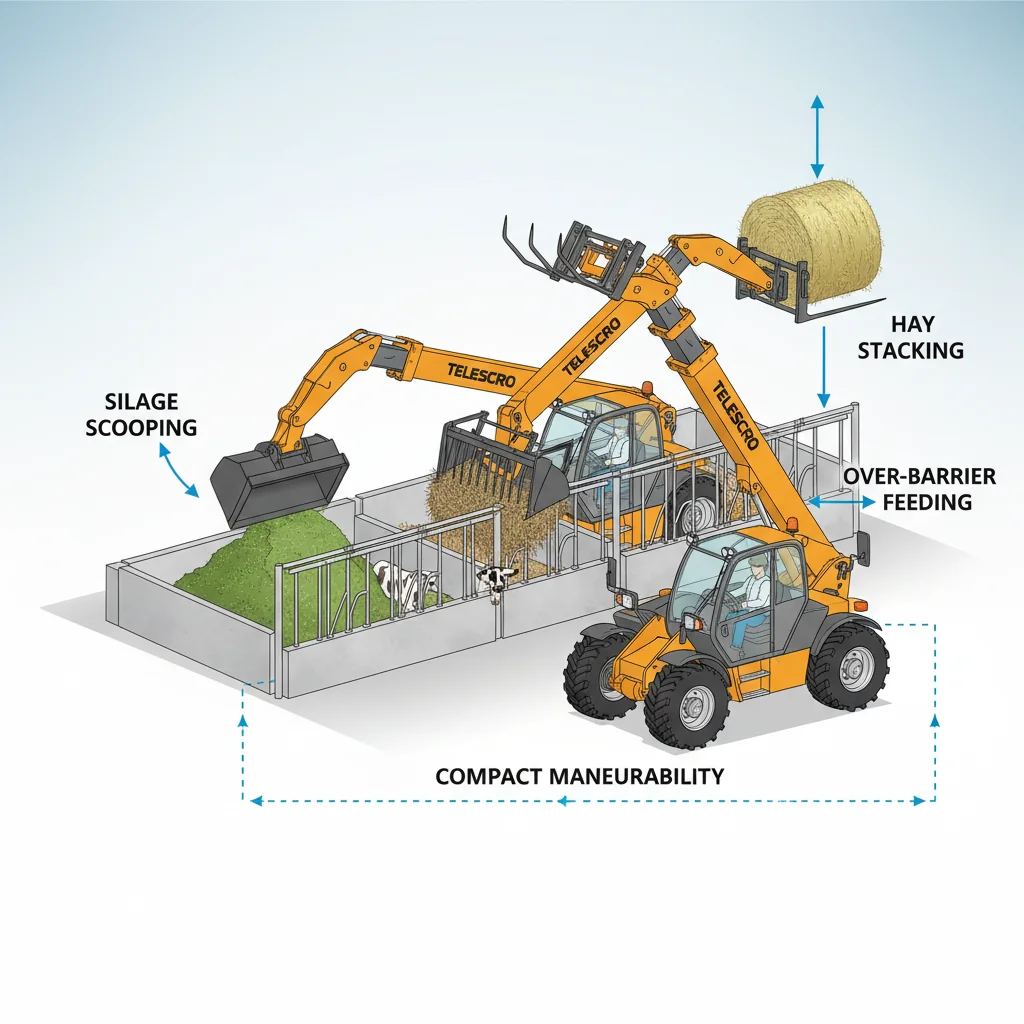
Here’s what matters most when you’re feeding livestock with a telehandler: compact size, clear sightlines, and a quick swap between attachments. In China’s Shandong province, I’ve worked with a dairy farmer who struggled with older tractors and loaders. Switching to a 3-ton, 7-meter compact telehandler changed everything for her team. With a turning radius under 4 meters, they zip between barns—no more three-point turns or grazed walls. That means less wasted time and no stressed-out cows.
Attachments are the real key to efficiency. Most farms I visit need to move silage, bales, and bedding—sometimes all before breakfast. One customer in Poland told me he saves nearly two hours every morning just by using the quick-attach hydraulic system. In less than a minute, his worker swaps from a bucket (for maize silage) to bale spikes (for straw) to a grab (for loose hay), then gets straight to feeding. That’s the kind of practical productivity boost you feel at the end of a 14-hour shift.
Telehandlers aren’t just about feeding, either. On beef and poultry farms in Kenya, I’ve seen units scraping alleys and hauling manure—improving hygiene and animal health. A compact boom pivot gives better downward visibility, so operators avoid hitting troughs or animals. Over-barrier feeding is another massive time-saver. Instead of shoveling feed by hand or working around fences, the boom reaches right over, even stacking bales four-high in cramped sheds. For anyone serious about daily chores, I suggest checking maneuverability, sightlines, and rapid attachment systems before anything else.
"CompactFalse
"A
Telehandlers used in livestock feeding typically have fixed boom lengths to ensure consistent load reach, preventing the need for attachment swaps during feeding cyclesFalse
Telehandlers commonly feature variable boom lengths or telescopic arms to adapt to different reach requirements. Quick attachment swaps improve versatility, allowing the same machine to handle various feeding tasks, so fixed boom lengths would limit operational flexibility.
Key takeaway: Telehandlers are indispensable in modern livestock operations, handling feed, bedding, and manure efficiently. Choosing a telehandler with compact dimensions, superior visibility, and a fast quick-attach system7 ensures safer, more productive, and less fatiguing daily feeding and cleaning rounds in cattle, pig, or poultry units.
How do telehandlers optimize harvest logistics?
Telehandlers streamline harvest logistics on farms by loading crops into trucks, shuttling trailers, and stacking storage bins with high lift heights. Their rough-terrain mobility and towing capability outperform conventional forklifts or tractor-loaders in field conditions, accelerating workflows. Industry data highlights telehandlers’ superior road speed, cycle times, and load capacity as critical advantages during peak harvest operations.
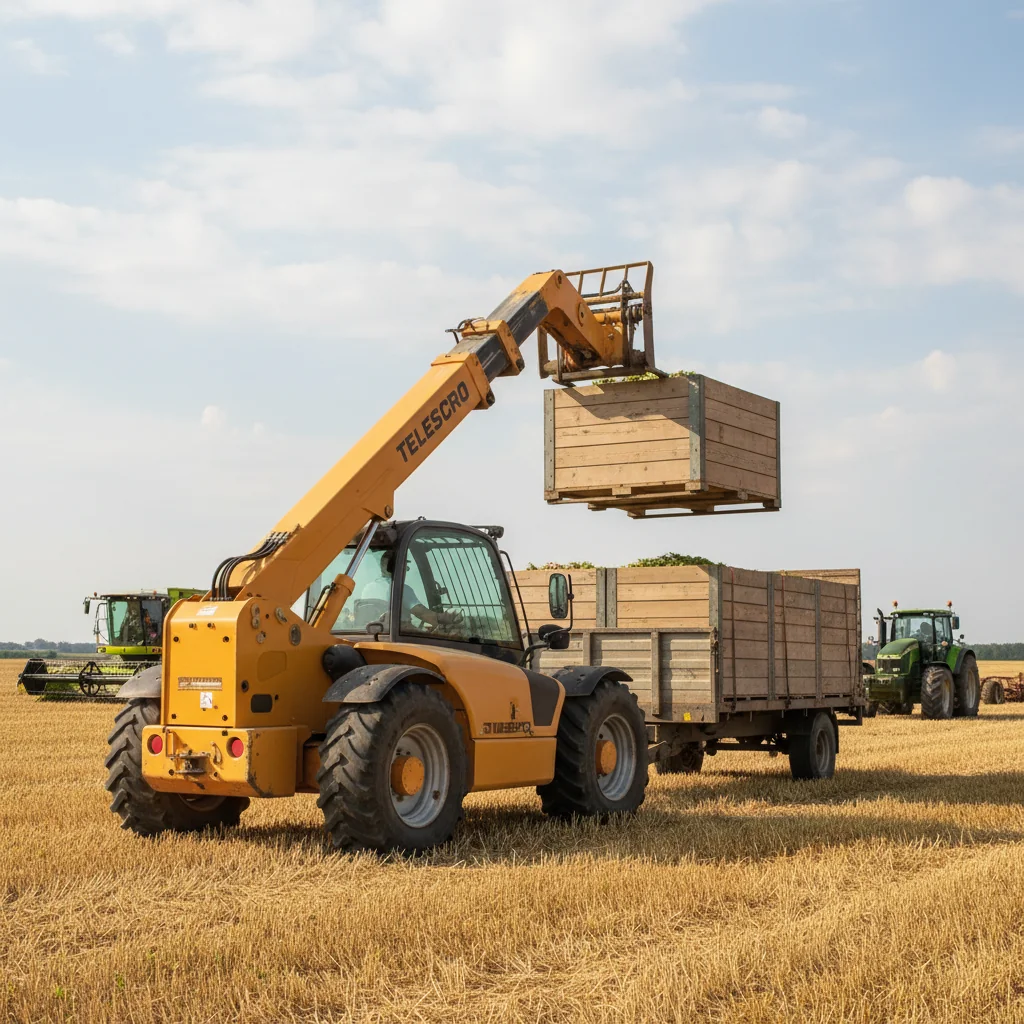
Last month, a customer from Kazakhstan called me during the peak grain harvest. He was struggling with delays using his old tractor-loader setup—trailers were bottlenecked at the field edge, and crews spent too long manually stacking storage bins. It’s a classic scenario: tractors are strong, but they just can’t match a telehandler’s combination of reach, road speed, and cycle efficiency. Once he tried a 4-ton telehandler rated for over 7 meters of lift, things changed fast. Their team loaded grain directly into tall-sided trucks, stacked three-meter bins right to the roof of their storage shelter, and towed loaded trailers back to the yard at over 30 km/h—a big jump from his previous 18 km/h top speed.
To be honest, lift capacity and cycle speed always matter more than most buyers expect. During harvest, the pressure is real—one slow machine can hold up the entire process. I recommend checking the load chart carefully before you order: will the telehandler handle a full bucket of potatoes at maximum reach, or do you lose too much rated capacity as you extend? Hydraulic circuit performance also plays a big role. Quick boom raise and lowering cycles can cut handling time nearly in half on some jobs, and I’ve seen this translate into at least two extra trailer loads per day for mid-sized farms.
My advice? When you plan harvest logistics, group similar attachment tasks—for example, load all bins before switching to trailer towing. This minimizes changeover and keeps your telehandler working flat out from field to store.
Telehandlers with a 4-ton capacity and over 7 meters lift height can reduce cycle times by up to 30% compared to traditional tractor-loaders by enabling faster stacking of grain bins and improved trailer loading efficiencyTrue
The combination of higher lift reach and load capacity allows telehandlers to place materials directly onto trailers or storage racks without repositioning, significantly cutting down manual handling and equipment repositioning delays common in tractor-loader setups.
Telehandlers are generally slower on roads than tractors, which limits their use in logistics between fields and storage sitesFalse
Telehandlers are designed with higher road speeds, often exceeding 40 km/h, whereas many tractors have lower top speeds around 25-30 km/h, making telehandlers more efficient for moving loads between fields and storage areas.
Key takeaway: Telehandlers elevate harvest efficiency by combining rough-terrain handling, quick cycle times, and high load capacity, allowing farms to coordinate field loading, trailer movement, and stacking tasks with fewer machines. Prioritizing lift capacity, speed, and workflow planning ensures maximum throughput and space utilization during peak agricultural operations.
How to Size a Farm Telehandler?
Selecting the correct telehandler size8 for farming depends on matching rated capacity and boom reach to your routine loads—whether that means heavy round bales, large grain buckets, or fertilizer pallets. Compact machines with capacities below about 2,500 kg can work well in smaller livestock or horticulture operations, but many mixed farms require 2.5–4 ton models to handle daily loading and stacking safely. Oversized, high-capacity units may reduce maneuverability in older barns due to wider frames and longer wheelbases. Always assess your heaviest loads, typical lift height, building clearances, and the load chart at working boom positions before choosing a model.
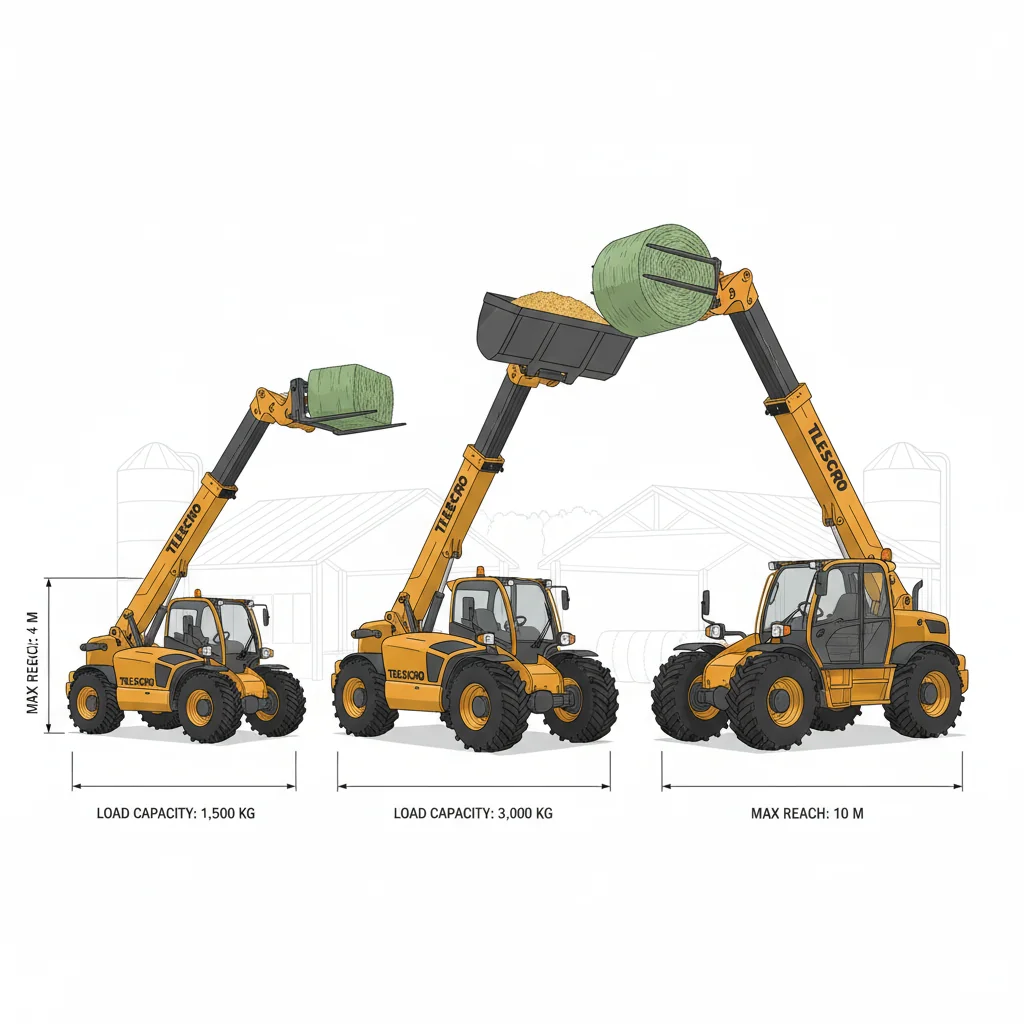
Most people don’t realize that picking the wrong telehandler size is one of the most expensive mistakes you can make on a farm. Too small, and you’ll struggle with big round bales or heavy grain buckets every day. Too large, and you’ll end up fighting to maneuver inside traditional barns or older sheds. In Spain, I supported a dairy farmer who thought “bigger is better,” so he bought a 4.5-ton machine. Within a week, he couldn’t get around old doors narrower than 2.5 meters, and the machine carved deep ruts in the yard during the wet season. He needed a more compact unit, around 3 tons and under 2.2 meters wide—much more practical for his job.
From my experience, the first thing to do is list out your heaviest routine loads—whether that’s a 1,200 kg hay bale or a fertilizer pallet pushing 1,600 kg. Check how high your top stack or trailer sits—do you need 6 meters, or is 7.5 meters safer for future growth? For most mixed farms, I find that a 2.5 to 4-ton machine with a 6–9 meter boom fits 80% of daily work. But, always measure your tightest building entrances and alleys. Many old barns have doors just over 2 meters tall, so don’t get caught out.
I suggest looking beyond engine horsepower. Focus on the load chart—see what your telehandler can actually lift at full extension, not just close-in. Compare turning radius and check for features like boom suspension or stability controls. A compact, well-matched telehandler usually saves time and headaches long term.
Choosing a telehandler with a lifting capacity about 25-30% higher than your heaviest load allows for safer operation and extends the machine's lifespanTrue
Oversizing the capacity slightly reduces the strain on the hydraulic system and structure, preventing premature wear and providing a margin of safety when handling irregular or dense loads common on farms.
Using a telehandler with the narrowest possible width always improves maneuverability inside traditional barns regardless of boom lengthFalse
While narrower width aids maneuverability, boom length and turning radius also critically impact the ability to operate in tight spaces, so prioritizing width alone can lead to poor overall machine access in farm buildings.
Key takeaway: Carefully assess load requirements, building dimensions, and operational needs before selecting a telehandler for farm use. Choosing the right size improves efficiency, prevents costly mismatches, and ensures both safety and maneuverability. Avoid defaulting to oversized models; compact, well-suited machines can outperform larger units in many farm scenarios.
Which telehandler attachments are vital for farms?
Essential telehandler farm attachments include pallet forks9 for handling seed, feed, and fertilizer pallets; buckets for grain and general loads; muck forks for manure; bale spikes and clamps for bales; and silage defacers. Prioritizing a robust quick-attach system and high-quality, ag-specific implements maximizes daily efficiency and minimizes downtime from premature equipment wear.
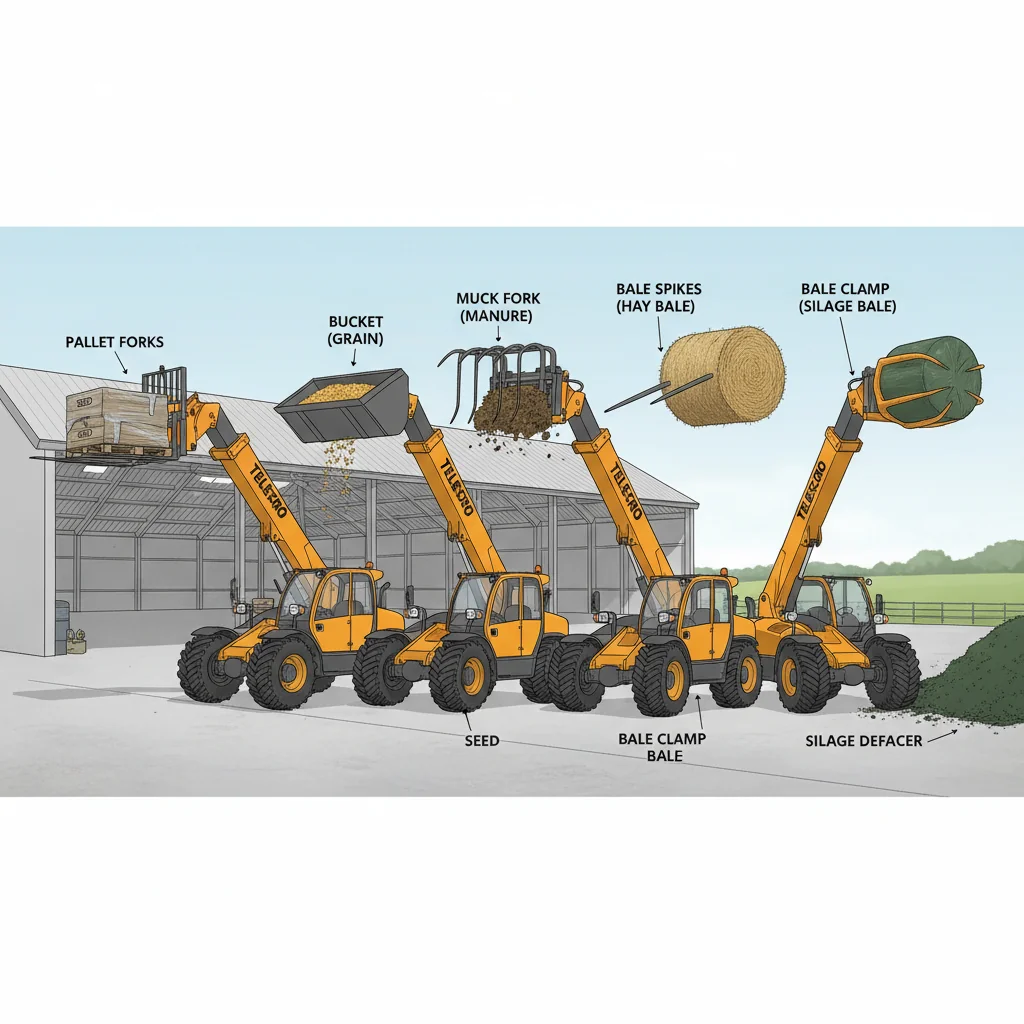
The biggest mistake I see is farmers focusing too much on small machine features and not enough on the attachments. Honestly, it’s your attachments—and how fast you can change them—that make all the difference for day-to-day efficiency. I’ve seen this firsthand. For example, last year I worked with a dairy operation in Australia. They tried to save costs by buying cheaper buckets and forks. In just under a year, their bucket wore out at the welds and the fork tines twisted handling fertilizer pallets.
That downtime cost them more than if they’d just chosen quality ag attachments in the beginning. Essential farm attachments include:
- Pallet forks – for moving seed bags, chemical drums, and almost every pallet load. I recommend 1,800–2,500 kg rated sets for most farms.
- General-purpose buckets – for grain, sand, or cleaning. Check that the cutting edge is replaceable and robust.
- Bale spikes or clamps – vital for any baled hay, whether you’re handling round or square bales. Match the spike length to your typical bale diameter.
- Muck forks or grab buckets – for manure, silage, or feed. Look for fully welded tines and protected hydraulic lines.
- Silage defacers – let you remove feed from clamps cleanly, reducing waste.
It’s worth comparing attachment options side-by-side:
| Attachment | Main Use | Typical Capacity | Common Pitfalls | Impact on Efficiency |
|---|---|---|---|---|
| Pallet forks | Seed, pallets, fertilizer | 1,800–2,500 kg | Twisted tines, poor welds | Essential daily handling; major time saver |
| General-purpose bucket | Grain, sand, cleanup | 0.8–1.5 m³ | Worn cutting edge, thin shell | Fast loading; reduces number of trips |
| Bale spikes/clamps | Round or square bales | 800–1,200 kg (typical) | Wrong spike length, weak backing | Critical for hay work; reduces bale damage |
| Muck fork / grab bucket | Manure, silage, feed | 1.0–1.6 m³ | Bent tines, exposed hyd. hoses | High productivity in feeding & cleanup |
| Silage defacer | Silage face removal | N/A (cutting—not lifting) | Weak motors, short bar width | Cleaner feed removal; reduces waste |
Quick-attach systems compatible with multiple telehandler attachments can reduce changeover time from over 10 minutes to under 2 minutes, significantly boosting farm productivityTrue
Modern quick-attach couplers standardized across attachments enable operators to swap tools rapidly without manual adjustments, minimizing downtime essential for diverse farm tasks like feeding, lifting pallets, and moving bales.
Telehandler forks designed for construction cannot be safely used on farms because they lack the reinforced tines needed for agricultural materialsFalse
While construction forks are designed primarily for palletized loads, many are robust enough for farm use, and it's the condition and maintenance of forks, not their original design intent, that primarily affect safe agricultural operation.
Key takeaway: Choosing the right core set of durable, high-quality attachments is more important than minor machine differences for farm telehandler efficiency. Invest in a reliable quick-attach system, inspect build quality, and align attachment choices with farm workflows to optimize both performance and cost.
What Safety Risks Affect Farm Telehandlers?
Key safety factors for telehandler use in farming include a high center of gravity, increased tipping risk when the boom is extended, and reduced stability on uneven or slippery ground. Operators must understand load charts10 and safe reach limits. Modern features such as load-moment indicators11, ride control, and other electronic stability aids significantly reduce accident risks, while advanced AI-assisted systems are emerging on some high-end models but are not yet widespread in agricultural fleets.

Last season, a dairy farmer from New Zealand called me after his 4-ton telehandler tipped near a silage clamp. Luckily, no one was hurt, but the accident forced a full safety audit. Honestly, the biggest risk on farms is not just lifting too much—it’s misjudging stability when working on soft ground or sloped yards. That high center of gravity, especially with the boom raised and loaded, can catch even experienced operators out. I’ve seen units rated for 2,500 kg become dangerously unstable with a 1,000 kg bale positioned out at 6 meters.
Key safety factors? Understanding the load chart is non-negotiable. Every manufacturer I’ve worked with makes it clear that the rated capacity depends not only on the boom’s extension and angle, but also on ground conditions. On a muddy day in Germany, a customer lost traction and slid toward a lagoon—because he travelled with the boom halfway up. Even a small bump can be risky if the load is too far out.
Modern features help a lot. Load-moment indicators now give live feedback if you’re approaching tipping point. Some models offer ride control and boom suspension, reducing shock loads when moving over rough ground. Lately, I’m seeing more AI-driven safety systems that intervene if you’re risking overload or operating on an unsafe slope, which can be a real lifesaver.
My advice? Never skip formal training, and check local operator certification rules. Keep the boom low when driving. Every time I visit a farm, I remind teams: study the load chart, watch the ground, and use stability aids whenever available. Staying strict on these basics saves both machines and lives.
Operating a telehandler with the boom extended beyond 75% of its horizontal reach on sloped terrain can reduce its stability rating by over 30%True
Extending the boom on a slope shifts the center of gravity forward and laterally, significantly decreasing stability margins even if the load is within the rated capacity, which can lead to tipping hazards on farm terrains.
Using telehandlers exclusively on flat, concrete surfaces eliminates the risk of tip-over accidents on farmsFalse
While flat, solid surfaces improve stability, tip-over risks remain due to factors like load misplacement, sudden operator movements, or mechanical failures; farms rarely consist solely of concrete surfaces, so risks persist in typical farm environments.
Key takeaway: Proper telehandler safety on farms demands operator familiarity with load charts, adherence to best practices for boom position and speed, and use of stability aids. Prioritizing visibility, training, and regulatory compliance can dramatically reduce tipping and operational hazards, minimizing downtime and improving long-term safety records.
What Are Telehandler Ownership Costs in Farming?
Farm-spec telehandlers typically range from about $80,000 to $150,000 USD when purchased new, depending on lift capacity, boom length, and comfort or automation features. Entry-level or compact models in some markets may fall below this range, while used units often sit between $40,000 and $90,000. Ongoing expenses include diesel, routine hydraulic and drivetrain servicing12, tire replacement, and periodic boom and pin-group refurbishment. Most manufacturers schedule engine-oil service roughly every 500–1,000 hours, with hydraulic filters and fluids often on longer intervals depending on OEM guidelines. High-use farms benefit from strong regional support from reliable dealer networks13, which directly affects uptime. Well-maintained telehandlers generally retain strong resale value, improving long-term cost efficiency.
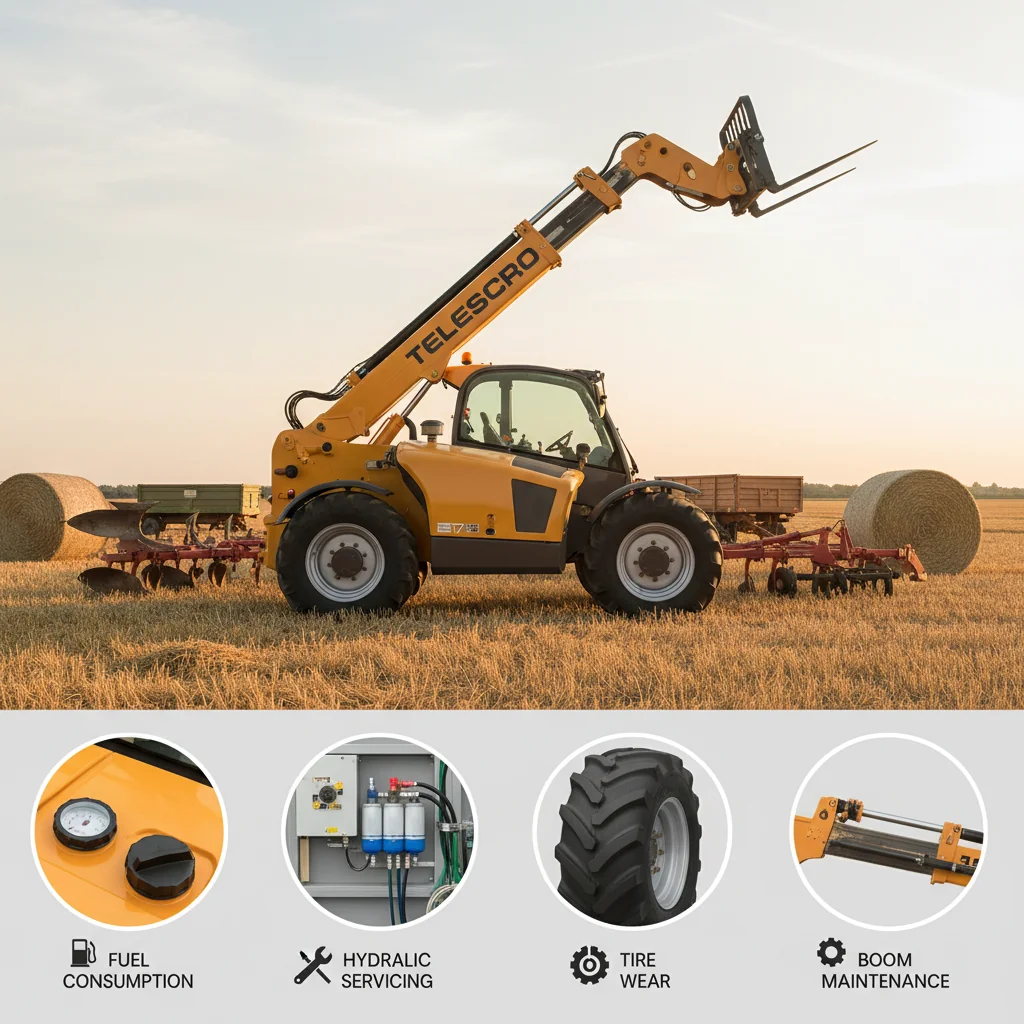
To be honest, a lot of farmers I talk to focus only on the sticker price, not what comes after. A new farm-spec telehandler might set you back anywhere from $45,000 up to $95,000 USD, depending on the rated capacity, comfort features, and whether you’re getting a compact 2.5-ton unit or something that’ll handle 4 tons at full reach. But that’s just where the ownership story starts. Regular servicing—usually every 500 engine hours—means you’ll be paying for hydraulic oil, filters, grease, and keeping an eye on wear points like the boom pins and drivetrain.
In China, one large-scale dairy operation I worked with calculated their tire replacement every 14 months because the limestone barn floors chewed up the tread. Each set wasn’t cheap, with agricultural pattern tires costing several thousand dollars per change. I’ve seen farmers in Brazil run their telehandlers across both field stacks and rough feedlots, clocking over 1,200 hours per year. They told me having a dealer within 80 kilometers made all the difference—especially when they needed a new hydraulic pump on short notice.
That’s why I always remind customers: dealer support often matters more than an extra half-ton on the spec sheet. The upside? If you use your telehandler for stacking feed, loading straw, and shifting pallets, it can easily replace both the old tractor-loader and a yard forklift.
Telehandler engine oil change intervals on farm models typically align with hydraulic fluid service intervals, often around every 500 engine hours to ensure joint component longevityTrue
Coordinating the engine oil change with hydraulic fluid service reduces maintenance frequency and covers lubrication needs for both systems, which helps maximize uptime and component life in farm telehandlers.
Farm-spec telehandlers commonly use synthetic hydraulic oil exclusively, which eliminates the need for filter changes during the machine's first 2,000 engine hoursFalse
While synthetic hydraulic oils improve performance and longevity, filters still require regular replacement around every 500 engine hours to prevent contamination and wear, regardless of oil type.
Key takeaway: Telehandler ownership in farming involves significant upfront and ongoing costs, but efficient use can offset these via savings in labor, equipment redundancy, and storage. Regular maintenance and dealer support are vital for uptime and resale value. Consider rentals or demos to confirm fit before purchasing.
How Is Telehandler Reliability Maintained on Farms?
Telehandler reliability on farms depends on daily inspections of tires, lights, hydraulic hoses, and quick-attach pins, plus checking for leaks. Regular greasing of booms and pivots is crucial in dusty or manure environments. Weekly air filter maintenance, radiator cleaning, 500-hour full servicing, and use of telematics systems can further minimize downtime and extend machine service life.
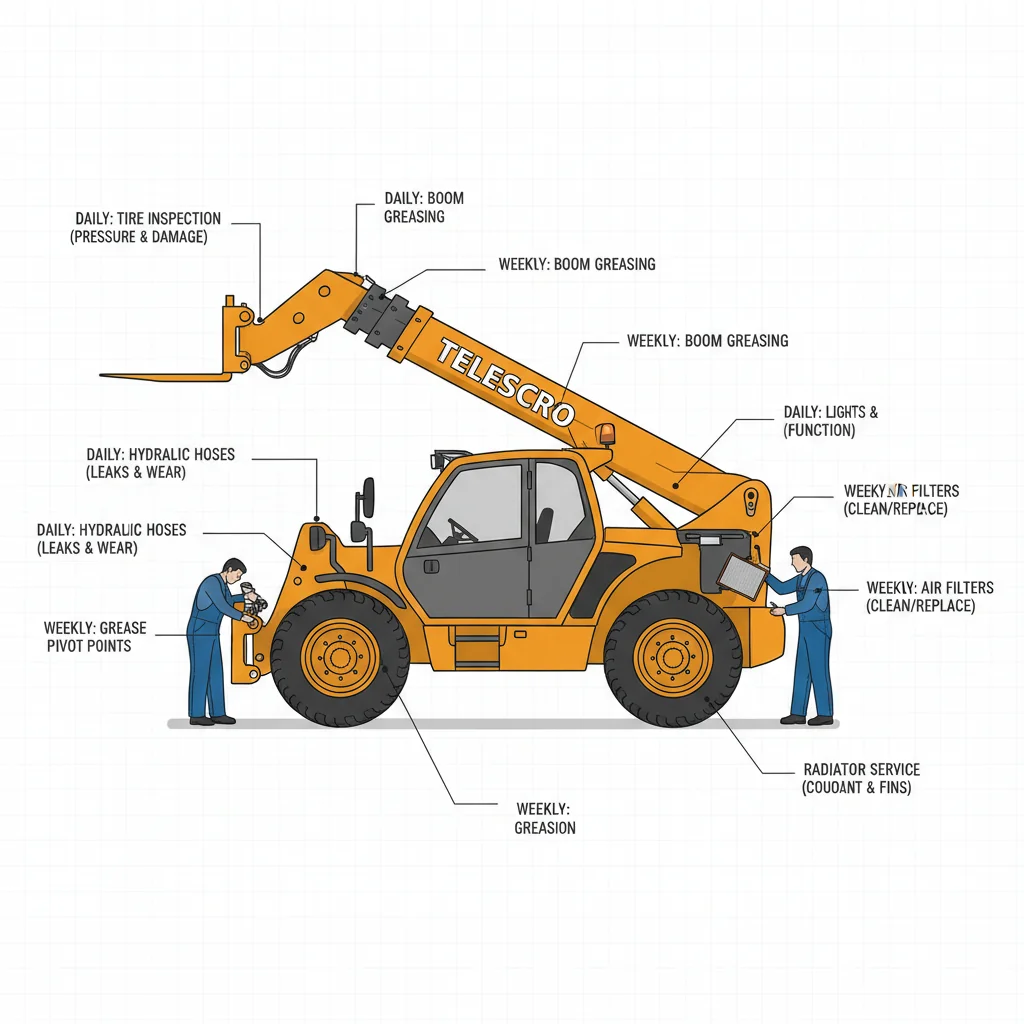
Farm jobsites push telehandlers hard—dust, straw, silage, and manure get into every corner. One question I get from farm managers in Brazil and Dubai is how to keep uptime high during peak harvest. Honestly, it starts with daily basics. Before each shift, inspect tires for cuts or pressure loss, shine a light on all lamps, check quick-attach pins for wear, and look closely at hydraulic hoses for any signs of leaks. I always emphasize inspecting the ground under the machine too—fresh oil means trouble brewing in the hydraulic circuit. These checks catch most issues before they cause downtime.
From my experience, routine greasing is where many operators fall short, especially on pivots and boom sections. Dust and bedding stick to those moving joints, and if you skip the grease gun for even a week, you’ll pay with extra wear. In North China, I saw a 3.5-ton telehandler reach 6,000 hours with minimal downtime—regular greasing made the difference. Air filters are another weak link; working near silage or grain, I suggest cleaning or replacing them weekly to prevent choking the engine. A clogged filter saps power fast.
Most manufacturers recommend full servicing every 500 hours—changing oil, hydraulic and fuel filters, and reviewing boom wear points. On busy dairy farms, I’ve found farmers underestimate how fast those hours add up when running two shifts. Telematics is changing the game, though.
Daily inspection of quick-attach pins helps reduce the risk of hydraulic-related issues by ensuring the attachment remains properly aligned and securely lockedTrue
Worn or loose quick-attach pins can cause excessive movement at the coupler, increasing stress on hydraulic hoses and seals; regular inspection maintains proper engagement and lowers the likelihood of hydraulic leaks or component damage.
Telehandlers used on farms do not require tire pressure checks before each shift because farm terrain is usually soft and forgivingFalse
Tire pressure directly affects machine stability and traction, especially on uneven or soft farm terrain; neglecting pressure checks increases the risk of tire damage, equipment instability, and downtime.
Key takeaway: Consistent daily maintenance, timely servicing, and proactive monitoring using telematics are essential for maximizing telehandler reliability in demanding farm conditions. Early issue reporting, clean cooling systems, and partnering with responsive dealers further reduce breakdowns, protect resale value, and ensure uninterrupted farm operations.
What Telehandler Trends Are Shaping Agriculture?
Future agricultural telehandler trends include specialized models with higher ground clearance, ag-tuned suspension, and cab layouts designed for long farm shifts. Advancements in hybrid powertrains14—such as electric drive supported by compressed natural gas—are reducing emissions and fuel costs. Telematics and automation are becoming more common across new models, while early-stage predictive maintenance features are beginning to appear on premium units. AI-assisted systems remain emerging technologies rather than widespread standards, but they are improving diagnostic insight and dealer support in pilot applications.
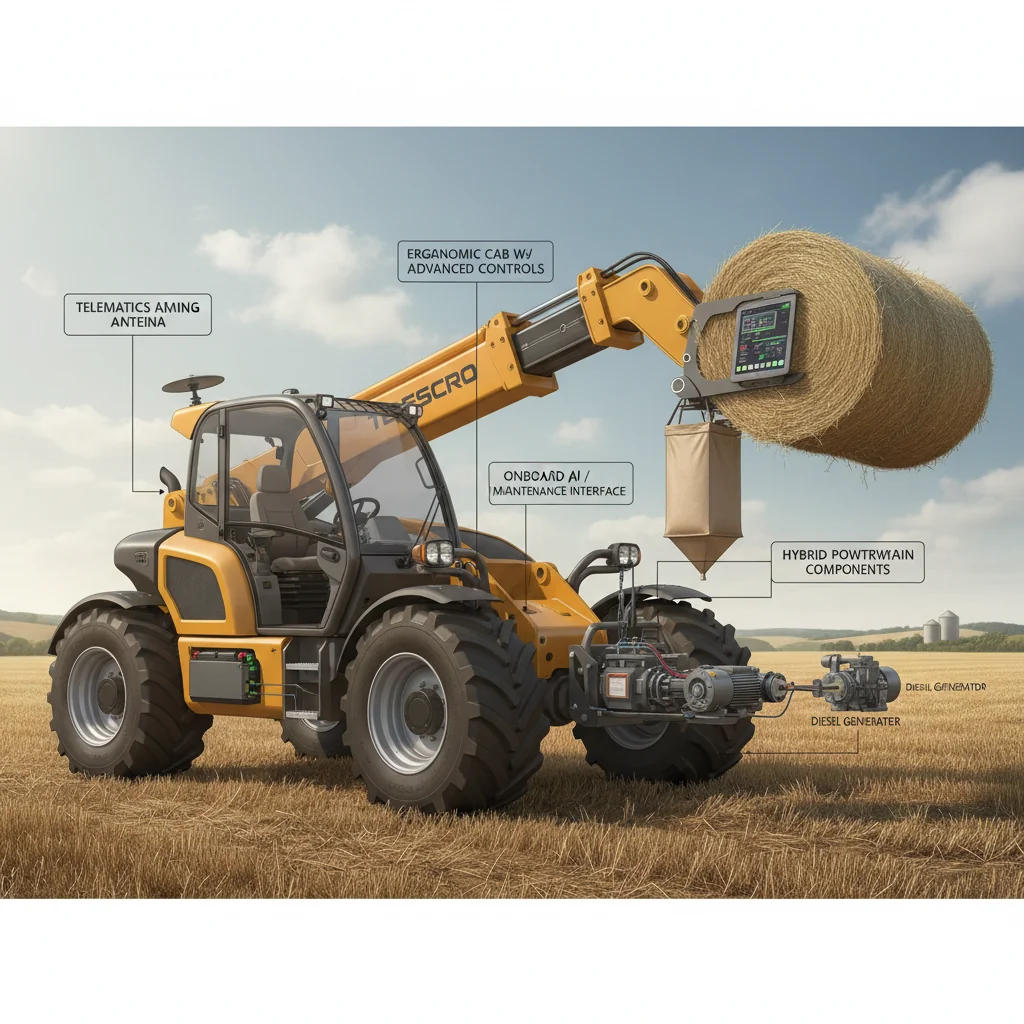
Here’s what matters most when looking at future telehandler trends in agriculture: farm use puts unique stresses on equipment that standard construction models just aren’t built for. I’ve seen this first-hand on jobsites in Brazil and Eastern Europe—muddy fields, long working hours, and constant switching between tasks like handling hay bales or filling feed bins. That’s why new ag-specific telehandlers are showing up with higher ground clearance, smoother suspension, and cabs designed for long shifts. For example, a 4-ton model with around 430 mm clearance and soft ride suspension handled corn silage piles much better than standard units, according to a dairy customer in Poland. The cab had extra storage, panoramic visibility, and joystick controls—small details, but they help cut fatigue across a 12-hour harvest.
Sustainability is pushing telehandler powertrain development forward, and several manufacturers are now experimenting with hybrid or alternative-fuel prototypes. These include electric-assist systems paired with low-emission engines, or in some cases CNG-based concepts aimed at farms that already produce biogas. While these technologies are still in early adoption rather than mainstream models, test units I’ve seen—such as a 7-meter, 4-ton prototype trialed on a farm in Shandong—show noticeably quieter operation in barns and meaningful fuel-use reductions during daily cycles.
Digital systems are also evolving. Remote diagnostics and telematics are now widely used, helping dealers identify issues earlier and reduce downtime. More advanced tools—such as predictive maintenance or automated load-control assistance—are emerging in limited high-end models, particularly in Europe, but are not yet standard across the agricultural telehandler market. When evaluating future-ready machines, I suggest checking whether the electronic architecture supports software updates and whether telematics data can integrate with your long-term farm management systems. This ensures technology investments continue delivering value as the equipment evolves.
Agricultural telehandlers typically feature ground clearance in the 35–45 cm range, which helps them navigate muddy and uneven farm terrain without becoming bogged downTrue
Most ag-spec telehandlers are designed with 350–450 mm of ground clearance, providing sufficient underbody height to prevent contact with ruts, silage, or soft soil while maintaining stability and a low center of gravity.
Telehandlers designed for agriculture typically eliminate auxiliary hydraulics to reduce maintenance complexityFalse
Auxiliary hydraulics are essential in agricultural telehandlers to operate various implements like bale grabs and feed mixers; removing them would limit versatility and contradict ag-specific equipment needs.
Key takeaway: Agricultural telehandlers are evolving rapidly with farm-specific designs, alternative powertrains, and smart features. Buyers should assess telematics compatibility and openness to upgrades, as integration with future farm management and sustainability requirements is becoming standard across new models and will affect long-term machine value and operational efficiency.
Conclusion
We looked at how telehandlers stack up against tractor loaders for farm material handling, and why actual site needs—like load size and clearance—should guide your choice more than eye-catching brochure numbers. From what I’ve seen, the farmers who avoid headaches always check how much their machine can really handle at their usual working height, not just max specs. I also recommend asking about parts support for your area—"parts roulette" is no fun when you need a crucial replacement. If you’re sorting through options or have questions about load charts, reach out—I’m happy to share what’s worked on real farms. Every jobsite is different, so finding what fits your daily workflow matters most.
References
-
Explore how quick-attach systems save time by enabling fast, seamless swapping of attachments on telehandlers for versatile farm tasks. ↩
-
Explore how telehandler lift capacity affects efficiency in loading and stacking crops during peak harvest seasons, with practical examples. ↩
-
Detailed insights on how telescopic booms combine crane-like lift height with forklift versatility for efficient farm material handling. ↩
-
Comprehensive overview of agricultural telehandler specs, including load capacity and boom reach, crucial for farm operations. ↩
-
Learn why telehandlers with compact maneuverability are essential for tight spaces and efficient livestock feeding on modern farms. ↩
-
Understand the critical role of fast cycle times in optimizing telehandler productivity and minimizing harvest delays. ↩
-
Understand how a robust quick-attach system allows fast-changing attachments, reducing downtime and increasing daily operational efficiency. ↩
-
Detailed guidance on matching telehandler size to farm load demands and maneuverability challenges for optimal performance and cost-efficiency. ↩
-
Explore how pallet forks improve handling of seed, feed, and fertilizer pallets, boosting farm efficiency with proper weight ratings and durability. ↩
-
Explains how correct use of load charts prevents tipping accidents by guiding safe lifting limits based on boom extension and ground conditions. ↩
-
Details how load-moment indicators provide real-time tipping risk alerts, enhancing operator awareness and reducing accident rates during lifting operations. ↩
-
Detailed insights on maintaining telehandler hydraulics and drivetrains, crucial for reducing downtime and extending equipment lifespan. ↩
-
Explains the benefits of robust dealer networks for service support and parts availability, improving telehandler uptime in high-use farming. ↩
-
Explore how hybrid powertrains reduce emissions and improve efficiency in farming telehandlers with technical insights and case studies. ↩