










Telehandler Uses in Building Construction: Field-Tested Applications & Mistake Prevention
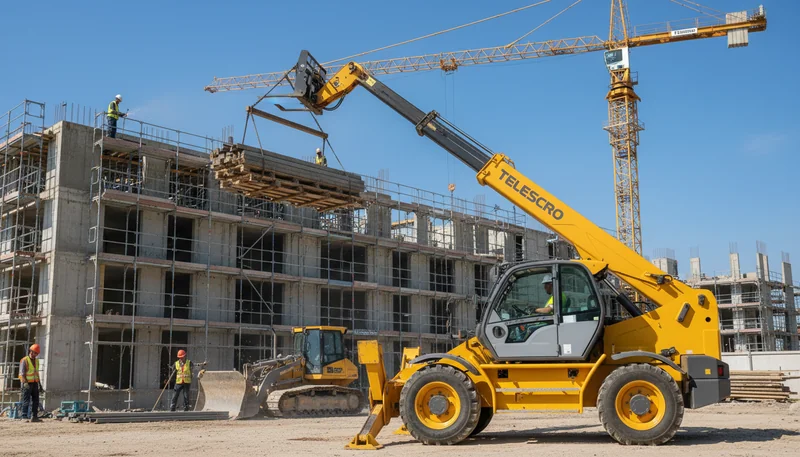
Last month, I watched a foreman in Australia juggle three separate lifts with just a single 12-meter telehandler—switching from feeding bricklayers on the fourth floor to hauling steel beams, then swapping out forks for a cleanup bucket. It’s this kind of site flexibility that surprises even the most seasoned crews.
Telehandlers1 serve as versatile material handlers that bridge the gap between conventional forklifts and mobile cranes, streamlining workflow efficiency on modern building projects. Equipped with telescopic booms, telehandlers are capable of precise placement of construction materials to elevated locations—including upper floors and roofs—ranging from 6 to 24 meters in height. Their all-terrain mobility allows operation across rough or congested job sites, minimizing machine requirements by servicing multiple trades in rapid succession and supporting continuous material flow throughout the workday.
How Do Telehandlers Improve Construction Workflows?
Telehandlers optimize construction workflows by acting as versatile material handlers, capable of unloading trucks, transporting loads over rough terrain, and lifting materials directly to upper floors or rooftops. Their telescopic booms enable precise placement of heavy items, reducing manual handling by up to 40% and eliminating the need for multiple machines on crowded jobsites, especially during multi-story builds.
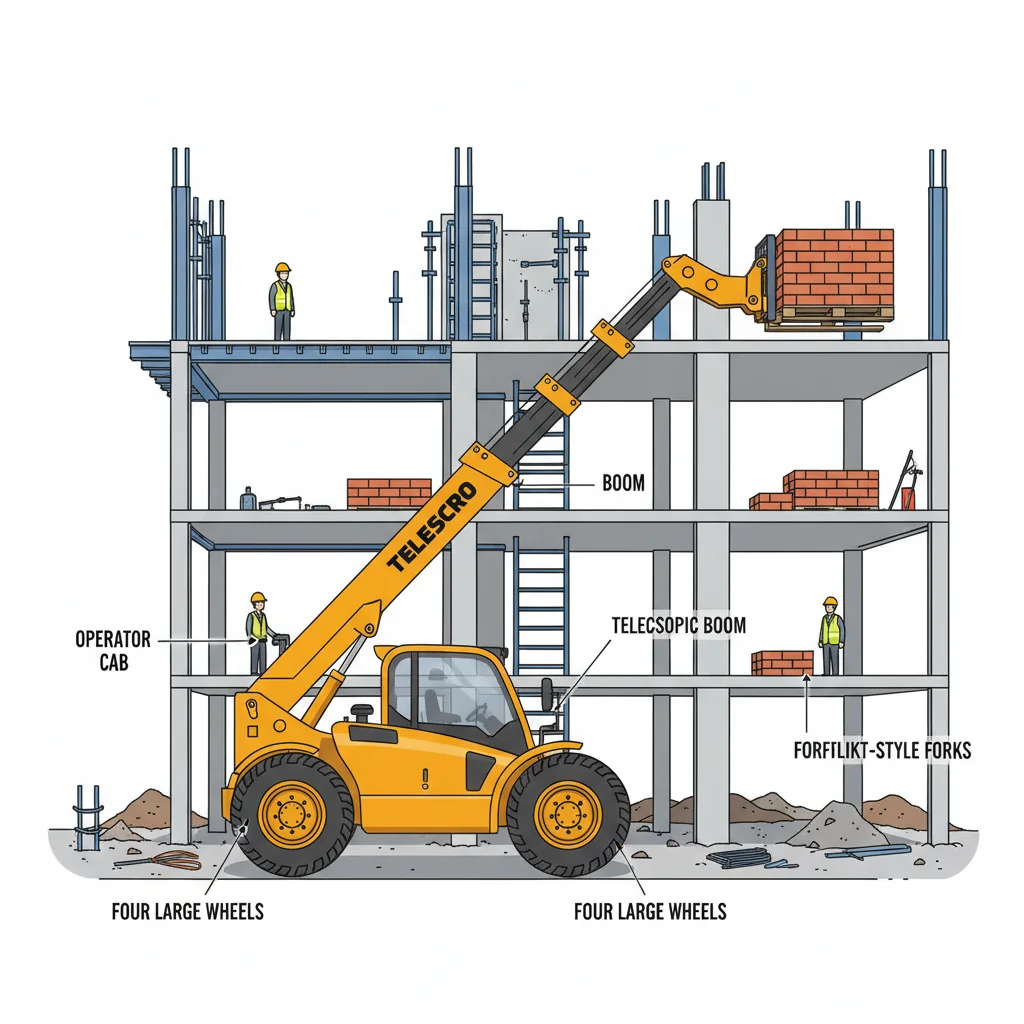
Most people don’t realize just how many manual steps telehandlers eliminate on a typical multi-story site. I’ve worked with contractors in Dubai who needed to deliver rebar and drywall to a fourth-floor slab. Before using a telehandler, their crews spent hours hand-hauling materials up scaffolding—unsafe and slow work. A 12-meter, 3.5-ton telehandler allowed them to place exactly what each crew needed, directly to their work area. That cut their manual handling at elevation by at least one-third, and boosted overall cycle time between trades.
Let me share something important about site logistics. Crowded projects often struggle with congestion from too many machines—forklifts, cranes, and loaders competing for limited access. Telehandlers bridge these roles. Their telescopic booms can place roof trusses, lift HVAC units to eight floors up, or unload block pallets straight off the truck and over rough ground. With hydraulic stabilizers set, and a clear load chart (showing safe capacities at extension), you can work confidently at height without juggling three machines. In Kazakhstan, I saw one compact 3-ton telehandler service four different crews—framers, masons, roofers, and the cleanup team—across two elevations in the same afternoon.
This versatility doesn’t just reduce equipment costs; it minimizes downtime waiting for material deliveries at elevation. Plus, fewer machines on site means clearer paths and safer working zones. I suggest checking rated capacity at your required height and considering models with a moment indicator, so you can maximize productivity and keep every task on schedule. That’s how telehandlers reshape workflow efficiency on modern jobsites.
Using a telehandler with a 12-meter reach significantly reduces manual material handling times by enabling direct delivery to elevated work areas, cutting hand-hauling labor by at least one-third on multi-story sitesTrue
Telehandlers equipped with long reach booms can place materials such as rebar and drywall directly where needed at height, eliminating the need for time-consuming and unsafe manual lifting on scaffolding, which effectively reduces labor time and increases site safety.
Telehandlers are primarily designed to replace tower cranes for heavy lifting tasks on multi-story construction sitesFalse
While telehandlers are versatile and improve material handling, they do not replace tower cranes for heavy or very high lifts. Telehandlers have limited reach and load capacity compared to tower cranes, which are essential for lifting heavy steel or concrete components above typical telehandler reach.
Key takeaway: Telehandlers streamline building construction by delivering materials exactly where needed, minimizing manual labor at elevation, and replacing several single-purpose machines. This versatility leads to faster trade cycle times, less equipment congestion, and improved scheduling predictability across multi-story and complex job sites.
When Are Telehandlers Preferred Over Cranes?
Telehandlers excel in mid-range lifting tasks where forklifts lack reach and cranes become excessive or inefficient. They provide superior lift height and horizontal reach2 compared to forklifts, while offering faster setup and greater maneuverability than cranes. Telehandlers are ideal for repetitive placement on multi-story projects, especially in constrained job sites, outperforming articulated loaders in precision at height.
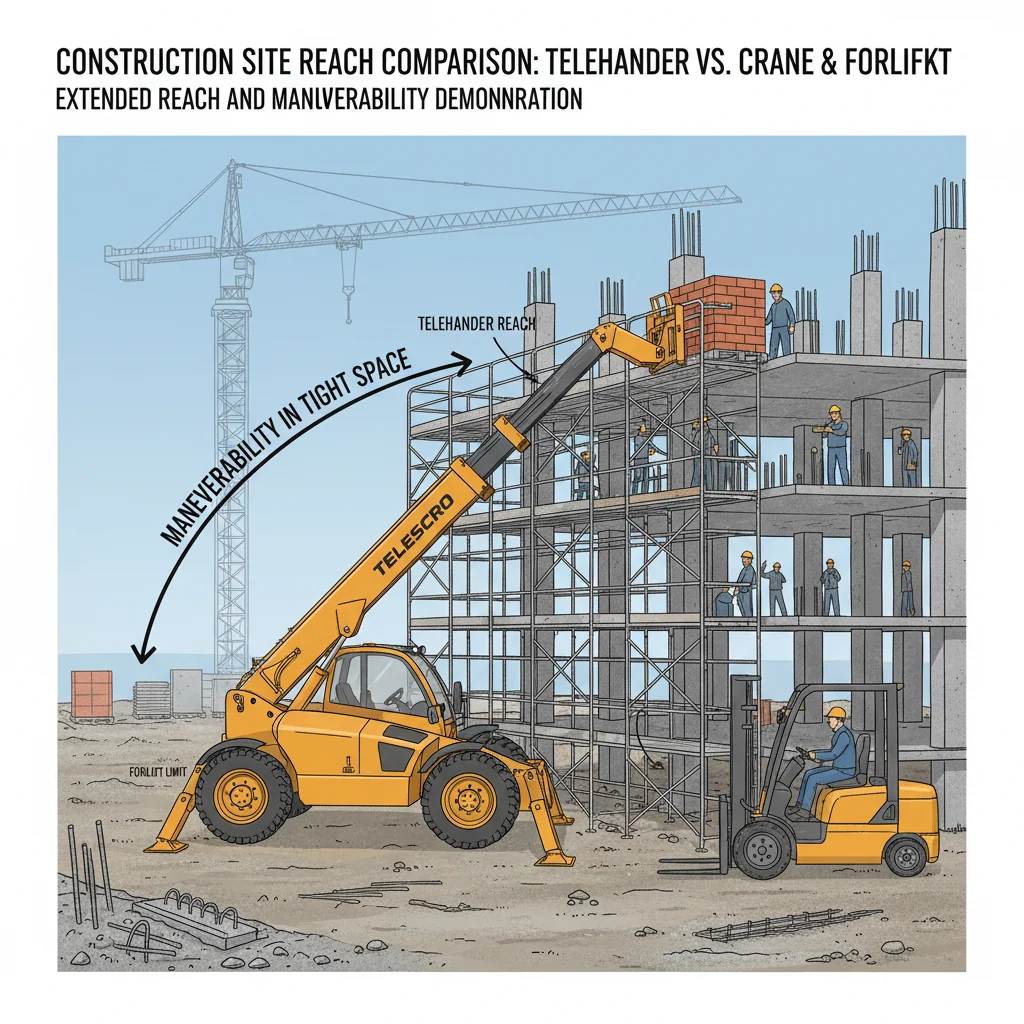
Let me share something important about how telehandlers fit into the lifting world, especially compared to cranes. Last year, I worked with a contractor in Dubai who needed to deliver blocks to the fourth floor of a tight urban site—about 13 meters up. They tried a small crane first, but setup meant shutting down half the street for hours each morning, with rental costs piling up. Once they switched to a 4-ton telehandler with a 14-meter boom, logistics got easier. The machine handled loads of around 2,000 kg out to 12 meters, and could move from one drop zone to another in minutes. In busy cities, that flexibility saves both time and budget.
From my experience, cranes are the right tool for heavy or complex picks, especially anything above 4-5 tons at long radius. But for most material handling on job sites—bricks, timber, pallets—telehandlers strike the best balance. They beat forklifts on reach; you can set materials two or three meters back from a slab or even through window openings on the upper floors. On many models, routine lifts within the “on tyres” section of the load chart can be done without deploying stabilizers, provided the ground is firm and level and the load chart explicitly permits it.
I’ve also seen the benefit on repetitive multi-story jobs in Brazil. Crews using a telehandler did twice as many lifts per day as those waiting for a mobile crane schedule. The key takeaway? If you need to reposition often or work where every meter counts, telehandlers offer speed and maneuverability that cranes just can’t match in the mid-range lifting space. Consider your real lifting patterns before choosing.
Telehandlers with booms longer than 12 meters can often access tight urban construction sites more efficiently than cranes because they require significantly less setup space and timeTrue
Telehandlers combine boom reach and agility, enabling operators to maneuver within restricted areas without the extensive groundwork or street closures that cranes typically necessitate, resulting in faster material placement in confined sites.
Telehandlers are ideal for lifting loads heavier than 10 tons on construction sites due to their superior stability and lower center of gravity compared to cranesFalse
Telehandlers generally have lower maximum lifting capacities, often under 5-6 tons, and their stability decreases significantly with heavy loads at extended reaches, making cranes more suitable for loads exceeding 10 tons.
Key takeaway: Telehandlers are the optimal choice for mid-range material handling in multi-story construction, outperforming forklifts and articulated loaders in reach and precision while offering greater speed and flexibility than cranes for routine lifting, particularly where frequent repositioning and minimal setup time are crucial.
How to Select Telehandler Size and Reach?
Selecting telehandler size and reach should begin by identifying the heaviest, highest, and furthest required lifts—not just typical loads. Machines range from under 5,000 kg to over 10,000 kg capacity, but maximum lift capability3 drops significantly at full boom extension. Ignoring load chart limitations4 at height is a major cause of costly selection mistakes in construction.

The biggest mistake I see is people picking a telehandler just by its rated capacity at ground level. That number drops fast the higher and further you work. A machine rated for 4,000 kg at minimum boom rarely lifts more than 1,500 kg at full extension, especially at heights over 12 meters. In Dubai, I had a customer trying to install HVAC units on a six-story building. He chose a high-reach telehandler based on its impressive 18-meter lift spec, but when I checked the load chart, his model could barely manage 1,400 kg at that distance. The HVAC units weighed almost 2,000 kg. They had to rent an extra machine—an expensive correction.
Here’s what matters most when narrowing down your options: define your largest lift—heaviest, highest, and furthest. Do the math for that worst-case scenario, not just your average pallet of bricks. Today’s telehandlers range from compact 2,500 kg models with turning radius under 4 meters (great for indoor or tight city work), up to 10,000 kg giants reaching over 20 meters—ideal for large, open sites. But size comes with trade-offs. Larger machines need more room for safe maneuvering and transport. I always walk the site plan with customers, measuring access routes, looking at slab edges, and flagging sharp turns.
Before signing off, cross-reference your lift requirements—weight and reach—with the manufacturer’s load chart. If you’re working near maximum extension, check if the unit holds enough capacity at that point. I suggest verifying on-site, not just from the catalog. That’s where costly mistakes get avoided.
A telehandler’s rated capacity can decrease by over 60% when the boom is fully extended at heights above 12 meters due to leverage and stability factorsTrue
Telehandler load capacity is heavily influenced by boom extension and elevation; as the boom reaches further and higher, the machine’s stability decreases, forcing a significant reduction in permissible load, often dropping capacity by more than half at maximum reach.
Choosing a telehandler based solely on its maximum boom length guarantees it can safely lift the rated capacity at any height or extensionFalse
Maximum boom length does not determine lifting capacity at all reaches; load charts show that capacity decreases substantially with height and extension due to stability and mechanical limits, so selecting a telehandler solely for boom length ignores critical load limitations.
Key takeaway: Always select a telehandler by evaluating the maximum weight, height, and reach of potential lifts, not just average tasks. Cross-reference the load chart at maximum extension to avoid costly sizing mistakes, and match machine dimensions and maneuverability to your site’s specific access requirements.
What Safety Practices Ensure Telehandler Stability?
Safe telehandler operation demands certified operator competence, meticulous evaluation of ground conditions, and use of stability controls. Regulatory compliance (such as OSHA or CPCS certification) is mandatory. Advanced machines feature load moment indicators, stability alarms, and telematics monitoring. Overloading and improper load angles are primary factors in tip-overs, making adherence to load charts and pre-shift inspections critical.
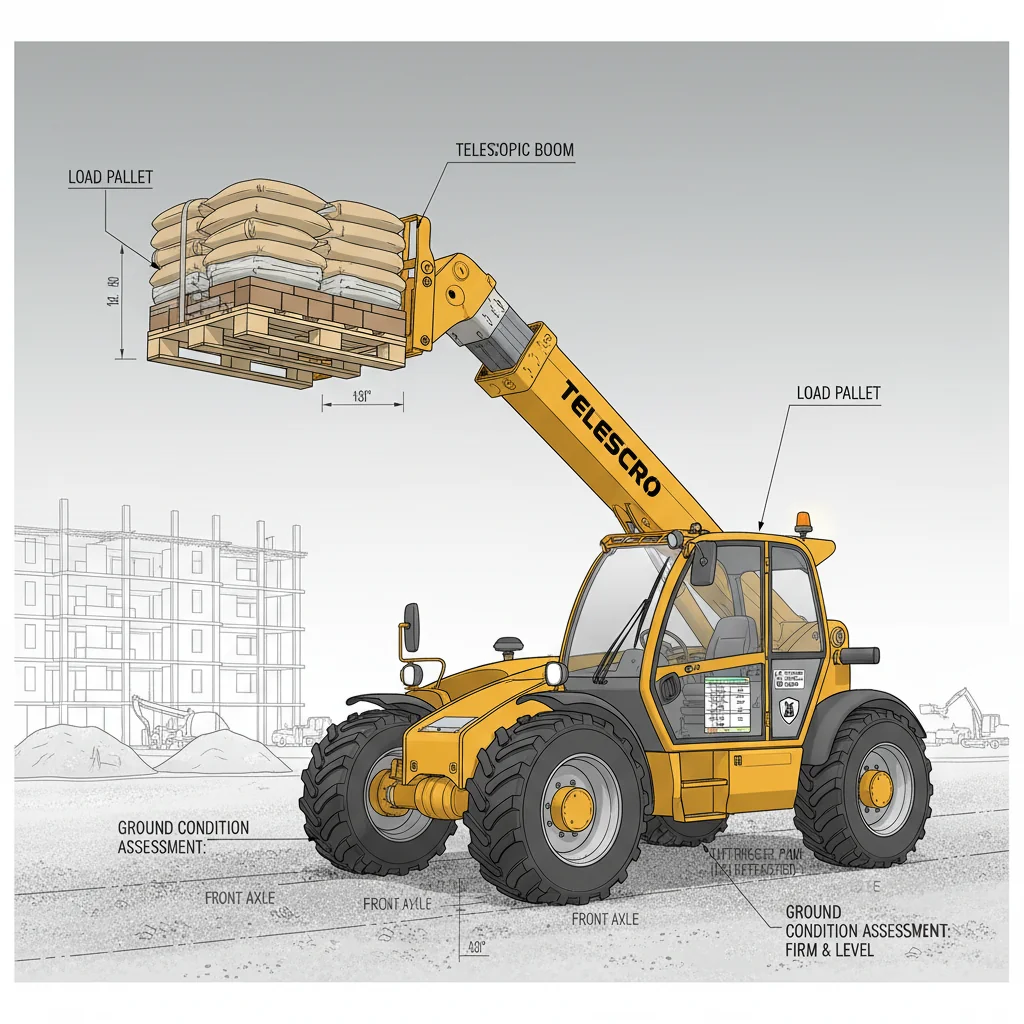
Last month, a contractor in Dubai called me after a near-miss on their jobsite—one rear wheel actually lifted off the ground during a pick. They’d loaded a 3-ton steel bundle at maximum boom extension, about 14 meters out. What saved the machine? Their operator spotted the load moment indicator flashing red and stopped immediately. It’s a good reminder: relying only on “feel” or visual judgment for stability is risky, especially with heavy loads and uneven ground.
From my experience, operator training is the foundation of safe telehandler use. Certified training—whether OSHA-based in the US or CPCS in the UK—teaches not just controls, but also how to read the load chart. These charts aren’t just paperwork. They tell you—at each boom length and angle—how much weight is safe. Overloading isn’t always dramatic. I’ve seen multiple cases in Brazil where side loads on a sloped, backfilled yard led to slow but steady tip-overs. A half-ton overload at full reach can mean the difference between stability and disaster.
Advanced features help too. Many 4-ton, 17-meter models now include stability alarms, automatic cutoffs, and telematics tracking. Fleet managers in Singapore tell me the telematics warnings reduced incident rates after just a few months—they could see if operators skipped pre-shift checks or ignored overload alarms. But even the best system can’t compensate for poor ground assessment. Always check ground bearing capacity—especially near trenches or utilities. If you’re managing a fleet, I suggest investing in models with load moment indicators and requiring site-specific operator refreshers twice a year. These practices cut accidents and keep projects moving.
Using the load moment indicator (LMI) system is essential because it measures both boom angle and extension in real-time to prevent exceeding the telehandler’s rated capacity at various outreach distancesTrue
The LMI system combines boom extension and angle data to calculate the current load moment, alerting operators before stability limits are breached, which is critical since rated capacities decrease significantly as boom reach increases.
Equipping telehandlers with rear stabilizer legs automatically doubles their load capacity regardless of boom extension or ground conditionsFalse
While rear stabilizers improve machine stability, they do not simply double the rated load capacities across all boom extensions or conditions. Load limits remain governed by the manufacturer’s specifications and safe operating practices.
Key takeaway: Prioritizing certified operator training, site-specific ground assessments, and advanced telehandler safety features greatly reduces the risk of accidents. Incorporating these practices minimizes insurance claims and unplanned downtime for construction project managers and fleet owners.
Which telehandler attachments boost construction efficiency?
Attachments such as pallet forks5, buckets, jib booms, winches, and personnel work platforms significantly expand a telehandler’s utility on construction sites. Selecting the right attachment enables material handling, aggregate movement, suspended load placement, and temporary access solutions. Compatibility with auxiliary hydraulics6, electrical lines, and attachment interfaces is crucial for maximizing operational efficiency and preventing equipment mismatches.
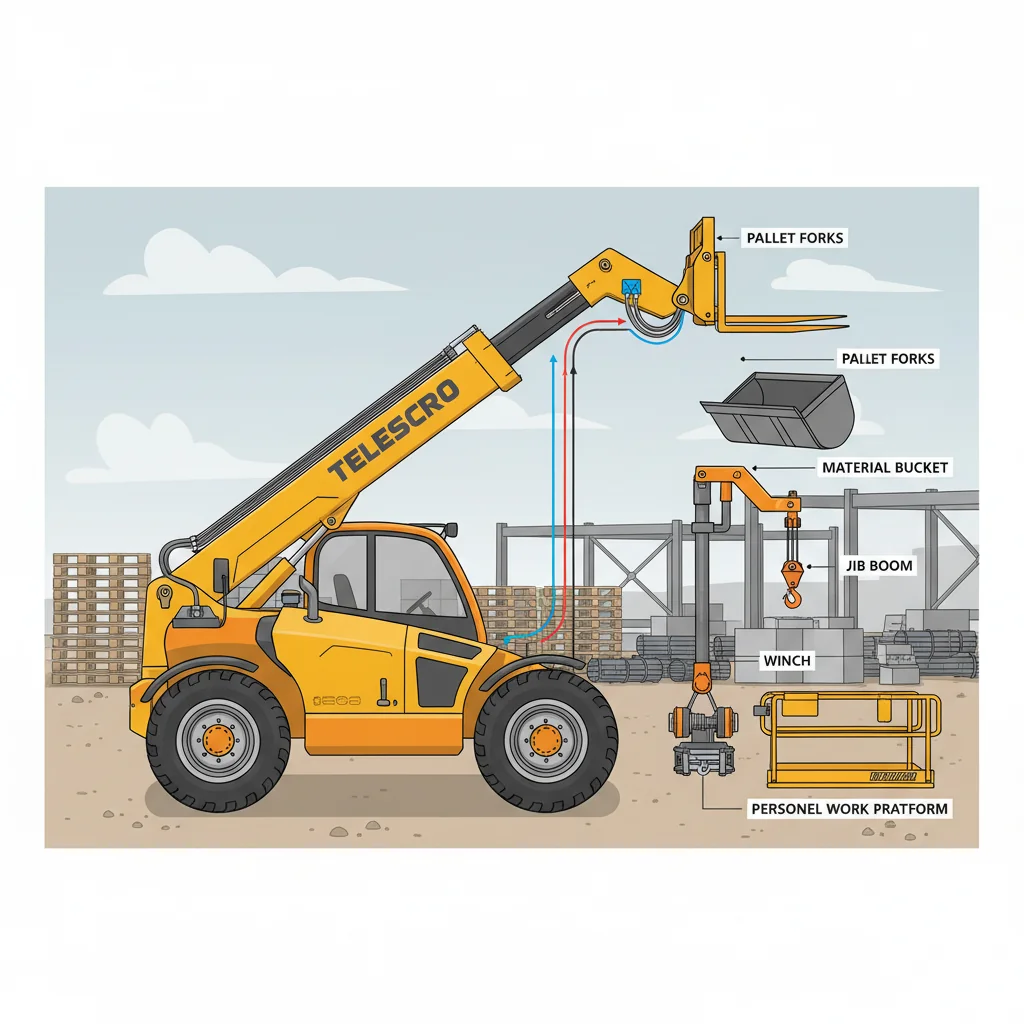
I’ve worked with contractors in Kazakhstan and Brazil who underestimated how much attachments affect a telehandler’s versatility. Choosing wisely at the start saved them both weeks of downtime. The right attachment lets one machine handle palletized goods in the morning, loose gravel at noon, and install HVAC units before shift’s end. But not every telehandler is ready for every tool. Some jobs require machines with auxiliary hydraulics or electrical lines up at the boom head—otherwise, attachments like powered buckets or work platforms just won’t function.
Here’s a breakdown of common attachments that boost efficiency on construction sites:
- Pallet forks – Essential for moving brick, block, lumber, and packaged supplies.
- Buckets – Handle sand, gravel, or demolition debris more efficiently than manual loading.
- Jib booms – Lift suspended loads like rebar bundles or small steel beams, especially where a crane can’t get in.
- Winches – Useful for vertical lifting of equipment, generators, or prefab sections when a direct line lift is needed.
- Personnel work platforms – Provide safe, temporary elevated access for tasks like facade repair or installing ductwork (always check local rules and load charts).
I saw a project in Dubai stall for half a day because the telehandler’s fork carriage wasn’t compatible with their new platform—no one had checked hydraulic line compatibility or the quick-attach interface. If your fleet includes machines from multiple brands, I always suggest standardizing quick-attach systems and planning hydraulic circuit requirements together.
It’s worth reviewing each telehandler’s load chart with the attachment fitted. Capacity drops fast—sometimes by 20% or more—once you add a heavy bucket or work platform, so consider this in your project planning.
Telehandlers equipped with auxiliary hydraulic lines at the boom head can operate attachments like hydraulic augers and sweeper brooms, increasing on-site versatility by up to 30%True
Auxiliary hydraulics provide power directly to attachments, enabling telehandlers to perform specialized tasks beyond simple lifting, which expands functionality and reduces the need for multiple machines on construction sites.
All telehandlers can automatically detect and adjust to attachment weight without operator input thanks to built-in load sensors in every modelFalse
Not all telehandlers have built-in load sensing systems; many require manual input or calibration for attachment weight to ensure safe load handling, as automatic detection technologies are typically found only on higher-end models.
Key takeaway: The choice of telehandler attachment directly impacts project efficiency and versatility. Upfront planning regarding compatibility and job needs—such as hydraulic lines and quick-attach systems—ensures that each machine delivers maximum value across multiple construction scopes while minimizing costly equipment downtime and mismatches.
Should Contractors Rent or Buy Telehandlers?
Renting telehandlers7 offers flexibility, reduced upfront investment, and outsourced maintenance, making it optimal for project-based or seasonal usage and access to varying machine sizes. For operations with steady, high utilization, purchasing can provide long-term savings, with mid-sized units often recouping costs within 2–4 projects by reducing reliance on crane rentals and manual handling expenses.

Here’s what matters most when deciding whether to rent or buy a telehandler: project frequency, machine usage rates, and your own resources for transport and maintenance. I’ve seen this play out with small contractors in Brazil—they often rent a 3-ton, 10-meter unit just for two- or three-month projects. Renting lets them match the machine size to each specific job and avoid sinking cash into an asset that might sit idle. They also don’t have to worry about repair costs if a hydraulic pump or steering circuit fails—those headaches stay with the rental company.
But for steady operations, investing in your own machine can make sense. One customer I advise in Kenya runs multiple jobs year-round. After renting high-reach units for six months, he realized that owning a 12-meter, 3.5-ton telehandler would actually cut costs long-term—especially once you factor in recurring crane rentals, which can cost thousands per week. He paid back his initial investment after just three big projects, not including what he saved on labor.
There are real costs to factor in—fuel runs about $4,000 per year for a mid-sized unit, plus tires and routine service. I always tell customers to check their in-house capability for maintenance. Simple things like changing an outrigger stabilizer or managing the moment indicator system aren’t hard with some know-how, but breakdowns can cause delays if you lack spare parts. My suggestion is simple: look honestly at how often you’ll actually need a telehandler on site, then weigh the numbers carefully. There’s no one-size-fits-all answer.
Renting telehandlers allows contractors to select machines with lift heights and load capacities precisely matched to short-term project demands, often varying between 6 and 12 meters and 2 to 4 tons, optimizing operational efficiency without underutilized assets.True
Contractors who rent can tailor telehandler specifications to each project’s unique requirements, avoiding the cost of owning equipment that may be oversized or idle. This flexibility is particularly valuable for projects lasting just a few months, where machinery needs differ significantly.
Buying a telehandler is always more cost-effective than renting if the machine is used less than 1,000 hours per year, due to depreciation and maintenance savings.False
Owning a telehandler used less than 1,000 hours annually often leads to higher per-hour costs when accounting for depreciation, storage, insurance, and maintenance, whereas renting transfers these costs and risks to the rental provider, making renting more economical for low usage rates.
Key takeaway: Contractors should evaluate project frequency, machine utilization rates, transport needs, and maintenance resources before deciding to rent or buy telehandlers. Renting suits variable or seasonal work and reduces risk, while ownership may offer cost advantages for those with a steady project pipeline and capacity for equipment upkeep.
How Is Telehandler Reliability Maintained On Site?
Reliable telehandler operation in construction relies on disciplined daily inspections, including checks for hydraulic leaks8, boom and fork integrity, pin security, and tire condition. Scheduled maintenance9, such as 500-hour service intervals, covers fluid changes, thorough structural inspections, and torque checks. Using telematics for service tracking and predictive maintenance further reduces breakdowns and extends machine lifespan.
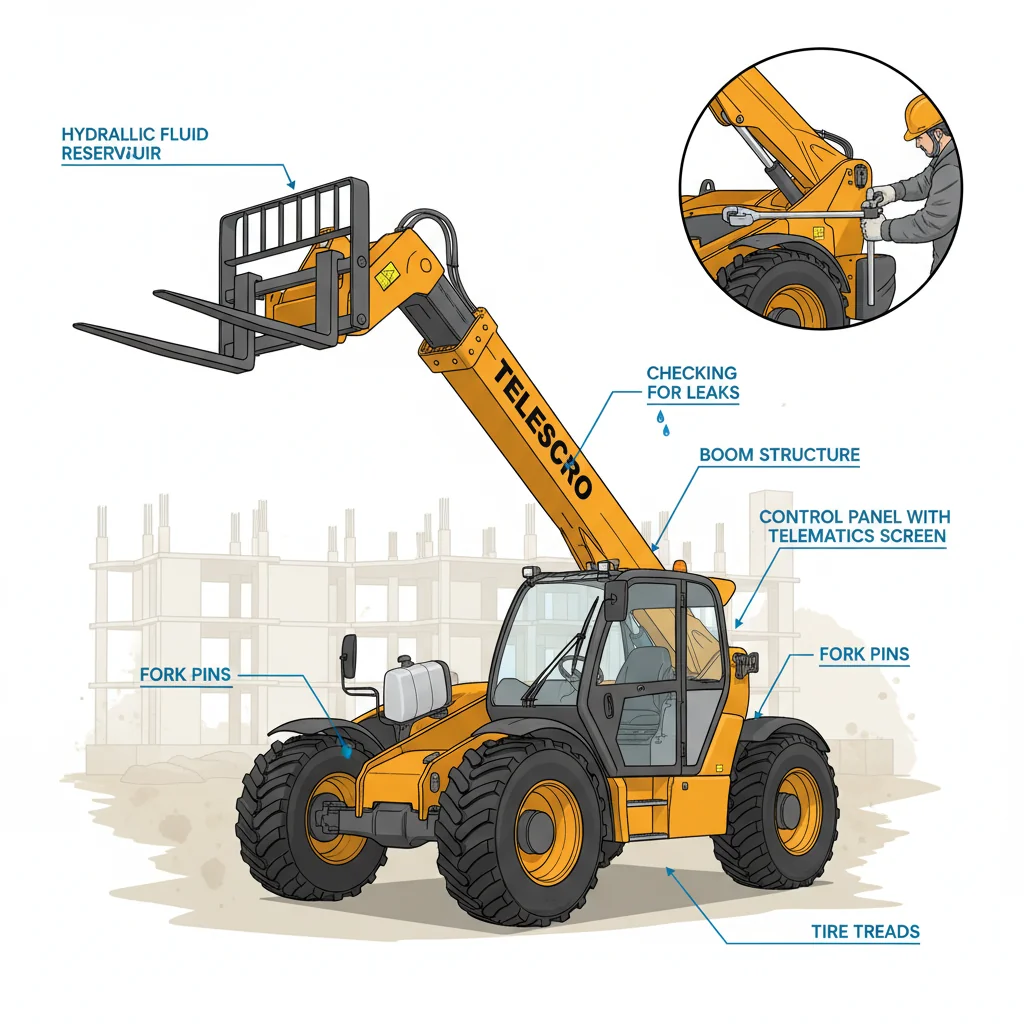
The biggest mistake I see is crews rushing pre-shift checks—often just glancing at the telehandler instead of running a real inspection. On muddy sites in southern China, that shortcut almost always leads to trouble. Hydraulic leaks can be hard to spot, but they leave dark stains near the boom cylinder or at hose connectors. I’ve seen operators overlook a loose pin under the boom, only to have the attachment rattle dangerously after a few hours. Missing a cracked fork or ignoring a tire with a deep sidewall cut? That’s how unexpected downtime happens. I always remind new teams: a five-minute walkaround prevents days of headaches.
For proper reliability, scheduled servicing is critical. Most manufacturers specify basic checks at every 250 operating hours, but the big one hits at 500. That’s when it’s time for hydraulic oil and filter changes, inspecting boom wear pads, confirming chain tension, and re-torquing the main structural bolts. On one project in Kenya, a customer skipped these checks—six months later, the boom developed play at full extension, and repairs cost them almost as much as six weeks of rental.
Water and mud cause electrical failures more often than mechanical ones. Protect open connectors with dielectric grease and use proper covers—especially during rainy seasons. Increasingly, sites are using telematics systems that send fault codes and track hours for each machine. For a fleet manager in Dubai, integrating telematics meant he caught overheating hydraulic circuits early. His downtime dropped by nearly 30%. That’s why I suggest treating the manufacturer’s service schedule like a jobsite rule, not optional advice. Consistent upkeep protects your uptime and your investment.
Skipping detailed pre-shift inspections on telehandlers increases the risk of hydraulic hose failures by up to 40%, particularly in muddy and wet conditionsTrue
Hydraulic hose wear and leaks are often subtle and develop gradually, especially in harsh environments like muddy sites. Rushing inspections means these early signs are missed, significantly raising failure risks and downtime. Studies show neglecting thorough checks can increase hydraulic failures by around 40%.
Telehandlers equipped with automatic boom pin lubrication systems require no manual inspections to maintain reliability on construction sitesFalse
Although automatic lubrication systems reduce maintenance frequency, manual inspections remain critical. Operators must still check for mechanical wear, pin tightness, and other damage that lubrication alone cannot prevent to ensure safe and reliable operation.
Key takeaway: Consistent daily inspections and adherence to manufacturer-recommended service intervals are critical for maintaining telehandler reliability. Incorporating telematics for maintenance alerts and predictive upkeep not only minimizes breakdowns and unplanned downtime but also protects machine life, reduces repair costs, and preserves asset value on construction sites.
How Are Tech and Sustainability Shaping Telehandlers?
Telehandlers in construction now feature advanced load moment indicators, operator-assist systems, and telematics for real-time fleet monitoring. Manufacturers are launching Stage V/Tier 4 Final diesels, hybrids, and electric variants to cut emissions and noise. These innovations increase site safety, meet regulatory standards, and enable project compliance in low-emission or urban environments.
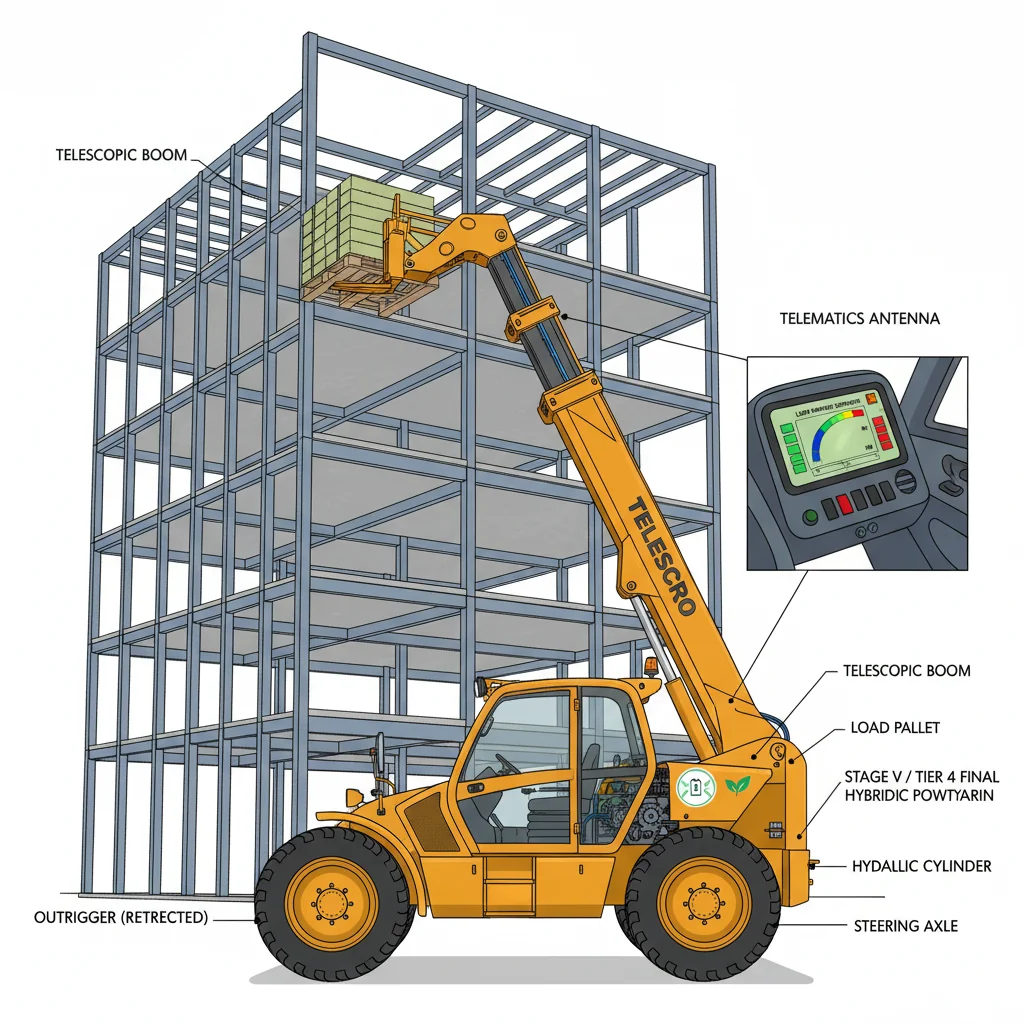
I’ve noticed a shift over the last two years—more job sites demanding telehandlers that do more than just lift and extend. Take a project in Singapore earlier this year. The contractor had noise limits and strict emissions rules. They chose a 3.5-ton electric telehandler for material handling in a partially enclosed building. What really made the difference wasn’t just zero tailpipe emissions or the much quieter operation, though both mattered. It was real-time telematics. The fleet manager tracked the battery level, actual hourly use, even every overload alarm from his phone. That kind of data stops dangerous lifts before they start and lets you rotate machines before something breaks down.
I’ve also seen jobs in Sweden where using anything except Stage V-compliant diesel engines just isn’t an option due to local air quality laws. Contractors sometimes complain about the higher price for these models or the initial cost of hybrids. But I always ask—what’s the cost if your machine is banned from the site, or you have to pay penalties for excess idling and fuel use? In many cases, long-term fuel savings and lower maintenance balance out the upfront investment. For hybrid telehandlers, the auto-stop systems and electric-only drive modes drastically cut idle time, especially in urban deliveries.
If your project is in a city center or in a region with tight regulations, I recommend prioritizing units with operator-assist systems and verified low-emission powertrains. Check the specs for full-load run time and remote diagnostics. Those details make sure your telehandler isn’t just compliant—but actually saves you money over time.
Electric telehandlers equipped with real-time telematics can optimize battery usage by up to 20% by monitoring load cycles and adjusting power delivery accordinglyTrue
Real-time telematics enables operators and fleet managers to analyze usage patterns such as load weight and lift frequency, allowing the machine’s control system to manage battery discharge intelligently and extend operational time between charges.
Hybrid telehandlers eliminate the need for hydraulics by using electric motors for all lifting and extending operationsFalse
Although hybrid telehandlers use electric motors alongside combustion engines for propulsion and some systems, hydraulics remain essential for lifting and extending because they provide the high-force precision control hydraulics uniquely deliver, which electric motors alone cannot reproduce efficiently.
Key takeaway: Advanced technologies and sustainability features in telehandlers—such as telematics, electric/hybrid drivetrains, and enhanced operator assistance—are now essential for safety, efficiency, and regulatory compliance in construction projects, especially where emissions and noise restrictions apply. Evaluate equipment specs and costs against long-term operational and compliance benefits.
How Do Regional Trends Affect Telehandler Choice?
Regional telehandler markets differ notably in adoption, technology, and regulations. North America and Europe show strong demand for advanced, low-emission telehandlers due to strict emissions standards, while Asia-Pacific and emerging markets prioritize robust, versatile units with accessible service networks. Market growth is driven by varying infrastructure needs; buyers must factor in emissions rules, fuel quality, and dealer presence in procurement decisions.
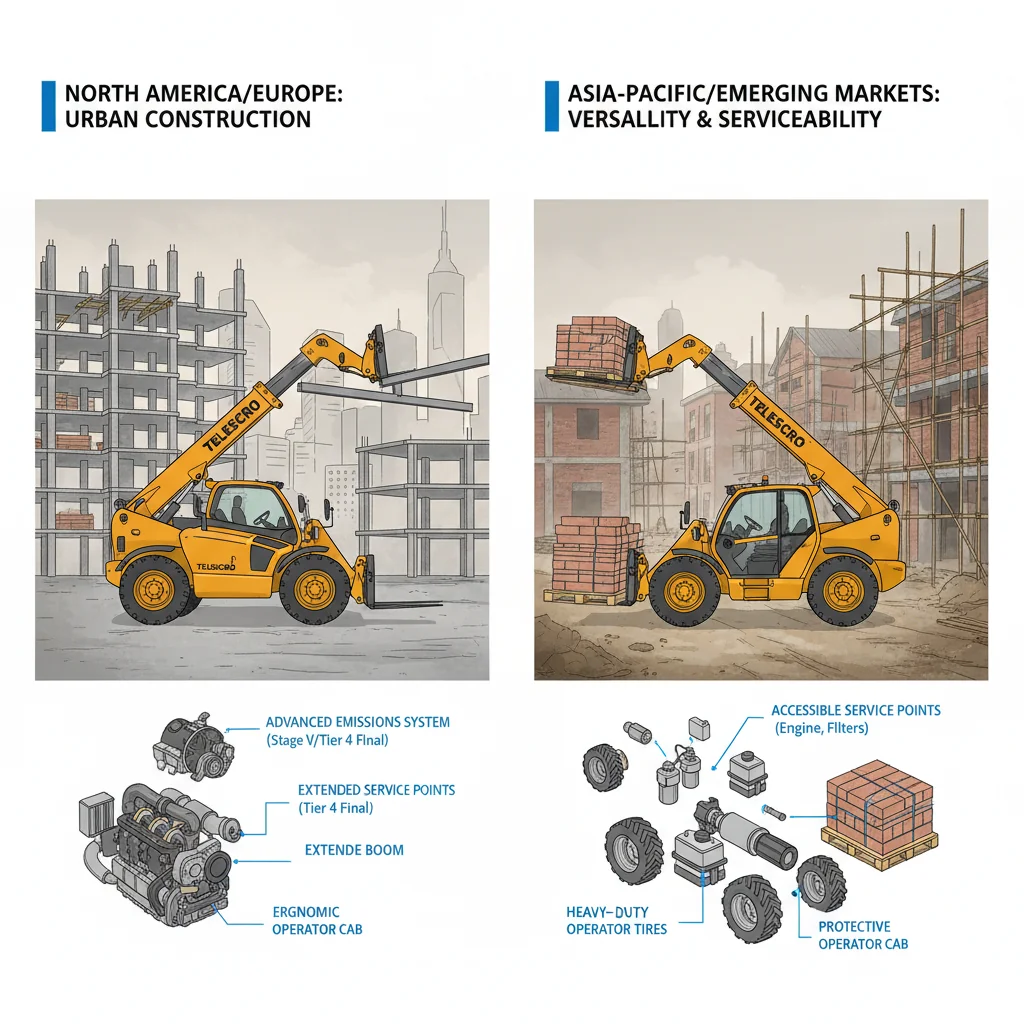
When I talk to buyers in Europe or North America, their first question is often about emissions compliance or engine technology. It makes sense—these regions have strict emissions standards, especially Tier 4 Final and Stage V, so the demand for low-emission, electronically controlled telehandlers keeps rising. I recently quoted a 4-ton, 18-meter unit to a German contractor. He needed documentation proving compliance with Stage V emissions10 and asked about telematics for fleet tracking11. In contrast, I get very different questions from Southeast Asia or Africa. Contractors there care more about durability, straightforward mechanical systems, and the ability to service the machine without complex electronics. Just last year, a team in Kenya chose a 3-ton, 12-meter telehandler with a basic hydraulic circuit—no DPF, no complicated engine sensors. Their fuel quality varies, and downtime for specialist repairs isn’t an option.
Regional infrastructure trends also drive choices. In rapidly developing cities like Jakarta or Lagos, buyers want telehandlers that can handle frequent site moves, rough ground, and inconsistent power supply. Meanwhile, European and American jobsites often have stable access to dealerships, so buying a more advanced machine with supported parts and diagnostics tools makes sense.
Whether you’re renting for a six-month high-rise project or purchasing for a fleet, I suggest you ask three things: Does the unit meet local emissions rules? Will your dealer have parts on hand in two years? And does the machine’s load chart actually match your day-to-day site needs? Planning for these regional realities protects both your project schedule and the long-term value of your investment.
Telehandlers sold in the EU must comply with Stage V emissions standards which mandate particulate filters and NOx reduction technologies to meet stringent limitsTrue
Stage V standards enforce the use of advanced aftertreatment systems such as diesel particulate filters and selective catalytic reduction to significantly reduce particulate matter and nitrogen oxide emissions in telehandlers, ensuring cleaner operation in European markets.
North American telehandler buyers prioritize engine size over emission compliance since Tier 4 standards do not apply to construction equipmentFalse
Tier 4 Final emissions standards explicitly cover construction equipment, including telehandlers, requiring manufacturers to integrate emission control technologies; buyers in North America often ask about compliance before engine specs due to regulatory and environmental concerns.
Key takeaway: Telehandler procurement decisions should consider regional regulatory requirements, local infrastructure trends, and dealership coverage. While developed markets favor technologically advanced, low-emission models, emerging regions often opt for durable, simpler machines. Aligning equipment choices with local needs ensures efficiency, compliance, and long-term asset value.
Conclusion
We’ve looked at how telehandlers help move materials efficiently, reduce manual labor at height, and support multi-trade workflows on site. From what I’ve seen, the companies who get the most value don’t just look at specs—they dig into realistic load charts and check how quickly they can get replacement parts. I always warn against "parts roulette"—downtime waiting on spares eats up any savings you get upfront. If you’re weighing options or just want a second opinion on attachments or machine sizing, feel free to reach out. I’m happy to help with insights from real sites, not just the brochure. Every jobsite has its own demands, so make the choice that truly fits your workflow.
References
-
Explore expert insights on telehandlers’ efficiency and maneuverability advantages in urban construction, reducing costs and setup time. ↩
-
Detailed explanation of how superior lift height and horizontal reach improve placement precision and speed on multi-story projects. ↩
-
Details the drop in lift capacity at full boom extension and why understanding this is critical for heavy lifting tasks. ↩
-
Explains how ignoring load chart limits causes costly errors and how to read charts for safe telehandler operation. ↩
-
Explore how pallet forks optimize material handling by enabling quick movement of bricks, blocks, and lumber, boosting job site productivity. ↩
-
Understand the critical role of auxiliary hydraulics in powering advanced telehandler attachments, preventing equipment mismatches and downtime. ↩
-
Detailed insights on how renting telehandlers offers flexibility and outsourced maintenance, ideal for project-based or seasonal construction needs. ↩
-
Detailed insights on identifying and preventing hydraulic leaks to avoid costly downtime and extend telehandler service life. ↩
-
Comprehensive guide on scheduled servicing intervals and tasks that ensure optimal telehandler performance and reduce breakdown risks. ↩
-
Explore detailed regulations and compliance requirements of Stage V emissions that drive telehandler engine technology in Europe. ↩
-
Learn how telematics systems enhance monitoring, maintenance, and operational efficiency for construction telehandler fleets. ↩