










Telehandler Types: Field Guide to Selecting the Right Model for Your Job
Last month, I watched a crew in Shanghai struggle for hours because they brought a massive rotating telehandler1 into an alley barely wide enough for the machine—simply the wrong tool for the job. Choosing the right telehandler can mean the difference between a smooth workday and lost time (and money).
Telehandlers are divided into categories primarily by boom configuration and size class. Fixed boom telehandlers2 use a telescopic arm that only moves up and down or out, providing mechanical simplicity and higher lift capacities3 for their size. Rotating telehandlers feature a turret-mounted cab and boom, allowing 360° reach from a single setup—an advantage in confined spaces but at the cost of increased complexity, higher price, and more demanding maintenance.
How Do Fixed Boom Telehandlers Operate?
Fixed boom telehandlers feature a telescopic arm that extends up, down, and forward, but their cab and structure remain stationary without rotation. These machines are prevalent in rental and agricultural sectors for their robustness, high lift capacities (5,000–12,000 lbs to 20–40 ft), and efficiency in front-facing, repetitive material-handling tasks.
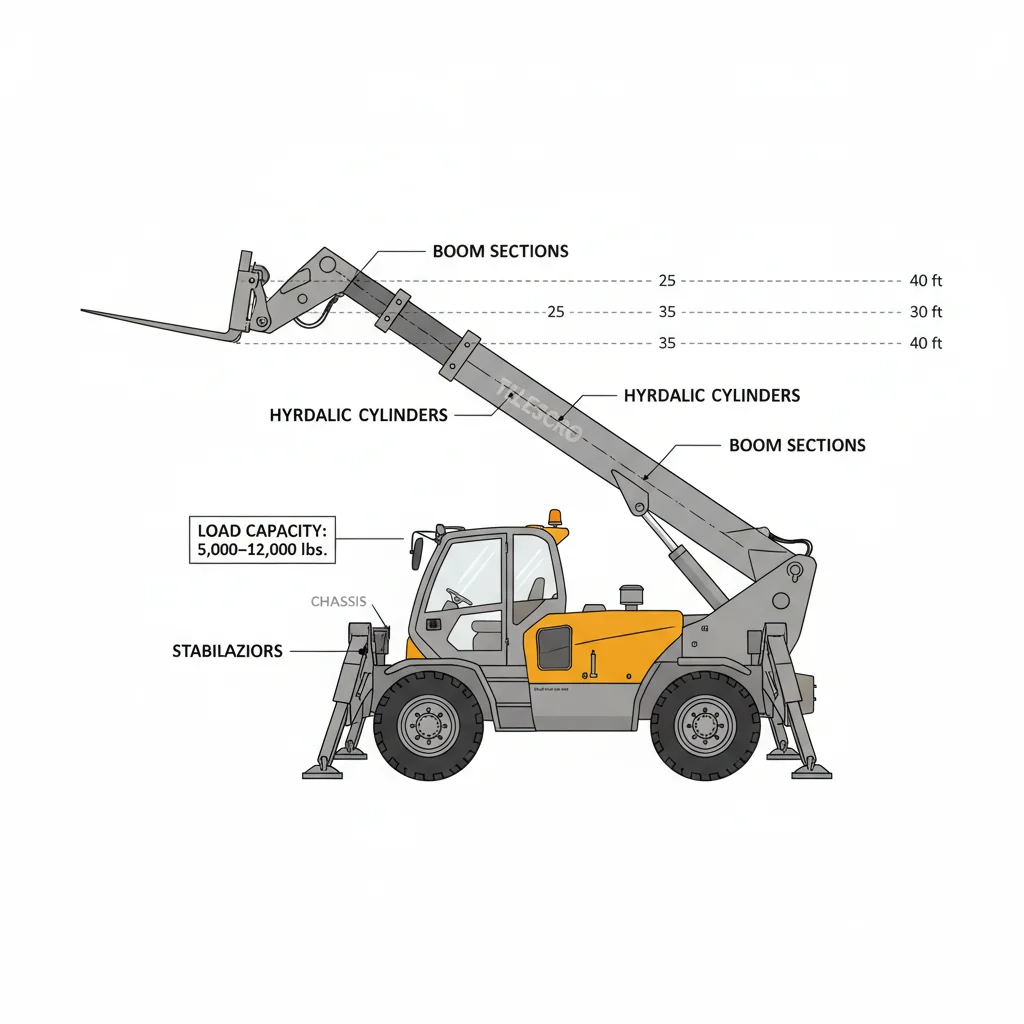
Most people don’t realize just how simple the operation of a fixed boom telehandler is compared to rotating types. The boom—what some call the arm—can only go up or down and extend forward, but the cab and body stay fixed, facing the load. I had a customer in Kazakhstan last year who wanted to speed up unloading on their grain farm. They chose a 5-ton, 9-meter fixed boom unit. Nothing fancy—just robust hydraulics, a clear load chart4 pasted in the cab, and fewer moving parts to worry about. Their crew moved over 250 tons of seed in five days, and not a single breakdown slowed them down.
For construction jobs, I always suggest checking where your main lifting zones are. Fixed boom machines excel if you mainly operate in front—moving bricks, blocks, or timber onto scaffolding. Their reach (usually 6–12 meters vertical, some higher) and lift capacity5 (often 5,000–12,000 lbs or more) outperform rotating models at the same price. In Dubai, a contractor told me his crew saved hours every shift by simply hopping in and repositioning the telehandler, rather than bothering with complex rotation controls.
Mechanically, fixed boom telehandlers are much simpler. There’s no slew ring or rotating cab. Fewer wear points means less downtime and lower maintenance—something I’ve seen save customers thousands per year. The hydraulic system is direct, with strong cylinders for boom movement and a clear moment indicator to help the operator avoid overloading. If your job is mostly forward-facing and speed, durability, and cost matter more than full 360° reach, I suggest fixed boom as your default workhorse.
Fixed boom telehandlers often have simpler hydraulic circuits with fewer valves than rotating boom models, which reduces maintenance complexity and improves reliabilityTrue
Because fixed boom telehandlers only move their boom up/down and forward/back without rotating the upper structure, their hydraulic systems require fewer directional control valves and rotary joints, simplifying maintenance and minimizing potential leak points.
Fixed boom telehandlers are typically equipped with 360-degree boom rotation capabilities to increase operational flexibility on construction sitesFalse
Unlike rotating boom telehandlers that feature a rotating upper structure allowing 360-degree boom movement, fixed boom telehandlers have a boom fixed in line with the chassis and cannot rotate, limiting their operation to forward and vertical boom movements only.
Key takeaway: Fixed boom telehandlers are the most common choice due to their durability, high lift capacity, and mechanical simplicity. They excel in tasks requiring straight-line lifting or frequent repositioning and are ideal when 360° rotation is unnecessary, offering cost-efficiency for contractors and farm operations.
When Are Rotating Telehandlers Most Effective?
Rotating telehandlers excel where tight, confined jobsites require precise placement without constant repositioning. Their 360° turret rotation6 allows operators to pick and place loads all around the machine from a single setup. These models are ideal for urban projects, façade work, and applications where crane-like functionality and reduced repositioning time are crucial.
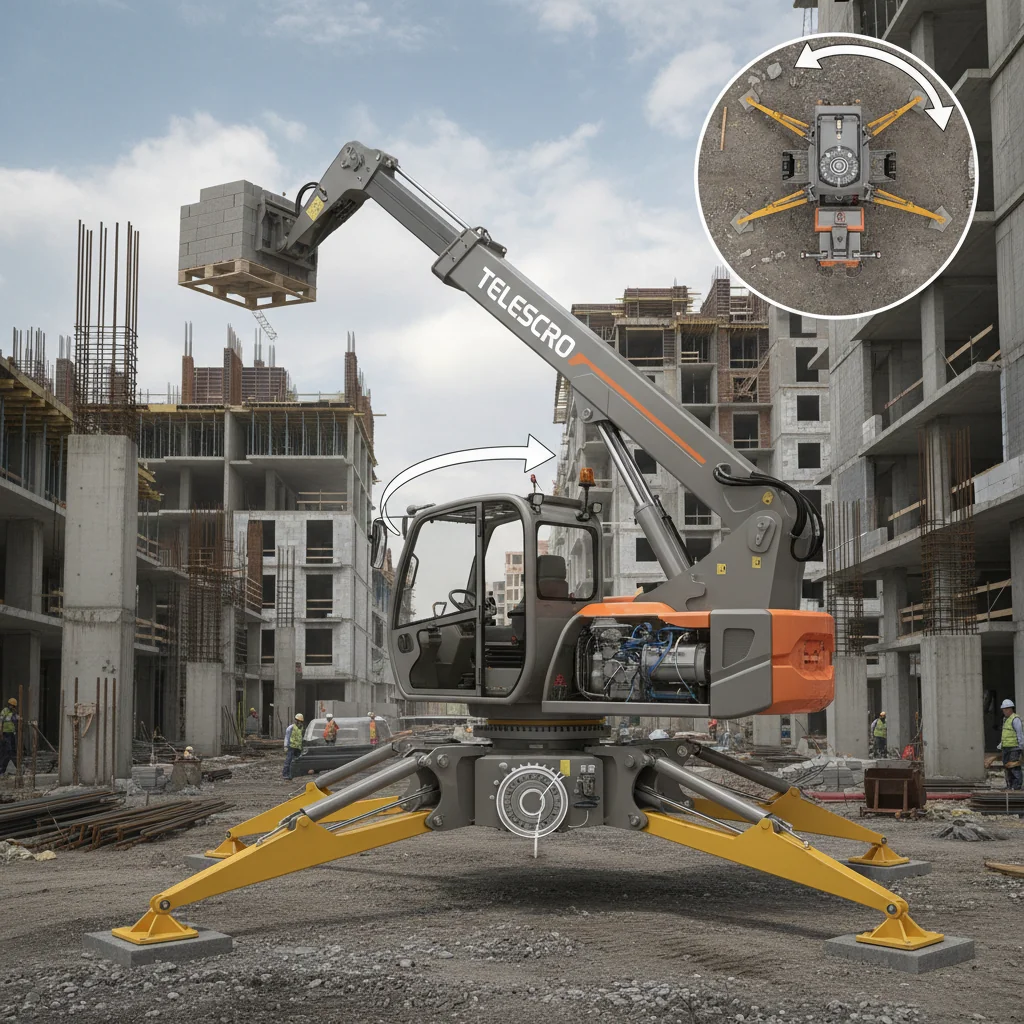
Let me share something important about rotating telehandlers—especially for anyone struggling with cramped projects or city jobsites. Last year, I supported a team in Singapore building a mid-rise commercial block. Their access was limited—a single service lane barely wider than the machine itself. Instead of wasting hours driving and repositioning a fixed boom model, they used a 5.5-ton rotating telehandler with 26-meter reach. One setup in the middle of the lot covered almost the entire structure. That 360° turret saved them at least two working days just on picking materials from different angles.
For these machines, it’s not just about maximum lift height. The real advantage is side or rear placement with precision—something you’ll need for façade work, glass installation, or placing steel beams on busy urban projects. Stabilizers7 (the folding support legs) make a big difference, boosting lift capacity and safety when you’re working with long or awkward loads. On most modern rotos, you’ll find load moment indicators and automatic hydraulic cut-offs, so it’s harder for operators to overload the boom. I’ve seen these features prevent costly tip-overs, especially with less experienced staff.
But to be honest, there are trade-offs. Rotating telehandlers can cost 35–50% more than fixed boom models of similar capacity. Controls are less “jump in and drive”—most operators need at least two days of focused training. Maintenance is also a step up. I suggest checking the rental fleet’s service reputation before you commit, especially if downtime will hold up the whole site.
Rotating telehandlers with 360-degree turret rotation can reduce site repositioning time by up to 50% on confined urban jobsites compared to fixed boom modelsTrue
Because rotating telehandlers can pivot their boom around the chassis, operators can reach multiple work areas without moving the entire machine, significantly cutting down on repositioning time in tight spaces.
Rotating telehandlers generally have higher maximum lifting capacities than fixed boom telehandlers due to their rotational mechanismsFalse
Rotating telehandlers often sacrifice maximum lifting capacity for enhanced maneuverability; their rotating turret and boom articulation typically limit load capacity compared to fixed boom models designed specifically for higher weight ratings.
Key takeaway: Rotating telehandlers are optimal for contractors and rental fleets handling complex, multi-directional picks on space-constrained sites. Their 360° rotation, versatile reach, and crane-like functions significantly boost productivity in dense urban environments, though they come with higher costs, complexity, and training demands.
How Are Telehandlers Classified by Size?
Telehandlers are typically classified as compact, mid-size, or large/heavy-duty based on rated lift capacity and reach. Compact models handle up to 6,000 lbs and 13–23 ft heights, mid-size units lift 10,000–20,000 lbs up to 40–55 ft, while large telehandlers serve demanding applications starting near 20,000 lbs capacity.
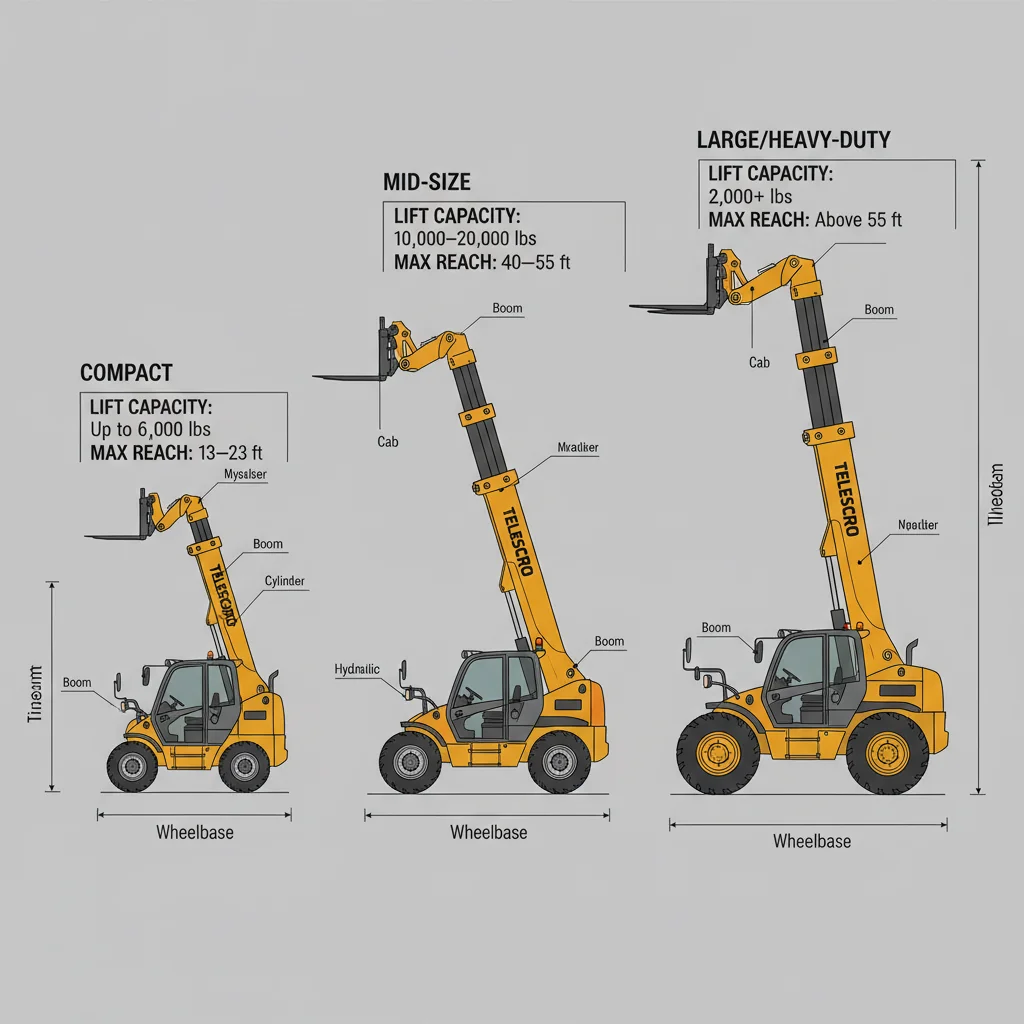
The biggest mistake I see is buyers sizing up “just in case” and ending up with machines that don’t actually fit the job. Let’s break it down: compact telehandlers8—usually rated up to 6,000 lbs and about 13–23 ft reach—shine in tight, busy areas. Last year, a warehouse project in Dubai needed something to lift 2,500 kg bags of cement onto upper shelves. The team originally tried a mid-size unit, but even with skilled operators, the turning radius created constant headaches inside the narrow aisles. A compact model with a turning radius under 4 meters made all the difference and actually sped up unload times by nearly a day.
Mid-size machines, on the other hand, tend to cover most construction needs. I worked with a contractor in Brazil using a 10,000 lb, 15-meter reach telehandler for everything from steel beams to brick pallets. At that site, the machine handled 80% of daily lifts, including some awkward roof trusses. The client checked the load chart first and discovered at full extension—close to 15 meters—actual lift capacity dropped to about 2,200 lbs. Most operators miss that drop-off. I always remind teams: the rated max isn’t always your usable max at working height.
Large or heavy-duty telehandlers suit more intensive workloads—think ports, mining, or precast yards. In Kazakhstan, I saw a 22,000 lb unit tackling bulk concrete formwork. It was perfect there, but far too cumbersome indoors. For real efficiency, I suggest mapping your load weights and working heights against the site’s physical limitations before buying or renting. Matching machine size to the true application always pays off.
Compact telehandlers typically have a maximum lift capacity under 6,000 lbs and a reach of 13 to 23 feet, making them ideal for operations inside confined spaces like warehouses or construction sites with narrow aisles.True
Compact telehandlers are designed with lower lift capacities and shorter reach to optimize maneuverability in tight spaces. Their smaller frame and reduced turning radius prevent operational issues in congested work environments, unlike larger models that may struggle in such conditions.
False
"While
Key takeaway: Selecting the right telehandler size class ensures safer operations and cost efficiency. Compact types suit confined spaces, mid-size models cover most construction needs, and large units support heavy-duty or industrial tasks. Matching capacity and reach to job demands prevents safety risks and operational inefficiencies.
When Are Compact Telehandlers Most Effective?
Compact telehandlers maximize maneuverability in confined areas such as narrow streets, low-ceiling warehouses, greenhouses, poultry or livestock buildings, and smaller yards. With typical reach up to 20 ft (6 m) and capacities under 3 t, high-clearance variants10 handle rough, uneven terrain. Their limitations include lower lift height and capacity, making them less suitable for heavy, multi-story, or façade work.
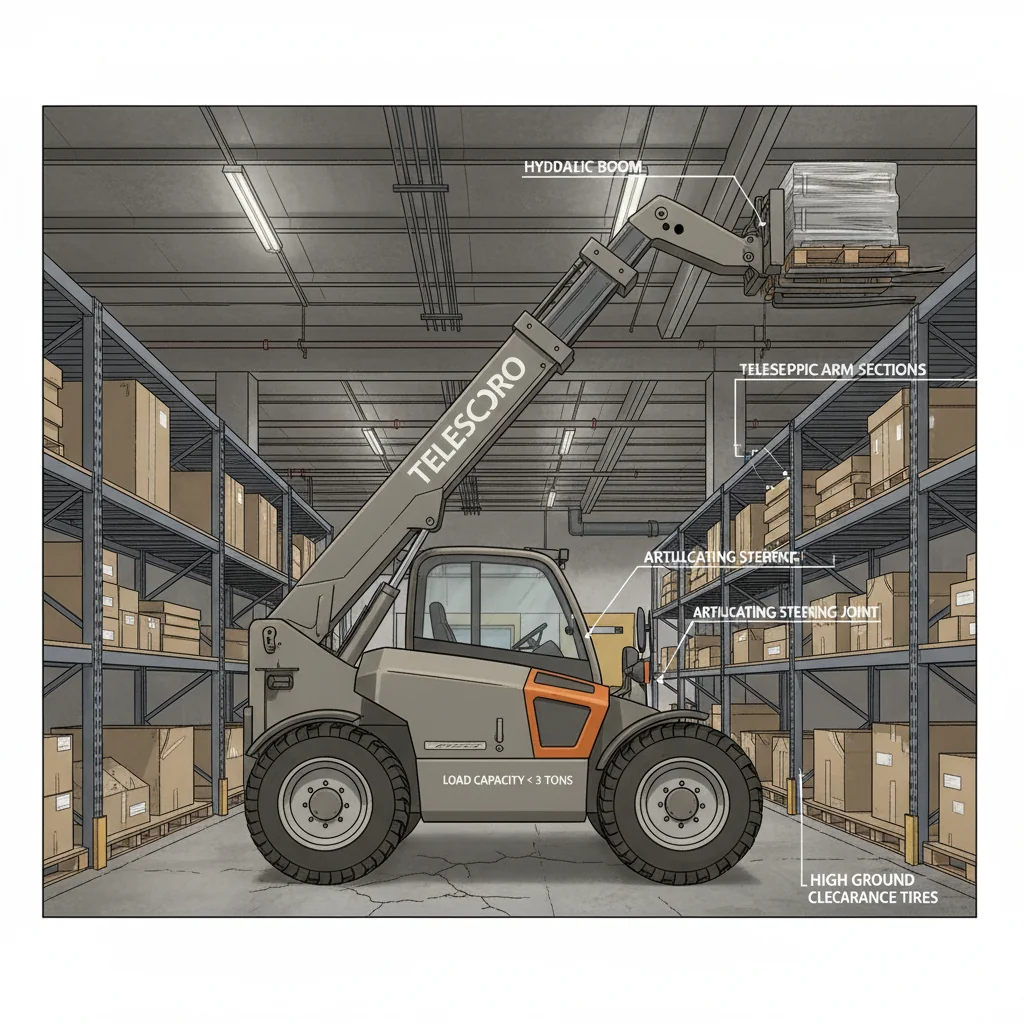
Here’s what matters most when choosing compact telehandlers: it’s all about tight access and frequent movement, not brute force. I’ve seen this play out on jobsites in the Netherlands, where space between greenhouses barely fits a full-sized loader—yet farmers still need to stack crates three high or deliver tools into corners with just 3 meters overhead. In these scenarios, a compact model with around 2.5-ton capacity and reach up to 6 meters does the job far better than any larger machine. Four-wheel steering and turning circles under 4 meters mean you can spin around in spaces where a regular forklift simply won’t fit.
A contractor I worked with in Kenya needed to feed livestock inside narrow barns, then shift bales out to muddy fields. Standard telehandlers just got stuck or couldn’t clear the rough ground. Here, a high-clearance variant—ground clearance over 400 mm and aggressive tires—handled deep ruts and uneven barn floors without issue. They saved at least two hours a day on material runs compared to struggling with older, low-slung machines. That kind of gain adds up quickly, even if the upfront cost is a bit higher.
Of course, these machines have real limits. From my experience, once you need to lift over 2,500 kg at full reach or place loads on multi-story façades, you’ll hit their ceiling fast. They’re not the right pick for heavy pallets or 10-meter façade jobs. I suggest always checking the load chart at maximum boom extension—never just base your decision on “max rated” numbers in the brochure. For tight, rough sites with moderate loads, compact telehandlers shine.
Compact telehandlers with a lifting capacity around 2.5 tons and a maximum reach of 6 meters are optimal for operations requiring maneuverability in tight spaces with moderate overhead clearance.True
Compact telehandlers balance sufficient lifting capacity and reach while maintaining a small footprint, allowing them to operate effectively in confined areas like narrow greenhouse aisles, where larger telehandlers cannot maneuver or fit under limited overhead space.
Compact telehandlers typically have a lifting capacity exceeding 5 tons, making them suitable for heavy industrial construction tasks requiring maximum brute force.False
Compact telehandlers generally have lower lifting capacities, around 2-3 tons, designed for agility and access rather than heavy lifting. Machines with capacities over 5 tons are usually larger telehandlers engineered for heavy-duty construction rather than tight or confined spaces.
Key takeaway: Compact and high-clearance telehandlers excel in jobs requiring tight access and frequent movement of moderate loads, especially where surface conditions are uneven. They are ideal for agriculture and warehouse environments but unsuitable for heavy lifting or tasks needing extended reach.
What defines heavy-duty and high-reach telehandlers?
Heavy-duty telehandlers feature reinforced frames11, robust axles, powerful engines, and can lift extreme loads—typically from 10,000 to over 20,000 lbs. High-reach telehandlers excel at vertical lifts, offering booms extending 50 feet or more. Load capacities fall sharply at maximum reach, so precise jobsite requirements and load charts12 must always guide model selection.
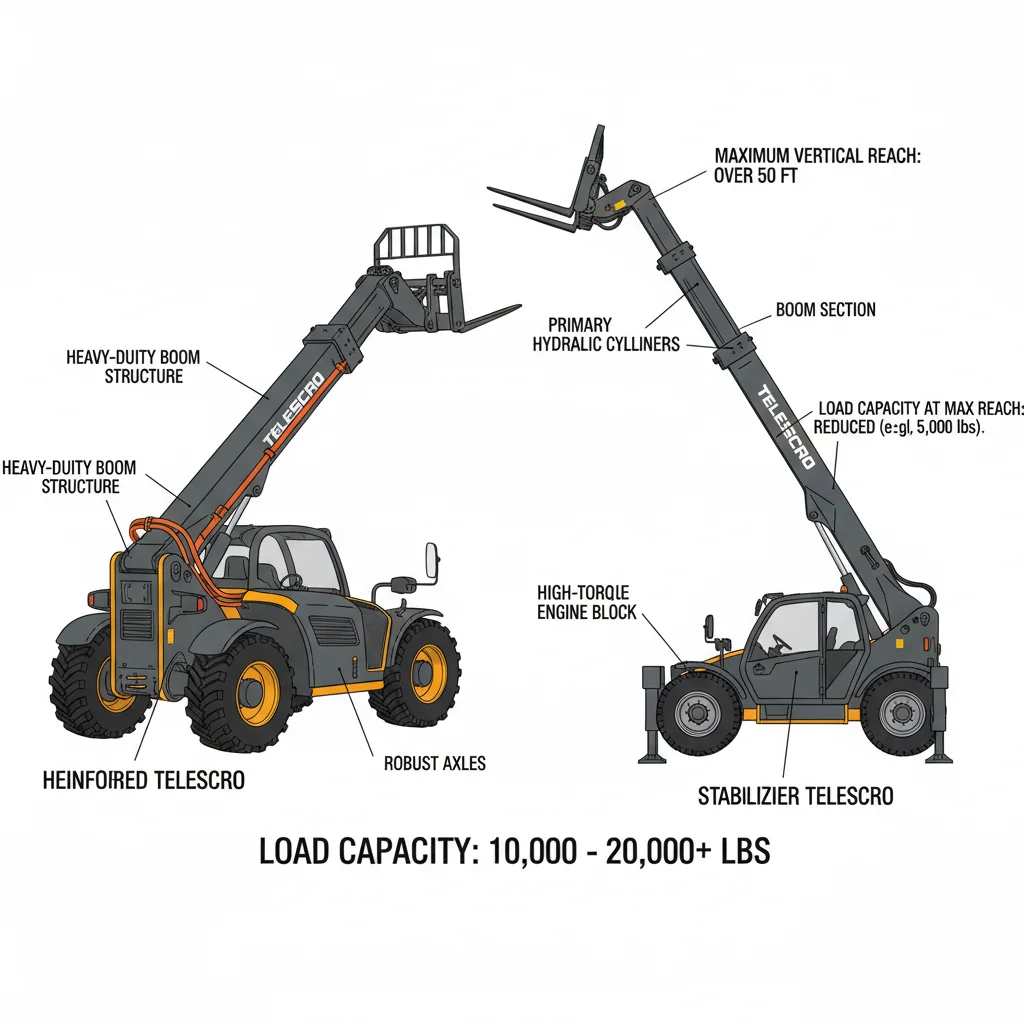
To be honest, the spec that actually matters is not just maximum lift—it’s how much weight the machine safely handles at real working heights. I’ve met buyers who think a telehandler rated for 16,000 lbs will do that at any position. The truth? At full extension, especially on high-reach models, your capacity might drop to half or less. Last year, a contractor in Dubai called me after his 20,000 lb-class telehandler struggled to place stone cladding on a 14-meter facade. We checked the load chart—the safe lift at full reach was just over 5,500 lbs. He ended up renting a second machine with a shorter boom but higher capacity to finish the job without risking an accident.
Heavy-duty telehandlers stand out with reinforced frames, thicker booms, and axles meant for continuous lifting of dense, awkward materials. You’ll see these in steel plants, precast yards, and busy ports where every day is non-stop heavy lift. I visited a shipyard in Indonesia last spring—one crew used a 9-ton capacity unit all day, moving steel coils that standard handlers simply couldn’t touch. The machines eat dust and rough surfaces, thanks to big hydraulic pumps and strong drivetrains. They cost more upfront, but downtime is minimal if you match specs to the site.
On the other hand, high-reach models come into their own on vertical jobs. Think roofing trusses on a four-story school or HVAC units on an office block, often over 16 meters up. Always consult the load chart before starting—not just for safety, but to keep productivity high. I suggest verifying capacity at full extension for your heaviest planned loads.
A telehandler's maximum rated lift capacity often decreases by 50% or more at its maximum horizontal reach due to stability and structural limitsTrue
Telehandler load charts demonstrate that as the boom extends horizontally, leverage forces increase, reducing the machine’s safe lifting capacity significantly—sometimes by half or more—to prevent tipping or structural failure. This decrease is critical for selecting the right model for high-reach tasks.
A telehandler rated for 20,000 lbs capacity maintains that lifting capacity at all boom extensions and anglesFalse
Telehandler capacity ratings are based on optimal boom positions. At full boom extension or high angles, the actual safe lift capacity is considerably lower due to mechanical and stability constraints, so the 20,000 lbs rating does not apply universally across all reach configurations.
Key takeaway: Selecting between heavy-duty and high-reach telehandlers depends on job demands. Heavy-duty models are designed for maximum load, while high-reach units prioritize vertical extension. Always consult the load chart, as rated capacities decrease at full extension, impacting safe and efficient operation for each site’s specific needs.
Are electric telehandlers suitable for job sites?
Electric telehandlers excel in indoor, low-emission, or noise-sensitive job sites such as hospitals, schools, and warehouses. Their battery-electric drivetrains13 eliminate tailpipe emissions and significantly reduce noise. However, they offer lower lift capacities and shorter runtimes than diesel models, and require adequate charging infrastructure to sustain productivity on multi-shift or heavy-duty sites.
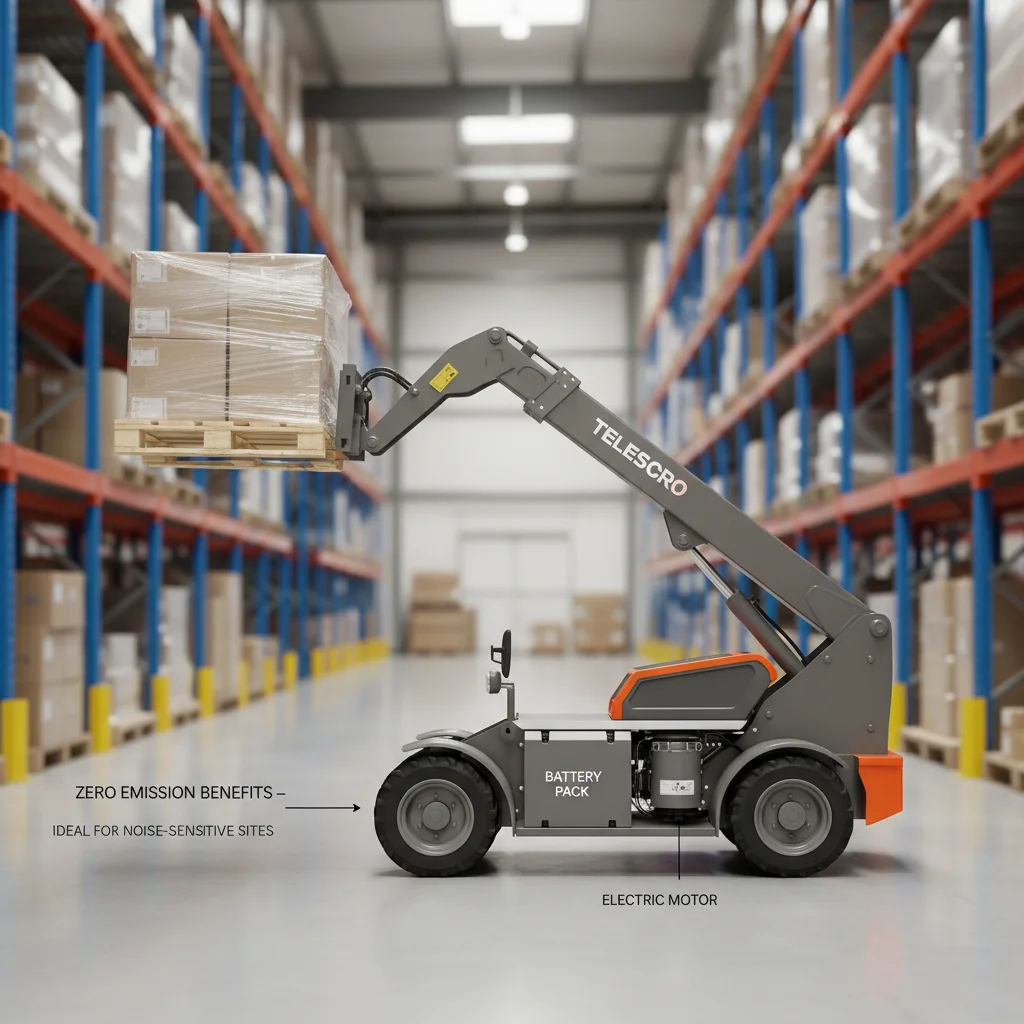
Most people overlook how critical air quality and noise restrictions are on some job sites. I worked with a project manager in Dubai last year who needed a telehandler for a hospital expansion. Diesel units weren’t allowed due to indoor air regulations, so he tried a compact 3-ton electric model with 7-meter reach. The difference was immediate—absolutely no exhaust fumes and barely any noise, even inside occupied wards. The hospital staff actually asked for another electric unit for a second phase.
But there are limits you can’t ignore. Electric models typically offer lower max capacities—often around 2,500 to 3,000 kg—and the runtime depends on battery size and site use. Heavy lifting or constant shuttling? Expect 6 to 8 hours on a full charge, sometimes less if you use attachment hydraulics a lot. In one food processing plant in Malaysia, the team managed two full shifts by charging during lunch breaks and swapping to a backup machine at night. Still, I always mention that multi-shift sites or those demanding more than 80% of the rated lift capacity may run into trouble without extra batteries or fast chargers installed.
The real sticking point is charging infrastructure. If your power supply can’t support multiple chargers or fast charging, productivity drops fast. I suggest mapping out your duty cycles—how many hours and how intense the lifting—before choosing electric. For clean, quiet jobs in sensitive environments, these machines are great. But if your main work is heavy steel or 24/7 operation, double-check your runtime needs and charging setup before making the switch.
Electric telehandlers typically have lower torque output compared to diesel models of the same class, which can limit lifting speed under heavy loadsTrue
Electric motors in telehandlers often prioritize smooth, emission-free operation and compact design over peak torque, resulting in slightly slower lifting speeds compared to diesel engines that produce higher torque bursts for rapid load movement.
Electric telehandlers require special indoor ventilation systems because they emit harmful gases even without a diesel engineFalse
Electric telehandlers produce zero exhaust emissions, eliminating the need for special indoor ventilation to manage harmful gases, which is a key advantage in sensitive environments like hospitals or enclosed job sites.
Key takeaway: Electric telehandlers are ideal for projects with strict air quality or noise regulations, especially indoors or in occupied buildings. However, lower capacity, limited runtime, and charging infrastructure must be carefully evaluated to ensure the model meets jobsite productivity requirements and operational timelines.
Which Telehandler Types Fit Farms or Construction?
Farm operations benefit from compact or rough-terrain fixed-boom telehandlers14, prioritizing maneuverability in tight spaces, stable handling on soft ground, and compatibility with diverse attachments. Construction sites favor mid-size fixed-boom or rotating telehandlers15 for lifting palletized materials and precise placement when crane access is limited, with most rental fleets choosing versatile mid-range models.
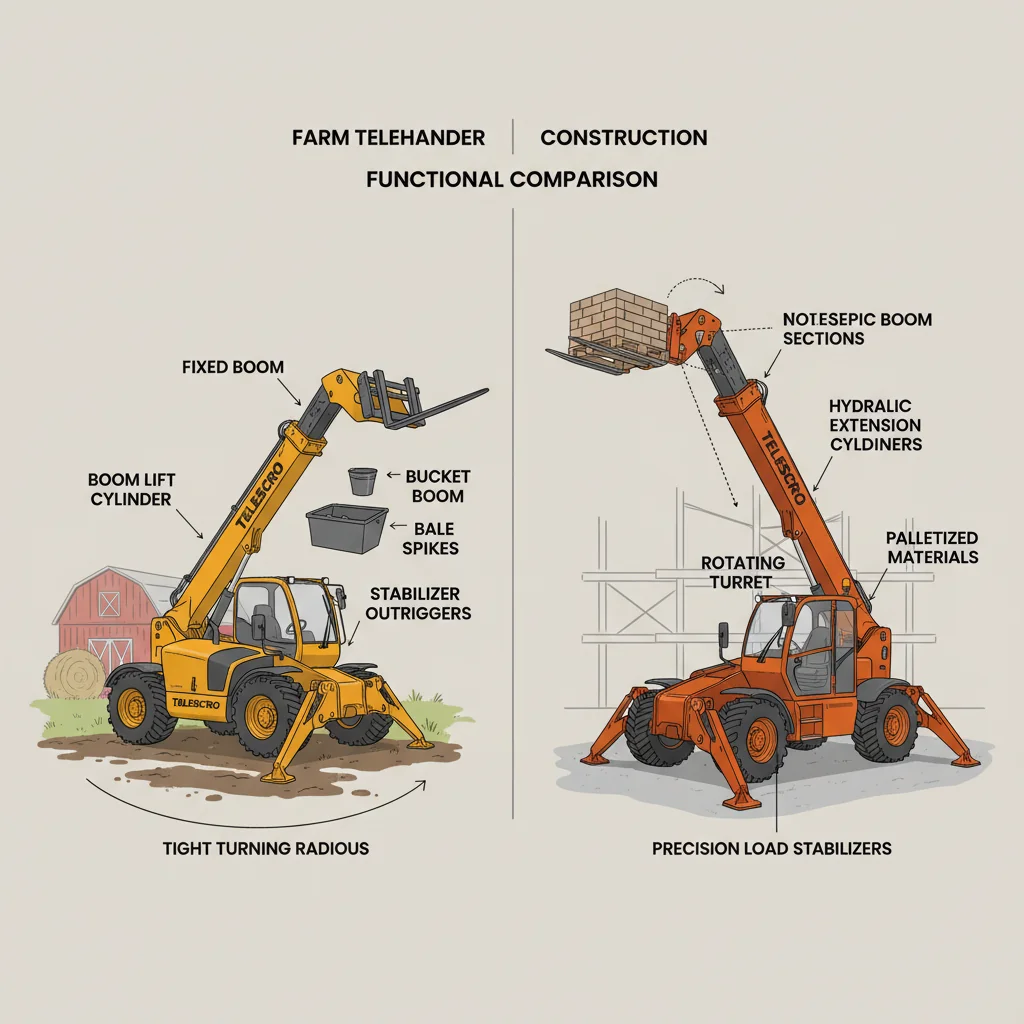
Last month, a farm owner from New Zealand called me with concerns about constant mud and tight sheds. She needed a machine that could swap between bale spikes, buckets, and pallet forks—all without tearing up the ground or getting stuck. That’s exactly where compact or rough-terrain fixed-boom telehandlers excel. With a turning radius under 4.5 meters and ground clearance near 410 mm, these models maneuver through barns and fields with ease. Most max out around 3,000 kg capacity and 7–9 meters of reach, which covers hay, feed, and light stacking. In my experience, farmers don’t often need more height—they want stable handling on slopes and gentle hydraulics so they don’t shred the bales or damage bags. On the other hand, construction sites have different demands. In Dubai last year, a rental fleet manager told me their 12-meter, 4-ton mid-size fixed-boom units worked on almost every project—carrying blocks to the second floor, loading rebar, or feeding formwork at height. For tight urban jobs or where you can’t bring in a crane, rotating telehandlers bring huge value. These machines can reach up to 21 meters and operate in a small footprint, swinging loads 360 degrees into position. I’ve seen them save two working days on congested city projects just by avoiding crane delays.
Compact rough-terrain telehandlers typically feature ground clearance close to 410 mm, allowing them to navigate muddy farm environments without getting stuckTrue
This ground clearance specification helps these machines traverse uneven, soft terrain common on farms, reducing the risk of becoming bogged down while maintaining stability.
All telehandlers with fixed booms have a turning radius larger than 5.5 meters, making them unsuitable for maneuvering in tight farm shedsFalse
Many compact fixed-boom telehandlers are designed with turning radii under 4.5 meters to fit in confined spaces like barns and sheds, contrary to the claim that their turning radius always exceeds 5.5 meters.
Key takeaway: Choosing the right telehandler hinges on assessing site demands. Farms require compact or rough-terrain fixed-boom models for stability and attachment versatility, while construction projects often need mid-size or rotating telehandlers for greater reach, lifting capacity, and maneuverability in congested or multi-level environments.
How to Match Telehandler Specs to Tasks?
Selecting the right telehandler begins with three main specifications: maximum lift height, lifting capacity, and forward reach. Actual capacity decreases significantly as the boom extends. Analyze the heaviest typical load and delivery height, reference manufacturer load charts, and consider site constraints such as access dimensions, maneuverability, and ground conditions to ensure the telehandler fits both job requirements and site limitations.
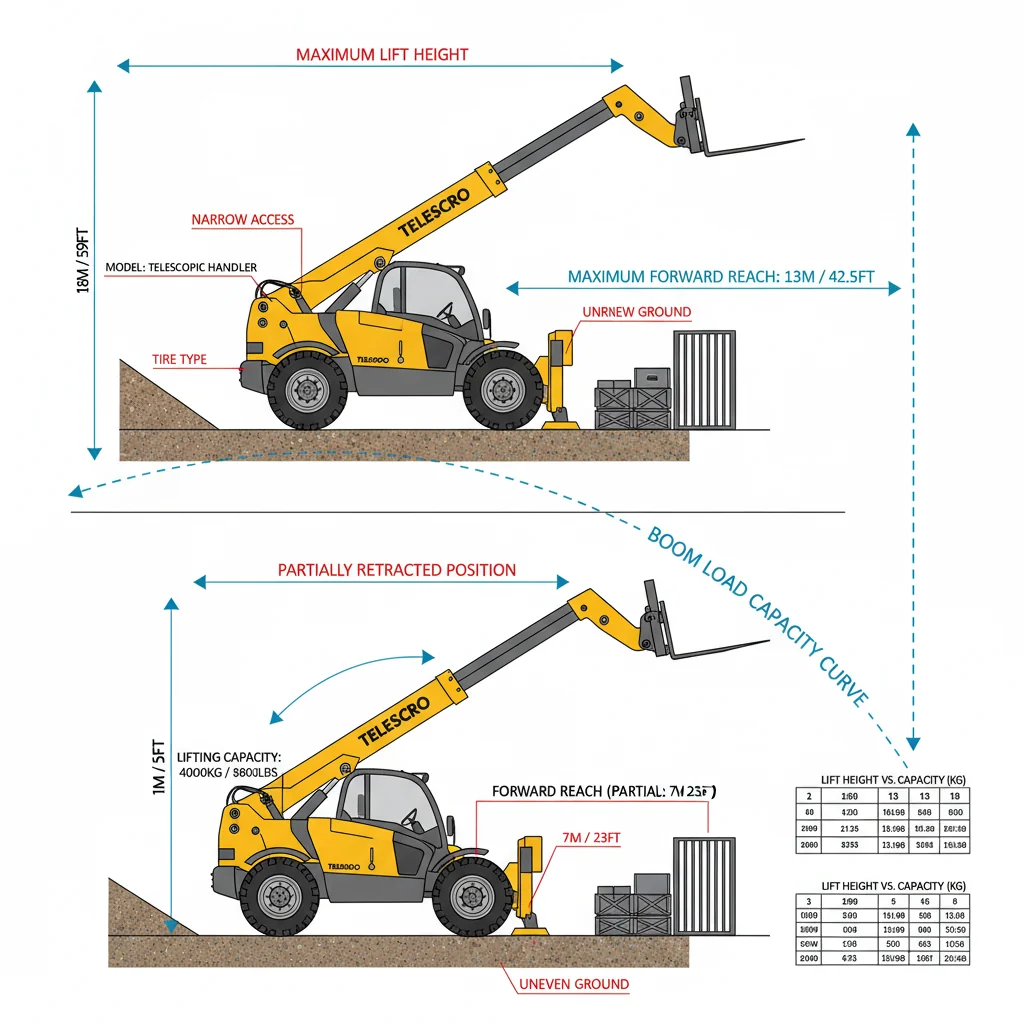
A question I hear often is, “What specs should I actually care about for my site?” Proper matching starts with your real-world loads and delivery points—not just the spec sheet numbers. For example, I worked with a steel contractor in Dubai who wanted a 14-meter telehandler for rooftop HVAC units. On paper, the maximum capacity was 3,500 kg. But at 11 meters out, the load chart showed less than 1,200 kg. Their typical compressors weighed around 1,400 kg. They almost signed off on the order until I pointed out this mismatch. We switched to a 4-ton, 17-meter model, ensuring it could safely lift at the true working radius.
From my experience, checking only the “maximum” stats isn’t enough. Actual safe lifting capacity drops fast as you extend the boom or outreach. That’s why the load chart—usually found beside the operator seat—is critical. I suggest overlaying these charts onto your site plans if possible. One customer in Kazakhstan used CAD layouts to visualize their pick points versus reach. This saved at least a week of lost time from site rework.
Don’t forget site access. If you have narrow pathways or low clearance under scaffolding, a compact 2.5-ton, 6-meter unit might be your best ally—even if its numbers look smaller. Oversizing creates more problems than it solves: higher rental costs, tough turning, and sometimes the machine can’t even enter. Before committing, check load at your typical reach, verify your heaviest loads, and make sure the telehandler fits your actual site—not just the brochure.
Telehandlers with higher boom length typically experience a reduction in lifting capacity by over 60% when extended beyond 10 meters due to leverage and stability constraintsTrue
As the boom extends, the load's moment arm increases, significantly reducing lifting capacity to maintain machine stability and avoid tipping. Load charts often show capacity dropping from several thousand kilograms at close range to less than half at max reach, especially beyond 10 meters.
All telehandlers feature a fixed boom length and rely solely on adjustable counterweights to handle varying load requirementsFalse
Telehandlers commonly have telescopic booms that can extend or retract to reach different heights and distances. Adjustable counterweights alone cannot compensate for leverage effects from boom extension; boom length adjustment is essential for versatility and safe load handling.
Key takeaway: Optimal telehandler selection relies on matching equipment specs—lift height, capacity, and outreach—to the task at hand, while factoring in real-world capacity at full extension and site constraints. Oversizing reduces efficiency and maneuverability; proper chart analysis prevents underperformance and costly mismatches.
Why Are Telehandler Attachments So Important?
Telehandler attachments determine the machine’s functional role, transforming it from a forklift to a loader, agricultural handler, or personnel lifter. Compatibility with quick-coupler types, auxiliary hydraulics16, and approved attachment lists directly impact efficiency, safety, and machine versatility across different jobs and industries. Rental and ownership strategies hinge on thoughtful attachment selection.
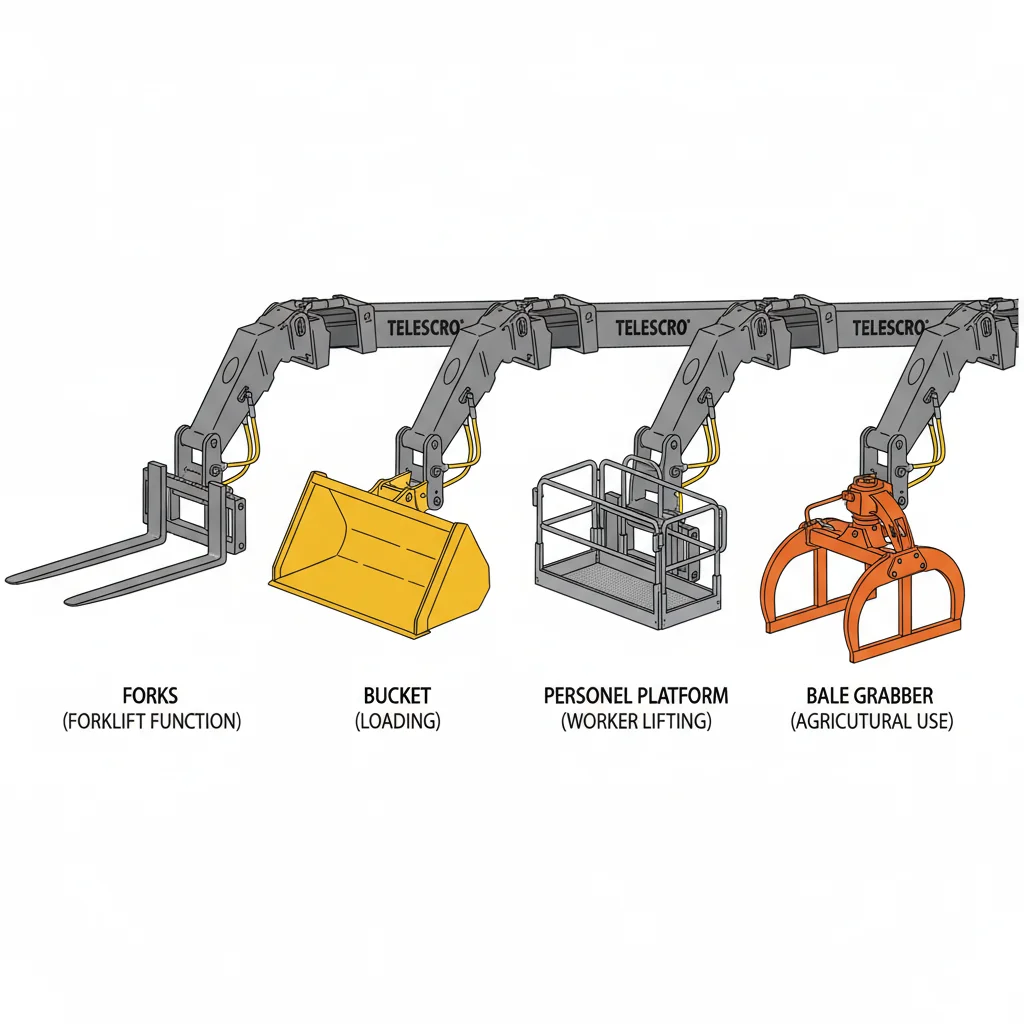
Last month, a contractor in Dubai called frustrated because their new 4-ton telehandler couldn’t use any of their older attachments. The machine sat idle for two weeks while they sourced brand-compatible buckets and grabs—losing time and money every day. This happens more often than you’d think, and it’s almost always due to ignoring attachment compatibility, quick-coupler type17, or auxiliary hydraulic requirements. Attachments are what make a telehandler more than just a rough-terrain forklift.
I’ve seen compact 2.5-ton models with basic forks handle pallets in urban warehouses, while a 14-meter rotating unit equipped with a work platform offers temporary access for façade repairs. In Kazakhstan, one of my clients swapped between a bucket, crane jib, and bale grab on a single machine to cover four types of jobs each week. It saved them from buying a separate loader, crane, and handler.
Choosing the right attachments changes both efficiency and job safety. Here’s what I look at for every project:
- Quick-coupler type: Universal (Euro-style) couplers save you headaches if you run mixed fleets or rent attachments.
- Auxiliary hydraulics: Essential for operating buckets with hydraulic clamps, sweepers, or augers—check for extra lines and circuit flow ratings.
- Attachment approval and load chart: Not all tools are factory-approved. Always confirm capacity for each attachment, especially at full extension.
- Control/software upgrades: Some work platforms or winches need specific safety interlocks, moment indicators, or updated controls—especially on rotating models.
Some telehandler models use a triple-pump hydraulic system to support simultaneous operation of attachments, boom functions, and steering without losing performanceTrue
Triple-pump hydraulic setups allow independent supply to different functions, ensuring attachments can operate hydraulically at full capacity without compromising lifting speed or maneuverability, which is critical for complex tasks.
All telescopic handlers are compatible with hydraulic-driven attachments regardless of their make or modelFalse
Hydraulic compatibility depends on the telehandler’s auxiliary hydraulic flow, pressure ratings, and quick-coupler hydraulic lines; older or smaller models often lack the necessary connections or capacity for certain attachments.
Key takeaway: Choosing the right attachments maximizes a telehandler’s usefulness, adaptability, and value. Confirming compatibility, coupler standardization, and hydraulic support is critical for safety, efficiency, and reducing fleet duplication—especially for rental fleets or multi-purpose jobs.
Which Telehandler Costs and Safety Matter Most?
Telehandler cost, support, and safety factors vary by type. Compact fixed‑boom units range from US$20k–40k, mid‑size fixed booms US$35k–70k, and rotating models over US$100k. Roto types carry higher service costs. Key considerations include fuel, tires, insurance, operator training18, reliable local dealer support, and region-specific safety certifications.
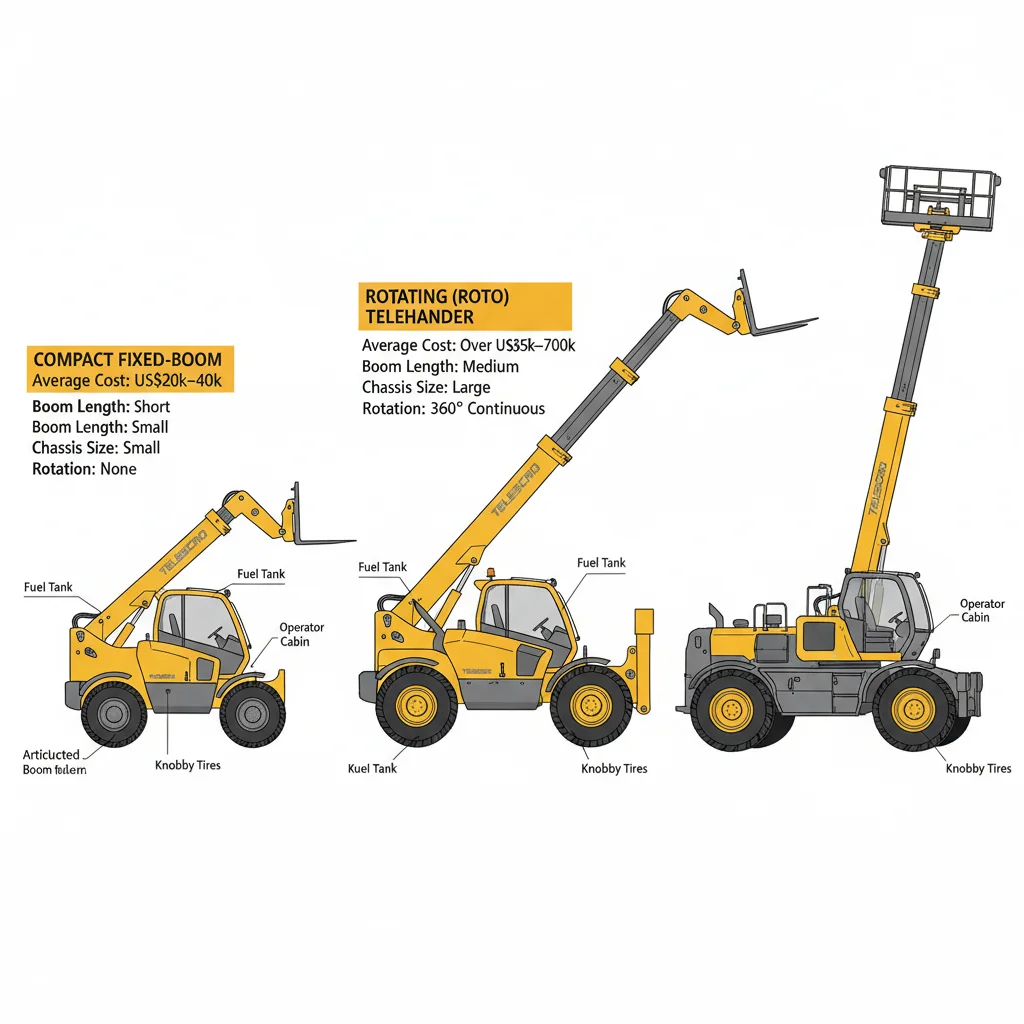
Most buyers focus on the sticker price, but I’ve seen hidden costs seriously affect long-term projects—especially when choosing between fixed-boom and rotating types. In Kazakhstan, a client recently selected a 4-ton rotating telehandler with a 17-meter reach. They loved the flexibility.
The reality? Parts and specialized service nearly doubled their operating expenses compared to a fixed-boom model. Training their operators took an extra week due to the rotation controls and complex electronics. Local support wasn’t strong—their site dealt with three weeks of downtime waiting on a main hydraulic valve.
Take a look at how costs and support compare by telehandler type:
| Telehandler Type | Typical Price (USD) | Service Requirement | Training Needed | Safety Focus | Best For |
|---|---|---|---|---|---|
| Compact Fixed Boom | $20k–40k | Low/simple | Basic | Basic load chart, stability | Urban, small sites |
| Mid-size Fixed | $35k–70k | Moderate | Moderate | Full chart, stability | General construction |
| Rotating (Roto) | $100k+ | High/complex | Advanced | Stabilizers, moment indicator | Confined/tight jobs |
Operating costs aren’t just about fuel. Tires for a heavy 12-meter machine can run $600 each and rarely last beyond a year on rocky or muddy sites. I always remind buyers: insurance premiums often jump for rotating units, and many countries—like the UAE—require certified training and updated safety systems for platform work. Overreaching without extending stabilizers is a leading cause of tip-overs, and I’ve seen costly incidents from ignoring this.
Rotating telehandlers typically require up to 40% more maintenance hours annually due to their complex swivel mechanisms and electronic controls compared to fixed-boom modelsTrue
The rotating boom's additional hydraulic joints, rotary actuators, and electronic systems increase wear points and complexity, necessitating more frequent inspections and specialized maintenance that can significantly add to operating costs.
Fixed-boom telehandlers generally provide a greater maximum reach than rotating telehandlers with the same rated load capacityFalse
Rotating telehandlers often have equal or greater maximum reach because their rotating boom design allows for longer, more versatile boom extensions without compromising stability, unlike fixed-boom models which are limited by their fixed structure.
Key takeaway: Comparing telehandler models requires weighing purchase price, operating expenses, local service support, training demands, and compliance with safety certifications. Higher-spec models—especially rotating telehandlers—typically incur greater maintenance and training costs, making dealer proximity and the right safety features critical for long-term reliability and safe usage.
Conclusion
We’ve looked at the main types of telehandlers and how to match them to your site needs. From my experience, the smartest buyers aren’t distracted by max height or lifting numbers—they dig into load charts and check on local parts support. I’ve seen “showroom hero, jobsite zero” happen too often when real-world needs get overlooked. If you’re weighing options or want help double-checking specs for your actual jobs, just reach out—no pressure, I’m always happy to share what’s worked for crews in 20 different countries. Every project is unique, so let’s find what fits your workflow best.
References
-
Detailed insights on the higher service costs and operational challenges of rotating telehandlers, vital for informed purchasing decisions. ↩
-
Detailed insights into fixed boom telehandler operation, advantages, and real-world applications in farming and construction sectors. ↩
-
Understand the tradeoffs in lift capacities between electric and diesel telehandlers for effective job site planning. ↩
-
Comprehensive overview of telehandler load charts and their role in ensuring safe lifting, crucial for informed equipment operation. ↩
-
Comprehensive analysis of lift capacity ranges, importance for material handling, and how it impacts telehandler performance and safety. ↩
-
Explore how 360° turret rotation improves efficiency on tight jobsites by reducing repositioning and enabling precise load placement. ↩
-
Learn how stabilizers boost lift capacity and safety when handling long or awkward loads in confined urban construction sites. ↩
-
Explore how compact telehandlers improve maneuverability in tight spaces and speed up tasks in busy construction zones. ↩
-
Understand why mid-size telehandlers meet most construction needs with versatile reach and load handling capabilities. ↩
-
Discover the advantages of high-clearance telehandlers tackling uneven ground with real-world performance insights and operational gains. ↩
-
In-depth insights into how reinforced frames enhance durability and lifting capacity for continuous heavy-duty telehandler operations. ↩
-
Detailed explanation of load charts helps operators choose safe telehandler models by matching capacities with jobsite needs. ↩
-
Explore how battery-electric drivetrains reduce emissions and noise, making telehandlers ideal for indoor and sensitive job sites. ↩
-
Explains how these telehandlers improve maneuverability and stable handling in farming environments with diverse attachments and soft ground. ↩
-
Details why mid-size telehandlers are versatile for lifting and precise placement on urban construction sites, especially where crane access is limited. ↩
-
Explore how auxiliary hydraulics expand telehandler capabilities by powering attachments, enhancing job safety and operational efficiency. ↩
-
Detailed explanation on how quick-coupler types affect attachment compatibility and machine versatility, crucial for efficient telehandler use. ↩
-
Explains the critical role of operator training in managing complex controls and minimizing downtime, essential for safer telehandler operation. ↩