










Telehandler Tire Types: Field-Tested Guide for the Right Jobsite Choice
Last month, I watched a crew in Turkey lose half a workday swapping out punctured pneumatic tires1—while a factory site just down the road ran solid tires2 for weeks with zero downtime. That contrast still sticks with me, because the "right" telehandler tire can make or break a project timeline.
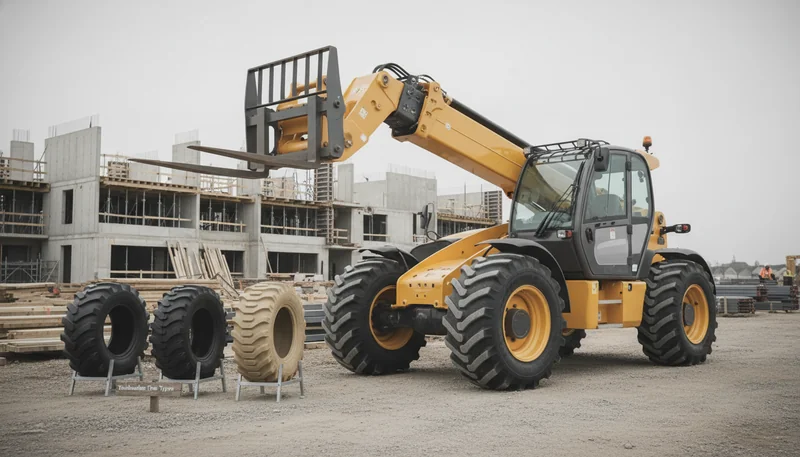
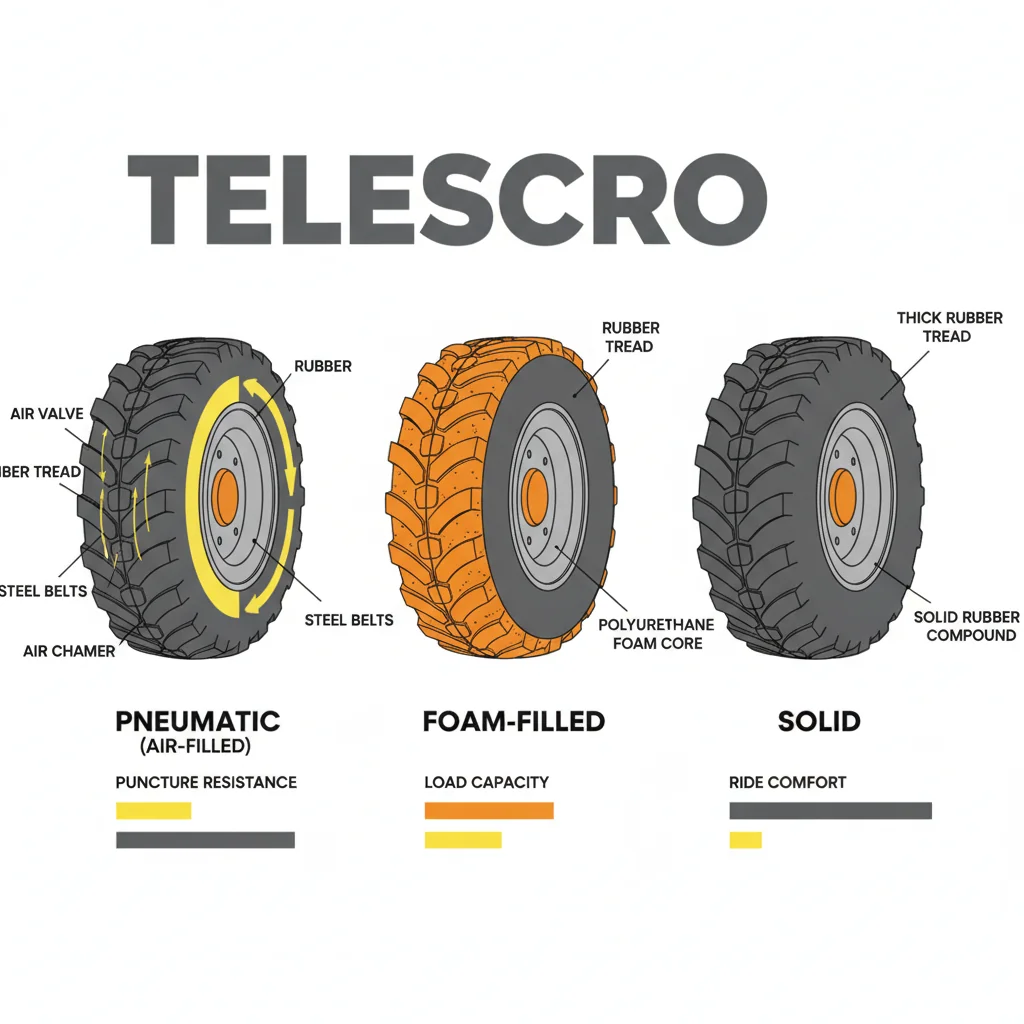
Telehandlers are typically equipped with one of three main tire types: pneumatic, foam-filled, or solid. Pneumatic tires offer the greatest ride comfort and flotation, making them suitable for soft or uneven terrains, but they remain highly susceptible to punctures and flats. Foam-filled tires3 resist punctures by being injected with polyurethane, striking a balance between comfort and durability but increasing machine weight and exerting more force on loose soils.
What Types of Telehandler Tires Exist?
Telehandlers primarily use three tire types: pneumatic (air-filled), foam-filled, and solid. Pneumatic tires provide excellent flotation and comfort but are prone to punctures. Foam-filled tires prevent flats while maintaining some flexibility, adding weight. Solid tires offer maximum durability and load capacity, being flat-proof, but produce a harsher ride on uneven terrain.
Most people don’t realize that tire type can actually dictate what a telehandler can safely accomplish on your jobsite. I’ve seen projects grind to a halt simply because the wrong tires meant repeated downtime.
Let’s break down the three main options so you can avoid costly surprises:
| Tire Type | Ride Comfort | Puncture Resistance | Flotation on Soft Ground | Load Capacity | Weight Impact | Downtime Risk |
|---|---|---|---|---|---|---|
| Pneumatic | Excellent | Poor | Best | Standard | Lightest | High |
| Foam-Filled | Good | Good | Fair | Slightly reduced | Adds 15–30% | Low |
| Solid | Poor | Excellent | Worst | Highest | Heaviest | Very Low |
Last year, a site manager in Dubai contacted me after three flats in just one week—he was running pneumatic tires through an active demolition area scattered with sharp rebar and scrap. Pneumatics are great for ride comfort and muddy ground, but debris is their downfall. On the other hand, solid tires are completely flat-proof, but I warn customers that even a top-of-the-line 4-ton telehandler will feel every bump—especially on gravel or unfinished concrete. Foam-filled is often a compromise. In Kenya, a client moving pallets over mixed terrain found that switching to foam-filled meant fewer interruptions. The telehandler gained about 400 kg in weight overall, but his team saved at least two full working days per month due to less downtime.
Solid pneumatic tires on telehandlers offer superior puncture resistance but generally provide lower flotation on soft or uneven terrain compared to foam-filled tiresTrue
Solid pneumatic tires are made of dense rubber, preventing air loss and punctures, but their rigidity reduces surface area contact and flotation on soft ground, unlike foam-filled tires that better distribute weight without sacrificing puncture protection.
"Foam-filledFalse
"Foam-filled
Key takeaway: Choosing the proper telehandler tire type—pneumatic, foam-filled, or solid—means balancing ride comfort, puncture resistance, flotation, load capacity, and downtime risk. Each option is optimized for specific ground conditions and jobsite demands, making correct tire selection critical to efficient, safe, and cost-effective telehandler operation.
How Do Jobsite Conditions Affect Tire Choice?
Telehandler tire selection must prioritize ground type and puncture hazards. Solid or foam-filled tires suit demolition or scrap sites with high debris, minimizing downtime. Deep-tread pneumatics5 perform better on soft soils to avoid compaction and axle overload. Assessment of surface, debris, slope, and required travel ensures optimal performance and reduces costly tire failures.
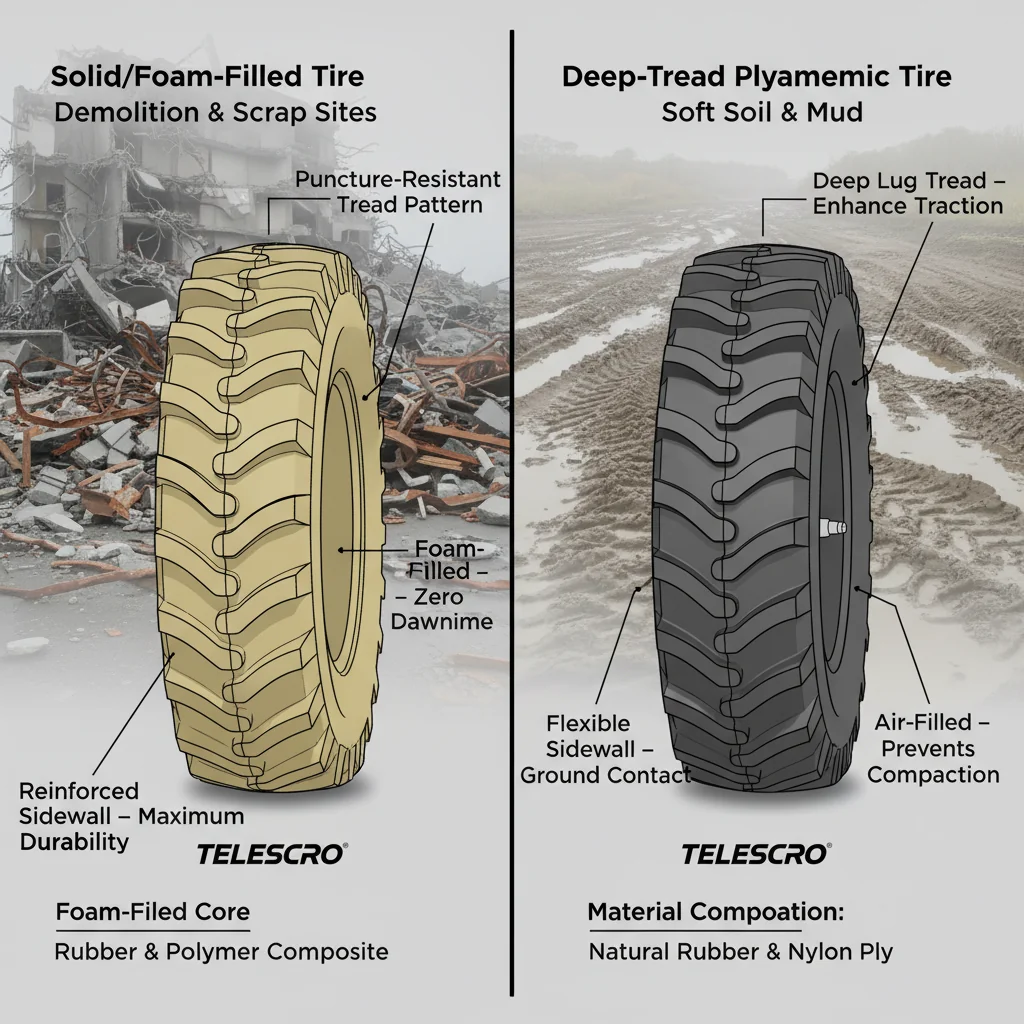
Let me share something important about tire selection—jobsite conditions can make or break telehandler efficiency. I’ve worked with contractors in Dubai’s demolition sites where half the downtime came from flat tires. On a scrap yard in South Africa last year, I recommended foam-filled tires for a client with a 3.5-ton unit. They switched from basic pneumatics, and downtime for tire repairs dropped by almost a week over two months. In debris-heavy zones, sharp rebar and scrap metal barely give regular tires a chance.
But the story flips completely in agriculture. In eastern China’s rice fields, I saw a customer try solid tires on a 2.8-ton telehandler for irrigation trench work. The machine bogged down almost daily—solid tires just dig in and overload the axles because they don’t flex, and they’re almost 25% heavier than deep-tread pneumatics. The solution was switching to aggressive deep-lug pneumatic tires, which provided much better flotation and grip, without tearing up the soft ground. That single change kept them on schedule for the harvest.
When you assess ground conditions, start with the basics: surface hardness, presence of sharp debris, and soil composition. On slopes or sandy ground, soft tires help prevent sliding. For long travel across paved yards, I suggest considering premium patterns that stay cool and resist wear—especially when machines run several kilometers each day. It’s always worth walking the path you’d drive, not just guessing from the office. The right tire type cuts downtime and avoids expensive, avoidable mistakes.
Foam-filled tires on telehandlers can reduce downtime by up to 70% in scrap yard environments with heavy sharp debris compared to standard pneumatic tiresTrue
Foam filling eliminates air, preventing punctures from sharp objects like rebar and scrap metal. This significantly reduces tire repair frequency and downtime, as observed in heavy debris zones where pneumatic tires are prone to flats.
All telehandlers heavier than 3 tons require solid rubber tires by industry standards to ensure load capacity and stabilityFalse
There is no industry standard mandating solid rubber tires for telehandlers over 3 tons; pneumatic and foam-filled tires are commonly used depending on terrain and operational needs. Tire choice is based on jobsite conditions rather than weight thresholds alone.
Key takeaway: Choosing the correct telehandler tire type starts with evaluating surface hardness, debris risks, and soil conditions. Solid and foam-filled tires excel in harsh, high-debris jobsites, while pneumatic deep-tread options are best for soft, agricultural fields. Mismatched tires cause downtime or damage, making systematic site assessment essential.
How Do Solid Tires Affect Telehandler Uptime?
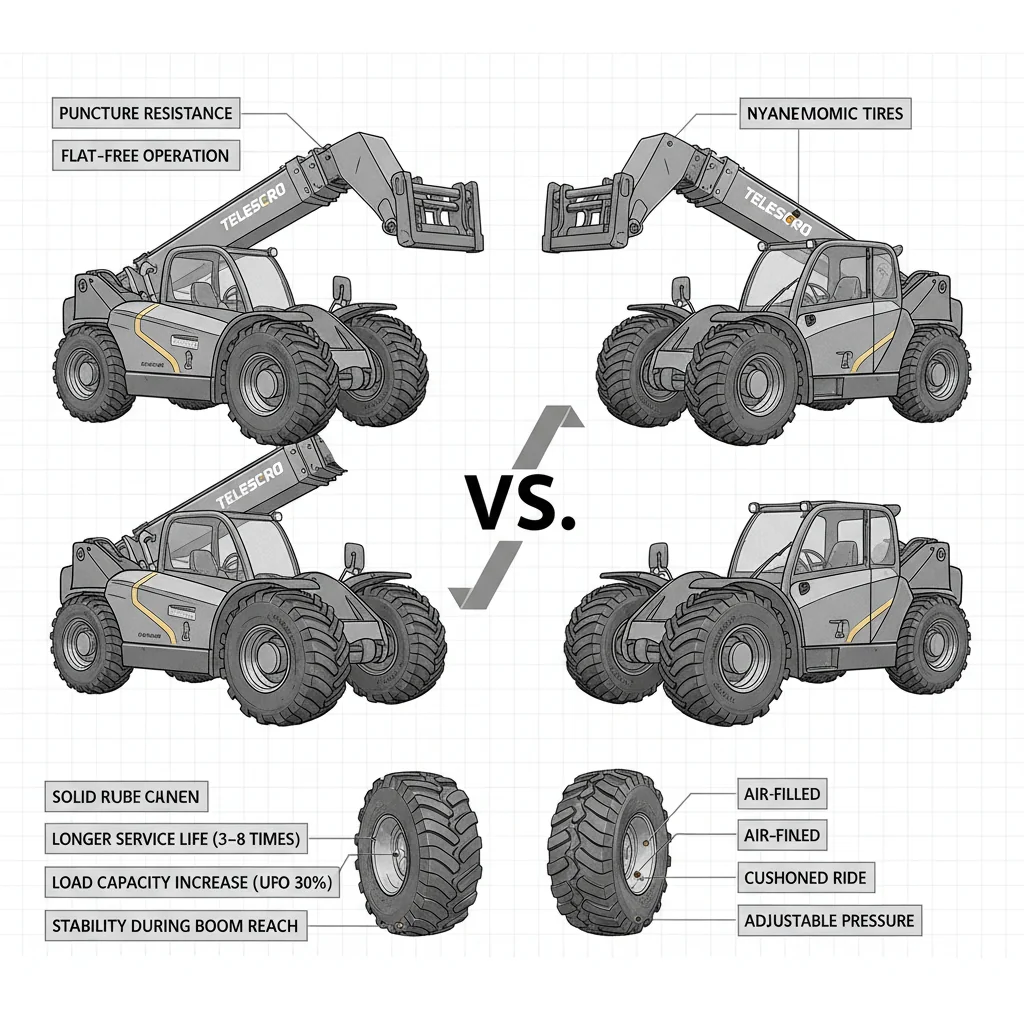
Solid telehandler tires6 maximize uptime by eliminating punctures and air-loss, delivering 3–8 times longer service life than foam-filled or pneumatic tires. They enable flat-free operation for over 5,000 hours according to some manufacturers, support up to 30% greater loads, and ensure consistent stability during long boom reach operations.
The biggest mistake I see is underestimating the real cost of downtime from flat or damaged tires. On one job in Dubai, a customer running standard pneumatic tires lost at least two full days every month to flats—usually from rebar or site debris. Their largest telehandler, rated for 4,000 kg with an 18-meter boom, simply couldn’t operate while waiting for tire repairs. That’s a lot of idle wages and missed deadlines. When they switched to solid tires, those sudden stoppages almost disappeared. They kept the machine on the move, sometimes logging over 5,500 hours on a single tire set without a single flat.
Solid tires change the game by removing puncture risk and air leaks entirely. There’s no inner air cavity—just dense, molded rubber. In my experience, this translates to service life at least three times longer than foam-filled, and up to eight times what we see with pneumatics on rough sites.
I’ve shipped solid pre-mounted assemblies to contractors in Africa who work on demolition projects—where sharp debris shreds regular tires in months. Solids absorb less impact, so ride quality is harsher, and you’ll notice a few hundred kilograms more weight per telehandler. This can affect fuel usage and increase strain on axles or hydraulic components. Still, for sites where downtime isn’t an option, the benefits are hard to ignore.
I suggest estimating your annual flat tire downtime, including lost productivity and repair costs, before you decide on tire type. For most high-risk jobsites, solids usually pay off within the first year.
Switching to solid tires on telehandlers can reduce unscheduled downtime from tire damage by up to 90% due to their resistance to punctures from site debris like rebarTrue
Solid tires are made from dense rubber compounds that do not rely on air pressure, making them impervious to punctures. This eliminates flats caused by sharp objects, significantly increasing machine uptime in harsh construction environments.
Solid tires improve telehandler traction on wet and muddy job sites compared to pneumatic tiresFalse
While solid tires reduce downtime due to flats, they generally have less grip on slippery surfaces than pneumatic tires because their harder compound and smaller tread depth provide less traction in wet or muddy conditions.
Key takeaway: Solid telehandler tires significantly boost uptime, carrying heavier loads and preventing flat-related downtime. While upfront costs, added weight, and ride quality must be considered, their durability and reliability make them ideal for jobsites where puncture risk, load consistency, and uninterrupted operation are critical to fleet productivity.
When Are Pneumatic Telehandler Tires Preferred?
Pneumatic telehandler tires are preferred on jobsites where ride quality, flotation, and soil protection are critical, such as farms, landscaping, and controlled environments. Their air-filled design delivers superior shock absorption over uneven terrain and reduces soil compaction7, especially on mud, sand, and tilled fields. They are cost-effective but require regular maintenance due to puncture and underinflation risks.
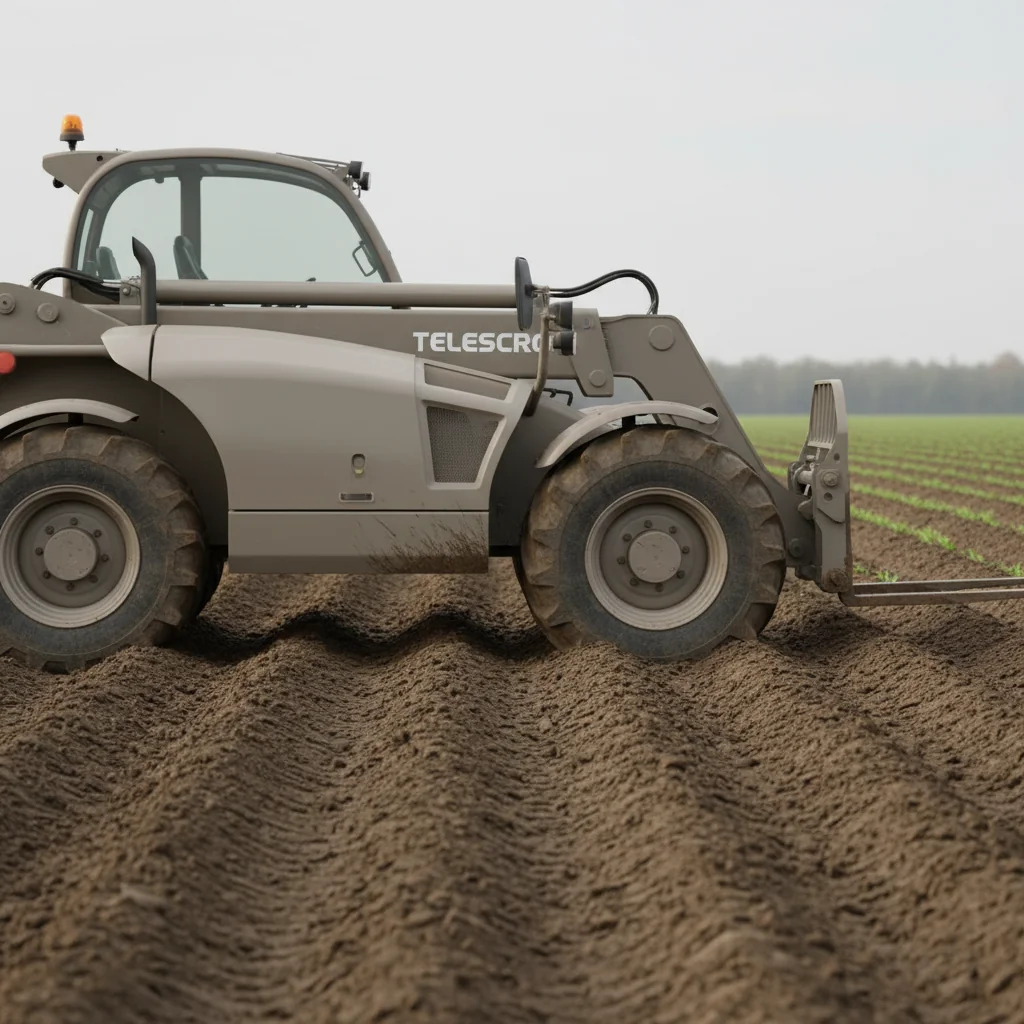
Here’s what matters most when deciding on pneumatic telehandler tires: jobsite conditions drive your choice, not just price. I’ve worked with several farms in southern Australia where ride quality and soil protection are non-negotiable. The difference was obvious—machines on pneumatic tires floated over ruts and sandy ground, while those with solid tires bounced and compacted the soil, making harvest work much harder. Pneumatics are air-filled, which means they absorb shocks from field debris and uneven terrain. This cushions both the operator and machine, especially at typical travel speeds of 10–20 km/h.
Last summer, a contractor in Kazakhstan reached out after seeing repeated downtime with foam-filled tires—mainly because the ride was stiff on tilled fields, and crop roots suffered from compaction. We switched his 3.5-ton telehandler to 14-ply pneumatic tires. Not only did he cut daily fatigue for his crew, but the machine handled soft mud without sinking or spinning. Cost wise, pneumatics are usually the cheapest—around $350 to $550 each for a standard 24-inch rim. But they come with risk: I’ve seen flats from stray nails and sharp stones, which immediately halt progress until you patch or swap the tire.
If you’re using your telehandler in controlled environments—like landscaping, agriculture, or greenhouse projects—pneumatic tires deliver the mix of comfort and flotation you want. I always suggest checking ply rating for puncture resistance and keeping a tire pressure gauge handy. Consistent air checks are your best insurance against unexpected downtime on critical days.
Pneumatic telehandler tires typically have a lower ground pressure than solid tires, often reducing soil compaction by up to 30% on soft agricultural terrainsTrue
Because pneumatic tires are air-filled and can deform to distribute the machine's weight over a larger contact patch, they exert less pressure per square inch on the soil, significantly protecting sensitive ground compared to solid tires.
Pneumatic telehandler tires provide better puncture resistance than solid tires due to their flexible air chambersFalse
Solid tires are actually more puncture-resistant because they lack air-filled chambers that can be pierced; pneumatic tires are more vulnerable to punctures in rough environments, which is why solid tires are preferred on jobsites with debris.
Key takeaway: Choose pneumatic telehandler tires in environments demanding excellent ride comfort, flotation, and minimal soil impact. Ideal for agriculture, landscaping, and sites with predictable debris, these cost-effective tires require diligent air pressure checks and the right ply rating to balance performance with durability and reduce downtime.
What Are Pros and Cons of Foam-Filled Tires?
Foam-filled tires for telehandlers combine the puncture resistance of solid tires with a ride quality closer to pneumatics. Advantages include high durability on debris-heavy sites and reduced downtime from flats. However, these tires are heavier, more costly, can be difficult to repair, and may affect machine handling and flotation in soft ground conditions.
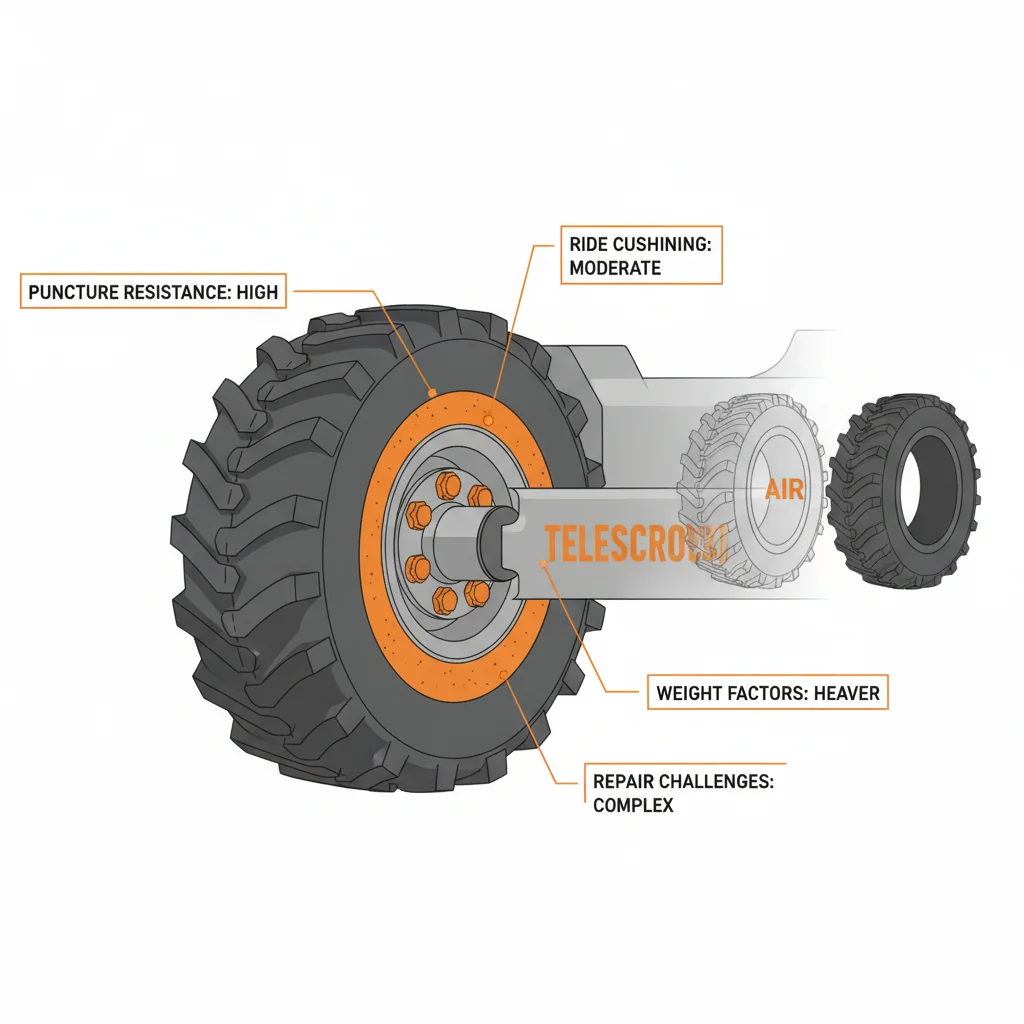
Last month, a contractor in Dubai called me after his site switched to foam-filled tires on four 4-ton telehandlers. The project involved constant debris—scrap metal, nails, broken concrete—and ordinary air-filled tires just couldn’t survive. With foam fill, their machines ran for three months without a single flat. That’s a huge win compared to the weekly downtime before.
These tires are almost impossible to puncture on sites littered with rebar, so crews can focus on lifting, not swapping tires. Also, because foam keeps the tire’s shape consistent, you get much better stability under a heavy load. I’ve seen jobsites in Brazil use foam-filled sets on telehandlers lifting 3,000 kg at nearly 12 meters height—operators felt confident tilting forward for higher picks because the tires didn’t squirm under pressure.
But I always warn buyers about the flip side. The added weight—sometimes over 200 kg more per tire—means you’ll sink faster in mud or soft sand. I once saw a team in Kazakhstan get stuck half a day after rain. Operators told me the flotation dropped so much compared to air tires, they couldn’t finish the lift route. And repairs are another issue. If the casing sidewall cracks, local workshops usually can’t fix it. Most times, you’ll need to replace the entire tire and foam core. That’s not cheap—each assembly can cost almost double compared to standard pneumatics. Before you spec foam-filled tires, I suggest checking with your telehandler’s OEM to confirm these options won’t affect rated capacity or the load chart.
Foam-filled tires can increase the overall weight of a telehandler by up to 15%, which may slightly reduce fuel efficiency but significantly improves tire durability on debris-strewn job sitesTrue
Foam filling adds density inside the tire, increasing its weight compared to air-filled tires. This additional weight slightly impacts fuel efficiency but provides superior resistance to flats and damage from sharp objects, making it beneficial in harsh environments.
Foam-filled tires on telehandlers require weekly replacement due to the foam degrading under constant weight and heatFalse
Contrary to this claim, foam-filled tires are designed to last significantly longer than air-filled tires under tough conditions, often enabling telehandlers to operate for several months without flats or replacements, as the foam does not degrade quickly under normal operating temperatures.
Key takeaway: Foam-filled telehandler tires offer excellent stability and puncture resistance on challenging jobsites, making them ideal for mixed-use conditions. However, their increased weight, cost, and complexity in repairs should be carefully considered against site demands and manufacturer approval before specifying for a project.
Why Do Telehandler Tire Ratings Matter?
Telehandler tire ratings, defined by size, load, and speed, determine the tire’s safe carrying capacity and operating limits. Load ratings decrease as travel speed increases, and construction types (bias, radial, solid, pneumatic) further affect allowable limits. Incorrect sizing or disregarding ratings can destabilize machines, overload axles, and breach industry safety standards such as EN 1459.
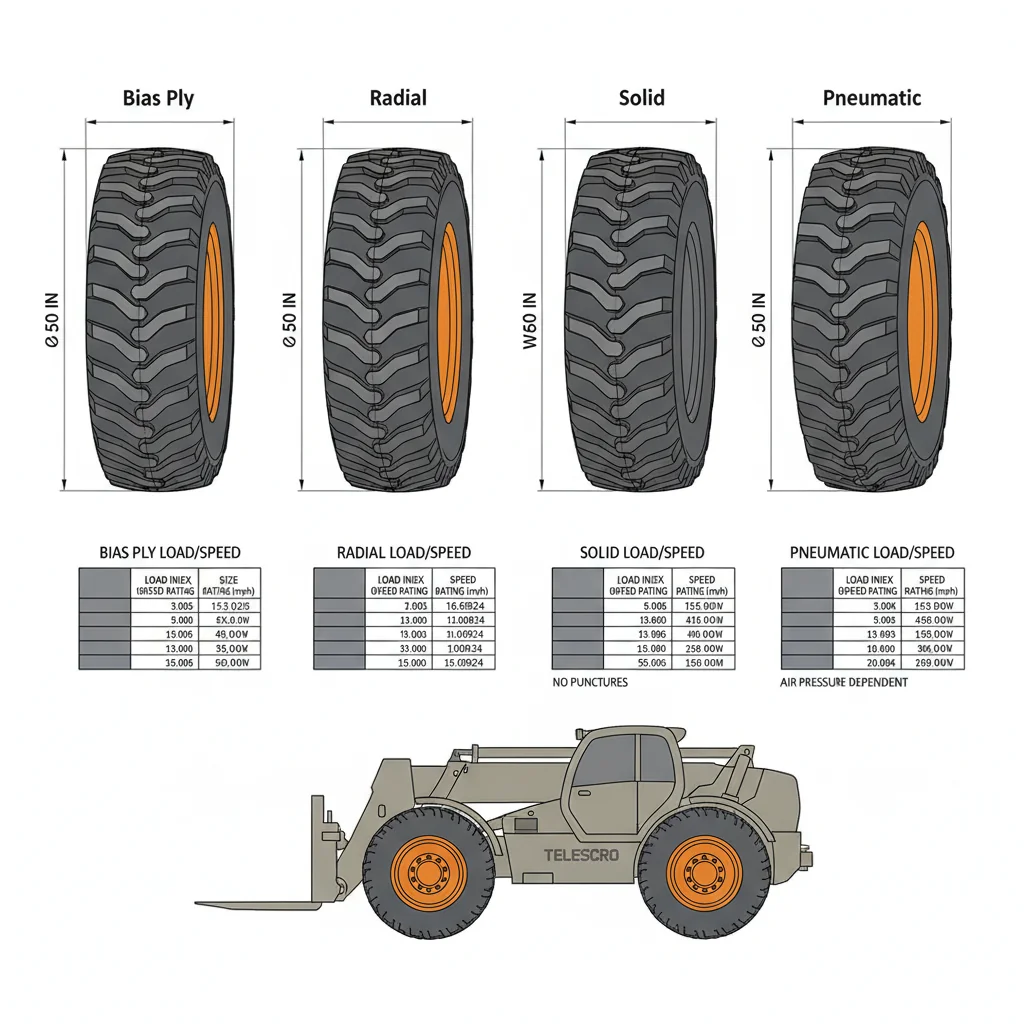
To be honest, the spec that actually matters is the tire’s rating—not just the diameter or look. I’ve worked with customers in Kazakhstan who upgraded their telehandlers but kept using their old 12.5×18 tires. The issue? Those older tires maxed out at roughly 4,200 lb at 25 km/h, but their new units regularly lifted heavier pipe loads. After one week, their team called me about stability alarms.
The load moment indicator kept warning, even though the hydraulic system was working fine. That’s the risk when you ignore proper tire ratings—axles get overloaded, machines lose balance, and site safety heads straight for a violation.
As travel speeds increase, the safe load rating of any tire drops. For example, a 15.5-25 industrial tire might safely carry about 6,400 lb at 40 km/h, but push it harder and you’ll see that number decrease on the spec sheet. Radial tires8 can sometimes handle a bit more speed than bias types, but they cost more up front. Solid or foam-filled tires? They’re great for sites with sharp debris, but the trade-off is stiffer ride and, usually, a lower speed limit.
I always suggest confirming everything with your OEM manual—matching tire size, load, and speed symbol to your exact model. If you’re swapping from pneumatic to solid, make sure the tire is approved and crosscheck your machine’s load chart. One overlooked detail can turn a perfectly good telehandler into a real headache. Don’t let a simple tire choice become your team’s weak link.
"TelehandlerFalse
"Higher
Using tires with a larger diameter automatically increases a telehandler’s maximum load capacity regardless of the tire’s ply ratingFalse
Tire diameter affects ground clearance and speedometer accuracy but does not change the tire's load capacity. Maximum load is primarily determined by the tire's construction and ply rating, not its size.
Key takeaway: Correct telehandler tire selection must account for size, load rating, speed symbol, and construction type—always referencing the OEM manual. Mismatched tires risk machine instability, axle overload, and non-compliance with key standards. Recheck both tire approval and load charts when switching between pneumatic, solid, or foam-filled types.
Which Tread Patterns Suit Telehandler Applications?
Telehandler tire tread patterns are specialized for terrain types and operational demands. G2 is optimal for soft ground, E3 for mixed earthmoving, L5 for severe-duty use, SM (smooth) for hard surfaces, and R4 for construction/agriculture hybrids. Aggressive lugs provide traction in mud but wear quickly on pavement, while smooth treads minimize vibration and protect indoor flooring.
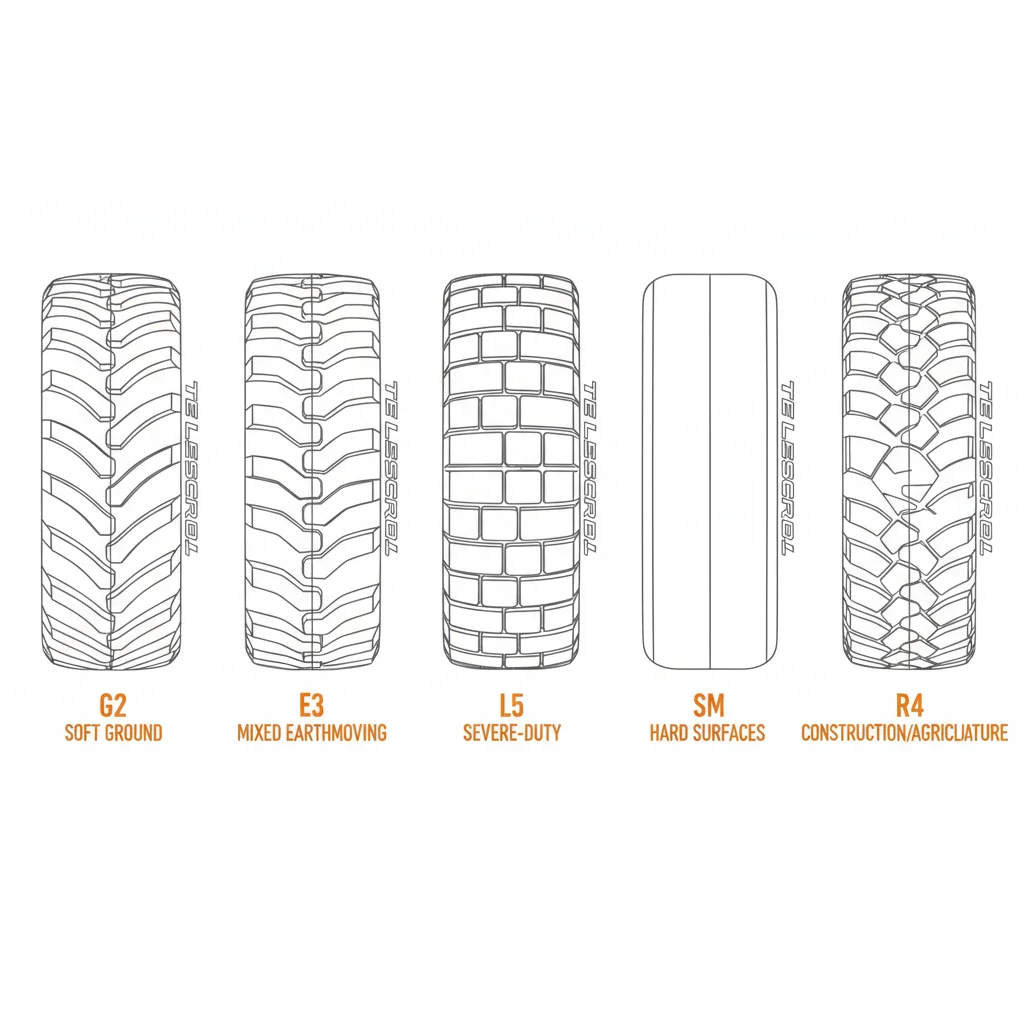
To be honest, the tread pattern10 you pick matters more than most buyers expect—especially once you leave the dealer’s lot and hit real-world ground. In Kazakhstan last winter, I worked with a team running a 4-ton telehandler on a road construction site. They started out with aggressive G2 tires11, thinking deep lugs always meant better grip. They got traction in mud, but on hard, frozen surfaces those lugs wore out in just six months and the ride was rough. That meant unplanned downtime plus a new set of tires—at nearly $1,600 each.
Here’s a table I use when helping customers choose:
| Tread Pattern | Best For | Traction | Wear Speed | Ride Quality | Notes |
|---|---|---|---|---|---|
| G2/L2 | Soft ground, mud | Very high | Fast | Rough | Open lugs, great in mud, wears fast |
| E3 | Mixed earthmoving | Good | Medium | Moderate | Balanced for dirt/loose soil |
| L5 | Severe-duty, rocks | Good | Slow | Firm | Deep, cut-resistant, heavy build |
| R4 | Construction/ag hybrid | Good | Medium | Moderate | Suits mixed sites, block pattern |
| SM (Smooth) | Pavement, indoors | Low | Slow | Smoothest | Ideal for asphalt/concrete, non-marking |
For warehouses, minimal soil damage | I’ve seen warehouse crews in Brazil switch to smooth SM tires for indoor loading—they noticed less vibration and lower cost over a year. But those same tires would have slipped badly the moment the site got wet.
Telehandler tires with a lug depth between 15-20 mm typically balance traction and tread longevity effectively for mixed terrain applicationsTrue
Moderate lug depth offers sufficient grip in mud and soft soils without excessive wear on hard surfaces, as very deep lugs tend to shear quickly on abrasive, frozen ground leading to premature tire replacement.
Using the deepest possible lug pattern always results in the best overall telehandler tire performance regardless of terrainFalse
While very deep lugs improve traction in muddy or soft conditions, they wear rapidly on hard or frozen surfaces, increasing downtime due to tire replacements and reducing ride comfort, so they don't always provide the best performance in varied telehandler applications.
Key takeaway: Selecting the correct telehandler tire tread pattern is essential for maximizing equipment performance, ensuring operator safety, and reducing long-term tire costs. Match tread aggressiveness and depth to the dominant jobsite environment, favoring deep lugs for soft conditions and smooth/block patterns for hard or finished surfaces.
How Does Tire Construction Impact Telehandler Performance?
Tire construction—bias-ply versus radial, and varying ply ratings—directly impacts a telehandler’s durability, comfort, and cost efficiency. Bias-ply tires12 offer tough sidewalls and lower cost for abusive or stationary work, while radials run cooler, last longer, and improve ride for higher-speed or long-distance travel. Ply ratings affect load capacity, puncture resistance, and operator comfort.
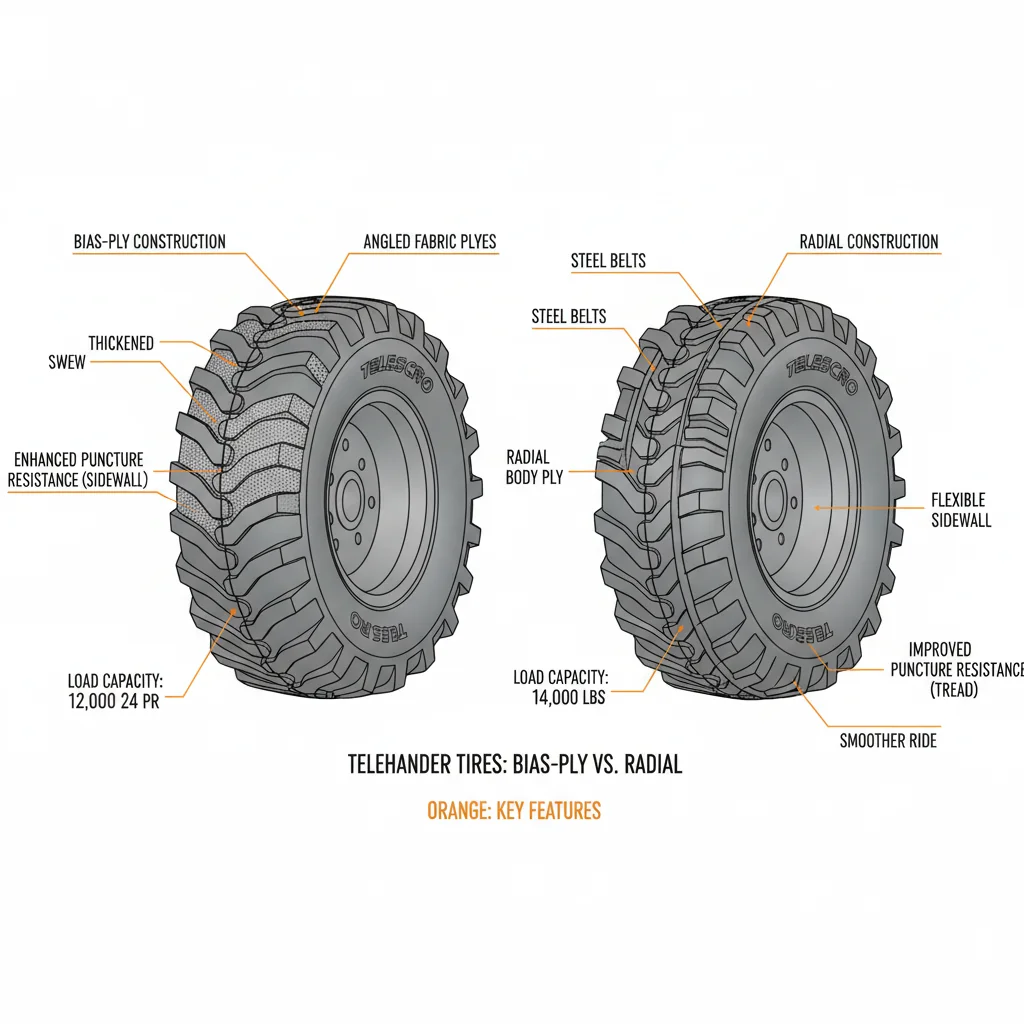
I’ve worked with customers who made the wrong tire choice and paid for it—literally. In Brazil, a warehouse contractor once fitted his 3.5-ton, 13-meter telehandler with standard bias-ply tires to save money. On paper, it looked logical. But within six months, he saw major tread wear and sidewall cuts. Their site had rough gravel, with workers driving back and forth across almost 500 meters daily. Radial tires—designed with flexible steel belts running bead to bead—would have run far cooler, provided a softer ride, and nearly doubled his tire lifespan. That jobsite taught them the real cost of “saving” upfront.
From my experience, the ply rating is less about the number on the sidewall and more about matching it to real loads. A 16-ply rating delivers plenty of puncture protection and capacity for a 4-ton unit working in demolition. But push to a 20-ply solid tire, and the ride turns stiff. Operators in Kazakhstan have told me this adds fatigue—especially when covering longer distances on concrete. There’s always a balance between maximizing carrying capacity and not beating up the machine, or the driver.
I always suggest looking at the actual work cycle before picking your tire construction. For jobs with limited movement or where debris risk is high, bias-ply or solid tires make sense—less downtime for flats. If your telehandler regularly travels between buildings or across uneven ground, spending extra on radials pays off in fuel savings and operator comfort. Tire construction isn’t flashy, but it shows up every hour on site. Consider your real conditions—your wallet and crew will thank you.
Radial tires on telehandlers typically reduce heat buildup by up to 30% compared to bias-ply tires due to their flexible steel belt design, extending tire life on rough surfaces.True
Radial tires incorporate steel belts running bead-to-bead, which allow the tire to flex more evenly and dissipate heat efficiently. This leads to lower operating temperatures and less tread wear, especially on abrasive terrains like gravel, thereby prolonging tire lifespan.
Bias-ply tires provide better fuel efficiency than radial tires on telehandlers because their stiffer sidewalls reduce rolling resistance on hard surfaces.False
Bias-ply tires have stiffer sidewalls, which actually increase rolling resistance and heat buildup compared to radial tires. Radials’ flexible belts enable better contact and rollability, improving fuel efficiency rather than bias-ply designs.
Key takeaway: Tire construction type and ply rating are essential factors influencing telehandler performance, tire longevity, and cost-per-hour. Matching construction—bias-ply for tough, stationary use or radial for travel—ensures optimal durability and safety, while ply selection balances load, puncture risk, and operator comfort for the jobsite.
What Practices Extend Telehandler Tire Life?
Proper tire fitment and maintenance are critical for telehandler performance and longevity. Using OEM-recommended sizes13 ensures stability and load capacity, especially at full boom extension. Daily inflation checks14 for pneumatic tires prevent heat buildup and blowouts, while routine inspections and rotations for all tire types reduce uneven wear, maximizing operational uptime and tire investment.
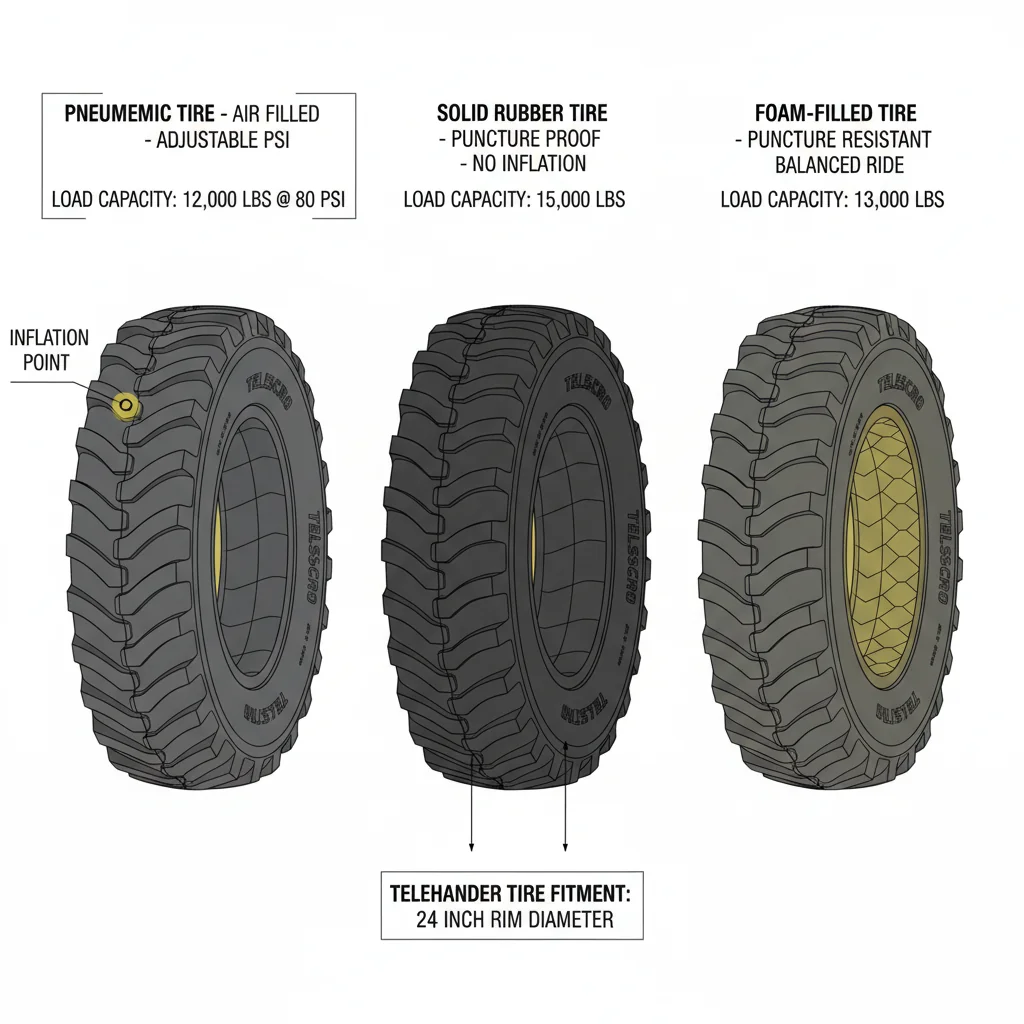
One thing I see overlooked is how critical correct tire sizing and daily care are for maximizing telehandler tire life. Just last quarter, a factory project in Kazakhstan ran into downtime when a 3.5-ton machine kept losing tire pressure. Their team had swapped in off-spec tires—slightly too narrow for the rim. It seemed minor, but they ended up with poor load distribution, extra flex, and faster sidewall cracks. I always suggest following the OEM fitment guide, right down to rim width and overall diameter, especially for loads at full boom extension where a small error means real safety risk.
For pneumatic tires, daily inflation checks make a massive difference. If pressure drops even 15%, heat buildup and rapid shoulder wear start eating into tire life immediately. In Brazil, I worked with a customer who logged tire hours. After switching to morning pressure checks, their average tire lasted almost 600 hours longer—nearly 30% more compared to their old routine. It doesn’t sound glamorous, but a quick 5-minute inspection catches cuts, splits, or embedded debris before it ruins a workday.
Solid and foam-filled tires skip inflation headaches, but I still recommend checking for chunking and uneven wear, especially on rough sites with lots of turning. Rotating all four tires every 500 hours—or sooner if your telehandler spends most of its time loaded up front—helps balance wear patterns. Keep records of tire damage and replacement intervals. It’s not just smart—suppliers may offer better warranty terms if you show good maintenance history. I suggest making it a jobsite habit.
Telehandler tires often use bias-ply construction designed to handle the lateral stresses and flexing encountered during boom extension and steering maneuversTrue
Bias-ply tires have multiple layers of fabric cords arranged diagonally, providing increased sidewall strength and flexibility essential for telehandlers which experience side loading and frequent tire articulation. This helps prevent premature sidewall cracking.
All telehandler tires are tubeless radials because they provide superior load capacity for heavy liftsFalse
While radial tires are common in many heavy machinery applications for their durability and fuel efficiency, telehandler tires often use bias-ply construction instead, as radials can be less resistant to sidewall damage caused by lateral stresses during boom operation. Moreover, not all telehandler tires are tubeless; some still use tube-type designs for specific fitment and repairability reasons.
Key takeaway: Adhering to manufacturer tire specs and implementing daily maintenance—such as pressure checks, frequent inspections, and regular rotations—directly extends tire life and improves telehandler safety and uptime. Investing in these practices can also yield better warranty terms and refine future tire selection decisions.
Conclusion
We’ve looked at how pneumatic, foam-filled, and solid telehandler tires each bring their own strengths depending on your site conditions and project needs. From my experience, the crews who see the least downtime pay close attention not just to tire type, but also to local parts availability—especially for foam-filled or solid tires. The “parts roulette” can hit hard when you least expect it, and I’ve seen projects slow down over something as basic as waiting for a replacement.
If you’re unsure about which tire suits your jobsite or want a practical comparison, feel free to reach out. I’m happy to share what’s worked for real customers on actual jobsites. Every project is unique—choose what makes your work smoother and safer.
References
-
Explore how pneumatic tires provide excellent flotation and comfort but face puncture risks, crucial for telehandler tire selection. ↩
-
Understand solid tires’ maximum durability and load capacity benefits, essential for heavy-duty telehandler use in tough terrains. ↩
-
Explore how foam-filled tires reduce downtime and resist punctures in debris-heavy environments, ideal for demolition and scrap yards. ↩
-
Explore how load ratings impact telehandler safety and performance, with insights on carrying capacity and speed limits for various tire types. ↩
-
Learn why deep-tread pneumatics provide better flotation and reduce axle overload, protecting soft ground and enhancing harvest schedules. ↩
-
Explore how solid telehandler tires eliminate punctures and air-loss, providing longer service life and enhanced stability for construction sites. ↩
-
Understand how air-filled tire designs reduce soil compaction on soft, tilled fields, improving crop yield and machine performance. ↩
-
Learn the performance differences between radial and bias telehandler tires, including speed capacity, cost implications, and site suitability. ↩
-
Expert analysis on how ply ratings influence load capacity, puncture resistance, and ride quality for heavy machinery. ↩
-
Comprehensive overview of how various tread patterns impact traction, wear speed, and ride quality in telehandler applications. ↩
-
Detailed insights on G2 tire tread patterns, optimal terrain use, traction benefits, and wear factors for telehandler operators. ↩
-
Detailed insights on bias-ply tire durability and cost-effectiveness for harsh environments from industry case studies. ↩
-
Explains how following OEM sizes ensures stability, load capacity, and safety, crucial for maximizing telehandler tire performance. ↩
-
Details how daily tire pressure monitoring prevents heat buildup and wear, significantly boosting tire longevity and equipment uptime. ↩