










Telehandler Tip-Overs: Why Rated Capacity Isn’t Always Safe (Field Guide)
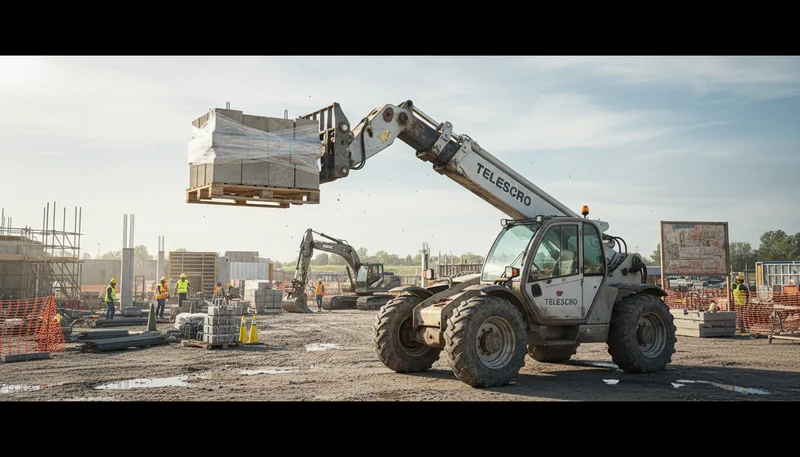
I’ll never forget the time in northern Italy when a site manager called, stunned that his “well-within-rated” telehandler had nearly toppled unloading bricks on a gentle hillside. Most operators trust the load chart1, but jobsites play by a different set of rules.
Telehandler load charts are developed under controlled OEM test conditions—firm, level ground; the specified tire size/type at the correct inflation pressure; approved attachments; and a balanced, static load at the stated load center. On active jobsites, ruts, slopes, soft ground, tire wear, component play, and operator movement can shift the combined center of gravity and reduce the available stability margin. Capacity is not a single fixed number: it decreases as boom height and reach increase, and it changes whenever the attachment, fork length, or load center changes.
Why Isn’t Rated Capacity Always Reliable?
Telehandler rated capacity is established under ideal OEM test conditions—firm, level ground; specified tire size and inflation; approved attachments; and a machine in proper operating condition. On real jobsites, ruts, slopes, soft or wet ground, and tire or component wear can shift the center of gravity and reduce stability, so the published rating should be treated as a reference point rather than a guaranteed safe working limit.

Most people don’t realize that the “rated capacity” stamped on your telehandler isn’t a guarantee for the jobsite. It’s actually the best-case number—measured on level, solid ground, with perfect tires, correct hydraulic pressure, and everything set exactly as the manufacturer wants. Out on real projects, you face mud, ruts, side slopes, worn tires, and—if we’re honest—operators in a rush. Even small changes move the machine’s center of gravity closer to the tipping axis2, so stability drops off fast. I’ve seen this happen on sites in Dubai, where a 3.5-ton telehandler struggled with wet sand and could only lift about 2,200 kg before showing signs of tilt, well below the charted figure.
Think about what actually “derates” capacity on site. Here are the main factors you should be watching:
- Ground condition3 – Soft, uneven, or sloped surfaces reduce usable capacity, sometimes by half.
- Tire status – Worn-out or underinflated tires change machine height and can cause side-to-side lean.
- Load position – Anything off-center or with a longer load center “eats” into your safe margin.
- Attachment type – Buckets, jibs, or custom carriers can substantially change the rated limit.
- Operator habits – Quick boom movements or swinging with a suspended load increase dynamic risk.
- Weather – Wind and rain add extra instability, especially at full boom extension.
I always suggest using the load chart as a reference—not a promise. On real jobs, I keep a clear working margin based on ground condition, tire status, attachment data, and how the load will be handled. When a lift is close to the chart limit at a given reach, I plan a trial pick and adjust the working load if the machine shows any sign of reduced stability. Treat the chart values as the theoretical maximum under ideal conditions—not the default starting point for everyday site work.
A telehandler operating on a slight side slope can lose significant lifting stability, even if it’s lifting well within the manufacturer’s rated capacity.True
Rated capacity assumes perfectly level ground; any lateral tilt shifts the center of gravity towards the tipping axis, so even smaller loads can cause instability and tipping.
As long as a telehandler’s load is within the rated capacity, the risk of tipping is minimal regardless of ground conditions or tire wear.False
Ground conditions and tire wear greatly affect stability; rated capacity only applies under ideal conditions. In real-world scenarios, poor ground or worn tires can lead to tipping at much lower loads.
Key takeaway: Rated capacity assumes level, controlled conditions and does not account for real-world factors like sloped or soft ground, worn components, or uneven loads. Always treat load chart values as theoretical maximums; real site conditions require conservative margins and careful setup to prevent tip-overs.
How do boom height and reach affect capacity?
Telehandler rated capacity is defined by a load chart curve4, not a single fixed number. As boom height and reach increase, the load acts farther from the front axle, reducing forward stability. At maximum extension, allowable capacity drops sharply, and the only safe value is the specific figure shown for that boom angle and reach on the manufacturer’s chart—not the headline rating.

Let me share something important about how boom height and reach impact real-world capacity. The load chart curve is not just a formality—it’s what keeps projects safe and running smooth. I’ve seen too many buyers in places like Dubai and South Africa assume that a 3.5-ton telehandler can always lift a full 3,500 kg. The reality hits hard on site. As soon as you raise or extend the boom, the load moves forward from the front axle line—what engineers call the “tipping axis.” The farther the load is from that line, the less stable your setup becomes.
Here’s a recent example: A contractor in Turkey needed to place heavy glass panels at a height of 14 meters. On paper, their machine was rated for 3.5 tons. But at full extension and boom raised, the safe capacity dropped to about 1.3 tons. That’s less than half the sticker number. They discovered this only after the telehandler started lifting off its rear wheels during a test pick—never a good sign. In that case, referencing the load chart saved them from a serious incident.
The key is to always match your lifting plan to the load chart’s reach and boom angle columns. Even carrying a pallet with long forks or placing the load on the fork tips can add an extra meter to your reach—and push you past safe limits before you even realize it. I always recommend making a trial lift at a lower height, checking that the machine feels stable, and only then committing to the final position. Never trust the headline capacity number alone.
A telehandler's rated lifting capacity is calculated at a specific boom angle and extension, and actual lifting capacity drops significantly when the boom is raised or extended beyond those points.True
Manufacturers determine rated capacity at a designated boom angle and extension; moving the load farther away from the machine's center of gravity introduces a larger overturning moment, so the machine’s capacity reduces significantly as the boom is elevated or telescoped.
As long as you do not exceed the maximum rated capacity shown on the telehandler's data plate, the machine will always remain stable at any boom position.False
The rated capacity on the data plate represents the maximum safe load only under certain boom angles and extensions. If you lift the same weight at a higher reach or greater boom extension, you may exceed the machine’s safe limits and risk tipping, even if you haven’t surpassed the nominal rated capacity.
Key takeaway: Telehandler rated capacity decreases significantly as boom height and reach increase. Always reference the manufacturer’s load chart for each boom angle and reach combination, and verify stability with test lifts before committing to elevated or extended loads.
How do dynamic forces trigger telehandler tip-overs?
Telehandler load charts reflect rated capacity under static, level conditions. During real operation, travel, braking, steering, bumps, or abrupt boom movements introduce dynamic forces that create short peak loads at the boom tip and rapidly reduce the available stability margin. These transient effects can shift the combined center of gravity outside the stability envelope, significantly increasing tip-over risk even when the static chart limit is not exceeded.
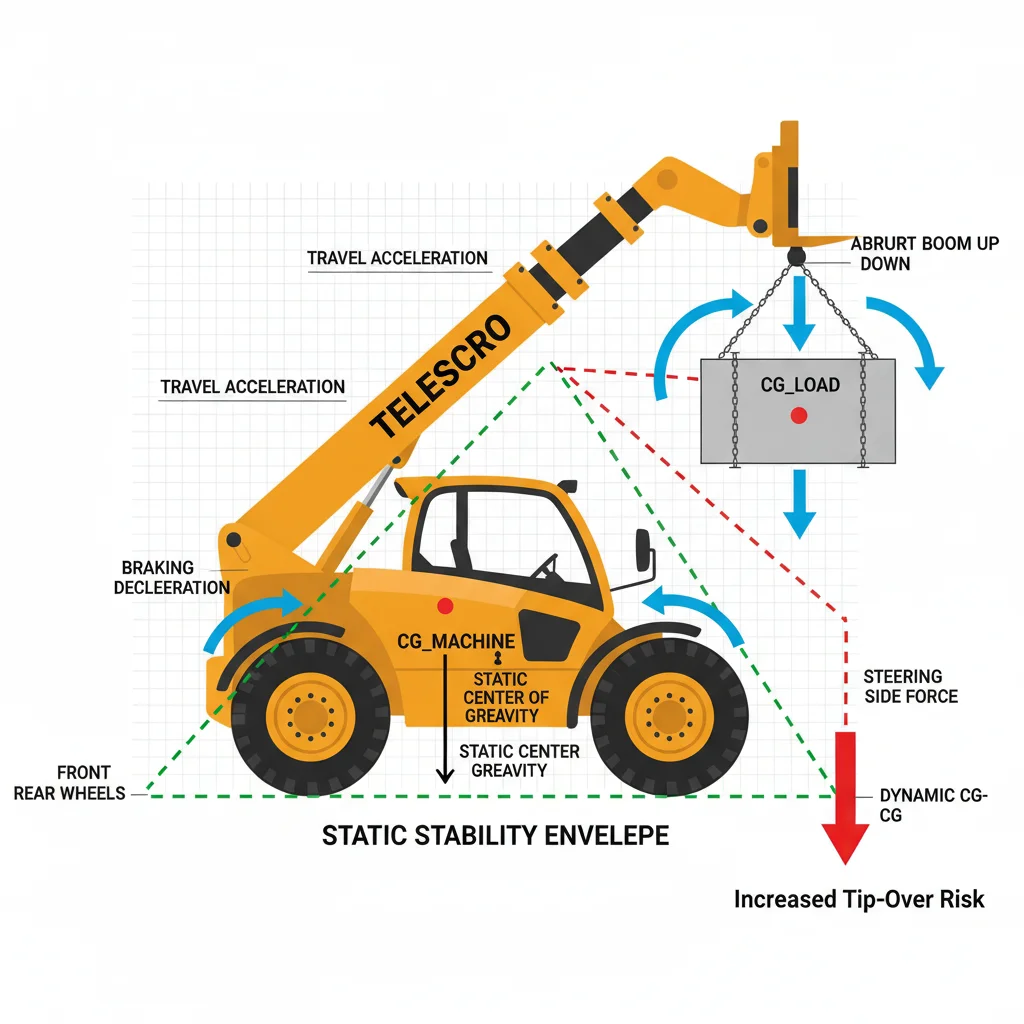
The biggest mistake I see is relying too much on the telehandler’s rated load chart without thinking about what happens when the machine is actually moving. Every customer I’ve visited—whether it’s a busy site in Dubai or a smaller job in the Philippines—has asked me, “Why did my telehandler suddenly feel unstable even when I stayed under the rated capacity?” Here’s the truth: load charts are created for static, level ground with no movement. But construction sites are anything but static. When you brake suddenly, drive over a pothole, or steer with the boom raised, you generate what we call dynamic forces.
Take a real scenario from Kazakhstan last year. One crew had a 3.5-ton telehandler rated for a 2,200 kg load at 7 meters reach. On paper, they were fine stacking bricks. But as the operator drove forward and stopped quickly to avoid an obstacle, the brick pallet at the boom tip “pulled” far more than 2,200 kg—likely closer to 2,700 kg for a split second. That temporary surge was enough to shift the center of gravity right past the front axle tip, raising the risk of forward tipping.
There’s no warning light for these dynamic spikes. Machine sensors and moment indicators can’t always respond fast enough to prevent a tip-over if you exceed the stability envelope, even for a moment. I always tell operators to travel with the boom as low and retracted as possible. Never swing, brake hard, or steer sharply with a heavy load suspended. If the ground is uneven or sloped, reduce your working load by at least 20%. That margin often prevents a very expensive—and dangerous—mistake.
"DynamicFalse
"Telehandler
As long as the telehandler's load stays within the rated capacity shown on the load chart, it cannot tip over, regardless of machine movement or terrain.False
The load chart only applies to static, level conditions. Movement, rough terrain, or abrupt operator actions can shift forces and compromise stability, causing tip-overs even if the weight is within the charted limit.
Key takeaway: Rated capacity on the telehandler load chart assumes static, level conditions that rarely exist in real-world operation. Movement, shocks, or steering with a raised boom can temporarily overload the machine and cause a tip-over. Always reduce capacity in non-ideal conditions and handle loads cautiously.
How do slopes impact telehandler stability?
Uneven ground—such as cross-slopes, ruts, or a single wheel settling—can significantly reduce a telehandler’s lateral stability6. When the chassis tilts, the combined center of gravity shifts toward the low side and the stability triangle shrinks. Under these conditions, loads that are well within the rated capacity on level ground can still lead to tip-overs because the assumptions behind the load chart are no longer met.
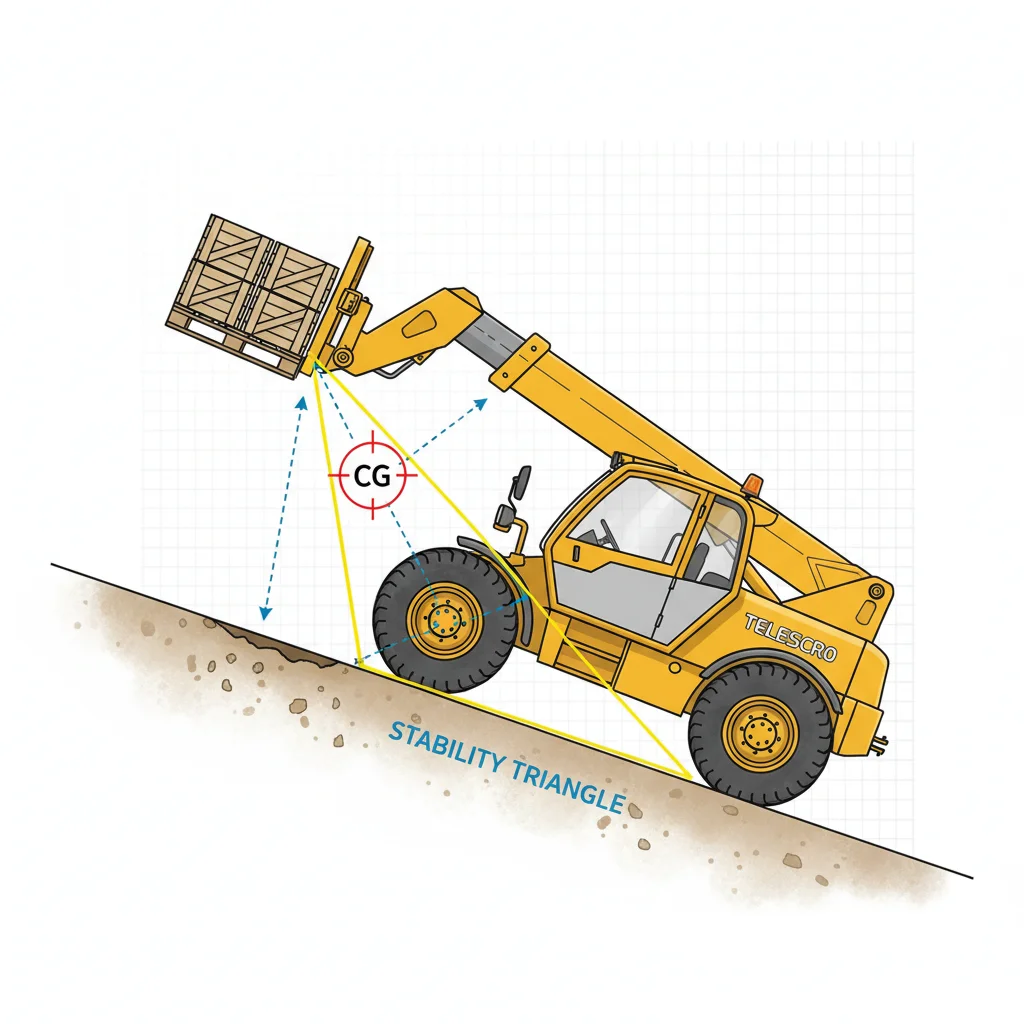
Last month, a contractor in Kazakhstan called me after tipping a 4-ton, 13-meter telehandler. At first glance, the jobsite looked level. But during inspection, we found one front wheel had settled into a soft patch several centimeters lower than the others. With the boom at mid-height and a load of about 1,600 kg—well within the rated capacity on paper—the machine began to lean. The operator felt the load suddenly “grow heavy” on the joystick, and within seconds the rear tire lifted clear of the ground. That small loss of lateral margin was enough to cross the stability limit and tip the machine onto its side.
Here’s the critical point: telehandler load charts assume the machine is properly leveled on firm ground before lifting. Cross-slopes, ruts, or soft edges shift the tipping axis toward the low side. As the boom is raised, the stability triangle shrinks even further. Once the combined center of gravity moves outside that base, the machine is no longer operating within the conditions the load chart is built on—regardless of what the rated capacity says.
From my experience, it doesn’t take much to lose that margin. A single wheel sinking, a slight cross-slope, or ground that looks compacted but isn’t can be enough, especially at longer reach. I always tell customers: if the machine cannot be confidently leveled and the ground firmness is uncertain, treat the lift as out-of-chart conditions. Use mats where needed, lower and retract the boom at the first sign of chassis lean, and reassess before continuing. Staying upright is the priority—once a telehandler tips, the rated capacity no longer matters.
A telehandler can lose stability and tip over even when carrying a load well within its rated lifting capacity if the machine is positioned unevenly on a slope or in a depression.True
Telehandler load charts assume operation on firm, level ground. When a wheel sinks or sits lower than the others, the center of gravity shifts, significantly reducing stability even if the load is light and within rated capacity.
As long as a telehandler’s load is under the rated capacity for its boom position, uneven ground or small slopes have minimal impact on tipping risk.False
Uneven ground and slopes can compromise a telehandler’s stability regardless of the load's weight, because they shift the center of gravity and can lead to tipping even with loads well inside the machine’s official rating.
Key takeaway: Telehandler rated capacity is valid only on level, firm ground—small slopes or soft patches can dramatically increase tip-over risk. Cross-slopes exceeding 3–5° invalidate the load chart. Always level the machine, derate capacity on questionable ground, and avoid operations if the unit leans or loads feel unstable.
How Do Attachments Affect Telehandler Capacity?
Telehandler load charts apply only to the manufacturer-approved attachment and fork configuration shown. Changing fork length or spacing, or fitting third-party attachments, alters load distribution and invalidates the published chart. In practice, allowable capacity is limited by the lowest-rated component—machine, carriage, forks, or attachment—and safe operation depends on having the correct, attachment-specific load chart available in the cab, in line with OEM guidance and site compliance requirements.
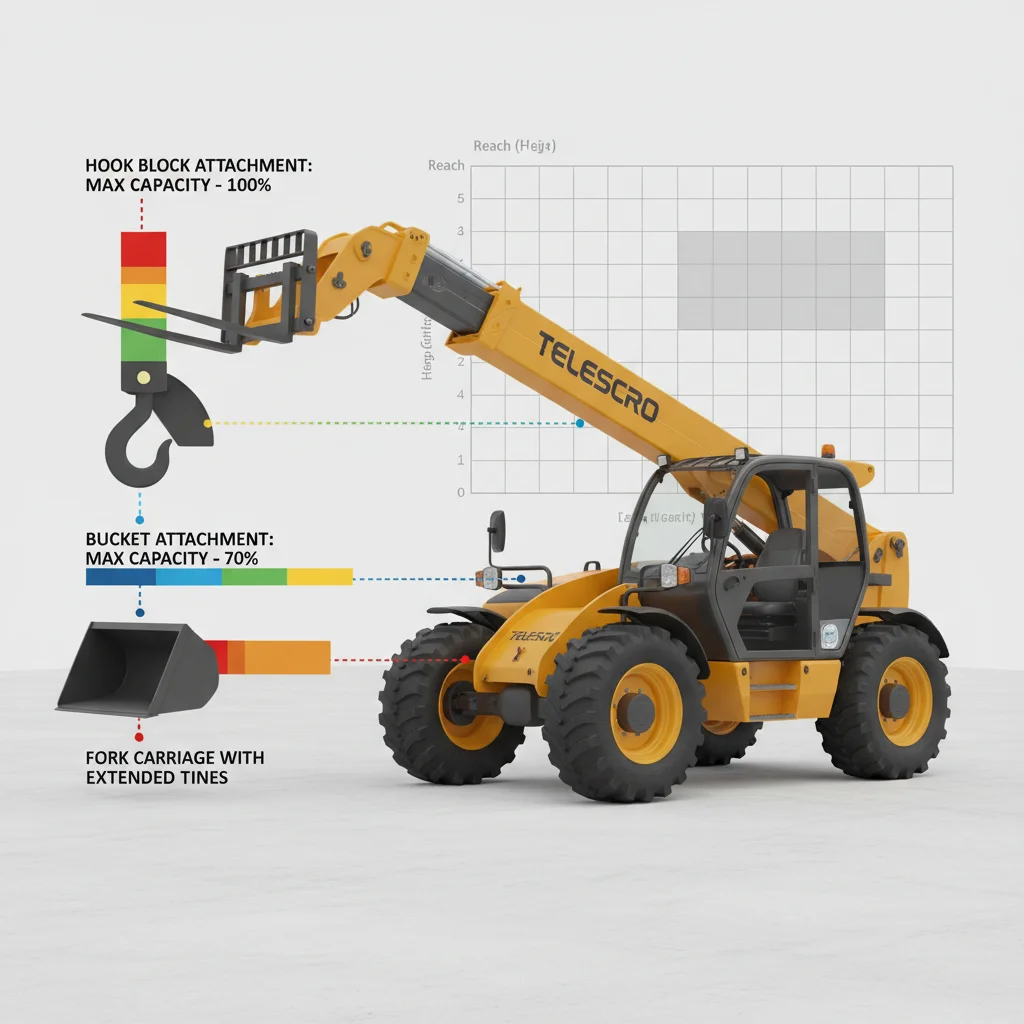
To be honest, the spec that actually matters is never just the max lift—or even the rated capacity number—unless the entire setup exactly matches what the load chart shows. I see a lot of jobsite crews in Dubai attach third-party buckets, longer forks, or even work platforms and assume the machine’s original chart still applies. That’s a real safety risk and a legal problem. In practice, every change—longer forks, non-standard carriages, or even uneven fork spacing—shifts the center of gravity and can slash your safe lifting ability, sometimes by hundreds of kilos.
The reality is, your safe lifting limit is always set by the lowest-rated component in the system. That means:
- Machine rating—the capacity the telehandler itself can safely support.
- Carriage and quick-coupler—each has its own stamped limit.
- Actual forks—check the markings; worn or swapped forks might be lower-rated.
- Attachment load chart—manufacturer-approved, attachment-specific charts only.
Last year, a client in Kenya swapped out the standard forks on a 4-ton telehandler for longer pallet forks. On paper, nothing else changed. But the true safe capacity dropped to under 2,800 kg at full forward reach, not the 4,000 kg shown in the cab. The original chart no longer applied—because the load center moved forward, shifting more load onto the tipping axis. Before any lift, I suggest you: – Verify the attachment and forks are approved for your machine. – Match fork spacing and length with the in-cab load chart.
Attaching longer forks to a telehandler can significantly reduce its safe lifting capacity, even if the original load chart is used.True
Longer forks shift the load's center of gravity further from the telehandler's front axle, increasing the risk of tipping and reducing the machine's actual safe capacity. The original load chart assumes factory-standard fork lengths and does not account for this change in leverage.
Swapping out a telehandler’s standard carriage for a third-party bucket does not affect the machine’s rated capacity as long as the load weight remains unchanged.False
Changing the attachment alters the setup’s weight distribution and center of gravity. Buckets often have different profiles, added weight, and can shift the load position, all of which invalidate the original load chart and require recalculating the safe working capacity.
Key takeaway: Telehandler capacity is only valid when using the exact attachment, forks, and configuration specified in the load chart. Any deviation—from longer forks to work platforms—means the machine’s published capacities no longer apply. Always reference a matching, manufacturer-approved load chart for every approved attachment.
Why is frame leveling risky with raised loads?
Frame leveling or adjusting stabilizers with the boom raised and carrying a load can rapidly shift the telehandler’s center of gravity outside the stability triangle. Because the chassis moves beneath an elevated load, even small leveling corrections can exceed stability limits. OEM operating guidance generally requires leveling and stabilizer adjustment to be completed before lifting, and warns against using these functions to compensate for instability with a raised load.

I’ve worked with customers who made this mistake, especially on tight urban sites. Imagine this: the operator has the load up at 7 meters, maybe 1,500 kg of precast concrete, but the telehandler sits on slightly uneven ground. They realize the machine isn’t quite level and try to use frame leveling—while the boom stays raised. What happens? Even a few degrees of adjustment can swing the center of gravity sideways, shifting the load outside the stability zone in an instant. I’ve seen it in Dubai—one small frame correction with a pallet overhead, and the whole machine went up on two wheels. They were lucky; no one got hurt.
Here’s the technical reason: when the boom is lifted, your stability “triangle” shrinks fast. The tipping axis—the line between your front tires—is now fighting both gravity and the leverage from that extended, elevated load. The hydraulic frame-leveling system, or stabilizers on some high-reach models, are meant to set the base before lifting. When you adjust with weight already in the air, the chassis moves under a floating load. That shift is way more dramatic at height than you expect from the cab.
So the practical takeaway? Always lower and retract the boom before you adjust frame leveling or stabilizers. Make sure your machine sits on solid, level ground before lifting. I suggest building this step into every site procedure and operator checklist. Supervisors should watch for “leveling under load” as a top red-flag behavior. It’s a simple habit, but it prevents some of the worst tip-overs I’ve seen in this industry.
Frame leveling with a raised load can cause the telehandler's center of gravity to move outside the stability triangle, even if the machine is operating within its rated load capacity.True
Frame leveling while the boom is elevated shifts the entire upper structure and load laterally. This can move the center of gravity outside the stability triangle, making the machine more prone to tipping, regardless of whether the load is technically within rated limits.
As long as the load does not exceed the telehandler’s rated capacity, it is safe to use the frame leveling function with the boom raised.False
Staying within rated capacity does not guarantee stability when the boom is raised. Lateral movements from frame leveling can still tip the telehandler by shifting the center of gravity beyond the support base, making this practice unsafe even if the load rating is not exceeded.
Key takeaway: Frame leveling or deploying stabilizers must only occur with the boom fully lowered and retracted. Adjusting either while the load is raised creates a severe tip-over hazard. Always follow the manufacturer’s instructions and site procedures to ensure stability and operator safety.
How much safety margin for telehandler capacity?
Sizing a telehandler at its rated capacity for a specific reach does not ensure safe operation. Industry best practice is to select a model with 20–30% reserve capacity7 at the actual working reach and height. This buffer accommodates uneven ground, attachment effects, and operational variables beyond ideal conditions.

Here’s what matters most when you’re sizing a telehandler for your jobsite: the rated capacity on the spec sheet only tells half the story. I’ve seen too many buyers match that number to their heaviest pallet, especially for lifting up multiple floors or over obstacles. They forget the jobsite isn’t a perfectly flat, paved yard—uneven ground and a half-full bucket can throw those numbers way off. The rated capacity is always based on level ground, standard forks, and the load set at a defined center distance—usually 500 or 600 mm, depending on the market and machine.
Take a real example from a site in Egypt. They needed to place 2,500 kg of roofing material at 10 meters reach, three stories up. The contractor chose a machine rated for exactly 2,500 kg at that reach on a flat surface. But as soon as the ground settled under the front wheels and the tires were a little out of level, the load moment indicator tripped. That team had to unload by hand, delaying the whole job two days.
From my experience, it’s smart to select a model showing at least 20–30% more capacity on the load chart at your real working reach and height—not at ground level. If your task is 2,500 kg at 10 meters, I tell customers to look for 3,000–3,200 kg at that exact chart position. Always ask your supplier to walk you through the load chart with your real loads, heights, and attachments. This extra buffer can save you from unexpected tipping alarms or lifting bans on rough days.
Even if a telehandler is operating below its rated capacity, it can still tip if the load is extended too far or the machine is on uneven ground.True
Rated capacity assumes ideal conditions, such as level ground and a retracted boom. Boom extension and uneven terrain shift the center of gravity and reduce stability, making tipping possible at lower loads.
As long as the telehandler is carrying less than its rated capacity, it cannot tip over regardless of boom position or sloped surfaces.False
Rated capacity is only valid for level ground with the boom retracted and standard attachments. Exceeding these parameters, like extending the boom or working on a slope, can result in tipping even with lighter loads.
Key takeaway: Matching a telehandler’s rated capacity to the heaviest load at maximum reach leaves no room for site variability or operator error. Always specify at least 20–30% reserve capacity at the intended working point according to the load chart, not at ground-level maximums.
Which telehandler stability features matter most?
Critical telehandler stability features to demand include automatic rear axle lock8 with the boom raised, load charts visible in the cab for each attachment, clear boom angle and reach indicators, boom suspension for safer travel, and load-moment indicator systems9 tracking both height and reach. Not all machines offer the same protection—system limitations always apply, especially on non-level ground.
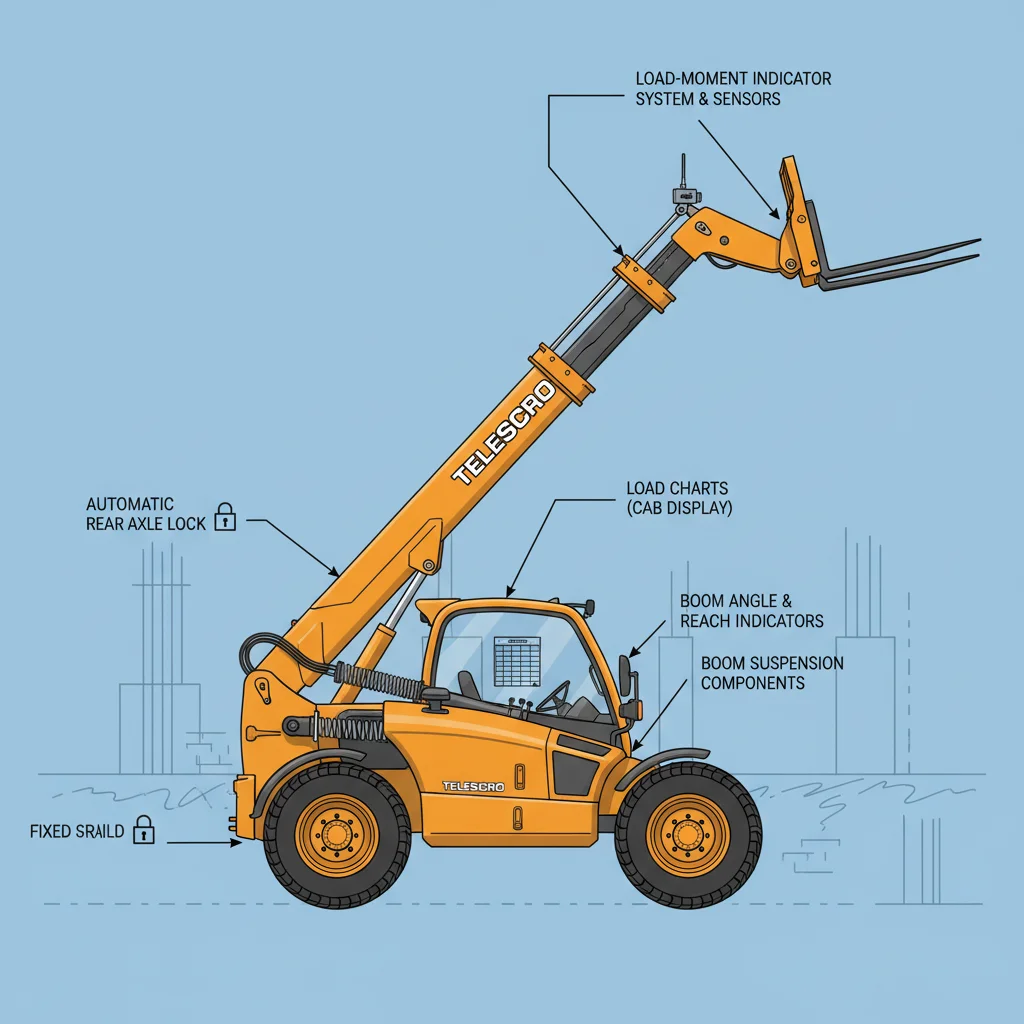
I always remind buyers: not all telehandlers protect you the same way if things go wrong. I learned this the hard way in Chile, where a contractor tipped a 4-ton machine, thinking the onboard alarms covered every risky angle. But their model only monitored forward overload—lateral stability wasn’t tracked, and the rear axle stayed free to oscillate after raising the boom. On uneven ground, that’s a recipe for disaster. Automatic rear-axle lock is the first thing I check. When the boom goes up, the system should lock out movement so the tipping axis stays consistent. Some telehandlers only lock at extreme angles. Others engage as soon as you start lifting, which I prefer for rough sites. Clear, attachment-specific load charts are just as important.
I’ve seen machines where operators flip between multi-page guides for every new bucket or fork—they end up guessing. The best cabs have each chart posted by attachment, with color-coded zones. Don’t forget boom position indicators. When you’re 12 meters up, visual reference is everything; a simple digital display prevents accidental overreaching.
Here’s a quick side-by-side comparison of common stability features:
| Feature | Basic Models | Advanced Models | Importance on Jobsite |
|---|---|---|---|
| Rear axle lock (automatic) | Often missing or delayed | Engages early as boom is raised | Essential for lateral stability |
| Lateral stability monitoring | Not monitored | Sensors track side-load and tilt | Critical on uneven or sloped ground |
| Load charts in cab | Minimal or generic | Attachment-specific, color-coded | Prevents operator guessing |
| Boom angle / reach indicator | Analog or unclear | Digital, easy-to-read display | Key for safe work at height |
A telehandler with an automatic rear-axle lock improves lateral stability when the boom is raised, reducing the risk of tipping on uneven ground.True
When the boom is elevated, lateral forces increase. If the rear axle is allowed to oscillate freely, it disrupts the stability triangle and can cause the machine to tip sideways. An automatic axle lock fixes the rear axle position, enhancing side-to-side stability particularly on slopes or rough surfaces.
Forward overload sensors on a telehandler will automatically detect and prevent all types of unstable tipping scenarios, including side-to-side tipping.False
Forward overload sensors are designed to monitor weight and stability primarily in the forward direction, not lateral forces. Side-to-side stability issues often go undetected by these systems, making it possible for a machine to tip sideways even if forward overload alarms are not triggered.
Key takeaway: Telehandler stability varies widely by model. Prioritize features like rear axle lock, clear load charts, and robust load-moment indicators. Rated capacity assumes level ground; stability aids are essential backups, not guarantees. Always compare specific machine systems and use stability technology as an extra layer—not a substitute for margin and proper setup.
How do tires and sensors affect telehandler stability?
Telehandler stability is directly influenced by tire condition10, brake performance, and sensor calibration11. Low or imbalanced tire pressures can tilt the chassis, reducing lateral stability margin. Worn or mismatched tires alter ground contact. Inaccurate or uncalibrated sensors may mislead operators by displaying safe status when overload conditions actually exist.
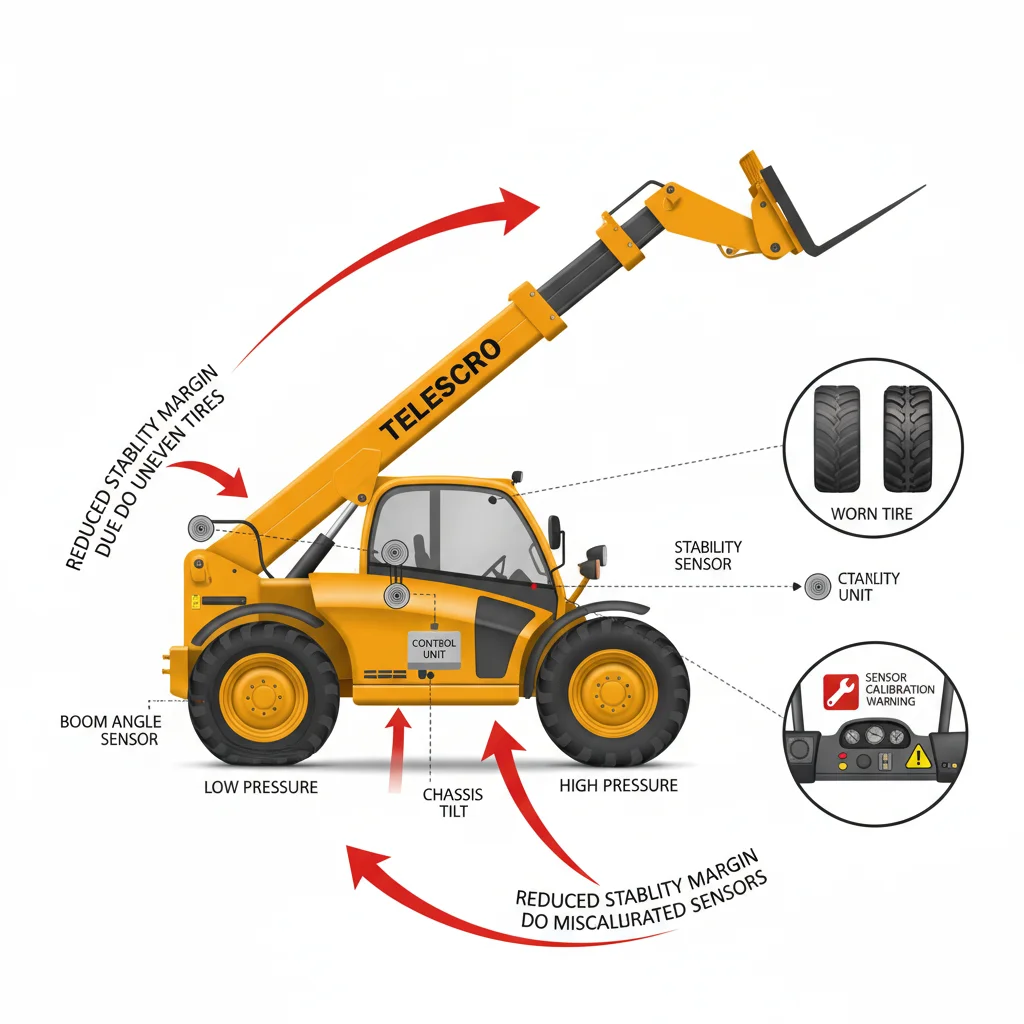
The biggest mistake I see is operators trusting the dashboard when machine condition isn’t right. Your telehandler’s stability is a lot more fragile than the load chart makes it look. I’ve watched a crew in Dubai lift heavy concrete blocks with a 14-meter unit, only to find the chassis tipping slightly—one tire was 25% softer than the others. That may not sound dramatic, but even a small tilt steals away your lateral safety margin, especially when the boom’s out over 10 meters. The operator was shocked; on paper, they were within limits, but that "OK" on the load indicator meant nothing once the machine started leaning.
Uneven or worn tires create these problems all over the world—from Australia’s dusty sites to Sweden’s icy pavements. Mismatched treads change how the machine grips uneven ground. It’s not just about load slipping, either. With one side lower, even a 4-ton rated telehandler can start drifting if parked on a slope. Brakes matter here, too. I’ve seen jobs in Saudi Arabia where delayed parking brake action let a machine creep half a meter on a mild grade—just enough to move a suspended load dangerously out of balance.
Sensors can trick you as well. I always remind techs in Kenya and Turkey: the load moment indicator, angle sensors, and boom position encoders need regular checks. Dirt, electrical noise, or simple wear can cause incorrect readings. My advice? Add monthly tire inspections, brake tests, and sensor recalibration to your routine. Not just engine oil and hydraulics. That’s how you keep real-world stability, not just what the chart claims.
Uneven tire pressure can make telehandlers unstable even if the load is within the rated capacity.True
When tire pressures are uneven, the chassis does not sit level. This reduces lateral stability by creating an unintentional tilt, which can cause the machine to tip even when the load and boom position are technically within safe operating limits.
Stability sensors on a telehandler automatically compensate for soft or underinflated tires by adjusting the hydraulic system.False
While stability sensors provide warnings or limit certain functions if instability is detected, they do not physically correct for differences in tire pressure. The system cannot auto-level the machine by compensating for underinflated tires, so manual intervention and regular checks are necessary.
Key takeaway: Maintaining telehandler stability requires more than checking the rated capacity. Regularly inspect and equalize tire pressures, perform brake tests, and verify load moment indicators and sensor calibration. Overlooking these machine condition factors can create invisible stability risks, even when operating within the load chart limits.
What Habits Prevent Telehandler Tip-Overs?
Most telehandler tip-overs occur within the load chart due to predictable operator habits, not equipment failure or extreme conditions. Core field practices—traveling with the boom low and retracted, only extending when stationary, avoiding side reach on slopes, retracting on uncertain ground, and stopping if loads feel unstable at height—significantly lower tip-over risks.

Last year, I watched a crew in Qatar nearly tip a 4-ton telehandler—despite working “within the chart.” The operator had the boom halfway out and was traversing a short slope to reposition a pallet. He assumed the rated capacity would keep him safe, but the real issue was having the boom extended while moving. The front axle is the tipping axis on any telehandler, and once your radius increases—even by half a meter—your margin shrinks fast, especially if the ground isn’t perfectly level. I stepped in and had them keep the boom fully retracted and low while traveling. No more close calls that week.
Here’s what I always suggest on site: travel with the boom as low and retracted as possible—never high or fully extended, even with light loads. Approach stacks or trucks, stop, and only then raise or extend the boom. Side reach on slopes is asking for trouble. I’ve seen several near misses in Kazakhstan where crews thought the machine’s frame leveling system could “cheat” the hill. Rated capacity is strictly based on level ground—usually three degrees or less. For questionable ground or sloped approaches, retract the boom one section and reassess the terrain before extending.
If the load feels noticeably heavier as you lift—stop. Lower it, retract, and check again from ground level. Sometimes it’s a hidden slope or soft soil shifting under the tires, not just the load’s weight. I tell supervisors in the UAE: don’t move with any load higher than about 1.2 meters unless the manufacturer’s manual clearly says so. Embedding these habits in every operator’s routine is the cheapest accident prevention strategy you’ll find.
A telehandler is more likely to tip when moving with the boom extended, even if the load weight is within the rated chart limits.True
Stability charts are based on stationary conditions on level ground. Extending the boom while moving greatly shifts the center of gravity, making the machine unstable even if within static rated capacity.
As long as the load remains within the telehandler's rated capacity, traveling with the boom raised does not increase the risk of a tip-over.False
The rated capacity assumes safe, stationary operation on level ground. Traveling with the boom raised or extended elevates the machine's center of gravity and increases tip-over risk, regardless of being under rated capacity.
Key takeaway: Embedding core habits—always traveling and approaching loads with the boom low, never extending sideways on slopes, retracting on uncertain ground, and immediately lowering if a load feels heavier at height—cuts tip-over risks dramatically, even when working strictly within rated capacity guidelines.
Conclusion
We’ve looked at why telehandler rated capacities are only a starting point and how real site conditions like uneven ground or worn parts can change everything. From what I’ve seen, it’s easy to trust load chart numbers, but the real world isn’t always as tidy as a test pad—especially when you’re working on a crowded or sloped jobsite. My advice: always give yourself a safety margin beyond what the chart says, and double-check your setup every time. Need help matching a telehandler to your actual site or want a second opinion on your current practice? I’m happy to share what’s worked in the field—just reach out. Every project has its surprises; the right prep keeps them manageable.
References
-
Explains the importance of load charts in maintaining telehandler stability and avoiding dangerous tip-overs during operation. ↩
-
In-depth insights on how the tipping axis impacts stability and lifting limits, essential for safe telehandler operation on construction sites. ↩
-
Details how soft, uneven, or sloped surfaces impact machine stability and can reduce telehandler capacity by up to half. ↩
-
Detailed explanation of load chart curves with examples on how they ensure telehandler stability and safe lifting capacity in real projects. ↩
-
Explains the critical stability triangle concept ensuring telehandler safety and how its changes impact tipping risks under slope conditions. ↩
-
Provides expert insights on how lateral stability limits telehandler operation on uneven terrain and prevents tip-overs in construction sites. ↩
-
Explains the critical need for reserve capacity to accommodate real-world variables like terrain and attachment effects, preventing accidents and delays. ↩
-
Explains how automatic rear axle lock prevents tipping by stabilizing the machine when the boom is raised on uneven ground. ↩
-
Details how load-moment indicators track height and reach to prevent overload and tipping risks, enhancing operational safety. ↩
-
Explains how tire pressure and wear impact machine balance, safety margins, and operational risks in telehandler usage. ↩
-
Details the risks of inaccurate sensors misleading operators about load safety, emphasizing proper calibration to prevent tipping accidents. ↩