










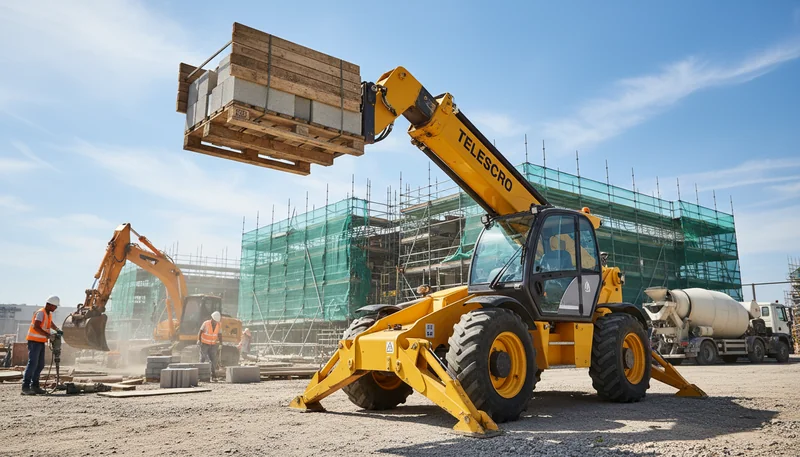
Telehandler Stability When Lifting: Field Guide to Avoid Costly Tipping Mistakes
Not long ago, I watched a crew in Vietnam nearly dump a pallet of bricks after extending their boom just a hair too far. They were confident—until the telehandler’s front wheels left the ground. It happens all over, from Shanghai towers to European renovation sites.
Telehandler stability fundamentally depends on understanding the relationship between the machine’s center of gravity and the stability triangle1 outlined by the front wheels and the oscillating rear axle. When a boom is lifted and extended, this alters the center of gravity, significantly increasing the risk of overturning if the load is not monitored closely. Stability aids such as counterweights, outriggers2, and frame leveling systems3 are designed to keep the center of gravity within safe limits.
How does the stability triangle prevent tipping?
The stability triangle, formed by the two front wheels and the rear axle pivot, is central to telehandler stability. The combined center of gravity of the machine and load must remain vertically above this triangle. When the center of gravity crosses any edge—typically the front—tipping occurs. Stability aids are designed to keep the load within these triangle boundaries.
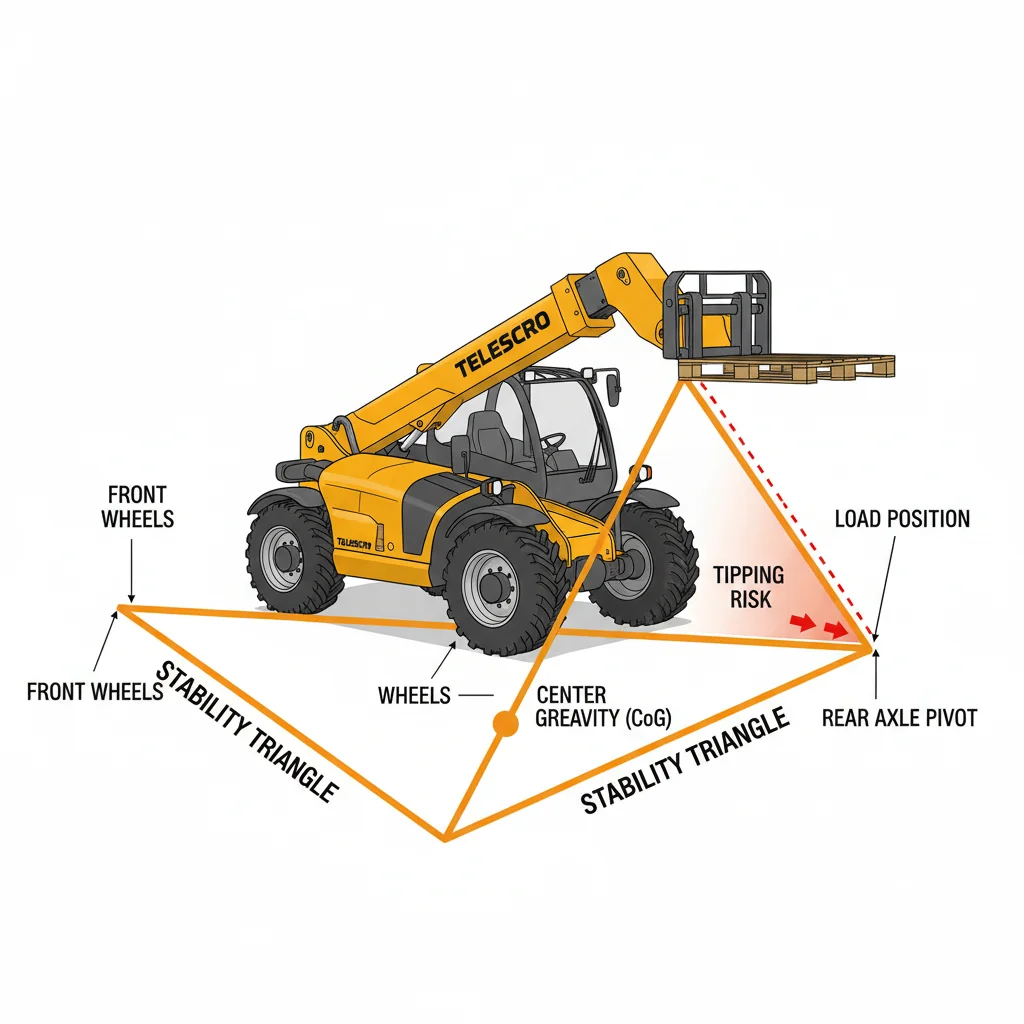
Most people don’t realize that the stability triangle isn’t just theory—it’s something that impacts daily safety on every jobsite. I had a client in Kazakhstan who upgraded to a 4-ton telehandler with a 16-meter boom. The site had a narrow access road and uneven ground. One morning, their operator lifted a pallet of bricks to 12 meters, but shifted the boom too far forward. The moment indicator4 (that’s the sensor showing if your load is safe) started beeping. Luckily, the operator stopped, but they were only about 30 cm away from pushing the center of gravity past the front edge of the triangle. A few centimeters more and that machine could have tipped.
To be honest, I see many operators underestimate how much a load at full extension changes stability. A 3,000 kg load that feels secure with the boom retracted can put you outside the safe zone when extended—even with counterweights. Outriggers or stabilizers, when available, widen your triangle and give more margin, but I always suggest retraining operators when adding new attachments or changing terrain. In Brazil last year, a sugar plant saved thousands in downtime by insisting their team review load charts and stability diagrams every month.
Here’s what matters most: the machine’s manuals and training should clearly show how the center of gravity behaves with different boom angles and loads. If you’re evaluating models, look for clear load charts, audible alarms, and simple instructions. Small changes—like keeping the boom lower when traveling—can mean the difference between a normal shift and a costly accident.
The stability triangle is defined by the points where the telehandler's tires contact the ground, and as long as the combined center of gravity of the machine and load stays within this triangle, tipping is preventedTrue
The stability triangle is formed by connecting the points of tire contact on each side of the telehandler, creating a polygon within which the combined center of gravity must remain to maintain balance. If the center of gravity moves outside this triangle, the telehandler risks tipping due to imbalance.
Using the moment indicator alone is sufficient to guarantee telehandler stability regardless of ground conditions or boom extensionFalse
While the moment indicator helps detect unsafe load and boom positions by monitoring tipping risk, it cannot compensate for external factors like uneven terrain or poor tire traction. Stability depends on multiple factors, including ground condition and proper positioning, which the indicator alone cannot control.
Key takeaway: Awareness of the stability triangle is critical in telehandler operations. Ensuring the center of gravity stays inside this triangle reduces tipping risks, making proper machine setup, training, and clear operator manuals essential for workplace safety and cost prevention.
How Do Boom Height and Reach Impact Stability?
Boom height and reach drastically influence telehandler stability by shifting the center of gravity. As the boom rises and extends, the center of gravity moves forward and upward, increasing the risk of tipping. This reduces the safety margin within the machine’s stability triangle and causes rated capacity to decline sharply at maximum height and reach.

Let me share something important about telehandler stability that catches many operators off guard. I’ve lost count of how many times people assume their machine is “solid” just because it feels stable—right up until it’s not. What actually happens is, as the boom goes up or out, the center of gravity shifts forward and upward, quickly shrinking your margin for error inside the stability triangle. The rated capacity drops faster than many expect once you reach high or far.
A few months ago, a customer in Kazakhstan called me after nearly tipping a 3.5-ton telehandler. He was unloading reinforcing steel at close to 13 meters with the boom fully extended. On the load chart5, rated capacity was only about 1.1 tons at that position—a huge drop from the 3.5 tons he could manage with the boom retracted. He said the machine “still felt steady” until the back wheels lifted off the ground. That’s the danger: the telehandler doesn’t always warn you with wobbles or alarms.
Even a short lift at high reach can stress the front axle or hydraulic system far more than most operators think. The moment indicator, if equipped, helps—but you can’t skip checking the load chart for every new job. I always suggest looking at the derating curve on the load chart: some models lose half their safe lifting weight by just extending halfway. My advice? Treat every high or long reach as a critical decision point. Confirm your actual safe working load before you get in the seat.
When the boom extends beyond 5 meters, the telehandler's rated capacity can decrease by up to 50% due to the forward shift in the center of gravityTrue
Extending the boom increases the leverage effect on the machine, moving the center of gravity forward and reducing stability; manufacturers adjust rated capacity significantly at longer reaches to maintain safe operation.
A telehandler's stability is unaffected by boom height as long as the load stays within the rated capacity shown on the load chartFalse
Boom height elevates the center of gravity and reduces the base of support, impacting stability even if the load is within rated capacity; load charts account for both boom extension and height to ensure safety.
Key takeaway: Rated capacity drops rapidly with increased boom height and forward reach due to shifts in the center of gravity. Relying on machine stability feel is unsafe; always consult load charts to avoid tipping accidents, especially at high elevations or extended reach.
How Should Telehandler Load Charts Be Used?
Operators should consult telehandler load charts before any lift, translating boom height and reach into safe lifting capacities. Performing a dry run6—extending the boom without a load—lets operators confirm the exact height/reach intersection on the chart. If the planned position falls outside the permitted zone, the lift is unsafe, regardless of overall capacity ratings. Overreaching remains a frequent cause of tipping accidents.

The biggest mistake I see is operators glancing at the telehandler’s headline capacity and assuming that covers every situation. In reality, the numbers on a load chart are what keep you safe on the job. For example, in Dubai last year, a client needed to lift heavy HVAC units—almost 2,200 kg—up to a rooftop 13 meters high. On paper, their 4-ton telehandler seemed perfect. But when we checked the load chart, capacity at that particular height and reach dropped below 1,500 kg. If they hadn’t noticed, an overload or tip could have happened.
Here’s what I recommend for every site:
- Before any lift, consult the load chart—Check both boom height and forward reach for your exact working position.
- Do a dry run with no load—Extend the boom to the planned position, then read the boom’s height and reach directly off the gauge or the machine display.
- Find the intersection—Match those values to the load chart and make sure the actual load is within the safe zone.
- Never rely only on max capacity—A telehandler rated for 4,000 kg may handle less than 1,300 kg at maximum reach.
- If it’s outside the chart zone, don’t risk it—Even if the number “looks close,” overreaching is a common cause of tipping.
For fleet managers, I suggest asking new operators to demonstrate these steps during training. In my experience across projects in Kenya and Brazil, the operators who practice dry runs make fewer costly mistakes. Careful use of load charts isn’t optional—it’s essential to protect people and equipment.
Telehandlers maintain stability by dynamically reducing lifting capacity based on boom extension and elevation angle, as specified in the load chart, which accounts for changes in the center of gravity and tipping momentTrue
The load chart factors in the boom's extension and angle because as the load moves farther from the machine's base, the leverage effect increases, reducing stability. This prevents overloading beyond safe limits and maintains balance.
A telehandler's stability is primarily maintained by automatically adjusting tire pressure in real-time to counteract load shifts during lifting operationsFalse
While tire pressure affects ground contact and general stability, telehandlers do not employ real-time tire pressure adjustments to maintain stability; instead, load charts and machine design elements like outriggers and counterweights govern safe lifting limits.
Key takeaway: Carefully reading telehandler load charts and performing a no-load dry run at the intended lift position are essential steps to avoid tipping incidents. Ensuring every lift stays within charted limits, not just headline capacity, is critical for operator safety and asset protection.
How Do Outriggers and Frame Leveling Boost Stability?
Outriggers expand a telehandler’s support base, minimizing chassis rocking and increasing resistance to tipping, especially at high lifts. Frame leveling systems adjust the chassis to counteract side slopes, but must be set before lifting loads. Improper outriggers on soft ground or late frame adjustments at height can significantly compromise stability.
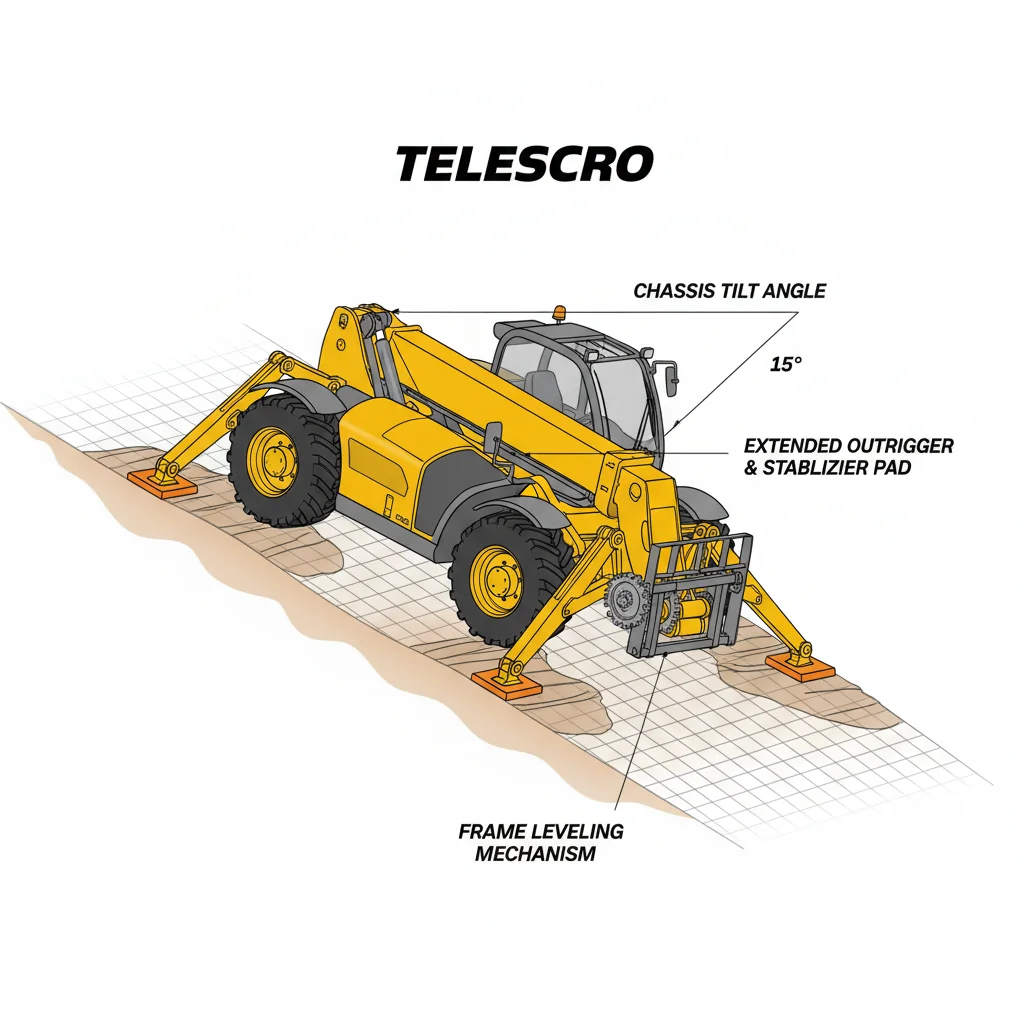
Here’s what matters most when talking stability: outriggers and frame leveling only do their job if used correctly, with the right ground conditions. I remember a site in Kazakhstan last autumn—muddy ground after heavy rain. The crew deployed outriggers on plywood sheets, thinking they’d compensated for the soft soil. Within an hour, the telehandler (rated for nearly 4 tons at 15 meters) started to tilt when reaching for a pallet at max extension. The plywood slowly sank, making the outrigger less effective. I always suggest—if you’re on unsteady surfaces, use bigger mats or, better yet, find firmer ground before setting up. Relying on “good enough” ground support is a risk you truly feel only when something goes wrong.
Let’s talk frame leveling. Most axle or chassis leveling systems let you adjust just 8–10°—handy, but there are limits. You set it before lifting, not after. I’ve seen operators in Dubai try to tweak the frame after raising the boom 5 meters. Not a good idea. Just a small tilt at that height shifts the load’s center of gravity outside the stability zone. That’s why most manufacturers strongly advise leveling with the boom down—machines can tip in an instant if you adjust at height.
The safest routine: park on level, solid ground, extend outriggers fully, check your level gauge, set the frame, then pick up the load. If the site isn’t stable enough for proper outrigger use, I recommend stopping and reassessing. Being patient at setup always saves bigger headaches later.
Deploying outriggers on rigid mats like plywood can prevent sinking if the mat thickness and ground bearing capacity are properly calculated and matched to the loadTrue
When the outrigger load is distributed over a large enough area with sufficiently strong mats, the ground pressure decreases to safe levels, preventing mat or soil failure and maintaining telehandler stability under load. Incorrect sizing or weak mats, however, still risk sinking.
Frame leveling systems automatically adjust outrigger pressure to compensate for uneven ground, making manual outrigger deployment unnecessaryFalse
Frame leveling systems only adjust the machine chassis orientation and cannot compensate for insufficient ground support beneath outriggers; manual outrigger deployment and ground preparation remain crucial for stability.
Key takeaway: Deploy outriggers fully on stable, level ground to maximize telehandler stability, and use frame leveling only before lifting—not after. Relying on outriggers in poor soil or adjusting the frame with a raised boom increases tip-over risk and threatens operator safety.
Which Features Improve Telehandler Stability Most?
Telehandler stability depends on several key design features: a longer wheelbase7 and wider track width enhance balance, while low-mounted components and substantial rear counterweights help resist forward tipping. High-lift models use reinforced frames, robust axles, and heavier overall weight to safely handle greater tipping moments encountered during maximum reach and rough-terrain operation.

From my experience, buyers often focus on maximum lift capacity and overlook the design features that actually keep a telehandler upright—especially at full extension. I’ve seen this on sites from Dubai to Peru. When you compare stability, four factors make the biggest difference: wheelbase, track width, counterweight8, and where the main components sit on the chassis. Let’s break down how these matter in real world use.
A longer wheelbase gives the machine a wider stance front-to-back. This directly resists the tipping force you’ll feel when the boom is fully out with a heavy load—say, lifting a 2,500 kg pallet at 12 meters. A wide track (side-to-side distance between wheels) helps even more on uneven, rutted sites. Machines with tracks over 2.4 meters handle side slopes far better. The rear counterweight is another key. To be honest, some compact models skimp here to keep transport weight down. But a heavier, low-mounted counterweight seriously improves forward stability during max reach lifts.
Here’s a simple table I use with customers to compare stability-related specs:
| Feature | Compact Model | Standard Model | High-Lift Model |
|---|---|---|---|
| Wheelbase | 2.5 m | 2.9 m | 3.2 m |
| Track Width | 2.0 m | 2.45 m | 2.55 m |
| Counterweight | 500 kg, high | 800 kg, mid-mount | 1,200 kg, low-mount |
| Unladen Weight | 6,000 kg | 9,000 kg | 12,000 kg |
I always suggest checking these figures before setting your budget. If you plan on high lifts or rough ground, it’s worth prioritizing stability over compactness—especially for anything over 12 meters.
Positioning the heaviest components, such as the engine and counterweight, closer to the rear axle increases rearward stability and allows safer lift at maximum boom extensionTrue
By concentrating mass near the rear axle, the telehandler's center of gravity shifts backward, counterbalancing the extended load and reducing the likelihood of tipping forward during lifts at full boom extension.
Increasing the track width beyond 5 meters on standard telehandlers significantly improves maneuverability on tight job sitesFalse
While a wider track width enhances lateral stability, excessively increasing it beyond typical design limits reduces maneuverability in confined spaces, making handling more cumbersome rather than easier.
Key takeaway: Telehandlers with longer wheelbases, wider tracks, low-mounted mass, and larger rear counterweights provide superior stability for lifting at reach. Evaluating these design elements ensures safer, more effective machine operation, especially on uneven terrain or when using high-capacity models for demanding site work.
How Do LMIs and Telematics Enhance Stability?
Electronic load management systems9 (LMIs) in telehandlers continuously monitor boom angle, boom extension, and hydraulic load, calculating stability in real time. When nearing safe operational limits, LMIs warn the operator and may restrict certain movements. Telematics extends this by logging stability data, enabling site managers to analyze incidents and optimize safety protocols for fleets and operators.

A few years ago, I was consulting for a rental fleet in Dubai where they’d just upgraded to telehandlers with electronic load management indicators (LMIs). That site ran multiple crews—some operators with ten years’ experience, others less than a month. The LMIs became a real equalizer. These systems track the boom angle, extension, and hydraulic pressure every second. When the operator moved close to the machine’s actual tipping point—let’s say trying to lift two tons out at twelve meters—the LMI sounded a clear warning. In some cases, it cut out boom functions beyond that safe zone. I remember one new hire tried to “push through” a warning, but the LMI stopped the extension automatically. That moment probably prevented a costly tip-over.
But the real game changer for managers was telematics. In Kazakhstan, I worked with a contractor who used telematics dashboards10 to review machine data every week. They could see exactly which units had boom overload warnings, which operators triggered them, and even the positions where it happened—usually at certain tight corner loads. One time, their records showed that 90% of near-overload incidents happened during third-shift unloading at a specific area. They adjusted traffic flow and ramp usage, and near-misses dropped significantly in the next month.
Integrating both LMIs and telematics doesn’t just keep the operator within limits—it builds a detailed picture of real usage and risks. For mixed-skill fleets or multi-shift jobs, I suggest making these systems a requirement. It’s a practical way to minimize tipping risks and continuously improve safety training.
Electronic Load Management Indicators (LMIs) measure boom angle, extension, and hydraulic pressure multiple times per second to calculate the actual load moment, preventing operators from exceeding the telehandler’s tipping threshold.True
LMIs continuously monitor critical variables such as boom angle and extension, integrating these in real time to determine the load moment. This dynamic calculation allows the system to alert the operator before the load causes instability, enhancing safety and preventing tip-overs.
Telematics systems alone can maintain telehandler stability by automatically adjusting counterweights based on the load detected by on-board sensors.False
Telematics primarily collect and transmit operational data for monitoring and maintenance; they do not actively control mechanical components like counterweights. Stability control is managed through systems such as LMIs and mechanical design, not telematics.
Key takeaway: Integrating LMIs and telematics greatly improves telehandler stability by both proactively preventing unsafe boom movements and capturing detailed operational data for analysis. Site managers and rental operators should prioritize these technologies to minimize tipping risks and refine safety training across varying operator skill levels.
What Practices Ensure Telehandler Lifting Stability?
Telehandler stability when lifting relies on operating strictly on firm, level ground, engaging the parking brake, and lifting loads slowly. Traveling with a raised load or operating on side slopes greatly increases tip risk, especially with the boom elevated. Training materials emphasize keeping all machine movement below 1.2–1.5 meters (4–5 feet) of boom height.
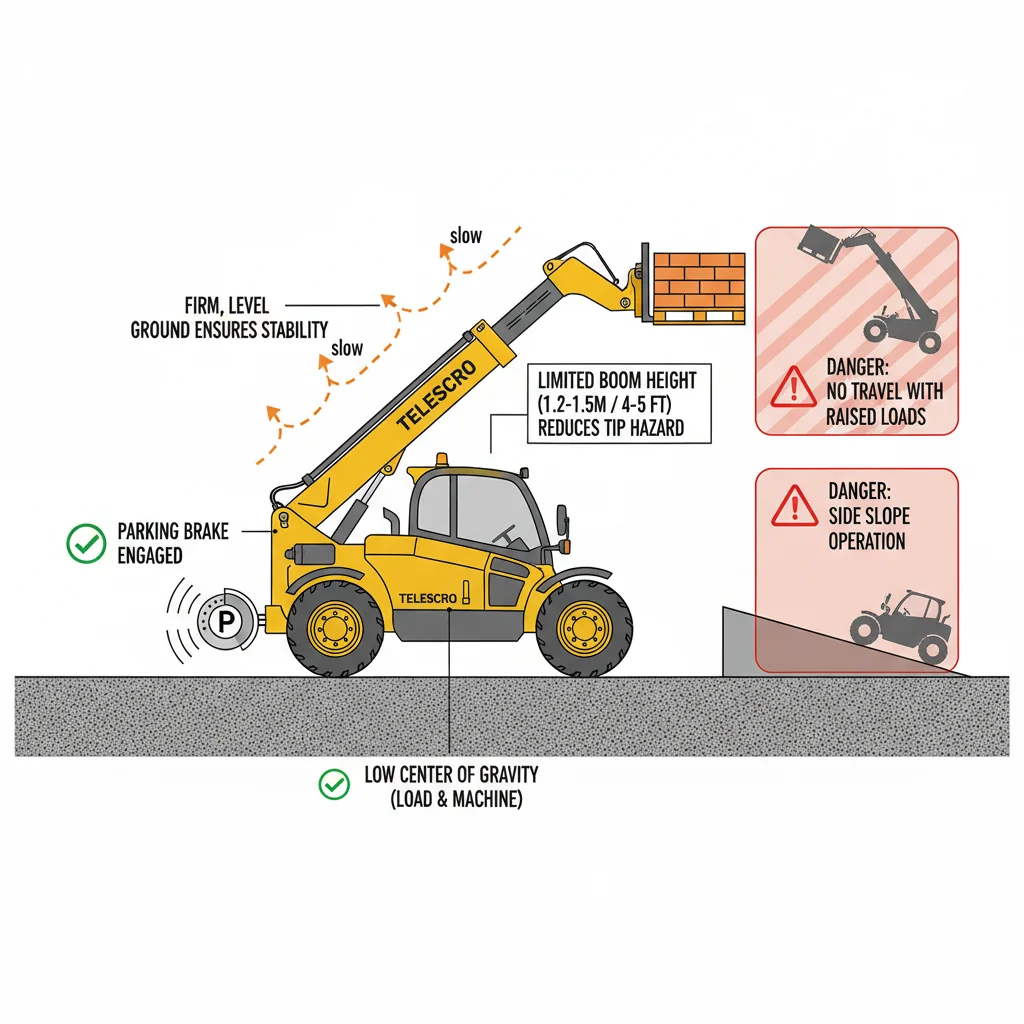
To be honest, the spec that actually matters is stability—not just max lift or reach. I’ve seen skilled operators in Dubai lose control when the basics weren’t followed. Even when you’re working with a 4-ton, 13-meter machine, if the tires aren’t all planted on solid, level ground, it doesn’t matter how advanced your telehandler is. In one project, a client tried saving time by “nudging” position on a slight slope, hoping frame leveling would compensate. The result? The rear wheel left the ground, and the moment indicator alarm went wild—close call, but a damaged pallet and a week of paperwork.
The biggest stability risks come from movement at height. I’ve watched crews in Brazil travel with a load lifted over 2 meters, thinking it saves time. What it actually does is shift the center of gravity dangerously high, especially if you hit a pothole or brake suddenly. The chassis can tip sideways with very little warning, particularly when you’re more than 1.5 meters up. I always remind customers: the load chart is your best friend. Most charts show a rapid drop in safe lifting capacity as the boom extends past halfway. Don’t trust “feel”—wait for the hydraulics to settle before you start moving.
If ground conditions aren’t perfect, I suggest stopping and repositioning, even if it adds ten minutes. Trying to “cheat” with frame leveling or small boom angle adjustments just isn’t worth the risk of a costly tip-over. A telehandler’s best feature is its flexibility, but stability comes first. Safe practice beats speed every time.
Using frame leveling on a telehandler does not compensate for instability caused by operating on slopes greater than 3 degreesTrue
Frame leveling systems can only adjust within limited angles (typically up to 3 degrees); beyond that, the machine’s center of gravity shifts, leading to loss of tire contact and instability despite leveling attempts.
Extending the telehandler’s stabilizers fully before lifting guarantees maximum load capacity regardless of ground conditionsFalse
While stabilizers increase stability, their effectiveness depends on the ground quality and levelness; if stabilizers are placed on uneven or soft ground, they can fail to prevent tipping, so proper site assessment is critical.
Key takeaway: The most crucial practices for telehandler stability are maintaining level ground, lifting slowly, and avoiding travel with elevated loads. Supervisors should enforce realignment or repositioning rather than attempting unsafe corrections with frame leveling or boom angle, to avoid costly and dangerous tipping incidents.
How Does Maintenance Affect Telehandler Stability?
Telehandler lifting stability is directly impacted by maintenance. Uneven or underinflated tires can tilt the chassis and shift the center of gravity, increasing tipping risk. For rough-terrain units, daily checks of tire pressure, and weekly inspections of outriggers—covering pins, pads, and hydraulic lines—are critical. Diligent maintenance supports both operational safety and warranty compliance.
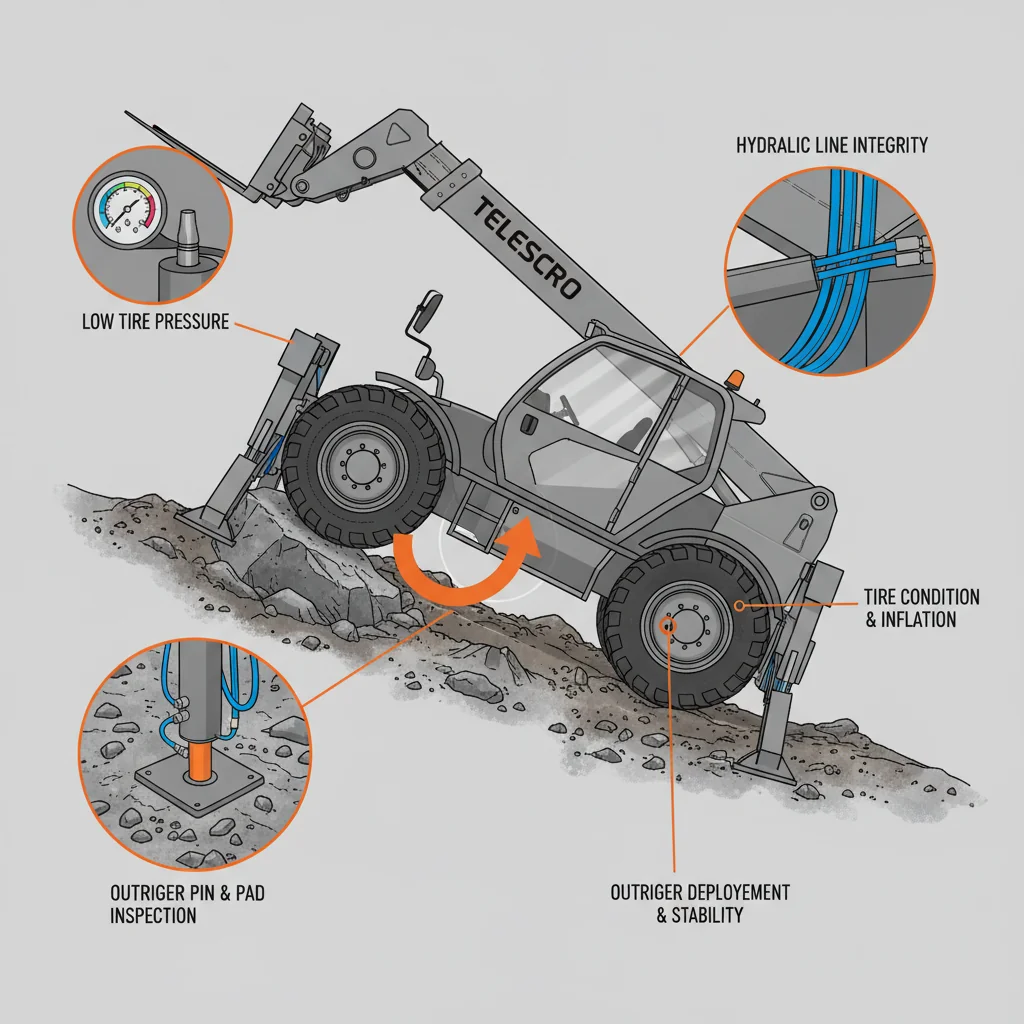
I’ve worked with customers who underestimated just how much simple maintenance affects stability. One case that stands out is from a site in Kazakhstan—a 4-ton telehandler with 17-meter reach was struggling on uneven ground. The team was lifting timber to the fourth floor, but I noticed one tire was several PSI lower than the rest. It wasn’t a massive difference—maybe 6 PSI—but that was enough to tilt the chassis slightly. At full height, even a small lean changes your center of gravity and can push you closer to a tipping event, especially when extending the boom.
For rough-terrain telehandlers, daily tire pressure checks11 aren’t just a box to tick. I always suggest checking that left and right pairs are within 2 PSI of each other. Uneven tires can make your outriggers work harder or, worse, allow a load shift before you see any warning. In Dubai, I saw a jobsite where an operator ignored this, and the outrigger pads started to sink unevenly. The whole machine began to settle—luckily no one was injured, but it delayed work by half a day.
Worn outrigger pins, cracked pads, or a leaking hydraulic cylinder can all lead to subtle instability. I recommend creating a weekly inspection checklist covering each of these points. Keep those records—manufacturers often require them for warranty claims, and I’ve seen solid maintenance logs help customers avoid denial of coverage. Telehandler lifting stability really does start with the basics. I suggest making maintenance part of your daily and weekly routine, not just an afterthought.
Uneven tire pressure differences as small as 5-6 PSI on a telehandler can shift the center of gravity enough to reduce stability at maximum boom extensionTrue
Because the telehandler’s chassis relies on balanced tire pressures for firm, level ground contact, even minor discrepancies cause a tilt that shifts the center of gravity outward when the boom is fully extended, increasing risk of tipping.
Telehandlers compensate for uneven tire pressure automatically by adjusting hydraulic stabilizers to maintain center of gravity alignment during liftsFalse
Most telehandlers do not have automatic hydraulic stabilization that corrects for uneven tire pressures; operators must manually maintain tire pressures and ground conditions because uneven tires cannot be 'corrected' hydraulically without risking equipment damage or failure.
Key takeaway: Routine maintenance such as tire pressure checks and outrigger inspections is fundamental for optimal telehandler lifting stability. Overlooking daily and weekly tasks can cause chassis lean or outrigger failure, increasing the risk of costly accidents. Maintenance diligence also strengthens warranty claims and operational documentation.
Why Do Telehandler Stability Standards Matter?
Stability standards, such as EN 145912 in the EU and OSHA regulations in the U.S., establish minimum criteria for tilt tolerance, load chart accuracy13, and operator training in telehandler operations. Compliance ensures machines are tested for real-world conditions and prevents legal liabilities, denied insurance claims, and costly project delays following incidents involving tipping or instability.

Something a lot of buyers overlook is that stability isn’t just a technical spec—it’s a legal and financial shield. Last year, I worked with a contractor in Dubai who thought all 4-ton telehandlers were equal, as long as they lifted the weight. Their site had uneven ground and frequent wind gusts, and the team wanted to lift precast panels up to 13 meters. They sent me the machine’s EU declaration, but when I checked, it was only tested for a 3° tilt—not the 5° required by EN 1459. If an incident happened, insurance could deny any claim because the telehandler didn’t meet local stability standards.
Here’s what matters most: standards like OSHA in the U.S. or EN 1459 in Europe make sure machines are stress-tested for real-life jobsite hazards. For example, EN 1459 requires a fully loaded telehandler to stay upright on a 5-degree sideways or forward tilt—think of it as a guarantee that the stability triangle and load charts are not just marketing. Operators must also be trained to read the load chart (which shows safe capacities at different boom lengths and angles) and set outriggers or stabilizers properly. Without this, the safest specs on paper fall apart on the jobsite.
I always suggest, before buying or renting, request documentation showing the machine’s conformity. After an incident, both investigators and insurers will check these records closely. On top of that, make sure your operator training actually covers what regulators require. It’s not about ticking a box—it’s about avoiding costly shutdowns and keeping projects on track.
Key takeaway: Adhering to telehandler stability standards is critical for safety, legal compliance, and project continuity. Non-compliance can result in fines, denied insurance claims, or shutdowns. Always request documentation proving a telehandler’s conformity and ensure operator training aligns directly with applicable regulatory standards.
Are Telehandler Stability Features Worth the Cost?
Stability features such as outriggers, load management systems, and telematics typically add 10–15% to telehandler costs. However, a tip-over can result in $8,000–$20,000 in repairs, plus downtime and liability risks. For high-reach or congested job sites, investing in advanced stability options is usually financially justified.
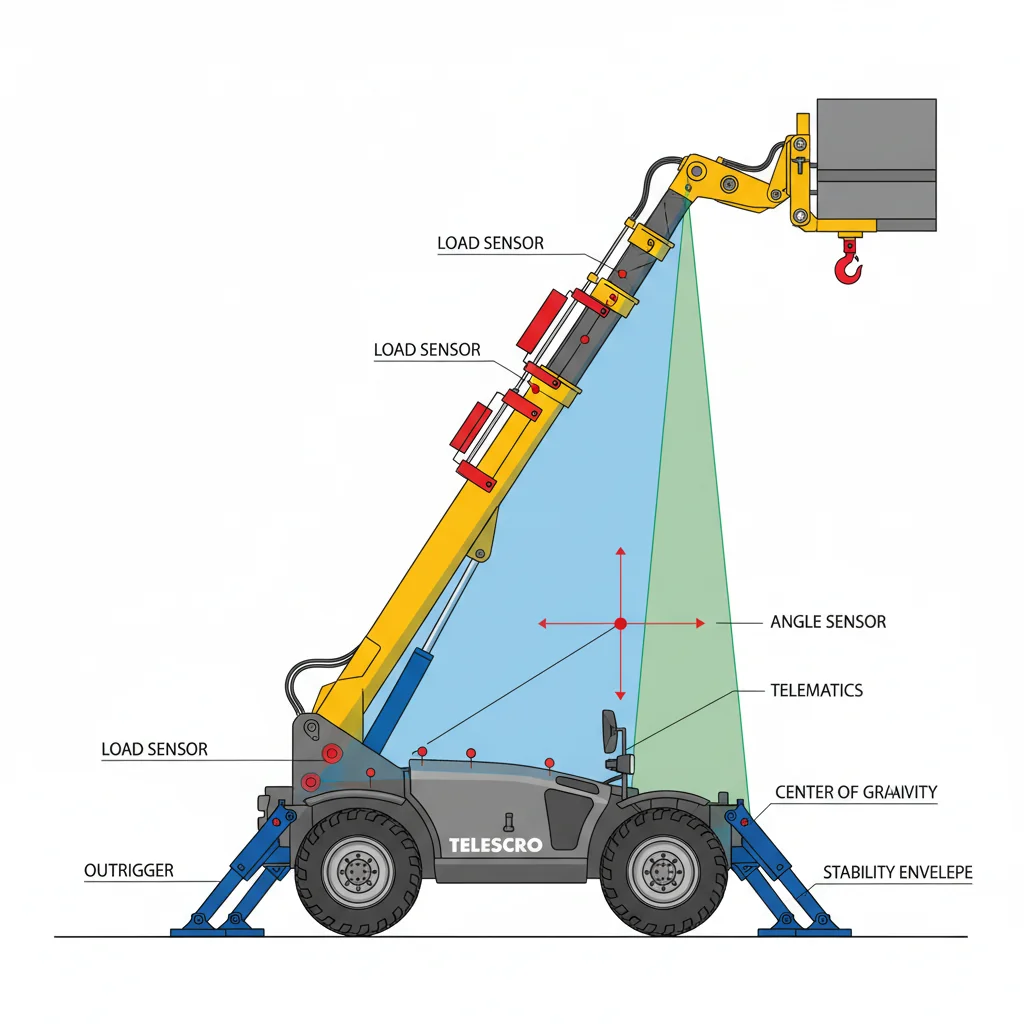
Last year, I helped a contractor in Dubai compare telehandler models for a tower project with limited access and soft ground—classic high-risk conditions. He hesitated at the extra 12% cost for units with load management systems, full outriggers, and telematics. But after I shared how quickly a tip-over can lead to $15,000 in crane recovery, repairs, and days of lost work, the choice became clear. On narrow or uneven sites, these stability features aren’t just “nice to have”—they’re frontline protection for your team, your schedule, and your bottom line.
When considering advanced stability, here are practical benefits I see on real jobsites:
- Outriggers – Provide crucial support on uneven or unstable ground. A 4-ton unit with outriggers maintains nearly full capacity at 15 meters, where a base-only model drops off sharply.
- Load Management Systems (LMS) – Give live feedback and restrict unsafe lifts. I’ve seen rental units in Brazil auto-lock booms before operators reached a dangerous moment.
- Telematics – Allow remote monitoring of load events, shock, and misuse. Managers in Kenya use this data for incident reviews and operator coaching.
- Better Documentation – Recorded stability events help with insurance claims and jobsite audits, improving credibility with clients.
- Operator Confidence – Clear indicators and alarms help less experienced crews stay within safe limits, reducing guesswork under pressure.
To be honest, I always recommend matching stability investments to the risk profile. If your lifts involve congested spaces, challenging terrain, or mixed operator skill, the added 10–15% is a hedge against far bigger risks. I suggest weighing total jobsite cost, not just the machine price.
Advanced telehandler stability systems continuously monitor the boom angle, extension, and load weight to dynamically adjust hydraulic pressure and prevent tipping even on uneven terrainTrue
Modern load management systems integrate sensor data on boom position and load mass to modulate hydraulic functions in real-time, maintaining stability margins before the operator reaches risky configurations, which is critical on soft or sloped surfaces.
Telehandlers with full outriggers rely solely on mechanical lock systems and do not require electronic load management to maintain stability under heavy loadsFalse
While outriggers provide crucial physical support, stability depends on coordinated electronic load sensing and management systems to alert operators and adjust machine behavior; purely mechanical locks cannot compensate for dynamic load shifts or soft ground conditions.
Key takeaway: Investing in advanced telehandler stability features is often financially wise for high-risk environments. The extra 10–15% cost for integrated systems may prevent incidents that cause far greater direct and indirect expenses, making enhanced safety technology a practical choice for many operators.
Conclusion
We’ve talked about why understanding your telehandler’s stability triangle and center of gravity is so important for safe lifting. Spending a few extra minutes on proper setup pays off far more than chasing max specs or rushing to get started. From what I’ve seen on real jobsites, overlooking basics like operator manuals and load charts causes more headaches than any "showroom hero, jobsite zero" machine ever will.
If you’re unsure about a specific load, attachment, or working angle, feel free to reach out—I’ve helped crews in all kinds of conditions and I’m happy to help you figure out what works best. The right telehandler choice depends on your actual jobsite needs, not just what’s written in the brochure.
References
-
Explains the core safety principle behind telehandler stability with expert insights on load balance and tipping risks. ↩
-
Explore how outriggers expand the support base and reduce tipping risks, crucial for safe telehandler operation on uneven ground. ↩
-
Learn how frame leveling helps counteract side slopes and why proper setup before lifting is essential to maintain balance. ↩
-
Details how moment indicators monitor load moments to prevent tipping, featuring real-world examples and best practices. ↩
-
Understand how to interpret load charts to avoid overload and tipping risks, critical for safe and efficient telehandler use. ↩
-
Explains the essential safety step of dry running a telehandler to verify boom position and prevent overload accidents. ↩
-
Explains how a longer wheelbase enhances balance and resists tipping forces, crucial for safe heavy load lifts in rough terrain. ↩
-
Details how substantial low-mounted rear counterweights improve forward stability during max reach lifts, ensuring safer operations. ↩
-
Explore how electronic load management systems use real-time data to prevent tipping and enhance operator safety in telehandlers. ↩
-
Learn how telematics dashboards enable site managers to analyze stability data, optimize safety protocols, and reduce incidents in fleet operations. ↩
-
Explains how regular tire pressure checks prevent tipping by maintaining chassis balance and safe center of gravity. ↩
-
Comprehensive overview of EN 1459 standards ensuring telehandler safety and compliance with EU stability and tilt tolerance requirements. ↩
-
Detailed explanation of load chart accuracy’s role in preventing tipping incidents and ensuring safe telehandler operation on varied terrains. ↩