










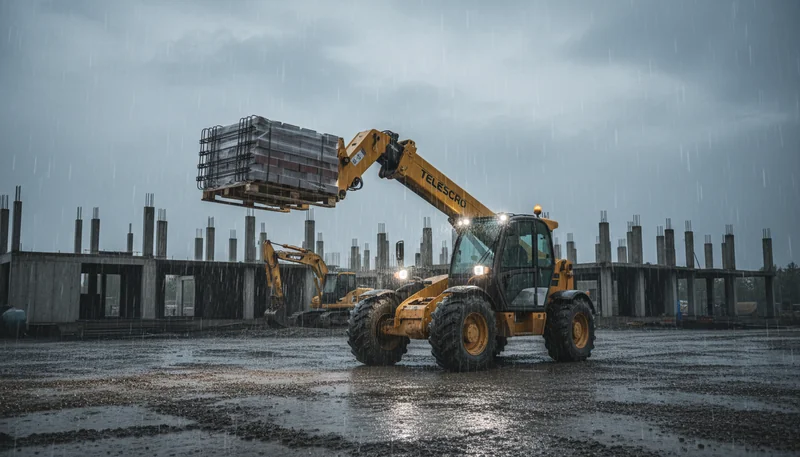
Telehandler Specs in Bad Weather: What Field Engineers Know (and Most Miss)
Earlier this year, I watched a crew in Jiangsu try to lift steel trusses during a sudden typhoon warning. Even with experienced operators and a brand-new telehandler, the machine’s stability shifted completely once the wind picked up. It reminded me just how deceptive “specs” can be when weather turns ugly.
Telehandler rated capacities and load charts1 are verified under controlled conditions—firm, level support and defined configurations, typically assuming calm air and compact, non-sail-like loads2. Standards such as EN 1459 and ASME B56.6 verify stability in specified test setups, but they don’t guarantee safe performance on soft ground, ice, or in gusty winds. In bad weather, wind loading, reduced ground bearing, and load geometry can shrink the usable working envelope and increase tip-over risk.
Do telehandler specs factor in bad weather?
Telehandler load charts3 are developed and verified under specified, controlled conditions—firm, level support and defined configurations, typically assuming stable loads and compliance with OEM-stated limits. They do not model site variables such as rain-softened ground, mud, ice, or wind effects, all of which can significantly reduce real-world rated capacity4 and stability. In adverse weather, safe field operation usually requires applying more conservative, site-specific working limits below the published chart values.
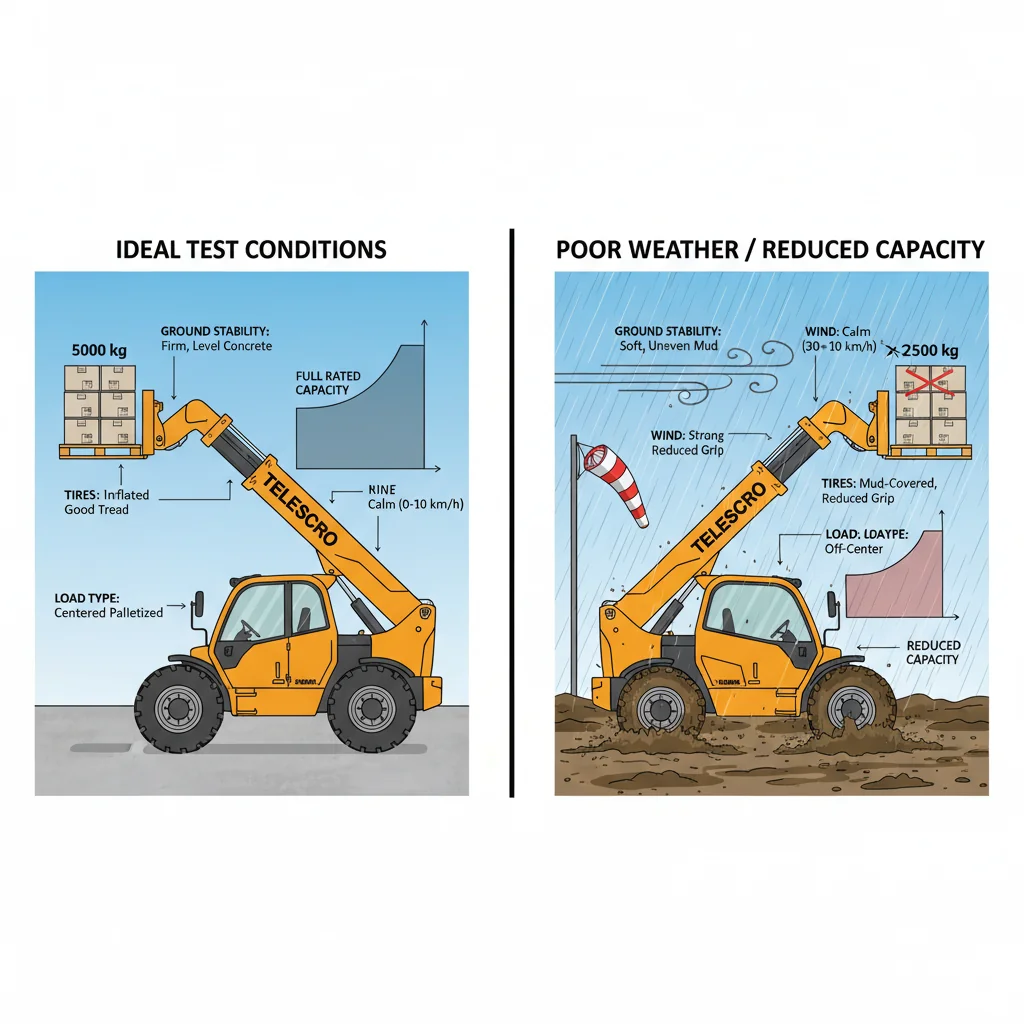
Most people don’t realize that telehandler specs are set under perfect test conditions—firm, level ground, no wind, and a well-packed, stable load. But jobsites are rarely that simple, especially once bad weather rolls in. I’ve been on sites in Kazakhstan during spring thaw where ground firmness changed by the hour. One minute, capacity looked fine on the chart. Then rain turned the dirt to mud, and suddenly, that 3,500 kg lift became a real risk.
On paper, a 12-meter telehandler rated for 4,000 kg sounds unbeatable. But standing water, ice, or sloppy clay can make the real safe lifting limit much lower—sometimes 60% of what the chart says. I had a customer in Brazil move coffee bins after heavy storms; the tires began to sink, and the moment indicator5 (the safety system that warns of overload) beeped constantly. They ended up reducing load size, even halving it, just to keep stability. That’s not in any load chart.
To be honest, I always suggest planning for a safety margin when weather is an issue. Load charts are a ceiling, not a guarantee for muddy or windy days. Consider wind too—anything above a gentle breeze adds force on the boom and destabilizes the machine. Make sure your crew checks ground conditions and reduces capacity when needed. I tell buyers: if you expect rough weather, choose a telehandler with reserve capacity and never push loads to chart limits. That’s the difference between “good on paper” and safe in the field.
Telehandler load charts do not account for the added risk of wind or soft ground, so operators must make manual adjustments when weather conditions worsen.True
Manufacturers determine telehandler specs like lifting capacity and reach based on controlled, ideal test environments. Wind, rain, mud, and unstable surfaces aren't factored into standard load charts, which means these real-world risks require field judgment and modified operation for safety.
If you reduce a telehandler’s rated capacity to account for rain or wind, it will void the manufacturer’s warranty.False
Reducing the actual load below the rated capacity for additional safety in bad weather is recommended practice and won’t void any warranty. Manufacturer warranties are voided by exceeding specs or misuse, not by operating more conservatively in challenging conditions.
Key takeaway: Telehandler load charts reflect maximum rated capacity under perfect conditions, not everyday jobsite realities. In challenging weather—mud, wind, ice, or uneven terrain—contractors and farmers should treat published specs as an upper limit and build in extra safety margin when planning lifts.
Are telehandler specs valid in strong winds?
Yes, but only within strict limits. Telehandler rated lifting capacities are only valid when wind speeds remain within the manufacturer’s stated maximum wind speed6 for the specific machine configuration and attachment in use. These limits are defined by each OEM and are not universal; once wind speed exceeds the specified maximum, operation must stop regardless of load chart values. Because wind speed increases with height and can differ significantly from ground-level readings, in-field wind measurement is essential for safe operation in strong winds.

Let me share something important about telehandler specs and wind—this is where even experienced crews can get caught out. The rated lifting capacities shown on the load chart only apply up to the manufacturer’s stated wind speed limit for the specific machine configuration and attachment in use. I’ve seen sites in Dubai and Kazakhstan where ground-level wind seemed acceptable, but when measured at the boom tip with an anemometer, readings were significantly higher—a clear no-go, even with a partially loaded attachment. At height, wind can be substantially stronger than at ground level, and gusts make conditions even more unpredictable.
Customers in coastal areas, like one builder I worked with in western Australia, often overlook this. They set up a 14-meter telehandler for steel panel installation. The panel acted like a sail, and even at 80% of rated load, the moment indicator tripped the alarm at just under the wind limit. That team learned to measure wind speed directly at working height, not just check a weather app. On exposed sites or rooftops, this practice can prevent real accidents.
So, even if your planned lift is well under the rated chart value, wind introduces extra forces the machine isn’t designed to handle. I always advise using an anemometer at boom height and setting jobsite wind thresholds more conservatively—maybe 10 or 11 m/s for exposed loads. And as wind picks up, keep boom length and height shorter, especially with panels, trusses, or mesh. This approach keeps people and property safe.
Telehandler rated lifting capacities are only valid if wind speeds stay within the manufacturer's specified limits, which are based on tests conducted in controlled wind conditions at full boom extension.True
Manufacturers determine load charts based on specific test criteria, including maximum allowable wind speeds. Exceeding these wind speeds affects machine stability and invalidates the published lifting capacities, making actual site conditions critical for safe operation.
Telehandler load charts account for wind gusts above the rated wind speed, so operators do not need to reduce loads if sudden gusts occur.False
Load charts do not factor in unexpected wind gusts above the rated speed. Operating during gusty or unpredictable winds can make the telehandler unstable and unsafe, requiring operators to reduce loads or stop lifts altogether if wind conditions exceed safe limits.
Key takeaway: Telehandler rated capacities assume winds below a specific OEM-stated limit—usually 12.5–14 m/s at max height. Due to unpredictable, higher winds at elevation, field engineers should use an anemometer at boom height and set conservative site limits below manufacturer maximums for safety.
How do sail-like loads impact wind safety?
Large, flat loads on telehandlers—such as cladding, panels, or trusses—act like sails, creating high sideways wind forces not shown in standard load charts. In gusty or funnelling winds, these loads can cause tip risk well below rated capacity. Most manufacturers prohibit large-area lifting as wind approaches placarded site limits.
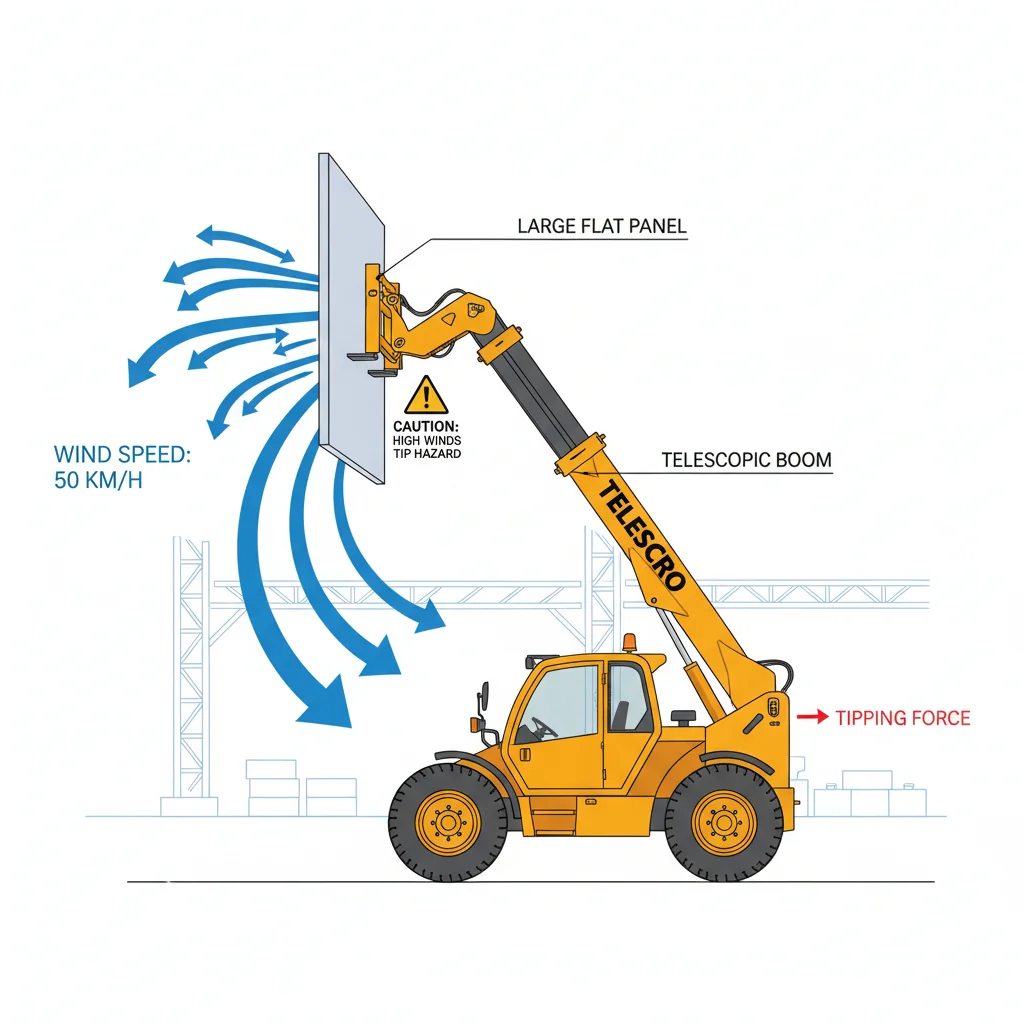
I’ve worked with customers in Peru who’ve been caught off guard by how quickly wind can turn a normal lift into a risky situation. The moment you hang a large cladding panel or a wide truss on the forks, you’re no longer just lifting weight—you’re also resisting wind-induced side loads. Large, flat loads can generate significant lateral forces even in moderate winds, increasing the overturning moment on the machine. In these conditions, a telehandler can approach a tip risk well below its rated capacity shown on the load chart.
Here’s what matters most when working at height with large, flat materials: standard telehandler load charts assume calm conditions and compact loads. They do not factor in sail-like wind loads or the extra tipping moment caused by side gusts. Machines can feel suddenly “light” on the upwind side or sway unpredictably. I’ve seen one crew in Kazakhstan nearly lose an insulated panel when a sudden funneling wind made the boom rock—well below any stickered capacity limit. The site wind monitor read only 9 m/s, but the load started to “sail” the machine.
For jobs like glass, roofing sheet, or panel installation outdoors, treat wind as a critical safety limit—not just another site annoyance. Most manufacturers advise stopping panel lifts as wind nears placarded site limits and absolutely above 7–8 m/s for big surface materials. Always double-check the load chart and the operator’s manual, and if you’re not sure, stop and ask. In windy conditions, err on the side of caution—your machine and crew will thank you.
Telehandler rated capacities do not account for the additional sideways forces created by wind on sail-like loads, making lifts riskier than the data plate suggests in gusty conditions.True
Manufacturers derive telehandler capacity ratings for still air and ideal conditions; large, flat surfaces like cladding panels can generate substantial wind-induced side loads not reflected in standard lifting charts, increasing the tipping risk even when staying within rated weight limits.
If you stay under the rated capacity shown on the telehandler’s data plate, you are fully protected from tip-over risks, even when handling large panels in windy conditions.False
The data plate capacity assumes stable, calm environments and does not factor in added wind forces on wide or flat loads. Wind can create extra side loads on the telehandler, potentially causing tip-over below the listed capacity.
Key takeaway: Always treat large-surface-area loads on telehandlers as a special risk in windy conditions. Follow manufacturer and site-specific wind rules, avoid panel lifts above 7–8 m/s, and consult the machine’s load chart—standard charts do not account for sail-like wind loads or associated tip hazards.
How Do Wet Surfaces Affect Telehandler Capacity?
Wet or soft ground dramatically reduces telehandler stability and usable capacity. Load charts assume firm, level support; on rain-soaked or disturbed soil, telehandlers can sink or lean, eroding the chart’s safety margin and increasing tip-over risk. Actual wheel and axle loads can exceed the bearing capacity of weak ground, making capacity derating and appropriate ground pressure mitigation7 essential.

Here’s what matters most when your jobsite surface turns wet or soft: load chart numbers are only valid on firm, stable ground. Those impressive capacities—like lifting 4,000 kg at 10 meters—can disappear the moment your telehandler’s tires start sinking into muddy soil. I’ve seen this first-hand on a project in Kazakhstan after a heavy rain. The ground looked solid in the morning. By 2 p.m., two wheels had sunken almost 80 mm during a lift, shifting the whole machine and nearly tipping a load that was well within the rated chart.
Steel tracks and stabilizer mats are common in Australia and parts of Africa—contractors there don’t trust any soft ground. There’s a good reason. A typical 9-ton machine can put up to 80 kN (around 8 tons) of load onto each wheel when lifting at maximum reach. Soft or waterlogged soil can’t handle that pressure. Even a small shift—less than 5 cm—can change the machine’s center of gravity and create a dangerous, silent loss of stability mid-lift.
From my experience, the biggest mistake is forgetting that the load chart assumes every wheel stays exactly where it started. On wet ground, you need to reduce both capacity and reach significantly. Keep the boom retracted and low, and if you must work on questionable surfaces, always spread the load with heavy mats or steel plates. If the job calls for a high lift over suspect ground, I suggest using a machine with front stabilizers, or switching to a rotating telehandler or crane for safety. Your rated capacity is not a guarantee—it’s a best-case scenario.
Telehandler rated capacities listed in load charts do not account for wet or unstable ground conditions, making them unreliable when operating on such surfaces.True
Load charts are based on tests performed on firm, level ground. Wet or soft surfaces reduce stability and can significantly decrease the safe lifting capacity of the machine, even though the numbers in the load chart remain unchanged.
As long as a telehandler is equipped with rough-terrain tires, its maximum lifting capacity remains unchanged, even when operating on wet or muddy surfaces.False
Rough-terrain tires improve traction and mobility but do not compensate for the loss of ground stability. Wet or muddy conditions can still cause the telehandler to sink or become unstable, reducing safe lifting capacity regardless of tire type.
Key takeaway: Load chart capacities only apply on firm, level ground. Wet, muddy, or soft surfaces destroy assumed stability, increasing tip-over risk—even in mid-lift. Always reduce capacity and reach, keep the boom low, and use mats or plates to spread load on questionable ground conditions.
When Should Telehandlers Stop for Bad Weather?
Telehandler operations must stop immediately in storms, when wind speeds exceed the manufacturer’s rated maximum, or when ground conditions are unsafe. Manufacturer load charts8 define absolute safety limits. Site management must assess both current and forecasted conditions. If weather is marginal and limits are approached, industry best practice is to suspend operations until safe parameters return.
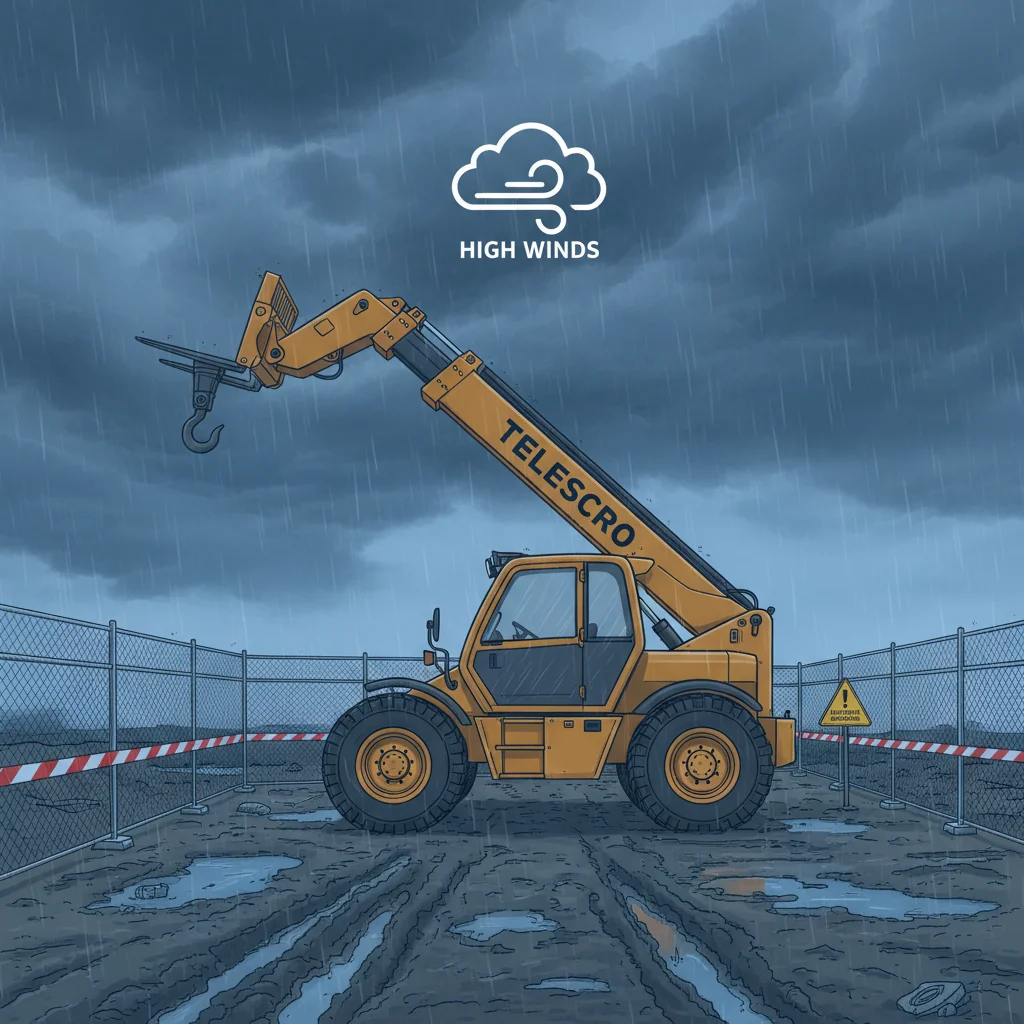
The biggest mistake I see is treating weather limits as guidelines instead of hard stops. There’s no room for negotiation—manufacturer load charts and manuals set the maximum wind speed, rated ground conditions, and sometimes even rain or snow thresholds. For example, I worked with a contractor in Kazakhstan last winter. Their 4-ton high-reach telehandler was lifting HVAC units at 14 meters. The load chart clearly showed a max wind speed of 11 m/s for their setup. Afternoon gusts hit that limit. The site supervisor wanted to "just finish." But with wind at the rated maximum and ice building up, the risk went off the charts. I advised them to stand down. It delayed their schedule by half a day but saved their machine—and probably lives.
Manufacturer limits aren’t targets to “push”—they’re absolute ceilings. Wind ratings defined in standards such as EN 280 for MEWPs cannot be assumed to apply to telehandlers. For telehandlers, allowable wind speeds and operating limits depend on the specific model, configuration, and attachment, and are defined in the load chart or operator’s manual. I’ve seen sites in Brazil apply additional site-specific safety margins when heavy rain or poor visibility reduced control. In parts of Europe, some contractors halt elevated work altogether once ground conditions become soft or slippery after storms—no compromise, even under schedule pressure.
From my experience, changing weather is the silent danger. Soft soil, a few sudden gusts, or sleet can push a stable setup outside its envelope fast. Pausing operations before you’re forced into an emergency is the mark of a professional site. I always suggest reviewing both the current and forecast conditions before every lift—risk increases long before you hit official limits.
Telehandlers must stop operation immediately if actual wind speeds reach the maximum listed in the manufacturer’s load chart, even if the load is lighter than the rated capacity.True
Wind forces affect not just the weight but also the stability and structural safety of telehandlers, especially when lifting at height. Exceeding published wind speed limits voids manufacturer safety calculations, regardless of actual load weight.
If ground conditions worsen due to rain but the telehandler has outriggers, it is always safe to continue operating at full rated capacity.False
Outriggers can improve stability, but waterlogged or unstable ground compromises support and can lead to tipping, regardless of the presence of outriggers. Manufacturer ground condition specs must still be met for safe operation.
Key takeaway: Telehandler operation limits for weather are absolute—manufacturer load charts and manuals set ceilings for wind, precipitation, and ground conditions. Site management is responsible for pausing work in marginal or escalating conditions. Standing down when conditions are close to limits prevents accidents and protects lives and equipment.
How Does Cold Weather Impact Telehandler Specs?
Extreme cold does not change the published telehandler load chart, but it has a clear impact on how safely and predictably the machine can be operated. Slower hydraulic response, difficult cold starts, reduced lubrication effectiveness, and longer stopping distances on icy surfaces all reduce usable performance. OEM-approved cold-weather kits9 and suitable fluids extend the operating range into low temperatures, but conservative operation and additional warm-up time remain essential in cold conditions.
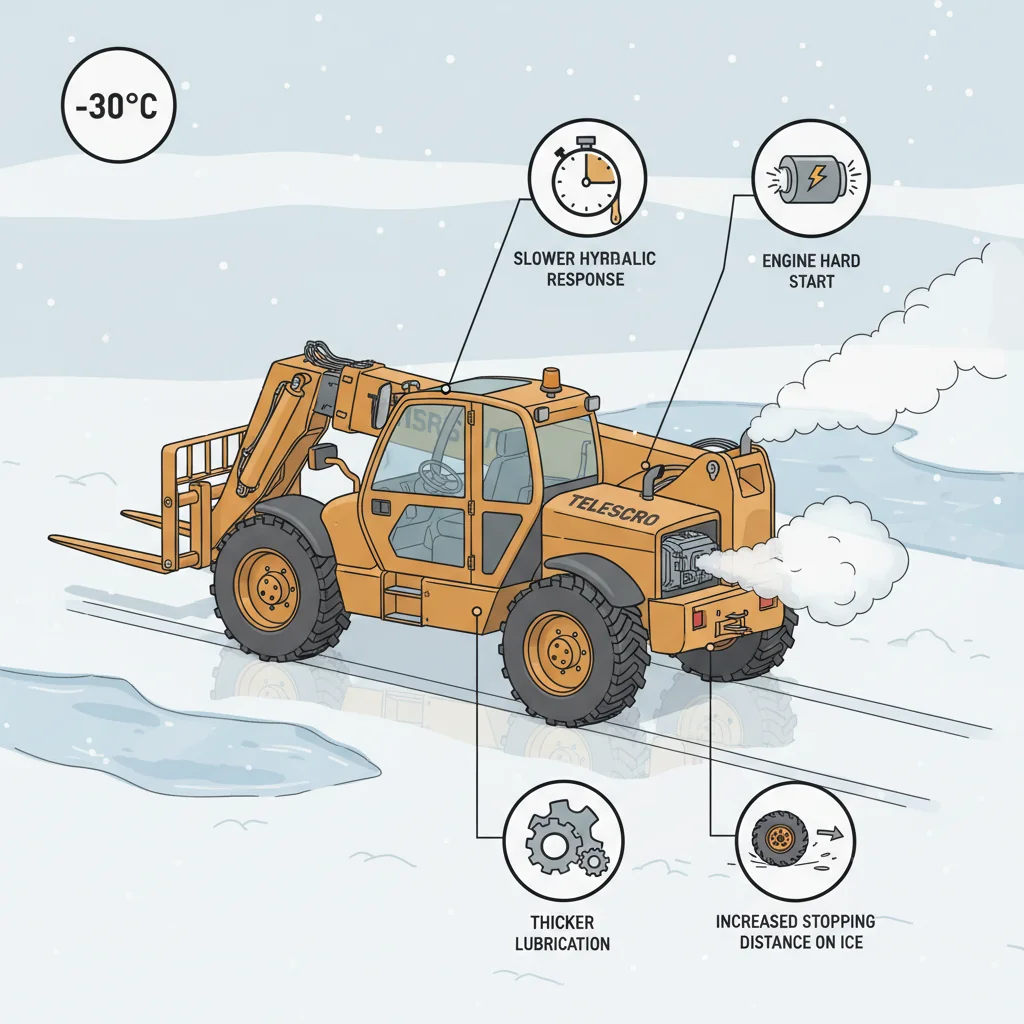
Last winter, I worked with a project team in Colombia on a high-altitude construction site where overnight temperatures regularly dropped well below freezing. On paper, their 4-ton, 13-meter telehandler met all the lifting requirements. In practice, the first hours of each morning were the most challenging. Cold starts took noticeably longer, boom movements felt sluggish, and hydraulic response lagged until the machine was fully warmed. The load chart itself didn’t change, but operating close to maximum capacity early in the shift felt unnecessarily risky, so the crew chose to work with additional margin until machine response normalized.
Cold weather affects more than just starting performance. As temperatures drop, hydraulic oil thickens and lubrication becomes less effective, making boom extension, tilt, and stabilizer movements slower and less precise. I’ve seen boom pins and wear points complain audibly when lubrication can’t flow properly in the cold. Traction is another overlooked issue—on icy or compacted surfaces, stopping distances increase and sudden inputs become harder to control, even with industrial or hybrid tires.
From my experience, cold-weather preparation is critical for any operation outside mild climates. Battery heaters, block heaters, and low-temperature hydraulic oils—as outlined in OEM guidance—make a real difference, but they don’t eliminate the need for patience. Longer warm-up periods, smoother control inputs, and keeping extra distance from load chart limits are all part of working safely in the cold. The specs on paper stay the same, but cold weather narrows the margin for error, making disciplined operation far more important.
Hydraulic fluid thickens in extreme cold, causing delayed or sluggish boom movements that are not accounted for in the standard telehandler load charts.True
Standard load charts assume optimal fluid viscosity, but in low temperatures, hydraulic oil can become more viscous, slowing response times and affecting real-world performance without changing the published specifications.
If a telehandler’s standard specs list a maximum lifting height of 13 meters, the boom will always reach that height regardless of temperature or weather conditions.False
Extreme cold can lead to hydraulic and mechanical issues, such as slow or incomplete cylinder extension, which may prevent the boom from reliably reaching its maximum rated height even if the specs say otherwise.
Key takeaway: Telehandler specifications on paper remain unchanged in cold weather, but actual machine performance, handling, and operator control are degraded below -20°C. Field engineers recommend slower operation, manufacturer-approved low-temp fluids, and conservative lift practices to maintain safety and reliability during extreme cold snaps.
Which Telehandler Specs Matter in Bad Weather?
Critical telehandler specs for bad weather include maximum rated wind speed10 (for each attachment), approved ambient temperature range11, ground-slope limits for lifting and travel, tire type with aggressive tread, 4WD or locking differentials, and frame-levelling features. Operator cab design—heated, enclosed, with demisters, wipers, work lights, and advanced safety indicators—directly affects productivity and safety in challenging conditions.
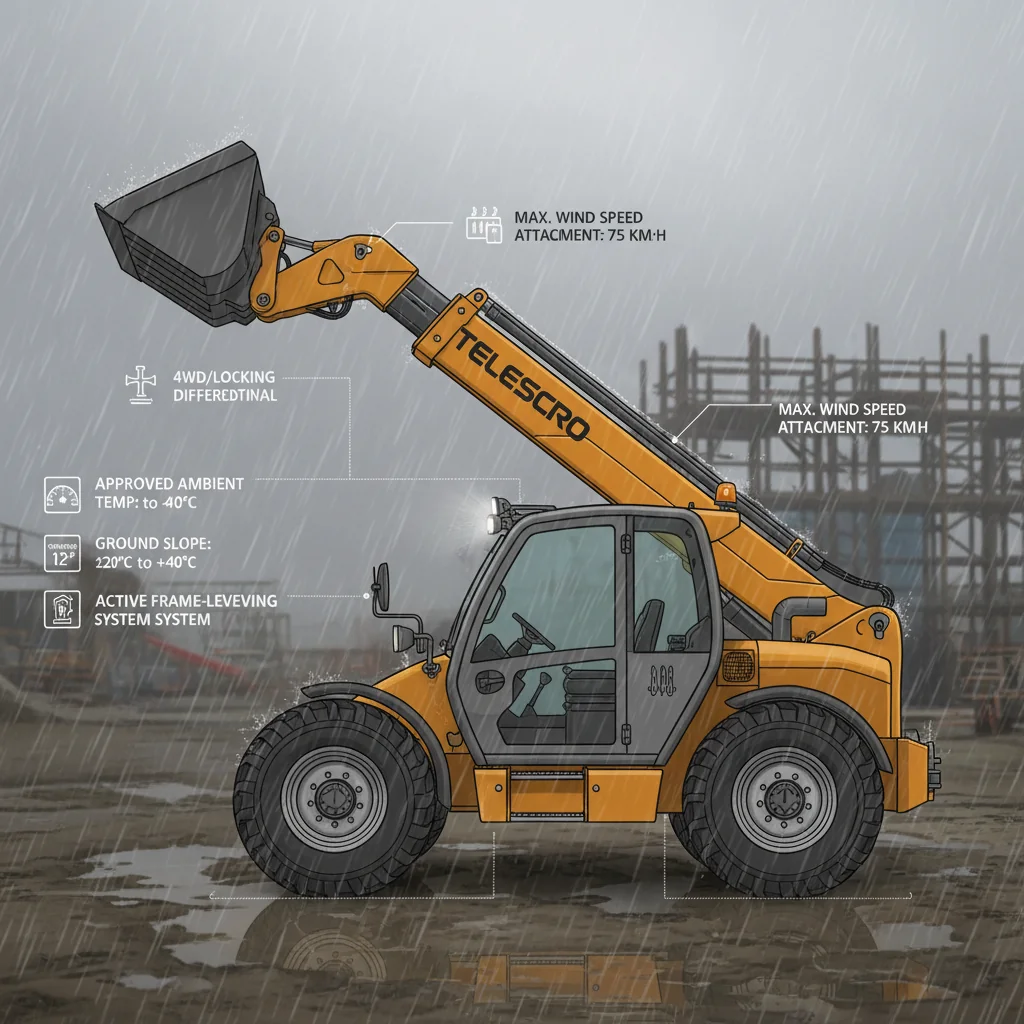
Last month, a contractor in northern Kazakhstan asked me why his 14-meter telehandler kept failing safety checks during winter lifts. He’d chosen a machine with plenty of height and capacity, but never checked its approved wind speed or cold-weather operation range. In that region, gusts hit 40 km/h and temperatures drop well below -20°C. Without a certified wind speed limit for both forks and jib, or a cab heater and demisters, productivity just collapsed—twice his crew had to stop work while waiting for visibility and controls to catch up. To be honest, lift performance in bad weather is less about headline numbers and more about whether the machine can actually operate near its “limit” conditions.
Here’s a quick comparison of the specs that matter most when weather turns ugly:
| Spec | Bad Weather Impact | Questions to Ask |
|---|---|---|
| Rated wind speed (by attachment) | Determines whether outdoor lifts are permitted and how quickly the envelope shrinks in gusts | “What is the maximum wind speed for forks vs. jib/hook vs. any approved platform?” |
| Approved ambient temperature range | Cold starts, hydraulic response, and control lag | “Is there an OEM cold-weather package and what temperature range is stated?” |
| Ground/slope limits (lift & travel) | Stability on ruts, soft shoulders, and slippery grades | “What are the lift/travel slope limits and any ‘pick-and-carry’ restrictions?” |
| Tires & tread options | Traction and flotation in mud/snow | “What tire options (industrial/ag, foam-filled) are available for my ground conditions?” |
| 4WD / diff lock / axle lock | Mobility and control on soft or uneven ground | “Is diff lock/axle lock available, and what are the usage limitations?” |
| Frame leveling | Helps keep the boom reference upright within a limited correction angle | “What is the frame-leveling range and what does the manual require before lifting?” |
Telehandler maximum allowable wind speeds are attachment- and configuration-specific, and must be taken from the load chart or operator manual for the tool in use, rather than assumed from the standard fork rating.True
Different attachments such as jibs, hooks, or approved work platforms change the machine’s stability and wind exposure. Manufacturers therefore specify wind speed limits by configuration or attachment, and operators must verify and follow the limit stated for the exact setup being used.
If a telehandler’s load chart shows a capacity for a given boom position, it will always be safe to operate at that position, regardless of temperature.False
Cold temperatures can impact hydraulic fluid viscosity and electronic sensor performance, potentially reducing safe operating limits. Manufacturers may recommend reduced capacities or modified operation guidelines in extreme cold, so load chart ratings are not always valid in all weather conditions.
Key takeaway: Selecting a telehandler for adverse weather means prioritizing lift and drive performance under wind, temperature, and ground conditions—plus operator comfort and visibility features. Advanced safety systems and the right tire and drive configurations are essential for reliable, safe operation on site.
Why oversize telehandlers for bad weather?
Oversizing telehandlers ensures a safety margin when weather conditions worsen. A unit operating near its rated capacity in ideal conditions may have no buffer in wind, rain, or on soft ground. Selecting models with 15–25% higher rated capacity allows continued, safer operation within reduced envelopes advised by industry safety practices.
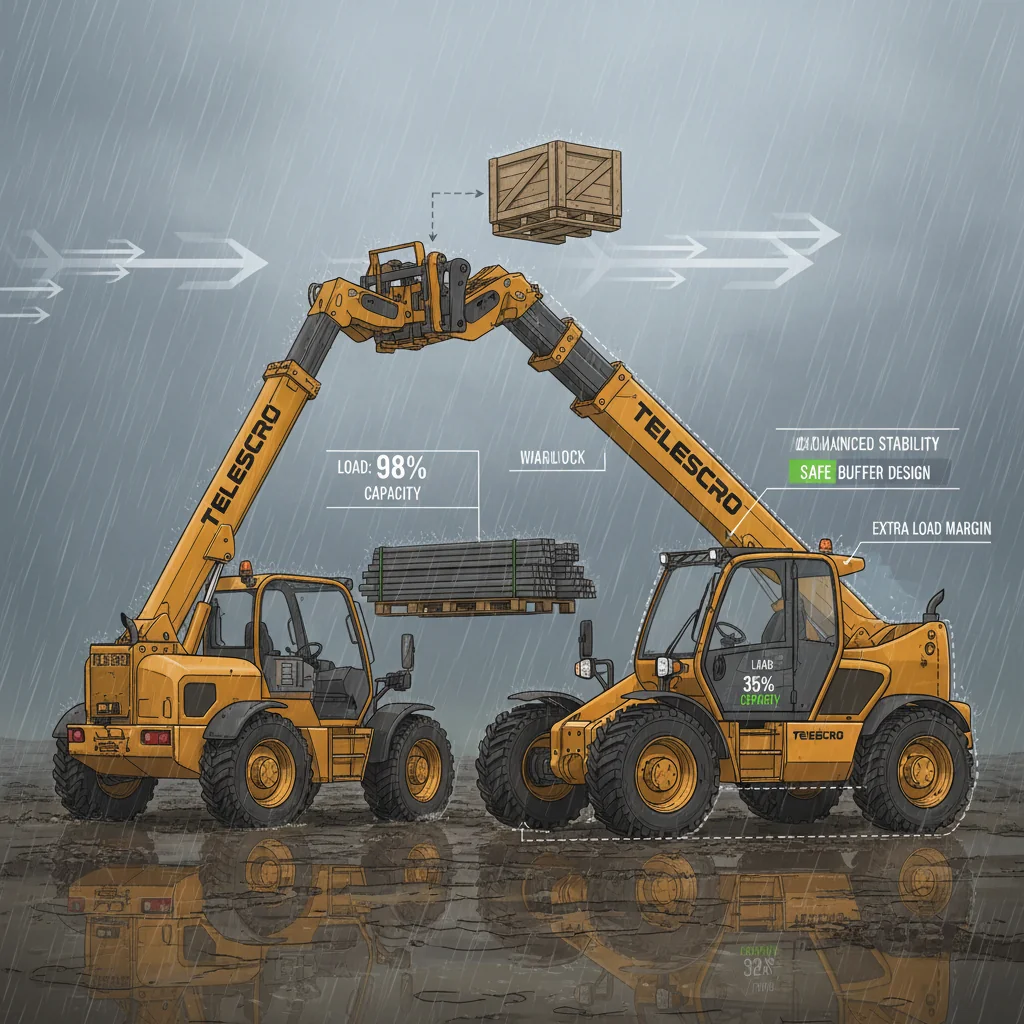
To be honest, the spec that actually matters is how much margin you leave for unexpected conditions—especially when weather turns rough. I’ve worked with contractors in central China who sized their telehandlers based on sunny-day loads, only to run into trouble the minute it rained and ground firmness changed.
The reality is, rated capacity on the load chart only holds if you’re on level, firm ground—usually within 3 degrees of tilt—using the exact attachment specified by the manufacturer. As soon as conditions turn soggy, windy, or uneven, that safe working envelope shrinks quickly.
Let me give you a real example from a jobsite in Kazakhstan. The customer routinely lifted 3-ton steel bundles to 8 meters using a 3.0 t / 8 m telehandler without issues on dry, compacted soil. After a week of spring rain, however, the ground softened and the tires began to sink. Almost immediately, any stability margin disappeared. The team was forced to stop work because the load moment indicator12 triggered warnings on every pick.
In the end, they had to rent an additional 4-ton unit just to keep production moving—an expensive solution in the middle of a tight schedule. That’s why I generally recommend selecting a telehandler with 15–25% extra rated capacity when the job regularly involves lifting near chart limits, especially in outdoor environments. That additional margin helps crews stay within the reduced operating envelope required by safety teams when wind increases or ground conditions fall out of specification—and it’s rarely wasted money.
A telehandler’s rated lifting capacity is only valid when used on level, firm ground with the attachments specified by the manufacturer.True
Load charts are based on controlled test conditions, and any deviation—such as uneven ground, mud, or different attachments—reduces the machine’s actual stable capacity.
Increasing the rated capacity of a telehandler guarantees it will perform safely in all weather conditions.False
Even a higher-capacity telehandler can become unstable or lose traction on uneven or soft ground; adverse weather introduces risks that cannot be compensated for solely by larger specs.
Key takeaway: Selecting a telehandler with extra rated capacity provides vital safety and productivity margins in real-world weather and site conditions. This approach minimizes risk of unsafe derating, costly stoppages, or incidents, and is often more cost-effective than frequently being forced to stop or upgrade mid-project.
How Does Bad Weather Affect Telehandler Maintenance?
Bad weather significantly increases telehandler maintenance needs. Mud, rain, and road salt accelerate wear on booms, pins, and electrical components by introducing grit and moisture, causing corrosion and scoring. Cold temperatures create additional risks, requiring more frequent greasing, inspections, special oils, regular cleaning, and seasonal fuel adaptation for reliable operation in harsh outdoor environments.

The biggest mistake I see is underestimating how quickly bad weather can damage a telehandler. Mud and rain don’t just create messy jobsites—they force grit and water deep into boom sections and pivot pins. I’ve seen this firsthand on projects in northern Europe, where crews had to significantly increase boom lubrication13 frequency after operating in heavy rain or clay. When this additional lubrication and cleaning is skipped, boom sections can begin to score and corrode much faster than expected. Road salt in winter is even more aggressive, attacking exposed steel and electrical connectors. I helped a fleet in Canada where insufficient cleaning after winter operation led to serious corrosion inside the boom base and unplanned repair costs.
Cold weather brings a different set of challenges. When temperatures fall below –10°C, standard diesel can start to gel, so I always remind customers to switch to winter-grade fuel14. In Kazakhstan, one farmer ignored this and lost two days of work waiting for the hydraulic system to thaw after the oil thickened. The wrong oil grade slows boom response and increases wear on seals and hoses. And don’t forget DEF/AdBlue—if it crystallizes inside the reservoir at low temperatures, cleaning it means downtime you can’t afford.
To keep your machine reliable, I suggest ramping up maintenance any time harsh weather hits. That means cleaning the undercarriage and boom more often, inspecting wear pads weekly, and checking oil types before each season. Keep your wipers, demisters, and lights in working order—visibility and safe handling are even more critical in bad weather.
Telehandler manufacturer lubrication intervals are based on ideal conditions, so maintenance schedules must be shortened significantly when operating in persistent wet or muddy environments.True
Manufacturer recommendations assume clean and dry conditions; exposure to water and mud accelerates wear on boom sections and pivot points, requiring more frequent lubrication to prevent damage.
If a telehandler meets its IP (Ingress Protection) rating, its moving parts are fully protected from rain and mud, so no additional maintenance is needed in bad weather.False
IP ratings primarily address electrical components, not the heavy wear suffered by moving mechanical parts in wet or muddy conditions. Extra maintenance is always needed when contaminants reach mechanical systems.
Key takeaway: Harsh weather, including mud, rain, salt, and sub-zero temperatures, accelerates wear on critical telehandler components. Field practice and OEM guidance both support increasing cleaning, inspections, and lubrication frequencies. Adapting maintenance routines and materials for the season and environment is essential to ensure safety and maximize machine life.
How does wet weather impact telehandler loads?
Wet weather can significantly increase the actual weight of agricultural loads handled by telehandlers. Materials such as hay, straw, or silage absorb moisture, and mud or water can also adhere to buckets and forks, resulting in loads that are heavier than assumed. Combined with soft or uneven ground conditions, this added weight reduces stability margins and increases the risk of overload or tip-over.
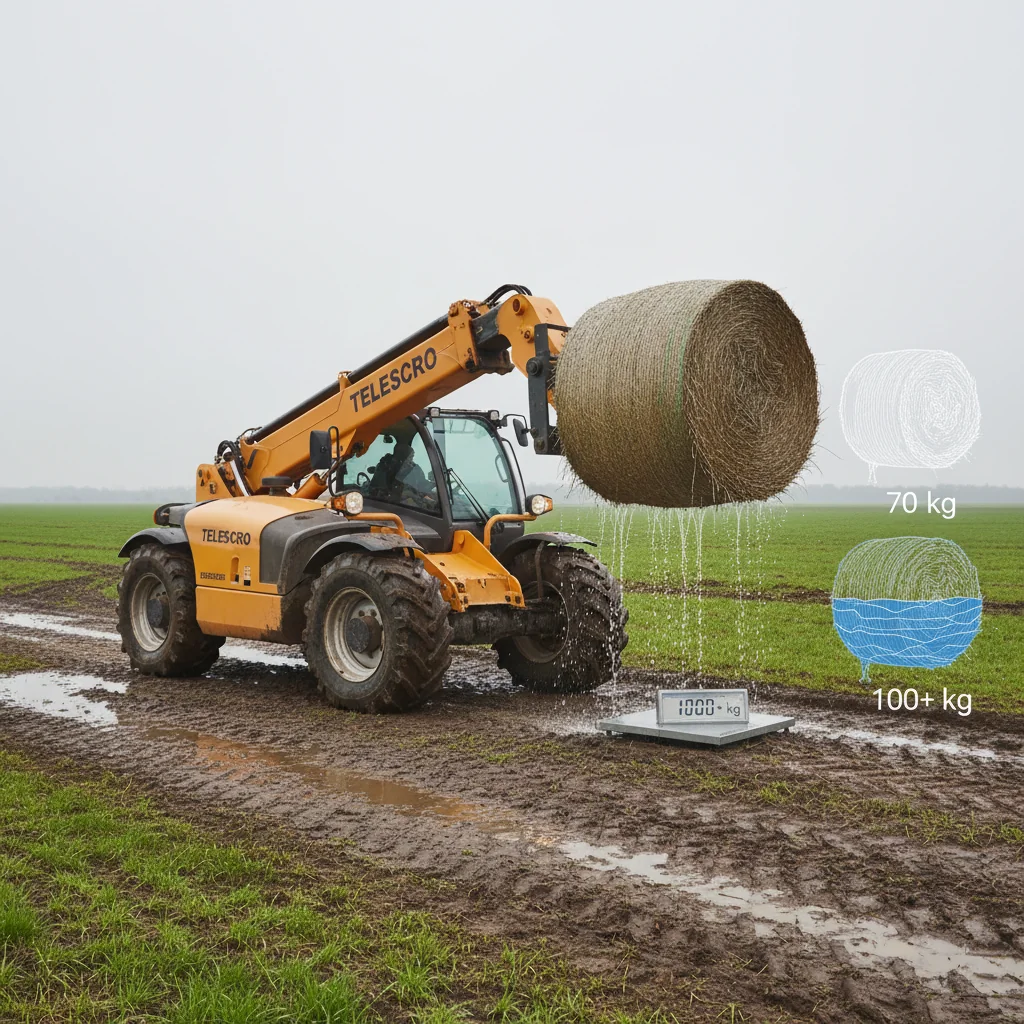
From my experience, operators rarely factor in how much moisture can change the actual weight of agricultural loads. A round bale that’s listed at 700 kg dry can easily tip the scale at over 1,000 kg after a heavy rain, especially in regions like eastern Europe or Brazil where field storage is common. I’ve seen growers in Poland shocked to find the telehandler straining just to lift what should be a routine load—until we weighed the sopping-wet bale. Wet silage, grain, or manure also tends to stick inside the bucket or to the forks, so you end up lifting not just the material but a layer of mud or slush. It’s easy to overload the machine without realizing it.
One farm in Kazakhstan ran into stability problems because their 3.5-ton telehandler couldn’t handle the unexpected weight from soaked straw after a thaw. The moment indicator alarm went off more than once, warning them they’d passed rated capacity. The reality is, all those load chart numbers assume dry materials under ideal conditions—firm, level ground, standard forks, and the right load center. But after rain, the loads are heavier and the ground is soft, meaning tires can sink and make tipping much more likely. Wet workyards rarely provide the level surface the load chart expects—sometimes I see more than 5° of slope, and at that angle, rated capacity doesn’t apply at all.
Here’s my advice: in wet conditions, do not rely on dry or nominal material weights for hay, straw, or grain. Treat loads as heavier and less predictable, and avoid operating close to maximum load chart limits. If handling wet, heavy agricultural loads is routine, specifying a higher-capacity machine or reducing stacking height provides a safer and more consistent operating margin.
Telehandler rated lift capacities are based on dry materials and do not account for the increased weight of loads soaked by rain or surface moisture.True
Manufacturer specifications for telehandlers assume standard, dry material weights. When handling agricultural loads like hay, silage, or grain that have absorbed water, the actual load weight can exceed the equipment's rated capacity, leading to performance issues or safety hazards.
Telehandlers automatically calibrate their load sensors to adjust for changing moisture content in lifted materials.False
Most telehandlers do not have sensors that detect changes in load composition like water content. Their load monitoring systems measure total weight but cannot distinguish between dry mass and moisture, so operators must manually account for extra weight due to wet conditions.
Key takeaway: In bad weather, the real-world weight of agricultural loads often exceeds dry weights, risking overload and instability. Prudent field practice is to assume 20–30% added weight for wet materials and avoid operating near rated capacity. Consider machine upgrades or lowering stacking heights if heavy wet loads are routine.
How Does Bad Weather Affect Telehandler Capacity?
Bad weather limits telehandler usable capacity15 by reducing visibility and control, even when rated capacity, ground conditions, and wind remain within technical limits. Poor operator visibility and slippery surfaces16 make precise handling difficult, so practical capacity often falls below load chart values until clear sightlines and traction are restored.

Most buyers expect the telehandler to lift its full rated load as long as the chart says so, but rain, fog, or snow make that number almost impossible to reach on real jobsites. In harsh weather, visibility drops—sometimes you can’t even see the forks or the pallet corners. I remember a contractor in coastal Chile who lost half a day one winter trying to position 1.2-ton packs of tiles onto a third-floor scaffold with a 14-meter unit. The machine was technically well within its load chart, but heavy rain and fogged cab windows meant the operator had to stop repeatedly, wiping glass and checking blind spots.
The real problem is control. Slippery mud or ice can double your stopping distance, even with a rough-terrain machine. When tires lose grip, every small motion gets exaggerated—especially with a load out at 10 meters of reach. I’ve seen operators in northern China refuse to go above waist height when unloading trucks during a snowstorm, even though the spec sheet promised 4-ton lifts at 5 meters. It’s not just fear. When you can’t judge distance or spot ground hazards, your usable capacity drops fast—long before wind limits or structural warnings kick in.
So, I always tell customers to focus on what you can see and feel—clear sightlines, dry footsteps, boom kept tucked closer. Use all the cab features: demisters, strong wipers, clean mirrors, and full lighting. On bad days, keep travel speed down and avoid running at the limit of reach or capacity. Real-world safety means treating visibility and traction as core capacity factors—not just numbers on a load chart.
Telehandler rated load capacities are based on testing in ideal conditions and do not account for reduced visibility or slippery surfaces encountered in bad weather.True
Load charts assume stable footing, clear sightlines, and controlled environments. Weather variables like wet ground or fog increase the risks and reduce safe handling capacity, which means operators must adjust their working loads even if within the published chart limits.
If a telehandler is equipped with foam-filled tires, its load chart capacity remains unchanged regardless of weather conditions.False
Foam-filled tires may reduce the risk of punctures but they do not counteract the hazards of poor visibility, high winds, or slippery ground that impact safe lifting in bad weather. Operator judgment and site conditions still determine whether rated capacities can be safely achieved.
Key takeaway: Rated telehandler capacity assumes clear visibility and full operator control. In bad weather—heavy rain, fog, or snow—actual usable capacity may be much lower due to poor sight and reduced traction. Always prioritize visibility, conservative boom positions, and low travel speeds for safe handling.
Conclusion
We’ve looked at how telehandler specs don’t always tell the whole story—especially when the weather or ground conditions aren’t ideal. From what I’ve seen on jobsites, the safest and most efficient lifts come from contractors who treat load charts as a starting point, not a guarantee. It’s easy to get caught up in “showroom hero, jobsite zero” thinking—where max specs look great on paper but fall short in the mud or wind. If you want a clear plan for your project, I’m happy to walk through actual load charts or help you figure out local parts options. Reach out anytime—every site is different, and I’m always glad to share what’s worked for others in real conditions.
References
-
Explore how load charts establish safe lifting limits based on surface stability and load position to prevent telehandler tip-overs. ↩
-
Explore how large flat loads create dangerous sideways wind forces, impacting telehandler stability beyond rated load charts. ↩
-
Detailed insights into how telehandler load charts are developed and why real-world conditions can reduce lifting capacity substantially. ↩
-
Detailed explanation of rated capacity and its critical role in safe telehandler operation under varying site conditions. ↩
-
Explains the function of the moment indicator in telehandlers, offering critical safety insights and practical tips for avoiding overloads on site. ↩
-
Explains the impact of maximum wind speed on telehandler use, including safety thresholds and best practices for operating in adverse weather. ↩
-
Discover methods like steel tracks and stabilizer mats that reduce ground pressure to maintain telehandler stability on wet or soft surfaces. ↩
-
Provides detailed insights into manufacturer load charts, explaining their critical role in maintaining telehandler safety and preventing overload risks. ↩
-
Learn how cold-weather kits help maintain telehandler efficiency and safety down to -30°C with specialized fluids and components. ↩
-
Detailed insights on how wind speed limits affect telehandler safety and operational reliability in harsh weather conditions. ↩
-
Expert explanation on how ambient temperature limits influence telehandler functionality and safety in extreme climates. ↩
-
In-depth look at load moment indicators, their warning functions, and how they prevent accidents on unstable or soft ground. ↩
-
Offers expert advice on increasing boom lubrication frequency to prevent scoring and corrosion during harsh weather conditions. ↩
-
Explains the critical role of winter-grade fuel in preventing diesel gelling and ensuring hydraulic reliability in temperatures below –10°C. ↩
-
Explore how poor visibility and slippery surfaces reduce telehandler usable capacity and impact jobsite safety and efficiency. ↩
-
Understand the impact of slippery surfaces on telehandler stopping distance and precise load handling in harsh weather conditions. ↩