










Telehandler Specifications: What Buyers Miss (Field Engineer’s Guide)
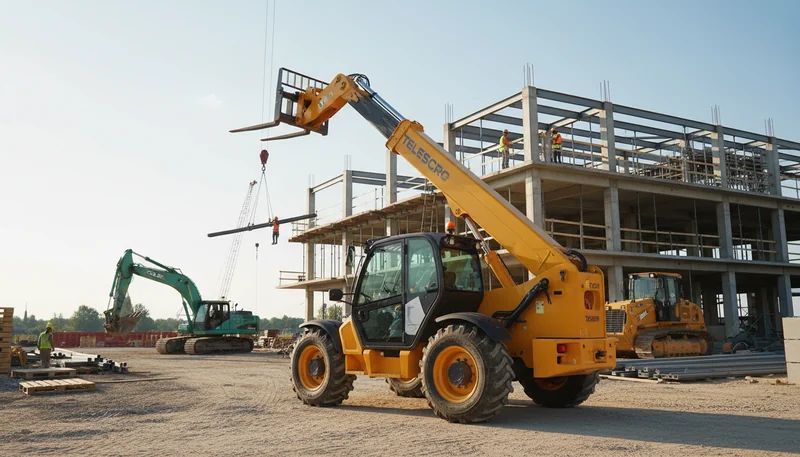
Not long ago, I got a panicked message from a project manager in the UK: his new telehandler was strong on paper, but couldn’t safely handle oversized loads on the upper floors. That’s a call I get surprisingly often—and it usually comes down to the specs that were overlooked.
Choosing the right telehandler is more than comparing maximum lift capacity or boom height. Real-world performance depends on how capacity changes with boom extension, load center, and attachment weight, as shown in manufacturers’ load charts. Compact machines typically offer 2,700–5,500 lb lift, while heavy-duty units reach 12,000 lb or more, but usable capacity drops sharply at full reach. Practical selection requires accurate assessment of the heaviest regular loads, required lift heights,
How to Determine Telehandler Lift Capacity?
Telehandler lift capacity must be sized by considering both the heaviest regular and worst-case loads, factoring in boom extension, load center, and any attachments. Manufacturer load charts1 give precise limits at various heights. Safe selection requires a 10–20% margin above expected maximum loads at actual working reach, not headline maximum capacity.
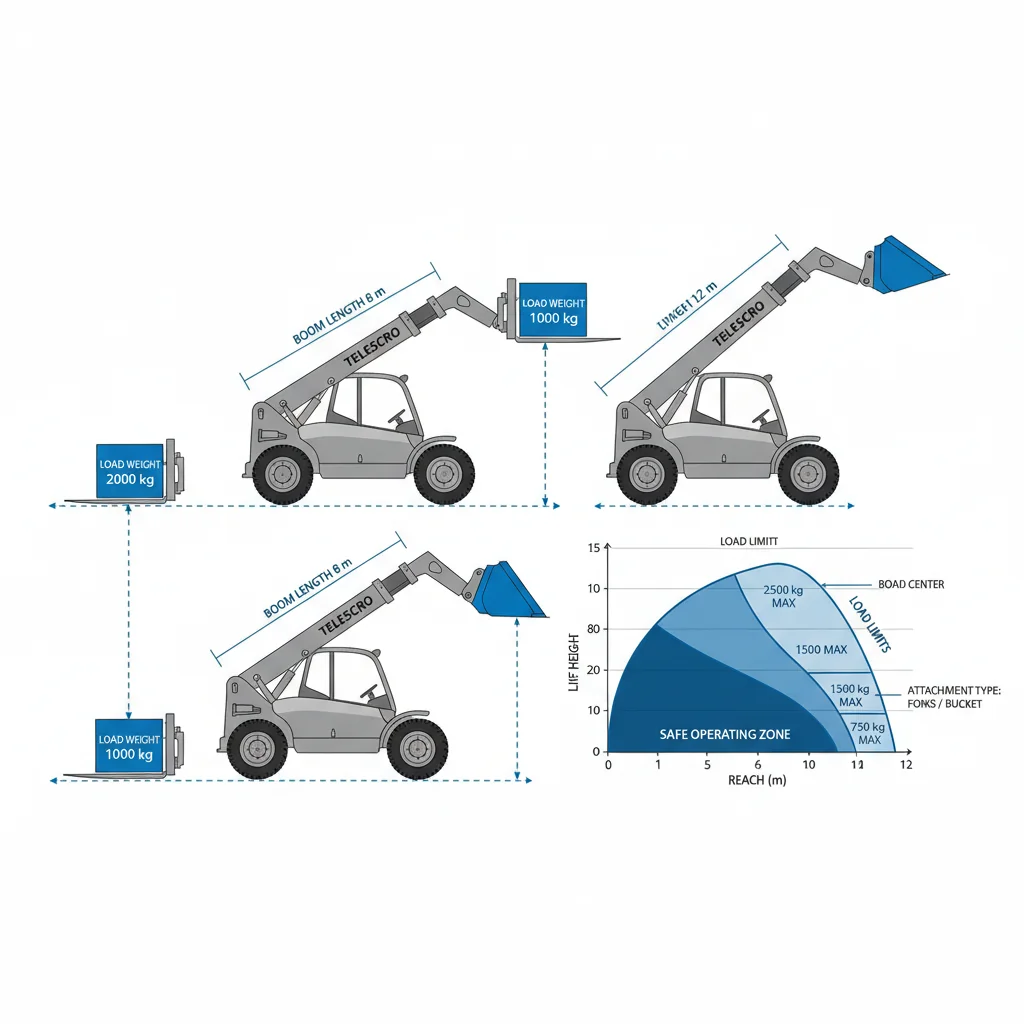
Most people don’t realize that telehandler lift capacity isn’t just about the big number on the spec sheet. What you really need is the capacity at your actual working height and reach.
The biggest mistake I see—especially with new buyers—is choosing a model just because it claims a 4-ton max on paper. That number only applies with the boom retracted and the load right at the front wheels. Extend the boom out to 12 meters with a pallet of bricks and you might be limited to only 1.5 tons, or even less if you’re using a bucket or platform.
Let me share a story from a contractor in Dubai. Their team needed to lift large HVAC units—close to 2,400 kg—onto a fifth-floor roof, about 14 meters up. On the load chart, their mid-range telehandler was rated for 3,800 kg at ground level, but at full extension, rated safe load dropped to under 1,900 kg. They had to split every delivery, doubling setup time and operator hours. On top of that, the fork carriage attachment weighed almost 350 kg—something they hadn’t factored in.
I always suggest listing out your heaviest routine lifts plus worst-case scenarios. Include wet material, attachment weights, and possible future needs—just like I do during my jobsite visits in Kazakhstan or Indonesia. Then, double-check the official load chart, focusing on your actual operating reach, not just the max headline. For real-world safety, select a machine with a 10–20% extra margin above the heaviest anticipated load. That’s the best way to balance operating cost and project safety.
Telehandler lift charts are essential because the rated capacity decreases significantly with increased boom extension and height, sometimes dropping from 4 tons at zero reach to under 1.5 tons at 12 meters outreachTrue
Lift capacities are rated at specific boom positions and angles; as the boom extends or rises, leverage increases load on the machine, reducing the safe lifting capacity to prevent tipping or structural failure. This is why spec sheets include detailed load charts for various boom configurations.
The maximum lift capacity listed on a telehandler's spec sheet always applies regardless of boom position or load center distanceFalse
The maximum lift capacity generally refers to the capacity with the boom fully retracted and load close to the machine; extending the boom or increasing load center distance reduces capacity to maintain stability and safety, so the max capacity is not constant across all operating positions.
Key takeaway: Always match telehandler lift capacity to the heaviest anticipated loads including attachments, at required working reach, not just ground level. Use official load charts and apply a 10–20% safety margin. Oversizing or undersizing increases both safety risks and operating costs.
What Lift Height and Reach Are Required?
Lift height and forward reach define a telehandler’s job suitability. Compact units lift 13–19 ft (4–6 m), ideal for single-story tasks, while construction models reach 40–56+ ft (12–17 m), enabling multi-story and high-stacking work. Usable lifting capacity2 decreases as the boom extends, making load chart consultation essential for safe and efficient operation.
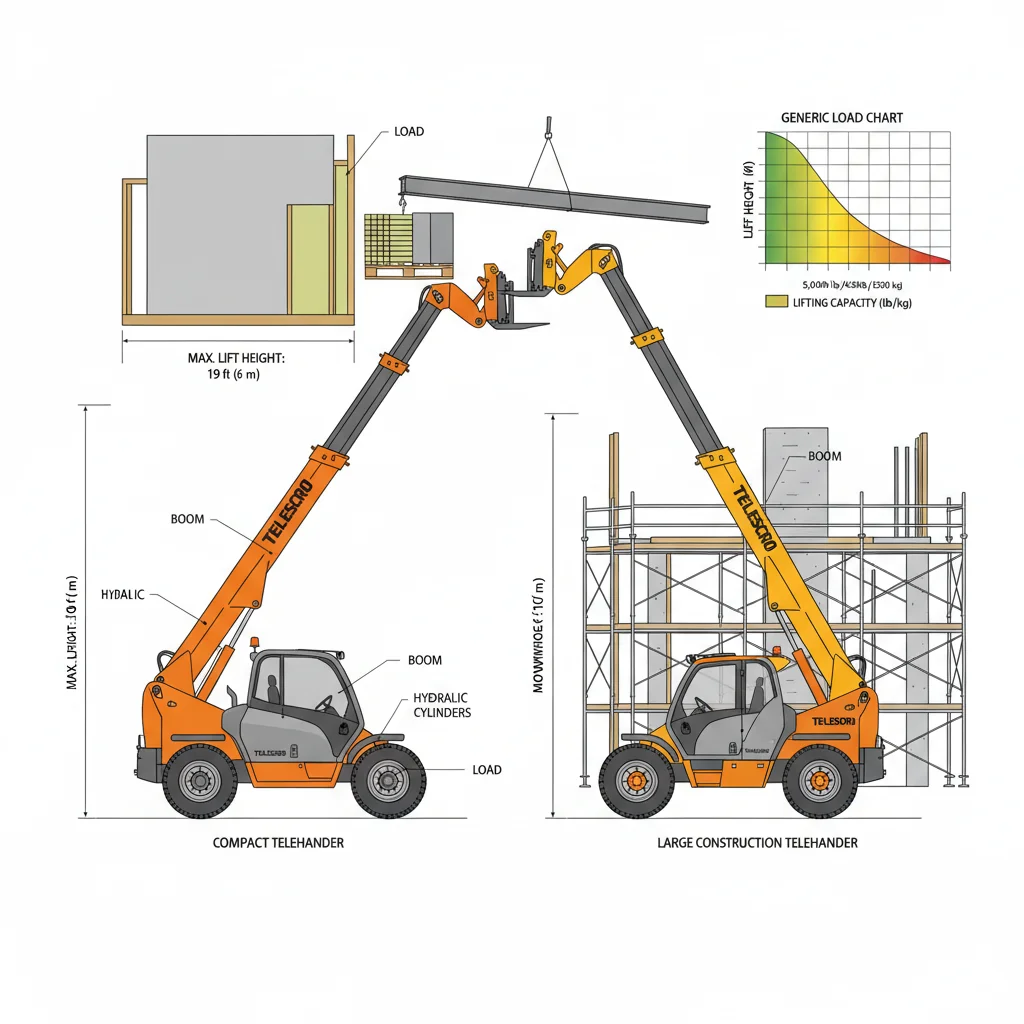
The biggest mistake I see is buyers choosing a telehandler based only on max lift height or spec sheet numbers. I get calls from customers in Dubai and Brazil, frustrated because their new machine can technically lift 12,000 lb or reach 17 meters, but not at the same time.
For example, last year in Dubai, a contractor bought a 17-meter unit thinking it would handle heavy steel beams all the way out. At full extension, though, its safe capacity was closer to 2,200 kg—nowhere near what they needed for the top floor.
Here’s what you really have to weigh: How high and how far out do you actually place loads, day to day? Compact telehandlers that reach 4–6 meters (13–19 ft) work well for small warehouses or one-story construction.
But on multi-story jobs, lifting materials or placing pallets at 12–15 meters (40–50 ft) is routine. Remember, as the boom extends, the machine’s rated capacity drops sharply—even a 4,000 kg telehandler might only lift 1,300 kg at max reach.
I always suggest walking your job site before deciding. Use a tape to measure the highest pallet spot, the distance back from walls, and the typical size of your loads. In Kazakhstan, a client once made the mistake of ignoring a tight loading area—turned out, they couldn’t safely reach the racks with their chosen unit.
My recommendation: Pick a telehandler that meets your real needs for 90–95% of jobs, not the one with the biggest brochure numbers. And always check the load chart for your actual scenarios.
A telehandler's maximum lift height and maximum load capacity cannot be achieved simultaneously at full reach because load capacity decreases significantly as the boom extends due to leverage and stability limitsTrue
Telehandler load charts demonstrate that as the boom extends, the rated load drops sharply to maintain machine stability and avoid tipping; therefore, buyers must consider capacity at the longest reach, not just peak lift height or maximum load independently.
Telehandler owners should always prioritize the absolute maximum lift height listed on the spec sheet as the most critical purchasing factor, since it guarantees the machine can handle any job at that height regardless of load weightFalse
Maximum lift height is only one aspect; load capacity at that height and reach is crucial since capacity often reduces drastically at extended reach, meaning a machine may reach a height but cannot safely lift heavy loads there.
Key takeaway: Selecting a telehandler requires evaluating not just maximum lift height and reach but also actual lifting capacity at extension. Buyers should measure real job site needs and consult load charts to match 90–95% of tasks, avoiding reliance on headline figures that do not reflect practical limitations.
Will Telehandler Size Fit Job Site Constraints?
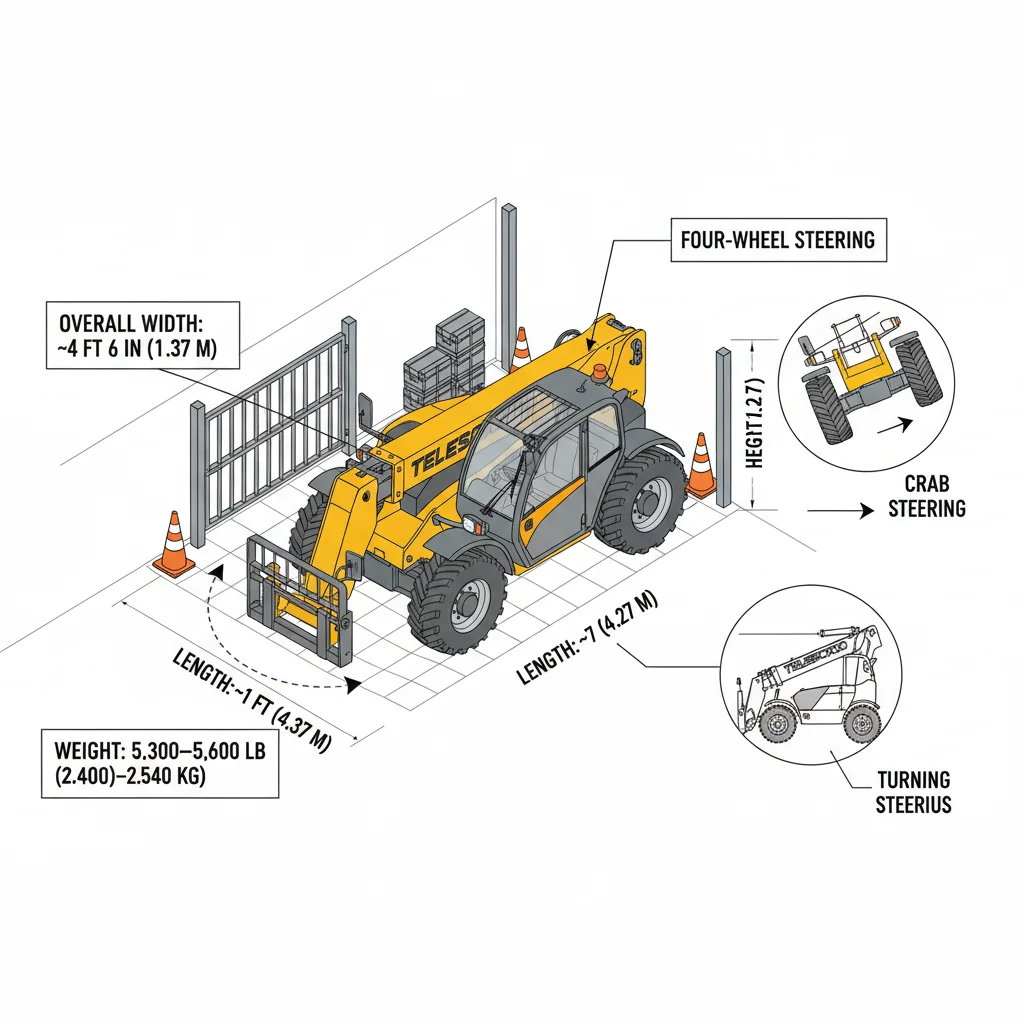
Telehandler size and maneuverability are crucial for confined sites. Key specifications include overall width, length, height, weight, turning radius3, and available steering modes. Ultra-compact models (around 4 ft 6 in wide, 5,300–5,600 lb) allow access through narrow gates and inside buildings. Advanced steering options, such as four-wheel and crab steering, enable precise positioning in tight spaces.
Let me share something important about telehandler selection that I see overlooked, especially on jobs in tight urban areas. Last year, I worked with a contractor in Singapore who struggled to get a standard 7,000 lb telehandler onto a cramped renovation site. The machine’s width—just over 6 feet—meant it couldn’t fit through older building entryways.
They lost half a week arranging new access. In these situations, I always advise mapping out every measurement before you finalize a model—door width, aisle clearances, and especially turning radius. Even an extra 8 inches in width can mean the difference between getting the job done or facing delays.
For jobs like warehouse maintenance or city-center construction, ultra-compact telehandlers4 (around 4 ft 6 in wide, weighing just 5,300–5,600 lb) can be the real problem-solvers. They’ll go through a garden gate or fit inside underground parking—places where a larger, higher-capacity machine just won’t work. I’ve seen a 2.5-ton compact model pass smoothly through 1.5-meter-wide corridors in Dubai, while bulkier machines needed costly disassembly.
Steering modes make a real difference, too. Four-wheel and crab steering let you swing the telehandler sideways or pivot in place—essential for positioning loads in tight corners. In a poultry farm in Poland, a customer cut loading time in half after switching to a model with full four-wheel steer and turning radius under 130 inches.
My recommendation? Think beyond maximum lift. List all site constraints and match them to machine size and maneuverability—this approach almost always saves headaches and keeps jobsites running efficiently.
Telehandler width is often a more critical constraint than lifting capacity when planning for tight urban job sites, with some compact models measuring as narrow as 5 feet to fit through narrow doorwaysTrue
Although lifting capacity is important, the physical dimensions of the telehandler—especially width and height—directly impact whether it can access confined spaces, such as older building entryways.</p> <p>Compact telehandlers can be nearly a foot narrower than standard models, enabling site access without costly modifications.
The primary telehandler specification to consider for urban job sites is maximum lifting height, as most access issues relate to reaching higher floors rather than fitting through narrow spacesFalse
While lifting height matters for reach, job site constraints in urban areas are usually about physical fit—width, length, and height clearance—not how high the boom can lift. Overlooking dimensional size leads to access problems and delays regardless of lifting height capability.
Key takeaway: For urban, indoor, or tight-access sites, prioritize telehandlers with compact dimensions and advanced steering over maximum lift capacity. Matching machine size and turn radius to real-world constraints like doorways, aisles, and ramps can prevent costly worksite bottlenecks and ensure productive, safe operation.
How Do Tires and Clearance Impact Access?
Tire type and ground clearance5 directly affect a telehandler’s ability to traverse challenging job sites. Large pneumatic or foam-filled tires and at least 11 inches of clearance are essential for rough terrain, reducing the likelihood of bogging, instability, or getting stuck. Lower-profile or solid tires suit paved areas, minimizing wear and operating costs.
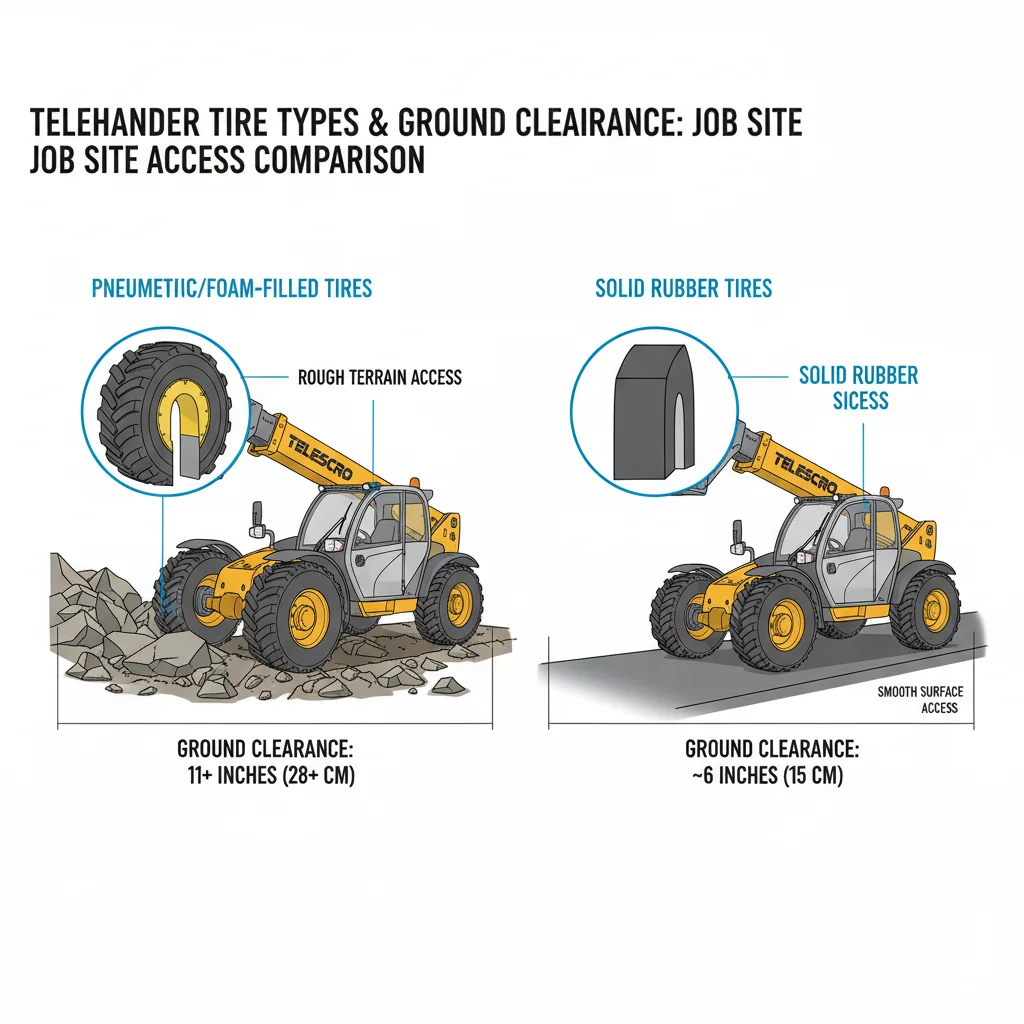
I’ve worked with customers who made this mistake—assuming any tire will handle their site, only to get stuck on day one. For example, in Kazakhstan last winter, a client ordered a compact telehandler with standard low-profile rubber tires, planning to move load pallets between storage sheds. It looked good on the spec sheet.
But after heavy snow, the telehandler lost traction and grounded itself before even reaching the work area.Their team lost half a day calling in another machine with larger, deep-tread pneumatic tires6 and higher clearance—almost 13 inches—to pull it out.
From my experience, jobsites with mud, ruts, or loose dirt really test your setup. At one project in Kenya, foam-filled tires with aggressive tread and an 11-inch ground clearance let a 4-ton machine power through soft soil during the rainy season—where a smaller, hard-tire model would’ve bogged down.
Four-wheel drive helped, but without the right tire and clearance combination, even the best drivetrain won’t save you from getting stuck. Think about slopes, debris, or uneven concrete near foundations—these are common across sites in Brazil, Indonesia, or the Middle East.
On the other hand, for warehouses or paved sites, I always suggest looking at solid or semi-solid rubber tires. They reduce vibration, limit tire wear, and can cut annual tire costs by around 30%. You typically don’t need big clearance here; even 9 inches is enough. The main thing? Match tires and ground clearance to your worst site conditions—not the brochure photos. This small detail determines whether the job moves forward or stops cold.
Tire diameter and tread pattern significantly affect a telehandler's ground clearance and traction, with larger diameter tires providing up to 20% more clearance and better performance in snow or mudTrue
Larger tires increase ground clearance, allowing equipment to navigate uneven terrain without grounding.</p> <p>Additionally, aggressive tread patterns improve grip on slippery surfaces by penetrating snow or mud, which is critical in environments like heavy snow conditions. This directly impacts a machine’s ability to maintain access and productivity.
Low-profile tires generally improve telehandler stability on uneven terrain by lowering the center of gravity, making them the preferred choice for all-terrain applicationsFalse
While low-profile tires reduce sidewall flex and may lower the center of gravity on flat surfaces, they typically reduce ground clearance and traction on uneven or soft terrain.</p> <p>This makes them less effective in off-road or snow conditions, where higher-profile, more aggressive tires are needed to maintain mobility and prevent getting stuck.
Key takeaway: Selecting tire type, tread, and ground clearance based on expected site conditions is critical. Underspecifying these features can halt productivity or even prevent the telehandler from reaching required locations, particularly on muddy or uneven terrain.
Which Boom Features Increase Telehandler Versatility?
Boom design and attachment systems impact a telehandler’s ability to handle multiple jobs. Key factors include cycle speed7, telescopic range8, and boom mounting position. Quick-connect couplers and auxiliary hydraulics allow fast attachment changes, supporting forks, buckets, platforms, or specialty tools. Compatibility with standardized couplers increases fleet flexibility and reduces machine redundancy.
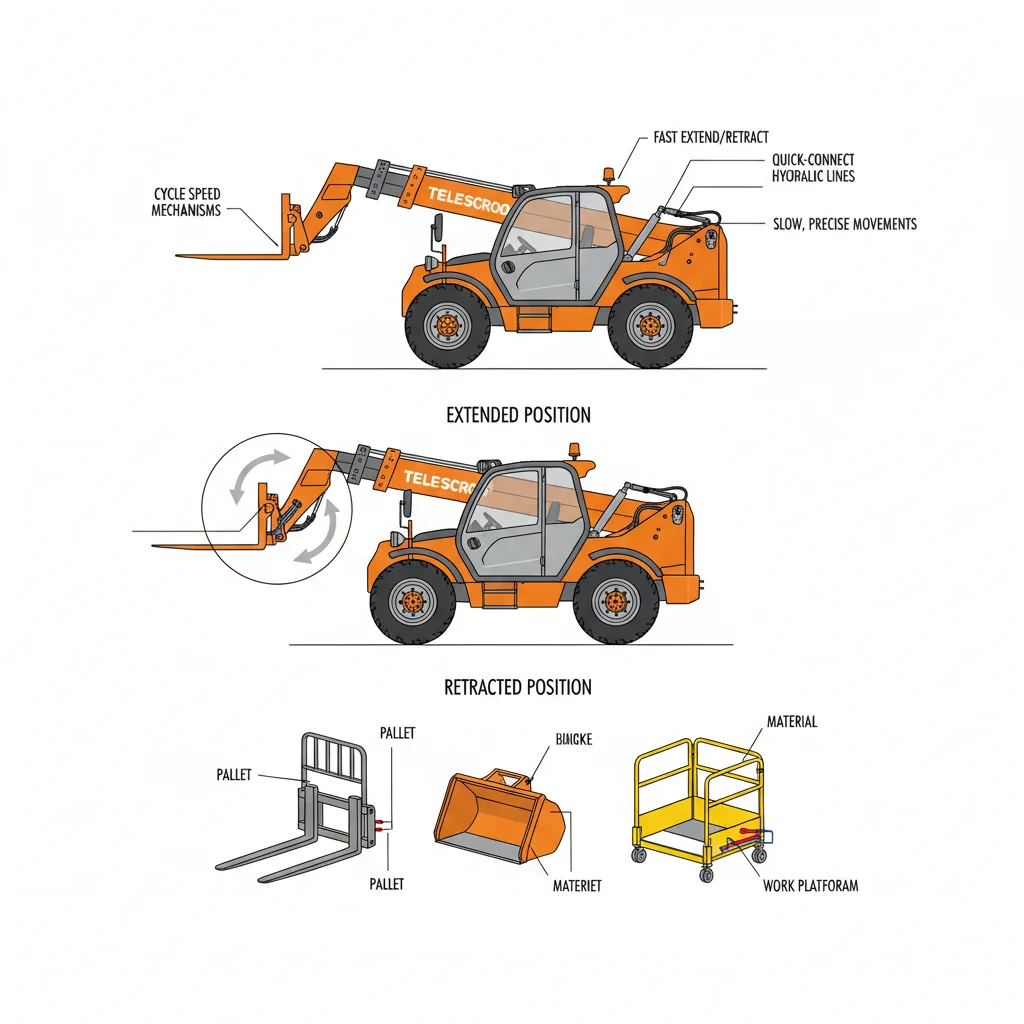
Last month, a logistics company in Saudi Arabia called me about a bottleneck moving sandbags and steel mesh on their jobsite. They needed one telehandler to do it all—forks for pallets in the morning, bucket for loose material after lunch, and a man basket for inspections later.I told them the boom and attachment setup would be the deciding factor.
You can have all the horsepower you want, but if your boom movement is slow or jerky, productivity suffers. Fast, controllable cycle speed makes a real difference—especially when you’re telescoping out 12 meters with a half-ton load hanging on the hook.
Here’s a quick comparison of key boom and attachment features I see customers weighing every week:
| Feature | Practical Benefit | Example Jobsite Impact |
|---|---|---|
| Fast cycle speed | More lifts per hour, less operator fatigue9 | Shaves at least 1–2 hours/day |
| Long telescopic range | Reach further without repositioning | Cover more ground, fewer machine moves |
| Side vs center mount | Side: lower cab & visibility; Center: more rigidity | Side mount fits tight urban sites |
| Quick-connect coupler | Attachment swapped in minutes, not hours | Handles 3+ tasks per shift |
| Standardized interface | Use attachments across brands and models | Simplifies fleet, reduces idle time |
To be honest, the quick-coupler system is vital if you change attachments often.
Booms with variable flow hydraulic circuits enable faster and smoother attachment changes, improving cycle times by up to 20%True
Variable flow hydraulics allow operators to precisely control boom movements and attachment functions simultaneously, reducing transition times and enhancing overall telehandler versatility on multi-task jobsites.
A telescopic boom length has no impact on telehandler versatility since all tasks require similar reach distancesFalse
Telescopic boom length directly affects a telehandler's ability to access varying heights and distances; different tasks require different reach capabilities, making boom length a crucial factor in jobsite flexibility and efficiency.
Key takeaway: Telehandlers with fast, well-controlled booms and quick-connect, standardized attachment couplers handle more jobs efficiently. Cycle speed, hydraulic flow, and attachment approval all influence productivity. Buyers should prioritize versatile systems for operations with frequently changing material handling or lifting requirements.
How Do Engine and Transmission Choices Impact Telehandlers?
Engine power, transmission type, and power source directly influence telehandler performance, fuel efficiency, and compliance with emissions standards. Most models use 75–100 hp Tier 4 Final/Stage V diesel engines10, while hydrostatic transmissions11 improve precision and control. Electric telehandlers eliminate local emissions but require planning for charging and use-case suitability.
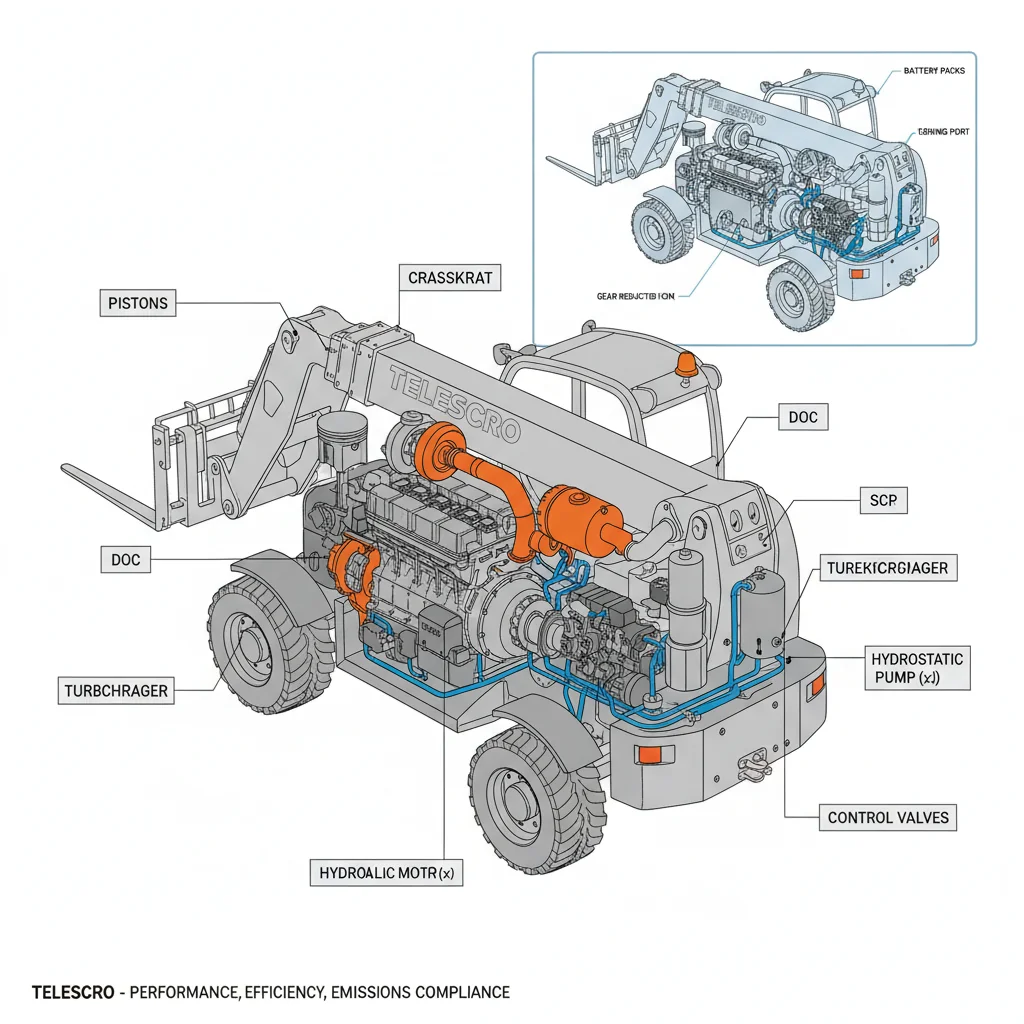
Here’s what matters most when matching a telehandler to your jobsite: it’s not just engine horsepower on the brochure. The combination of engine, transmission, and power source shapes real-world performance and your daily operating costs. Take, for example, a contractor I worked with last year in Dubai. They chose a 100-hp Tier 4 Final diesel model for a mixed-use building site.
The engine gave solid torque for lifting heavy loads—nearly 3,800 kg up to 14 meters—but what made the biggest impact was the hydrostatic transmission. Instead of jerky starts, the operator could inch forward with millimeter precision to position glass panels against steel frames. On a busy urban site, that level of control saved them both time and rework.
For customers in Europe, emissions standards are strict—Stage V compliance is non-negotiable in cities like Paris or Milan. Several clients have come back frustrated after failing noise and emission checks with older Tier 3 models. I’ve seen local regulators halt indoor work mid-shift because of excessive exhaust. That’s where electric telehandlers are making headway.
One logistics center in Shanghai tried a compact electric telehandler with a 20 kWh battery. Four hours of steady operation was enough for their indoor cycle. No local exhaust, just routine overnight charging. But switching to electric isn’t always simple: you need to plan around charging downtime, and heavier outdoor work can drain batteries faster than expected.
I suggest looking beyond headline specs. Consider your typical site conditions, fuel access, and future emission rules. For urban or indoor work, even partial adoption of electric units can keep your projects running smoothly in tight regulatory environments.
Selecting a Tier 4 Final diesel engine can improve torque output by up to 10% at low RPMs compared to Tier 3 engines, enhancing a telehandler’s ability to lift heavy loads efficientlyTrue
Tier 4 Final diesel engines incorporate advanced emission controls like SCR and DPF, which optimize combustion and torque delivery especially at low engine speeds, leading to better lifting performance under heavy load conditions.
Hydrostatic transmissions always deliver higher fuel efficiency than powershift transmissions in telehandlers, regardless of jobsite conditionsFalse
While hydrostatic transmissions offer smooth variable speed control, they often consume more fuel under heavy load due to continuous hydraulic losses; powershift transmissions can be more fuel-efficient during repetitive heavy lifting and travel tasks on varied terrains.
Key takeaway: Evaluating telehandler specs should go beyond horsepower, factoring in fuel use, emissions compliance, transmission performance on specific terrains, and emerging electric alternatives. Standardizing powertrains eases fleet maintenance, while urban or indoor sites benefit from early adoption of zero-emission units to meet regulatory and operational demands.
How is telehandler ROI calculated?
Telehandler ROI requires evaluating more than just purchase price; factors include fuel consumption, maintenance, operator certification, insurance, downtime risk, and resale value. Calculating cost per productive hour and per unit moved, then aligning machine specs with typical load weights and annual usage, yields the clearest measure of total ownership cost versus performance.
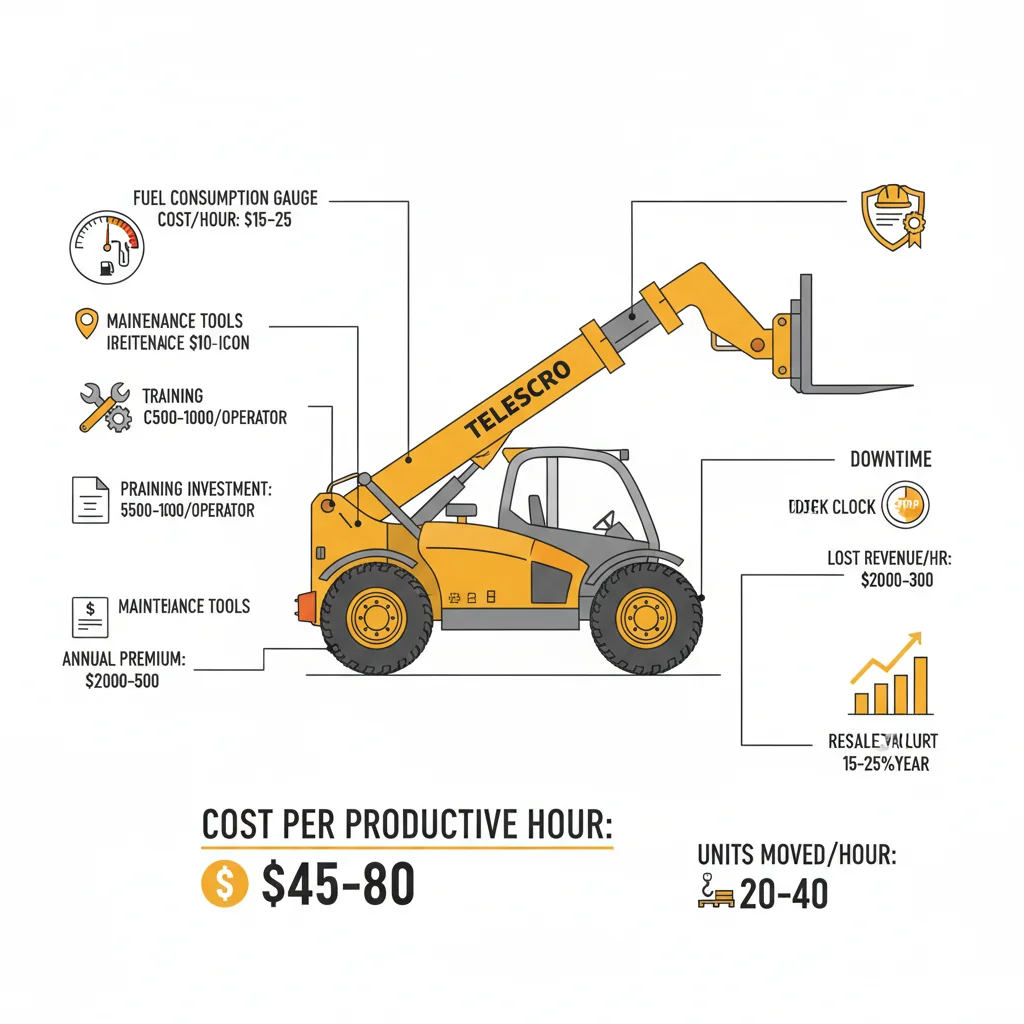
To be honest, calculating telehandler ROI goes way beyond just checking the sticker price or spec sheet. I’ve seen teams in Dubai run the numbers and realize their lower-priced compact unit cost more per hour than a bigger mid-range machine. Why? When you look at fuel consumption, maintenance, and downtime, it adds up fast. For example, a 4-ton telehandler with 17-meter reach might use 7 liters of diesel every hour during typical work. If diesel prices climb, or your machine idles too much, your “hourly” cost can spike by 15% over the year.
One customer in Kenya tracked their mid-size rental—about $80,000 new—against an older 11-meter machine. The new model handled more weight per cycle and moved brick pallets faster.
Their actual cost per ton lifted dropped, even though total ownership (insurance, certification, maintenance) seemed higher up front. The lesson? It’s not just about capacity, but how efficiently the machine matches daily jobs.I always suggest estimating your annual working hours—say, 1,200 to 1,500—and breaking expenses into productive hour or per ton moved.
Don’t forget to factor in things like operator certification costs, insurance requirements for high-reach units, and the real downtime risk. Parts availability is huge—“parts roulette” is what I call it when you wait weeks for a hydraulic hose in Kazakhstan, meaning your project stalls.
I recommend buyers tally all these costs, then compare machines based on their most common tasks, not rare lifts. Aim for the unit that delivers reliably on 95% of your jobsite needs.
Telehandler ROI calculations must factor in diesel consumption rates, as a 4-ton unit consuming 7 liters per hour can significantly impact operating costs when fuel prices riseTrue
Fuel consumption directly influences hourly operating expenses; considering diesel use alongside purchase price reveals more accurate long-term cost-effectiveness, especially with fluctuating fuel prices.
Calculating telehandler ROI only requires comparing the initial purchase price, as maintenance and fuel costs are negligible in the first 5 yearsFalse
Operating expenses like fuel and maintenance are substantial over time and can exceed purchase costs; ignoring them skews ROI estimates and can lead to selecting machines with higher total costs despite lower upfront prices.
Key takeaway: Total telehandler ROI depends on balancing upfront cost with operational expenses, productivity, and resale value. Buyers should quantify annual workload, maintenance, downtime, and parts availability before comparing models, ensuring the chosen telehandler fits regular high-margin tasks instead of exceptional, infrequent lifts.
Which Telehandler Safety Specs Are Critical?
Essential telehandler safety specs include load moment indicators12 (LMI) or overload warning systems, automatic stability cut-offs13, robust fall protection anchor points, and comprehensive 360° visibility via cab tilt, cameras, or slim boom profiles. Compliance with CE, ANSI, or ISO certifications ensures machines meet legal and project requirements across regions. Always verify documentation for safety audits and insurer compliance.
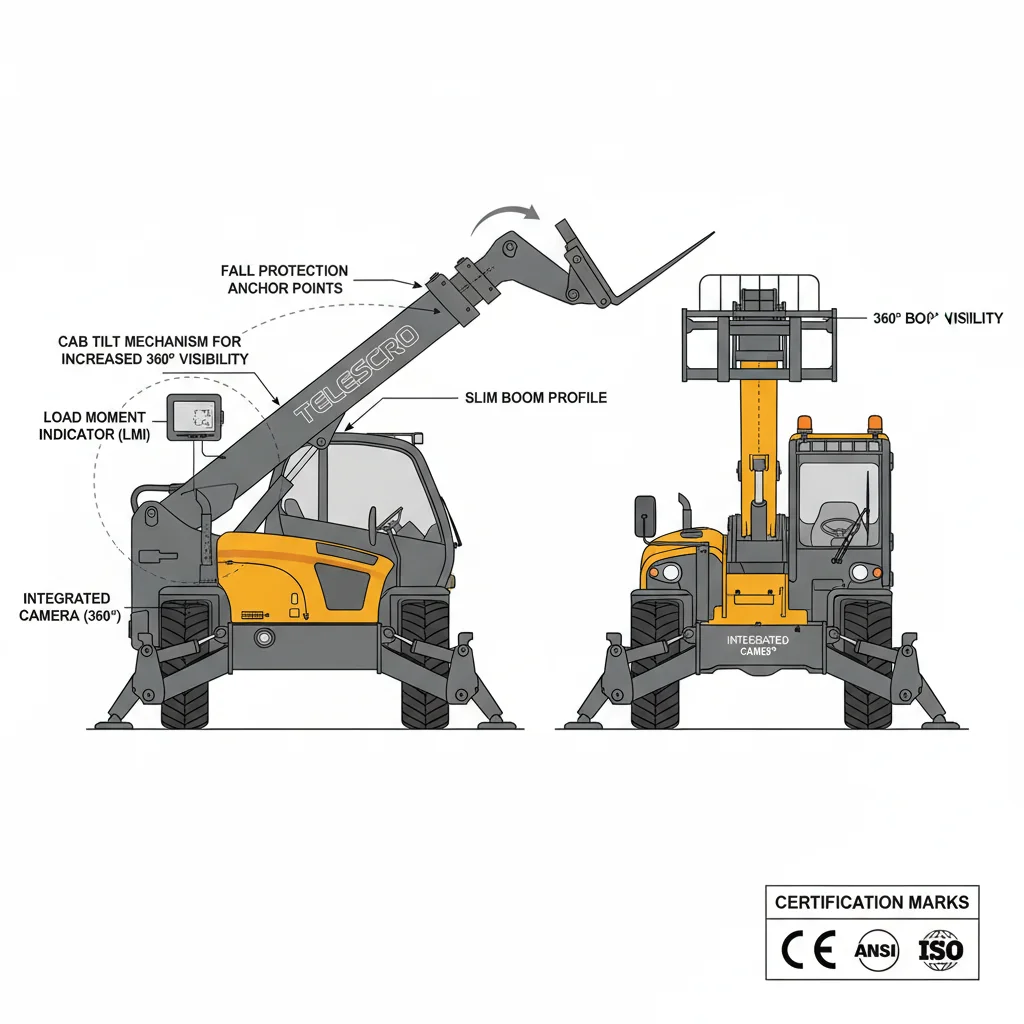
Here’s what matters most when you’re reviewing telehandler safety specs: on a major project in Dubai last year, entry was blocked for three new machines until we proved they had working load moment indicators and CE certification. That’s become the norm across many sites I’ve seen—if the machine can’t prove its safety, you lose the job or face serious delays. I always suggest checking for automatic stability cut-offs and clear warning alarms in the cab, especially with units rated above 3,000 kg. Overload warning systems aren’t just a nice bonus; they actively stop costly accidents.
Let’s compare the most critical safety specs you should look for:
| Safety Spec | Why It Matters | Typical Requirement (Region) | Real-World Example |
|---|---|---|---|
| Load Moment Indicator (LMI) | Prevents overloading, warns operator | CE (Europe), ANSI/ISO (Americas, Asia) | Dubai: Site stopped all lifts without LMI |
| Auto Stability Cut-off | Stops operation if tipping risk is detected | Required on newer models worldwide | Germany: Prevented a side-tip incident |
| Fall Protection Anchors | Secures harness when lifting personnel | EN280 in EU, ANSI A92.20 in USA | UK: Insurer demanded anchor point inspection |
| 360° Visibility Features | Reduces blind spots, prevents collision | Increasingly specified by contractors | Brazil: Cameras avoided scaffolding impact |
| Certified Load Charts | Verifies legal capacity at every boom angle/height | All regulated markets | Kenya: Failed audit due to missing charts |
Telehandlers rated above 3,000 kg typically require automatic stability cut-offs to prevent tipping by reducing hydraulic pressure when the load approaches unsafe limitsTrue
Automatic stability cut-offs monitor the load and boom angle to cut hydraulic power if the telehandler nears instability, which is especially critical for machines handling heavier loads above 3,000 kg to prevent accidents.
CE certification for telehandlers guarantees that the machine includes built-in GPS tracking and remote monitoring features as part of the safety standardsFalse
CE certification ensures conformity with European health, safety, and environmental protection standards, but it does not mandate GPS tracking or remote monitoring systems as part of telehandler safety requirements.
Key takeaway: Project access and site safety often depend on telehandlers having advanced safety systems and certifications. Prioritize models with overload prevention, strong visibility features, and documentation proving compliance with regional regulations to reduce risk and satisfy general contractor or insurer requirements.
Why Prioritize Telehandler Cab Ergonomics?
Operator comfort features14—such as cab size, tilting cabs15 for improved visibility, advanced seat quality, and intuitive multi-function joysticks—directly affect telehandler productivity, safety, and operator retention. Extended shifts on uneven terrain demand ergonomic design. Poor ergonomics increase fatigue, mistake rates, and turnover, while field-tested, operator-driven controls maintain alertness and efficiency during 10-hour operating days.
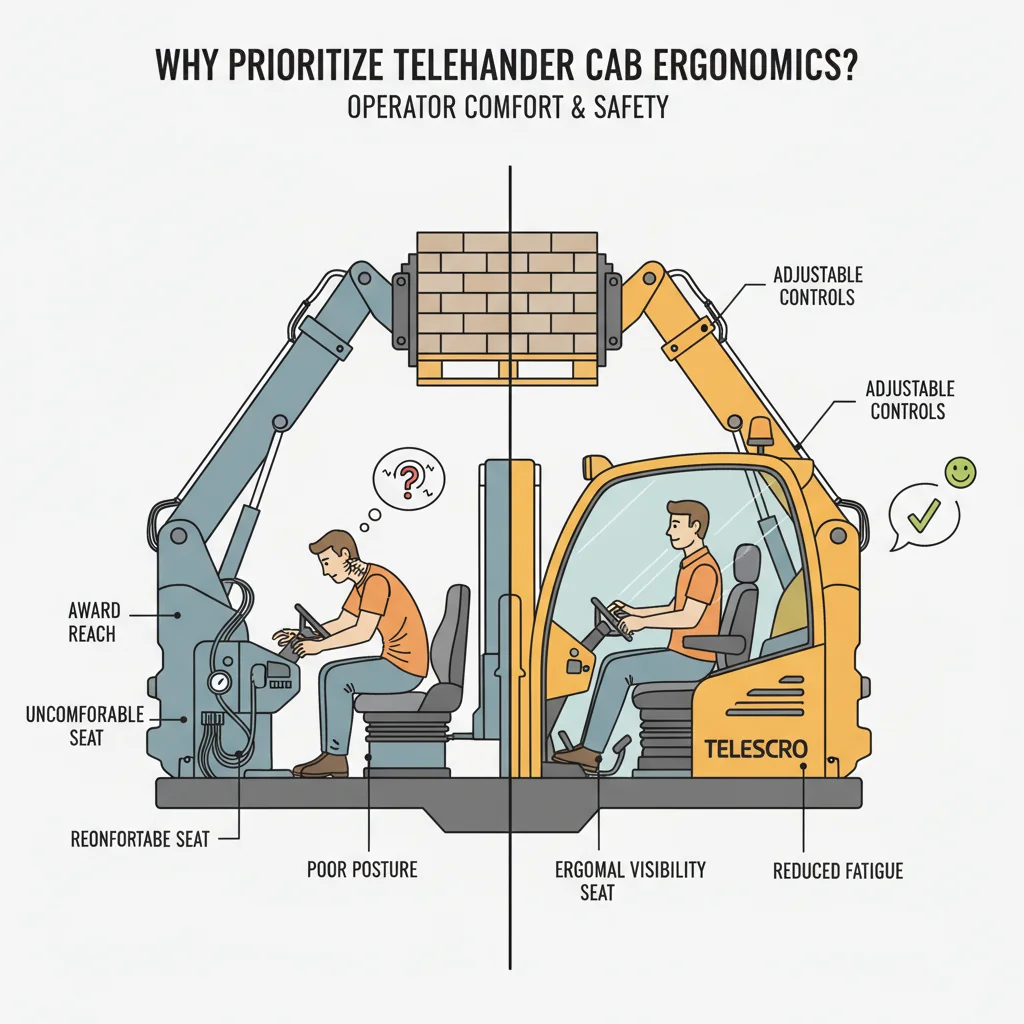
From my experience, ignoring cab ergonomics is a shortcut to tired, unhappy operators—and costly mistakes. I’ve seen it firsthand on jobsites in Dubai, where 10-hour shifts in 38°C heat are standard. Operators there told me that a cramped cab with cheap seats left them sore and distracted long before the day ended.
One crew ran two identical 4-ton telehandlers; the only difference was upgraded cab comfort in the newer unit. By lunch, the operator in the better cab could still focus, while the other needed breaks just to stretch and cool off. That difference adds up over weeks—efficiency drops when comfort is ignored.
Ergonomics isn’t just about comfort. On a multi-story build in Malaysia, tilting cabs—able to angle from 0° up to around 20°—let the operator see exactly where the pallet was landing at 13 meters high.No more stretching necks or climbing out to check line of sight. That reduced misalignment and rework. When you’re moving heavy curtain wall panels, even a small visibility advantage can prevent a costly knock or delay. Better visibility means better safety.
Operator controls matter just as much. Multi-function joysticks that combine steering, boom, and auxiliary hydraulics save seconds every cycle. Over a full 60-load day, that’s easily 30-45 minutes saved. I always recommend demoing machines—have actual operators handle typical site tasks. Ask them about in-cab noise, vibration, and how easy it is to enter and exit. Comfort isn’t luxury. It’s practical risk management. I suggest budgeting for ergonomic upgrades because the investment pays you back in uptime and fewer mistakes.
Ergonomically designed telehandler cabs with adjustable suspension seats can reduce operator fatigue by up to 30% during long shiftsTrue
Adjustable suspension seats absorb vibrations and allow operators to customize seating position, significantly lowering musculoskeletal strain and fatigue over extended work periods, especially in harsh conditions like high heat and rough terrain.
Upgraded cab ergonomics in telehandlers eliminate the need for regular breaks during 10-hour shifts in extreme heat conditionsFalse
Even with improved cab ergonomics, operators require regular breaks to prevent heat stress and maintain alertness; ergonomic improvements reduce fatigue but do not replace the necessity of rest periods during long, hot shifts.
Key takeaway: Prioritizing ergonomic cab design and operator comfort reduces fatigue, improves safety, and maximizes productivity. Features like tilting cabs, quality seats, and intuitive controls are essential for telehandlers used on long shifts in tough conditions. Field testing with operators ensures investments align with real-world demands.
How Do Maintenance Specs Impact Uptime?
Maintenance specifications directly influence telehandler uptime. Features like ground-level engine access16 and clearly marked service points ensure essential checks are performed, minimizing missed inspections. Machines with crowded engine bays or hidden grease points are prone to neglected maintenance and early failures. Dealer support17, including parts availability, warranty coverage, and technician response, is equally critical to keeping telehandlers operational on site.
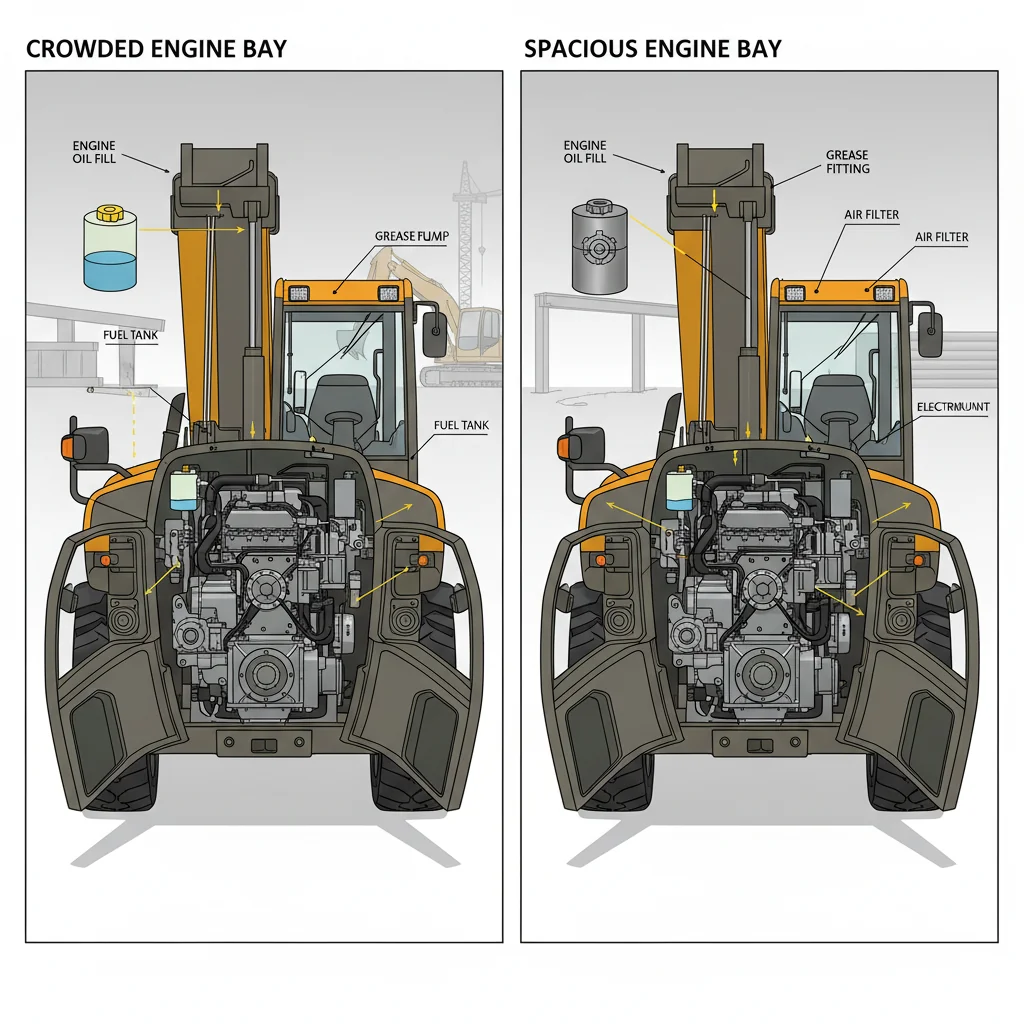
Let me share something important about maintenance specs—because I’ve watched a well-designed telehandler save a site days of downtime, while a poor one costs thousands. About two years ago, a team in Dubai ran a 4-ton, 17-meter unit with excellent ground-level filter access and color-coded service points.
Their operators finished full daily checks in under 10 minutes. Compare that with a crowded 3.5-ton model I saw in Kazakhstan—engine oil checks meant climbing over hot hydraulics, and half the grease points were buried. Guess which machine saw fewer breakdowns? Dubai’s was still running strong after 2,000 hours, while the other needed a full hydraulic hose replacement by 1,200 hours—mainly from skipped maintenance.
Proper dealer support makes a huge difference too. I remember a contractor in Kenya whose lift broke a boom wear pad mid-project. Their dealer was two hours away but carried those wear pads in stock and sent a technician the same day. That quick response saved them at least two full days. But I’ve heard rental companies in eastern Europe talk about “parts roulette” for less common brands—it’s not unusual for a machine to wait a week on a $40 seal.
To be honest, technical specs only tell half the story. I suggest looking closely at service intervals, real parts prices, and how nearby your dealer actually is. Ask about actual downtime for common items—like tires, pads, and hoses. A telehandler that’s quick to service and has strong local support often costs less to run, even if the initial price is higher. That’s what keeps jobsites productive.
Telehandlers with ground-level, color-coded service points can reduce daily maintenance time by up to 50%, significantly increasing machine uptimeTrue
Ground-level color-coded service points streamline maintenance tasks, enabling operators to complete daily checks faster and more accurately, which minimizes downtime and keeps the telehandler operational for longer periods.
Telehandlers with higher maximum lift height always have longer maintenance intervals regardless of access design or component layoutFalse
Maintenance intervals depend on component design, accessibility, and usage patterns rather than maximum lift height alone. A taller telehandler with poor access can have longer maintenance times and more frequent interventions than a shorter, well-designed machine.
Key takeaway: Prioritizing telehandlers with accessible maintenance points, transparent service intervals, and robust dealer support is crucial for minimizing unplanned downtime. For buyers, evaluating aftersales support and real-world reliability can be as important as technical specs—ultimately driving higher fleet productivity and lower cost of ownership.
Why Test Telehandlers On-Site First?
On-site testing of telehandlers exposes differences in cycle times, steering modes, boom smoothness18, and stability that factory spec sheets may overlook. Field trials reveal real-world ergonomic and visibility issues—such as control layout, blind spots, and operator fatigue—allowing buyers to assess each model’s true suitability for specific loads, terrains, and site conditions.
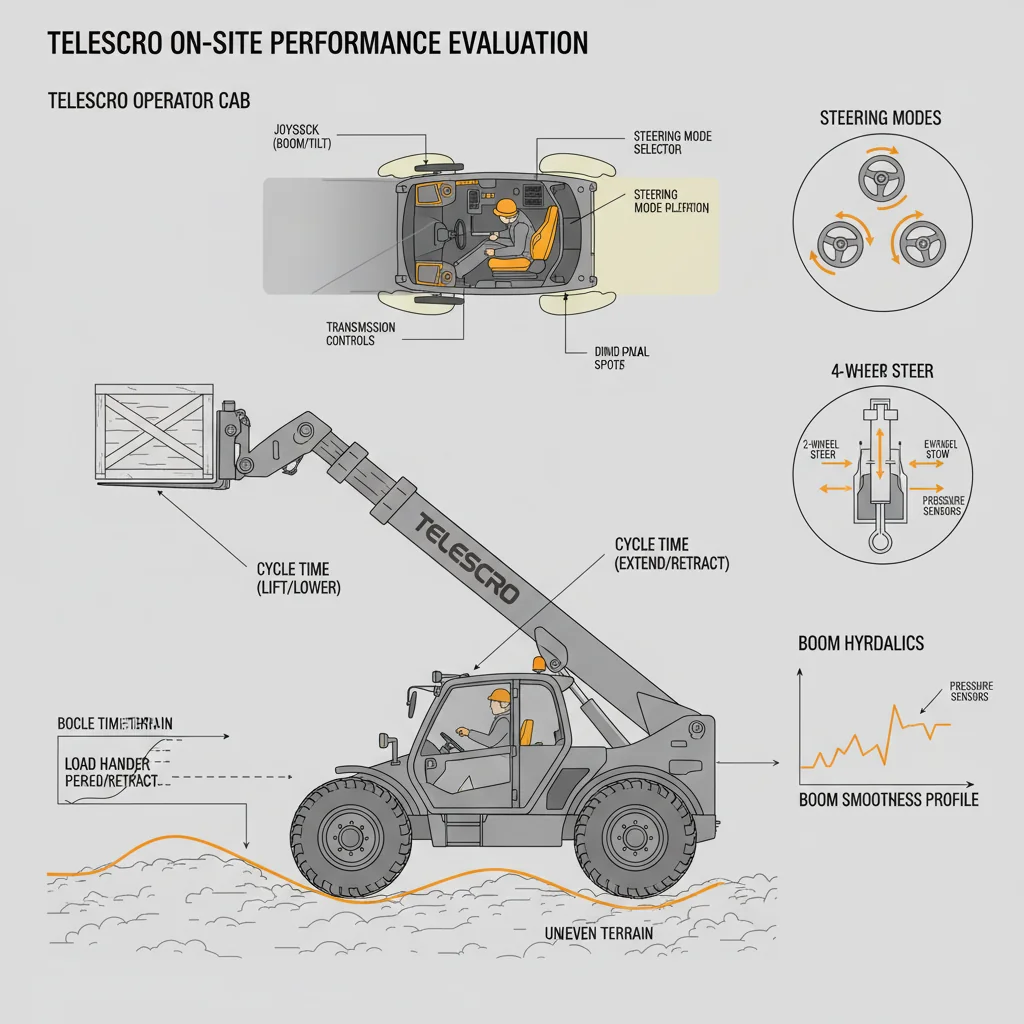
A question I get a lot is: why not just trust the spec sheet? The short answer—machines behave very differently once you put them in real jobsite conditions. For example, I supported a logistics contractor in Dubai last year. On paper, two 4-ton telehandlers with 17-meter reach looked nearly identical.
But once we ran both units in their warehouse, the differences jumped out. One unit’s hydraulic circuit delivered noticeably smoother boom extension, trimming cycle times by at least 10%. The other? Operators struggled with stop-and-start jolts, especially when placing loads high on uneven ground.
Jobsite layout and terrain make a huge difference too. In Kazakhstan, a client tested two models on their mixed gravel and mud compound. One telehandler, advertised as “compact,” bottomed out its frame crossing a shallow dip. The other had ground clearance around 410 mm, easily clearing obstacles. These practical differences never show up in factory data.
Visibility and cab comfort become obvious during long shifts. I noticed one model had rear blind spots that forced the operator to lean out—fatiguing after a full day. That level of detail can’t be found in the brochures.
Before any big purchase, I always suggest running structured field trials: timed loading cycles, maximum reach placements, and tight space maneuvers. Use your actual operators and materials. Gather their feedback on comfort, control layout, and fatigue. This approach helped a client in Kenya spot a steering mode issue—“crab” steering that felt stiff under load—which a one-hour showroom demo never revealed. For any buyer, on-site testing is the best way to prevent expensive equipment mismatches.
A telehandler's hydraulic circuit performance can influence cycle times by over 10%, impacting overall jobsite efficiency significantlyTrue
Hydraulic circuit design affects the smoothness and speed of boom extension and retraction, directly influencing cycle times. </p> <p>As demonstrated in real-world tests, a better circuit can reduce cycle times, improving operational productivity.
The maximum lifting capacity listed on the spec sheet always reflects the telehandler's actual lifting capability on any jobsiteFalse
Maximum lifting capacity on spec sheets is typically rated under ideal test conditions and may not consider real-world factors like terrain, load distribution, or hydraulic responsiveness, which can reduce effective lifting capacity on site.
Key takeaway: Relying solely on telehandler spec sheets can result in mismatched equipment. Structured on-site demos with actual loads and operators uncover real performance and usability differences, ensuring the chosen telehandler matches the jobsite’s demands and prevents costly purchasing mistakes.
Conclusion
We’ve looked at how choosing the right telehandler is all about matching lift capacity and reach to your real-world jobsite needs—not just what the specs say at ground level. From my experience, the smartest buyers spend extra time with the load chart and always ask about local parts support. I call it avoiding “parts roulette”—waiting on repairs slows everything down. If you want a more detailed comparison or need help reading the charts for your site, just reach out. I’ve worked with customers from 20 different countries and am always happy to help, no pressure. The best telehandler is the one that fits your workflow, not just the brochure.
References
-
Learn how to read and interpret manufacturer load charts to prevent overload and improve job site safety and efficiency. ↩
-
Understand the relationship between boom extension and lifting capacity to ensure safe and efficient telehandler operation on site. ↩
-
Details how turning radius affects telehandler maneuverability on cramped sites, impacting job efficiency and safety on tight urban projects. ↩
-
Explains how ultra-compact telehandlers provide superior maneuverability and access in confined urban and indoor construction spaces. ↩
-
Understand why higher ground clearance prevents getting stuck and improves mobility over mud, ruts, and debris, with expert case examples. ↩
-
Explore how pneumatic tires improve traction and stability on challenging job sites, reducing downtime and enhancing safety. ↩
-
Explores how faster cycle speeds reduce operator fatigue and increase lifts per hour, boosting jobsite efficiency significantly. ↩
-
Details how extended telescopic reach minimizes repositioning, improves ground coverage, and reduces machine downtime. ↩
-
Understand ergonomic and visibility challenges that lead to operator fatigue, with insights for improving workplace safety and comfort. ↩
-
Provide a detailed introduction to the technical requirements of Tier 4 Final and Stage V emission standards and their impact on the environmental performance of construction equipment—intended for users concerned with regulatory compliance. ↩
-
Provide an in-depth analysis of how hydraulic power transmission systems enable smooth and precise telehandler operation, improving jobsite efficiency while reducing equipment wear—intended for technical professionals. ↩
-
Deliver a detailed explanation of the working principles and safety functions of load moment indicators, integrating regulatory requirements and real-world jobsite case studies—designed for equipment operators and safety management personnel. ↩
-
Offer an in-depth analysis of how automatic stability cut-off systems prevent tip-over incidents, incorporating technical details and safety standards to enhance equipment safety management on construction sites. ↩
-
Understand how cab size, seat quality, and joysticks boost safety and efficiency during long shifts on rough terrain. ↩
-
Explore how tilting cabs enhance visibility at height, reducing misalignment and costly rework in construction lifts. ↩
-
Explains how ground-level engine access reduces downtime by enabling faster, safer daily maintenance and inspections on telehandlers. ↩
-
Details the impact of dealer stock availability and technician response times on minimizing telehandler breakdowns and project delays. ↩
-
Explore how smoother boom operation improves cycle times and load placement accuracy, enhancing overall jobsite efficiency. ↩