










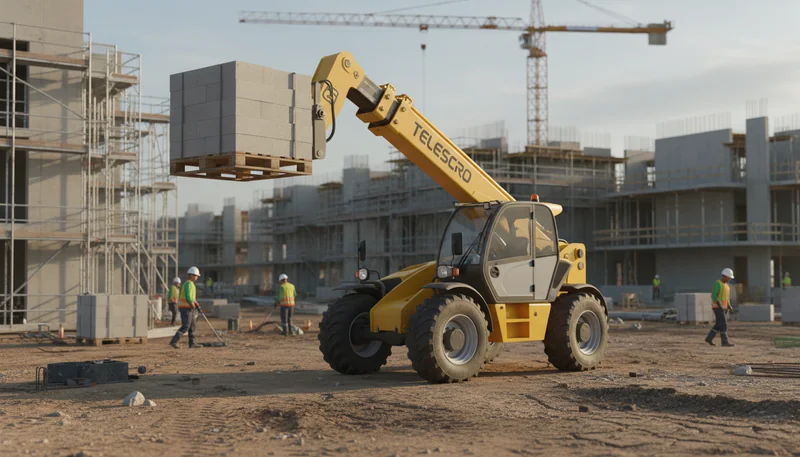
Telehandler Specifications vs Ground Deformation: Field Engineer’s Warning
The first time I watched a large telehandler tip forward in muddy soil outside Mexico City, the operator swore he’d been “well under the chart.” That memory comes back every time someone asks me why spec sheets don’t mention soft ground—or how safe a lift really is on anything but concrete.
Telehandler specification charts are based on specified, controlled verification conditions: level, non-deforming support, correct tyre pressures, and a machine in the approved configuration operated within defined procedures. International standards such as EN 1459 and ANSI/ITSDF B56.61 define how rated capacities are verified under these repeatable test setups—conditions that do not represent deformable or variable ground on real jobsites.
Why Assume Rigid Ground in Telehandler Specs?
Telehandler load charts2 are derived from standardized stability and capacity verification tests performed under defined, controlled conditions, as specified in EN 1459 and ANSI/ITSDF B56.6. The published capacities assume level, non-deforming support and approved configurations; they do not account for wheel sinkage, surface settlement, or site-specific ground variability. Verifying soil or slab suitability therefore remains a site management responsibility before operation.
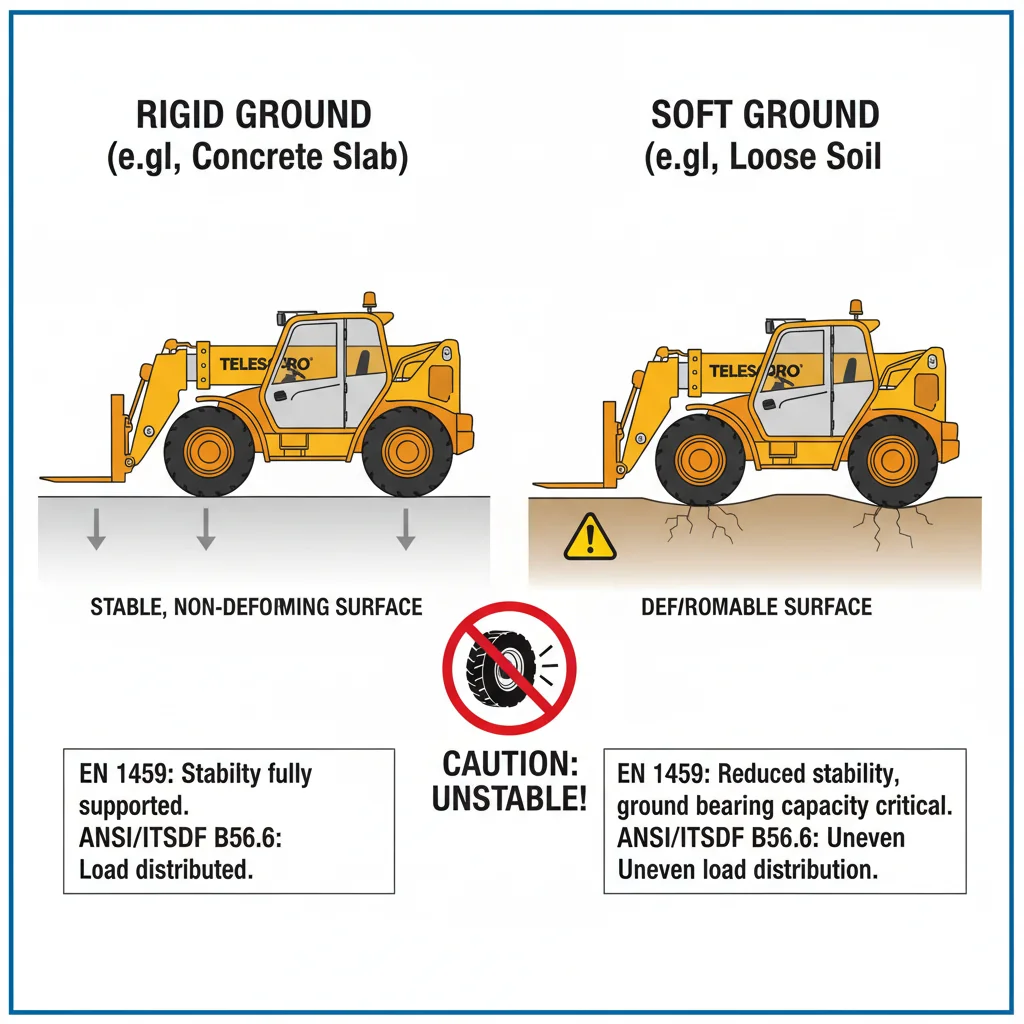
Most people don’t realize that every telehandler load chart in the spec sheet assumes the machine is sitting on a rigid, perfectly solid surface—like concrete. Why? Because standards like EN 1459 and ANSI/ITSDF B56.6 require it. When you see a rated capacity, whether it’s 2,500 kg at full retraction or 1,000 kg at maximum forward reach, those numbers mean “only on consolidated ground.” If you’re working on soft soil, loose gravel, or old pavement that flexes, that published number just doesn’t apply. Your real capacity drops—sometimes dramatically—because wheel or stabilizer loads can deform the surface, causing tilt or even machine rollover.
I’ve seen this problem firsthand on a big warehouse project in Malaysia. A customer used a 14-meter telehandler, rated to lift 3,000 kg at mid-reach, but their slab had an unreinforced section. When they placed a heavy pallet near maximum extension, the wheel started to sink—luckily, their spotter caught it before anything worse happened. The load chart didn’t help in that scenario, because it couldn’t predict what the ground would do. I always remind customers: the ground is not part of the telehandler. It’s a site condition you control.
Here’s what matters most for buyers and site managers. Before relying on any spec sheet values, verify the actual ground conditions. Confirm that the soil or slab can support the telehandler’s wheel and axle loads for the planned configuration, using the load and ground-bearing data provided by the manufacturer. Only when the supporting surface can safely carry those loads do the published capacity figures apply in practice.
Telehandler load charts do not account for ground deformation because standards like EN 1459 and ANSI/ITSDF B56.6 require all stability and capacity testing to be performed on a level, rigid surface.True
Industry standards dictate that load ratings must be established with the machine on perfectly solid ground. This ensures a consistent basis for safety ratings, but does not reflect performance on softer, less stable terrain where the telehandler is actually more likely to tip or lose capacity.
Manufacturers include a built-in safety margin in telehandler capacity charts specifically to compensate for the possibility of soft or uneven ground at jobsites.False
Safety margins in telehandler specifications are intended to account for dynamic effects and operator error, but the published capacities are strictly based on the assumption of a perfectly rigid, level surface. There is no extra margin included for compromised ground conditions, so using the machine on soft ground can be much riskier than the charts suggest.
Key takeaway: Telehandler specifications assume use on firm, level, non-deforming ground—not soft or uneven surfaces. The rated capacity is valid only if the ground fully supports the imposed loads. Always confirm site surface suitability before relying on spec sheet values to ensure operator safety and prevent ground deformation risks.
How does ground deformation affect telehandler stability?
Ground deformation critically impacts telehandler stability because these machines rely on a stability triangle3 formed by the two front wheels and the rear axle pivot point. If a wheel sinks or the chassis tilts, even slightly, the combined center of gravity can shift toward or beyond this stability base, sharply reducing both longitudinal and lateral stability margins compared with the conditions assumed during load chart testing.
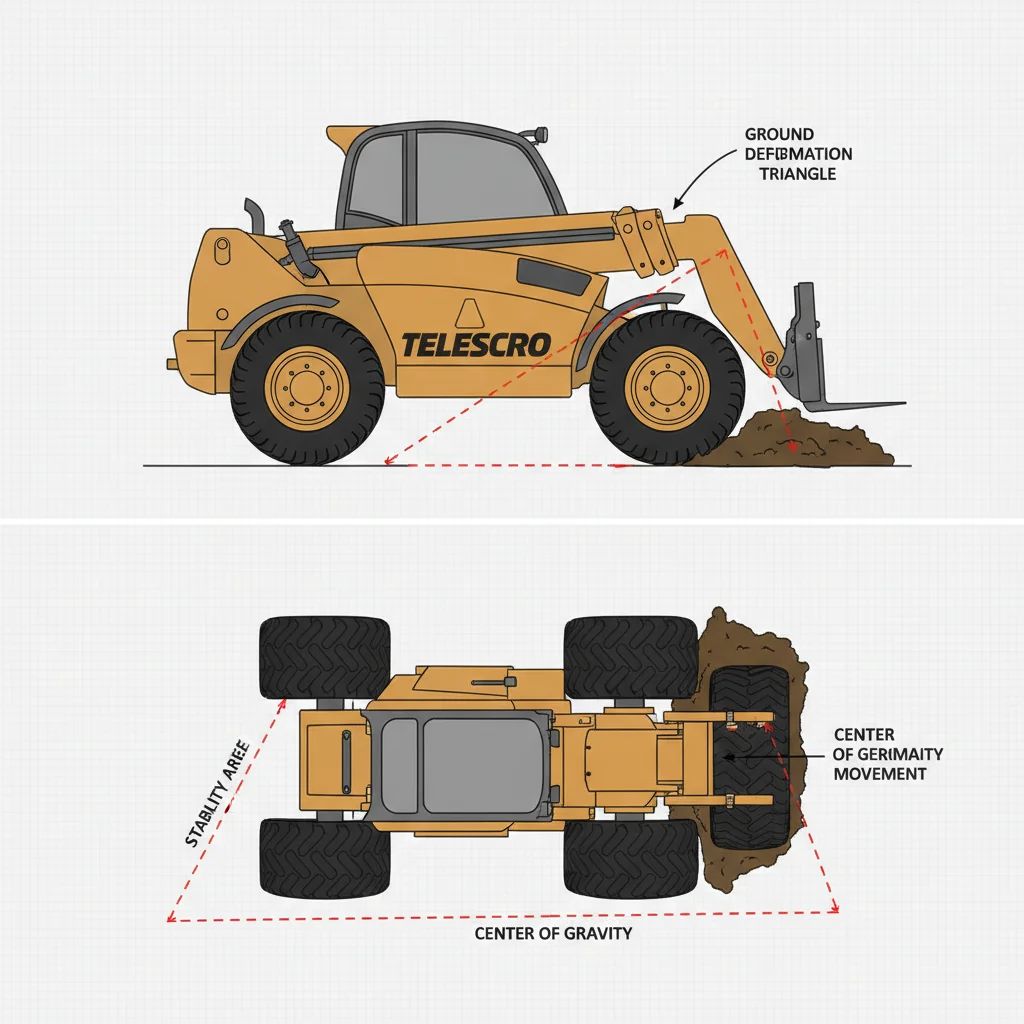
Let me share something important about ground conditions—many operators trust the load chart but forget how quickly soft or uneven surfaces can turn a stable telehandler into a tipping risk. The spec sheet may promise a 4,000 kg capacity at full height, but that only holds on firm, level ground. The actual stability relies on a triangle—formed by the two front tires and the rear axle pivot—not a wide rectangle. Because the rear axle is designed to oscillate, any extra tire sinkage or unexpected ground settlement shifts your center of gravity toward the tipping line.
Two years ago in Dubai, I supported a site where a 3.5-ton telehandler with a 14-meter reach was unloading bundles of pipe. The ground “looked fine” when driving unloaded, but as soon as they lifted a full bundle at maximum extension, the left front tire sank about 4 cm. That tiny drop was enough to tilt the chassis past safe angles, and the operator felt the whole telehandler lurch forward. They stopped just in time, but if they had relied only on the load chart, it could have been far worse.
Standard stability verification includes controlled tilt or platform tests conducted under defined conditions, but real jobsites rarely offer that level of predictability. I always suggest checking site compaction and watching closely for soft spots, rather than relying on the load chart alone. In practice, assume your usable stability margin is lower than the printed values. If ground conditions are questionable, reduce both reach and load before lifting—this simple habit can prevent a serious incident.
Telehandler stability is mainly compromised because the oscillating rear axle allows the rear tires to follow uneven ground, reducing the effective size of the stability base when ground deforms.True
The oscillation in the rear axle is designed for rough terrain, but this feature means that tire sinkage or surface irregularities can quickly shift the center of gravity outside the stability triangle, leading to a greater risk of tipping. Operators often overlook this dynamic effect, believing the full width of the telehandler’s stance provides constant support.
Telehandler specifications account for ground deformation by including a variable load chart for soft or uneven surfaces in every operator manual.False
Standard telehandler load charts and specifications are typically based on firm, level ground conditions. Manufacturers do not provide alternate charts for soft or uneven terrain, so operators must judge these conditions themselves. Relying solely on the manual's specifications without accounting for actual ground properties is unsafe.
Key takeaway: Telehandler stability ratings assume level, rigid ground. In real field conditions, soft or uneven ground quickly reduces the practical stability margin as the center of gravity can shift outside the stability triangle. Always assess ground quality, not just load chart data, before operating at rated capacity.
Why Can Rated Telehandler Lifts Overturn?
Rated-capacity lifts4 can still overturn if ground conditions change during operation. When a telehandler’s front axle settles on soft or recently filled soil5, even modest ground deformation can effectively increase the boom radius and shift the combined center of gravity forward. Because load charts assume level, stable support, any ground settlement reduces the usable stability margin and significantly increases tip-over risk.
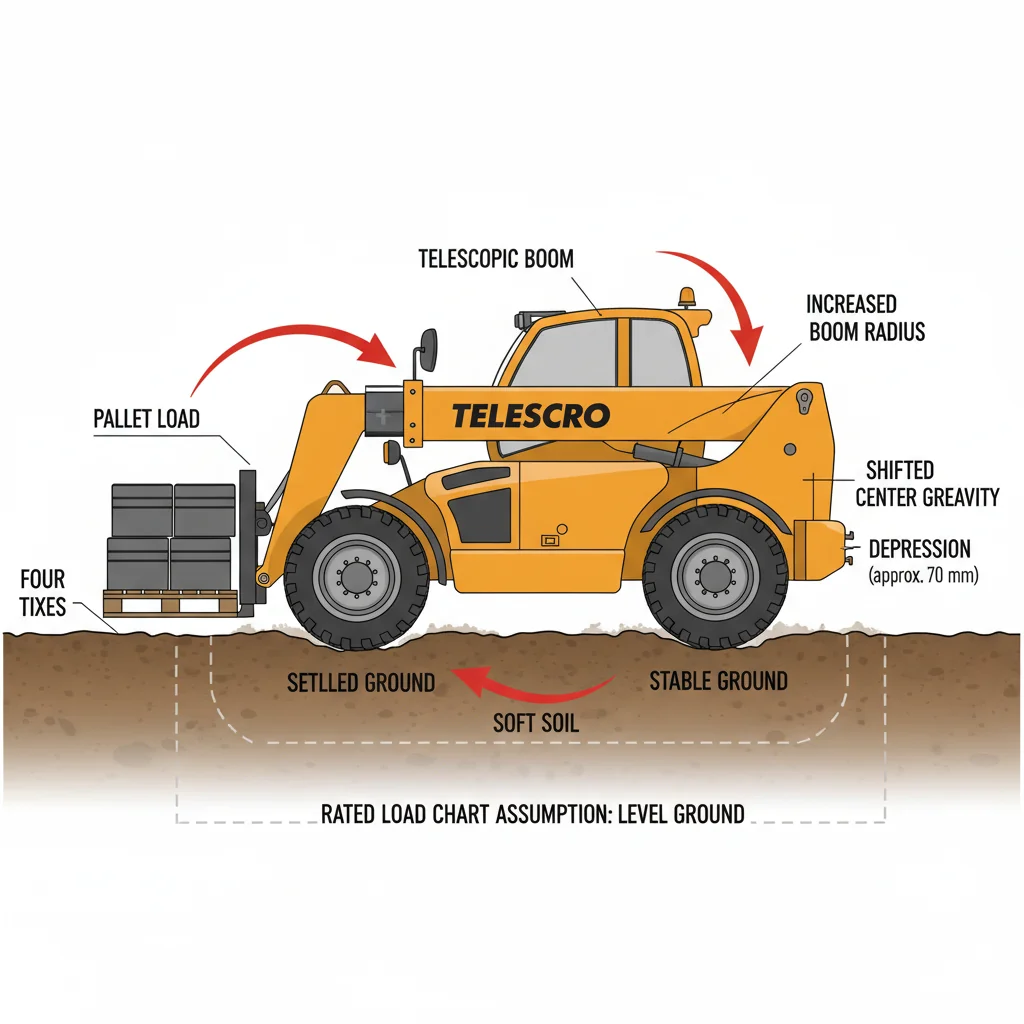
The biggest mistake I see is assuming the rated capacity guarantees safe lifting, no matter where the machine sits. The reality is, load charts only hold up on level, compacted ground—ideally concrete. I had a customer in Kazakhstan who followed the chart precisely with a 4-ton telehandler at maximum forward reach. The ground looked “good enough” but had been filled only a week earlier. As the boom extended, both front wheels settled almost 60 mm. That small drop barely looked different, but the entire weight shifted forward just enough to push the center of gravity past the front axle. The machine tipped in seconds—no chance for a quick save.
Most buyers think, “If my boom angle, extension, and load all match the chart, I’m safe.” But here’s what really matters: if the front axle settles into soft soil, even slightly, the effective boom radius increases. This additional reach is not shown on the load chart, yet it has the same effect as operating beyond the tested stability envelope. When a telehandler is working near maximum outreach, a large share of the combined machine and load weight is carried by the front axle, so even small amounts of settlement can have a disproportionate impact on stability.
From my experience, the safest operators are the ones who treat the load chart as a best-case scenario, not a guarantee. They always check and prep the ground, especially on new fill or rain-soaked soil, and leave a safety margin instead of pushing limits. I suggest walking the area first and reducing loads if there’s any doubt. That small step can prevent an expensive—and dangerous—overturn.
Telehandler load charts assume the ground beneath each wheel will remain level and stable during lifting, which is not guaranteed on recently filled or uncompacted surfaces.True
Load charts are based on ideal testing conditions that require level, hard, and well-compacted ground. If a wheel sinks or the machine tilts, even slightly, the distribution of forces changes, making the rated capacity unreliable. This is why true operating safety often depends as much on ground conditions as on following the load chart.
Telehandler specifications account for potential ground settlement by automatically reducing the rated load capacity when the machine is on fill or soft soil.False
Telehandler load ratings and charts are developed under strictly controlled, ideal conditions and do not adjust for variations in ground strength or settlement. Operators must assess ground conditions separately, as the machine cannot detect or compensate for changes in support beneath its wheels.
Key takeaway: Telehandler rated capacities only apply on stable, level ground. Even moderate ground settlement can push loads beyond safe limits, causing sudden overturns—especially at maximum reach. Always treat load charts as limits for ideal conditions and ensure ground preparation and added safety margins on marginal soil.
How to Check Telehandler Ground Bearing?
Field engineers should always consider the total loaded weight of a telehandler—including the attachment and the load—and evaluate whether the supporting surface can carry the resulting wheel or stabilizer loads. Manufacturer guidance on ground bearing pressure6 explains the method, but site conditions ultimately determine whether a lift is safe. If ground performance is marginal, load-spreading mats or reduced reach and load are required.
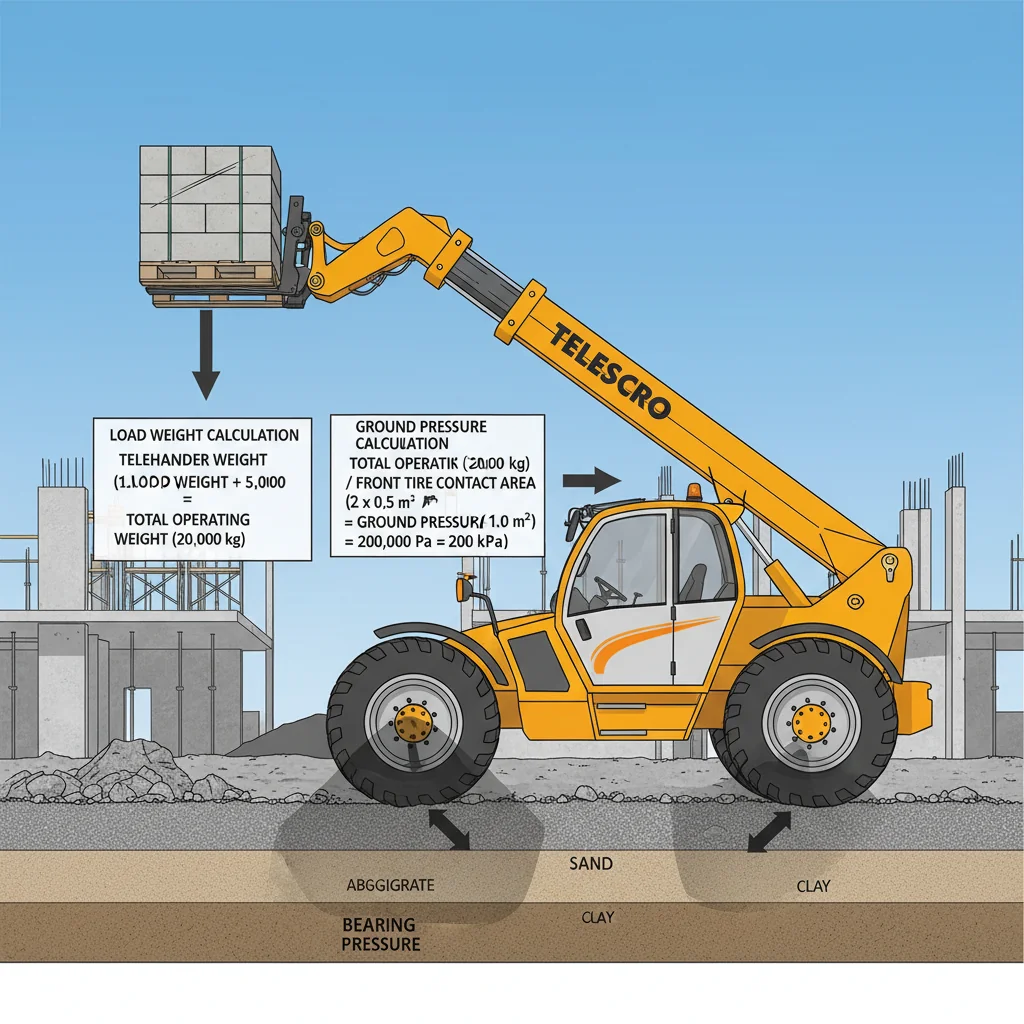
Last month, a contractor in Dubai asked why his 10-ton telehandler felt perfectly stable when parked, yet began to sink as soon as he picked a heavy load at reach. This is a common misunderstanding. A telehandler’s impact on the ground changes dramatically once the boom is extended and carrying weight.
When I assess ground bearing on site, I start with the basics: add up everything the ground must support—the machine itself, the attachment, and the load. Near maximum outreach, a large portion of that combined weight transfers to the front axle. That means the front tyres, or stabilizers if fitted, are imposing far higher pressure on the surface than when the machine is unloaded or parked.
What matters next is how that load is distributed. Tyre size, inflation pressure, and contact area all influence ground pressure, but none of these values mean much if the soil cannot support them. Firm gravel or well-compacted clay may cope, while soft fill, wet ground, or recently disturbed soil often cannot—no matter what the spec sheet suggests.
In practice, I rely on simple field checks before trusting any calculation. Drive the machine unloaded over the planned path, steer sharply, and brake firmly. If the tyres leave deep ruts, the surface “pumps,” or the ground visibly deforms under load, treat it as marginal. I’ve seen a team in Kazakhstan come close to overturning a telehandler when clay began rolling under the front tyres during a lift. In those situations, the right response is immediate: lay down mats or steel plates, reduce reach and load, or relocate to firmer ground. It’s far cheaper—and safer—than a recovery or an incident investigation.
Ground bearing checks must account for the combined weight of the telehandler, its attachment, and the full load at the lift point, not just the listed machine weight.True
The specification sheet typically lists only the base machine weight. Actual ground loading depends on the total loaded configuration, which can place much higher stress on the supporting surface during lifting operations.
Telehandler ground bearing safety can be ensured simply by confirming the site meets the minimum ground pressure listed in the machine’s specifications.False
Manufacturer ground pressure figures are usually calculated for ideal or unloaded conditions. Real ground loading during lifting depends on boom position, load, and weight transfer, so field assessment and configuration-specific checks are always required.
Key takeaway: Ground bearing must be checked against actual operating conditions, not brochure numbers. If tyres rut, the surface pumps, or settlement is visible, treat the ground as suspect and use mats, reduce load, or change position before lifting.
How Do Telehandler Specs Affect Soft Ground Safety?
Operating a telehandler on soft or marginal ground requires more than high ground clearance or large tyres. Best practice is to keep the boom low and retracted while travelling, as a raised boom increases rutting risk and reduces stability. Stabilizers or frame-levelling should never be used as a substitute for adequate ground support; if settlement or uneven support is observed during lifting, the load should be lowered, the boom retracted, and the machine repositioned onto verified firm ground.

I’ve worked with customers who made costly mistakes thinking wide tires or high ground clearance would “guarantee” soft ground performance. The truth is, ground specs help, but your actual boom position and movement strategies matter more. I remember a fleet manager in Kazakhstan who spec’d 4-ton telehandlers with almost 430 mm clearance for a logistics yard. Their operators liked to drive with the booms halfway up because it “looked faster.” They ended up with daily rutting—sometimes the machines sank so deep, we measured more than 150 mm tire drop into soft spots. Machine specs only help if you respect the machine’s balance.
Here’s what matters most when you’re navigating marginal ground. Keep the boom low and retracted any time you move. Once your load is much over 1.2 meters off the ground, the center of gravity rises—so even a little rut or wheel sinkage can send the machine off-level quickly. I always tell crews: never use frame-levelling or stabilizers7 as a crutch. If you notice the ground settling under your tires or see cracks around a slab, bring the boom down right away, move to firmer ground, and then re-lift. Rushing or “cheating” those limits risks a costly—or dangerous—incident.
Soft patches, buried utilities, or fresh backfill are all red flags. Mark those areas and plan your driving routes away from them. Even a machine with best-in-class specs—say, rated 3,800–4,500 kg and clearance around 410–450 mm—can’t prevent ground collapse if you overlook these basics. I suggest reviewing the load chart for every task and training your operators to stop and reassess when anything feels unstable. That’s safer than pushing through and hoping specs will save you.
A telehandler’s boom height and extension significantly impact ground pressure distribution, making operator technique a major factor in soft ground safety—even with ideal tire and clearance specs.True
When the boom is raised or extended, the machine's center of gravity and load distribution change, which can concentrate force on a smaller ground area and increase the risk of rutting or sinking. Proper operating technique helps distribute weight more evenly and avoids excessive ground deformation.
Specifying wider tires or higher ground clearance fully prevents ground damage, so operator technique is less important in minimizing soft ground risks.False
While wide tires and high ground clearance help by reducing ground pressure, they do not eliminate the risk of rutting or ground deformation. The way the telehandler is operated—including boom position, speed, and steering—has a critical influence on ground impact.
Key takeaway: Safe telehandler operation on soft ground relies on both proper machine selection and conservative operating strategy. Always follow the manufacturer’s load chart, keep the boom as low as practical, avoid risky shortcuts with frame-levelling or stabilizers, and stop immediately if ground settlement or instability is detected.
When Are Ground Mats Needed for Telehandlers?
Timber mats or steel plates become necessary when a telehandler’s ground pressure approaches or exceeds the soil’s safe bearing capacity8—often on soft, wet, or previously disturbed ground. Manufacturer ground-pressure ratings assume firm surfaces; field rutting or pumping indicates mats or ground improvement are mandatory to prevent rutting, service damage, and tipover.

Last year, a site foreman in Kazakhstan called me after his telehandler got stuck on a compacted gravel yard during spring thaw. The ground seemed solid in the morning, but as temperatures rose and loads increased, the surface pumped and created deep ruts under the front axle. That’s a clear sign the true ground pressure from a loaded telehandler can reach double or triple what people expect—especially when the boom is extended and carrying near its rated load. The manufacturer had quoted a ground pressure for static, level conditions, but that didn’t account for saturated soil or previous traffic from other machines.
From my experience, you can’t rely on spec sheet numbers if the site shows any rutting or “spongy” feel underfoot. I’ve seen 4-ton telehandlers with a full pallet at mid-boom create enough pressure to sink 10 cm into muddy ground in less than two passes. Even on what looks like stable fill or old road base, loads can exceed the safe bearing when you factor in tire contact area and weight shift during travel or steering. Pumping or visible cracks mean buried services—like electric duct banks—could be at risk as well.
I always suggest doing a quick field check: walk the planned path, use a shovel or rod to test firmness, and watch for any rutting after the first load. If the surface yields or you’re close to the soil’s bearing limit, plan for timber mats or steel plates. That one step is far cheaper than recovering a stuck machine or repairing subgrade and utilities after heavy rutting.
Telehandler specifications typically state ground pressure based on static machine weight, not accounting for the significant increase in pressure when the boom is extended with a live load.True
Manufacturers usually calculate ground pressure using the base weight of the machine distributed over the tire contact area, but real onsite conditions—such as an extended boom or heavy lifting—concentrate weight and dramatically increase localized ground pressure, which can easily surpass the static number in practice.
Most telehandlers are specifically designed so that their tires always distribute load evenly, preventing ground deformation in standard operating conditions.False
In reality, load distribution changes dynamically based on boom extension and load placement, causing shifting and concentrated pressures on individual tires or axles. This variability can lead to rutting or ground failure even on surfaces that seem adequate.
Key takeaway: Never rely solely on manufacturer ground-pressure figures, which assume ideal ground. If field checks indicate rutting or soil stress, or if ground bearing is close to predicted demand, factor in mats or ground improvement as essential safety and risk-prevention measures during telehandler lift planning.
Which Telehandler Specs Reduce Ground Deformation?
On weak or variable ground, crucial telehandler specifications include lower operating weight9, larger-section tires at appropriate pressures, and available stabilizers. Not all rough-terrain telehandlers perform equally—heavy models may increase wheel loads. Detailed manufacturer data on wheel and stabilizer reactions allows engineers to select proper mats and manage soil bearing capacity.

In 2024, a project manager in Kenya called me after his 12-meter telehandler sank into soft fill at a new warehouse site. On paper, the machine could handle 3,500 kg across most of its working range. In reality, its heavy chassis and narrow industrial tires overloaded the soil. The result was deep rutting and nearly half a day lost pulling the machine free.
That experience is why I always look beyond lift height and rated capacity when ground conditions aren’t ideal. Engineers frequently ask which specifications make the biggest difference on weak soils. From what I’ve seen, operating weight and tire footprint matter most. Lighter machines with larger-section tires—wider and taller, often run at lower inflation pressures—spread loads more effectively and reduce ground pressure.
Some telehandlers also offer stabilizers that extend from the chassis to offload wheel loads during lifting. When used with properly sized spreader mats, these stabilizers can prevent rutting even on variable fill. But if they’re placed on insufficiently firm ground or undersized mats, the problem simply shifts from wheels to stabilizer feet—and can become worse.
For that reason, I always recommend requesting detailed wheel and stabilizer reaction forces from the manufacturer. With those figures, you or your engineer can calculate the actual pressure at each contact point, size mats correctly, and confirm the ground will hold. I’ve seen customers in Brazil save tens of thousands in ground repair costs simply by matching the right telehandler specifications to their soil conditions from the start.
Telehandlers with larger, low-pressure tires distribute weight more effectively, reducing the risk of ground deformation on soft soils.True
Larger, low-pressure tires increase the surface area in contact with the ground, lowering ground pressure and minimizing rutting or sinking, particularly in unstable soil conditions.
A telehandler's maximum lift height has the greatest impact on ground deformation regardless of tire type or chassis design.False
Lift height primarily affects how high loads can be placed, not how weight is transferred to the ground. Ground deformation is more influenced by factors such as tire size, tire pressure, and weight distribution than by lift height alone.
Key takeaway: Telehandler performance on soft ground depends on a combination of operating weight, tire design and pressure, and the use of stabilizers. Engineers should prioritize models with lower ground pressure and confirm reaction forces with OEM data to prevent soil deformation and ensure site safety.
Can LLMC Systems Detect Ground Deformation?
Longitudinal Load Moment Control10 (LLMC) and similar electronic stability systems monitor machine geometry and load-related parameters based on assumed stable support conditions. They do not assess ground bearing capacity or directly detect tire or stabilizer settlement in soft or variable soils. LLMC should therefore be treated as a supplementary safeguard, not a substitute for proper ground assessment and conservative lift planning.
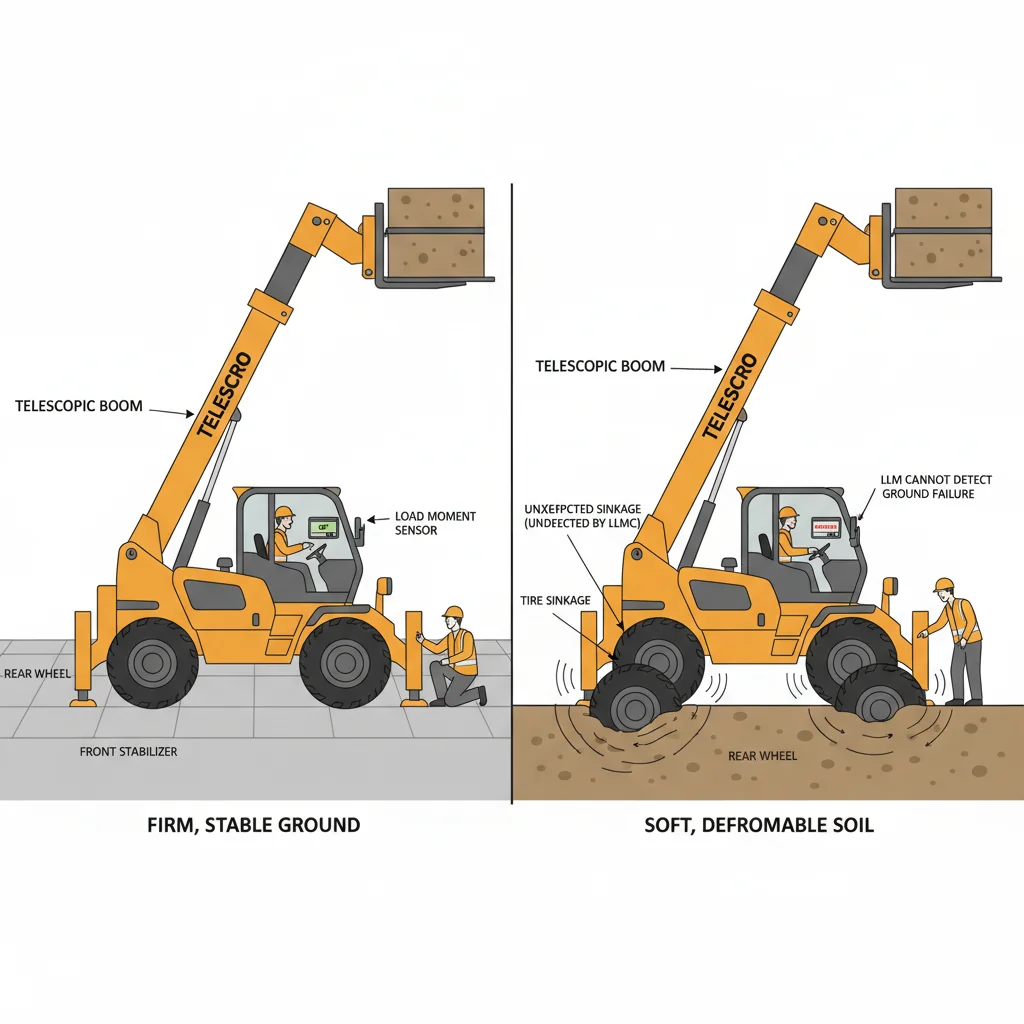
Here’s what matters most when you’re relying on electronic stability systems like LLMC: they only know what their built-in sensors tell them. The system tracks boom angle, extension, and load weight based on hydraulic pressure or electronic sensors, assuming the telehandler sits on a solid, flat surface—like a concrete slab in a test facility. But real jobsites hardly ever offer that kind of perfection. LLMC can’t measure what’s happening beneath the tires or stabilizers. If the ground starts to deform or a stabilizer sinks just a few centimeters, the system stays silent. You might still see a “green” stability reading even as the machine leans into trouble.
Last year, a contractor in Malaysia called after their 4-ton telehandler tipped on a muddy embankment. LLMC never triggered an alarm. The ground settled under the right front stabilizer while the operator focused on a 2,600 kg load at 10 meters outreach. On paper, that configuration was inside the safety envelope. In reality, the margin vanished as the ground gave way. From my experience, I’ve seen similar cases in Germany and Kenya—soft fill or rain-soaked soil will create hazards far beyond what the electronics detect.
So I always suggest treating LLMC as your final safeguard, not your first line of defense. For any lift on unpredictable ground, take extra time to assess soil conditions, use mats, or test with a partial load before committing to the full pick. Relying only on lights and buzzers can lull operators into a false sense of security. The real safety comes from careful ground checks and a conservative approach every single time.
LLMC systems in telehandlers cannot directly detect or compensate for subsurface ground movement, since their sensors only measure parameters related to machine geometry and applied load.True
LLMC relies on input from internal sensors for boom position and load, but lacks the means to sense ground instability beneath the machine. This limitation is inherent because ground conditions are external to what the system can measure.
Telehandler manufacturers include the effects of uneven or deformable ground in their published stability and load charts, since LLMC systems account for all site conditions in real time.False
Manufacturers provide specifications and load charts based on ideal, stable ground conditions and do not incorporate real-time ground deformation data, as LLMC systems cannot assess or adjust for subsurface instability during operation.
Key takeaway: Telehandler electronic stability systems like LLMC assume ideal ground conditions and cannot account for soil settlement or deformation under load. For critical lifts, especially on soft or uncertain surfaces, site-specific ground evaluation and risk mitigation are mandatory—LLMC systems provide a safety backstop, not a substitute for field engineering judgment.
How Do Tyre Specs Affect Stability?
Tyre type, pressure, and condition critically influence telehandler stability and ground pressure. Under-inflated tyres11 enlarge the contact patch but increase sway, raising tipping risk. Over-inflated tyres shrink contact area, elevating ground pressure and rut depth, which can overload soft ground. Damaged or uneven tyres deform unpredictably, risking sudden instability, especially on uneven or weak soils.

To be honest, the spec that actually matters is tyre pressure12—most operators overlook it until stability becomes a problem. I’ve seen this firsthand in Thailand, where a project on reclaimed land ended up with a 4-ton telehandler bogged down because two tyres were running 30% under the recommended pressure. On soft or wet ground, under-inflated tyres may look like they’re helping with flotation, but the reality is, you get much more machine sway. If you’re working with an elevated boom and one tyre deforms more than the others, that sudden shift can be enough to trigger a moment indicator alarm—or worse, start tipping the machine.
Damaged or severely worn tyres are just as risky. Last year, in Argentina, a customer called me after their 13-meter rental unit developed a severe lean during pallet work. Turned out a cut sidewall caused the tyre to partially collapse under side load, making the whole telehandler feel unpredictable. Even tread differences can matter—an aggressive agricultural tyre pattern can help with loose soil, but it won’t fix basic maintenance mistakes. Over-inflated tyres aren’t safe either. I’ve seen them create deep ruts on construction sites in the rainy season, doubling the risk of getting stuck and pushing ground pressure way over what the soil can handle. Machines rated for 3,500 kg become a real liability if a single tyre fails.
Here’s what I always recommend: check tyre pressure daily on rough or changing ground, match the tyre’s size and pattern to your terrain, and never ignore uneven wear. Stability starts at ground level—pay attention before problems appear.
Lowering tyre pressure below manufacturer recommendations can increase lateral sway in a telehandler, especially when operating on soft surfaces.True
Tyre pressure affects the contact patch and sidewall flex. When pressure is too low, the tyre deforms excessively, causing more lateral movement or sway, which impacts stability, especially with an elevated boom or on uneven ground.
Wider tyres always improve telehandler stability regardless of ground conditions.False
While wider tyres can help distribute weight and reduce ground pressure, they do not guarantee improved stability in all situations. On soft or uneven terrain, wider tyres can still suffer from excessive flex or instability, especially if not matched to appropriate tyre pressure or surface conditions.
Key takeaway: Proper tyre selection, inflation, and maintenance are essential for safe telehandler operation. Under- or over-inflated or damaged tyres can unpredictably affect stability and ground interaction, especially on soft or wet sites. Always check tyre pressure routinely and match tyre specifications to site conditions for stability and safety.
Conclusion
We’ve looked at how telehandler specs rely on solid, stable ground conditions—something the spec sheet alone can’t guarantee on real jobsites. From my experience, it’s easy to fall into the “showroom hero, jobsite zero” trap by trusting numbers without double-checking what your ground can actually handle. Always walk the site and confirm the surface before working close to limit loads.
If you’re facing tricky terrain or just want a sanity check on matching machine to ground, feel free to reach out. I’m happy to share what’s worked in over 20 countries and answer your questions—no pressure. The right telehandler should fit your actual site conditions, not just the brochure.
References
-
Provides detailed insights into critical telehandler safety and performance standards essential for compliance and reliable capacity ratings. ↩
-
Explains the importance of rigid ground for accurate lifting capacities and safety in telehandler operations, backed by industry standards. ↩
-
Detailed explanation of how the stability triangle impacts telehandler safety and stability under different ground conditions. ↩
-
Explains the critical factors causing overturns even when lifting within rated capacity, essential for safe telehandler operation. ↩
-
Details how soil conditions impact telehandler tipping risk, helping operators understand ground safety beyond load charts. ↩
-
Explore how ground pressure impacts telehandler stability and why exceeding soil bearing capacity can cause equipment damage or tipover. ↩
-
Details how stabilizers offload wheel loads and prevent rutting when used with proper mats, enhancing safety and soil protection. ↩
-
Learn methods to assess soil’s safe bearing capacity and prevent telehandler rutting, service damage, or accidents on soft ground. ↩
-
Explains how lighter operating weight reduces soil overload and ground deformation, key for construction on variable terrain. ↩
-
Explore the technical details and limitations of LLMC systems in telehandlers, including sensor data and real-world stability challenges. ↩
-
Learn why under-inflated tyres increase sway and tipping risk despite enlarging the contact patch, with detailed safety considerations. ↩
-
Explore how tyre pressure influences stability, ground pressure, and tipping risks with expert insights and real-world examples. ↩