











Telehandler Sizes: What Most Buyers Use (And Common Sizing Mistakes)
I still remember a project in Melbourne where a customer called, frustrated that his brand-new telehandler couldn’t lift a standard pallet of bricks to the third floor. The machine’s specs looked perfect on paper—but the actual working capacity told a different story, and it’s a mistake I see far too often.
Telehandler “size” is best understood as a combination of rated lift capacity, lift height/reach, and overall machine dimensions. Across construction fleets, many commonly used machines fall in roughly the ~2–6 tonne class with lift heights ranging from compact low-height units up to ~18 m (and higher in some ranges). Actual usable capacity at working height and outreach is typically much lower than the headline rating, especially with the boom extended.
How Is Telehandler Size Properly Defined?
Telehandler size is best defined by three core specifications: rated lift capacity1, maximum lift height2, and overall machine dimensions. Real-world suitability depends on the rated capacity at your working height and outreach—often much lower than the headline figure. It is critical to review the OEM load chart3 for the actual capacity at the required height, reach, attachment, and load center.

The biggest mistake I see is buyers focusing on maximum rated lift or height from the spec sheet. Those headline numbers can be misleading if you don’t verify what the machine can safely lift at your actual working position. For example, a telehandler that looks capable on paper may see its usable capacity drop sharply once the boom is extended to typical upper-floor working heights—especially if the load is offset, an attachment is fitted, or the ground is not perfectly level. This is a detail many buyers overlook until it creates real problems on site.
Last year, I supported a project in Dubai where the site manager ordered a 6-ton, 17-meter machine based only on maximum specs. Their daily task was lifting 2-ton steel bundles up to the ninth floor, almost 15 meters out. What happened? At that boom reach, the load chart showed safe capacity dropped to just 1,700 kg. They couldn’t safely complete lifts half the time, so rental costs doubled while a second machine arrived. The real lesson: rated capacity4 only applies at minimal boom extension—never at full height or reach. That’s why I always remind customers to check the load chart for their typical working scenario, not just what’s in big bold font.
Here’s what matters most: always leave yourself a 20–30% safety margin. So if you plan to lift 1,500 kg regularly, target a machine supporting at least 2,000 kg at that boom extension and height. This avoids underspec headaches or paying too much for performance you never use. I suggest confirming every requirement with the OEM’s actual load chart—real jobsite safety depends on it.
A telehandler's true lifting capacity at maximum reach is often significantly lower than its maximum rated lift, due to leverage forces acting on the extended boom.True
When a telehandler boom is fully extended, the load exerts a greater moment force on the machine, reducing stability and safe capacity compared to the manufacturer's headline rating, which is usually measured with the boom retracted and close to the chassis.
The most important factor in sizing a telehandler is its maximum rated lift capacity, regardless of how far the boom is extended.False
Relying solely on maximum rated lift capacity is misleading because the actual lifting ability decreases as the boom extends. Safe and proper telehandler sizing must consider the reduced capacity at full reach and real working positions rather than just the headline numbers.
Key takeaway: Telehandler sizing must prioritize required rated capacity at specific height and reach, not only maximum values. Always consult the model’s load chart and allow a 20–30% safety margin to prevent underspecification or paying for unnecessary performance.
What telehandler size covers most site needs?
Across many construction and rental fleets, mid-range telehandlers are commonly stocked because they balance reach, capacity and maneuverability. In North America, popular classes often include roughly 6,000–12,000 lb capacity machines with ~36–55 ft lift heights, which cover a large share of everyday jobsite handling tasks depending on the trade and lift plan.
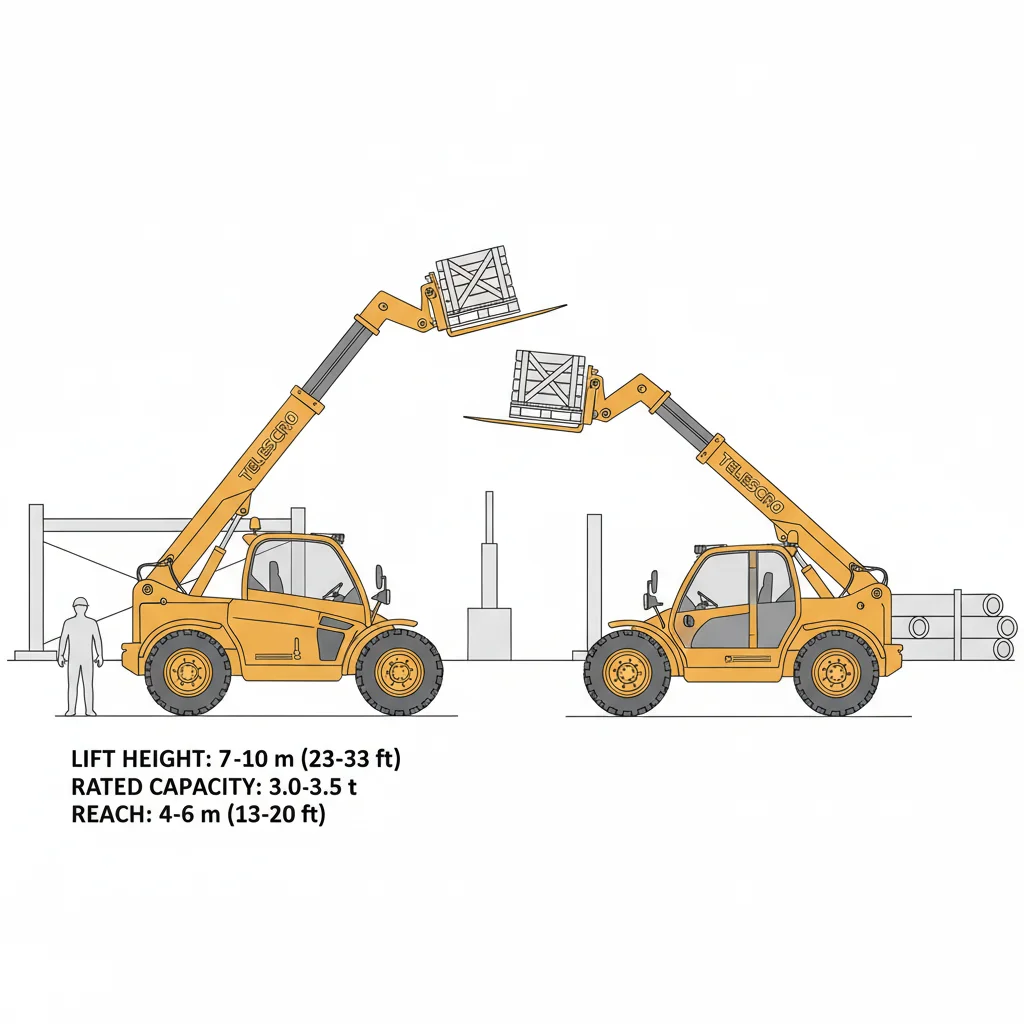
Most people don’t realize that medium-size telehandlers—those with a rated capacity around 3.0–3.5 tons and lift heights in the 7–12 meter range—actually do the heavy lifting on most construction sites worldwide. If you walk through a mixed-use site in Dubai or São Paulo, you’ll spot these machines moving palletized loads, unloading trucks, and feeding material up to the third or fourth floor. Why this size? It’s the right balance. Big enough for steel, block, or brick packs, but still compact enough to maneuver between scaffolding and tight access points.
Let me share something important about matching machine to jobsite. Last year, a contractor in Saudi Arabia called me after renting an 18-meter high-reach model just to move pallets of cement to the second floor. The machine looked impressive, but it ate up space and cost him more on transport and fuel. In the end, a 10-meter, 3.5-ton unit would have finished the work faster and slotted in around other traffic. I see this all the time—over-specifying for height, then paying extra for no benefit.
From my experience, rental platforms in Europe and North America keep fleets stocked with these medium-class telehandlers because they handle about 90% of daily site tasks. Most brands design their core models in this range for a reason: load charts are known and stable, operators get certified quickly, and the machines can handle everything from rebar to drywall with the right attachment. Unless you’re working on a high-rise or inside a tiny alley, this size will get your job done and save headaches on running costs.
Medium-size telehandlers with lift heights between 7–12 meters are typically the most flexible option for multi-story construction sites.True
This is true because these sizes can efficiently handle diverse tasks like moving materials to mid-level floors, unloading supplies, and navigating confined spaces, making them suitable for the majority of standard building projects.
Larger, high-capacity telehandlers are preferred on site because they offer superior maneuverability in tight urban or residential spaces.False
This is false; larger telehandlers, while powerful, are usually less maneuverable due to their size and turning radius, making them unsuitable for the constrained environments found in most building sites.
Key takeaway: Most buyers and renters rely on medium-size telehandlers (7–10 m lift, 3.0–3.5 t capacity) for everyday material handling tasks. These models offer the best trade-off between reach, lifting power, and cost for general construction, making them the core fleet choice unless specialized needs apply.
How Common Are Compact Telehandlers?
Compact telehandlers are commonly used on tight construction sites, small farms, and indoor or restricted-access applications due to their maneuverability and compact dimensions. Typical models such as the Genie GTH-5519 and JLG G5-18A are rated around 5,500 lb with lift heights in the 18–19 ft range; however, usable capacity decreases significantly as the boom extends, and heavier loads are limited at maximum height or outreach according to the load chart.

Let me share something important about compact telehandlers—these machines aren’t just popular, they’re nearly essential in spaces where larger equipment simply can’t fit. I’ve seen this first-hand on jobsites in Singapore and Denmark, especially with indoor renovations or dense city infill projects. In those environments, you need a telehandler with a narrow width (about 1.8 meters) and a turning radius under 4 meters to get around tight corners and standard doorways.
Typical compact models handle up to 2.5 or 3 tons, but at full reach or maximum height—say 5.5 meters up—the safe load drops drastically. I remember a small landscaping firm in Dubai that picked a compact unit for greenhouse work. On paper, it could lift 2,500 kg, but at full extension they managed just under 900 kg safely. That was fine for mulch and bags, but it caught them off guard for heavier pallets. Always check the load chart (which shows limits at different boom angles), not just the spec sheet headline.
These machines truly shine on small farms, recycling yards, and warehouses. Their low hydraulic noise level and compact frame make them perfect for working indoors or near livestock. I often recommend compact telehandlers when site access is a bigger challenge than the size of your materials. If most of your lifts stay well under 2 tons—even at the highest boom angles—this category offers the flexibility you need. Always match your real working loads, not just the max spec, to avoid unwanted surprises.
Compact telehandlers are especially favored for urban construction sites because their reduced width and tight turning radius allow them to maneuver in confined areas where standard telehandlers cannot operate.True
Urban jobsites and interior renovation projects often have limited space and restricted access paths, making the compact telehandler's size and agility crucial compared to larger, more traditional telehandler models.
Most compact telehandlers have a wider chassis than standard telehandlers to increase stability on uneven terrain.False
Compact telehandlers are specifically designed with a narrower chassis to navigate confined spaces and pass through standard doorways, which contrasts with the wider design of larger telehandler models that prioritize stability over compactness.
Key takeaway: Compact telehandlers dominate in restricted-access environments where maneuverability is crucial, offering effective solutions for light to moderate lifting. However, their rated capacity at maximum reach is significantly lower, making them suitable only when typical loads do not exceed 2 tons at working height.
When Are High-Reach Telehandlers Needed?
High-reach and heavy-lift telehandlers5—typically offering 14–18 m lift height and 3–4 t capacity, or up to 20,000 lb capacity at 9–12 m—are essential in specialized sectors like mining, steel mills, ports, and high-rise construction. For most contractors, these units are not everyday choices due to weight, size, and transport complexity.

Here’s what matters most when considering high-reach or heavy-lift telehandlers: these are not everyday machines, but when they are required, they are often the only safe and practical solution. High-reach telehandlers are typically selected for work in the 14–18 meter range, and sometimes beyond. I’ve seen steel mill projects in Dubai where crews needed to place large prefabricated cladding panels at around 17 meters. At that working height and outreach, standard mid-range or 4-ton telehandlers could not safely reach or maintain sufficient chart capacity, making a high-reach unit—or an alternative heavy lifting solution—the appropriate choice.
You’ll find these machines most often on specialized sites. Mining operations in Kazakhstan use 20,000-lb capacity telehandlers for engine block swaps and conveyor repairs. I once worked with a port client in Kenya who needed to reposition oversized steel pipes—each over 8 tons—well above the height of their standard warehouse racking. In these environments, heavy-lift models handle the large weights, but their size comes with compromise. Machines in this class easily tip 15–20 tons themselves, and their width—often above 2.4 meters—makes navigating tight job sites much more challenging.
Transport and logistics add extra headaches. One customer told me renting a high-reach telehandler for a two-week high-rise project almost doubled their hauling costs compared to a 3-ton, 12-meter model. For most contractors, these units are simply too large for daily use. That’s why I always suggest evaluating the real needs of your project. If you only handle oversized loads or work above 15 meters occasionally, renting a high-reach or heavy-lift model is usually the smarter, safer option.
High-reach telehandlers with booms exceeding 14 meters are typically chosen for jobs that require precise placement of heavy materials at elevated heights, such as installing facade panels or structural components on multi-story buildings.True
High-reach telehandlers are not standard for all sites, but are essential when both height and load capacity are needed in tandem. Their specialty is safely lifting substantial weights to locations regular telehandlers cannot access, preventing unsafe rigging or manual lifting.
Most construction projects prefer ultra-high-reach telehandlers over standard-size machines because they are more compact and easier to maneuver on crowded jobsites.False
Ultra-high-reach telehandlers are typically larger and less maneuverable than standard models, making them less suitable for most everyday construction sites. They are used only when their extended capability is required, not because they are easier to handle in tight spaces.
Key takeaway: High-reach and heavy-lift telehandlers are critical for demanding tasks in specialized industries but generally exceed the needs of most contractors or agricultural users. For typical projects, standard telehandler sizes suffice, reserving high-reach or heavy-lift models for rental in specialized situations.
How Does Height Affect Telehandler Capacity?
Telehandler rated capacity declines as boom height and reach increase. Maximum listed capacities apply only at low boom angles and minimum reach. As the boom extends upwards or forwards, leverage and stability limits reduce allowable load. Always consult the manufacturer’s load chart for each height and reach combination, maintaining at least a 20–30% working safety margin.
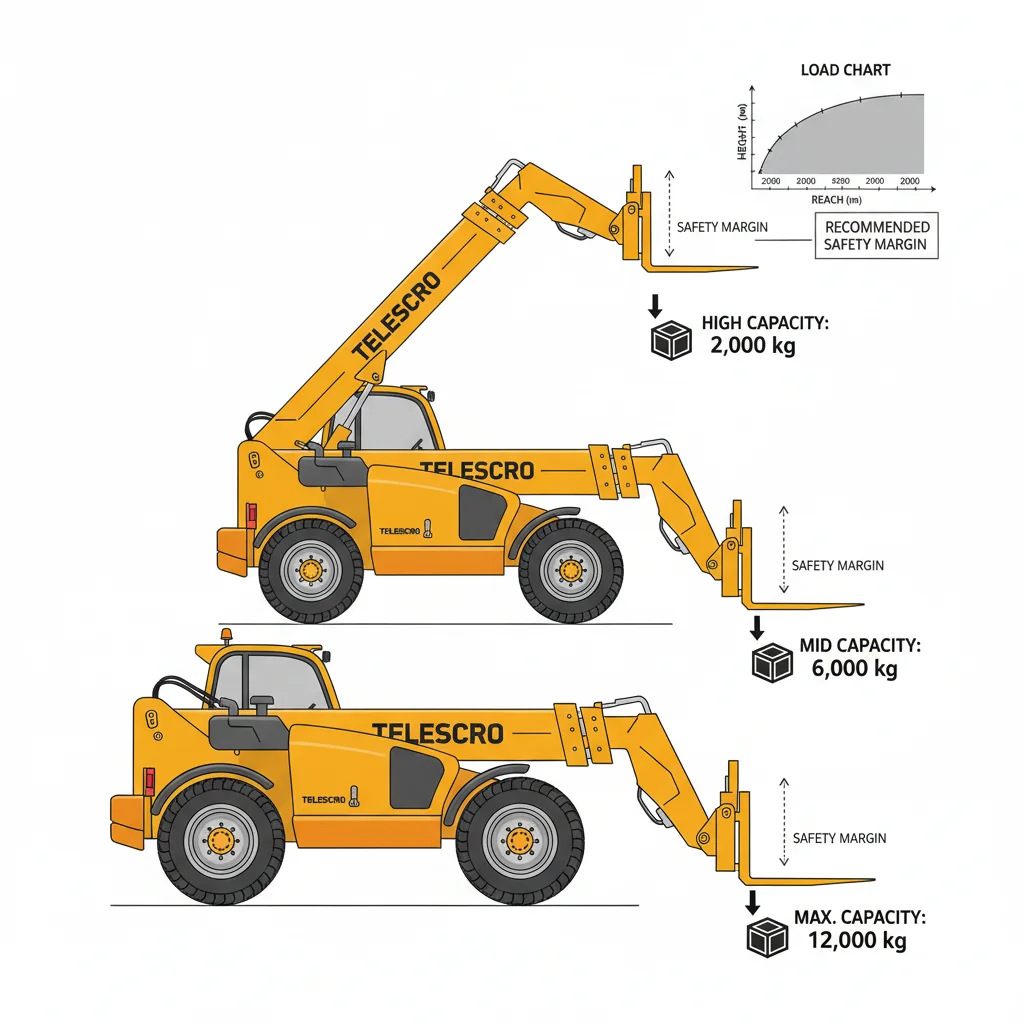
To be honest, the specification that really matters is how much weight a telehandler can safely handle at the position you use most—not the headline capacity quoted with the boom retracted and close to the chassis. On nearly every project, the practical question is not “What’s the maximum rating?” but “What can it actually lift when the boom is up and out?”
I’ve seen buyers in Dubai order a machine advertised as a “10,000 lb / 55 ft” unit, only to discover on site that its usable capacity at full extension was far lower than expected. The load chart makes this clear: as boom height and forward reach increase, allowable load drops rapidly. Relying on brochure figures without checking the chart is a common cause of underspecification and jobsite delays.
One detail that often gets missed is how reach is defined on the load chart. Capacity limits are based on the OEM’s specified horizontal reach to the load center, not simply on boom length. Depending on the manufacturer, this reference may be measured from the front axle or another defined point, which is why the load chart—not assumptions—is the only reliable guide.
For example, a telehandler rated at 3 tons may only achieve that capacity at low lift heights and minimal outreach. As the boom is raised and extended forward, usable capacity can drop substantially. I saw this firsthand on a site in Kazakhstan, where an operator planned lifts based on brochure ratings. At the actual working height and reach, the machine reached its stability limit well before maximum boom extension.
The takeaway is simple: always size and plan lifts using the manufacturer’s load chart for your target height, reach, attachment, and load center. As a general practice, many fleets allow a working margin (often around 20%, and more for uneven ground or dynamic handling) to avoid operating at the edge of the machine’s stability envelope.
Telehandlers with longer booms experience a significant reduction in lifting capacity as the boom extends and raises, which means the usable capacity at maximum height or outreach is often much lower than the machine’s rated maximum.True
This is true because of the leverage effect; as the boom extends, the load moves further from the machine’s center of gravity, reducing stability and requiring lower lift capacities for safety, as shown on standardized load charts.
The lifting capacity of a telehandler remains nearly constant regardless of boom extension or height, as long as the machine is on level ground.False
This is false because a telehandler’s maximum safe lifting weight drops substantially as the boom moves higher or further out; this is due to increased leverage and reduced stability, not just ground conditions.
Key takeaway: Telehandlers do not maintain rated capacity at full height or reach. Most models show a substantial drop in load capacity as the boom extends upward or outward. Always verify actual capacity using the load chart, not just brochure specs, and ensure a safety margin for typical tasks.
Which Telehandler Sizes Are Most Common by Application?
Telehandler size usage varies by application, but across most industries, mid-range machines remain the most widely used due to their balance of reach, capacity, maneuverability, and transport efficiency. Different sectors tend to concentrate around specific size bands based on typical load weights, working heights, and site constraints.

Contractors often assume that larger telehandlers are safer or more versatile, but usage patterns across construction, rental fleets, and agriculture show otherwise. For general construction work—such as blockwork, palletized materials, and routine upper-floor placement—the most commonly used machines fall in the 7–10 meter lift height, 3–3.5 ton capacity range6. These units offer sufficient capacity for typical 1–2.5 ton pallet loads while remaining compact enough for congested sites and economical to transport. As a result, they form the core of most contractor-owned fleets and rental inventories.
High-reach telehandlers in the 14–18 meter class are typically seen on larger commercial or industrial projects, such as facade installation or structural steel handling. Even on these sites, they are rarely the primary machine. Instead, they are used alongside mid-size telehandlers to handle specific high-elevation tasks, while the smaller units manage daily material movement more efficiently.
In agricultural applications, demand shifts slightly toward shorter machines with higher stability and lower overall height. Many farmers favor 6–7 meter telehandlers with roughly 3–3.8 ton capacity7, which are well suited for stacking bales, loading feed wagons, and working inside barns with limited clearance. These models balance lift performance with a compact profile, making them easier to operate in confined farm environments.
Rental fleet turnover reflects similar patterns. While a wide range of sizes is offered, machines in the mid-capacity classes—roughly 6,000–10,000 lb rated capacity with moderate lift heights—tend to see the highest utilization rates. This reflects their ability to serve a broad range of customers without the higher transport, fuel, and handling costs associated with larger high-reach units.
Key takeaway: Across construction, rental, and agriculture, telehandlers in the mid-size range are the most commonly used because they meet the majority of lifting needs without the cost and complexity of larger machines. Matching telehandler size to the dominant application—rather than occasional extreme tasks—helps avoid oversizing, reduces operating costs, and improves overall fleet utilization.
How to select the right telehandler size?
Selecting the correct telehandler size requires analyzing typical load weights, needed lift heights, and site access restrictions—not just maximum theoretical demands. Most buyers use 3–4 t rated capacity machines, sized for regular tasks with a 20–30% working margin above usual loads. Renting larger units is cost-effective for rare, extreme lifts.

Here’s what matters most when selecting telehandler size: focus on what you move daily, not the biggest lift you might see once a year. Rated capacity can look impressive in the brochure, but it drops fast with the boom extended or a heavier attachment. I often see buyers in the Middle East sizing for a single “extreme” job, then struggling for months with a machine that’s too bulky for tight, routine work. For typical sites handling pallets around 1–2 tons, a telehandler with a 3–4 ton rated capacity gives you breathing room—a 20–30% working margin, which is critical for safety and keeping operators confident.
Now let’s talk about lift height and access. Most farm and building jobs rarely need more than 7–10 meters of vertical reach, which covers stacking two to three stories. A client in Kenya recently chose a 10-meter unit for a farm supply yard, and it turned out perfect—the machine slipped through 2.5-meter gates and turned sharply, saving hours every week compared to their old, oversized model. If you’re tackling 4–6 story work, then yes, you’ll need a high-reach machine in the 14–18 meter class—but don’t expect the same load capacity at max extension. Load charts show this trade-off clearly; at full outreach, your safe lift might drop by 40% or more.
Don’t forget site constraints. Narrow alleys, storage sheds, or low ceilings often demand compact machines—sometimes even at the cost of raw capacity. I always tell customers: measure your tightest bottleneck first. Renting a larger telehandler for rare, heavy lifts is almost always cheaper than owning a “showroom hero, jobsite zero” that just gets in the way.
A telehandler’s rated capacity can be significantly reduced by extending the boom or attaching heavy accessories, making it important to choose a machine based on typical working conditions rather than infrequent maximum lifts.True
Rated capacity is measured with the boom retracted and minimal attachment weight. As the boom is extended or heavier attachments are used, leverage and weight distribution reduce the effective lifting capacity—so sizing for day-to-day work avoids underperformance.
Telehandlers with the largest possible lift capacities are always the most efficient choice for construction sites, even if daily loads are much lighter.False
Oversized telehandlers can be unwieldy and difficult to maneuver in tight spaces, leading to inefficiency and increased operational challenges when typical loads are lighter. Matching telehandler size to common tasks improves productivity and site safety.
Key takeaway: Match telehandler sizing to routine job requirements—consider rated capacity at working reach, height needs, and site constraints. Avoid overspecifying for occasional extreme tasks. Apply a 20–30% safety margin, referencing manufacturer load charts and ensuring sizing is based on actual jobsite conditions for optimal efficiency.
How Does Telehandler Size Impact Costs?
Telehandler size significantly affects both purchase and operational costs8. Moving from a standard 7–10 m, 3–4 t machine to a larger 14–17 m, 4 t model can increase buying costs by 30–60%, with fuel and maintenance rising 15–30%. Heavier, wider units require costlier logistics and specialized transport.

Let me share something important about telehandler size—it’s easy to underestimate the real costs that come with each step up. Buyers often look at a 14–17 meter, 4-ton model and compare it to a standard 7–10 meter, 3–4 ton machine, thinking it’s just a bigger version for bigger jobs. But from my experience, the jump in purchase price isn’t small. Expect a 30–60% increase on the sticker alone. On top of that, operational costs creep up everywhere: fuel burns faster (about 15–30% more), maintenance routines get more expensive, and even daily tire wear on those heavier, wider machines hits your budget quicker than you’d expect.
I recently worked with a contractor in Kazakhstan who added a 17-meter, 4-ton unit to his fleet for occasional high-reach work. It looked perfect for one tricky project, but transport costs blindsided them. That machine’s width and weight meant special permits, low-bed trailers, and restricted routes—moves cost nearly double compared to their 10-meter units. They also burned through a set of front tires within eight months, partly because a high-reach boom and heavier chassis put more strain on the rubber and booms during rough site use. These hidden costs quickly add up.
For most jobsites, a 7–10 meter, 3–4 ton telehandler covers 80% of daily work, offers better maneuverability, and keeps logistics simple—standard plant trailers, no transport headaches. My advice? Treat large models as specialty tools: rent them only when absolutely necessary, and let a high-utilization standard telehandler be your fleet’s workhorse. It almost always delivers the best ROI in real field conditions.
Key takeaway: Upsizing telehandlers adds substantial costs—not only for the machine, but also fuel, maintenance, tire wear, and transportation. For most buyers, a high-utilization 7–10 m, 3–4 t telehandler offers better ROI, with larger models best reserved for occasional rental when truly required.
How Do Telehandler Model Numbers Indicate Size?
Telehandler model numbers often reference rated capacity and maximum lift height, providing a quick indication of a machine’s size class. For example, a Genie GTH-1056 denotes a telehandler with approximately 10,000 lb rated capacity and a 56 ft maximum lift height. In North America, models in the 9,000–10,000 lb and 45–56 ft range are commonly used as mid-size machines in construction and rental fleets.
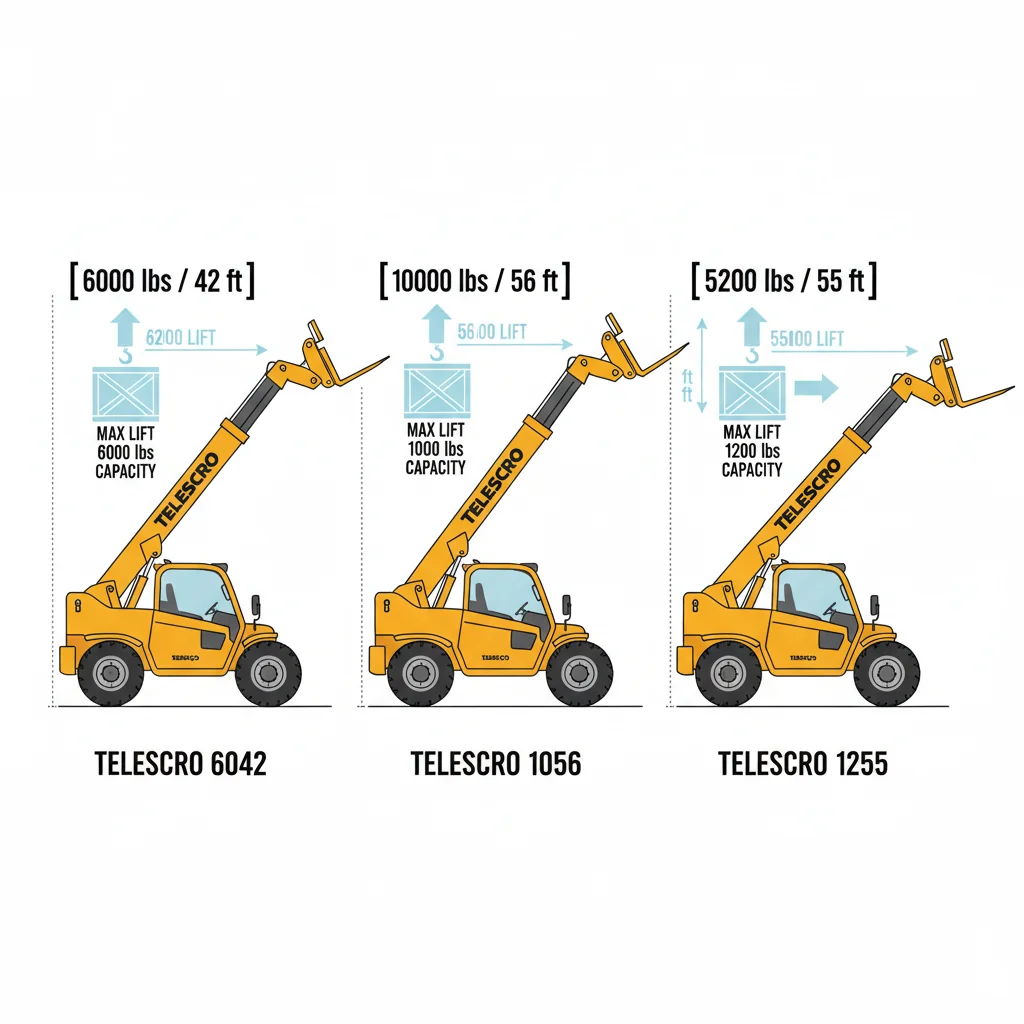
If you look at most telehandler model numbers, you’ll often spot a direct clue about the machine’s size class. For example, a model labeled “1056” usually means it’s designed for roughly 10,000 pounds rated capacity and a 56-foot maximum lift height. That convention isn’t just for show—it saves time on the jobsite when matching machines to specific lifts. On medium and large projects in places like Canada or the US, I’ve seen crews ask specifically for “10k class” telehandlers, knowing they’ll get something in that reliable 10,000 lb and 50- to 56-foot range. Those specs dominate new construction and general rental fleets here and overseas.
But model numbers only tell part of the story. Forks and attachments are rated separately and often become the limiting factor. For example, on a 4.5-ton telehandler, many standard fork sets are rated around 12,000 lb per pair at a 24-inch load center. In Brazil last year, I worked with a client using a long load spreader where the issue wasn’t lift height, but attachment capacity. The forks were rated for only 9,000 lb, even though the machine’s load chart allowed close to 10,000 lb at that position. That mismatch reduced usable capacity and slowed operations.
So before signing any rental agreement, I always suggest confirming the attachment’s rated capacity matches your telehandler—and exceeds your load at the reach you actually use. Model numbers give you a starting point, but safe operations depend on every link in the chain being up to the job. Don’t let a fork rating become the weak spot.
Telehandler model numbers in North America often indicate both maximum lift capacity (in thousands of pounds) and maximum lift height (in feet), making it easier for operators to select the correct size for their application.True
Manufacturers commonly use a standardized numbering system—like '1056' for a 10,000 lb capacity and 56-foot reach—so operators and site managers can quickly identify and match equipment to the required lift tasks without consulting detailed spec sheets.
A telehandler listed as a '1056' model will always be able to lift 10,000 pounds to its maximum height of 56 feet.False
While the model number implies a 10,000-pound lift capacity and 56-foot reach, telehandlers cannot lift their maximum rated weight to the full height due to stability and load chart limitations; the maximum capacity typically applies at a much lower height or closer reach.
Key takeaway: Understanding model number conventions helps buyers quickly assess telehandler size and suitability for the job site. Always confirm that attachment ratings match or exceed both the telehandler’s rated capacity and job requirements, as unsafe pairings risk overloads and limit full machine capability.
Which Telehandler Size Should Be Chosen?
When choosing between adjacent telehandler sizes, buyers should match selection to business model: steady own-use demands favor the smaller, more maneuverable machine9 if it covers 80–90% of tasks, while rental or project-based operations benefit from the larger option within the same class due to greater versatility and demand.
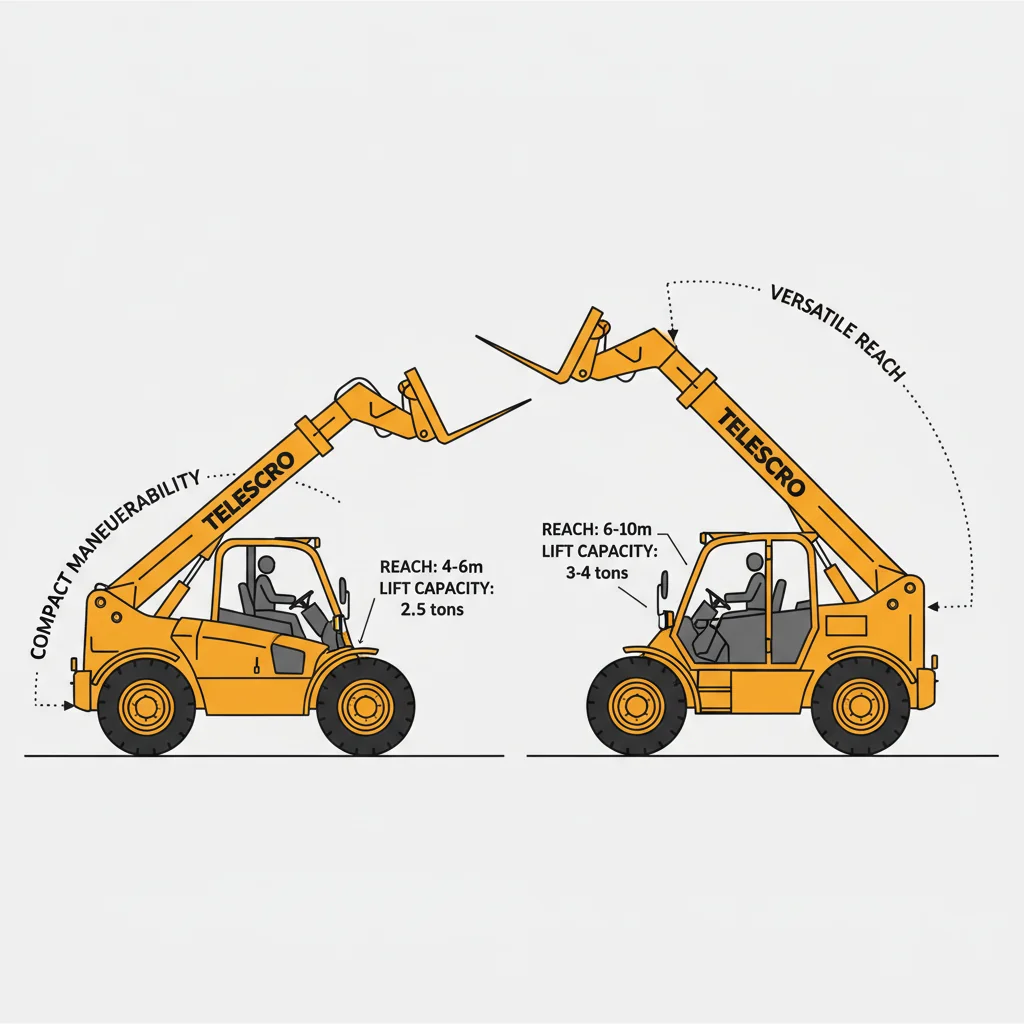
Here’s what matters most when deciding between two similar telehandler sizes: match the choice to how your business actually works, not just what “might” be useful. If you run a steady jobsite with repeat materials—like a lumber yard in Canada or a greenhouse operation in the Netherlands—the smaller, lighter machine pays off. I’ve seen a 7-meter, 3.5-ton model handle over 85% of daily tasks at a big farm in Shandong while saving on fuel and transport. Smaller units are easier to maneuver, especially indoors or when space is tight. As long as the load chart (which specifies capacity at each height and reach) covers your main tasks with a solid safety margin, you’re not missing out. But in rental fleets or for contractors working rotating sites, that little extra reach or capacity makes a real difference.
Just last season, a rental customer in Kazakhstan kept losing business to competitors because their 6-meter machines couldn’t safely place heavier loads on upper floors. He upgraded to a 7-meter unit instead of a 6, and suddenly his utilization rate jumped—more builders requested the higher spec. The cost increase was modest, but the job coverage expanded a lot.
Here’s a quick comparison to help clarify the choice:
| Size Option | Best Use Case | Typical Capacity | Max Reach | Turning Radius | Versatility |
|---|---|---|---|---|---|
| Smaller (e.g. 6 m) | Own-use, steady jobsite, indoor/tight | ~3,000 kg | 6 m | <4 m | Focused (lower cost, easier handling) |
| Larger (e.g. 7 m) | Rental fleets, mixed sites, upper-floor placement | ~3,500 kg | 7 m | 4–5 m | Higher (covers more jobs, higher utilization) |
Choosing a larger telehandler than needed can actually reduce efficiency on tight jobsites because longer wheelbases make them less maneuverable in confined work areas.True
Longer wheelbases and wider turning radii are inherent to larger telehandler models, making it more difficult to navigate restricted spaces, which slows down operations in small or crowded environments.
All telehandler sizes require the same transportation equipment, so opting for a larger model won’t affect logistics or delivery planning.False
Larger telehandlers often exceed the weight or dimension limits for standard trailers and may require special permits or heavy haulers, whereas smaller models can be moved more easily with standard trucks, simplifying logistics.
Key takeaway: Select telehandler size using business-specific logic—opt for smaller, lighter models if primarily operating on a single site and the capacity suffices, but favor the slightly larger unit for rental or mixed-use fleets to increase task coverage and broad market appeal.
Conclusion
We’ve looked at how telehandler sizing really comes down to rated capacity at your true working height and reach—not just picking the biggest number from the spec sheet. From my experience, the buyers who avoid headaches focus on the load chart and local parts support, not just max stats. Don’t let a “showroom hero, jobsite zero” situation catch you by surprise—it’s easy to overlook the real demands you’ll face once work starts. If you have questions about practical sizing, attachments, or how to avoid parts roulette, I’m happy to share what’s worked for crews in different countries. Feel free to reach out anytime. Every site is different—choose a telehandler that actually fits your daily workflow.
References
-
Explore how rated lift capacity determines telehandler performance and why real-world factors affect actual lifting limits on site. ↩
-
Learn the impact of maximum lift height on telehandler applications and jobsite efficiency, with examples from common North American models. ↩
-
Learn how to use the OEM load chart to verify safe lifting capacities at various boom extensions and avoid costly onsite mistakes. ↩
-
Understand how the rated capacity of 3.0–3.5 tons optimizes load handling, improving efficiency and safety across diverse jobsite tasks. ↩
-
Explains the critical role and load capacities of heavy-lift telehandlers in mining, ports, and steel mills, with real-world examples. ↩
-
Explains the balance of reach, capacity, and ease of transport making this size ideal for general and mid-size construction projects. ↩
-
Details why this size works well in farming, balancing lifting height and capacity for stacking bales and loading wagons safely. ↩
-
Understand factors raising telehandler operational costs—including fuel, maintenance, and tire wear—by 15–30% with larger machine sizes. ↩
-
Explains advantages of smaller telehandlers for fuel savings, maneuverability, and task coverage in steady use scenarios. ↩