










Telehandler: Rotating vs Fixed — Field-Tested Decision Guide for Buyers
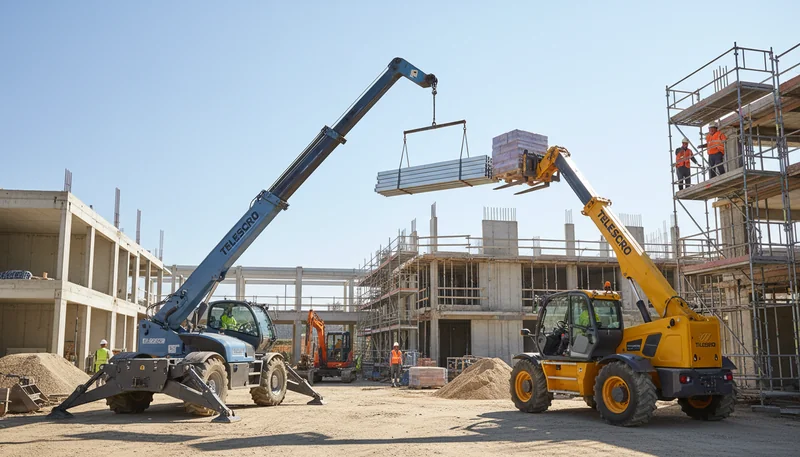
Not long ago on a Shanghai high-rise site, I watched a fixed telehandler zigzag twenty times just to feed materials around a tight corner. Next bay over, a rotating unit finished three façades without moving an inch. These moments really highlight how your jobsite layout can completely change which machine comes out ahead.
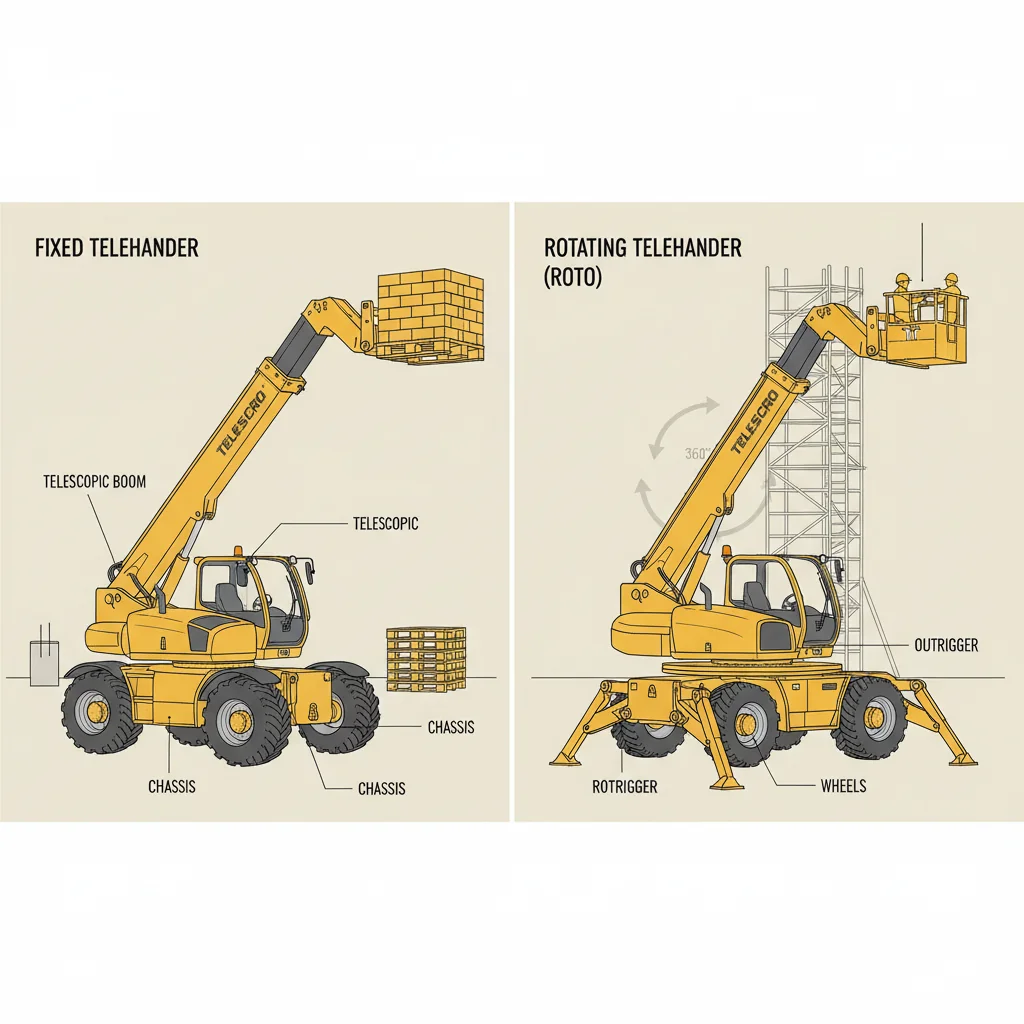
Rotating and fixed telehandlers perform similar lifting and placing functions with a telescopic boom, but key architectural differences define their strengths in the field. Fixed telehandlers operate with a forward-only boom, requiring the entire machine to reposition for multi-side access, and often deliver superior driving speed and simplicity. Rotating telehandlers1, equipped with a 360° turret and outriggers, offer enhanced reach, flexibility, and multi-directional operation, especially in constrained provide this data in a two-dimensional grid—showing allowable capacity at specific combinations of height and forward reach for the stated attachment/load center.
What distinguishes rotating vs fixed telehandlers?
Rotating telehandlers use a slewing turret that can rotate the boom around the chassis (up to 360° on many models, depending on design), allowing operators to serve multiple pick-and-place positions from a single setup. Fixed telehandlers have a non-rotating boom and typically must reposition the whole machine to change working direction. In general market terms, fixed units are commonly found in the ~6–18 m lift-height classes, while rotating models are often selected in higher-reach segments (e.g., ~18–30 m), with exact ranges varying by brand and application.
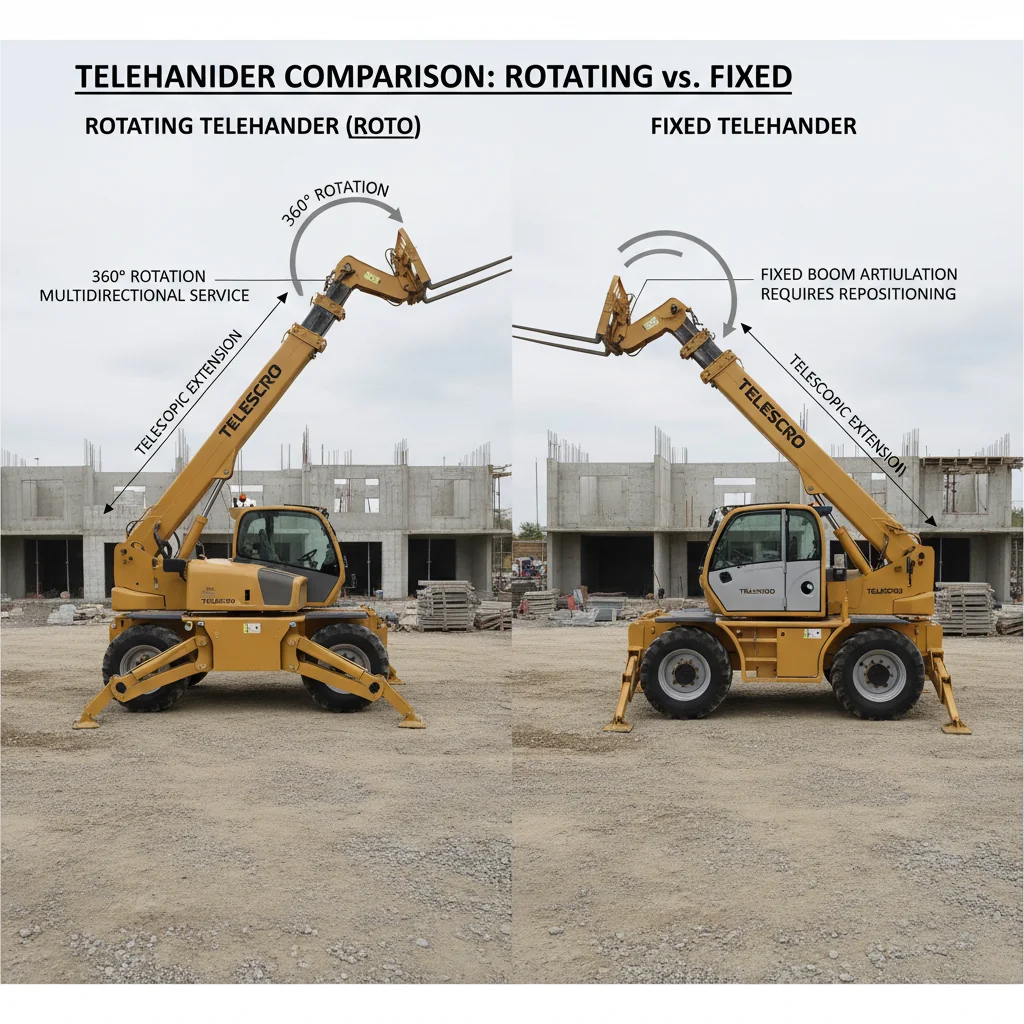
Most people don’t realize how much jobsite layout drives the decision between rotating and fixed telehandlers. I’ve visited high-rise projects in Dubai where a standard fixed telehandler wasn’t practical—too much movement, too little space. Fixed models have a non-rotating boom, so every change in working direction means moving the whole machine. This style is direct, rugged, and efficient for hauling and placing loads on linear sites, like distributing bricks along a new road or unloading pallets in open yards. Mainstream fixed units offer 2.5–5 tons capacity and core lift heights of 7–12 meters for construction, with some high-reach models stretching to 18 meters. Rotating telehandlers (often called RTH) bring a totally different structure. Once their stabilizers are deployed—those hydraulic legs at each corner—the entire upper frame pivots on a turret. This lets you lift, extend, and rotate the boom up to 360° (rotation angle always depends on model and brand; don’t assume continuous slewing). On a job in Kazakhstan, I saw a crew use an RTH with 24 meters max height to service three façades from one setup—no need to reposition. RTHs usually handle 3–6 tons and can reach 18–30 meters at the top end, but all that extra machinery (turret, stabilizers, electronics) adds serious weight, so setup takes longer and ground pressure increases.
"RotatingFalse
"A
Fixed telehandlers are generally preferred for overhead lifting tasks at urban construction sites with limited maneuvering room.False
Rotating telehandlers are better suited to urban jobsites with limited space because their ability to rotate the boom allows them to perform overhead lifts and set loads in different directions without moving the chassis, unlike fixed models.
Key takeaway: Fixed telehandlers excel at transporting and placing loads in straightforward, drive-repeat tasks. Rotating models are ideal for jobs requiring multi-directional access and higher reach from one position, but come with higher weight, added complexity, and longer setup time. Project requirements should determine the choice.
When Should Rotating Telehandlers Be Used?
Rotating telehandlers are particularly well suited to confined, multi-directional, or high-rise environments where repeatedly repositioning a fixed telehandler is time-consuming or impractical. Field experience and project case studies consistently show significant productivity gains on tight urban or industrial sites, as rotating units can service multiple façades from a single setup—reducing machine travel, repeated re-leveling, and reliance on additional lifting equipment.

Here’s what matters most when deciding if a rotating telehandler is worth the investment: the jobsite layout and workflow demands. I see the biggest gains on sites where moving a fixed machine isn’t just slow—it’s nearly impossible. Tight urban lots3, industrial facilities with equipment blocking your access, or high-rise projects where you need to reach several façades from one point. In these setups, a 360° rotating model cuts time wasted on constant repositioning and re-leveling.
Let me give you an example. On a recent refurbishment project in Dubai, the contractor needed to deliver glazing panels to three sides of a building—20 meters up. With a standard 4-ton fixed telehandler, they spent over an hour just repositioning between lifts. When they switched to a rotating unit, their operator completed the same work in half a shift—stabilizers down, turret rotated, no extra moves.
The total lift plan went from three days to one and a half. The higher rental paid for itself with a shorter site schedule and less congestion.
Rotating telehandlers shine in these situations:
- Confined urban or industrial sites with little free space for travel
- Multi-side façade work where several elevations need access from one spot
- Lifting over obstacles like fences, machinery, or busy roads
- Projects with frequent pick-and-place at different angles or heights
From my experience, specs like boom rotation, stabilizer spread, and rated capacity at maximum extension matter much more than just max lift height.
Rotating telehandlers are especially beneficial on sites where frequent machine repositioning is restricted by obstacles or limited space, allowing operators to service multiple work areas from a single setup point.True
The 360° rotating upper structure enables operators to reach different areas without moving the base machine, which is ideal in congested environments where maneuvering a conventional fixed telehandler would be challenging or inefficient.
Rotating telehandlers should only be used on large, open jobsites, since their ability to rotate offers no real advantage in confined or complex environments.False
Rotating telehandlers offer their greatest benefits on tight or obstructed sites by reducing the need for repositioning. In contrast, on wide open jobsites, a fixed telehandler may suffice and provide similar efficiency.
Key takeaway: Rotating telehandlers justify their higher cost in projects with restricted space, multi-angle lifts, or multiple elevation points. For urban refurbishment, infill construction, or obstacle-rich industrial plants, RTH models reduce site congestion, speed up schedules, and often eliminate the need for additional lifting equipment.
When Is a Fixed Telehandler Ideal?
Fixed telehandlers are typically best suited to straightforward load-and-carry work such as truck loading, feeding batching plants, or routine agricultural handling. Their non-rotating frame, generally lower center of gravity4, and simpler hydraulic and electronic systems contribute to lower purchase and rental costs, higher travel speeds, and easier maintenance compared with rotating models. When operated within the manufacturer’s load chart and ground condition limits, this simpler configuration also delivers more predictable handling during repeated travel tasks.
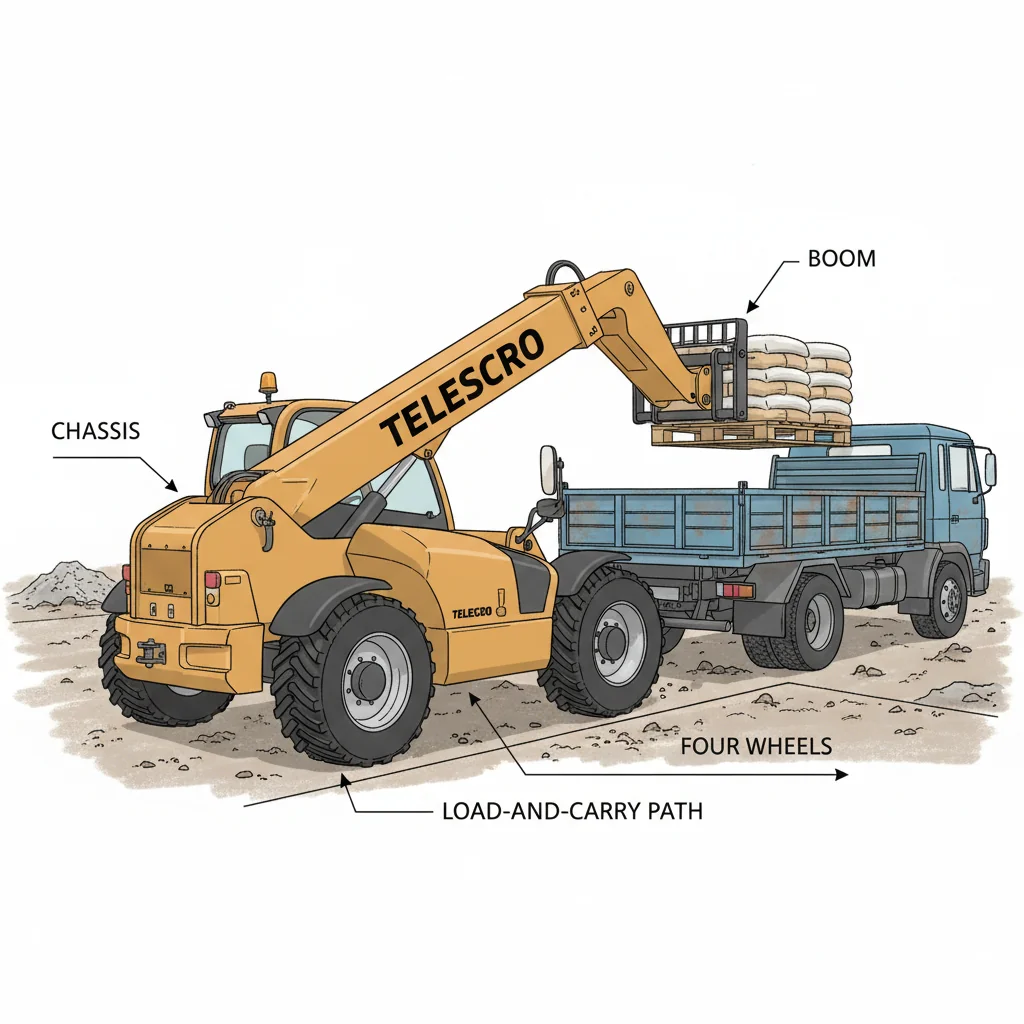
Let me share something important about fixed telehandlers, especially for those running projects where most of the day is spent shuttling materials back and forth. On open sites like civil works in Kazakhstan or a cement plant in northern China, travel speed and machine uptime drive productivity—not boom rotation. With a fixed telehandler, you get a lower center of gravity, which means better stability over rough ground. Fewer hydraulic circuits also translate to faster maintenance and less downtime for leaks or electrical issues. In fact, one customer in Brazil told me switching from a rotating to a fixed model cut their maintenance calls almost in half over a six-month cycle.
I’ve seen crews in Dubai using fixed telehandlers rated at 3.5 to 4 tons for non-stop tasks like loading trucks with brick pallets or feeding readymix plants. They spend their shifts driving forward, loading up, and heading right back for more—not swinging a boom around obstacles. In these cases, the extra weight and stabilizer setup time of a rotating machine just slow things down. On big agricultural sites in Australia, fixed models handle hay bales, feed, and equipment reliably, with a typical model lifting up to 4,000 kg and max reach around 7 to 10 meters.
For companies with high operator turnover, fixed telehandlers are less risky. Training takes hours—not days—and the simpler controls mean fewer mistakes. I always remind buyers: if you don’t need turret movement, the fixed machine delivers a lower hourly cost and keeps your project moving. Check your crew’s real workload before deciding. Usually, straightforward load-and-carry work means a fixed telehandler is simply the smarter investment.
Fixed telehandlers are less complex mechanically than rotating telehandlers, making them more reliable for continuous material handling in harsh site conditions.True
Fixed telehandlers have fewer moving parts and hydraulic functions since they lack a rotating turret. This simplicity enhances their durability and reduces the risk of mechanical failures in demanding environments.
Rotating telehandlers always provide greater lifting capacity than fixed telehandlers of similar size.False
Lifting capacity depends on machine design, weight distribution, and boom construction, not simply on the presence of a rotating turret. Many fixed telehandlers can match or even exceed the lifting capacities of comparable rotating models.
Key takeaway: For repetitive load-and-carry operations across large or open sites, fixed telehandlers offer superior value and lower operational costs. Their simplicity makes them easier to drive, maintain, and train on—ideal where rotation brings little productivity advantage and high crew turnover is a concern.
How does job mix affect telehandler choice?
Job mix analysis is essential for telehandler selection. If over 50% of working hours involve at-height tasks, multi-side access, or platform/winch attachments, rotating models are worth evaluating. For operations where more than 70% of usage is point-to-point hauling, fixed telehandlers are typically the most economical, according to recent fleet utilization data.

The biggest mistake I see is guessing job mix based on general impressions, not on real data. I had a mid-size contractor in Dubai show me their annual utilization reports—on paper, they thought they needed a rotating telehandler for "flexibility." But once we broke down their last 18 months of work orders, over 80% of hours went to simple point-to-point hauling: loading blocks from the yard, moving materials to a ground-level site, very little façade or elevated platform work. In that case, a fixed 4-ton, 17-meter telehandler handled more tasks, cost less up front, and was cheaper to maintain—no complex slew ring5 or extra sensors that need extra service.
On the other hand, I’ve worked with restoration crews in southern France who tracked every lift and access job. Their numbers showed over half of their telehandler time was spent at-height, often changing work face several times a day—roof tiles, cladding, glass panels, even man-basket access for electricians at 20 meters up. For them, evaluating a rotating machine made sense. It reduced the need to rent small cranes or move separate boom lifts, since one operator could reposition the platform or winch in tight urban streets.
Here’s what matters most: pull usage data from your ERP or manual hour logbooks—don’t guess. If your records show steady crane rentals for short 18–25 meter façade lifts, or frequent multi-side building work, that’s a signal to consider rotation. But if almost all hours are straightforward yard-to-slab or truck-to-footing runs, stick with fixed. I always suggest putting the real numbers first—that’s what gets you better utilization and avoids “just in case” overspending.
A rotating telehandler is not always the best choice for jobs that involve primarily horizontal material movement at ground level.True
Rotating telehandlers offer maximum versatility for complex lifts and elevated access, but their advanced features are often unnecessary when a job's tasks are limited to moving loads from point A to B on ground level. Fixed telehandlers are more straightforward, often more cost-effective, and easier to operate for such job mixes.
A rotating telehandler will always outperform a fixed telehandler, regardless of the job mix.False
Rotating telehandlers are best suited for specialized tasks requiring multi-directional reach and working at height. When job requirements do not demand these features, fixed telehandlers can be more efficient, reliable, and appropriate for the task, debunking the idea that rotating models always outperform fixed ones.
Key takeaway: Real-world work order and hour tracking should drive the rotating vs fixed telehandler decision. Let actual task distribution—not hypothetical scenarios or marketing—determine equipment needs, to optimize both utilization and return on investment, especially for small to mid-sized contractors.
How Do Rotating vs Fixed Telehandler Costs Compare?
Rotating telehandlers cost 30–70% more than fixed units due to added systems like slew rings and electronics. Annual maintenance6 and daily rental rates are 15–25% higher. However, rotators can offset crane and boom-lift rentals, especially on jobs over 20–25 m. Total job cost and utilization rates should guide purchase decisions.

From my experience working with contractors in Kenya and Dubai, nobody ever regrets running the full cost math before jumping for a rotating telehandler. The price tag can be a shock—new rotators cost at least 30% more than a fixed boom of the same size, sometimes almost double. That extra goes into the heavy slew ring, smarter sensors, extra electronics, and the hydraulic circuit for stabilizer legs. Annual maintenance isn’t cheap either—expect 15–25% higher spend thanks to more moving parts, swing gear greasing, outrigger checks, and complex diagnostics.
I saw a jobsite in Dubai last year where an 18-meter rotating unit replaced both a small mobile crane and a separate boom lift. On that project, it offset around $1,200 per day in extra rentals. Over a six-month tower build, those savings wiped out the up-front price gap. But I also have clients in Poland who only need boom rotation for less than 5% of annual hours—it doesn’t pay back unless you actually use it.
Here’s a rough comparison table from projects I’ve supported:
| Feature | Fixed Telehandler | Rotating Telehandler |
|---|---|---|
| Typical Cost | $75,000–$120,000 | $110,000–$200,000 |
| Annual Maintenance | $3,000–$5,000 | $4,000–$7,000 |
| Daily Rental Rate | $180–$280 | $250–$380 |
| Max Height | Up to 18 m | Up to 32 m |
| Resale Value | Moderate | Often higher in cities |
Rotating telehandlers require more frequent and specialized maintenance compared to fixed telehandlers because of their complex slew mechanisms and additional stabilizing hydraulics.True
Rotating telehandlers have extra components, such as the slew ring and stabilizer legs, which introduce more potential points of wear and failure. These parts demand not only routine checks but also technicians familiar with advanced hydraulic and electrical systems, leading to higher and more specialized maintenance needs.
The insurance costs for rotating and fixed telehandlers are nearly identical because the core lifting function is the same.False
Insurance premiums are typically higher for rotating telehandlers due to their greater complexity, increased replacement value, and heightened operational risks, such as potential for overextension or instability. Insurers factor in these risks, resulting in a noticeable difference in coverage costs compared to simpler fixed models.
Key takeaway: Comparing rotating and fixed telehandlers requires a whole-life cost analysis, not just initial price. Factor in utilization rate, potential crane/basket rentals avoided, and resale value. For low rotation needs, renting a rotator may offer better payback than ownership.
How Versatile Are Rotating Telehandler Attachments?
Rotating telehandler attachments significantly expand versatility by enabling one machine to perform as a telehandler, rough-terrain crane, and aerial work platform. This flexibility is most valuable on projects with restricted access or changing tasks. Compatibility and control systems vary by brand—buyers must confirm supported attachments to leverage full benefits.
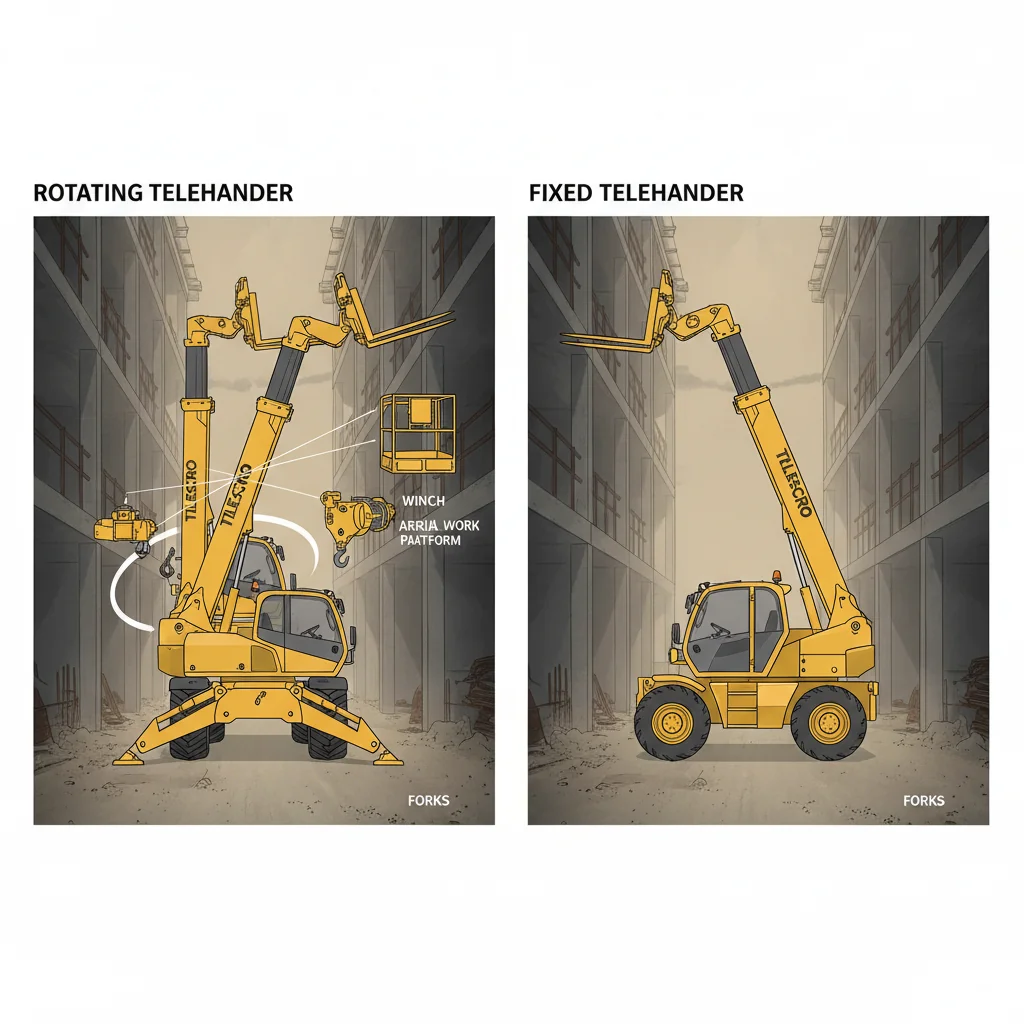
A lot of buyers ask me if rotating telehandler attachments are really as versatile as advertised. Here’s the reality: when used right, a rotating telehandler can handle tasks that would usually need three separate machines. But that versatility depends on a lot more than a “3-in-1” brochure claim.
I’ve seen contractors in Dubai fit a rotating model with forks in the morning to unload glass panels, swap to a winch for lift-and-place steelwork after lunch, then finish the day using a man basket for façade access—all without moving the base machine.
That kind of flexibility is only possible if your machine recognizes each attachment, and your control system supports safe, monitored operation.
Let me break down the most common rotating attachments I see customers use on jobsites:
- Pallet forks – for unloading materials or placing pallets at height
- Winch/hook – for lifting loads vertically, like a rough-terrain crane
- Jib/boom extension – adding extra outreach to position HVAC units or steel beams
- Work platform (man basket) – for personnel to work safely at height
- Buckets – for moving bulk materials such as gravel or sand
Keep in mind, not every attachment will work on every rotating telehandler. Some brands lock advanced functions—like winches or work platforms—behind proprietary recognition or require specially coded attachments. I always suggest customers double-check their desired attachments are supported and load-moment monitoring is included.
Rotating telehandler attachments allow operators to position loads at acute angles without repositioning the entire machine, which is particularly useful on congested or restricted job sites.True
Because the upper structure of a rotating telehandler can pivot independently from the chassis, operators can swing loads around obstacles or into tight areas that would be inaccessible or require multiple fixed telehandler moves. This feature supports more efficient use of space and safer lifting in complex environments.
Rotating telehandlers can safely use all the same attachments and load charts as fixed-frame telehandlers without any additional considerations.False
Rotating telehandlers have different stability dynamics and operational envelopes compared to fixed models, especially when the boom is rotated or extended at angles. Their attachments may have specific compatibility requirements, and load charts differ to account for the rotational mechanism and resulting stability limits; using the wrong chart or attachment can compromise safety.
Key takeaway: Rotating telehandlers offer true multi-functionality when paired with compatible attachments and control systems. Buyers should carefully verify machine–attachment compatibility and control features before purchase to ensure versatility delivers productivity gains and justifies higher investment, especially for tight-access or multi-tasking project environments.
What extra safety steps do rotators need?
Rotating telehandlers demand more advanced operator training due to turret slewing (up to 360° depending on model), the use of sector-based load charts7, and stabilizer deployment requirements defined under EN 1459-28. In many markets, additional authorization or certification is required when using personnel work platforms. Operators must be competent in interpreting load moment indicators, tilt and slew sensors, and electronic safety interlocks; when these systems detect unsafe conditions or faults, machine functions may be limited or stopped until the issue is addressed.

One thing that surprises many new owners is just how much extra training a rotating telehandler (or "roto") requires. Unlike fixed models, the rotating turret brings a full circle of movement—and that adds real risk if your operator isn’t focused.
About two years ago, a client in Dubai called me after his team had a close call. They’d failed to check the sector-based load chart for a sideways pick at 13 meters—result: the tilt sensor locked out the hydraulics mid-lift.
Productivity dropped until their technician could reset the safety system and double-check stabilizer positions. It wasn’t a technical fault; it was unfamiliarity with the electronic safety. Here’s the reality: regulators in Europe, Australia, and the Middle East treat rotators much more like cranes than standard handlers.
If you use a man basket, you’ll likely need CE or local certification. Training should always cover these critical areas:
- Sector-based load chart reading – Operators must check the load chart for each boom angle, extension, and turret sector, not just a single “max” value.
- Stabilizer deployment – EN 1459-2 requires stabilizers to reach full chart capacity, but partial extension (“short-jacking”) is allowed if you follow chart limitations.
- Load moment indicators (LMI) and tilt sensors – Operators should know LMI warnings and understand what happens if systems detect overload or unsafe tilt.
- Electronic lockouts and faults – Expect machines to halt safely if a sensor triggers or a fault develops—sometimes work must stop until a technician resets systems.
Rotating telehandlers require operators to monitor the boom's horizontal rotation angle (slew), as stability limits change depending on the turret’s position relative to the chassis.True
Unlike fixed telehandlers, rotators can swing loads in a full circle, which changes the direction of overturning forces. This means that an operator must check the slew angle and use sector-based load charts, since safe lifting capacity can vary significantly at different turret angles—especially when working sideways to the chassis.
Because of their advanced technology, rotating telehandlers automatically adjust and compensate for all instability risks during every maneuver, so extra operator attention is unnecessary.False
While rotating telehandlers use sensors and lockouts to enhance safety, they cannot prevent every possible risk on their own. Operators must still understand how turret position and load distribution affect machine stability, and must consult load charts and safety protocols, as automation cannot substitute for skilled, attentive operation.
Key takeaway: Rotating telehandlers introduce greater risk and regulatory scrutiny than fixed models. Extra training, sector-specific load chart reading, and familiarity with safety electronics are essential. Small firms or those lacking rigorous oversight should carefully consider if they can support the necessary training and compliance requirements.
How Do Site Conditions Affect Telehandler Choice?
Site layout and terrain type strongly influence telehandler performance. On extensive, rough, open sites, fixed telehandlers offer stability and rapid travel for long hauls. In confined, uneven, or obstructed areas, rotating models enable multi-directional servicing and precise material placement without frequent repositioning, improving productivity and safety.
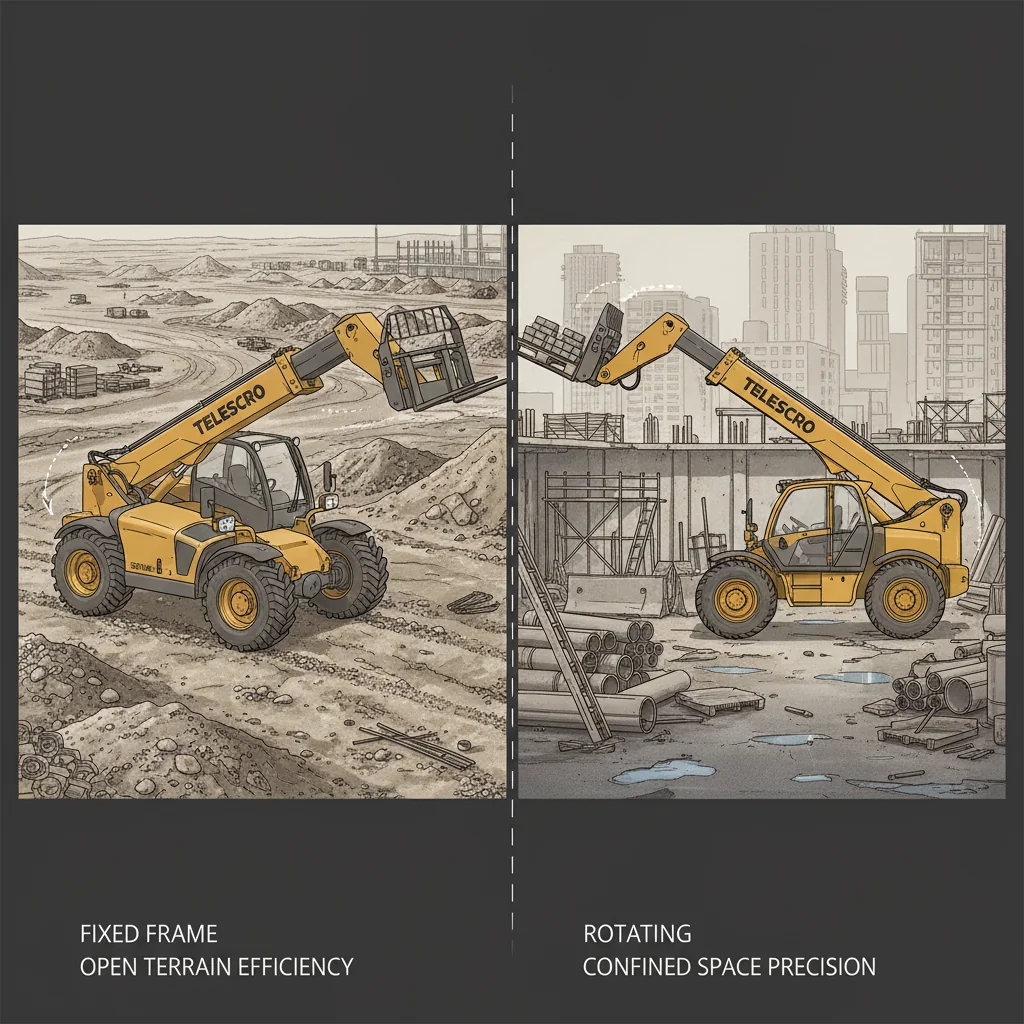
Let me share something important about how real site conditions shape telehandler choices. I’ve worked with crews in Dubai, where vast, open construction areas favor fixed telehandlers—machines with a stable chassis and faster road speeds. On a wind farm project there, the team spent more than half their shift driving materials between towers, not lifting overhead. They chose a 4-ton fixed telehandler with 17-meter reach, and it made sense—the wide turning radius didn’t matter, but the extra ground clearance (over 400 mm) and higher travel speed (up to 30 km/h) saved them hours each day. On these sites, you spend most of your time hauling loads, not spinning around obstacles.
The situation changes completely on tight, complex jobsites. Last year in central Warsaw, a contractor tried using the same fixed model in a tight urban build. They kept wasting time repositioning—each move meant folding in the stabilizers, checking ground conditions again, and navigating tight corners. It slowed everything down. When they switched to a rotating telehandler (with auto-leveling and 5-meter turning radius), things sped up. Now the operator could service three building faces just by rotating the upper cab and extending the boom. No need to constantly drive around or block other site traffic. Precision goes up, near-misses go down.
So, before you buy, map out your typical lift distances, turning requirements, and uneven ground zones. Does your site mean long-distance runs, or are you hemmed in by obstacles? Matching the machine—not just by numbers on a brochure, but by actual site reality—is what delivers real productivity and keeps your crew safer.
On rough or uneven terrain, fixed telehandlers tend to offer greater stability compared to rotating telehandlers due to their simpler, more rigid chassis designs.True
Fixed telehandlers are built with a non-rotating, robust frame that enhances stability when operating on uneven surfaces, which is critical to preventing tipping in challenging site conditions. Rotating telehandlers, with their slewing upper structures, can have more complex load dynamics that require careful management on rough ground.
Rotating telehandlers always outperform fixed telehandlers when the primary task is long-distance travel between work areas on large sites.False
Rotating telehandlers are not optimized for long-distance travel; their design focuses on maneuvering and placing materials in confined spaces with 360-degree reach. Fixed telehandlers generally have higher travel speeds and are better suited for tasks that involve moving loads over greater distances across spacious construction sites.
Key takeaway: Mapping typical jobsite features—such as lift radii, travel distances, surface conditions, and obstructions—guides buyers toward the right telehandler type. Matching machine capabilities to real site demands, not just brochure specifications, is critical for productivity, maneuverability, and safe material handling performance.
What dealer support do rotators require?
Rotating telehandlers require disciplined maintenance and strong local dealer support. Key components—such as slew rings, slewing gearboxes, advanced sensors, and electronics—demand specialized service. Rapid access to expensive parts and diagnostic tools9, plus trained technicians, is critical. Limited dealer capacity can result in prolonged downtime compared to fixed telehandlers.

I’ve worked with customers in Kazakhstan and Dubai who learned the hard way—rotating telehandlers bring a whole new level of complexity to maintenance. These machines aren’t just a fixed-frame with a spinning top. You’re looking at critical components like the slew ring, slewing gearbox, rotary hydraulic manifold, and a pile of extra electronic sensors. If your dealer can’t handle the electronics or doesn’t keep control displays and slew rings in stock, a small fault can sideline your 21-meter rotator for days—sometimes weeks.
Let me share something important about small rental fleets. In Brazil, a customer added a high-reach rotating model, expecting more versatility. But when the rotary joint developed a hydraulic leak, local techs didn’t have the right diagnostic tools or training. The part cost around $6,000, and it took nearly three weeks just to get it cleared through customs. The machine sat idle—a serious problem for a contractor counting on peak season work.
From my experience, buyers often underestimate ongoing maintenance. Regular torque checks on slew ring bolts, proper greasing, and oil changes for the slew drive aren’t optional—these extend life and prevent failure. The electronic safety system—load moment indicators, angle sensors, CAN-bus wiring—can be especially sensitive. One sensor fault, and your rotator might refuse to even start. I always suggest verifying if your dealer can supply trained technicians and fast parts delivery, not just glossy brochures and price sheets.
If you’re a smaller contractor or rental outfit, check dealer support before you buy. Solid local service is what keeps these machines earning—not sitting.
Rotating telehandlers require dealer support capable of diagnosing and repairing advanced electronic control systems due to their integrated slew sensors and programmable safety features.True
Unlike fixed-frame telehandlers, rotators use additional electronics to monitor slew angle, boom position, and load charts for safety interlocks. Servicing or troubleshooting these systems typically demands dealer technicians trained in specialized electronics and diagnostics.
Because rotators use the same main components as fixed-frame telehandlers, any dealer familiar with standard telehandlers can maintain them with no additional training or spare parts.False
Rotating telehandlers feature unique systems like the slew ring, slewing gearbox, rotary manifolds, and extra electronic interfaces. Proper maintenance and diagnostics require parts inventory and training specific to rotators, which differ from fixed-frame machines.
Key takeaway: Rotating telehandlers introduce complex systems that require highly specialized dealer support, prompt access to parts, and skilled technicians. Buyers should verify local service capabilities before purchase, as inadequate support often leads to extended downtime, undermining the equipment’s value—especially for smaller contractors or rental operations.
Should Contractors Own or Rent Rotating Telehandlers?
Industry data shows that owning fixed telehandlers suits routine, high-utilization tasks at lower cost, while rotating units (RTHs) are best rented for specialized work making up less than 10–15% of annual telehandler hours. Rotators add value for limited-duration, complex lifts—ownership makes sense only as rotation-heavy projects increase.
Last month, a contractor in Dubai called me asking if he should buy a rotating telehandler after renting one for a high-rise project. His team mostly used two 4-ton fixed telehandlers for daily pallet work, but needed rotation for tricky glass panel lifts on the eighth floor. The rotator saved them at least three days compared to using a crane and manlift, but in the whole year, that was their only rotation-based job.
Here’s the thing I’ve seen across smaller contractors in China, Brazil, and Kenya—if you only need rotation 10% of the time or less, owning a rotator adds cost and complexity. Rotating models have advanced hydraulic circuits, electronic moment indicators10, and stabilizers. Repairs are pricier, and operators need extra training. Your fixed telehandler (let’s say a 17-meter reach, 4,000 kg unit) might run all year—high utilization, low hourly cost. But a rotator sitting idle for months? That stings on the bottom line.
When does it shift? I always suggest tracking how often jobs need tight turning, three-way placement, or overhead MEP work. One contractor in Kazakhstan switched to owning a 6-ton rotator once 25% of their work moved to steel frame buildings with tight access. In dense urban markets, rotators also rent out quickly between your jobs—which can offset ownership costs.
My advice? Unless you’re moving into routine multi-story, rotation-heavy work, stick to renting rotators for specific lifts. Keep your main fleet simple, reliable, and busy. Monitor project trends closely—when rotation tasks start stacking up, then consider investing.
Rotating telehandlers are better suited for infrequent, complex lifts where space is limited, as their articulation can replace both a crane and a manlift on certain tasks.True
This is true because rotating telehandlers can telescope and rotate loads into precisely confined or elevated positions, reducing the need for multiple machines on specialized lifts, which is particularly valuable when such tasks arise occasionally rather than daily.
Owning a rotating telehandler is always more cost-effective than renting for small contractors who mainly do standard pallet work.False
This is false because the high purchase and maintenance costs of rotating telehandlers are rarely justified if rotation functionality is needed infrequently; renting is typically the more economical choice for small contractors focusing on standard material handling.
Key takeaway: Most small and mid-size contractors benefit from owning fixed telehandlers for core logistics and renting rotating telehandlers for specialized, rotation-intensive tasks. Only when multi-story or constrained-access work becomes routine does owning one or more rotators become financially justified, especially in urban markets.
Conclusion
We’ve looked at how fixed and rotating telehandlers fit different jobsite needs, from simple load placement to complex reach requirements. From my experience, the best results come when buyers look beyond showroom specs and dig into the real jobsite numbers. Watch out for the “3-meter blind spot”—focusing on max height instead of useful load at your working radius. Before you decide, check the load chart at typical extension and be sure replacement parts can reach you quickly. If you have questions about practical jobsite use, attachments, or which type suits your workflow, I’m happy to share what’s worked for crews in over 20 countries—just reach out. Every site’s unique, so choose what truly fits your team’s day-to-day work.
References
-
Explore how rotating telehandlers improve efficiency with 360° slew, reducing repositioning needs on tight job sites. ↩
-
Explore detailed benefits and operational efficiencies of rotating telehandlers for at-height and multi-side access tasks with expert data. ↩
-
Understand the challenges tight urban lots present to fixed telehandlers and how rotating models reduce repositioning time to boost productivity. ↩
-
Learn why lower center of gravity enhances stability on rough ground, reducing risk and improving safety for telehandler operations. ↩
-
Detailed insight into slew rings’ role and maintenance challenges for rotating telehandlers, essential for minimizing costly downtime. ↩
-
Explains the reasons behind 15-25% higher maintenance costs, including more moving parts and complex diagnostics for rotating telehandlers. ↩
-
Detailed explanation of sector-based load charts critical for safe turret operation, helping operators avoid load and safety issues. ↩
-
Clear guidance on EN 1459-2 requirements for stabilizers and operator safety, crucial for compliance and safe machine use. ↩
-
Explains how specialized diagnostic tools enable faster fault detection and repair, reducing idle time of complex telehandlers. ↩
-
Explains how electronic moment indicators enhance operational safety by preventing overloads in complex telehandler lifts, backed by industry data. ↩