










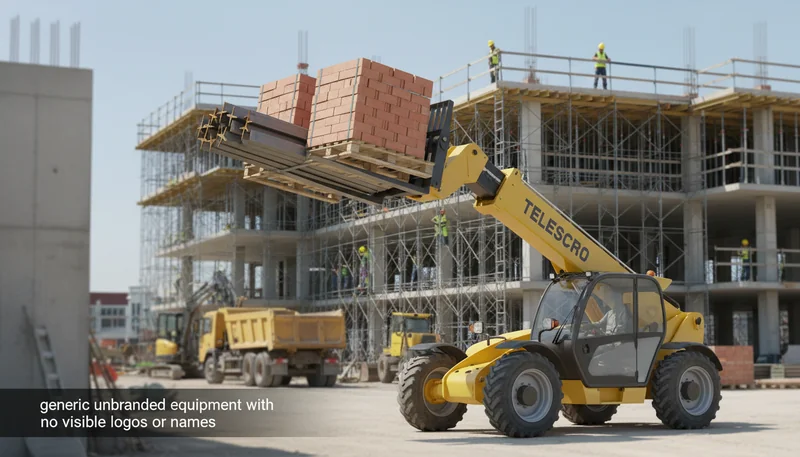
Telehandler Rated vs Usable Capacity: Field Guide to Avoid Costly Lifting Mistakes
Last autumn in Germany, I watched a foreman try to lift a pallet of bricks onto the fifth floor with a “4,000 kg” telehandler—only to get stuck halfway, buzzing alarms screaming, load barely off the ground. The spec number looked great, but the real-world result told a different story.
Telehandler rated lifting capacity refers to the maximum load published by the manufacturer for a specific, highly stable configuration—typically at minimum horizontal reach, with a standard attachment, a defined load center, and on firm, level ground as specified in the operator’s manual. Actual usable capacity varies significantly with boom extension, lift height, attachment type, load center, and site conditions. As the boom is raised or extended, leverage increases and forward stability decreases, resulting in substantially lower allowable loads. Attachment changes and real jobsite conditions can further reduce usable capacity, which is why all lifting decisions must be verified against the appropriate OEM load chart for the exact operating configuration.
Why isn’t rated capacity always usable?
Rated capacity is measured under ideal test conditions—boom retracted, machine level, standard forks, specified load center1, and no wind—reflecting only the maximum safe load at minimum reach. Actual usable capacity drops as boom height or reach increases, and must always be verified against the manufacturer’s load chart2 for the specific operating scenario.

Most people don’t realize that the big “4,000 kg” number on a telehandler brochure only tells part of the story. That figure is measured in the most controlled conditions—boom fully retracted, machine perfectly level, standard forks, and a specific load center distance. The moment you raise the boom or extend it outward, the dynamics completely change. I saw this first-hand on a job in Dubai—a team needed to lift concrete blocks to a platform 12 meters away. They expected to move full loads, but the actual safe capacity at that reach dropped to just 1,200 kg according to the load chart. Rated capacity isn’t a universal promise you can count on for every task.
Here’s why:
- Boom Extension: As the boom moves forward, usable capacity falls dramatically due to leverage.
- Boom Height: Raising the boom higher reduces capacity at any given reach. – Load Center: A heavier or longer load (with the center further from the fork face) means lower safe weights.
- Ground Slope: Rated capacity applies only when the machine is level as defined by the OEM. Side slopes, ramps, or uneven ground that exceed the telehandler’s leveling capability rapidly reduce stability and mean rated capacity figures can no longer be relied upon.
- Attachments: Swapping forks for a bucket or a jib changes your load chart entirely.
I’ve worked with plenty of contractors in South Africa who missed these details—one even tried to lift a 2.5-ton pallet at 14 meters on sloping ground. The machine’s alarm went off, and it refused to lift. The rated capacity simply didn’t apply in that scenario.
A telehandler’s brochure ‘rated capacity’ is typically achieved only at minimum reach (boom largely retracted/low extension) under the OEM’s specified test assumptions—level, firm ground, standard attachment, and the stated load center. For other boom positions or attachments, the allowable capacity must be verified on the corresponding manufacturer load chart.True
This is true because the headline rated capacity is commonly published for the most stable configuration (minimum horizontal reach), with defined load-center and ground assumptions. As boom outreach/height increases or attachments change the load center and added front weight, allowable capacity can drop substantially. OEM load charts (including attachment-specific charts and any load-center reduction factors) are the controlling reference for each operating scenario.
The rated capacity listed on a telehandler’s brochure remains the same regardless of boom extension or height.False
This is false because as the boom extends or lifts to a higher angle, the load moves farther from the machine’s center of gravity, which increases leverage and reduces stability. Real-world usable capacity drops significantly with any boom extension or elevation, which is why load charts are essential for actual operation.
Key takeaway: Telehandler rated capacity is a best-case figure, valid only under specific, ideal conditions. Always rely on the manufacturer’s load chart for actual usable capacity at any boom position, height, or attachment combination—never assume the nameplate value applies everywhere on site.
How do height and reach reduce capacity?
Telehandler rated capacity decreases sharply as boom height and reach increase. This is due to the growing overturning moment: as the load moves further from the front axle (tipping axis), the center of gravity shifts forward, reducing stability. Load charts quantify the allowable capacity at each height and reach combination.

Let me share something important about telehandler capacity that catches a lot of buyers off guard. The biggest mistake I see is assuming that a machine’s rated capacity—say, 4,000 kg—applies at every boom position. It doesn’t. That “4-ton” number is for boom fully retracted, close to the front tire edge, at ground level. The moment you extend the boom or raise it up, your safe lifting limit starts dropping fast. I’ve worked with contractors in Dubai who thought their 17-meter unit could easily handle 2,500 kg at full reach. But when we checked the load chart together on site, the real capacity at 15 meters horizontal reach was barely 1,200 kg. That’s standard physics for telehandlers, not a flaw.
Here’s why: a telehandler acts like a giant lever pivoting on the front axle. As you push the load further out—by raising or extending the boom—the “overturning moment” (load weight times horizontal distance from the front wheels) increases. The machine’s center of gravity shifts forward. If you keep increasing reach, you eventually pass the safe tipping axis. That’s why the load chart (measured from the front tire edge to the load center) gives you a specific capacity for every height and reach—you can’t just go by the headline number.
From my experience, I always advise customers to check the load chart at their real working positions, not just max specs. For most jobs, you’ll be working with less than half the rated capacity when the boom is more than halfway out. That detail can make or break a project. I suggest verifying actual capacity at every planned lift position—before you buy or rent.
A telehandler's lifting capacity can decrease significantly when the boom is extended horizontally, even if the load weight remains unchanged.True
This is true because extending the boom increases leverage on the machine, moving the load further from the rotation axis and causing higher tipping forces, which greatly reduces safe lifting capacity.
As long as the boom is lifted vertically, the telehandler’s rated capacity does not decrease, regardless of height.False
This is false because increasing boom height, even in a vertical position, typically reduces capacity due to stability limits and structural stress, not just horizontal reach.
Key takeaway: Telehandlers experience major capacity reductions when the boom is raised or extended. Always consult the load chart for the exact safe lifting limit at specific heights and reaches—a machine’s rated capacity only applies at minimum reach, not throughout the full boom range.
Why Does the Load Chart Outrank Specifications?
The telehandler load chart is a certified, legally binding document specifying usable capacity at every height and reach combination. Unlike headline rated capacities in brochures, the load chart reflects true operating limits. Capacity may be drastically reduced at extended boom positions or increased reach, regardless of maximum rated figures.

The biggest mistake I see is buyers relying on the “headline” rated capacity from the product brochure. Just last year, a team in Dubai called me after renting a 4-ton, 17-meter telehandler for glass installation on the third floor. On arrival, they checked the load chart and found their actual working capacity at 12 meters reach was only about 1,350 kg—much less than expected. Their project stalled two days as they arranged a second, larger machine. The lesson? Rated capacity isn’t the number you’ll use 90% of the time.
Here’s what matters most when choosing a telehandler: operational safety3 and compliance start with the load chart—not the spec sheet. The chart tells you the exact lifting limit at every single boom height and reach combination, measured from the front edge of the tires to the load center of the attachment. Those colored zones aren’t suggestions; they’re enforced both by design and by law. Ignore them and you risk tipping over, damaging equipment, or facing legal penalties. I’ve seen more than one contractor face fines for operating outside charted limits.
To be honest, the spec that actually matters is what you can safely lift at your real working position. If your job requires placing a 2,000 kg pallet 10 meters out, you find that box on the chart—nothing else counts. Even telehandlers in the same tonnage class can differ by hundreds of kilos at those positions due to chassis design or stabilizer setup. I always suggest sitting down with the OEM load chart before making any buying or rental decision. It’s the only way to match your needs to a machine’s real capabilities.
A telehandler’s rated lifting capacity is measured only at its minimum boom extension and optimal stability, not at maximum reach or height.True
The rated capacity in brochures reflects the optimal conditions—shortest boom extension and closest load to the machine's axis—where stability is highest. As the boom extends, leverage increases, dramatically reducing usable capacity.
If a telehandler is rated for 4 tons, it can safely lift 4 tons at any boom extension and height within its maximum range.False
The rated lifting capacity is only valid under specific load positions. As the boom extends or lifts higher, mechanical leverage and stability decrease, resulting in much lower safe capacities. This is why the load chart is vital, as it shows actual limits at different positions.
Key takeaway: Always determine telehandler size and suitability by referencing the OEM load chart at the actual working position—never by the brochure’s rated capacity. Real-world tasks often require much lower capacity than advertised. Compliance with the load chart is both a safety and legal requirement for every operation.
How do attachments and load center affect capacity?
Telehandler rated capacity is determined with standard forks at a defined load center, such as 500 mm or 24 in. Changing to attachments like jibs or buckets both adds weight ahead of the boom and pushes the load center outward, significantly reducing safe lifting capacity. Always consult attachment-specific OEM load charts.
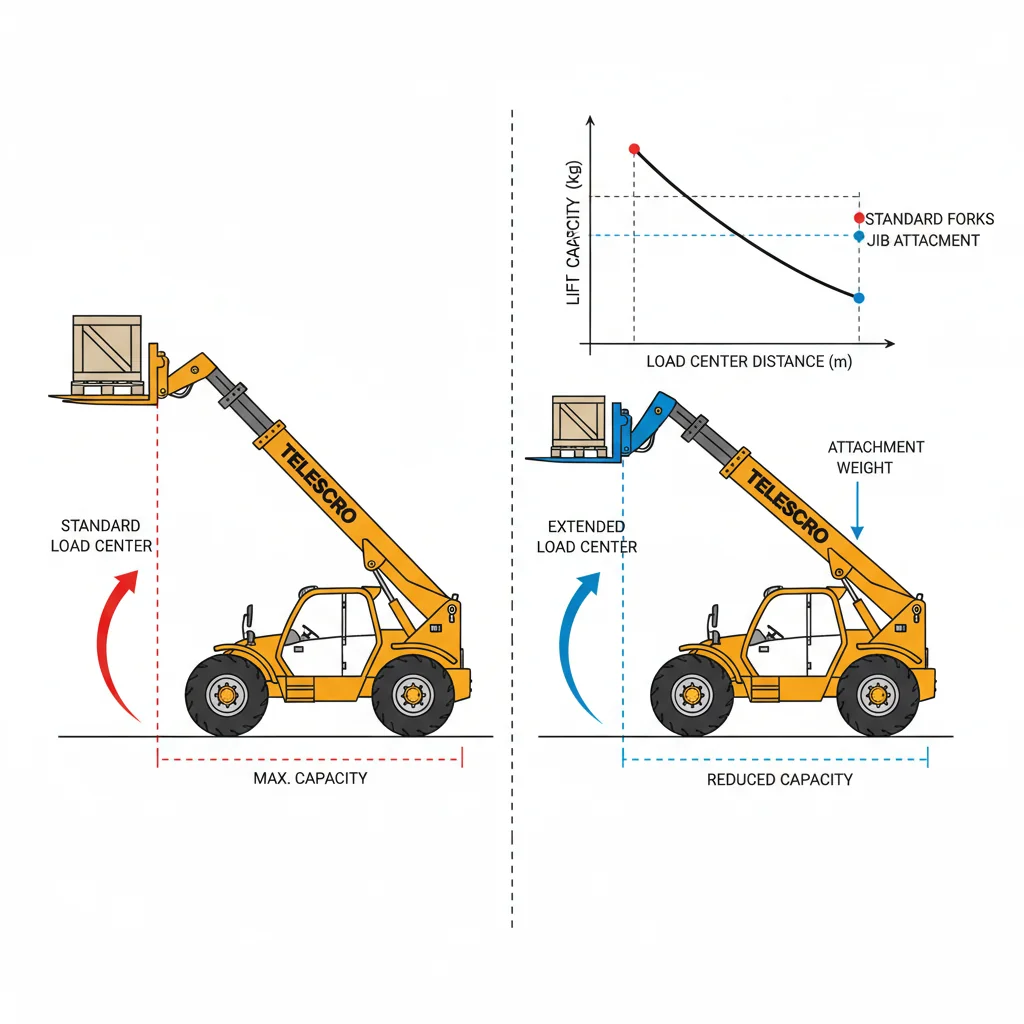
Let me share something important about telehandler capacity that trips up even experienced contractors. The number you see in the brochure—rated capacity at, say, 4,000 kg—is with standard forks and a specific load center, often 500 mm or 24 inches. Change attachments, and everything changes. I’ve seen crews in Kazakhstan switch from forks to a jib, expecting similar performance. The reality? Their safe lifting limit dropped by almost 40%, because that jib not only added extra weight but also pushed the load center farther from the front tires. The same telehandler that handled 2-meter pallet loads with ease now struggled with a basic steel beam at mid-boom.
Here’s a quick breakdown of what actually happens when you use different attachments:
- Every attachment adds its own weight—buckets, winches, bale clamps, man baskets.
- Load center moves forward—attachments usually extend the distance from the fork face to the load’s center of gravity.
- The overturning moment increases—the farther out you place the weight, the more leverage it has to tip the machine.
- Rated capacity always drops—often by 20-50% compared to standard forks, and sometimes more with heavy or long attachments.
- OEMs publish separate load charts—you must use the chart for your exact tool, not just the machine.
I always remind customers: never assume the “fork rating” applies for jibs, buckets, or baskets. Last month, a Dubai site avoided an expensive mistake by checking the attachment load chart before lifting curtain wall panels. If your attachment-specific chart is close to your required load, consider a bigger machine or rethink your approach. Safety and real productivity both depend on this step.
Switching from standard forks to a heavier attachment like a jib or bucket can substantially decrease a telehandler’s lifting capacity due to changes in both the attachment’s weight and how far the load extends from the carriage.True
When an attachment is heavier or positions the load farther from the telehandler’s front axle, it increases the effective load center. This reduces the maximum safe lifting capacity, which is originally rated for standard forks and a specific load center.
As long as the total weight lifted does not exceed the telehandler’s maximum rated capacity, the type of attachment and load center have no effect on stability or safe operation.False
Both attachment type and load center directly affect a telehandler’s stability and lifting capacity. Heavier or longer attachments increase the load center distance, meaning the machine can safely lift less weight than its maximum rating with standard forks.
Key takeaway: Telehandler capacity is not universal for every attachment. Each tool changes the load center and adds its own weight, often requiring a 20-50% load reduction compared to forks. Always base decisions on the attachment-specific load chart for safe operations and correct equipment sizing.
How do site conditions derate telehandler capacity?
Telehandler rated capacity is published assuming the machine is operating on firm, level ground, with correct tyres and pressures, approved attachments, and environmental conditions within the limits stated in the operator’s manual. On real jobsites, factors such as soft or yielding surfaces4, slopes, ruts, or wind can significantly reduce stability and usable lifting capacity. Manufacturer load charts do not account for these site-specific conditions, so lifts should never be planned near chart limits unless the ground and environment fully meet OEM assumptions.

Last month, a contractor in Dubai called me about a telehandler that struggled with its supposed 3.5-ton capacity. The unit was operating on packed sand, not solid concrete. Even though the machine was rated for 3,500 kg at minimum reach, the load chart assumes almost perfect ground—level, firm, and dry. On that jobsite, one front tire sank about three centimeters as the load was lifted. This small shift increased the reach from the tire edge to the pallet, moving the center of gravity forward. I watched their crew try to pick a 2,900 kg pallet at 6 meters, but the overload alarm kept activating. On soft or unlevel ground, actual safe capacity can drop 15% or more—even before you account for wind or operator error.
From my experience, this isn’t just a Middle East issue. In coastal Kenya, I’ve seen rain turn hard dirt to mud in minutes. One customer thought he could run a 4-ton telehandler right up to the load chart limits while working on a slight slope. The moment the boom extended, the whole unit started to lean. Good thing they stopped—the real capacity on that angle was probably closer to 3,000 kg before stability was at risk. Even a side slope of 4° cuts your margin fast. Operators have to use judgement, because the machine itself won’t compensate for tough ground. The takeaway? Always check your site versus the rated-ground setup in the manual.
Telehandler rated lifting capacity assumes a level and firm surface; soft or uneven ground can significantly reduce usable capacity even if the load and boom angle remain the same.True
This is true because shifting ground affects the machine’s stability and changes the center of gravity, causing the actual safe lifting capacity to be much lower than chart values indicate.
Operating a telehandler on packed sand does not affect lifting capacity as long as the machine’s load is within the rated chart values.False
This is false because packed sand can compress or give way under load, causing instability and a forward shift in the center of gravity, which can reduce safe capacity regardless of the chart rating.
Key takeaway: Rated capacity is valid only under ideal, level ground conditions. On uneven, soft, or sloped sites, actual safe lifting capacity can drop by 10–25%. Always select equipment with extra margin and derate chart figures when site conditions fall short of factory test parameters.
Why isn’t rated capacity enough for telehandlers?
Rated capacity refers to the maximum load published by the manufacturer for a specific, highly stable configuration—typically at minimum horizontal reach and under defined test assumptions. It does not reflect real-world variables such as boom extension and height, attachment selection, load center, or actual load placement. As a result, sizing telehandlers based solely on rated capacity or maximum lift height often leads to in-field overload warnings, productivity losses, and costly re-mobilization when real working positions are checked against the OEM load chart.

Here’s what matters most when selecting a telehandler: rated capacity only tells you part of the story. Rated capacity is the maximum load at minimum reach, on perfectly level ground, with a specific attachment—conditions you’ll almost never see on a real jobsite. I’ve worked with customers in South Africa and Brazil who bought “4-ton” telehandlers expecting to lift 4,000 kg throughout the entire reach. What happened? As soon as they needed to boom out to 12 or 14 meters, the warning alarm sounded. At that extension, the machine could barely handle 1,100 kg safely. The brochure numbers look great, but the actual working envelope is much smaller.
The biggest mistake I see: teams size telehandlers by max height or tonnage class, not by the true “weight at reach5” their job requires. Let me give an example from a site in Kazakhstan. A client needed to place heavy stone panels, each close to 2,800 kg, onto the fifth floor—around 13 meters out from the front tires. On paper, their model was rated for 3,500 kg. But the load chart, checked at 13 meters reach with their fork attachment, showed only 2,200 kg capacity left. They were stuck—they had to rent a larger unit, losing time and budget.
My advice is practical: always use the load chart for your highest likely load, at your actual reach and height, using the intended attachment. Double-check ground level—rated capacities assume less than 3 degrees slope. If your point lands near the limit line, go up one size. That safety margin gives peace of mind and saves real headaches on site.
A telehandler rated at 4,000 kg can only lift that maximum weight when the boom is fully retracted and the machine is on level ground, not when the boom is extended.True
Rated capacity is measured at the shortest horizontal reach and ideal ground conditions. As the boom is extended, lifting capacity is substantially reduced due to increased leverage and stability limits.
The rated capacity of a telehandler is a reliable indicator of the maximum weight it can safely handle at any reach or angle.False
Rated capacity only applies under specific test conditions, usually with the boom retracted. Actual usable capacity decreases as you extend the boom or operate on uneven ground, making rated capacity unreliable for all jobsite scenarios.
Key takeaway: Rated capacity figures only apply under optimal, controlled conditions and do not reflect real working scenarios. Always size telehandlers by the actual load weight at the required reach point shown on the manufacturer’s load chart, adding a safety margin to ensure safe, productive lifting operations.
How do weight and wheelbase affect capacity?
Telehandler chassis weight and wheelbase influence rated capacity, as heavier machines with longer wheelbases provide greater counterweight and stability6 at minimum reach. However, regardless of machine size, usable capacity drops quickly as boom outreach increases. Always confirm allowable load at the actual working reach using the OEM load chart.
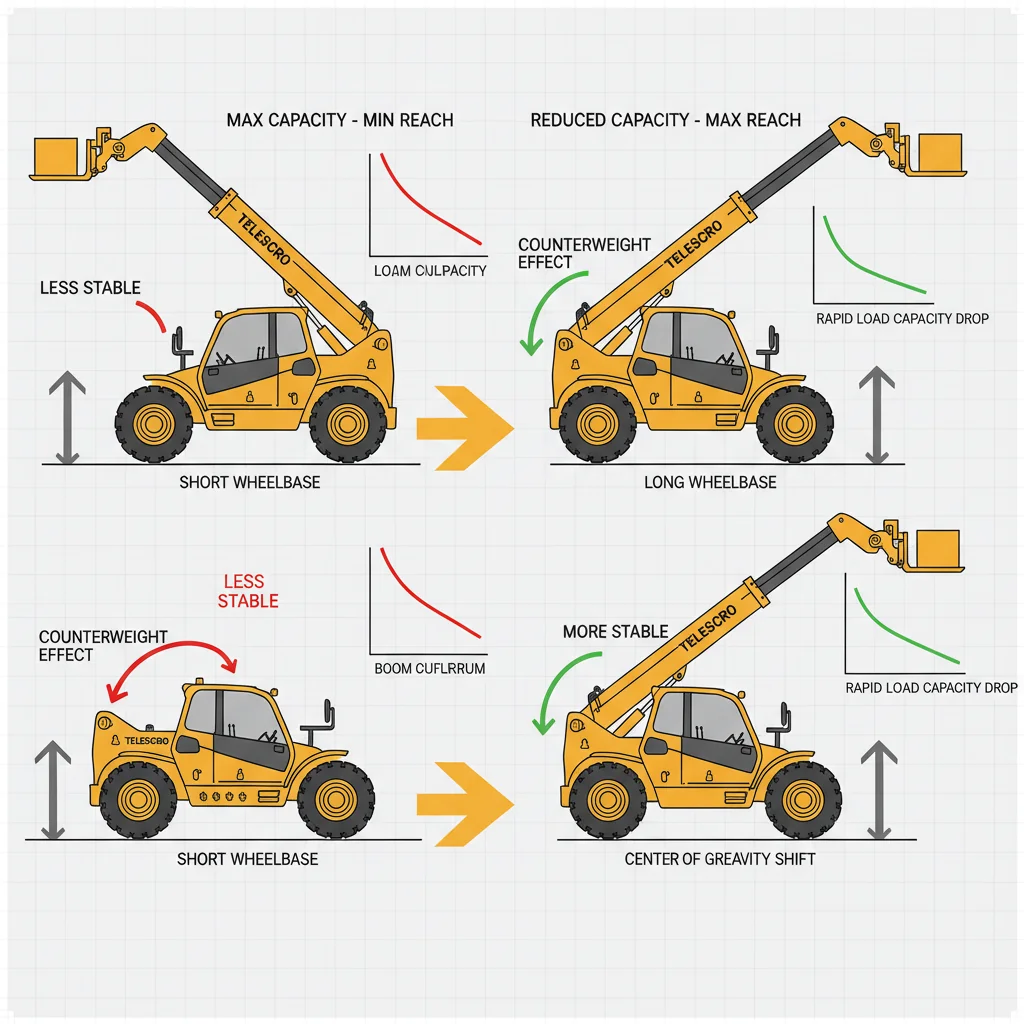
To be honest, the spec that actually matters is not just maximum rated capacity—it’s where that capacity is usable on the jobsite. I’ve worked with a lot of customers who assume a heavier telehandler with a longer wheelbase can always lift more, no matter the reach. At first glance, that’s true: a 14-ton machine with a 3-meter wheelbase feels rock solid, especially at minimum reach. Its own mass and wide chassis act as a strong counterweight, which allows for rated capacities of 5,000 kg or more—at least when the boom is low and retracted.
But I saw a classic example last year in Kazakhstan. The site invested in a high-capacity telehandler for heavy precast lifting. On paper, it looked perfect. In reality, when they needed to place 2,200 kg loads at a 12-meter reach, the load chart showed usable capacity dropping to just 1,700 kg. That’s standard physics—every telehandler, big or small, loses lifting ability as the boom extends. The tipping axis, defined by the front axles, limits forward stability. The further the load center moves from the front tires, the faster your safe capacity falls off.
Don’t let gross capacity or machine weight tempt you into the wrong choice. I always advise customers to compare load charts at the actual reach and height their job demands. Sometimes, a mid-size model with a strong chart at 7 or 8 meters gets the job done—and saves you serious cost and maneuvering headaches. Always put your real load point on the chart before deciding. That’s how you avoid an expensive mistake on site.
A longer wheelbase and heavier telehandler can increase lifting stability, but this advantage diminishes significantly as the boom is extended to full reach.True
While added weight and wheelbase help keep the machine stable at minimum reach, the leverage effect from an extended boom quickly reduces effective capacity, so rated capacity is only achievable at specific positions.
A telehandler’s maximum rated capacity is the same at every reach and height because its weight and wheelbase do not change.False
Although the base machine remains the same, the physics of load distribution change dramatically as the boom extends, causing the maximum safe lifting capacity to decrease depending on reach and boom angle.
Key takeaway: Rated capacity is strongly affected by telehandler weight and wheelbase, but the true usable capacity at height or reach depends on each model’s load chart. Never compare gross ratings only—assess capacity at the actual load point to avoid costly lifting mistakes.
Why do telehandler load charts include a safety?
Telehandler load charts reflect a built-in safety margin, mandated by standards such as EN 14597, to ensure rated capacity is always below the tipping point under controlled conditions. However, real-world factors—rough terrain, wind, sudden stops—can quickly consume this safety buffer, making strict adherence to the load chart essential for safe operation.

Here’s what matters most when you look at a telehandler load chart: those numbers already include a safety margin, baked in by standards like EN 1459. A rated capacity of 2,000 kg at a specific height and reach doesn’t mean the machine’s limit is 2,001 kg in the real world. Instead, it means the unit was tested on level, hard ground, with a factory-supplied attachment and a defined load center—conditions most sites rarely match. I’ve seen contractors in Malaysia underestimate this when handling block pallets six meters out. One bump in the terrain, a sudden turn, or a light gust can eat up all the margin intended to save you from tipping.
A customer in Kazakhstan once called me after lifting steel beams at 80% of charted capacity, thinking there was still ‘room to spare.’ The reality? The load shifted while he reversed down a small ramp, and the telehandler’s rear wheels lifted off—right up to the edge of a tip. He was lucky. That built-in safety factor only helps under controlled conditions, not in jobsite chaos.
Treat the load chart as the upper operating limit, not a target to be pushed. For critical or worst-case lifts, it is common site practice to maintain a clear margin below the charted capacity, especially when conditions are less than ideal. This helps protect personnel, reduce near-misses, and limit stress on the boom and hydraulics. Telehandlers are rated for level ground; if the jobsite is uneven, the machine must be properly leveled or the working load reduced accordingly. Do not rely on the built-in safety margin to compensate for poor conditions.
Telehandler load charts include a built-in safety margin because the rated capacities are based on ideal test conditions which rarely reflect the actual working environment on most job sites.True
Safety margins are added to account for variable site conditions such as uneven ground, different attachments, or wind. This ensures the operator has a buffer to maintain stability and avoid tip-overs, even when conditions are less than perfect.
The rated lifting capacity shown on a telehandler load chart always represents the absolute maximum weight the telehandler structure and hydraulics can withstand under any conditions.False
Rated capacities are determined under controlled test conditions and already include a margin of safety. Real-world factors, such as uneven terrain or heavier-than-expected attachments, can further reduce the safe working load. The actual structural and hydraulic limits are higher, but rated loads reflect the safe operational limit, not the absolute failure threshold.
Key takeaway: Telehandler load chart capacities include a tested safety margin, but operational dynamics like terrain and load movement can rapidly use up this buffer. Treat the load chart as a strict upper limit, and select machines where worst-case lifts remain well below the rated line for enhanced safety.
How does maintenance impact telehandler capacity?
Telehandler rated capacity remains unchanged, but actual usable capacity can decrease due to mechanical wear8 and sensor miscalibration. Worn boom pads, loose pins, leaking cylinders, or cracked tyres may compromise stability, while out-of-calibration load moment indicators (LMI) increase overload risk. Regular inspection and calibration are essential to ensure safe operation near rated limits.
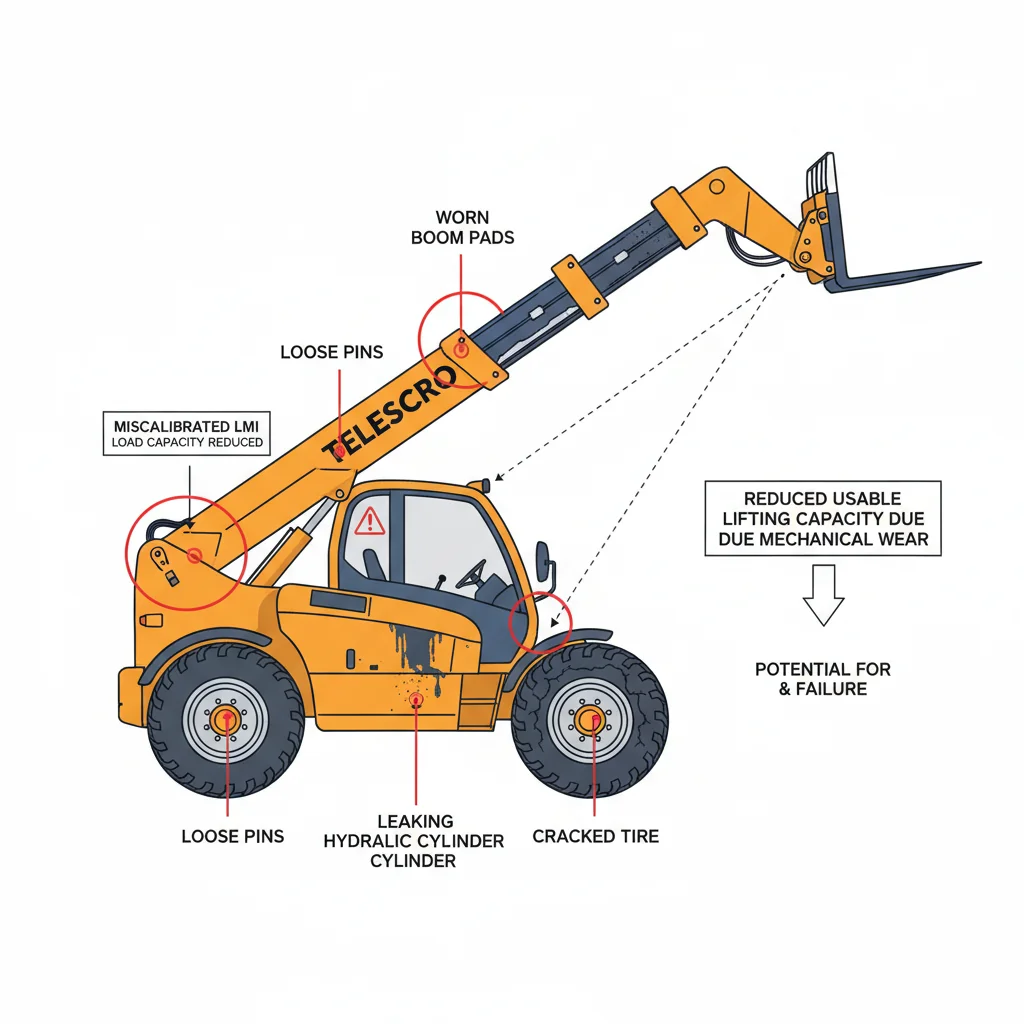
I’ve worked with customers who overlooked maintenance on rented telehandlers—resulting in real trouble at the jobsite. In Brazil last year, a crew tried to lift 2,000 kg of steel rebar at 8 meters with a unit rated for 2.5 tons. On paper, it should have been fine. But once they extended the boom halfway, the machine felt unsteady, and the load moment indicator (LMI) started flashing even though they hadn’t exceeded the published load chart. After a quick inspection, we found worn boom pads and significant play in several pins. The actual usable capacity had dropped, even though the specification sticker still showed 2,500 kg.
This isn’t rare. Over time, mechanical wear—like loose boom pivots, cracked tires, or minor hydraulic leaks—reduces the machine’s structural tightness and stability. The LMI or hydraulic pressure sensors can also drift out of calibration. When that happens, you might get false overload alarms, or worse, the LMI misses a dangerous overload entirely. I’ve seen machines in Kazakhstan where an out-of-calibration LMI allowed lifts 15% over rated capacity before any alarm. That kind of risk is invisible until you’re already in trouble.
Whenever you work near the upper end of the load chart—especially with used or long-term rental units—I always suggest asking for up-to-date inspection and load-test records. If documentation is missing or more than six months old, plan for immediate service and be cautious with demanding lifts. The rated capacity on the data plate means nothing if the machine’s condition and sensors aren’t honestly up to spec. Your safest jobsite is always the one with tight booms, calibrated LMIs, and zero hydraulic leaks.
Worn boom pads can cause increased flex and instability in a telehandler’s boom, reducing its usable lifting capacity even if the machine has not reached its rated limit.True
Boom pads provide stability and minimize play between boom sections. As they wear, increased movement and flex reduce the structural integrity of the boom, causing the load moment system to signal instability at weights below rated capacity. This makes real-world lifting ability lower than the published load chart in neglected machines.
The published load chart of a telehandler assumes all maintenance components, such as hydraulic oil and boom pads, have no effect on the machine’s lifting capacity.False
Load charts are based on new or properly maintained equipment. Neglected maintenance—such as worn pads or contaminated hydraulic fluid—can alter balance, strength, and response, lowering actual usable capacity compared to the chart.
Key takeaway: Telehandler rated capacity is static, but true safe lifting capacity depends on current mechanical condition and accurate sensor calibration. Always confirm recent inspections and LMI calibrations before demanding lifts, especially on used or rented units, to avoid unplanned downtime or overload accidents.
How to Size Telehandlers with Suppliers?
Optimal telehandler sizing requires presenting suppliers with detailed use scenarios: specific load weights (including pallets and attachments), load dimensions and center of gravity, target lift height and outreach, and ground conditions. Suppliers should reference manufacturer load charts for actual usable capacity, request attachment-specific charts, and provide operator training on chart interpretation and LMI system warnings.

One question I always ask customers is, “Can you describe exactly what you’re lifting and where?” Generic specs like “4-ton, 17 meters” sound good, but don’t tell us if the machine will actually work for your job.
Last year, a contractor in Kazakhstan described their job as “heavy concrete panels, top floor, 14 meters up.” I asked for more detail: pallet plus panel weight (about 2,600 kg total), panel size, and how far forward from the building line the load needed to reach. That last part—horizontal reach from the front tire edge—made all the difference.
When we checked the load chart for a typical 4-ton, 17-meter machine, usable capacity at 14 meters reach dropped to about 1,400 kg. Not even close. They would have overloaded the telehandler on almost every pick.
This is why I recommend preparing at least two real scenarios before talking to suppliers. Write down the combined load weight (include pallet and any rigging), the full dimensions, and try to estimate center of gravity vs. standard fork carriage.
State the lift height and horizontal reach, not just boom length—always from the front tire edge to where the load sits. Include your ground conditions. Flat concrete is very different from rough, sloping gravel. If you’re working on a 4-degree ramp, rated capacity may not apply without special leveling.
Ask your supplier to overlay these scenarios directly onto the manufacturer’s current load charts, showing actual working capacity for every attachment you might use.
Telehandler rated lifting capacity is usually measured at minimum boom extension and close to the machine, which means the actual usable capacity at maximum reach or height is significantly lower.True
Manufacturers report maximum lifting capacity based on optimal, stable positions—shortest boom and closest load. As you extend the boom or reach farther out, the leverage reduces lifting power, so real-world usable capacity at jobsite working points is often much less.
If a telehandler is rated for 4 tons, it can always safely lift 4 tons at any boom angle or extension within its reach limits.False
A telehandler’s maximum lifting capacity decreases as the boom extends or is elevated. The rated capacity is only valid at specific positions; exceeding those parameters can risk overload or tip-over, so the operator must consult load charts for each working position.
Key takeaway: Sizing telehandlers based on real job scenarios—not generic specs—ensures actual lifting requirements are matched to machine capacity. Request attachment-specific load charts and targeted operator training to avoid costly mistakes and ensure safe, efficient lifting operations on your site.
Conclusion
We’ve talked about the real difference between rated and usable capacity, and why telehandler performance is about much more than the nameplate number. From what I see onsite, the crews that avoid headaches are the ones who treat the load chart like a daily tool—not just something to skim at purchase. It’s easy to get caught by what I call the “showroom hero, jobsite zero”—a machine that looks great on paper but falls short on a real job. If you’re sorting through load charts, attachments, or just want to double-check what fits your work, I’m happy to help. Reach out any time—I’ve worked with projects across 20 countries and can share what actually works. Every site’s unique, so choose what’s right for your real conditions.
References
-
Detailed explanation of how load center shifts impact lifting capacity and safety margins for telehandlers with different attachments. ↩
-
Detailed guidance on interpreting load charts for varying boom positions and attachments to avoid overloading in real scenarios. ↩
-
Covers the crucial safety measures and compliance requirements to prevent accidents and equipment damage on job sites. ↩
-
Expert guidance on the impact of soft surfaces such as sand and mud on telehandler load limits and operational safety. ↩
-
Details the critical importance of considering load weight at extended reach distances to prevent overload issues and costly operational errors. ↩
-
Explore how counterweight and chassis stability increase lifting capacity and ensure safe operation at minimal boom outreach. ↩
-
An authoritative explanation of the EN 1459 standard, focusing on safety requirements and load testing protocols for telehandlers. ↩
-
Detailed look at mechanical wear impact on stability and safety, including common wear points and maintenance best practices. ↩