










Telehandler Rated Capacity on Soft Ground: Field-Tested Mistakes to Avoid
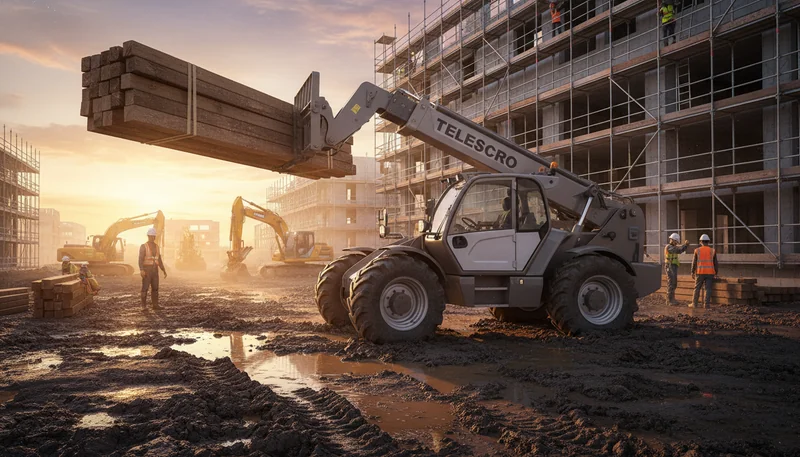
I’ll never forget the time I visited a muddy jobsite north of Guangzhou and saw a nearly new telehandler nose-down, boom half-extended, with sacks of concrete still dangling from the forks. The load was under the chart limits—yet the machine still tipped. That accident stuck with me.
Telehandler rated capacities are determined under manufacturer‑specified conditions, typically on firm, level surfaces like concrete or compacted gravel, as outlined in safety standards such as EN 1459 and ANSI/ITSDF B56.6. On soft or unstable ground, tire sinkage and chassis tilting can significantly reduce stability, shifting the center of gravity closer to the tipping axis. Manufacturer and field experience indicate that real‑world stability can be compromised by 20–50%, depending on soil conditions and equipment setup. For more details, see tire sinkage and center of gravity considerations.
Does telehandler capacity change on soft ground?
Telehandler rated capacities on load charts are valid only on firm, level surfaces, such as concrete or well-compacted ground within a ±3° slope. On soft or muddy ground, stability margins can be significantly reduced—by 20–50% or more—due to tire sinkage and chassis tilt, making the published load chart unreliable.
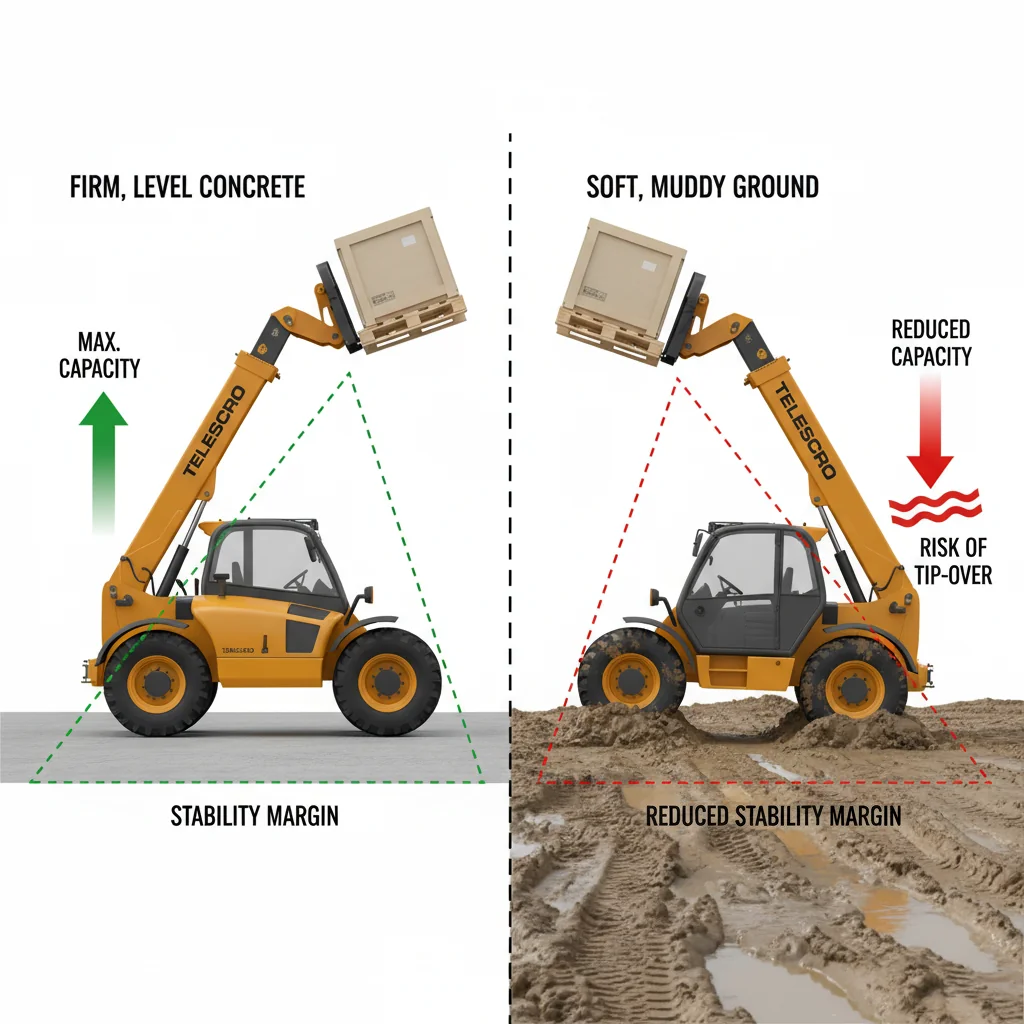
Let me share something important about telehandler load charts—they are based on very specific ground conditions. Most people don’t realize that the rated capacity you see is tested and certified only when the machine is set on firm, level ground, usually concrete or a well-compacted base with less than three degrees of tilt. If your jobsite shifts to soft or muddy surfaces, that number on the chart doesn’t actually reflect what is safe anymore. I’ve seen this catch out more than one team, like a project outside Almaty, Kazakhstan, where clay soil after rain cost them precious hours when the telehandler sank almost 10 cm and the center of gravity moved dangerously close to the tipping axis.
On soft ground, the tires can sink unevenly and the chassis tilts, sometimes without much visible warning. This changes the entire stability calculation. Field studies and OEM training show that once a telehandler works on soft ground, its real stability margin can drop by 20–50%. I’ve had customers in Brazil who thought moving timber pallets at the chart’s maximum reach was fine, but when I visited the site, the ground gave way slightly, and a “safe” 2,500 kg load suddenly felt risky at only 1,500 kg. The published load chart does not update itself for these ground changes.
I always suggest improving the ground first—mats, steel plates, or serious compaction—before lifting near rated limits. If you can’t achieve “load chart” conditions, you need to mentally derate your capacity by at least 20%—sometimes more. Trust what you see in the field, not just the numbers on paper, especially when the ground gets soft or uneven.
Telehandler rated capacity decreases significantly when operating on soft ground because uneven or unstable surfaces compromise the machine's stability and increase the risk of tipping.True
Telehandler load charts are determined under controlled, stable ground conditions. Soft ground can cause the machine to settle or lean, shifting the center of gravity and reducing safe lifting capability even if the load remains the same.
As long as a telehandler’s outriggers are fully extended, its rated capacity remains unchanged on soft ground.False
Outriggers improve stability but cannot compensate for ground that compresses or shifts under load. Soft ground undermines the support required to safely handle rated loads, regardless of outrigger use.
Key takeaway: Telehandler load charts are valid only for firm, level ground. On soft or unstable surfaces, the actual safe lifting capacity may be reduced by 20–50% or more. Always adjust for surface conditions by improving ground support or applying appropriate derating before lifting according to the chart.
How Does Soft Ground Affect Telehandler Stability?
Soft or muddy ground undermines telehandler stability through tire sinkage and uneven slope, causing the chassis to tilt and the center of gravity to shift forward. Even minor nose dips or lateral tilts—often just 2–3°—can reduce rated stability by up to 20%, increasing tip-over risk during standard “under the chart” lifts.
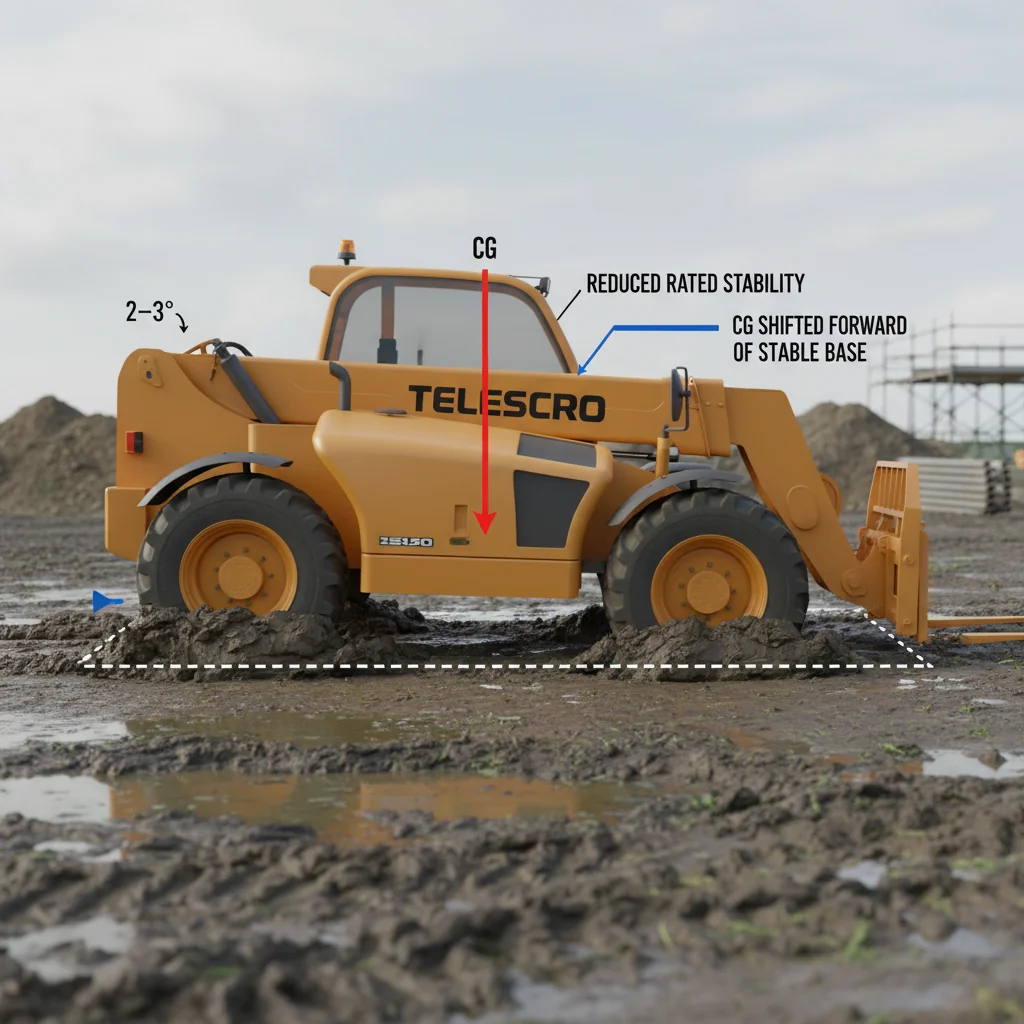
The biggest mistake I see is crews trusting the rated capacity on the load chart without considering ground conditions. Most telehandlers are tested on level, compacted surfaces in the factory yard. On soft, muddy, or recently filled ground, those ideal numbers no longer apply. What actually happens? The weight of the machine causes the front tires to sink, often by 50 to 100 millimeters, and the chassis tilts forward or leans to one side. The boom angle decreases slightly, and the entire center of gravity—including both the telehandler and the load—shifts closer to the front axle. Even a minor nose dip can reduce your stability margin by 10% or more, especially if you’re already working near the chart limits.
Last month, a client in Dubai ran into this issue on a villa site. He had a 3.5-ton telehandler rated for 1.5 tons at 7 meters on paper. But the ground was soft, and one front tire dropped a bit more than the other. When they picked up a 1.2-ton rebar pallet, the whole machine started to tip forward—even though the load was supposed to be under the rated capacity. I’ve seen similar accidents in Kenya and Vietnam. It comes down to this: the load chart doesn’t consider ground movement or tilt beyond about 3 degrees.
Any time you see soft spots, backfill, or puddles, assume rated stability is reduced. If you can, use frame leveling or stabilize the machine before lifting. I always suggest walking the work area and checking ground firmness with a bar or rod. The safest operators don’t just watch the chart—they read the ground too.
On soft or uncompacted ground, a telehandler's center of gravity can shift forward as the front tires sink, reducing the effective rated capacity even if the load chart appears to allow the lift.True
Telehandler rated capacities assume stable, level, and solid ground; when the front tires sink, the whole chassis tilts forward, changing boom geometry and increasing the risk of tipping at loads below the chart's stated capacity.
Soft or muddy ground has little effect on telehandler stability as long as the outrigger pads are deployed.False
Most telehandlers do not have outriggers, and even those that do are still affected by poor ground conditions; soft ground reduces bearing capacity and can lead to uneven settling, undermining stability regardless of outrigger use.
Key takeaway: On soft or uncompacted ground, telehandler rated capacity and stability are compromised by even slight tire sinkage and chassis tilt. These factors are not reflected in standard load charts. Always ensure machines are leveled and verify ground conditions before operating near charted limits.
How to Derate Telehandler Capacity on Soft Ground?
Telehandler rated capacity must be reduced when operating on soft or saturated ground. Field experience and industry best practices suggest a typical loss of 20–50% in usable capacity, with up to 40% stability loss in muddy conditions. Operators should apply a conservative reduction unless ground conditions are verified as suitable.

I’ve worked with several contractors in Australia and the Middle East who thought their new 4-ton telehandler could handle the same pallet loads on damp, sandy ground as on concrete. A few weeks ago, a site in Dubai realized too late that their machine was bogging down—by mid-morning, the rear tires had sunk nearly to the rim. Their operators tried to stick to the load chart, but nobody had applied a derate for the ground conditions. The reality? Their “4,000 kg” machine struggled with more than 2,300 kg at moderate outreach, and the moment indicator kept flashing warnings.
Field testing and industry guidelines both say rated capacity is based on level, firm ground, typically with less than 3° of slope. Mud, soft fill, or loosely compacted soil destroys that baseline. On saturated ground, you typically see a 20–50% capacity loss. In muddy conditions, I’ve measured up to 40% drop in machine stability—even before reaching the machine’s extension limits.
So, how do you apply this on site? I always advise operators: If your unloaded telehandler sinks more than half its tire tread, treat that area as unsuitable for lifting at maximum charted capacity. Move to firmer ground, lay down stabilizing mats, or reduce the capacity by at least 25–50%. When in doubt, a good rule of thumb is to "move one column right" on the load chart—meaning, treat your 7-meter extension as if it were 8 meters. Never push for full rated capacity unless you’ve verified the ground’s bearing strength and compaction. This simple approach helps avoid a lot of potential problems.
Telehandler load charts are calculated based on firm, level ground conditions; when operating on soft ground, rated lifting capacity must be derated because reduced tire support increases the risk of instability and tipping.True
Load charts assume optimal ground conditions, so soft or unstable surfaces can compromise stability by allowing the machine to sink or tilt, making it unsafe to lift maximum charted loads.
The machine's rated capacity remains the same regardless of ground conditions as long as the telescopic boom is not fully extended.False
Ground conditions affect the telehandler's stability and wheel support, so even with the boom retracted, operating on soft surfaces may lead to reduced safe lifting capacity, not just with the boom fully extended.
Key takeaway: Never assume rated capacity applies on soft, wet, or rutted ground. Soft surfaces can reduce usable telehandler capacity by 20–50%. Always apply a substantial derate, reference the load chart conservatively, and relocate or stabilize the work area if tires sink over half their tread depth.
How Do Tires and Weight Affect Soft-Ground Capacity?
On soft ground, ground bearing pressure1—not hydraulic lift capacity—typically limits telehandler performance. Heavier machines produce higher pressure at the tire-soil interface and will sink sooner than lighter units. Specifying wider, larger, or lower-pressure tires2, or selecting compact telehandlers, reduces ground pressure and preserves usable capacity.

Most people don’t realize that on soft ground, the real limitation isn’t the telehandler’s hydraulic system—it’s the ground underneath your tires. I’ve seen jobs stall in Kazakhstan because the machine looked good on the lift chart but just kept sinking when loaded. Even if you have a unit rated for 4,000 kg, soft ground like clay or wet topsoil might only support 50–75 kPa of pressure. If you run a 10-ton machine on four standard tires, you could be putting over 60 kPa onto each contact patch. Add dynamic movement—like booming out—and that pressure can spike fast.
From my experience, lighter or more compact telehandlers often out-work the big units on muddy or agricultural sites. One project in southern Brazil comes to mind: the crew swapped their 14-ton machine for a compact 10-tonner and gained almost a third more usable capacity, just because the smaller machine didn’t bog down. The minute the larger telehandler started spinning or digging in, the rated capacity meant nothing. Numbers on the spec sheet only count if the ground will hold them.
You can shift the odds in your favor with wider or lower-pressure tires. Increasing the tire footprint spreads machine weight over a bigger area, dropping the pressure and letting you move heavier loads without sinking. I always push customers to ask about ground pressure—not just lift specs. Make sure you get the numbers for your tire and configuration, not some showroom baseline. That’s how you keep real capacity, not just theoretical numbers, on soft sites.
A telehandler with wider tires can often carry more weight on soft ground than the same machine with narrower tires, even if their hydraulic lifting capacities are identical.True
Wider tires distribute the machine's weight over a larger area, reducing ground pressure and the risk of sinking, which allows safer operation on softer surfaces even though hydraulic limits remain the same.
A telehandler’s advertised rated capacity will always apply, regardless of ground conditions, as long as the machine is balanced and stable.False
Rated capacity is determined under ideal conditions, typically on firm, level ground. On soft or unstable surfaces, the true limit is set by how much load the ground can support under the tires, which can be much less than the rated capacity.
Key takeaway: Telehandler rated capacity is not the sole limiting factor on soft ground—ground pressure governs stability. Choosing lighter units or enlarging tire footprint minimizes sinking and preserves effective lifting ability. Always verify ground pressure data for the working configuration, not just manufacturer lift ratings.
How Do Mats and Pads Restore Capacity?
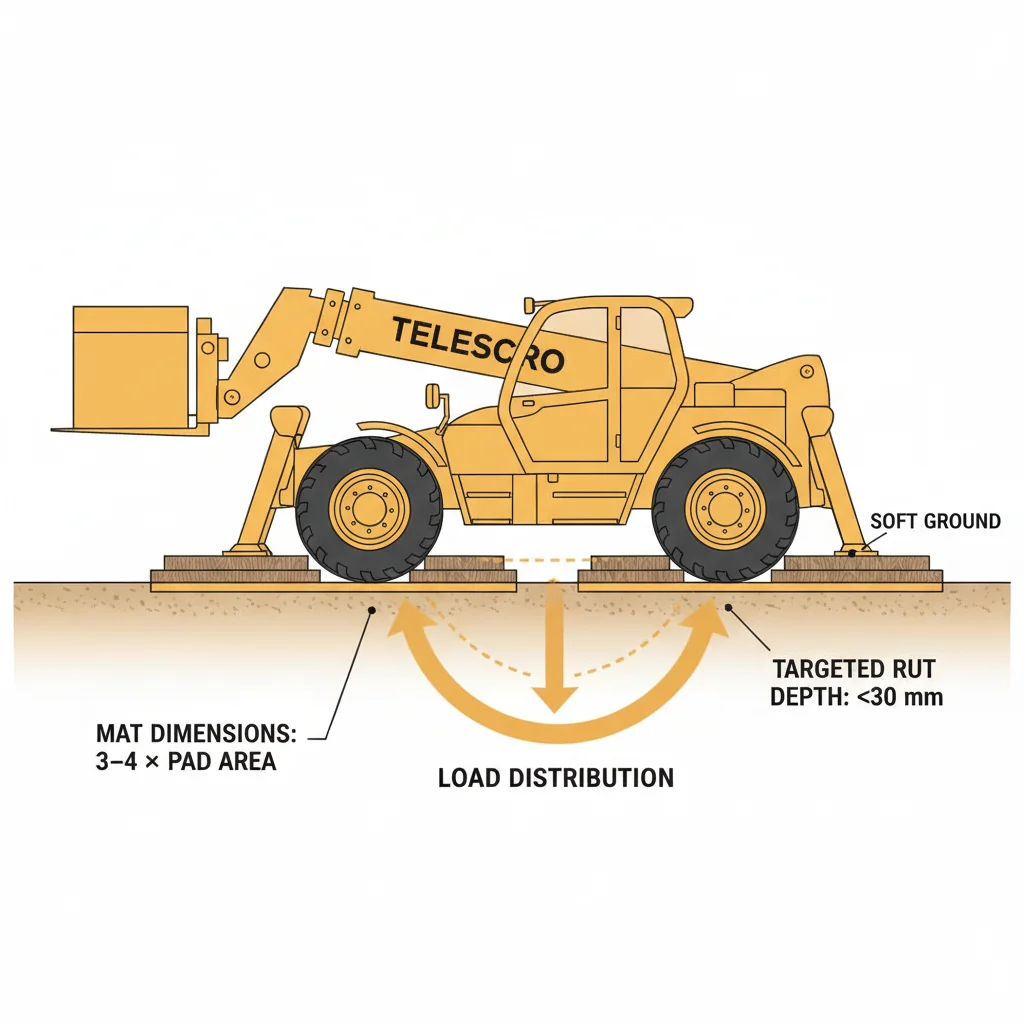
Proper use of mats, pads, and stabilizers helps restore telehandler rated capacity on soft ground by spreading the load, which enables the ground to mimic firm conditions. Hardwood mats or steel plates at least 3–4 times the pad area are recommended, targeting ruts under 20–30 mm to approach near load chart values.
Last month, a contractor in Kazakhstan reached out after his 3.5-ton telehandler struggled to lift full loads on a newly filled clay roadway. The machine had enough structural capacity for the job, but tires sank nearly 40 mm once the boom was halfway out. That’s a red flag. The load chart always assumes firm, level conditions—when you see deep or growing ruts, the ground can’t carry the rated load, no matter what the brochure says.
What actually helps is spreading out the ground pressure. I told him to source steel road plates3 at least three times larger than each stabilizer pad4. For fixed-chassis machines, heavy timber mats under all four tires work too. The goal is simple: keep ruts under 20–30 mm under the weight. On that site, with plates under both tires and pads, he went from almost zero safe lift at 10-meter reach to close to the full load chart value—around 1,300 kg at that position instead of 700 kg before. Big improvement, not magic.
Here’s what matters most: mats and pads do not change the machine’s structural limits. They only help the ground behave more like the level, compacted surface the designer assumed when making the load chart. So, always test the setup with a partial load and the boom partway out. If the ground shows movement, add more matting or relocate. I always remind teams—if you see ruts over 30 mm after testing, treat that zone as derated and never push for full chart numbers.
Using ground mats or outrigger pads under the telehandler's wheels helps restore rated lifting capacity on soft or unstable surfaces by distributing the load over a greater area, reducing the risk of tire sinkage and unintentional tipping.True
Telehandler load charts assume solid, level ground. On softer surfaces, ground pressure from tires can exceed what the soil can support, causing instability. Mats and pads increase the contact area, lowering ground pressure, preventing deep ruts, and helping maintain the safe capacity indicated by the load chart.
Inflating the telehandler's tires to a higher pressure allows the machine to safely lift heavier loads on soft or recently filled ground.False
Increasing tire pressure does not significantly increase ground bearing capacity. While it may offer marginally improved tire support, it does not address the fundamental limitation of soft ground, which is its inability to support concentrated loads. Ground mats or pads are needed to distribute the machine's weight and safely restore capacity.
Key takeaway: Mats, pads, and stabilizers do not increase a telehandler’s structural capacity, but they enable safer operation near rated values on soft ground by distributing load pressure and limiting rut depth. Always test for excessive rutting5 and adjust matting as needed to stay within safe working conditions.
Why is telehandler reach risky on soft ground?
Telehandler rated capacity drops steeply at long reach, even on level, firm surfaces. On soft or uneven ground, small tilts (just 2–3°) further worsen leverage, shifting the center of gravity forward. This makes the machine less stable than load charts predict, especially at maximum reach or near slopes.

I’ve worked with customers who made this exact mistake—underestimating how risky it is to extend the boom on soft or uneven ground. In Dubai last year, a team used a 4-ton telehandler to set glass panels at a 14-meter reach. The load chart said 1,200 kg was safe, but one tire sank just two centimeters into fresh backfill. The machine tilted forward even though their load was well below the chart value. The problem? Soft ground shifts the machine’s balance instantly—the chassis tilts, the boom angle drops, and suddenly your reach is longer than the load chart assumes. That extra leverage can take you right to the edge of a tip-over.
On firm concrete, I’ve seen units hold rated loads at maximum extension if you stay within a 3° level tolerance. But in places like Kenya or northern China, where jobsites can be muddy or sloped, even a small tilt changes everything. Just 2–3° of chassis lean moves the center of gravity toward the front axle, shrinking your stability margin much faster than most operators expect. At long reach, you lose half your charted capacity even before the ground starts to give way. Trying to boom out downhill is extremely dangerous—OEMs warn against it for a reason.
I suggest staying conservative: work at 60–70% of rated load if you’re unsure about the ground, and always keep the boom low and retracted when traveling across soft areas. Before any big lift, recheck your machine’s level and watch for sudden tire compression or surface movement. That little bit of caution makes all the difference between a safe lift and a dangerous situation.
A telehandler's rated capacity assumes the machine is on firm, level ground; even minor ground subsidence can cause the center of gravity to shift outside the stability zone, leading to tipping at loads below the chart value.True
Load charts are calculated under ideal conditions. Soft ground undermines stability by allowing the chassis to tilt and the stabilizing force to diminish, so the machine may tip even when lifting less than the rated capacity.
The telehandler’s load chart automatically adjusts for soft or uneven ground when the outriggers are deployed, ensuring safe operation at any reach.False
Load charts do not account for ground conditions; they assume ideal, firm, and level surfaces. Outriggers may help stabilize, but they cannot compensate for ground that shifts or compresses during lifting.
Key takeaway: Telehandler stability and rated capacity rely on level, firm ground. On soft or uneven ground, keep boom retracted and loads well below chart capacity—especially at longer reaches or on any slope. Always reference load chart limits and manufacturer guidelines for reduced load when ground conditions are uncertain.
How to assess telehandler ground conditions?
Ground assessment is a critical part of lift planning with telehandlers. Operators must inspect for high-risk zones such as uncompacted backfill6, trench edges, recent fills, saturated or pumping soils, and utility corridors. If rutting exceeds ~50 mm (or half the tire tread depth) during unloaded approach, rated capacity lifts at that location are prohibited.

Here’s what matters most when you’re planning any critical lift with a telehandler: ground conditions set the real limits. Rated capacity in the load chart only applies if you’re on firm, level ground—usually within about 3 degrees tilt. That’s not just a technicality; unstable soils or hidden soft spots can turn a “safe” lift into a real hazard. One project I helped in Brazil had a compact 2.5-ton telehandler struggling on recently filled ground. Even though the surface looked solid, the tires sank nearly 70 mm while driving unloaded. I told the crew—no rated lifts here. They added timber mats to spread the weight, then checked again with the same unloaded test. Rutting dropped under 30 mm, so lighter picks were possible, but they kept away from maximum loads.
Ground assessment isn’t just visual. Always check for warning signs: uncompacted backfill, recent trench lines, saturated or pumping soils (where water comes up as you step), and utility corridors. I see high risk along trench edges—the rule is, stay at least 2–3 meters back, no matter how firm the surface feels. For a quick check, drive to your planned lift spot with an empty machine and see if the tires leave deep ruts. If the depression is more than half your tire tread, that’s a red flag—derate or relocate.
If you need to lift anywhere near full chart capacity, don’t guess. I suggest requesting geotechnical data or a simple plate load test for that spot. When in doubt, play it safe: use ground mats, reduce capacity, or pick a more stable area. That extra caution keeps both your load and your crew safe.
A telehandler’s rated lifting capacity is only valid when operating on firm, level ground, as soft or uneven surfaces can lead to dangerous instability even if the load is within chart limits.True
Load charts assume optimal ground conditions; soft or uneven ground can cause subsidence or tilting, compromising stability and making the rated capacity inaccurate.
If a telehandler’s load chart states a capacity of 2.5 tons, it is safe to lift that amount regardless of soil firmness as long as the machine appears level.False
Soil firmness cannot be judged solely by appearance; soft or recently disturbed ground may not adequately support the telehandler, increasing the risk of tipping or ground collapse even if the surface looks level.
Key takeaway: Rated capacity on a telehandler is valid only for level, verified firm ground. Prioritize soil inspection for classic weak spots, utilize simple rut-testing before any critical lift, and always consult geotechnical data for borderline conditions. When in doubt, derate capacity or add engineered ground support.
What Are Soft Ground Risks for Telehandlers?
Operating telehandlers on soft ground can cause significant cost and maintenance impacts beyond tip-over risk. Incidents like getting stuck often lead to recovery expenses of $1,000–$5,000 per event, plus schedule delays and equipment wear. Timber or steel mats7 provide affordable ground support, minimizing both downtime and machine damage.

To be honest, most operators underestimate just how much soft ground can punish both your budget and your fleet. I’ve seen teams in Dubai lose two working days—and over $2,500—just recovering a 4-ton telehandler that sank in after overnight rain. The crane fee wasn’t the biggest problem. The real damage came from shredded tires, mud-packed brakes, and king post bearings that needed replacement far earlier than planned.
Soft surfaces don’t just threaten tipping; they quietly eat away at your machine’s life span and your project timeline. Heavy mud packs into every hydraulic pivot and wears down boom pins and wear pads, often creating slack that you won’t notice right away. But at full boom extension, a few extra millimeters of play can easily cause more than 100 mm of horizontal tip movement. That means the safety margin promised by your load chart simply isn’t there anymore.
Last winter, a client in Kazakhstan decided to skip ground mats to save money—big mistake. Their 18-meter unit got stuck twice in one week. Each recovery cost around $1,500, plus lost hours for the crew. Renting timber mats cost less than $30 per day, but the delays and mechanical wear cost far more over the month.
I always recommend simple steps: If you’re working in wet or unprepared terrain, use timber or steel mats and consider a larger-capacity machine so you’re not pushing limits. And if your fleet handles mud regularly, increase inspections—check tires, king posts, and pivot pins more often. Minor prep spares you from major headaches.
Soft ground can significantly reduce a telehandler's rated capacity, because the machine no longer has the stable base required by manufacturers' load charts.True
Load charts are based on firm, level ground. Soft or unstable ground compromises the stability of the telehandler, increasing the risk of tipping before reaching the stated rated capacity. Manufacturers specifically warn that rated loads apply only on surfaces capable of supporting the full weight and load of the machine.
If a telehandler is equipped with wider tires, it can always operate at maximum rated capacity on any type of soft ground.False
Wider tires help reduce ground pressure but do not guarantee full rated capacity on all soft surfaces. Soil consistency, saturation, and compaction still affect stability and bearing capacity, meaning that even with specialized tires, the operator may need to derate the load to prevent sinking or tipping.
Key takeaway: Ignoring soft ground conditions dramatically increases telehandler operating costs through recovery expenses, repair bills, accelerated wear, and downtime. Affordable solutions such as renting ground mats or using larger-capacity units can prevent these issues and extend machine reliability. Frequent inspections are essential for fleets often working in mud.
Conclusion
We’ve gone over why telehandler load charts are only reliable on solid, level ground and how lifting on softer surfaces means playing it safe with your numbers. From my experience, I see too many crews assume the chart covers every scenario, but soft ground is where real mistakes happen—think of it as the "3-meter blind spot" that can catch anyone off guard. Before you lift, always check if the conditions under your tires match the chart assumptions, or apply a healthy safety margin. Want help figuring out the right capacity and setup for your site? I’ve worked with crews in over 20 countries—feel free to reach out with your questions. Picking a safe, reliable telehandler always depends on your actual site, not just the brochure.
References
-
Explains how ground bearing pressure limits telehandler use on soft terrain, with technical details for safer equipment selection. ↩
-
Details the benefits of using lower-pressure tires to reduce soil compaction and increase usable capacity on soft surfaces. ↩
-
Details the benefits of using steel road plates to reduce ground pressure and prevent deep ruts affecting telehandler lifting ability. ↩
-
Explains how stabilizer pads spread load and enhance ground stability to achieve near load chart capacity on soft soils. ↩
-
Details the significance of rut depth on telehandler load capacity limits and methods to assess ground conditions for safe lifting. ↩
-
Explains how uncompacted backfill affects soil stability and telehandler safety, with expert tips for risk management in lift planning. ↩
-
Expert advice on using ground mats for safer telehandler operation with cost-effective solutions that minimize equipment wear and delays. ↩