











Telehandler Rated Capacity: Why Operator Skill Can’t Exceed the Chart (Field Guide)
Just last month, I was standing on a muddy jobsite near Chengdu, watching an operator insist his experience meant he could “push the limits” of our 4-ton telehandler. He’d done this work in three countries—but physics on the load chart1 didn’t care about his résumé.
Telehandler rated capacity is a fixed, engineered limit established under standardized stability assessment for a defined configuration—boom position, specified load center, approved attachment, and level/firm ground. The published load chart already includes a defined stability margin to the onset of overturning under those conditions, providing a built-in safety margin2. Operator technique can improve control and reduce dynamic effects, but it cannot increase the rated capacity or extend the charted operating envelope.
Can Operator Skill Increase Telehandler Capacity?
Operator skill does not increase telehandler rated capacity. The load chart value is a fixed, engineered limit established under controlled conditions—specific boom position, load center, machine configuration, and level ground. This figure already includes a designed safety margin. Policies, training, and job planning must treat the manufacturer’s load chart as an absolute maximum, regardless of operator confidence.
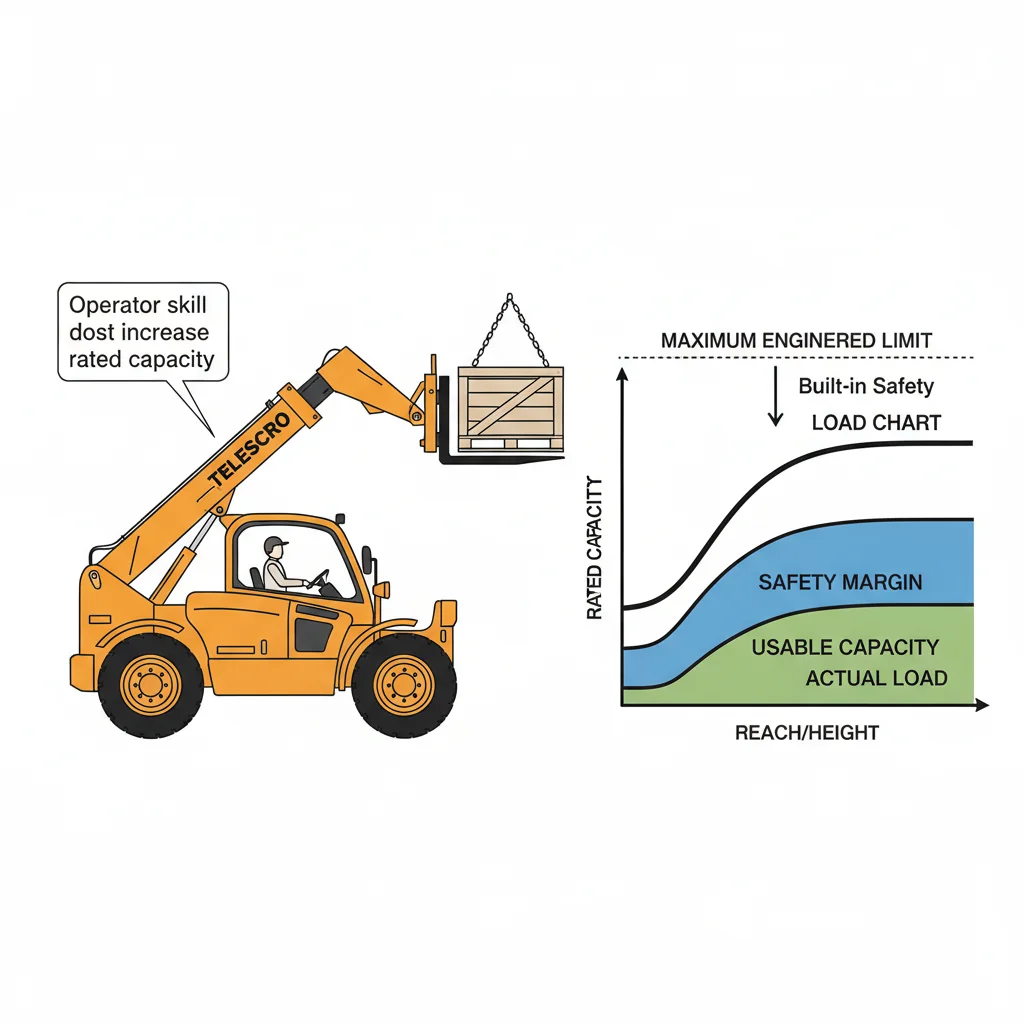
Let me share something important about telehandler capacity that many people overlook. Operator skill can absolutely make a jobsite safer and more efficient, but it will never increase the rated capacity shown on the machine’s load chart. That capacity is established through controlled engineering evaluation—with the boom at a defined angle and reach, a specified load center, an approved attachment, and the machine positioned on firm, level ground.
Even highly experienced operators—from Dubai to Brazil—cannot “push past” these limits. The load chart already incorporates a built-in stability margin relative to the machine’s tipping threshold under the tested configuration. Operator technique can reduce dynamic effects and help stay within that envelope, but it cannot expand the envelope itself.
I remember a case in Kazakhstan where a very experienced contractor insisted his most trusted driver could safely handle heavier steel beams beyond the 4-ton limit at 10 meters. He’d worked with this operator for ten years without incident. But the physical laws don’t bend for confidence. The boom structure, hydraulic circuit, and tipping axis (which is the front wheel ground line) all operate within those engineered boundaries. The site manager ignored them—resulting in a load slip that damaged material and forced an urgent stop to work. No experience level could have prevented what the load chart made clear.
Here’s the thing: operator technique matters a lot, but only inside the published working envelope. If you want to avoid expensive mistakes or safety shutdowns, always plan your lifts strictly using the manufacturer’s load chart. I suggest verifying every planned load at maximum reach against the chart—don’t assume skill can make up for excess weight or poor conditions. That’s non-negotiable everywhere I’ve worked.
Operator skill can prevent accidental overloads by precisely interpreting the load chart and adjusting boom position to stay within safe working limits.True
While operator technique cannot raise the telehandler's maximum rated capacity, a skilled operator can maximize safety and prevent accidents by adhering strictly to the manufacturer’s guidelines and compensating for variable site conditions.
An experienced telehandler operator can safely lift loads heavier than the rated capacity if they move the controls slowly and keep the boom low.False
No matter how cautious or skilled the operator is, the telehandler’s rated capacity is fixed by its structural design and stability limits. Exceeding these limits risks tipping or damaging the machine, regardless of operator technique.
Key takeaway: Rated capacity on a telehandler is a non-negotiable engineering limit. Operator skill affects safe operation within the documented load chart, but cannot lawfully or safely expand the machine’s capability. Always plan work strictly within the stated capacity, never on presumed margins for ‘good’ operators.
Does Operator Technique Affect Rated Capacity Limits?
Operator technique does not change the rated capacity shown on the telehandler load chart, but significantly impacts real-world stability. Rapid boom movement, harsh braking, or sharp steering can create dynamic forces3 that bring the machine close to tipping well below its theoretical capacity. Smooth, deliberate operation keeps actual working limits nearer to charted ratings.
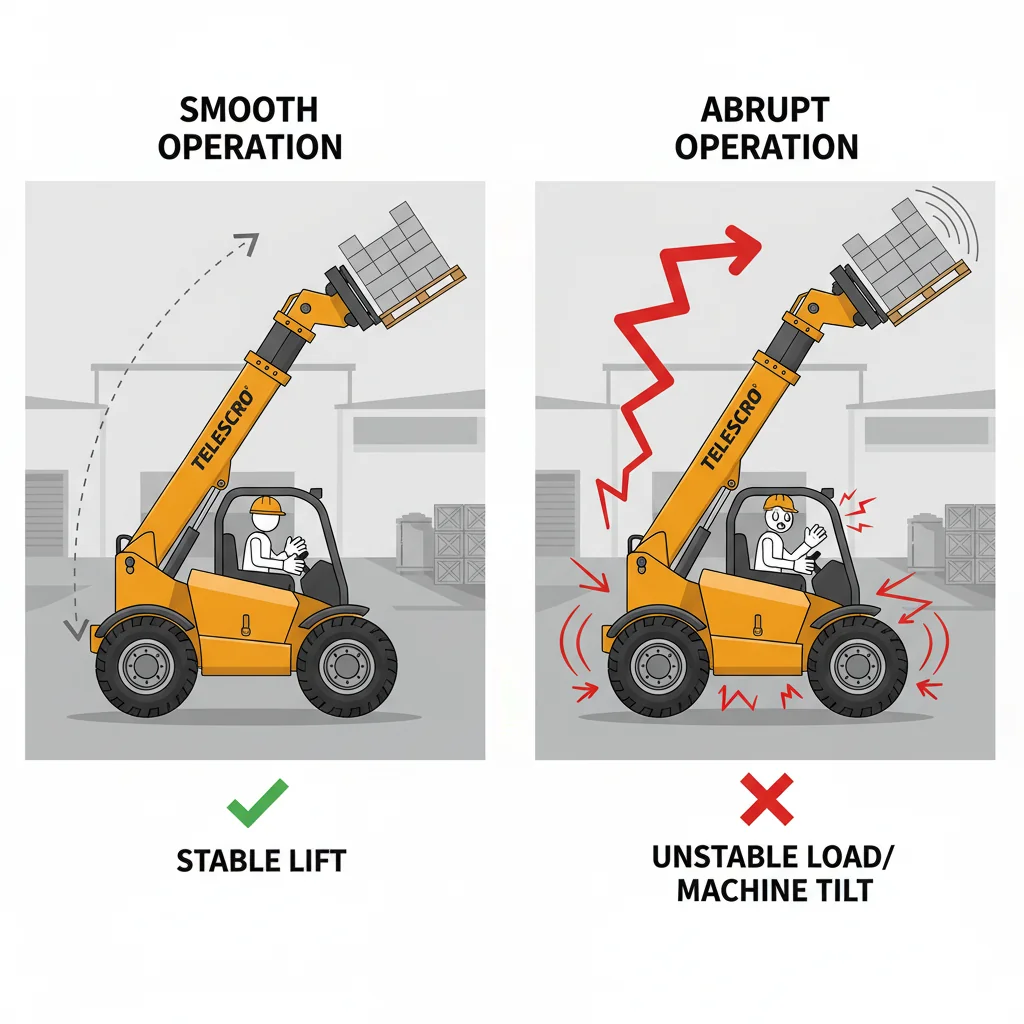
The biggest mistake I see is assuming the telehandler’s rated capacity from the load chart is guaranteed, no matter how you operate. That’s just not how it works on real jobsites. The load chart is based on factory conditions—level ground, correct attachment, and, most importantly, steady, controlled operator inputs. If someone whips the boom out quickly or slams on the brakes with a raised load, they introduce dynamic forces that aren’t shown on the chart. I’ve watched a 3,500 kg model in Vietnam feel wobbly with 2,900 kg on the forks—just because the operator feathered the controls too aggressively and took a sharp turn. The machine stayed upright, but I could see the counterweight “float” for a moment. That’s a warning sign you’re flirting with the tipping line.
Here’s what matters most when working near the rated capacity: slow, deliberate movement. If an operator lowers the boom smoothly, keeps the load tight against the carriage, and avoids traveling with the boom extended, the machine behaves much closer to its tested capabilities. I always tell contractors in places like Dubai, where teams mix seasoned pros with new hires, to plan for a safety buffer in daily work—don’t push close to the limit unless you trust every operator’s touch.
So, the capacity number doesn’t change, but the “real stability” depends on the hands behind the controls. If you manage crews with varied experience, expect practical limits to be lower than the chart. I suggest ranking jobs by risk and matching your most patient operators to the toughest lifts. That keeps everyone safer—and projects on track.
Rapid or jerky boom movements can create dynamic loads that temporarily exceed the telehandler's static rated capacity, increasing the risk of instability.True
Load charts are based on controlled, steady movements. Fast or abrupt operator inputs introduce additional forces (dynamic loading) that can make the telehandler momentarily unstable, even if the static load is within the chart limits.
As long as the telehandler's load is within the rated capacity shown on the factory load chart, the operator’s handling technique has no effect on safety or stability.False
Improper operator technique—such as abrupt stops, sharp turns, or uneven boom operation—can significantly affect machine stability, regardless of the static load shown on the chart. Real-world handling impacts dynamic forces that are not accounted for in standard capacity ratings.
Key takeaway: While telehandler rated capacity remains fixed by factory test conditions, an operator’s skill level determines how safely loads can be handled near that limit. Companies managing mixed-skill teams should plan for reduced practical capacity and train operators to use slow, controlled boom and steering movements to maintain stability.
Why is telehandler capacity position-dependent?
Telehandler rated capacity relies on load chart positions, not a universal ‘max lift’ figure. Capacity decreases sharply as boom height and reach increase. Manufacturer load charts4 specify allowable loads for each height and reach combination. Exceeding these limits risks tip-over, regardless of operator skill or technique.
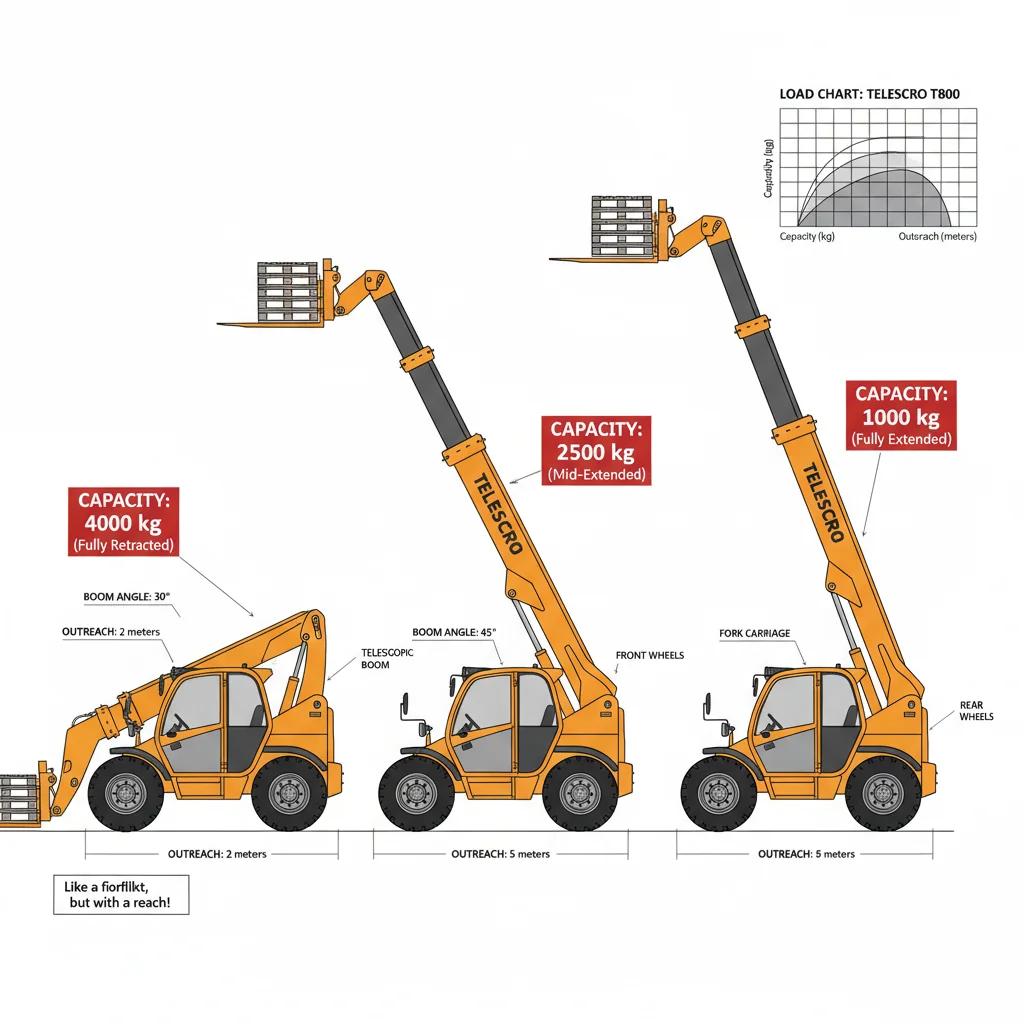
Last month, a contractor in Dubai called me after an incident on site—they tried lifting a 2,800 kg pallet at full boom extension, thinking their 3,000 kg “rated” telehandler would be fine. The telehandler barely left the ground before tilting forward. What they missed was the load chart. Rated capacity always assumes boom fully retracted, minimum reach, and level ground. Once you extend the boom, even by a few meters, the safe lifting capacity drops fast—sometimes by half or more. The moment the load shifts further from the front tire edge (what we call “reach”), stability changes completely. Even the best operator can’t fight physics.
I’ve seen cases in South Africa where teams relied on headline numbers—like “4-ton telehandler”—to plan material movement on a 13-meter reach site. At maximum extension and height, the chart showed only 1,300 kg capacity. If you ignore those zones, you’re gambling with safety, not just productivity. Load charts use grids showing allowable weights at each combination of boom angle (height) and reach. Safe zones are usually marked green; red means no-go. Some models also have moment indicators in the cab—if you’re about to tip, an alarm sounds, but by then the risk is already there.
The reality is, every telehandler has its own stability envelope, defined by chassis, counterweight, boom structure, tire type, and even attachment. Load center can be 500 mm in Europe or 610 mm in North America, and this affects your margin. I suggest reviewing the load chart for your exact working position before you decide if a machine is suitable. Operator training5 must focus on understanding these position-dependent rules, not just machine controls.
A telehandler's rated lifting capacity is only valid when the boom is fully retracted and the machine is on level ground.True
Manufacturers determine rated capacity based on optimal conditions: boom retracted, close-in load, and level terrain. Extending the boom or working on a slope decreases stability and mechanical leverage, reducing safe working limits.
An experienced operator can safely lift loads at full boom extension up to the machine’s rated capacity by using careful technique.False
Operator skill cannot overcome the physics of leverage and stability that govern telehandler capacity. Load charts and boom position, not operator technique, determine safe lifting limits when the boom is extended.
Key takeaway: Telehandler capacity varies with boom position, height, and reach. Operator skill cannot override load chart limits—safe lifting depends entirely on staying within the manufacturer’s rated zones for each working position. Reviewing load charts is essential for safe and effective telehandler planning and operation.
How Much Safety Margin is Needed for Telehandlers?
Telehandler operators should not plan to operate at 100% of the rated load chart capacity6. Load charts assume ideal conditions—level ground, correct tires, precise load handling—but real-world factors erode safety margins. In practice, limiting planning loads to 70–85% of chart values is recommended, depending on operator training and ground conditions.

Most people don’t realize that the numbers on a telehandler load chart are only part of the story. Rated capacity assumes perfect conditions—perfectly level ground (within 3°), correct tire pressure, the right attachment, and a well-balanced, properly centered load. But jobsites are rarely perfect. Even a small slope, a loaded pallet that’s not quite square, or worn tires can eat into your safety margin without you noticing.
I’ve worked with a team in Kazakhstan who bought a 4-ton telehandler, convinced it would always lift 4,000 kg at full reach. Their site was firm, but not perfectly level, and their operators rotated between shift crews with different experience. The reality? At their maximum 12-meter reach, the safest practical load was closer to 3,000–3,300 kg. The rest of the "rated" number disappeared once we factored in the real ground slope and a few windy days. No one planned to overload—but they would have run out of margin fast if they’d sized for 100%.
To be honest, I always suggest using 70–85% of the load chart capacity for your planning, especially at critical reaches. If your operators are highly trained and your site prep is excellent, you might work closer to 85%. But if you’re handing over to seasonal staff or working on rough ground, stick to the lower end. For example, if your max pallet is about 2,500 kg at full reach, look for a machine with at least 3,200 kg rated capacity at that load chart point—not just what’s written on the spec sheet. That planning margin is what keeps everyone safe.
A telehandler's rated capacity assumes that the operator lifts and places the load smoothly, without sudden or jerky movements.True
Proper operator technique is critical because abrupt or harsh controls can destabilize the machine, increasing the risk of tipping or shifting the load, even if the load is within rated limits.
A telehandler’s rated capacity will automatically adjust in real time based on the operator’s skill and judgment.False
The rated capacity of a telehandler is determined by engineering standards and is displayed on the load chart for ideal conditions; it does not change dynamically based on operator behavior, though improper technique can create unsafe situations.
Key takeaway: Rated capacity on a telehandler load chart assumes ideal conditions. For actual planning and fleet sizing, select machines capable of handling 15–30% more than the maximum anticipated load at critical reach, especially when operator skill or site conditions vary. This approach preserves vital safety margins.
Can operators safely exceed telehandler load charts?
No. Operators cannot safely exceed telehandler load charts under any circumstances. Rated capacity limits are established through standardized testing and define the maximum safe operating envelope for a specific boom position, load center, attachment, and ground condition. Operator skill does not alter these limits. Many modern telehandlers are equipped with electronic load-moment or rated-capacity limiters to warn against or prevent overload. Ignoring load charts or bypassing safety systems violates manufacturer instructions, industry standards, and exposes both operators and employers to serious safety and liability consequences.
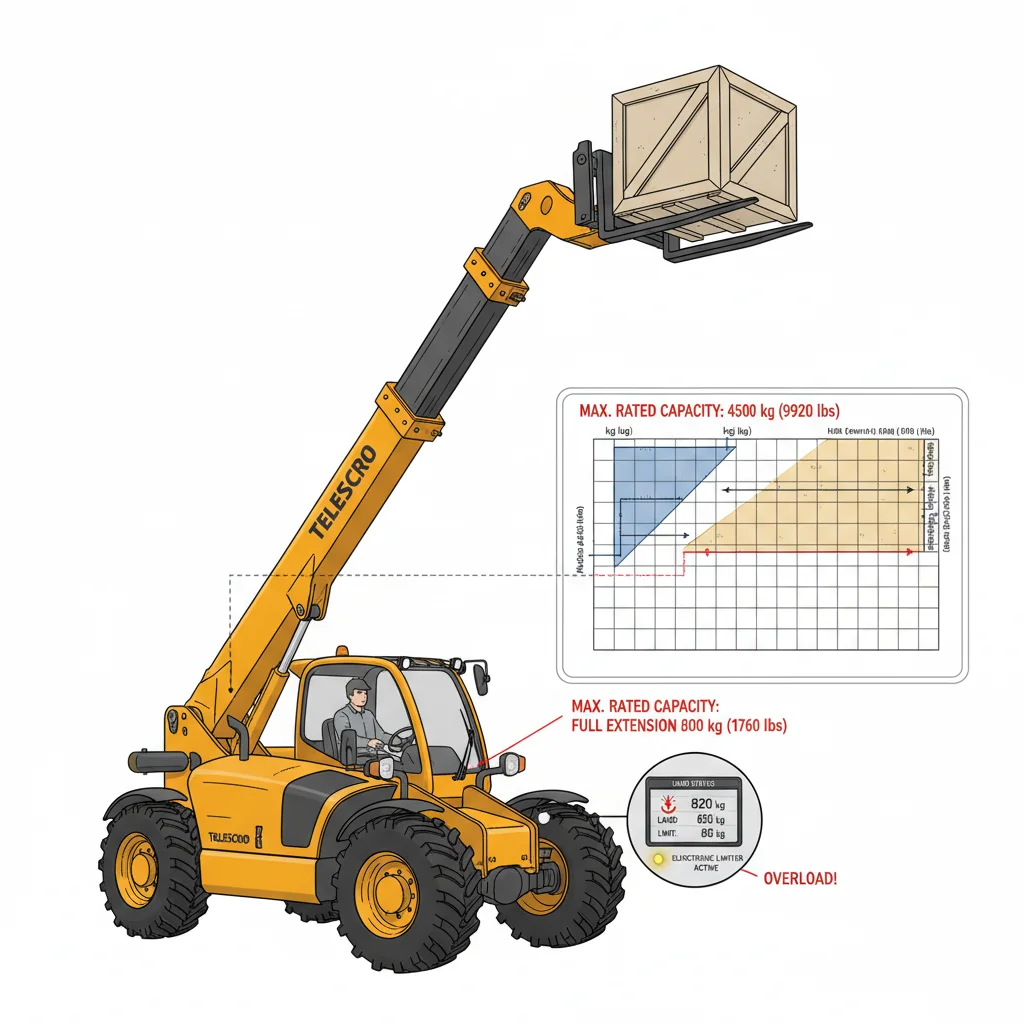
Here’s what matters most when it comes to telehandler load charts: experience won’t override physics or legal boundaries. Even the most seasoned operator can’t “feel” a machine’s safe limit if the numbers are being ignored. I’ve seen skilled crews in South Africa try to get just one extra pallet lifted at full boom—ignoring a load chart that clearly capped that position at 1,200 kg. The machine “felt stable” right up until the rear wheels bounced. They were lucky—no one got hurt—but that incident triggered a full site shutdown and months of paperwork. Manufacturer load charts aren’t optional; they define safe operating limits based on strict, level-ground test conditions with specified attachments and load centers.
On most modern jobsites, telehandlers include electronic rated capacity limiters7 or load-moment indicators8. These systems will warn or cut off hydraulic movement when you approach unsafe conditions. I always tell clients: if an operator bypasses these safety features, you’re not just breaking rules—you’re risking lives and opening yourself to major liability. In Kazakhstan, a company tried to disable a moment indicator to finish a rush order. Their insurer refused to pay after a tip-over because machine data proved the system was overridden and the chart had been exceeded by 300 kg.
The reality is, regulations assume telehandlers are operated within the load chart by trained people, on level, suitable ground. In an accident investigation, saying “our best operator knew it would hold” carries no weight if the data says otherwise. I recommend treating operator experience as a safety buffer—not an excuse to override limits. Always stay within manufacturer-defined boundaries—jobsites are safer that way.
Telehandler rated capacity depends strictly on the machine’s geometry and counterweight, not the operator’s skill or driving technique.True
Load charts are determined by manufacturer testing based on the physical limits of hydraulic stability and structural integrity at various boom angles and extensions. Operator skill cannot change these mechanical limits.
An operator with extensive experience can safely exceed the stated limits of a telehandler load chart by carefully adjusting their driving or lift technique.False
No amount of operator expertise can bypass the load chart’s constraints, which are based on the physical tipping and structural limits of the machine. Techniques or intuition cannot increase safe load capacity.
Key takeaway: Operator experience cannot justify exceeding telehandler rated capacity. Load charts are legal and technical boundaries based on controlled conditions. Disregarding these, including bypassing safety systems, creates significant safety hazards and legal liability. Always operate within manufacturer-defined limits, regardless of perceived operator skill.
How do attachments affect rated capacity?
Telehandler attachments and suspended loads9 significantly alter rated capacity. Standard load charts assume compact, palletized loads on forks at a specific load center. Using accessories like jibs, buckets, or hook attachments usually requires a dedicated chart, often showing 30–50% lower capacities, especially at maximum reach. Suspended loads introduce dynamic instability, making standard charts invalid unless explicitly provided.
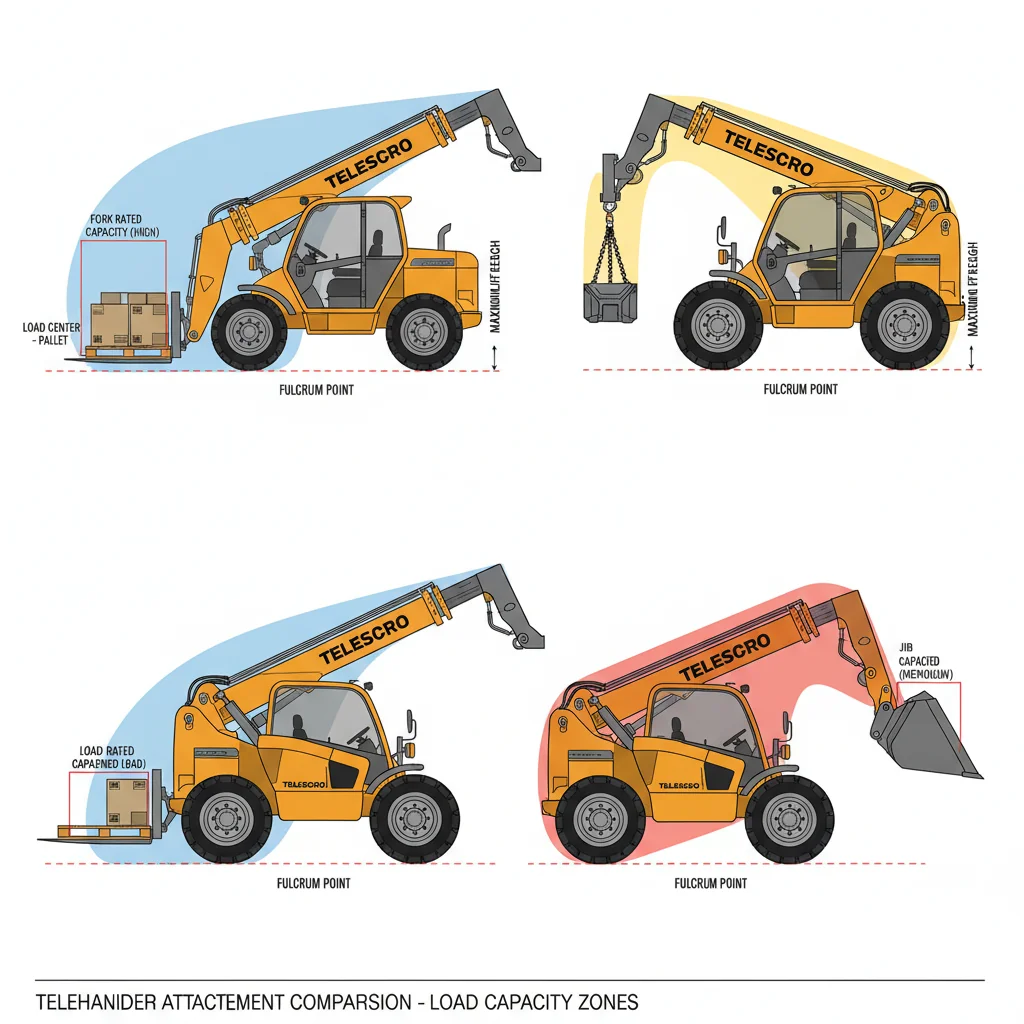
I’ve worked with customers who made this mistake on sites from Saudi Arabia to South Africa—using the standard fork load chart when running a jib or lifting trusses on a hook. The results can be dangerous. Standard rated capacities assume compact, palletized loads resting on forks at a precise load center. The moment you install an attachment like a concrete bucket, a winch, or even fork extensions, you’re shifting the machine’s balance and changing how force transfers through the boom and chassis.
Here’s what actually happens when you swap attachments or start handling suspended loads:
- Lower capacity at any reach: Most OEMs reduce rated capacity by 30–50% for jibs, hooks, or buckets, especially at maximum extension.
- New (and often smaller) working envelope: The safe reach and lift zone shrinks. That 18-meter boom might only lift half its rated load with a man basket.
- Dynamic instability with suspended loads: Loads that swing introduce shocks and unpredictable movement, amplifying overturn risk. Standard charts don’t cover this.
- Requirement for special charts and warnings: Any time you fit a non-standard tool, the OEM should provide a new load chart—if not, don’t guess. Some skip this step, and that’s when problems start.
One project manager in Kazakhstan learned this the hard way: their 4-ton telehandler tipped a load at only 2,000 kg when a steel panel swung in the wind. Luckily, no one was hurt. I always tell customers—operator skill can’t override physics or engineering limits. Before every non-standard lift, stop and demand the specific load chart for that attachment. That simple habit prevents costly—and dangerous—mistakes.
Telehandler rated capacity can be significantly reduced when using attachments such as jibs or buckets, because these devices shift the load's center of gravity farther from the boom pivot.True
Attachments like jibs or buckets extend the load out from the original load center, increasing the overturning moment on the machine and thus requiring a lower rated capacity for safe operation. Even minor shifts in load center can have major impacts on stability and lifting limits.
An experienced operator can safely lift the maximum rated load using any attachment, as long as they handle the controls smoothly.False
Operator skill does not change the physics of load distribution or machine stability. Attachments alter the load center and force applied to the boom, so rated capacities must be adjusted regardless of operator technique. Neglecting this puts the machine and site personnel at risk.
Key takeaway: Attachments and suspended loads drastically reduce telehandler rated capacity. Never use standard fork load charts with non-standard attachments or suspended loads. Always demand and strictly adhere to OEM-provided charts for specific configurations to ensure safety and avoid dangerous overloading. Operator skill cannot override these engineering limits.
How do telehandler stability aids enforce capacity?
Modern telehandlers utilize load-moment indicators, rated-capacity limiters10, and boom sensors to continuously track actual overturning forces versus safe limits. These stability aids issue escalating warnings and may block risky movements, ensuring operators cannot exceed the rated capacity specified in the load chart, regardless of skill or experience.
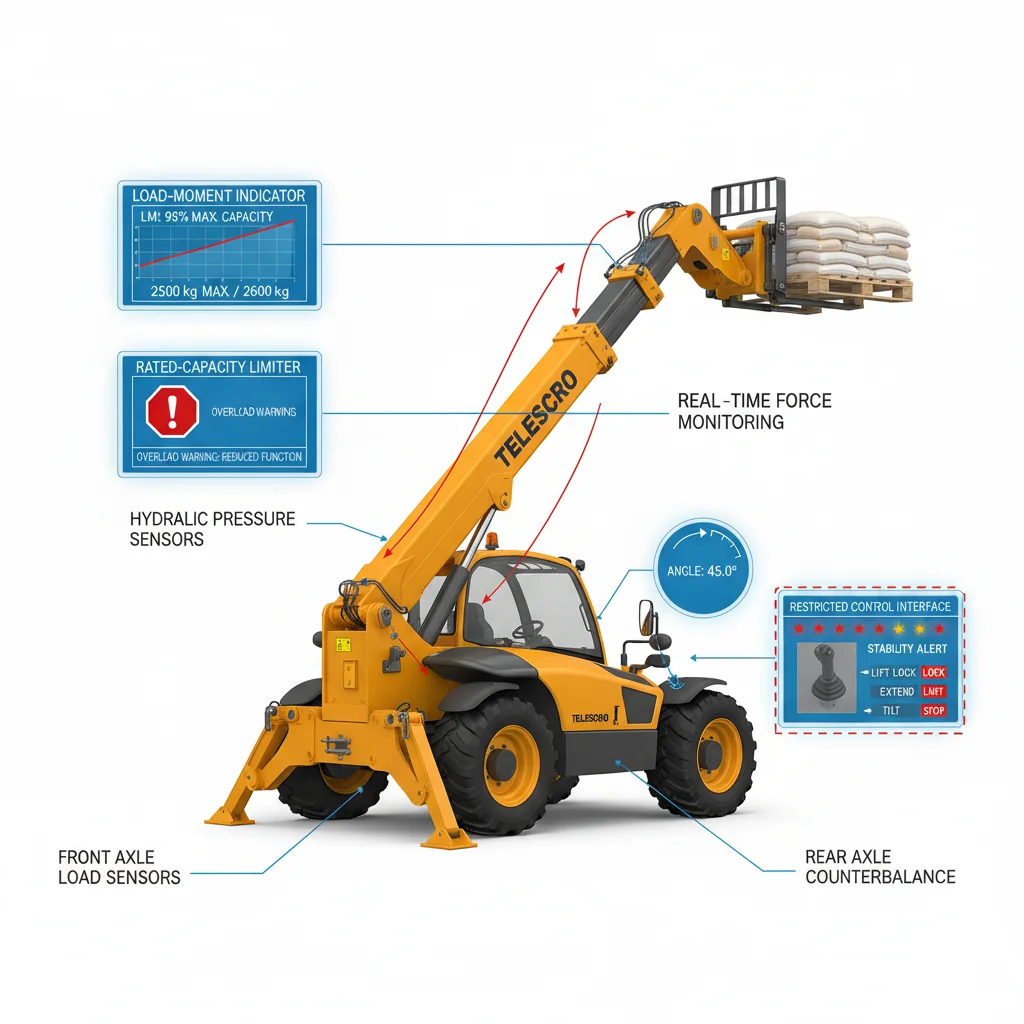
From my experience working with construction fleets in Kazakhstan and Eastern Europe, operators often assume electronic stability aids will make the telehandler “stronger”—but that’s not the case. These systems, including load-moment indicators and rated-capacity limiters, watch the overturning force in real time by measuring things like boom angle, extension, and hydraulic pressure. The sensors basically track how close you are to the machine’s tipping axis—the line drawn through the front tire contact points. When a telehandler nears its rated envelope, the system starts to warn the operator with lights or buzzers. If you keep pushing closer to the limit, the machine might block “risky” actions like extending further or raising the boom, but it still allows you to retract or lower the load. This is a critical safeguard, especially when less-trained operators jump in for short-term jobs or rentals.
I saw this play out on a site near Nairobi. The customer had a 3.5-ton unit moving concrete panels out to almost maximum reach—around 13 meters. The moment indicator triggered a warning just as the load got close to the charted capacity at that reach. The operator tried to keep lifting, but the controller cut off “out” movement—he could only retract or bring the boom down. This prevented a potential tip-over, even though the operator was less experienced and working fast.
The key takeaway? These electronic systems never increase the rated capacity on the load chart—they just enforce it. I always suggest you check whether the machine can actually block overload movements, not just give you a light or alarm. For most sites, having non-bypassable stability aids keeps both your people and your budget safer.
Electronic stability aids on telehandlers can override operator inputs to prevent lifting loads that exceed rated capacity, regardless of the operator’s skill.True
These systems use real-time sensor data to evaluate risk of tip-over and can disable boom functions or alarm the operator if lifting criteria are exceeded, enforcing safety irrespective of operator experience or technique.
A highly skilled operator can consistently exceed a telehandler’s rated capacity when using electronic stability aids, since these systems only advise but do not restrict operation.False
Stability aids are designed to physically limit unsafe operation by overriding controls when limits are approached or exceeded, preventing exceeding rated capacity even if the operator believes they can handle the load safely.
Key takeaway: Electronic overload and stability systems do not raise rated capacity; they enforce the boundaries defined by the load chart. By preventing unsafe maneuvers, especially as the telehandler nears its tipping limits, these aids help protect less-experienced operators and minimize the risks of human error on diverse job sites.
Does operator skill affect rated capacity?
Operator training minimizes the risk of exceeding the telehandler’s rated capacity but does not increase the capacity values published in the load chart. A well-trained operator is less likely to misuse the machine, but capacity planning must always be based on the chart’s limits, not skill level.
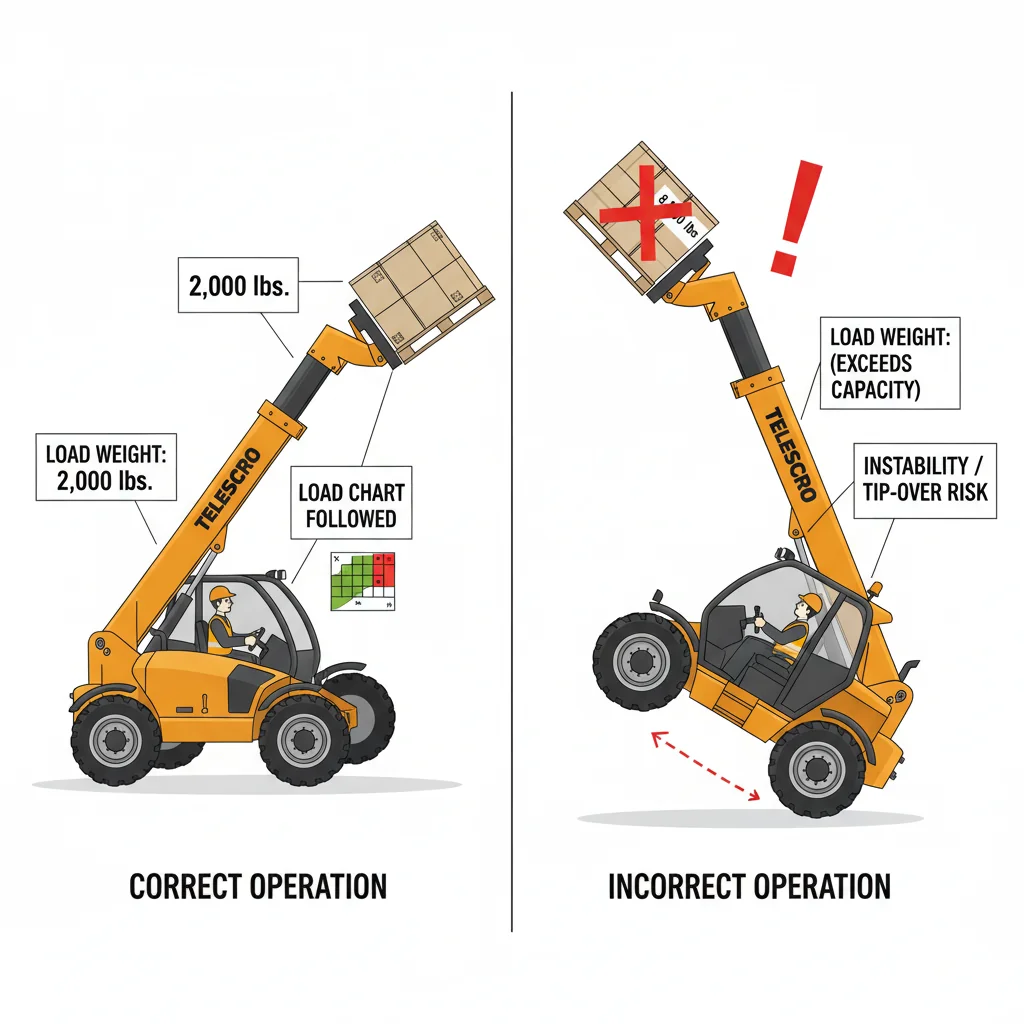
I’ve had customers in Kazakhstan ask whether their top operators can “stretch” what a machine can handle. Here’s the truth—no amount of operator skill actually increases the numbers you see on the load chart. The rated capacity—say, 3,500 kg with the boom at minimum extension—is a hard limit set by the manufacturer, based on level ground, standard forks, and a specific load center. Even when your best operator feels comfortable, the laws of physics and the tipping axis at the front axle never change. I’ve seen experienced crews tempted to push machines when working under tight schedules, but this is where risk multiplies, not capacity.
Operator training is still critical for safety and reliability. In Brazil, one team I worked with reduced near-miss incidents by half after sending their crew for model-specific telehandler training. A trained operator understands how to read the load chart, checks stabilization (on tyres or with stabilizers), and avoids shortcuts—like swinging a load with improvised attachments or rushing movements at full boom extension. The difference is real: trained operators protect your jobsite and equipment. But don’t mistake this for a “capacity boost”—your telehandler’s limits remain the same, no matter who’s at the controls.
To be honest, when planning for a lift, I always recommend sizing the machine for the load and reach based on the chart—so even your least experienced qualified operator can finish the job safely. Skill reduces mistakes, not physics. The safest policy? Formal training, clear site rules, and a machine chosen for the real demands—not just best-case hopes.
An experienced telehandler operator can improve jobsite productivity and minimize handling errors but cannot increase the machine's maximum rated capacity listed on the load chart.True
The load chart represents the physical and mechanical limits set by the manufacturer, based on stability and structural integrity; operator proficiency cannot alter these engineering constraints.
A highly skilled operator can safely lift loads above the telehandler's rated capacity if they monitor the balance and use precise movements.False
No operator expertise can override the fundamental tipping and structural limits defined by the telehandler's design; exceeding rated capacity can result in equipment damage or catastrophic failure.
Key takeaway: Operator competence is crucial for safe telehandler operation and incident reduction but never permits exceeding rated capacity. Always select machine size based on the load chart, not best-case operator performance. Formal, model-specific training remains essential for compliance and risk management.
How should telehandlers be sized for operators?
Telehandlers must be specified for real site conditions and operator skill mixes, not just the rated capacity from the load chart. Actual usable capacity11 depends on operator experience and ground conditions, so best practice is to apply a conservative buffer—typically 70–85% of the chart value—to ensure safe, consistent performance for all trained operators.

Most people don’t realize that sizing a telehandler isn’t about picking the biggest number from a load chart—it’s about matching the machine to the real abilities of your team and the toughest spot on your site. I worked with a contractor in Kenya who bought a 4-ton, 17-meter telehandler, expecting it to handle all their drywall lifts. The problem? At full forward reach (over 14 meters), the load chart showed safe capacity dropped to just about 1,200 kg—less than a third of headline capacity. With several seasonal hires on site, anything close to the limit made operators nervous, especially when ground was uneven after rain.
I always tell customers: start with your farthest, highest pick point and check the load chart at that exact spot—not just at minimum reach or “on tyres.” Then, apply a practical buffer. For crews with mostly experienced operators and firm ground, planning at 80–85% of load chart value can work. But if you’ve got seasonal or mixed-skill operators, or you’re often on unpaved surfaces, drop it to 70–75%. If you deal with muddy or sloped ground, take off another 10%. I’ve seen projects in Brazil stall because only the most skilled “hero operator” could make a tricky lift—everyone else struggled or refused.
The goal is to keep every trained operator within a safety margin, so you’re not gambling on perfect conditions or one superstar. This lowers stress, speeds up cycles, and keeps you out of those “white-knuckle” situations. If you size for your whole team, not just the best on paper, the telehandler works for you—not the other way around.
Telehandler rated capacity is based on fixed stability and mechanical limits, so even the most skilled operator cannot safely exceed the manufacturer’s charted limits at any boom extension.True
Manufacturer-rated capacity accounts for factors like machine balance, boom length, and structural integrity. Operator technique cannot alter these fundamental physical and mechanical boundaries.
An experienced operator can routinely lift more than the rated capacity shown on a telehandler’s load chart by using proper lifting technique.False
The rated capacities given by manufacturers are set by engineering and safety standards, and exceeding them—even with advanced skills—creates serious risk of tip-over or structural failure.
Key takeaway: Always select telehandlers based on specific job requirements, the most challenging working point, and the actual skills of the operator pool. Applying a prudent capacity buffer reduces risk, avoids near-misses, and ensures all operators—not just the most skilled—can perform tasks within safe working limits.
How Do Poor Practices Affect Telehandler Stability?
Even if a telehandler’s rated capacity appears unchanging on the load chart, poor operation and inadequate maintenance erode real-world stability. Harsh braking, side-loading the boom, overloading tires, and neglecting wear can result in increased wobble, reduced effective center of gravity, and a measurable decline in safe handling performance.

Here’s the thing—telehandler stability on paper is not the same as jobsite reality. I’ve seen well-rated machines feel unpredictable when operators ignore the basics. Hard braking at speed with a loaded boom, slamming into piles, or side-loading the boom wears out key parts fast. In Brazil, a warehouse crew used a 4,000 kg telehandler to shuffle concrete panels all day. By the end of year two, worn boom pads and loose steering linkage created enough “wobble” that the operator felt the cabin tilt just lifting to five meters. Nobody changed the capacity number—but the machine handled nothing like new.
Most buyers don’t realize the rated capacity on the load chart assumes a machine in top condition—level ground, correct tire pressure, no worn pins, and perfect hydraulic function. But tires slowly lose pressure or crack, axles pick up play, and frame bolts come loose when maintenance is skipped. Even tire overloading makes a difference. I once saw a crew in Kenya push a 3.5-ton machine to its limit with under-inflated front tires; the effective center of gravity shifted, and suddenly the telehandler would lean several degrees just from steering at medium reach.
So, what’s the practical solution? I always suggest fleet managers put clear site rules in place: no ramming, never side-load the boom, keep machines on firm ground, and check tire pressures weekly. Schedule visual inspections focused on boom components and steering joints. A beat-up machine will never feel as stable as a smaller, well-maintained unit. Care and good habits are what keep your rated capacity safe—long after the first year is over.
Operator habits such as abrupt braking or repeatedly side-loading the boom can accelerate wear of load-handling components, ultimately reducing a telehandler’s actual safe lifting capacity below its rated value.True
Real-world stresses from poor operating practices cause premature wear and increased clearances in load paths (like boom pads or bearings), compromising stability and making the machine less capable than its factory rating suggests.
As long as the telehandler’s load does not exceed the charted rated capacity, the operator’s driving style has no impact on stability over time.False
Even within rated limits, reckless operation (such as hard cornering or abrupt stops with a raised boom) can shift the load’s center of gravity or deteriorate critical components, negatively impacting stability regardless of the load being under the official capacity.
Key takeaway: Telehandler rated capacity assumes optimal condition and skillful operation. Abuse and neglected maintenance degrade key stability components, making even a high-capacity unit less reliable than a smaller, well-maintained machine. Strict operational controls and regular inspections are essential to preserve safety and the rated capacity envelope.
Conclusion
We’ve discussed why the rated capacity of a telehandler is set by engineering—and why operator skill can’t stretch those limits. From what I’ve seen on jobsites, the safest crews are the ones who treat the load chart as a hard rule, not a guideline. Cutting corners or assuming “good enough” never pays off, and that’s where a “showroom hero” can become a jobsite zero. If you’re unsure how these limits fit your project, or need help matching capacity to real tasks, just ask. I’ve worked with customers in over 20 countries and I’m happy to help you sort out what works best for your jobsite. The right choice always comes down to real-world needs and safe operation.
References
-
In-depth insights into load chart engineering, including factors like boom angle and load center, essential for accurate job planning and safety. ↩
-
Insight into why safety margins are critical in telehandler operations, including factors that reduce rated capacities on uneven ground. ↩
-
Understand how dynamic forces like rapid movements or harsh braking influence telehandler tipping risks and jobsite safety. ↩
-
Explains the critical role of manufacturer load charts in defining safe telehandler limits based on rigorous testing and standards. ↩
-
Learn how model-specific telehandler training reduces near-miss incidents and improves jobsite safety through expert insights. ↩
-
Detailed explanation of telehandler load chart capacity, helping operators understand safe lifting limits and real-world applications. ↩
-
Details how electronic limiters prevent unsafe telehandler operations by alerting or restricting actions beyond rated capacity. ↩
-
Explore how load-moment indicators monitor tipping forces in real time to prevent accidents and enhance operator safety on-site. ↩
-
Understand the risks of dynamic instability and overturn when handling suspended loads and why standard charts don’t apply. ↩
-
Understand how rated-capacity limiters prevent exceeding load charts, blocking risky moves and ensuring compliance with safety standards. ↩
-
Explains how operator skill and site ground conditions influence telehandler usable capacity for safer, more reliable operation. ↩