











Telehandler Quick Couplers: Hydraulic vs Mechanical—Key Differences Field-Tested
I’ll never forget watching a crew in Brazil struggle for nearly ten minutes with frozen, muddy quick coupler pins—while a high-reach forklift sat idling and a deadline crept closer. That day, the team’s frustration had nothing to do with horsepower or brand, but with one overlooked decision: hydraulic or mechanical quick coupler?
Hydraulic quick couplers1 utilize the machine’s onboard hydraulic pressure to actuate locking cylinders, allowing the operator to engage or disengage attachments entirely from within the cab. Mechanical quick couplers, by contrast, require manual intervention—operators must exit the cab and physically lock or unlock pins, often using tools. Hydraulic systems deliver faster, more consistent attachment changes, minimizing operator exposure to ground hazards and reducing labor fatigue.
How Do Hydraulic and Mechanical Couplers Work?
Hydraulic quick couplers use a machine’s hydraulic system to activate locking cylinders, allowing operators to secure or release attachments from the cab with the press of a button. Mechanical couplers require manual intervention—operators must exit the telehandler and secure attachments by hand, typically with locking pins or a latch system.
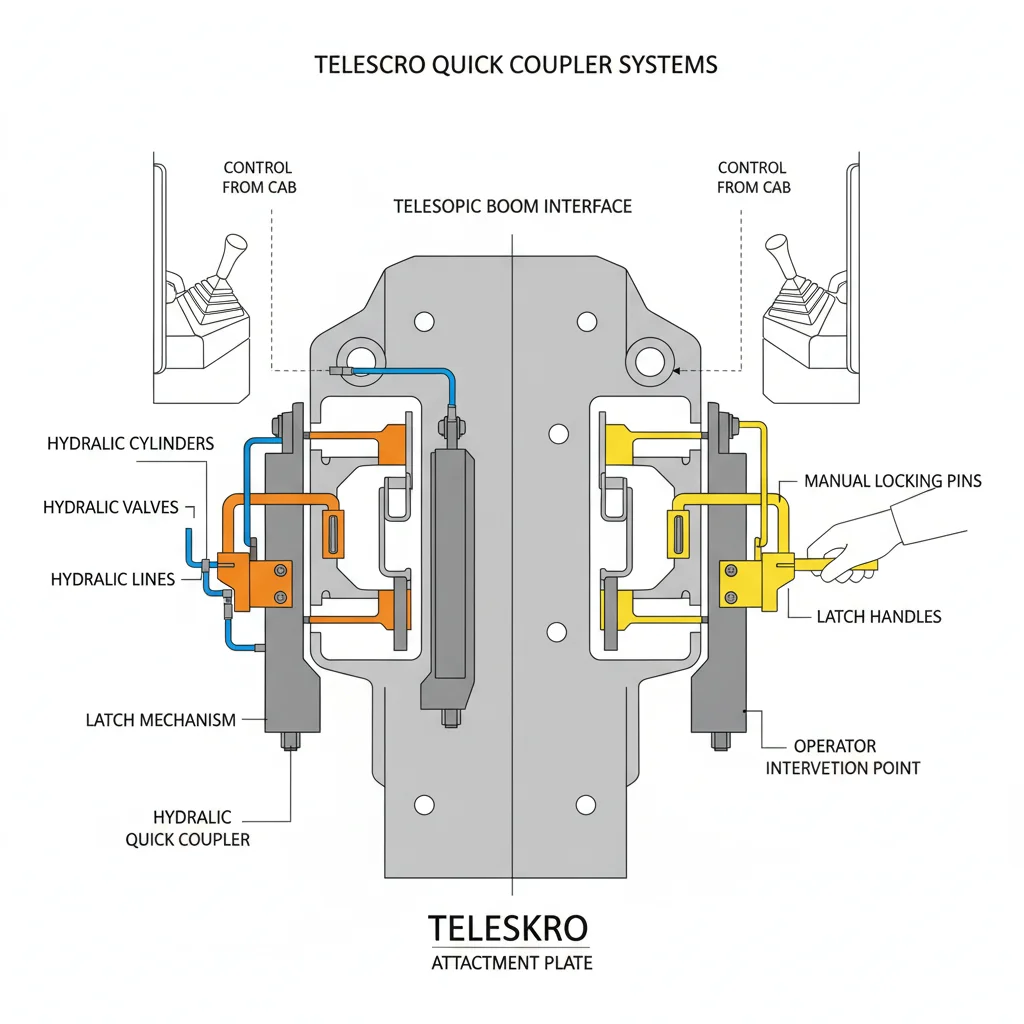
Most people don’t realize that the real difference between hydraulic and mechanical couplers comes down to operator experience and jobsite pace. With a hydraulic quick coupler, you stay in the cab. The hydraulic circuit powers locking cylinders—usually with a button or switch on your joystick. The system lines up pins and wedges to secure your attachment. I’ve worked on 4-ton telehandlers with 12-meter booms where a skilled operator could switch from forks to a bucket in under 45 seconds, all without stepping into the mud.
Contrast that with mechanical couplers, which I see on a lot of cost-sensitive sites in Southeast Asia and Eastern Europe. Changing attachments means stopping work, climbing out, and sometimes fighting with stuck pins or dirty latches. Just last year in Kazakhstan, a client’s team spent at least 10 minutes per change in winter conditions—cold slows everything, especially when pins freeze up. Over a week, that added hours of downtime, not counting manual handling risks.
Both systems do aim for a secure lock. Some hydraulic couplers2 feature in-cab lock indicators—a green light or audible signal—so the operator doesn’t guess if things are set. Mechanical setups rely on physical inspection. To be honest, on busy jobsites where every minute counts, I always suggest checking if the small upfront investment in hydraulics pays off through better productivity and less operator strain.
Remember: the faster your crew can adapt their telehandler, the more you can get done with fewer machines. I suggest you match coupler type to your typical daily attachment routine and real labor costs—don’t just chase the lowest price.
Hydraulic couplers often incorporate multiple locking points, including pins and wedges, to provide a more secure attachment connection than mechanical couplers, which typically rely on a single manual locking pinTrue
Hydraulic couplers use powered cylinders to engage several locking mechanisms simultaneously, improving attachment stability and reducing the risk of accidental release, whereas mechanical couplers depend on manual engagement of a single locking pin, which can be less secure under dynamic loads.
Mechanical couplers usually allow attachment changes without leaving the cab by using an automated locking system operated through the joystick, similar to hydraulic couplersFalse
Mechanical couplers generally require the operator to exit the cab and manually engage or disengage the locking pin, as they lack hydraulic actuation and remote operation features inherent in hydraulic quick couplers.
Key takeaway: Understanding the core operational differences—remote, in-cab control versus manual locking—between hydraulic and mechanical telehandler quick couplers is critical, as these mechanisms strongly impact attachment change speed, operator effort, and jobsite productivity, influencing overall fleet efficiency and ownership costs.
How Does Coupler Speed Impact Productivity?
Hydraulic quick couplers on telehandlers consistently outperform mechanical alternatives in speed, completing tool swaps in under a minute compared to manual methods that may take up to 10 minutes when conditions are difficult. This rapid changeover can save nearly an hour of operator time per day, boosting productivity, machine utilization, and return on investment for high-use fleets.
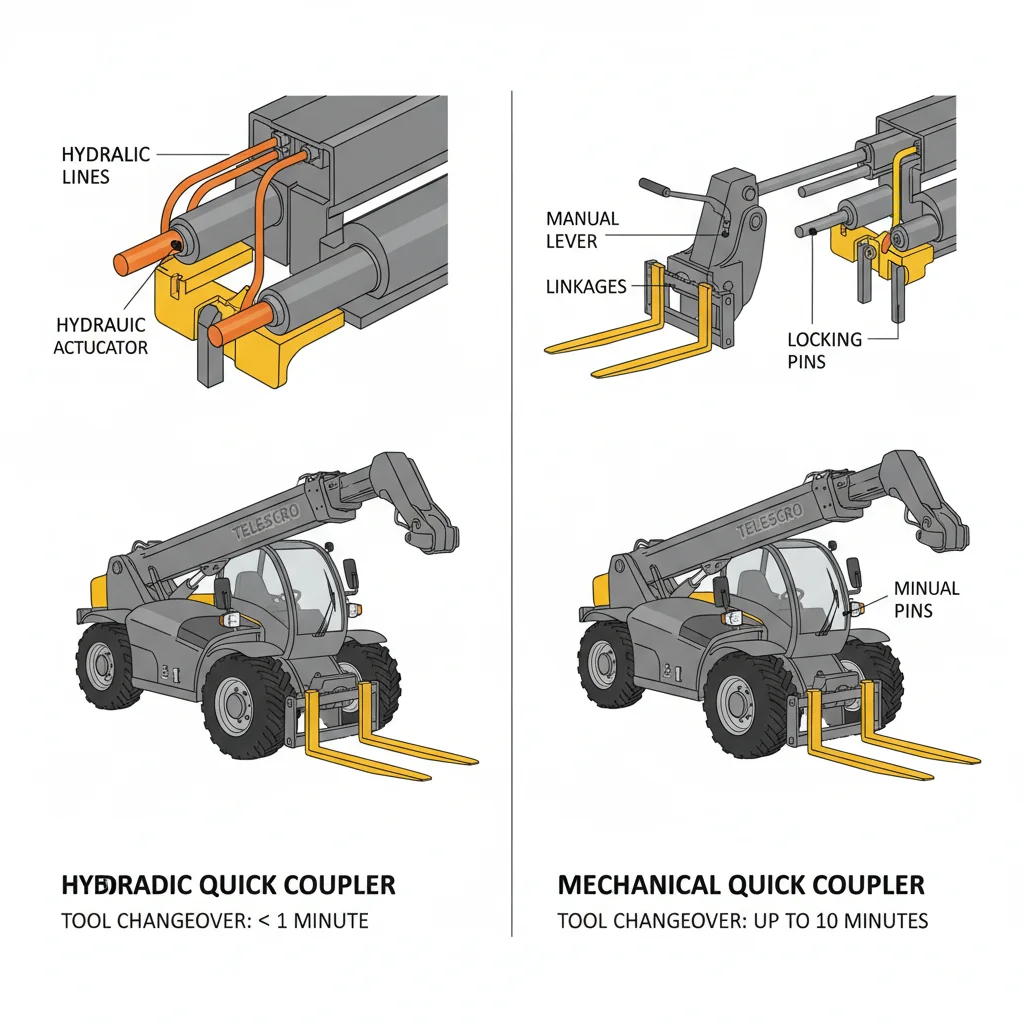
Let me share something important about coupler speed that often gets overlooked on busy jobsites. I’ve worked with crews in Dubai and Kazakhstan where every minute lost swapping attachments meant lost profit, especially when running multiple shifts. Hydraulic quick couplers really change the game in these conditions. I’ve timed a typical manual swap on a 3.5-ton telehandler—it can take anywhere from five to ten minutes if pins are tight or the attachment is caked with dirt. When you multiply that by six or eight changes per day, that’s nearly an hour, sometimes more, lost on just one machine.
Now, compare this to a hydraulic quick coupler system. In my own tests (and with several customers in Poland last year), swapping forks to a bucket took less than a minute—often just 30 seconds—without leaving the cab. The operator simply aligned, pressed a button, and the hydraulic circuit did the rest. With municipal fleets or rental customers, this speed means a supervisor can quickly reassign machines to a new section without a long wait. Over a month, that adds up to dozens of extra billed machine hours.
The biggest mistake I see is underestimating these time savings compared to the up-front purchase price. Yes, hydraulic couplers cost more at first, but in fleets that switch tools many times per day, the payback is fast—sometimes inside three months. I suggest tracking daily attachment changes for a week before deciding. For high-utilization or multi-crew operations, that lost time can seriously impact your ROI.
Hydraulic quick couplers can reduce attachment changeover time by up to 70% compared to mechanical pin-based couplers because they use pressurized fluid to actuate locking mechanisms instantlyTrue
Hydraulic couplers eliminate manual pin removal by using hydraulic pressure to lock and release attachments, significantly speeding up changes, especially in harsh conditions where pins may get stuck or dirty. This can cut changeover times from 10 minutes manually to as little as 3 minutes.
Mechanical quick couplers are generally faster than hydraulic couplers for attachment changes because they do not rely on hydraulic systems which can have lag or pressure loss issuesFalse
Mechanical couplers require manual removal and insertion of locking pins, which takes longer and is more physically demanding. Hydraulic couplers use fluid power to actuate locks remotely, making them faster and more efficient in practice despite potential hydraulic system delays.
Key takeaway: Faster hydraulic coupler swaps can dramatically reduce non-productive operator time, especially with frequent attachment changes. This efficiency not only counteracts higher initial costs but maximizes billed hours, making hydraulic couplers a strong investment for high-utilization fleets and multi-crew jobsite operations.
How Do Hydraulic and Mechanical Quick Couplers Differ?
Hydraulic quick couplers enhance operator safety and comfort by allowing attachments to be changed from inside the cab, minimizing exposure to slips, trips, and crush zones. In contrast, mechanical couplers require operators to exit the cab and handle heavy pins, increasing fatigue and accident risk, especially in adverse conditions. Both types must meet EN474 safety standards.
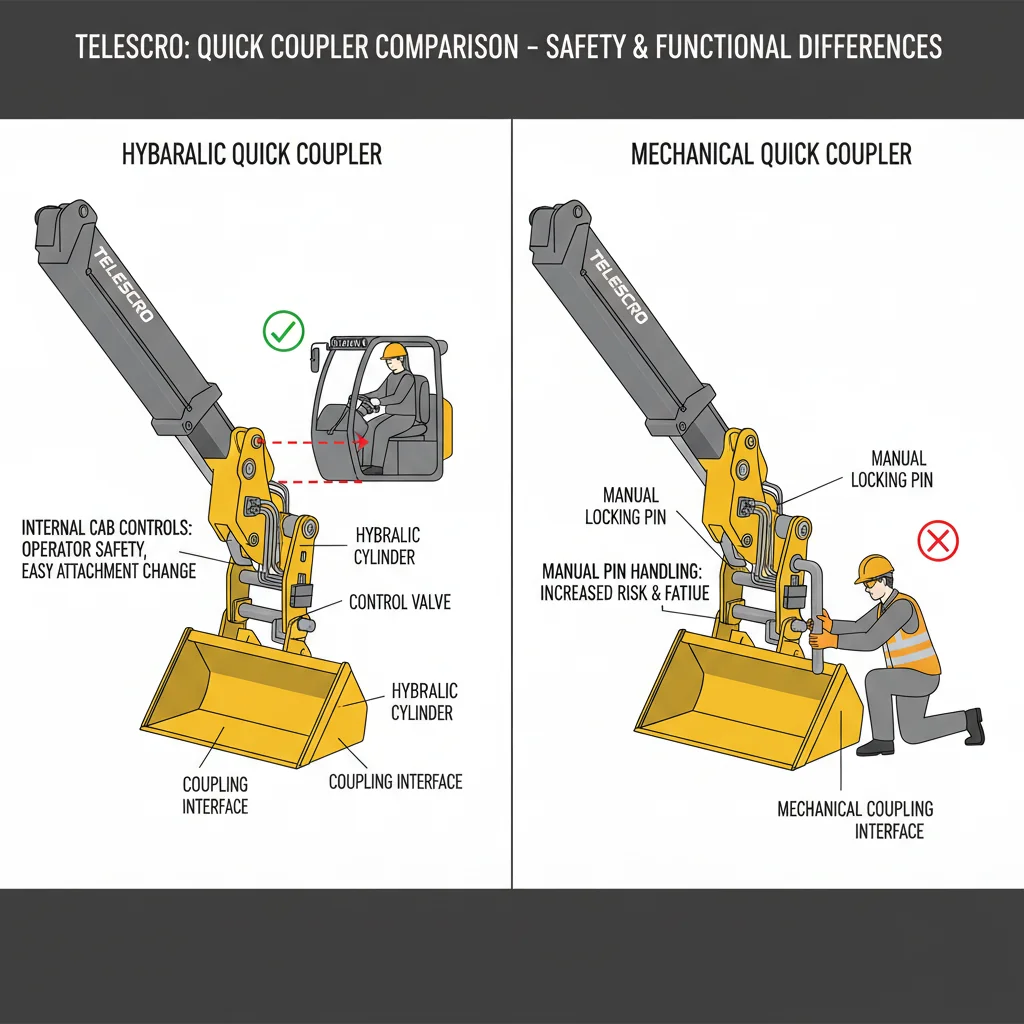
Here’s what matters most when choosing between hydraulic and mechanical quick couplers: the actual risk and effort your operators face daily. In wet season Kazakhstan, I saw a crew with mechanical couplers forced to change buckets five times a day on muddy ground. Every swap meant climbing down, wrestling with 18 kg steel pins, and kneeling beside a greasy coupler—practically begging for slips or pinched hands. By the end of the week, two guys reported sore backs and one sprained wrist. That’s routine reality, not just theory.
Hydraulic quick couplers flip the script. Operators stay in the cab—it takes less than a minute to unlock and relock, even with heavy forks or buckets. No exposure to uneven ground, passing vehicles, or moving booms. One contractor in Dubai told me they saved at least two working hours per week just from fewer cab exits. Plus, on a 4-ton telehandler with a 14-meter boom, swapping attachments by hydraulics means nobody’s under a raised load or near blind corners. The margin for error shrinks—lock engages, secondary latch checks in automatically, and the circuit holds pressure until the visual indicator confirms it’s secure.
Of course, both styles must follow EN474 safety standards. That means secondary locks, regular inspections, and operator training—no shortcuts. But I always recommend, regardless of system, do a visual check and a ‘shake test’ every time. The biggest difference? Hydraulics minimize the places things go wrong. For teams doing frequent swaps outside or in traffic, operator fatigue and safety are where you feel this upgrade first. Consider the long-term wellbeing—not just the upfront cost—when making your decision.
Hydraulic quick couplers allow operators to switch attachments from inside the cab using hydraulic controls, reducing bucket change time by up to 70% compared to mechanical couplers that require manual pin removal.True
Hydraulic couplers integrate with machine hydraulics, enabling on-the-fly attachment changes without operator exit. This not only speeds up work but significantly lowers ergonomic strain and exposure to hazards that manual pin handling involves.
Mechanical quick couplers typically provide better sealing against hydraulic leaks than hydraulic couplers, making them more suitable for high-pressure attachment use.False
Mechanical quick couplers do not rely on hydraulic seals; thus, the risk of hydraulic fluid leaks is associated with hydraulic couplers. Hydraulic couplers are specifically designed to maintain fluid integrity under high pressure, whereas mechanical couplers primarily secure attachments physically.
Key takeaway: Hydraulic quick couplers significantly reduce physical risk and operator fatigue by enabling in-cab attachment changes, whereas mechanical couplers require manual intervention and present greater hazards. Adhering to safety routines and compliance standards is essential for both systems, but hydraulic solutions naturally minimize human error and improve overall operator well-being.
How Do Quick Coupler Costs Compare?
Mechanical quick couplers for telehandlers are typically 30–50% less expensive upfront, costing around US$400–900, while hydraulic versions are priced from US$1,200–2,000 plus additional retrofitting expenses. Hydraulic coupling systems incur higher initial and retrofitting costs, but for high-frequency attachment swaps, labor savings and reduced machine downtime can offset the investment within a season.
The biggest mistake I see is buyers fixating on the upfront price tag for quick couplers without thinking about long-term costs. A few months ago, I spoke with a site manager in Kazakhstan who insisted on mechanical couplers for his 10-unit fleet of 4-ton telehandlers. On paper, saving over US$10,000 across his machines looked good. But after six months—constantly swapping buckets and jibs—his team lost serious time. Each manual swap took at least 15 minutes with two workers. That added over four hours of downtime every week. On a busy project, those hours are expensive.
Here’s a breakdown to compare the true numbers:
| Coupler Type | Upfront Cost (each) | Typical Retrofit Cost | Avg. Swap Time | Maintenance | Best Use Case |
|---|---|---|---|---|---|
| Mechanical | US$400–900 | None | 10–20 min | Low | Infrequent swaps, small jobs |
| Hydraulic | US$1,200–2,000 | US$2,000–5,000 | 1–2 min | Medium | Frequent swaps, large fleets |
From my experience, mechanical systems make sense if you only switch attachments once or twice daily, especially in regions with lower labor rates. They’re simple—less to break, and repairs are cheaper. Hydraulic couplers, though costly to set up, shine where time is money and swaps happen all day. I worked with a Dubai customer whose high-billing 18-meter telehandlers often changed tools five times daily. Hydraulic switching cut downtime so much the extra investment paid back in less than six months. My advice? Calculate lost hours before chasing a “cheap” purchase. For most big jobs, I always suggest weighing total ownership cost, not just the sticker price.
Hydraulic quick couplers typically reduce attachment change time by over 50% compared to mechanical couplers, as they allow single-operator, push-button swaps without manual pin removal.True
Hydraulic couplers use integrated hydraulic lines to control locking mechanisms, enabling faster, safer attachment changes often in under 5 minutes, whereas mechanical couplers require manual pinning that can take 15-20 minutes with two workers.
Mechanical quick couplers generally offer better load stability than hydraulic couplers because they use hardened steel pins which prevent any lateral movement under full telehandler capacity.False
While mechanical couplers rely on steel pins, modern hydraulic couplers are engineered to meet or exceed load stability standards by using secure locking mechanisms and hydraulic pressure to maintain attachment position, ensuring safe operation even under heavy loads.
Key takeaway: Mechanical quick couplers offer lower purchase and maintenance costs, making them suitable for operations with infrequent attachment changes. In contrast, hydraulic quick couplers, though more expensive upfront, provide superior total cost benefits for high-utilization fleets by minimizing labor and reducing downtime during frequent attachment swaps.
When Should Telehandlers Use Hydraulic or Mechanical Couplers?
Mechanical quick couplers are best for straightforward operations with minimal attachment changes, such as farming or small contracting, due to their simplicity, lower cost, and ease of maintenance. Hydraulic couplers excel in high-volume, multi-attachment tasks—such as rentals, municipalities, and large contractors—where rapid swaps improve productivity and machine value for resale.
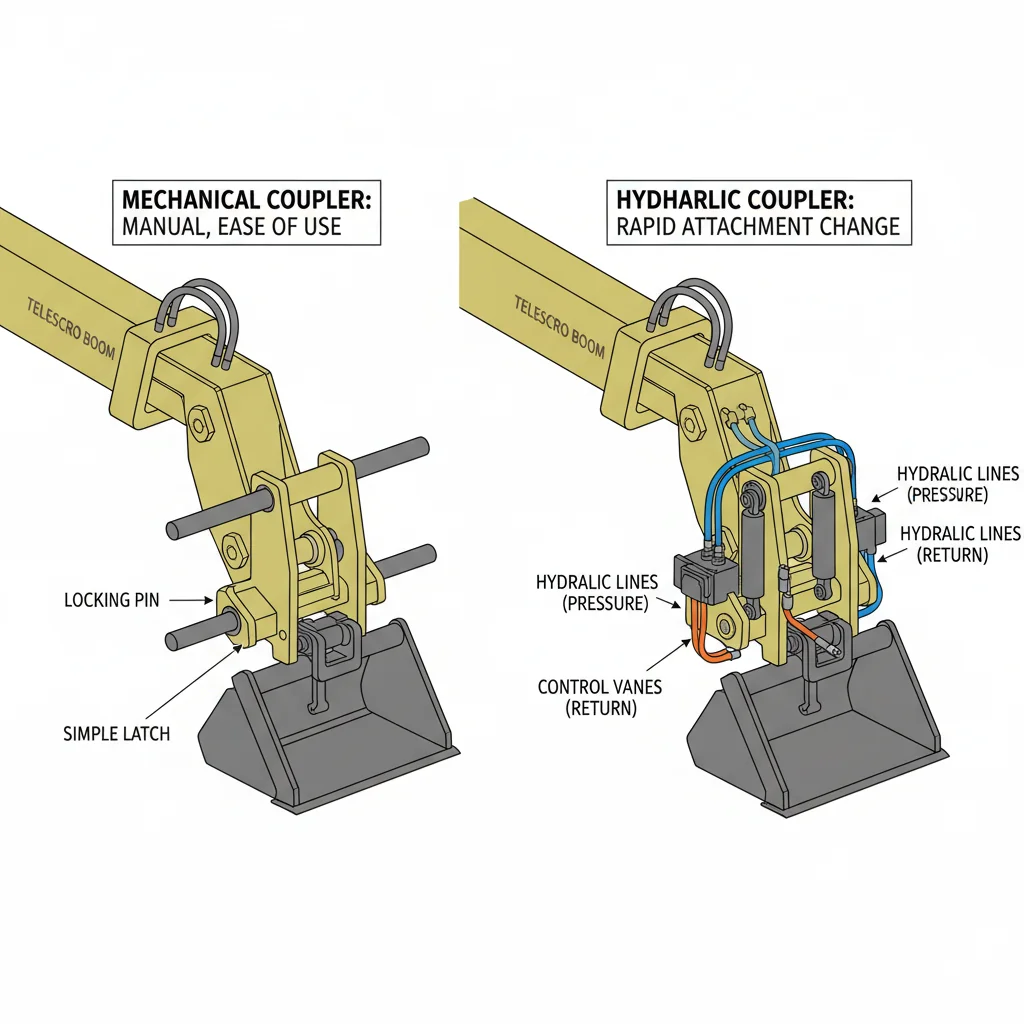
Last month, a contractor in Dubai asked me if hydraulic couplers were really worth the extra investment for his new telehandler fleet. That question doesn’t have a simple answer, but the big difference comes down to how often attachments need changing and how much downtime costs your project. I saw a farm outside Chengdu using a basic 3-ton telehandler with a mechanical quick coupler. The operators maybe switched between forks and a bucket twice per season. For their workflow, mechanical made sense—minimal moving parts, easy to maintain, and much lower upfront cost.
But on busy construction sites or in rental fleets, hydraulic couplers absolutely pull ahead. I’ve watched large rental companies in Poland and Brazil save at least two hours per week, per machine. When you have five telehandlers constantly swapping between forks, buckets, and jibs, the time lost walking out, unlocking pins, or using hammers adds up fast. With hydraulic couplers, operators stay in the cab and change tools in seconds.
Here’s a quick breakdown:
- Mechanical couplers work best for:
- Jobs with mainly one attachment all day
- Rural areas or farms with limited dealer support
- Lower labor rates, where operator time is less critical
- Simple repair needs—basic hand tools, no special parts
- Hydraulic couplers deliver value for:
- Large fleets with frequent daily swaps
- Municipalities or rentals serving varied job types
- Urban sites where every minute counts
- Fleets aiming for higher resale value
I suggest tracking how often your team switches attachments in a typical month. That number reveals which coupler option saves you money over time.
Hydraulic quick couplers enable attachments to be changed without the operator leaving the cab, reducing attachment swap time from around 10 minutes to under 2 minutes on averageTrue
Hydraulic couplers integrate with the machine’s hydraulic system, allowing remote attachment release and engagement, which significantly reduces downtime compared to mechanical systems that require manual pin removal. This is particularly advantageous on sites where attachments change frequently.
Mechanical couplers provide better sealing against hydraulic leaks than hydraulic couplers, making them the preferred choice for heavy fluid-handling attachmentsFalse
Mechanical couplers do not involve hydraulic fluid circuits and thus do not provide any sealing advantage for hydraulic leaks. Hydraulic couplers are directly connected to hydraulic lines and designed with seals and locking mechanisms to prevent leaks during attachment changes. Mechanical couplers are simpler but do not offer leak prevention for hydraulic functions.
Key takeaway: Mechanical couplers suit low-change, lower-complexity telehandler workflows, prioritizing affordability and reliability. Hydraulic couplers deliver significant time savings and advanced productivity in high-traffic or multi-attachment environments, making them optimal for large fleets and demanding applications where efficiency and uptime directly impact operational profitability.
How Do Quick Coupler Maintenance Needs Compare?
Mechanical telehandler quick couplers are simpler, using basic pins and latches, resulting in fewer failure points and easier field maintenance. Hydraulic quick couplers incorporate cylinders, seals, hoses, and electrical components, demanding periodic checks for leaks and faults. Both types risk ‘false lock,’ making daily visual and physical engagement checks critical for operator safety and machine reliability.
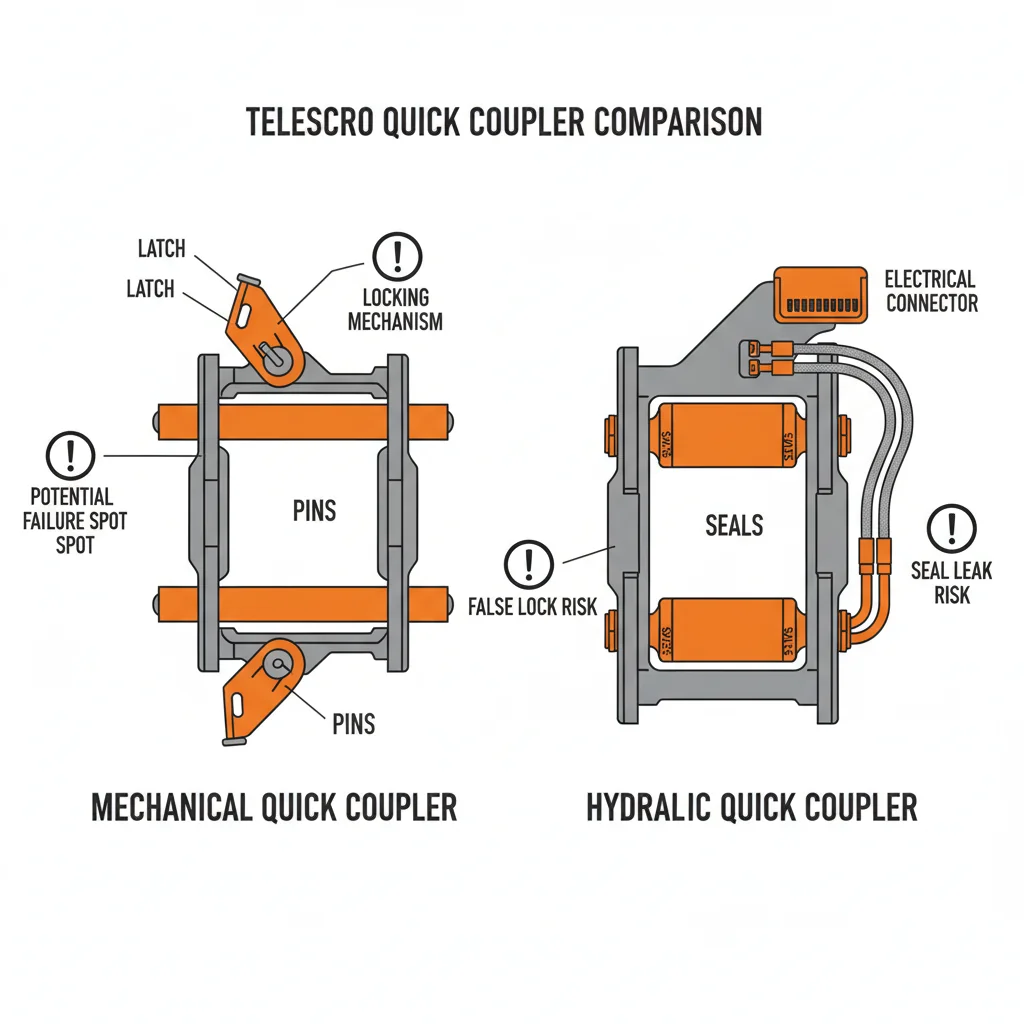
To be honest, maintenance is where quick coupler selection makes a real difference—especially if you work in remote areas or can’t get spare parts quickly. Mechanical quick couplers keep things simple. There’s a latch, a couple of locking pins, and not much else. I’ve seen contractors on mountain wind farm jobs in Yunnan keep these working with only grease and a wire brush for a whole season. The typical issues are stuck pins, wear at the latch point, and dirt jamming the mechanism.
Usually, a quick clean and re-grease does the trick, and rarely does the coupler sideline the machine. Hydraulic couplers, on the other hand, ramp up performance but add more to watch. Last summer, a customer in Kazakhstan had three telehandlers with hydraulic quick couplers, running for about 2,000 hours each in tough conditions. Two developed leaks at cylinder seals, and one showed a hose fault in the middle of a pour. Fixing these required skilled technicians and set them back a full day. With hydraulics, you face potential seal wear, leaking hoses, and electrical issues—especially as the equipment gets older. Inspections need to include cylinder movement, hose condition, and all fittings every few months, not just once a year.
Here’s a practical breakdown:
| Coupler Type | Main Maintenance Needs | Typical Issues | Best For | Field Repairs |
|---|---|---|---|---|
| Mechanical | Greasing, cleaning, pin check | Wear, seized latch, debris | Remote or basic job sites | Easy, basic tools |
| Hydraulic | Hose check, cylinder seals | Leaks, failed solenoids, weak lock | High-productivity job sites | Harder; needs tools |
Mechanical quick couplers typically require only grease and minimal tools, enabling them to operate reliably for an entire season in harsh environments like mountain wind farms without part replacementsTrue
Mechanical couplers have a simple design with few moving parts — mainly latches and pins — which can be maintained effectively with basic lubrication and cleaning, making them ideal for remote sites where spare parts are hard to obtain.
Hydraulic quick couplers never experience latch wear or pin jamming because their mechanisms are fully sealed and self-lubricatingFalse
Despite being sealed to protect internal components, hydraulic couplers still have mechanical latch points and pins subject to wear and dirt intrusion, requiring regular inspection and maintenance to ensure proper function.
Key takeaway: Mechanical quick couplers offer straightforward maintenance and a lower risk of breakdowns in remote conditions. Hydraulic couplers provide speed but require diligent inspection of seals, hoses, and electrical systems. For both, daily visual and physical engagement checks are vital to prevent attachment mishaps or costly downtime.
Are telehandler quick couplers retrofit-friendly?
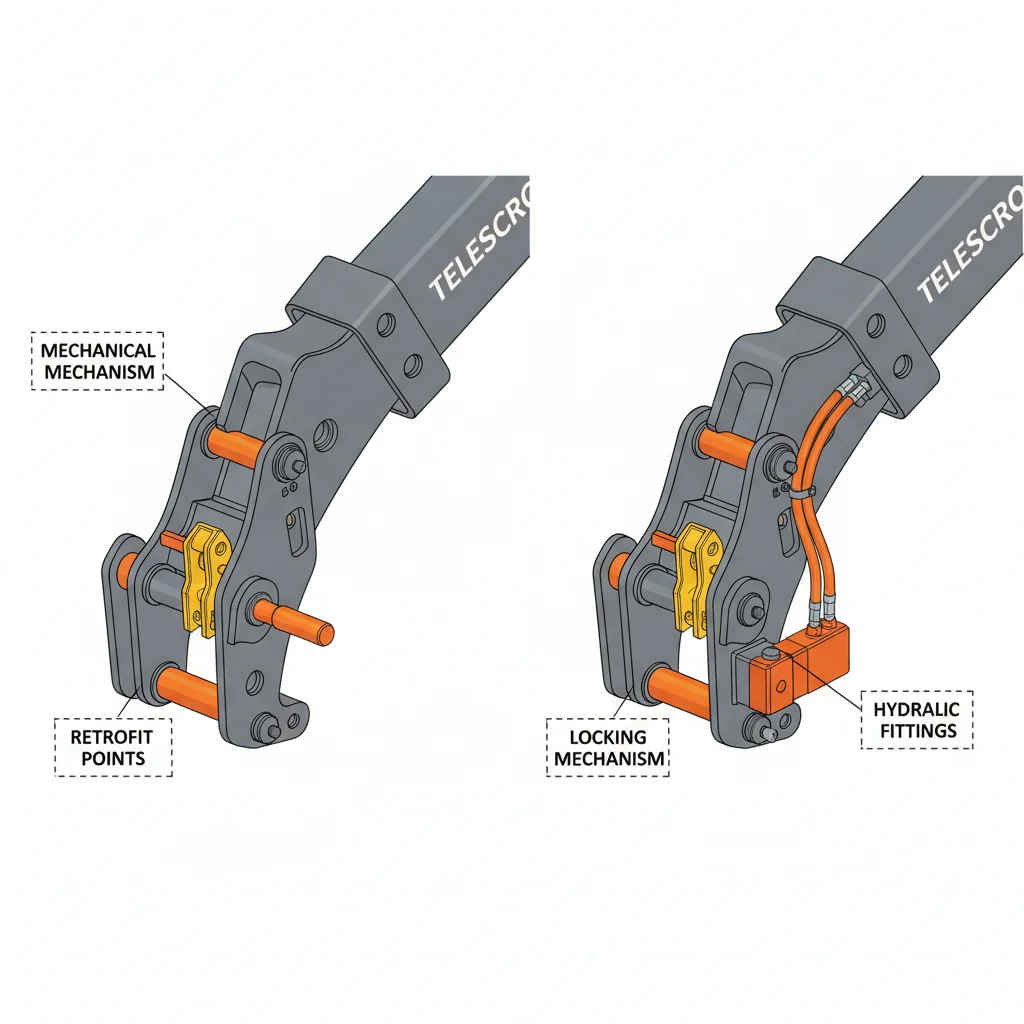
Compatibility and retrofitting of telehandler quick couplers depend on system type. Hydraulic couplers require extra hydraulic services and cab controls, often necessitating retrofit kits, especially for older machines. Mechanical couplers are typically easier and less costly to retrofit due to minimal plumbing or wiring. Universal couplers boost attachment flexibility but may increase weight or complexity, while dedicated systems ensure optimal fit.
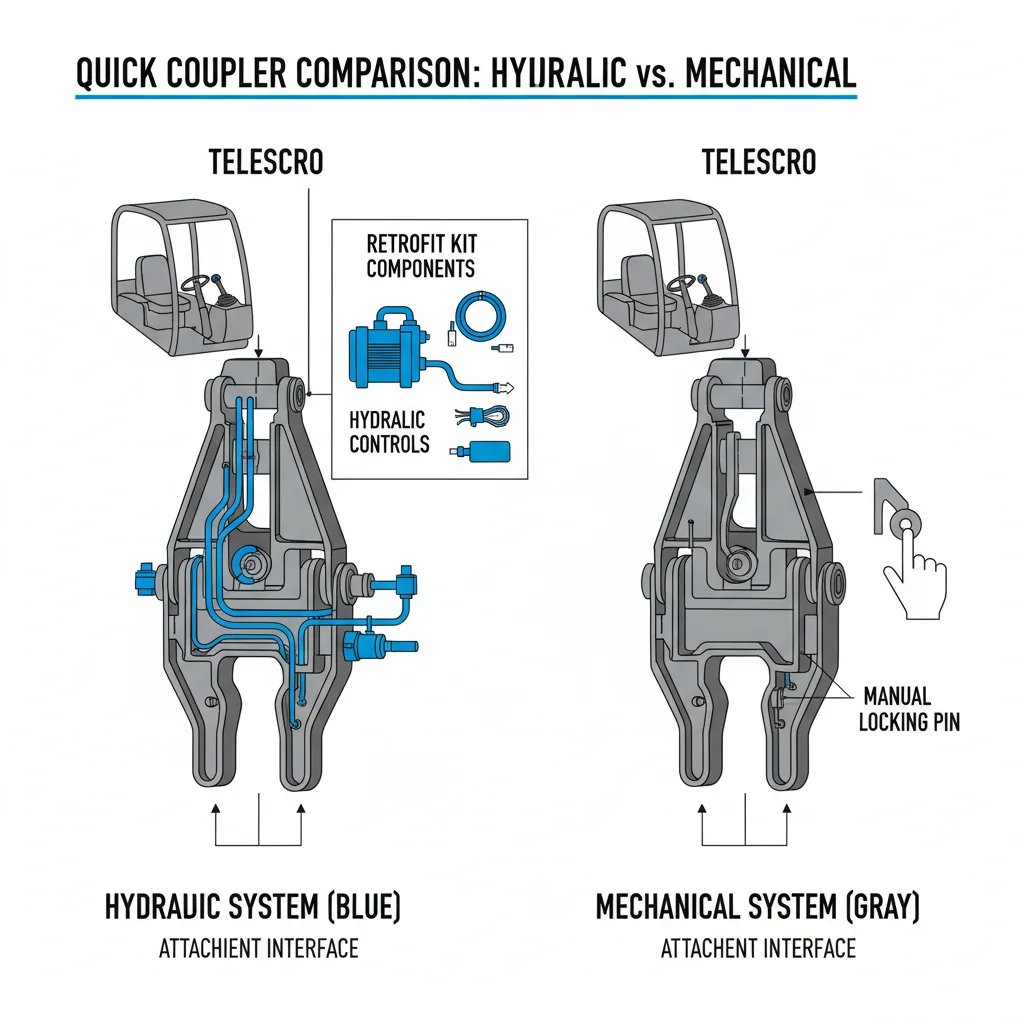
I’ve worked with customers in Kazakhstan who assumed quick coupler retrofits were always straightforward. In reality, it comes down to your machine’s age, hydraulic setup, and the attachments you plan to use. For a contractor running a 4-ton, 14-meter telehandler from 2012, we found a mechanical coupler could be installed in less than half a day, with parts costing under $750. No extra controls or hoses—just basic tools and a couple of people. That’s much simpler compared to hydraulic systems.
Now, hydraulic quick couplers offer a big convenience jump—especially on jobsites swapping forks and buckets all day. But, those require an extra hydraulic circuit and corresponding in-cab controls. On models built before 2018, a retrofit typically means adding complete kits, running new hoses, and sometimes updating the control panel. In Malaysia last year, one customer spent upwards of $2,500 per unit, with each retrofit taking a full day and two technicians. If your attachments need hydraulic functions—like rotating forks or grabs—factor in multi-coupler plates. Those let you connect multiple hydraulic lines in one motion, cutting swap time down to just a couple of minutes.
Here’s what I always remind buyers: universal couplers make life flexible, since you can share attachments among machines or brands. The downside? You might gain a few kilos in weight and lose some tip capacity. Dedicated couplers keep things tight and reliable, but limit options long-term. My advice—double-check that your chosen coupler matches both the machine’s hydraulics and every attachment you’ll be using. That safeguard prevents expensive surprises later.
Mechanical quick couplers typically require no additional hydraulic lines or electronic controls, allowing retrofitting on older telehandlers with minimal downtime and under $750 in parts for a 4-ton, 14-meter 2012 model.True
Mechanical couplers use manual locking mechanisms that operate independently from the machine’s hydraulic system, making installation simpler and less invasive compared to hydraulic couplers, which often need new hoses and control systems.
Hydraulic quick couplers can be retrofitted on any telehandler regardless of age without modifying existing hydraulic circuits or adding extra controls.False
Hydraulic quick couplers usually require integration with the telehandler’s hydraulic system and controls, which may involve installing additional hoses, valves, and switches, making retrofitting complex or impractical on older models without hydraulic provisions.
Key takeaway: Retrofitting telehandler quick couplers requires careful consideration of machine and attachment compatibility. Mechanical couplers are usually simpler and more affordable to retrofit, while hydraulic systems offer advanced features but can involve higher cost and complexity. Universal couplers maximize flexibility, with tradeoffs in weight or complexity versus dedicated, optimized systems.
What Telehandler Quick Coupler Types Exist?
Hydraulic quick couplers for telehandlers include poppet-style, flat-face, ball-type, and multi-coupling systems3. Poppet-style is robust but may leak fluid, flat-face virtually eliminates spillage, ball-type is mostly on older equipment, and multi-coupling allows multiple lines to connect simultaneously, improving safety and efficiency on busy job sites.
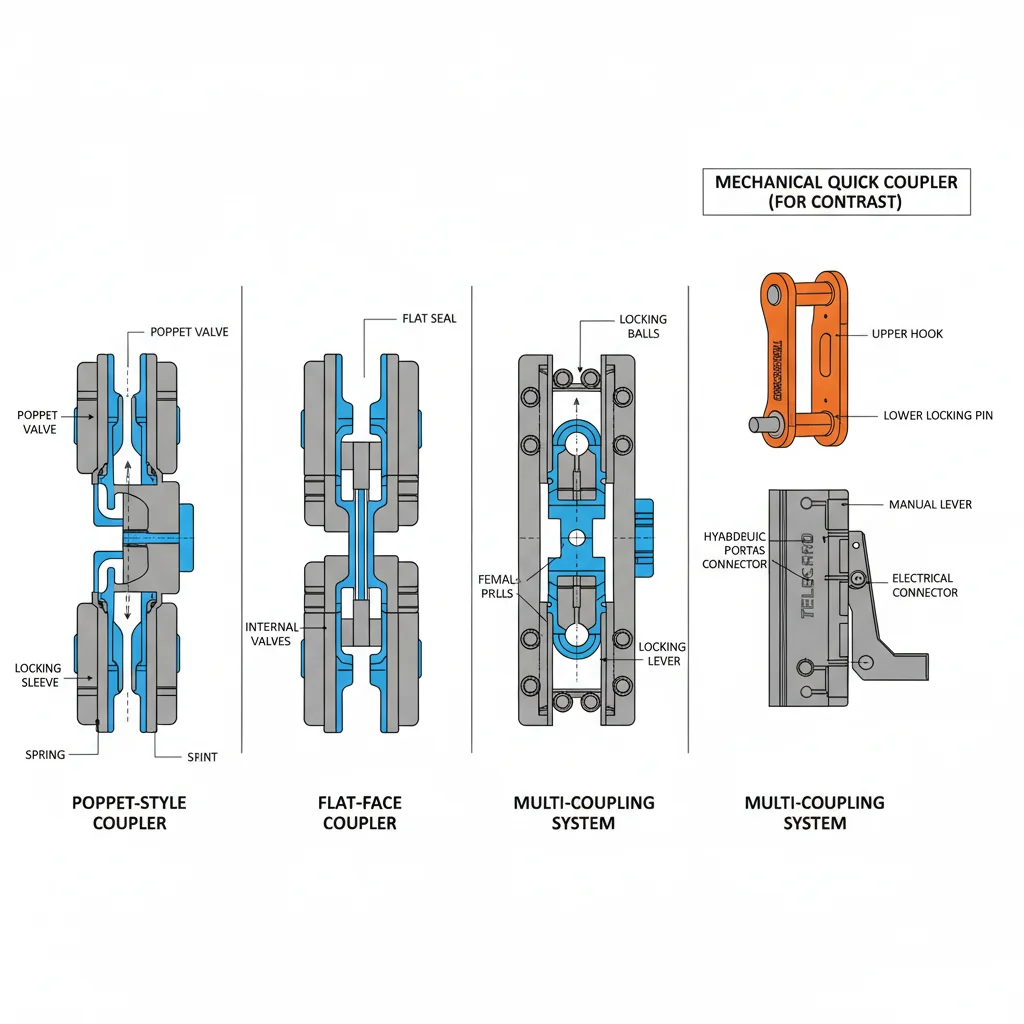
Here’s what matters most when you’re choosing a quick coupler for your telehandler: the working conditions at your site and the type of attachments you plan to run. In my experience, flat-face and multi-coupling systems perform best on busy jobsites—especially where contamination control or rapid changeovers are critical. For example, a forestry client in Canada switched from old ball-type couplers on their 3.5-ton, 13-meter machines to flat-face couplers4. They immediately noticed less hydraulic oil spillage during changeovers and spent less on oil and cleaning—especially in freezing temperatures.
Let me break down the main types you’ll see, and where each fits best:
| Coupler Type | Typical Use Cases | Leak Risk | Cleanliness | Changeover Speed | Common on |
|---|---|---|---|---|---|
| Poppet-Style | Agriculture, oilfields | Moderate | Fair | Moderate | Older/utility |
| Flat-Face | Construction, forestry | Very low | High | Fast | Modern units |
| Ball-Type | Legacy equipment | High | Low | Slow | Pre-2010 |
| Multi-Coupling | Heavy attachment changes | Very low | Highest | Fastest | High-spec |
I’ve worked with teams in Dubai using multi-coupling plates on 4-ton, 17-meter reach machines. Their operators connect several hydraulic lines with a single movement—no guessing which hose goes where. It saves at least 15 minutes per attachment swap, which adds up by the end of the week.
Hydraulic quick couplers often incorporate flat-face designs which minimize fluid spillage and contamination during attachment changes, making them ideal for environments requiring stringent hydraulic cleanliness.True
Flat-face hydraulic couplers prevent hydraulic fluid exposure to air when disconnecting, reducing contamination risk and maintaining system integrity, which is especially critical in forestry and construction applications.
Mechanical quick couplers always provide faster attachment changes than hydraulic couplers because they do not rely on the machine's hydraulic system.False
While mechanical couplers are simpler, modern hydraulic quick couplers often allow faster and safer attachment changes by enabling remote control and eliminating manual locking, especially on larger machines where mechanical locking can be cumbersome.
Key takeaway: Flat-face and multi-coupling quick couplers are preferred for modern telehandlers due to their safer, cleaner operation and streamlined setup, minimizing contamination and spillage. When upgrading or specifying equipment, prioritizing these coupler types supports productivity and hydraulics system longevity, especially in demanding construction or forestry applications.
How Do Hydraulic vs Mechanical Couplers Secure Attachments?
Hydraulic quick couplers use cylinders to apply consistent, high engagement force when locking telehandler attachments, ensuring a secure and precise fit regardless of operator strength. Mechanical couplers rely more on proper manual technique, with attachment security depending on full pin insertion and correct latch engagement, making operator diligence crucial for safe load handling.
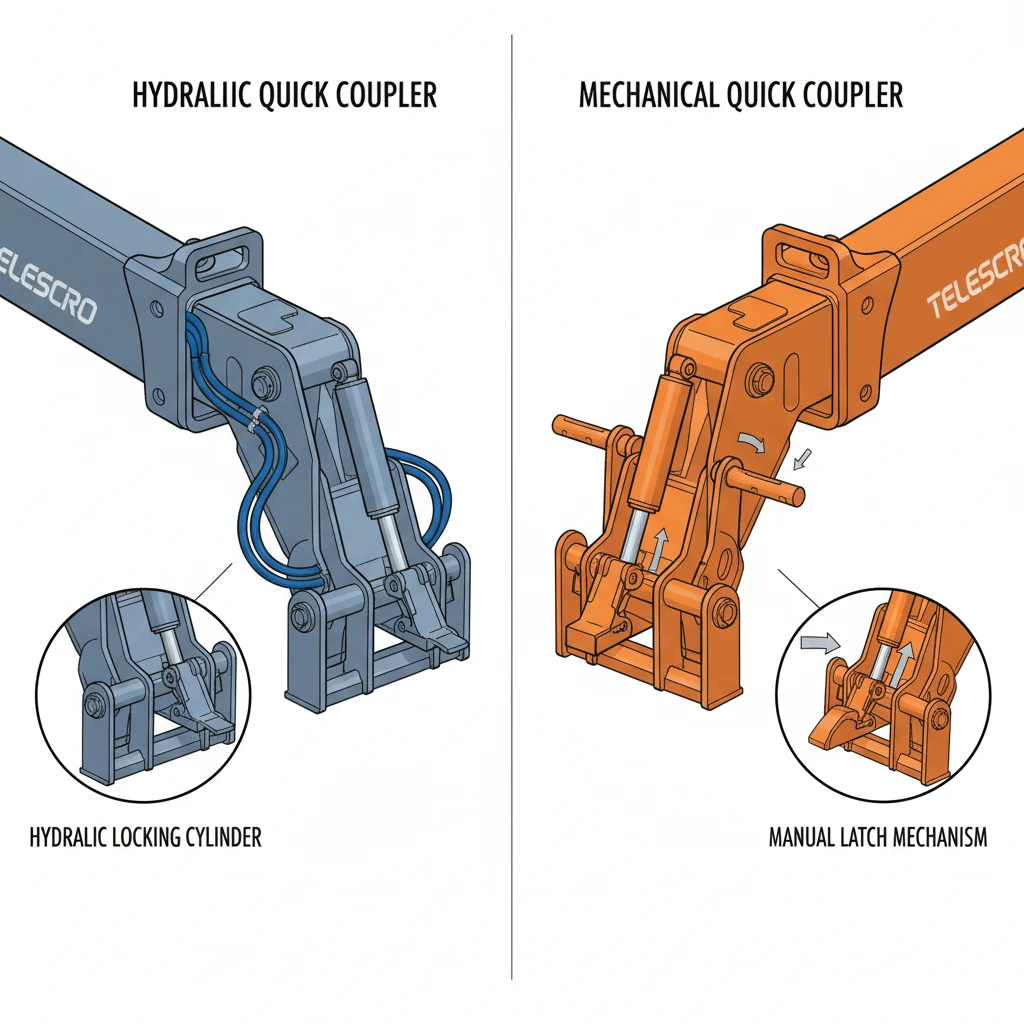
Last year in Brazil, I watched a crew swap between a fork and a stone bucket on a 4-ton telehandler with a hydraulic quick coupler. What struck me was how consistent the attachment fit was—every time, the hydraulic cylinder drove the wedges home with the same force, no matter which operator was in the cab. That’s the big difference: hydraulic systems apply a high, controlled force to lock your attachments, which really matters if you’re lifting at full capacity or booms are stretched to 15 meters. It reduces play at the coupler point, so your forks don’t rattle or shift mid-lift. I’ve seen that give operators extra confidence when placing loads near glass curtainwalls or working over vehicles. With mechanical couplers, I see more variation. On a job in Kenya, a team struggled when mud caked inside the pin holes. Their system depended on pins fully seated and safety latches engaged—if not, the attachment could come loose, especially under shock loads. A tired or rushed operator might think the pin’s in, when actually it’s not fully engaged. That’s risky. Mechanical systems can definitely be safe, but only when operators double-check lock status and give the attachment a quick lift-and-tilt test before moving off.
Here’s a side-by-side comparison:
| Coupler Type | How It Locks | Engagement Force | Operator Impact | Best For |
|---|---|---|---|---|
| Hydraulic Coupler | Cylinders push wedges/pins | Consistent, high (independent of operator) | Low effort, just a switch | Frequent changes, heavy or precision attachments |
Hydraulic quick couplers use a consistent cylinder pressure, typically around 150 bar, to actuate locking wedges, ensuring uniform attachment engagement regardless of operator inputTrue
The hydraulic system applies a controlled, repeatable force via pressure-regulated cylinders, unlike mechanical couplers that rely on manual force, leading to more consistent and secure locking especially under high load or extended boom reach.
Mechanical quick couplers automatically adjust locking force based on attachment weight, providing safer connections than hydraulic couplersFalse
Mechanical couplers depend on manual or spring-loaded locking mechanisms and do not adjust locking force dynamically. This can lead to inconsistent locking pressure, unlike hydraulic systems that provide controlled, consistent force regardless of attachment weight.
Key takeaway: Hydraulic couplers deliver consistent attachment security by automating engagement force, while mechanical couplers can be equally safe if properly locked by the operator. Regardless of type, regularly verifying lock status and inspecting for wear are critical steps to maintain safety and performance in demanding telehandler operations.
When Should Telehandlers Use Hydraulic Couplers?
Hydraulic quick couplers are best suited for telehandlers that change attachments multiple times per shift, common in rental fleets or large operations. Mechanical couplers remain cost-effective if attachment changes are infrequent and support staff are limited. Managers should assess operating frequency, labor costs, support environment, retrofit impacts, and operator skill to determine the optimal coupler type.
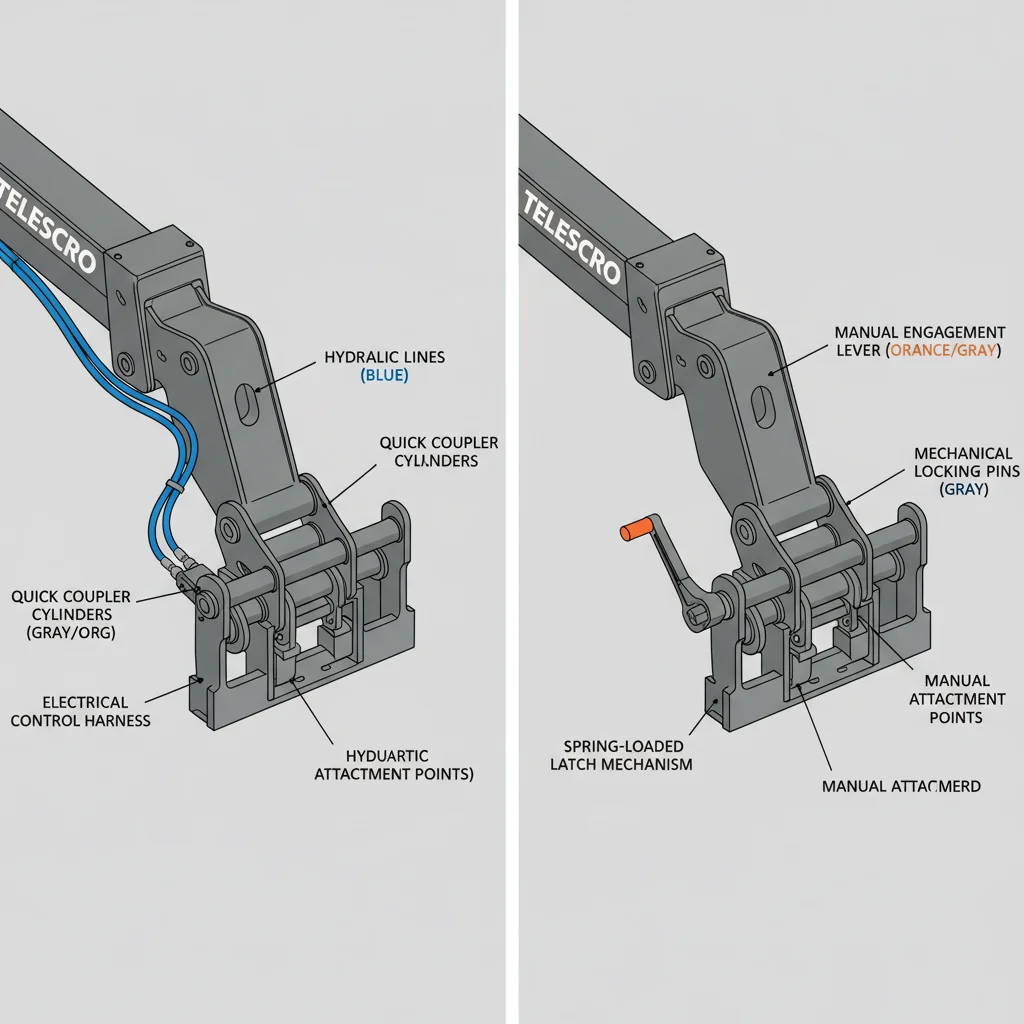
I’ve worked with crews in Kenya and Brazil who faced this decision head-on. One large contracting team in São Paulo needed their 4-ton telehandlers to switch between pallet forks, buckets, and lifting hooks at least five times per shift. Manual couplers were costing them close to an hour of downtime each day—more if the operators weren’t experienced. When they switched to hydraulic quick couplers, they cut changeover time to a few minutes per swap. Over a month, that saved well over 20 working hours. For operations like that, the upfront cost of hydraulics pays off fast.
But not every jobsite looks like that. In remote mining sites in Kazakhstan, I often see telehandlers change tools once or twice a week. Labor costs are lower, and support teams are small. Mechanical couplers just make sense there—less to maintain, less risk of hydraulic circuit problems, and repairs can be done with basic tools.
Here’s how I advise fleet managers to decide:
- High-frequency attachment changes (3–4+ per day): Pick hydraulic quick couplers for real productivity gains.
- Low-frequency changes (less than 2 per week): Mechanical couplers stay budget-friendly and reliable.
- Support environment: If your site lacks hydraulic troubleshooting skills, stick with mechanical solutions.
- Retrofit considerations: Older machines can be expensive to upgrade—sometimes more than half the unit’s value.
- Operator experience: Hydraulic systems help less-skilled teams work safely, but need basic hydraulic know-how.
I suggest matching coupler type to each machine’s actual workload—don’t force a fleet-wide rule that only adds cost without real benefit.
Hydraulic quick couplers can reduce attachment changeover time by up to 80% compared to mechanical couplers, significantly increasing telehandler productivity on sites with frequent attachment swaps.True
Hydraulic couplers operate with the push of a lever inside the cab, allowing operators to switch attachments in minutes without exiting the vehicle, whereas mechanical couplers require manual unlocking and physical effort, consuming substantially more time especially across multiple swaps per shift.
Hydraulic couplers provide a stronger mechanical locking force than mechanical couplers, making them the safest option for handling extremely heavy loads above the telehandler's rated capacity.False
While hydraulic couplers offer quick and convenient attachment changes, the mechanical locking force is governed by the coupler design and telehandler rating; hydraulic couplers do not inherently increase the maximum safe load capacity and operators must adhere to rated limits regardless of coupler type.
Key takeaway: Select hydraulic quick couplers for telehandlers operating in high-frequency attachment-switch environments or well-supported fleets. For machines with minimal attachment changes or remote locations, mechanical couplers generally offer greater simplicity, reduced maintenance, and lower initial investment. Always align coupler selection with actual machine usage instead of enforcing a fleet-wide standard.
Conclusion
We looked at the real-world differences between hydraulic and mechanical telehandler quick couplers, focusing on how they actually affect attachment changes on site. From what I’ve seen, many buyers get drawn to specs and price tags but overlook day-to-day realities—like how frequent attachment swaps or operator workload impact jobsite flow. Don’t let impressive showroom specs turn into a ‘showroom hero, jobsite zero’ situation. When deciding, try to match coupler choice to your crew’s actual pace and site layout, not just initial costs. If you want tailored advice for your application or have questions about real field performance, I’m happy to help—just reach out, no pressure. The best telehandler setup is always the one that fits your real working conditions.
References
-
Detailed explanation of how hydraulic quick couplers reduce tool swap time, boosting machine utilization and ROI in demanding conditions. ↩
-
Explores how hydraulic couplers boost productivity by enabling rapid attachment swaps, ideal for rentals and busy construction sites. ↩
-
Learn how multi-coupling systems allow multiple lines to connect simultaneously, enhancing safety and speeding up attachment changeovers. ↩
-
Explore how flat-face couplers reduce hydraulic oil spillage and improve cleanliness, especially in cold and contamination-sensitive environments. ↩