










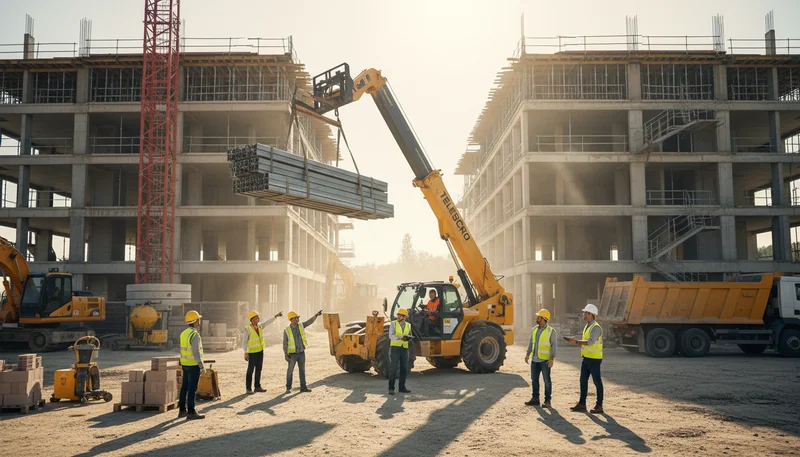
Telehandler Productivity: Expert Field Guide to Real Jobsite Gains
Not long ago, I watched a crew in Vietnam still juggling three machines to keep their mid-rise project on track—forklift at the gate, loader in the mud, then waiting for a crane to place bricks on the upper floors. They kept asking, “How much quicker if we just used one telehandler?”
Telehandlers drive measurable gains in jobsite productivity by combining vertical reach with on-site mobility, eliminating repeated material-handling steps common to traditional equipment setups. On many mid-rise and infrastructure projects, contractors report load cycles that are around 10–20% faster and noticeably more material moved per shift after adopting telehandlers. By acting as forklift, small crane and loader through quick attachment swaps, a single modern telehandler minimizes machine transfers, reduces operator requirements, and declutters overall site logistics.
How Do Telehandlers Boost Handling Efficiency?
Telehandlers enhance material-handling efficiency by combining high reach with mobility, enabling direct lifts from truck to final position. This eliminates double handling, slashing cycle times by up to 15% and increasing daily loads moved by as much as 25%, especially on mid-rise construction jobs.
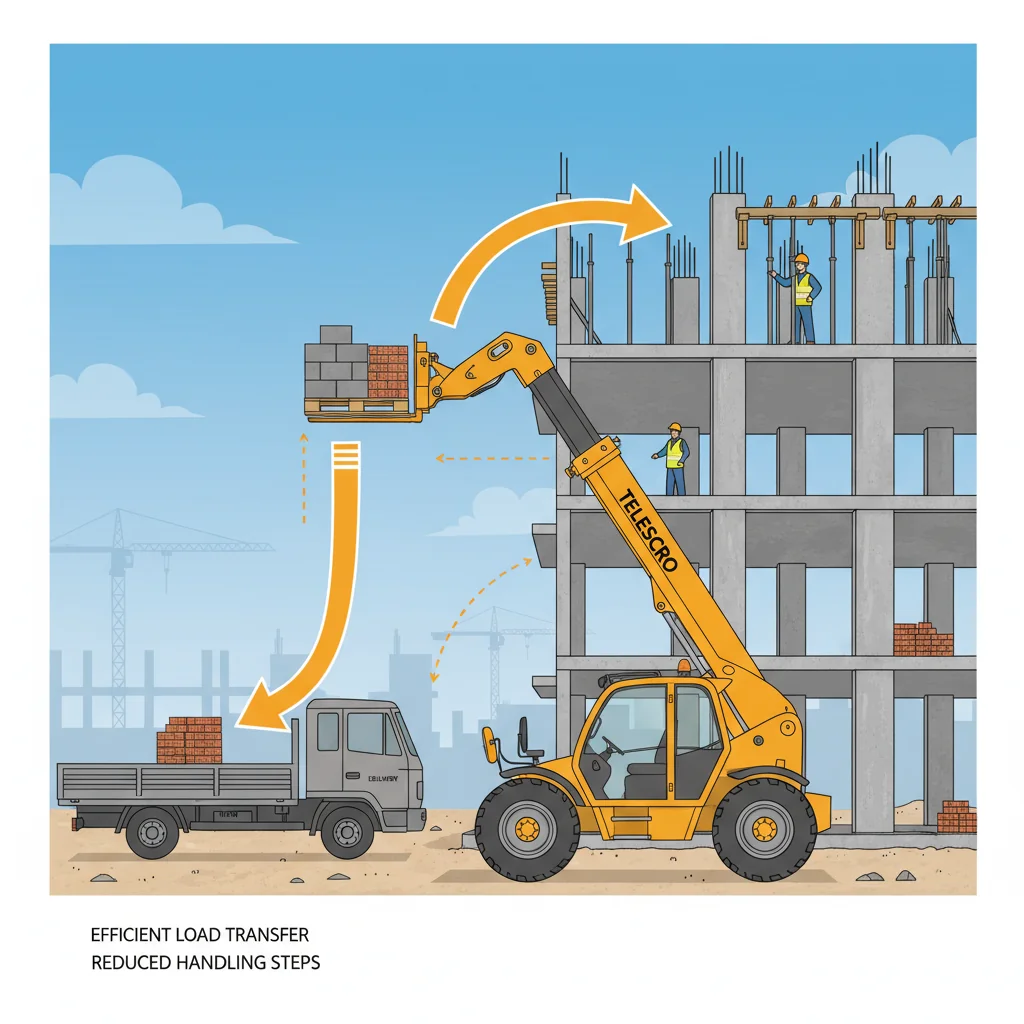
Most people don’t realize that a forklift plus crane combo can add hours of wasted time every day on mid-rise jobs. I’ve seen this firsthand on sites in Brazil—crews had to offload pallets at ground level, then wait for the crane to come over and lift each bundle to the right floor. With a modern telehandler, you skip all those extra steps. An industry-standard 4-ton unit with a 14- to 18-meter boom can take material straight from the delivery truck to where it’s actually needed, even over rough or uneven ground.
Here’s what matters most: cycle time1. On a typical site in Dubai, one contractor told me moving 80 pallets a day used to eat up nearly ten hours. After switching to telehandlers, the same task dropped to about five hours—a real five-hour gain every shift. If you’re handling heavy blocks or roofing panels, direct placement by telehandler lets you set more loads per hour, so your teams spend more time installing and less time shuffling materials between stockpiles.
To be honest, the real secret isn’t just the lift height or rated capacity—it’s the combination of reach, maneuverability, and an up-to-date load chart2. I see too many buyers overlook routing at the planning stage. If you can map a “truck to final position” path with minimum turns, you’ll boost efficiency by up to 25%. My advice? Walk the route, check if the boom’s full extension matches your highest point of use, and always confirm with the actual load chart before committing to a spec.
A telehandler with a rotating boom (roto telehandler) can significantly reduce material-handling cycle times compared to fixed-boom types on congested sites.True
Roto telehandlers allow the operator to swivel the upper structure without repositioning the base, making it much faster to reach multiple points from a single spot. This minimizes machine movement and delays, especially when obstacles or limited space complicate logistics.
Telehandlers with standard tires are always able to traverse muddy or uneven ground without any reduction in speed.False
Standard tires can struggle on soft or uneven terrain, leading to slippage and slower travel. Specialized flotation or all-terrain tires, and sometimes additional features like axle oscillation, are needed to maintain optimal performance in such conditions.
Key takeaway: Telehandlers streamline jobsite workflow by eliminating intermediate stockpiling and double handling. Direct lifts from delivery truck to point of use can save contractors up to five hours per day, translating to more work completed per shift and higher project productivity.
How can one telehandler replace several machines?
A modern telehandler equipped with compatible attachments—such as pallet forks, buckets, lifting hooks, and man baskets3—performs multiple roles, including forklift, small crane, loader, and access platform duties. This versatility reduces jobsite machine transfers by 30–40%, streamlines logistics, decreases personnel requirements, and minimizes site congestion for improved productivity.
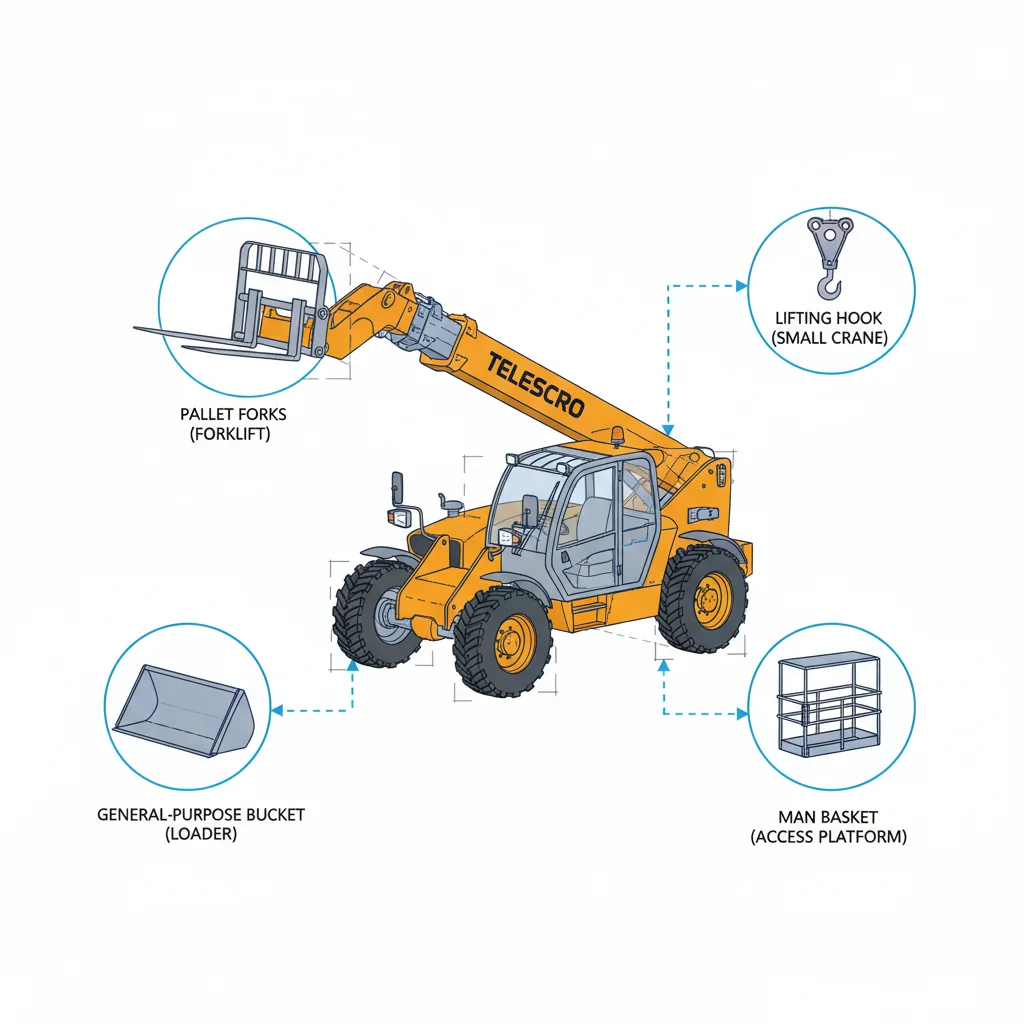
Let me share something important about telehandler versatility4 that many site planners overlook. When you spec the right machine—say, a 4-ton model with a 17-meter boom and a strong hydraulic circuit—you’re not just getting a forklift. With quick coupler attachments5 like pallet forks, buckets, and lifting hooks, that single telehandler can handle tasks that would normally require a small crane, a loader, and a traditional mast forklift. On one housing project in Saudi Arabia, I watched the team eliminate almost 40% of their internal machine calls by switching to a single well-equipped telehandler.
The result? Less idle time, smoother deliveries, and far fewer traffic jams around the material laydown zones. From my experience, one of the biggest payoffs comes with overhead work. If your jobs involve placing materials to second or third floors—like steel beams or blocks—most telehandlers in the 3.5-4 ton, 12-17 meter class are up to the challenge. I’ve seen crews use a man basket for short façade repairs, then swap back to pallet forks in under ten minutes to keep materials flowing. It’s efficient and safe, but only if operators respect the load chart and moment indicator. The flexibility really shines on tight city sites, where a single machine cuts down on congestion and frees up operators for more high-value work. I always suggest checking your daily lift patterns.
A 17-meter telehandler equipped with a jib winch can safely lift pipe sections directly from delivery trucks to upper floor workspaces, eliminating the need for a small mobile crane on residential mid-rise sites.True
With a jib winch attachment, telehandlers can perform light-duty lifting tasks such as hoisting pipe bundles or air conditioning units to elevated positions, provided they stay within the rated load chart and lifting capacity. This versatility makes them effective crane substitutes for many job site scenarios.
A telehandler fitted with a bucket can routinely outperform a purpose-built wheel loader in cycle times for bulk material movement, such as loading sand or gravel into trucks.False
Although telehandlers can be fitted with buckets to move loose materials, their hydraulics and cycle times are not optimized for fast repetitive loading like those of wheel loaders. Wheel loaders have higher breakout forces, faster lifting cycles, and better stability for heavy-duty bulk handling, making them more efficient for these applications.
Key takeaway: One well-specified telehandler with appropriate attachments can effectively consolidate the roles of several machines onsite. This approach reduces machine traffic, operator numbers, and logistical complexity. The result: improved jobsite productivity, reduced congestion, and significant savings in both time and operational costs.
How Does Correct Telehandler Sizing Boost Output?
Correct telehandler sizing directly impacts jobsite productivity. Using an undersized model limits lift at required reach, forcing partial loads or extra trips, while oversizing increases costs without efficiency gains. Industry experts advise mapping load weights, placement heights, and reach needs, then selecting a machine covering 90% of tasks, including a 20–30% capacity margin.
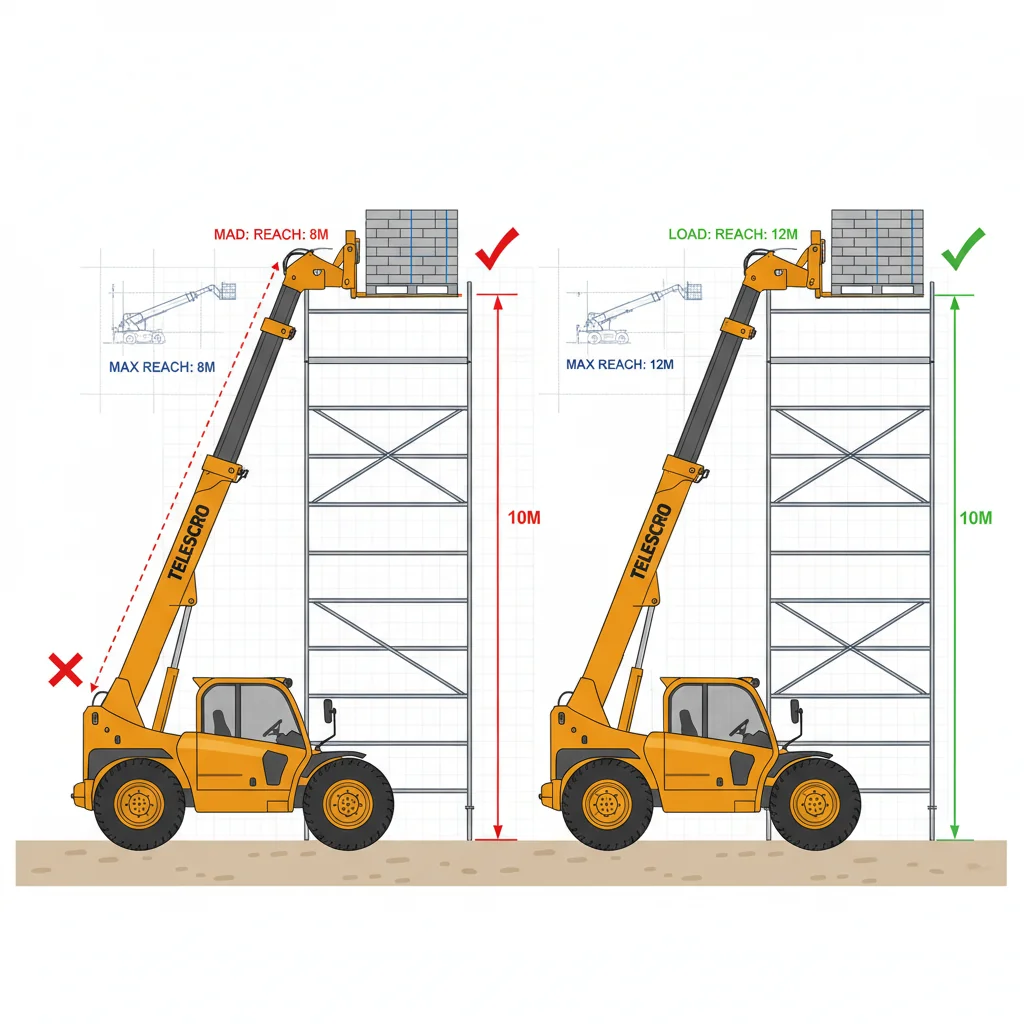
The biggest mistake I see is crews matching telehandler size to maximum specs on paper, not the actual loads and reaches needed every day. For example, an urban project team in Dubai recently struggled with a 2.5-ton, 10-meter unit. Their brick pallets averaged 1.6 tons. The problem showed up at the third floor—over 11 meters out. According to the load chart, safe lift there was barely 800 kg, so every pallet took two trips. That doubled their cycle time and forced them to schedule a mobile crane for the heavier beams. They told me they lost at least two full working days in a single month.
On the other side, I’ve worked with a client in Brazil who picked an 18-meter, 4-ton high-reach machine for a mid-rise block. The job rarely needed more than 2 tons at any given point. They paid extra for up-front purchase and daily fuel — but the big machine barely reached half its capacity except once a week. No real productivity gain, just added costs. The extra size didn’t help with maneuvering either; a compact 3-ton, 13-meter unit would have done 90% of their lifts, especially when working between scaffold and trucks.
Here’s what matters most when matching machine size to site work: map your real loads, heights, and reach. Then read the load chart for those working positions—not just at ground level or at minimum boom. I usually tell clients: give yourself a 25% buffer on rated capacity for safety and smooth operations. That’s how you avoid wasted time, extra trips, and unplanned equipment costs.
Selecting a telehandler based solely on maximum lift capacity often leads to underperformance when operating at extended reaches, because rated capacity drops sharply as boom angle increases and boom extends.True
Telehandler load charts show a significant reduction in safe lifting capacity at greater boom extensions and reaches. This means a machine sized for its maximum spec can be unable to handle typical pallet weights at practical work heights or outreach, causing workflow slowdowns.
A telehandler with a 2.5-ton rated capacity can reliably lift 2.5 tons to any height within its boom's maximum reach.False
The rated capacity applies only at the most favorable boom angle and minimum extension. As the boom extends or lifts higher, leverage and stability limits reduce the allowable load, often by more than 50% at maximum outreach. Failing to account for this leads to unsafe operations or inefficiency.
Key takeaway: Right-sizing a telehandler is one of the most effective ways to drive real productivity gains on-site. By carefully aligning rated capacity and reach to typical load demands, operators minimize downtime, avoid costly workarounds, and optimize both equipment investment and daily jobsite results.
How Do Attachments Boost Telehandler Productivity?
Attachments expand telehandler capability beyond pallet handling. Buckets enable material movement and cleanup, jibs lift irregular loads, man baskets support elevated tasks, and bale grabs serve agriculture. Contractors who plan a small set of core attachments for key trades and standardize couplers often see telehandler utilization move from roughly 50–60% on traditional ‘fork-only’ setups toward much higher levels, often above 70–80%, because the same machine stays useful across more phases of the job.
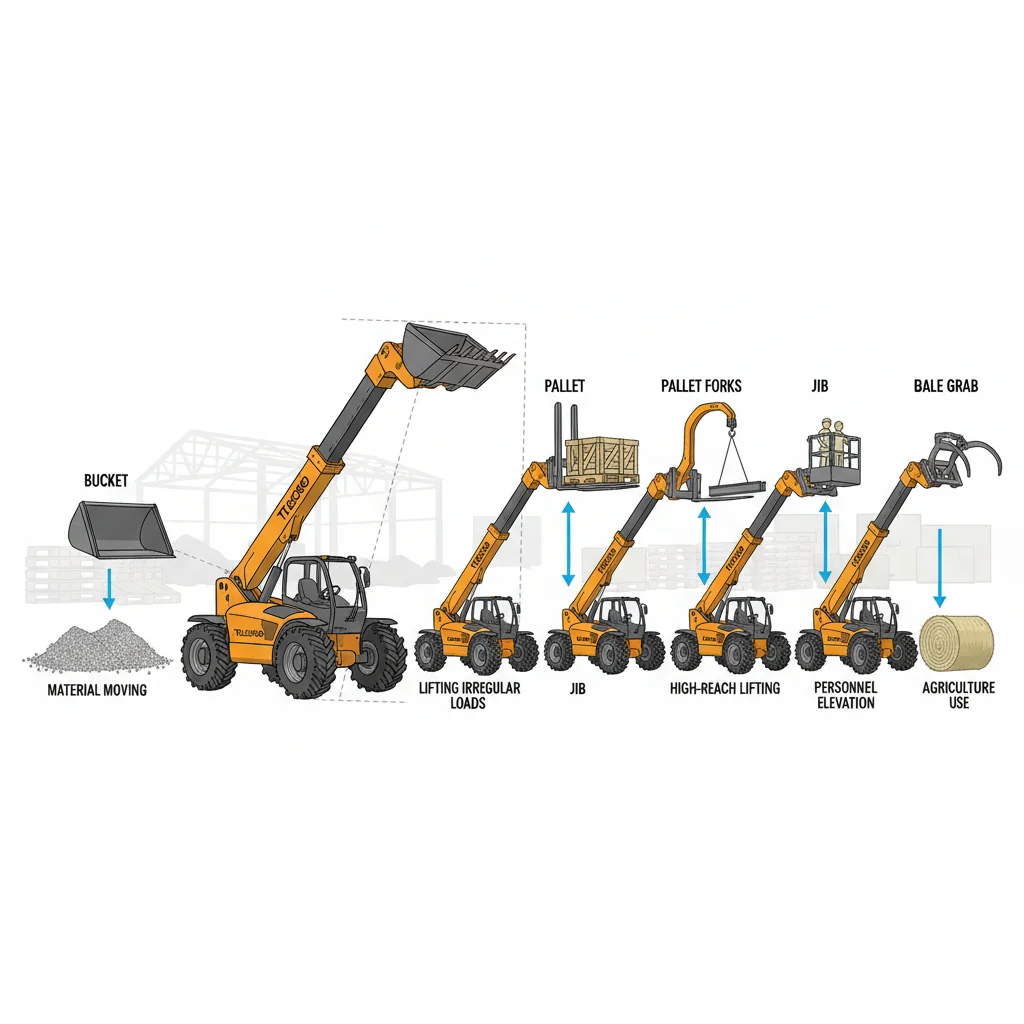
Here’s what matters most when you want to keep your telehandler busy: attachments are your biggest lever for real productivity gains. Most sites start with forks for pallets, then barely scratch the surface. From my experience, the smart crews plan for buckets, jibs, man baskets, and at least one specialty tool. I saw this in Kazakhstan—a client ran the same 4-ton, 17-meter machine for masonry, roof lifts, HVAC, and even site cleanup, just by swapping attachments mid-shift. Their machine stayed in use nearly 80% of the project, compared to 50–60% on standard sites.
Common core attachments for high telehandler utilization include:
- General-purpose bucket: Move aggregate, sand, or clear debris—especially after concrete pours or during final cleanup.
- Lifting jib with hook6: Safely handles truss sections, rebar bundles, or other odd-shaped loads without rigging headaches.
- Man baskets: Turn the telehandler into a mobile work platform for façade, glass installs, and MEP work at height.
- Bale grab or clamp: For agricultural work—farm teams in Brazil use these year-round for silage and hay.
- Side shift/fork positioner: Speeds up loading by sliding pallets into position without driving all over the site.
To maximize all these gains, I always recommend standardizing quick couplers and hydraulic lines across your fleet. Staging attachments near job zones saves a lot of wasted motion. And don’t overlook operator training7—switching from forks to bucket or jib should take minutes, not half an hour. I suggest planning three to five key attachments up front. That’s what keeps your telehandler earning its spot all project long.
Using a hydraulic side-shift carriage attachment can increase pallet placement precision by up to 50 millimeters, reducing the need for machine repositioning on congested job sites.True
Hydraulic side-shift carriages allow operators to laterally adjust loads without moving the entire telehandler, resulting in finer placement accuracy and saving time in tight layouts.
Telehandler attachments are universally compatible across all brands and models, so any bucket, jib, or basket can be used interchangeably without modification.False
Attachment mounting systems and hydraulic connections vary by manufacturer and model, and most attachments require specific couplers or adapters to fit properly and operate safely. Universal compatibility does not exist in the industry.
Key takeaway: Strategic use of attachments and standardized quick couplers dramatically increase telehandler utilization across all project phases. Selecting and staging 3–5 core attachments for major site tasks allows the same machine to stay in use longer, while efficient changeover and operator training drive further productivity gains.
How Do Telehandler Safety Systems Boost Uptime?
Modern telehandler safety systems—including load sensors, stability management, and boom limiters—directly support uptime by helping prevent the unsafe maneuvers that lead to damage and incidents. Fleets that move from basic machines to sensor-equipped models commonly report fewer overload events, less structural or boom damage, and a reduction in unplanned repair stops, underscoring how integrated safety features contribute to real gains in jobsite productivity.
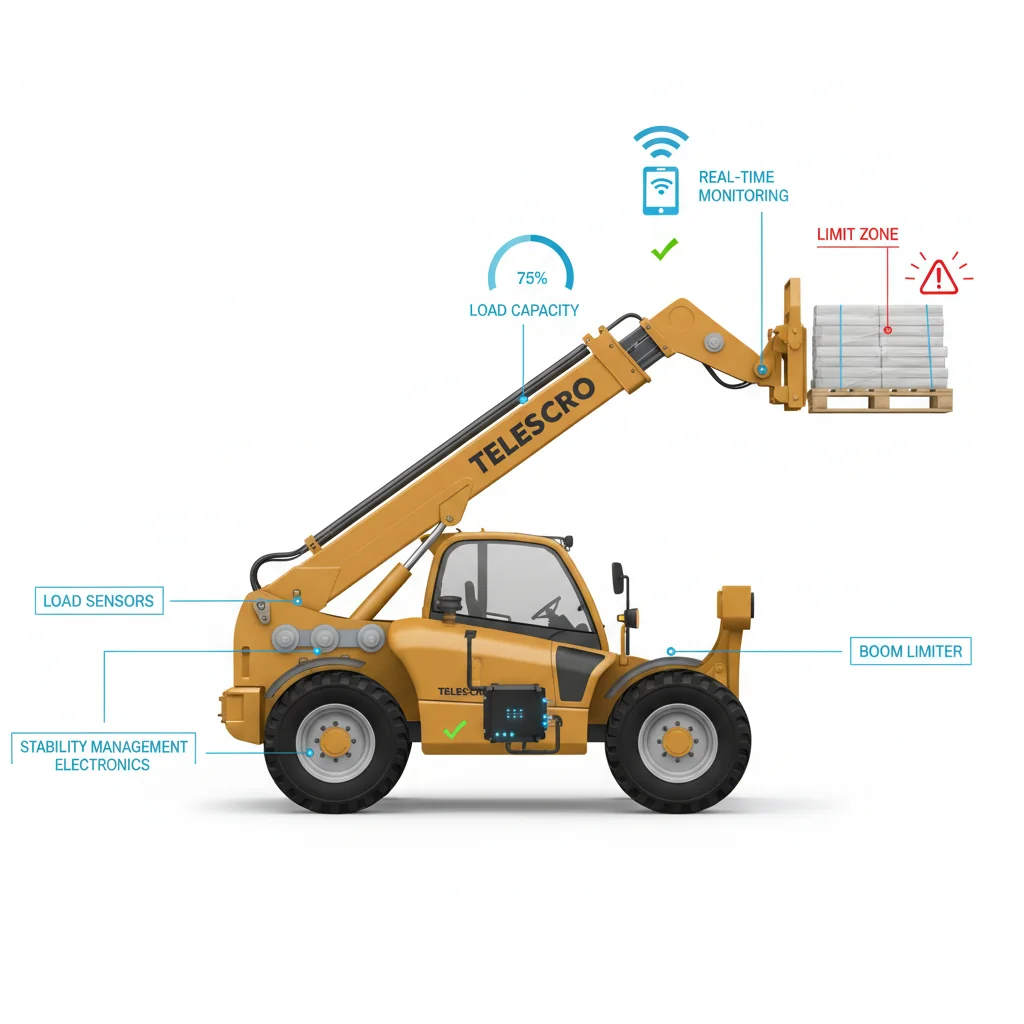
I’ve worked with fleets in Dubai and Australia who upgraded from basic telehandlers to units with full sensor packages—load indicators, stability management, and automatic boom limiters. The difference? Fewer breakdowns caused by overloading or tip-overs. One client in Dubai told me their average downtime per machine dropped by almost a week per year once operators couldn’t override safety warnings. That means crews kept moving, instead of waiting for a damaged boom or bent chassis to get back from the workshop.
Let me share something important about load sensors and stability systems. These features aren’t just there to satisfy inspectors—they step in before a mistake puts the machine (and your people) at risk. When an operator reaches too far with a heavy pallet, the system cuts off the hydraulics before things get out of hand. I’ve seen a 4-ton unit in Kazakhstan stop automatically when a load approached tipping limits at full outreach. That single intervention prevented a costly accident and a potential week of lost site time.
Operators sometimes think these safety features slow them down, but the reality is the opposite. Avoiding even one tip-over or boom collision keeps your schedule and budget on track. I always recommend you check that every machine matches its working conditions—and that your team is trained on those exact safety systems, not just “any telehandler.” Safe practices using the manufacturer’s load chart and respecting all sensor warnings mean more uptime, fewer injuries, and a telehandler that earns its keep every day.
Telehandlers equipped with real-time load monitoring systems report up to 40% fewer instances of boom overextension compared to basic models.True
Real-time load monitoring provides immediate feedback to operators, actively preventing moves that exceed safe boom limits, which dramatically cuts down incidents linked to overextension and the resulting repairs.
Automatic boom limiters allow telehandlers to safely lift loads 20% above their rated capacity without increasing breakdown risk.False
Boom limiters help prevent unsafe lifting by restricting operation beyond rated limits; overriding limits does not make overloading safe and can in fact increase the likelihood of equipment failure.
Key takeaway: Integrated safety systems in telehandlers—such as load sensors and stability management—reduce the risk of tip-overs and collisions. Preventing incidents not only protects personnel but also minimizes unexpected downtime, keeping projects on track and maintaining telehandler earning potential.
How Do Ergonomics Boost Telehandler Productivity?
Telehandlers with ergonomic cabs8, low vibration, advanced joystick controls, and superior visibility significantly enhance operator speed and precision. Studies show up to 25% more daily tasks completed after upgrading to such models. Poor sightlines, however, can slow placement by up to 30% as operators proceed cautiously near obstacles or at height.
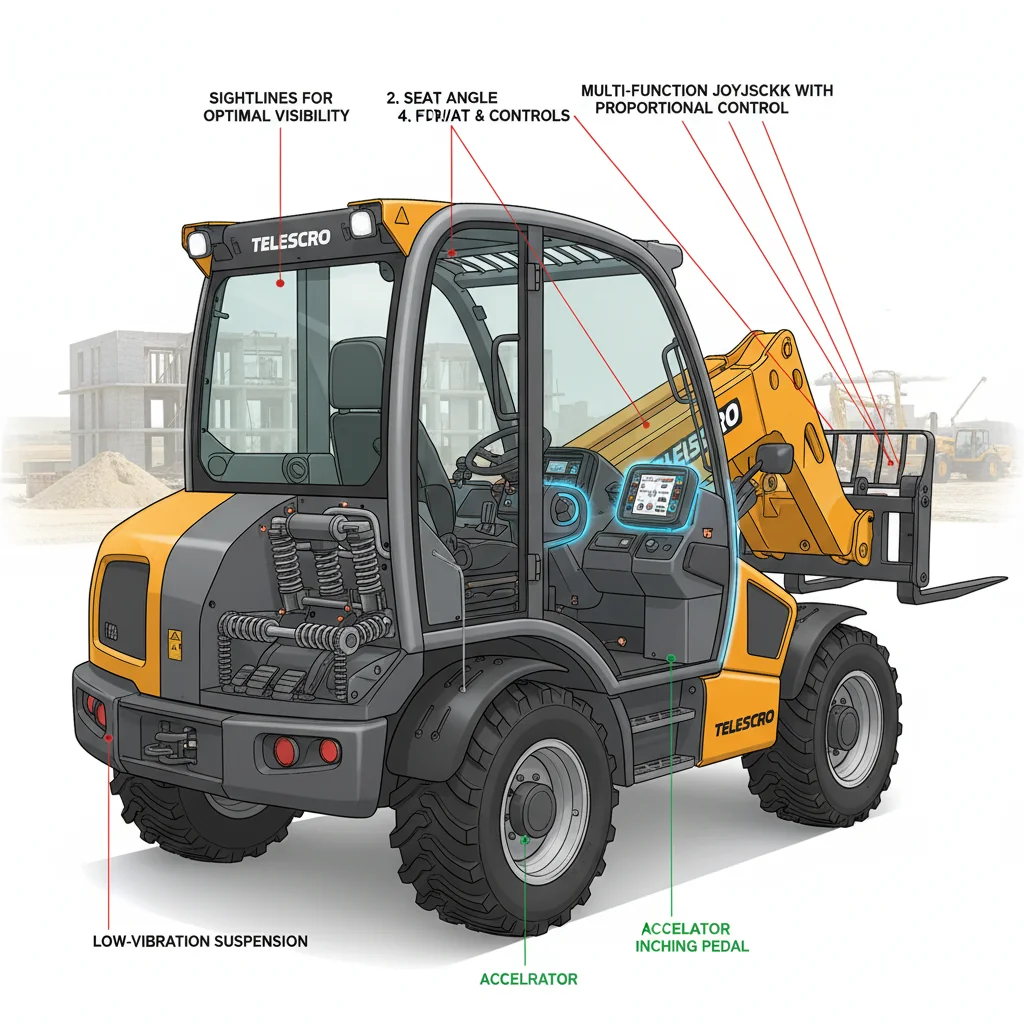
Last month, a contractor in Kazakhstan called me after upgrading to a new 4-ton telehandler with a fully adjustable cab and camera-assisted visibility. His crew saw an immediate difference—operators handled almost 25% more pallet movements per day, with fewer missed placements. He told me his old unit’s narrow windows forced drivers to lean and pause, especially near concrete columns. Those few seconds add up. When you swap in large glass panels and a good rear-view camera, suddenly every maneuver feels natural—no more creeping or second guessing around blind corners.
From my experience, the two biggest ergonomic wins are smooth joystick controls and low cabin vibration9. One customer in Brazil ran long shifts moving formwork panels 11 meters up. With his older machines, operators complained about stiff wrists and back fatigue by lunch, which led to mistakes late in the day. His new machines came with suspended seats and one-handed proportional joysticks—after two weeks, no one wanted to go back. That comfort matters when you expect people to stay alert for 12 hours in summer heat or on muddy ground.
Good sightlines might not seem urgent in the showroom, but on a crowded site, they dictate speed. I’ve seen jobs where poor visibility slowed each placement by over 30%—especially with tight steel frames or brick walls. Before you order, I suggest having your lead operator test the view and feel. If they stay relaxed threading a load onto a second-story scaffold, you know the machine can support safer, smoother cycles all shift long.
Telehandlers with multi-position adjustable seats and controls can reduce operator error rates by up to 30% compared to fixed-cab designsTrue
Adjustable ergonomics allow operators to maintain optimal posture and clear lines of sight, minimizing fatigue and spatial misjudgment, which leads to fewer operational mistakes and more accurate load placement.
Camera-assisted visibility systems on telehandlers are primarily designed to help with night operation by providing infrared imagingFalse
Most camera-assisted systems on telehandlers use standard optical cameras to improve visibility around blind spots during normal daylight operations; infrared capability is uncommon and typically not intended for general jobsite productivity.
Key takeaway: Investing in telehandlers with ergonomic cabs and enhanced visibility dramatically boosts productivity, as operators remain comfortable and alert on long shifts. Prioritizing these features allows faster, safer operation in tight jobsite conditions, leading to significantly more tasks completed per day and minimal workflow interruptions.
What Daily Checks Prevent Telehandler Downtime?
A disciplined 5-minute daily inspection10—covering tire pressure, boom wear pads and greasing, hydraulic oil levels11, leak detection, functional safety interlocks, and radiator cleanliness—significantly lowers the risk of unplanned breakdowns. Contractors and fleet managers consistently report fewer hydraulic failures, reduced overheating incidents, and more stable lift performance when operators follow structured daily checklists, regardless of how advanced the machine’s onboard diagnostics may be. These habits remain one of the most cost-effective ways to protect uptime and extend component life.
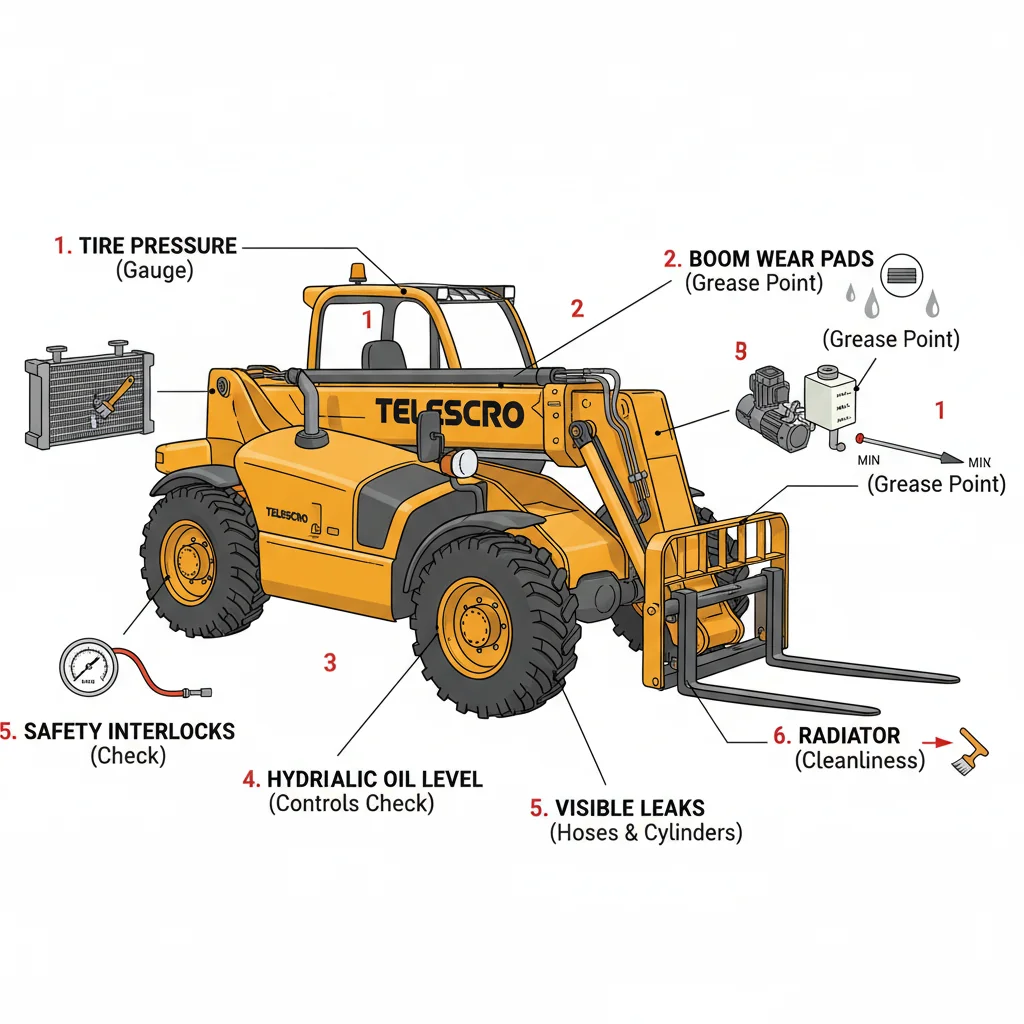
To be honest, a telehandler’s reliability comes down to five minutes at the start of each shift. I’ve seen crews in Oman breeze through their checklists, then wonder why their machines suddenly refuse to lift mid-morning. What really matters? A disciplined routine that looks beyond just the “big” issues.
For most sites, tire checks get skipped, but a low tire can cut stability and add strain to the driveline—especially if you’re lifting 2,500 kg loads across a rough jobsite. From my experience, the most costly downtime always seems to start small. Last year in Brazil, a fleet manager called me about repeated jerky boom movement. We found dry wear pads and zero grease at critical points. Expecting the machine’s diagnostics to catch early wear was a mistake. Even advanced models still rely on proper manual greasing and visual inspections.
I always recommend checking the boom wear pads for dry spots and making sure all grease nipples are actually clean and used. It’s a ten-second job that prevents a week of repair. Another area everyone overlooks is hydraulic oil. One leaking hose, and your jobsite grinds to a halt.
I met a team in Kenya who kept a spare return hose and filter on the service truck after two unplanned stops cost them at least two full working days. Keeping radiators clean pays off too—a dusty or clogged core can overheat the hydraulic circuit fast in summer conditions, dropping your power right when you need it.
Checking telehandler boom wear pads for excessive play each day can extend boom service life by over 20%.True
Daily inspection catches early signs of wear or misalignment in boom pads, preventing accelerated degradation and costly repairs. Consistent maintenance like this distributes loads evenly, reducing metal-on-metal contact and extending component life.
Operating a telehandler with one underinflated tire by 15% will only affect fuel consumption, not load stability or steering response.False
An underinflated tire alters the machine’s stance and load distribution, significantly impacting stability, steering response, and safe lifting capacity, especially when handling heavy loads on uneven ground.
Key takeaway: Consistent start-of-shift checks for critical items—tires, boom pads, hydraulics, and safety systems—prevent unexpected telehandler failures and cut downtime by up to half. Integrate these habits with checklists and quick audits for sustained jobsite productivity and lower long-term maintenance costs.
How does fuel efficiency affect telehandler costs?
Fuel efficiency directly impacts telehandler cost per ton handled. Newer models equipped with optimized hydraulics12 and smart power modes deliver 12–18% fuel savings under real jobsite conditions, while idling consumption drops by up to 15%. These improvements reduce both operating costs and emissions compliance risks, especially on high-hour or multi-shift projects.
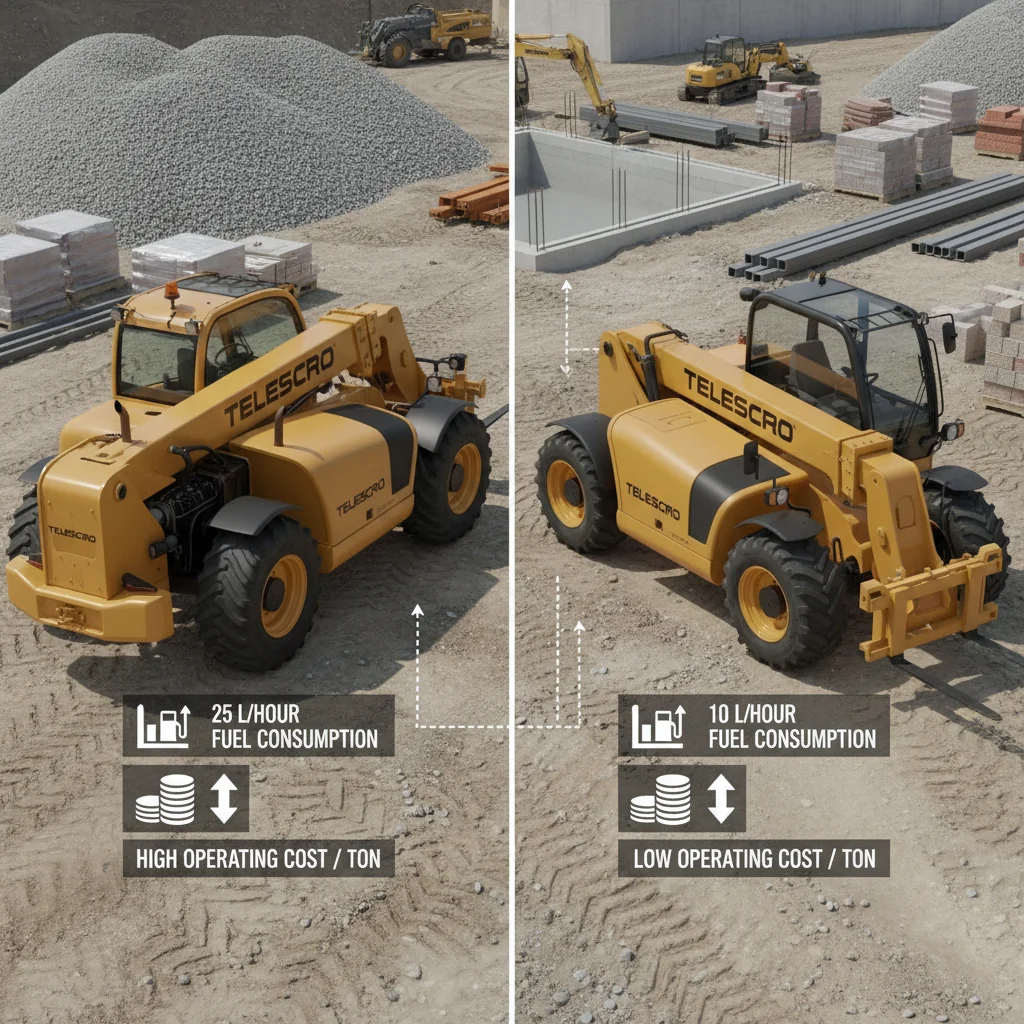
From my experience, buyers often underestimate how quickly fuel costs add up on a high-hour site. In Kenya, I worked with a contractor managing three telehandlers on a busy housing project. Running older units, their weekly diesel bill stayed stubbornly high despite steady workloads. Once they upgraded to models with auto-idle13 and smart power controls, they reported about 15% less fuel used per ton moved—even with the same operators and jobsite conditions.
The real savings come during idling and partial-load work. On urban jobs in Brazil, I’ve seen telehandlers idling for nearly half of each shift—mostly waiting on material. With optimized hydraulics and auto-shutdown, newer units now burn significantly less during those periods. That reduction—which looks small per hour—means thousands saved over a year. One Brazilian fleet manager told me their fuel expenses dropped by at least $240 per month per unit after switching machines.
Technical features make a difference. Efficient engines paired with load-sensing hydraulic circuits can boost lifting efficiency by 15-20%. Instead of wasting power as heat, more energy translates directly into lifting. So, a 4-ton telehandler might handle the same load with less strain than an older 4-ton model. Lower fuel use also means fewer emissions, which is critical on jobs with strict compliance rules—especially in city centers or when bidding on large infrastructure contracts.
I always suggest checking real-world fuel data—actual jobsite numbers—not just catalog values. Training crews to use eco-modes and shut down during longer pauses turns tech features into real savings. Over hundreds of hours, that’s money back in your pocket.
Telehandlers equipped with advanced auto-idle features can reduce total idling fuel consumption by as much as 30% on high-activity construction sites.True
Auto-idle technology automatically reduces engine RPMs during periods of inactivity, significantly decreasing fuel use during idling periods, which can account for a large fraction of operating hours on crowded job sites.
Using a telehandler with a larger engine always results in lower fuel costs per load moved.False
A larger engine does not guarantee improved fuel efficiency; in fact, oversized engines often consume more fuel unless the machine operates consistently at higher loads. Smart power management and right-sizing engine output for the application are more important factors in minimizing fuel costs per load.
Key takeaway: Upgrading to modern telehandlers with smart power modes and optimized engine technology can reduce fuel use per ton by 12–18%, directly lowering operating expenses and aiding emissions compliance. Operator training on eco features and idling habits further maximizes savings over hundreds of annual use hours.
How Do Telematics Improve Telehandler Productivity?
Telematics systems in telehandlers14 enable real-time monitoring of location, engine hours, utilization, idle time, and fault codes. Fleet managers use this data to reassign underused machines, optimize maintenance schedules, and benchmark productivity and fuel efficiency across sites, minimizing delays and maximizing total jobsite performance.
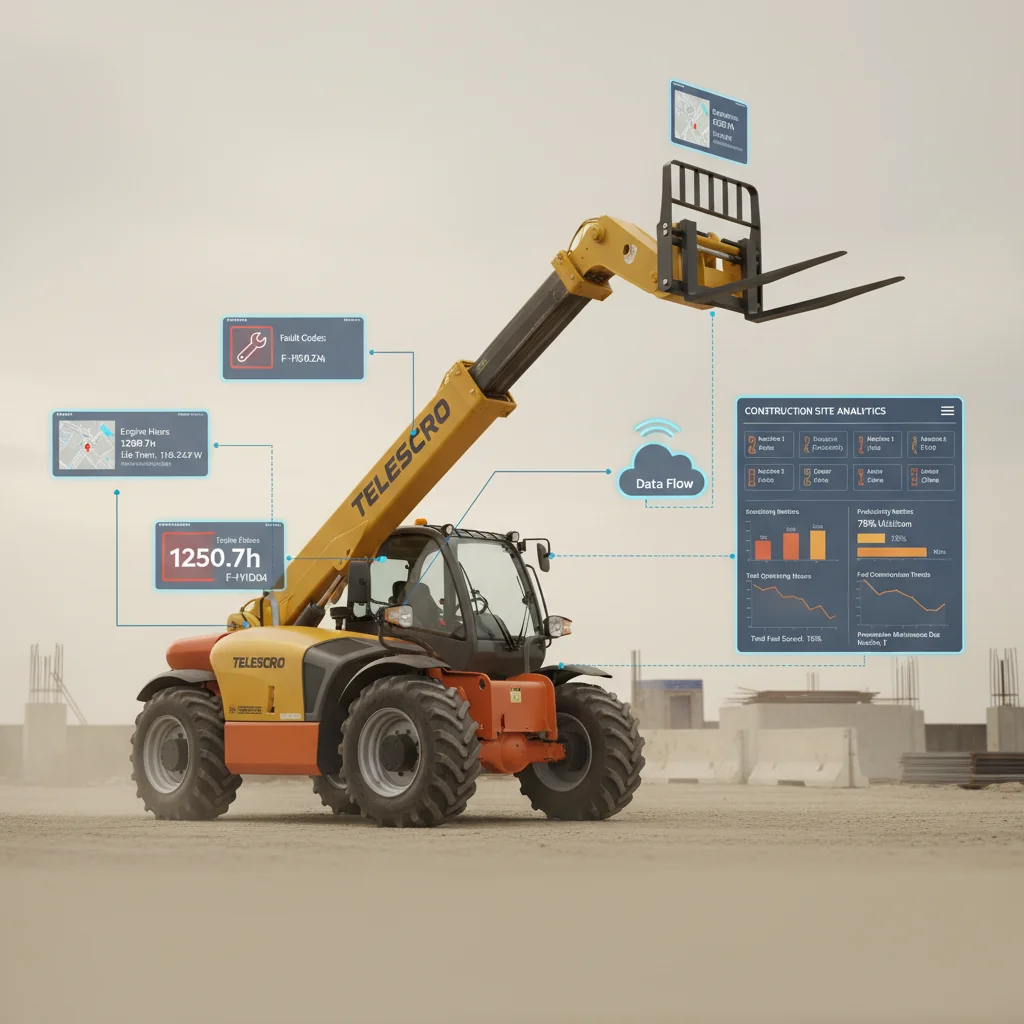
I always remind customers that you can’t manage what you don’t measure—telematics takes the guesswork out of telehandler productivity. Instead of relying on daily operator logs, you get real-time data: engine hours, exact GPS location, how often the machine is actually lifting, and even alerts for mechanical issues. This is especially important on jobsites with multiple units or when you’re renting equipment—you need to know if that 4-ton, 17-meter telehandler is used six hours or just sitting idle. I’ve seen cases in Dubai where managers spotted underutilized units and quickly moved them to busier sites. That alone saved at least two days of downtime and cut unnecessary rental costs.
Let me share a recent example from a contractor in Brazil. They had five telehandlers spread across three job sites—two of them spent over 40% of their time idling. The telematics report revealed it in a week, something paper logs never showed. They reassigned one idle unit to a critical steel erection project and scheduled preventive maintenance on another, triggered by a fault code before a breakdown happened. The difference? Productivity jumped significantly and unscheduled stoppages dropped.
Set your KPIs before you start. I usually suggest target utilization above 70% and keep idle time under 25%. Benchmark weekly, not just monthly—and always check your fuel burn per operating hour. Even on a smaller fleet, these numbers make a huge difference in true costs. I recommend choosing a telematics system that works with your other equipment software and supports mixed-fleet data. That’s how you turn data into results, not just dashboards.
Telematics systems can identify underutilized telehandlers by logging actual lift cycle counts and idle versus operating hours, leading to fleet optimization and reduced rental costs.True
With detailed activity data like lift cycles and hour-by-hour usage, fleet managers can spot which telehandlers are frequently idle, allowing them to adjust rentals or reassign assets, directly saving on unnecessary equipment costs.
Telematics data automatically adjusts the engine's hydraulic output in real time to optimize productivity without operator intervention.False
Telematics only collects and transmits data for monitoring and analysis. It does not directly control engine or hydraulic functions; adjustments still require operator input or manual reprogramming.
Key takeaway: Telematics delivers actionable data that lets managers optimize telehandler deployment, right-size machine fleets, schedule preventive maintenance, and control costs based on real utilization and idle rates. Consistent KPI tracking helps ensure every telehandler meets productivity targets, driving measurable efficiency gains on any jobsite.
How Does Standardizing Telehandler Models Boost Productivity?
Standardizing telehandler models and training simplifies jobsite operations by reducing operator learning curves, minimizing training duration by up to 50%, and streamlining attachment compatibility15. Uniform controls and interchangeable components accelerate machine handovers, lower parts inventory requirements, and enable immediate productivity gains, as any qualified operator can confidently operate any standardized unit.
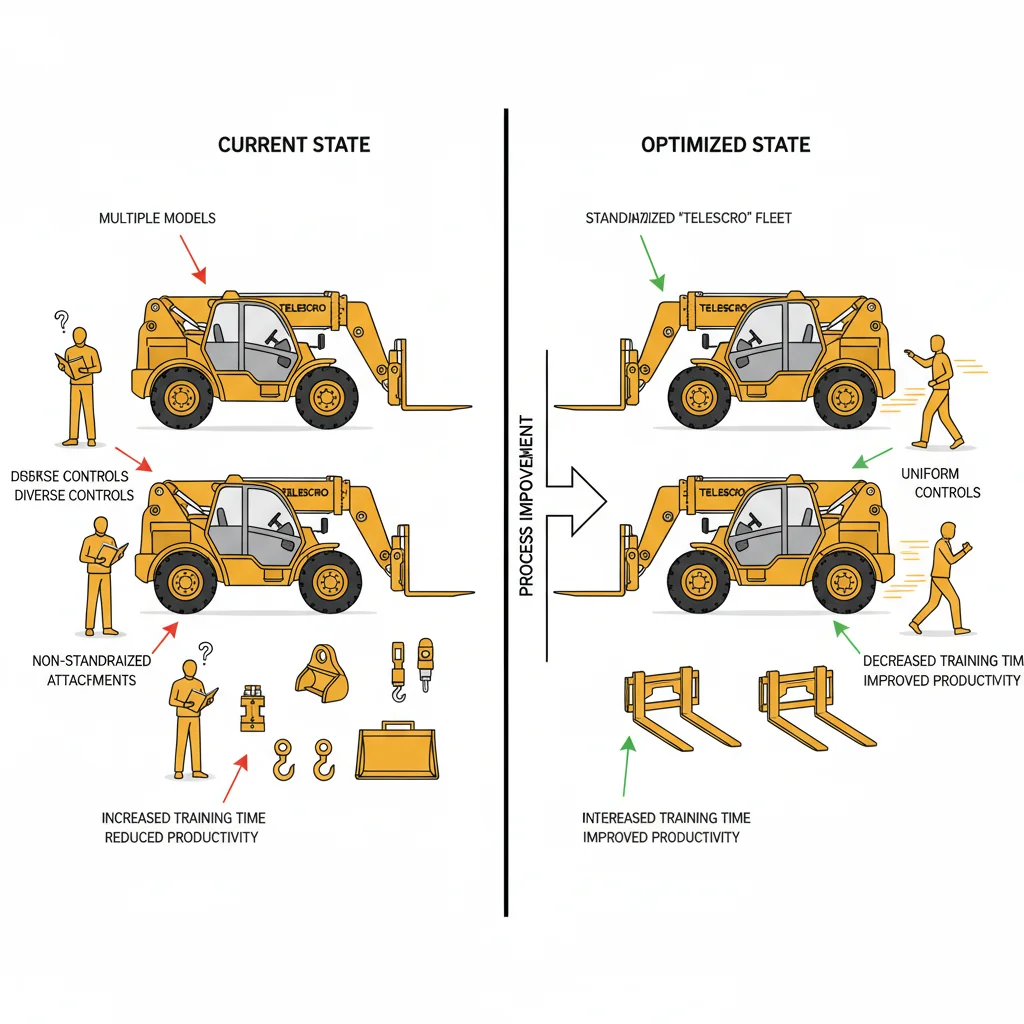
Here’s what matters most when you want to boost jobsite productivity: every minute your crews spend figuring out which button does what, or swapping mismatched attachments, is time lost. I’ve seen this firsthand in Brazil, where a contractor ran three different telehandler models—each with its own control patterns and hydraulic coupler design. On that project, operator training stretched for nearly a week, and swapping attachments meant dragging out three separate sets of forks and buckets. Not only did it slow them down, but it also led to more mistakes—like connecting the wrong hydraulic lines and damaging hoses.
When you standardize on a core model—let’s say a 3.5-ton, 14-meter unit—things change fast. Any trained operator can jump in and get to work without hesitating, even if they last drove another unit weeks ago. I’ve watched crews in Kenya cut their training time by half just by switching to identical machines across multiple sites. With standard quick couplers, all attachments—buckets, man baskets, truss booms—can be swapped in minutes. No more “parts roulette” hunting through the yard for the right fitting. Even maintenance gets easier since you only stock one set of spare parts and filters, which keeps your downtime low.
One detail I always highlight: make sure your training covers real-world jobs. I suggest one or two full days of hands-on instruction for each operator, with a big focus on safety systems and how to switch out attachments on the fly. Once everyone is fluent in the same controls and attachments, job starts are faster, operator errors drop, and productivity stays high—no matter who’s on shift.
Standardizing telehandler models on a jobsite can reduce total operator training time by up to 60% compared to using a mixed fleet with different control layouts.True
When all machines share the same controls and attachment interfaces, operators only need to learn one system. This significantly decreases onboarding and cross-training periods, freeing up skilled labor for productive work sooner.
Standardizing telehandler models eliminates the need for daily pre-use inspections because all machines operate identically.False
Even with standardized models, daily pre-use inspections remain essential to identify wear, leaks, or component failure. Uniformity does not replace safety requirements or manufacturer-recommended maintenance checks.
Key takeaway: Standardizing telehandler models and structured training enable faster job starts, fewer operator errors, and consistent high productivity by creating uniformity in controls, attachments, and skills across crews and job sites.
When Is Buying vs. Renting a Telehandler Best?
Choosing between new, used, or rental telehandlers depends on projected annual usage and jobsite needs. High utilization (800–1,500 hours/year) favors new ownership for reliability and modern safety systems. For light duty, a serviced used unit16 can be cost-effective. Rental is optimal for peak, short-term demand. Always compare total cost per productive hour17.
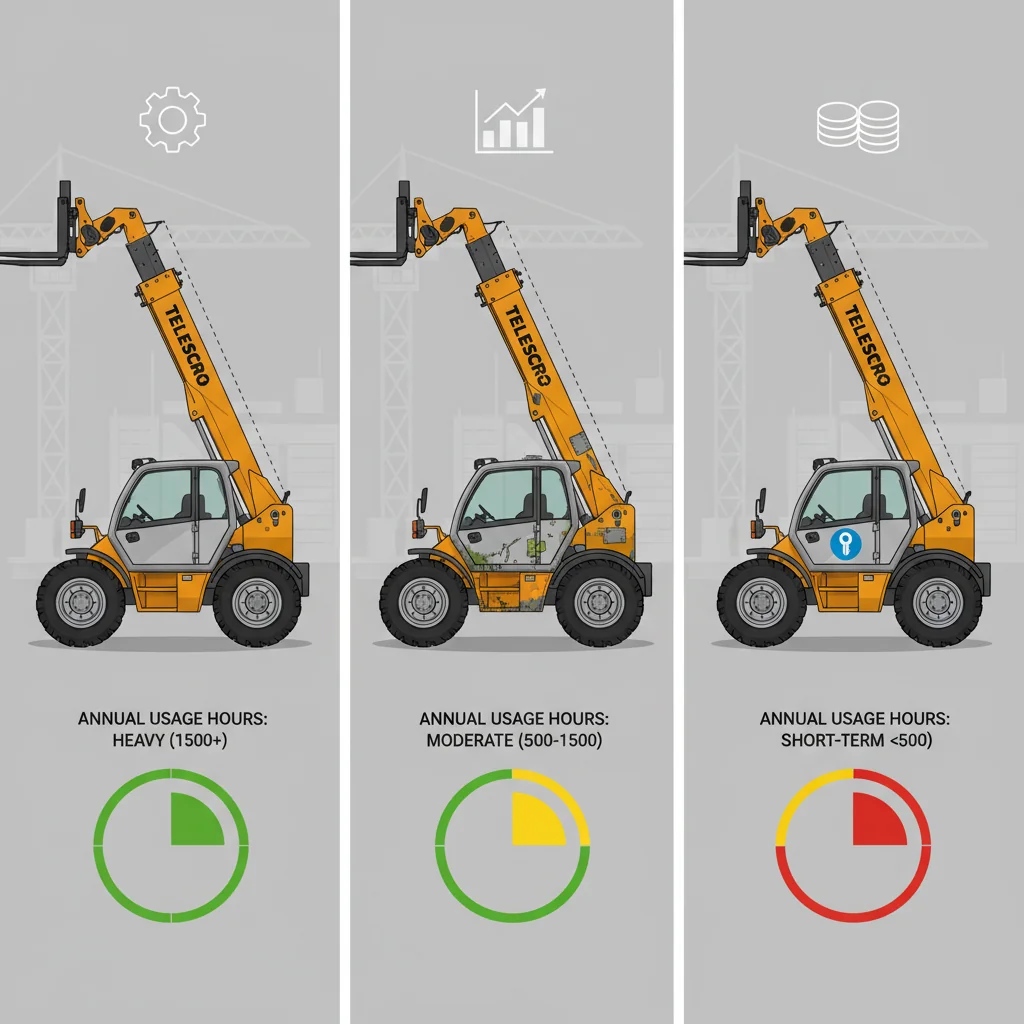
Here’s what matters most when deciding if you should buy or rent a telehandler: estimate your monthly utilization as honestly as you can. If you’ve got a pipeline of core projects—say, a concrete contractor in the UAE running two shifts and averaging well over 1,000 hours per year—a new mid-size unit makes sense. Modern models don’t just bring better lift and safer moment indicators. You also avoid the stress of a rental fleet that’s booked out during peak season. On a site in Dubai last summer, I watched a client lose three working days when a rental machine was yanked for a higher-paying job. Productivity took a bigger hit than their rental savings.
For lighter or more unpredictable needs, a serviced used machine can work well—if you check the service logs, inspect for hydraulic leaks, and confirm that boom wear is within standard limits. I’ve helped a team in Kenya get three years of reliable performance from a 4-ton, 12-meter reach model they bought used for half the price of new. But the trick is verifying the safety electronics and making sure parts are available. If you’re stuck waiting a week for a simple joystick or relay, that deal falls apart fast.
Short-term rental really shines for sudden workload spikes. On a six-month high-rise facade job in Malaysia, one customer rented two extra telehandlers for just that period, kept core equipment costs down, and returned the machines before the rainy off-season. My advice? Always break down the total cost per actual working hour, not just the upfront price. That’s what keeps projects—and budgets—on track.
Telehandlers equipped with advanced boom position sensors can cut load placement time by up to 30%, directly increasing job site productivity.True
Boom position sensors provide operators with precise feedback, enabling faster and more accurate placement of materials at height, which reduces rework and waiting times on busy job sites.
Renting a telehandler always provides more uptime than owning, because rental companies guarantee immediate replacement for any breakdown.False
While reputable rental companies often offer support, immediate replacement during breakdowns cannot be guaranteed, especially during high-demand periods, meaning your job site productivity can still be impacted by equipment unavailability.
Key takeaway: Match telehandler acquisition to jobsite demands. High-usage fleets benefit most from new equipment, while lower or variable use justifies used or rental. Focus on reliability, safety, and total productive hour cost—not just headline price—to maximize jobsite productivity and avoid avoidable project delays.
How Will Automation Boost Telehandler Productivity?
Future automation will significantly enhance telehandler productivity by introducing features such as semi-automated boom positioning, return-to-dig functions, obstacle detection, and advanced telematics. These advancements will streamline repetitive tasks, enable more predictive maintenance planning and help operators work closer to the rated load chart with greater consistency, allowing telehandlers to handle a broader range of jobsite applications more efficiently.
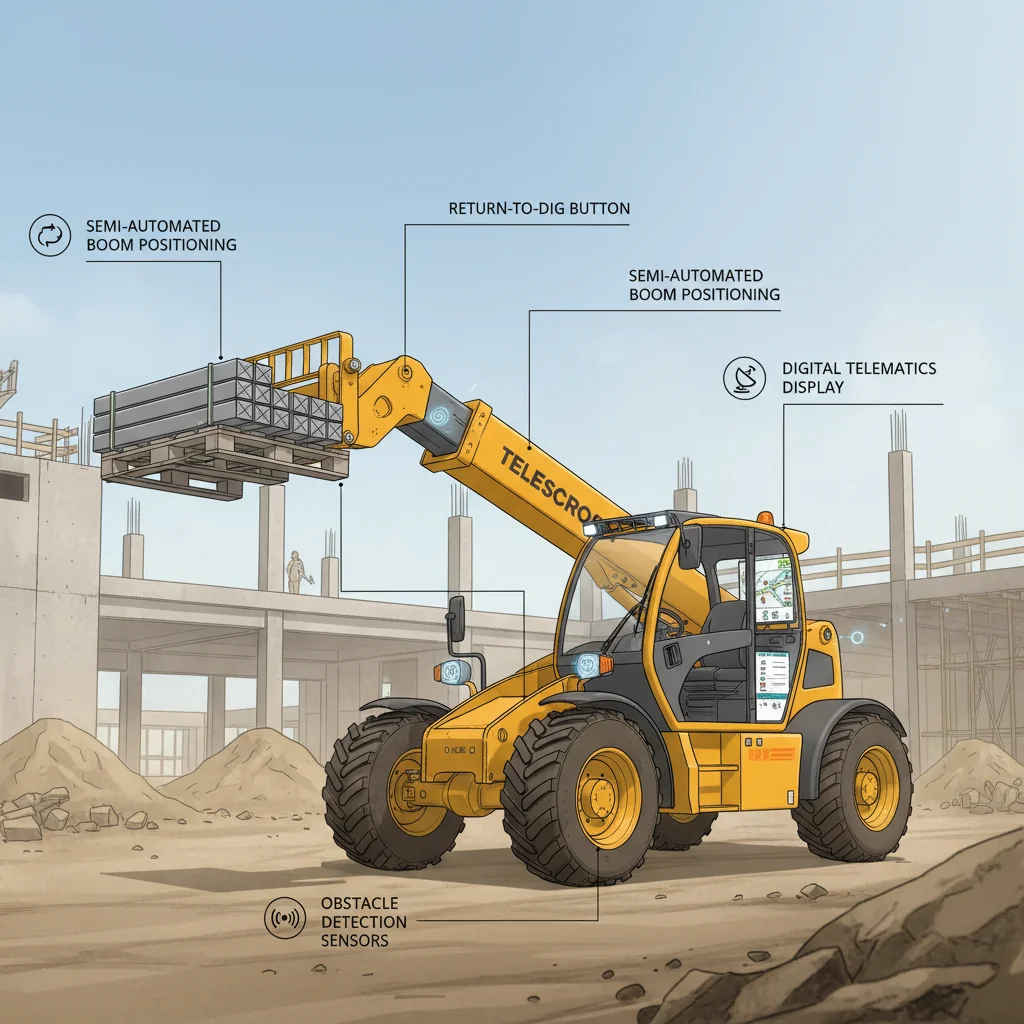
Here’s what matters most when looking at automation in telehandlers: the best systems don’t just handle tasks for you—they let operators work faster, safer, and with less stress. A few months ago, I worked with a concrete crew in Brazil testing a new 4-ton telehandler fitted with semi-automated boom positioning. Their team was able to set return-to-load and return-to-dig memory points, so the machine consistently cycled the boom between the floor and the second story platform. The result? Each lift was almost 20 seconds faster, and the operator could focus on site traffic instead of constantly adjusting boom angle.
I’ve also seen real benefits with advanced telematics in Kenya, where a contractor used predictive maintenance alerts on a 3,500 kg unit. The onboard diagnostics spotted a hydraulic pump issue before the machine failed—avoiding at least two days of downtime. Jobsites don’t have spare machines sitting idle, so this kind of foresight means big savings in both time and cost.
Obstacle detection and collision avoidance are starting to show up too, especially where space is tight. Last year, I visited a project in Dubai where a high-reach model with sensors helped prevent accidental hits on steel columns. With extended booms—15 meters or more—blind spots can end up costing money or injuring someone.
If you plan to keep your fleet for several years, I suggest choosing telehandlers with upgradeable software and open telematics. That way, as more automated functions become practical, your machines can stay productive and competitive without a major overhaul.
Semi-automated boom positioning in telehandlers can reduce cycle times by up to 30% when repeatedly shuttling materials between fixed heights.True
With programmable memory points, the operator can automate repetitive movement sequences, allowing the machine to return precisely to preset positions, which streamlines operations and minimizes manual adjustments, significantly speeding up material handling cycles.
Automated telehandler systems function independently from operator input during load placement, fully eliminating the need for manual control.False
Current telehandler automation focuses on assisting and enhancing operator actions—such as guiding or repeating movements—and still requires the operator to supervise, initiate commands, and make safety decisions, particularly when placing loads in complex or changing site conditions.
Key takeaway: Automation will drive real jobsite gains by enabling semi-automated functions, predictive maintenance, and increased lift capabilities. Contractors should prioritize telehandlers with upgradeable software and open telematics platforms to ensure long-term productivity and adaptability as new features and integrations become practical in the industry.
Conclusion
We’ve looked at how telehandlers can clear a lot of bottlenecks by moving materials directly from the delivery truck to where you actually need them. It’s simple, but those hours saved each day really add up on a busy jobsite. From what I’ve seen, the contractors who get the most value choose their machines based on load charts and reliability, not the biggest headline specs. Before you decide, my advice is to check the load chart at your common reach, and ask suppliers about parts support—that’s where “parts roulette” can cost you later. If you’re weighing different telehandler options, or just need a second opinion, I’m always happy to help. The right choice depends on real jobsite needs, not just what looks good on paper.
References
-
Explore detailed insights on how cutting cycle times boosts material handling speeds and construction productivity, backed by real project data. ↩
-
Understand load charts to ensure safe lifting by matching telehandler capacity to load weight and reach, preventing costly delays. ↩
-
Explains how man baskets convert telehandlers into mobile work platforms, improving safety and efficiency for elevated tasks. ↩
-
Explore detailed benefits of telehandler versatility, including reduced machine transfers and improved logistics efficiency on job sites. ↩
-
Learn how quick coupler attachments maximize telehandler use by enabling fast switching between forks, buckets, and lifting hooks for diverse tasks. ↩
-
Details how lifting jibs handle irregular loads safely and reduce rigging challenges for construction and masonry jobs. ↩
-
Explores how reducing operator training time by up to 50% improves efficiency and cuts costs on construction sites. ↩
-
Explore how ergonomic cabs enhance operator comfort and efficiency, reducing fatigue and increasing task completion by up to 25%. ↩
-
Learn why low cabin vibration minimizes operator fatigue and errors during long shifts, boosting safety and productivity in harsh conditions. ↩
-
Detailed insights on how a quick 5-minute daily check reduces downtime by 30-50%, saving costly repairs and extending equipment life. ↩
-
Explains the importance of monitoring hydraulic oil levels and leak detection to avoid failures and maintain telehandler performance. ↩
-
Explore how advanced hydraulic systems reduce fuel consumption and boost lifting efficiency in telehandlers with real-world data. ↩
-
Learn how auto-idle features minimize fuel waste during idling, significantly lowering operating expenses on construction sites. ↩
-
Explore how telematics enables real-time machine monitoring and optimizes utilization, maintenance, and jobsite efficiency for fleet managers. ↩
-
Details the benefits of uniform attachment compatibility in reducing downtime and enabling fast tool swapping on jobsites. ↩
-
Learn key inspection points for serviced used telehandlers to ensure reliability and safety, including service logs and hydraulic checks. ↩
-
Explore methods to accurately calculate telehandler costs per productive hour, aiding smarter buy vs rent decisions with real-world factors. ↩