










What Power Sources Do Telehandlers Use? Field Guide for Buyers
Not long ago, I watched a team in Germany struggle to meet new emissions rules with their old diesel telehandlers1—while a warehouse site in Singapore was happily running battery-electric units all shift. It’s fascinating how the right power source can make or break a job, depending on where and how the machine’s used.
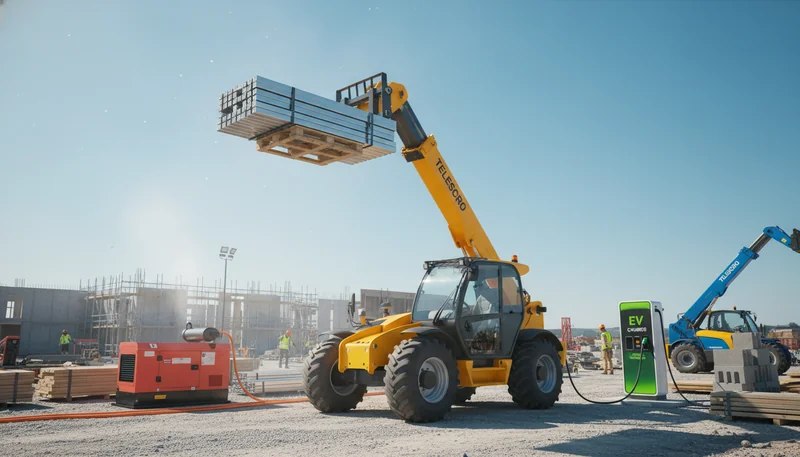
Telehandlers today are powered mainly by diesel or battery-electric systems, with hydrogen fuel cells emerging in select pilot projects. LPG or dual-fuel options exist in some markets and applications, but availability varies by OEM and region. Diesel dominates construction fleets worldwide for its torque, runtime, and quick refuelling, but faces increasing regulatory pressure due to noise and emissions. Battery-electric models provide near-silent, zero-emission operation, making them best for indoor, urban, or environmentally sensitive applications, but require planned charging and suitable site power.
Why Are Diesel Telehandlers So Dominant?
Diesel engines remain the dominant power source for telehandlers worldwide, especially in rough-terrain construction applications where long runtime and high torque are critical. Their advantages include strong low-speed torque, full-shift operating capability, and quick refuelling. However, newer Stage V/Tier 4 Final diesel units2 incorporate additional emissions control systems3, while older-generation engines are still commonly used in regions with less stringent emissions regulations.
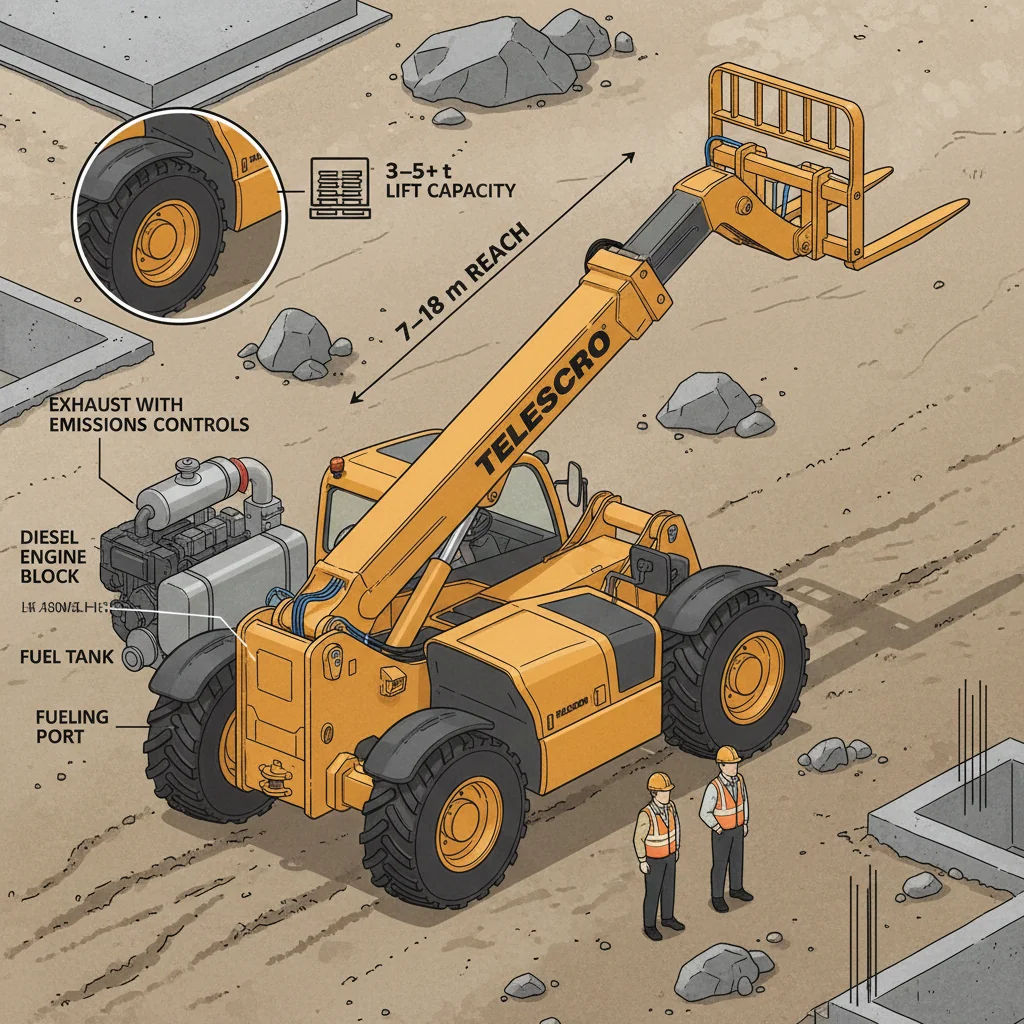
The biggest reason diesel telehandlers dominate many jobsites is their ability to deliver reliable power over long shifts. I’ve visited dusty limestone quarries in Morocco and seen 4-ton-class machines with around 14-meter reach running continuously, moving crushed rock throughout the day. These units are typically equipped with industrial diesel engines paired with hydrostatic or powershift transmissions, designed to maintain stable hydraulic performance under sustained load. With large onboard fuel tanks, operators can usually complete a full working shift on a single fill, and refuelling takes only a few minutes—even on remote sites.
Last year, a customer in Kazakhstan operated rough-terrain telehandlers on a wind farm project with no grid power. The machines had to handle heavy nacelle components—sometimes on muddy, uneven ground—making battery-electric options impractical for that site. Diesel units provided strong low-speed torque and stable engine speed under load, helping maintain consistent hydraulic performance when lifting near working limits in difficult conditions.
Buyers often ask about Stage V or Tier 4 Final machines, especially in Western Europe or the Middle East. Many of these models use exhaust aftertreatment systems such as DPF and, in some cases, SCR with AdBlue (DEF), which adds monitoring and maintenance considerations. In less regulated markets—such as parts of Africa or Southeast Asia—older Tier 2 and Tier 3 machines are still widely used, offering simpler engine designs and fewer electronic systems.
For projects involving heavy outdoor lifting away from urban or emissions-restricted areas, diesel remains a practical and widely supported choice. However, local emissions regulations should always be reviewed before purchasing or importing a new unit.
Diesel telehandlers can maintain consistent lifting performance even when operating in high-dust or extreme temperature environments.True
Industrial diesel engines are engineered to tolerate harsh site conditions, with advanced filtration and cooling systems that protect performance where electric or gas-powered alternatives may degrade.
Most telehandlers on today’s jobsites rely on compressed natural gas (CNG) engines for their primary power source.False
In reality, diesel engines are the industry standard for telehandlers due to their torque and fuel efficiency; CNG-powered telehandlers are rare and not widely adopted in heavy construction.
Key takeaway: Diesel telehandlers remain the primary choice for demanding outdoor work due to their robust performance, long runtime, and refuelling ease. Buyers should consider emissions compliance for newer models, especially in regions with strict environmental regulations or low-emission zones.
When Are Battery-Electric Telehandlers Ideal?
Battery-electric telehandlers excel in environments with strict noise or emission limits, such as warehouses, tunnels, food production, and urban jobsites. Electric drivetrains provide near-silent operation, zero tailpipe emissions, and instant torque. However, usable runtime and productivity depend on battery capacity, duty cycle, and available charging infrastructure, making these models best suited to applications with planned charging opportunities and predictable work patterns.
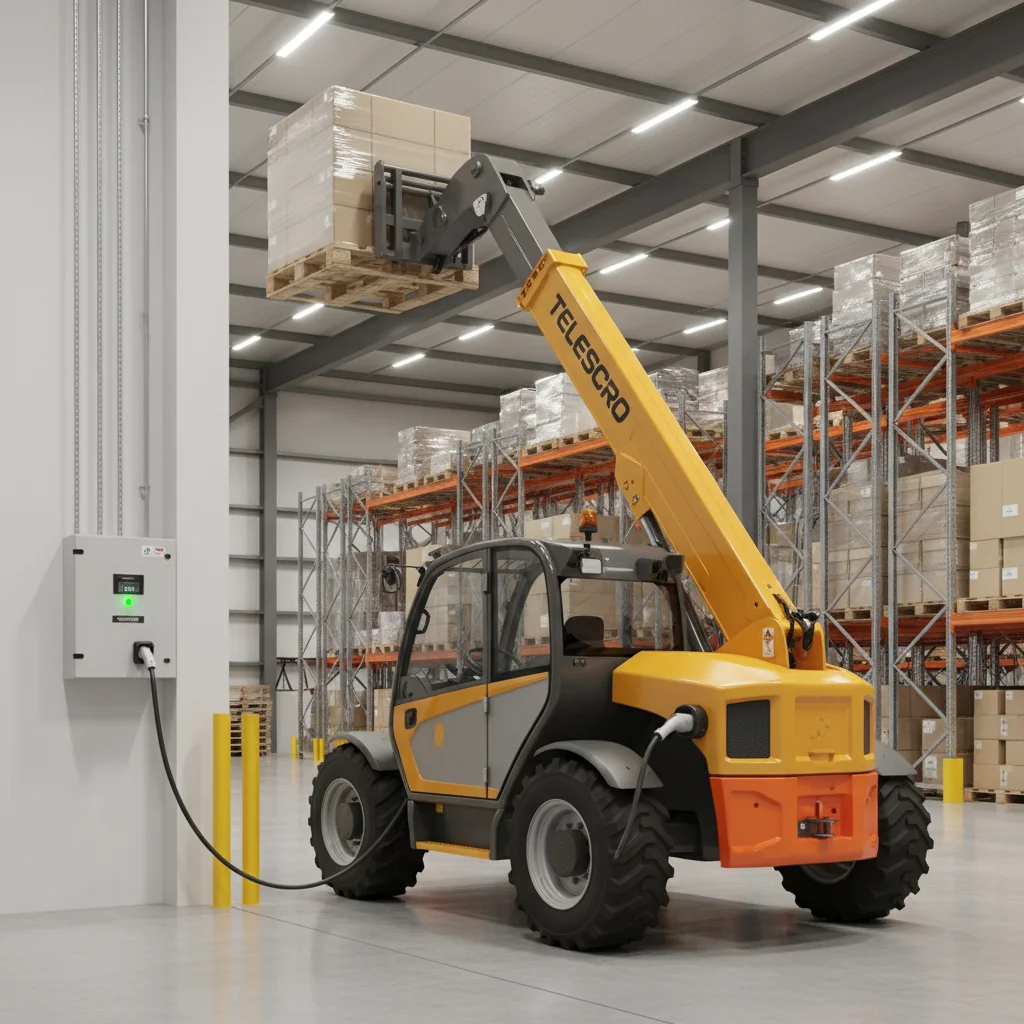
Let me share an important point about battery-electric telehandlers: they are not just a “green” option—they can deliver strong performance when applied under the right conditions. I worked with a logistics hub in the Netherlands where diesel machines were not permitted indoors. Their team successfully operated compact electric telehandlers throughout a full working day by combining suitable battery capacity with planned charging during natural breaks, such as lunch or shift changes. The near-silent operation made a clear difference, allowing normal communication on the warehouse floor without engine noise.
Battery-electric units perform best in regulated environments such as warehouses, food processing facilities, tunnels, underground projects, and dense urban sites where noise and exhaust emissions are restricted. Zero tailpipe emissions help maintain indoor air quality, and electric drivetrains provide immediate, smooth torque response. From a maintenance perspective, the absence of engine oil, fuel filters, and diesel aftertreatment systems simplifies routine servicing, shifting the focus mainly to battery management, hydraulics, and lubrication.
However, workflow planning is essential. I have also seen outdoor projects struggle when electric telehandlers were introduced without adequate charging access or realistic duty-cycle planning. Under sustained heavy lifting, usable runtime can be significantly shorter than a full shift, making charging strategy a critical part of deployment. Buyers should verify available site power, charger specifications supported by the machine, and realistic operating intensity, and then plan charging windows accordingly. When these factors are aligned, battery-electric telehandlers can deliver reliable productivity; when they are not, diesel remains the more practical option.
Battery-electric telehandlers are especially advantageous in environments with strict air quality regulations because they emit no exhaust gases, making them suitable for indoor use where diesel-powered machines are restricted.True
Since battery-electric telehandlers do not produce harmful emissions, they can safely operate in confined or poorly ventilated spaces where internal combustion engines would not meet local air quality standards.
All telehandlers with battery-electric powertrains are capable of continuous 12-hour operation without the need for charging breaks.False
Most current battery-electric telehandlers are not designed for uninterrupted all-day shifts; frequent or heavy-duty use generally requires scheduled charging breaks or battery swaps, depending on battery capacity and workload.
Key takeaway: Battery-electric telehandlers are best suited for regulated environments where zero emissions, low noise, and flexible charging opportunities are essential. They deliver strong performance for shifts up to 8 hours, provided that site power can support fast or overnight charging, making them ideal for many indoor and urban applications.
How Do Telehandler Battery Types Compare?
Telehandlers use flooded lead‑acid, TPPL, and lithium‑ion (LFP) batteries4. Flooded lead‑acid offers low cost and high recyclability but needs significant maintenance and slow charging. TPPL improves cycle life and charging convenience. LFP lithium‑ion enables fast charging, minimal maintenance, and best uptime, especially for high‑duty indoor/outdoor fleets.
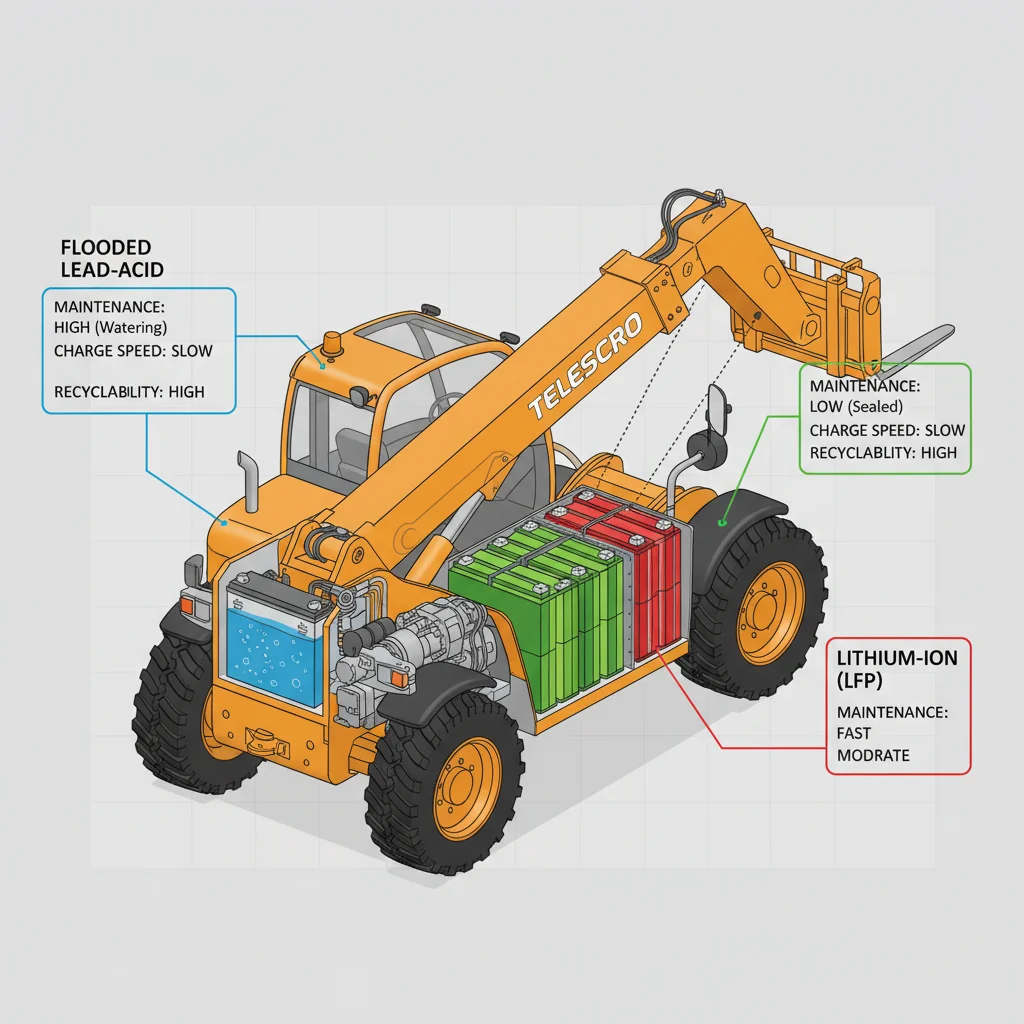
Here’s what matters most when choosing a telehandler battery: the right technology saves you hours on the job and headaches in the workshop. Too many buyers zero in on upfront cost without thinking about daily maintenance or long-term downtime. I learned that the hard way while helping a concrete contractor in Dubai last year. They picked the cheapest flooded lead-acid pack for their 3.5-ton telehandler—fine for light use, but a disaster once two-shift operation kicked in. The crew spent an extra hour every day just checking water levels and running equalization charges. Their productivity dropped fast.
If you’re trying to balance budget with work demands, take a look at the real-world differences in this comparison table:
| Battery Type | Typical Shift Suitability | Charging Characteristics | Maintenance Need | Typical Cycle Life* | Best For |
|---|---|---|---|---|---|
| Flooded Lead-Acid | Limited / single shift | Long recharge, no fast charging | High (watering & equalizing) | Lower, duty-cycle dependent | Budget-focused fleets, light duty, single-shift use |
| TPPL (Pure Lead) | Medium to multi-shift | Faster than flooded, limited opportunity charging | Low (sealed, no watering) | Medium, duty-cycle dependent | Medium-duty fleets seeking less maintenance complexity |
| Lithium-ion (LFP) | High, multi-shift capable | Fast and opportunity charging | Minimal | High, duty-cycle dependent | High-utilization fleets, urban/indoor, predictable use |
- Actual cycle life and uptime vary significantly by battery supplier, charging strategy, temperature, and operating intensity.
To be honest, if you’re running mixed indoor/outdoor jobs or two shifts per day, LFP lithium-ion cuts your lost time in half. It’s basically plug and play between breaks.
"Lithium-ionFalse
"Lithium-ion
All telehandler battery types are equally suited for extended multi-shift operations, as long as they meet the machine’s voltage requirements.False
Flooded lead-acid batteries can struggle in multi-shift environments due to their lengthy charging times and maintenance needs, while lithium-ion and some AGM batteries maintain capacity and allow for opportunity charging, making them better suited for high-utilization schedules.
Key takeaway: Battery technology choice impacts telehandler uptime, maintenance needs, and long-term cost. Lithium-ion (LFP) is optimal for high-use or urban operations, while lead-acid types suit budget-limited or lower-demand roles. Understanding these differences is essential for buyers seeking the best fit for their application.
Where Do LPG Telehandlers Fit In?
LPG and dual-fuel telehandlers6 are available in certain markets and applications, though they are far less common than diesel or battery-electric models. Where offered, LPG power can reduce particulate emissions compared to diesel, making it a potential option for semi-indoor or well-ventilated environments when electric telehandlers are impractical. Dual-fuel variants add operational flexibility through gasoline backup, but typically involve higher fuel costs and shorter runtime.

Most people don’t realize that LPG telehandlers hit a real sweet spot for mixed indoor and outdoor work. In well-ventilated warehouses or partially enclosed sites, diesel exhaust often triggers complaints—and electric models just aren’t practical when you need mid-shift refuelling or long run times. I’ve worked with rental fleets in Dubai and South Africa where LPG units let crews move heavy loads inside logistics centers without the harsh smell or smoke you get from diesel.
Rapid refuelling is one of the biggest advantages. I’ve watched teams swap out an LPG cylinder in under five minutes—much faster than charging batteries or waiting for a diesel tank truck. One customer in Brazil told me their LPG telehandler (rated at 3,500 kg with a 12-meter reach) worked two full shifts on a standard 33 kg bottle, even in high-utilization environments. That kept productivity up and downtime low, especially when the jobsite couldn’t install a full electric charging bay.
Dual-fuel models, which can run on both LPG and gasoline, also have a place—mainly on remote jobs where LPG supply is unpredictable. Gasoline burns faster and costs more, but it’s a useful backup if your LPG delivery is delayed. You still need to monitor air quality. Even though LPG outputs less soot and fewer particulates, carbon monoxide and CO₂ are still present. I always suggest checking local ventilation and fire safety requirements before bringing these units indoors. That small step can save a lot of headaches down the line.
LPG-powered telehandlers produce significantly less particulate matter than diesel models, making them better suited for use in enclosed or semi-enclosed environments where air quality is a concern.True
Unlike diesel combustion, LPG combustion generates very little soot and particulate output, which is why LPG machines are often allowed where diesel is restricted due to indoor air quality requirements.
LPG telehandlers cannot operate outdoors in cold weather because low temperatures prevent the engine from starting reliably.False
LPG engines can operate in a wide range of temperatures, as LPG fuel systems and engines are designed to function even in cold climates. Outdoor use in winter is not an inherent limitation for LPG telehandlers.
Key takeaway: LPG and dual-fuel telehandlers provide rapid refuelling and reduced emissions compared to diesel, making them ideal for semi-indoor tasks, rental fleets, and mixed-use applications—especially where diesel fumes are a concern but electric isn’t feasible. Always follow local ventilation and safety regulations when operating these models.
Are hydrogen fuel cell telehandlers practical?
Hydrogen fuel cell telehandlers offer rapid refueling and zero emissions at point of use, making them attractive for industrial sites with hydrogen infrastructure. However, as of today, these machines remain in the prototype or pilot stage, primarily limited by high costs and limited hydrogen supply7.
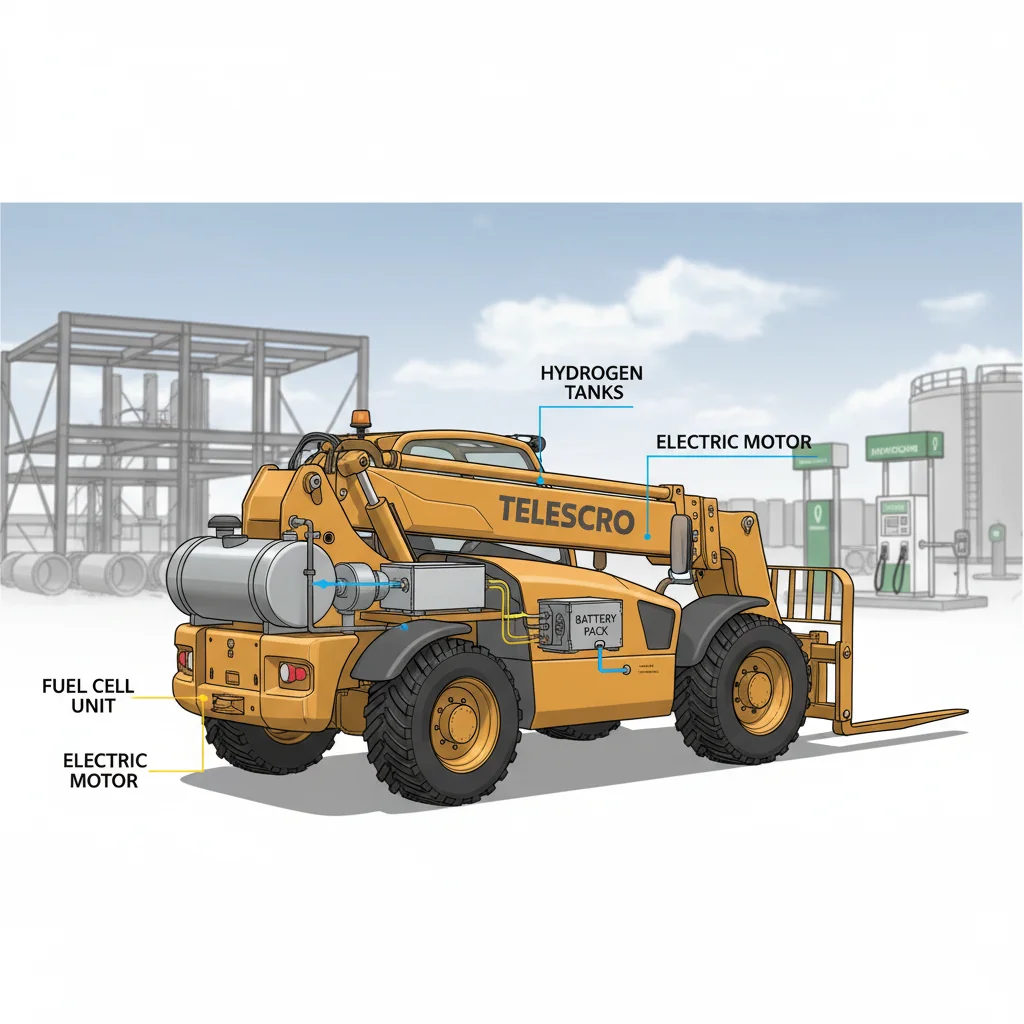
Let me share something important about hydrogen fuel cell telehandlers—they sound perfect on paper, but the real-world situation is more complicated. I’ve seen a lot of interest from ports in the Netherlands and China where zero emissions are a hard requirement. These sites sometimes already handle hydrogen-powered trucks or forklifts, so it’s possible to set up the refueling and safety protocols. Refueling a fuel cell telehandler can take only five or six minutes, which is fast—much better than charging a battery machine. And these units run quietly, with only water vapor coming out of the exhaust.
But here’s the thing. Outside of these few industrial campuses, the story changes quickly. Most job sites—whether it’s a construction project in Kenya or a farm in Brazil—have no access to safe hydrogen storage or reliable supply. One customer in Dubai asked me if he could just truck in hydrogen like diesel, but the logistics are expensive and you need special pressure vessels and strict handling rules. The upfront cost of a hydrogen fuel cell telehandler is at least two or three times higher than a standard diesel model, and service support is still limited.
From my experience, contractors and rental fleets care about uptime and support more than new tech—even if it’s green. If you’re running a major port or a distribution hub with existing hydrogen assets, it could make sense to pilot one unit. For almost everyone else, I suggest looking at battery-electric or modern diesel machines for now. These have more proven performance, lower total cost, and much easier support.
Hydrogen fuel cell telehandlers require specialized high-pressure storage tanks to safely contain compressed hydrogen gas, which adds complexity compared to diesel or battery-electric models.True
Hydrogen is stored at high pressures in specialized tanks to ensure sufficient energy density for practical use. This necessitates advanced containment systems and safety protocols, making hydrogen telehandlers more complex than those using conventional fuels.
Most telehandlers on the market today are powered primarily by hydrogen fuel cells, with diesel and electric models making up a small minority.False
In reality, the majority of telehandlers currently in use are diesel-powered, with electric models growing in availability. Hydrogen fuel cell telehandlers are still emerging and represent only a small fraction of the global telehandler market due to infrastructure, cost, and technology constraints.
Key takeaway: Hydrogen fuel cell telehandlers are promising for zero-emission operations but remain impractical for widespread use due to infrastructure and cost barriers. They may suit ports or logistics hubs with existing hydrogen systems, but for most buyers, diesel or battery-electric models are currently more viable options.
How does duty cycle affect telehandler power choice?
Duty cycle—how long and intensively a telehandler operates—directly determines the best power source. Low-hour, intermittent use often fits lead‑acid or modest lithium battery packs8, while high-demand, lengthy shifts typically require diesel or high-capacity lithium systems. Proper matching ensures reliable runtime and efficiency for both indoor and outdoor operations.

The biggest mistake I see is buyers choosing a telehandler based on power source first—even before thinking about how the machine will actually be used. Duty cycle always comes first. I once advised a site manager in Dubai who wanted lithium electric units for outdoor steel erection. His shift schedule? Twelve-hour days, barely any idle time. Within a week, he called back frustrated—the battery packs lasted maybe half that time, and there was no way to fast-charge midday. They ended up swapping for diesel, because battery simply couldn’t keep up with heavy, continuous lifting.
For lighter, low-hour applications, battery power can make perfect sense. For example, a logistics warehouse in Poland only runs their compact telehandler for a few hours daily—mostly unloading trucks and moving pallets inside. In that case, a lead-acid or modest lithium battery handles the entire day, with spare capacity. Overnight charging is easy to manage and energy costs stay predictable. Even a 2.5-ton model with a 6-meter lift can run efficiently for this type of job—no need for a complicated diesel engine or the fuel deliveries it requires.
To be honest, the spec that matters most isn’t raw engine power or battery voltage—it’s how long you plan to lift, travel, and stop throughout a shift. I always suggest mapping your busiest workweeks first. If you regularly run over 8 hours nonstop, diesel or large lithium (with fast DC charging) is a safer bet. For true 10–12 hour shifts, internal combustion is still unbeaten for reliability. Choosing based on real duty cycle keeps your project running—and avoids expensive mistakes.
Telehandlers operating in high-duty cycles with minimal downtime are best suited to diesel power sources, since battery-electric models can rarely recharge fast enough to meet continuous heavy usage.True
Battery-electric telehandlers are limited by current battery technology and charging infrastructure. For applications with lengthy shifts and little opportunity for breaks, diesel engines provide sustained power without the runtime or recharging constraints associated with electric units.
Hybrid telehandler power systems are specifically designed to deliver their highest efficiency during constant, non-stop high-duty cycles, making them more suitable than diesel units for round-the-clock operations.False
Hybrid power systems typically excel in applications with frequent idle or low-load periods, where they can optimize energy usage. Under continuous heavy demand, their efficiency advantage decreases, and they may not outperform diesel units for nonstop, high-duty scenarios.
Key takeaway: Duty cycle is the most critical factor in selecting a telehandler’s power source. Lighter or intermittent use may be suited to smaller batteries, while long, continuous shifts require diesel engines or large, fast-charging lithium packs for consistent uptime and effective productivity.
What Drives Telehandler TCO: Diesel vs. Electric?
Total cost of ownership9 (TCO) for telehandlers depends on usage hours, fuel or electricity prices, and maintenance. High-utilization electric units can save significantly on energy and upkeep but have higher upfront and battery replacement costs10, while low-hour diesel machines may offer better value due to lower capital expenses.
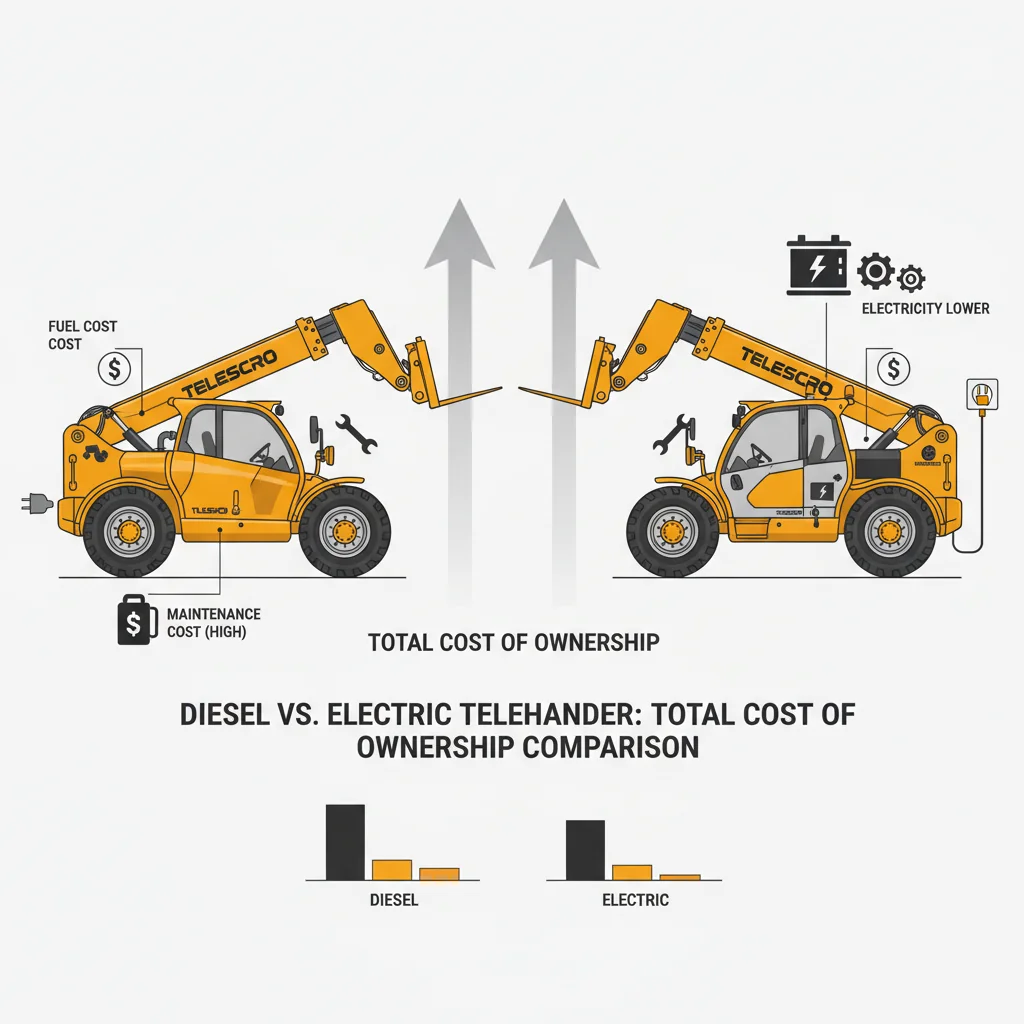
The biggest mistake I see is thinking fuel cost is the only factor. In reality, telehandler TCO stretches way beyond how much you spend at the pump or plug. For example, in Dubai last year, I helped a rental fleet compare numbers on a 75 kW diesel model versus a similar-rated electric machine. Both logged around 1,200 hours annually. Diesel burned about 6 liters per hour at $1.20 per liter—that’s $8,600 just for fuel each year. The electric machine, running at 15 kWh per hour and $0.12 per kWh, used about $2,200 of electricity for the same work.
But that’s not the whole story. Electric units save on oil, filters, and diesel particulate filter (DPF) cleaning—maintenance headaches that add up fast. In China, one customer told me they cut annual maintenance by nearly 40% after switching half their high-use fleet to electric. No more surprise injector work or downtime from dirty fuel systems. However, I always remind clients about the battery—a replacement lithium pack can cost 20–30% of the machine price after 8-10 years or 3,000–4,000 cycles.
From my experience, low-hour sites, like small builders in Kenya running only 400 hours per year, usually get more value sticking with diesel. The fuel and service savings from electric just don’t offset the initial cost. That’s why I always suggest modeling your actual use hours and local energy prices before deciding. If your jobsite can guarantee stable, cheap electricity and high utilization, electric starts to make real sense. Small fleets or changing sites? Diesel’s still hard to beat.
Electric telehandlers typically have much lower maintenance requirements for their drivetrains compared to diesel models, due to having fewer moving parts and the absence of engine oil and filter changes.True
Electric drivetrains lack internal combustion components like pistons, injectors, and exhaust systems, resulting in less routine maintenance and fewer wear items over the machine's lifespan.
Diesel telehandlers can always outlift electric telehandlers of the same rated capacity because diesel engines inherently provide more hydraulic power.False
Rated lifting capacity is determined by machine design, not only the power source. Modern electric telehandlers often match diesel counterparts in lifting ability by using high-capacity batteries and efficient electric motors, allowing similar hydraulic performance within the same class.
Key takeaway: Electric telehandlers can dramatically lower energy and maintenance costs, outperforming diesel in high-use, stable-power scenarios. However, higher initial investments and battery replacement costs mean diesel often prevails for low-hour fleets. Modeling annual hours and local energy costs is crucial for accurate TCO comparison.
How Do Safety Rules Impact Telehandler Power Choice?
Safety regulations and site compliance strongly affect telehandler power source selection. Diesel models, even with emissions controls, face strict indoor and urban limits due to CO₂, NOx, and particulates. Electric and hydrogen telehandlers often gain entry in low-emission zones, but require specialized charging, storage, and operator training to meet evolving safety standards.
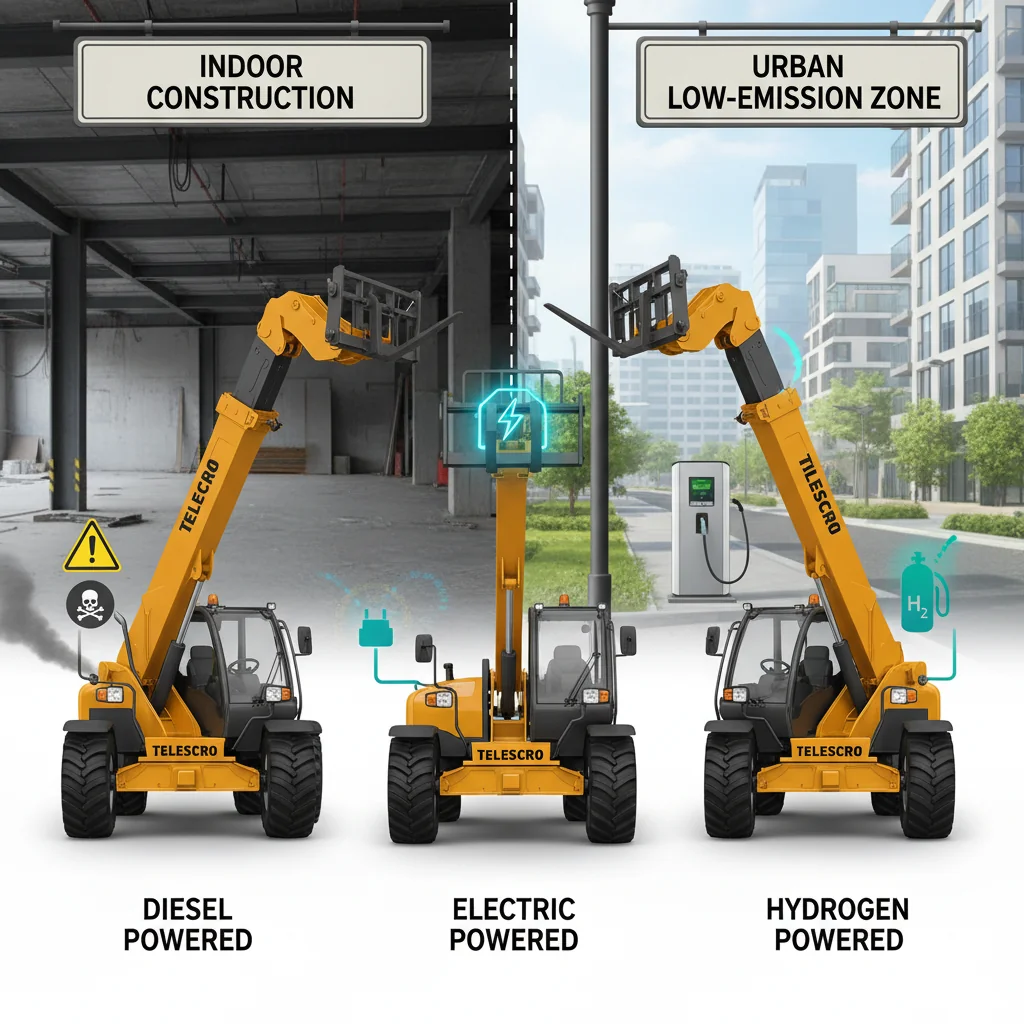
Last month, a contractor in Dubai asked why their brand-new diesel telehandler wasn’t allowed inside a logistics warehouse. The truth is, even modern diesel units with Stage V emissions controls still emit CO₂ and particulates. Indoors or in enclosed settings, that means limited runtime or needing extra ventilation systems—sometimes costing thousands of dollars. On urban jobs, I’ve seen sites only permit electric telehandlers, especially in Europe where clean air rules are tightening every year.
But swapping to electric or hydrogen-powered units brings its own set of challenges. In a food processing plant I worked with in Belgium, the site manager had to retrofit special charging bays and enforce new battery handling protocols11. Lithium batteries in particular can’t be charged in unventilated corners—thermal runaway risk is real. Operators needed extra training, not just basic certification, but specific procedures for battery tech and emergency response. These updates added at least a week to project startup, but skipping them would have put the entire operation out of compliance with both local and CE safety standards.
The reality is, safety and legal compliance force you to think ahead. I’ve seen site access denied for older diesel machines—even ones with only a few thousand hours—just because they didn’t meet the city’s latest emission zone requirements. Hydrogen-powered telehandlers, while promising, mean learning to handle high-pressure fuel systems and following strict gas storage rules. My advice? Always check local regulations for today and the next five years before picking a powertrain. The last thing you want is a machine that gets banned before it’s paid off.
Electric telehandlers are increasingly selected for indoor or urban jobs due to their zero local emissions and compliance with strict air quality regulations.True
This is true because electric telehandlers eliminate exhaust emissions at the point of use, making them suitable for enclosed or regulated environments where diesel or gas fumes are restricted by law or site policy.
Modern diesel telehandlers equipped with Stage V emissions controls are permitted to operate in enclosed warehouses without any additional ventilation requirements.False
This is false because even with advanced emissions controls, diesel telehandlers still produce gases and particulates that can accumulate indoors, necessitating costly ventilation systems or even outright bans, depending on site safety policies.
Key takeaway: Choosing the right telehandler powertrain requires balancing emissions laws, site access rules, and equipment safety. Buyers must monitor current and future regulations, as some cities will restrict non-electric or older diesel models. Always implement correct handling and training for batteries and alternative fuels to maintain compliance.
How Does Maintenance Vary by Power Source?
Diesel telehandlers require scheduled engine servicing every 250–500 hours, including oil, filter, and coolant checks, plus attention to emissions systems12 in modern models. In contrast, electric telehandlers focus on battery care13 and power electronics, allowing longer intervals and up to 30% less planned maintenance, provided charging logistics suit operational needs.
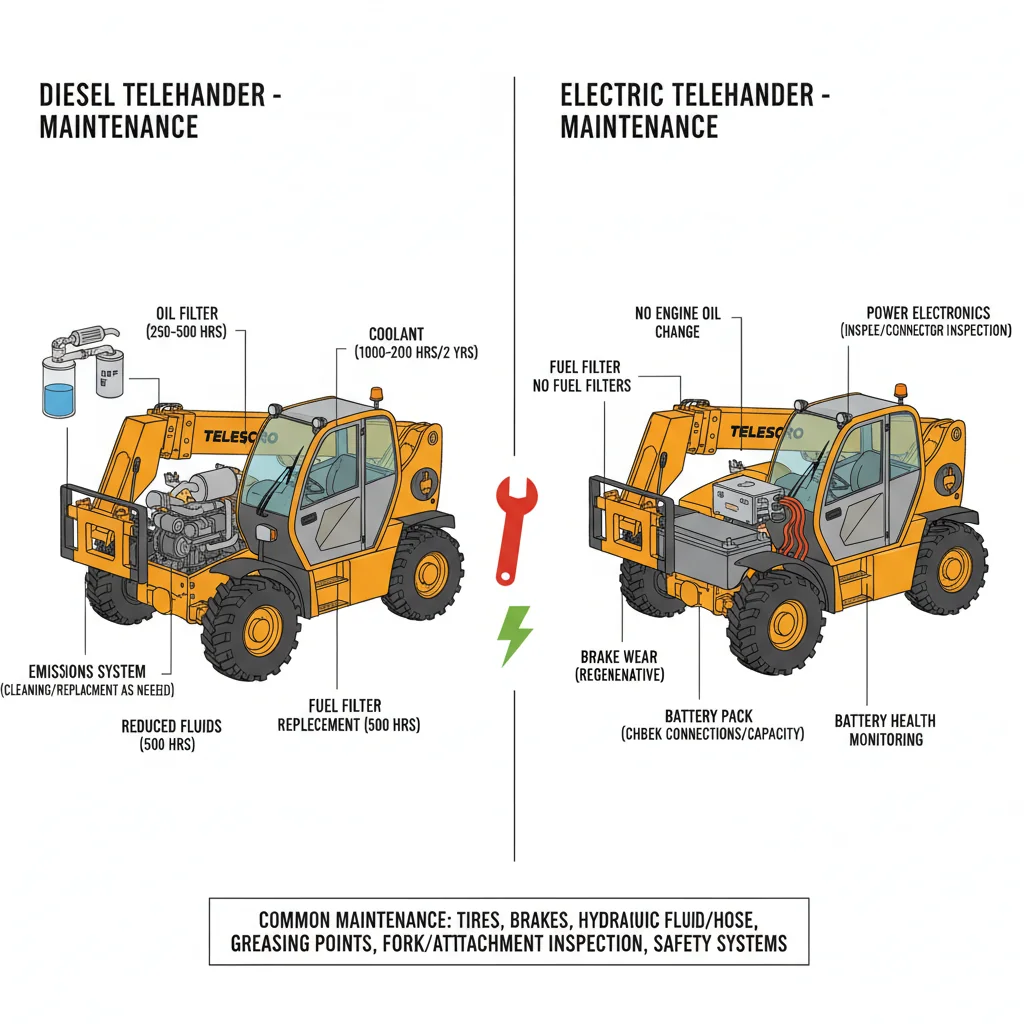
Here’s what matters most when you compare maintenance for diesel and electric telehandlers: the differences go far beyond just oil changes or charge times. Diesel models still dominate jobsites in places like South Africa and Kazakhstan for a reason, but they demand steady attention—engine oil checks every 500 hours, fuel and air filters replaced at precise intervals, regular coolant inspections, and, on the latest models, looking after emissions systems like DPF and DEF fluid. In dusty or remote sites, I’ve seen poor quality diesel destroy injectors within a single season. That kind of damage isn’t just inconvenient—it means lost days and thousands in extra costs, not to mention the scheduling headaches when your main lifting machine is sidelined for repairs. With electric telehandlers, planned maintenance is much simpler but comes with a different workload. Most customers I’ve supported in Qatar or Singapore quickly appreciate having fewer tasks—no more oil changes, and no fuel filter drama. Instead, battery care becomes the headline. You need operators to avoid deep battery discharges and to keep the state-of-charge between 20% and 90% for longer battery life. Cooling fans and connectors have to stay clean, and it really pays to log the charge cycles, especially if you’re running multiple shifts. The main mechanical wear points—like boom slides or hydraulic fluid checks—stay about the same as on diesel models, but you’ll need these checks less often because the electric driveline has fewer moving parts.
Electric telehandlers require substantially less maintenance than diesel models because they lack internal combustion engines, eliminating the need for oil changes, fuel filter replacements, and exhaust aftertreatment system servicing.True
Electric telehandlers do not have engine oil, fuel, or emissions control systems, so these frequent diesel service tasks are not needed, reducing complexity and regular maintenance demands.
All telehandlers, regardless of power source, require identical daily coolant inspections due to their similar cooling system designs.False
Electric telehandlers often use simpler or different cooling systems, such as those dedicated only to battery temperature management, and may not require daily checks like diesel engines, which experience greater heat and have more stringent cooling needs.
Key takeaway: Maintenance needs differ significantly by telehandler power source. Diesel models demand regular engine and emissions servicing, driving higher labor and downtime. Electric units minimize planned maintenance, centering on battery management and electronic inspections. For remote or workshop-limited fleets, simplified electric maintenance offers a compelling operational advantage if charging is practical.
How Can Fleets Future‑Proof Telehandler Power?
Fleets can future‑proof telehandler power by collecting equipment usage data—such as engine hours, idle ratios, load profiles, and operational environments—through telematics14 or hour meters. This informs decisions on adopting electric vs. diesel units and highlights the value of modular battery packs15, retrofit options, and a mixed power strategy for evolving regulatory and jobsite needs.
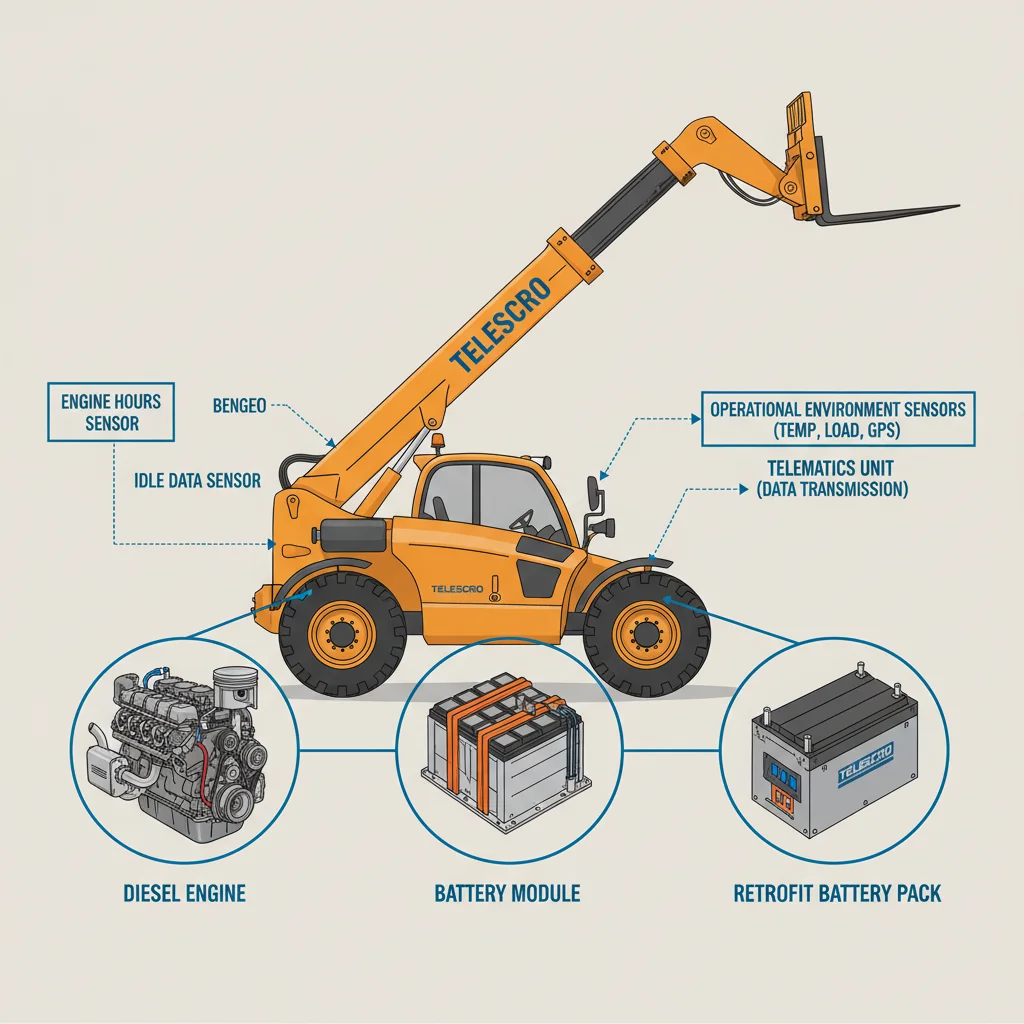
Last year, a rental fleet manager in Kazakhstan asked me how to plan for the next five years—should he go all-in on electric units, or keep buying diesel? I told him, future‑proofing starts with knowing how each telehandler is really used. Telematics or even just tracking hour meter readings can reveal patterns: some machines rack up high engine hours moving material inside warehouses, others sit for long stretches at dusty, remote energy sites. The real trick? Looking beyond total hours and checking idle ratios, average lifts, and even how often boom extension is needed. That’s the insight that separates smart buyers.
I’ve seen fleets in Brazil and Dubai use this approach. After analyzing data for three months, one contractor realized their five compact, 3.5-ton units spent 70% of time indoors on short, repetitive moves under 8 meters. Those became perfect candidates for switching to electric telehandlers with modular battery packs—saving on diesel and avoiding future city restrictions. But their 4-ton, 17‑meter reach units? Still used outdoors in rough, remote conditions, so those stayed diesel, Stage V compliant.
Here’s what I suggest: when buying new, ask if you can start with a 50 or 75 kWh battery and upgrade later. Some models offer swap‑and‑go battery packs or support both on-board and external fast charging—very helpful if your grid power is inconsistent. For big mixed fleets or rental companies, offering both electric and diesel machines in the same lift class keeps you flexible as local laws shift. Check your real duty cycles first. The numbers will always tell you where to invest next.
Some newer telehandlers are designed to run on both diesel and electric power, allowing fleets to adapt to different jobsite requirements without replacing the entire machine.True
Hybrid or dual-power telehandlers can switch between diesel and electric operation. This flexibility helps fleets future-proof their investments by providing compliance with emission regulations in urban areas, while retaining functionality for remote or long-duration applications.
Telehandlers powered exclusively by propane are now the most common choice for large-scale construction fleets aiming to future-proof their operations.False
While propane-powered telehandlers exist, they are much less common than diesel or electric units, especially in large-scale construction. Diesel remains the dominant power source, with electric models gaining ground for indoor or emission-sensitive jobs.
Key takeaway: Using detailed operational data allows fleets to strategically add electric telehandlers for indoor and regulated zones while maintaining diesel units for heavy, remote tasks. Modular battery options and a mix of power sources ensure compliance, flexibility, and lower operational risk as emissions standards evolve.
Conclusion
We’ve discussed the main power sources for telehandlers and how they impact daily use—especially when it comes to diesel models for tough outdoor jobs. From what I’ve seen, buyers who think beyond the purchase price and check things like local emissions rules and real-world fuel access avoid headaches down the line. Before you decide, I suggest confirming parts availability in your region—unplanned downtime turns a “showroom hero” into a jobsite zero quickly. If you have questions about which power type matches your site or how emissions will affect your next project, just reach out—I’m always happy to share what’s worked (or not) for real crews. Every jobsite is different, so let’s find what fits your workflow best.
References
-
Explore technical insights on diesel telehandlers’ power, torque, runtime, and versatility in heavy-duty construction applications. ↩
-
Learn about the latest emissions controls and regulations affecting diesel telehandlers, vital for compliance and performance. ↩
-
Explore expert insights on how emissions controls impact telehandler usage, costs, and compliance in indoor and urban environments. ↩
-
Explains fast charging, minimal maintenance, and high uptime benefits of LFP lithium-ion batteries suited for intensive telehandler use. ↩
-
Detailed insights into cost, maintenance, and cycle life of flooded lead-acid batteries help choose the best option for light-duty telehandlers. ↩
-
Understand the advantages of dual-fuel telehandlers combining LPG and gasoline for flexibility on remote sites with unpredictable fuel supply. ↩
-
Understand the logistical, safety, and availability challenges of hydrogen supply affecting the adoption of fuel cell telehandlers worldwide. ↩
-
Get detailed insights on lithium battery performance, charging constraints, and suitability for varying telehandler workload intensities. ↩
-
Comprehensive insights into TCO drivers, including fuel, maintenance, and battery costs, helping fleet managers optimize expenses. ↩
-
Detailed explanation of lithium battery replacement expenses and lifespan, crucial for evaluating electric telehandler investments. ↩
-
Learn detailed procedures and safety measures for lithium battery management in electric telehandlers to prevent thermal runaway risks. ↩
-
Detailed insights into maintaining diesel telehandler emissions systems like DPF and DEF fluids to ensure compliance and avoid costly repairs. ↩
-
Explore expert tips on extending electric telehandler battery life and avoiding deep discharges to minimize downtime and maintenance costs. ↩
-
Explores how telematics data drives smarter telehandler choices by analyzing usage, idle ratios, and operational environments to optimize fleet power. ↩
-
Details advantages of modular battery packs for electric telehandlers, including flexibility, retrofit options, and compliance with evolving jobsite needs. ↩