










Episode Summary
Key Takeaways
Published lift height and rated capacity are often measured under ideal conditions. On a real job site, usable height with load is always lower — always allow margin when selecting.
Capacity at full reach is the number most buyers miss. Maximum capacity only applies when the boom is fully retracted. The moment you extend forward or lift at height, that number drops significantly.
Rigid, rotating, and compact telehandlers serve different site conditions. If you can freely reposition the machine, a rigid model is usually enough. Rotating suits confined access with complex placement needs. Compact fits tight or semi-indoor environments.
Attachments must be decided at the same time as the base machine. Hydraulic flow, mounting options, and control functions are fixed once the machine is configured — deciding later leaves very few options.
Choosing the largest machine as a precaution is a common and costly mistake. Larger machines cost more to buy, transport, and maintain — and on confined sites, they can reduce efficiency rather than improve it.
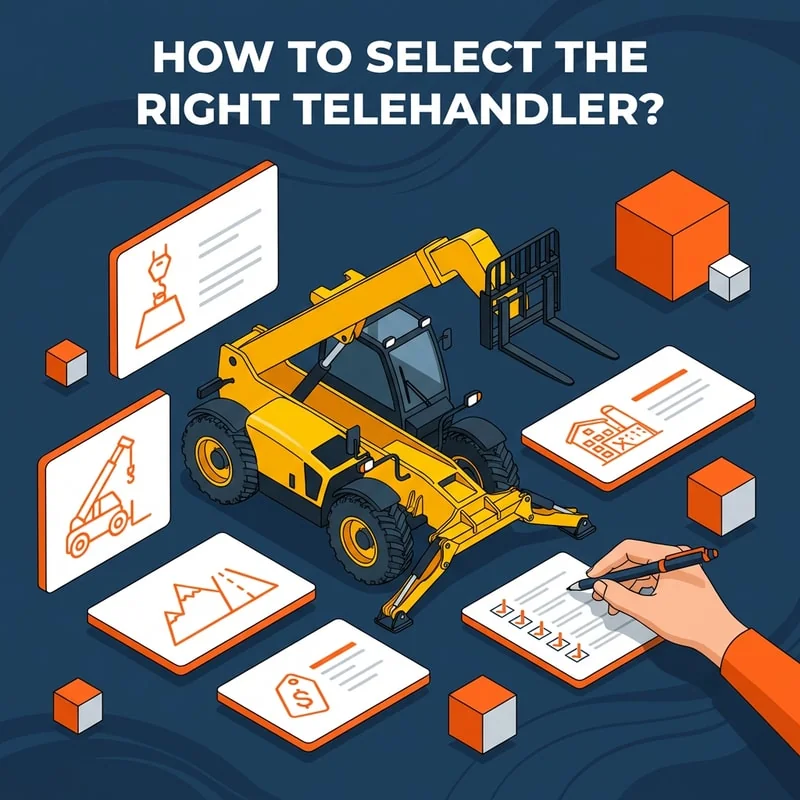
Before talking to any supplier, get clear on four things: your application type, the lift height you actually need at working reach, the attachments you will use, and your ground conditions and site access.
Interested in the equipment discussed in this episode?
Transcript Highlights
How to Select the Right Telehandler
Most buyers pick a telehandler based on the highest number in the brochure — lift height, rated capacity. Those numbers look impressive on paper. But they are often measured under ideal conditions, not the ones your site actually presents. That gap is where expensive mistakes happen.
Step 1: Define Your Application
Before looking at any specification, start with one question: what does this machine actually do every day? Construction sites, agriculture and farming, industrial and warehouse environments, and heavy-duty operations like ports or mines each place different demands on a machine. Your application type changes everything that follows.
Step 2: The Specs That Matter on a Real Job Site
Five specifications deserve close attention. Lift height should include a margin — the published number is measured without load. Capacity at full reach is the figure most buyers miss, as maximum capacity only applies when the boom is fully retracted. Operating weight affects stability at height and on uneven ground. Hydraulic flow determines how attachments perform in daily use. And emission compliance must be confirmed early, as missing this step can delay an order after it has already been placed.
Step 3: Rigid, Rotating, or Compact?
Rigid telehandlers are the most common choice and suit standard construction, agriculture, and rental fleet applications. Rotating models allow the upper structure to turn 360 degrees, which is useful when loads need to be placed around obstacles without repositioning the machine — though at higher cost and with greater operator skill required. Compact models fit tight spaces, urban construction, and semi-indoor environments. The deciding factor is usually whether the machine can be freely repositioned on your site.
Step 4: Decide on Attachments Early
Hydraulic flow, mounting options, and control functions are fixed once the telehandler is configured. If a bale clamp, jib hook, or man basket is added as an afterthought after the base machine is already specified, the options become very limited. Attachments should be decided at the same time as the base machine — not after.
Step 5: Common Mistakes to Avoid
Four mistakes come up consistently. Focusing only on maximum capacity without considering performance at extended reach. Choosing the largest machine as a precaution, which increases cost and can reduce efficiency on confined sites. Deciding on attachments too late. And assuming one configuration will work across different projects or teams with different site conditions.
The Four Questions to Answer Before Talking to Any Supplier
What is your application type? What lift height do you actually need with load at your working reach? What attachments will you use? And what are your ground conditions and site access? Bringing clear answers to these four questions protects you from being sold a machine that does not fit your work.
Want the complete engineering specifications, load charts, and operational guidelines discussed in this episode? Read the full guide or talk to our team directly.